Bone chapel, anti-Nazi martyrs’ memorial, and contemporary stained glass at the Basilica of St. Ursula, Cologne

(All photos in this article are my own, taken either by me or my husband.)

I knew very little about the virgin martyr St. Ursula before visiting the basilica dedicated to her in Cologne, Germany, last month. She’s the patron saint of the city, where, according to hagiography, she was murdered sometime in the fourth century.

There’s no historical veracity to her story, which is why her name was removed from the Catholic calendar of saints when it was revised in 1969. But her feast day is still observed by many on October 21.
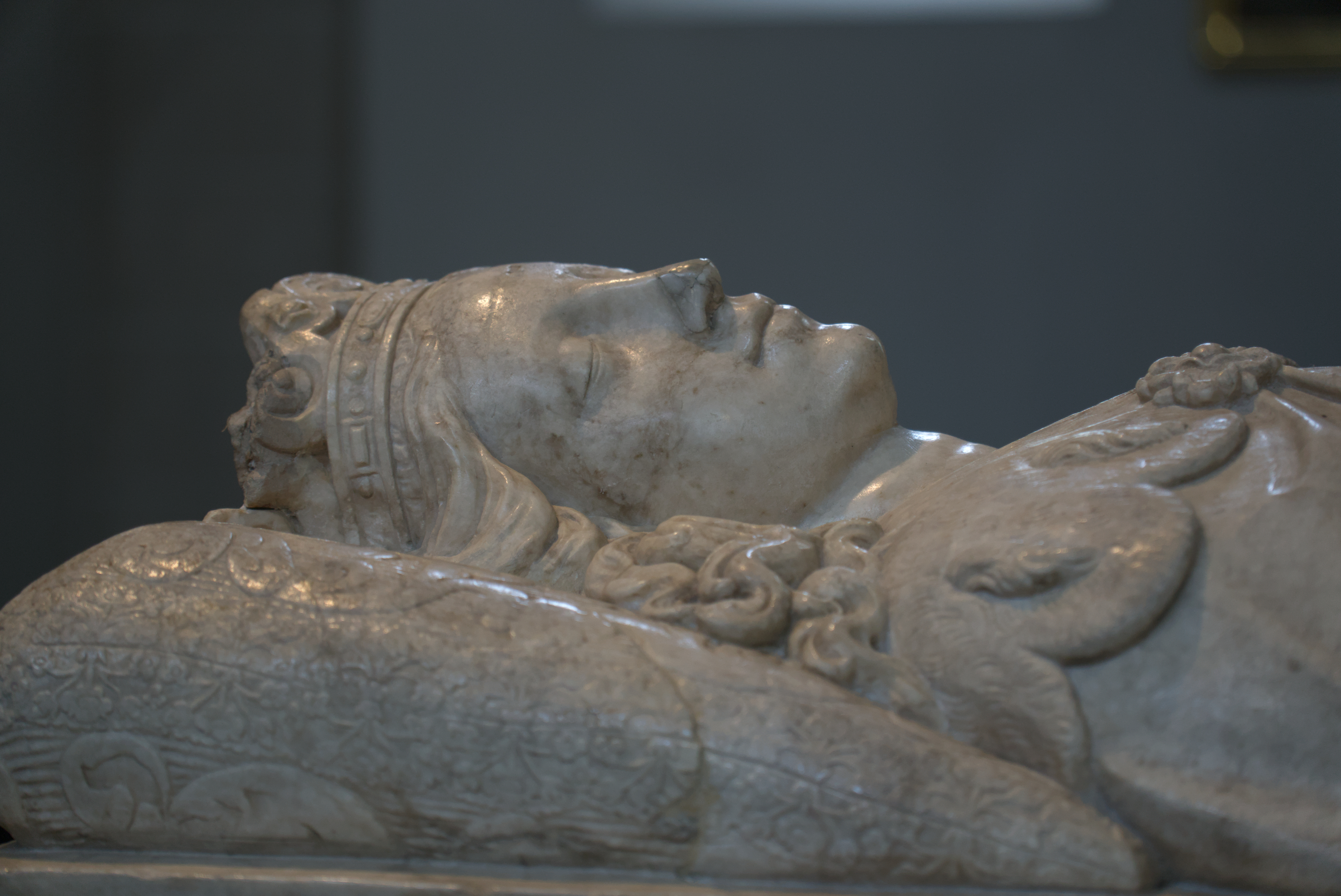
St. Ursula alabaster
Johann T.W. Lentz, St. Ursula (detail), 1659. Alabaster. North transept, Basilica of St. Ursula, Cologne. This reclining figure of the saint lies over her Baroque tomb made of black marble.

As legend has it, Ursula was a Romano-British princess and a Christian. She was engaged to be married to a pagan prince. To delay the wedding, she successfully requested that she first be allowed to take a three-year pilgrimage to Rome, and that she be accompanied by eleven thousand virgins (a ridiculous number that was likely embellished from what was originally eleven). On their voyage, she converted all eleven thousand to the faith.

On their way back to Britain from Rome, they were traveling through Cologne when it was besieged by the Huns, a group of nomadic warriors from Central Asia. Ursula and her companions refused the soldiers’ sexual advances and were slaughtered as a result. One version of the legend says the women’s souls then formed a celestial army that drove out the Huns, saving Cologne.

The earliest possible reference to Ursula and company—though they are unnamed and unnumbered—is a stone plaque dated to 400. Now incorporated into the choir wall of the present Basilica of St. Ursula, it mentions a basilica restored on this site by the Roman senator Clematius to commemorate the “martyred virgins coming from the east, in fulfillment of a vow, . . . holy virgins [who] spilled their blood in the name of Christ.” This inscription not only provides the seed of what would become the Ursula legend; it’s also the earliest evidence of Christianity in Cologne, attesting to the presence of a church there in the fourth century.

It wasn’t until the tenth century that the name Ursula emerged, identified as the leader of the group of virgins, and that their number, which had previously ranged from two to thousands, became fixed at eleven thousand. The women were never officially canonized, but their veneration as saints grew immensely in the twelfth century after a large, late antique Roman cemetery was discovered in 1106 near the aforementioned Church of the Holy Virgins in Cologne during an excavation project to expand the city’s fortifications. The skeletal remains in the hundreds of graves were purported to be those of the martyred women (notwithstanding the presence of many men’s and children’s bones among them).

The discovery of these putative relics called for the rebuilding of the predecessor church to house them. Construction began in the second quarter of the twelfth century, and it’s that structure, with later renovations, refurbishments, additions, and (post–World War II) restorations and repairs, that stands today. The church was elevated to the status of minor basilica in 1920.
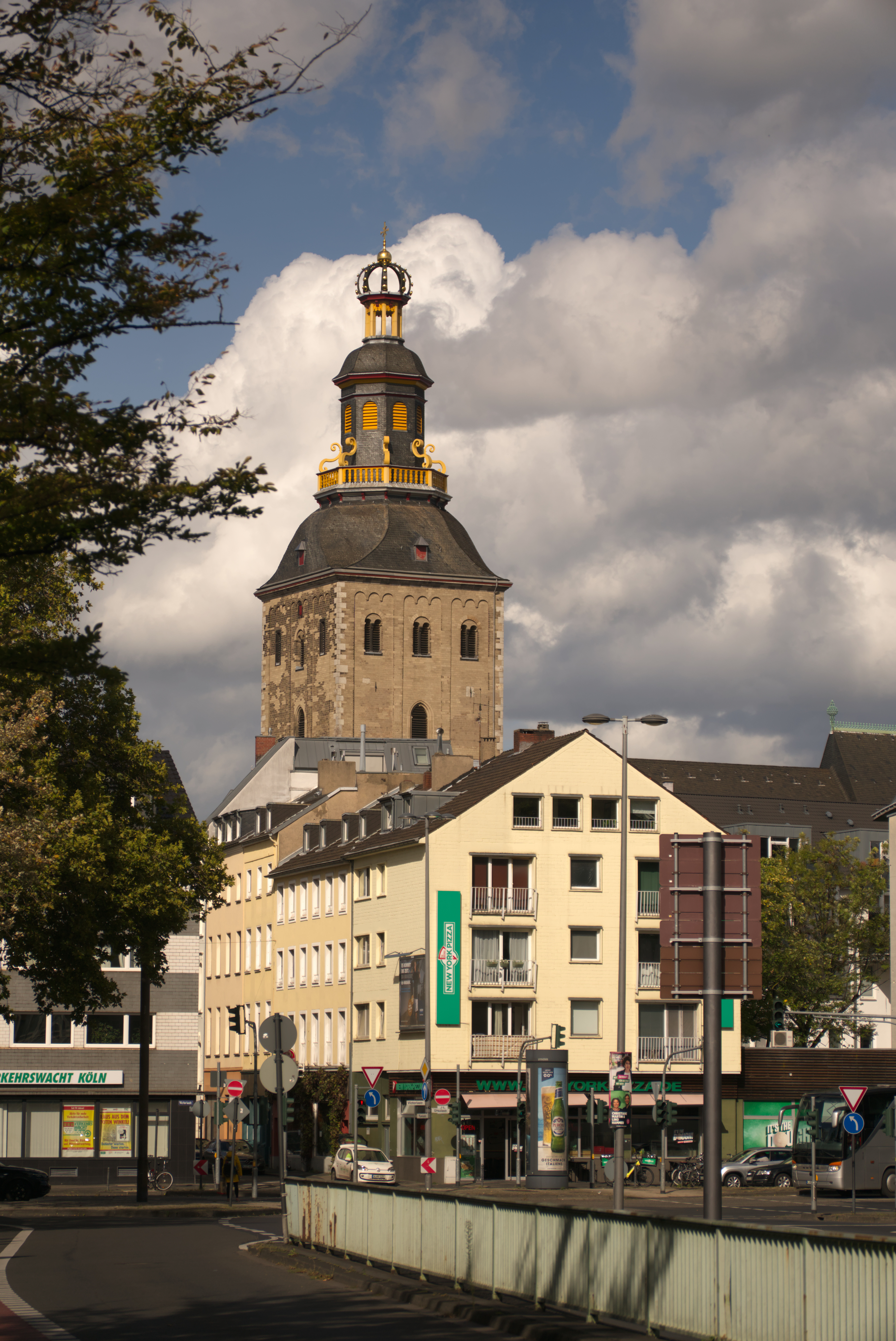
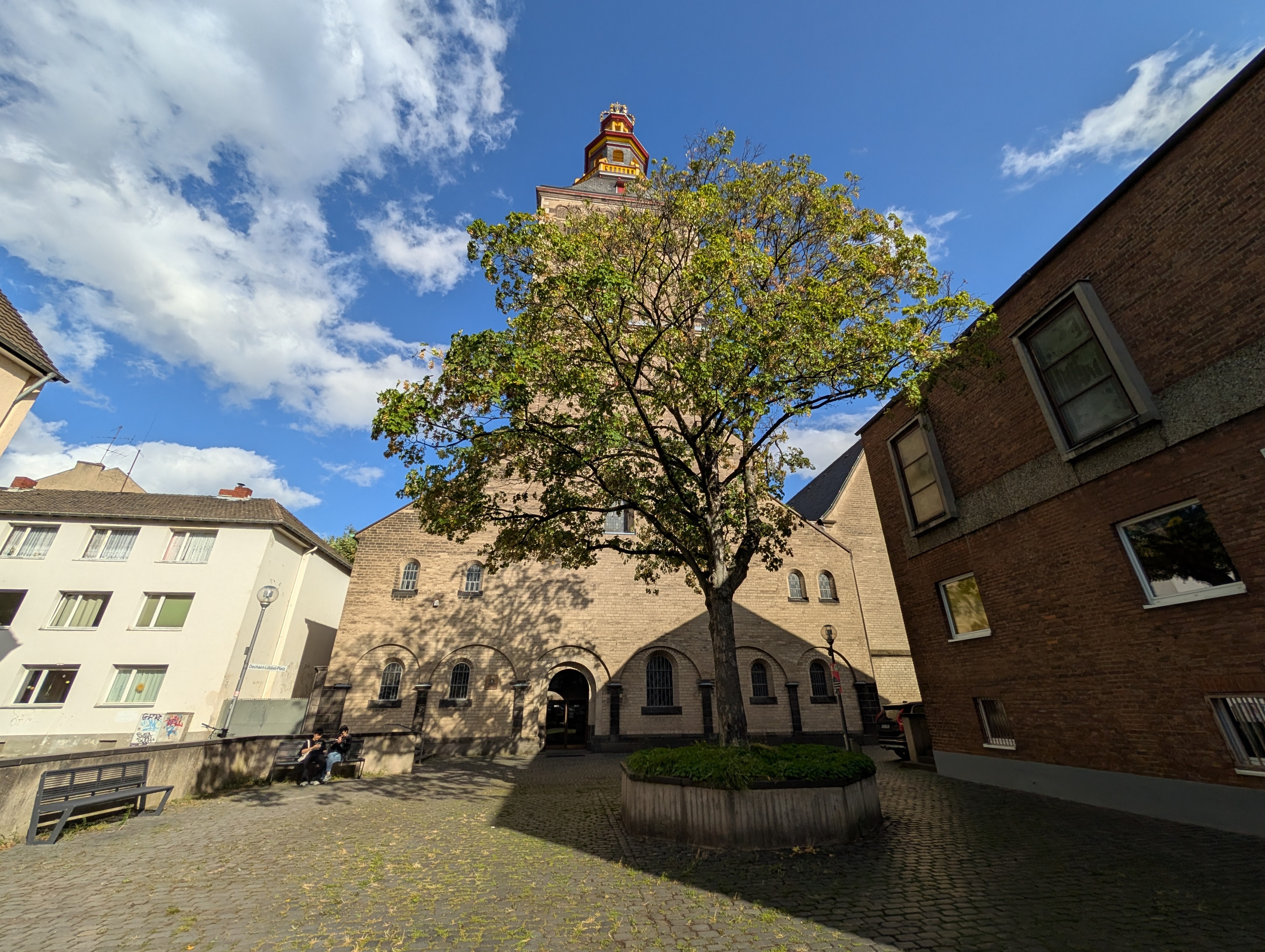
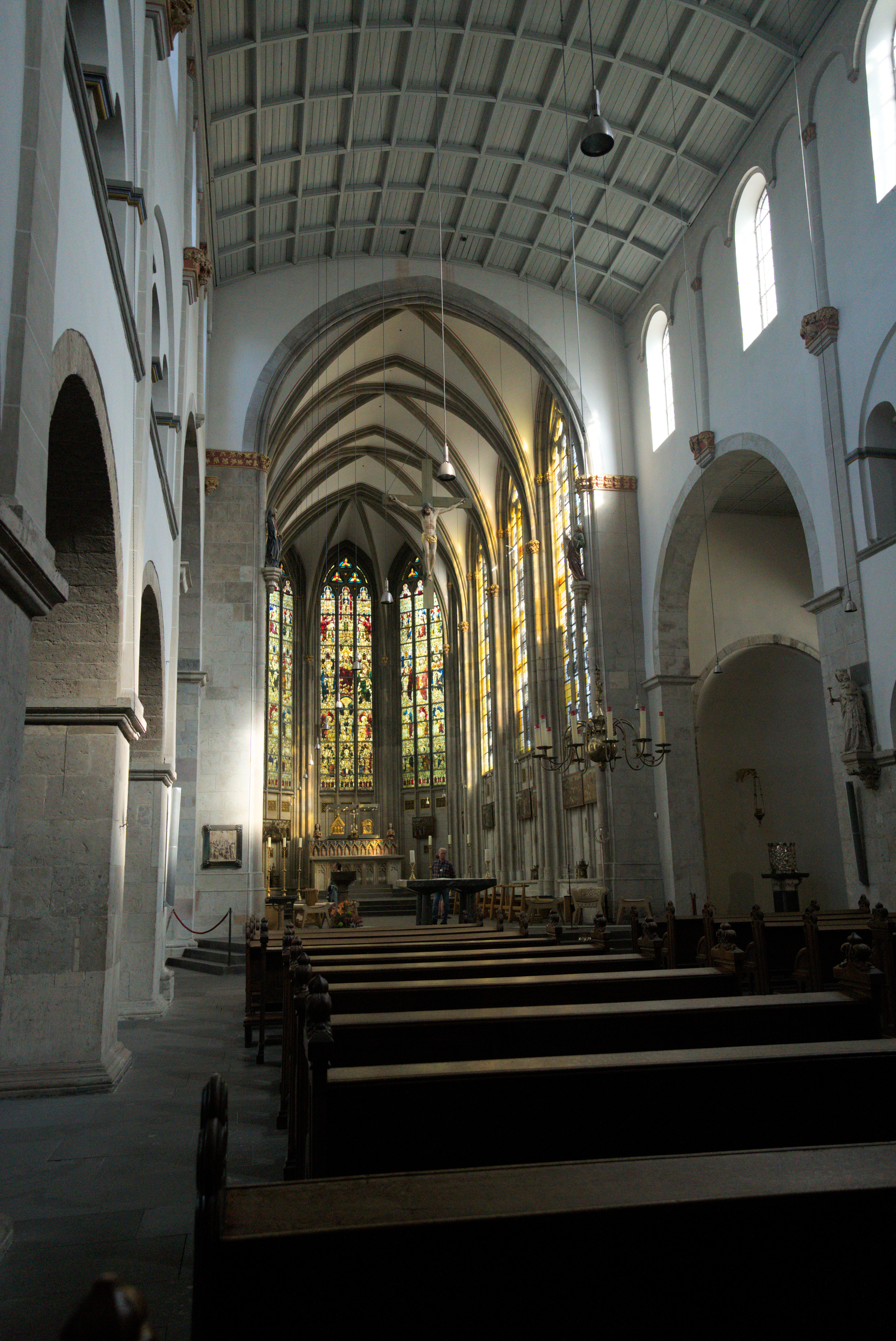
Basilica of St. Ursula, Cologne
West facade, where you enter

Basilica of St. Ursula
The nave and the main tower of the Basilica of St. Ursula are Romanesque, but the choir was rebuilt in the Gothic style.

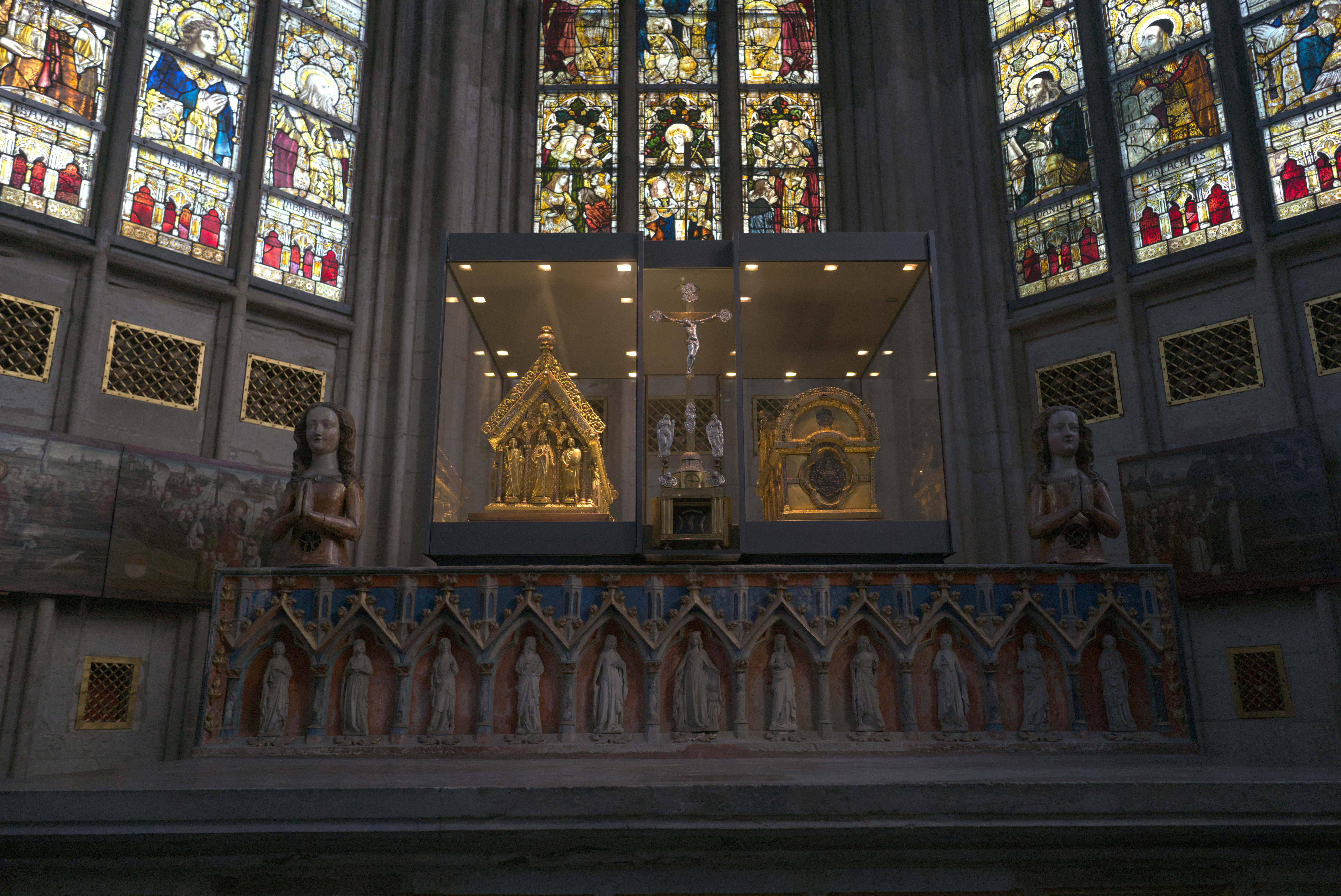
Shrine altar
Shrine altar in the choir apse, containing the relics of Ursula, Etherius, and Hippolytus. Behind it are grilled reliquary niches and paintings of the Legend of St. Ursula from from the “long cycle” of 1456.

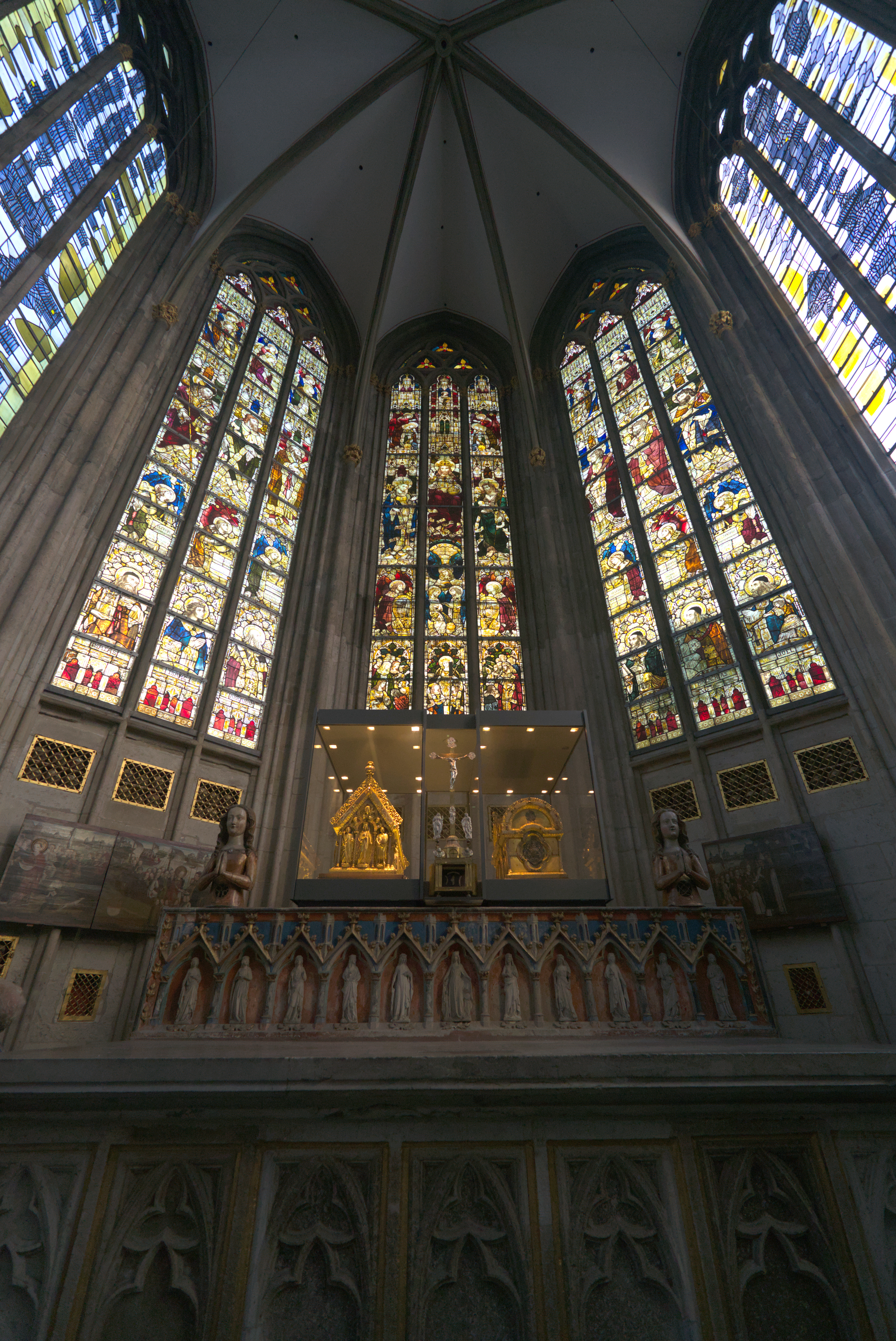
Chancel windows
Chancel windows by Francis William Dixon, 1892. Left: St. James the Greater, St. Andrew, and St. Peter, accompanied by angels; lower register: Isaiah, Isaac, and Abraham. Center: Christ enthroned, with Mary and St. John the Baptist (Deesis) at his side; lower register: St. Ursula of Cologne with her companions. Right: St. James the Lesser, St. Matthew, and St. Thomas, accompanied by angels; lower register: Daniel, Malachi, and Joel.

The reason the Basilica of St. Ursula was on my list of stops was I wanted to see its so-called Golden Chamber.

The Golden Chamber

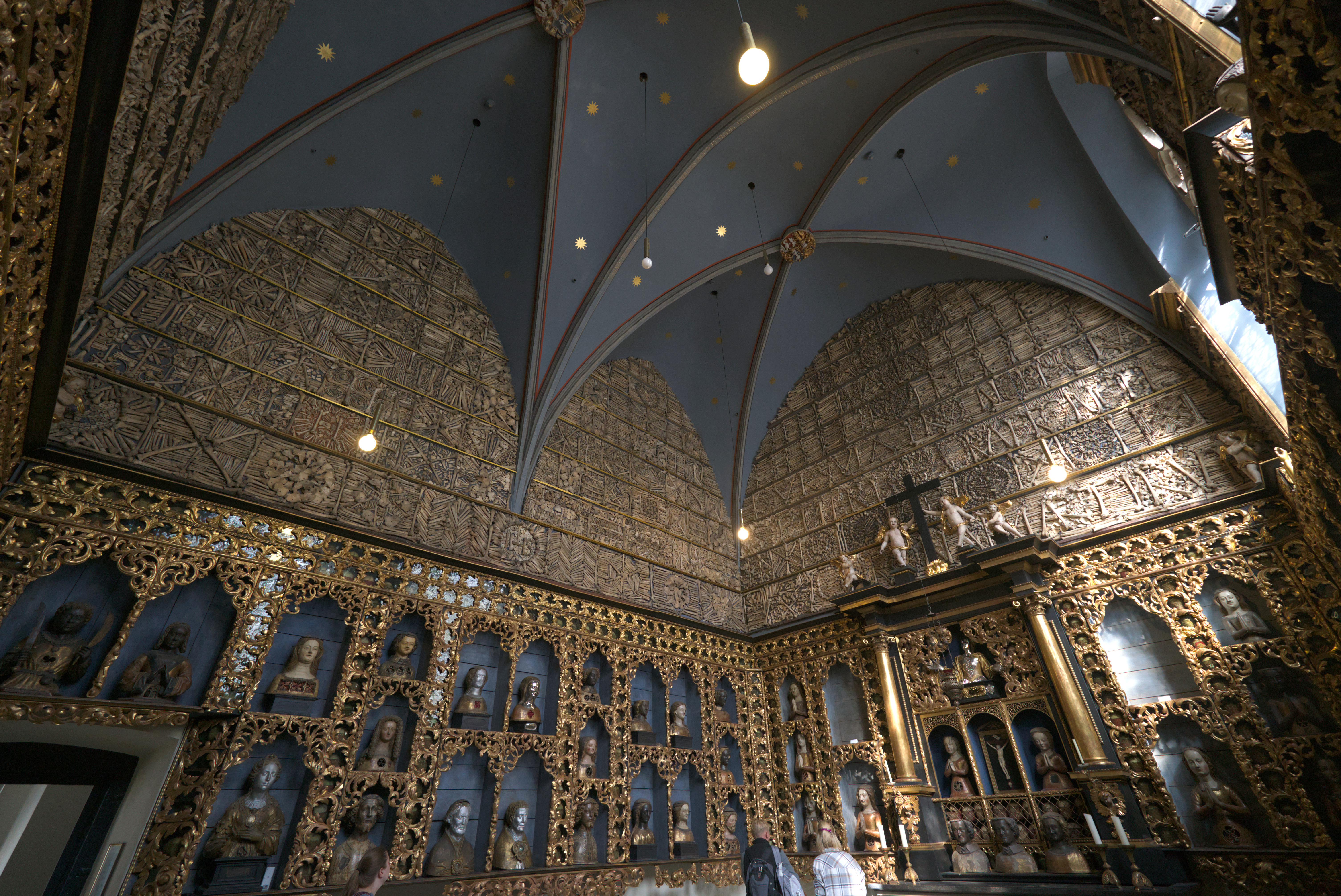
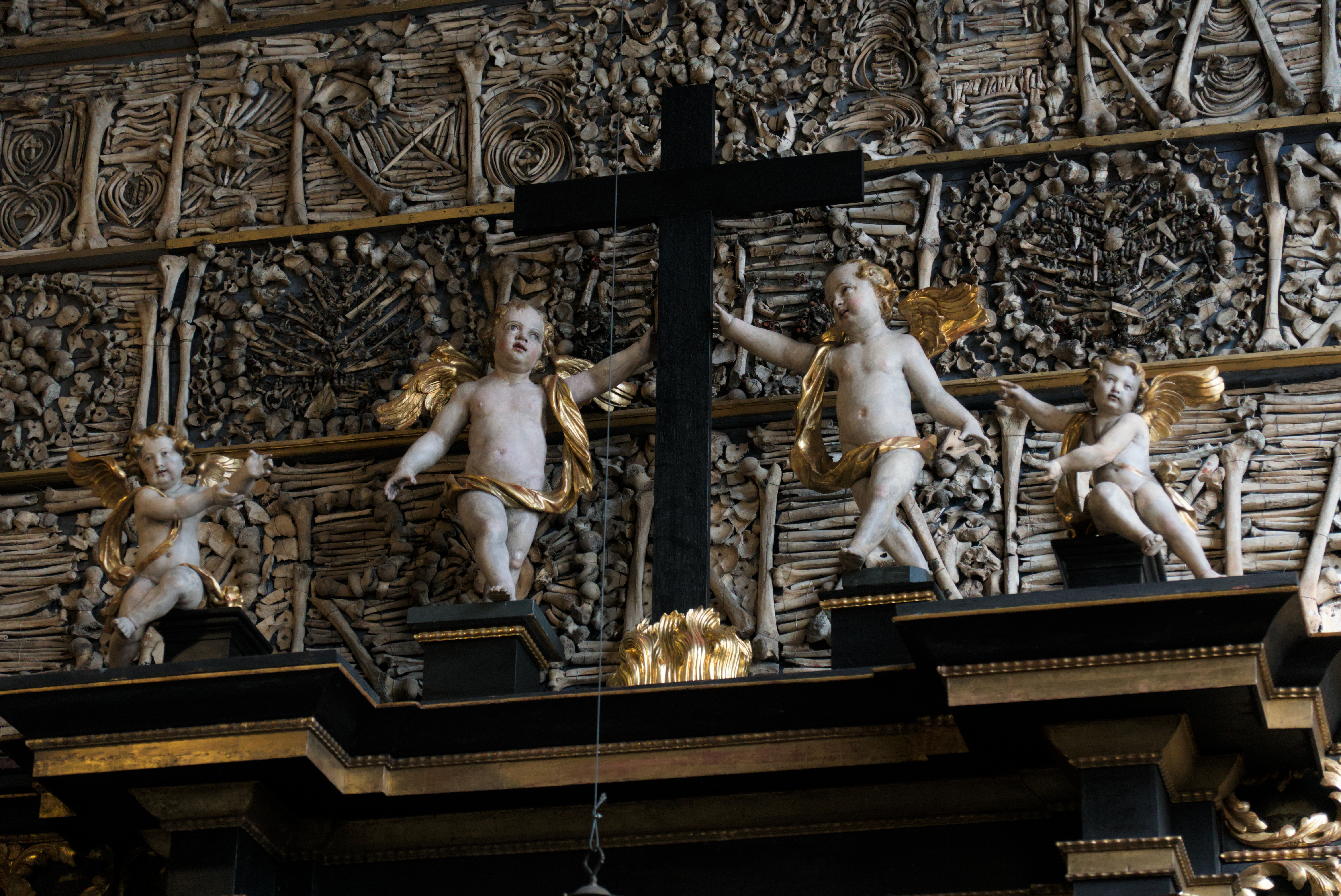
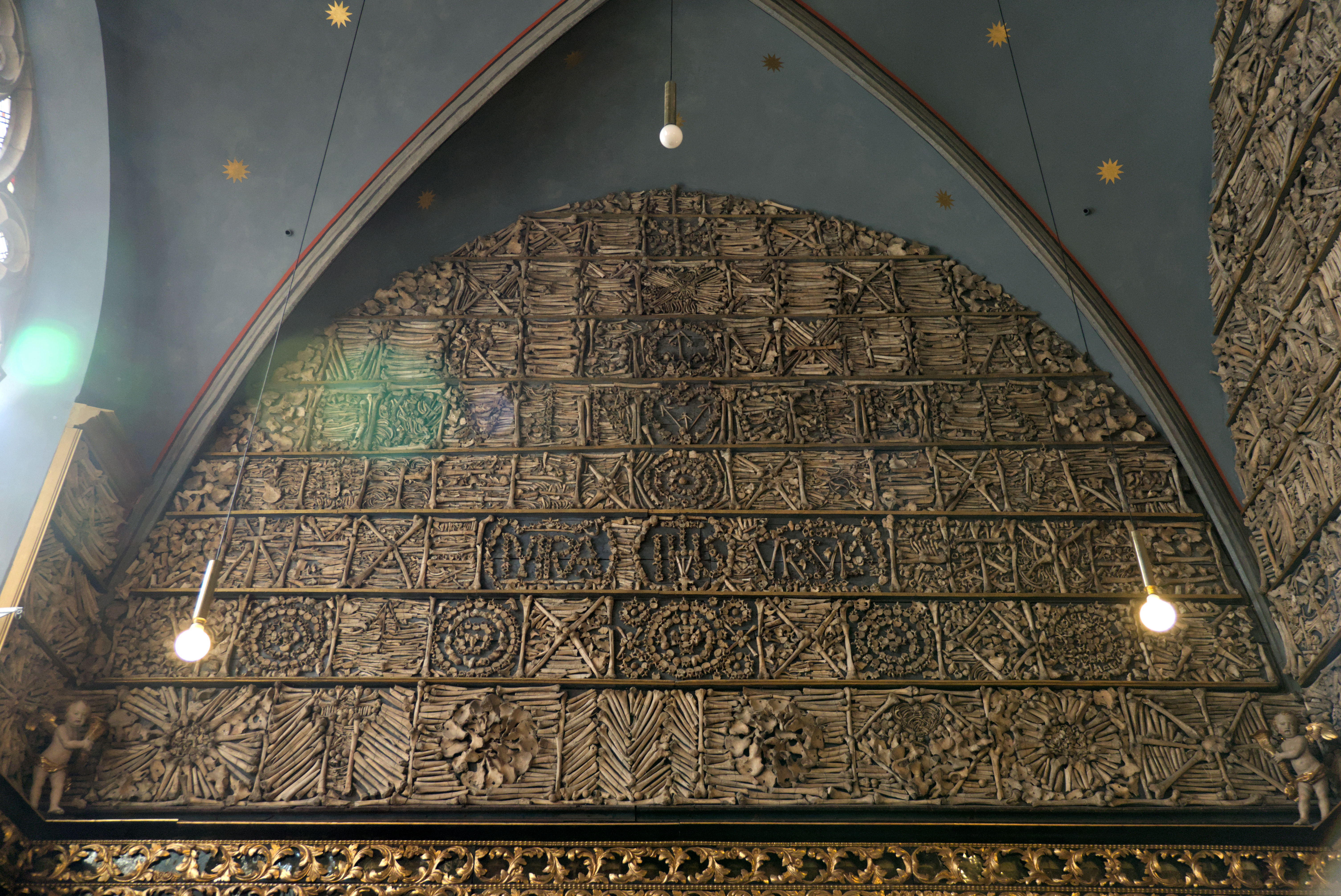
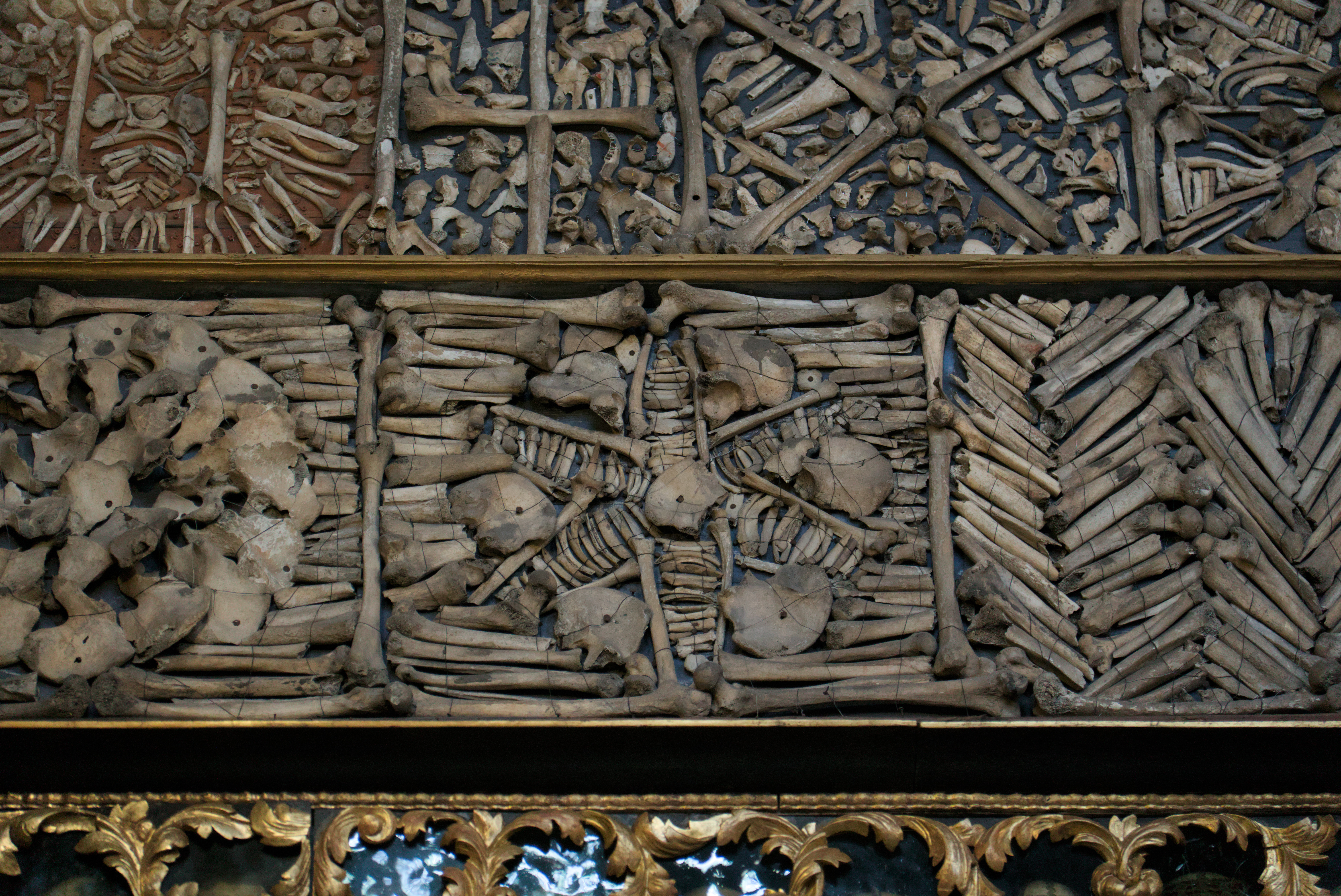
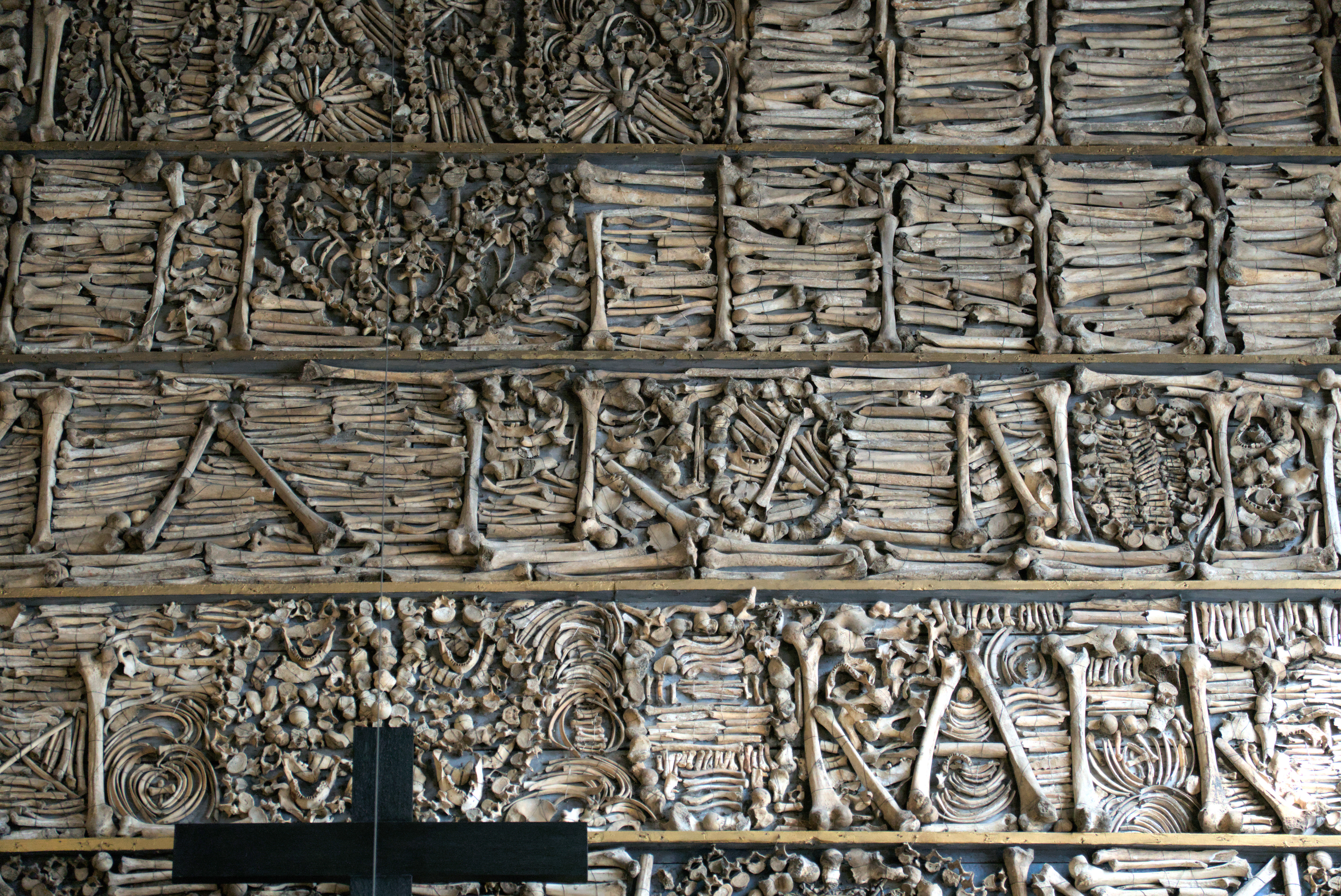
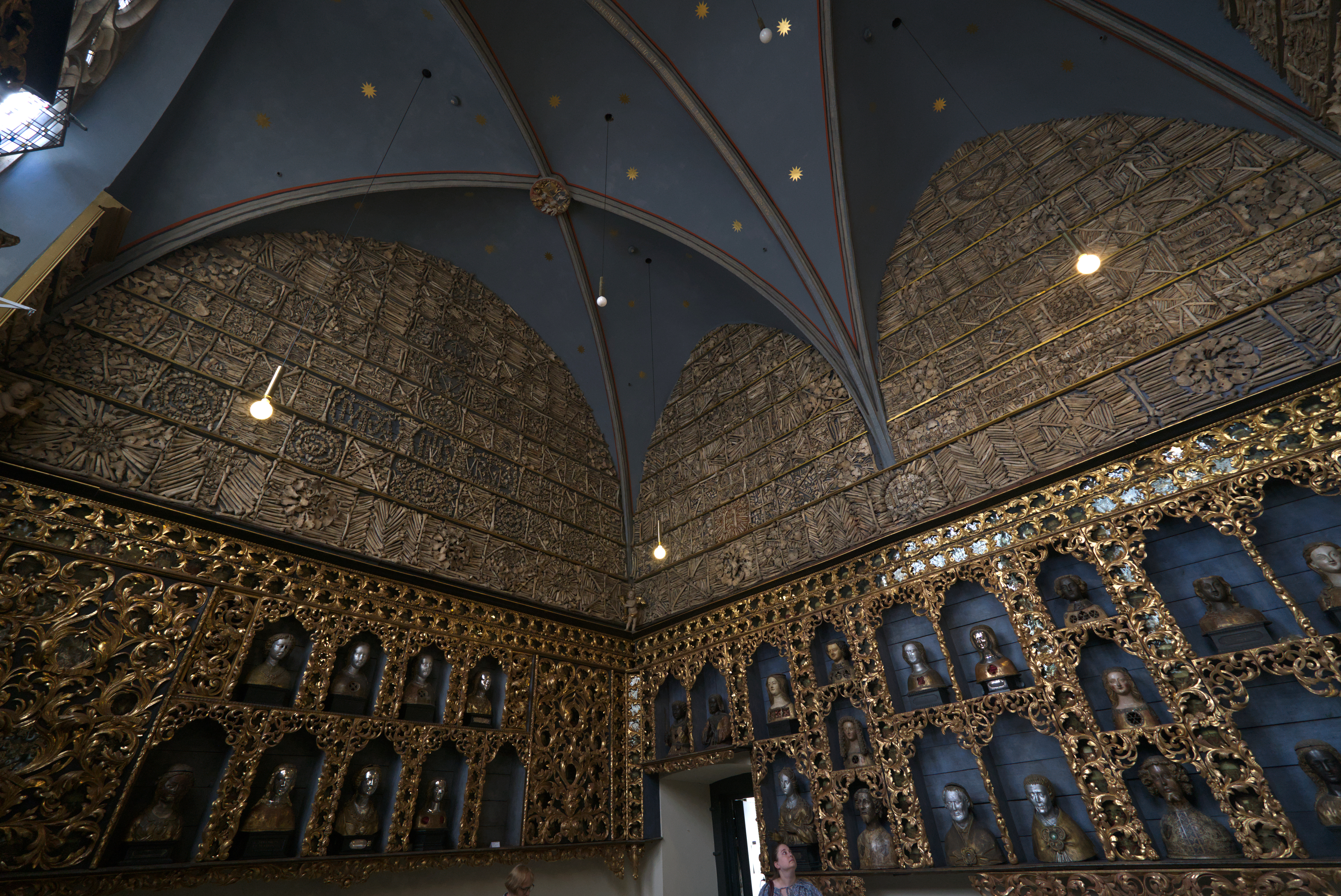
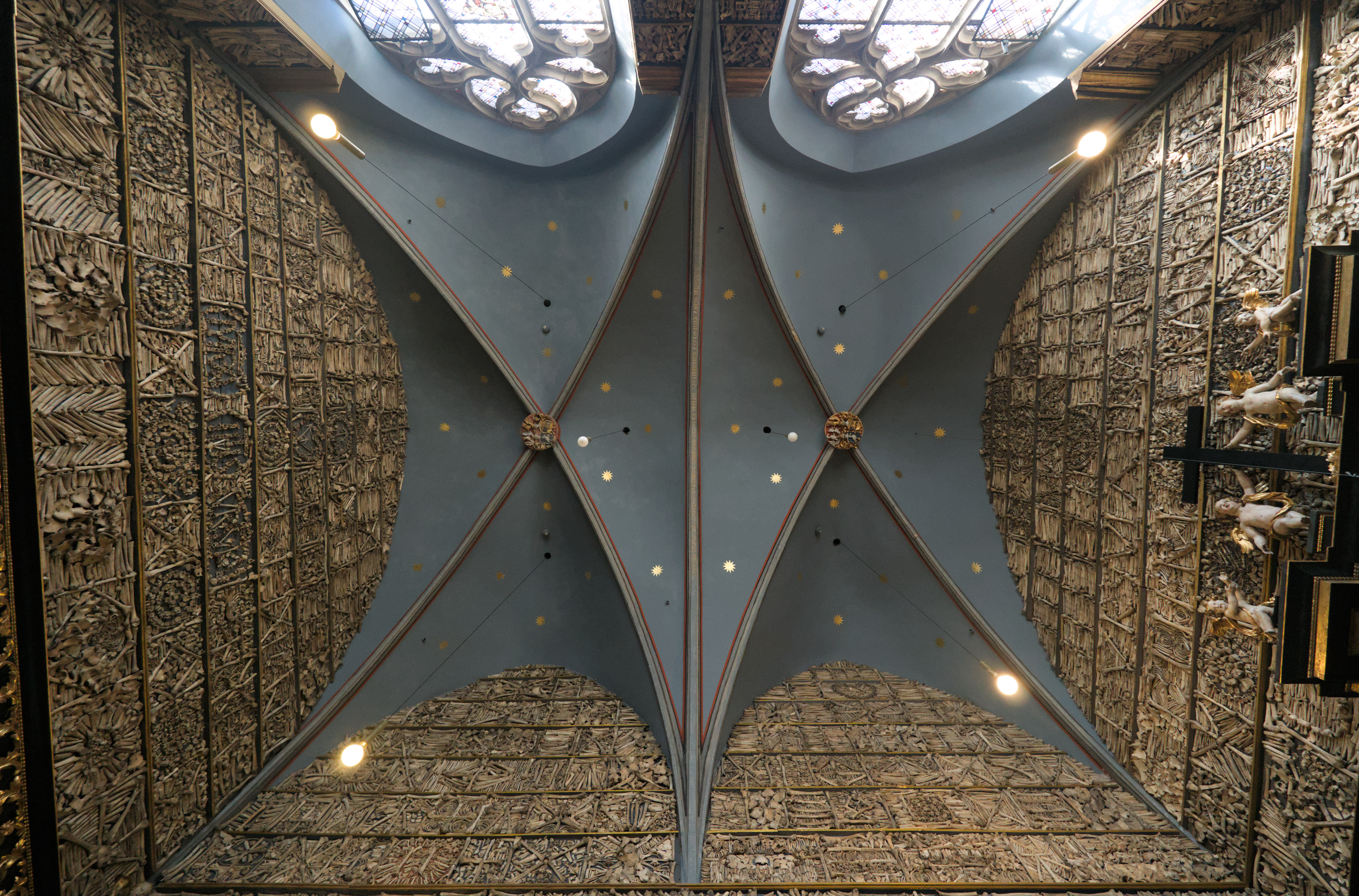
The largest ossuary north of the Alps, the Goldene Kammer (Golden Chamber) is decorated with the bones of, allegedly, St. Ursula and her eleven thousand travel mates, which are artfully arranged across the walls in geometric patterns, rosettes, and even words! Unlike most other relic displays I had seen before, where the relics are kept in some kind of encasement and usually only partially visible, this one puts many of the bones right out in the open, making the whole room a walk-in reliquary.
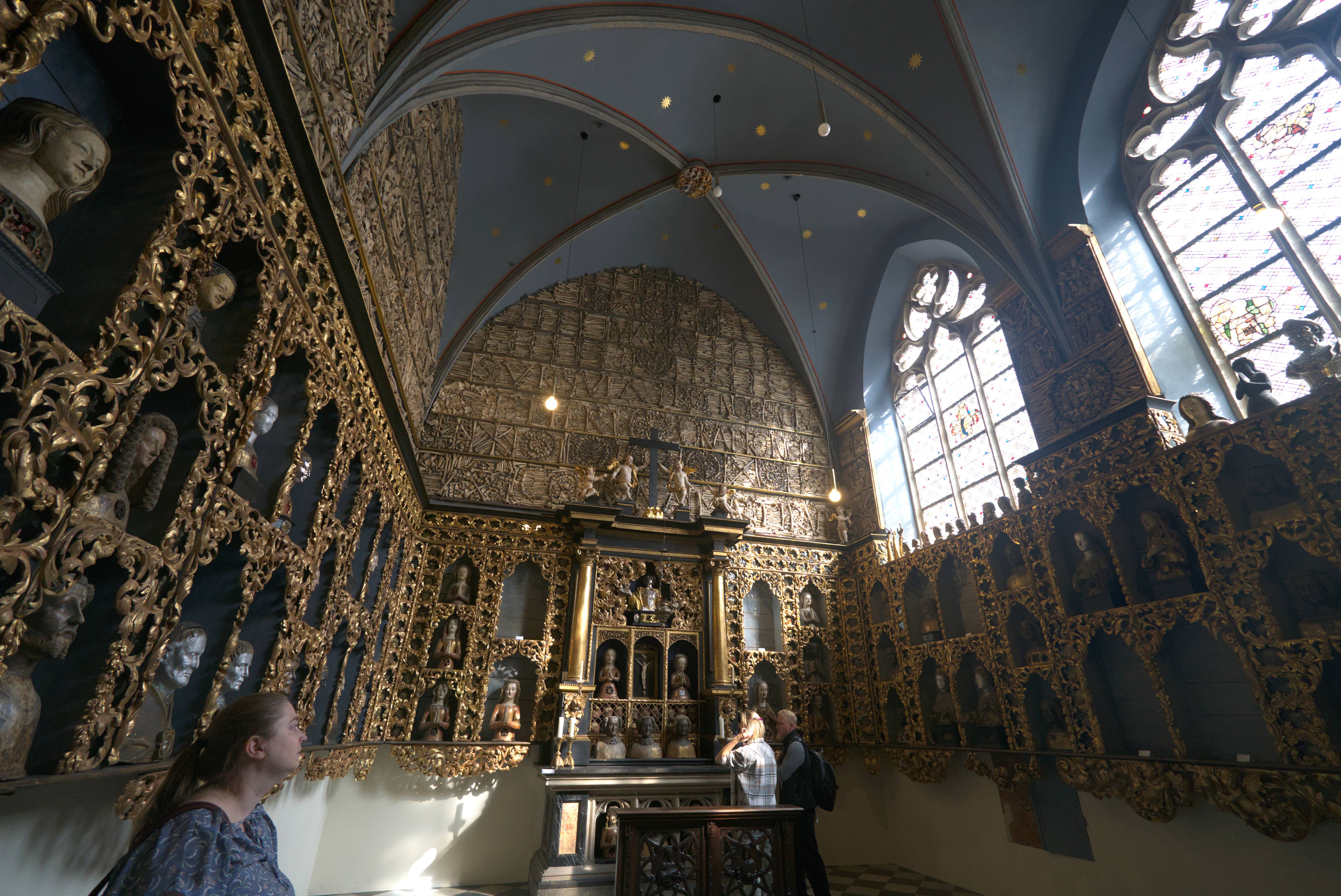
Golden Chamber
That’s me at the left, taking it in.

Golden Chamber
Golden Chamber
Golden Chamber

A Baroque marvel, the Golden Chamber was established on the south side of the church in 1643 through a donation by the imperial court councilor of the Holy Roman Empire Johann von Crane and his wife, Verena Hegemihler. It replaced a smaller medieval camera aurea (treasury and relic chamber), where the bones had previously been displayed. Crane and Hegemihler oversaw the design and construction of the space, with its ribbed, star-studded, sky-blue vault, and the arrangement of the bones into their present form.
Golden Chamber

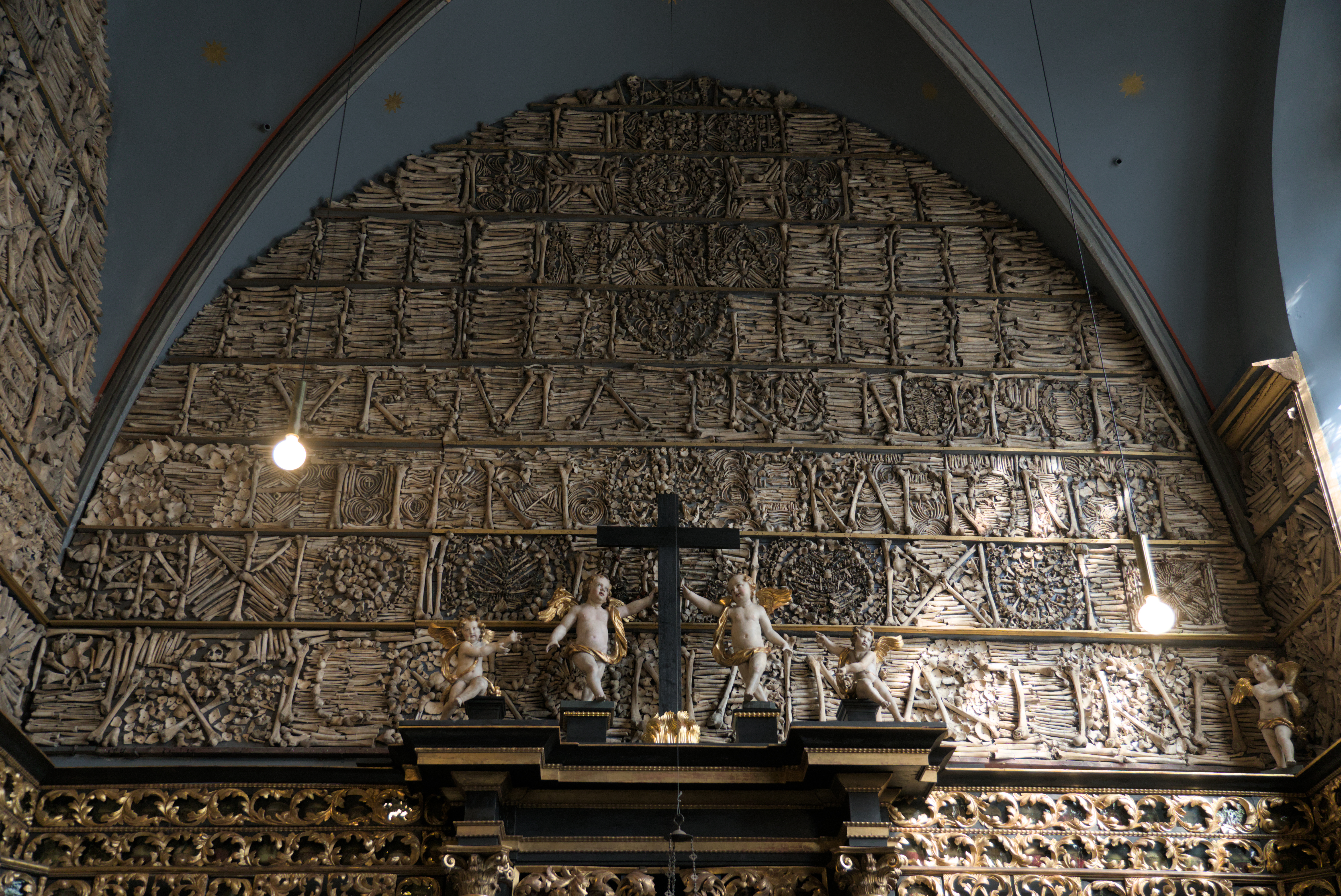
Above the altar, tibias, fibulas, femurs, humeri, and other bones spell out “Sancta Ursula Ora Pro Nobis” (Saint Ursula, pray for us). Also rendered in bones are the name Etherius—Ursula’s fiancé, who converted to Christianity at her insistence and met her in Cologne to die with her—and a mention of the holy virgins.
Golden Chamber
Golden Chamber
Golden Chamber

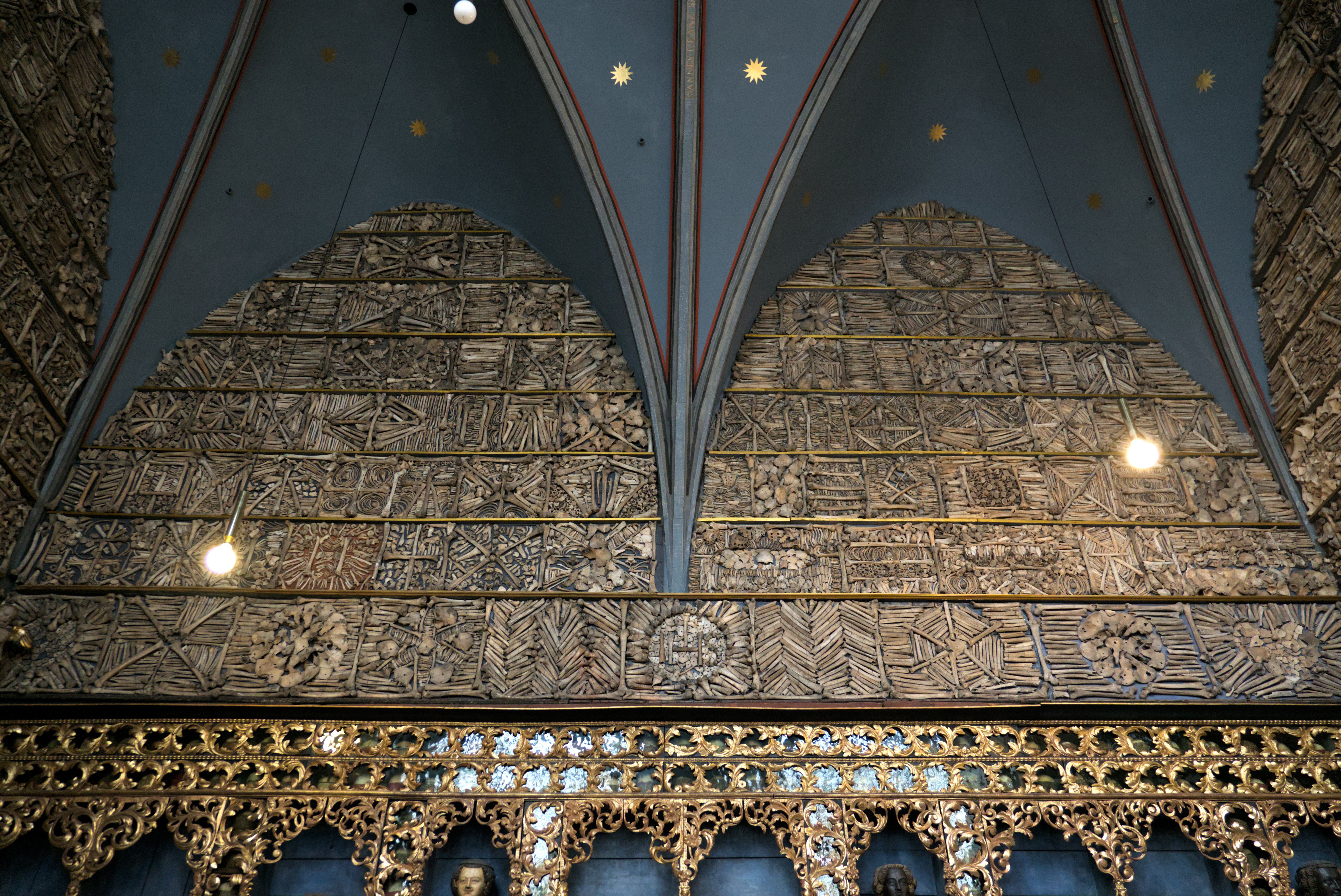
Other sections of the wall use vertebrae, pelvic bones, ribs, shoulder blades, and so on to create ornamental designs like hearts, spirals, webs, flowers, and crosses.
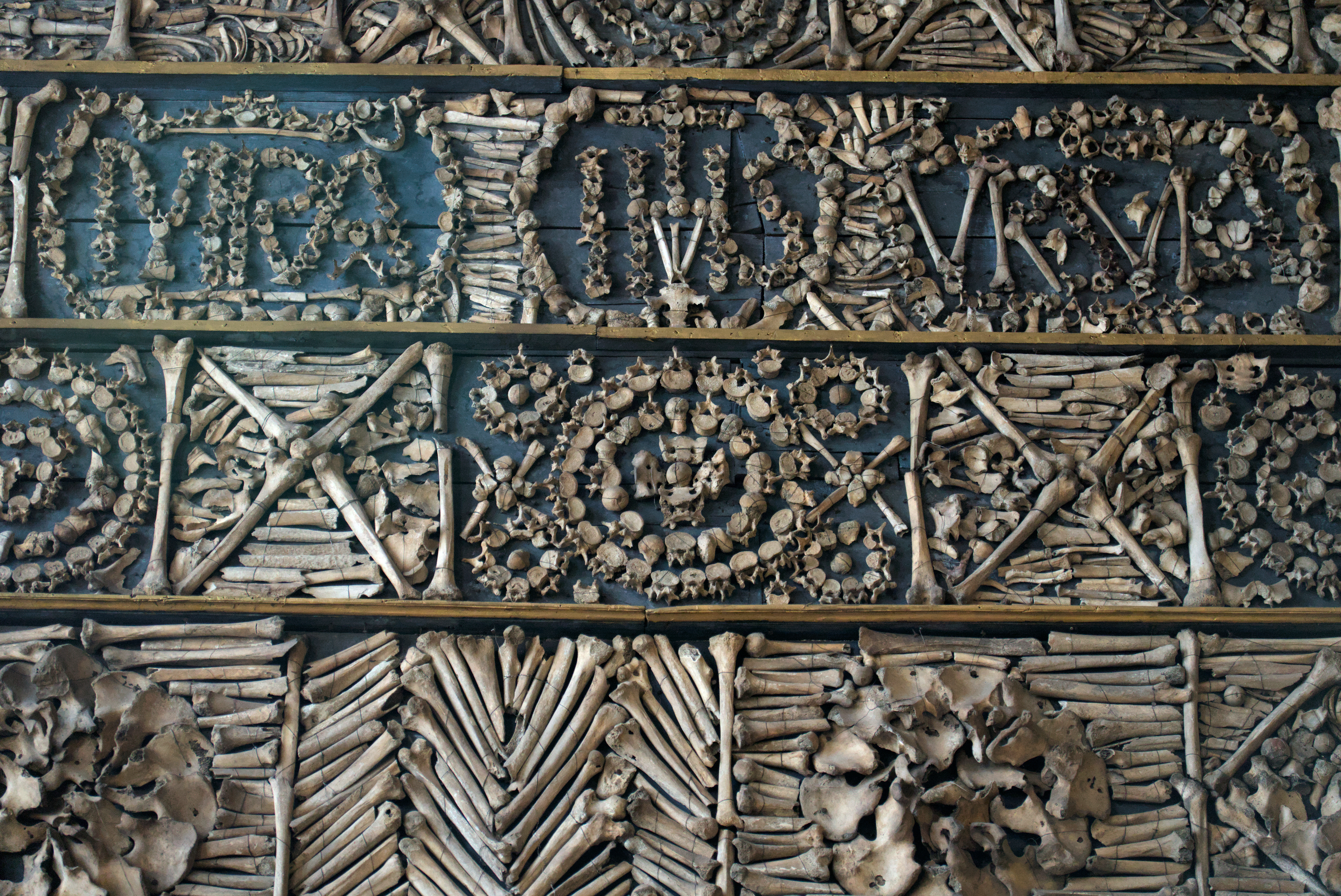
Golden Chamber
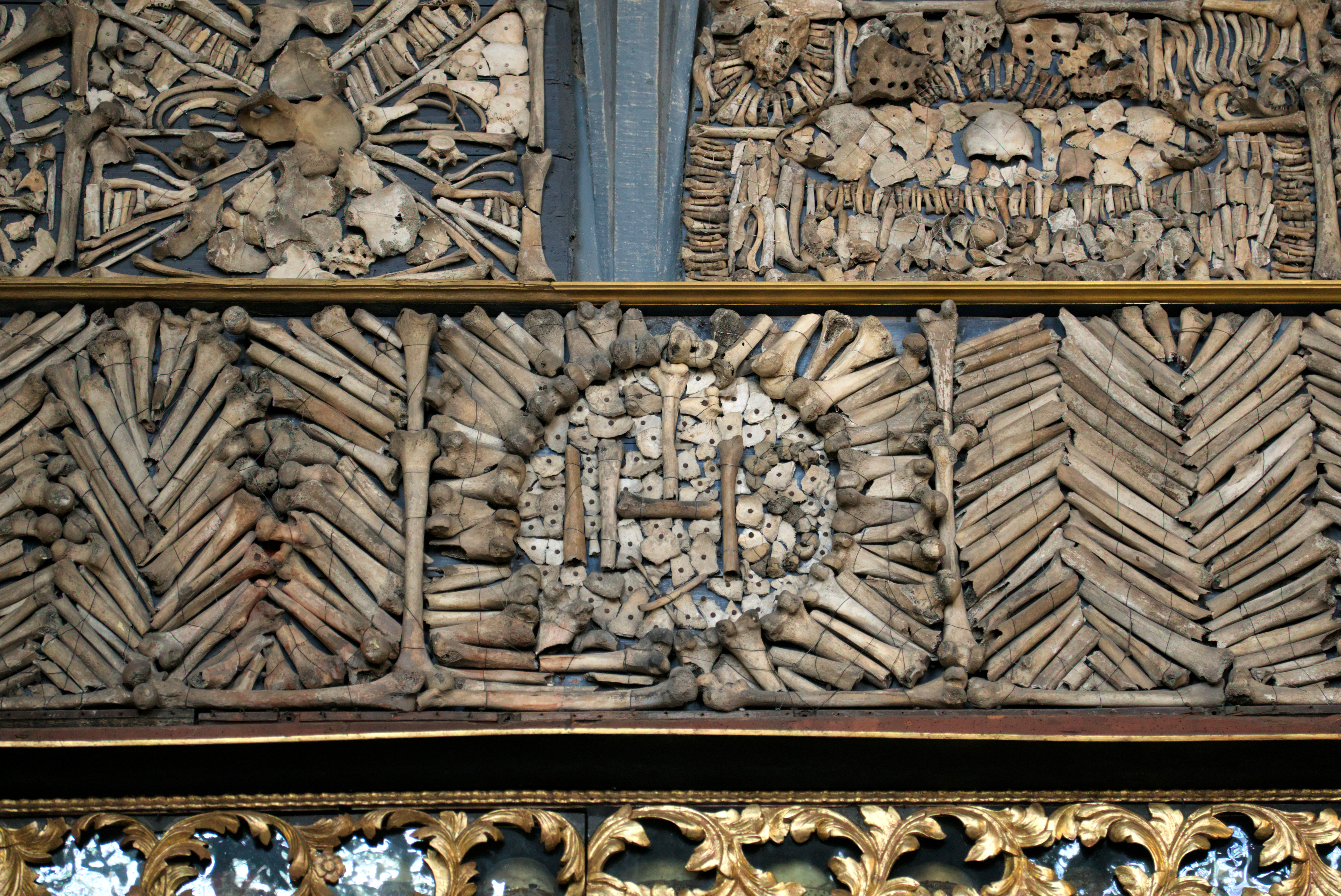
“IHS” is a popular Latin acronym for “Iesus Hominum Salvator” (Jesus, Savior of Humankind).

Golden Chamber
Golden Chamber
Golden Chamber

Similar visual displays of bones in charnel houses, writes art historian Jackie Mann, had become increasingly common in Europe by the late fourteenth century.

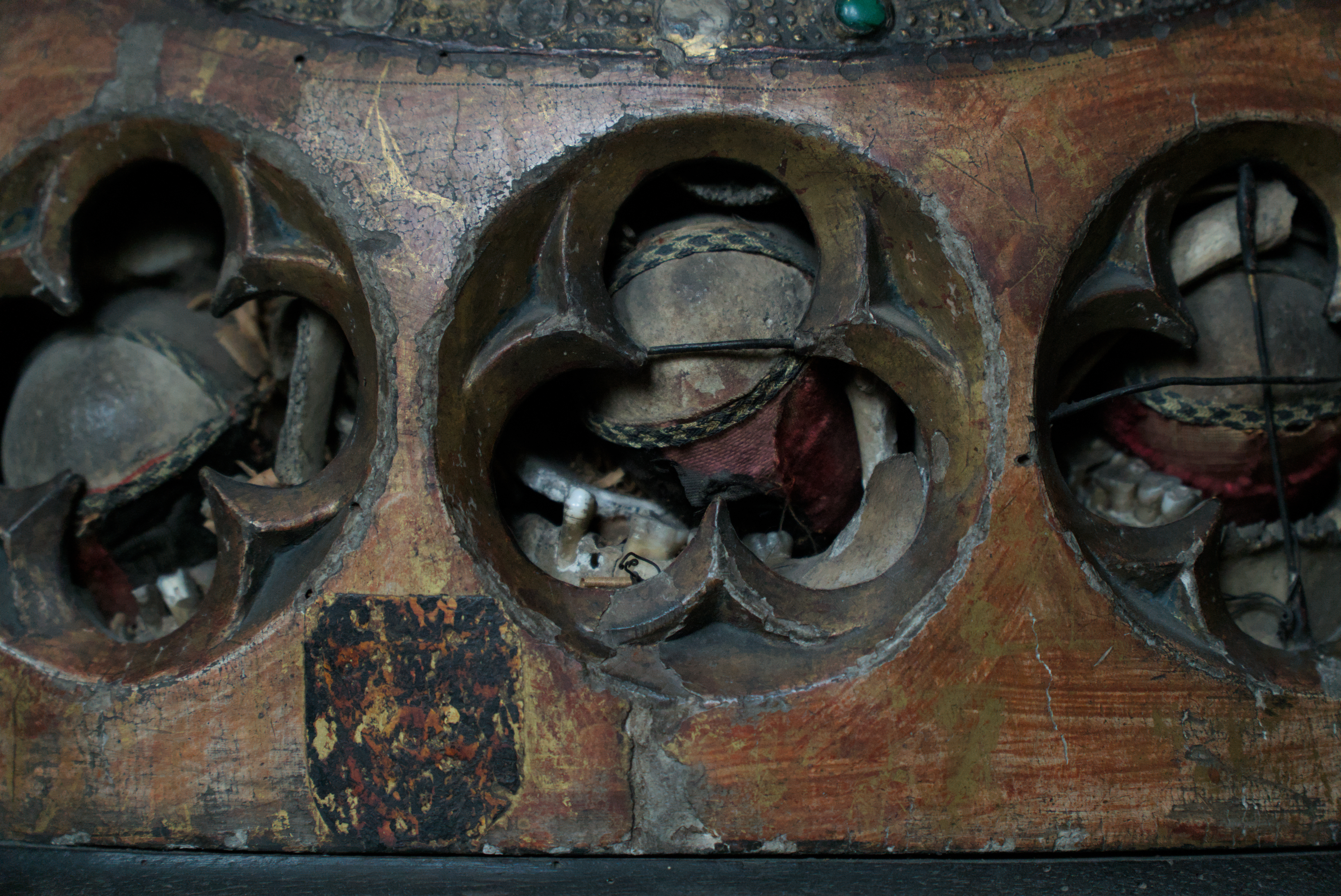
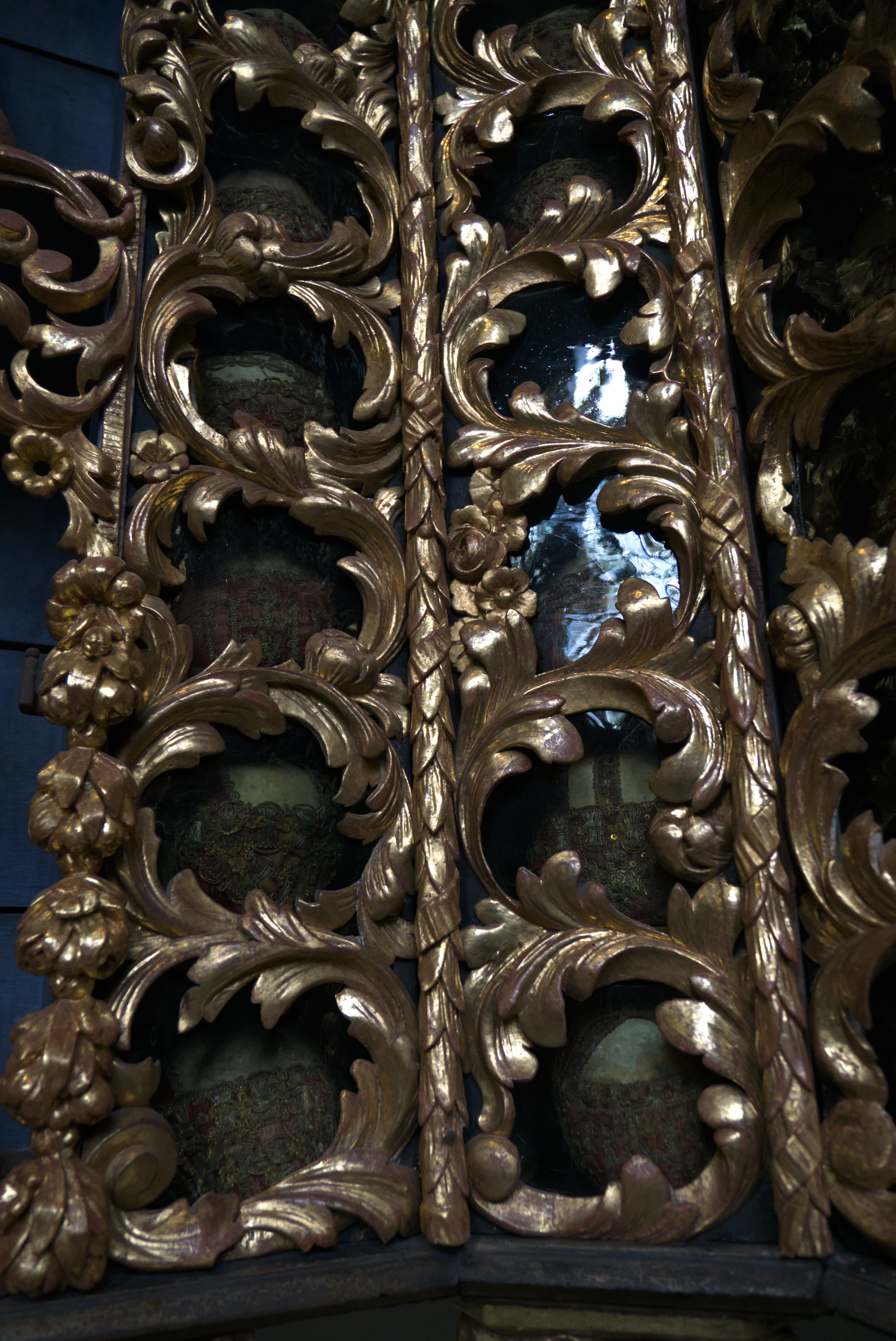
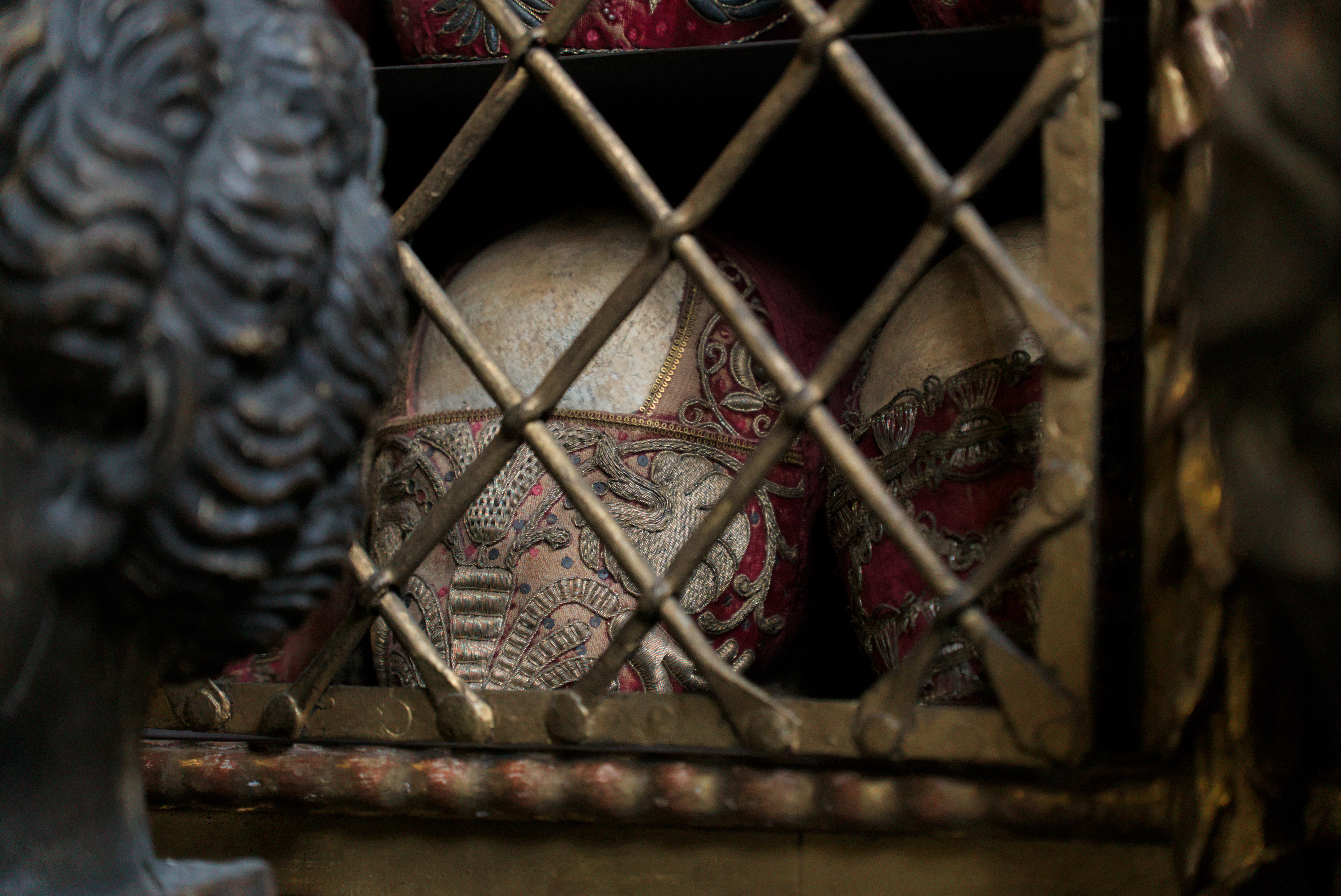
The shelving cabinets below the bone decor belong to the second phase of furnishings around 1700. They contain niches that house 112 reliquary busts (most of them produced between 1260 and 1400 and made of polychromed wood), as well as gilded acanthus tendrils that encompass some 600 skulls. Out of reverence, many of the skulls are at least partially wrapped in red velvet with gold and silver embroidery made by the nuns of the nearby Ursuline convent.
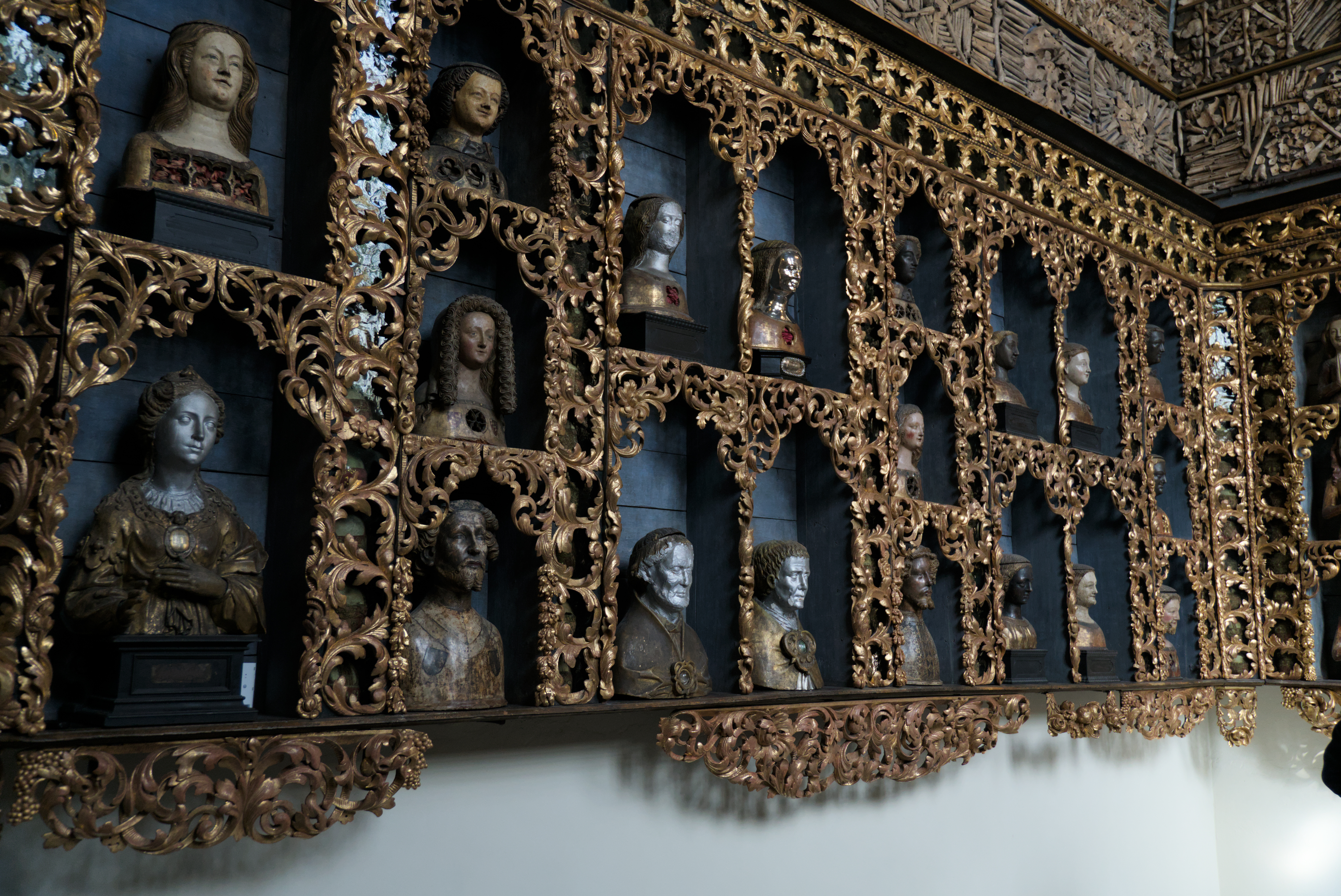
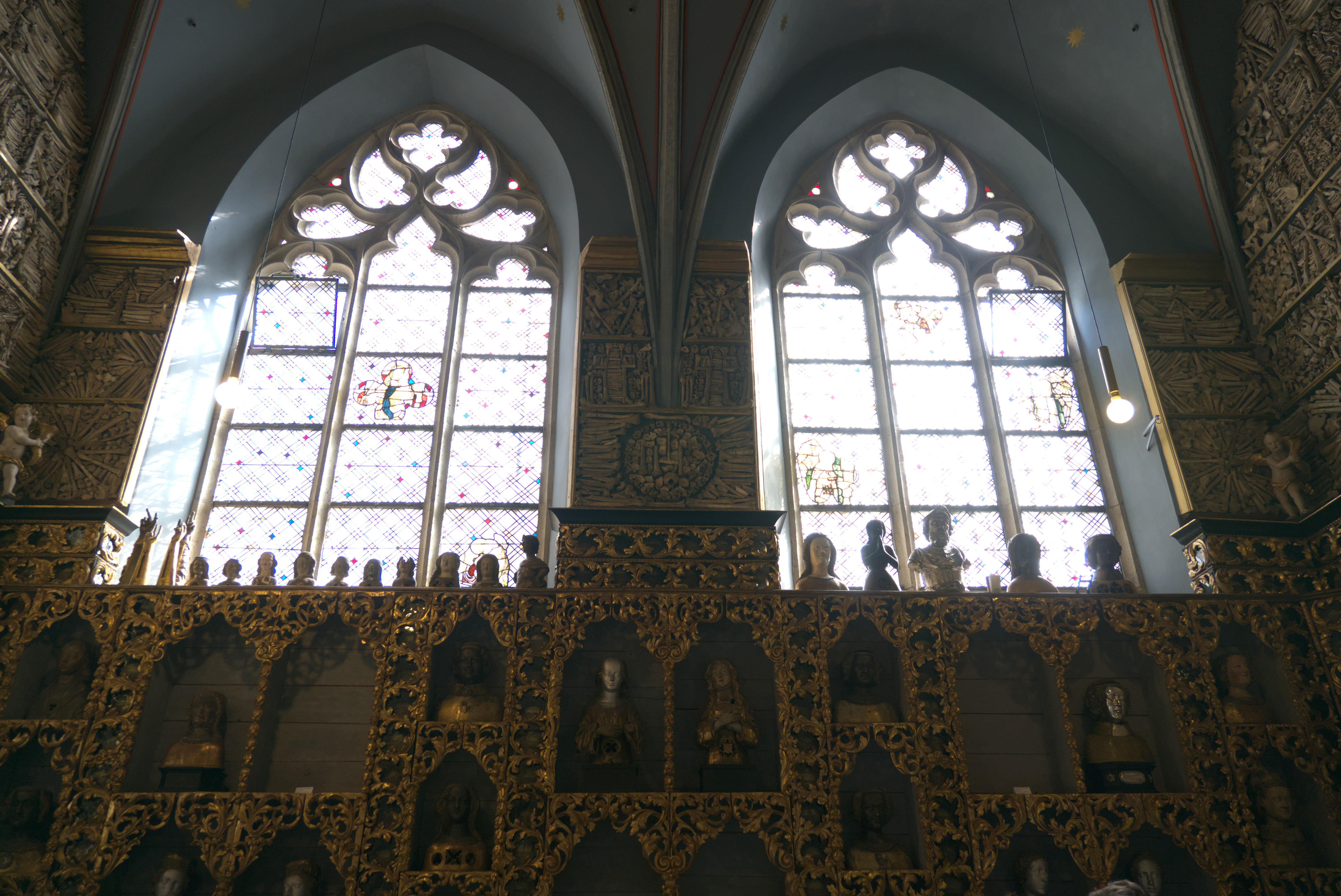
Golden Chamber
Golden Chamber
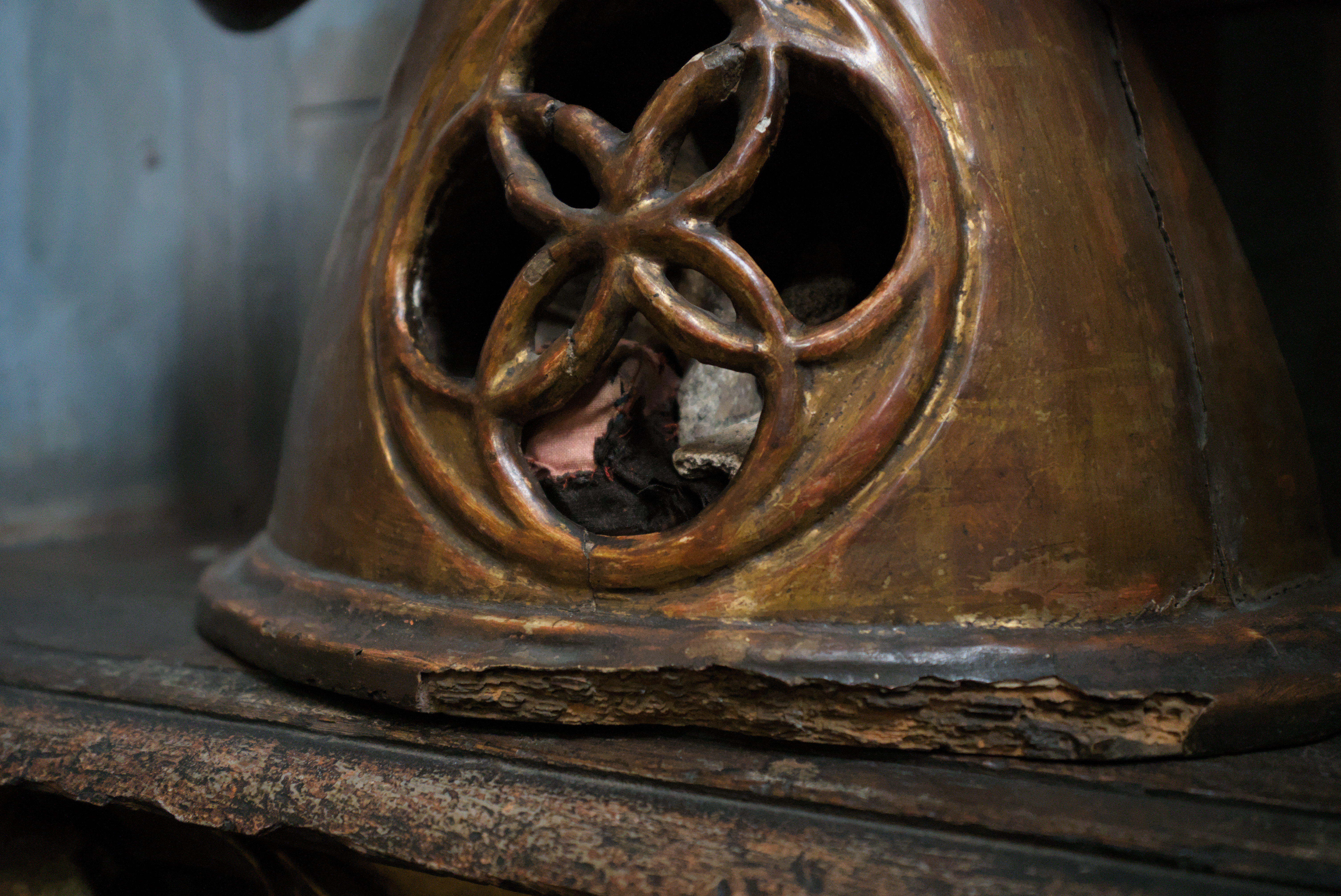
Inside a reliquary bust
Skulls
Skulls

Occasionally, where the wrapping has slipped, you’ll see an eye hole staring back at you.
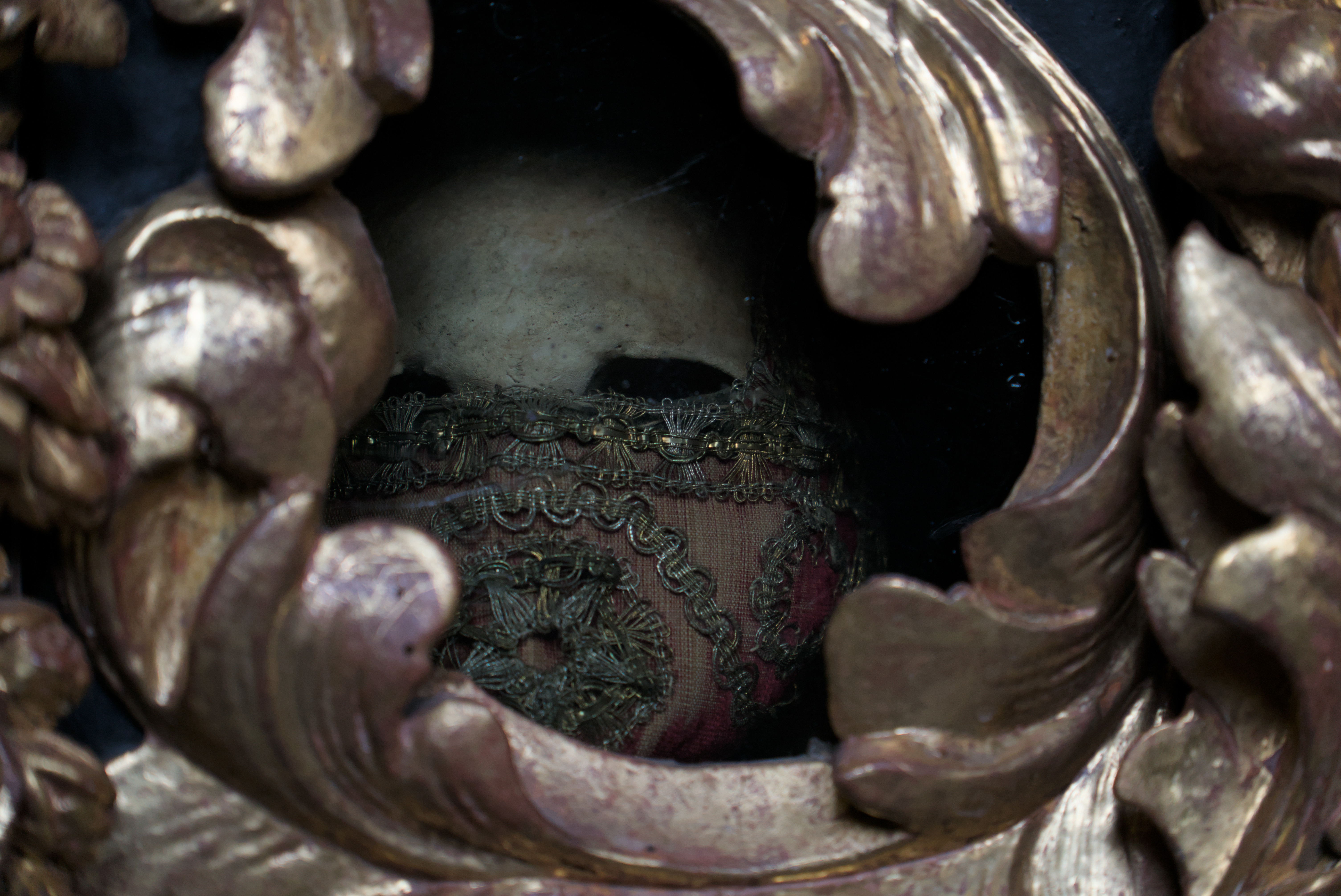
Skulls

To account for the presence of men’s bones in the ancient Roman churchyard, the legend of St. Ursula was adapted in the twelfth century to include male martyrs—namely, Etherius and his retinue. That’s why the Golden Chamber contains several male busts alongside the female.
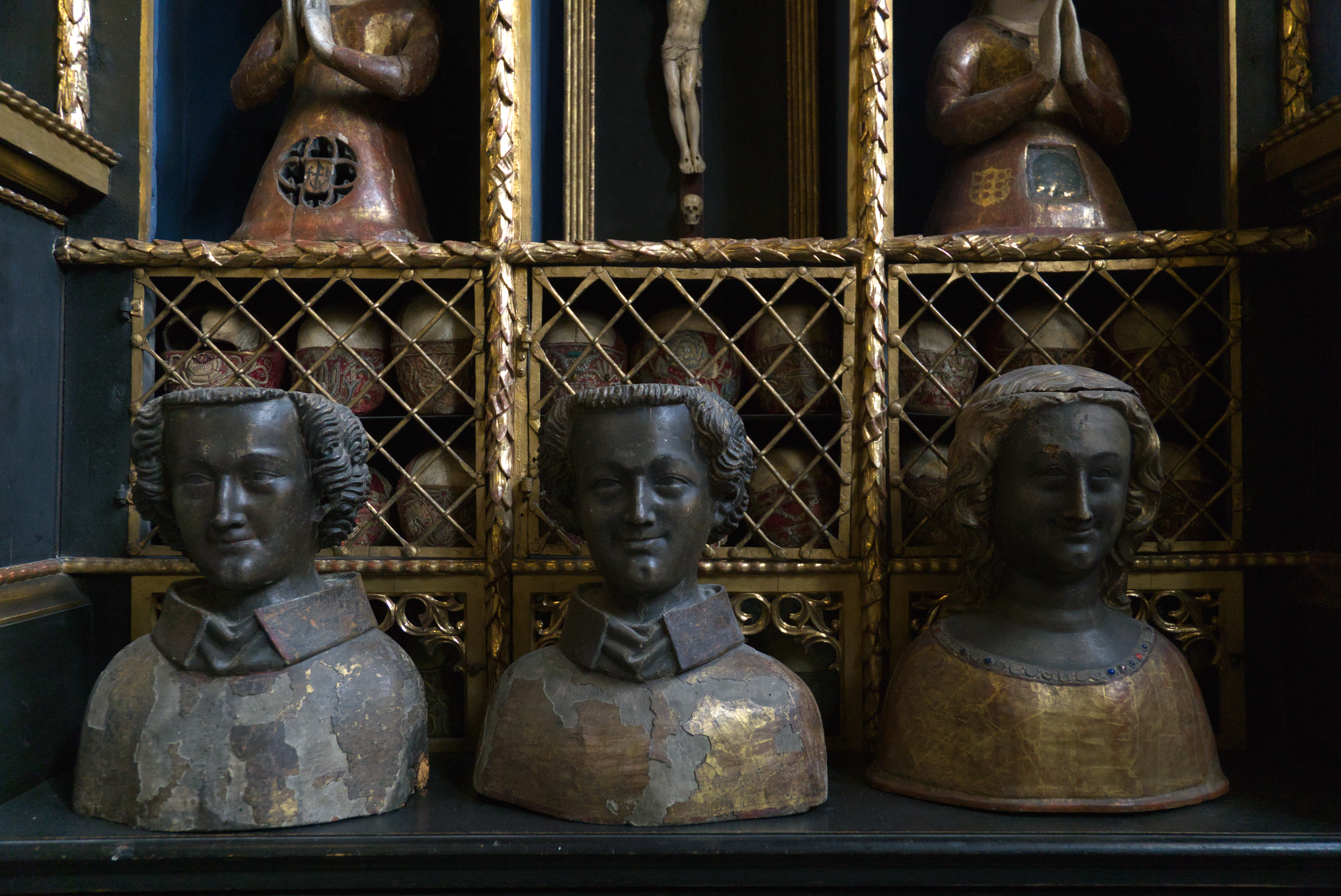
Golden Chamber

To the average person, the Golden Chamber is a weird, macabre spectacle. But for Catholics, displaying human bones is not meant to be creepy or horror-inducing. Rather, by bringing remnants of the dead into spaces of the living, we are reminded of: (1) our own mortality, (2) the community of saints that transcends time, and (3) the promise of universal, bodily resurrection (dem bones gonna rise again!).

Memento mori (“remember you will die”) was a common trope in seventeenth-century art and devotion, meant to increase one’s awareness of the fleetingness of life and to encourage one to live in light of heaven. Mann calls the Golden Chamber an “immersive memento mori.” Again, the traditional Christian summons to remember our mortality is not meant to frighten. It’s meant to inspire us to live whole and holy lives.

While death is an ending in one sense, it’s also an entry into life immortal. The Golden Chamber gathers together the fragments of local saints that had been scattered in ancient burial ruins, preserving them for the saints of later generations as a witness that our bodies will never be finally lost; they will be raised and renewed by God on the last day and reunited with our souls. Christians treat the remains of the deceased with honor in recognition that our bodies—including the framework of bones that support our soft tissues, protect our organs, enable our movement, store minerals for our use, and produce our blood cells—are not just temporary shells encasing who we really are, but rather are a part of who we are. Hence why we proclaim, in the Apostles’ Creed, that “we believe . . . in the resurrection of the body.”

Memorial for the Martyrs of Today

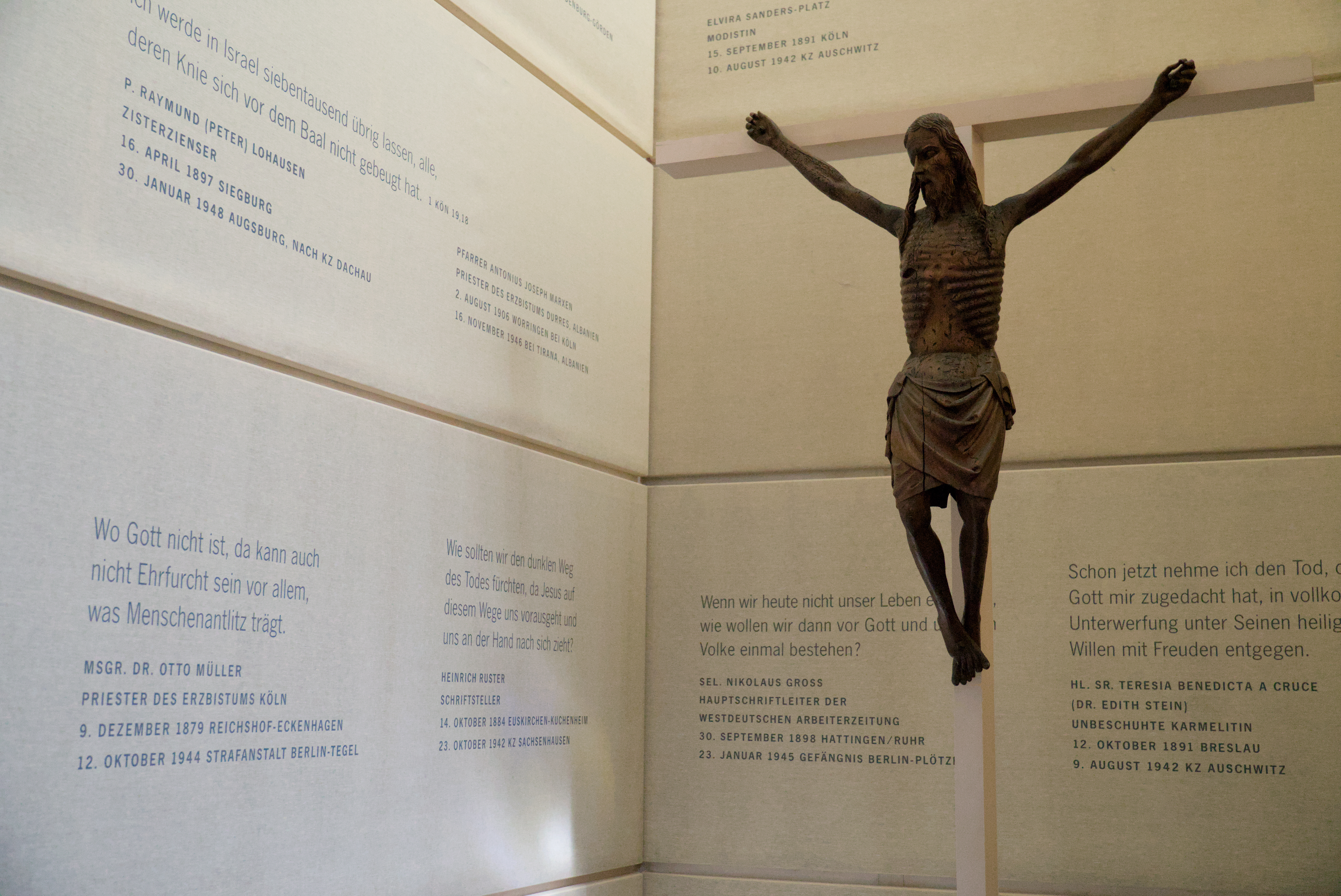
While the Golden Chamber is the primary draw for visitors to the Basilica of St. Ursula, there are other sights in the church worth spending time with, ones I was not expecting. One of them is the Gedenkstätte für die Märtyrer der Gegenwart (Memorial for the Martyrs of Today), a chapel in the south transept that commemorates the Christians in Cologne, both religious and lay, who were killed for resisting the Nazi regime—or, in the case of Sr. Teresa Benedicta of the Cross (Edith Stein) and Elvira Sanders-Platz, for being ethnically Jewish.
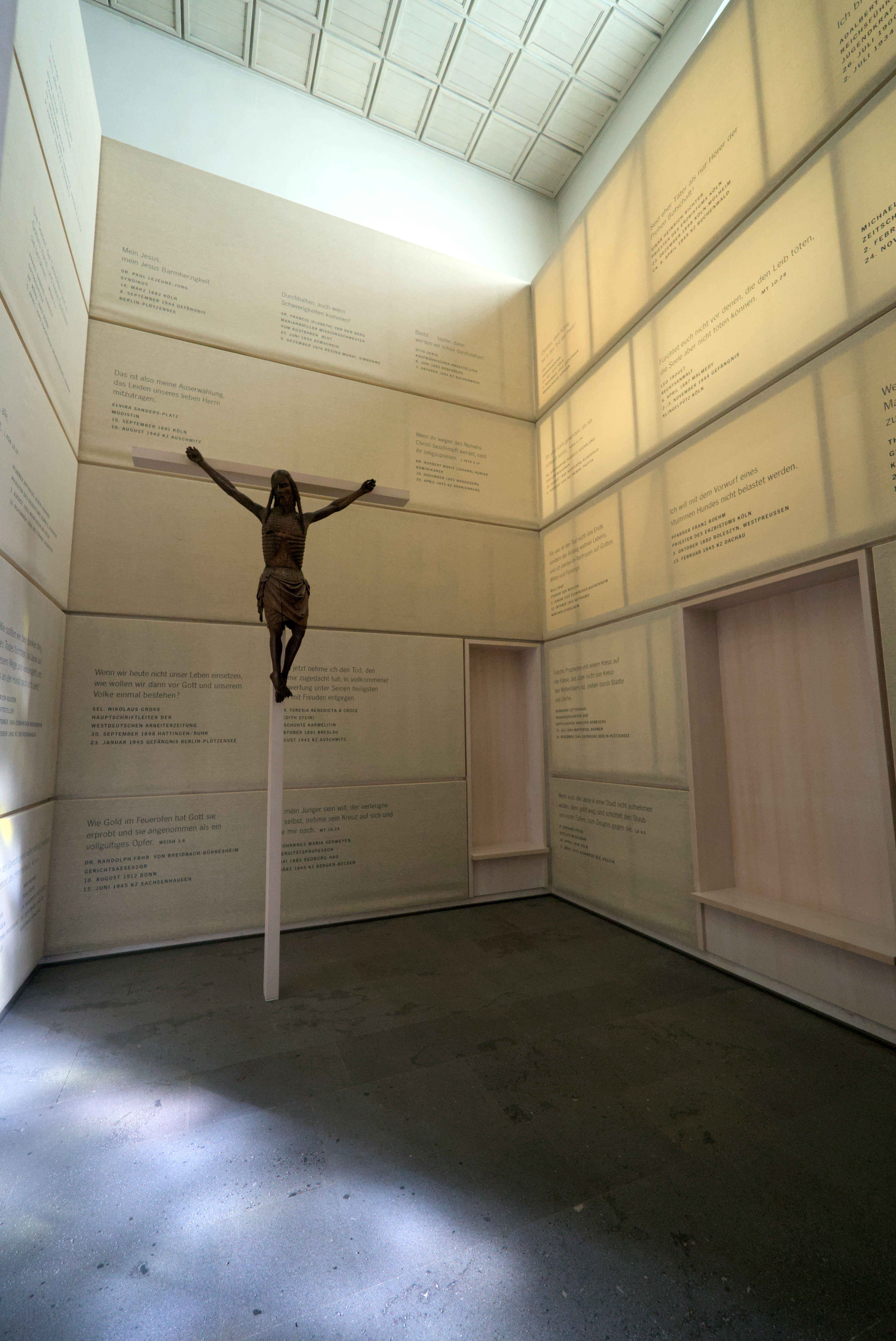
Memorial for the Martyrs of Today
Gedenkstätte für die Märtyrer der Gegenwart (Memorial for the Martyrs of Today), designed and built by the firm Kister Scheithauer Gross, 2003–5. South transept, Basilica of St. Ursula, Cologne.

Memorial for the Martyrs of Today

Made by the architectural and design firm Kister Scheithauer Gross, the chapel consists of a double-shelled, slightly transparent canvas construction printed on the inside with the names and dates of the martyrs, as well as quotes they gave before their deaths. Sunlight enters from the window to the right of the chapel, causing the space to glow. There’s a small bench on each of the three sides, for people to sit and pray or reflect.

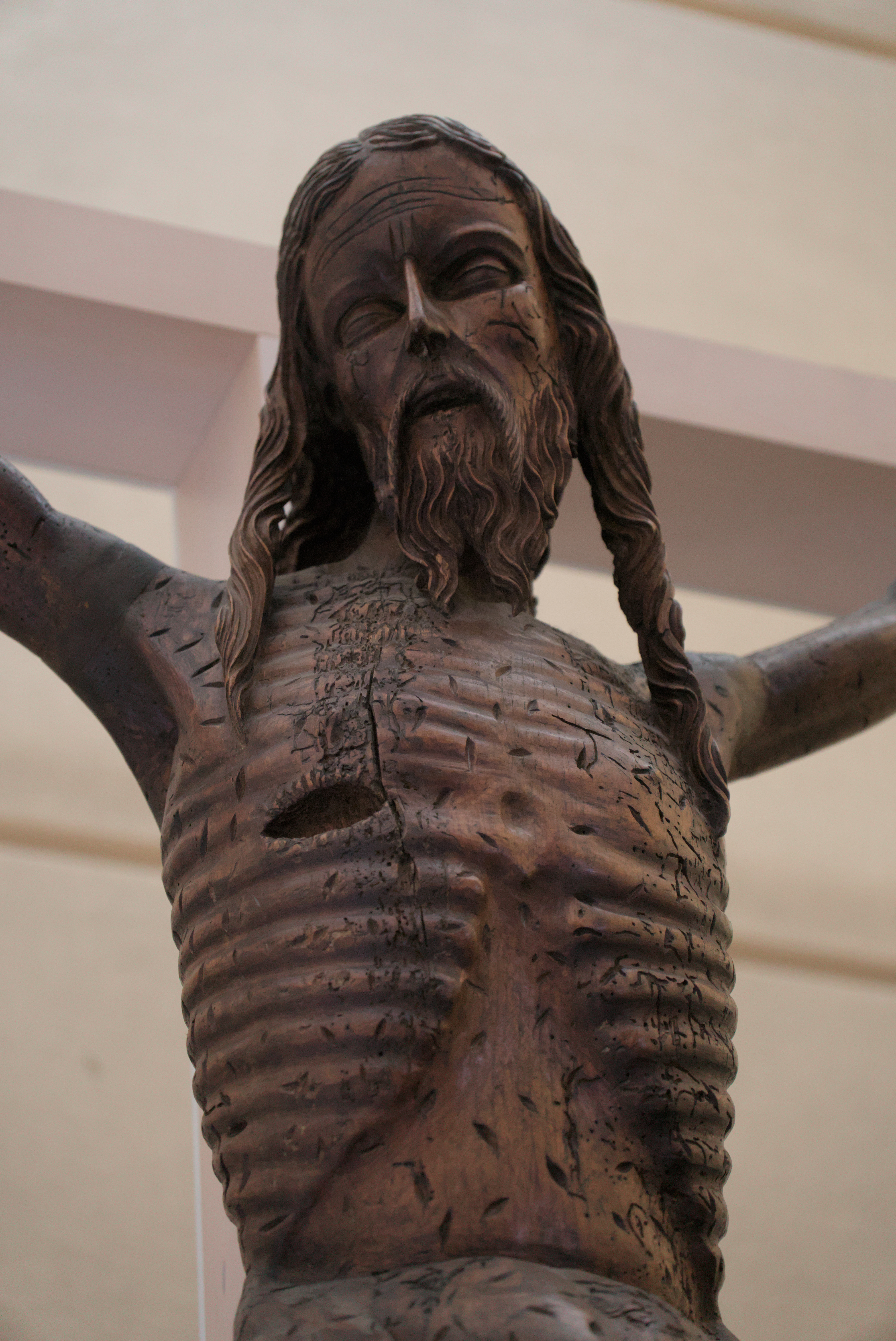
In the center is a life-size wood crucifix. The gaunt Christ figure is pierced all over and bears a deep wound in his side where the centurion’s spear went through. Like those whose names surround him, Jesus preached and pursued love and justice, ultimately laying down his life—a loss that God turned to gain in the Resurrection and in the redemption of the world.

A language barrier prevented me from effectively asking the staff person, or understanding the answer, whether the crucifix was carved in the early 2000s specifically for the chapel, or if it’s medieval. There’s no info inside the church about this chapel.
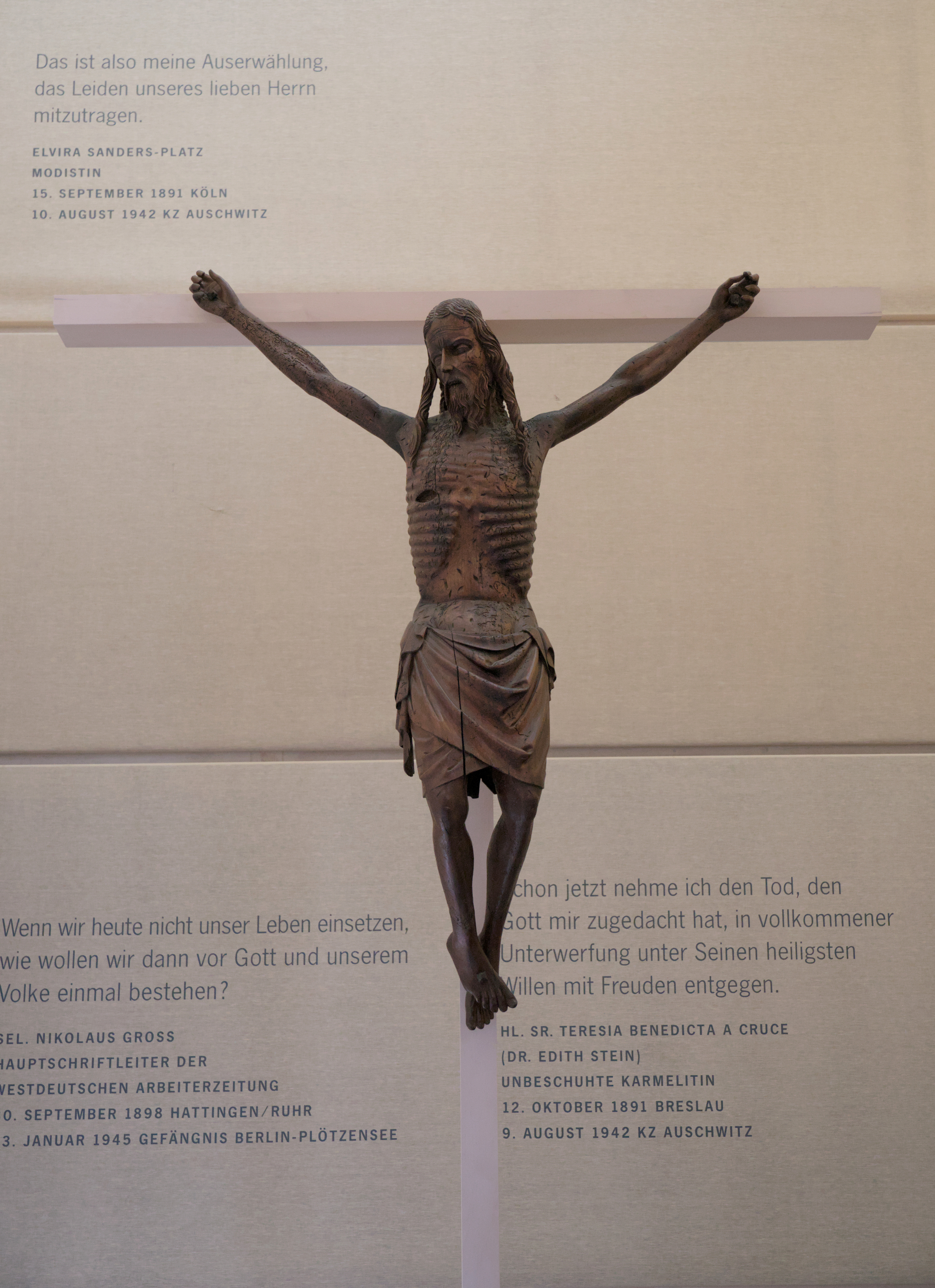
Crucifix
Crucifix

The Memorial for the Martyrs of Today is an example of what Christian martyrdom looked like in Cologne in the twentieth century. Fr. Otto Müller, Br. Norbert Maria Kubiak, writer Heinrich Ruster, medical student Willi Graf, Catholic Youth leader Adalbert Probst . . . The stories of the many individuals who were executed for subverting Hitler, for calling out his evils, in the name of Christ are far more compelling to me than the fabulous and convoluted story of an ancient princess killed in a land invasion and then heroized—for her virginity?

Contemporary Stained Glass

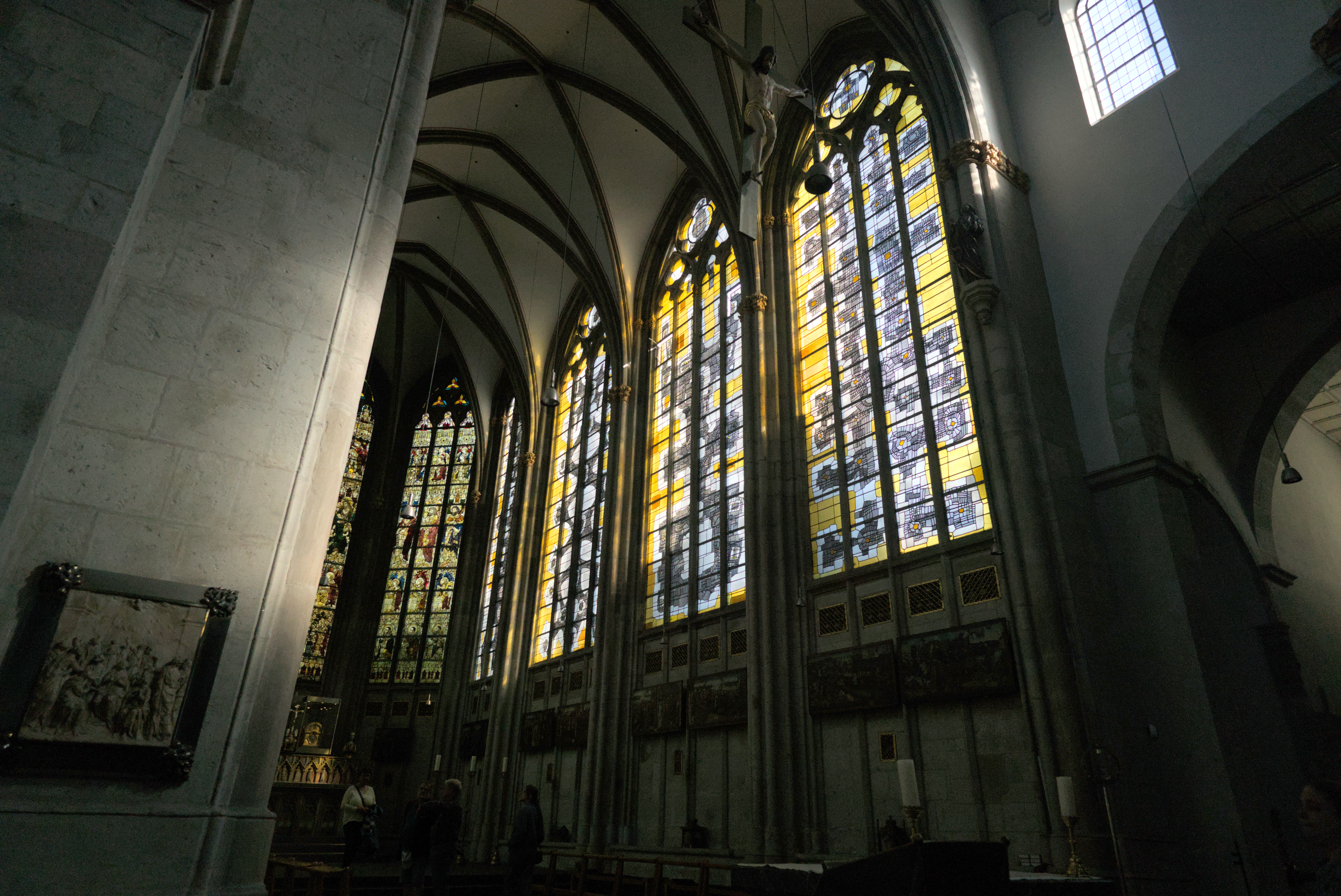
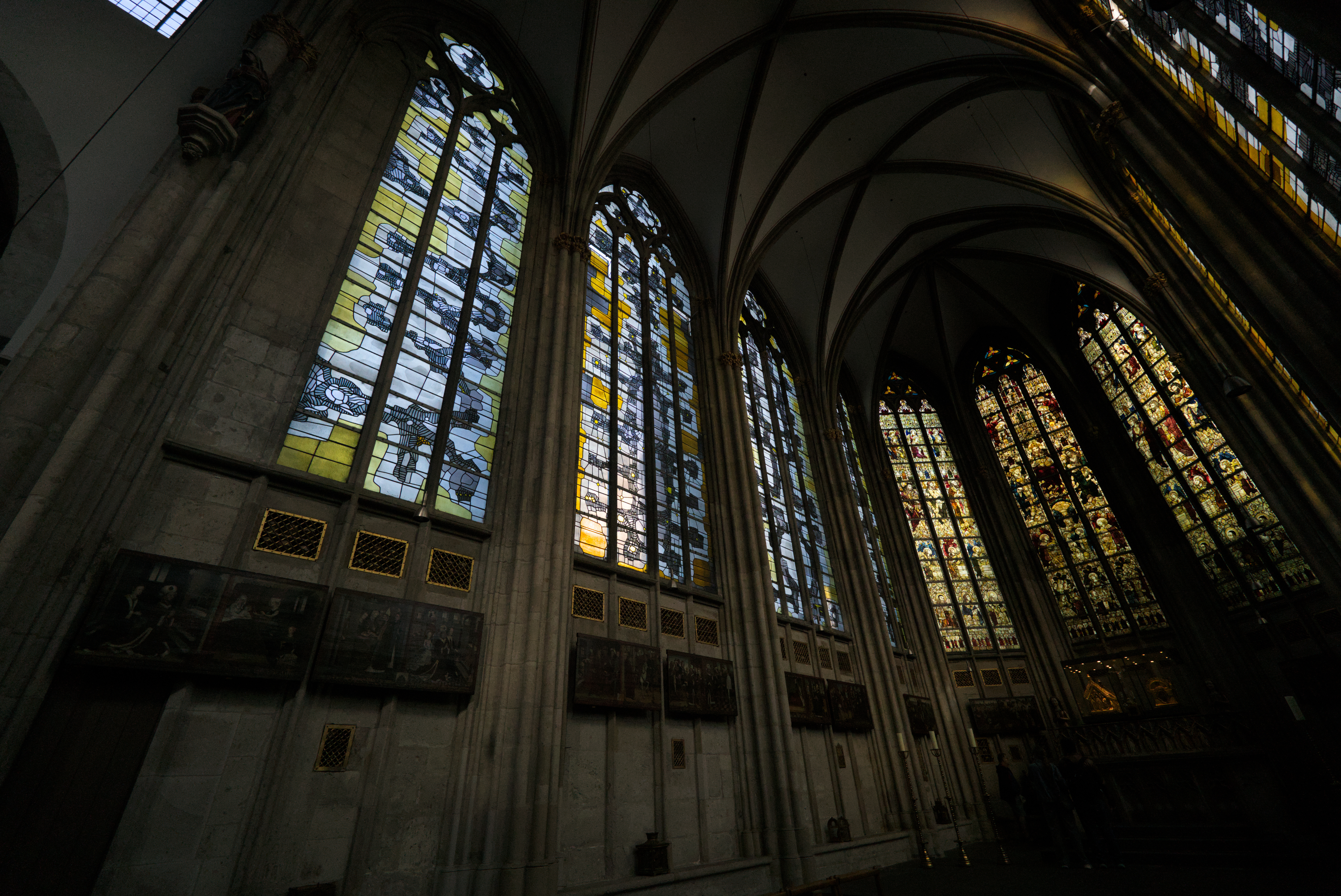
I also liked the contemporary stained glass in the church. In the choir, there’s a set of eight windows by Wilhelm Buschulte—abstract compositions in yellow, white, and gray.
Wilhelm Buschulte
Stained glass windows by Wilhelm Buschulte (German, 1923–2013), 1962, choir, Basilica of St. Ursula, Cologne

Wilhelm Buschulte

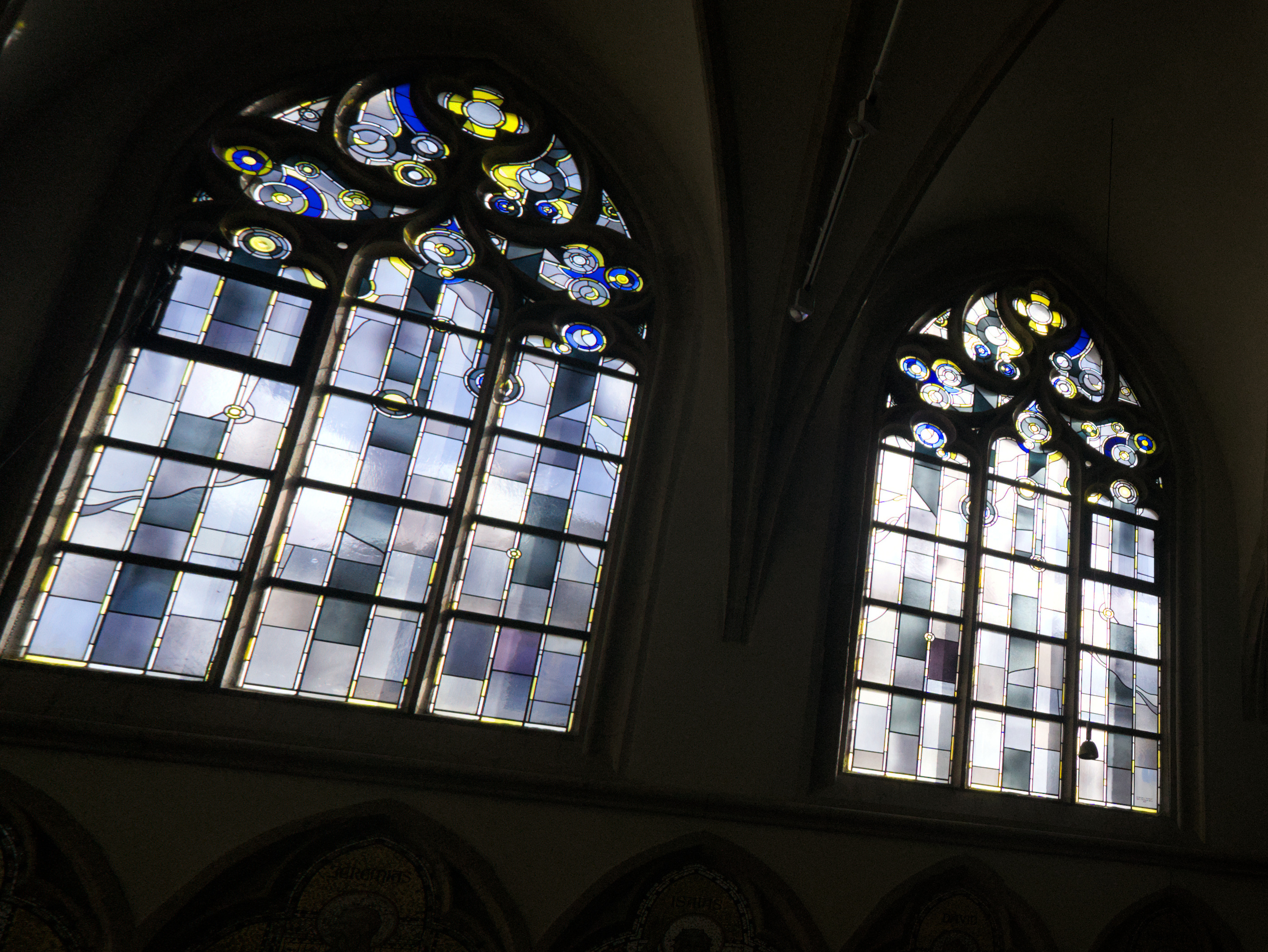
In the south aisle are two round-arched windows by Will Thonett, also abstract: a grid of blues, grays, and lavender, with yellow circles and thin vertical bands.
Will Thonett
Stained glass windows by Will Thonett (1931–1973), 1967, south aisle, Basilica of St. Ursula, Cologne

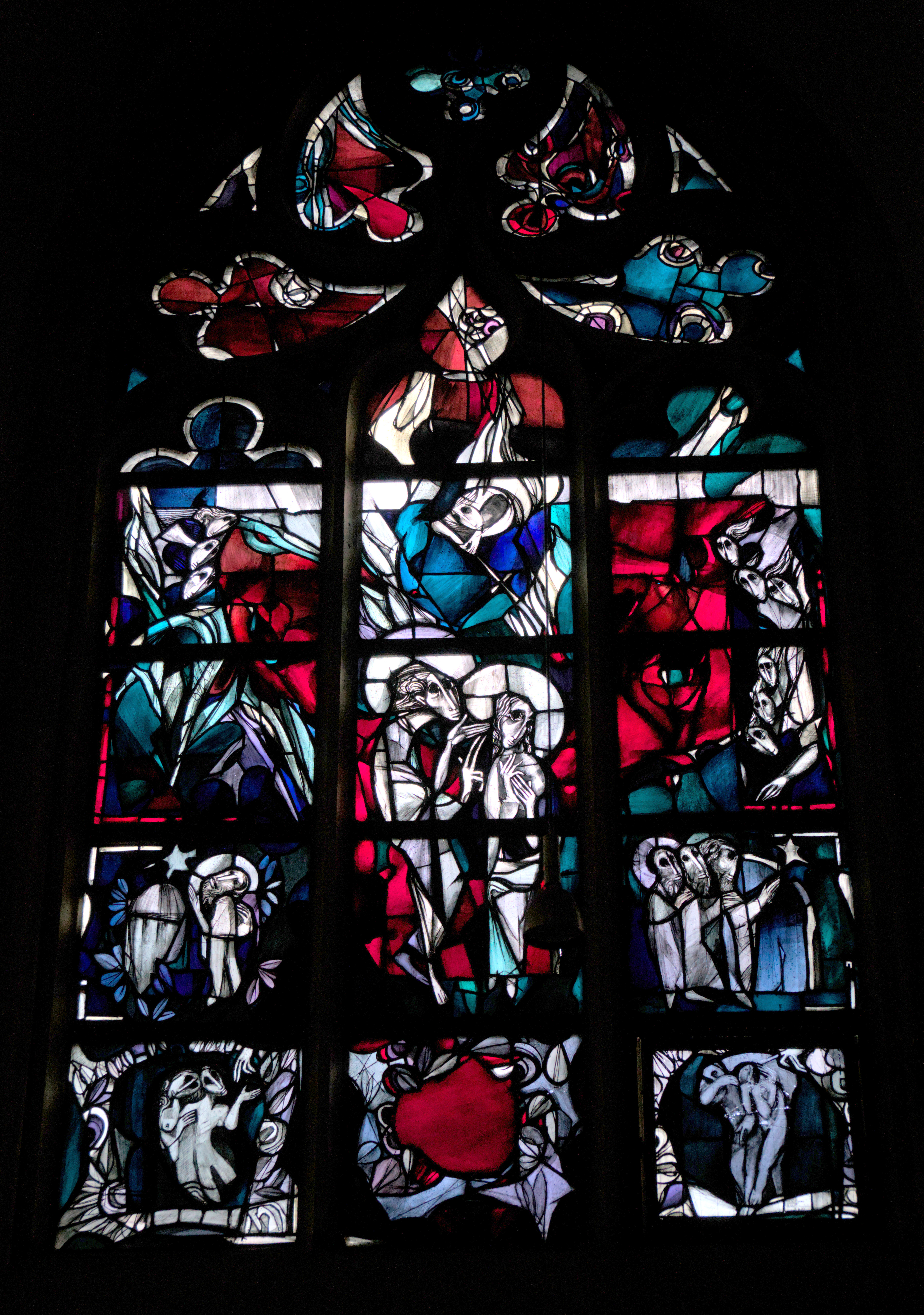
To the right of these are three Mary-themed windows by Hermann Gottfried. The primary scene of the first one is the Annunciation. A giant red rose appears in the background, probably a reference to Mary as the Rosa Mystica. Below this scene, to the left, is the Creation of Adam and Eve, and to the right, the Expulsion from Paradise; these contextualize Christ’s conception in the greater narrative of scripture. The peripheral scenes in the middle register show the magi following the star to Bethlehem.
Hermann Gottfried_Annunciation
Stained glass window by Hermann Gottfried (German, 1929–), 1984, south aisle, Basilica of St. Ursula, Cologne

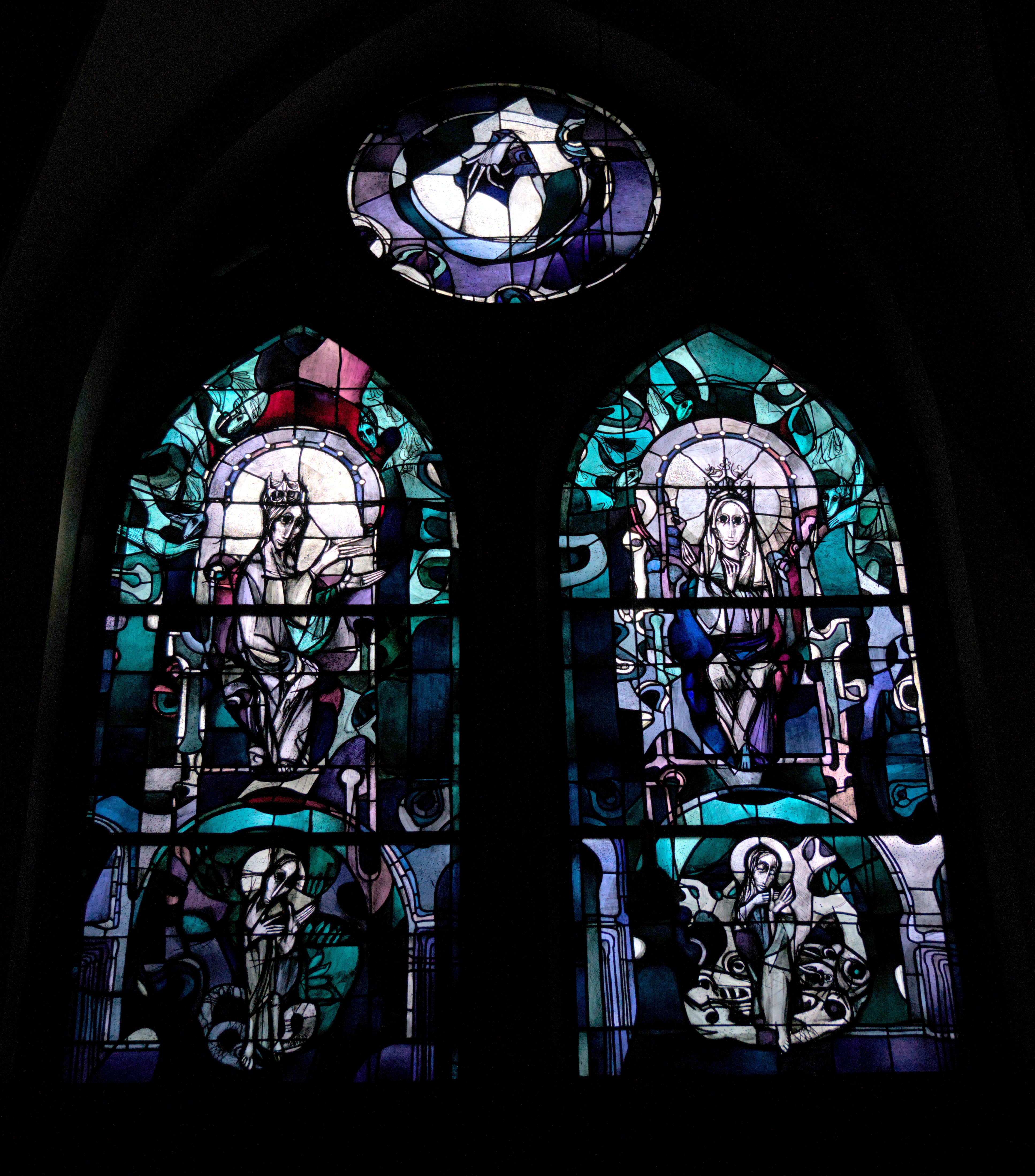
The central window portrays the Coronation of Mary. I believe both figures in the left lancet are Christ—crowning his mother as Queen of Heaven, and at the bottom, crushing the serpent, as the protoevangelium in Genesis 3:15 prophesied. Beneath the enthroned Mary on the right is a smaller vignette, which I think may be Mary again, also stepping on the serpent’s head, since by her cooperation with God’s plan, she shares in the victory over Satan. This imagery is also related to Woman of the Apocalypse described in Revelation 12, whom Catholics interpret as Mary. The hand of God dispenses blessing from above.
Hermann Gottfried_Coronation of the Virgin
Stained glass window by Hermann Gottfried (German, 1929–), 1984, south aisle, Basilica of St. Ursula, Cologne

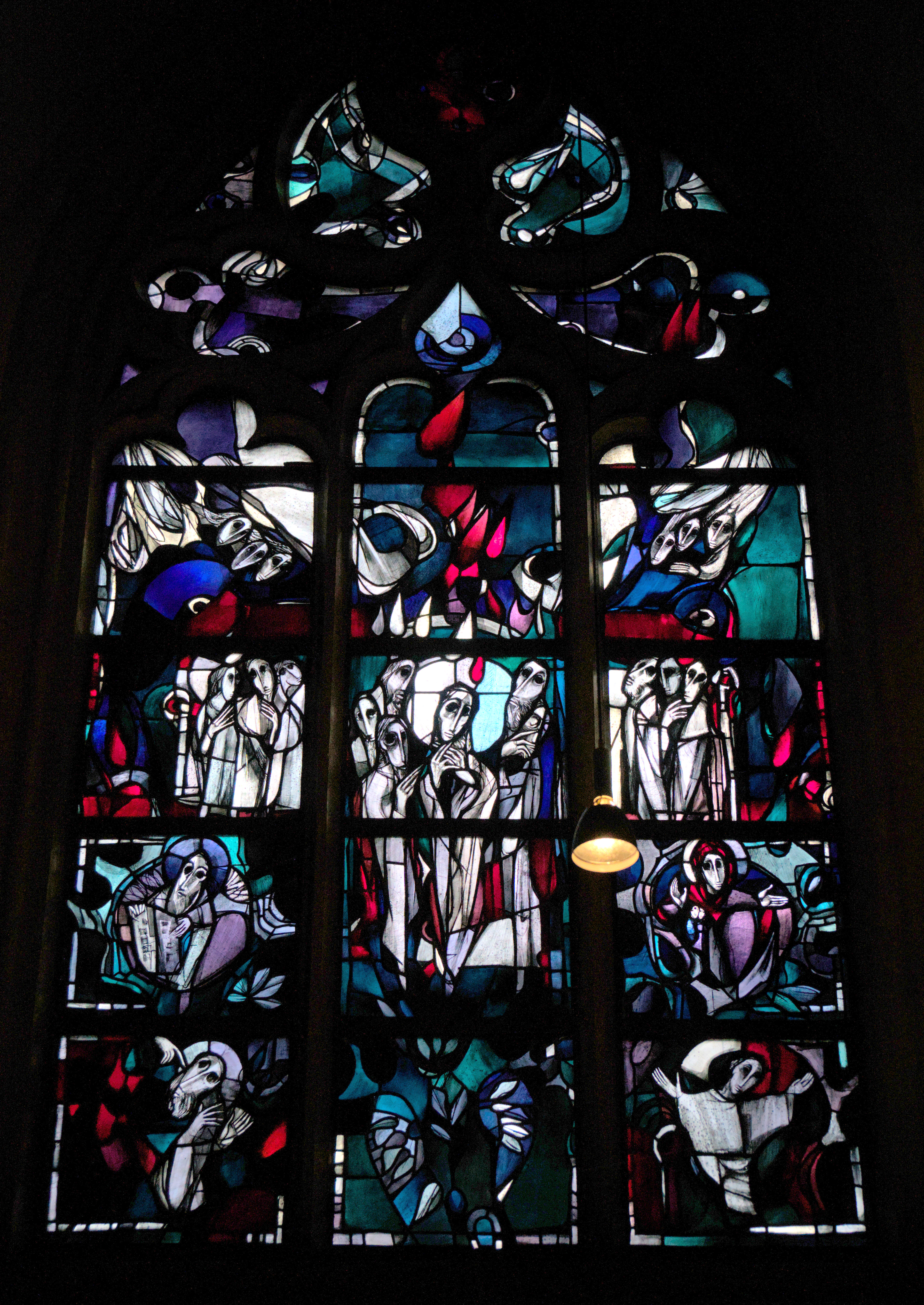
The final window in this trio portrays the Descent of the Holy Spirit at Pentecost. The two quadrants at the bottom right show Moses before the burning bush, in which Mary appears; Catholic teaching compares Mary to the burning bush of Exodus because for nine months she held the fire of divinity within her womb (God incarnate) and was not consumed. On the left Moses is receiving the tablets of the law on Mount Sinai, an event often read in parallel with the story of Pentecost in Acts 2, where God writes his word not on stone but on people’s hearts by giving his Spirit to dwell within them.
Hermann Gottfried_Pentecost
Stained glass window by Hermann Gottfried (German, 1929–), 1984, south aisle, Basilica of St. Ursula, Cologne


If you’re ever in Cologne, I encourage you to include the Basilica of St. Ursula on your itinerary. Entry to the church is free, but the Golden Chamber costs €2 (only cash is accepted, I believe). There are six large standing posters in the narthex that provide a timeline, in German, of the church’s history, and when I was there, there were two attendants who were available to answer questions, one of whom spoke some English.

For more comprehensive photos of the church’s art and architecture, see https://www.sakrale-bauten.de/kirche_koeln_st_ursula.html and https://www.winckelmann-akademie.de/wp-content/uploads/Koeln_St._Ursula.pdf.

“Miriam” by Alison Leonard (poem)

Zwerger, Lisbeth_Miriam relinquishes Moses
Watercolor illustration by Lisbeth Zwerger, from Stories from the Bible (NorthSouth Books, 2016)

Hush my mother’s infant lusty
hush my fear-born brother nigh
rock you still in paper’s cradle
cry you not, or you will die

Rushes taller than your manhood
hide you now from club and sword
neighbours’ howls forget, and slumber
on the swaying water-sward

Rose a king who knew not Joseph
feared our numbers, feared our poise
feared our strength within his nation
spoke the killing of our boys

Cunning she who bore you quietly
cunning midwife I must be
cunning now to rock you, rock you
on the river tenderly

Hush, and hear not my heart beating
for the story that’s to come
mist-enfolded seeps toward me
in a howl that must be dumb

Silent children, silent women
silent men and silent bones
silent shoes in piles unnumbered
silent dust among the stones –

Here’s the woman with her women
with her barren sorrow bowed
jewels, gold and slaves unnumbered
cannot soothe her field unploughed

Cunning I, my mother’s daughter
cannot hush you, but can save
but can lift you from the water
king’s son make from son of slave

Running now to fetch my mother
running now to lose the sight
of the silent dust unslumbered
mist-encroaching through my flight

Mother, Mother, run and feed him –
of his origins be dumb –
close your ears against the howling
of the mothers still to come

This poem, inspired by Exodus 1–2, is published in The Poetic Bible, ed. Colin Duriez (Hendrickson, 2001).

Alison Leonard (born 1944) is a writer from the UK whose works include children’s and adult fiction, stage and (BBC) radio plays, poetry, and spiritual nonfiction. She is a Quaker and is deeply committed to interfaith dialogue and learning.

(Related posts: “Bithiah’s defiance: Kelley Nikondeha and poet Eleanor Wilner imagine Pharaoh’s daughter”; “Miriam,” a poem by Rachel Barenblat)

Favorite Films of 2024, Part 1

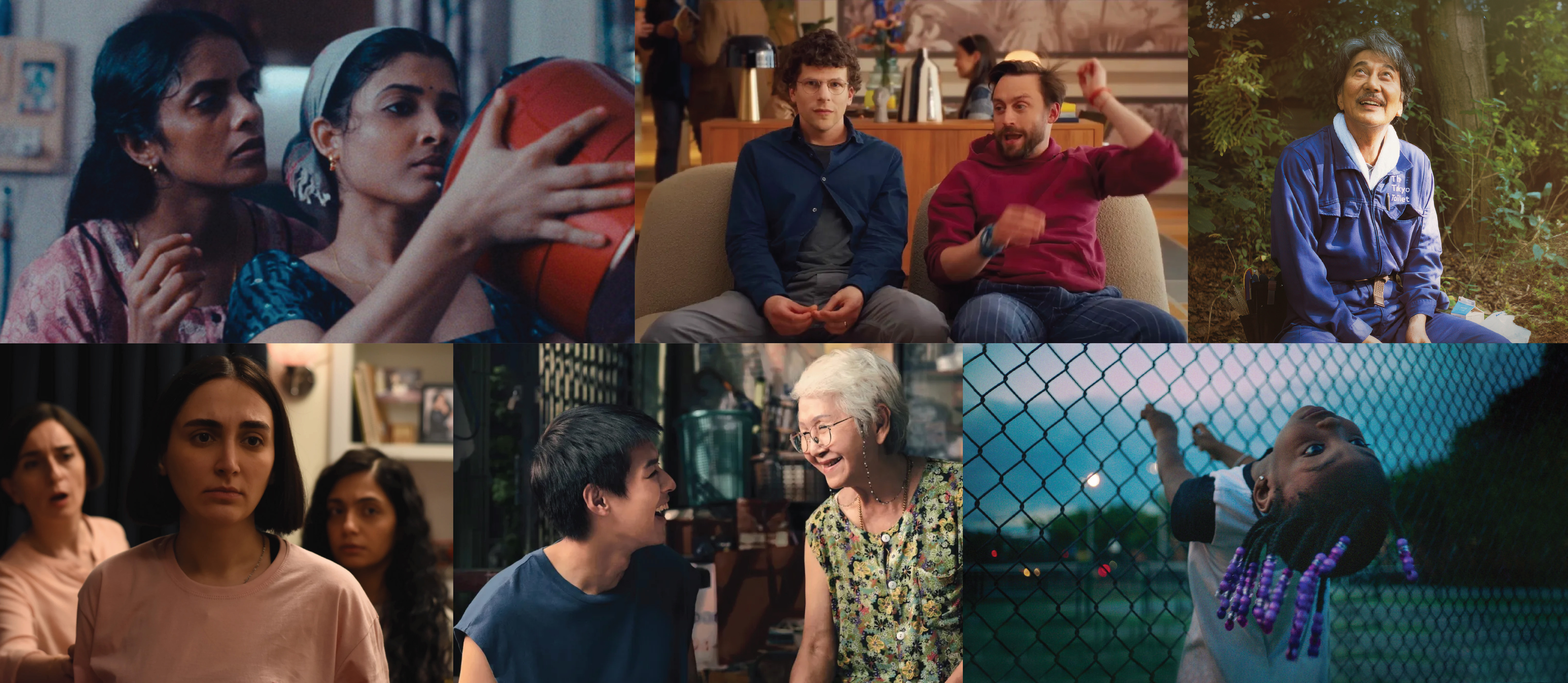
Of the 102 films I’ve seen that were released in the United States in 2024, these are my top ten. I’ll reveal my top eleven through twenty in a “part 2” post in the next few days.

Although I typically draw spiritual, theological, or liturgical connections with the art I feature on this website, here I do not do that. I’ve chosen these films not based on any kind of Christian messaging or interpretive possibilities but because they are beautifully made films that resonated with me. They address themes such as family, friendship, simplicity and awe, repressive governments, growing up, grief, mortality, addiction, trauma, joy, disability, identity.

One thing I love about cinema, as holds true with all the arts, is how it can connect us more fully to God, others, the world, and our own selves. So while I don’t think you need to watch movies with a purpose in mind, if you find yourself hesitant to invest the time, perhaps you might consider that connective capacity.

If the film is currently streaming for free with a subscription service, I’ve noted that at the bottom of the entry. Otherwise, check your local theaters or online rental platforms.

[Top 20 from 2023] [Top 20 from 2022] [Top 20 from 2021] [Top 20 from 2020]

Cautionary note: Different viewers have different sensitivities. If there’s a particular type of content you want to avoid, I’d advise you to check out the “Parents’ Guide” section of the film’s IMDb webpage, to which I’ve linked each film title.

Favorite Films of 2024

1. How to Make Millions Before Grandma Dies, dir. Pat Boonnitipat: From Thailand comes this tender story of a late teenage boy, M (Putthipong “Billkin” Assaratanakul), who quits his job as a video game streamer to become the live-in caretaker of his ailing amah (maternal grandmother) (Usha Seamkhum) in the hopes of inheriting her house when she dies. While initially motivated by self-interest, M develops genuine affection and gratitude for his grandma the more time he spends with her—getting up early with her each morning to make and sell congee at the street market, bringing her to the temple to pray, sitting with her during chemotherapy sessions (one of the most moving scenes is when he picks off the loose hairs she’s been shedding, one by one, from her sweater while she rests in her chemo chair). The balance of humor—conveyed especially through Amah’s feistiness—and sadness—loneliness, familial hurt and estrangement, terminal illness—is deftly handled and the emotional climax well earned.

2. Daughters, dir. Angela Patton and Natalie Rae. Pursuing the initiative of a group of young Black girls at Camp Diva Leadership Academy (now merged with Girls For A Change), Virginia-based community activist Angela Patton has helped organize a series of daddy-daughter dances in US prisons, a chance for K–12 girls to connect in person and make memories with their incarcerated fathers. This documentary captures one of those dances from 2019, following Aubrey, Santana, Raziah, and Ja’Ana over the course of eight years—before, during, and after the event. These girls and their fathers speak their sorrows, fears, insights, disappointments, and hopes, shedding light on the impact of parental incarceration and especially the rise, since 2014, of no-touch and even screen-only prison visits.

I appreciate that the film shows the complexity of the father-daughter bond, avoiding a simplistic portrait of that bond as either wholly resilient or frankly unmendable. The dance is not a triumph for all participants. While all at least have a desire to show up for each other, forgiveness and trust don’t always come easily. Nor does conversation, when you’ve been separated from someone for so long and barely know them.

Surely a contender for scene of the year is when the girls come down the hallway in their dresses, hand in hand and proud but nervous, to greet their fathers, who sit in a row of folding chairs in borrowed suits and ties. The men’s reactions are precious.

Streaming on Netflix.

3. Dìdi, dir. Sean Wang. Dìdi means “little brother” in Mandarin, and Chinese parents also use the term as an endearment for their younger sons. In this semiautobiographical dramedy from writer-director Sean Wang, it references the lead character Chris (Izaac Wang), a thirteen-year-old Taiwanese American boy growing up in Fremont, California. It’s 2008, the summer before high school, and all the awkwardness and anxieties of adolescent boyhood are upon him. He’s trying to fit in with a skater crowd and to figure out how to flirt with girls, and he’s navigating turbulent relationships with his mom (Joan Chen), who he feels is ashamed of him, and his sister (Shirley Chen), his only sibling, who’s getting ready to leave for college. Also living in the house is his nai nai (paternal grandmother) (Zhang Li Hua), played by Sean Wang’s actual grandma. The film is cringey in all the right ways, capturing that pubescent period we’ve all gone through of insecurity, immaturity, pressure, and desperation. Izaac Wang’s is one of my favorite performances of the year, especially for the vulnerability he lets us see in his character.

Streaming on Peacock.

4. Perfect Days, dir. Wim Wenders. This serene drama contains little plot, dialogue, or conflict and yet is absorbing to watch. It’s built around the daily routine of Hirayama (Kôji Yakusho), a custodial worker in Tokyo whose job is to clean public toilets. We watch him wake up, fold his bedding, water his plants, brush his teeth, put on his royal blue jumpsuit, and walk outside to greet a new day. He sanitizes toilet bowls, sweeps floors, and wipes mirrors, taking great pride and care in his work. He occasionally pauses to appreciate moments of beauty: children playing in the park, leaves glimmering in sunlight. He eats dinner at a restaurant where he’s friends with the proprietor. Then he reads at home by lamplight before falling asleep. His is a quiet life and a full one. His attentiveness and gratitude call us to the same.

Streaming on Hulu.

5. Sing Sing, dir. Greg Kwedar. Rehabilitation Through the Arts (RTA) is a program at New York’s Sing Sing Correctional Facility in which professional teaching artists lead year-round workshops inside the prison in theater, dance, music, creative writing, and visual arts. The drama Sing Sing spotlights the acting troupe as they put on a production of Breakin’ the Mummy’s Code, a time-traveling epic they helped come up with that involves an Egyptian prince, gladiators, pirates, cowboys, Robin Hood, and Hamlet. Starring Colman Domingo as the real-life John “Divine G” Whitfield (who was a founding member of RTA and who makes a cameo appearance), Clarence “Divine Eye” Maclin as himself, and an ensemble cast of other formerly incarcerated RTA participants, the film celebrates the transformative, therapeutic power of the arts, as the men find vulnerability, agency, creativity, confidence, connection, and release. It’s a real heart-warmer!

6. Nickel Boys, dir. RaMell Ross. Based on the Pulitzer Prize–winning novel by Colson Whitehead, this lyrical film is set in the Jim Crow era primarily at Nickel Academy, a state-run juvenile “reform school” (essentially a prison farm) in Florida, inspired by the real-life Dozier School for Boys that operated from 1900 to 2011, where hundreds of students were subjected to forced labor and physical and/or sexual abuse. The remains of several dozen boys have recently been unearthed from unmarked graves on the school grounds, many presumed to be victims of excessive punishment.

Nickel Boys centers on Elwood (Ethan Herisse), a high-achieving high schooler who gets sent to Nickel after hitching a ride in, unbeknown to him, a stolen car. There he becomes friends with Turner (Brandon Wilson). Despite the harrowing backdrop of their relationship, the boys share moments of leisure and joy, and for any violence that occurs, the director made the deliberate choice to portray it offscreen.

The film is shot almost entirely in double first-person POV, switching between the perspectives of Elwood and Turner. I had heard this beforehand and was skeptical that it would work for an entire movie, worried that it might come across as gimmicky, but on the contrary, it worked beautifully. I was mesmerized by the compositional poetics from the very beginning, by how the use of what the director calls “sentient perspective” allows us to get inside moments in a new way. (Shout-out to cinematographer Jomo Fray for, alongside director RaMell Ross, developing and executing such an evocative visual language; for an enthusiastic, in-depth conversation Fray has on his process, approach, and choices for the film, see here.) Before we meet Turner, a decade-plus earlier in the timeline, we see young Elwood’s face only in reflections—in the chrome plating of his grandma’s iron as he watches her do house chores, or through a window display of televisions that are broadcasting King’s “Our God Is Marching On” speech, before which Elwood stands transfixed. Then later we get to see him through Turner’s eyes. That characters look straight into the camera when they address the two mains creates an atypical intimacy and directness.

7. The Seed of the Sacred Fig, dir. Mohammad Rasoulof: Shot in secret and smuggled out of Iran, this thriller is about a family of four in Tehran who become increasingly divided as the Woman, Life, Freedom movement takes hold in 2022, demanding the end of compulsory hijab laws and other forms of oppression against women. Because the protest and crackdown scenes could not be re-created without attracting scrutiny, the director spliced in documentary footage that had been captured on various anonymous cellphones, some of which, I’ll warn, graphicly depicts police brutality and its aftermath.

In the film, the head of household, Iman (Missagh Zareh), works as an investigator in the country’s Islamic Revolutionary Court, signing death warrants against those who have violated sharia law, much to the chagrin of his daughters, Rezvan (Mahsa Rostami) and Sana (Setareh Maleki), who sympathize with the antigovernment protestors. Their mom, Najmeh (Soheila Golestani), tries to run interference between them and Iman and maintain normalcy, tradition, and respect in the home. But when Iman’s gun goes missing, chaos ensues; he becomes increasingly paranoid and unhinged.

Writer-director Mohammad Rasoulof has served jailtime before for his criticism of the Iranian government, and to avoid his latest eight-year prison sentence, he escaped the country illegally in 2024 and currently resides in self-exile in Berlin.

8. A Real Pain, dir. Jesse Eisenberg. After the recent death of their grandmother, a Holocaust survivor, two Jewish American cousins embark on a tour of Poland to visit her childhood home and connect with their heritage. David (Jesse Eisenberg) is straitlaced, shy, and anxious, whereas Benji (Kieran Culkin) is loud, uninhibited, fly-by-the-seat-of-his-pants, devil-may-care. This clash of personalities makes for a funny film, but we also come to see that behind Benji’s bluster there is, as the title gestures toward, “a real pain.” (The more frivolous meaning, of course, is that Benji is exasperating!) Both comedic and serious, the film succeeds in pulling off its dual tone while exploring relational dynamics and different ways of dealing with pain and trauma.

Streaming on Hulu.

9. All We Imagine as Light, dir. Payal Kapadia. Prabha (Kani Kusruti) and Anu (Divya Prabha) live together as apartment mates in multicultural Mumbai and work as hospital nurses. Prabha’s husband lives in Germany and rarely communicates with her, and Anu is dating a young Muslim man, against her Hindu parents’ wishes. When their friend Parvaty (Chhaya Kadam) becomes widowed, she is evicted from her shantytown, and they help her move back to her home village by the sea. The film is about sisterhood and longing—about these three women of different ages each pursuing a light-filled future in their own way.

10. Nowhere Special, dir. Uberto Pasolini. This warm, affectionate, tragic film set in Belfast was inspired by a newspaper headline: “Father dying of cancer spent his final months finding family for son.” When John (James Norton), a single dad who’s thirty-three, is diagnosed with brain cancer, he starts looking for a home for his four-year-old boy, Michael (Daniel Lamont). He partners with social workers to interview potential parents and tries to prepare Michael for what’s coming. A dead beetle in the park becomes an opportunity to teach him about death.

A premise like this could easily become over-the-top sentimental, but much to the film’s credit, and owing in part to the contained performances of the two leads, it does not. There’s both a sweetness and a sadness to it, as we watch father and son build ordinary memories before their imminent separation: they take naps together, wash their respective vehicles, enjoy ice cream cones in the park, watch dump trucks in action. As John becomes progressively weaker, Michael notices: he observes how his dad now needs to use two hands to pour a cup of OJ; he sees him wincing in pain when he thinks he’s not looking. Despite the heartbreaking scenario, the film is ultimately hopeful.

Streaming on Kanopy.

Favorite Films of 2023, Part 1

Past Lives

I’ve seen over seventy films from 2023 (and there are still more I want to see!), and these are my top ten. My top eleven through twenty will be released this weekend in a separate post. Many are international, and what year to classify them as can be hazy; I go by the date on which the film was released in the US, which is when I have access to it.

If the film is streaming for free with a subscription service, I’ve noted that at the bottom of the entry. Otherwise, most are available for digital rental (Google Play is my preferred vendor), and a few are still in theaters. You might also see if your local library has any on DVD, as that’s how I watched several of these.

Please be aware that the following films have either PG-13 or R ratings, for various reasons. I don’t have a personal policy of “no x” or “no y” in the movies I watch, but if you do, please consult the MPAA rating descriptors or a more detailed content advisory before deciding whether to view the film.

1. Past Lives, dir. Celine Song. Kind, gentle, and empathetic, this semiautobiographical indie drama by debut director Celine Song follows Na Young, or Nora (Greta Lee), over the course of twenty-four years, from her young adolescence in South Korea to her emigration to Canada and then the US. Act 1 introduces us to Nora’s childhood sweetheart, Hae Sung (Teo Yoo), whom she reconnects with virtually twelve years later in act 2, shortly before meeting and befriending a white American man named Arthur (John Magaro) at a writers’ retreat. After another twelve years of not interacting, Nora and Hae Sung find each other again in act 3 at age thirty-six, when the single Hae Sung visits Nora, who’s now married to Arthur, in New York.

What I love about this film is how it subverts all the tropes associated with the romantic triangle. The characters aren’t possessive, conniving, or competitive. There are no heroes or villains here. The film is about bonds of love and culture, and especially about what trust, support, constancy, maturity, and love look like in a marriage. In an interview on the DVD special features, Song says Past Lives is at its core a love story between Nora and Arthur. It’s also a story of navigating a bicultural identity—living between two worlds, mourning the piece of oneself that’s lost with the adoption of a new home country, and integrating elements of one’s “past life” into one’s new life, continuing to be shaped by both.

The opening scene and closing scene are perfect. Song’s skill as a storyteller, honed over her years as a successful playwright, really shines through in her screenplay.

2. The Zone of Interest, dir. Jonathan Glazer. This chilling Holocaust drama centers on a Nazi family living their dream life in the literal backyard of the Auschwitz concentration and death camp. Rudolf Höss (Christian Friedel)—who is an actual historical figure—is the commandant of the camp; having risen through the ranks, he seeks to provide his wife, Hedwig (Sandra Hüller), and their five children a comfortable and idyllic life. It’s a risky choice to tell this story from a German perspective, but Glazer and the two lead actors more than succeed. We never actually set foot inside the camp; most of the scenes happen within the confines of the villa or at the nearby river where the family goes on outings. Nor do we directly see any of the horrors; we see merely hints, like smoke rising from a crematorium chimney in the background. But even more, we hear these intimations: a train pulling into the station, a tussle, a chase, a barking dog, a gunshot, screaming. All of this happens just over the wall, while Hedwig tends to her flower garden or her son plays with toys in his bedroom. (Props to the sound designer, Johnnie Burn.)

What is so disturbing about the film is the banality of evil that it reveals. Rudolf isn’t the type of villain who sneers or snarls or has violent outbursts. He brings his kids kayaking and reads them bedtime stories; he sips coffee with his wife. He could be us. “I wanted to show that these were crimes committed by Mr. and Mrs. Smith at No. 26,” Glazer said. Sanitization is one of the themes explored—lots of scrubbing.

3. Four Daughters, dir. Kaouther Ben Hania. Blending documentary and fiction, this film tells the true story of a Tunisian Muslim mother—Olfa Hamrouni—and her four daughters, the elder two of whom became radicalized by ISIS as teenagers and ran away to Libya to engage in jihad. In 2016 Kaouther Ben Hania saw media segments of Olfa calling out local authorities for their indifference and inaction and knew she wanted to make a film about the disappearance, to understand how a tragedy like this can happen in a family. She originally wanted to do a straight documentary but soon realized it would be more powerful, and more feasible, to have Olfa and her younger daughters, Eya and Tayssir Chikhaoui (born in 2003 and 2005), reenact their memories onscreen. Because daughters Ghofrane and Rahma Chikhaoui are still absent, actors Ichrak Matar and Nour Karoui were hired to portray them, and actor Hind Sabri stepped into the mother role for the scenes that took too high an emotional toll on Olfa.

This method of storytelling better reveals the story’s complex layers, as the three women are both inside and outside the scenes. They’re telling the past, but they’re also questioning it. They’re reflecting on their motivations as they discuss their memories with each other and Ben Hania—many of them traumatic, but others warm or simply ordinary, as when they talk about their first periods! Olfa, the mother, is a particularly complex character, as she is fiercely protective of her daughters but also perpetuates on them some of the patriarchal oppression that she herself suffered. The film is about motherhood, sisterhood, zealotry, rebellion, and violence, and it has left a searing impression on me.

4. Anatomy of a Fall, dir. Justine Triet. In this courtroom drama set in the French Alps, Sandra (Sandra Hüller) is suspected of her husband Samuel’s (Samuel Theis) murder. As the police investigate and the prosecution launches its interrogations, they uncover details about Sandra and Samuel’s conflicted relationship, and the couple’s visually impaired eleven-year-old son, Daniel (Milo Machado Graner), is forced to testify. Hüller’s performance is riveting—she gets my vote for Best Actress of the Year.

5. Saint Omer, dir. Alice Diop. Another French courtroom drama, this one based on the real-life story of Fabienne Kabou. Laurence Coly (Guslagie Malanda), a Senegalese immigrant to France, is on trial in Saint-Omer for the murder of her fifteen-month-old daughter, Lili, an action she blames on sorcery. Intrigued by the case as potential source material for the novel she’s working on, Rama (Kayije Kagame), pregnant, travels from Paris to attend the trial. But when Laurence’s motives prove inscrutable and mental illness is put on the table, Rama begins to worry about her own ability to mother. The testimony dredges up emotions for Rama surrounding her troubled relationship with her mother—also a Senegalese immigrant, who appears, from the flashback sequences, to suffer from depression—and sharpens her sense of cultural alienation. Rama is an analogue for the filmmaker, Alice Diop, who, as a documentarian and expectant mother at the time, attended the Kabou trial, and it forced her to face her own difficult truths.

Streaming on Hulu.

6. Dream Scenario, dir. Kristoffer Borgli. Paul Matthews (Nicolas Cage) is an evolutionary biologist teaching at a small-town college and living a quiet life with his wife and two daughters, when out of nowhere, he starts appearing in the dreams of strangers around the world and becomes instantly famous. An absurd comedy with elements of horror, Dream Scenario satirizes the fickle nature of celebrity in today’s internet age, in which even the most unremarkable people can become an overnight sensation, and the adoration of fans can turn to hatred at the drop of a hat. I was laughing out loud a lot at this one—and cringing too!

7. Fremont, dir. Babak Jalali. Donya (Anaita Wali Zada) is a young Afghan immigrant working at a fortune cookie factory in the Bay Area of California. Formerly a translator for the US Army in Afghanistan, she is ostracized by many of her fellow Afghans as a traitor, and she struggles with loneliness. But the film has an uplifting tone; it’s about survival, hope, and connection. The first full-length feature by the Iranian British filmmaker Babak Jalali, it is in English, Dari, and Cantonese.

Streaming on MUBI.

8. Monster, dir. Kore-eda Hirokazu. When her eleven-year-old son, Minato (Soya Kurokawa), starts behaving strangely and she hears that a teacher hit him, Saori (Sakura Ando) demands answers from the school. The story is told in three parts, each from a different narrative perspective: first the mom’s, then the teacher’s, then the boy’s. The truth gradually emerges with each shift, and a stormy finale brings things to a close.

9. Plan 75, dir. Chie Hayakawa. In a near future, the Japanese government launches a voluntary but coercive program encouraging the nation’s elderly citizens to terminate their lives in order to nobly reduce the burden on society. Having been forced to retire from her job as a hotel maid after one of her coworker peers slips in a hotel shower, Michi (Chieko Baishô) is considering signing up. The film focuses on her but also develops side stories for two Plan 75 employees: a Filipino migrant whose daughter back home needs an operation, and a man whose estranged uncle becomes a client.

10. Killers of the Flower Moon, dir. Martin Scorsese. Based on the best-selling nonfiction book by David Grann about the serial murder of members of Osage Nation in the 1920s, Scorsese’s Killers of the Flower Moon depicts the criminal ugliness of white greed and laments a grave historical injustice. When the Osage discover oil on the reservation they’ve been displaced to in Oklahoma, they become very wealthy, and white men from the outside move in to try to steal that wealth. The white crime boss and master of deception William Hale (Robert De Niro)—the movie uses all the real names—has ingratiated himself with the Osage over decades and has secretly been carrying out a plan to gain control of Osage headrights by killing off inheritors.

The movie focuses on Hale’s nephew Ernest Burkhart (Leonardo DiCaprio), a simpleton whom Hale compels to marry the young Osage woman Mollie Kyle (Lily Gladstone) and further manipulates to manipulate others. The movie suggests that the love been Ernest and Mollie is genuine but complicated, and I didn’t quite grasp what bound them together (was it just physical attraction?) or how much either of them knew about what was going on (was Ernest really that naive? did Mollie never suspect him or his uncle of foul play earlier on?). But I was engrossed for the full three-and-a-half-hour runtime, all the way to the gutsy final scene of the radio play and the beautiful, defiant coda.

Streaming on Apple TV+.

Read part 2.

Roundup: Crucifixion and Holocaust, Indonesian Christian art, and more

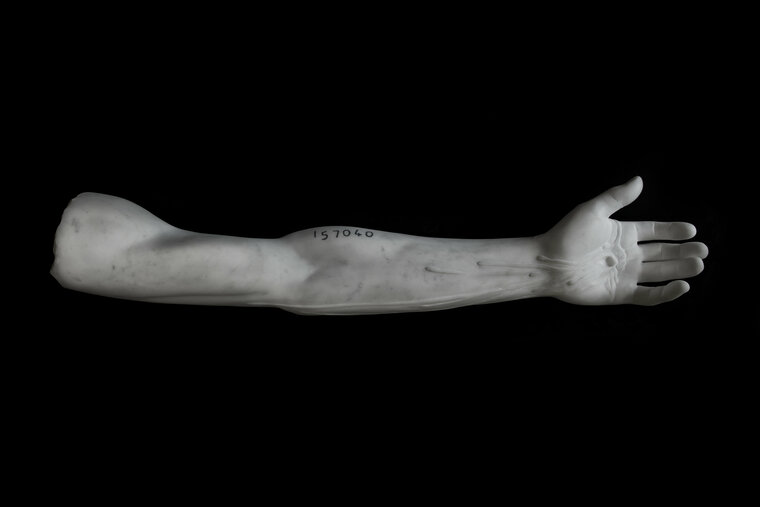
VISUAL MEDITATION: “Golgotha, Auschwitz, and the Problem of Evil” by Victoria Emily Jones: Last month for ArtWay I was asked to write about Emma Elliott’s Reconciliation, a sculpted marble arm that bears both a nail wound of Christ from his crucifixion and the number tattoo of Holocaust survivor Eliezer Goldwyn (1922–2017).

Elliott, Emma_Reconciliation
Emma Elliott (British, 1983–), Reconciliation, 2016. Carrara marble, 20 × 110 × 25 cm.

+++

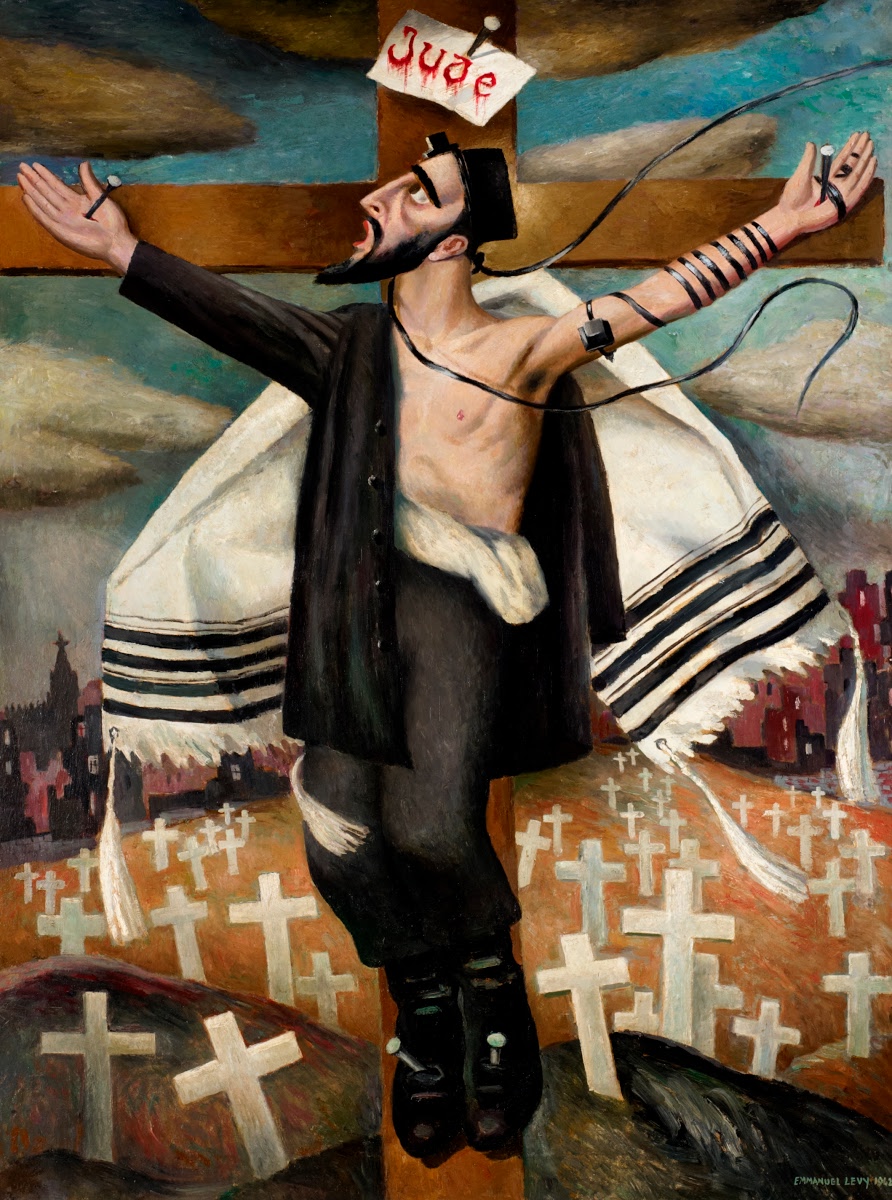
ESSAY: “The church’s reception of Jewish crucifixion imagery after the Holocaust” by Andrew Williams, AGON 48 (Winter 2015): Can Jews create Christian art? “I seek to revisit this question by examining the ways in which Jewish artists have made reference to the central symbol of the Christian faith, the crucifixion, and consider the ethical and theological horizons they open up for the church. . . . Given its place as a symbol of oppression within Judaism, and in particular its integration with the swastika during the years of Nazi power, its widespread adoption within a Jewish artistic vocabulary is remarkable.” Williams discusses “how the resulting christological imagery has been freighted with meaning connected with collective suffering, personal grief and divine abandonment.”

Levy, Emmanuel_Crucifixion
Emmanuel Levy (British, 1900–1986), Crucifixion, 1942. Oil on canvas, 102 × 78 cm. Ben Uri Gallery, London.

Jacob Epstein, Marc Chagall, Emmanuel Levy, RB Kitaj, Mauricio Lassansky, Abraham Rattner, Samuel Bak, Mark Rothko, Barnett Newman, Adi Nes, and Seymour Lipton are among the artists engaged in this illustrated essay. The author provides an extensive bibliography if you’d like to learn more. I also want to remind you of the excellent exhibition catalog essay “Behold the Man: Jesus in Israeli Art” that I shared back in 2017.

+++

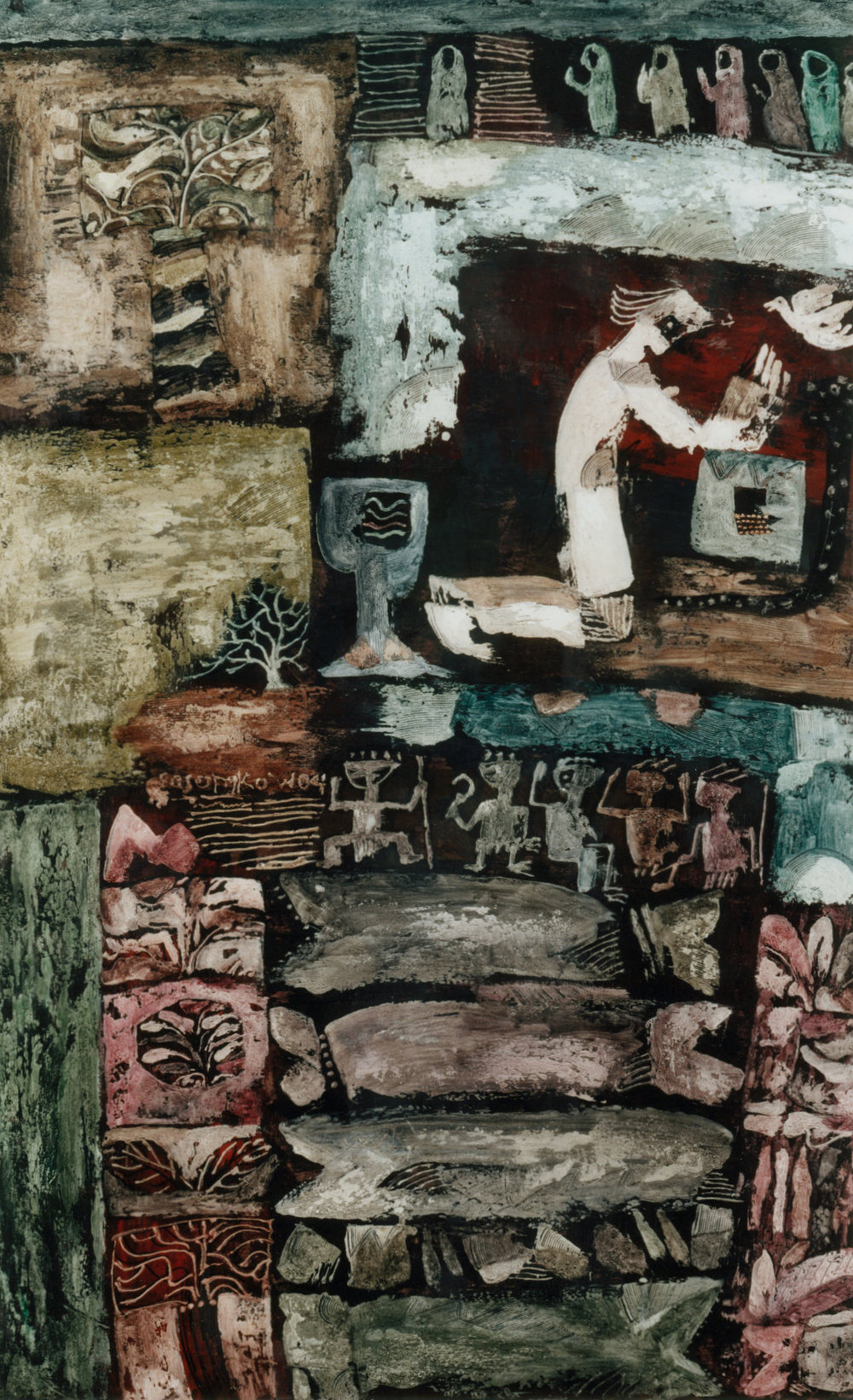
UPCOMING VIRTUAL EVENT: Studio Talk with Indonesian Artist Wisnu Sasongko, April 28, 2022, 8:30 a.m. ET: Organized by the Overseas Ministries Study Center at Princeton Theological Seminary, where Sasongko [previously] served as artist in residence in 2004–5. Cost: $15. Read the artist’s bio and see a sampling of his work at https://omsc.ptsem.edu/artist-sasongko/. There’s also a catalog of his paintings you can buy.

Sasongko, Wisnu_Gethsemane
Wisnu Sasongko (Indonesian, 1975–), Last Night in Gethsemane, 2005. Acrylic on canvas, 48 × 34 in.

+++

ESSAY: “The Christian Art Scene in Yogyakarta” by Volker Küster: Published June 27, 2012, by Protestantse Theologische Universiteit (Protestant Theological University) in Kampen, Netherlands, this essay spotlights five Indonesian artists whose work culturally contextualizes the Christian story: Bagong Kussudiardja [previously], Hendarto, Hari Santosa, Dopo Yeihan, and Wisnu Sasongko. Küster provides biographical information on the artists, including their religious backgrounds (most are converts from Islam), and discusses three paintings by each, all of which are reproduced in full color.

Want to read more by Volker Küster? His chapter on “Visual Arts in World Christianity” in The Wiley Blackwell Companion to World Christianity is excellent, and some of it is available in the Google Books preview. See also his book The Many Faces of Jesus Christ: Intercultural Christology (Orbis, 2001).

+++

ART VIDEO: “Caravaggio’s Taking of Christ (Great Art Explained): In 2020 art writer and gallerist James Payne launched the YouTube video series Great Art Explained, consisting of fifteen-minute videos that each explore a single historically significant artwork. Here’s one he did on an extraordinary painting of Caravaggio’s from the collection of the National Gallery of Ireland, which shows Judas’s betrayal of Christ in Gethsemane.

Walking the Via Dolorosa through Amsterdam (Part 1)

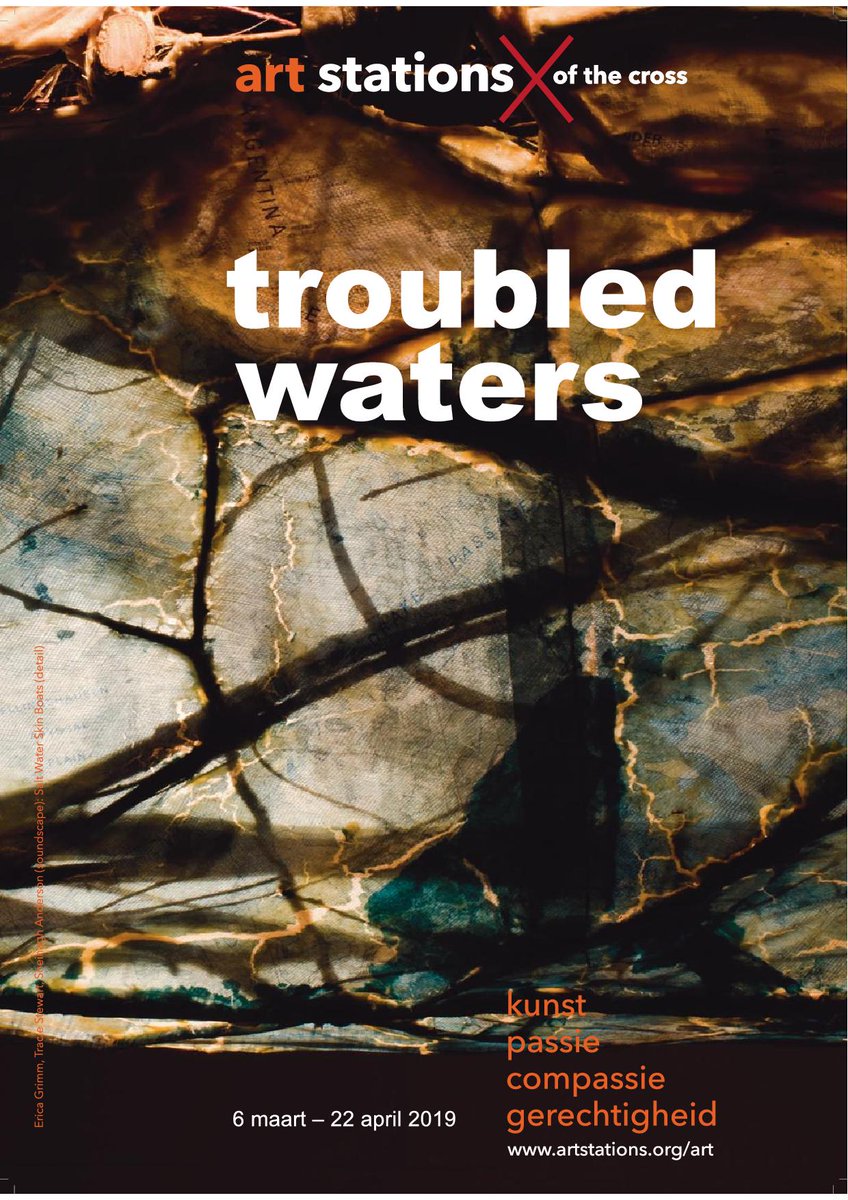
Last month I undertook a contemporary art pilgrimage through Amsterdam, curated by Marleen Hengelaar-Rookmaaker and Anikó Ouweneel-Tóth under the aegis of Art Stations of the Cross, a project founded in 2016 by Dr. Aaron Rosen and the Rev. Dr. Catriona Laing. (Previous city-specific editions have been in London; Washington, DC; and New York.)

Inspired by the traditional Stations of the Cross, the pilgrimage comprises fifteen stops at thirteen locations across the city, where participants are invited to spend time before a specially chosen contemporary artwork that addresses some form of human or environmental suffering. The route starts at the Basilica of Saint Nicholas (Amsterdam’s patron saint) just across from the train station and weaves through, among other places, a park, the old Jewish quarter, a former orphanage, a church-cum–rock concert hall, a hidden house church where persecuted Catholics used to worship, and the red-light district, ending inside the Oude Kerk (Old Church), the city’s oldest extant building, located right in the heart. Not only the art but also the sites themselves were selected with intention, each one a part of the journey down this via dolorosa, “way of sorrows.”

This was my first time to Amsterdam, and it was such a good way to see the city, learn about the city, and pray for the city—all through the agent of art, which functions in this experience as a series of visual laments. When I encounter suffering or read about it in the news, I am often at a loss for how to bring it before God in prayer. I feel its heaviness but lack the words to express that feeling or to intercede in any concrete way. That’s why I’m so appreciative of artists, whose work so often becomes, for me, a nonverbal prayer addressed to my Maker, as I behold and internalize what the artist has first beheld and internalized and has then shared with me through whatever their medium. This is a gift that artists offer the church: vision, long and deep, that’s sensitive to the glories but also the woes of the world and that invites others in, through the skillful crafting of materials, to see right along with them. That act of seeing—of noticing, of giving attention to—can itself be prayer.

Troubled Waters

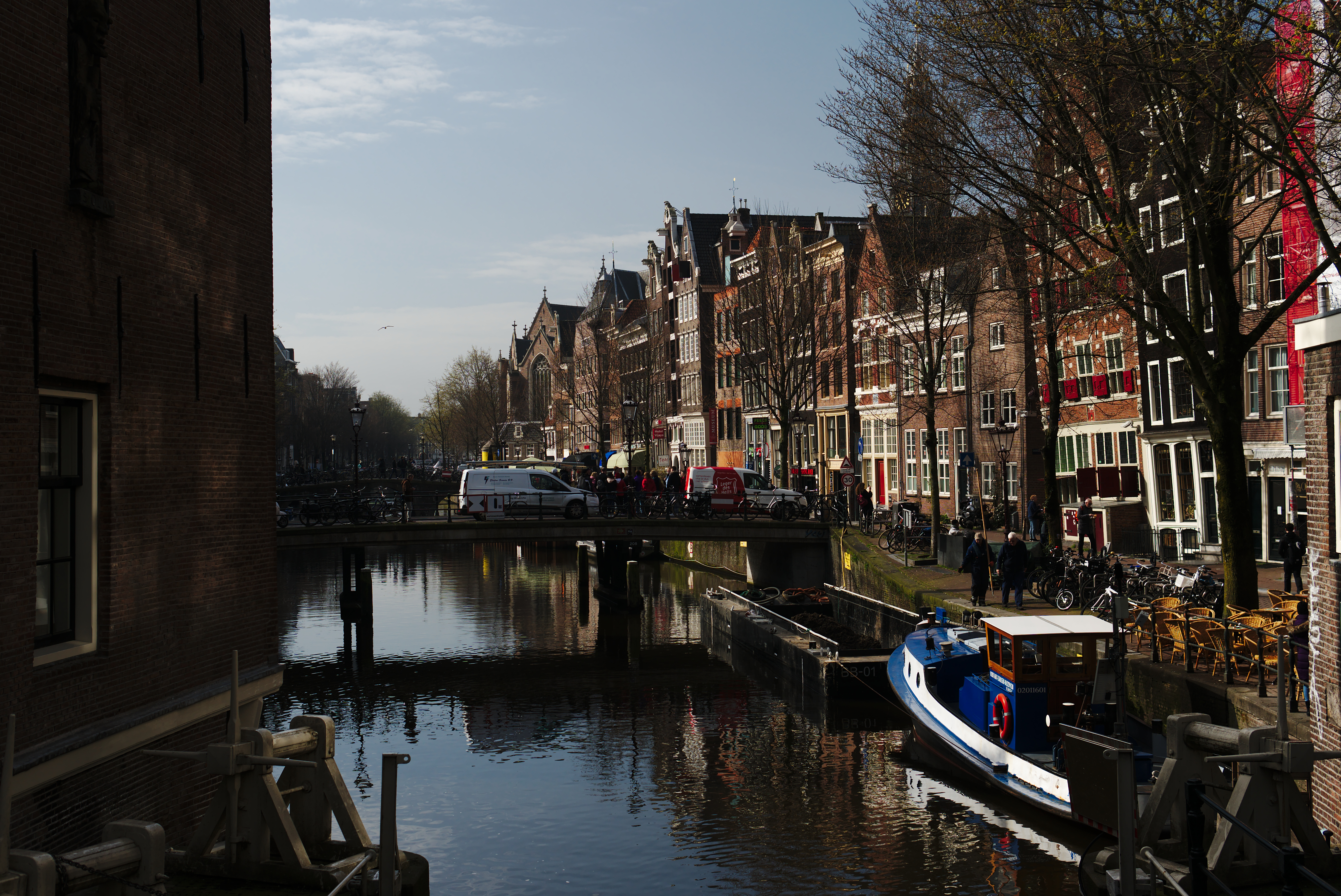
Amsterdam was founded as a fishing village at the end of the twelfth century with the building of a dam on the Amstel River. (The name Amstelledamme later evolved into Amsterdam.) Its sixty-plus miles of interconnected canals have earned it the nickname “Venice of the North” and make it the most watery city in the world. These navigable waterways led to Amsterdam becoming, in the seventeenth century, the foremost maritime and economic power in the world, and the wealth that came through international trade also enabled the arts and sciences to flourish throughout the country; that’s why the seventeenth century is known as the Dutch Golden Age. (Think Rembrandt and Vermeer.)

Amsterdam canal

The exhibition’s subtitle, Troubled Waters, alludes to the fraught nature of Amsterdam’s identity as a historic port city into which both goods and people travel. The pioneering Dutch East India Company, an amalgamation of trading companies that is now defunct, is important in global business history as the forerunner of modern corporations, but it also cannot be separated from its involvement in the slave trade. Although slavery was formally abolished in the Netherlands in 1863, it continues in Amsterdam’s sex industry, in which a percentage of workers are victims of human trafficking; girls and women sometimes arrive in shipping containers, enslaved by pimps and even further by ignorant customers.

Other residents of Amsterdam arrive as refugees, and for many of them, water is a formidable danger that must be traversed on the way to safety.

“Troubled waters” also references the acidification, pollution, and rising temperatures of the world’s oceans, which endanger the many marine species that live there. So even the water itself bears wounds.

Although the overall tone of the pilgrimage is one of sorrow, pockets of hope are dispersed throughout, as in the empowered Surinamese painted by Iris Kensmil (station 5), Paul van Dongen’s Rising drawing that counterbalances his Judgment (station 7), Janpeter Muilwijk’s afterlife vision of his dead daughter victoriously bounding over the earth (station 9), the soothing “streams of mercy, never ceasing” that provide an auditory accompaniment to Anjet van Linge’s chiseled “Kyrie eleison” (station 12), and, of course, the inclusion of a resurrection station (station 15).

(Related posts: “Stations of the Cross at the Smithsonian American Art Museum”“Remembering Charleston”)

Though modeled loosely after a medieval devotional practice, Art Stations of the Cross: Troubled Waters is thoroughly modern, incorporating audio and video components, 3-D technologies, and the distinctively contemporary genre of installation art. Figurative art is still present and in some cases interacts with the traditional religious images in its environs, but it often does so transgressively—for example, the photorealistic Madonna and Child wrapped in emergency blankets in station 1 and the decapitated corpus of Christ in station 13.

For more information about Art Stations, which runs through April 22, visit http://www.artstations.org/. There you can find a map, opening times, descriptions, tie-in events, and information on where you can purchase a catalog (available in Dutch or English). Most stops along the route host a stack of brochures that condense this info and that contain a stamp card on the back, where you can mark off the stations you’ve visited. All the exhibition sites are freely accessible. (Oude Kerk waives its admission fee if you present your Art Stations brochure at the entrance desk.)

Below and in two subsequent posts, I will share some of my photos and impressions of each station. Unless otherwise specified, all photos are by my husband, Eric James Jones, and are the property of ArtandTheology.org. Feel free to use them noncommercially, with credit to the artists and a link back to this webpage.

+++

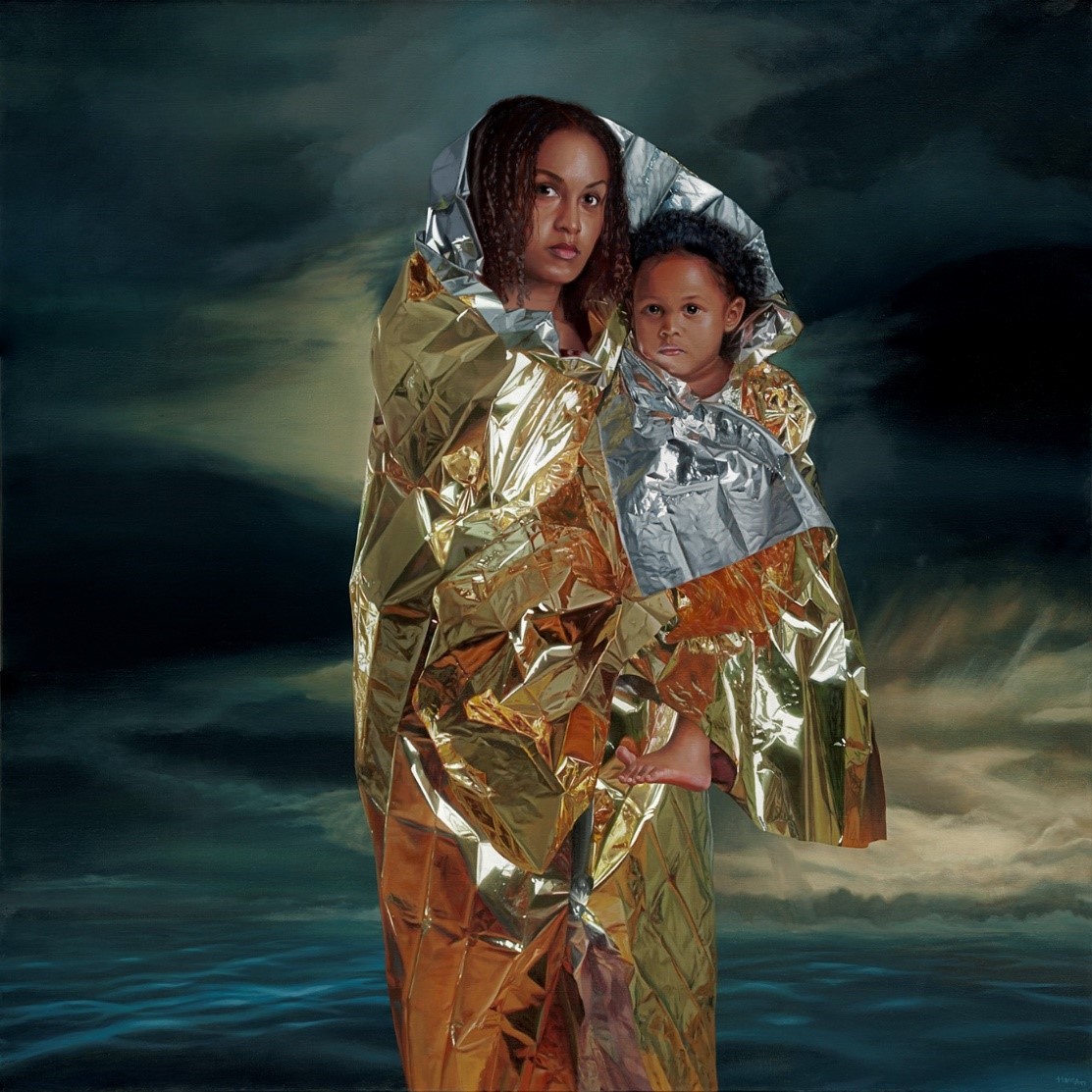
Madonna del Mare Nostrum by Hansa
Hansa (Hans Versteeg) (Dutch, 1941–), Madonna del Mare Nostrum, 2017. Oil on canvas, 125 × 125 cm. Photo courtesy of the artist.

STATION 1. The route starts at the neo-Baroque Church of St. Nicholas, which temporarily houses one of my favorite and arguably the most confrontational of all the works on the tour: Hans Versteeg’s Madonna del Mare Nostrum: Of, Mantel der Liefde (Our Lady of the Mediterranean Sea: Or, Cloak of Love). A young dark-skinned mother holds her toddler son, both of them wrapped in a thermal blanket like the ones given to refugees to prevent hypothermia. Replacing Mary’s traditional ultramarine robe with a “robe” of metallized polyethylene terephthalate, whose gold surface glints in the sun, emphasizes how she and her boy are clothed not only in holiness but also in need. Because of how the artist chose to frame the composition, we don’t know if the figures are standing in a boat that’s still at sea or on the shore. Regardless, their strongly frontal positioning and their direct stares seem to ask the viewer, “Will you receive us?”  Continue reading “Walking the Via Dolorosa through Amsterdam (Part 1)”