Roundup: Restful Advent; preparing the way; walking with the Holy Family

ADVENT SERIES: Restful Advent by Tamara Hill Murphy: Tamara Hill Murphy [previously] is one of my favorite spiritual writers, her thoughtful words and curation of resources having served as a well of inspiration for me over the years. Each year, similar to Art & Theology but with the sensibilities and expertise of an Anglican spiritual director, she publishes a new daily Advent and Christmastide guide through her Substack, Restful, running this year from November 30 to January 5. Each post in the series includes lectionary readings, art, music, a prayer, and a simple practice to help us notice God’s presence during these waiting days. This time around, the Daybook will feature excerpts from Claude Atcho’s new book Rhythms of Faith along with ideas from The Liturgical Home by Ashley Tumlin Wallace and some of my own formerly published art commentaries.

“The Daybook is a way to pay attention to Christ’s three arrivals—then, now, and still to come—and to walk through December with a quieter heart and a stronger hope,” Murphy writes.

Murphy is offering Art & Theology readers a 50% discount to Restful using this link, which brings the subscription cost down to $4/month (let it run for two months if you want to receive the full Christmastide Daybook) or $32/year, which will give you access to her year-round content. The offer expires January 5, 2026.

+++

BLOG POST: “The Sacred Journey of Advent” by Ashley Tumlin Wallace, The Liturgical Home: “Advent,” writes Wallace, “is a season of preparation, for the coming of Christ at Christmas, and also for His return in glory at the end of time.” This is a great introduction to the season that kicks off the new church year.

+++

SONGS:

One of the scripture texts of Advent is Isaiah 40:3–5:

A voice cries out:
“In the wilderness prepare the way of the LORD;
    make straight in the desert a highway for our God.
Every valley shall be lifted up,
    and every mountain and hill be made low;
the uneven ground shall become level,
    and the rough places a plain.
Then the glory of the LORD shall be revealed,
    and all flesh shall see it together,
    for the mouth of the LORD has spoken.”

The Gospel-writers Matthew (3:3), Mark (1:3), and Luke (3:4) all see this exclamatory figure as John the Baptist, who told people to prepare for God’s coming by repenting of sin, since holding on tightly to ways of unlove erects barriers to God’s entry into one’s life. Here are two songs based on this Advent passage.

>> “Prepare the Way” by Maverick City Music and Tribl, feat. Chandler Moore and Siri Worku, on Tribl I (2021): This song repeats, again and again, the Advent mantra “Prepare the way,” embedding John the Baptist’s invitation deeply into hearts and minds. Its tag beseeches Christ to come with the fire of purging, the rain of refreshment, and the oil of blessing. To welcome this coming, this transformation and growth, we need to decenter ourselves, ceding to God the place of primacy, from which he works our good and his glory.

>> “Prepare the Way” by Christopher Walker, on Rise Up and Sing, 3rd ed., vol. 3 (2009): This 1991 song is by Christopher Walker, a church music composer, lecturer, and choral conductor originally from the UK but now living in Santa Monica, California. Published by OCP (Oregon Catholic Press), it would make a great song for a children’s Advent choir.

+++

2018 SERIES: Advent Caravan: Walking with the Holy Family by Sarah Quezada: I learned about Sarah Quezada’s work at the intersection of faith, justice, and culture through Tamara Hill Murphy (see first roundup item) in 2018, when Quezada published a five-part series reflecting on the likelihood that Mary and Joseph traveled to Bethlehem for the census not alone but in a caravan. Interweaving personal story, biblical interpretation, and current events, Quezada considers how the holy couple’s experience in the final months of Mary’s pregnancy connects to the reality of people on the move seeking hope, peace, joy, and love today.

While the series is not hosted online, I received permission from Quezada to reproduce it here.

On Instagram, Quezada also shared a photo of her friend’s Advent mantel, where she combined figurines from her various nativity sets to form a “caravan” of travelers.
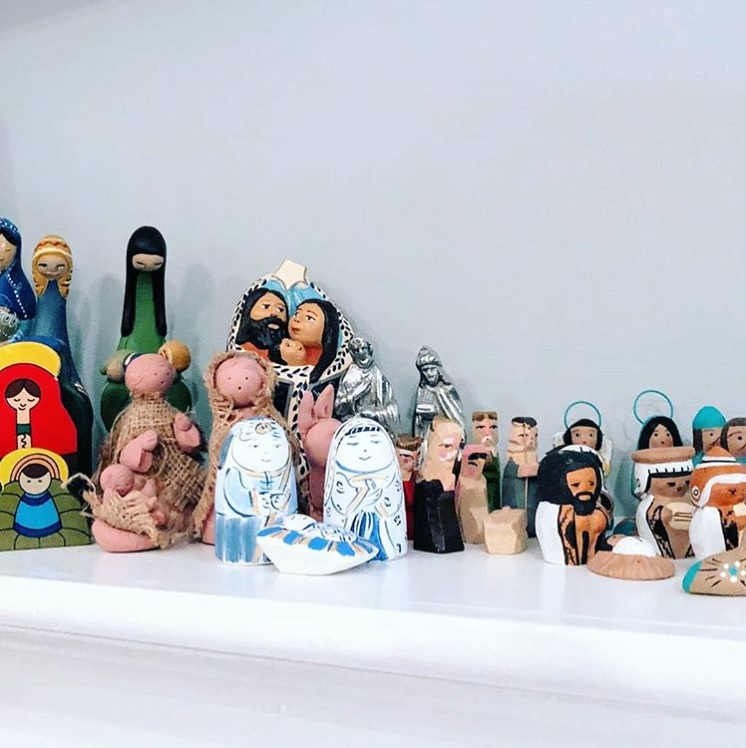
Advent caravan
Photo via @sarahquezada

+++

YOUTUBE PLAYLIST: Jouluradion Hoosianna: Jouluradio is a Finnish radio station that broadcasts annually from November 1 to January 6, playing all Advent and Christmas music. Since 2012, every year they premiere a new arrangement and video performance of the popular Scandinavian Advent hymn “Hoosianna” (Hosanna, an Aramaic expression meaning “Save now!”), which Lutheran and Catholic churches in Finland sing on the first Sunday of the season. Based on Matthew 21:9, its lyrics greet the approaching Christ, affirming his identity and craving the deliverance only he can bring:

Hoosianna, Daavidin Poika,
kiitetty olkoon hän!
Kiitetty Daavidin Poika,
joka tulee Herran nimeen.
Hoosianna, hoosianna,
hoosianna, hoosianna!
Kiitetty Daavidin Poika,
joka tulee Herran nimeen.
Hosanna, Son of David,
Most blessed Holy One,
Hosanna, Son of David,
Who comes in the name of the Lord!
Hosanna, hosanna, hosanna
In the highest!
Hosanna, Son of David,
Who comes in the name of the Lord!

This hymn was written by the German composer, educator, and piano and organ virtuoso Georg Joseph Vogler in 1795 while working in Sweden as court conductor as well as tutor to the crown prince Gustav IV Adolf.

The Jouluradio commissions, which the station has compiled in a YouTube playlist, encompass a range of genres, including jazz, hip-hop, choral, pop, and electronic. Below is a list of previous years’, of which I’ve embedded the two asterisked ones on this page. Jouluradio typically releases their annual “Hoosianna” the day before Advent, so 2025’s will likely be posted this Saturday. [HT: Gracia Grindal]

Advent, Day 6: That Holy Thing

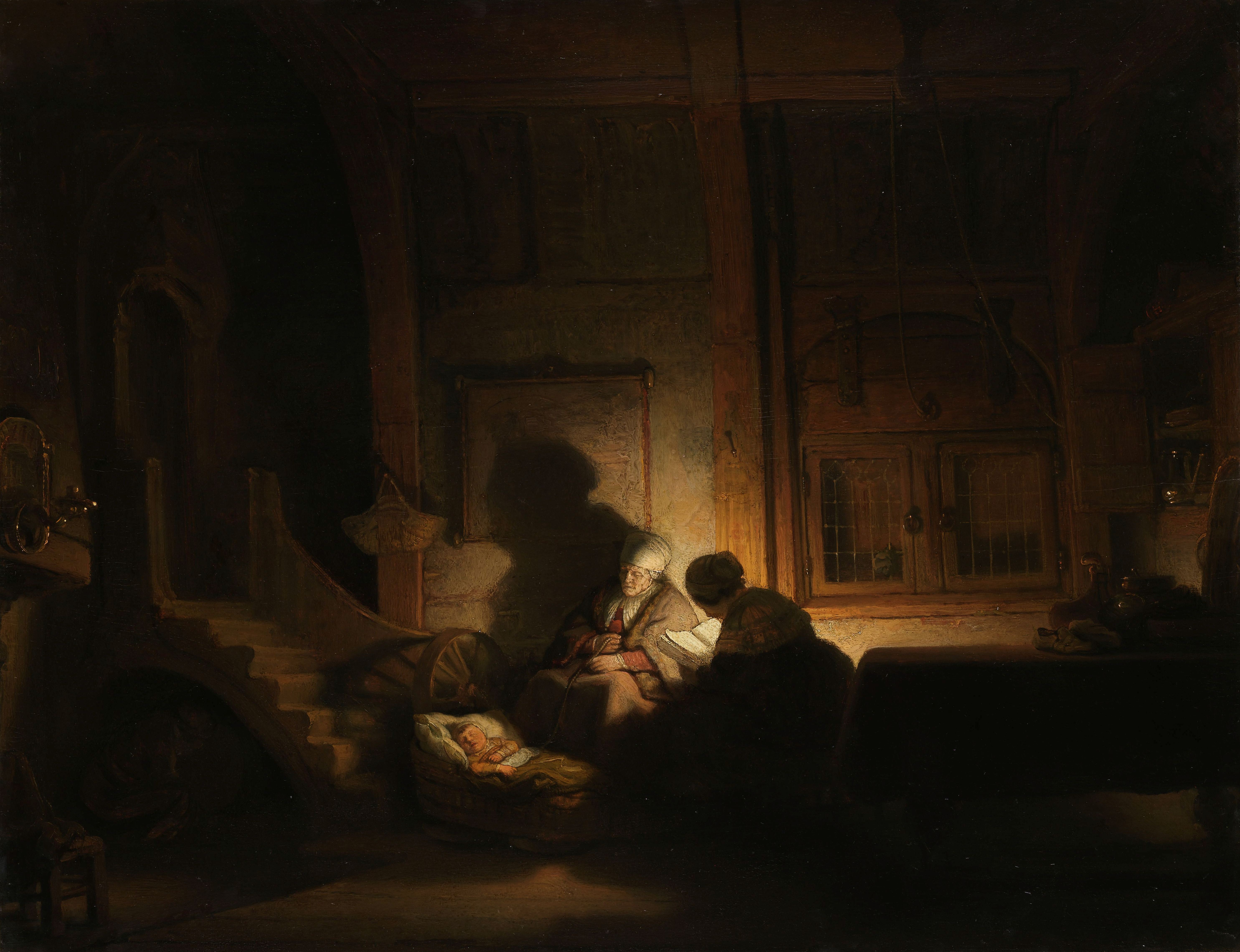
LOOK: Holy Family at Night (Rembrandt’s workshop)

Rembrandt (workshop)_Holy Family at Night
Workshop of Rembrandt van Rijn, Holy Family at Night, ca. 1642–48. Oil on panel, 66.5 × 78 cm. Rijksmuseum, Amsterdam.

During the Dutch Golden Age, the master artist Rembrandt van Rijn (1606–1669) ran a flourishing workshop in Amsterdam, overseeing the production of students’ paintings that continued the deep chiaroscuro and distinctive application of paint seen in his own work.

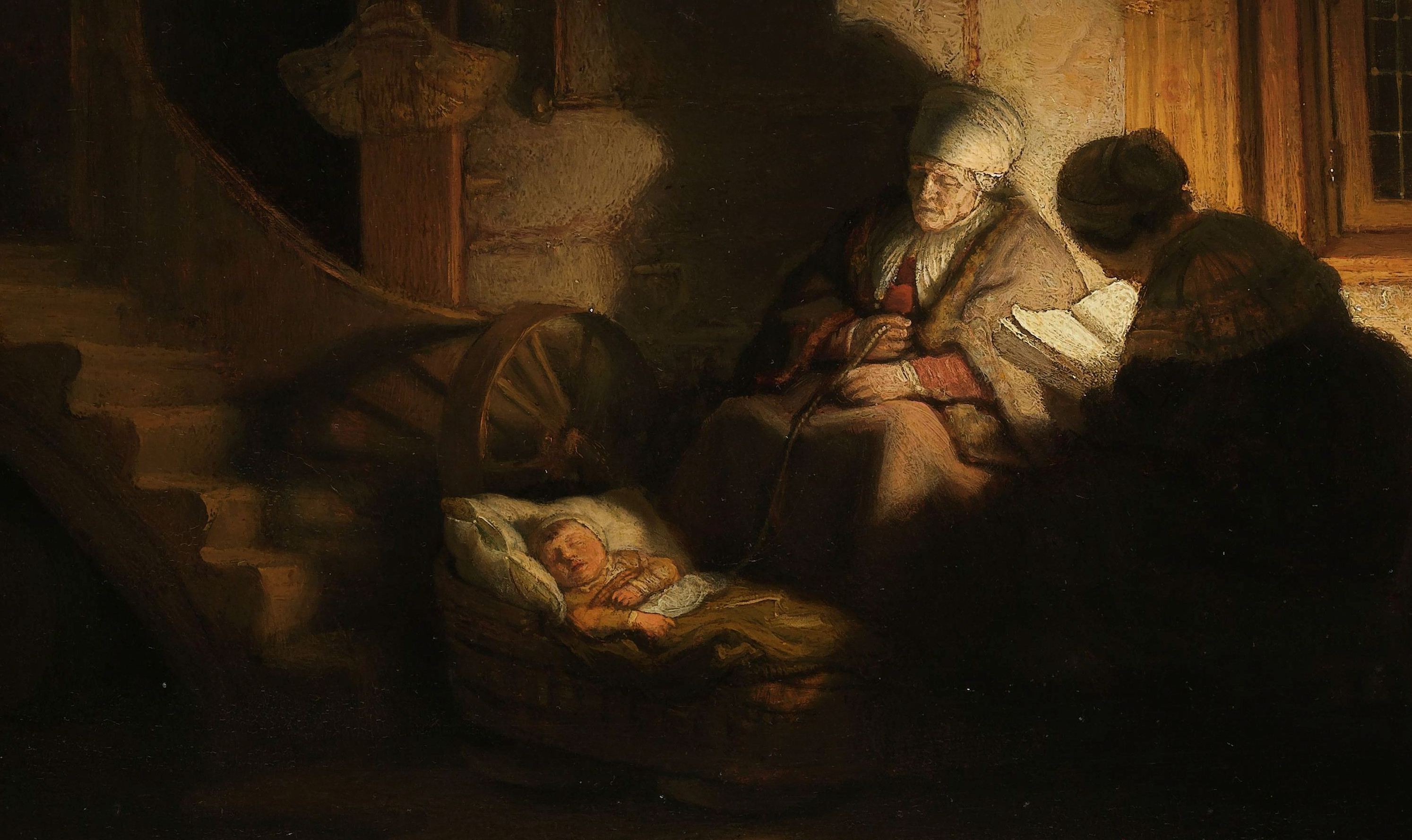
This painting from his workshop shows the Holy Family in a sparsely lit domestic interior at night. The Christ child lies asleep in a wicker cradle at the foot of a half staircase, his grandma Anne likewise nodding off as she rocks him gently with the cradle rope. Relieved by the quiet, Jesus’s mom, Mary, catches up on some reading, and Joseph taps liquid from a barrel on the left under the stairs (he’s very difficult to make out through the shadows).

This lived-in room is full of everyday objects from seventeenth-century Holland. Over the hearth on the left a copper candlestick holder is affixed to the wall. Behind Anne is a map, and beside her a spinning wheel, and a wicker basket hangs from the nail of a curved wooden beam. On the table to the right are a pair of old shoes, a flask attached to a leather belt, and a mortar and pestle, and a Jan Steen jug and other kitchenware are stored in the cupboard above. The shutters are drawn closed over the window. How utterly ordinary!

Although scholarly opinion since 1900 has identified the figures as biblical ones (the title is not the artist’s, as artists did not title their paintings at the time), for much of the painting’s history viewers interpreted it as simply a genre scene—that is, a scene showing regular people going about their daily lives. It lacks the “distinction, nobility, and loftiness” owed to biblical subject matter, it was believed, especially the Holy Family. There are no angels, no haloes. The only hint of sacredness is the pouring of light from a mysterious unknown source.

Rembrandt (workshop)_Holy Family at Night (detail)

But the ordinariness of the scene depicted is precisely what makes it so glorious. Jesus was born into a working-class family. For most of his life he labored as a carpenter, adopting Joseph’s trade. He wasn’t surrounded by lavish things. His upbringing looked much like that of all the other Jewish boys in Nazareth. That he was God incarnate would be revealed in time, to those who had eyes to see. But in the meantime, he cooed and pooed and cried and slept and fed and spit up like any other baby! And his mom was exhausted like any other mom, forced to sneak in some time for herself (including private devotional time, as she’s probably reading her Bible here) wherever she could, between childcare, chores, and other obligations.

That God chose to come to us as an ordinary human being born to an ordinary family (albeit conceived in an extraordinary way!) surprised everyone. The song that follows extends the surprise of the Incarnation into God’s other interventions in our lives, on a more personal scale. Just as he defied expectations in his first coming, so he often continues to surprise us in the ways he comes to us now—that is, not according to our own prescriptions, but down his “own secret stair,” when and where we’re least expecting it.

LISTEN: “That Holy Thing” | Words by George MacDonald, 1877 | Music by Katy Wehr, on In Others’ Words, 2008

They all were looking for a king,
To slay their foes, and lift them high:
Thou cam’st a little baby thing
That made a woman cry.

O Son of Man, to right my lot
Naught but thy presence can avail;
Yet on the road thy wheels are not,
Nor on the sea thy sail.

My how or when thou wilt not heed,
But come down thine own secret stair,
That thou mayst answer all my need,
Yea, every bygone prayer.

This song is a setting of a poem written by George MacDonald (1824–1905) in December 1877 and sent by letter to a handful of friends.* When it was first published in 1893 in the two-volume Poetical Works of George MacDonald, it was with this revised final stanza:

My fancied ways why shouldst thou heed?
Thou com’st down thine own secret stair;
Com’st down to answer all my need,
Yea, every bygone prayer!

The poem appears in the highly influential Oxford Book of English Verse (1900), compiled and edited by Arthur Quiller-Couch, but in its original form.

“That holy thing” is a translation of the Greek word hagios, which appears in Gabriel’s speech to Mary in Luke 1:35: “that holy thing which shall be born of thee shall be called the Son of God.” Educator Missy Andrews unpacks the poem:

In “That Holy Thing,” MacDonald meditates on man’s expectations and God’s will. In the first line of the poem, the poet remembers the first-century Jews who suffered under Roman occupation, waiting for the Messiah who would restore the throne of David to Israel. He acknowledges their plight and their expectation, contrasting it with what they in fact received. The baby Christ represented both a gracious answer to their need, and an immediate disappointment. He satisfied the deepest intentions of their prayer and Yahweh’s ancient prophecies, but frustrated their earthy expectations for geographic kingdoms and vindication. Not only that, but the baby King “made a woman cry.” This references not only the immediate suffering and travail of the Christ Child’s mother, Mary, but ultimately the suffering that would rend her heart when He himself was lifted high upon the cross in answer to their desperate prayer for triumph over their foes.

The poet notes that his own travails and petitions, his own desperate need of God’s intervening help, is denied in its immediacy as well. For, although the Son of Man’s own presence alone can help to “right the lot” of the poet, his coming is not visible by road or sea. In this way, MacDonald acknowledges that his own expectations, like those of his spiritual forebears, eclipse his ability to see the Lord’s coming in his own circumstances. He acknowledges the differences between God’s ways and man’s, in faith acknowledging that the Lord answers man in his own ways and times, keeping secret His approach, but stealthily accomplishing man’s every need, answering his every prayer through the mystery of incarnation. This incarnate Child, the Son of Man, replete with humanity and no stranger to suffering, suggests a remedy for all who wait and suffer.

Andrews is a founding director of CenterForLit, whose goal is “to bring readers face to face with the world’s best books so they can know themselves more fully as God’s creatures.” The center has a special emphasis on equipping parents to teach the classics to their kids.

The commentary above is excerpted, with Andrews’s permission, from the first post of twenty-five published in Advent 2015 for the CenterForLit’s “Literary Advent” blog series (which is excellent!). Andrews provides interpretations of poems by John Donne, Madeleine L’Engle, Gerard Manley Hopkins, T. S. Eliot, W. H. Auden, and more, combining literary analysis and theological reflection. You can enjoy Andrews’s series in print form with the book Wild Bells: A Literary Advent.

Kathryn Wehr, PhD, is a singer-songwriter whose most recent album, which leans folk rock in style, is And All the Marys: Women Encountering Christ in the Gospels (2018).

Besides being a musical artist, Wehr is also a scholar whose interests include theology and the arts, spiritual formation, and church history. Her specialization is the religious drama of Dorothy L. Sayers, and as such, she is the editor of the forthcoming book The Man Born to be King, Wade Annotated Edition (IVP Academic, 2023). In addition, she is the managing editor of Logos: A Journal of Catholic Thought and Culture at the Center for Catholic Studies at the University of St. Thomas in Saint Paul, Minnesota. 

* Thank you to the Special Collections & University Archives at Taylor University, through whose British Author Collections I discovered this earlier composition date for the poem, as well as an authoritative version of stanza 3 from MacDonald’s own hand. They provided me with a scan of one of MacDonald’s handwritten copies of “That Holy Thing” (Ref. ID 482), which contains the headnote “Written for my friends—Christmas, 1877.”

Christmas, Day 9

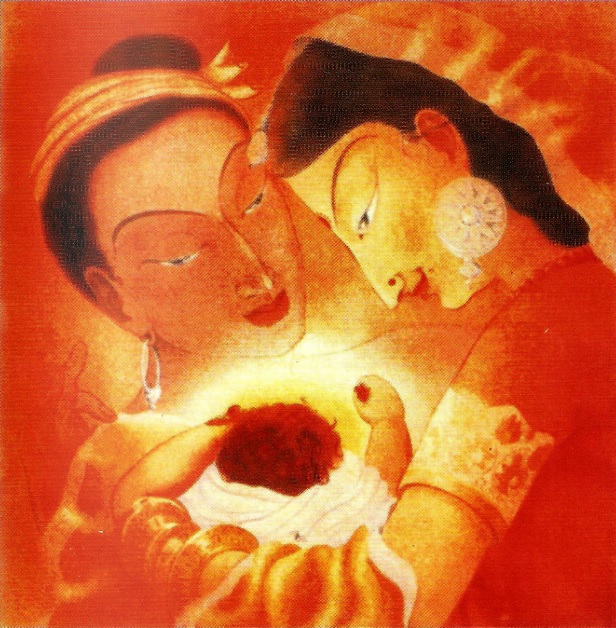
LOOK: Holy Family in Saffron by Frank Wesley

Wesley, Frank_Holy Family
Frank Wesley (Indian, 1923–2002), Holy Family in Saffron, ca. 1950. Watercolor, 21 × 16 cm. Gould Collection. Photo courtesy of the Asian Christian Art Association.

Frank Wesley [previously] was a fifth-generation Christian from North India who began painting biblical subjects in 1947 when the Christian Home Committee of the National Christian Council of India began licensing original images from him for their magazine, a relationship that lasted for decades. His initial training had been in commercial art, but from 1950 to 1952 he studied as a postgraduate at the School of Art in Lucknow under the Hindu artist Bireshwar Sen, kickstarting his fine-art career. The Lucknow school of watercolor painting, developed during the Bengal Renaissance in the first half of the twentieth century, is the style with which he is most associated, and which the above painting is representative of, with its graceful, calligraphic lines.

With the aid of an American patron, Wesley continued his art education at Kyoto Art University from 1954 to 1958, where he learned traditional and modern Japanese painting techniques, lacquer work, textile design, woodblock printing, and ink drawing, and in Chicago from 1958 to 1960, which included coursework at the Art Institute, where he learned about modern abstraction and how to work with oil paint.

Wesley returned to India in 1960 and, after a four-year courtship, married Athalie Brown, an Australian nurse working in a mission hospital in Azamgarh. They had two children. Seeking better opportunities, he emigrated to Australia with his family in 1973 and lived there until his death in 2002. Even in his new adopted country, he continued painting biblical scenes in an Indian style.

You can view thumbnails of other paintings by Frank Wesley at www.frankwesleyart.com. For better-quality reproductions along with more detailed biographical information, there’s the book Frank Wesley: Exploring Faith with a Brush by Naomi Wray (Auckland: Pace Publishing, 1993), but it’s out of print and difficult to find.

LISTEN: “Joseph Dearest, Joseph Mine” (original: “Josef lieber, Josef mein”) | Traditional German carol, 14th century (tune: RESONET IN LAUDIBUS) | English translation of verses by Percy Dearmer,* 1928; refrain translated by Edward T. Horn III, 1958 (from the carol “Long Ago and Far Away”) | Arranged and performed by Blue Water Highway on Christmastide, 2014

“Joseph dearest, Joseph mine,
Help me cradle the Child divine.
God reward thee and all that’s thine,
In paradise,” so prays the mother Mary.

He came among us at Christmastide,
At Christmastide, in Bethlehem;
Men shall bring him from far and wide
Love’s diadem: Jesus, Jesus,
Lo, he comes, and loves, and saves, and frees us!

“Gladly, dear one, Lady mine,
Help I cradle this Child of thine.”
“God’s own light on us both shall shine,
In paradise,” as prays the mother Mary.

All shall come and bow the knee;
Wise and happy their souls shall be,
Loving such a divinity as all may see
In Jesus, son of Mary.

Sweet and lovely, little one,
Princely, beautiful, God’s own Son,
Without thee all of us were undone;
Our love is won by thine, O son of Mary.

* Some sources cite Neville S. Talbot as the translator; I’m going with The Oxford Book of Carols, whose original 1928 edition, and subsequent ones, name Dearmer.

RESONET IN LAUDIBUS (Let the voice of praise resound) is a fourteenth-century German carol tune associated with a carol text of the same name as well as with “Josef lieber, Joseph mein.” The latter carol is from a medieval mystery play from Leipzig that survives in multiple manuscripts. It spotlights Joseph’s faithful presence and loving support during Christ’s infancy.

The original carol did not have a refrain; an unknown editor spliced that in from a different fourteenth-century German carol at some point, but it still often circulated with the verses only, including in the earliest English translations. In 1958, however, the American pastor Edward Traill Horn III (1909–1994) translated the refrain from German into English for incorporation into a new Christmas carol he wrote, “Long Ago and Far Away.” Blue Water Highway uses verses and refrain for their recording “Joseph Dearest, Joseph Mine.”

Find free sheet music here.

If you prefer choral music, I really like Kirke Mechem’s arrangement of the carol, from his Seven Joys of Christmas suite, as performed by the Stanford University Chamber Chorale and Orchestra under the direction of Stephen M. Sano.

See also the recording on Vaughan Williams: An Oxford Christmas (2021), where it appears under the title “Song of the Crib.”

Birth and death in Lavinia Fontana’s Holy Family painting

Renaissance artists often employed foreshadowing as a theological device in their paintings of Christ’s infancy to remind viewers that Jesus came not just to live a perfect life but to die an atoning death on behalf of sinners. Over all the joy and celebration of the Nativity looms the dark cloud of Crucifixion.

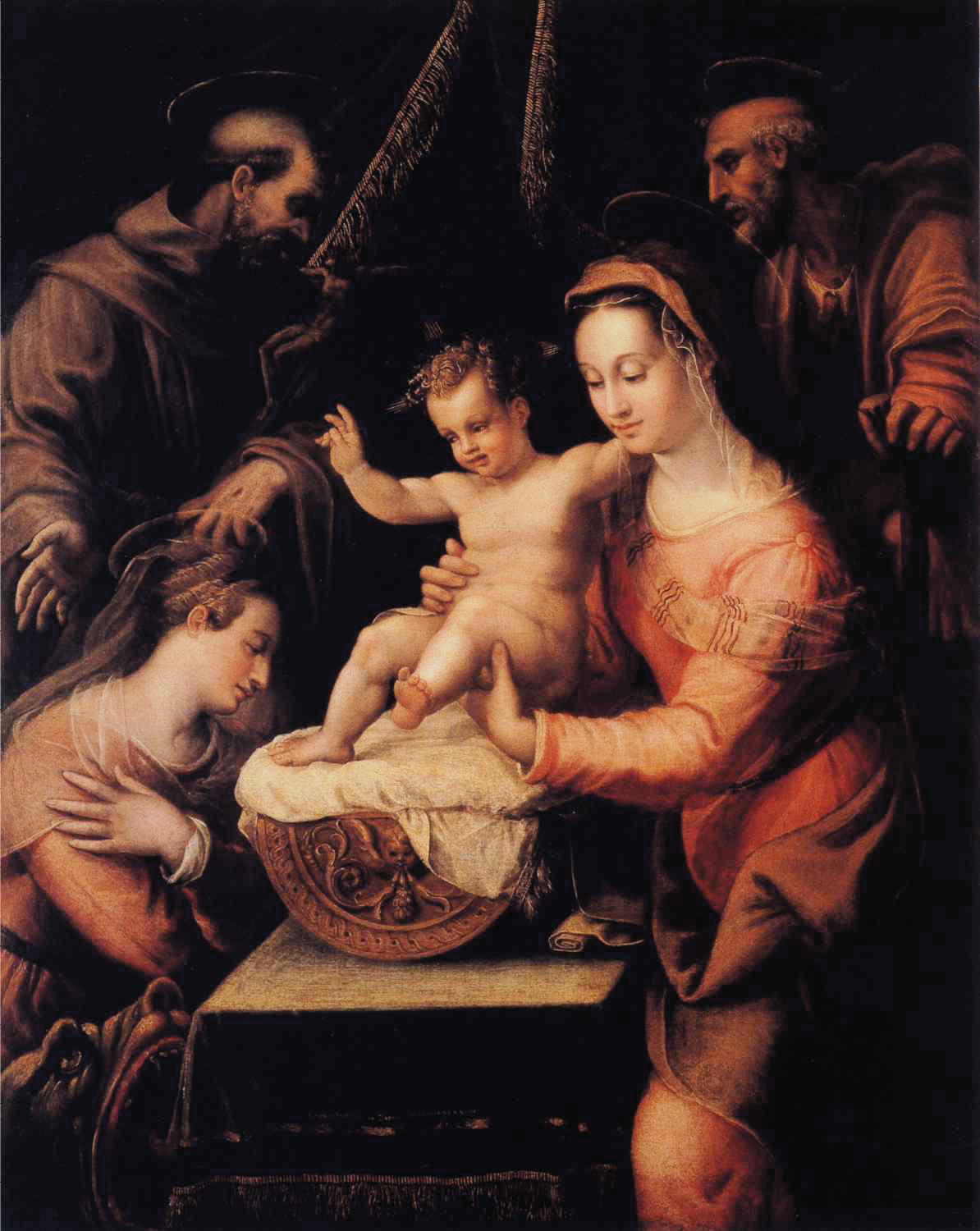
Holy Family with Saints Margaret and Francis by Lavinia Fontana (1552–1614)—one of the first professional female artists to achieve international fame—is one such work that’s embedded with signs of future death: a sarcophagus-like crib resting on an altar-like slab; Mary’s elevation of the body of Christ in a manner that recalls the priest’s raising of the host during the Eucharist; Francis’s cradling of a crucifix in his left elbow pit; and a curtain opening into darkness.

A year earlier, Fontana’s firstborn child died, so her bereavement may have partially inspired the painting.

Holy Family with Saints by Lavinia Fontana
Lavinia Fontana (Italian, 1552–1614), Holy Family with Saints Margaret and Francis, 1578. Oil on canvas, 127 × 104.1 cm (50 × 41 in.). Davis Museum, Wellesley College, Wellesley, Massachusetts.

[ZOOM IN]

The following commentary by Margaret A. Samu is taken from the 2001 exhibition catalog Divine Mirrors: The Virgin Mary in the Visual Arts (pp. 197–98):

In her Holy Family with Saints, Lavinia Fontana presents the Madonna in an intimate domestic scene. Mary tenderly places the infant Christ in a cradle as Joseph stands behind her; opposite them, Saints Margaret and Francis bow their heads in worship. At first glance, the painting appears to celebrate both Christ’s divine birth and the human joy of motherhood, yet its iconographical elements speak also of Christ’s death.

Fontana is widely considered to be the first professional woman artist, as she received numerous commissions for portraits and large-scale religious paintings and actually supported her family by her work. She painted the Holy Family just as her career was beginning to flourish. As an assertion of her arrival as an artist, the painting prominently bears her signature and the date: LAVINIA FONTANA DE ZAPPIS FACIEBAT MDLXXVIII. This signature not only allows us to date the painting with ease but also reveals something of the confidence of this artist, who signs her work like a master so early in her career. Unknown to Italian scholars before the 1990s, this painting has gained prominence in two recent exhibitions.

Like other artists of her period, Fontana responds to the artistic decrees of the Counter-Reformation by turning away from the excesses of the Mannerist style in which she had been trained. Instead, she uses linear perspective and foreshortening to create a realistic sense of spatial recession that clearly defines the setting. In addition, she gives her figures the modest dress and pious decorum that are appropriate to the painting’s religious subject matter. By creating a balanced, nearly symmetrical composition with strong upward diagonals, she emphasizes the centrality of Christ to the devotional image. The linking of her figures by gazes and graceful gestures shows that, like other Bolognese artists, she was influenced by the work of the High Renaissance artist Correggio. In order to succeed as a woman artist in a male-dominated art world, Fontana had to adhere scrupulously to the newly defined doctrines of the Church that arose out of the 1545–1562 Ecumenical Council of Trent.

The artistic verisimilitude of the painting would have made its iconography all the easier for contemporary viewers to read. Saint Margaret is recognizable by her attribute, the dragon that accompanies her. According to legend, she became the patron saint of women in childbirth after using her cross to deliver herself unharmed from the belly of the dragon that had swallowed her as a test of her Christian faith; she then asked women to call upon her for the safe delivery of their children. Bathed in a beatific light, Mary and Saint Margaret are fully absorbed in the present moment, worshipping and caring for the child who raises his plump hand in a babyish sign of blessing. Standing in shadowy gloom, the male saints appear unaware of the scene of maternal bliss before them. Somberly contemplating the crucifix, they are occupied not with the present, the infant Christ, but with his coming death on the cross. To emphasize the point, Saint Francis reveals the stigmata on his hands, miraculous signs of his communion with Christ’s suffering.

Yet the light and dark areas of the painting do not create an absolute division between present and future concerns. Saint Francis is also associated with Christ’s birth: credited with creating the first Nativity scene in an Italian grotto in the thirteenth century, he cradles the tiny crucifix in his arm like a mother holding a child. Mary, on the other hand, does not cradle the child near her but places him in a sarcophagus-like crib on a sacrificial altar table. She lifts his body like a priest raising the Host—the transubstantiated body of Christ—in the celebration of the Holy Eucharist.

Fontana’s inextricable merging of these signs of the birth, death, and resurrection of Christ may reflect her contemplation of the recent birth and subsequent death of her own first-born child in the year before she painted the Holy Family. As she depicts this theme of great personal significance, Fontana also establishes a connection between the divine and earthly planes: a holy subject takes on the real, everyday quality of a domestic scene, while an everyday scene of motherhood is lifted to a sacred level.