A Blessing for Those Who Hate and Hurt

Pena Defillo, Fernando_The Offering
Fernando Peña Defilló (Dominican, 1928–2016), La ofrenda (The Offering), 1993. Oil and acrylic on canvas, 126 × 166 cm. Private collection. Source: Latin American Art in the Twentieth Century, ed. Edward J. Sullivan (Phaidon, 1996), p. 110.

May those whose hell it is
To hate and hurt
Be turned into lovers
Bringing flowers.

—Shantideva, eighth century

These lines are from chapter 10, stanza 9, of the Bodhicharyavatara (Way of the Bodhisattva), a Mahayana Buddhist text by the eighth-century Indian monk Shantideva. I first encountered this religious classic, originally written in Sanskrit, while working at Shambhala Publications. The excerpt above was adapted by author David Richo from a translation by the Padmakara Translation Group. Here’s 10.9 in full, as translated by PTG:

May the hail of lava, fiery stones, and weapons
Henceforth become a rain of blossom.
May those whose hell it is to fight and wound
Be turned to lovers offering their flowers. [source]

Other translations include those by Stephen Batchelor—

May the rains of lava, blazing stones, and weapons
From now on become a rain of flowers,
And may all battling with weapons
From now on be a playful exchange of flowers. [source]

—and Fedor Stracke:

May the rain of leafs, embers, and weapons
Become forthwith a rain of flowers.
May those cutting each other with knives
Forthwith throw flowers for fun. [source]

I am so struck by this short benediction that prays our hate be transformed into love, our hardness into softness, our cold, sterile weaponry into delicately petaled, fragrant blooms. Shantideva recognized that when we lash out in physical or verbal violence, we create a hell that’s all our own. We may intend to inflict suffering on another, but in doing so, we often wound ourselves—psychologically, spiritually. When we dehumanize others, we become less human.

Instead of hurling rocks, punches, bullets, or insults, what if we were to completely confound our enemies by offering them words or tokens of love? Love is the way of the bodhisattva, the “enlightened being.” It’s the way of Jesus—he who said, “Love your enemies; do good to those who hate you; bless those who curse you; pray for those who mistreat you” (Luke 6:27–28).

Loving people doesn’t mean we can’t be angry at them—but we cannot allow our anger to fester into bitterness and ill will or to explode in harmful outbursts. It should be a productive anger.

How might we use an ethic of love to direct our anger or somebody else’s toward a good end, to defuse a contentious situation? Not taking the easy way out by simply ignoring or retreating from a problem, but confronting our opponent in peaceful, creative, and potentially transformative ways?

I’m reminded of the historic Pulitzer Prize–nominated photograph Flower Power, taken by Washington Star photojournalist Bernie Boston on October 21, 1967, when he was covering an antiwar march on the Pentagon. As the 503rd Military Police Battalion formed a semicircle around demonstrators to prevent them from climbing the Pentagon steps, Boston captured eighteen-year-old George Edgerly Harris III, aka Hibiscus, placing a carnation into the barrel of an M14 rifle held by one of the soldiers. What a powerful image!
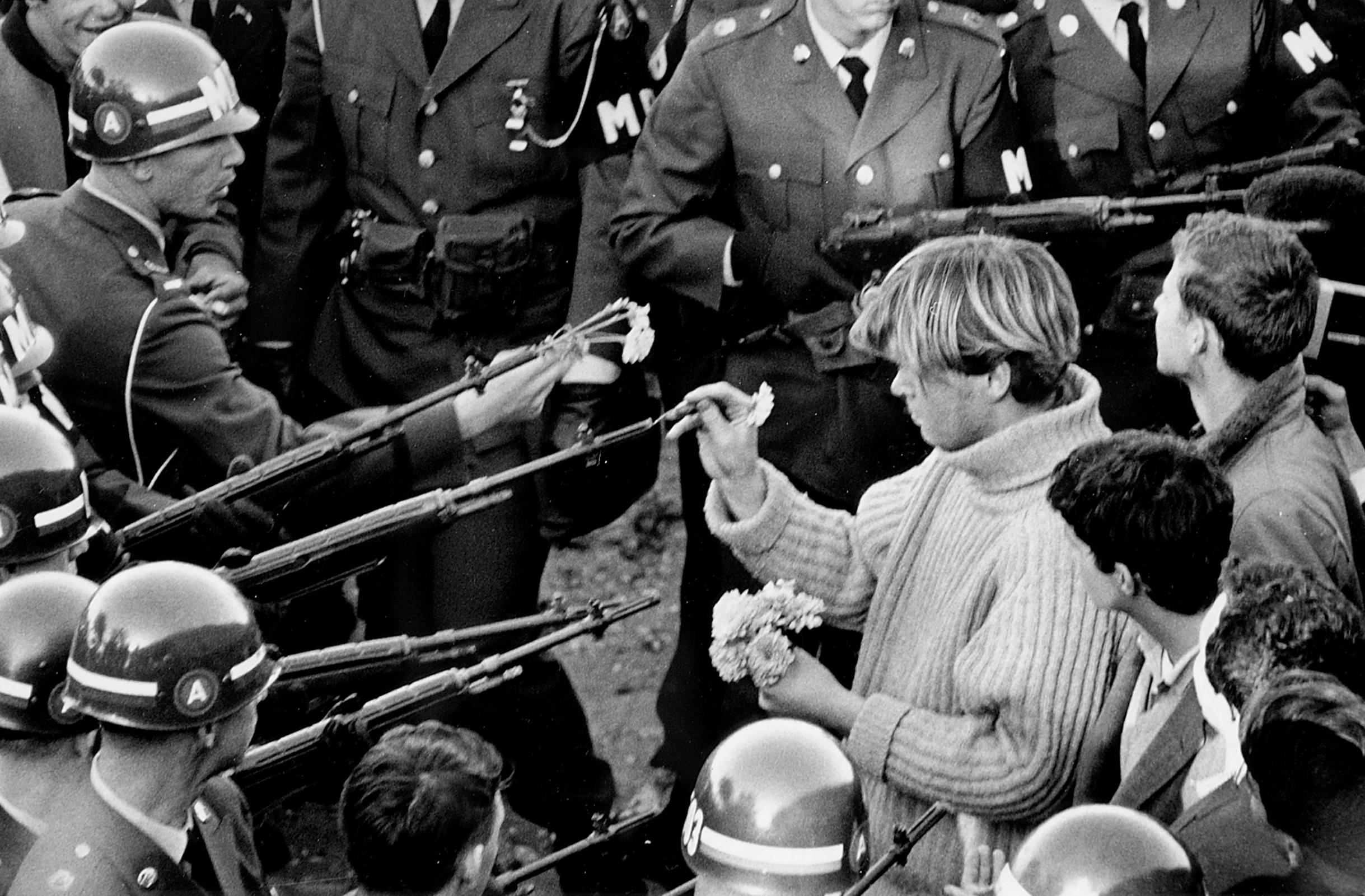
Flower Power
Bernie Boston (American, 1933–2008), Flower Power, Arlington, Virginia, 1967

Two years earlier in his essay “How to Make a March/Spectacle,” Allen Ginsberg was the first to expound on the potency of flowers as a spectacle to simultaneously disarm opponents and influence thought. He said “masses of flowers” should be handed out on the front lines of protests to police, the press, and onlookers as a symbol of nonviolent advocacy. He also suggested candy bars and toys.

Artist Scott Erickson seems to have drawn on Boston’s Flower Power photograph in his visual interpretation of Isaiah 2:4, Swords into Plowshares, which shows a sprig of foliage growing out of the barrel of a pistol, oriented upward like a vase. Its deadly power mocked and reversed, the gun releases a benign projectile that attracts and nourishes rather than strikes fear.
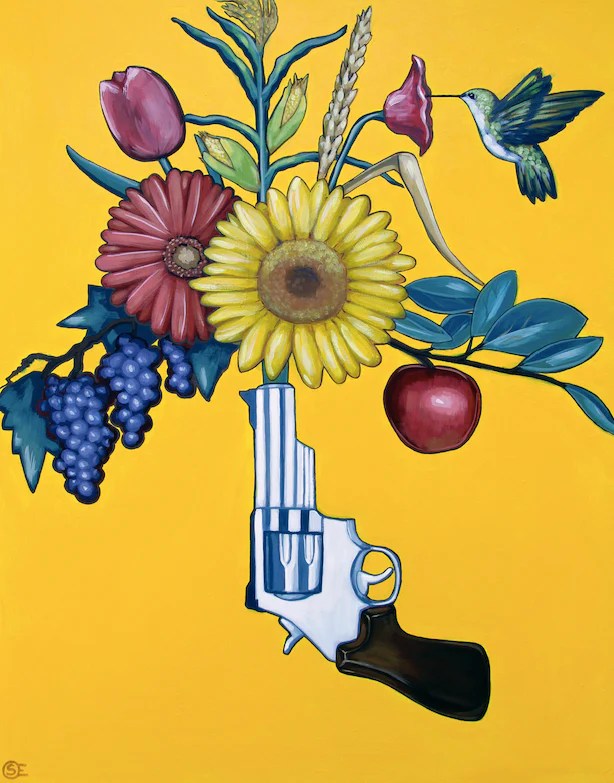
Erickson, Scott_Swords into Plowshares
Scott Erickson (American, 1977–), Swords into Plowshares, 2016 [purchase a reproduction]

The evocative Bible verse on which this painting is based prophesies a day when all the nations “shall beat their swords into plowshares, and their spears into pruning hooks”—a poetic way of describing the cessation of violence, as tools of destruction are transformed into gardening tools.

Christian activist Shane Claiborne has been instrumental in helping me see the immense beauty of Isaiah’s visions of the eschaton—he has worked with RAWtools to decommission firearms and literally forge them into shovels, spades, and other life-giving implements!—along with the holy foolishness of the gospel and all that implies. Before becoming a leader of the new monasticism movement, Claiborne went to circus school, and he has often put that training to use on the streets of Philadelphia where he lives. In his first book, The Irresistible Revolution: Living as an Ordinary Radical (2006), he writes,

Whenever there is a fight on our block, my first instinct is to run inside and grab our torches and begin juggling them, to upstage the drama of violent conflicts in our neighborhood. Perhaps the kids will lose interest in the noise of a good fight and move toward the other end of the block to watch the circus. I truly believe we can overwhelm the darkness of this world by shining something brighter and more beautiful. (285)

He has also written about Jesus’s “triumphal” entry into Jerusalem as a theatrical parody of power: he rode in on a dinky donkey instead of a warhorse, showing a much different alternative to the military might of empires. (“Imagine the president riding a unicycle in the Fourth of July parade”! Jesus for President, p. 122) And then on the cross, Jesus made a spectacle of human violence. In exchange for taunts and blows, he gave forgiveness, a metaphorical bouquet.

Banksy_Rage, Flower Thrower
Banksy, Rage, Flower Thrower, 2005. Mural, Beit Sahour, Palestinian Territories. Photo: Eddie Gerald / Alamy Stock Photo.

The UK-based street artist Banksy draws on the association of flowers with love and peace and their playful ability to disrupt violence in his mural Rage, Flower Thrower, which debuted on the West Bank wall in Israel-Palestine. Nathan Mladin, a researcher for Theos think tank, wrote about this artwork for the Visual Commentary on Scripture’s Logics of Reversals exhibition:  

With a balaclava drawn over his face, the young protester is shown leaning back, as though braced to hurl a Molotov cocktail. But instead of a weapon, he wields a flower bouquet, the only coloured element in this otherwise monochrome work. We expect an act of aggression—all other elements of the mural suggest imminent violence—but instead we are offered a call to peace. . . . Theologically construed, the mural hints at the eschatological terminus of violence.

The absurd juxtaposition of flowers and violence is employed too by Lithuanian artist Severija Inčirauskaitė-Kriaunevičienė, who embroiders floral patterns onto antique soldiers’ helmets sourced from various countries, and Natalie Baxter of Lexington, Kentucky, whose Warm Gun series comprises over one hundred quilted stuffed guns, “droopy caricatures of assault weapons,” she says, “bringing ‘macho’ objects into a traditionally feminine sphere and questioning their potency.”


Incirauskaite-Kriauneviciene, Severija_Kill(ed) for Peace
Severija Inčirauskaitė-Kriaunevičienė (Lituanian, 1977–), from the series Kill(ed) for Peace, 2016. Antique soldier’s helmet, cotton, cross-stitch embroidery, drilling, and industrial needle punching, 30 × 22 × 21 cm. Private collection, Latvia.

Baxter, Natalie_Rose to the Occasion (Warm Gun)
Natalie Baxter (American, 1985–), Rose to the Occasion, from the Warm Gun series, 2016. Fabric and polyfill, 15 × 42 × 3 in.

Another artistic example of overcoming brutality with gentleness can be found in the climactic battle sequence from Disney’s animated classic Sleeping Beauty (1959). As Prince Phillip escapes from Maleficent’s dungeon with the aid of the three good fairies, Maleficent’s goons shoot arrows at him—but Flora transforms them by magic into flowers, which fall innocuously about his booted feet. (The animation is by Dan McManus.)

Sleeping Beauty arrows

Flora’s other enchantments include turning launched boulders into soap bubbles and a curtain of boiling water, tipped from a cauldron over a doorway, into a rainbow. Each of these deflective maneuvers involves the transformation of something threatening into something whimsical. While they do not ultimately deter the villain from her murderous rampage, and alas, Phillip conquers evil with a sword (albeit the Sword of Truth—there’s metaphor at play here), Flora’s few creative interventions at the outset of the battle assert an attractive counterethic that we would do well to embrace.

I need the dreams of Isaiah and the prayers of Shantideva, I need the ridiculous street theater of Hibiscus and Shane Claiborne and the activist blacksmithing of RAWtools, I need Banksy’s murals in zones of conflict and other subversive art, I need fairy tales from writers and animation studios, to help me relinquish my hate and imagine wholesome new ways of engaging my enemies. Most of all, I need Christ’s vibrant, upending gospel embedded more deeply in my heart, and the Holy Spirit—renewer, transformer—to melt the disdain and loathing I feel for certain figures in the current US political landscape and reshape it into loving regard.

While I do not have an urge to enact physical violence on anyone, I often seethe and think unkindly thoughts toward those I deem morally odious. Sometimes I pray they get what’s coming to them. But then I am convicted by that un-Christlike posture. I crave the eyes and mind of Christ, who sees everyone as redeemable and worthy of love, bearers of the divine image, and who moves toward them with open arms instead of clenched fists.

“May those whose hell it is to hate and hurt be turned into lovers bringing flowers.”

I pray this, sincerely, for others (I have a few particular names in mind), and also for myself.

Amen.
“Christographia 31” by Gene Doty (poem)

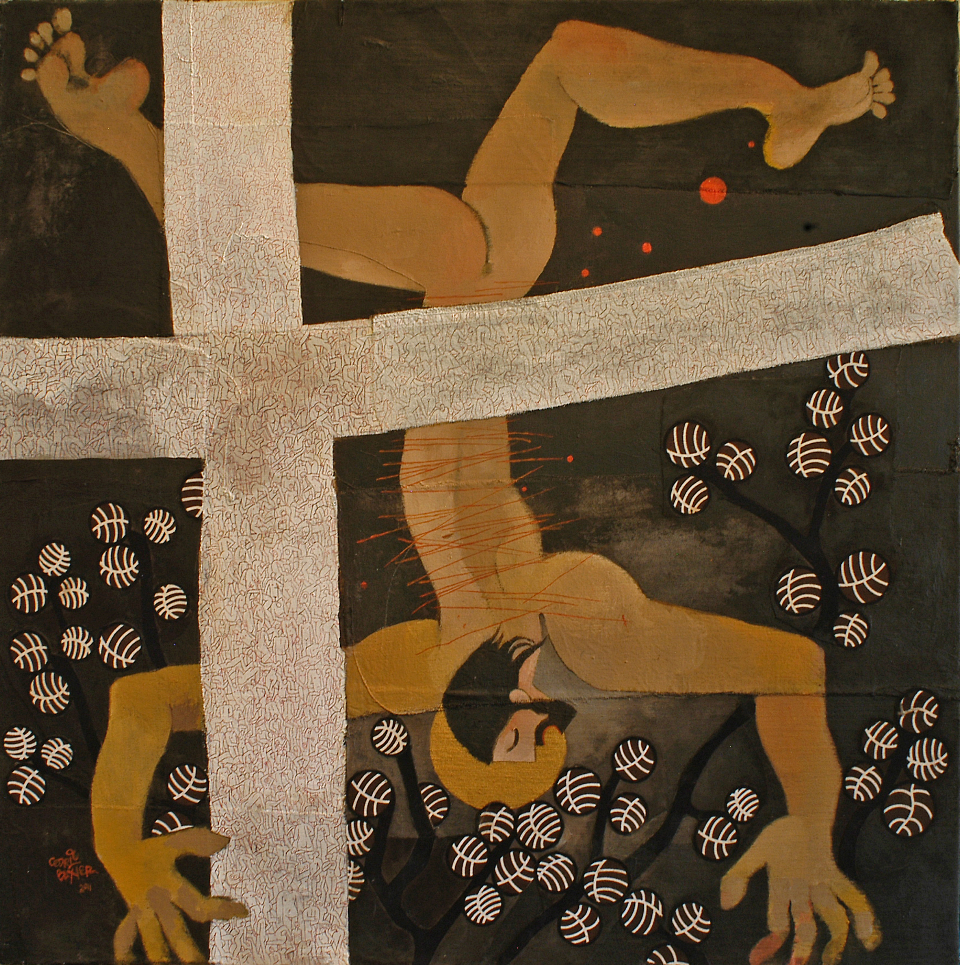
Baxter, Cedric_Jesus Striped and Stripped
Cedric Baxter (Australian, 1930–), Jesus Striped and Stripped, 2011. Acrylic, collage, and pen on canvas, 91 × 91 cm. Collection of the Uniting Church in Australia. [learn more]

Christ came juggling from the tomb,
flipping and bouncing death’s stone pages,
tossing those narrow letters high
against the roots of dawn spread in cloud.
This Jesus, clown, came dancing
in the dust of Judea, each slapping step
a new blossom spiked with joy.

Hey! Listen—that chuckle in the dark,
that clean blast of laughter behind—
Christ comes juggling our tombs,
tossing them high and higher yet,
until they hit the sun and break open
and we fall out, dancing and juggling
our griefs like sizzling balls of light.

This poem is from Christographia by Eugene Warren (St. Louis, MO: The Cauldron Press, 1977), a chapbook of thirty-two numbered poems that “attempt to express personal views of, & perspectives on, Christ.” The book’s title comes from a series of sermons by the Puritan poet and preacher Edward Taylor.

Gene Warren Doty (1941–2015) was an American poet in the Anabaptist tradition who taught in the English department of Missouri S&T for forty-two years. Throughout his career he explored a variety of non-Western poetic forms, including haiku, renga, tanka, sijo, and ghazals. He is the author of seven books of poetry: Christographia, Rumors of Light, Geometries of Light, Fishing at Easter, Similitudes, Nose to Nose, and Zero: Thirty Ghazals. Until 1988 his books and poems were signed “Eugene Warren,” Warren being the surname of his adoptive father, George, who raised him; but from 1988 onward he used the surname of his biological father, Floyd Doty.

“the calling of the disciples” by Lucille Clifton

Garawun, George_Calling the Disciples
George Garawun (Djinang [Aboriginal Australian], 1945–1993), Calling the Disciples, natural earth pigments on eucalyptus bark, Maningrida Church, Arnhem Land, Northern Territory, Australia. Source: The Bible Through Asian Eyes, p. 93.

some Jesus
has come on me

i throw down my nets
into the water he walks

i loose the fish
he feeds to cities

and everyone calls me
an old name

as i follow out
laughing like God’s fool
behind this Jesus

“the calling of the disciples” by Lucille Clifton is the eleventh poem in a sixteen-poem sequence titled “some jesus,” originally published in Good News About the Earth (Random House, 1972) and later compiled in The Collected Poems of Lucille Clifton 1965–2010 (BOA Editions, 2012). Used with permission.

“Tripping over Joy” by Daniel Ladinsky

Leunig, Michael_Falling Fool
Falling Fool by Michael Leunig (Australian, 1945–)

What is the difference
Between your experience of Existence
And that of a saint?

The saint knows
That the spiritual path
Is a sublime chess game with God

And that the Beloved
Has just made such a Fantastic Move

That the saint is continually
Tripping over Joy
And bursting out in Laughter
And saying, “I Surrender!”

Whereas, my dear,
I am afraid you still think
You have a thousand serious moves.

This poem, inspired by the fourteenth-century Persian poet Hafiz, appears in I Heard God Laughing: Poems of Hope and Joy (Penguin, 2006) and is used here by permission of the author.

“Turn Back, O Man” as motet and showtune

Early this week I was searching the Hymnary database for hymns based on or referent to Sunday’s lectionary reading from Ezekiel 18, where God calls on his people to “repent and turn from all your transgressions, lest iniquity be your ruin” (v. 30b), and the very similar passage later in the book: “As I live, declares the Lord GOD, I have no pleasure in the death of the wicked, but that the wicked turn from his way and live; turn back, turn back from your evil ways, for why will you die, O house of Israel?” (Ezek. 33:11).

One of the search results was “Turn Back, O Man” by the English poet and playwright Clifford Bax. Written in 1916, it doesn’t explicitly reference World War I, but it’s likely that that was the intended subtext.

Turn back, O man, forswear thy foolish ways.
Old now is earth, and none may count her days,
Yet thou, its child, whose head is crowned with flame,
Still wilt not hear thine inner God proclaim,
“Turn back, O man, forswear thy foolish ways.”
 
Earth might be fair, and people glad and wise.
Age after age their tragic empires rise,
Built while they dream, and in that dreaming weep.
Would they but wake from out their haunted sleep,
Earth shall be fair, and people glad and wise.
 
Earth shall be fair, and all its people one,
Nor till that hour shall God’s whole will be done!
Now, even now, once more from earth to sky
Peals forth in joy the old, undaunted cry,
“Earth shall be fair, and all its people one.”

The tune it’s set to in hymnals, OLD 124TH, is by Louis Bourgeois and is from the 1551 edition of the Genevan Psalter. Gustav Holst arranged the tune as a motet (a polyphonic, unaccompanied choral composition) in 1916 and in fact is the one who approached Bax with the request for a new text.

Here is a performance by the University of Texas Chamber Singers, from their 2008 album Great Hymns of Faith:

When I read the first line, it sounded familiar, and I was reminded that the song (with a much different tune and style!) opens the second act of Godspell. This 1971 musical created by John-Michael Tebelak and composed by Stephen Schwartz is based on Jesus’s teaching ministry as told in the Gospels, especially Matthew’s. (The show’s title is the archaic English spelling for “gospel.”) In addition to Jesus and John the Baptist/Judas, the cast consists of eight nonbiblical, “holy fool” characters who use their own names and sing and act out the parables and other sayings.

Tebelak, who wrote the play as his master’s thesis at Carnegie Mellon, was studying Greek and Roman mythology when, in his last year at school, he started reading the Christian Gospels in earnest and was enraptured by the joy they exuded and compelled by their emphasis on community. He tells the story of how on March 29, 1970, in pursuit of knowing more, he attended an Easter Vigil service at a church in Pittsburgh, wearing his usual overalls and a T-shirt—and he was frisked for drugs. “I left with the feeling that, rather than rolling the rock away from the Tomb, they were piling more on,” he said. That experience motivated him to write Godspell.

Tebelak’s Godspell was produced at Carnegie Mellon in late fall 1970, featuring an original song by cast member Jay Hamburger (“By My Side”) and a handful of old Episcopal hymns played by a rock band.

After leaving university, Tebelak took the show to New York City, where prospective producers suggested a new score and brought in Stephen Schwartz for the job. The rescored show, which retained Hamburger’s single song contribution, opened May 17, 1971, at the off-Broadway Cherry Lane Theatre and became a hit.

Six of Godspell’s eighteen song texts, including the chart-topping “Day by Day,” are actually taken straight from the Episcopal Hymnal. Schwartz liked the idea of dusting the cobwebs off some of these stodgy hymns and giving them new melodies with a catchy seventies pop vibe that would leave audiences singing them as they exited the theater.

“Turn Back, O Man” is one of those. It’s sung by Sonia, the sassy character with a put-on sensuality, a role originated by Sonia Manzano (of Sesame Street fame). Here’s the scene from the 1973 film adaptation directed by David Greene, with “Sonia” played by Joanne Jonas:

Isolated from the rest of the musical, this song seems completely irreverent and unbefitting the serious nature of God’s call to repentance. Its zaniness and sense of play, punctuated by Jesus’s pensive delivery of the third verse, is on a par with the tone of the whole—and that unique approach to telling the gospel works, I think, really well overall in Godspell, bringing to mind how “the foolishness of God is wiser than men, and the weakness of God is stronger than men” (1 Cor. 1:25). The characters embody the countercultural aspect of Jesus’s teachings, which appear ridiculous, clownish, to the rest of the world.

“The characters in Godspell were never supposed to be hippies,” Stephen Schwartz clarifies.

They were supposed to be putting on “clown” garb to follow the example of the Jesus character as was conceived by Godspell’s originator, John-Michael Tebelak, according to the “Christ as clown” theory propounded by Harvey Cox of the Harvard Divinity School (among others). . . . Because the show was originally produced in the hippie era, and because the director of the Godspell movie somewhat misinterpreted the characters as hippie-esque, that misunderstanding has come to haunt the show a bit.

In this particular song, performed by a hammy character in a feather boa, the lyrics entreat hearers to give up their “foolish ways,” going on to suggest that what is truly foolish is living as if asleep—building “tragic empires,” chasing empty dreams. Though endowed with the flame of reason and conscience, humanity at large, generation after generation, keeps rejecting God’s will, hence the lack of global unity and gladness.