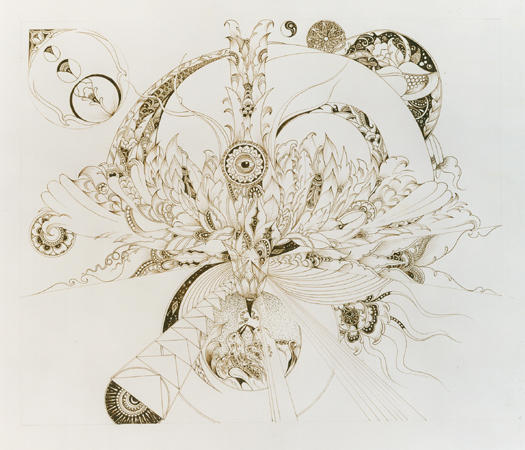
Sawai Chinnawong (Thai, 1959–), Holy Spirit, 2003. Ink drawing, 14 × 17 in. Artist’s statement: “God’s all-seeing eye takes in the whole of creation, here represented by slivers of his cosmos. A great mother bird feeds us, her spiritual young. The metamorphosis of all life, part flower, part animal, takes place in my Christian view of Yin and Yang.”
Romans 8:6:
“To set the mind on the flesh is death, but to set the mind on the Spirit is life and peace.”(RSV)
“Obsession with self . . . is a dead end; attention to God leads us out into the open, into a spacious, free life.” (The Message)
This post belongs to the weekly series Artful Devotion. If you can’t view the music player in your email or RSS reader, try opening the post in your browser.
To view all the Revised Common Lectionary scripture readings for Proper 10, cycle A, click here.
MaMuse is an acoustic folk duo from Chico, California, made up of Karisha Longaker and Sarah Nutting. Known for their soulful harmonies and light, bright lyrics, these women have said that they want their music to bring spiritual uplift and to connect people to the richness of life. Both Longaker and Nutting have backgrounds in music therapy and therefore view music as a healing art form. They also consider it an opportunity to bless others. Because of the intimacy it affords, they especially love performing house concerts.
Although they are not confessional Christians (they have a very all-embracing spirituality), they do cite gospel influences, which is evident in songs like “Hallelujah” and “On the Altar.” The former is the first track on their 2009 debut album All the Way and is one of the most beautiful songs I’ve heard in a while. Watch the music video below.
The song invokes a whole cluster of water imagery from the Bible. Jesus, for example, declared his Spirit to be the living water that quenches one’s deepest thirst (John 4:1–45, 7:37–39). Those who believe in him will receive within them “a spring of water welling up to eternal life”; “from [their] innermost being will flow rivers of living water.” The third verse of the song alludes to this gift:
There is a river In this heart of hearts With a knowingness Of my highest good
The Spirit not only nourishes and refreshes us but also prompts us to do what is right and good, coursing through our veins like a river of holy desire and spurting forth like a fountain for all to see. Continue reading “The soul-nourishing music of MaMuse”→
Ten days after Jesus ascended into heaven (and fifty days after his resurrection), his Holy Spirit descended on the apostles, manifesting as “tongues of fire” (Acts 2:3). This miraculous gift enabled the apostles to speak in languages foreign to them but native to the many Jews from abroad who were gathered in Jerusalem for Shavuot (called “Pentecost” by Hellenized Jews), a festival of giving thanks for the harvest and for God’s provision of the Torah. For the first time the gospel of Jesus Christ was proclaimed to a global audience. Three thousand people came to faith that day, and the Christian church was born.
The Spirit is still at work in the dissemination of the good news today, breathing life into cultures all over the world and thereby building up an incredibly diverse body of Christ.
As at Pentecost, Parthians, Medes and Elamites heard the message, “every man in his own tongue wherein he was born,” so we see Chinese and Japanese and Indians expressing Christianity’s universal language, each with his own brush. For when the spirit of God descends upon any people, new forms of beauty appear, new artistic gifts are revealed, adding another testimony to the universality of the Christian faith.
Since the publication of this book almost seventy years ago, Christianity has grown exponentially in Asia, as have indigenous artistic expressions of the faith. In 1975 Japanese theologian and arts advocate Masao Takenaka published the heavily illustrated book Christian Art in Asia, highlighting the robust variety being produced on the continent. Three years later the Asian Christian Art Association was founded to encourage the exchange of ideas between Asian artists and theologians. Their magazine, Image (not to be confused with the Seattle-based quarterly), has showcased local talents even further. Dozens more books have been published in English on individual Asian artists, countries, and the Asian Christian art movement in general. For the latter, see the beautifully designed The Christian Story: Five Asian Artists Today, plus The Bible Through Asian Eyes.
Below is a sampling of Asian art on the theme of Pentecost. Some works were made using traditional art forms or techniques—Chinese papercutting, Japanese flower arranging (ikebana) or stencil printing (kappazuri), Indian cloth dyeing (batik)—while other artists have chosen to work in oils and acrylics, collage, or glass. Some depict native people and settings—for example, Thai dancers wrapped in sabai, or a group sitting under a thatched roof in Indonesia—while others prefer ethnic and geographic ambiguity. There’s no single style that epitomizes the art of any country.
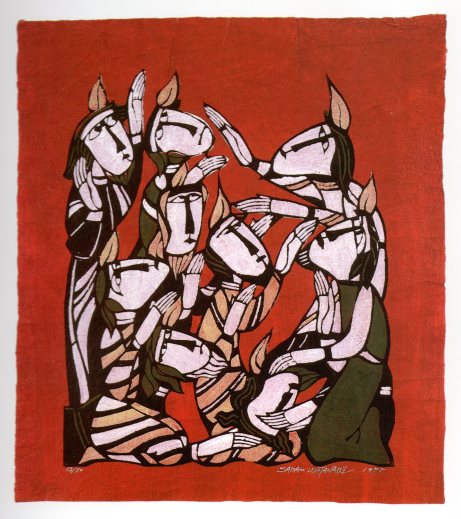
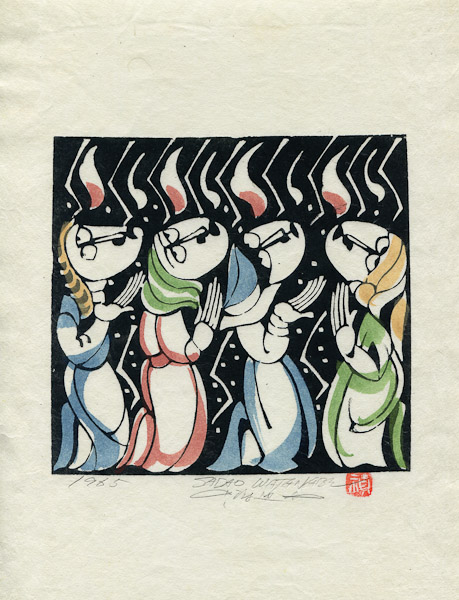
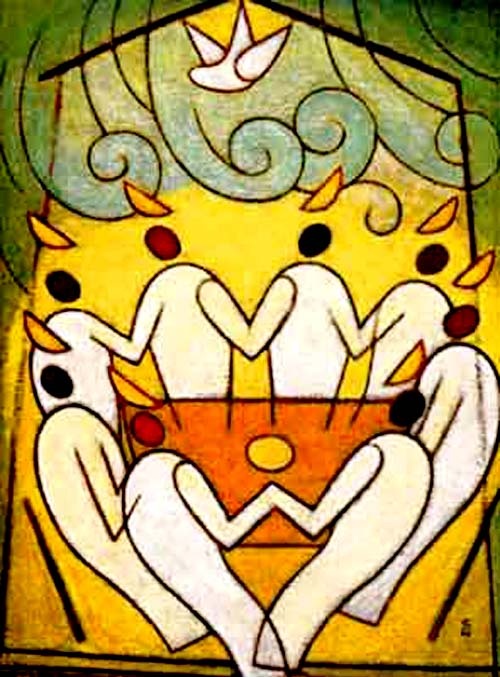
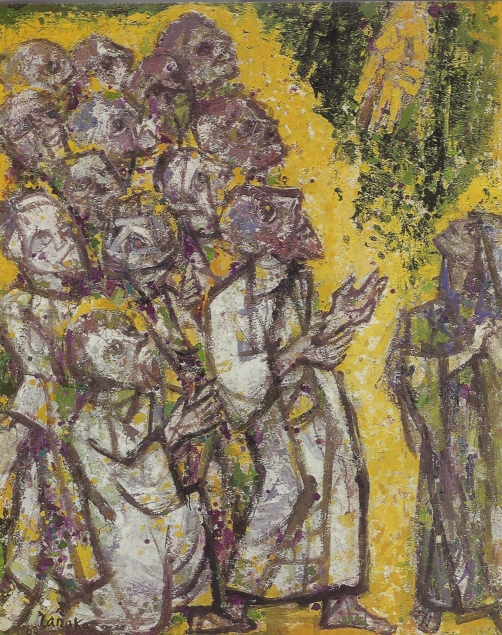
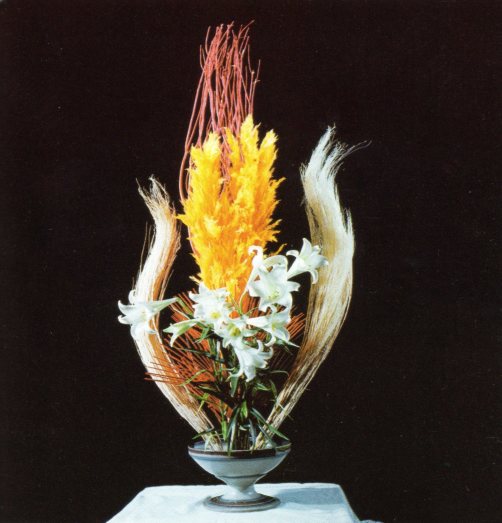
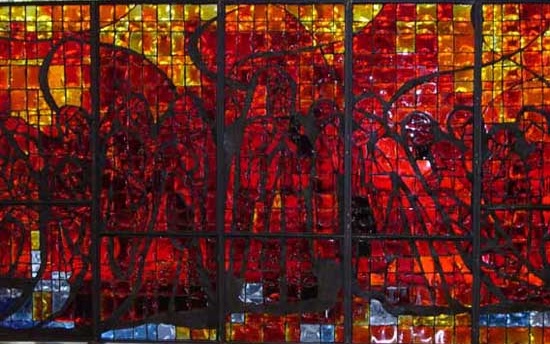
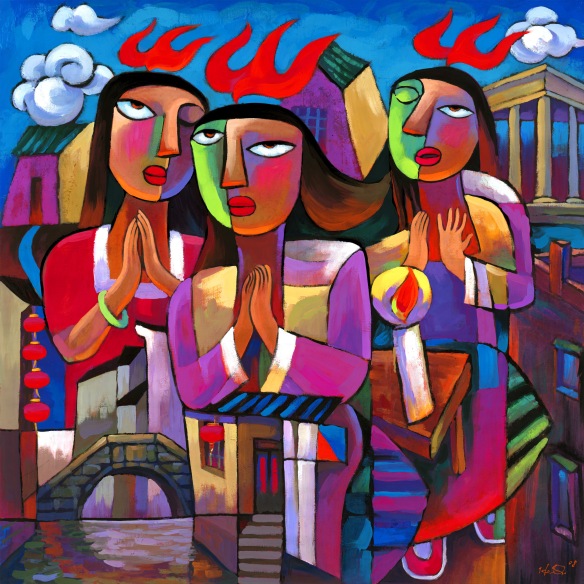
Sadao Watanabe (Japanese, 1913–1996), Pentecost, 1975. Hand-colored kappazuri-dyed stencil print on washi paper, 25.5 × 22.75 in. Source: Printing the Word: The Art of Watanabe Sadao (Philadelphia: American Bible Society, 2003)Sadao Watanabe (Japanese, 1913–1996), Pentecost, 1965. Hand-colored kappazuri-dyed stencil print on washi paper.Soichi Watanabe (Japanese, 1949–), The Coming of the Holy Spirit, 1996. Oil on canvas, 18 × 13.25 in. Collection of the Overseas Ministries Study Center.Tadao Tanaka (Japanese, 1903–1995), Pentecost, 1963. Oil on canvas. Source: Christian Art in Asia by Masao Takenaka (Tokyo: Kyo Bun Kwan, 1975)Gako Ota (Japanese, 1904–1972), Pentecost. Belvedere, pampas grass, paper bush, lilies, and rib of fan. Source: Consider the Flowers: Meditations in Ikebana, ed. Masao Takenaka (Tokyo: Kyo Bun Kwan, 1990)Keiko Miura (Japanese, 1935–), Pentecost, 2004. Stained glass window, All Pilgrims Christian Church, Seattle, Washington, USA.He Qi (Chinese, 1950–), Holy Spirit Coming, 1998. Oil on canvas.

 Art & Theology