They went to a place called Gethsemane, and [Jesus] said . . . “My soul is deeply grieved, even to death. . . . Abba, Father, for you all things are possible; remove this cup from me, yet not what I want but what you want.”
—Mark 14:32, 34, 36
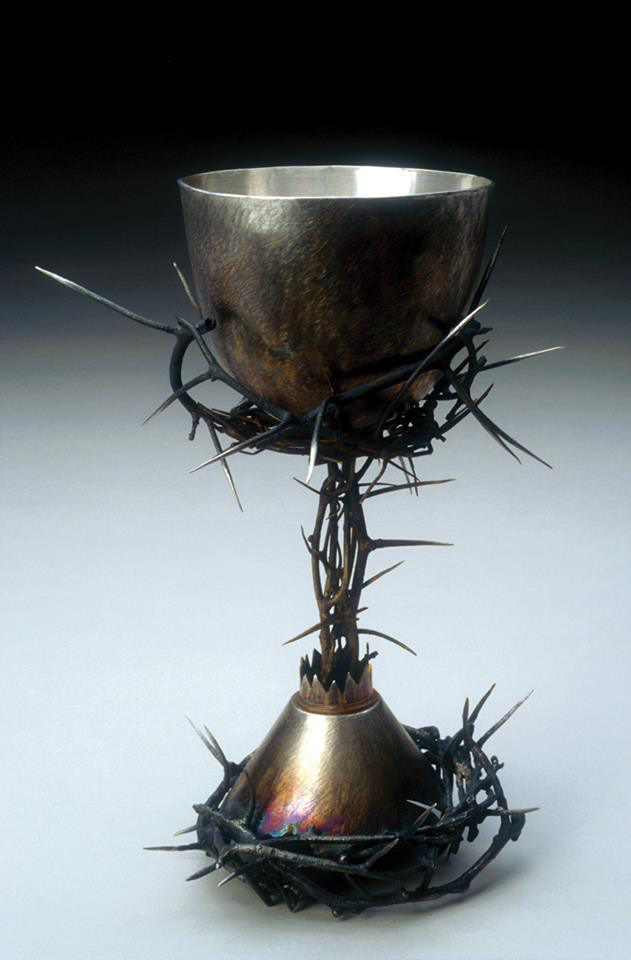
LOOK: Can you drink the cup I am about to drink? by John Kiefer
John Kiefer (American, 1944–), Can you drink the cup I am about to drink?, 1999. Sterling silver and other metals, 10 × 3 × 3 in. Bowden Collections, Chatham, Massachusetts.
Fr. John Kiefer is a Catholic priest, metalsmith, and woodworker from Indiana. His piece Can you drink the cup I am about to drink? is from the collection of Sandra and Bob Bowden in Chatham, Massachusetts, and is part of the traveling exhibition they loan out called Come! The Table Is Ready.
Can you drink is a silver chalice enwrapped ominously, cup and foot, by thorns. In the Bible, a cup often symbolizes one’s portion or destiny that comes from God. Jesus’s cup entails suffering and premature death. Deeply distraught, Jesus asks his Father, if it be possible, to remove the cup.
Request denied.
Within eighteen hours of voicing this prayer, Jesus is taken, tried, tortured, and killed—“tast[ing] death for everyone” (Heb. 2:9).
Some biblical commentators have interpreted the cup Jesus must drink as God’s wrath over sin, as that metaphor—cup as bitter-tasting divine punishment poured out—was a common one in the ancient Near East, including in the Bible. But that doesn’t make sense if we pull in what Jesus says to James and John earlier, in Matthew 20:22 (cf. Mark 10:38): “Are you able to drink the cup that I am about to drink?” They affirm yes, and Jesus corroborates: “You will indeed drink my cup . . .”
This is why the cup is best understood more generally as one of suffering. So argues Raymond E. Brown in his magisterial two-volume work The Death of the Messiah, albeit conceding that “some of the connotation of the classical cup of wrath or judgment may be preserved in Mark [14:36], not in the sense that Jesus is the object of wrath, but inasmuch as his death will take place in the apocalyptic context of the great struggle of last times when God’s kingdom overcomes evil” (1:170).
Archimandrite Seraphim Bit-Kharibi [previously] is an Assyrian Orthodox priest living in the country of Georgia. He is one of the few priests in the world who celebrates the Divine Liturgy in Aramaic, the language of Jesus. The video above shows him chanting the words Jesus prayed in the garden of Gethsemane the night before his execution.
I wasn’t able to find the full text he uses (and my email inquiry went unanswered), but I’m fairly sure the core is this:
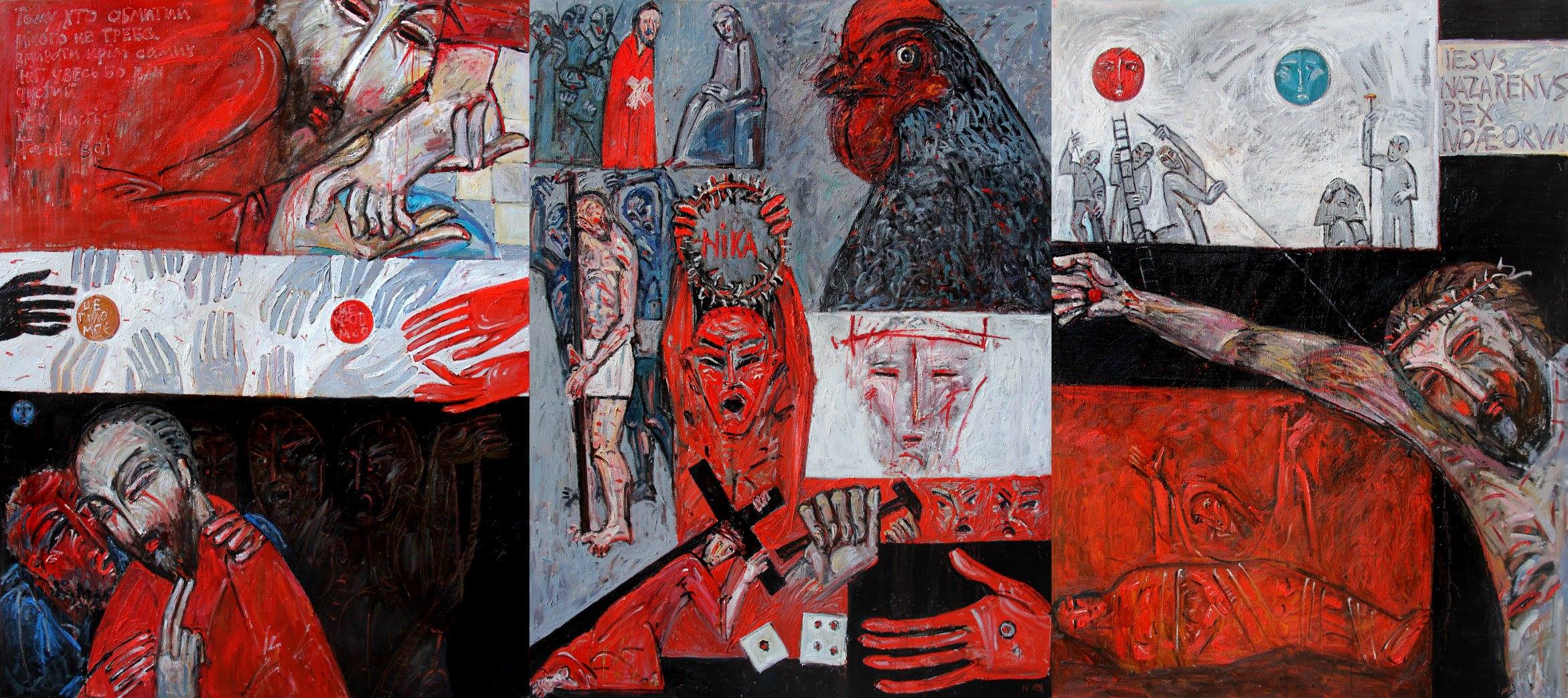
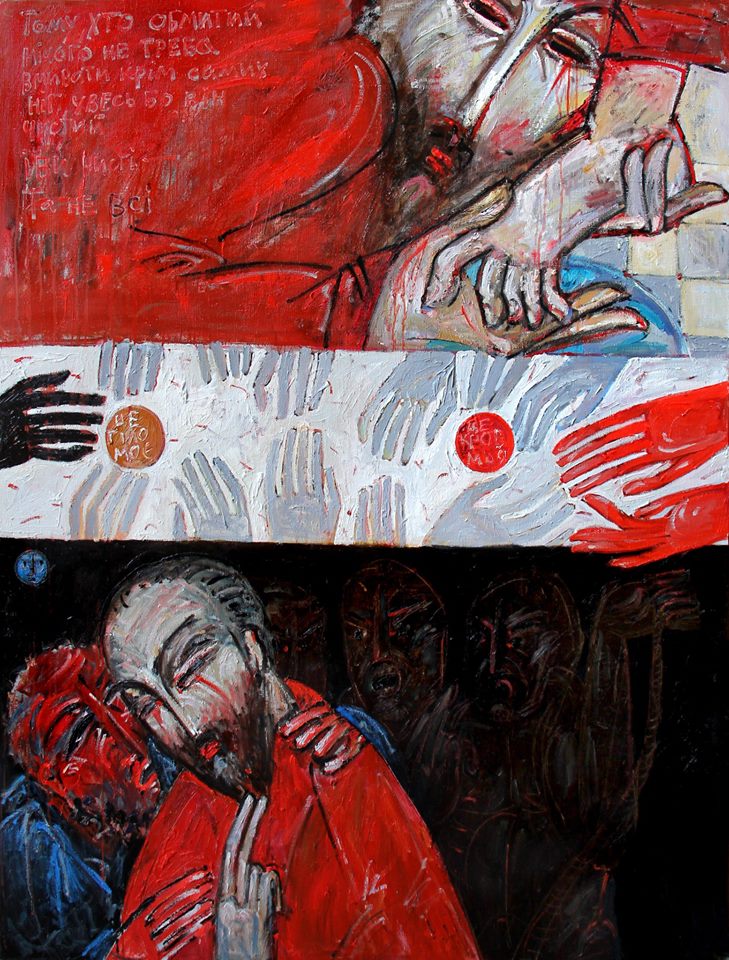
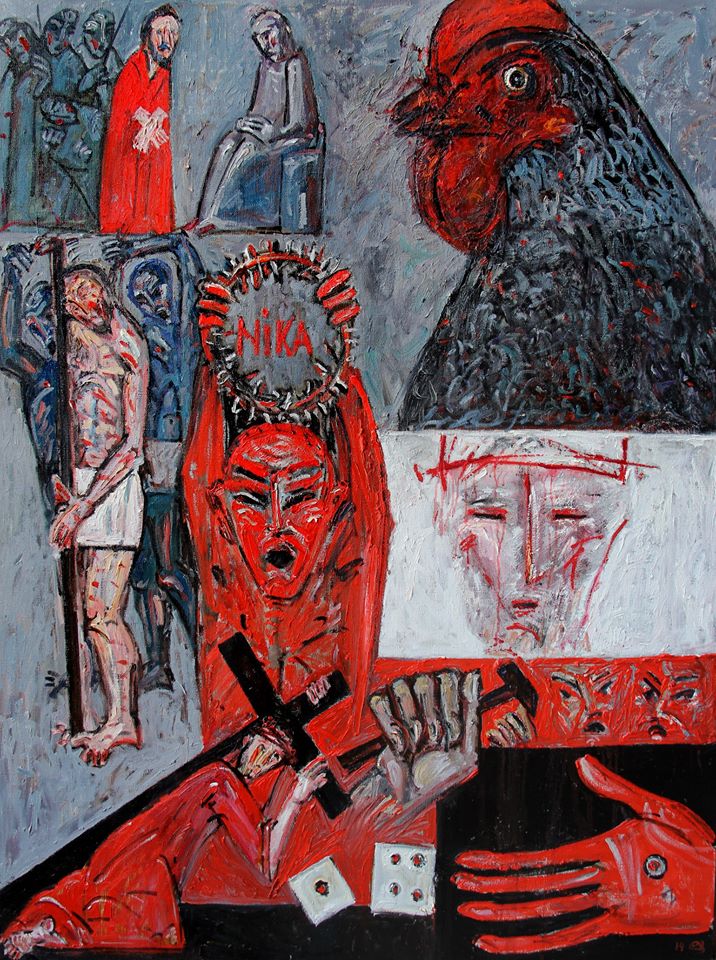
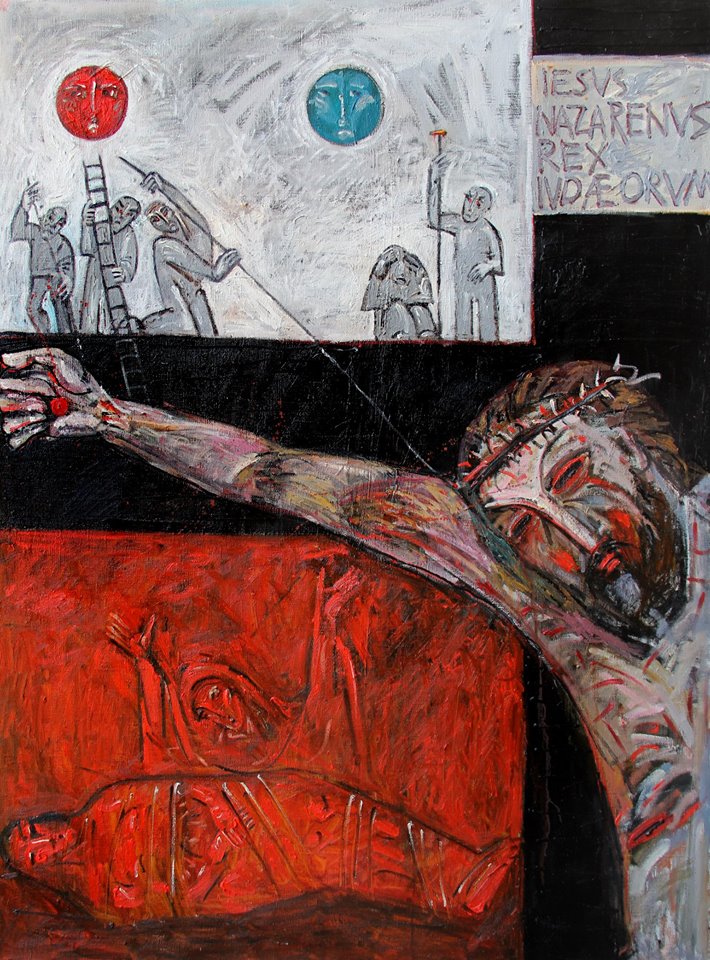
This painting by the late Ukrainian artist Ostap Lozynsky portrays a handful of episodes from Passion Week: Jesus washing his disciples’ feet, the Last Supper, the Kiss of Judas, Christ before Pilate, the Flagellation, the Crowning with Thorns, Peter’s denial (represented emblematically by the rooster), Christ taking up his cross, Christ being nailed to the cross, the Crucifixion, and the Lamentation over the Dead Christ.
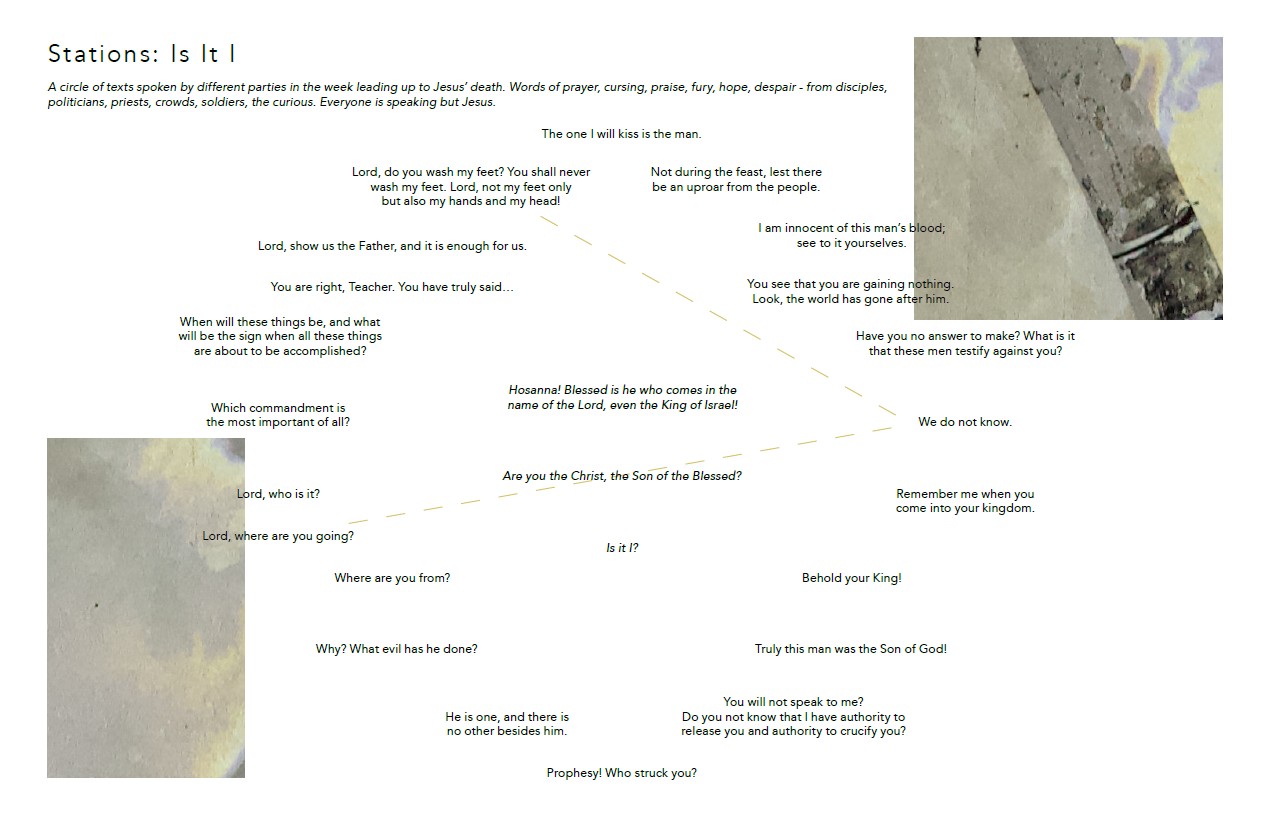
From liner notes of PRIMEMOVER by Joshua Stamper. Pinch to zoom, or if on a computer, right-click and open the image in a new tab to enlarge.
Joshua Stamper is “a transdisciplinary artist and composer whose work explores hiddenness, revelation, ephemera, and archive.” Commissioned by Resurrection Philadelphia, his “Stations: Is It I” composition collages spoken “words of prayer, cursing, praise, fury, hope, despair—from disciples, politicians, priests, crowds, soldiers, the curious,” all parties connected to Jesus’s final week. The texts are taken from scripture.
The cacophony is stressful. Maybe you turned off the recording before it finished, unable to bear it. I encourage you to stick with it for the full four minutes and twenty-one seconds, as a way of sitting with the discomfort and chaos of Christ’s passion, of entering into this story that’s at the center of the church’s proclamation.
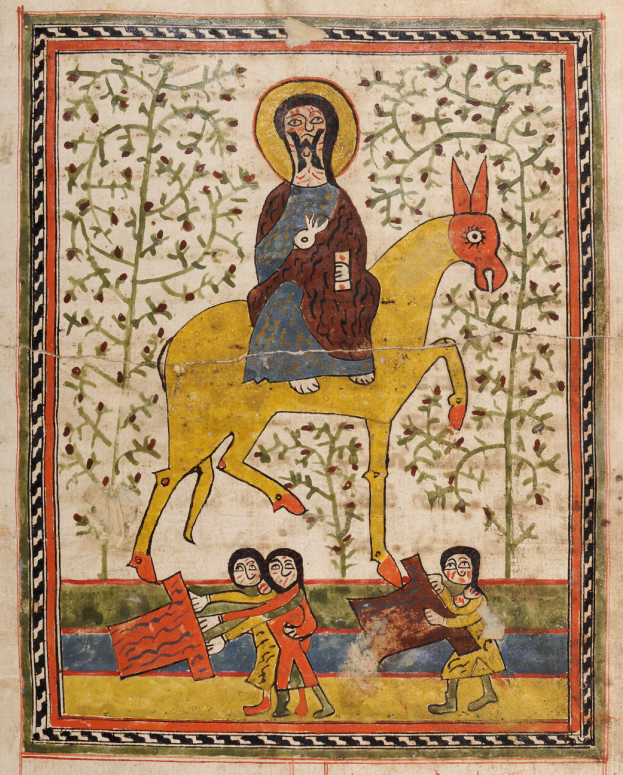
Christ’s Entry into Jerusalem, Alqosh, Iraq, 1723, from a Syriac Gospel lectionary. Collection of the Dominican Friars of Mosul (DFM 13, fol. 43v). Digitized in collaboration with the Centre Numérique des Manuscrits Orientaux (CNMO), Ankawa, Erbil, Iraq.
Made three centuries ago at a monastery in Iraq, this is one of three figurative paintings from a Syriac Gospel lectionary, the other two depicting Thomas touching Jesus’s wounds and the apocryphal saint George defeating a dragon. While the scribe is named in the manuscript as ʼEliyā bar Yaldā, the artist, if he is a different person (as they usually were), is not identified.
I love the fanciful coloration! Yellow and orange for the donkey, and a tricolored road of yellow, blue, and green. Plus, in the background, fruiting tree branches that climb and curl. The red striations on the figures’ necks and faces are, as far as I know, an idiosyncratic aesthetic choice of the artist’s; they may signify blood running through the veins, or perhaps the marks are simply decorative.
While the donkey is shown in profile, clopping along toward Jerusalem’s city center, Jesus rides sidesaddle and is oriented toward us, his eyes meeting ours. He holds a scroll in one hand, signifying that he is the fulfillment of Old Testament prophecies (most directly in this moment, Zechariah 9:9), and his right hand, which is heavily stylized, I can only assume is raised in a gesture of blessing, as it is in many other images of this subject.
At his feet, the people spread their cloaks, a sign of reverence.
Addendum: The following video of Palm Sunday celebrations in Iraq showed up in my Instagram feed a few hours after I published this blog post, and I thought it fitting to add.
LISTEN: “Hosanna! (Matthew 21:9 & 11)” by Frank Hernandez, for Steve Green’s Hide ’Em in Your Heart: Bible Memory Melodies, 1990 | Performed by Susanna and Rosalia, 2026
Blessed is he who comes in the name of the Lord Blessed is he who comes in the name of the Lord
Hosanna to the Son of David Hosanna in the highest Hosanna to the Son of David Hosanna, this is Jesus
Blessed is he (blessed is he) who comes in the name of the Lord Blessed is he (blessed is he) who comes in the name of the Lord
Hosanna to the Son of David Hosanna in the highest Hosanna to the Son of David Hosanna, this is Jesus
Hosanna (Hosanna) Hosanna (in the highest) Hosanna (Hosanna) Hosanna, this is Jesus
I learned this song two years ago when two girls from my church, sisters, sang it during the offertory for our Palm Sunday worship service. I asked them if they’d be willing to reprise their performance for my blog, as I love the sweetness of their voices together, and they obliged. They are thirteen and eleven years old.
Palm Sunday is an especially great day to utilize the children’s voices in your congregation for music or other parts of the liturgy, as Matthew mentions in his account of Christ’s entry into Jerusalem that “when the chief priests and the scribes . . . heard the children crying out in the temple and saying, ‘Hosanna to the Son of David,’ they became angry and said to [Jesus], ‘Do you hear what these are saying?’ Jesus said to them, ‘Yes; have you never read, “Out of the mouths of infants and nursing babies you have prepared praise for yourself” [Ps. 8:2]?’” (Matt. 21:15–16). “Hosanna” is an expression that in this context means something like “Hooray for salvation!,” as John Piper puts it.
The enthusiasm of the masses upon Jesus’s arrival in Judea’s capital city for Passover, and especially their ascription to him of the messianic title “Son of David” (not to mention “prophet” and “wonderworker”), raised the hackles of the temple leadership. He was a threat to their authority and status and to their understanding of the scriptures. So they purposed, in collusion with Rome, to put him to death.
There are hundreds of creative works I could feature on the topic of Christ’s wounds. Here are just a few of note.
ARTICLE: “‘Your body is full of wounds’: references, social contexts and uses of the wounds of Christ in Late Medieval Europe” by Johanna Pollick, Emily Poore, Sophie Sexon, and Sara Stradal: In this three-part collaborative essay, I was most intrigued, in part because of its newness to me, by the first section, “The flowering wound: Christ’s heart in Princeton University, MS Taylor 17,” in which Dr. Johanna Pollick explores a small English illuminated devotional book, dating from around 1500, that portrays Christ’s wounds as wells. For help in interpreting these images, she turns to medieval literary traditions as well as to the Carthusian Miscellany.
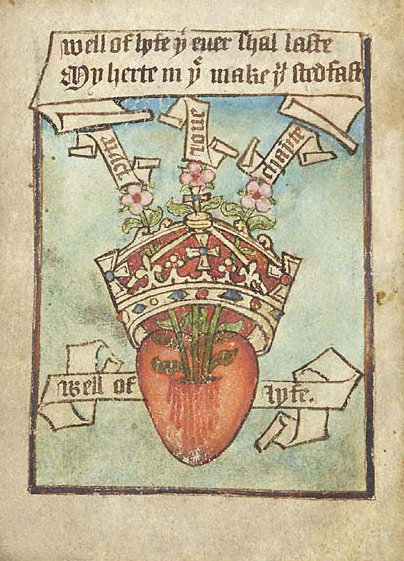
Wounded Heart of Christ as the Well of Lyfe, England, ca. 1500. Princeton University Library, MS Taylor 17, fol. 10v.
Dr. Grace Hamman writes about MS Taylor 17’s extraordinary “well of lyfe” page in Jesus through Medieval Eyes (and for InterVarsity’s The Well), which is what brought me to this essay. The hand-colored image shows flowers—labeled “pyte” (pity), “loue” (love), and “charyte” (charity)—springing forth from the wounded heart of Jesus. The verse prayer at the top reads, “Well of lyfe that ever shall laste / My herte in thee make it stedfast.”
The same theme shows up in another late fifteenth-century English lyric in MS Arundel 286 at the British Library, which appears in modern compilations under the title “The Wounds, as Wells of Life” or “The Wells of Jesus’ Wounds”:
Ihesus woundes so wide
Ben welles of lif to the goode,
Namely the stronde of his syde
That ran ful breme on the rode.
Yif thee list to drinke
To fle fro the fendes of helle,
Bowe thu doun to the brinke
And mekely taste of the welle.
Jesus’s wounds so wide
Are wells of life to the good,
Namely the stream from his side
That ran fiercely on the rood.
If thou list to drink,
To flee from the fiends of hell,
Bow thou down to the brink
And meekly taste of the well.

Trans. Victoria Emily Jones
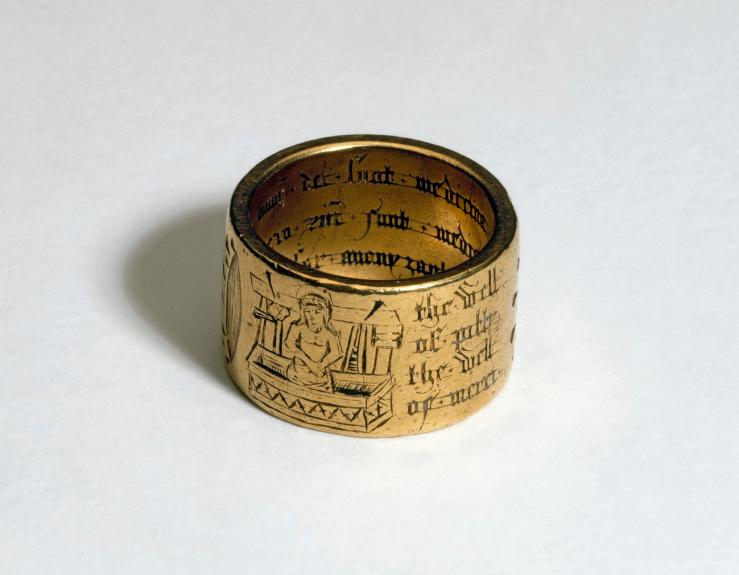
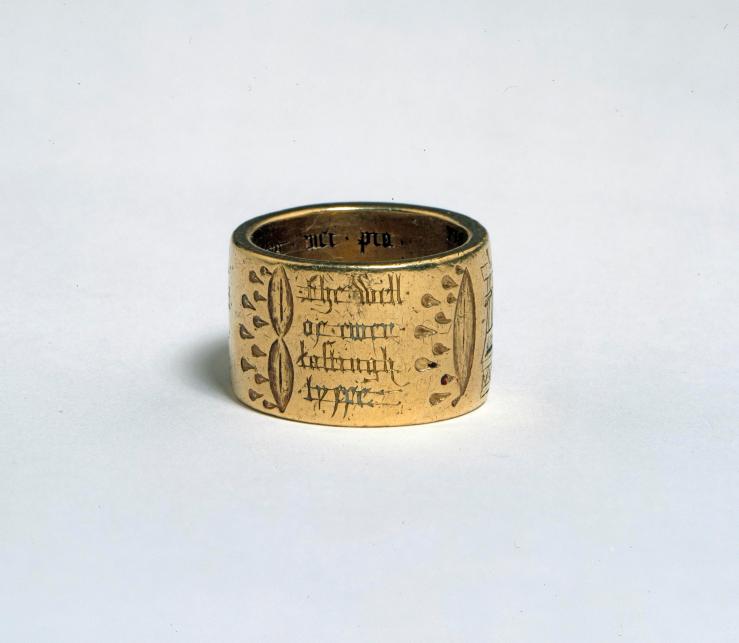
And in a late fifteenth-century gold ring, also from England, engraved with a Man of Sorrows image and hieroglyphs of Christ’s five wounds, labeled “The well of pitty, the well of merci, the well of confort, the well of gracy, the well of everlastingh lyffe”:
SONG: “Deep Were His Wounds” by William Johnson, 1953: This midcentury hymn is composed of three simple stanzas: The first half of each meditates on Jesus’s cruel death on the cross, whereas each second half (“But . . .”) celebrates the healing, freedom, and eternal life that death wrought.
>> Music by Leland B. Sateren, 1958: I like this tune, called MARLEE, but it’s difficult to sing congregationally. Here’s a soloist, Sarah Gulseth, singing it for her church’s 2011 Good Friday service, accompanied on organ by Luther Gulseth:
>> Music by Vito Aiuto, 2008: I was first introduced to “Deep Were His Wounds” through the Welcome Wagon’s debut album, Welcome to the Welcome Wagon, “a ramshackle singalong enterprise of a Presbyterian pastor (the Rev. Vito Aiuto) and his wife (Monique) wrestling out the influences of folk music, religion, popular culture, and church tradition.” Mood-wise, Aiuto’s tune wouldn’t work as well for Good Friday—even given the paradox of that day, it’s too bright, in my opinion, for that somber observance. But it’s great for throughout the year, especially for churches that favor a contemporary/folksy style of music.
+++
CANTATA CYCLE:“Membra Jesu Nostri” (The Limbs of Our Suffering Jesus) by Dieterich Buxtehude: Dieterich Buxtehude (ca. 1637–1707) was a Danish German organist and composer of the mid-Baroque period. For Good Friday 1680, he composed a cycle of seven concerto-aria cantatas. The texts of the aria sections are taken from the medieval Latin hymn “Salve mundi salutare” (Hail, the World’s Salvation) by the Cistercian abbot Arnulf of Leuven (ca. 1200–1250), whereas the concerto section texts are Old Testament quotations. The following video is a 2004 performance from Payerne, Switzerland; see the YouTube video description for further credits. The video includes English subtitles, but you can also read the lyrics (with translation) here.
The cycle begins by paying homage to Christ’s wounded feet (“Ad Pedes” = “To the Feet”), and then progresses upward to his knees, hands, side, breast, heart, and finally, face/head. Traditionally, Christ’s wounds are enumerated as five: a hole in each foot, a hole in each hand, and a hole through his side/heart (from the centurion’s spear). But Arnulf meditates on seven distinct body parts of Christ’s that were injured on Good Friday.
+++
ARTWORKS:
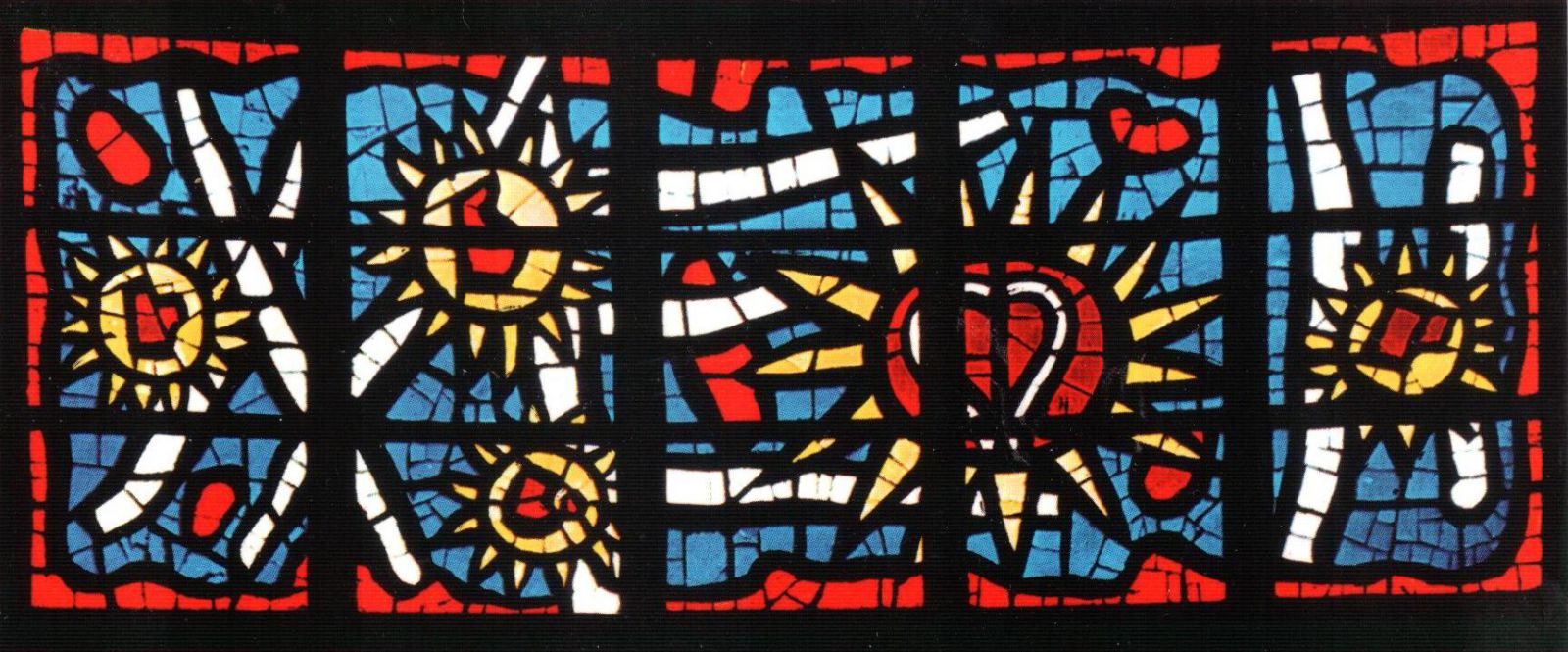
>> The Five Wounds of Christ by Fernand Léger | Commentary by Albert Hengelaar: This visual meditation is about the architecture and interior decoration of the Sacré-Coeur in Audincourt, France, a product of the Art Sacré movement, a Catholic art renaissance spearheaded by the French Dominican Order from 1919 to the 1950s. The centerpiece of the church, sited above the high altar, is a stained glass window depicting the five wounds of Christ shining like suns—one of seventeen windows the artist Fernand Léger designed to encircle the space in a strip.
Fernand Léger (French, 1881–1955), The Five Wounds of Christ, 1950–52. Stained glass window, Église du Sacré-Cœur (Church of the Sacred Heart), Audincourt, France.
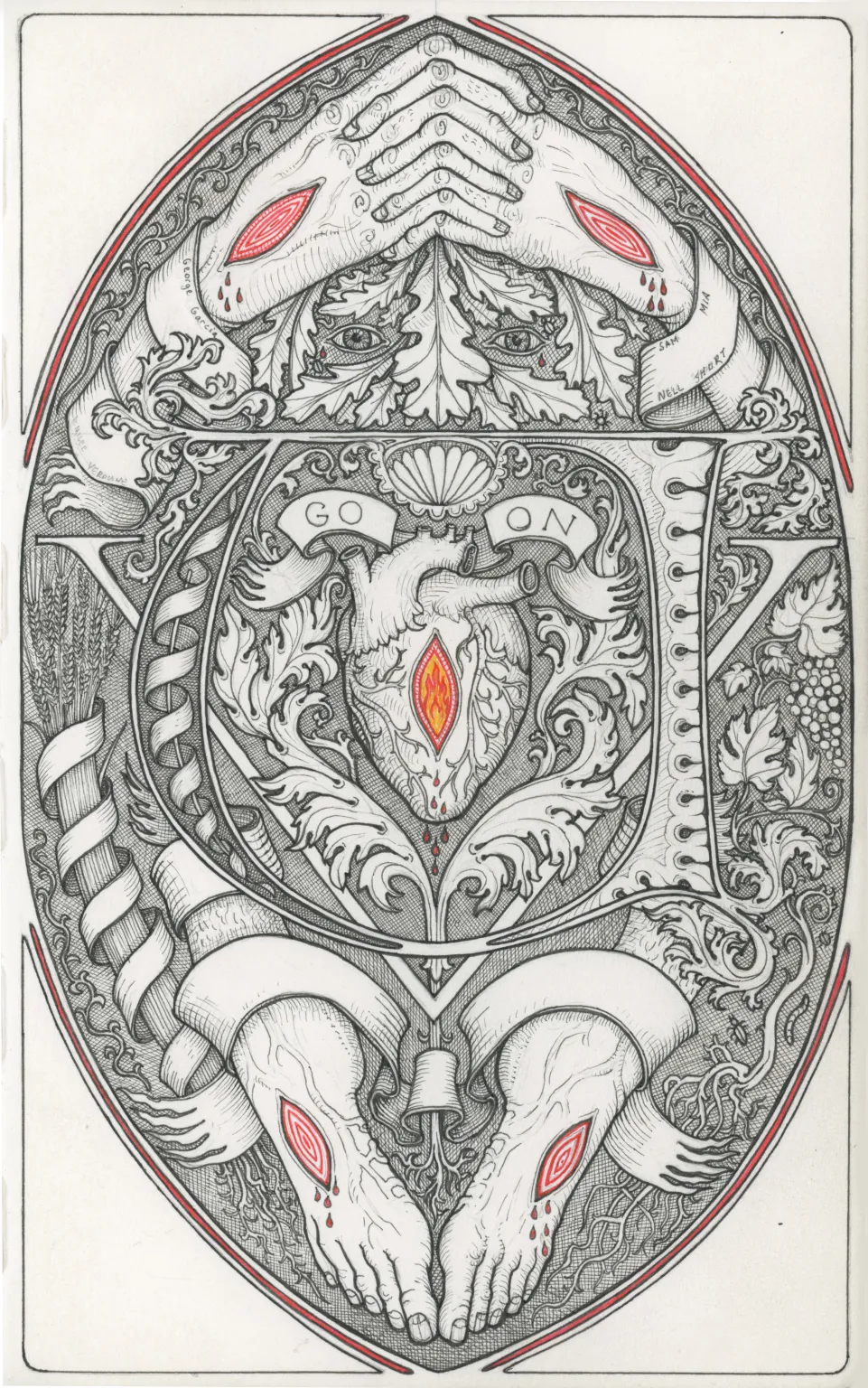
>> The Great Wound, aka Go On, Wounded Healer by Jack Baumgartner | Commentary by Sam Kee: In this Substack post, Sam Kee unpacks a drawing by his friend Jack Baumgartner [previously], which shows that “there is life in His [Christ’s] wounds, and He pours His life into our wounds.” The drawing started with the roman numeral V, which stands for the five wounds of Christ. The circumference is one large wound that encompasses five smaller wounds, eye-like, each one weeping blood. Other symbols that Kee analyzes in the drawing are wheat, grapes, fig leaves, seashell, fire, heart, and womb. “Go on” is a refrain that Baumgartner uses often in his work, a mantra for persevering in the faith, for continuing on the path.
Jack Baumgartner (American, 1976–), The Great Wound, 2024. Drawing from the series The Diary of a Tree Standing on Its Head.
Kee concludes with an original ekphrastic poem.
You can purchase an archival reproduction of The Great Wound from Baumgartner’s online shop. I encourage you to explore his website as well. I admire how his work is somehow both mystical and earthy, rooted.
Rejoice greatly, O daughter Zion! Shout aloud, O daughter Jerusalem! See, your king comes to you; triumphant and victorious is he, humble and riding on a donkey, on a colt, the foal of a donkey.
—Zechariah 9:9
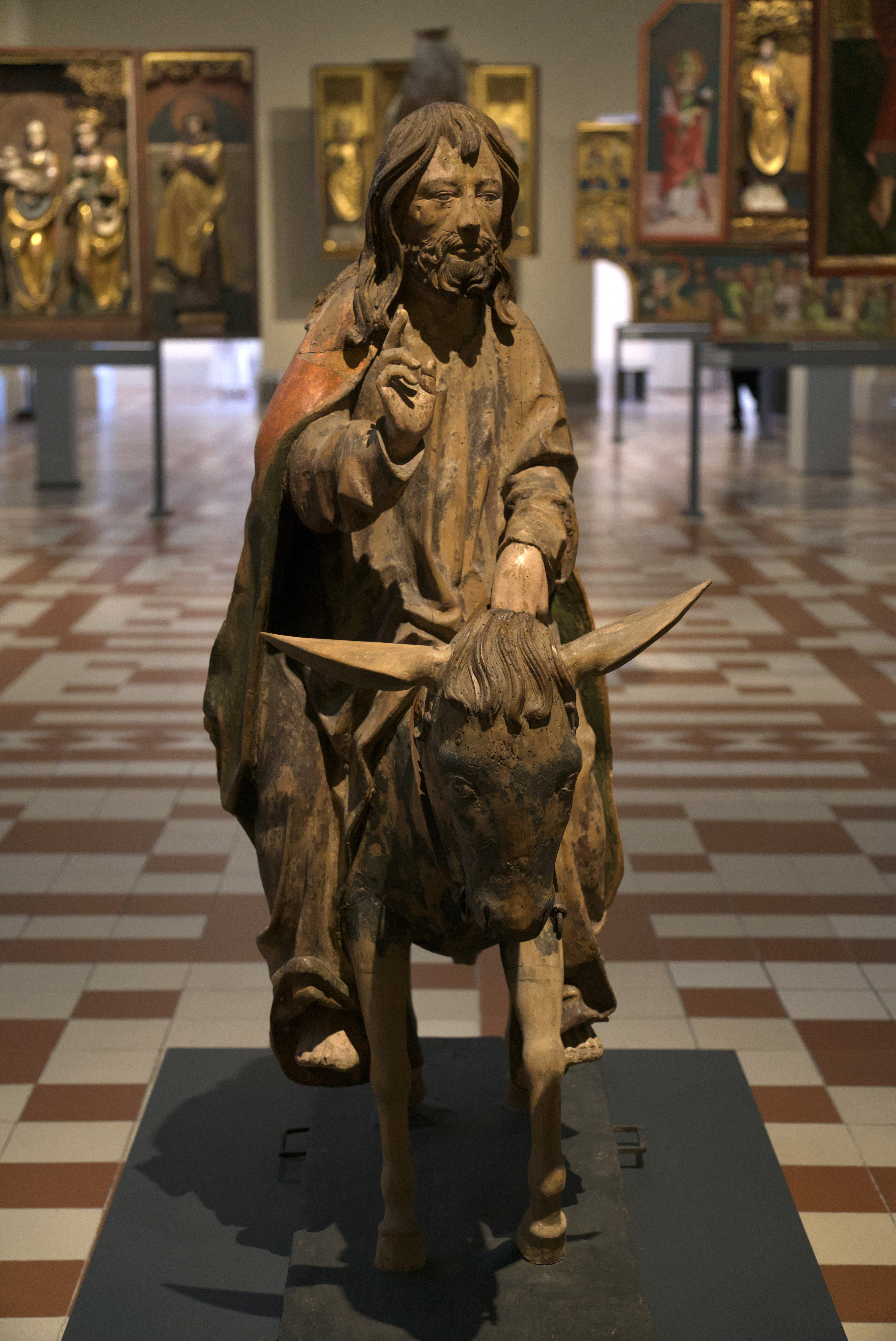
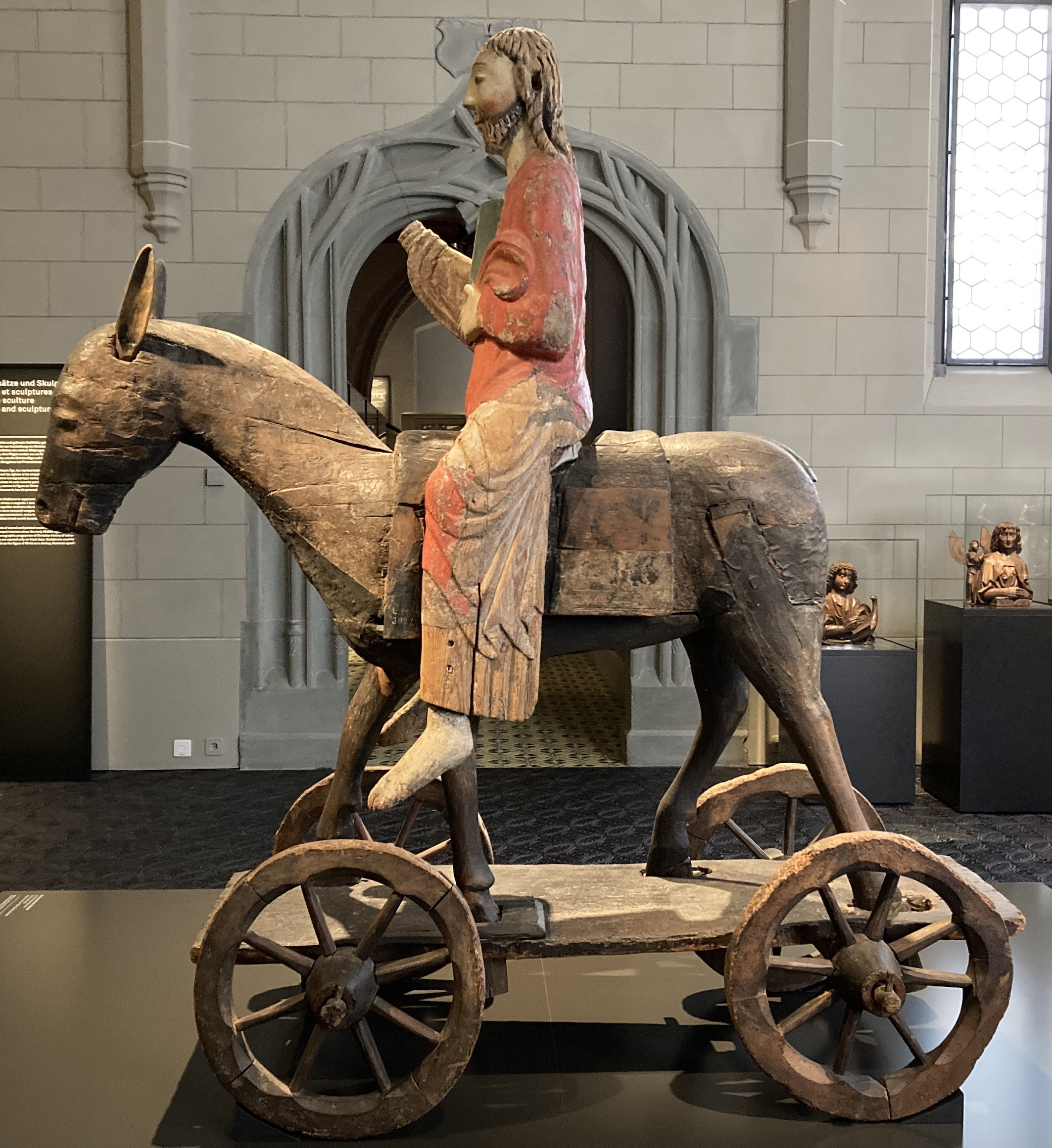
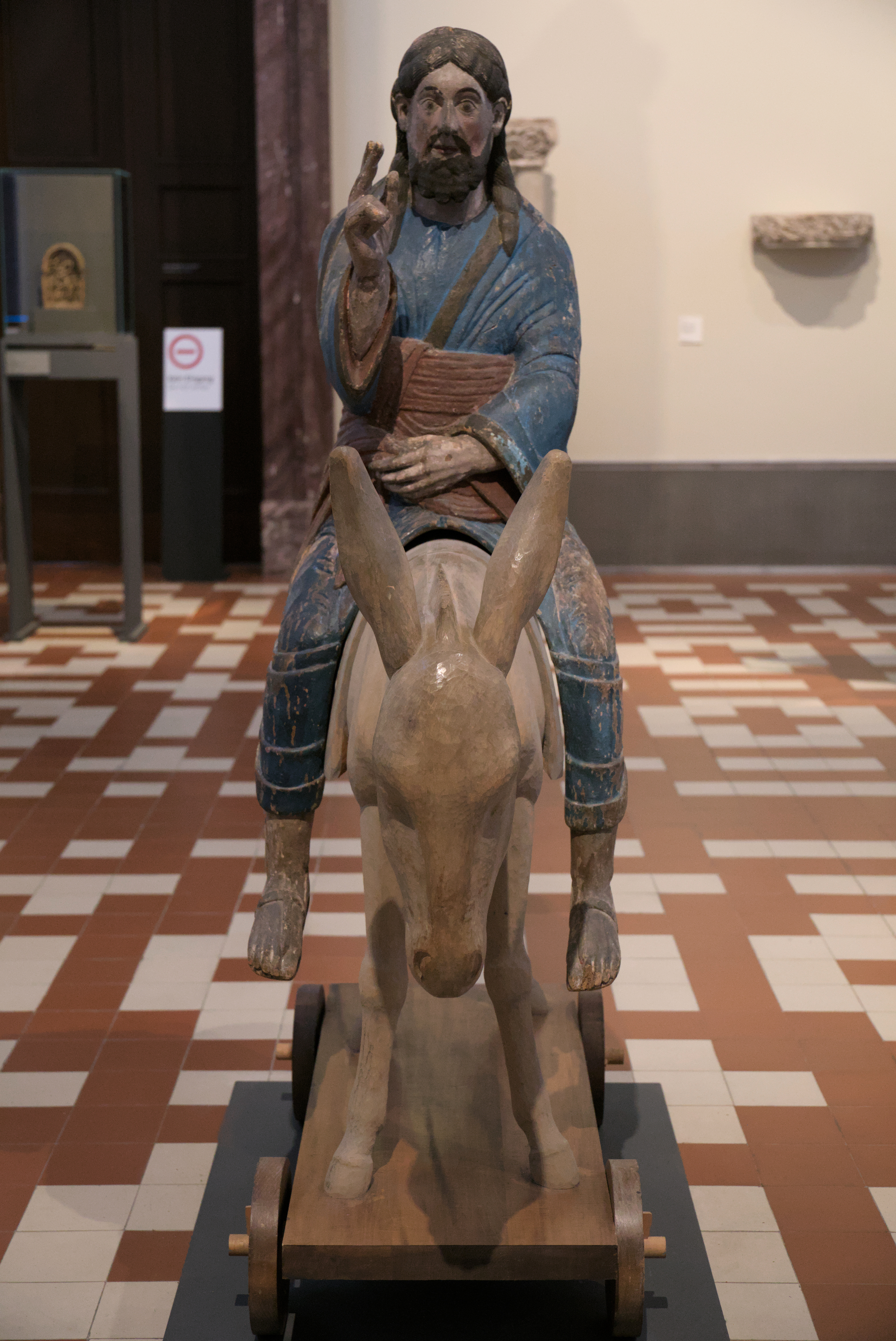
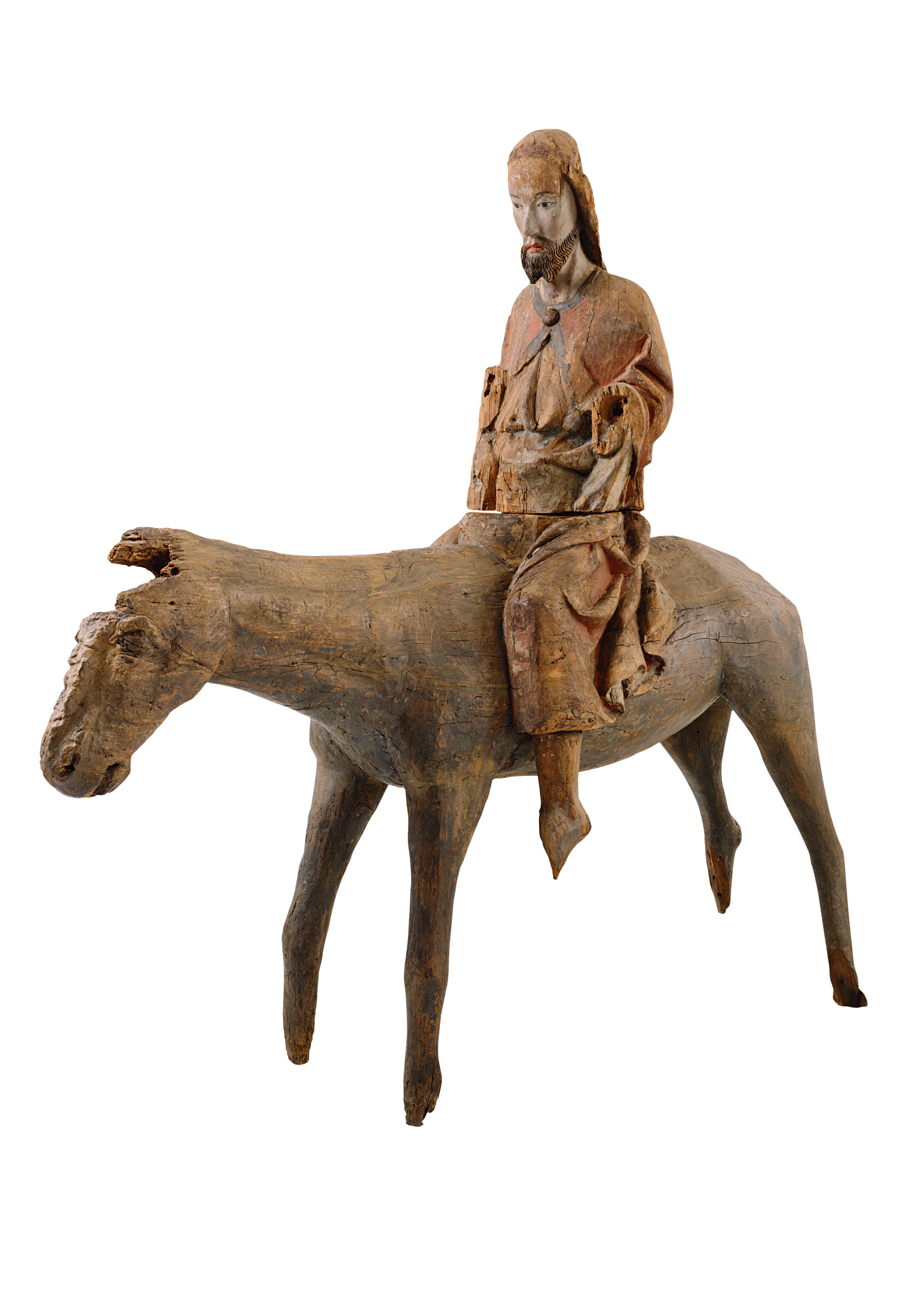
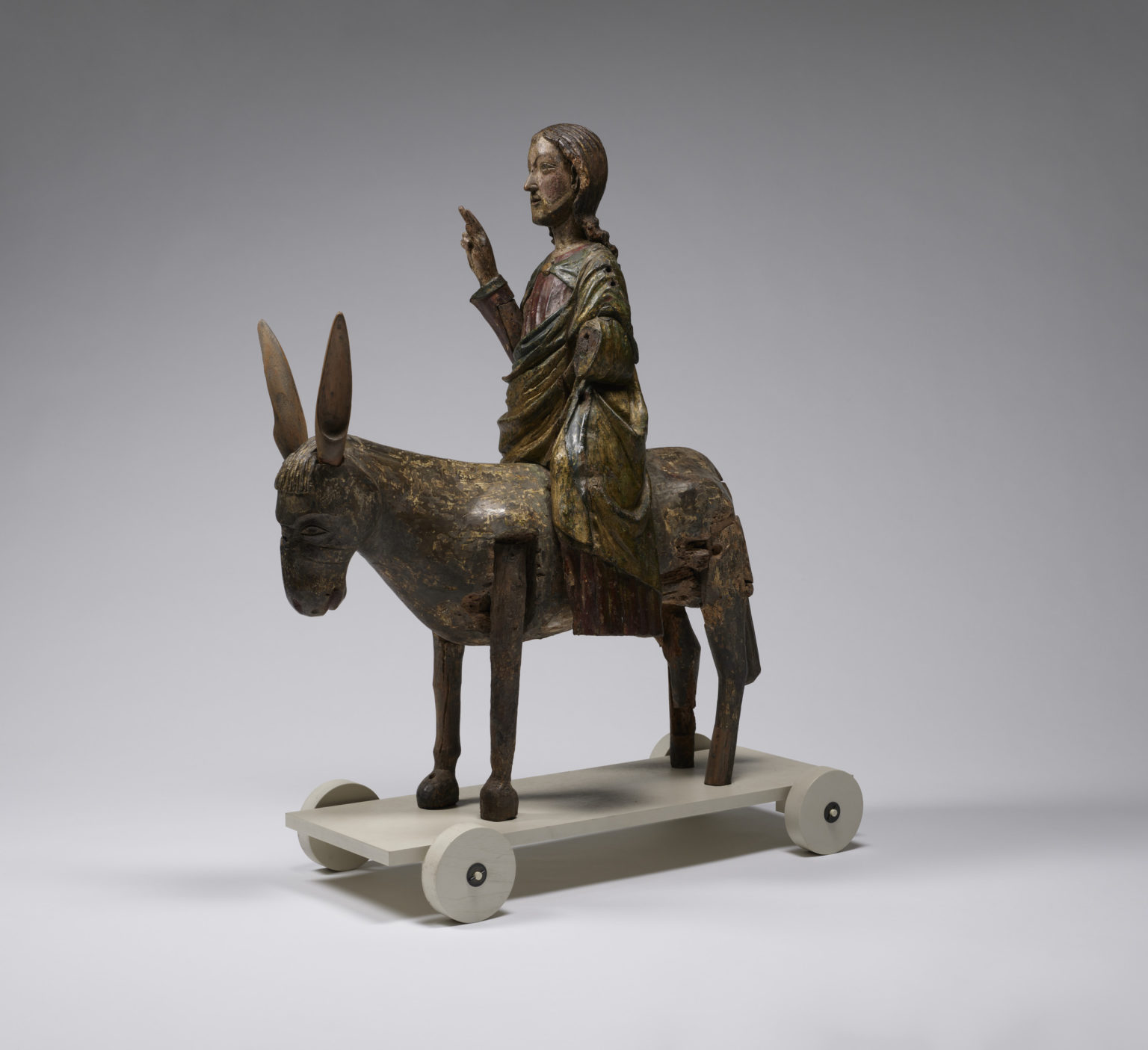
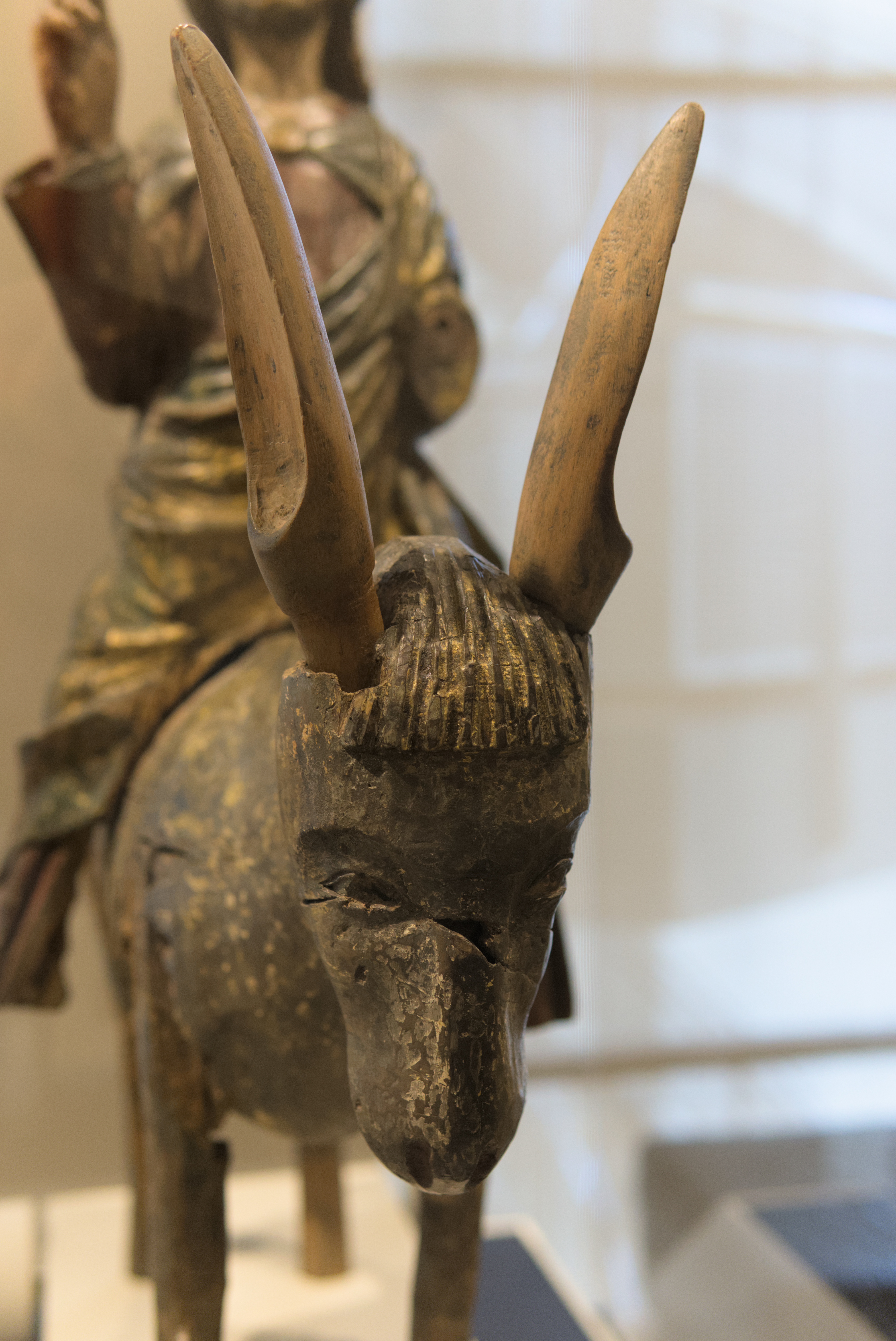
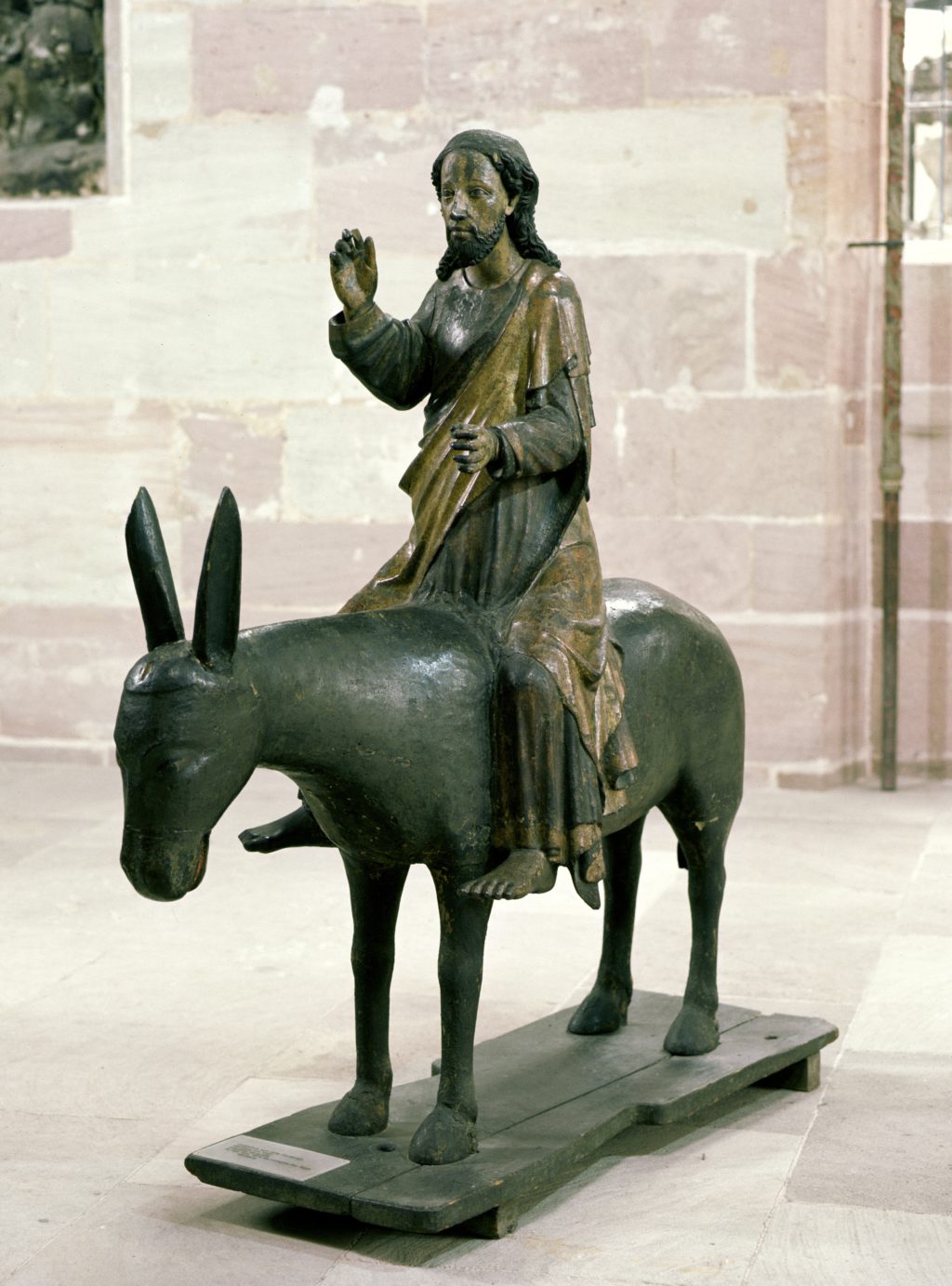
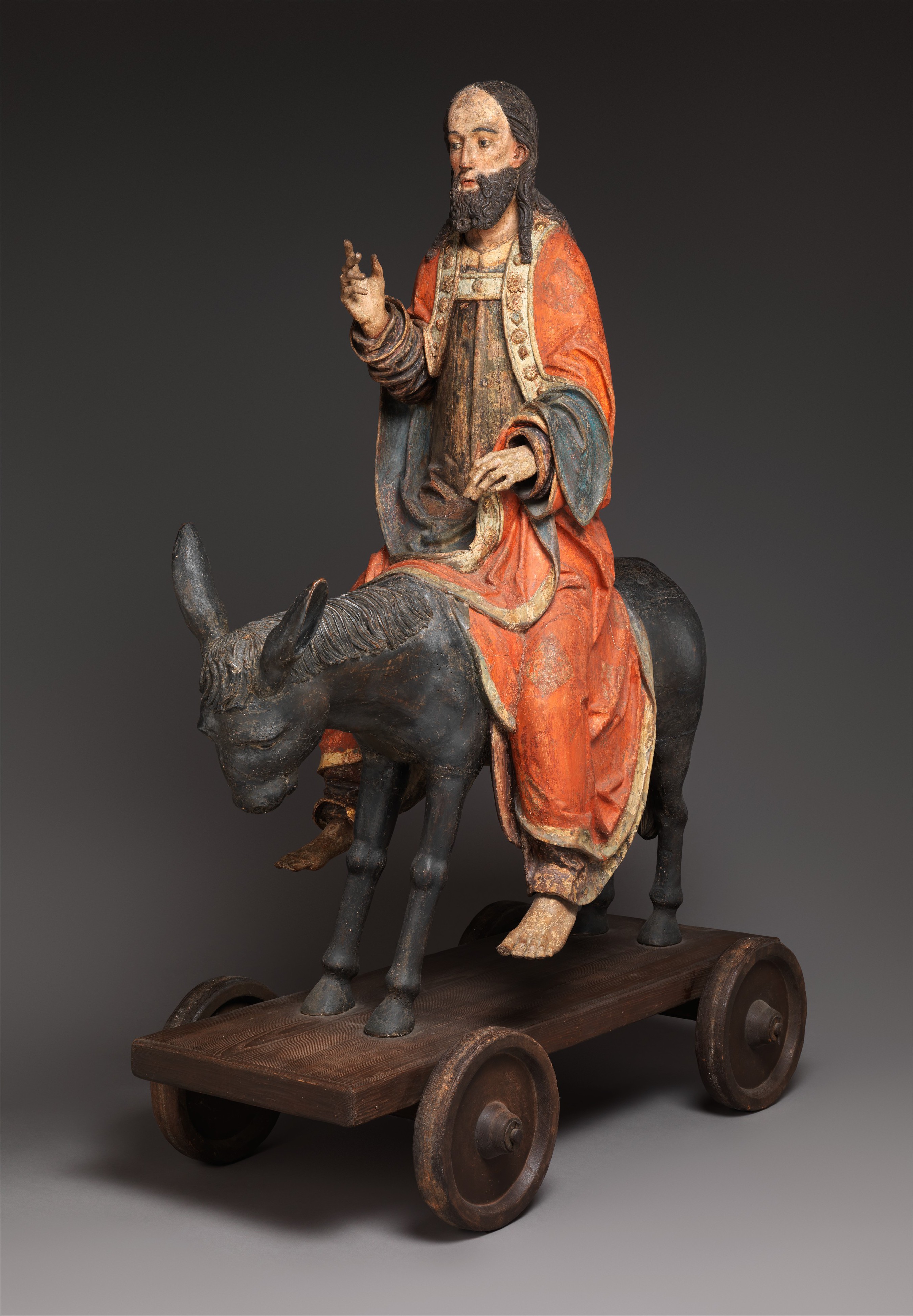
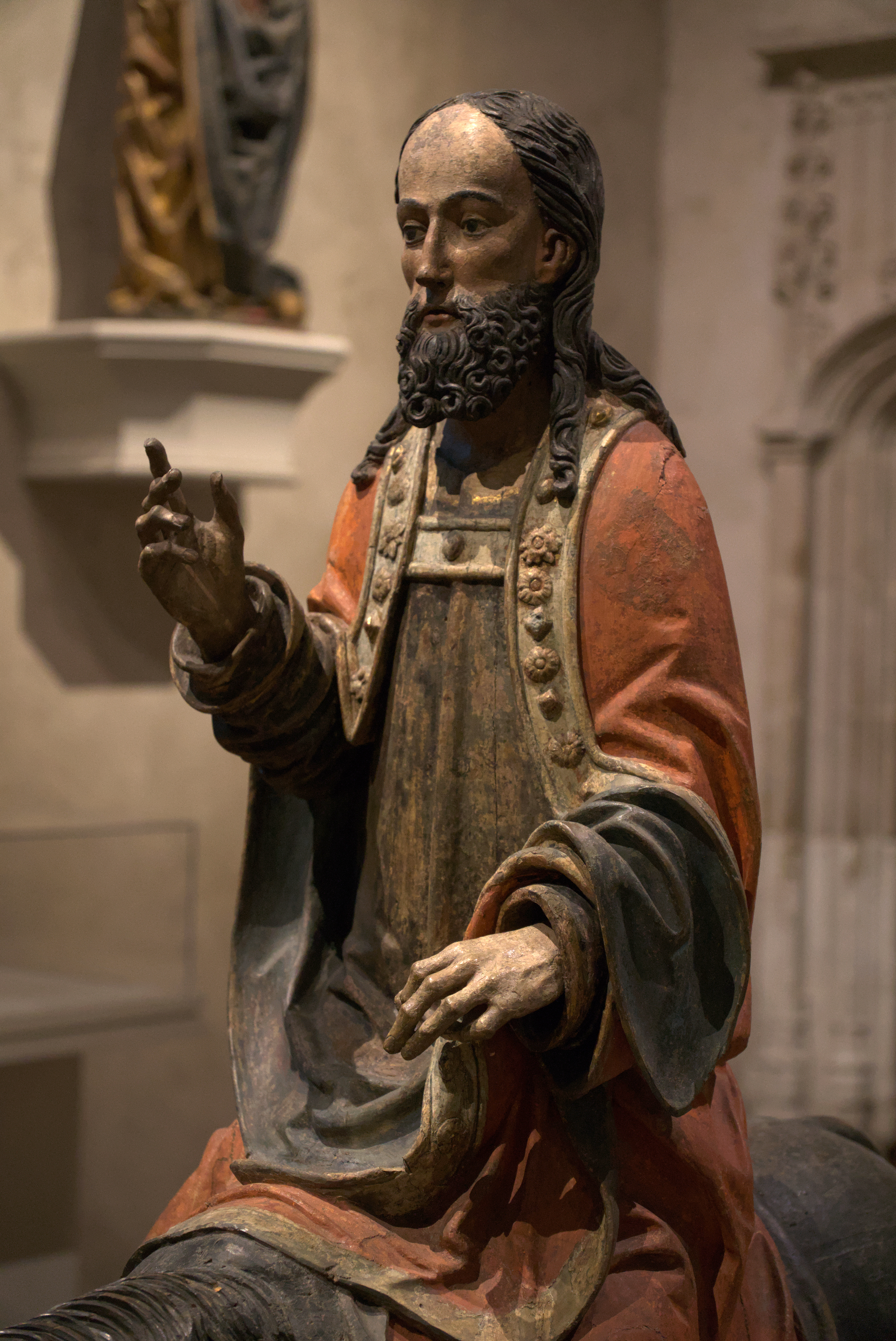
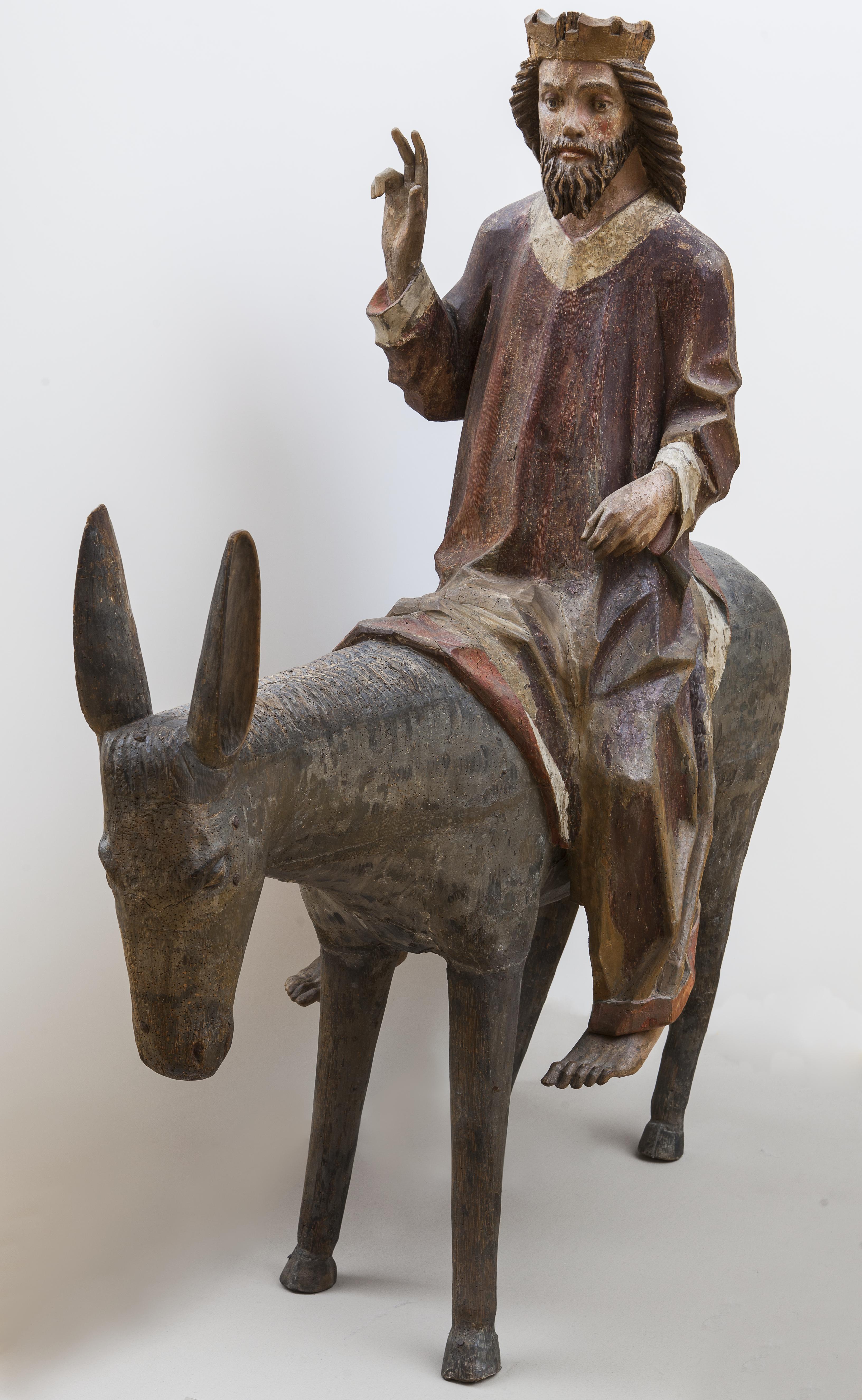
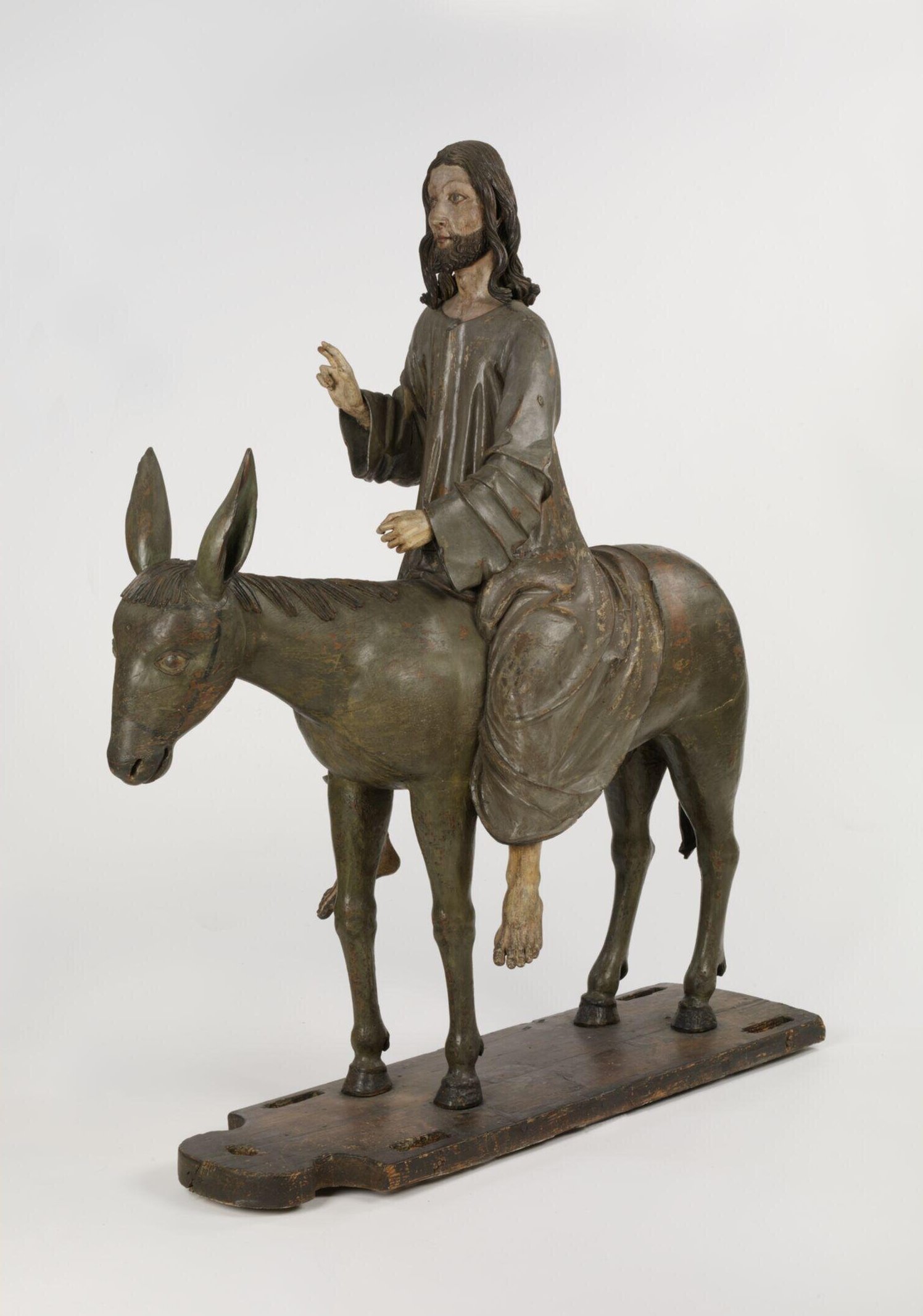
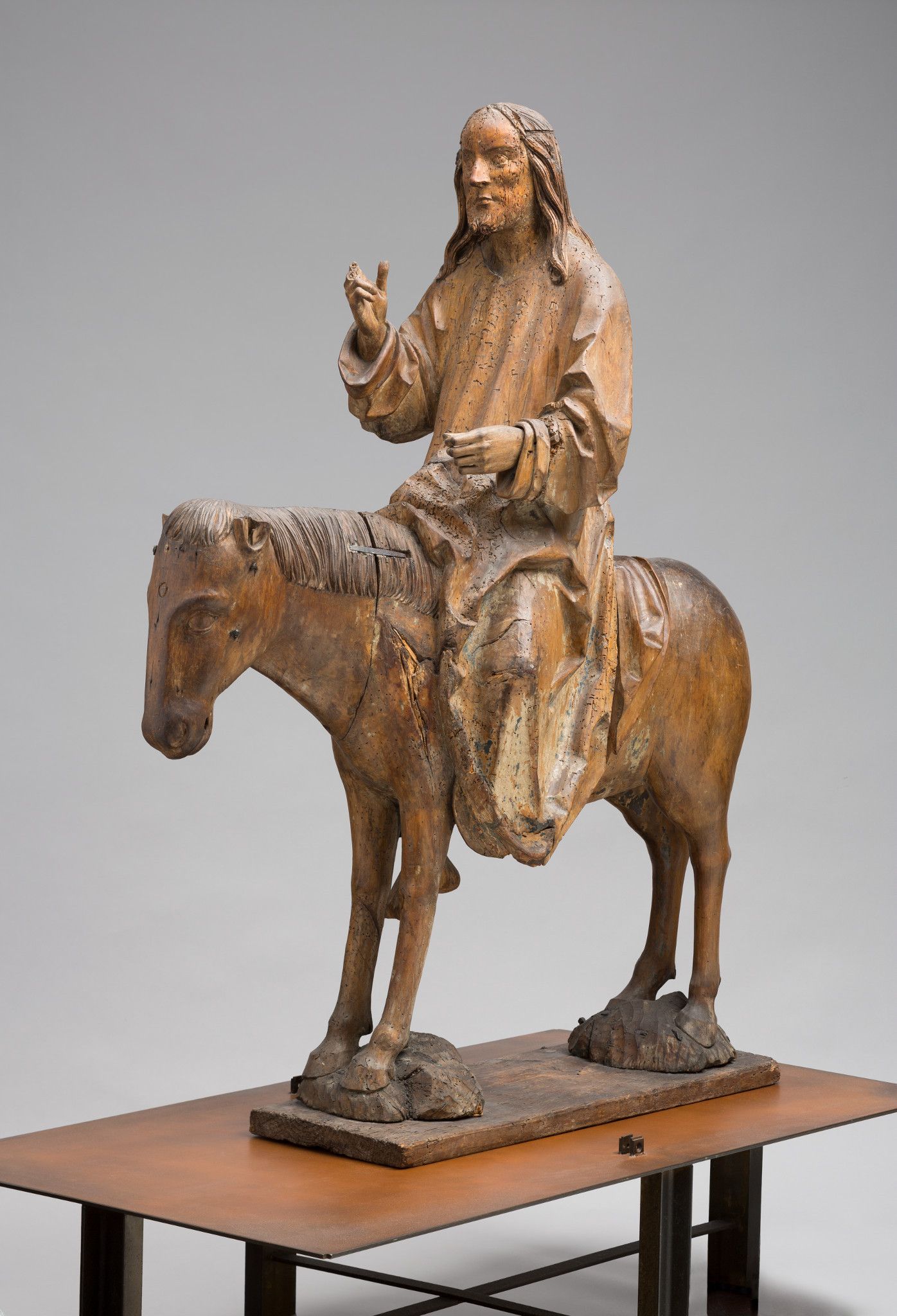
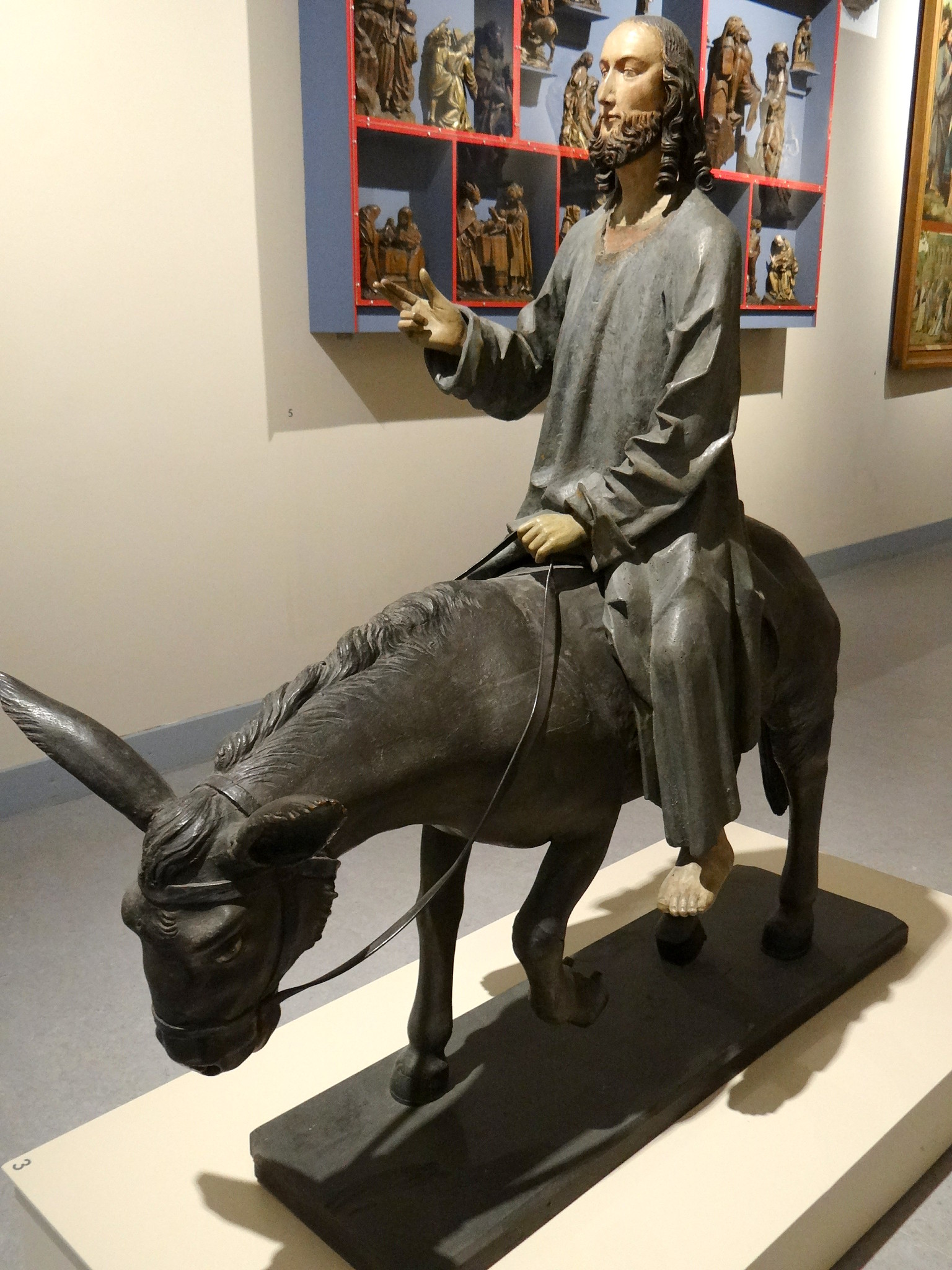
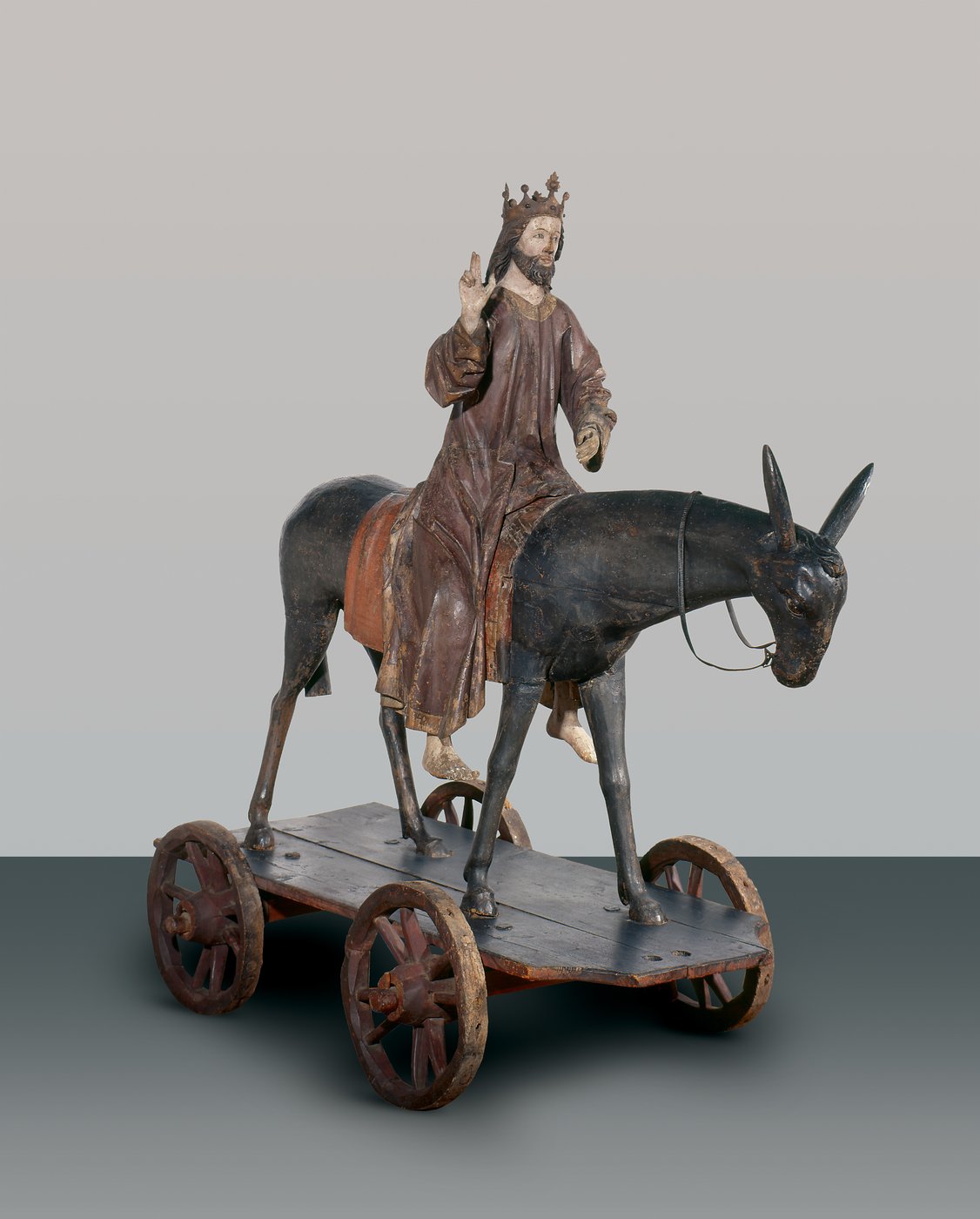
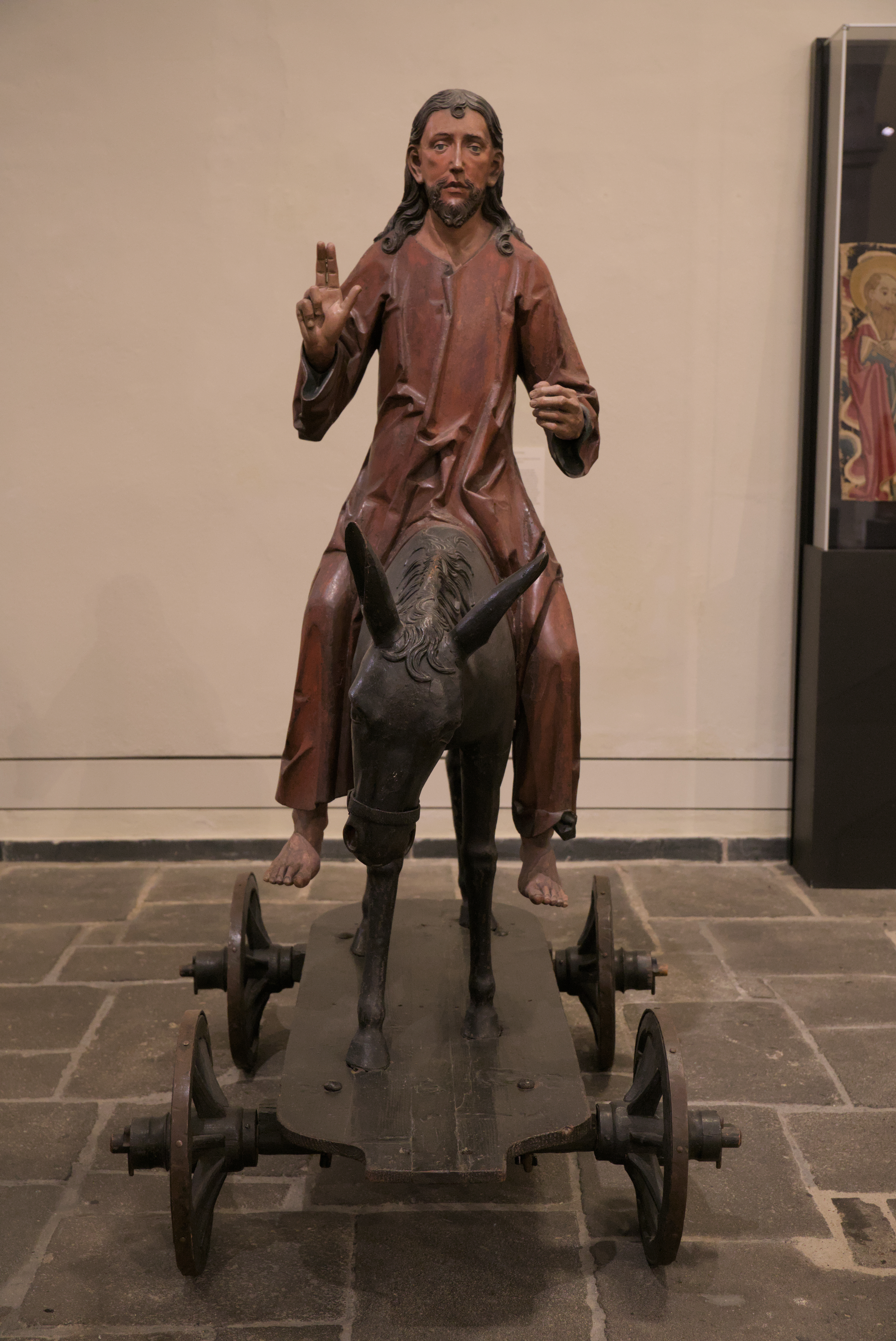
In German-speaking lands from the tenth to sixteenth centuries, many Christian communities would celebrate Palm Sunday by processing through the streets with a painted wood sculpture of Christ astride a donkey, called a Palmesel (pronounced PALM-ay-sul), German for “palm donkey.” Mounted on a wheeled cart and often escorted by children, the sculpture would move around town through crowds who had gathered from nearby villages and hamlets for the inauguration of Holy Week, the period of the Christian liturgical year that commemorates Jesus’s last days. The procession included the singing of hymns and the strewing of palm branches and outer garments along the Christ figure’s path, in imitation of the crowds that greeted Jesus when he entered Jerusalem for his (unbeknown to them) final Passover.
Christus auf dem Palmesel (Christ on the Palm Donkey), Franconia, ca. 1520–30. Polychrome linden wood, 148.5 × 166 × 54 cm. Skulpturensammlung, Bode-Museum, Berlin, Inv. 7710. Photo: Victoria Emily Jones. [object record]Palmesel illustration by the German chronicler Dominikus Debler, ca. 1800
Generally, the Protestant Reformers, with their emphasis on sola scriptura (scripture alone), didn’t like religious pageantry or images, as they believed they promoted idolatry. So when the Reformation swept through Germany in the 1500s, it destroyed many Palmesels. Another wave of destruction hit in the late eighteenth century when, influenced by the Enlightenment, temporary episcopal and synodal decrees in some localities banned “theatrical representations” of liturgical events, including Palmesel processions. Nevertheless, some 175 late medieval and Renaissance Palmesels, either partial or whole, have survived to the present day. The vast majority are in museum collections, no longer in active use.
A Frankenschau broadcast news segment from 2024 (see video below) reports on the Palmesel tradition, opening and closing with a Palmesel from ca. 1470 Nuremberg that’s on display year-round in the Rieterkirche St. Marien und Christophorus (Rieter Church of St. Mary and St. Christopher) in Kalbensteinberg, Germany—surprisingly, not a Catholic church but an Evangelical Lutheran one! The segment also looks at the Miltenberger Palmesel at the Stiftsmuseum Aschaffenburg and the Palmesel at the Met Cloisters in New York City. Press the CC button on the video player for closed captioning in English.
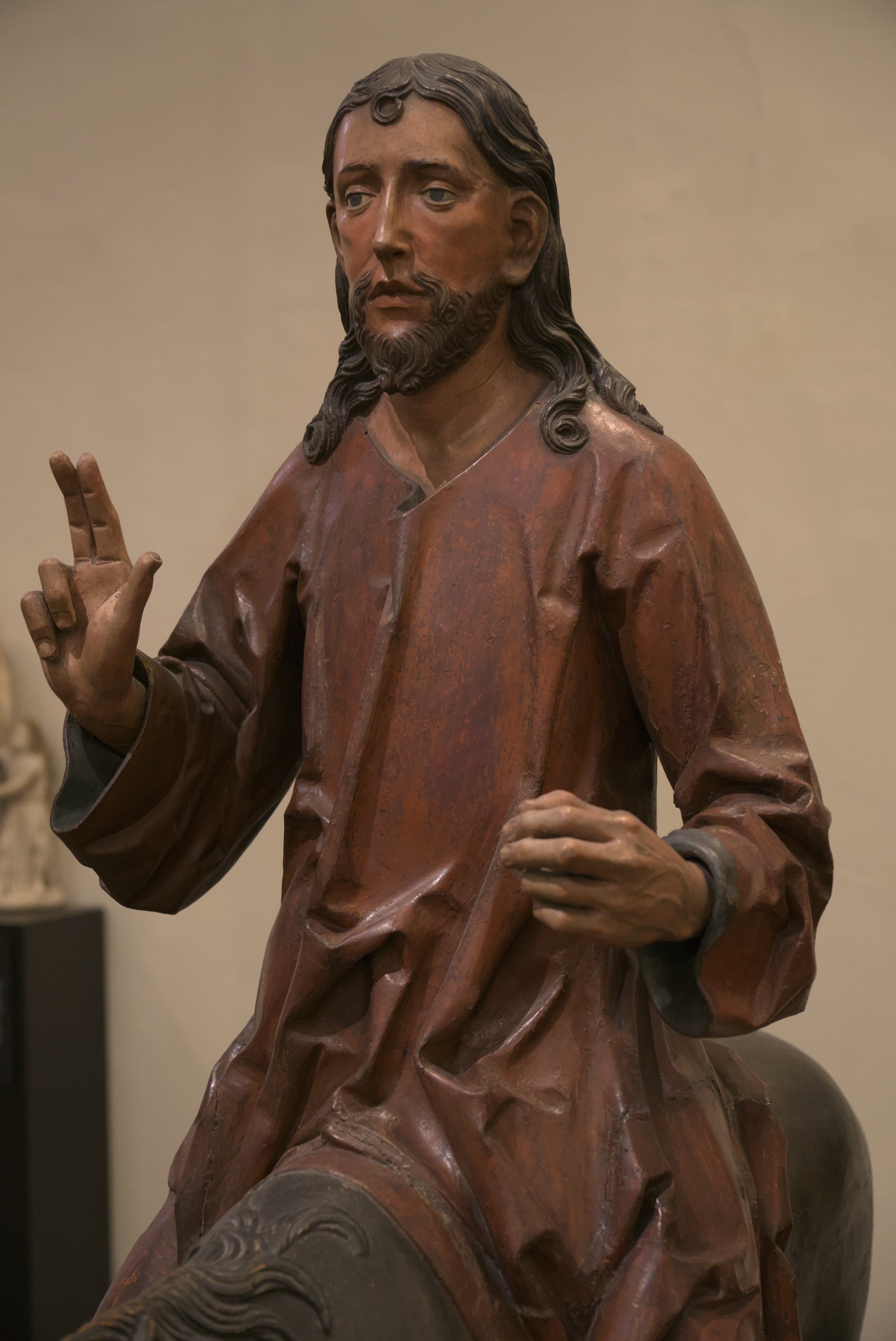
Palmesel sizes range from half-size (more intimate, and more navigable by children) to life-size. Christ is usually dressed in a simple tunic and mantle, and his feet hang bare. Sometimes he wears a crown. Typically his right hand is raised in blessing, while his left hand holds the reins—though in the first example below, it clutches a book.
Steiner Palmesel, ca. 1055. Polychrome linden wood, 176.5 × 135 cm. Landesmuseum (Swiss National Museum), Zurich, Inv. LM 362. Photo: Linda Safran. [object record]Christus auf dem Palmesel, ca. 1200. Poplar wood with renewed finish, 138 × 55.5 × 52 cm. Skulpturensammlung, Bode-Museum, Berlin, Inv. 2766. Photo: Victoria Emily Jones. [object record]Christus auf dem Palmesel, ca. 1310. Church of Saints Peter and Paul, Petersthal, Germany.Christus auf dem Palmesel, Upper Rhine, 1350–60. Polychrome poplar wood, 159.5 × 52.5 × 16.1 cm. Augustinermuseum, Freiburg, Germany, Inv. 10079. Photo: Hans-Peter Vieser.Palmesel, Franconia, ca. 1350–1400. Wood with paint and gilding, 96 × 34 × 82 cm. Walters Art Museum, Baltimore.Photo: Victoria Emily JonesChristus auf dem Palmesel, Franconia, ca. 1370–80. Polychrome alderwood, willow, 172.5 × 61.5 × 169 cm. Germanisches Nationalmuseum, Nuremberg, Inv. PI.O.153.Christus auf dem Palmesel, Poltringen, Germany, ca. 1380. Hohenzollerisches Landesmuseum, Hechingen, Germany.Christus auf dem Palmesel, Swabia, late 14th century. Polychrome linden wood. Landesmuseum Württemberg, Stuttgart, Germany.Christus auf dem Palmesel, Ulm, Germany, 15th century (statue), 18th century (wagon). Zeppelin Museum Friedrichshafen, Germany.Palmesel, Franconia, 15th century. Polychrome linden wood, 156.2 × 60.3 × 138.4 cm. Cloisters Collection, Metropolitan Museum of Art, New York.Photo: Victoria Emily JonesPalmesel, Austria, ca. 1450. Polychrome wood, 154.9 × 144.1 × 50.2 cm. Chazen Museum of Art, University of Wisconsin, Madison, Inv. 1977.2.Christ on an Ass, ca. 1480. Linden wood and pine, painted and gilded, 147.4 × 47.8 × 133.5 cm. Victoria and Albert Museum, London.Christofel Langeisen, Palmesel (Christ Entering Jerusalem on the Back of a Donkey), 1480–90. Polychrome linden wood, 143.5 × 40.6 × 110.5 cm. Detroit Institute of Arts, Detroit, Michigan.Christus auf dem Palmesel, southern Germany, perhaps Swabia, late 15th century. Polychrome linden wood, 122 × 100 × 44 cm. Musée de Cluny, Paris. Photo: Marie-Lan Nguyen.Christus auf dem Palmesel, southern Germany (circle of Erasmus Grasser), ca. 1500. Suermondt-Ludwig Museum, Aachen, Germany. Photo: Rex Harris.Christus auf dem Palmesel, Lake Constance, ca. 1500. Polychrome linden wood, height 190 cm. Historisches Museum, Basel, Switzerland, Inv. 1898.275.Christus auf dem Palmesel, Nuremberg, ca. 1505. Polychrome linden wood, 82 × 31.5 × 88 cm. Germanisches Nationalmuseum, Nuremberg, Germany.Christus auf dem Palmesel, Cologne, ca. 1520. Polychrome linden wood, softwood. Museum Schnütgen, Cologne, Germany, Inv. A 124. Photo: Victoria Emily Jones.Photo: Victoria Emily Jones
Palmesels were living art objects engaged by people of all classes. “Unlike many museum objects from the Middle Ages,” writes a Walters Art Museum curator, “the Palmesel was accessible not just to the wealthy elite and the clergy but to all levels of society. It moved among the laypeople so that they could participate in an immersive experience of a significant event from Christ’s life in their own time and place.”
The following edited video shows a 2018 Palmesel procession, led by choirboys, wending its way through an Alpine landscape from Thaur to Rum. It’s the last of its kind in the Austrian state of Tyrol. The sculpture is modern.
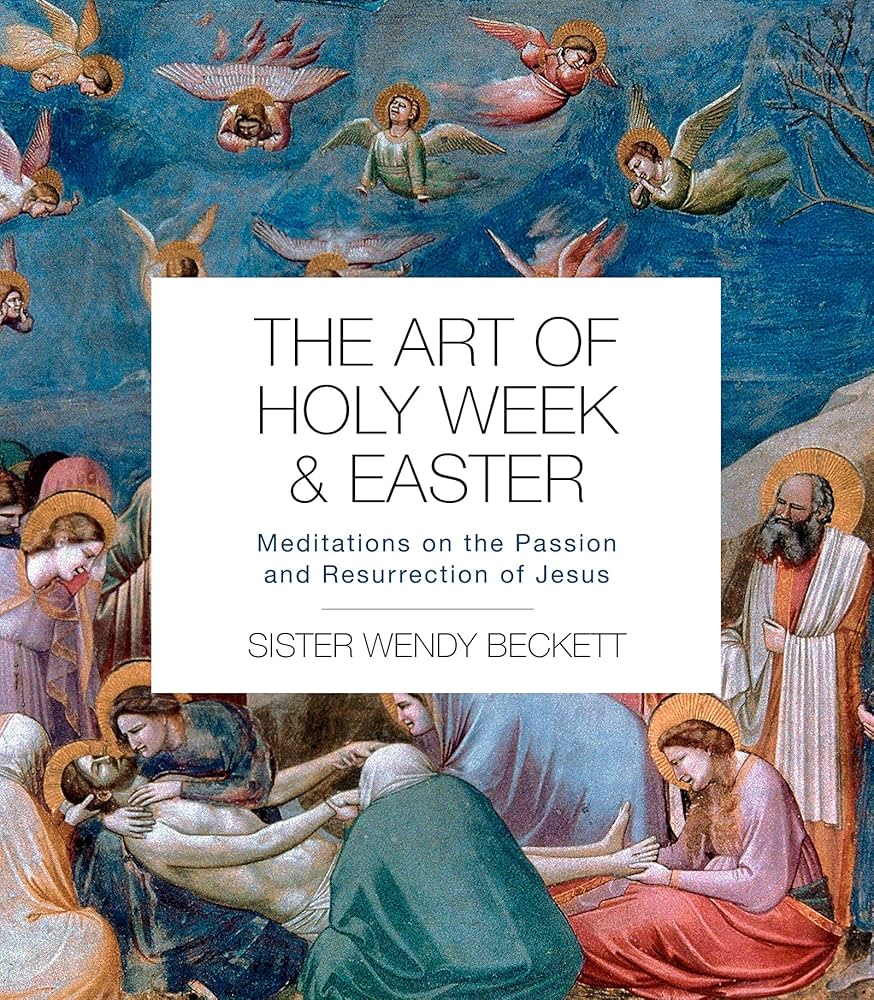
BOOK: The Art of Holy Week and Easter: Meditations on the Passion and Resurrection of Jesus by Sister Wendy Beckett (2021): Sister Wendy Beckett, a British Catholic nun and art enthusiast who died in 2018, is the one who first got me interested in art history. We watched clips from her BBC series Sister Wendy’s Story of Painting in my studio art class in high school, and I was so drawn to the way she looked at art and talked about it. Enthusiastic, warm, inquisitive, spiritually sensitive and theologically astute, and interested not just in the technical qualities of a work but also in its content—though I know I lack the same flair, my own voice and approach when it comes to art are indebted to hers.
So I was delighted to see that SPCK (and IVP in North America) has published two church calendar–based art devotionals by Sister Wendy: one for Lent, and one for Holy Week and Easter. I was disappointed with The Art of Lent: It has an admirable diversity of art selections, but Sister Wendy’s reflections are short and basic, and most don’t shine in the way I’ve come to expect from her; there were only two standouts for me. I also found it thematically confusing (for example, a section on “Confidence”?), unfocused, and redundant (especially in the “Silence” and “Contemplation” sections). I will grant that Lent is a more difficult season to structure for a project like this than Advent is, as I found the one year I published a daily Lent series; it can mean many things to many people.
Sister Wendy’s The Art of Holy Week and Easter, on the other hand, I did enjoy and recommend, even though I wish it had the same variety as the Lent book. (There’s only one modern/contemporary painting.) I care for only about half the featured artworks—two favorites are below—but even for the ones I was disinclined toward, her commentary helped me appreciate them.
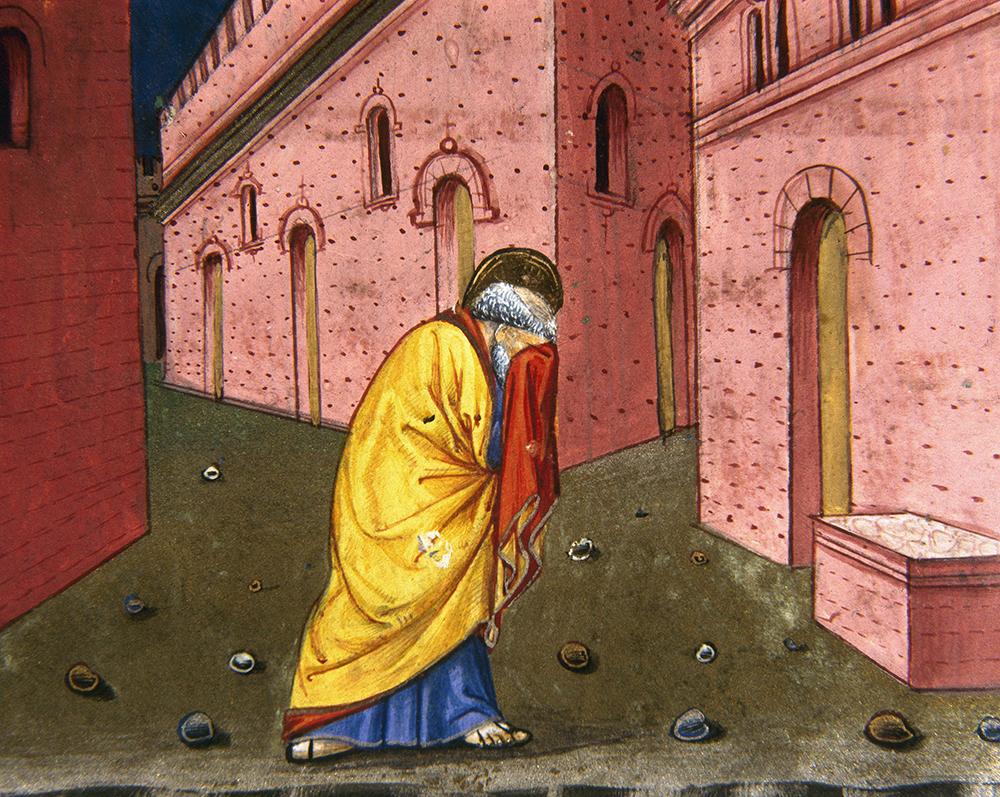
Cristoforo de Predis (Italian, 1440–1486), “Saint Peter realizing he has thrice betrayed Jesus,” from the Leggendario Sforza-Savoia, 1476. Codice Varia 124, Biblioteca Reale (Royal Library), Turin, Italy.
About a medieval manuscript illumination of Peter weeping by Cristoforo de Predis, Sister Wendy writes:
This magical little picture presents an unforgettable image of grief. It is that most painful kind of grief, lamenting of our own folly. Here we see Peter with his shamed face covered, stumbling blindly forward from one closed door to the next. There are ways out behind him, but Peter is too lost in misery to look for them. This claustrophobic despair, this helpless anguish, this incapacitating sense of shame: these are the result of a sudden overturn of our own self-image.
Peter had honestly seen himself as one who loved and followed Jesus, priding himself, moreover, on how true his loyalty was in comparison with that of others. ‘Even if all should betray you, I will never betray you’ – it was a boast, but he had meant it. Now he sees, piercingly, that he is fraudulent. He has been unmasked to himself, he has lost his self-worth.
The crucial question is: What next? Will he hide his face forever, destroyed by self-pity? Will he lose all heart, perhaps even kill himself, as Judas did? But while Judas felt only remorse, Peter feels contrition, a healing sorrow that will lead to repentance and a change of heart. Now that he knows his true weakness, he will cling to Jesus as never before. He will cling in desperate need and not in false strength, and will in the end become truly Peter, the ‘rock’, on which the Church, likewise dependent on Christ, will be built. (26)
El Greco (Greek Spanish, 1541–1614), Christ Crucified with Toledo in the Background, 1604–14. Oil on canvas, 111 × 69 cm. Fundación Banco Santander, Madrid.
About El Greco’s Christ Crucified, she mentions how “Jesus . . . dies looking upwards, his determination set upon his Father’s will and its consummation. . . . His body spirals upwards like a white flame, radiating out as he spreads his arms to share the light with the defeated shadows” (38).
+++
HYMNS:
>> “O Love, How Deep, How Broad, How High”: I’ve enjoyed learning a few new-to-me hymns from the YouTube channel of Josh Bales. Attributed to the fifteenth-century German Dutch Catholic mystic Thomas à Kempis, this hymn text was translated from Latin into English by Benjamin Webb in 1871. It appears in the Episcopal hymnal with the tune EISENACH by Bartholomäus Gesius, as adapted by Johann Hermann Schein in 1628, which is what Bales sings. It’s rare among hymns for emphasizing that our salvation was won not just by Christ’s death but also by his life—his faithful obedience to the Father.
>> “I Stand Amazed (How Marvelous)”: A favorite from my childhood, this 1905 gospel hymn by Charles H. Gabriel is performed here by the Imani Milele Choir, made up of orphaned and/or vulnerable children and youth from Uganda.
>> “Come Let Me Love”: I recently learned of this shape-note hymn from a book I’m reading by J. R. Watson. Written by the late great Isaac Watts, the text was first published in the 1706 edition of Watts’s Horæ lyricæ with the title “Christ’s Amazing Love and My Amazing Coldness.” I especially love verses 4 and 5, reproduced below. The tune in the following video, LAVY, is actually a new one (from 1993) that sounds old, by John Bayer Jr.
Infinite grace! Almighty charms! Stand in amaze, ye rolling skies! Jesus, the God with naked arms, Hangs on a cross of love and dies.
Did pity ever stoop so low, Dress’d in divinity and blood? Was ever rebel courted so, In groans of an expiring God?
+++
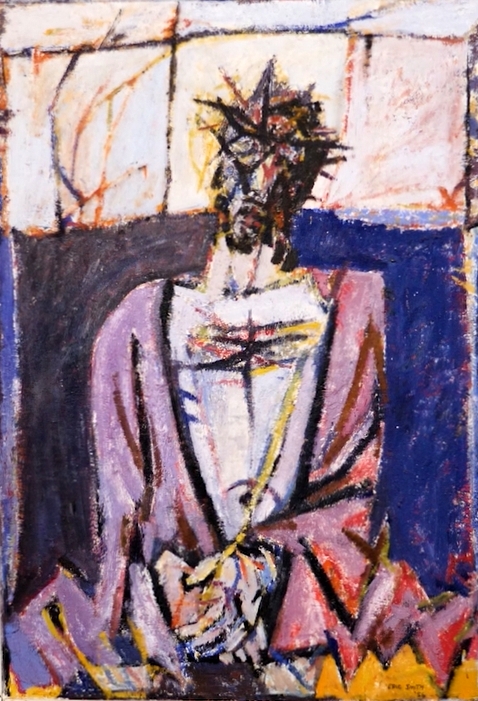
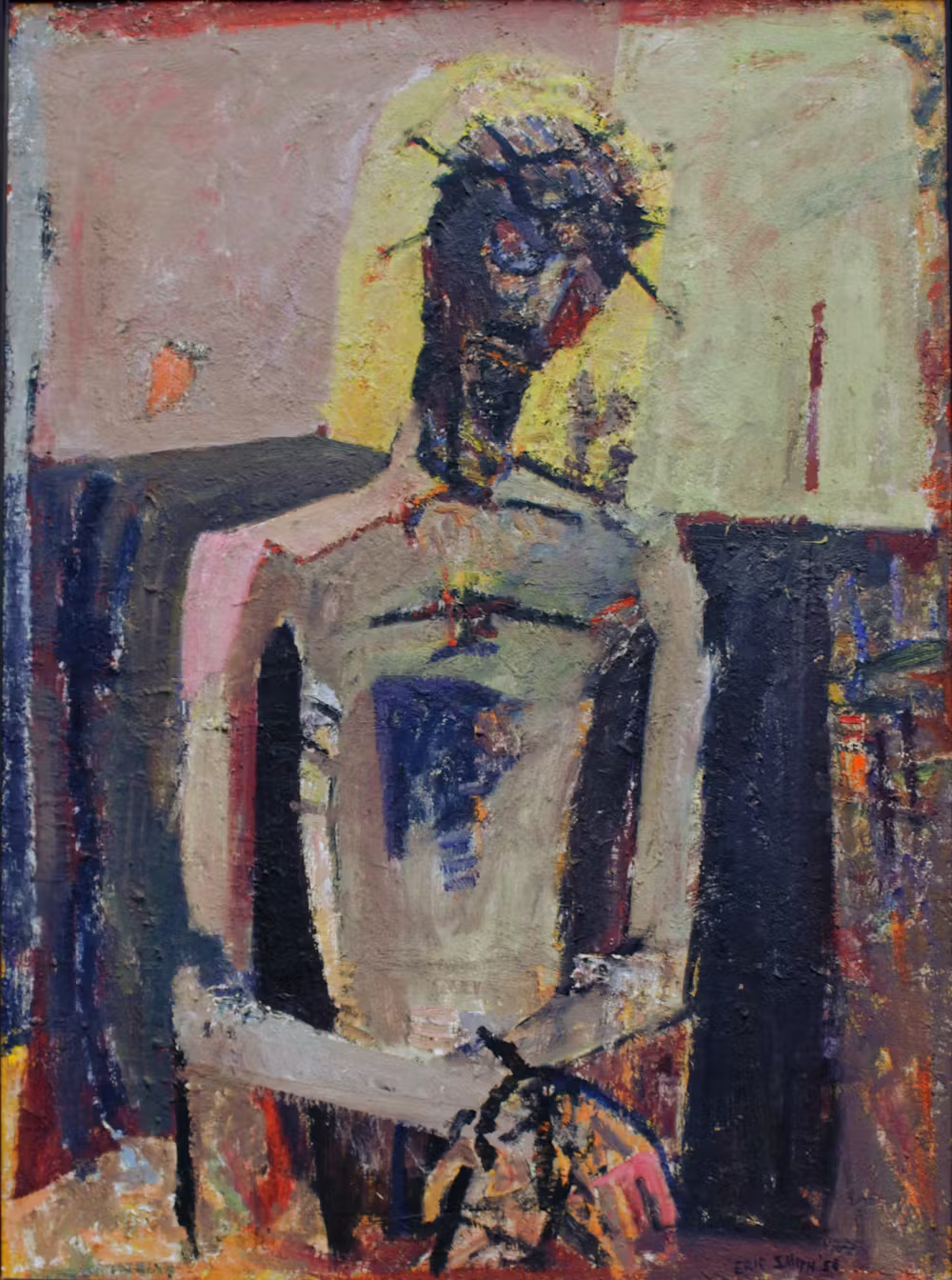
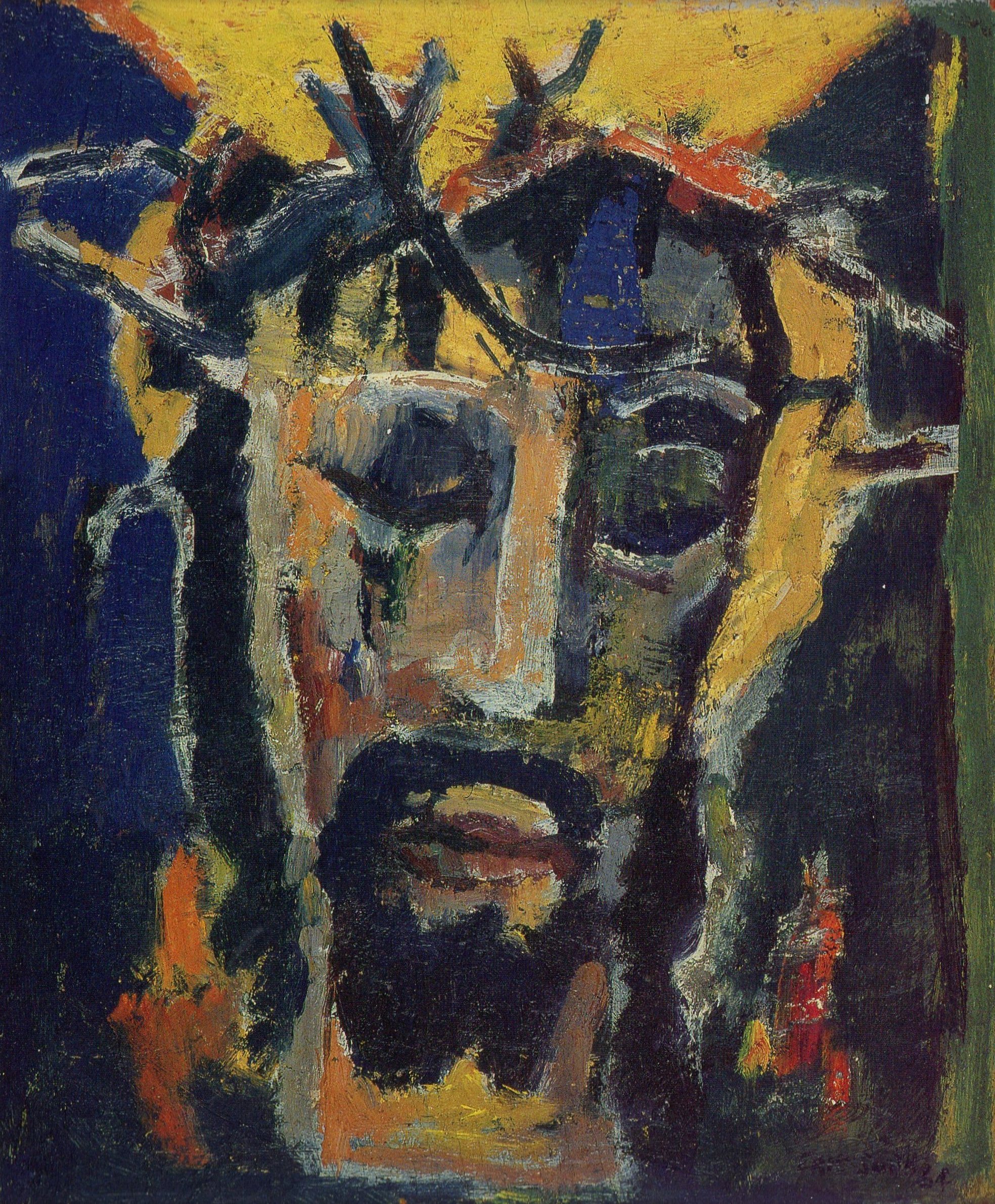
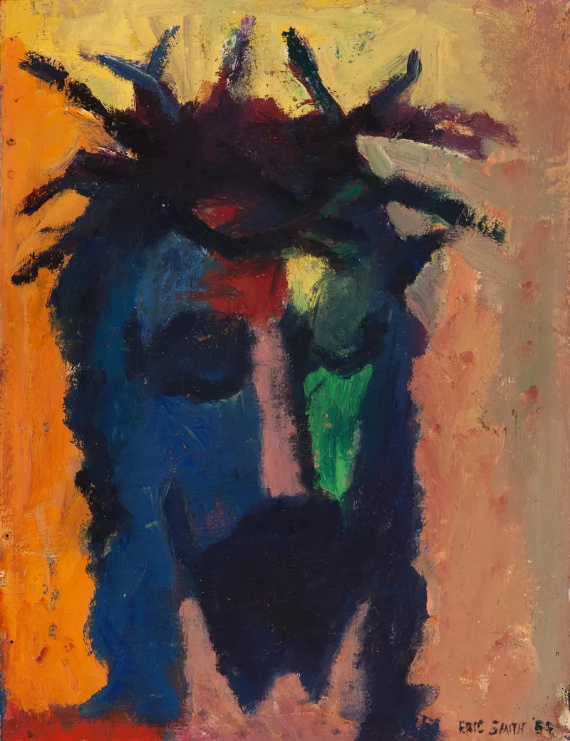
VIDEO:“Christ by Eric Smith”: This is the first video in the (Catholic) Archdiocese of Brisbane’s four-part Art Aficionados series from 2022. In it, Archbishop Emeritus Mark Coleridge, theology professor Maeve Heaney, and Rev. Dr. Tom Elich of Liturgy Brisbane discuss the semiabstract Ecce homo painting Christ by the modern Australian artist Eric Smith—its pathos, calm, and double irony. This Christ is crushed yet composed, Coleridge says. Smith won the prestigious Blake Prize for Religious Art six times, including, in 1956, for a painting similar to this one (see second image in slideshow below). I’d love to see more dioceses releasing videos like this!—close looking at art.
Eric Smith (Australian, 1919–2017), Christ, 1956. Oil on Masonite, 138 × 95 cm. Collection of Holy Spirit Seminary (Queensland Provincial Seminary), Banyo, Brisbane, Australia. Photo courtesy of Tom Elich.
Eric Smith (Australian, 1919–2017), The Scourged Christ, 1956. Oil on Masonite, 116 × 85 cm. Penrith Regional Gallery, Emu Plains, Australia.
Eric Smith (Australian, 1919–2017), Head of Christ, 1954. Oil on wood, 47 × 39.4 cm. Collection of Newman College, University of Melbourne, Australia.
Eric Smith (Australian, 1919–2017), Head of Christ, 1954. Oil on Masonite, 40.5 × 32.6 cm. Art Gallery of South Australia, Adelaide.
+++
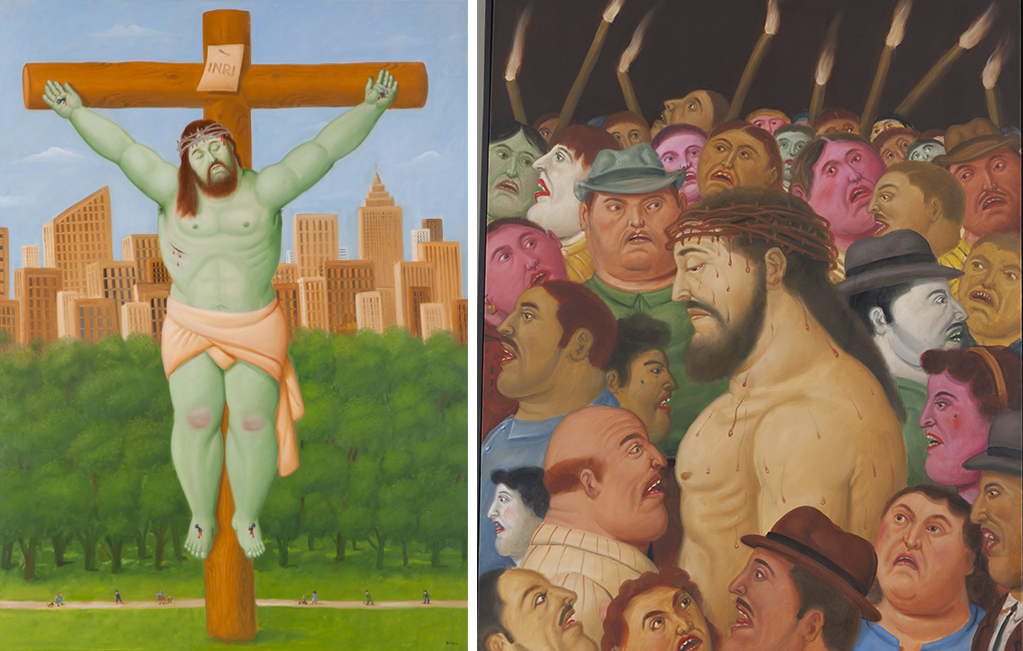
ART SERIES: Via Crucis: La pasión de Cristo (Way of the Cross: The Passion of Christ) by Fernando Botero: Executed in 2010–11, Via Crucis is a series of twenty-seven oil paintings and thirty-four mixed-media drawings by Colombia’s most famous artist, Fernando Botero (1932–2023) [previously]. Botero said he turned to the subject of Christ’s passion not because he’s religious, but out of admiration for the great works of art on the subject; he approached it with “a spirit of great respect,” aiming to portray God as a tortured man. The artist donated the series to the Museo de Antioquia in Medellín for his eightieth birthday. I can’t find a compilation of the whole series (the museum has digital records of the Boteros in its collection, but not all the images are showing up for me)—but you can view fourteen of the paintings in this article, and here’s a quick little Facebook reel.
Marlborough Gallery in New York offers a catalog of the series for $75, and Artika offers a much more expensive one (a gorgeous product, but $9,500!):
Here’s a news segment, in English, about the series’ exhibition at Lisbon’s Palacio de Ajuda in November 2012 (unfortunately, the video quality is low):
Fernando Botero (Colombian, 1932–2023), Crucifixión (Crucifixion), 2011, and Jesús y la multitud (Jesus and the Crowd), 2010. Oil on canvas. Museo de Antioquia, Medellín, Colombia.
+++
I have thematic playlists on Spotify for Lent and Holy Week—for the latter, don’t miss “From the Garden to the Tomb” by The Soil and The Seed Project, one of several recent additions.
But, by popular request, I also have a brand-new March 2026 playlist, a somewhat random assortment of songs I’ve been enjoying—some new releases, some not.
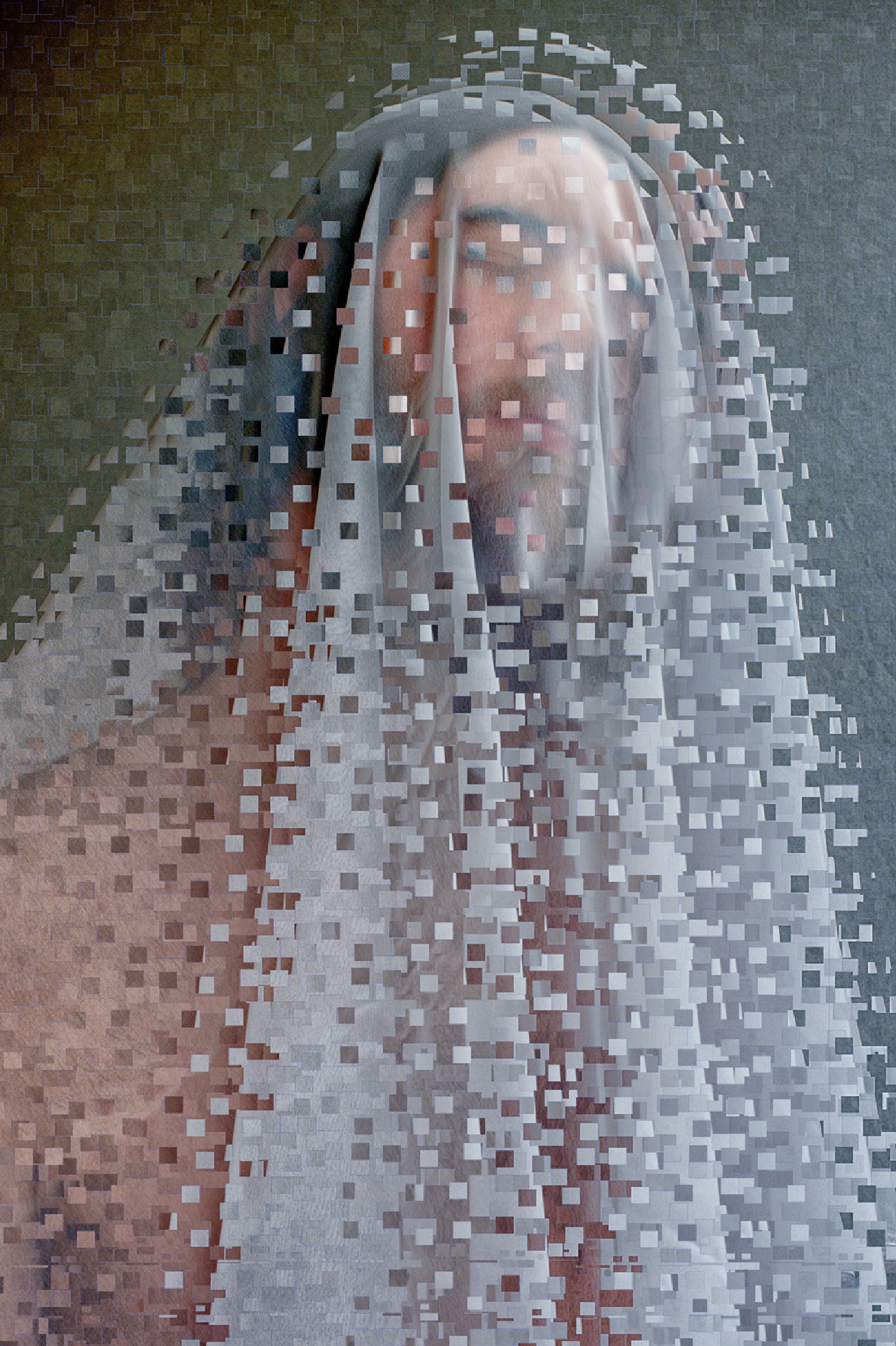
Brett Canét-Gibson (Australian, 1965–), Anastasis, 2016. Photographic digital print, 90 × 60 cm.
Anastasis is the Greek word for “resurrection.” This image by the Australian photographer Brett Canét-Gibson shows the dead Christ covered in a translucent burial shroud, which appears pixelated, out of joint. Some kind of mysterious transformation is afoot. It’s as if Jesus is in the process of waking up, reconstituting, his form coming back into focus as death comes undone. The shimmying squares create a sense of motion and effervescence.
LISTEN: “The Communion Verse of Holy Saturday” | Traditional Orthodox liturgical hymn (in Tone 4), arr. Boris Ledkovsky, mid-20th century | Performed by the Holy Trinity Monastery and Seminary Choir of the Russian Orthodox Church Outside Russia, Jordanville, New York, on Let Us Sing of John, the Hierarch of Christ, 2011
This verse is sung at the end of the Vespers with Divine Liturgy service of the Orthodox Church on the morning of Great and Holy Saturday. Here is the Slavonic text, followed by a phonetic rendering and the English translation:
Воста яко спя Господь: и воскресе спасаяй нас. Аллилуиа.
Vosta yako spya Gospod, i voskrese spasayai nas. Aleluija.
The Lord awoke as one out of sleep, and he is risen to save us. Alleluia.
Even though Holy Saturday commemorates Jesus’s repose in the tomb, this hymn for the occasion anticipates his resurrection. The first half is taken from Psalm 78:65a: “Then the LORD awaked as one out of sleep.”
As we wait in the darkness of what looks like defeat, victorious new life is stirring, about to emerge.
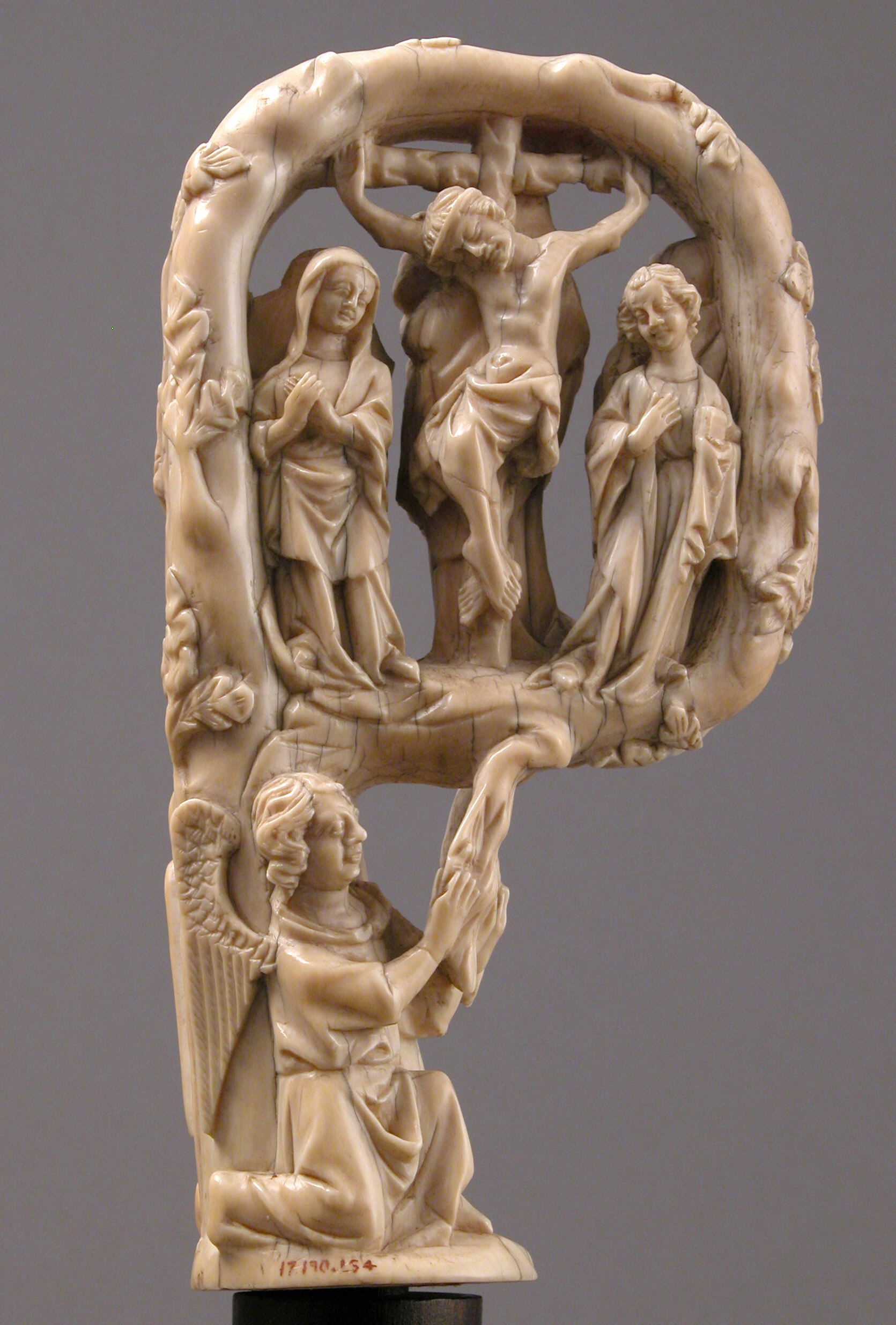
Crozier Head with the Crucifixion, Paris, ca. 1350. Elephant ivory, 5 13/16 × 3 1/8 × 1 1/2 in. (14.8 × 8 × 3.8 cm). Metropolitan Museum of Art, New York. The reverse side depicts the Virgin and Child with Saint Denis.
This carved head of a bishop’s staff from medieval France depicts Christ crucified on the tree of the cross, flanked by his mother Mary and his friend John. From the base of the cross flows a healing stream of blood, which an angel kneels to catch in his hands.
LISTEN: “O Love Divine, What Hast Thou Done” | Words by Charles Wesley, 1742
I can’t decide which of the following two tunes I prefer, so I proffer them both. The first is a traditional four-part hymn tune, sung a cappella, whereas the second is a contemporary guitar-driven tune.
>> Music by Isaac Baker Woodbury, 1850 | Performed by the Choral Arts Society of Washington, dir. Scott Tucker, on Lift Up Your Voice: Hymns of Charles Wesley, 2015:
>> Music by Heaven’s Dave, on Beyond the Starry Skies, 2023:
O Love divine, what hast thou done? Th’ immortal God hath died for me; The Father’s co-eternal Son Bore all my sins upon the tree. Th’ immortal God for me hath died; My Lord, my Love, is crucified.
Behold him, all ye that pass by, The bleeding Prince of Life and Peace; Come, sinners, see your Savior die, And say, “Was ever grief like his?” Come feel with me his blood applied; My Lord, my Love, is crucified.
Is crucified for me and you, To bring us rebels back to God. Believe, believe the record true: We all are bought with Jesus’ blood. Pardon for all flows from his side; My Lord, my Love, is crucified.
Then let us sit beneath his cross, And gladly catch the healing stream; All things for him account but loss, And give up all our hearts to him— Of nothing speak, or think beside, But Jesus and him crucified.
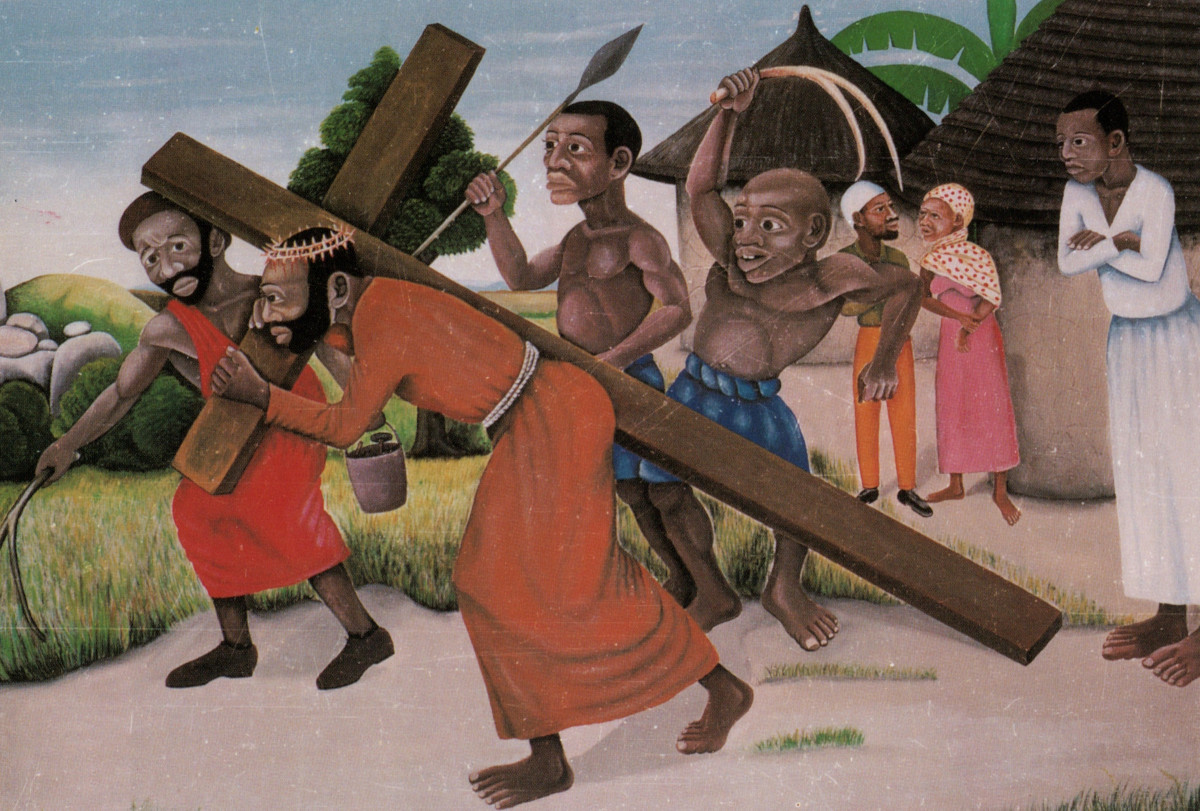
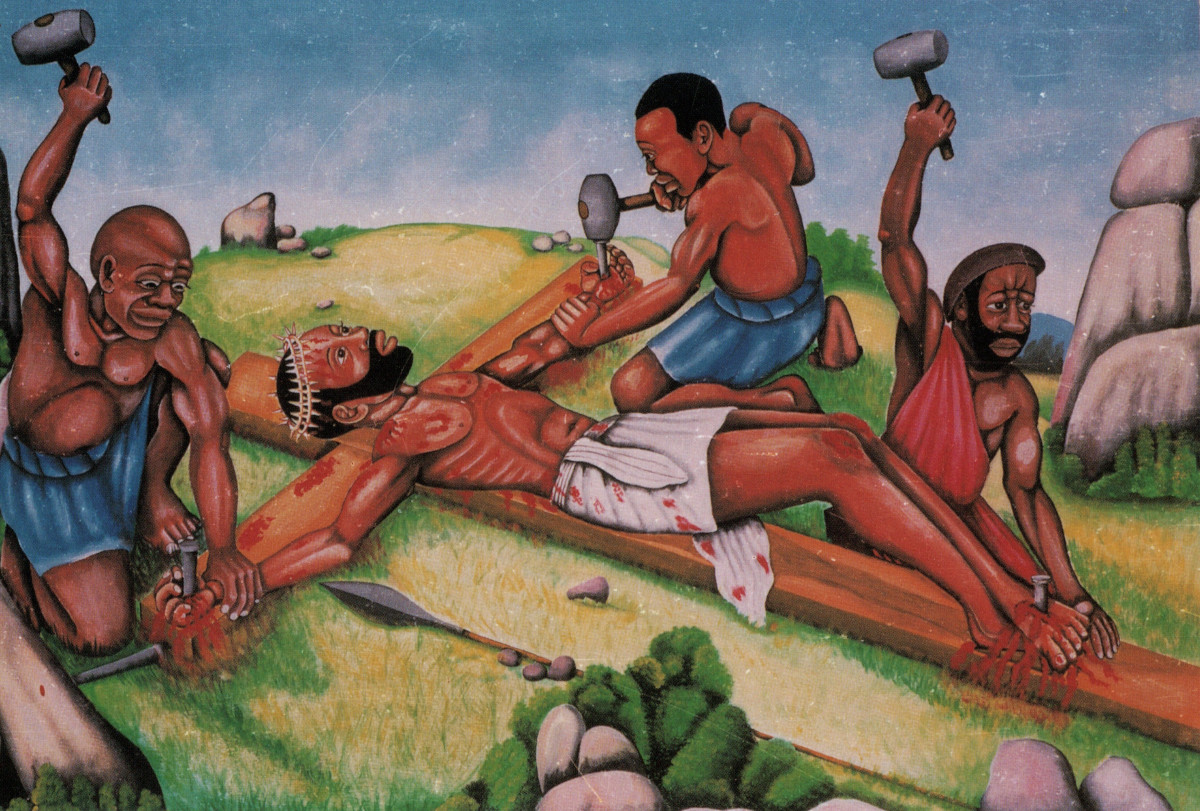
LOOK: Stations of the Cross #2 and #11 by Charles Ndege
Charles S. Ndege (Tanzanian, 1966–), Station II: Jesus Takes Up His Cross. Wall painting from St. Joseph Mukasa Balikuddembe Church, Nyakato (Mwanza region), Tanzania. Source: Were You There? Stations of the Cross by Diana L. HayesCharles S. Ndege, Station XI: Jesus Is Nailed to the Cross
The cement walls of St. Joseph Mukasa Balikuddembe Church in Nyakato, Tanzania, bear a series of murals by the Tanzanian artist Charles Ndege depicting the Stations of the Cross, set around the southern shores of Lake Victoria.
I couldn’t find what year the murals were painted, but the earliest would be 1995, as they are mentioned (and one is reproduced) in the book Towards an African Narrative Theology by the American Maryknoll missionary priests Joseph Healey and Donald Sybertz, which came out in 1996.
I found out about Ndege’s Stations from the book Were You There? Stations of the Cross (Orbis, 2000), a small paperback that reproduces all fourteen scenes in full color and features reflections by the African American Catholic theologian Diana L. Hayes. I recommend it.
See how they done my Lord See how they done my Lord (Can’t you) See how they done my Lord Lord, have mercy on me
Well, they whipped him all night long They whipped him all night long (Tell me) Whipped him all night long Lord, have mercy on me
Well, they whipped him up a hill They whipped him up a hill (Tell me) Whipped him up a hill Lord, have mercy on me
Well, they nailed him to the cross They nailed him to the cross (Tell me) Nailed him to the cross Lord, have mercy on me
Well, two thieves was hanging beside him Two thieves was hanging beside him (Tell me) Two thieves was hanging beside him Lord, have mercy on me
This song is sung by six unidentified men incarcerated at the Louisiana State Penitentiary, known colloquially as Angola Prison, one of the largest maximum-security prisons in the United States. A lament reflecting on Christ’s passion, it’s one of a series of Black gospel songs and spirituals recorded at the prison by the folklorist and musicologist Harry Oster in the late 1950s.
“How they done him” is slang for “how they wronged him” or “how they treated him badly.”
I can’t help but wonder if the singers identified with the abuse Christ suffered and found comfort in knowing that God himself walked the road before them and is with them in their own ways of sorrow. Perhaps (instead or too) they saw themselves in the penitent thief mentioned in the last stanza, who acknowledged the justice of his own sentence and asked Jesus to remember him in God’s kingdom.
The song’s refrain, “Lord, have mercy,” is a common one in liturgical churches, one that invokes God’s mercy in light of personal and corporate sins. It’s a plea for God’s compassion and forgiveness, and for relief.
He was oppressed, and he was afflicted, yet he did not open his mouth; like a lamb that is led to the slaughter and like a sheep that before its shearers is silent, so he did not open his mouth.
—Isaiah 53:7
As soon as it was morning, the chief priests held a consultation with the elders and scribes and the whole council. They bound Jesus, led him away, and handed him over to Pilate. Pilate asked him, “Are you the King of the Jews?” He answered him, “You say so.” Then the chief priests accused him of many things. Pilate asked him again, “Have you no answer? See how many charges they bring against you.” But Jesus made no further reply, so that Pilate was amazed.
—Mark 15:1–5
LOOK: Christ before the Judge by Cecil Collins
Cecil Collins (British, 1908–1989), Christ before the Judge, 1954–56. Oil on board, 47 1/2 × 35 1/2 in. (120 × 90 cm). Gardiner Chantry, Winchester Cathedral, England. Photo: Anne Baring.
I learned of this painting from the book The Image of Christ in Modern Art by Richard Harries. In the painting, Harries writes, Pilate is fierce, angular, aggressive, baring his teeth. “He represents the mechanism of law against Christ, now striated by the flagellation, and wearing a large crown of thorns. But Christ’s eyes are wide open, revealing a strong, serene and eternal order that remains untouched by the harshness.”
LISTEN: “Silencio,” movement 28 from La pasión según San Marcos (St. Mark’s Passion) by Osvaldo Golijov, 2000
The video below is the world premiere performance by the Orquesta La Pasión and the Schola Cantorum de Venezuela, conducted by María Guinand, on September 5, 2000, at the Beethovenhalle in Stuttgart, Germany. The “Silencio” movement is cued up for playback, but I recommend listening to the entire work!
Osvaldo Golijov(born 1960) is an Argentine composer born in La Plata to Ukrainian and Romanian Jewish parents. He left his native Argentina in 1983 to study for three years at the Rubin Academy of Music in Jerusalem, and then he settled in the United States. He lives in Massachusetts.
Golijov was one of four composers commissioned by the International Bach Academy of Stuttgart in 1996 to write a Passion oratorio to commemorate the 250th anniversary of J. S. Bach’s death in 2000. (I featured another, Tan Dun, in a recent roundup.) Golijov chose Mark’s Gospel as his basis, compiling the libretto from a Spanish translation of the Gospel and other Spanish-language sources, and for the music, drawing on a variety of Latin American styles and rhythms.
The “Silencio” movement of Golijov’s La pasión según San Marcos captures the moment at which Christ stands before Pontius Pilate, the governor of the Roman province of Judaea. He had already appeared before Caiaphas, the Jewish high priest; now he’s been handed over to another authority to stand trial yet again.
Much to everyone’s surprise, he does not defend himself against the charges of sedition, treason, and blasphemy—not because he was guilty, but because he knew it would do no good. He had already told the people who he was and what he was there to do—had demonstrated it with miracles—but most of those in power continued to disbelieve and resist him. And so he returns their accusations with a dignified silence. He has purposed to take his gospel all the way to the cross to further reveal the heart of God.
“Silencio” (Silence), which comes between “Amanecer: Ante Pilato” (Dawn: Before Pilate) and “Sentencia” (Sentence), consists of clapping and stomping in the mode of flamenco, the texture thickening to convey ratcheting tension. “Spanish flamenco suggests the influence of the colonizing power, akin to ancient Rome in the Holy Land,” Thomas May writes, “and is thus suitable for Jesus’ betrayal and sentencing by the authorities – but also for the fatalistic aura of his impending death.”
There are no vocals in this movement, and the only instruments are the cajón and body percussion. The chorus creates rhythms with their hands and feet, representing the chief priests and scribes and the gathered crowds who wait anxiously for a word from the accused, but who are more anxious still for a verdict.









 Art & Theology