“Very truly, I tell you, unless a grain of wheat falls into the earth and dies, it remains just a single grain, but if it dies it bears much fruit.”
—John 12:24
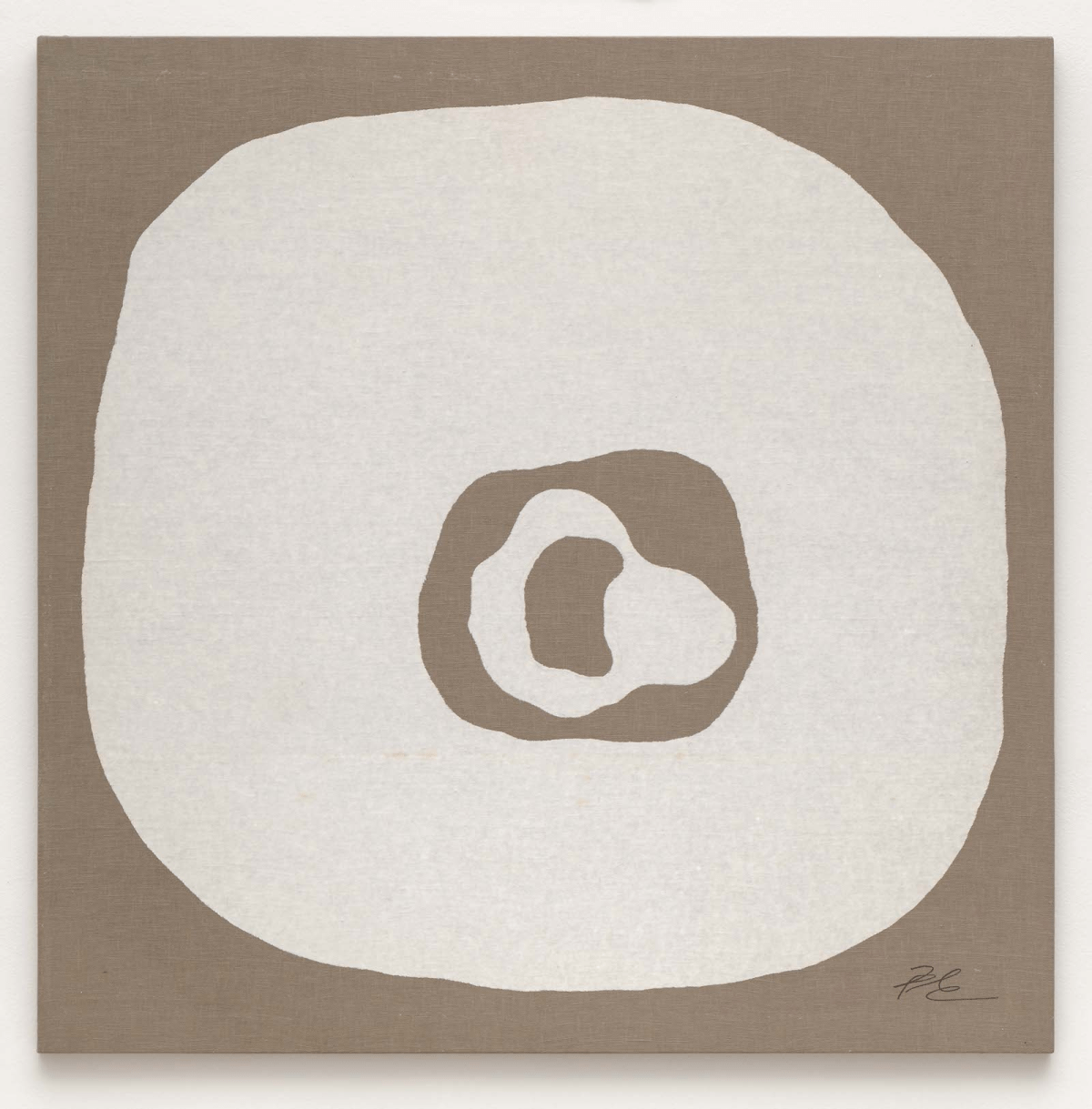
LOOK: Untitled by Kwon Young-Woo
Kwon Young-Woo (Korean, 1926–2013), Untitled, 2002. Korean paper on canvas, 51 3/16 × 51 3/16 in. Photo: Chunho Ahn, courtesy the artist’s estate and Kukje Gallery.
Before the fruit is ripened by the sun, Before the petals or the leaves uncoil, Before the first fine silken root is spun, A seed is dropped and buried in the soil.
Before the Easter alleluias ring, Before the massive rock is rolled aside, Before the fear of death has lost its sting, A just and loving man is crucified.
Before we gain the grace that comes through loss, Before we live by more than bread and breath, Before we lift in joy an empty cross, We face with Christ the seed’s renewing death.
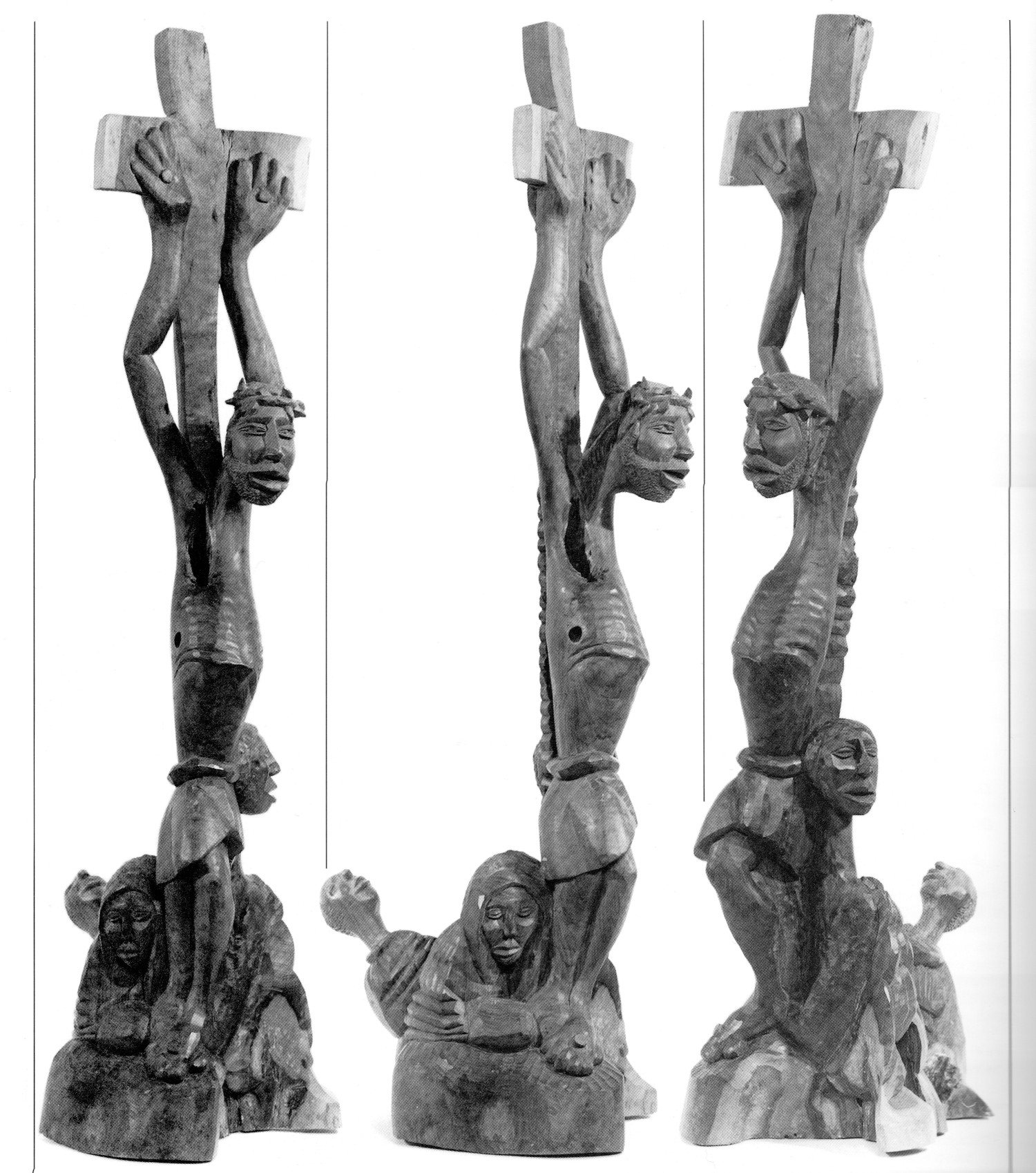
Olivewood crucifix, South Africa, 1978. Source: Christliche Kunst in Afrika, p. 263
LISTEN: “Indodana” (Son), traditional isiXhosa song from South Africa | Arr. Michael Barrett and Ralf Schmitt, adapt. André van der Merwe, 2014 | Performed by the Stellenbosch University Choir, 2014
You took your own son
Who lived among us [wailing]
(Repeat)

The Son of God
Was crucified [wailing]
(Repeat)

Oh Father! Father, Father Jehovah!
Father! [wailing]
(Repeat)

[source]
This song so well captures the mood of mourning that characterizes Good Friday, when the Son of God was slain. “Hololo” and “helele” are wordless expressions of grief. So is the “Zjem zjem zja” sung by the basses, like heaving sobs, on the title word in verse 2. One soprano who performed this piece said that singing the “Oh’s” above the melody felt like singing tears.
Then Jesus went with his disciples to a place called Gethsemane, and he said to them, “Sit here while I go over there and pray.” He took Peter and the two sons of Zebedee along with him, and he began to be sorrowful and troubled. Then he said to them, “My soul is overwhelmed with sorrow to the point of death. Stay here and keep watch with me.”
Going a little farther, he fell with his face to the ground and prayed, “My Father, if it is possible, may this cup be taken from me. Yet not as I will, but as you will.”
Then he returned to his disciples and found them sleeping. “Couldn’t you men keep watch with me for one hour?” he asked Peter. “Watch and pray so that you will not fall into temptation. The spirit is willing, but the flesh is weak.”
He went away a second time and prayed, “My Father, if it is not possible for this cup to be taken away unless I drink it, may your will be done.”
When he came back, he again found them sleeping, because their eyes were heavy. So he left them and went away once more and prayed the third time, saying the same thing.
Then he returned to the disciples and said to them, “Are you still sleeping and resting? Look, the hour has come, and the Son of Man is delivered into the hands of sinners. Rise! Let us go! Here comes my betrayer!”
—Matthew 26:36–46 NIV, emphasis added
LOOK: Agony in the Garden by Fra Angelico [HT: John Skillen]
Fra Angelico (Italian, ca. 1387–1455), Agony in the Garden, ca. 1450. Fresco, 177 × 147 cm. Cell 34, Convent of San Marco, Florence.
This fresco is from one of the forty-four cells in the Dominican convent of San Marco in Florence whose walls Fra Angelico and his assistants painted with religious scenes in the mid-fifteenth century. The friars who lived at San Marco—of which the artist, whose nickname means “Angelic Brother,” was one—used these paintings for private meditation.
Here we see Jesus in the garden of Gethsemane pleading with God the Father to let the cup of suffering, held out by an angel, pass him by. As he prays in agony, his disciples James, John, and Peter nod off just a stone’s throw away. Jesus had asked them to stay awake and pray with him, but their tiredness gets the better of them. In their friend’s hour of deepest need, they fail him.
By contrast—and this is unique!—Mary and Martha, two sisters from Bethany who are also followers of Jesus, are awake and alert under an open loggia, diligently praying and studying God’s word. Perhaps Mary points, in the book in her lap, to the passage of the Suffering Servant in Isaiah 53, recognizing Christ in it, or to the book of Exodus, where the Israelites celebrate their first Passover by smearing the blood of a lamb over their doors. Perhaps Martha prays that the Father would grant Jesus discernment of his will and the strength to follow through with it—that he would sustain him all the way to the cross and beyond.
While the male disciples on the other side of the wall fall asleep, heads in hands, the women watch and wait through the night, exemplars of faithfulness. They trust the prophecies and keep vigil, supporting their Lord in his suffering.
LISTEN: “Stay with Me” by Jacques Berthier, 1984 | Performed by the Taizé Community Choir on Songs of Taizé: O Lord, Hear My Prayer & My Soul Is at Rest, 1999
Stay with me Remain here with me Watch and pray Watch and pray
The words from this Taizé chant come from Jesus’s words in Matthew 26:38, 41 (cf. Mark 14:34, 38). He and his disciples have just finished the Passover Seder, and with full bellies, three of them follow Jesus up to an olive grove, which was perhaps a favorite prayer spot. But they neglect his instruction to stay awake and pray with him.
How can we remain with Christ this Maundy Thursday?
To “keep vigil” this night is to be fully present to Christ’s suffering and spiritually awake to his will and way.
Julia Stankova (Bulgarian, 1954–), Portrait of Judas, 2004. Tempera, gouache, watercolor, and lacquer technique on wood, 45 × 60 cm.
In this painting by Julia Stankova, Judas presses in for his infamous kiss, identifying Jesus to his captors. Stankova portrays the moment as one of double woe, leading to the death of both Jesus and Judas. To heighten the emotional impact, she tightly crops the composition, eliminating all other figures besides the two. Jesus closes his eyes to receive with grace what has been a long time coming. Judas keeps his open. With one arm, he embraces his former friend; with the other, he holds a branch that’s ornamented, forebodingly, with his own dangling corpse. The Bulgarian inscription names the painting: Portrait of Judas.
LISTEN: “Gallows of My Desire” by Kris MacQueen, on Good Morning. Happy Easter. 3 (2014)
Tonight we ate together Bread and the wine cooked rare You looked so disappointed When I took off down the stairs We took the road together But I just exited right I’ll see you in a little while And again on the other side
Refrain: I stood above you Like a conqueror And you stood beside me like a friend I kissed you goodbye At the gates of hell But you’ve always called my bluff Yeah, you know my every tell
Tonight I’m taking matters Into my guilty hands Just sold the Prince of Peace out For a little stretch of land There’s nothing like the yoke Of the innocent when they die It came upon me like a stone When I saw the deed was mine [Refrain]
Now I’m swinging in the gallows Of my own desire My spirit is departing to God knows where Is there a grace sufficient To receive this broken soul? You bled out for the whole wide world How ’bout your very own? [Refrain]
But I always knew I’d bow to you in the end
Kris MacQueen is a singer-songwriter and former pastor from Kitchener, Ontario. Since 2019 he has been recording music with his wife, Liv, under the name The MacQueens. It is their voices on “Gallows.” This song was released in 2014 on a little six-song compilation album of Passion-Easter-Pentecost music put out by Morning and Night Music, which is no longer available. I asked MacQueen if he’d be willing to post his contribution online so that you all can enjoy it, and he obliged!
The song is in the voice of Judas, who is feeling the full weight of his betrayal—the innocent Christ’s death a yoke or a millstone around his neck. Many Christian interpreters think that Judas gave Jesus up to the authorities as a way to force his hand; impatient with Jesus’s not seizing power from Rome, Israel’s political oppressors, he thought that an arrest would be just the inciting event Jesus needed to finally unleash the forces of heaven against the empire, obtaining vindication and freedom for God’s people. Judas, according to this theory, was genuinely shocked and horrified when Jesus submitted to the capture and then the death sentence.
By asserting his own plans and desires counter to God’s, Judas effectively builds his own death trap, as the guilt over the consequences of his betrayal leads him to suicide. But before tying that noose, maybe, we can only hope, he sought redemption for his wrongdoing. His return of the blood money seems to indicate as much. He was clearly remorseful. MacQueen’s Judas prays from the gallows, pleading the blood of Jesus. If Jesus’s blood can save even the most odious of sinners, he reasons, then surely it avails for me. But he’s not so sure; he poses it as a question, a challenge, even.
The final line of the song suggests that in the end, perhaps Judas was finally able to see the rightness of Jesus’s way and was able to bow not to the king he imagined or wanted him to be, but to the king he was—the Prince of Peace, the servant-Christ, the sacrificial Lamb.
And at midnight there was a cry made, Behold, the bridegroom cometh; go ye out to meet him.
—Matthew 25:6 KJV
In the Orthodox Church, observances of Holy Monday, Tuesday, and Wednesday (which in that tradition take place next week) focus on the end times, “remind[ing] us of the eschatological meaning of Pascha,” says Alexander Schmemann.
The Gospel reading for the Liturgy of the Presanctified Gifts on Holy Tuesday is Matthew 24:36–26:2, which covers the need for watchfulness, the parable of the ten bridesmaids, the parable of the talents, and the Last Judgment. These passages constitute the latter half of Jesus’s Olivet Discourse, or Little Apocalypse, which, according to the chronology of Mark’s Gospel, Jesus preached the Tuesday before his death.
So, informed by the Matthew 25:1–13 reading, today I’ve selected a papercut by Chinese artist Fan Pu and a Black gospel song from the southern US that both engage with Jesus’s call to keep our metaphoric oil lamps burning in expectation of the return of the Bridegroom, who died and rose for love of us, and who has gone to build us a home.
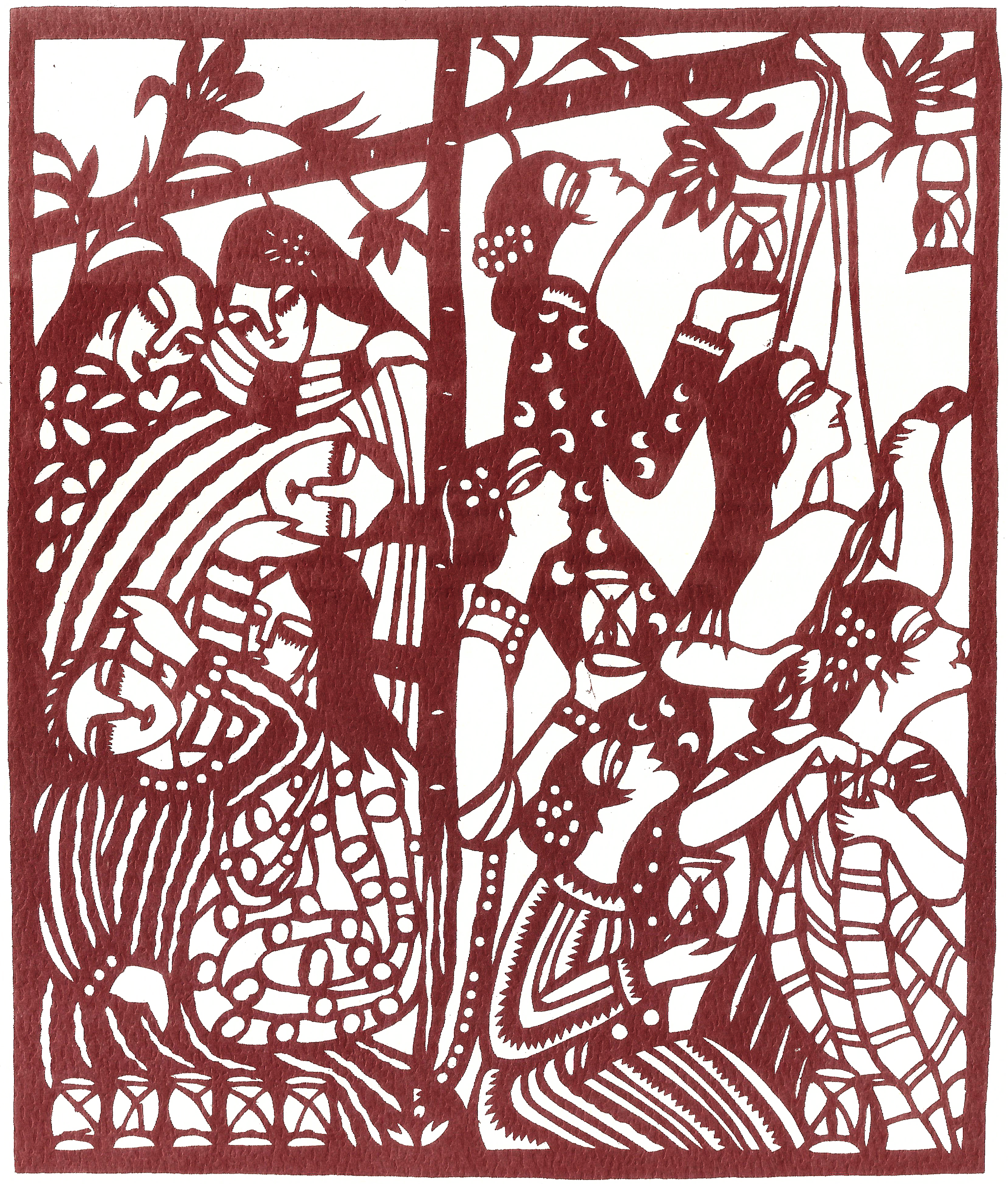
LOOK: Ten Bridesmaids by Fan Pu
Fan Pu (Chinese, 1948–), Ten Bridesmaids, 2001. Papercut. Collection of the Asian Christian Art Association.
(Note: This artwork has changed since the original publication of this post. I learned that the previous artist did not want her work featured or her name mentioned on the website.)
LISTEN: “The Bridegroom’s Coming,” traditional gospel song | Recorded August 6, 1940, by Mitchell’s Christian Singers, on Mitchell’s Christian Singers, vol. 3 (1938–1940) (released 1996)
I couldn’t find lyrics for this song online, so I transcribed them myself the best I could. I’m not positive about the second line in the refrain, and I couldn’t make out the second half of the last line of verse 2.
Refrain: And behold (and behold), lo, the Bridegroom’s coming Lift up (lift up), I heard the voices cryin’ out loud And be ready (and be ready) when the Bridegroom’s coming To meet him in the air
Ever seen such a man as this? Jesus was sent, he came down to die Jesus was sent, he came down to die Came to save my soul from the burning fire [Refrain ×2]
Ever seen such a man as this? Jesus was sent, he came down to die Jesus was sent, he came down to die I want to meet . . . (?) [Refrain ×2]
Mitchell’s Christian Singers [previously] were an influential early gospel group from Kinston, North Carolina.
The Kentucky Jubilee Four recorded an earlier version of this song for OKeh in St. Louis, Missouri, in 1927.
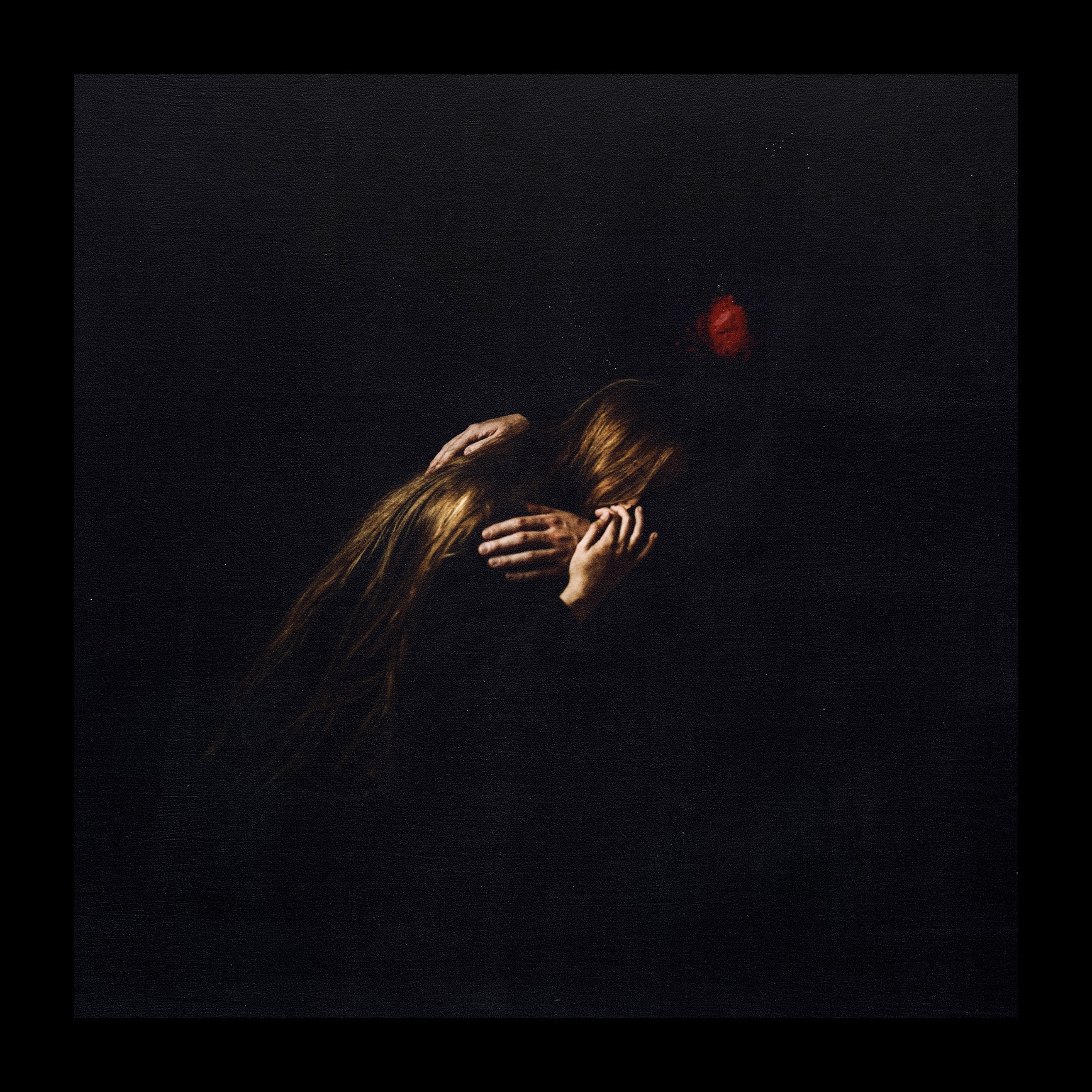
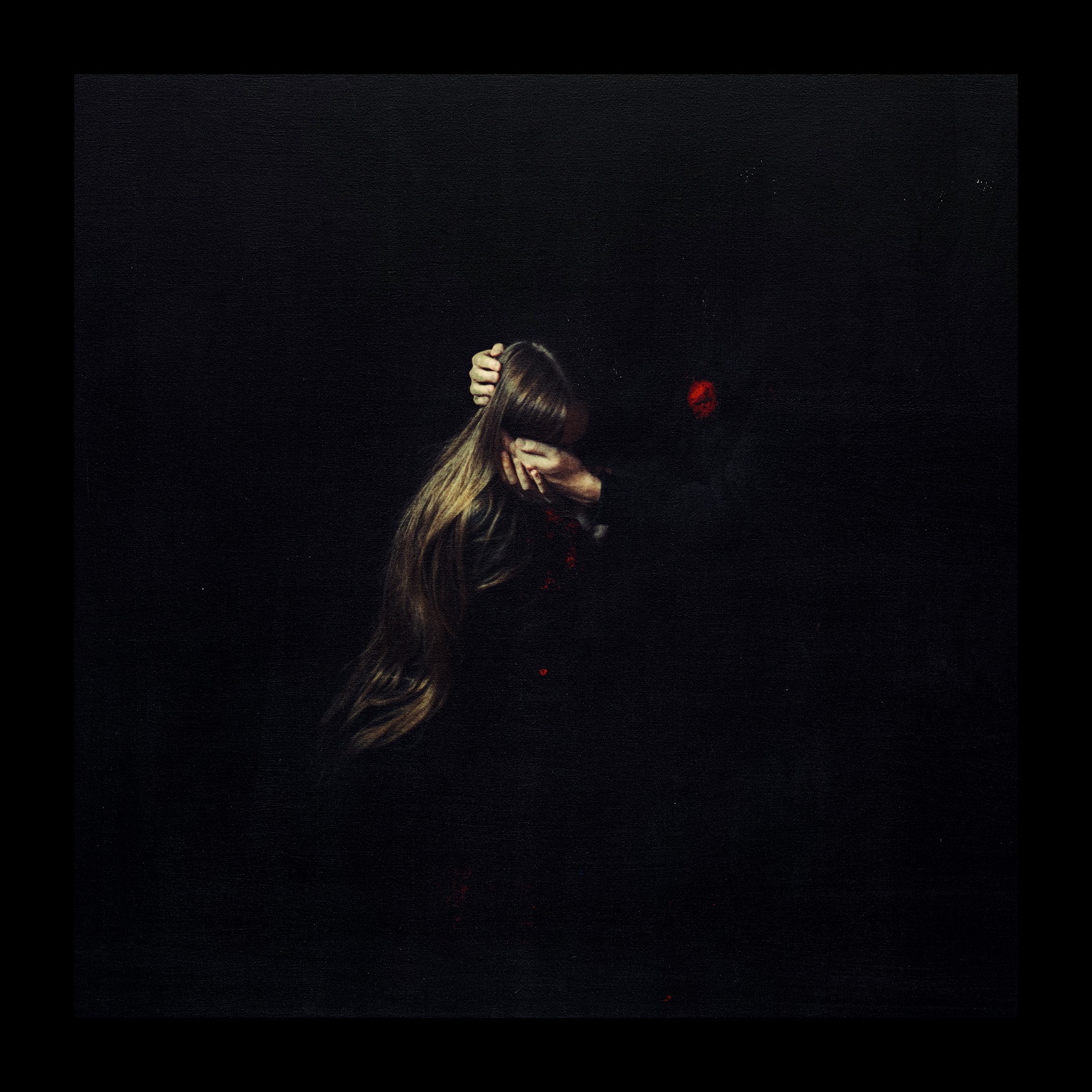
Laura Makabresku (Polish, 1987–), Intimacy of the Heart (7), 2020Laura Makabresku (Polish, 1987–), Intimacy of the Heart (8), 2020
LISTEN: “Mary” by the Brothers of Abriem Harp, on Last Days (2015) [reviewed here]
Mary, my dear, come over here Tell me, is it true what they say? Mary, my dear, let go of your fear And bring your gift to me, I pray Let your heart rest with mine I don’t have much time So break your fragrance free, my dear
Let your tears fall on me Brush your hair on my feet Let your alabaster tears fall on me Fall on me
Overflow, overflow And go where you go Let this fragrance fill the air with love divine Love divine
Fill the air, fill the air Let your heart beat with mine Let this fragrance fill the air with love divine Love divine
Mary, my dear, bring yourself near Let your heart beat with mine, my dear
Laura Makabresku (Polish, 1987–), Intimacy of the Heart (10), 2020
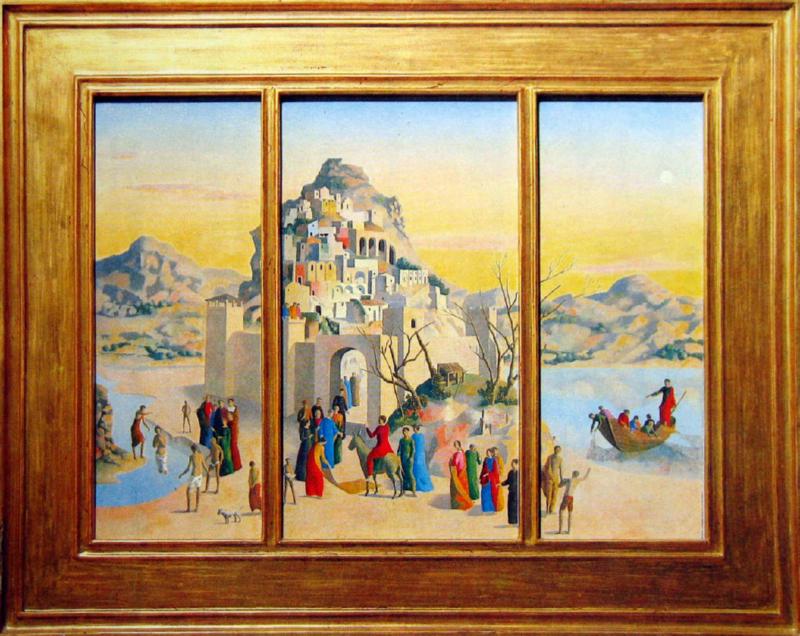
Justin O’Brien (Australian, 1917–1996), Palm Sunday, 1962. Oil on canvas, 45.5 × 62 cm.
This triptych (three-paneled artwork) by Australian artist Justin O’Brien portrays three scenes from the life of Christ. On the left wing is the Baptism of Christ, where he’s anointed by God’s Spirit for his messianic role, and on the right is the Miraculous Draught of Fishes, a story of miraculous abundance. The center panel shows Jesus about to enter the gates of a hilltop city representing Jerusalem. He rides a donkey and is dressed in red, the color of martyrdom. One man lays down his cloak before Jesus’s dusty path as a sign of reverence. Now the people welcome him in, but in just a few short days many will turn on him.
O’Brien grew up in a Catholic household in Sydney. In 1948–49 he visited Italy and fell in love with the work of the Proto- and Early Renaissance painters from Tuscany, like Duccio and Piero della Francesca. Most of O’Brien’s paintings are on religious subjects, despite his renunciation of Catholicism in 1954. Though he self-identified as agnostic for the second half of his life, he continued to be artistically inspired by the stories of the New Testament. He moved to Rome in 1967 and spent the remainder of his days there, returning to his home country of Australia every few years for exhibitions.
LISTEN: “Jerusalem Interlude,” excerpted from “The Holy City” | Words by Frederick E. Weatherly, 1892 | Music by Stephen Adams (pseudonym of Michael Maybrick), 1892; arr. Noble Caine, 1946 | Performed by the Aeolians of Oakwood University on Aeolianology Acappella, vol. 2, 2015
Jerusalem, Jerusalem Lift up your gates and sing Hosanna in the highest Hosanna to your king
This is the refrain of the Victorian choral ballad “The Holy City” by the English lawyer, author, lyricist, and broadcaster Frederick E. Weatherly (best known for writing “Danny Boy”) and his regular collaborator, the English composer Michael Maybrick, who published under the pen name Stephen Adams. The song became hugely popular in the UK and the US at the beginning of the twentieth century, and is even mentioned in James Joyce’s Ulysses (1920). It is sung by early Hollywood musical superstar Jeanette MacDonald in the 1936 film San Francisco.
Lyrics to the complete song are below, as is a video performance by the Aeolians from 2020:
Last night I lay a-sleeping There came a dream so fair I stood in old Jerusalem Beside the temple there I heard the children singing And ever as they sang Methought the voice of angels From heav’n in answer rang
“Jerusalem, Jerusalem! Lift up your gates and sing Hosanna in the highest Hosanna to your king!”
And then methought my dream was chang’d The streets no longer rang Hush’d were the glad Hosannas The little children sang The sun grew dark with mystery The morn was cold and chill As the shadow of a cross arose Upon a lonely hill
“Jerusalem, Jerusalem! Hark! how the angels sing Hosanna in the highest Hosanna to your king!”
And once again the scene was chang’d New earth there seem’d to be I saw the Holy City Beside the tideless sea The light of God was on its streets The gates were open wide And all who would might enter And no one was denied No need of moon or stars by night Or sun to shine by day It was the new Jerusalem That would not pass away
“Jerusalem, Jerusalem! Sing, for the night is o’er! Hosanna in the highest! Hosanna for evermore!”
The song’s speaker has a dream about Christ’s celebrated entry into Jerusalem, with crowds surrounding him and shouting his praises. But then the mood turns dark and hushed as a cross is erected on Golgotha and the newly hailed king is crucified. However, the mood revolves back to one of celebration in the final verse as the New Jerusalem comes down, permanently displacing all sorrow, its gates thrown open wide in universal welcome and the wounded but victorious Jesus seated on the throne.
The Aeolians’ isolation of the first refrain for their “Jerusalem Interlude,” which echoes Psalm 24:7–10 [previously], makes a perfect antiphon for Palm Sunday. Though the words are exultant, the music has an aching quality that foreshadows the suffering that is soon to come and that matches the tone of Jesus’s lament over Jerusalem on this day: “As he came near and saw the city, he wept over it, saying, ‘If you, even you, had only recognized on this day the things that make for peace! But now they are hidden from your eyes’” (Luke 19:41–42; cf. Matt. 23:37–39).
The American jazz composer Duke Ellington used the refrain’s melody as the basis of the opening of his “Black and Tan Fantasy” (1927), in which a cornet and trombone play dolefully in parallel harmony. Can you hear the clopping donkey?
Addendum, 4/23/25: Here’s another arrangement of the song I like, by African Vocals, an a cappella group from Namibia. The following video shows one of the performances from their 2019 Germany tour. Soloist Reinhard Kungairi Kahambuee (who doesn’t come into frame until fifty seconds in) is wonderful! Note that at 1:40, the tempo becomes bright, lively, and more rhythmic, with the addition of hand claps.




 Art & Theology