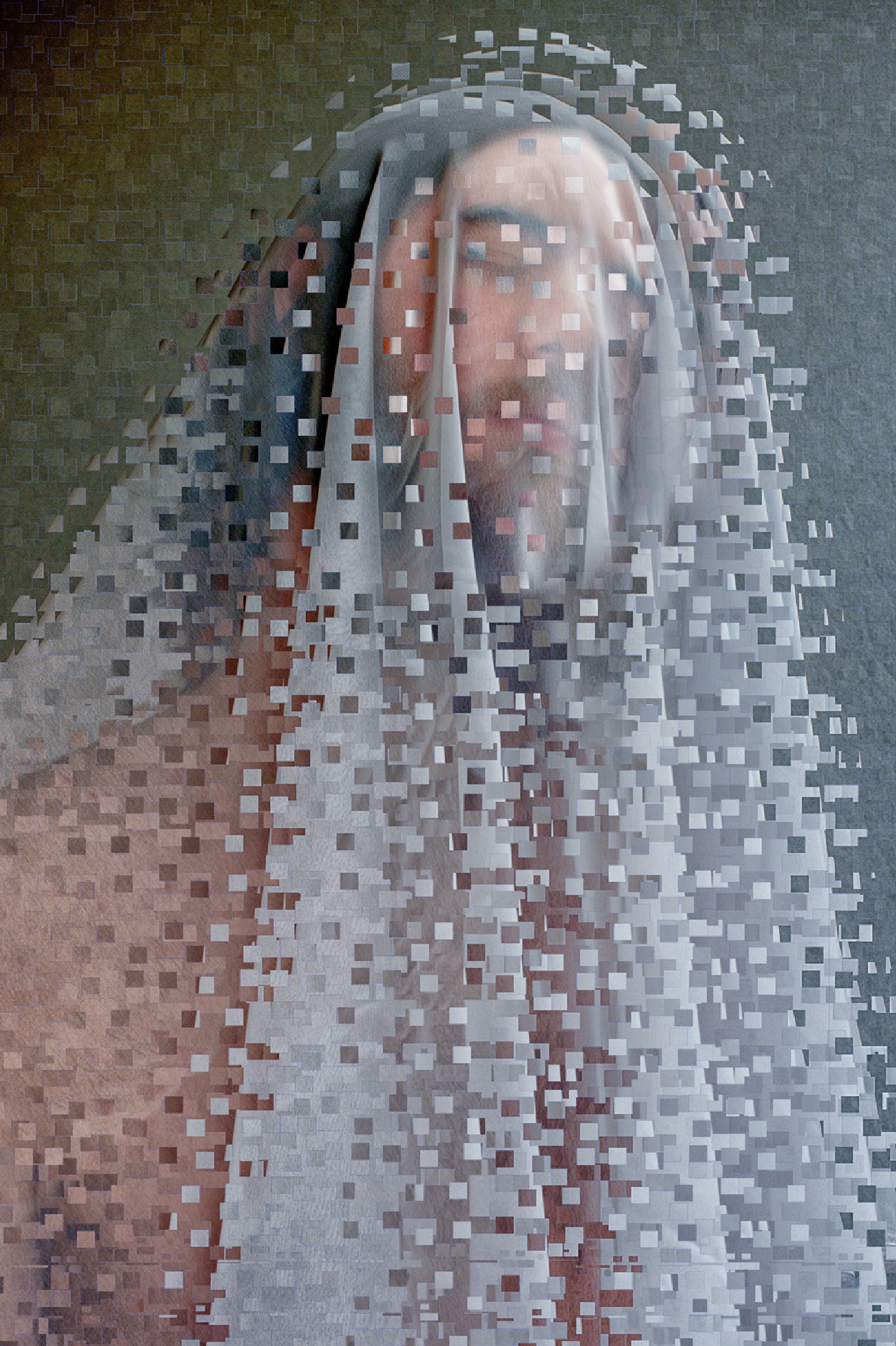
Brett Canét-Gibson (Australian, 1965–), Anastasis, 2016. Photographic digital print, 90 × 60 cm.
Anastasis is the Greek word for “resurrection.” This image by the Australian photographer Brett Canét-Gibson shows the dead Christ covered in a translucent burial shroud, which appears pixelated, out of joint. Some kind of mysterious transformation is afoot. It’s as if Jesus is in the process of waking up, reconstituting, his form coming back into focus as death comes undone. The shimmying squares create a sense of motion and effervescence.
LISTEN: “The Communion Verse of Holy Saturday” | Traditional Orthodox liturgical hymn (in Tone 4), arr. Boris Ledkovsky, mid-20th century | Performed by the Holy Trinity Monastery and Seminary Choir of the Russian Orthodox Church Outside Russia, Jordanville, New York, on Let Us Sing of John, the Hierarch of Christ, 2011
This verse is sung at the end of the Vespers with Divine Liturgy service of the Orthodox Church on the morning of Great and Holy Saturday. Here is the Slavonic text, followed by a phonetic rendering and the English translation:
Воста яко спя Господь: и воскресе спасаяй нас. Аллилуиа.
Vosta yako spya Gospod, i voskrese spasayai nas. Aleluija.
The Lord awoke as one out of sleep, and he is risen to save us. Alleluia.
Even though Holy Saturday commemorates Jesus’s repose in the tomb, this hymn for the occasion anticipates his resurrection. The first half is taken from Psalm 78:65a: “Then the LORD awaked as one out of sleep.”
As we wait in the darkness of what looks like defeat, victorious new life is stirring, about to emerge.
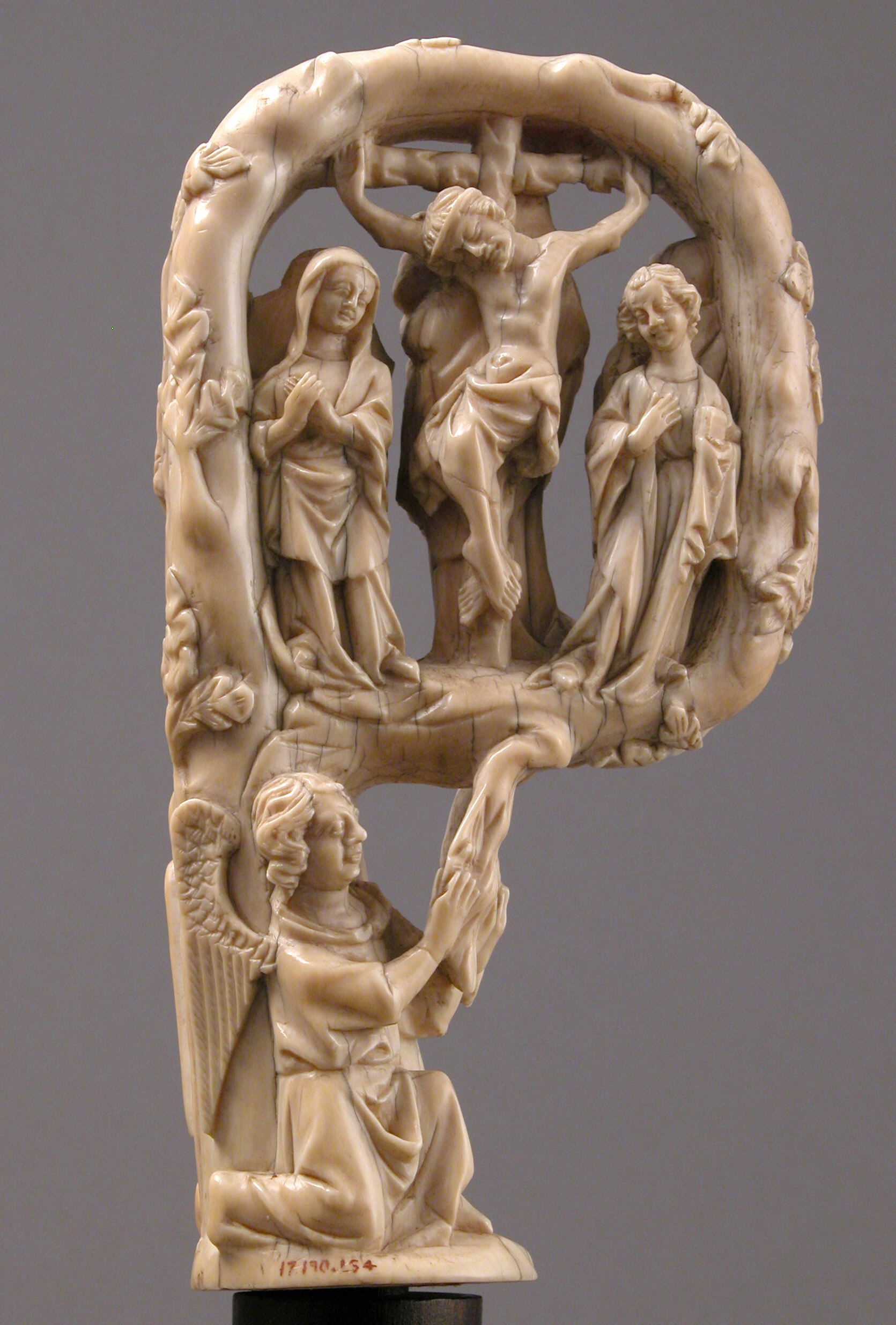
Crozier Head with the Crucifixion, Paris, ca. 1350. Elephant ivory, 5 13/16 × 3 1/8 × 1 1/2 in. (14.8 × 8 × 3.8 cm). Metropolitan Museum of Art, New York. The reverse side depicts the Virgin and Child with Saint Denis.
This carved head of a bishop’s staff from medieval France depicts Christ crucified on the tree of the cross, flanked by his mother Mary and his friend John. From the base of the cross flows a healing stream of blood, which an angel kneels to catch in his hands.
LISTEN: “O Love Divine, What Hast Thou Done” | Words by Charles Wesley, 1742
I can’t decide which of the following two tunes I prefer, so I proffer them both. The first is a traditional four-part hymn tune, sung a cappella, whereas the second is a contemporary guitar-driven tune.
>> Music by Isaac Baker Woodbury, 1850 | Performed by the Choral Arts Society of Washington, dir. Scott Tucker, on Lift Up Your Voice: Hymns of Charles Wesley, 2015:
>> Music by Heaven’s Dave, on Beyond the Starry Skies, 2023:
O Love divine, what hast thou done? Th’ immortal God hath died for me; The Father’s co-eternal Son Bore all my sins upon the tree. Th’ immortal God for me hath died; My Lord, my Love, is crucified.
Behold him, all ye that pass by, The bleeding Prince of Life and Peace; Come, sinners, see your Savior die, And say, “Was ever grief like his?” Come feel with me his blood applied; My Lord, my Love, is crucified.
Is crucified for me and you, To bring us rebels back to God. Believe, believe the record true: We all are bought with Jesus’ blood. Pardon for all flows from his side; My Lord, my Love, is crucified.
Then let us sit beneath his cross, And gladly catch the healing stream; All things for him account but loss, And give up all our hearts to him— Of nothing speak, or think beside, But Jesus and him crucified.
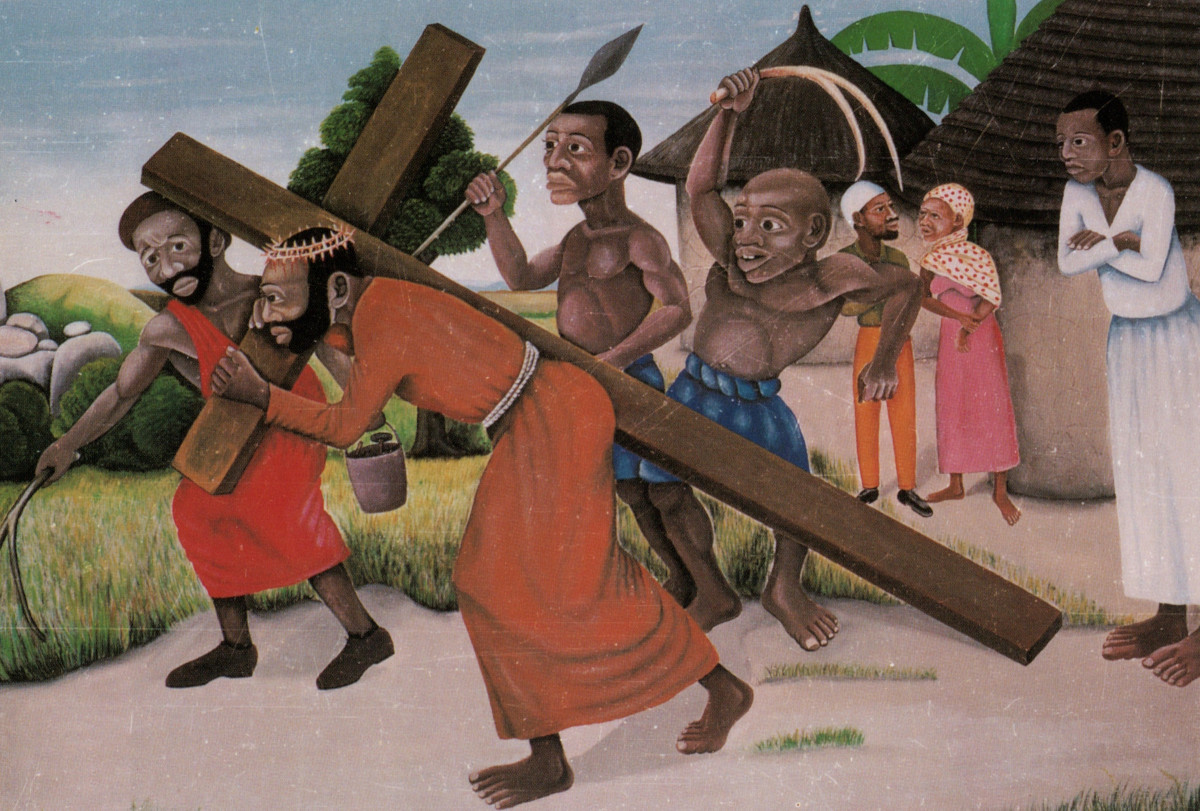
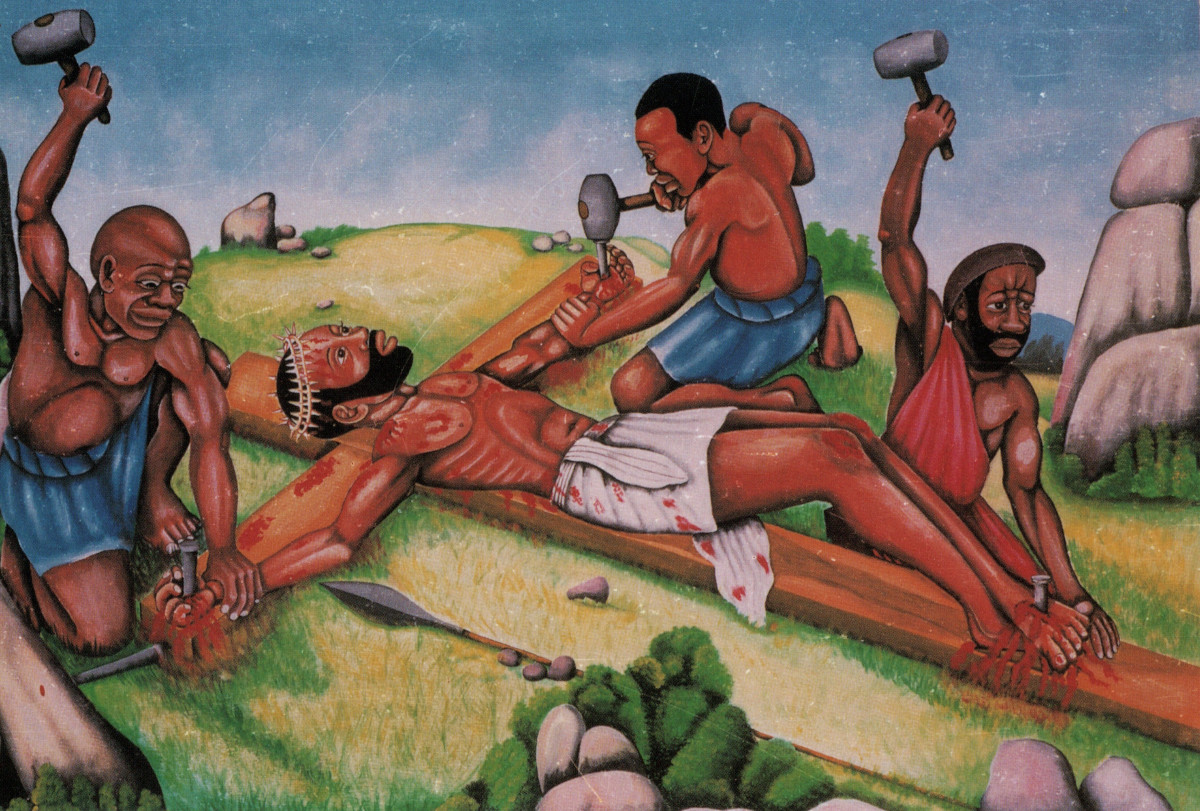
LOOK: Stations of the Cross #2 and #11 by Charles Ndege
Charles S. Ndege (Tanzanian, 1966–), Station II: Jesus Takes Up His Cross. Wall painting from St. Joseph Mukasa Balikuddembe Church, Nyakato (Mwanza region), Tanzania. Source: Were You There? Stations of the Cross by Diana L. HayesCharles S. Ndege, Station XI: Jesus Is Nailed to the Cross
The cement walls of St. Joseph Mukasa Balikuddembe Church in Nyakato, Tanzania, bear a series of murals by the Tanzanian artist Charles Ndege depicting the Stations of the Cross, set around the southern shores of Lake Victoria.
I couldn’t find what year the murals were painted, but the earliest would be 1995, as they are mentioned (and one is reproduced) in the book Towards an African Narrative Theology by the American Maryknoll missionary priests Joseph Healey and Donald Sybertz, which came out in 1996.
I found out about Ndege’s Stations from the book Were You There? Stations of the Cross (Orbis, 2000), a small paperback that reproduces all fourteen scenes in full color and features reflections by the African American Catholic theologian Diana L. Hayes. I recommend it.
See how they done my Lord See how they done my Lord (Can’t you) See how they done my Lord Lord, have mercy on me
Well, they whipped him all night long They whipped him all night long (Tell me) Whipped him all night long Lord, have mercy on me
Well, they whipped him up a hill They whipped him up a hill (Tell me) Whipped him up a hill Lord, have mercy on me
Well, they nailed him to the cross They nailed him to the cross (Tell me) Nailed him to the cross Lord, have mercy on me
Well, two thieves was hanging beside him Two thieves was hanging beside him (Tell me) Two thieves was hanging beside him Lord, have mercy on me
This song is sung by six unidentified men incarcerated at the Louisiana State Penitentiary, known colloquially as Angola Prison, one of the largest maximum-security prisons in the United States. A lament reflecting on Christ’s passion, it’s one of a series of Black gospel songs and spirituals recorded at the prison by the folklorist and musicologist Harry Oster in the late 1950s.
“How they done him” is slang for “how they wronged him” or “how they treated him badly.”
I can’t help but wonder if the singers identified with the abuse Christ suffered and found comfort in knowing that God himself walked the road before them and is with them in their own ways of sorrow. Perhaps (instead or too) they saw themselves in the penitent thief mentioned in the last stanza, who acknowledged the justice of his own sentence and asked Jesus to remember him in God’s kingdom.
The song’s refrain, “Lord, have mercy,” is a common one in liturgical churches, one that invokes God’s mercy in light of personal and corporate sins. It’s a plea for God’s compassion and forgiveness, and for relief.
He was oppressed, and he was afflicted, yet he did not open his mouth; like a lamb that is led to the slaughter and like a sheep that before its shearers is silent, so he did not open his mouth.
—Isaiah 53:7
As soon as it was morning, the chief priests held a consultation with the elders and scribes and the whole council. They bound Jesus, led him away, and handed him over to Pilate. Pilate asked him, “Are you the King of the Jews?” He answered him, “You say so.” Then the chief priests accused him of many things. Pilate asked him again, “Have you no answer? See how many charges they bring against you.” But Jesus made no further reply, so that Pilate was amazed.
—Mark 15:1–5
LOOK: Christ before the Judge by Cecil Collins
Cecil Collins (British, 1908–1989), Christ before the Judge, 1954–56. Oil on board, 47 1/2 × 35 1/2 in. (120 × 90 cm). Gardiner Chantry, Winchester Cathedral, England. Photo: Anne Baring.
I learned of this painting from the book The Image of Christ in Modern Art by Richard Harries. In the painting, Harries writes, Pilate is fierce, angular, aggressive, baring his teeth. “He represents the mechanism of law against Christ, now striated by the flagellation, and wearing a large crown of thorns. But Christ’s eyes are wide open, revealing a strong, serene and eternal order that remains untouched by the harshness.”
LISTEN: “Silencio,” movement 28 from La pasión según San Marcos (St. Mark’s Passion) by Osvaldo Golijov, 2000
The video below is the world premiere performance by the Orquesta La Pasión and the Schola Cantorum de Venezuela, conducted by María Guinand, on September 5, 2000, at the Beethovenhalle in Stuttgart, Germany. The “Silencio” movement is cued up for playback, but I recommend listening to the entire work!
Osvaldo Golijov(born 1960) is an Argentine composer born in La Plata to Ukrainian and Romanian Jewish parents. He left his native Argentina in 1983 to study for three years at the Rubin Academy of Music in Jerusalem, and then he settled in the United States. He lives in Massachusetts.
Golijov was one of four composers commissioned by the International Bach Academy of Stuttgart in 1996 to write a Passion oratorio to commemorate the 250th anniversary of J. S. Bach’s death in 2000. (I featured another, Tan Dun, in a recent roundup.) Golijov chose Mark’s Gospel as his basis, compiling the libretto from a Spanish translation of the Gospel and other Spanish-language sources, and for the music, drawing on a variety of Latin American styles and rhythms.
The “Silencio” movement of Golijov’s La pasión según San Marcos captures the moment at which Christ stands before Pontius Pilate, the governor of the Roman province of Judaea. He had already appeared before Caiaphas, the Jewish high priest; now he’s been handed over to another authority to stand trial yet again.
Much to everyone’s surprise, he does not defend himself against the charges of sedition, treason, and blasphemy—not because he was guilty, but because he knew it would do no good. He had already told the people who he was and what he was there to do—had demonstrated it with miracles—but most of those in power continued to disbelieve and resist him. And so he returns their accusations with a dignified silence. He has purposed to take his gospel all the way to the cross to further reveal the heart of God.
“Silencio” (Silence), which comes between “Amanecer: Ante Pilato” (Dawn: Before Pilate) and “Sentencia” (Sentence), consists of clapping and stomping in the mode of flamenco, the texture thickening to convey ratcheting tension. “Spanish flamenco suggests the influence of the colonizing power, akin to ancient Rome in the Holy Land,” Thomas May writes, “and is thus suitable for Jesus’ betrayal and sentencing by the authorities – but also for the fatalistic aura of his impending death.”
There are no vocals in this movement, and the only instruments are the cajón and body percussion. The chorus creates rhythms with their hands and feet, representing the chief priests and scribes and the gathered crowds who wait anxiously for a word from the accused, but who are more anxious still for a verdict.
Then Jesus went with them to a place called Gethsemane, and he said to his disciples, “Sit here while I go over there and pray.” He took with him Peter and the two sons of Zebedee and began to be grieved and agitated. Then he said to them, “My soul is deeply grieved, even to death; remain here, and stay awake with me.” And going a little farther, he threw himself on the ground and prayed, “My Father, if it is possible, let this cup pass from me, yet not what I want but what you want.”
In this artwork, the contemporary German artist Carola Faller-Barris has collaged to paper a photo cutout of a traditionally sculpted corpus of Christ from a crucifix, orienting him sideways as if he’s lying on the ground, his arms outstretched to the heavens. But he’s tangled in twine, representing the sin, hate, misunderstanding, and betrayal that have felled him, or else the oppressiveness of death, cutting holes through his hands and feet and restricting his movement. The words of the psalmist could be his:
The cords of death encompassed me; the torrents of perdition assailed me; the cords of Sheol entangled me; the snares of death confronted me. (Ps. 18:4–5)
Just prior to Gethsemane, Jesus had washed the feet of his disciples, signaled by the water bowl and draped cloth to his left. This action embodied his ethic of humble service and love. But one of the Twelve whom he washed betrayed him into the hands of his enemies. The blood-red color of the bowl is striking in this work that is otherwise just beige and gray, drawing our focus to the messianic model that God’s people, in demanding the crucifixion of the one God had sent (or abandoning him in his final hours), by and large rejected.
Christ is isolated in this work; no other figures are present, emphasizing the aloneness Christ felt in Gethsemane and on the cross. There’s not even a background—just a void that suggests the indeterminate space between life and death. By using Christ’s crucified form but titling the work Gethsemane, Faller-Barris collapses together Christ’s prayer on the Mount of Olives and his prayers at Calvary, both of which express an admixture of agony and surrender.
LISTEN: “In Passione positus Iesus” from De Passione D.N. Iesu Christi by Francisco Guerrero, 1555 | Performed by the Gesualdo Six, dir. Owain Park, 2021
In passione positus Jesus, cum pro nobis oblatus est, tremens ait: tristis est anima mea usque ad mortem vigilate mecum. Et factus est in agonia orabat dicens: Pater mi, si possibile est, transeat a me calix iste et clamans in cruce dicens:
Deus, Deus meus ut quid dereliquisti me in manus tuas Domine commendo Spiritum meum consummatum est.
English translation:
In his Passion, Jesus, when sacrificed for us, cried out, trembling: “My soul is sad unto death. Watch with me.” And in his agony, pleading, he said: “My Father, if it is possible, take this cup from me.”
“My God, my God, why hast thou forsaken me? Into thy hands, O Lord, I commend my spirit. It is finished.”
This sacred motet for five voices is by the Spanish Renaissance composer Francisco Guerrero. Written for Passiontide (the final two weeks of Lent), it quotes some of Jesus’s words from the garden of Gethsemane the night of his arrest, and then three of his seven sayings from the cross. Download the sheet music here.
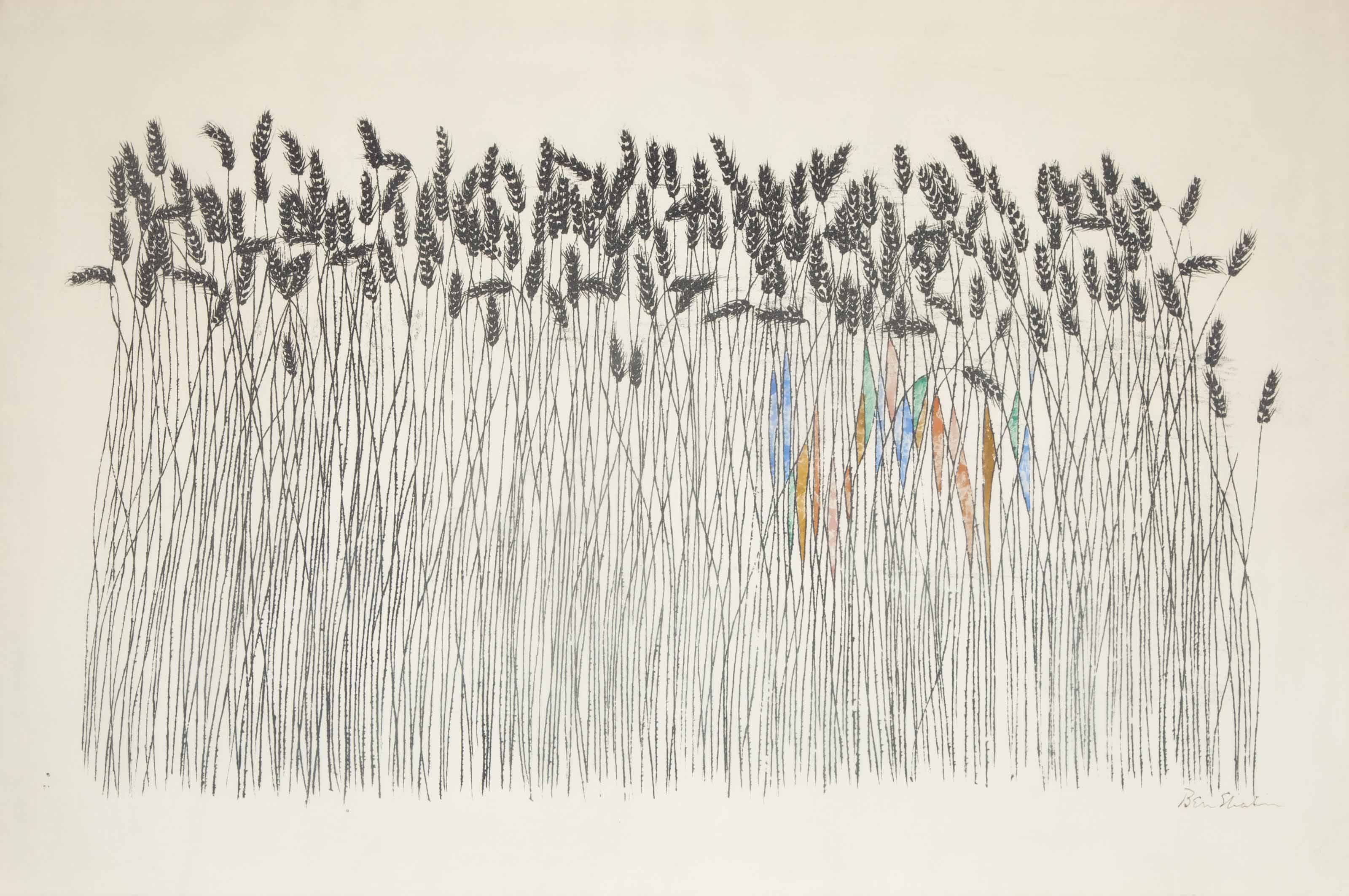
The hour has come for the Son of Man to be glorified. Very truly, I tell you, unless a grain of wheat falls into the earth and dies, it remains just a single grain, but if it dies it bears much fruit.
—John 12:23–24
Jesus spoke these words after his entry into Jerusalem to the acclamation of throngs, and then proceeded to prophesy his own death.
LOOK: Wheat Field by Ben Shahn
Ben Shahn (American, 1898–1969), Wheat Field, 1958. Photolithograph, 16 × 25 1/2 in. (40.7 × 64.7 cm).
This piece for violin and piano was commissioned by City Church Philadelphia (now Resurrection Philadelphia), where it premiered in March 2019. The recording features David Danel on violin and Bethany Danel Brooks on piano.
When the days drew near for him to be taken up, he set his face to go to Jerusalem.
—Luke 9:51
The next day the great crowd that had come to the festival [of Passover] heard that Jesus was coming to Jerusalem. So they took branches of palm trees and went out to meet him, shouting,
Hosanna! Blessed is the one who comes in the name of the Lord— the King of Israel! [Ps. 118:25–26]
Jesus found a young donkey and sat on it, as it is written:
Do not be afraid, daughter of Zion. Look, your king is coming, sitting on a donkey’s colt! [Zech. 9:9]
His disciples did not understand these things at first, but when Jesus was glorified, then they remembered that these things had been written of him and had been done to him.
So the crowd that had been with him when he called Lazarus out of the tomb and raised him from the dead continued to testify. It was also because they heard that he had performed this sign that the crowd went to meet him.
—John 12:12–18
LOOK: Christ’s Entry into Jerusalem from Daphni Monastery
Christ’s Entry into Jerusalem, late 11th century. Mosaic, Daphni Monastery, Greece.
LISTEN: “Ride On to Die” by Michael Card, on Known by the Scars (1984)
Sense the sorrow untold as you look down the road At the clamoring crowd drawing near Feel the heat of the day as you look down the way Hear the shouts of “Hosanna the King!”
Refrain: Oh daughter of Zion, your time’s drawing near Don’t forsake him, oh don’t pass it by On the foal of a donkey, as the prophets had said Passing by you, he rides on to die
Come now, little foal, though you’re not very old Come and bear your first burden bravely Walk so softly upon all the coats and the palms Bare the One on your back oh so gently
’Midst the shouting so loud and the joy of the crowd There is One who is riding in silence For He knows the ones here will be fleeing in fear When their shepherd is taken away [Refrain]
Soon the thorn-cursed ground will bring forth a crown And this Jesus will seem to be beaten But he’ll conquer alone both the shroud and the stone And the prophecies will be completed [Refrain]



._Author%E2%80%99s_photograph1.jpg)
 Art & Theology