Then Jesus went with them to a place called Gethsemane, and he said to his disciples, “Sit here while I go over there and pray.” He took with him Peter and the two sons of Zebedee and began to be grieved and agitated. Then he said to them, “My soul is deeply grieved, even to death; remain here, and stay awake with me.” And going a little farther, he threw himself on the ground and prayed, “My Father, if it is possible, let this cup pass from me, yet not what I want but what you want.”
In this artwork, the contemporary German artist Carola Faller-Barris has collaged to paper a photo cutout of a traditionally sculpted corpus of Christ from a crucifix, orienting him sideways as if he’s lying on the ground, his arms outstretched to the heavens. But he’s tangled in twine, representing the sin, hate, misunderstanding, and betrayal that have felled him, or else the oppressiveness of death, cutting holes through his hands and feet and restricting his movement. The words of the psalmist could be his:
The cords of death encompassed me; the torrents of perdition assailed me; the cords of Sheol entangled me; the snares of death confronted me. (Ps. 18:4–5)
Just prior to Gethsemane, Jesus had washed the feet of his disciples, signaled by the water bowl and draped cloth to his left. This action embodied his ethic of humble service and love. But one of the Twelve whom he washed betrayed him into the hands of his enemies. The blood-red color of the bowl is striking in this work that is otherwise just beige and gray, drawing our focus to the messianic model that God’s people, in demanding the crucifixion of the one God had sent (or abandoning him in his final hours), by and large rejected.
Christ is isolated in this work; no other figures are present, emphasizing the aloneness Christ felt in Gethsemane and on the cross. There’s not even a background—just a void that suggests the indeterminate space between life and death. By using Christ’s crucified form but titling the work Gethsemane, Faller-Barris collapses together Christ’s prayer on the Mount of Olives and his prayers at Calvary, both of which express an admixture of agony and surrender.
LISTEN: “In Passione positus Iesus” from De Passione D.N. Iesu Christi by Francisco Guerrero, 1555 | Performed by the Gesualdo Six, dir. Owain Park, 2021
In passione positus Jesus, cum pro nobis oblatus est, tremens ait: tristis est anima mea usque ad mortem vigilate mecum. Et factus est in agonia orabat dicens: Pater mi, si possibile est, transeat a me calix iste et clamans in cruce dicens:
Deus, Deus meus ut quid dereliquisti me in manus tuas Domine commendo Spiritum meum consummatum est.
English translation:
In his Passion, Jesus, when sacrificed for us, cried out, trembling: “My soul is sad unto death. Watch with me.” And in his agony, pleading, he said: “My Father, if it is possible, take this cup from me.”
“My God, my God, why hast thou forsaken me? Into thy hands, O Lord, I commend my spirit. It is finished.”
This sacred motet for five voices is by the Spanish Renaissance composer Francisco Guerrero. Written for Passiontide (the final two weeks of Lent), it quotes some of Jesus’s words from the garden of Gethsemane the night of his arrest, and then three of his seven sayings from the cross. Download the sheet music here.
The hour has come for the Son of Man to be glorified. Very truly, I tell you, unless a grain of wheat falls into the earth and dies, it remains just a single grain, but if it dies it bears much fruit.
—John 12:23–24
Jesus spoke these words after his entry into Jerusalem to the acclamation of throngs, and then proceeded to prophesy his own death.
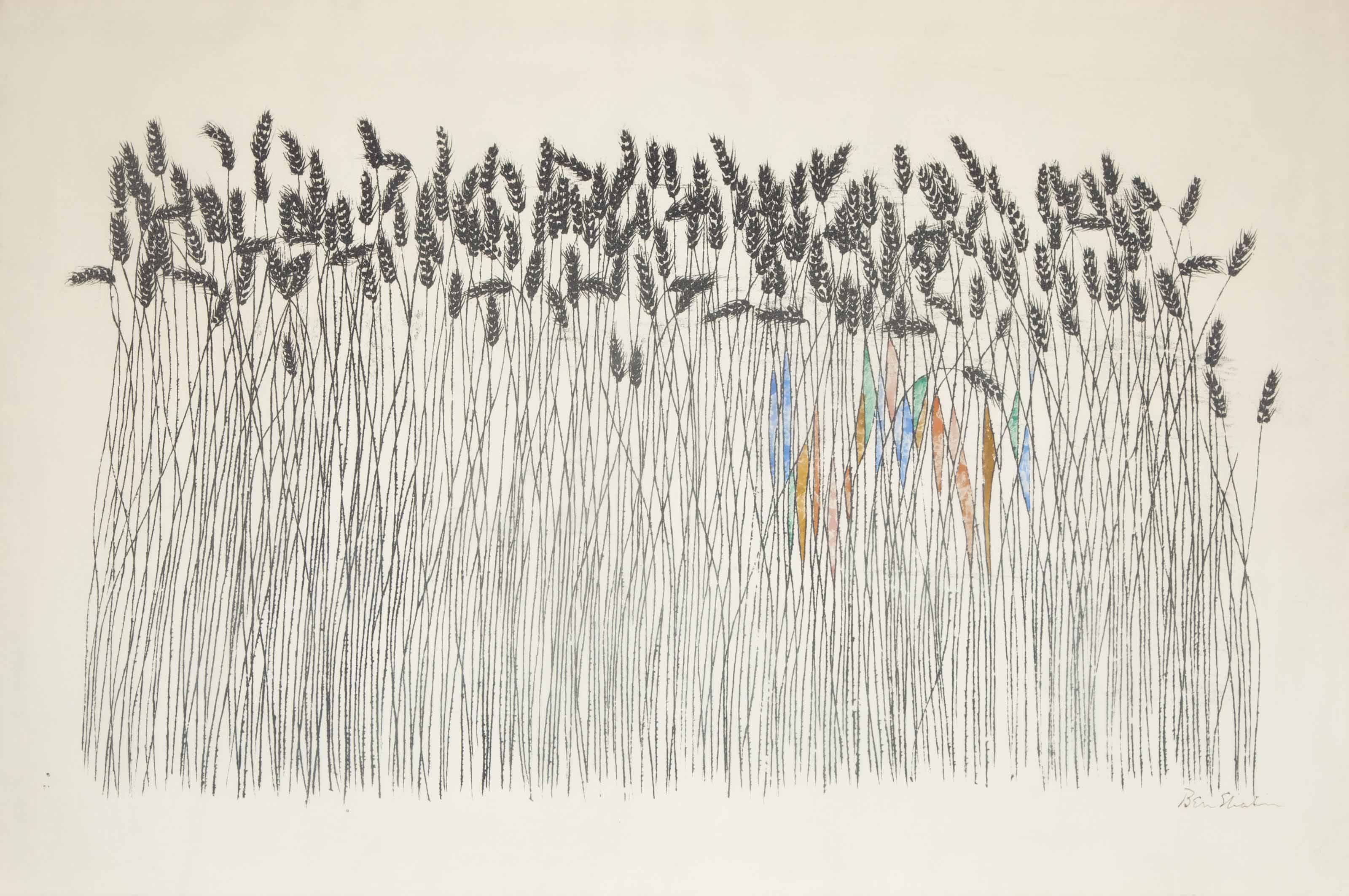
LOOK: Wheat Field by Ben Shahn
Ben Shahn (American, 1898–1969), Wheat Field, 1958. Photolithograph, 16 × 25 1/2 in. (40.7 × 64.7 cm).
This piece for violin and piano was commissioned by City Church Philadelphia (now Resurrection Philadelphia), where it premiered in March 2019. The recording features David Danel on violin and Bethany Danel Brooks on piano.
When the days drew near for him to be taken up, he set his face to go to Jerusalem.
—Luke 9:51
The next day the great crowd that had come to the festival [of Passover] heard that Jesus was coming to Jerusalem. So they took branches of palm trees and went out to meet him, shouting,
Hosanna! Blessed is the one who comes in the name of the Lord— the King of Israel! [Ps. 118:25–26]
Jesus found a young donkey and sat on it, as it is written:
Do not be afraid, daughter of Zion. Look, your king is coming, sitting on a donkey’s colt! [Zech. 9:9]
His disciples did not understand these things at first, but when Jesus was glorified, then they remembered that these things had been written of him and had been done to him.
So the crowd that had been with him when he called Lazarus out of the tomb and raised him from the dead continued to testify. It was also because they heard that he had performed this sign that the crowd went to meet him.
—John 12:12–18
LOOK: Christ’s Entry into Jerusalem from Daphni Monastery
Christ’s Entry into Jerusalem, late 11th century. Mosaic, Daphni Monastery, Greece.
LISTEN: “Ride On to Die” by Michael Card, on Known by the Scars (1984)
Sense the sorrow untold as you look down the road At the clamoring crowd drawing near Feel the heat of the day as you look down the way Hear the shouts of “Hosanna the King!”
Refrain: Oh daughter of Zion, your time’s drawing near Don’t forsake him, oh don’t pass it by On the foal of a donkey, as the prophets had said Passing by you, he rides on to die
Come now, little foal, though you’re not very old Come and bear your first burden bravely Walk so softly upon all the coats and the palms Bare the One on your back oh so gently
’Midst the shouting so loud and the joy of the crowd There is One who is riding in silence For He knows the ones here will be fleeing in fear When their shepherd is taken away [Refrain]
Soon the thorn-cursed ground will bring forth a crown And this Jesus will seem to be beaten But he’ll conquer alone both the shroud and the stone And the prophecies will be completed [Refrain]
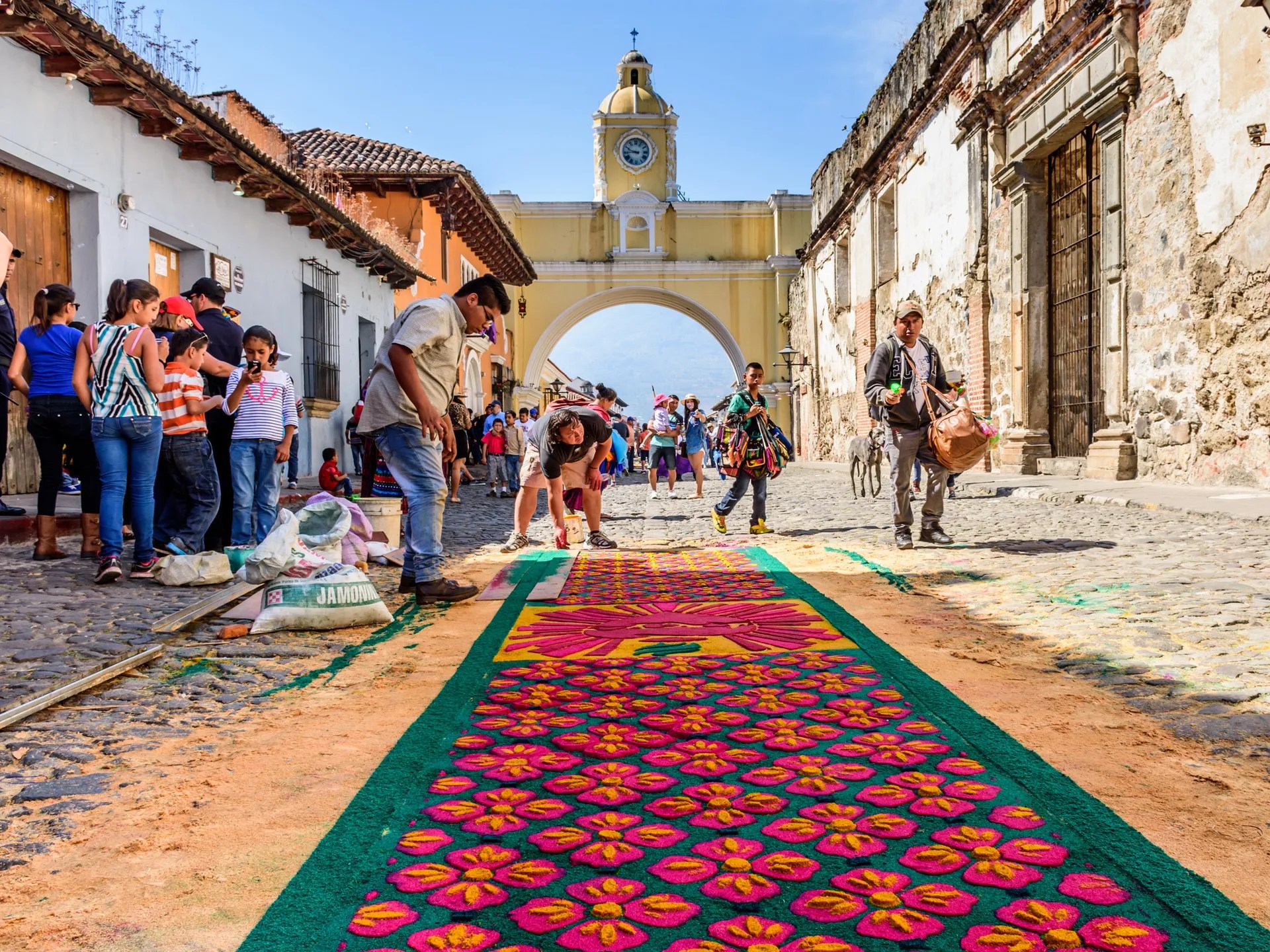
HOLY WEEK TRADITION: Antigua, Guatemala, is renowned for its annual Good Friday observance, which involves the laying out of alfombras (carpets) of multicolored sawdust through the city’s cobblestone streets, hundreds of feet long. On Maundy Thursday, the city closes so that families and businesses can spend the day constructing the carpets, applying the sawdust to planned designs using stencils and strainers and adding pine needles, flowers, fruits, and other natural materials as well.
People watch while locals make an alfombra (carpet) of dyed sawdust for Antigua’s Good Friday processions, the most famous in Latin America. Photo: Lucy Brown, 2016.
At 4 a.m. on Good Friday, the processions begin, with people carrying floats that bear statues of Christ carrying his cross, followed by marching bands playing solemn music. (This is a remembrance of Jesus’s walk to Calvary.) As their feet pass over the alfombras, the dust scatters. Locals and visitors gather along the streets dressed in black for mourning, and at 11 p.m. a figure of Jesus is laid to rest in the church.
Here are two resources for exploring this tradition further:
>> VIDEO: “Alfombras de Semana Santa en Guatemala,” dir.Federica Dominguez: This short film (in Spanish, with English subtitles) interviews Rolando Ortiz, an alfombrero who is also a shoemaker. He explains that the carpets hark back to Jesus’s triumphal entry into Jerusalem, when the crowds strewed his path with palm branches (giving him the red carpet treatment, so to speak). Even though the alfombras last only a brief time, locals spare no expense in bringing them to fruition each year—“for Jesus,” Ortiz says. “It is an act of gratitude above all.” An offering of beauty and praise.
+++
NEW ALBUM: As Foretold, Part 3 by Poor Bishop Hooper: Released today, this is the final album in a trilogy based on the prophetic fulfillment passages in the Gospel of Matthew. It centers on Jesus’s passion and concludes with a resurrection epilogue. As with all their music, the duo graciously offers it for free download from their website.
+++
SONGS performed by Emorja Roberson: Emorja Roberson [previously] is a singer, gospel choir conductor, and assistant professor of music and African American studies at Oxford College of Emory University in Georgia. I enjoy following his YouTube channel. Here are two songs that are especially fitting for Holy Week.
>> “I Know It Was the Blood”: Roberson sings three verses of this beloved African American spiritual: the title verse, “They whipped him all night long,” and “He never said a mumblin’ word.” The song is more typically sung in a major key, and its full lyrics span Christ’s passion, resurrection, ascension, and second coming. But Roberson slows down the tempo and sings in a minor key, homing in on the sorrow of Good Friday.
>> “He Decided to Die” by Margaret Pleasant Douroux: Roberson, on keys, sings a gospel classic with friends Marcus Morton and Cameron Scott, a song that emphasizes Christ’s resoluteness on the cross, his endurance for love.
+++
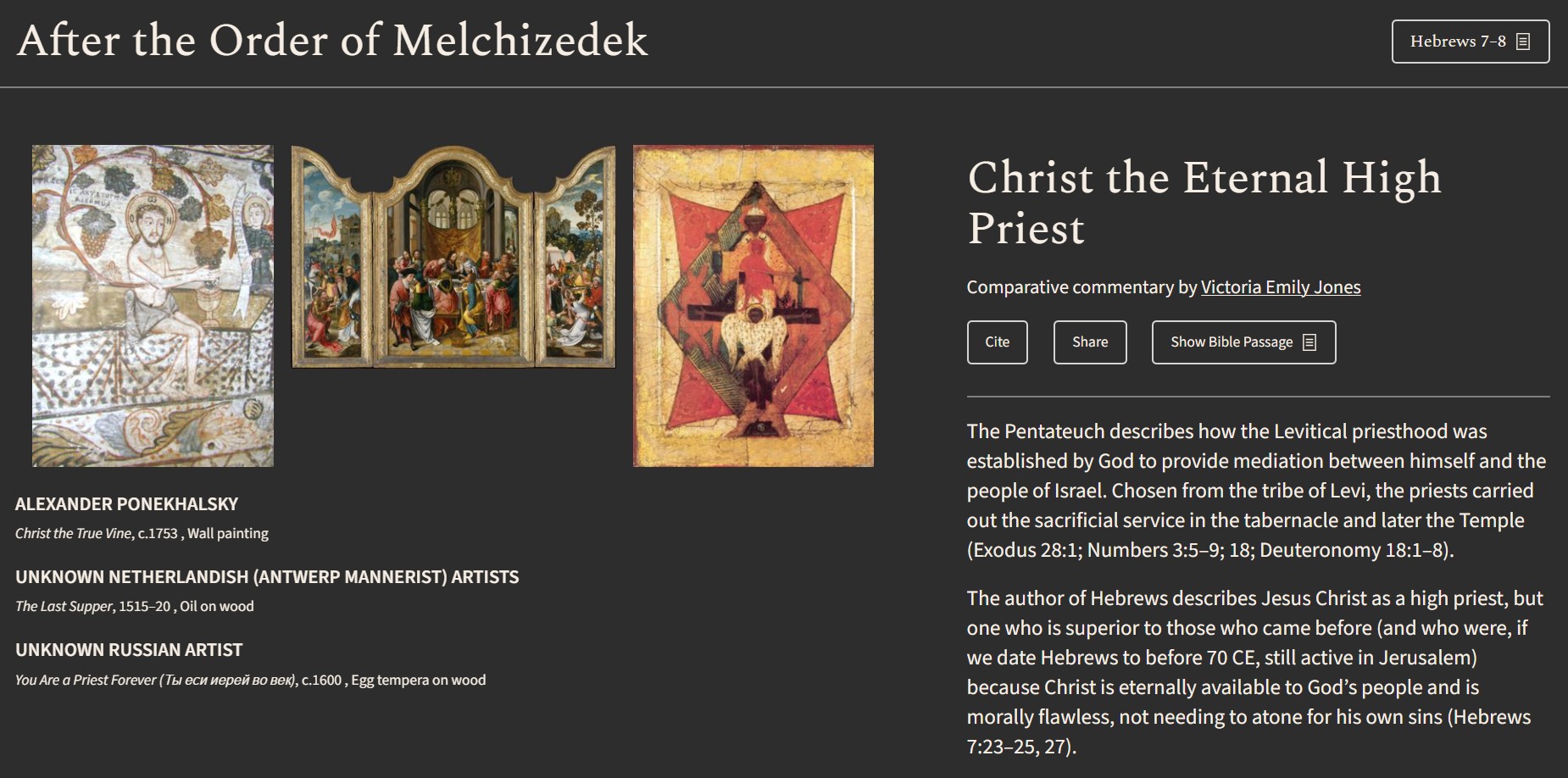
VISUAL COMMENTARIES: “After the Order of Melchizedek” by Victoria Emily Jones: My latest contribution to the Visual Commentary on Scripture, a project based out of King’s College London, was published earlier this month. Tasked with choosing and commenting on three artworks that dialogue with Hebrews 7–8, I landed on a “You Are a Priest Forever” icon from Russia (very strange!), an Antwerp Mannerist triptych that centers the Last Supper, and (my favorite) a wall painting of Christ the Grapevine from a Romanian church. I was interested to explore the idea of how Jesus, in giving his body and blood, is both the offerer and the offered, both priest and sacrifice.
+++
POEM: “The Death of Christ” by Emperor Kangxi: Emperor Kangxi (1654–1722) ruled in China for sixty-one years during the Qing Dynasty. In 1692 he issued the Edict of Toleration, which barred attacks on churches and legalized the practice of Christianity among Chinese people. Curious about and respectful of other faiths, he penned this short poem on the Crucifixion using the classical qi-yen-she form.
+++
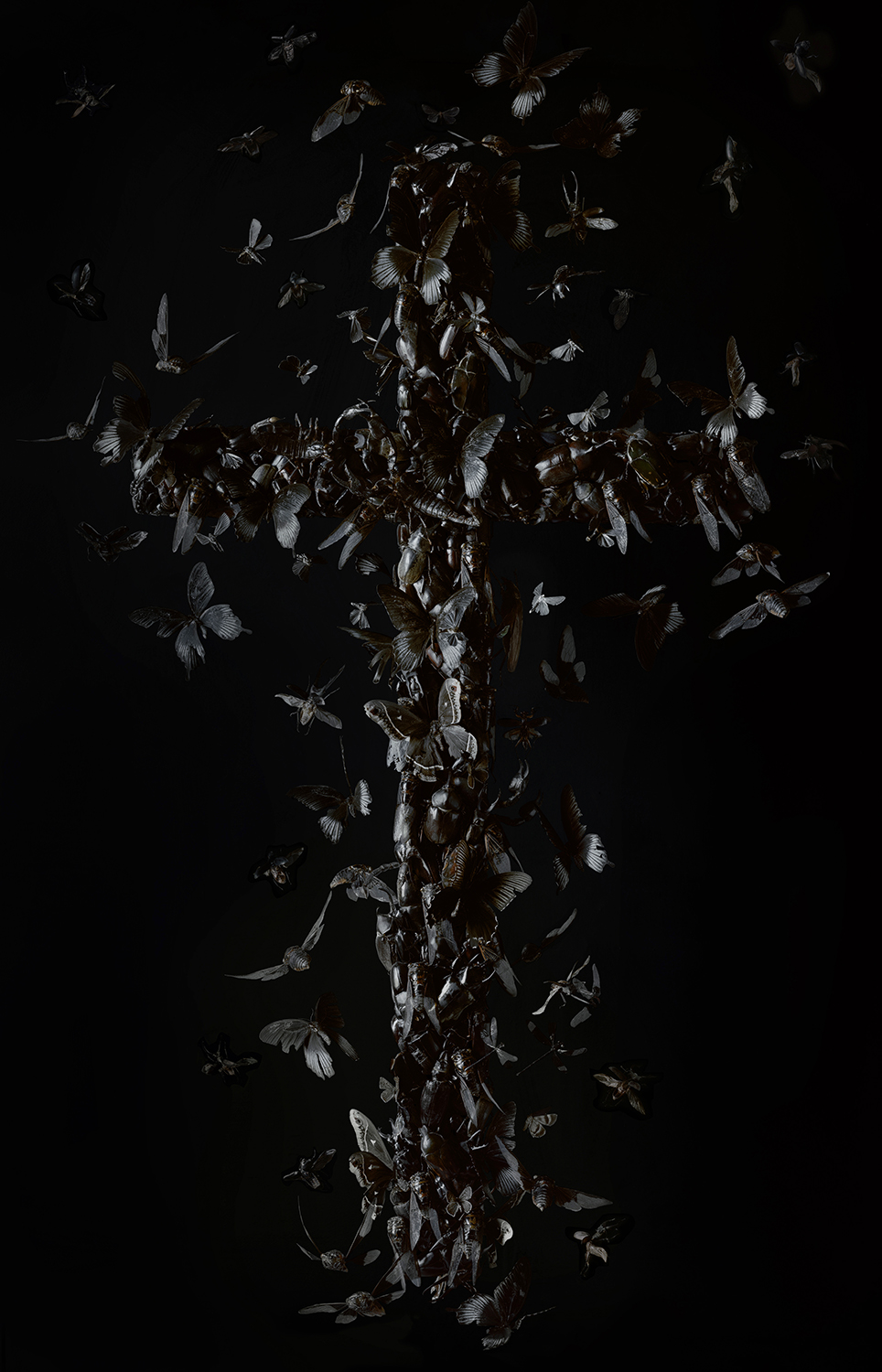
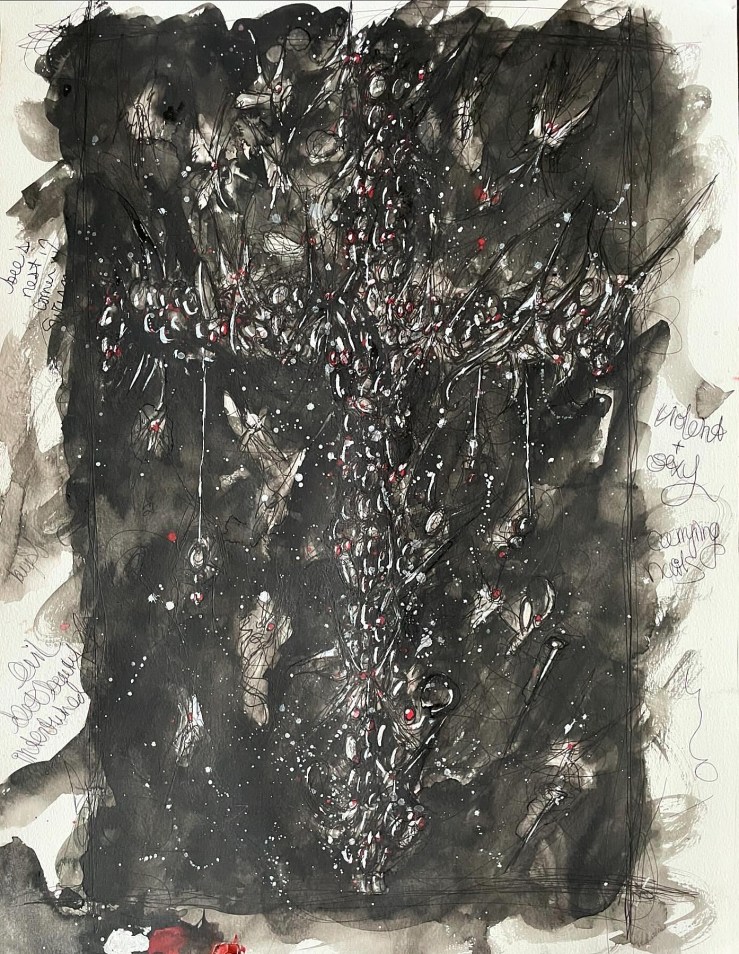
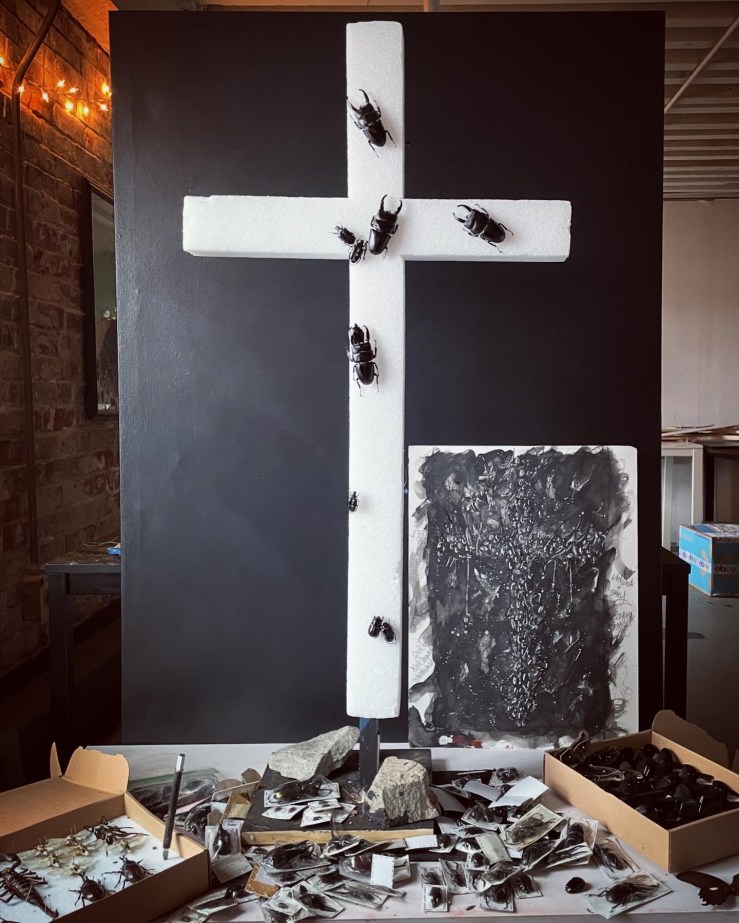
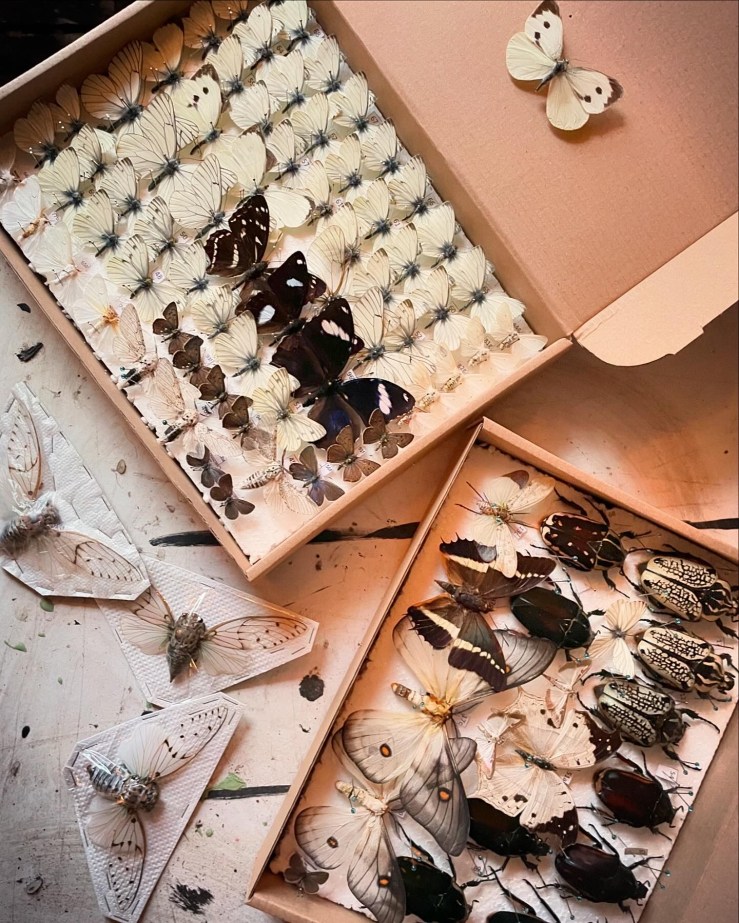
EXHIBITION: Tara Sellios: Ask Now the Beasts, Fitchburg Art Museum, January 18, 2025–January 18, 2026:Tara Sellios is a multidisciplinary artist from South Boston working mainly in large-format photography. Delighting in detail and complex symbolism, she often uses insects, dried fauna, bone, and other organic matter to create elaborate still lifes that she then photographs under dramatic lighting. She is inspired by art historical representations of the end of the world, especially the bizarre paintings of Hieronymus Bosch and Albrecht Dürer’s Apocalypse woodcuts, and by seventeenth-century Dutch vanitas paintings.
The photographs in her current solo show, Ask Now the Beasts at Fitchburg Art Museum in Massachusetts, are “contemporary allegories of suffering and transcendence.” The exhibition’s title comes from Job 12:7.
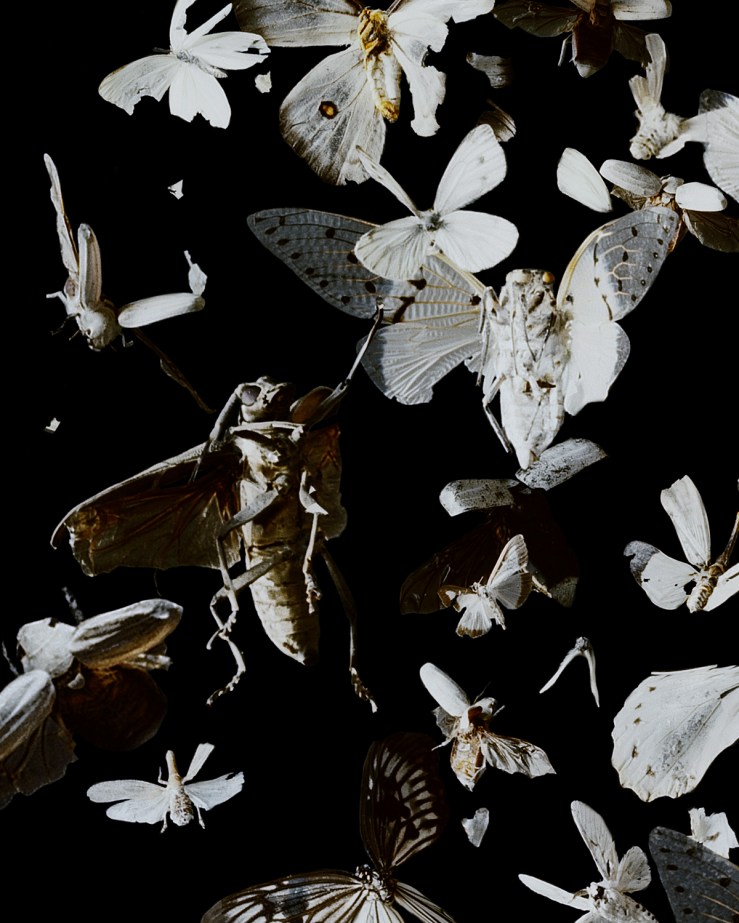
Two of the works on display are a pair of crosses: Umbra (Latin for “darkness” or “shadow”) and Dilucesco (“to begin to grow light, to dawn”), which together suggest a movement from death to resurrection. Constructed with a throng of black beetles and other black insects, the Umbra cross evokes the detail from the Synoptic Gospels’ Crucifixion accounts that at noon, “darkness came over the whole land until three in the afternoon, while the sun’s light failed” (Luke 23:44–45; cf. Matt. 27:45; Mark 15:33). Dilucesco, on the other hand, shows the cross seemingly exploding into light, as white moths and other winged insects break out of their cruciform shape. View these two photographic artworks, plus a few process photos and sketches the artist sent me, below. See, too, www.tarasellios.com.
Tara Sellios (American, 1987–), Umbra, 2024, from the series Ask Now the Beasts. Inkjet print from 8 × 10 negative, 55 × 35 in. Courtesy of the artist.Tara Sellios (American, 1987–), Dilucesco, 2024, from the series Ask Now the Beasts. Inkjet print from 8 × 10 negative, 55 × 35 in. Courtesy of the artist.
The following exhortation is by Kenneth Tanner, pastor of Holy Redeemer church in Rochester Hills, Michigan, and the author of Vulnerable God: Reviving the Wonder of God-with-Us in Our Humanity, forthcoming from Brazos Press. He originally posted it on Facebook on March 26, 2018, and I reprint it here with his permission.
[In 2004] a film premiered during Lent. The film was about this week we are entering, the week that changes the world.
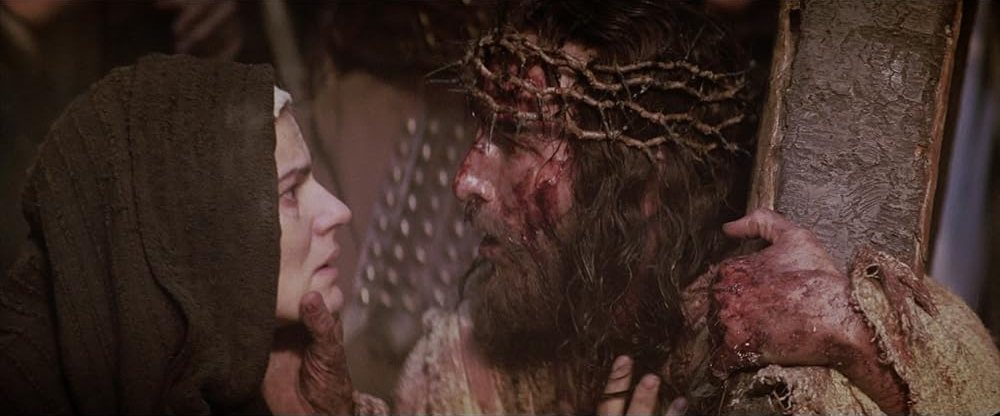
There’s a scene in the film of Jesus falling flat on his face into a dusty road; surrounded by crowds, a crown of thorns on his head, the heavy timber he is carrying comes down hard on his back.
He falls at the intersection of an alleyway where we see his mother Mary huddled in anguish as she waits in horror to glimpse Jesus passing.
When Jesus hits the ground just yards from her, Mary flashes back to a moment when as a child Jesus stumbled and hurt himself. In the memory, Jesus runs to her in pain and she takes him into her arms of comfort.
Startled back from her vision, back to the reality of her son laying prostrate in the dust, Mary springs to life and rushes to the aid of her son. When Jesus sees her, he shoulders his cross, and as he slowly rises back to his feet, he looks at Mary and says, “Behold, mother, I make all things new.”
Film still from The Passion of the Christ (2004), dir. Mel Gibson
Once a year Christians let this story be the priority in their lives. We take children out of music lessons and sporting events. We don’t plan social engagements. We pause. We take a deep breath. We put ordinary busyness on hold. We take a long weekend of sabbaths.
We pray. We sing. We lament. We remember. We find silence and dwell in it. We worship.
We ENTER the story together by the Spirit in gathered liturgies that re-enact the gift of the Last Supper, the command to love as God has loved us, the anxious questions and perspiration of Gethsemane.
We come together again to take a hard look at the cross, at our own violence toward God, at the Love that forgives even as we betray and deny and flee, as we smite and whip and nail and mock.
In the quiet of Holy Saturday we ponder a world without God, where death reigns without the resurrection.
Then we gather once more with great joy to remember that death is not the end of anyone or the end of the world, that the resurrection is the end of all things.
I want to encourage you to disconnect from the grind and walk the way of the cross this week, to stay with Jesus and the women and John in the darkness that has to come before the new dawn.
You will never quite understand our community, ancient practices, or the deeper meanings of this week until you let it take over your life once a year. And with every passing year, as you keep this sacred week sacred, free from other obligations and pursuits, you will see and experience and encounter Jesus Christ anew.
So I invite you to surrender and enter contemplation of the mighty acts whereby God has reconciled the world to himself in Jesus Christ, the things only Jesus can do, for we cannot do them ourselves, where we find genuine rest from our labors in the acts of Love that make the world new.
To assist your contemplations, I’ll be sharing a song and an artwork here on each day of Holy Week, as is my custom. (You can view the archived posts in this annual series, from 2024, 2023, 2022, 2021, and 2020.) Some of the songs can be found on Art & Theology’s Holy Week Playlist:
It was nine o’clock in the morning when they crucified him. . . .
When it was noon, darkness came over the whole land until three in the afternoon. At three o’clock Jesus cried out with a loud voice, “Eloi, Eloi, lema sabachthani?” which means, “My God, my God, why have you forsaken me?” . . . Then Jesus gave a loud cry and breathed his last.
—Mark 15:25, 33–34, 37
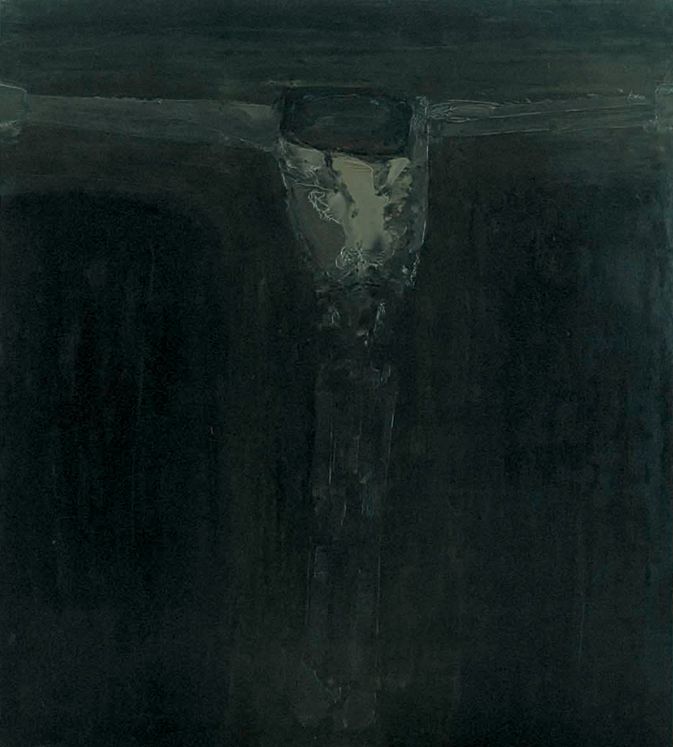
LOOK: Crucifix 45 by William Congdon
William Congdon (American, 1912–1998), Crocefisso 45 (Crucifix 45), 1966. Oil on canvas, 152 × 139 cm. Collection of the William G. Congdon Foundation, Milan.
After his conversion to Catholicism in 1959, artist William Congdon [previously], an American expatriate living in Italy, spent the next twenty years of his life painting dozens of Crucifixions. One of them, Crocefisso 45, shows the crucified Christ immersed in near total darkness. His form is barely differentiated from the black background but can just be discerned by the faint band of light that outlines it. Congdon writes that he wanted to portray “a body soaked with pain to the point that one cannot distinguish the body from the pain, almost as though the pain had become a body and not the body a pain.”1
Christ’s head, like a gaping hole, hangs down to rest on his dimly luminescent chest. It’s as if the light of the world has been eclipsed. Art historian Giuseppe Mazzariol wrote of the recurring nero sole (black sun) in Congdon’s work, whose purpose is “to express the spiritual widowhood of a world marked by suffering.”2 Here it expresses the utter desolation of Good Friday.
Fred Licht writes that “in the Crucifixes [of Congdon] the black spot becomes the storm over Golgotha which is repeated every year with the advent of Good Friday, erasing the images from the altars, extinguishing the candles, and plunging the Christian world into deepest night.”3
Notes:
1. William Congdon, Esistenza/Viaggio di pittore americano: Diario (Milan: Jaca Book, 1975), 154.
2. Giuseppe Mazzariol, Introduzione a William Congdon, exh. cat. (Ferrara, 1981).
3. Fred Licht, “The Art of William Congdon,” in Fred Licht, Peter Selz, and Rodolfo Balzarotti, William Congdon (Jaca Book: Milan, 1995): 11–58.
The sun’s gone dim And the sky’s turned black ’Cause I loved her And she didn’t love back
“The Sun’s Gone Dim and the Sky’s Turned Black” by the late Icelandic composer Jóhann Jóhannsson (1969–2018) blends, as does most of his work, traditional orchestration with contemporary electronic elements. The elegiac lyrics, which repeat multiple times over the nearly six-minute runtime, are adapted from “Two-Volume Novel” by Dorothy Parker, a four-line poem about unrequited love.
This piece was inspired by a recording of an IBM mainframe computer that Jóhannsson’s father, Jóhann Gunnarsson, made on a reel-to-reel tape machine in the 1970s. (Gunnarsson was an IBM engineer and one of Iceland’s first computer programmers, who used early hardware to compose melodies during his downtime at work.) It was recorded by a sixty-piece string orchestra, with Jóhannsson on vocals.
Credit goes to the Rabbit Room not only for this find but also for connecting it to Good Friday. (I found the song on their Lent playlist.) Imagine the speaker as Jesus on the cross, speaking to the world that he so loved (John 3:16) but who rejected him. Even the sky mourns with him as the sun veils her face. All is dark and seemingly lost.
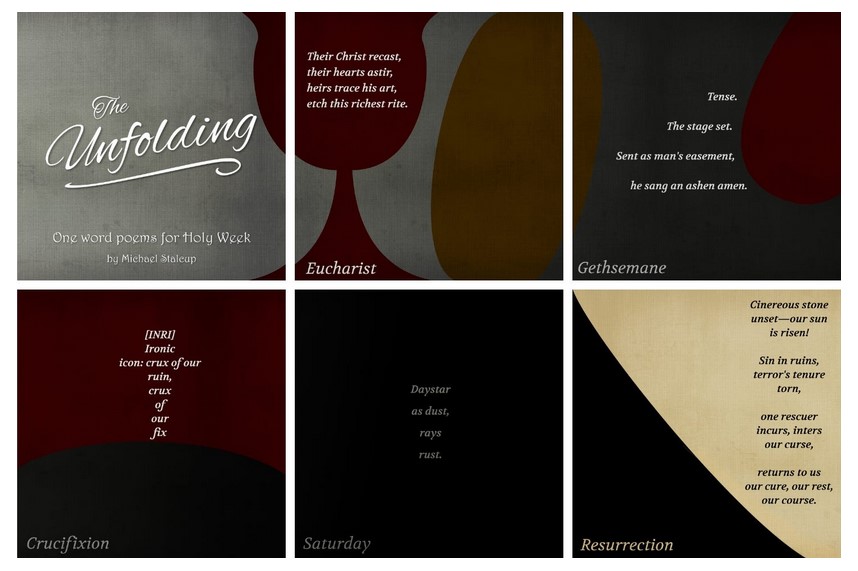
POEM SEQUENCE: “The Unfolding” by Michael Stalcup: Michael Stalcup has published a sequence of five short poems in Solum Journal that “tells the story of Jesus’ death and resurrection by unfolding five words that take us from Maundy Thursday through Easter Sunday,” he says. “I wrote these poems in a very unusual way, restricting myself to words that could be formed from the letters in each poem’s title. . . . This poetic form calls for creativity within intense limitations, which seems fitting for Holy Week—a time when Jesus crafted the most beautiful art this world has ever known within the constraints of his own suffering and death.” Stalcup has also presented them on Instagram (click on the image below).
+++
ARTICLE: “Don’t Rush Past Good Friday” by Brian Zahnd: Pastor and author Brian Zahnd cautions us not to shortchange the cross on the way to Easter, but rather to slow down and dwell there, beholding the crucified Christ.
+++
SONGS:
>> “Friday Morning” by Sydney Carter, performed by Timothy Renner: This Good Friday song by the English folk musician Sydney Bertram Carter (1915–2004) is difficult—one might even say blasphemous. That’s because it’s voiced from the perspective of the “bad” thief, who is spewing hatred and bitterness over his fate and blaming God for having created such a cruel world. But we’re aware of an irony in the refrain that the convicted man is not: “It’s God they ought to crucify / Instead of you and me, / I said to the carpenter / A-hanging on the tree.”
>> “Go to Hell” by Nick Chambers: This song is a setting of a poem by Pádraig Ó Tuama from his collection Sorry for Your Troubles (Canterbury Press Norwich, 2013). The title is shocking, I know, but it’s derived from a line in the Apostles’ Creed, where we Christians profess that after Jesus died, he “descended into hell.” The singer-songwriter, Nick Chambers, writes in the YouTube video description: “In between Good Friday and Easter Sunday is possibly strangest day of the Christian year. On Holy Saturday, not only is Jesus, the God-Man, in the grave; traditions abound about his descent to the dead, his ‘harrowing of hell.’ What does it mean for the coming down of God-with-us not to end on earth but ‘under the earth,’ extending hope to the furthest regions of human pain and abandonment? Such a question deserves more poetry than explanation.”
“Go to hell” is a slang expression of scorn or rejection, to which Jesus was no stranger. As in the previous song, there’s an irony here, in telling Jesus to go to hell—because he did. Literally. Ó Tuama meditates on how Jesus shares in our vulnerabilities and yearnings and seeks to pull us out of the hells we’re in and redeem our stories.
Hear the poem read by the poet here, or at the end of the Stations of the Cross video below. “he is called to hell, this man / he is called to glory . . .”
+++
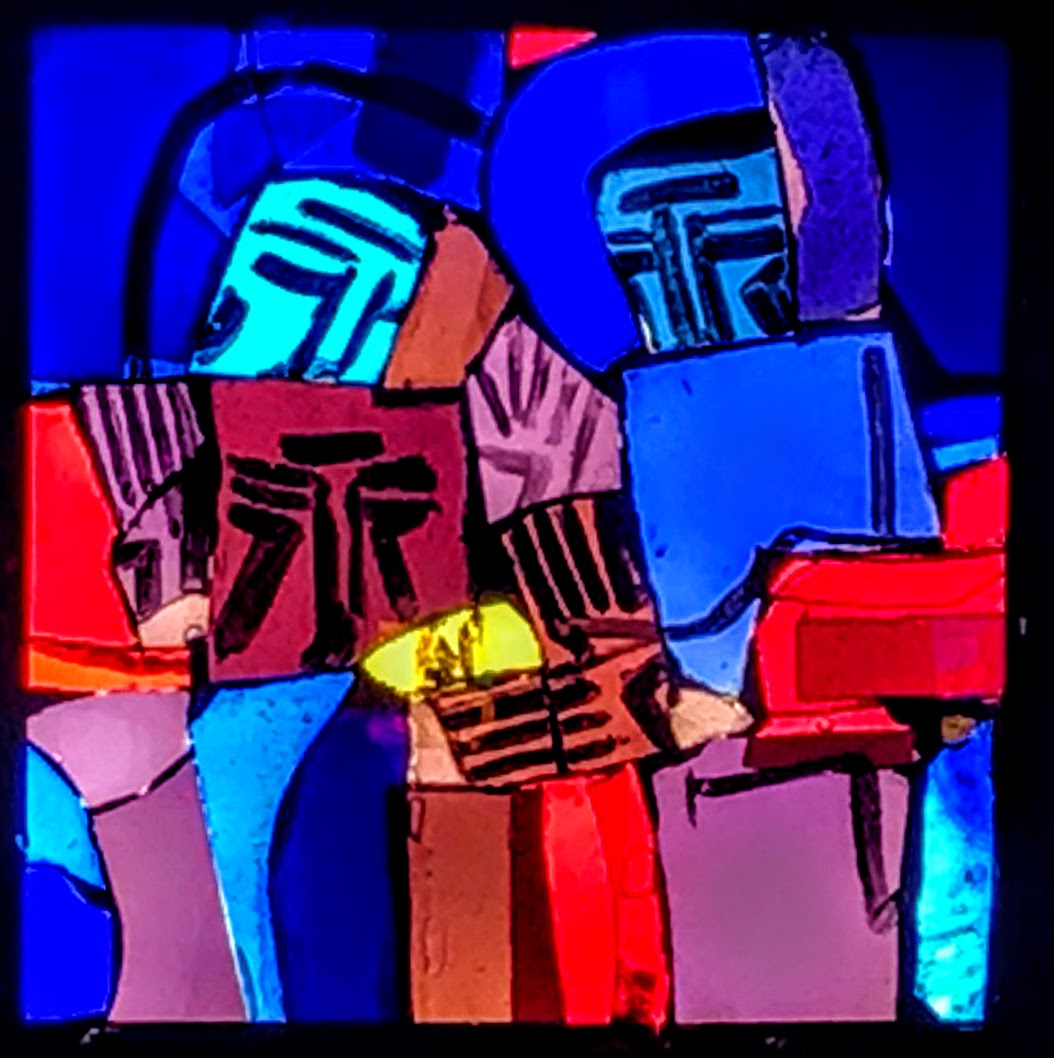
GUIDED MEDITATION: “Stations of the Cross, Good Friday, 2020” by Pádraig Ó Tuama: In 2020 the poet-theologian Pádraig Ó Tuama put together this twenty-minute video reflection for Good Friday structured around the Stations of the Cross, consisting of photos of art he’s taken and the praying of collects he’s written. (Several of the collects can be found in his book Daily Prayer with the Corrymeela Community from 2017.) The throughline is a set of stained-glass Stations by Sheila Corcoran at the Church of Our Lady Queen of Heaven at Dublin Airport; others are by Jong-Tae Choi, Gib Singleton, Sieger Köder, Richard P. Campbell, and Audrey Frank Anastasi.
Sheila Corcoran, Station 6: Veronica Wipes the Face of Jesus, ca. 1964. Stained glass, Church of Our Lady Queen of Heaven, Dublin Airport. Photo: Patrick Comerford.Richard P. Campbell (Dunghutti/Gumbaynggirr, 1958–), Station 10: Jesus is stripped of his garments, 2001. Reconciliation Church, La Perouse, Sydney, Australia.
But before stepping onto Jesus’s Via Dolorosa, Ó Tuama considers Judas, sharing a stained glass panel by Harry Clarke that illustrates a medieval legend about the Irish monastic saint Brendan the Navigator. According to the Navigatio Sancti Brendani Abbatis, on one of his voyages St. Brendan encountered Judas at sea, tied to an iceberg. He learned that an angel had taken pity on Judas in hell and given him a reprieve of one hour to cool himself from the flames of judgment. Ó Tuama then prays for those who, like Judas, are tormented by guilt and see no way out.
He closes with a reading of his poem “Go to Hell” (set to music in the previous roundup item).
+++
SONG: “For the Songless Hearts” by Jon Guerra: “There’s a lot of hubbub around Easter weekend in churches. And for good reason,” says singer-songwriter Jon Guerra. “But our hearts can’t always cooperate with the prescribed mood of the Easter season: ‘Celebrate! Be happy! Sing!’ Sometimes the last thing we are able to do is sing. Thankfully, Good Friday and Easter are not about mustering a mood. Good Friday and Easter are about remembering that there is One who meets us in our life and meets us in our death. He sings for us—and over us—when we can’t.”
That’s what “For the Songless Hearts” is about—a single released in 2017, and which Guerra sings with his wife, Valerie. In a Mockingbird blog post about it, Guerra admonishes, “Remember that before the tomb was empty, it was full. ‘When he was laid in the tomb, he laid right next to you.’” Jesus knew the depths of sorrow and the sting of death. We are not alone in such experiences.
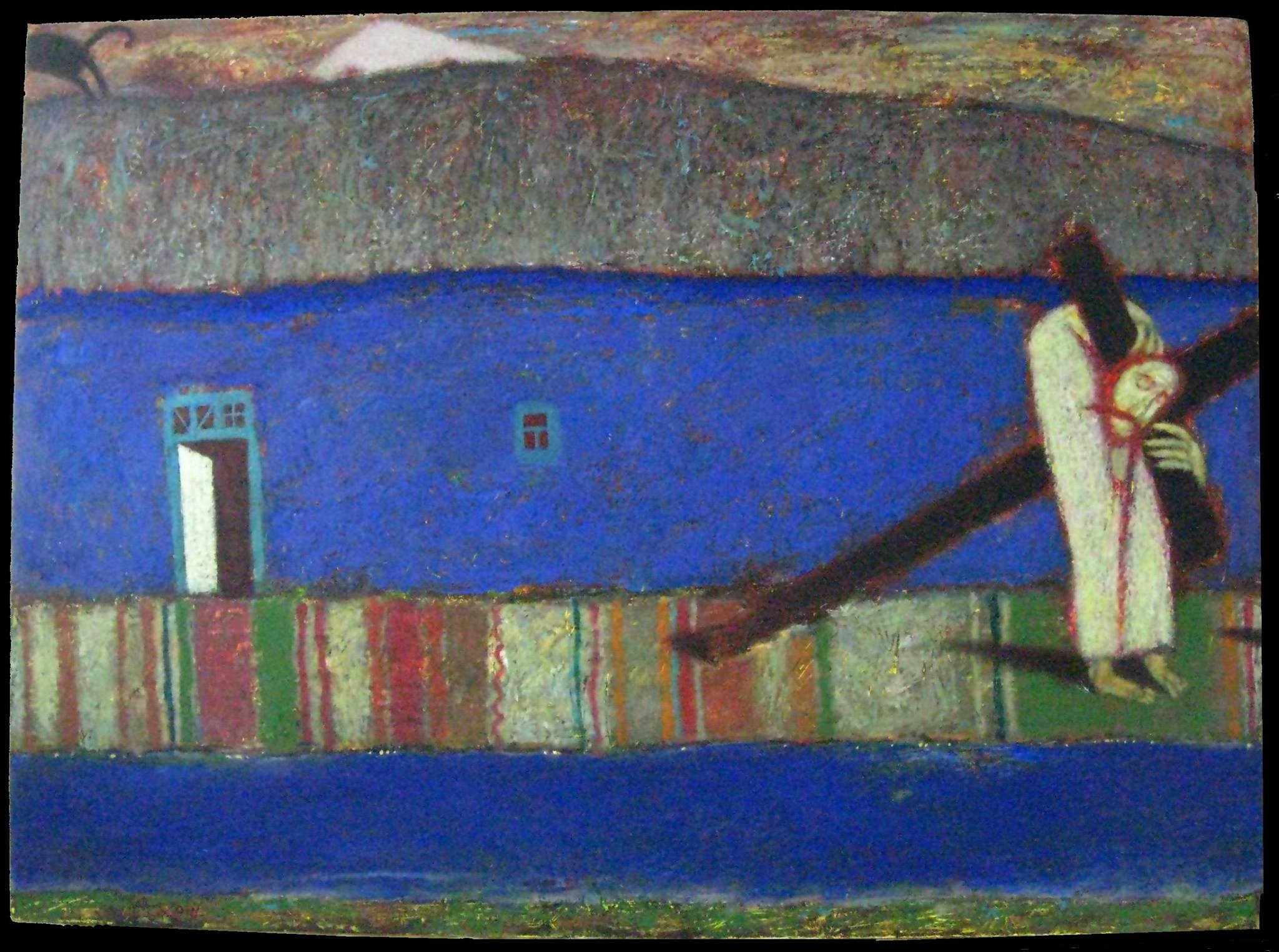
. . . carrying the cross by himself he went out to what is called the Place of the Skull, which in Hebrew is called Golgotha. There they crucified him . . .
—John 19:17–18
LOOK: White Mountain by Ihor Paneyko
Ihor Paneyko (Игоря Панейка) (Ukrainian, 1957–), White Mountain, 2011. Egg tempera on gessoed board.
LISTEN: “Solus ad victimam” (Alone to Sacrifice Thou Goest, Lord) | Original Latin words by Peter Abelard, second quarter of 12th century; English translation by Helen Waddell, 1929 | Music by Kenneth Leighton, 1973 | Performed by St. Olaf Cantorei, dir. John Ferguson, on Hidden in Humbleness: Meditations for Holy Week and Easter, 2010
Alone to sacrifice thou goest, Lord, Giving thyself to Death, whom thou hast slain. For us, thy wretched folk, is [there] any word, Who know that for our sins this is thy pain?
For they are ours, O Lord, our deeds, our deeds. Why must thou suffer torture for our sin? Let our hearts suffer for thy passion, Lord, That very suffering may thy mercy win.
This is that night of tears, the three days’ space, Sorrow abiding of the eventide, Until the day break with the risen Christ, And hearts that sorrowed shall be satisfied.
So may our hearts share in thine anguish, Lord, That they may sharers of thy glory be. Heavy with weeping may the three days pass, To win the laughter of thine Easter Day.
“In Parasceve Domini: III. Nocturno,” whose first line is “Solus ad victimam procedis, Domine,” is a Latin hymn by the French scholastic philosopher, theologian, and poet Peter Abelard (1079–1142). It appears in his collection Hymnarius Paraclitensis—a major contribution to medieval Latin hymnody—and was sung in the night office (Nocturns) of prayers on Good Friday.
Today it is best known through its modern choral setting of the English by British composer and pianist Kenneth Leighton (1929–1988). Dr. David Ouzts, the minister of music and liturgy at Church of the Holy Communion in Memphis, says this is “one of the most effective musical settings of any anthem of the 1,000-plus octavos in our parish music library.” He continues:
This anthem is one of those with harmonies and sonorities that may not sound correct when they are. Worshipers will hear the sparseness of the choir singing in simple same-note octaves, and in the next moment, dissonances between the choral voices will appear.
Though this 12th century text is most certainly a Passiontide text, my favorite aspect is that it foreshadows Easter and the Resurrection.
The wordplay of the music that accompanies “laughter” in the text is notable. The choral voices are high in their tessituras, and the full choir ends literally on a high note, after which the organ accompaniment steals the show with great dissonant chords, only to land on a huge, bright E Major chord.
The hymn invites us to follow Christ to Golgotha, beholding his suffering so that we might be moved to contrition and, clinging to God’s mercy, rise to newness of life—or, as the wonderful last line puts it, “win the laughter of [Christ’s] Easter Day.” The fourth stanza alludes to Romans 8:17, where the apostle Paul writes that we are “heirs of God and joint heirs with Christ, if we in fact suffer with him so that we may also be glorified with him.” Paul speaks elsewhere of believers being “crucified with Christ” (Gal. 2:20)—see my visual commentaries on this passage—and “baptized into his death” (Rom. 6:3) as well as being raised with him.
Jesus may have gone “alone to sacrifice”—but the fruits of that sacrifice abound to all who would eat. Praise be to God.
As we enter the Paschal Triduum, let us weep for our sins and for the innocent Lamb who was slain to atone for them. Let us also look with hope toward daybreak.
Those who had arrested Jesus took him to Caiaphas the high priest, where the scribes and the elders had gathered. . . .
Now the chief priests and the whole council were looking for false testimony against Jesus so that they might put him to death, but they found none, though many false witnesses came forward. At last two came forward and said, “This fellow said, ‘I am able to destroy the temple of God and to build it in three days.’”
The high priest stood up and said, “Have you no answer? What is it that they testify against you?”
But Jesus was silent. Then the high priest said to him, “I put you under oath before the living God, tell us if you are the Messiah, the Son of God.”
Jesus said to him, “You have said so. But I tell you,
From now on you will see the Son of Man seated at the right hand of Power and coming on the clouds of heaven.”
—Matthew 26:57–64
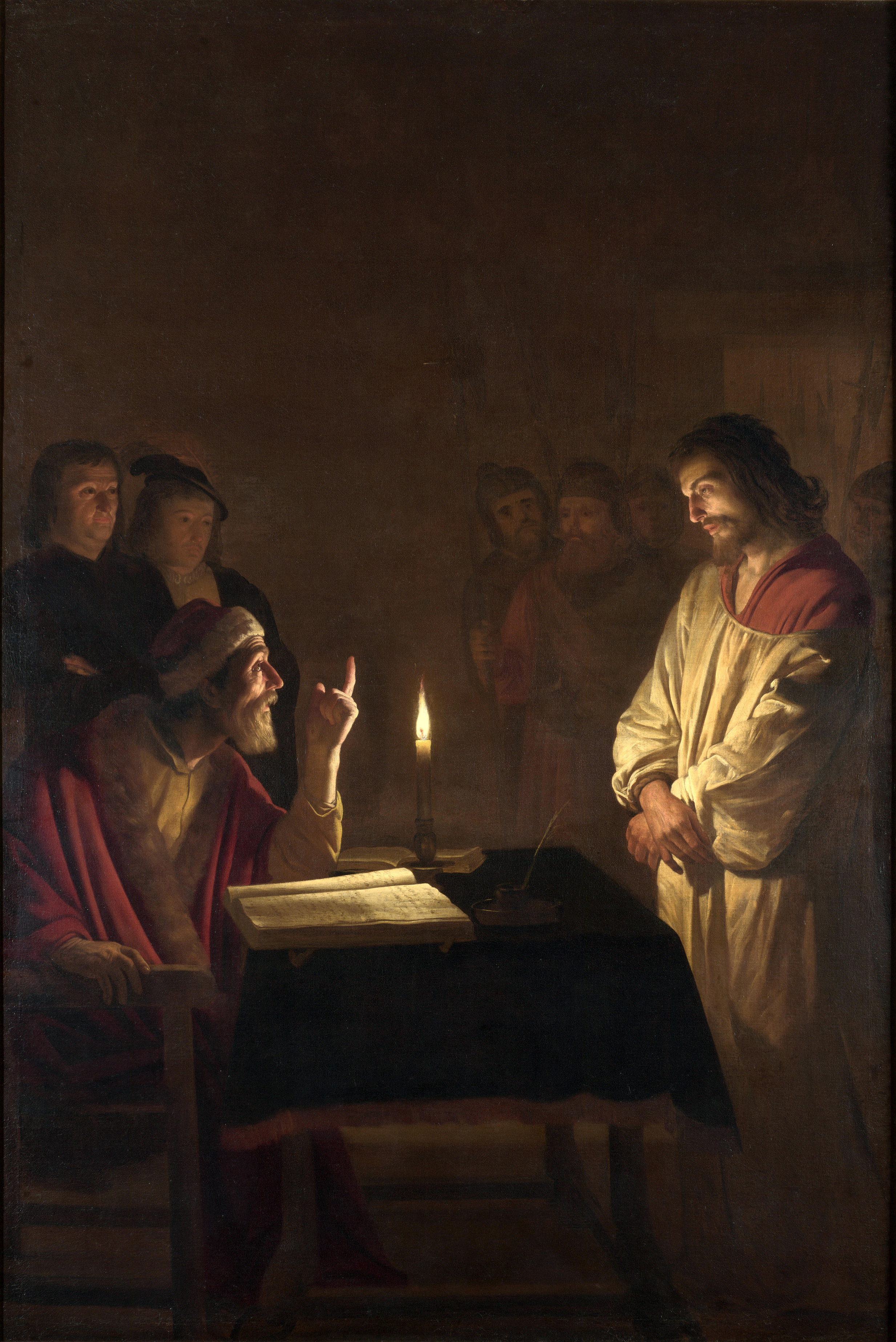
LOOK: Christ before the High Priest by Gerrit van Honthorst
Gerrit van Honthorst (Dutch, 1590–1656), Christ before the High Priest, ca. 1617. Oil on canvas, 272 × 183 cm. National Gallery, London.
Rev. Katherine Hedderly, associate vicar for ministry at St Martin-in-the-Fields, reflected on this painting as part of the online course “Inspired to Follow: Art and the Bible Story”:
Jesus places himself totally in the place of light and truth. But we see here, and will see again as we journey to the cross, that it is a lonely place. I wonder if we’re prepared to stand in the lonely place for the sake of the truth. . . .
Opposite Jesus in the painting we find Caiaphas, seated. And in front of Caiaphas, on the table, the books of the Mosaic Law are open. All the power of the religious authority is being brought to bear. Caiaphas has all the weight and authority in the scene, the two witnesses standing arms folded behind him in cowardly judgement. Caiaphas’s finger is very prominent. He is accusing, judgmental. . . .
Jesus’ silence condemns the judge and the witnesses; and by his silence he refuses to accept the authority of the trial. In the face of this onslaught from the religious hierarchy Jesus is the one with real authority.
LISTEN:“Sanhedrin” by Nicholas Andrew Barber, on Stations (2020)
When the day had come When the dreadful day had come All the people gathered round They were the powers that be
The priests, the scribes, and the elders Took their counsel, all eyes on this king Of a different kind Oh, he was a king of a different kind
They asked him plain and simple Oh, but their intentions were far more complicated Minds and hearts are so complicated Minds and hearts are so complicated
You are the Christ Oh, you are the Son of Man You are seated at the right hand of the power of God Over all the powers that be
You needed to say no more They’d heard enough They heard his words But not what he said
When they had sung the hymn, they went out to the Mount of Olives.
Then Jesus said to [his disciples], “You will all fall away because of me this night, for it is written, ‘I will strike the shepherd, and the sheep of the flock will be scattered.’ But after I am raised up, I will go ahead of you to Galilee.”
Peter said to him, “Even if all fall away because of you, I will never fall away.”
Jesus said to him, “Truly I tell you, this very night, before the cock crows, you will deny me three times.”
Peter said to him, “Even though I must die with you, I will not deny you.” And so said all the disciples.
Then Jesus went with them to a place called Gethsemane, and he said to his disciples, “Sit here while I go over there and pray.” He took with him Peter and the two sons of Zebedee and began to be grieved and agitated. Then he said to them, “My soul is deeply grieved, even to death; remain here, and stay awake with me.” And going a little farther, he threw himself on the ground and prayed, “My Father, if it is possible, let this cup pass from me, yet not what I want but what you want.”
Then he came to the disciples and found them sleeping, and he said to Peter, “So, could you not stay awake with me one hour? Stay awake and pray that you may not come into the time of trial; the spirit indeed is willing, but the flesh is weak.”
Again he went away for the second time and prayed, “My Father, if this cannot pass unless I drink it, your will be done.” Again he came and found them sleeping, for their eyes were heavy.
So leaving them again, he went away and prayed for the third time, saying the same words. Then he came to the disciples and said to them, “Are you still sleeping and taking your rest? Now the hour is at hand, and the Son of Man is betrayed into the hands of sinners. Get up, let us be going. Look, my betrayer is at hand.”
—Matthew 26:30–46
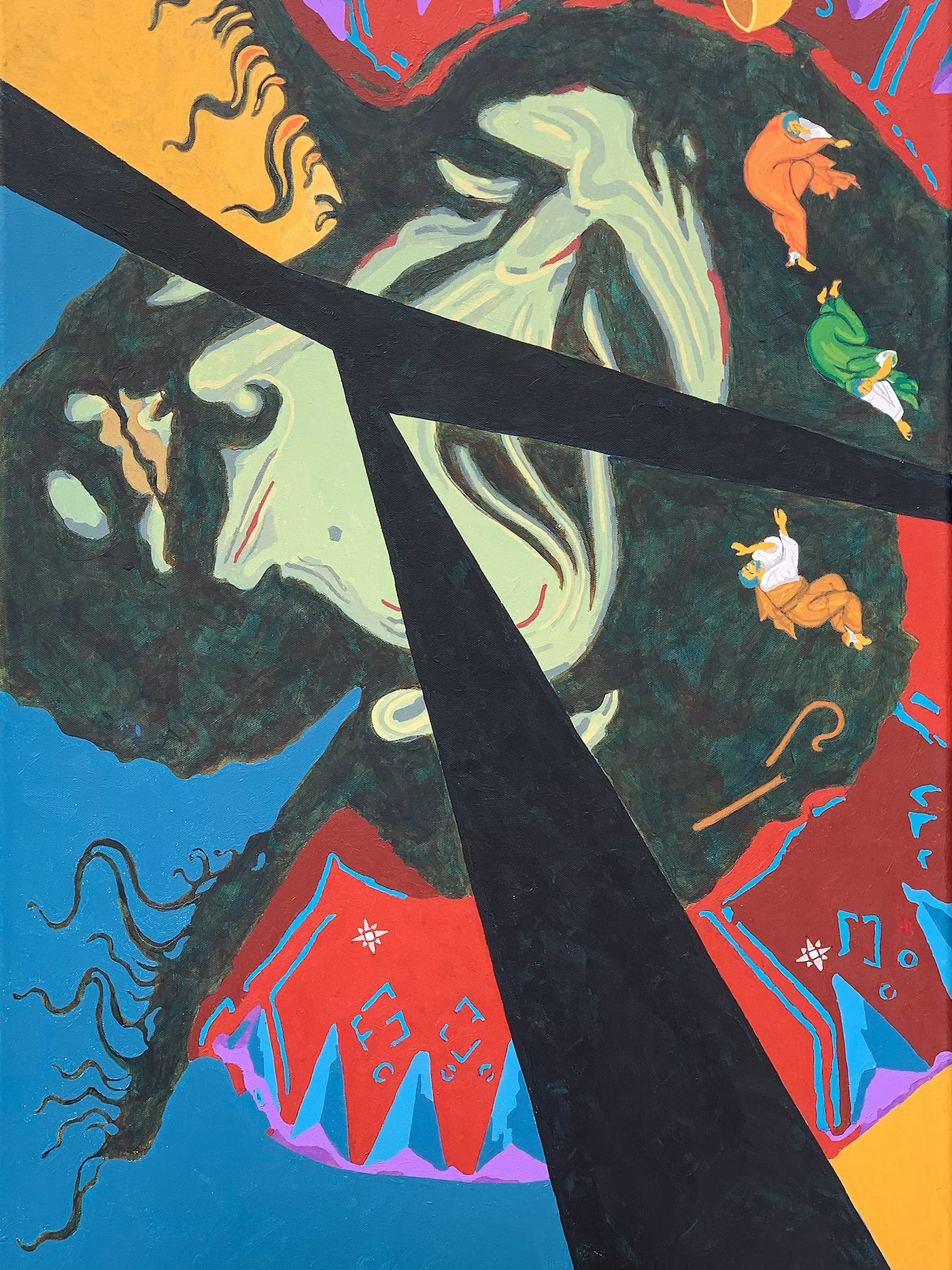
LOOK: Exceeding Sorrowful by Douglas Porter
Douglas Porter (Canadian, 1949–), Exceeding Sorrowful, 2023. Acrylic on canvas, 36 × 24 in.
Doug Porter is a painter, video artist and editor, and graphic designer from Orillia, Ontario. His painting Exceeding Sorrowful portrays the religious subject known as the Agony in the Garden. The painting’s title comes from the King James Version of Matthew 26:38, where Jesus tells his inner circle of disciples (Peter, James, and John), “My soul is exceeding sorrowful, even unto death: tarry ye here, and watch with me.”
He had just eaten the Passover seder with them and the rest of the Twelve, pronouncing some strange words at the table: “Take, eat; this is my body,” he said as he broke the bread. And as he raised the wineglass, he commanded them, “Drink from it, all of you, for this is my blood of the covenant, which is poured out for many for the forgiveness of sins . . .”
Singing a hymn and going out to the Mount of Olives, he then foretold his disciples’ desertion of him. Adapting God’s words from Zechariah 13:7, he told them that he, their shepherd, would be struck, and they, his sheep, would be scattered. They all protested, but their faithlessness would soon be revealed.
Using rich hues reminiscent of stained glass, Porter shows Christ with his eyes closed as if a wave of pain is passing over him, and his brow anxiously furrowed. (The head of Christ is based on a painted wood crucifix by Coppo di Marcovaldo of Italy, from around 1260.) He is broken, shattered; the three jagged shards of him pull away to reveal a dark void. At the top the rim of the cup of suffering is just visible, which he pleads with God to remove. But as he communes with the Father, he becomes increasingly bolstered in his resolve to carry out his mission to the very end.
On the right is a shepherd’s staff, also broken, representing Christ’s words about his being struck. Three of his “sheep” are sprawled out on the ground. The figures of Peter, James, and John are based on a fifteenth-century icon of the Transfiguration by Theophanes the Greek. These three disciples on the Mount of Olives had been privileged earlier to see their Lord gloriously transfigured on another mount: Tabor. And yet despite having received that divine vision, in Gethsemane they fall asleep, failing to support Jesus in his final hours.
In a few days, Jesus’s exceeding sorrow and pain would be transfigured. But on that Thursday and Friday, he drank that cup to its dregs.
LISTEN: “Miracle” by Dave Von Bieker, on Bridge Songs ONE by Urban Bridge Church (2007) | MP3 provided by permission of the artist
Update, 3/28/24: Von Bieker told me my interest in the song has spurred him on to remake it! Here’s his new recording from this week:
This garden grows death And it’s damp and it’s dark Your three closest friends Are asleep on the bark Of a tree that once grew tall Offering its shade But it’s dead and it’s mourning It’s black and decayed
And you search for a place That is far enough out So your voice won’t be heard When you cry and you shout Have you come here to bargain? Have you come to ask why? Is that fear or pure sorrow Buried in your eyes?
And isn’t it time To turn water into wine? To drink a different cup? To forget what’s on your mind? It seems a good time To take up Satan’s deal To leap from tall buildings Without bruising a heel
But now’s not the time for miracles Now’s not the time for trap doors and way outs Oh, now’s not the time for miracles Everything comes in its time
It’s a strange sort of prayer More a fight to the death You walk back to your watchmen There isn’t one left They’ve all slept through this spiritual Solar eclipse They don’t get it, how could they Who would have guessed this?
And you drop to your knees There’s no way out, not yet And your pores are still dripping With blood, oh, with sweat Jacob left with a limp Moses’ tongue couldn’t find An excuse, Paul be blinded Why fight him when you know it’s no use? When you know, well
That now’s not the time for miracles Now’s not the time for trap doors and way outs No, now’s not the time for miracles Everything comes in its time
You sit at her bedside And cry to the roof I don’t know why I hold on When I have no proof But there’s something in knowing You knew how this felt Yeah, there’s something in sharing This hand that we’re dealt
And isn’t it time to say, “Wake up, arise! Come on, Take up your mat! Come on And open your eyes!” Isn’t it time now? He’s sick, close to death He’s been in the grave for four days Why not yet?
But now’s not the time for miracles Now’s not the time for trap doors and way outs No, now’s not the time for miracles And everything comes in its time And everything comes in its time
Dave Von Bieker is a singer-songwriter from Edmonton, Alberta, Canada, who performs and records under the artist name “Von Bieker.” He wrote “Miracle” while part of a songwriting group connected to Urban Bridge Church, a Pentecostal Assemblies of Canada church plant in downtown Edmonton that existed from 2006 to 2015. “We [were] writing songs that dance around the edges of the sacred and songs that wade right through it,” he said. “We [were] questioning and shouting with our songs.”
Starting in 2007, each year the collective shared some of their work at a live concert event they dubbed Bridge Songs and released an album. “Miracle” is from the first such album, Bridge Songs ONE. This album is no longer available, but Von Bieker gave me permission to share this song from it, which I learned about last year as a subscriber to his newsletter, Von Bieker Backstage.
The narrator of the song observes Christ’s distress in the garden of Gethsemane and questions why he doesn’t work a miracle to avoid the cross. Then the refrain comes in—perhaps in Christ’s voice, perhaps in the voice of the concessionary narrator—saying that “now’s not the time for miracles” but suggesting that the miracle of resurrection will come in its time.
A bloody crucifixion is probably not the path to victory we would have imagined, but it’s the path God in his wisdom laid out and took and by doing so showed com-passion (literally “suffering with”) on humanity. The physical, mental, and spiritual anguish that God in Christ endured speaks to God’s awesome love, which comes alongside us in our own suffering.
In the third verse “Miracle” appears to shift to a contemporary scene of a loved one (daughter? wife? mother? friend?) lying gravely ill in bed. Why doesn’t God intervene to miraculously heal? It then moves back again in time to the story of Lazarus, who died. His sister Martha chastises Jesus for his delayed arrival to Lazarus’s bedside. Upon seeing the four-days-dead body of his friend in the tomb, “Jesus began to weep” and was “greatly disturbed” (John 11:35, 38). Then, after giving space to his grief, he calls into the dark cavern, “Lazarus, come out!”—and wouldn’t you know, Lazarus comes stumbling out alive! A delayed miracle.
I love how this song enfolds the story of Christ into our own and that of the Old and New Testament saints, who wrestled with God and stammered their doubts and had their obstinacy obliterated by blinding light, or their fervent belief validated by a brother’s sudden awakening from the grave.
In addition to writing songs, in September 2011 Von Bieker founded Bleeding Heart Art Space, a community space dedicated to exploring art, faith, and justice. He served as director, or “arts chaplain,” until June 2018. Bleeding Heart started as a ministry of Urban Bridge Church, and when that church closed, Bleeding Heart was grafted into St. Faith’s Anglican Church, under whose aegis it remains active today, organizing pop-up solo and group exhibitions and hosting ArtLucks for local artists to share what they’ve been working on.


._Author%E2%80%99s_photograph1.jpg)


 Art & Theology