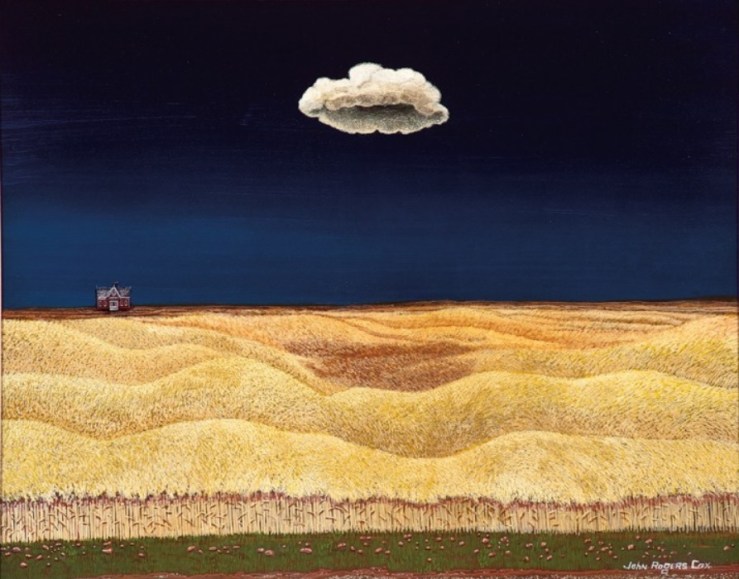
John Rogers Cox (American, 1915–1990), Wheat Field, ca. 1943. Oil on Masonite, 16 × 20 in. The John and Susan Horseman Collection of American Art, St. Louis, Missouri.
And Jesus answered them, “The hour has come for the Son of Man to be glorified. Truly, truly, I say to you, unless a grain of wheat falls into the earth and dies, it remains alone; but if it dies, it bears much fruit. Whoever loves his life loses it, and whoever hates his life in this world will keep it for eternal life. If anyone serves me, he must follow me; and where I am, there will my servant be also. If anyone serves me, the Father will honor him.
“Now is my soul troubled. And what shall I say? ‘Father, save me from this hour’? But for this purpose I have come to this hour. Father, glorify your name.”
Then a voice came from heaven: “I have glorified it, and I will glorify it again.”
The crowd that stood there and heard it said that it had thundered. Others said, “An angel has spoken to him.”
Jesus answered, “This voice has come for your sake, not mine. Now is the judgment of this world; now will the ruler of this world be cast out. And I, when I am lifted up from the earth, will draw all people to myself.” He said this to show by what kind of death he was going to die.
So the crowd answered him, “We have heard from the Law that the Christ remains forever. How can you say that the Son of Man must be lifted up? Who is this Son of Man?”
So Jesus said to them, “The light is among you for a little while longer. Walk while you have the light, lest darkness overtake you. The one who walks in the darkness does not know where he is going. While you have the light, believe in the light, that you may become sons of light.”
When Jesus had said these things, he departed and hid himself from them.
—John 12:23–36
+++
SONG: “Glorify” by Joe Kurtz and Josh Compton, on Last Days by The Brothers of Abriem Harp (2015)
This post belongs to the weekly series Artful Devotion. If you can’t view the music player in your email or RSS reader, try opening the post in your browser.
To view all the Revised Common Lectionary scripture readings for Tuesday of Holy Week, cycle A, click here.
Illumination from the Vaux Passional, England, ca. 1503–4. Peniarth MS 482D, fol. 15v, National Library of Wales, Aberystwyth. [see full page]
Six days before the Passover, Jesus therefore came to Bethany, where Lazarus was, whom Jesus had raised from the dead. So they gave a dinner for him there. Martha served, and Lazarus was one of those reclining with him at table. Mary therefore took a pound of expensive ointment made from pure nard, and anointed the feet of Jesus and wiped his feet with her hair. The house was filled with the fragrance of the perfume. But Judas Iscariot, one of his disciples (he who was about to betray him), said, “Why was this ointment not sold for three hundred denarii and given to the poor?” He said this, not because he cared about the poor, but because he was a thief, and having charge of the moneybag he used to help himself to what was put into it. Jesus said, “Leave her alone; she intended to keep it for the day of my burial. For the poor you always have with you, but you do not always have me.”
When the large crowd of the Jews learned that Jesus was there, they came, not only on account of him but also to see Lazarus, whom he had raised from the dead. So the chief priests made plans to put Lazarus to death as well, because on account of him many of the Jews were going away and believing in Jesus.
—John 12:1–11
+++
SONG: “Said Judas to Mary” by Sydney Carter, 1964 | Performed by ValLimar Jansen and the choir of Christ the King Church, Kingston, Rhode Island, 2015
This post belongs to the weekly series Artful Devotion. If you can’t view the music player in your email or RSS reader, try opening the post in your browser.
To view all the Revised Common Lectionary scripture readings for Monday of Holy Week, cycle A, click here.
Jyoti Sahi (Indian, 1944–), Entry into Jerusalem, 2012. Oil and acrylic on canvas. Photo courtesy of the artist.
. . . Most of the crowd spread their cloaks on the road, and others cut branches from the trees and spread them on the road. And the crowds that went before him and that followed him were shouting, “Hosanna to the Son of David! Blessed is he who comes in the name of the Lord! Hosanna in the highest!” And when he entered Jerusalem, the whole city was stirred up, saying, “Who is this?” And the crowds said, “This is the prophet Jesus, from Nazareth of Galilee.”
Ride on, ride on in majesty!
Hark! all the tribes hosanna cry;
O Savior meek, pursue thy road
with palms and scattered garments strowed.
Ride on, ride on in majesty!
In lowly pomp ride on to die:
O Christ, thy triumphs now begin
o’er captive death and conquered sin.
Ride on, ride on in majesty!
The angel armies of the sky
look down with sad and wond’ring eyes
to see th’approaching sacrifice.
Ride on, ride on in majesty!
Thy last and fiercest strife is nigh;
the Father on his sapphire throne
expects his own anointed Son.
Ride on, ride on in majesty!
In lowly pomp ride on to die;
bow thy meek head to mortal pain,
then take, O Christ, thy pow’r and reign.
This year’s Palm Sunday music selection comes from Hymnistry, an excellent podcast that ran from 2015 to 2018. I’ve always liked Henry H. Milman’s hymn text “Ride On, Ride On in Majesty!,” but not the traditional tunes it’s typically paired with. So I was thrilled to hear this contemporary setting by John Hatfield. Hatfield’s introduction to the hymn starts at 5:51. He discusses the cognitive dissonance of Palm Sunday, a celebratory occasion with somber undertones, because we’re really cheering Jesus on to his death. He’s hailed as king, Hatfield says, and “his first act in office is to give himself up for us.” Milman’s text captures this paradox of victory through a cross, and Hatfield seeks to do so as well in his retuning, maintaining a happy energy throughout but sneaking in a minor chord. The actual hymn starts at 10:32.
In the first half of the episode, the Rev. Jacob Paul Breeze, pastor of Holy Family in downtown Houston, gives some illuminating historical background. He says that when Jesus entered Jerusalem during Passover, the Israelites took out the Hanukkah decorations (palm branches) instead! Why were they getting their holidays mixed up? Well, they weren’t. Waving palm branches, which were a symbol of prosperity and triumph in Judaism, is how they celebrated their ancestor Judah Maccabee’s cleansing of the temple in the second century BCE. (He recaptured Jerusalem from the Syrian Greeks and restored Jewish temple worship, which gave way to the first Hanukkah, really a belated celebration of the fall festival of Sukkot; see 2 Maccabees 10:1–8, cf. 1 Maccabees 4:54–60.) The Israelites’ waving of date palms as Jesus processed into their most holy city was their way of affirming him as their chosen one, Breeze says, to lead a revolt against the Romans and secure their freedom.
+++
I love the colorful flurry of excitement in Jyoti Sahi’s painting Entry into Jerusalem, where crowds gather in effusive praise of their new liberator. Birds and angels wing overhead, while green palm branches spill forth from the bottom right to carpet Jesus’s path.
Jyoti told me he started this painting after visiting Jerusalem for an interfaith meeting—his first trip to the Holy Land—where he presented a paper on art and meditation. He was fascinated by the surrounding landscape. The theme of Christ entering Jerusalem is related to the idea of Christ entering the human heart, he says.
The painting was acquired in 2018 by a visiting Italian monk for a Christian chapel in Sicily.
+++
Palm Sunday–related posts from the Art & Theology archives:
A simple, gradually quickening Hebrew folk melody on accordion accompanies a contemporary Bulgarian icon by Julia Stankova in “Hail to the King (Artful Devotion)”
Modernist paintings by Australian artist Nathan Simpson meet Hiram Ring’s blues-inflected song “My Lord” (“My Lord is a donkey-ridin’ man . . .”) in “He Went On Ahead (Artful Devotion)”
Did you know Simon and Garfunkel adapted Orlande de Lassus’s motet setting of the Benedictus (“Blessed is he that comes in the name of the Lord”) and recorded it for their first album? Read more in my review of Wednesday Morning, 3 A.M.
+++
This is the first in a series of eight Artful Devotions I’ve planned—one for each day of Holy Week and the Paschal Triduum. I’m posting this one several days ahead because it’s more substantial than the others; the rest I will endeavor to post in the early morning of the given day, from next Monday through Sunday (Easter!). Most of the world will be spending Holy Week at home this year due to the COVID-19 pandemic. Paul Neeley of Global Christian Worship has compiled a great list of resources to help individuals and families honor these days while in quarantine: https://globalworship.tumblr.com/post/613778966717841408/holy-week-at-home. I’m sure there are many more ideas and materials out there as well.
This post belongs to the weekly series Artful Devotion. If you can’t view the music player in your email or RSS reader, try opening the post in your browser.
To view all the Revised Common Lectionary scripture readings for Palm Sunday, cycle A, click here.
This Sunday marks the start of Passion Week, with Jesus riding into Jerusalem on a donkey, where he is greeted by palm branches and Hosannas. By Thursday, though, these shouts of praise will devolve into “Is it I?,” “I do not know him,” and “Crucify him!”
In a series of simple verses, Hiram Ring’s blues-inflected song “My Lord” moves from Jesus’s triumphal entry to his agony in the garden (where he drinks heavily the bitter draft of suffering) to his crucifixion. The final two verses shift then to his resurrection and his exaltation in heaven.
+++
Nathan Simpson (Australian, 1973–), Agony in the Garden, 1999. Oil on canvas.Nathan Simpson (Australian, 1973–), Large Resurrection, 1999. Oil on canvas.
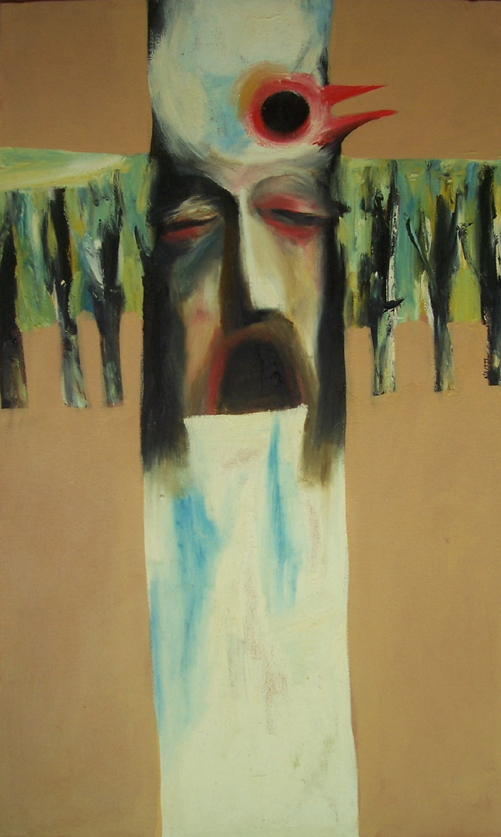
I’m compelled by the Gospel narrative paintings of contemporary Australian artist Nathan Simpson. These are a few I saved from his website a while ago before it went under construction. In Simpson’s Agony in the Garden, Christ’s anguish is palpable. The image combines the Gethsemane narrative with all the suffering that lies ahead, culminating in death. A row of olive trees forms the horizontal beam of a cross, while a rooster (alluding to Peter’s betrayal) forms the vertical; Christ’s head, with swollen eyes and gaping mouth (“My God, my God . . .”), is the point of intersection.
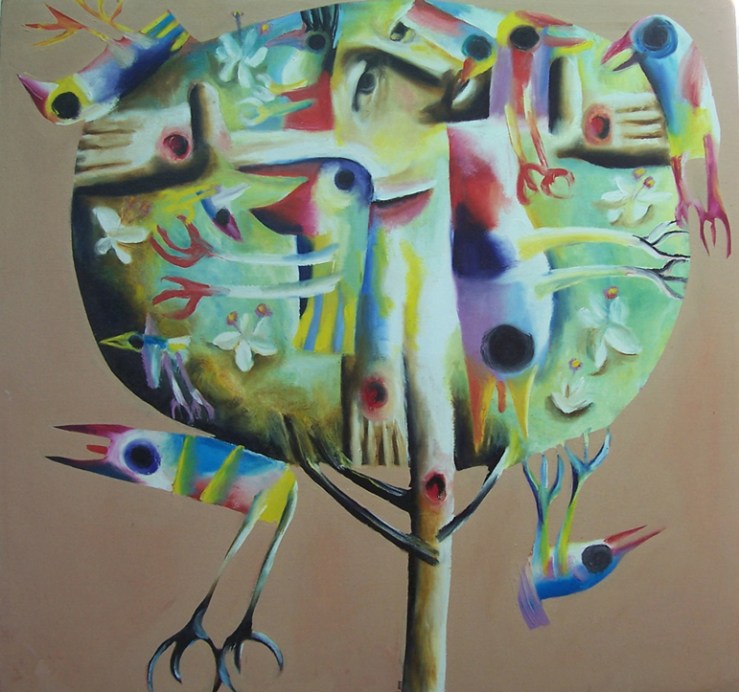
Simpson’s Resurrection painting, by contrast, shows a Christ who’s victorious over death, his face serene. The artist plays with the popular “tree of life” motif, fusing Christ’s body into this flowering, bird-filled plant. An arborescent Christ! See how the nail wound in his left foot is also the tree’s hollow.
+++
In their latest blog post, SALT Project suggests a simple at-home Holy Week ritual for families that I really like: a Tenebrae Wreath (tenebrae means “shadows”).
Imagine . . . a sort of Advent Wreath in reverse: four candles in a circle with a Paschal candle in the middle, extinguished one by one. Sunday night: beginning with only the Paschal candle lit, read Luke’s story of Palm Sunday, and then light all four candles in joy, hope, and thanksgiving. Thursday night: read Luke’s story of the Last Supper, and extinguish one candle; then read Luke’s story of Gethsemane, and extinguish a second. Friday night: read Luke’s story of Peter’s denials and desertion, and extinguish a third candle; then read Luke’s story of Jesus’ suffering, and extinguish the fourth; and then finally, read Luke’s story of Jesus’ death, and extinguish the Paschal candle. Saturday, the wreath remains unlit and bare, perhaps shrouded with cloth. And Sunday morning, the shroud is gone and all candles are lit, with a few more candles added—along with some flowers and Easter sweets! Read Luke’s story of the empty tomb, and sing your favorite Easter hymn (or two).
This post belongs to the weekly series Artful Devotion. If you can’t view the music player in your email or RSS reader, try opening the post in your browser.
To view all the Revised Common Lectionary scripture readings for Palm Sunday and the Liturgy of the Passion, cycle C, click here and here.
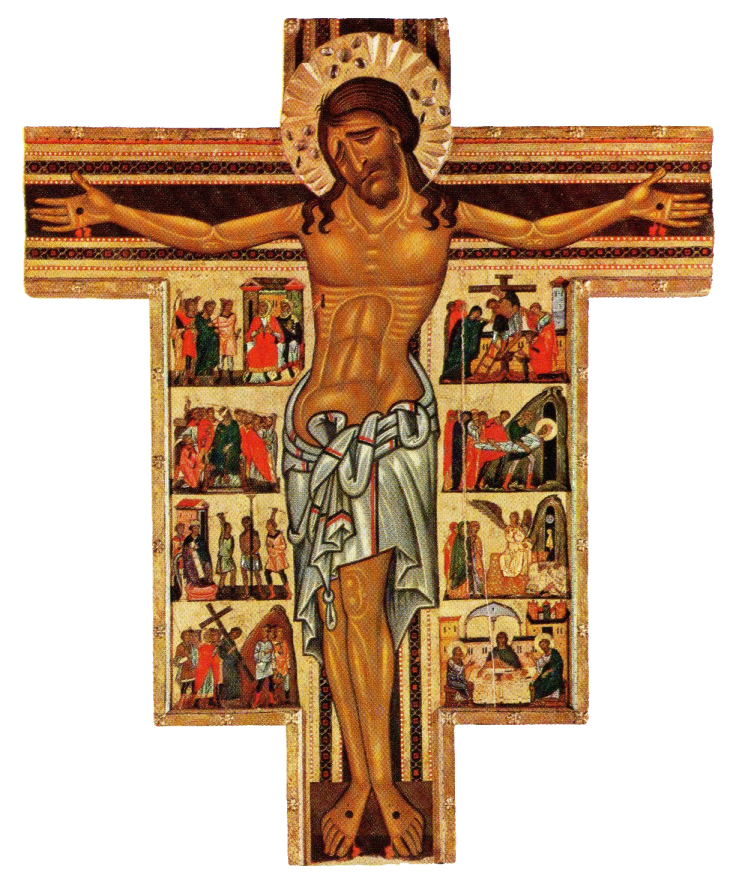
Crucifix with scenes of the Passion, Pisa, Italy, ca. 1240. Tempera on wood, 247 × 202 cm. Uffizi Galleries, Florence, Italy. Left: the Trial of Christ before Annas and Caiaphas, the Mocking of Christ, the Flagellation, Christ Carries His Cross; right: the Descent from the Cross, the Entombment, the Holy Women at the Tomb, the Supper at Emmaus.
“. . . they crucified him . . .”—John 19:18
+++
SONG: “Crucifixus” for 8 voices | Words: from the Nicene Creed | Music: Antonio Lotti (1667–1740) | Performed by Tenebrae, 2016
Crucifixus etiam pro nobis; sub Pontio Pilato passus et sepultus est.
(He was crucified also for us; under Pontius Pilate he suffered and was buried.)
This post belongs to the weekly series Artful Devotion. If you can’t view the music player in your email or RSS reader, try opening the post in your browser.
To view all the Revised Common Lectionary scripture readings for Good Friday, cycle B, click here. An Easter devotion will be published Sunday morning.
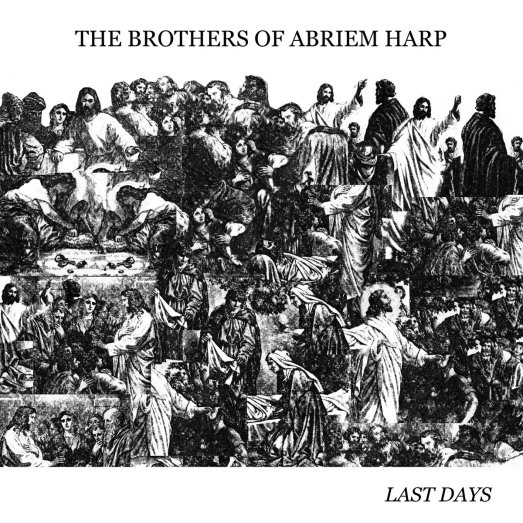
Released in 2015, the album Last Days by the Brothers of Abriem Harp features twelve original indie-folk songs for Holy Week that tell the story of Christ’s passion, from the thundering voice of the Father affirming the Son but also presaging judgment, to the glorification of Christ in the resurrection. One of its major draws is its quiet, understated conveyance of the week’s drama through several different voices: Jesus, of course, but also Mary, Peter, Judas, and other unnamed disciples who reflect on the events they witness, especially in light of their histories with Christ.
Approaching Jesus’s last days primarily through the lens of story—plot, character, mood, etc.—rather than the lens of doctrine makes the listening experience more immersive. That’s not to say theology is absent from the album; it’s very much there. But it is not heavy-handed or abstruse, and neither is it reduced to clichés.
The songs are written and sung by Joe Kurtz (pseudonym: Abriem Harp) and Josh Compton (Josh Harp), with Matt Kurtz (Matthew Harp) on percussion and John Finley (Hezekiah Harp) playing many of the other instruments. On the band’s Facebook page they describe themselves as “gospel-shoutin’ melody makers from the Rust Belt,” and among their musical influences are field recordings, the Sacred Harp tradition, and mountain music.
In the video below, the Brothers have set the entire album to altered footage from Vie et Passion du Christ (Life and Passion of the Christ), a forty-four-minute silent film released in France in 1903. The album is also available for streaming and purchase at https://harpfamilyrecordings.bandcamp.com/album/last-days.
Here’s a rundown of the songs.
1. “Glorify”
A voice arose, a voice arose
A voice arose, a voice
It sounded like thunder, pounded like thunder (×4)
It said, “I’ve glorified it, and again I’ll glorify it”
Yeah, “I’ve glorified it, and again I’ll glorify it” (×3)
This is an unconventional starting point for the passion narrative, which typically begins with Christ’s entry into Jerusalem. Instead, the Brothers have chosen a lesser-known episode from John’s Gospel, which occurs just after the triumphal entry—and what a beautiful passage to highlight. (I actually was not familiar with the references in the song and had to look them up—a great example of how the arts can stimulate renewed engagement with the Bible!)
“The hour has come for the Son of Man to be glorified. Truly, truly, I say to you, unless a grain of wheat falls into the earth and dies, it remains alone; but if it dies, it bears much fruit. . . .
“Now is my soul troubled. And what shall I say? ‘Father, save me from this hour’? But for this purpose I have come to this hour. Father, glorify your name.”
Then a voice came from heaven: “I have glorified it, and I will glorify it again.” The crowd that stood there and heard it said that it had thundered. Others said, “An angel has spoken to him.”
Jesus answered, “This voice has come for your sake, not mine. Now is the judgment of this world; now will the ruler of this world be cast out. And I, when I am lifted up from the earth, will draw all people to myself.” He said this to show by what kind of death he was going to die.
“It’s time.” That’s essentially what Jesus is saying. And then in the middle of this discourse with the disciples, Jesus gets real with the Father. “I’m scared! But what can I do? This is my destiny; I can’t avoid it.” And then, his words of acceptance, of surrender: “Father, glorify your name.” It’s unclear whether this prayer was audible to the disciples or was expressed merely internally. Whatever the case, the Father’s response was heard by all—though some attributed it to natural phenomena, or to an angel.
As this passage clarifies, the “it” in the song is the Father’s name: God says that he has glorified it in the past, and he will glorify it again, when Christ is lifted up for the salvation of the world.
John uses the words glory and glorified a lot in his Gospel, especially in relation to Christ’s passion. In John 13:31, after the Last Supper, where Jesus has just identified Judas as his future betrayer, Jesus says, “Now is the Son of man glorified, and God is glorified in him.” Later that night, in Gethsemane, Jesus prays, “Father, the hour has come; glorify your Son that the Son may glorify you. . . . I glorified you on earth, having accomplished the work that you gave me to do. And now, Father, glorify me in your own presence with the glory that I had with you before the world existed” (John 17:1, 4–5).
The opening song on Last Days, therefore, though just three allusive lines, repeated, is packed with meaning, much of it concentrated in that dense word glorify, a word that orients the whole album. Much like the opening sequence of a movie sets the movie’s tone and hints at what you’re in for, so do opening songs on albums, and this one is somewhat portentous, leaving us wondering, “How will God’s name be glorified?”; it also gives the Father a speaking role and thus situates him as a main character in the story. Continue reading “Album Review: Last Days by the Brothers of Abriem Harp”→
Julia Stankova (Bulgarian, 1954–), The Entry into Jerusalem, before 2002. Tempera, gouache, watercolors, and lacquer technique on wood, 40 × 22 cm.
The next day the large crowd that had come to the feast heard that Jesus was coming to Jerusalem. So they took branches of palm trees and went out to meet him, crying out, “Hosanna! Blessed is he who comes in the name of the Lord, even the King of Israel!” And Jesus found a young donkey and sat on it, just as it is written, “Fear not, daughter of Zion; behold, your king is coming, sitting on a donkey’s colt!”
—John 12:12–15
+++
SONG: “King of Kings and Lord of Lords” | Music: Traditional Hebrew folk tune | Words: Sophie Conty and Naomi Batya (stage name: Nomi Yah), 1974 | Performed by Glenn Tompkins, 2011 | CCLI #23952
This Hebrew folk melody, with its gradually increasing tempo, is in the tradition of the Israeli hora, or round dance. In 1974 two Christian gal pals, Sophie Conty and Naomi Batya, put their own words to it when they were only thirteen. Since then the song has been published in at least sixteen hymnals. I learned about it two Palm Sundays ago when we sang it at my church. Tying it to that particular liturgical occasion was, I think, a really insightful choice on the part of the music leader. The beats are evocative of a clopping donkey, and the quickening pace builds tension, as when Christ approached the swell of praises in Jerusalem that preceded his doom.
It was hard to search for recordings of “King of Kings” because the title is such a common one. I’ve found that it is often performed by children’s choirs (replete with side steps and hand motions!), and the rock band Petra covered it in the late eighties. I chose to feature this solo accordion arrangement because it best captures the flavor of the song. Even without a vocalist, it’s easy to follow along:
King of Kings and Lord of Lords
Glory, hallelujah
King of Kings and Lord of Lords
Glory, hallelujah
Jesus, Prince of Peace
Glory, hallelujah
Jesus, Prince of Peace
Glory, hallelujah
This post belongs to the weekly series Artful Devotion. If you can’t view the music player in your email or RSS reader, try opening the post in your browser.
To view all the Revised Common Lectionary scripture readings for Palm Sunday, cycle B, click here.
Mahalia Jackson’s bluesy rendition of the traditional song “Calvary” provides a perfect space in which to dwell with the sorrow of the cross. The performance below was recorded live from the concert she gave on March 26, 1967, in Lincoln Center’s Philharmonic Hall in New York City and is available on the CD Gospels, Spirituals, and Hymns. According to the liner notes, the names of the piano, organ, and guitar accompanists are unknown.
The lyrics are simple:
Calvary, Calvary, Lord!
Calvary, Calvary, Lord!
Calvary, Calvary, Lord!
Surely he died on Calvary.
Can’t you hear him callin’ his Father? Can’t you hear him callin’ his Father? Can’t you hear him callin’ his Father? Surely, oh surely, Surely, oh surely, He died on Calvary.
But when Jackson sings them, her mournful passion gives them depth, delivers their sting.
“Calvary” invites us to sit in the silence that is the death of God the Son.
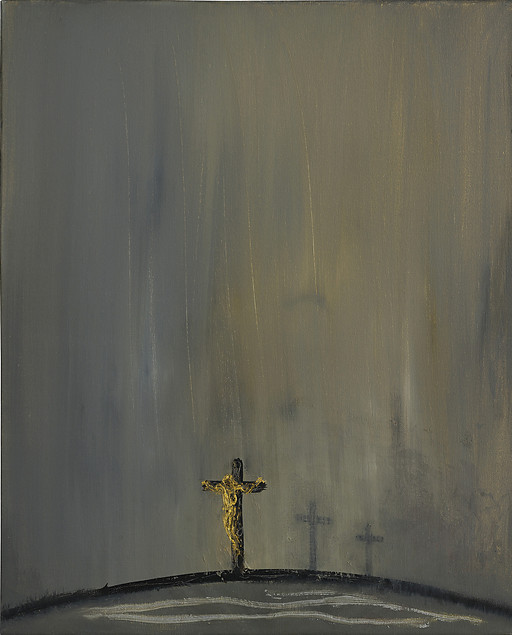
Maggi Hambling (British, 1945–), Good Friday, 2002. Oil on canvas, 55.5 × 45.5 cm.

_Cropped.jpg)



 Art & Theology