Flemish Tapestry with Scenes of the Passion

This month I traveled to parts of Germany and Belgium to experience some of the art of those countries, with a focus on medieval religious art. In Brussels, besides exploring the famous Oldmasters Museum (part of the Royal Museums of Fine Arts of Belgium), I visited the lesser-known Art and History Museum, whose collection includes not just western European art from prehistoric times through the nineteenth century, but also art from Asia (China, Korea, India, Pakistan, Afghanistan, Sri Lanka, Tibet, Nepal, Turkey, Iran, Cambodia, Thailand, Burma), Oceania, the pre-Columbian Americas, and ancient Egypt, Greece, and Rome.

Art and History Museum, Brussels

I spent the most time with the medieval European art on the ground floor—wooden statuettes, ivory and alabaster carvings, stained glass, paintings, metalworks, and tapestries. With the Google Translate app open, I hovered my phone over the Dutch and French descriptive labels to read them in English.

My favorite tapestry I saw, from fifteenth-century Tournai, portrays three scenes from the passion of Christ: Christ Carrying the Cross, the Crucifixion, and the Resurrection. The museum gallery it’s displayed in also houses a large medieval loom, which is what’s protruding at the bottom right corner of the following photo.

Tapestry of the Passion
Scenes from the Passion, Tournai, ca. 1445–55. Tapestry of wool and silk, 424 × 911 cm. Art and History Museum, Brussels, Belgium, Inv. 3644. All photos by Victoria Emily Jones.

Tapestries made in the Flemish city of Tournai were among the most sought after in the fifteenth century. These large-scale wall hangings were bought by royalty, nobles, and high-ranking clergy to decorate their palaces. This one, nearly thirty feet long, is the second of a two-part hanging whose first part (portraying Christ’s Entry into Jerusalem, the Last Supper, and the Arrest of Christ) is in the collection of the Vatican.

Below are some detail shots.

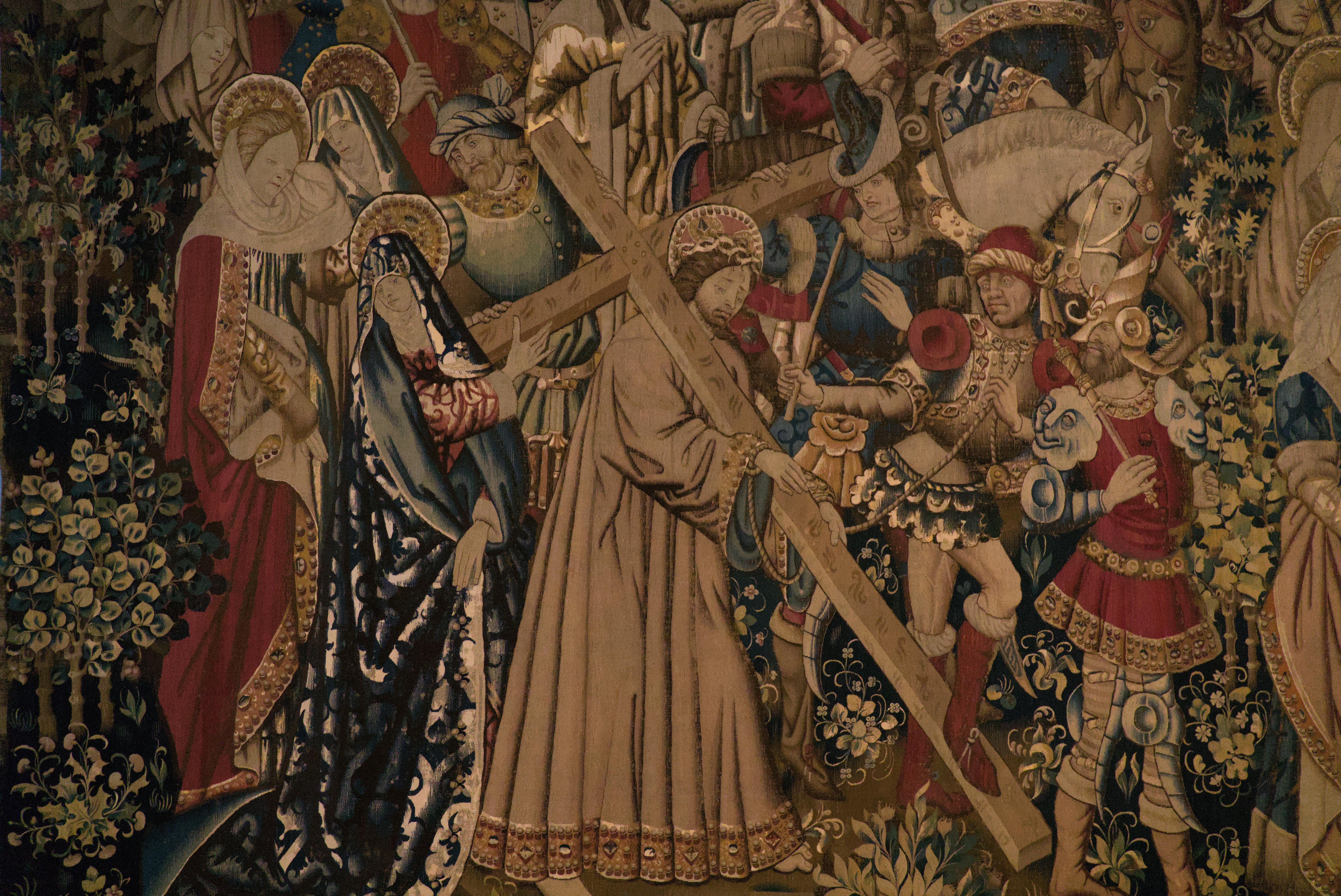
First, Christ carries his cross. A soldier pulls him forward by a rope tied to his wrists, while tauntingly standing on the vertical wood beam and hitting him with a baton. On a less serious note, those are some spiffy face-shaped shoulder scales on the right.
Sept2025_DSC1508

Christ crucified:

Sept2025_DSC1509

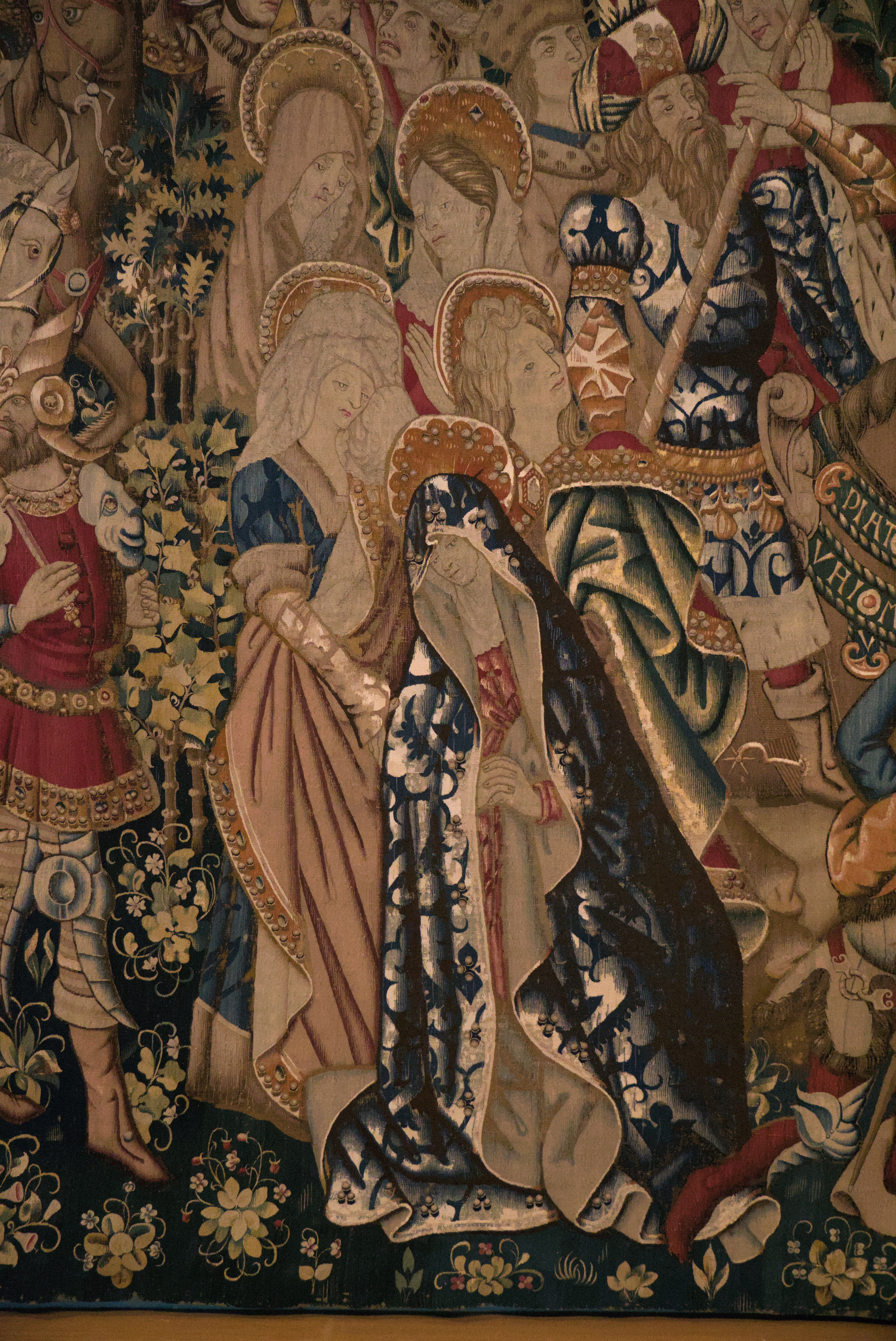
A group of four women mourn—the Virgin Mary up front in the blue mantle, backed by three other Marys—alongside a curly-haired apostle John in green.
Sept2025_DSC1515

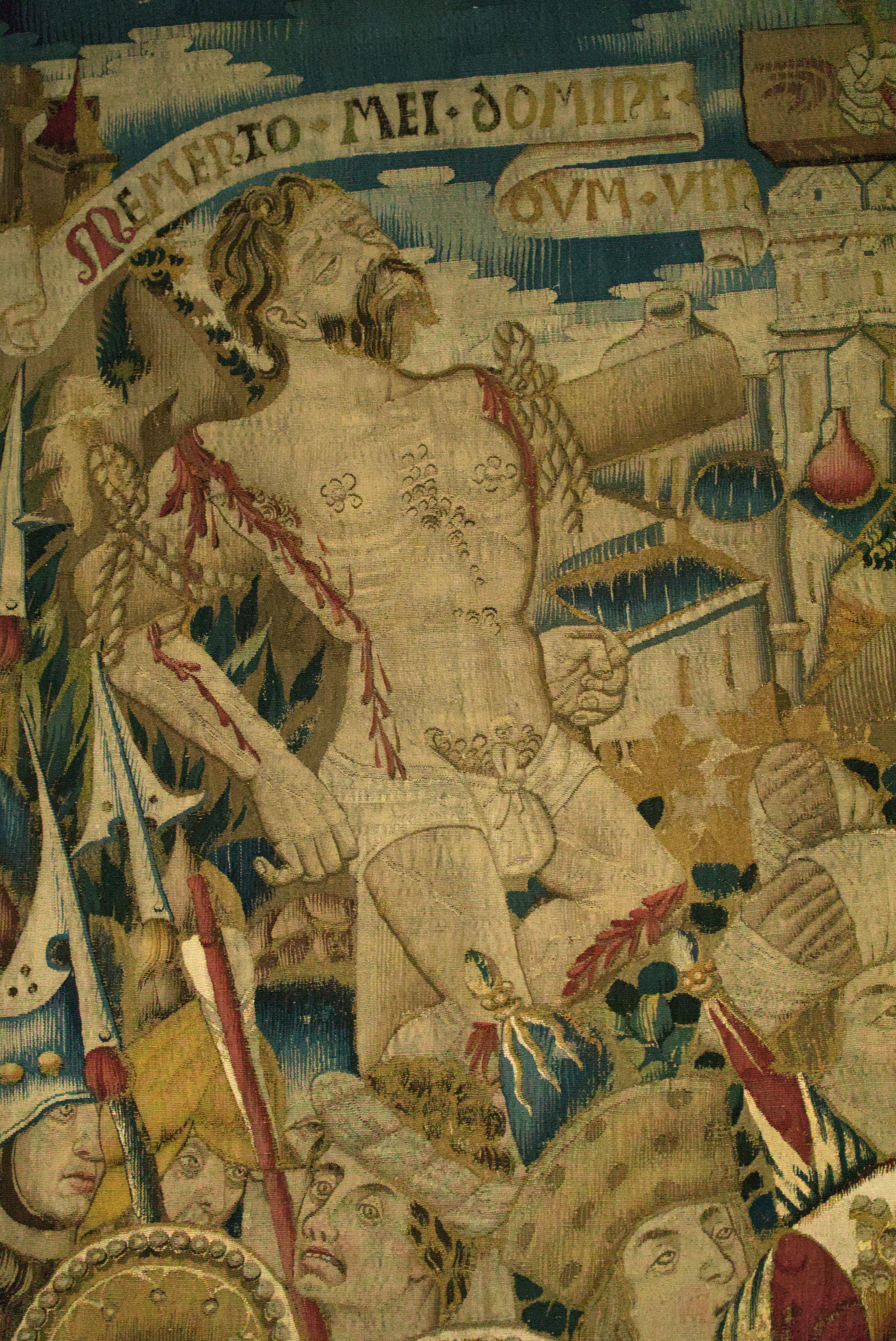
On Christ’s right (the viewer’s left), the penitent thief, with his last breaths, says, Memento mei, Domine, dum ven[eris in regnum tuum] (Remember me, Lord, when you come into your kingdom) (Luke 23:42).
Sept2025_DSC1512

The pointing man below the cross to Christ’s left, our right, is the Roman centurion (officer in command of one hundred soldiers) who, when Jesus died, proclaimed, Vere filius Dei erat iste (Truly this man was the Son of God!) (Matt. 27:54; Mark 15:39; cf. Luke 23:47).

Sept2025_DSC1513

On the other side of the cross, a Roman spearman, to whom tradition gives the name Longinus, points to his eyes. That’s because according to a medieval legend, Longinus was blind, but when he pierced Jesus’s side to verify his death, some of the blood from the open wound fell into Longinus’s eyes and restored his sight, after which he confessed allegiance to Christ.

Sept2025_DSC1516

Despite these three stories—two biblical, one apocryphal—of Christian conversion at the cross, Christ’s death did not move all the hearts of those present. At the base of the cross, two men fight with knives over Christ’s garment, their greed and aggression a foil to Christ’s selflessness and gentleness, and an example of the sin he came to redeem us from.

Sept2025_DSC1514

And again, pacifist though I am, I can’t help but remark on the fine-looking armor in the crowd:

Sept2025_DSC1519

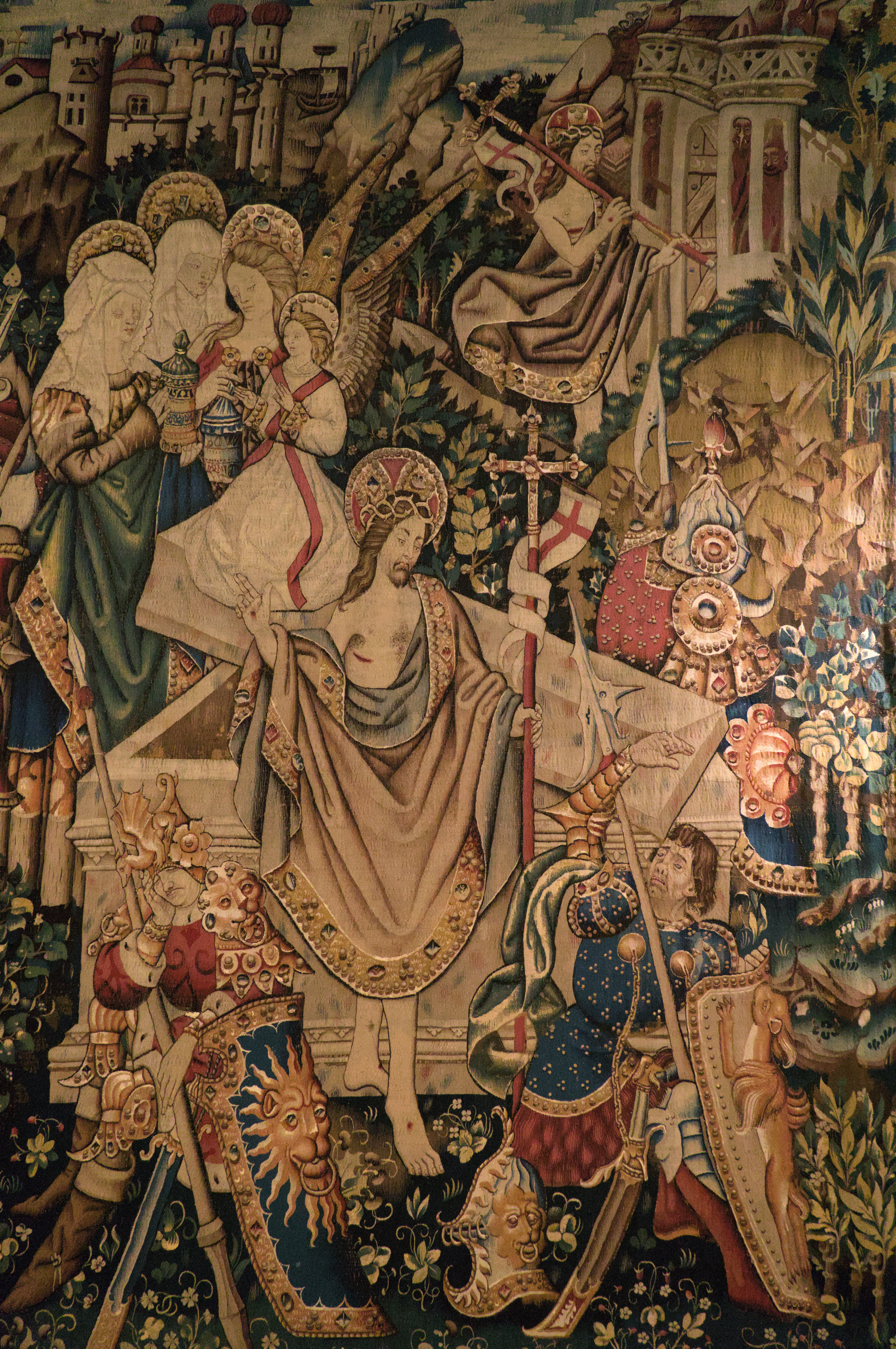
The right-most third of the tapestry portrays vignettes of the Resurrection.
Sept2025_DSC1525

At the bottom, Christ emerges triumphant from his tomb, holding a banner in one hand and bestowing blessing with the other.

Sept2025_DSC1521

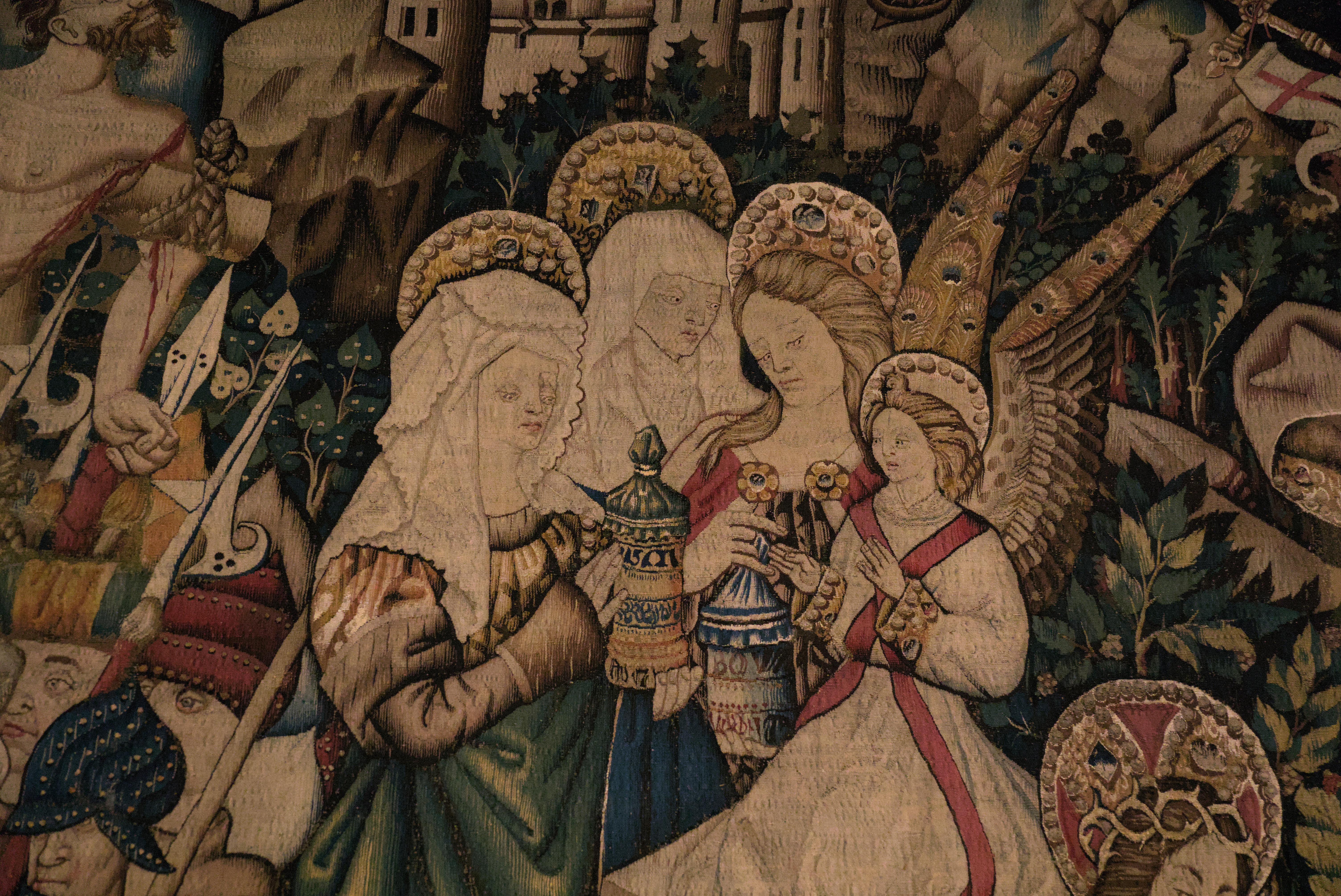
In the middle ground, the three Marys arrive at the empty tomb, ointments in hand, where they meet an angel who informs them that Christ has risen from the dead. Mary Magdalene is the one with her hair uncovered.
Sept2025_DSC1520

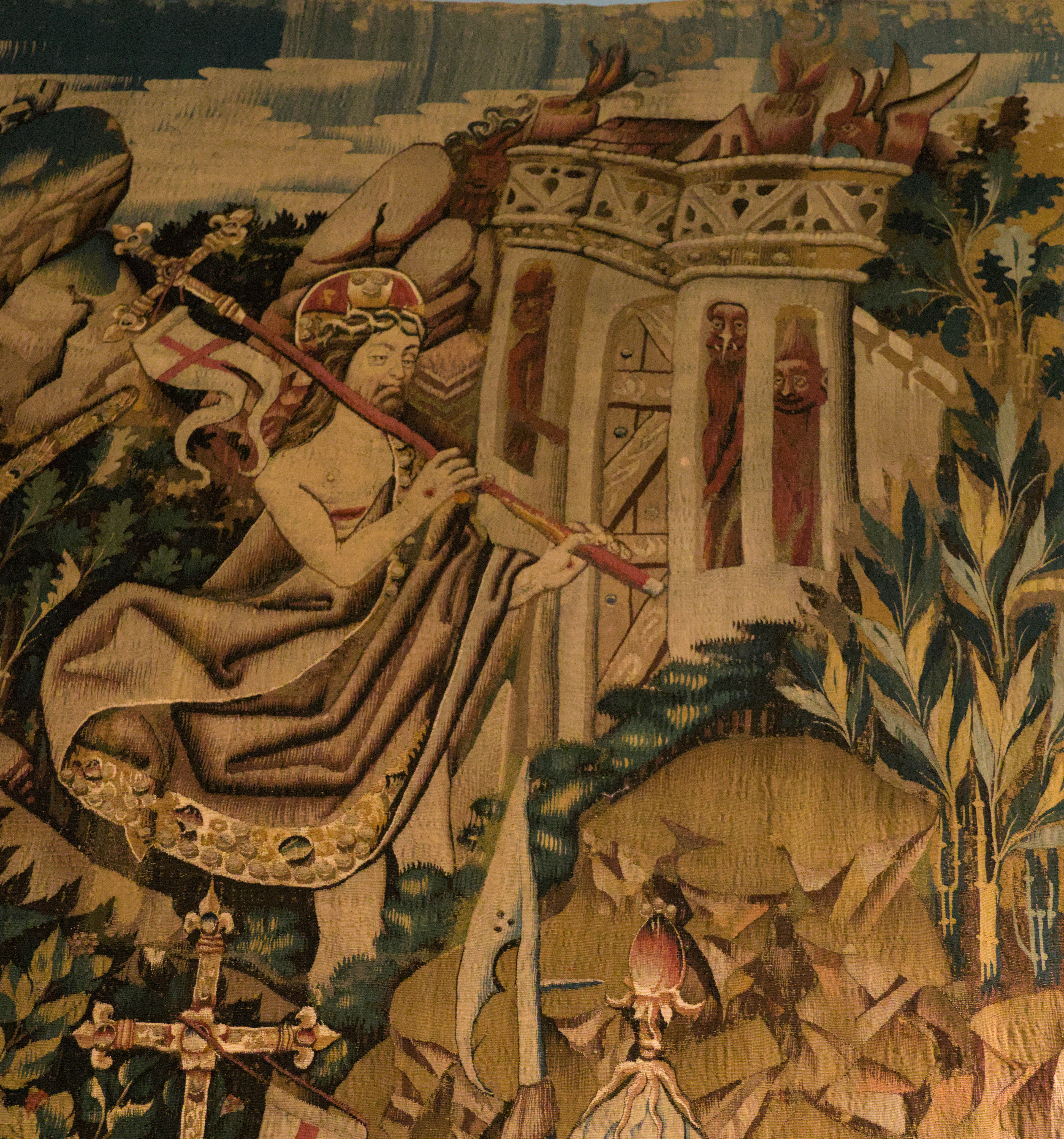
The risen Christ appears again at the top right, harrowing hell, a realm that is represented as a turreted fortress from whose windows fiery red demons glower and smirk. Christ has come to break down the doors and release the Old Testament saints being held captive—that is, those who died trusting in Yahweh and who were awaiting Christ’s redemption in the netherworld.
Sept2025_DSC1522

Let’s zoom in closer, shall we?

Sept2025_DSC1523

This is just one of the many artistic treasures, woven and otherwise, at Brussels’ Art and History Museum. I highly recommend a visit! I easily spent several hours there.

Roundup: “Harrowing of Hades” audio drama, Easter chant in Arabic, and more

HYMN TEXT: “Lights” by Kate Bluett: Kate Bluett [previously] is a Catholic poet and lyricist from North Texas who frequently participates in cross-denominational music collaborations. Her work has been published by Oregon Catholic Press and GIA Publications and recorded by the Porter’s Gate and Paul Zach, among others. I enjoy following her at https://katebluett.home.blog/, where she regularly shares new metrical verses she has written, tied to the liturgical calendar. Last Eastertide she published a text called “Lights,” which muses on candle flames, stars, and other light sources as reflections of the light of the risen Christ.

+++

AUDIO DRAMA: Anastasis: The Harrowing of Hades by Creative Orthodox: Creative Orthodox is the moniker of Michael Elgamal, a Coptic Orthodox artist and storyteller born in Egypt and living in Canada. Last May he released an audio drama, adapted from a graphic novel, about Christ’s epic descent into the underworld to reclaim the Old Testament righteous. This theatrical medium, which relies on voice acting, sound effects, and music to tell a story, was a very popular form of entertainment in the 1920s–40s before the advent of television but is much rarer today—which is a shame, because I find it really engaging! See the YouTube description for a full list of credits (script, score, actors, etc.).

+++

BLOG POST: “Iconography of the Descent of Jesus Christ into Hell” by Daria Chechko: A brief history and compilation of Anastasis icons.

Dionysius_Descent into Hell icon
Dionysius (Russian, ca. 1440–ca. 1508), Christ’s Descent into Hades, from Ferapontov Monastery, ca. 1495–1504. Tempera on wood, 31.2 × 10.5 cm. State Russian Museum, Saint Petersburg.

+++

SONGS:

>> “Christ Is Risen” (لمسيح قام) by Ribale Wehbé: Ribale Wehbé is a Lebanese singer specializing in Byzantine chant. Here she sings a traditional Easter chant in Arabic, arranged by Joseph Yazbeck.

>> “Hallelujah, Hosanna” (हाल्लेलुयाह होशन्ना) by One Tribe: Originally written in Tamil by pastors Dudley Thangaiah and Paul Thangaiah, “Hallelujah, Hosanna” is sung here in Hindi by the Indian Christian worship collective One Tribe. Turn on “CC” for closed captioning, and view the full credits in the YouTube video description. [HT: Global Christian Worship]

>> “He Did Rise” by Monroe Crossing: A bluegrass song about the women’s discovery of the empty tomb on Easter morning, written by Mark Anderson and performed here by his band, Monroe Crossing, at a music festival in Lexington, Kentucky, in 2009. Anderson is on the double bass. [HT: Global Christian Worship]

+++

SPOTIFY PLAYLIST: May 2025 (Art & Theology): An assortment of psalms, hymns, and spiritual songs, old and new. For my Easter-specific playlist from 2022 (with a smattering of new additions since, including a large batch from Cardiphonia at the bottom), see here.

Types of Christ’s resurrection in the Eton Roundels

The medieval manuscript known as the Eton Roundels is a brief typological picture sequence produced in the English Midlands (possibly Worcester) in the mid-thirteenth century. Typology is a mode of Christian biblical interpretation in which certain Old Testament figures, events, or objects are seen as foreshadowing New Testament figures or events, especially Christ. Art historian Avril Henry says the Eton Roundels came into being at about the same time as the Biblia pauperum, a tradition of picture Bibles forming the largest and best-known compendium of typological imagery and verses.

The Eton manuscript consists of twelve pages of pictures, each with a large roundel at the center picturing a New Testament event (the “antitype”) and four surrounding smaller roundels depicting the Old Testament (and occasionally classical) “types” and prophets. Each page also includes a half-roundel on the left and right inhabited by anonymous figures who probably simply represent onlookers. A crowned female Virtue is seated at the bottom of each page, under whom is written a biblical commandment whose relevance to the pictures is sometimes difficult to discern. These pages are bound together with an Apocalypse, but it’s unknown whether the two works were conceived together from the start; it’s only certain that they were combined by the late seventeenth century.

The maker, scriptorium or city of origin, original recipient (and whether religious or lay), and purpose of the Eton Roundels are also unknown. Presumably the manuscript’s function was meditational.

The artist didn’t invent any of the typological correspondences illustrated in the roundels; they were all already common currency.

Below are the two Resurrection-themed pages, with a breakdown of the illustrations, including translations of the Latin inscriptions. The translations are by Avril Henry and are from his book The Eton Roundels: Eton College, MS 177 (‘Figurae bibliorum’)—A colour facsimile with transcription, translation and commentary (Scolar Press, 1990). This book is an excellent resource for learning more about the manuscript and is the only place I’m aware of where you can view all twelve pages.

Thank you to Sally Jennings, Collections Administrator at Eton College Library, and Dr. Carlotta Barranu, Library Curator of Rare Books and Manuscripts at the time of my research, who provided me with photographs and translations prior to my gaining access to Henry’s book.

Folio VIII (5v)

Eton Roundels
“Three Women at the Tomb,” etc., from the Eton Roundels manuscript, English Midlands, 1260–70. Eton College Library, MS 177, fol. VIII. Reproduced by permission of the Provost and Fellows of Eton College.

Eton Roundel

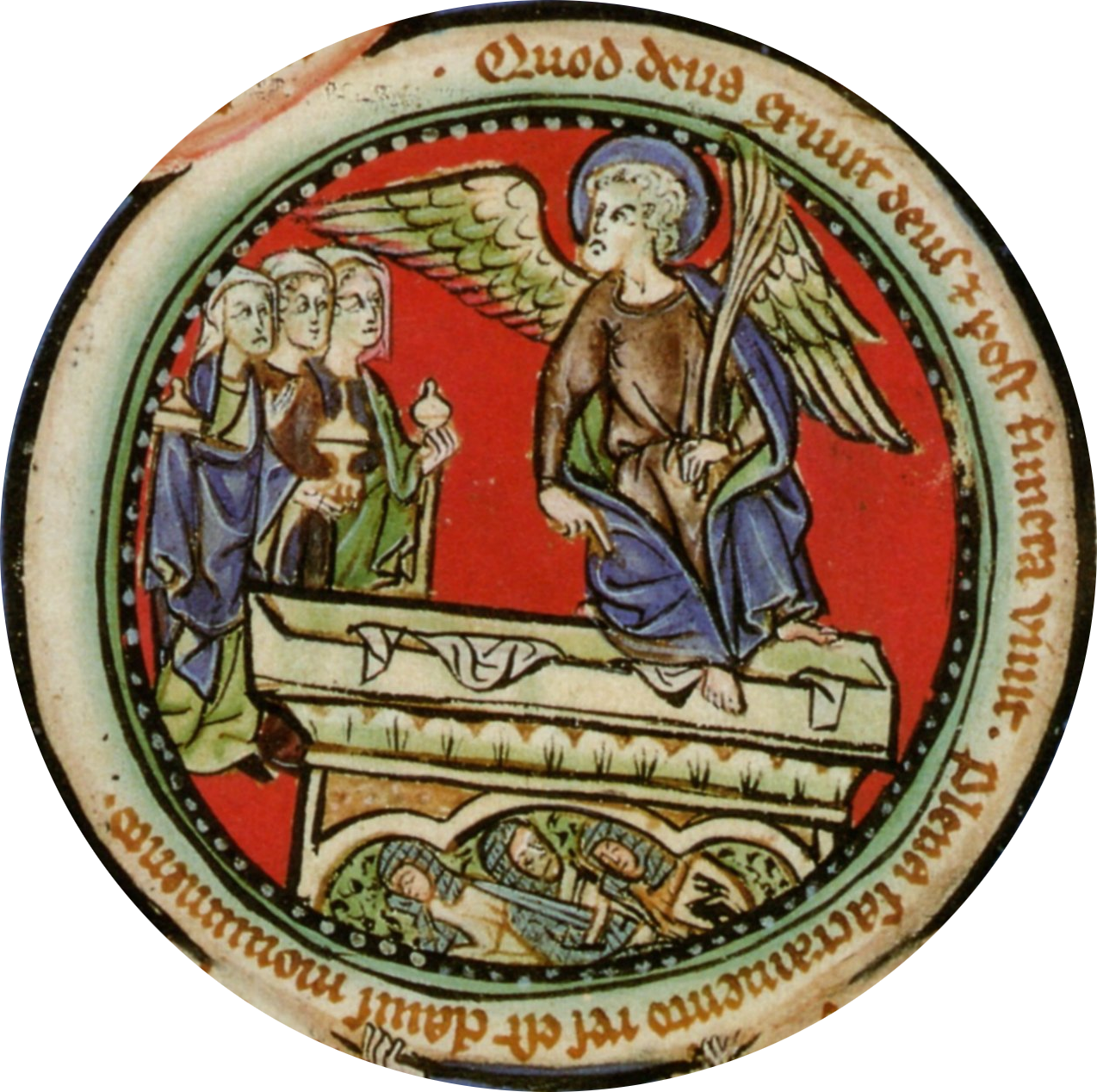
Center: Three Women at the Tomb (Mark 16:1–8)

“Because God came forth and God lives after burial, the event filled with mystery is the key to the tomb.”

Eton Roundel

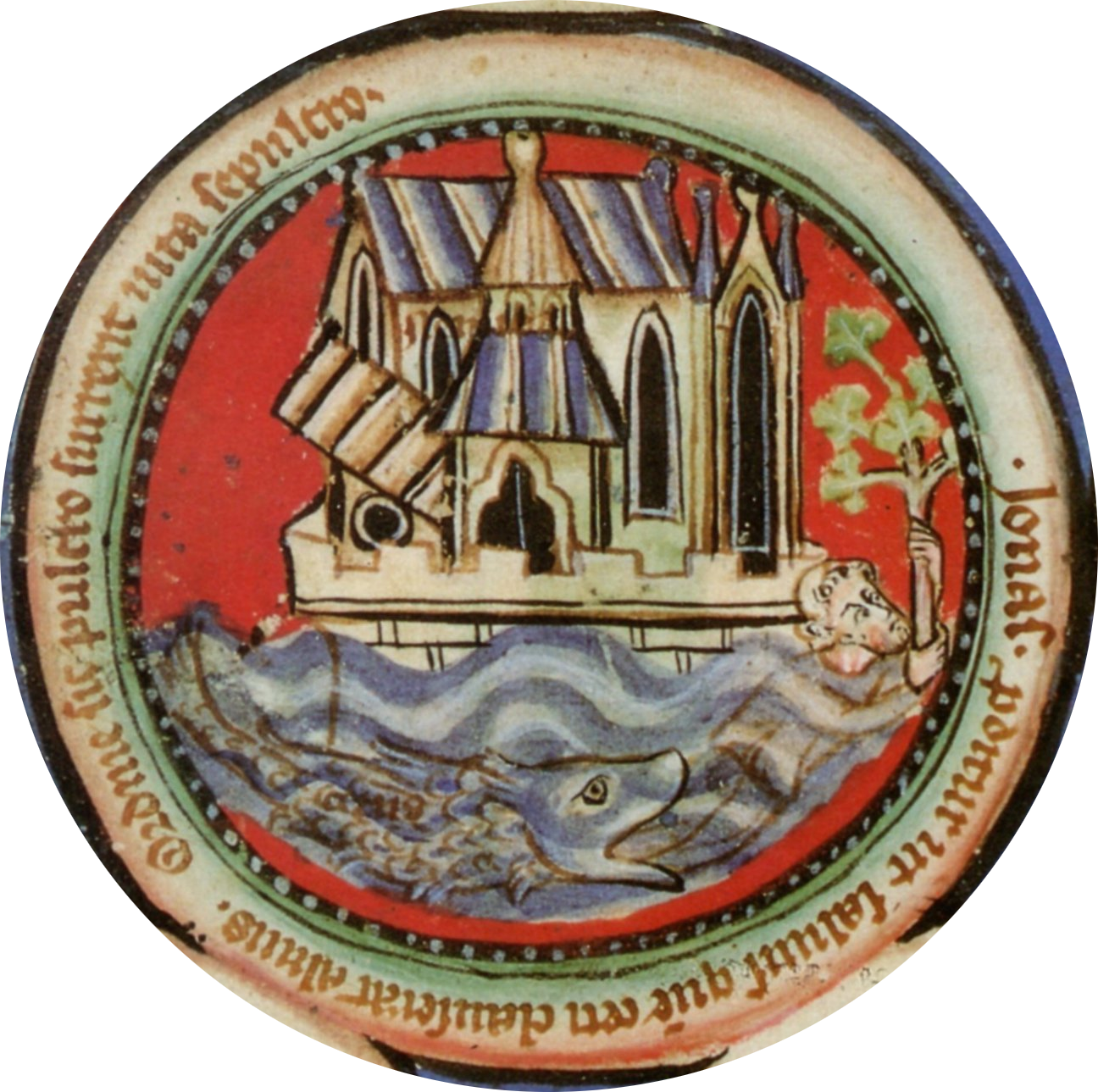
↑ Top left: Jonah Leaves the Fish (Jonah 2:11; cf. Matt. 12:38–41)

“Jonas. Just as he whom the belly of the sea-creature had enclosed is brought forth unharmed, at a glorious command life rose up from the tomb.”

Eton Roundel

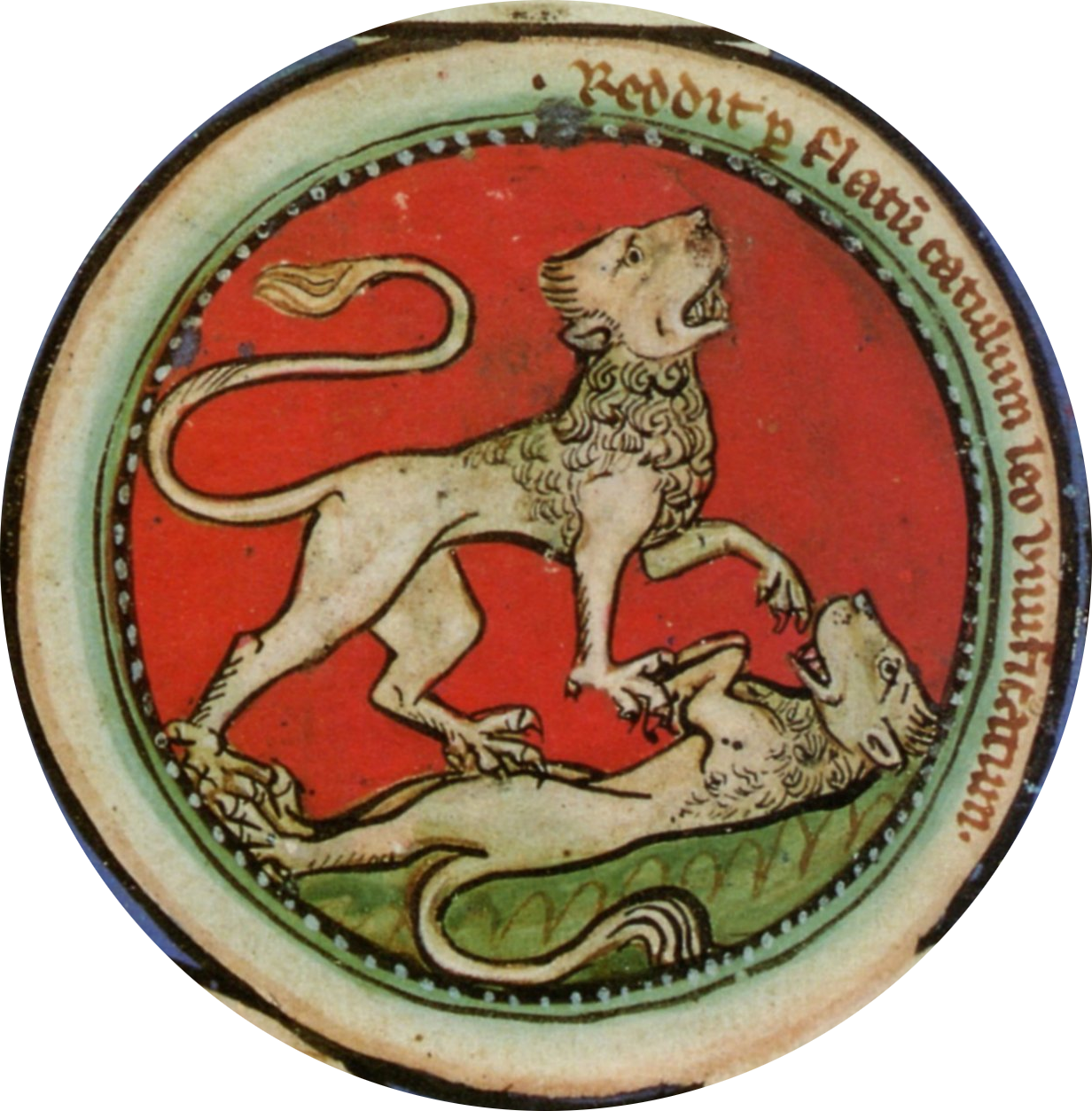
↑ Top right: A Lion Revivifies Its Young

“By [its] breath the lion brings its cub back to life.”

This statement refers to a piece of lore found in the third-century Physiologus and its descendants, the medieval bestiaries, according to which lion cubs are born dead but are brought back to life three days later by their father’s breath. This (fictitious) leonine behavior was seen to reflect the Father raising the Son from the tomb on Easter morning.

Eton Roundel

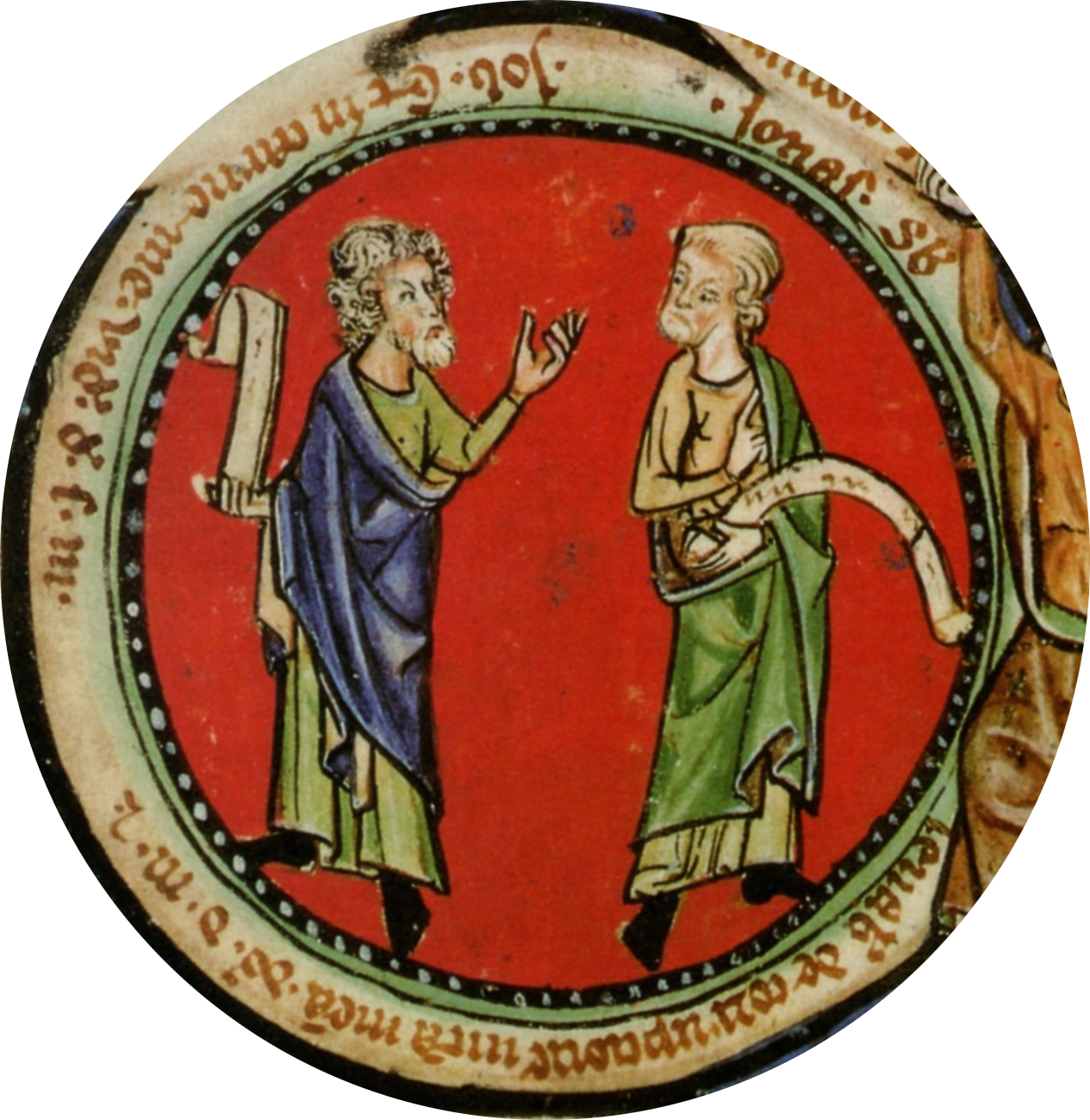
↑ Bottom left: Job and Jonah (Job 19:26; Jonah 2:7)

“Job: And in my flesh I shall see God my [savior].
Jonah: Thou shalt lift up my life from corruption, O Lord my God.”

Eton Roundel

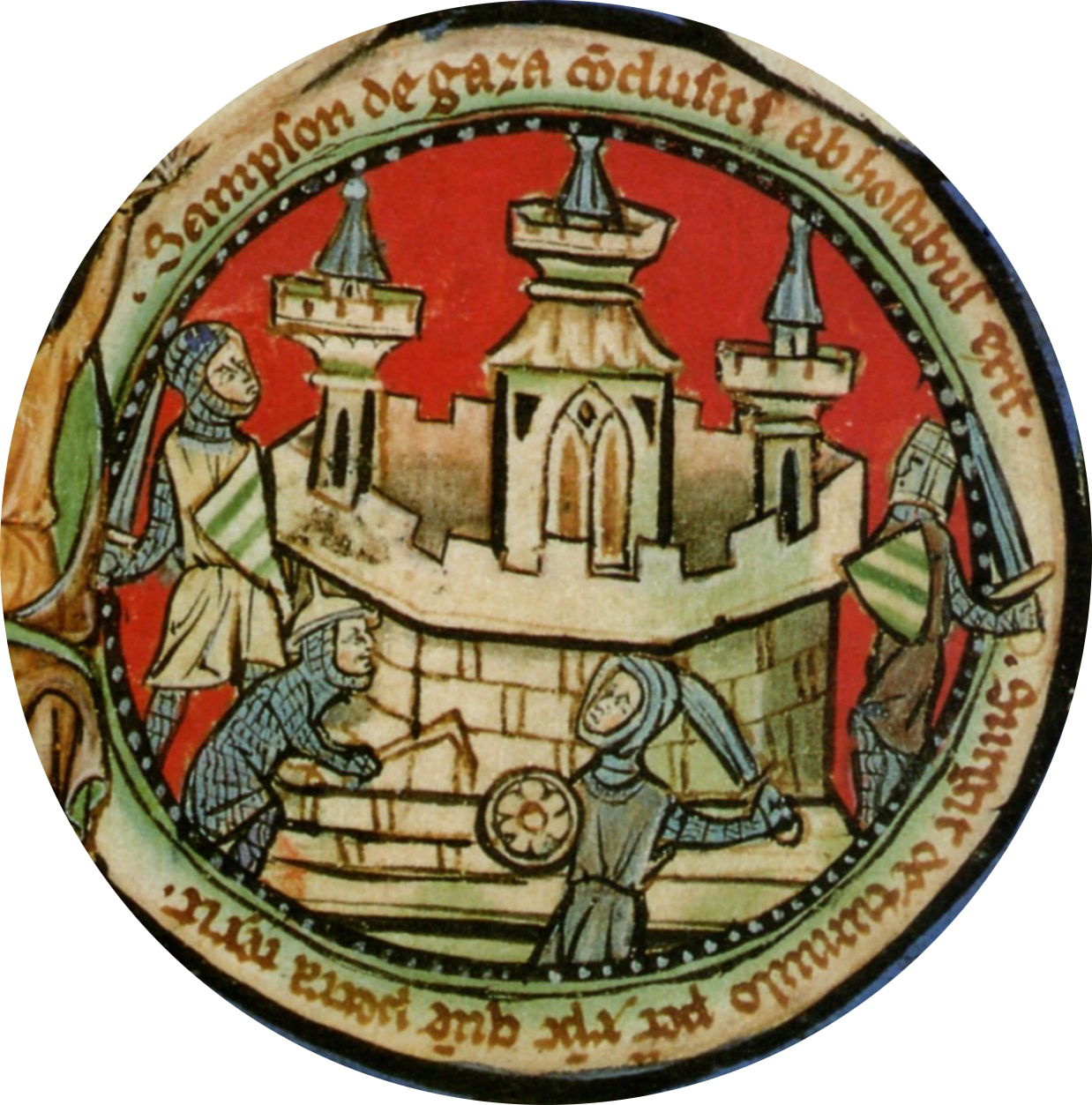
↑ Bottom right: Samson’s Escape from Gaza (Judg. 16:1–3)

“The imprisoned Samson escaped from Gaza and his enemies. Christ the stone, whom the stone covered, rose from the tomb.”

This roundel portrays Philistine soldiers of Gaza encircling the city gate to kill Samson the Israelite. But Samson escapes their watch unharmed, in a dramatic episode depicted on the following page (see below). The scene here is rarely depicted, whereas what follows in the narrative—Samson carrying the gates of Gaza—was a popular type of the Resurrection. Notice how the soldiers parallel the sleeping ones in the central scene, both groups bested by God’s power.

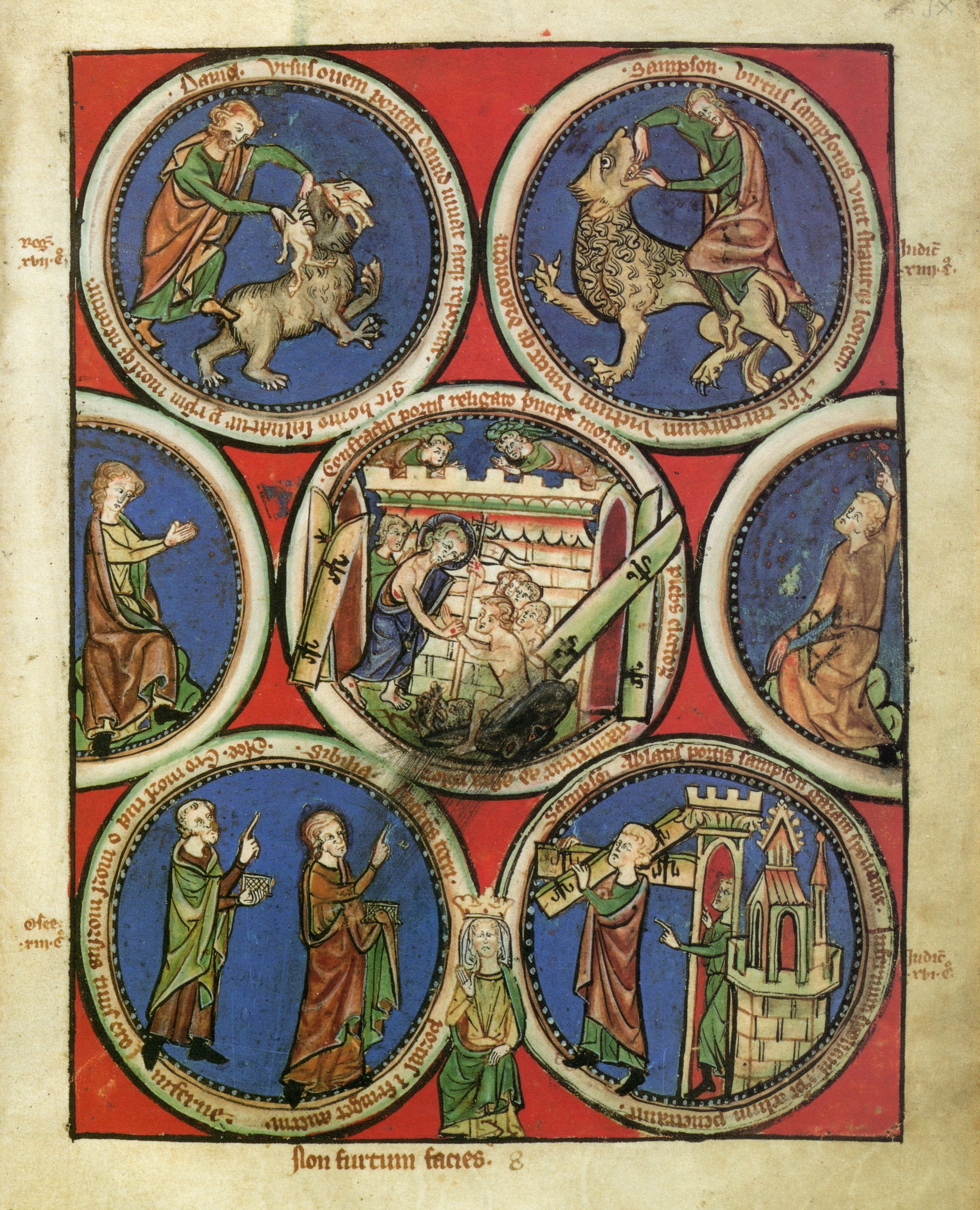
Folio IX (6r)

Eton Roundels
“Christ Opens Limbo,” etc., from the Eton Roundels manuscript, English Midlands, 1260–70. Eton College Library, MS 177, fol. IX. Reproduced by permission of the Provost and Fellows of Eton College.

Eton Roundel

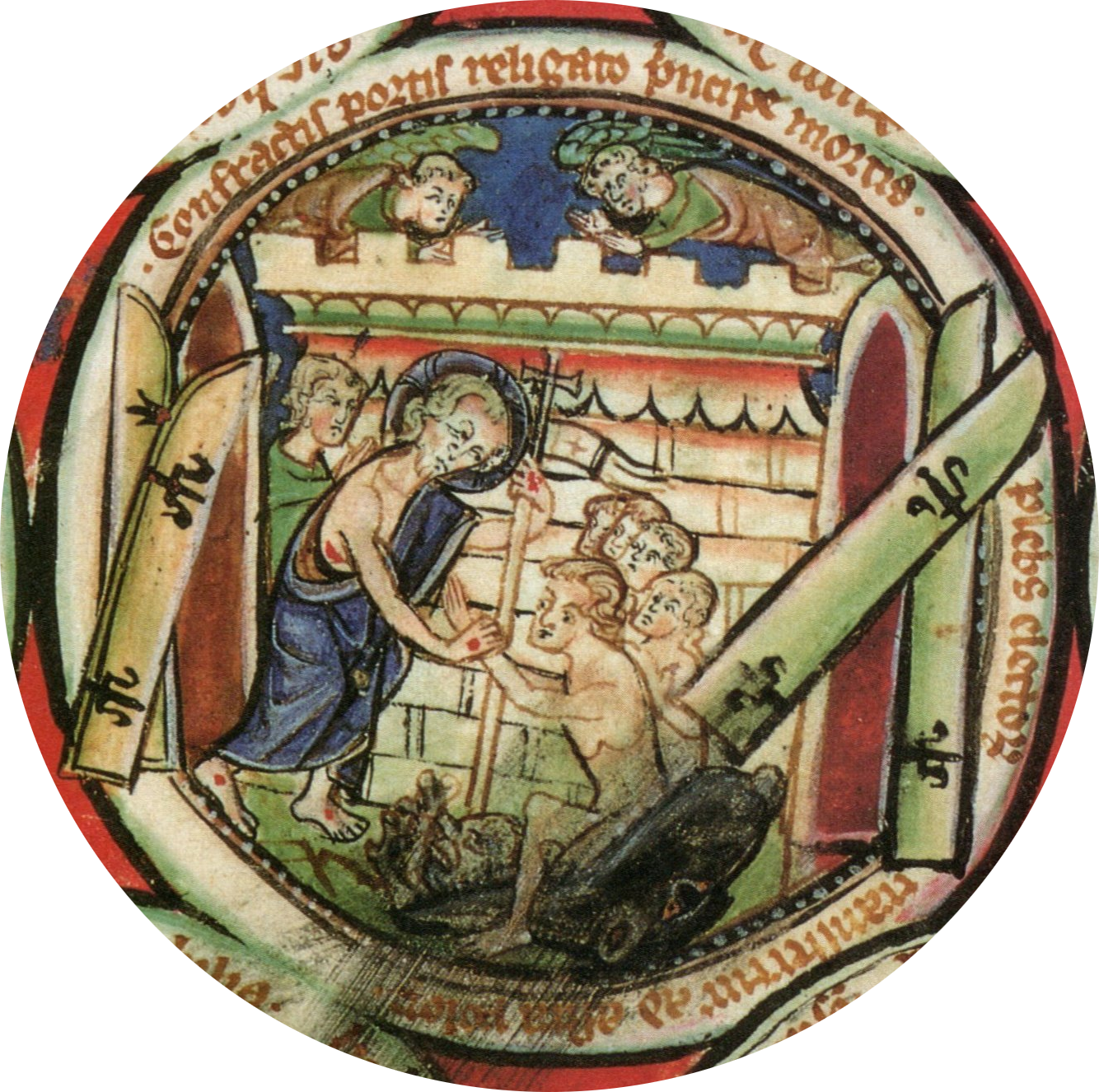
↑ Center: Christ Opens Limbo (1 Pet. 3:19; 4:6; Eph. 4:8–10)

“The gates having been broken and the prince of death bound, the body of the elect is carried to the stars in the heavens.”

Christ’s Descent into Limbo, or the Harrowing of Hell, is an episode inferred from a few enigmatic biblical verses and elaborated in the apocryphal Gospel of Nicodemus. In the Eastern Orthodox Church, it is the primary icon of the Resurrection: Christ breaking down the gates of hell to rescue his predeceased beloveds from death and Satan. Medieval artists in the West were also fond of picturing the Harrowing, often portraying the entrance to hell as a monstrous maw (called a “hellmouth”).

Eton Roundel

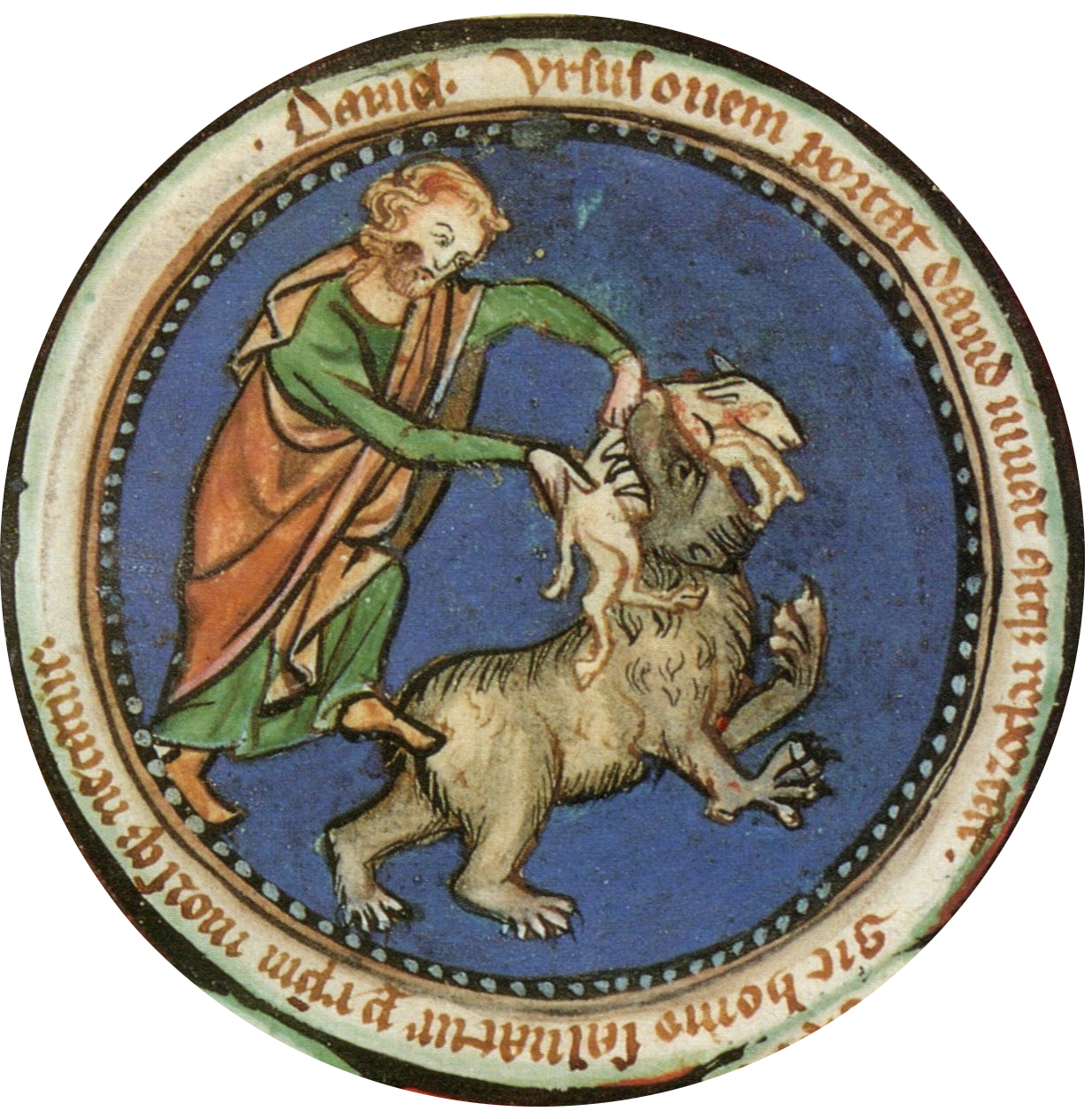
↑ Top left: David Saves the Lamb from the Bear (1 Sam. 17:34–37)

“David. The bear is carrying off a sheep. David assists [the sheep], and takes it back. In the same way, man is saved by Christ and death is slain.”

David, who was a shepherd before he was anointed king of Israel, figures Christ in how he fiercely protected the lambs in his care, intervening to save them whenever they were snatched away by a lion or bear; he’d pry open the beast’s jaws, free the lamb, and then strike the beast dead, he relays to Saul. In a similar manner, Christ pried open the jaws of hell to save his precious sheep.

Eton Roundel

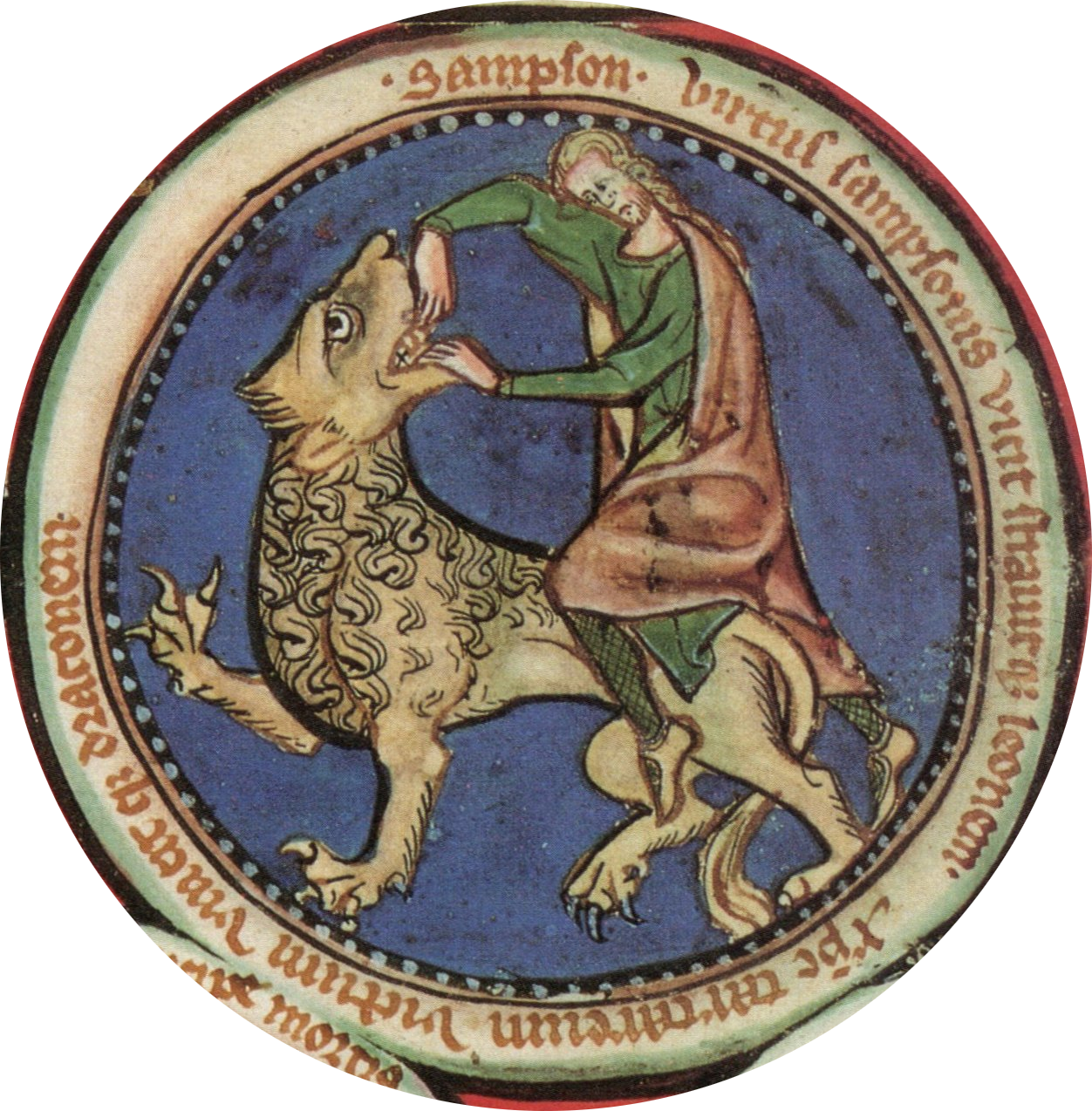
↑ Top right: Samson Kills the Lion (Judg. 14:5–8)

“Samson. The strength of Samson conquered the lion and tore [it] to pieces, and Christ conquers defeated hell together with the dragon.”

When Samson went down to the vineyards of Timnah to seek a wife, he encountered a fearsome lion, and “the spirit of the LORD rushed on him, and he tore the lion apart barehanded” (Judg. 14:6). This was Samson’s first display of divine empowerment.

Eton Roundel

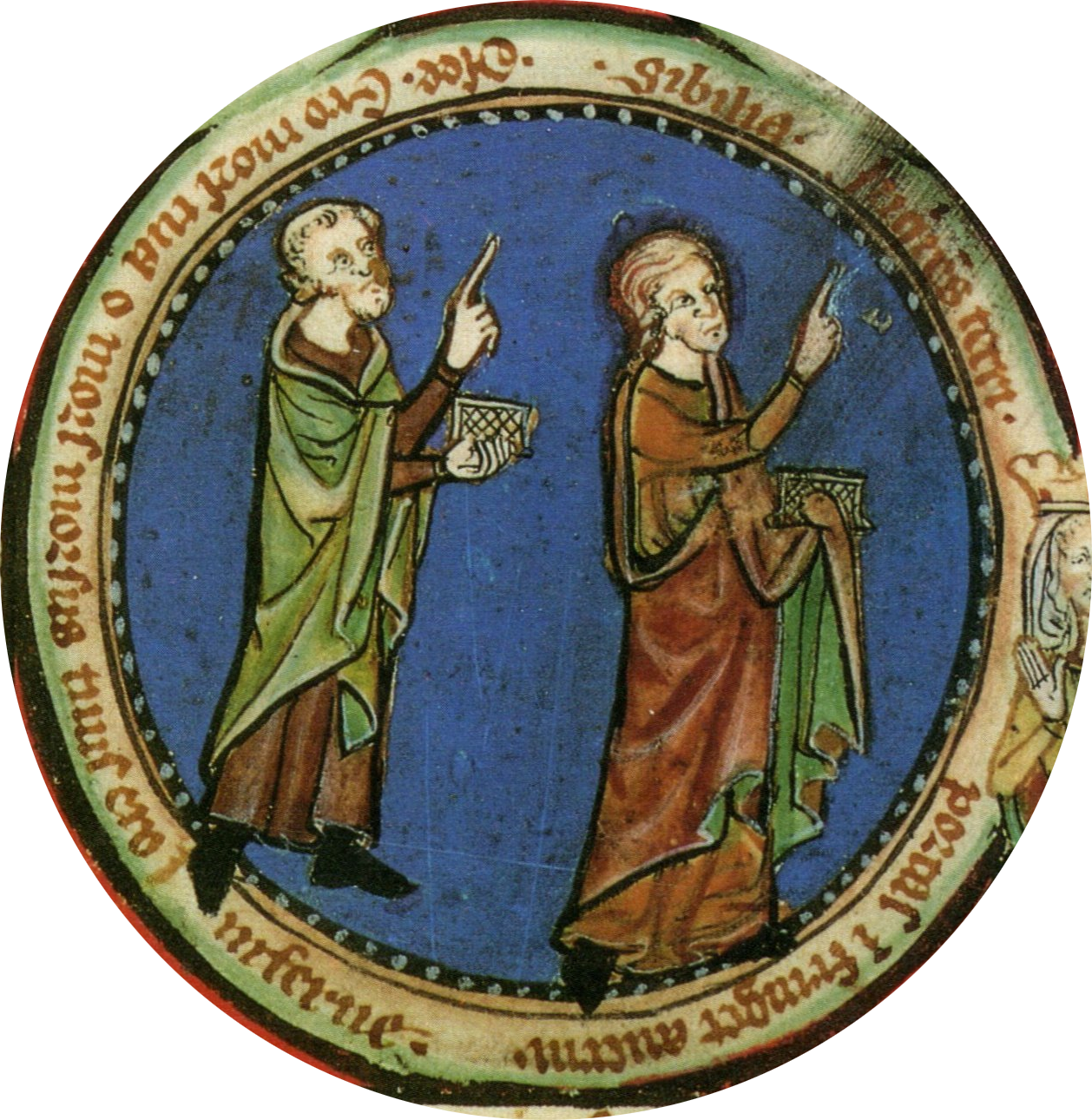
↑ Bottom left: Hosea and the Erythraean Sibyl (Hosea 13:14; Augustine, PL XLI 579)

“Hosea: O death, I will be your death; O hell, I will be your torment.
Sibyl: The seeker will break the gates of the hideous underworld.”

The Sybilline Oracles is a collection of ancient Greek prophecies ascribed to the pagan sibyls (but many of which were actually written by Jews and Christians). Several of the church fathers cited them in defense of Christianity. The Erythraean Sibyl, for example, is said to have foretold the coming of Christ through an acrostic whose initial letters spell out “Ιησόύς Χριστός Θεου Ύίος Σωτηρ Σταύρος” (Jesus Christ, God’s Son, Savior, Cross). (See Eusebius’s Oration of Constantine, chap. 18.) She appears in the floor mosaic at Siena Cathedral, the stained glass at Beauvais Cathedral, Michelangelo’s Sistine Chapel, the Van Eycks’ Ghent Altarpiece, and a number of other medieval and Renaissance Christian artworks.

Eton Roundel

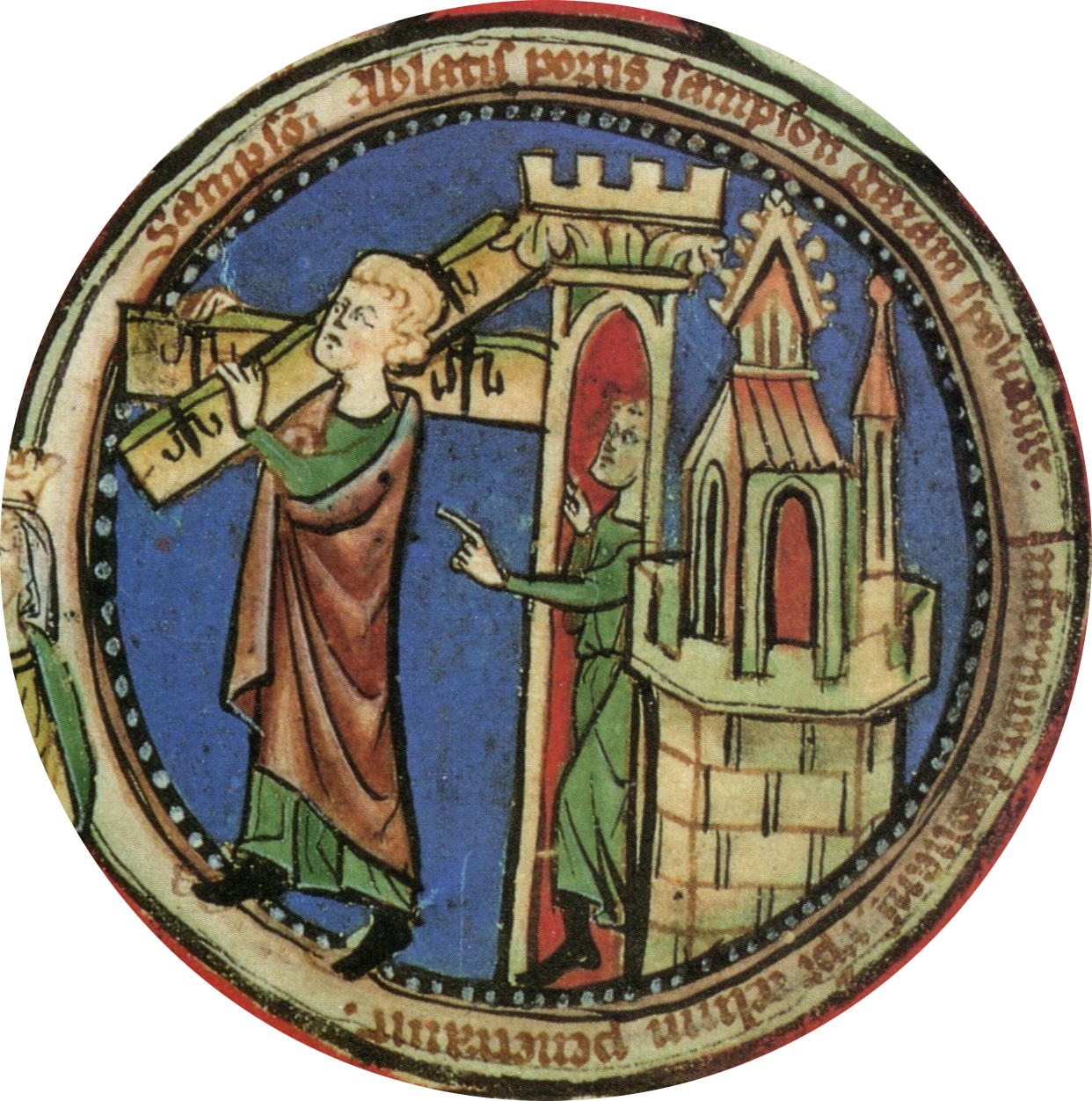
↑ Bottom right: Samson and the Gates of Gaza (Judg. 16:1–3)

“By carrying off the gates, Samson robbed Gaza. Robbing hell, Christ entered heaven.”

To break free of the Gazites, Samson tore the doors of the city gates off their hinges and carried them away, a demonstration of triumph. This feat prefigured Christ’s breaking out of his tomb. It can also be read, as on this Eton folio, as a prefigurement of Christ’s storming the gates of hell to release those held captive by the devil.

Roundup: Multilingual Paschal greeting, Easter sermon by N. T. Wright, the Myrrhbearers and the Magi, and more

VIDEO: “The Lord is Risen! Proclaimed by people from 29 countries”: This video was put out in 2020 by ICF Rotterdam, an intercultural church in the Netherlands whose congregation consists of members from over forty nations! They asked a handful of them to recite the Paschal greeting in their native tongue, so represented here are Indonesian, Chinese, Zulu, Igbo, Urdu, Nepali, Kurdish, Romanian, and more. [HT: Global Christian Worship]

Wycliffe Bibliafordítók (Wycliffe Bible Translators) in Hungary produced a similar video last year:

+++

SERMON: “Let Beauty Awake” by N. T. Wright: One of the things I love about the Anglican cleric N. T. Wright’s preaching and teaching is the importance he places on beauty. (I actually met Wright once—and it was at an arts conference.) In this sermon, which he preached at Durham Cathedral on Easter Sunday 2009, he takes as his text what I’ve heard him say is his favorite chapter in the Bible, John 20, and discusses how in Jesus’s rising, the glory of God was let loose in all the world.

“Easter carries with it a strange and powerful beauty,” he says. “I hope that, by exploring the biblical roots of why this is so, I may have surprised some of you at least into asking, afresh, What can we do to celebrate, more consciously and deliberately, the reawakening of beauty which comes with the light of Easter Day? How can we take this forward, as an explicit project, so that a world so full of ugliness and functionality, and in consequence so full of unbelief or false belief, can once again be wooed into belief and love?”

He opens the sermon by quoting a stanza from a poem by Robert Louis Stevenson, and near the close, he reprises it in his own words, which were developed into a song by Steve Bell:

Let Beauty awake in the morn from the cool of the grave,
Beauty awake from death;
Let Beauty awake,
For Jesus’ sake,
In the hour when the angels their silence break
And the garden is bright with His Breath.

+++

RECIPE: “Tsoureki: The Symbolic Greek Easter Bread”: On her blog The Liturgical Home (and on Instagram), Ashley Tumlin Wallace shares a recipe for tsoureki, a brioche-like sweet bread made by many Greek Christians on Easter. It is soft and fluffy, flavored with citrus, and decorated with red-dyed eggs!

+++

SPOKEN WORD + SONG: “Because He Lives” by Sharon Irving: Singer-songwriter, worship leader, and spoken word artist Sharon Irving [previously] recorded this video for City First Church Spring Creek’s virtual worship service for Easter 2020. It begins with an original spoken word piece, and then is followed by her singing the Gaither classic “Because He Lives.”

+++

SONG: “Sbab Dia Hidup” (Because He Lives) by Prison Akustik: The song “Because He Lives,” written in 1971 by Bill and Gloria Gaither, has made its way all around the world and has been translated into many languages. Here is the group Prison Akustik [previously] singing it in Indonesian.

+++

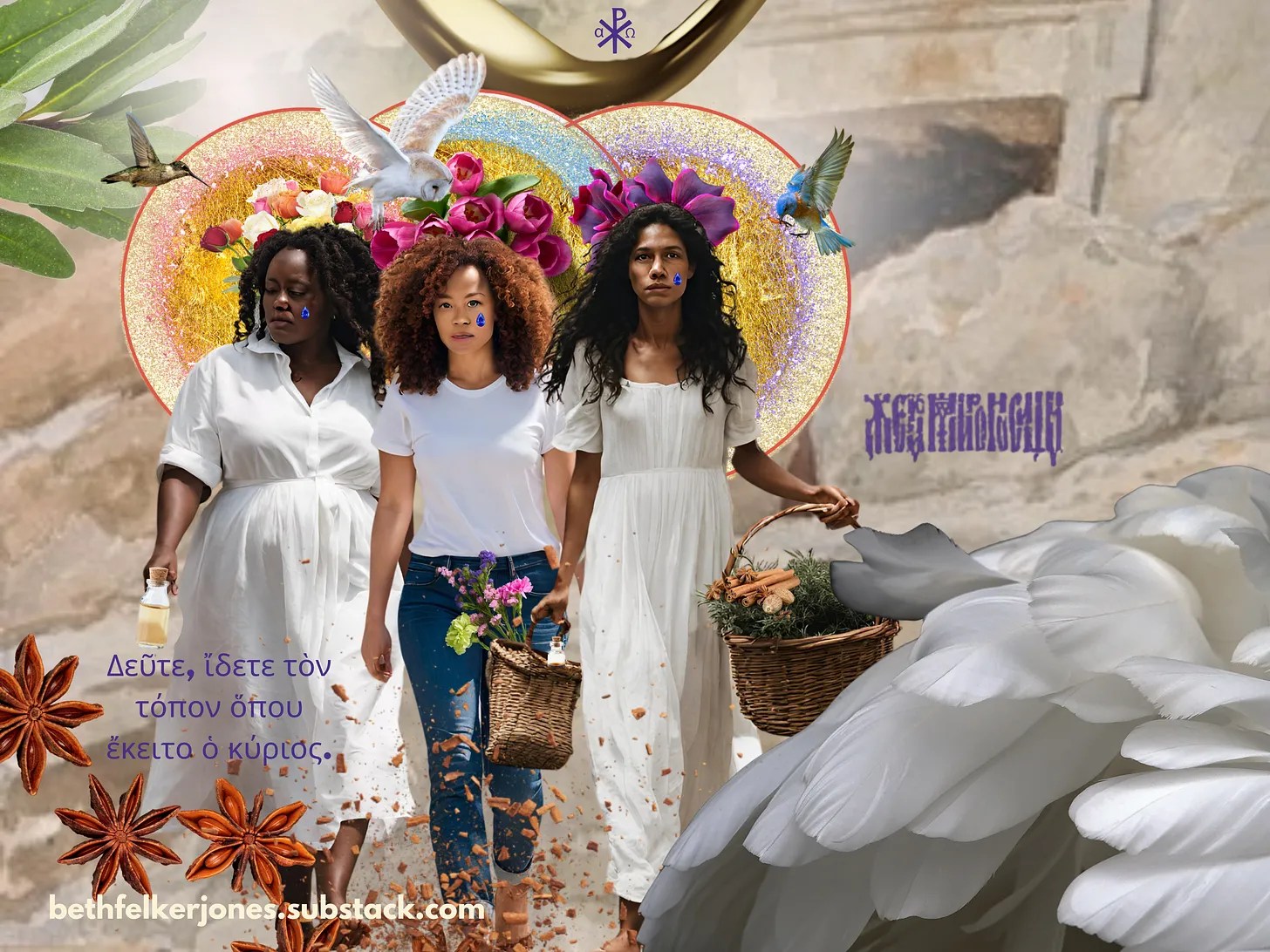
SUBSTACK POST: “Myrrhbearers & Magi” by Beth Felker Jones: In her Church Blogmatics post from last week, theologian Beth Felker Jones [previously] shares three new digital collages she made: one of the three myrrh-bearing women who discovered Jesus’s empty tomb, one of the three magi who brought gifts to the newborn Christ, and one that combines both groups of devoted witnesses. She provides descriptions of each and two original prayers, including the one below.

Myrrhbearers
Digital collage (with AI-generated elements) by Beth Felker Jones, 2025

Holy Father, who accompanied your daughters on their way to the tomb, and in the power of your Spirit, turned their sorrow into joy, bring us too into the joy of those who found the tomb empty, and incorporate us, with them, into your resurrection life. With our sisters at the tomb that day, help us to say, “I have seen the Lord!” Amen.

Easter, Day 8: Sent

Now the eleven disciples went to Galilee, to the mountain to which Jesus had directed them. When they saw him, they worshiped him, but they doubted. And Jesus came and said to them, “All authority in heaven and on earth has been given to me. Go therefore and make disciples of all nations, baptizing them in the name of the Father and of the Son and of the Holy Spirit and teaching them to obey everything that I have commanded you. And remember, I am with you always, to the end of the age.”

—Matthew 28:16–20

Jesus said to [his disciples] again, “Peace be with you. As the Father has sent me, so I send you.” When he had said this, he breathed on them and said to them, “Receive the Holy Spirit.”

—John 20:21–22

LOOK: The Great Commission by He Qi

He Qi_Great Commission
He Qi (Chinese, 1950–), The Great Commission, 2017. Oil on canvas. [purchase giclée print]

In this painting by the Chinese artist He Qi (pronounced huh chee), Jesus holds a staff in his right hand (he is the Good Shepherd) and with the other points to the world outside Jerusalem’s gates, to which he calls his disciples to carry his all-renewing gospel. A modern cityscape rises up behind the figures, indicating that this call extends to the present era.

In the foreground, a minister baptizes a kneeling woman in red, their forms intercut with a fishing boat. The boat is a reference to Peter and Andrew’s original vocation as fishers and to Jesus’s promise, should they choose to follow him, to make them “fishers of people” (Matt. 4:19)—that is, gatherers of folks into the wide net of (proto-)Christian community, proclaiming and living out the kingdom of God in the power of God’s Spirit.

The Holy Spirit is represented as a dove sweeping down from the heavens, caressing the edge of Jesus’s halo. He’s the wind in the sails of the woman at the right, who goes forth into the darkness bearing the light of God’s word—her cheeks aglow with it, her feet eager to publish it abroad.

Her predecessors in the task of preaching the good news of Christ’s resurrection are portrayed in the background—the three women who first discovered the empty tomb and who then proceeded to “go quickly and tell” (Matt. 28:7).

LISTEN: “As the Father Sent Me” by Alana Levandoski, on Behold, I Make All Things New (2018)

As the Father sent me
So I send you


This is the final “artful devotion” post of this Easter season—but Eastertide continues until June 8! Spiritual director Tamara Hill Murphy explains on her Substack:

Easter Sunday marks the beginning of a week in the liturgical calendar known as the Easter Octave, followed by a seven-week festival called Eastertide, also referred to as the Great Fifty Days.

Beginning with the Feast of the Resurrection and including the Feast of the Ascension, Eastertide lasts fifty days, paralleling the forty days Christ spent on earth after His resurrection, plus the ten days the disciples spent waiting for the promised Spirit of Jesus. Exclamatory worship and celebratory feasting characterize the prayers and practices of Eastertide, which include invitations for baptism, thanksgiving, savoring beauty, feasting, play, and caring for creation. It is a time of celebration for the new creation that Jesus inaugurates for all of us.

So keep celebrating! I will continue posting Easter content throughout the season, just at a lesser frequency.

On this eighth day of Easter and ever forward, may you be filled with the transforming knowledge, excitement, and power of Christ’s resurrection, and go out and share it with the world.

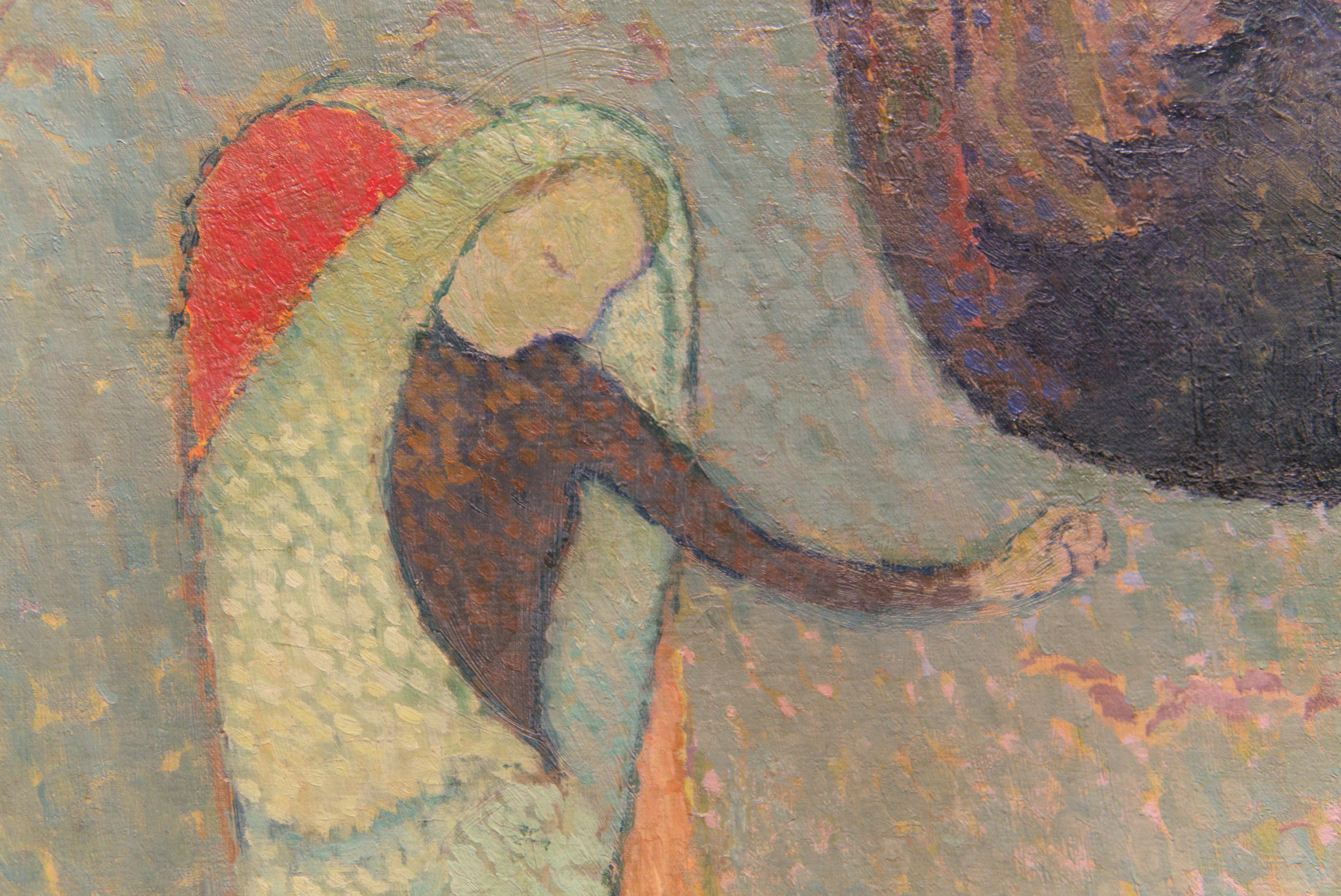
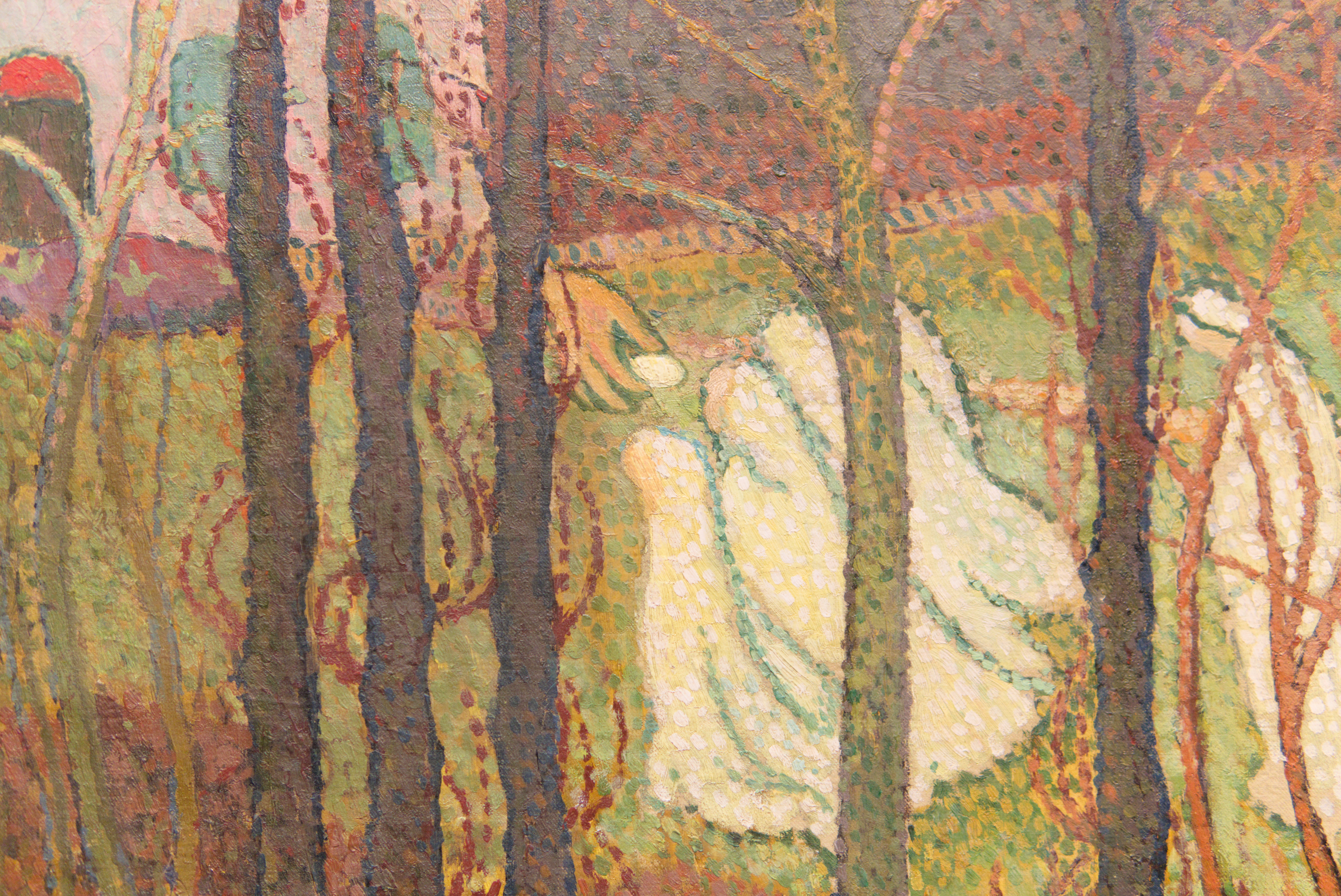
Easter Mystery by Maurice Denis (painting)

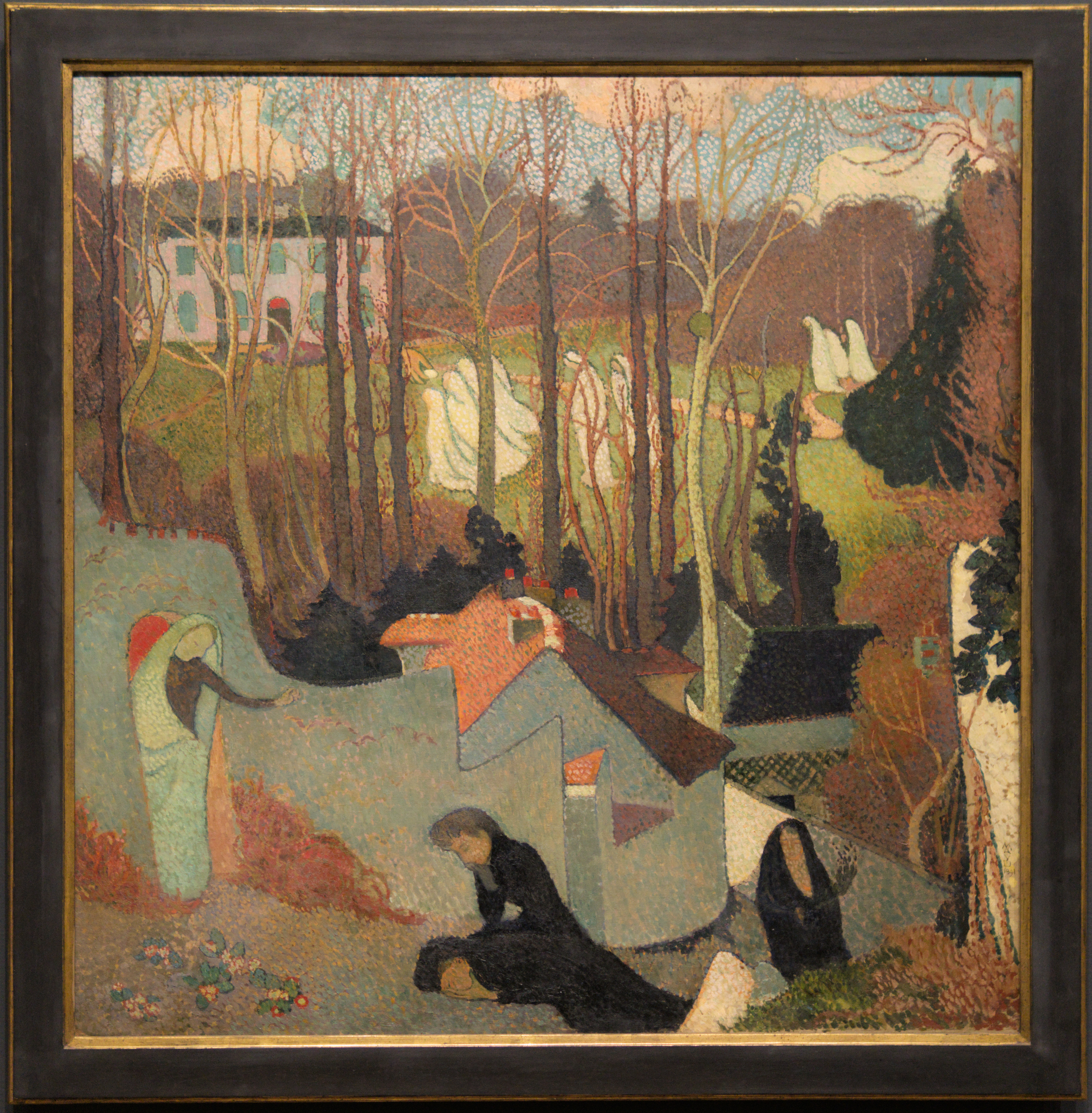
Last year when I was at the Art Institute of Chicago, I was transfixed by the pointillist painting Easter Mystery by the French artist Maurice Denis.

Denis, Maurice_Easter Mystery
Maurice Denis (French, 1870–1943), Easter Mystery (Mystère de Pâcques), 1891. Oil on canvas, 41 × 40 1/8 in. (104 × 102 cm). Art Institute of Chicago. Photo: Victoria Emily Jones. [object record]

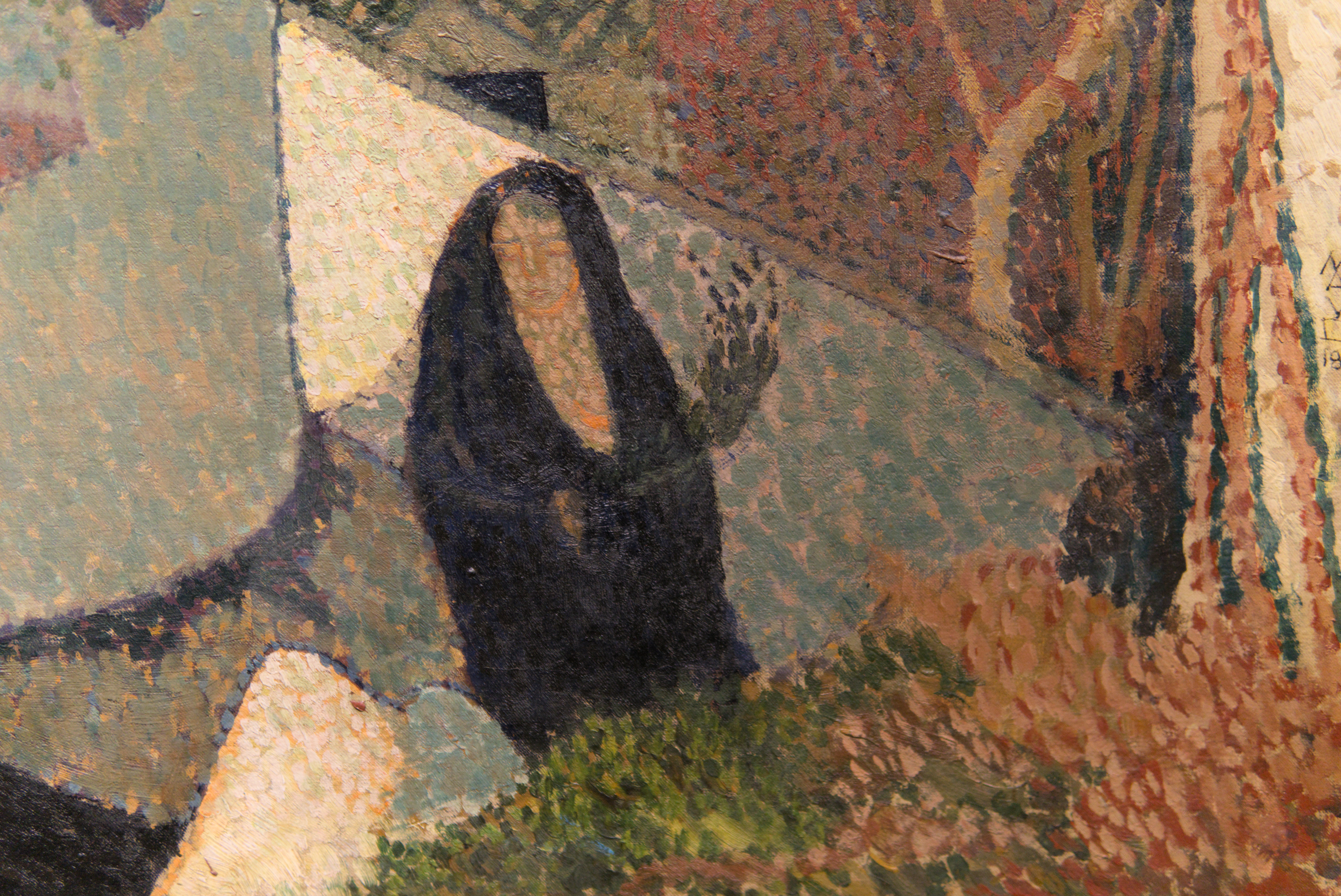
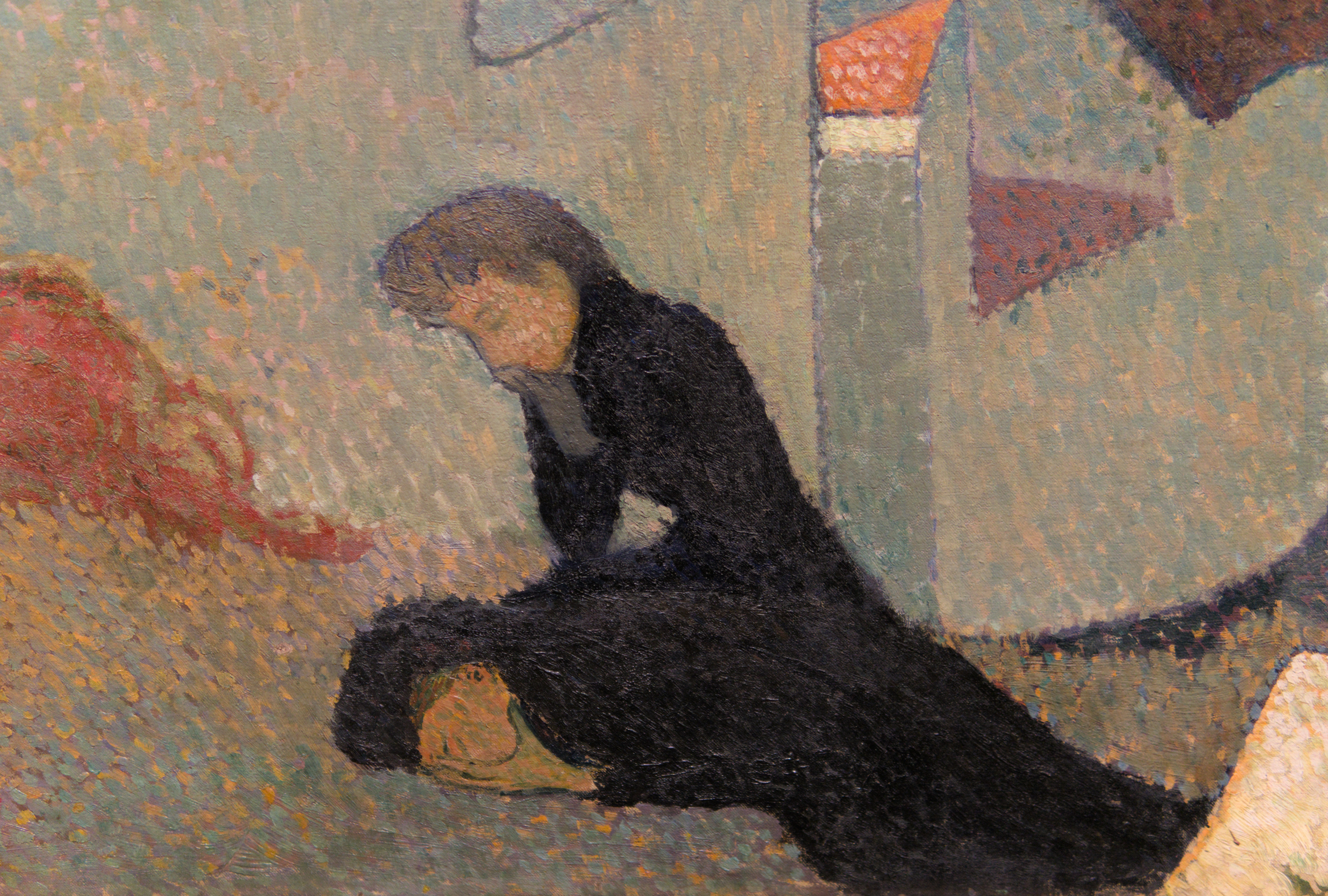
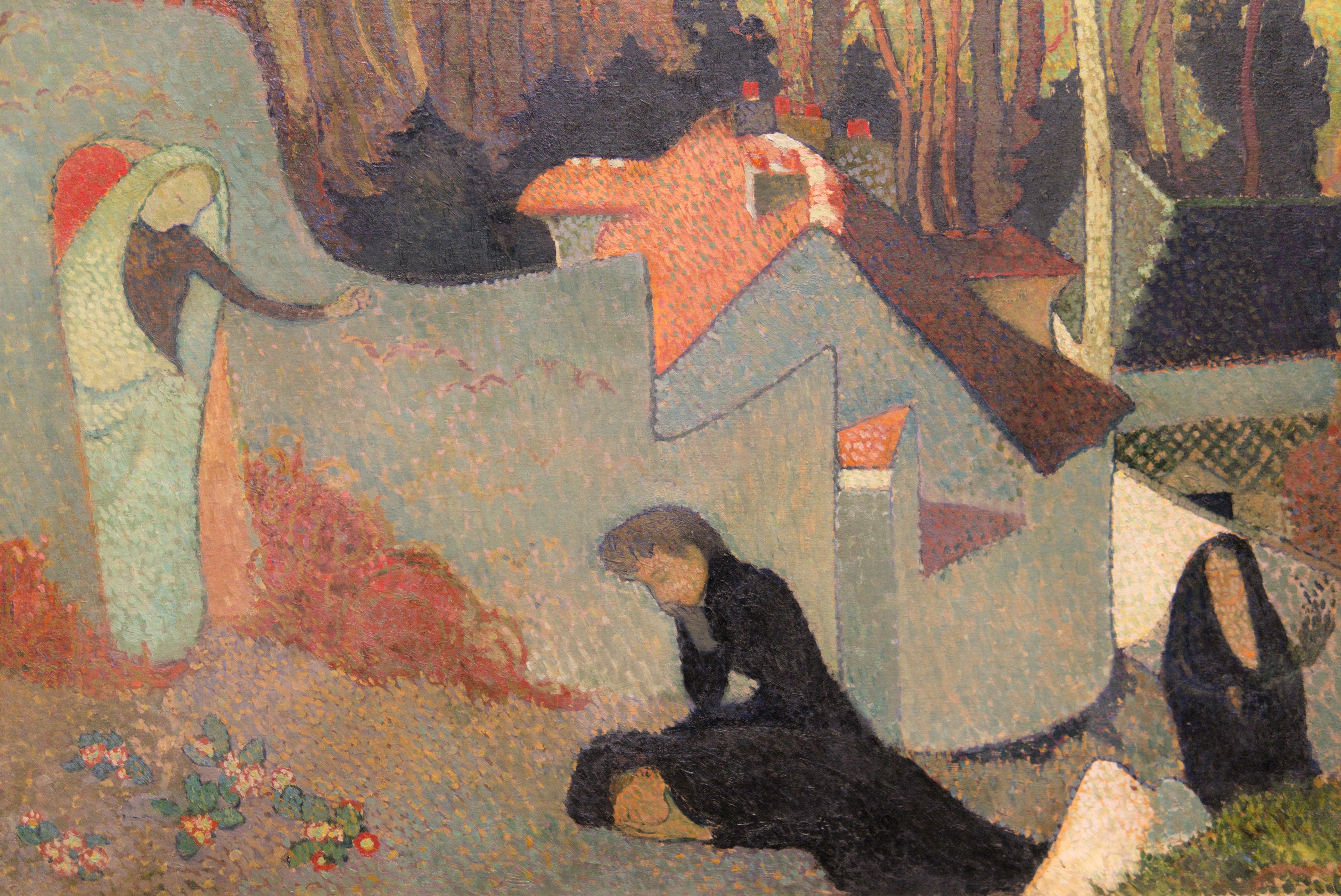
It shows three women dressed in mourning clothes arriving at Christ’s tomb (one ascending the hill, one kneeling, and one prostrate), only to find an angel at its entrance, announcing that Christ has risen. In the midground, visible through a veil of trees, the hand of God bends down to feed a group of white-clad women the body of Christ, a consecrated wafer that gives them eternal life.

Jesus’s teaching in John 6:48–58 is instructive here:

“I am the bread of life. Your ancestors ate the manna in the wilderness, and they died. This is the bread that comes down from heaven, so that one may eat of it and not die. I am the living bread that came down from heaven. Whoever eats of this bread will live forever, and the bread that I will give for the life of the world is my flesh.”

The Jews then disputed among themselves, saying, “How can this man give us his flesh to eat?”

So Jesus said to them, “Very truly, I tell you, unless you eat the flesh of the Son of Man and drink his blood, you have no life in you. Those who eat my flesh and drink my blood have eternal life, and I will raise them up on the last day, for my flesh is true food, and my blood is true drink. Those who eat my flesh and drink my blood abide in me and I in them. Just as the living Father sent me and I live because of the Father, so whoever eats me will live because of me. This is the bread that came down from heaven, not like that which the ancestors ate, and they died. But the one who eats this bread will live forever.”

The Art Institute audio guide (#841) provides the following commentary on the painting:

Maurice Denis belonged to a group of young French artists who called themselves the Nabis after the Hebrew word for prophets. The Nabis were interested in imbuing their subject matter with a sense of mystery and otherness. For Denis, a devout Catholic, an ordinary landscape could be loaded with manifestations of the divine. Denis sets this scene in the village of Saint-Germain-en-Laye, west of Paris, where he lived. The large house in the background would later become his home. In the foreground, an angel emerges from a cave, as if to announce Christ rising, to the mourning Virgin Mary and Mary Magdalene. Behind them are white-clad figures who hasten toward an astonishing sight, the hand of God himself, appearing miraculously from the trees to offer the Eucharist.

Denis strived for simple, flattened forms that sometimes verge on abstraction. He believed this process reflected spiritual purification, and he looked to the work of early Italian Renaissance art, and especially to the work of the painter monk Fra Angelico for inspiration. But he and the other Nabis were also deeply influenced by avant-garde French art. Here, Denis explores the effects of the pointillist technique of building up the picture surface with tiny dots of paint.

A 1994 exhibition catalog for Maurice Denis, 1870–1943 at the Musée des beaux-arts in Lyon expands on the artist’s technique in Easter Mystery. “By treating the surface with a kind of pointillist technique,” it reads, “he accentuates the gentleness of the curves, increases the light everywhere as in a mosaic, and endows the whole composition with an effect of airy lightness. . . . A spring landscape seems to be scattered with regularly spaced dabs of green paint, which work like a prism, breaking the light up into coloured particles. Denis used this method widely in order [in the words of Jean-Paul Bouillon] ‘to embody the truths of love and faith in perceptible form – making a surface quiver.’”

The quivering surface contributes to the mystical quality of the painting, in which mortality is taken up into immortality. By our partaking of the Eucharist, Christ assimilates us into his risen, living body, over which death has no dominion.

Photo by Victoria Emily Jones

This painting is in the public domain, and you are free to use my photos if you wish. To view them in full resolution, right-click and open in a new tab (if viewing on a computer) or pinch to zoom (if viewing on a phone).

Easter, Day 2: When the Sabbath was past…

LOOK: The Three Marys by Henry Ossawa Tanner

Tanner, Henry Ossawa_The Three Marys
Henry Ossawa Tanner (American, 1859–1937), The Three Marys, 1910. Oil on canvas, 42 × 50 in. Fisk University Art Galleries, Nashville, Tennessee.

Based on Mark 16:1–4, this painting shows Mary Magdalene (leading the way), Mary the mother of James, and Salome approaching the tomb of their rabbi, Jesus, the Sunday after his crucifixion. They came bearing spices to anoint his body. They expected it to be a mournful day.

Imagine their response when they found the stone rolled away and the tomb empty! That’s the moment the artist Henry Ossawa Tanner shows us here. Not the Resurrection itself, but the emotional reaction to it, or rather to the evidence of it.

What do you read on the faces of these women? Surprise? Confusion? Fear? Curiosity? Caution? Wonder? Love? Some mix thereof?

They are illumined by the light of an angel who is out of frame and who will speak the news to them presently. Mary Magdalene lifts her hand to her face in a gesture of self-reassurance, while her companion raises her tensed arms at the elbow in a defensive posture, as I read it. Compelled but still somewhat guarded, they progress toward the mystery.

Born and raised the son of a minister in the AME Church in Pennsylvania, Henry Ossawa Tanner (1859–1937) was an African American expat to Paris whose biblical paintings, inspired in part by his two trips to the Holy Land, garnered him international acclaim. In Beholding Christ and Christianity in African American Art, art historian James Romaine identifies Tanner as “the most artistically gifted and theologically astute American painter of biblical subjects.” A master of conveying nuanced mystery, “Tanner paints personal experiences rather than public spectacles,” Romaine writes, communicating more through suggestion than depiction and urging the viewer to undergo, like the figures in his paintings, their own experience of spiritual sight.

LISTEN: “Dum transisset Sabbatum” (When the Sabbath was past) | Text: Mark 16:1–2 | Music by John Taverner, 1520s | Performed by Alamire, 2010

Dum transisset Sabbatum, Maria Magdalene et Maria Jacobi et Salome emerunt aromata ut venientes ungerent Jesum. Alleluia.

Et valde mane una sabbatorum veniunt ad monumentum orto iam sole.

Gloria Patri et Filio et Spiritui Sancto.

English translation:

And when the sabbath was past, Mary Magdalene, and Mary the mother of James, and Salome, had bought sweet spices, that they might come and anoint him. Alleluia.

And very early in the morning the first day of the week, they came unto the sepulcher at the rising of the sun.

Glory be to the Father, and to the Son, and to the Holy Ghost.

The third responsory at Matins on Easter Sunday, this text has been set to music by many composers. The motet by English Renaissance composer John Taverner is the most famous. The video above is just an excerpt. The full piece lasts about eight minutes and alternates between plainchant and polyphony.

This song is on the Art & Theology Eastertide Playlist.