Roundup: Theological spinoff of “The Twelve Days of Christmas,” Advent art with Elissa Yukiko Weichbrodt, and four new Christmas song recordings

POEM SERIES: “Twelve Days of Advent” by Kate Bluett: This year on her blog, writer Kate Bluett [previously] is publishing a series of original metrical verses based loosely on the cumulative song “The Twelve Days of Christmas.” She calls it the Twelve Days of Advent and through it explores the theology of Christ’s coming. I love this creative, sacred spin on the popular seasonal ditty! Here’s where the series currently stands (my favorite poems are in boldface):

  1. “A Partridge in a Pear Tree”: Bluett imagines, in the tree of the knowledge of good and evil, a bird singing (representing, as I take it, God’s word), but Adam and Eve heed not his song, and, taking the tree’s forbidden fruit, find themselves exiled. The bird weeps for the alienation of his two friends, and wings his way east of Eden, into the home of a young maiden, a daughter of Eve, who receives him, shelters him, an act that leads to restoration. Bluett uses some of the language of late medieval English folksong, such as “with a low, low, my love, my love” and “welaway.”
  2. “Two Turtledoves”
  3. “Three French Hens”
  4. “Four Calling Birds”: This poem is brilliant. In it the four matriarchs in Jesus’s genealogy speak to Mary, tenderly calling her “Child” and rejoicing in her “bringing forth our life’s tomorrow.” Tamar, Rahab, Ruth, Bathsheba—they’ve long awaited redemption, and now they’re at its threshold. Mary’s yes to God’s call “set[s] [their] dry bones stirring, thrumming / with a hope [they’d] hardly dared.” They inform her that her vocation will involve great suffering (as we know, she’ll experience the brutal death of her son)—but her willingness to give up her son to the cross, to endure that rupture, will mean new life for the world.
  5. “Five Gold Rings”
  6. “Six Geese a-Laying”: Picking up the Isaianic language of the wilderness being made glad, the poetic speaker sings an eschatological vision of flocks coming home to “the orchard of the rood” (rood = cross) to lay and hatch eggs in nests once empty, now brimming with life.
  7. “Seven Swans a-Swimming”

I eagerly await the remaining five poems!

Update, 12/23/25:

    +++

    SUBSTACK SERIES: “Art + Advent 2025” by Elissa Yukiko Weichbrodt: The art historian Elissa Yukiko Weichbrodt [previously], author of Redeeming Vision and the Loving Look Substack, is one of my favorite writers. This Advent she is writing a weekly series of art reflections centered on the themes of hope, peace, joy, and love.

    >> “Week 1 // Hope: Abraham’s Oak and Sarah’s Laughter”: Looking at Henry Ossawa Tanner’s painting Abraham’s Oak, Weichbrodt writes about shadowy promise. She also considers, with reference to an early Byzantine mosaic of the Hospitality of Abraham, how to hope again after being wounded, as Sarah did, is a vulnerable thing. “As Advent begins, I find myself peering into a Tanner-like mist, seeing the dim outline of longed-for goodness taking shape in the distance. Sometimes I’m full of hope, but I’m also, like Sarah, sometimes full of armored laughter.”
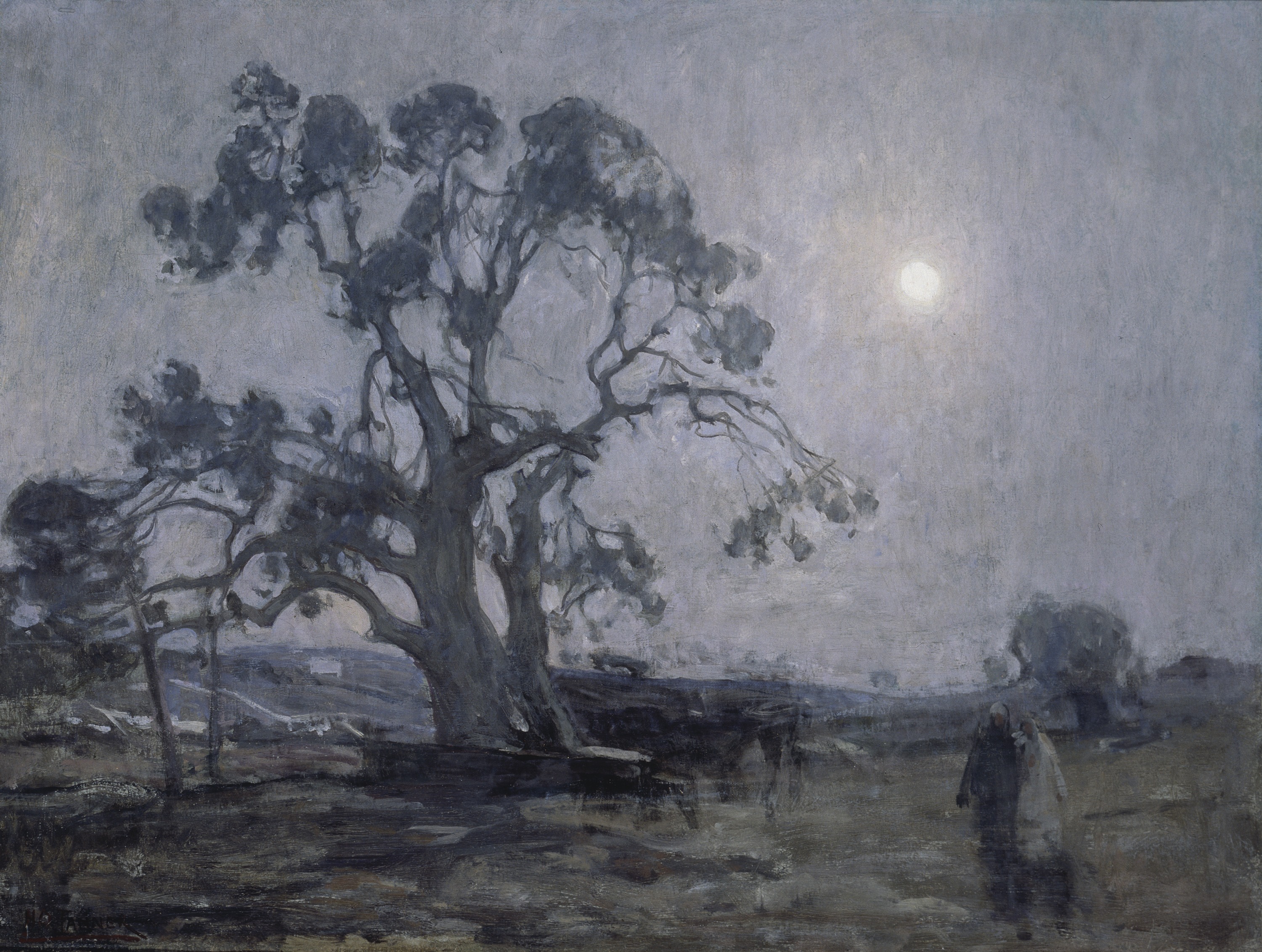
    Tanner, Henry Ossawa_Abraham's Oak
    Henry Ossawa Tanner (American, 1859–1937), Abraham’s Oak, 1905. Oil on canvas, 21 3/8 × 28 5/8 in. (54.4 × 72.8 cm). Smithsonian American Art Museum, Washington, DC.

    >> “Week 2 // Peace: A Stitch Pulling Tight”: “How do we do repair work in a fraying world with our own, fraying selves? What thread can stitch together all these gaping wounds?” Weichbrodt asks. She looks at Mary Weatherford’s monumental painting Gloria (new to me!), finding in the hot coral neon light blazing across the canvas resonance with Renaissance paintings of the Annunciation, which portray the Light of the World as the stitch that mends the tear between God and humanity.
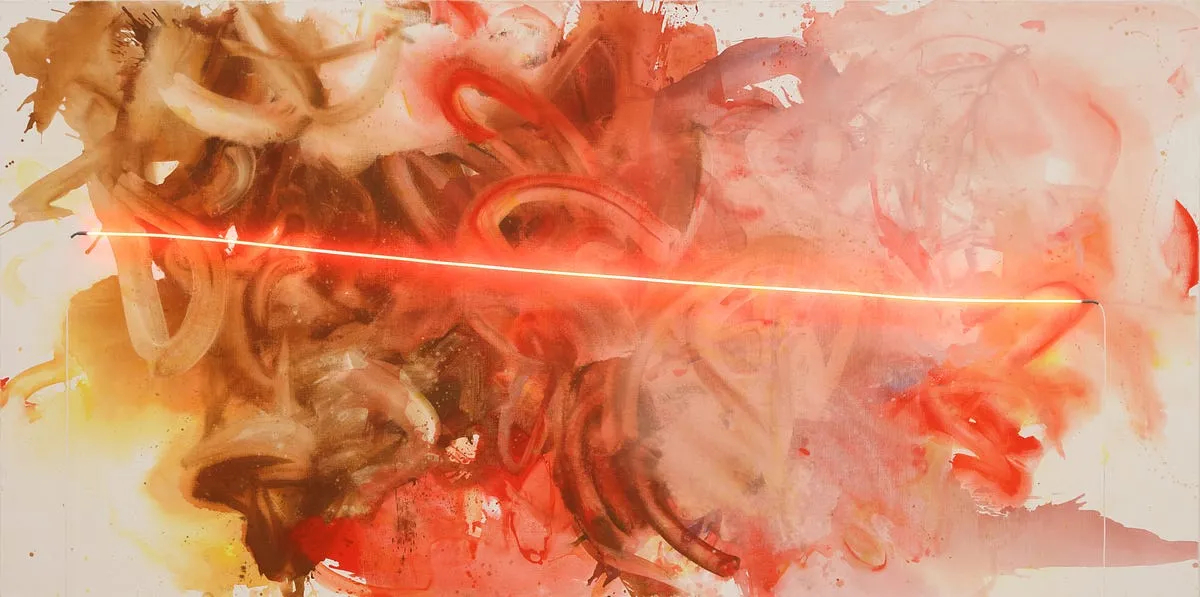
    Weatherford, Mary_Gloria
    Mary Weatherford (American, 1963–), Gloria, 2018. Flashe paint and neon on linen, 117 × 234 in. (297.2 × 594.4 cm). High Museum of Art, Atlanta.

    >> “Week 3 // Joy: Far as the Curse Is Found”: In this post, Weichbrodt explores nine Visitation paintings and one extraordinary embroidery. “Every time I see [a Visitation artwork],” Weichbrodt writes, “I encounter joy. It’s not that Mary and Elizabeth are always smiling. Often, their expressions are quite serious. But joy—deep, sustained, sustaining joy—circulates between them like an electrical current.” Justice, threshold, and fecundity are among the supplementary themes touched on.
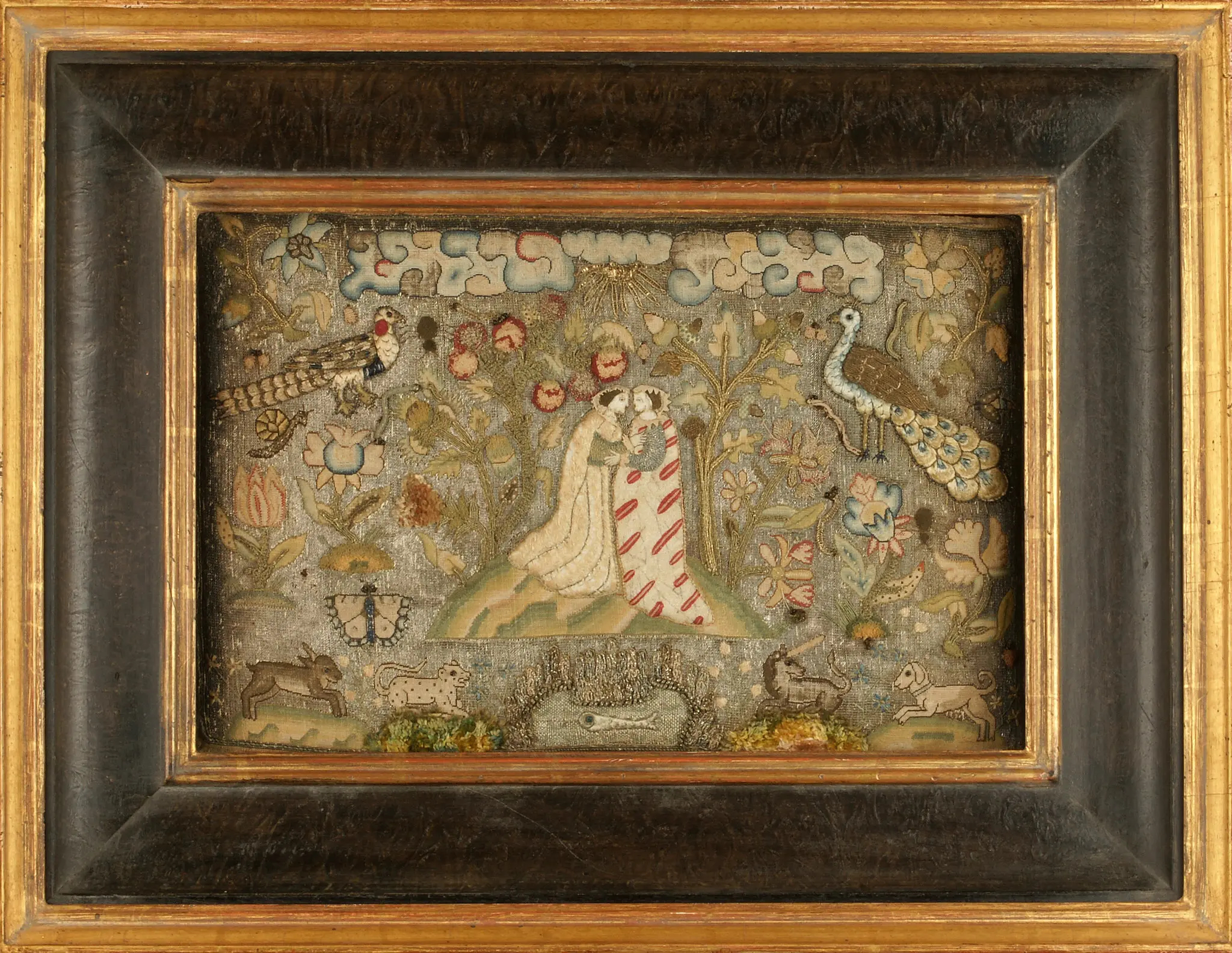
    Visitation embroidery
    The Visitation, England, first half of 17th century. Embroidery, 44.1 × 57 cm (framed). Ashmolean Museum, University of Oxford.

    Weichbrodt’s final Advent 2025 post, on love, will be published this Saturday. Weichbrodt’s final Advent 2025 post, on love, will be published this Saturday. (Update, 12/20/25: Week 4’s post, “Love In Between,” is now published. It centers on Vincent van Gogh’s painting Almond Blossoms, a gift for his newborn nephew, but also spends time with a Nativity mosaic by Pietro Cavallini and a Nativity painting by Gerard David.)

    +++

    SONGS:

    Here are four newly released Christmas songs of note: two originals, one lyrical adaptation of a classic, and a new arrangement.

    >> “War on Christmas” by Seryn: Seryn’s new album is titled War on Christmas. Here’s the title track:

    The refrain is:

    There is a war on Christmas
    But it’s not the one you think
    It’s in the news, it’s out of mind
    It happens overseas
    Cause as we sing the hymns and songs
    With families by our sides
    There is a war on Christmas
    Someone’s fighting to survive

    “War on Christmas” is a phrase some Christian conservatives in the US use to express their feeling of having their faith traditions attacked by the sinister forces of pluralism when people or signage greet them with a generic “Happy Holidays” instead of “Merry Christmas.” I roll my eyes big-time when I hear people complain about this, because it’s ridiculous for any American to assert that they are impeded from or ostracized for celebrating Christmas in this country, or to take offense that a stranger does not automatically assume their particular religious affiliation.

    Seryn’s song affirms that yes, there is a war on Christmas—only it’s a war not against personal religious freedoms in America but against peace, love, and the other values Christ came to teach and embody. When humans wage literal wars with literal weapons, killing and maiming each other and inducing mass terror—that’s an assault against Christ’s mass, with its message of welcome and reconciliation. So, too, when we perpetuate hate, whether on personal, national, or global scales. As another Christmas song puts it, “Hate is strong and mocks the song of ‘Peace on earth, goodwill to men.’”

    >> “O New Commingling! O Strange Conjunction!” by the Anachronists: The lyrics to this new song by the Anachronists [previously]—Corey Janz, Andrés Pérez González, and Jonathan Lipps—are a paraphrase from the sermon “On the Theophany, or Birthday of Christ” by Gregory of Nazianzus (ca. 329–390), one of the most influential and poetic theologians of the early church. Gregory delivered the sermon, labeled “Oration 38” in the Nicene and Post-Nicene Fathers series, at Christmastime in 380 in Constantinople, where he served as bishop. In section 13, the Anachronists’ source for the song, he expresses awe at the beautiful mystery of the Incarnation. Below is an excerpt from the public-domain NPNF translation.

    The Word of God Himself—Who is before all worlds, the Invisible, the Incomprehensible, the Bodiless, Beginning of Beginning, the Light of Light, the Source of Life and Immortality, the Image of the Archetypal Beauty, the immovable Seal, the unchangeable Image, the Father’s Definition and Word—came to His own Image, and took on Him flesh for the sake of our flesh, and mingled Himself with an intelligent soul for my soul’s sake, purifying like by like; and in all points except sin was made man. . . . O new commingling; O strange conjunction; the Self-Existent comes into being, the Uncreate is created, That which cannot be contained is contained. . . . He Who gives riches becomes poor, for He assumes the poverty of my flesh, that I may assume the richness of His Godhead. He that is full empties Himself, for He empties Himself of His glory for a short while, that I may have a share in His fullness. What is the riches of His goodness? What is this mystery that is around me? I had a share in the image; I did not keep it; He partakes of my flesh that He may both save the image and make the flesh immortal. He communicates a second Communion far more marvelous than the first.

    (Related post: Andy Bast sets to music a Nativity hymn by St. Ephrem)

    >> “Away in a Manger (Then to Calvary)” by Sarah Sparks: Singer-songwriter Sarah Sparks [previously] released a new EP, Christmas Hymns, last month, comprising five classic carols, including one with revised lyrics that further draw out the significance of the Incarnation. I’m a big fan of Sparks’s voice and her no-frills acoustic style.

    Away in the manger
    No crib for a bed
    The great King of Heaven
    Does lay down his head
    The stars he created
    Look down where he lay
    The little Lord Jesus
    Asleep on the hay

    And there in the manger
    The Maker of earth
    In riches and glory?
    No, born in the dirt
    With oxen and cattle
    With shepherds and sheep
    No stranger to weakness
    He loves even me

    And there in the manger
    Is our Servant-King
    He sits with the lowly
    He washes their feet
    Away in the manger
    Then to Calvary
    His birth, life, and death
    And his raising for me

    And there in the manger
    Is my greatest friend
    His mercy, his patience
    His grace know no end
    Be near me, Lord Jesus
    For all of my days
    In life and in death
    Till we meet face to face

    >> “Angels We Have Heard on High” by the Petersens: Last Friday the Petersens [previously] released a music video—shot at Wonderland Tree Farm in Pea Ridge, Arkansas—debuting their new bluegrass arrangement of one of my favorite Christmas carols. Banjo, mandolin, fiddle, acoustic guitar, dobro, upright bass—I love the instrumentation of the bluegrass genre and what it adds here, and the Petersens are consummate performers.  
    Trinity Sunday Roundup

    Today, June 4, is Trinity Sunday! Here’s a handful of art and music items on the topic.

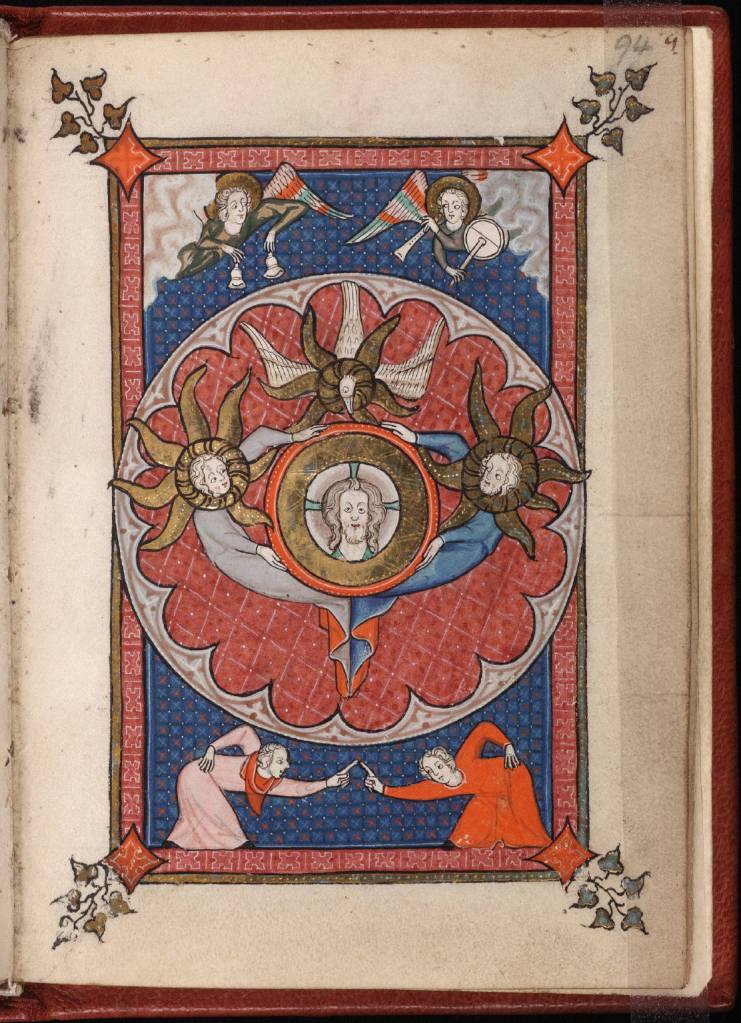
    VISUAL MEDITATION: “The Wheeling Playfulness of the Trinity” by Victoria Emily Jones: The Rothschild Canticles [previously] from ca. 1300 Flanders contains some of the most inventive and delightful artistic renderings of the Trinity that I’ve ever seen. I key in on four of them in today’s visual meditation for ArtWay

    Beinecke MS 404, fol. 94r

    +++

    MUSICAL COMMENTARY: “Theology in Sound and Motion: Perichoresis, for Brass Quintet” by Delvyn Case: Delvyn Case provides musical and theological commentary on his brass quintet composition “Perichoresis” (2006), inspired by the divine dance of the Trinity. “Its overall mood is joyous, an ecstatic whirling-about in which all three members become lost in the ecstasy of divine fellowship,” he writes. “At the exact moment of the dance when one member moves, the other fills in the spot left vacant.” “Perichoresis” premiered by Boston’s Triton Brass and appears on Case’s 2018 album Strange Energy. About this piece, Bible scholar and theologian Walter Brueggemann said, “I . . . have pondered ‘perichoresis’ for a long time. This is the finest exposition of that thick idea that I have encountered.”

    +++

    SONGS:

    >> “Trinity Song” by Paul Zach: Performed in 2021 by Solomon Dorsey with Liz Vice and Madison Cunningham, this song by Paul Zach evolved into “God of Grace and Mystery” for The Porter’s Gate’s 2022 album Climate Vigil Songs. This earlier iteration has a Trinitarian focus that’s just lovely. “God of all eternity / Father, Spirit, and the Son / Ever-loving Three-in-One / O divine community / . . . / Calling us to join your dance . . .”

    >> “One-Two-Three” by the Chosen Gospel Singers: This song was recorded in Los Angeles for Specialty Records and released as a single in 1952, with singers J. B. Randall (bass), E. J. Brumfield (tenor), George Butler (tenor), Fred Sims (tenor), and Oscar Cook (baritone). It opens with a repetition of the lines “One, two, three / One-in-Three and the Trinity.” The refrain is:

    One for the Father
    Two for the Son
    Three for the Holy Ghost
    All made of one

    The song is largely eschatological. The first verse is about John the Revelator’s vision of the New Jerusalem descending, among other wonders; it ascribes a vision of the Trinity to John, even though that is not explicit as such in either John’s Gospel or the Apocalypse (but see “The Trinity in the Book of Revelation” by Edwin Reynolds). The second verse anticipates our singing and praising the Triune God in heaven, dressed in our brand-new robes. It also mentions David and Goliath, and I’m honestly not sure how that relates. But with gospel songs, floating lyrics are common, taken from one song and spliced into another, some more coherent than others in their new context.

    +++

    ESSAY: “The Hospitality of Abraham in the Work of Julia Stankova, Painter of Bulgarian Icons” by François Bœspflug: The first half of this peer-reviewed article introduces readers to the Bulgarian artist Julia Stankova, rehearsing her biography and examining her relationship to the icons tradition. The second half explores twelve of her paintings on the subject of the three angelic visitors to Abraham and Sarah in Genesis 18, whom the narrator suggests are a manifestation of God (“The LORD appeared to Abraham at the oaks of Mamre . . .”); because of the number of visitors, many Christians interpret this passage as revealing something of God’s triune nature, and for this reason traditional icons of the story are often titled The Trinity.

    Stankova, Julia_The Hospitality of Abraham
    Julia Stankova (Bulgarian, 1954–), The Hospitality of Abraham, 2004. Tempera on primed wooden panel and lacquer technique, 46 × 41 cm.

    Since the publication of this article in 2019, Stankova has made at least three more paintings on the subject, all of which foreground Sarah and are titled Sarah’s Smile. She has just heard the angels announce that she will conceive a son in her old age.

    +++

    POEM: “After Rublev’s Trinity by Carrie Purcell Kahler: Published in Image no. 99 (Winter 2018), p. 21, this ekphrastic poem by Carrie Purcell Kahler interprets the famous fifteenth-century Trinity icon by Andrei Rublev. Sometimes referred to as “the hospitality of Abraham,” this biblical episode, as the iconographers interpret it, is really about the hospitality of God, who extends a hand to humanity, ever inviting us to sit at his table.

    Rublev, Andrei_Trinity
    Andrei Rublev (Russian, 1360–ca. 1430), The Trinity, ca. 1411. Tempera on wood, 141.5 × 114 cm. Tretyakov Gallery, Moscow.

    A new choral setting of this poem by Garrett John Law is premiering today at Holy Trinity Episcopal Church in Covina, California, where Law serves as music director and organist. I believe it can be heard on the 10:30 a.m. PT worship service livestream on the church’s YouTube channel, but I’m not sure whether the performance will be archived online for later viewing. (Update, 6/12/23: Here it is! Sung by Holy Trinity’s seven-person choir.)

    I Am Covered (Artful Devotion)

    Altarpiece by Sieger Koder
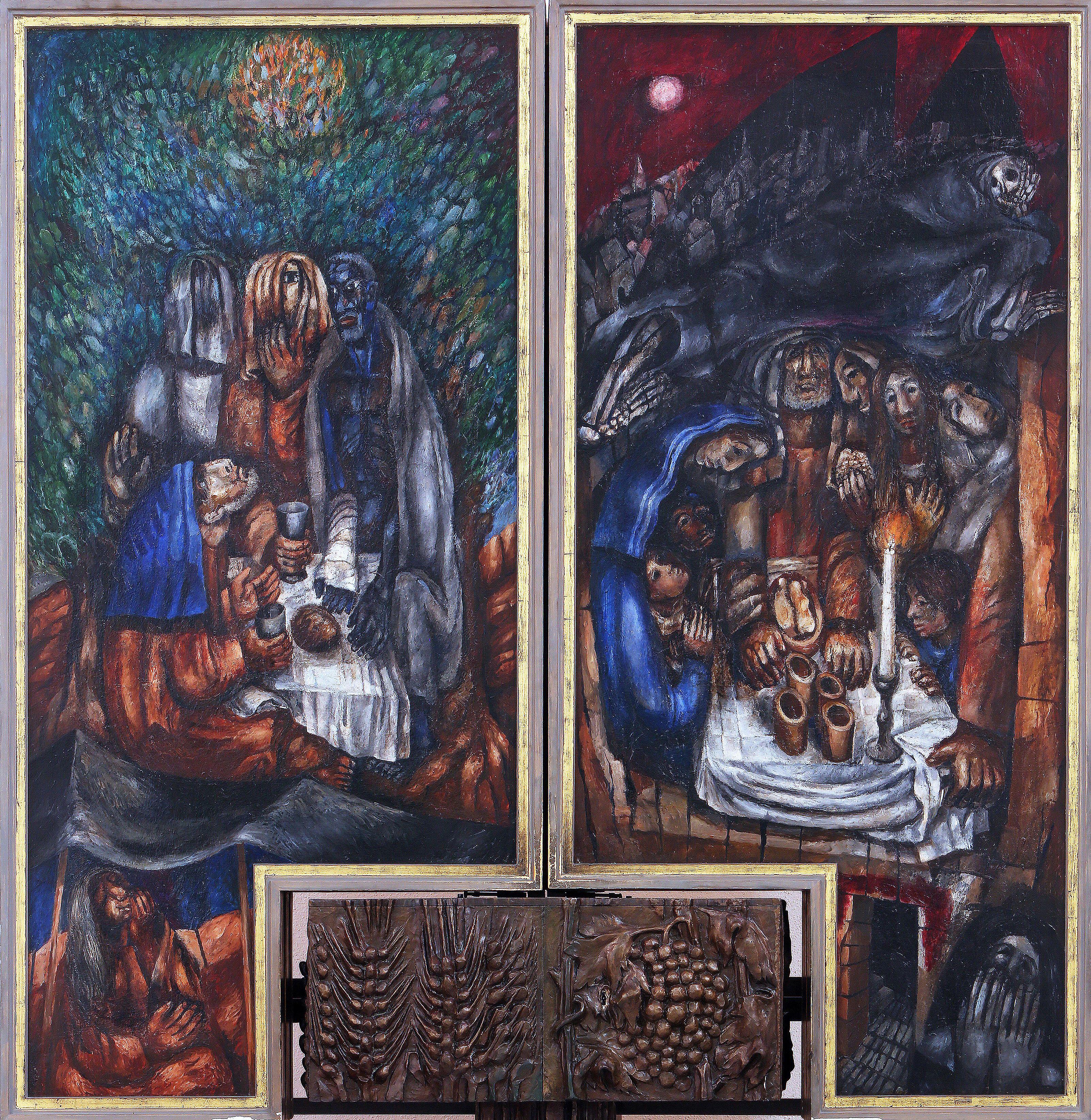
    Altarpiece (closed) by Sieger Köder (German, 1925–2015), 1970, St. Stephen’s Church, Wasseralfingen, Germany. Photo: Zvonimir Atletić / Alamy Stock Photo (ref. no. 2BAA8HW).

    The LORD said to Moses and Aaron in the land of Egypt, “This month shall be for you the beginning of months. It shall be the first month of the year for you. Tell all the congregation of Israel that on the tenth day of this month every man shall take a lamb according to their fathers’ houses, a lamb for a household. And if the household is too small for a lamb, then he and his nearest neighbor shall take according to the number of persons; according to what each can eat you shall make your count for the lamb. Your lamb shall be without blemish, a male a year old. You may take it from the sheep or from the goats, and you shall keep it until the fourteenth day of this month, when the whole assembly of the congregation of Israel shall kill their lambs at twilight.

    “Then they shall take some of the blood and put it on the two doorposts and the lintel of the houses in which they eat it. They shall eat the flesh that night, roasted on the fire; with unleavened bread and bitter herbs they shall eat it. Do not eat any of it raw or boiled in water, but roasted, its head with its legs and its inner parts. And you shall let none of it remain until the morning; anything that remains until the morning you shall burn. In this manner you shall eat it: with your belt fastened, your sandals on your feet, and your staff in your hand. And you shall eat it in haste. It is the LORD’s Passover. For I will pass through the land of Egypt that night, and I will strike all the firstborn in the land of Egypt, both man and beast; and on all the gods of Egypt I will execute judgments: I am the LORD. The blood shall be a sign for you, on the houses where you are. And when I see the blood, I will pass over you, and no plague will befall you to destroy you, when I strike the land of Egypt.

    “This day shall be for you a memorial day, and you shall keep it as a feast to the LORD; throughout your generations, as a statute forever, you shall keep it as a feast.”

    —Exodus 12:1–14

    +++

    SONG: “Passover Song” by IAMSON (Orlando Palmer), on Bread for the Journey by Urban Doxology (2016) and iAmSon (2017)

    Passover is a major Jewish holiday celebrated every spring, marking God’s deliverance of the people of Israel out of Egyptian bondage. Exodus 12 tells the story of how in Egypt God sent death as a means of judgment against oppressors but “passed over” the houses of the faithful who, following God’s instructions, smeared their doorposts with the blood of a lamb.

    Christians interpret this event as a prefiguration of the death of Jesus, the lamb of God, whose blood saves from death those who choose to place themselves under it, liberating us from our slavery to sin. Driving home the connection, all four Gospel writers mention that Jesus was killed during the feast of Passover. His blood smeared the wooden posts of the cross.

    +++

    Father Sieger Köder was born in Wasseralfingen in Swabia in southwestern Germany in 1925. From 1947 to 1951 he attended the State Academy of Fine Arts Stuttgart, where he trained as a silversmith and a painter. While establishing his art practice, he also worked as an art teacher at a secondary school in Aalen for just over a decade. Increasingly he felt a pull into Christian ministry, so from 1965 to 1970 he studied theology in Tübingen, becoming ordained in the Catholic Church a year later. He served as a parish priest in Hohenberg and Rosenberg from 1975 to 1995, combining that vocation with his work as an artist. He continued his art making well into retirement, dying in 2015 at age ninety. His religious paintings can be found all over Germany and in other parts of Europe.

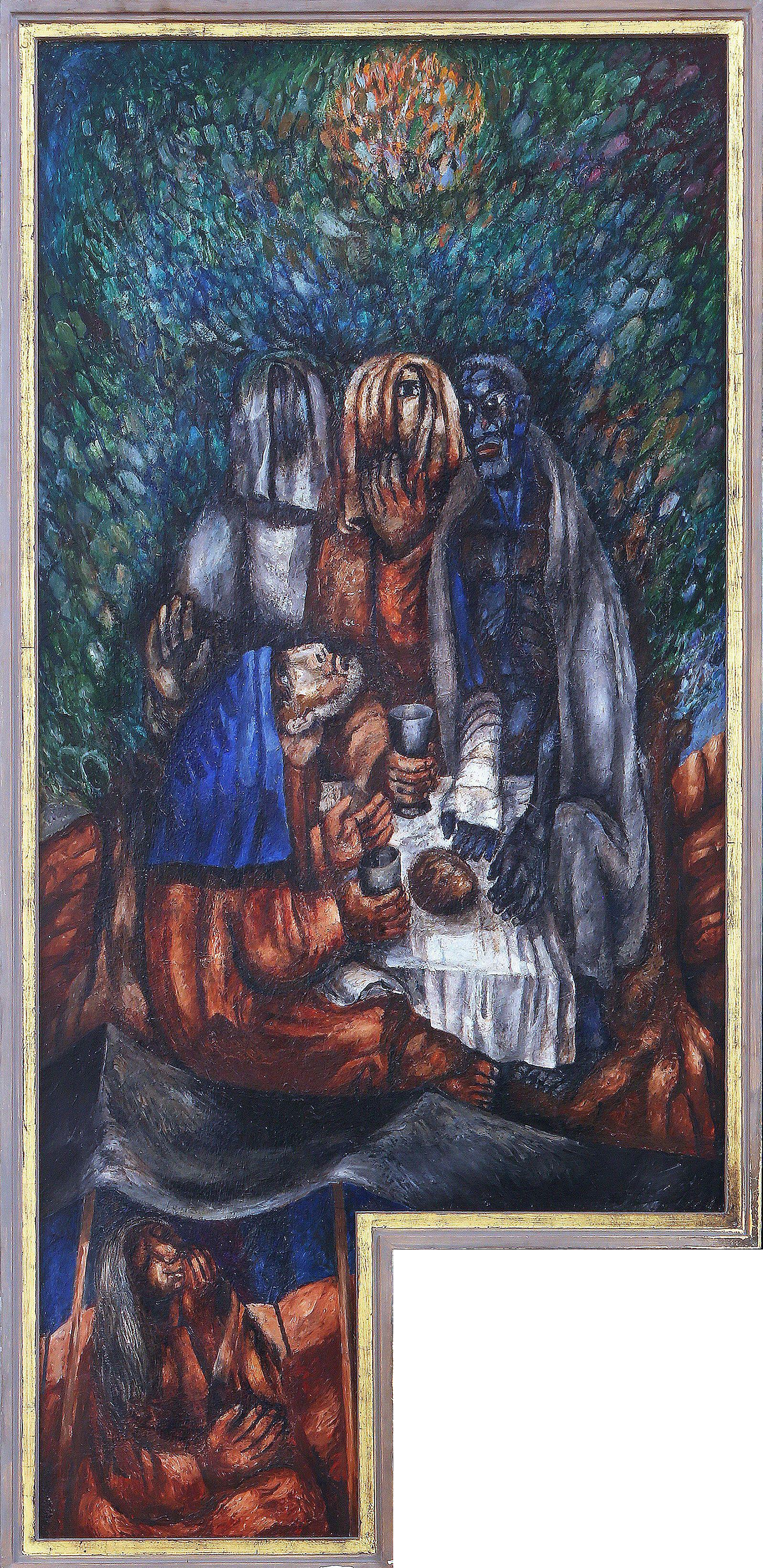
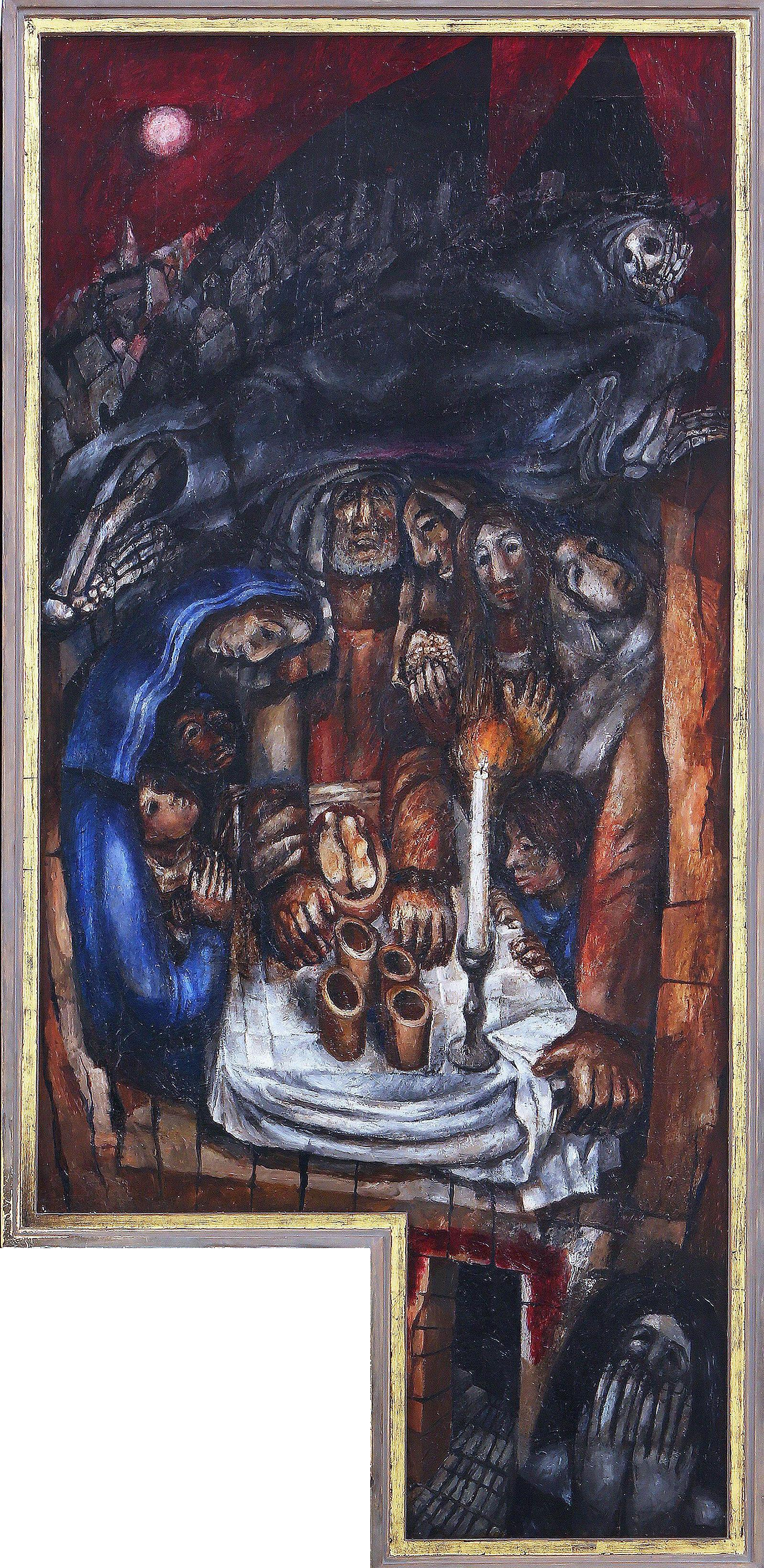
    The artwork above is the closed view of the high altarpiece Köder made for the parish church in his hometown, Saint Stephen’s (Sankt Stephanus).

    Koder, Sieger_Hospitality of Abraham

    The outer left panel shows the Hospitality of Abraham (Genesis 18:1–21)—that is, Abraham’s entertaining three men who turn out to be a theophany, an appearance of God in a human body (or in this case, three human bodies). I’m guessing that the man on the left, who is veiled, represents God the Father; the man in the middle, who’s holding the cup, is God the Son; and the man on the right, who appears to have a broken arm and to be naked except for a blanket draped over him, is God the Spirit—though he is likely also meant to show how God often comes to us in the guise of the poor, the hungry, the unsheltered (Matthew 25:31–46). Above the heads of this trinity, glowing through the oak leaves, is a fiery orb reminiscent of the burning bush from which God would call Moses a few centuries later. At the bottom of the painting Abraham’s wife Sarah laughs from inside her tent, having eavesdropped on the visitors’ news that she, a nonagenarian, will conceive a child. The lineage of that child, Isaac, would produce Jesus.

    Koder, Sieger_Passover

    The outer right panel, based on Sunday’s lectionary reading, shows the first Passover. Israelite families huddle around a meal of roast lamb, unleavened bread, and bitter herbs as a cloaked, skeletal presence passes by overhead. One of the adults tries to steady the rattling table with his hand while a mother protects two of her children, hugging them tightly to herself. Though afraid, they are in no danger, as their doorway is covered in the blood of the lamb whose flesh they eat.

    Altarpiece by Sieger Koder
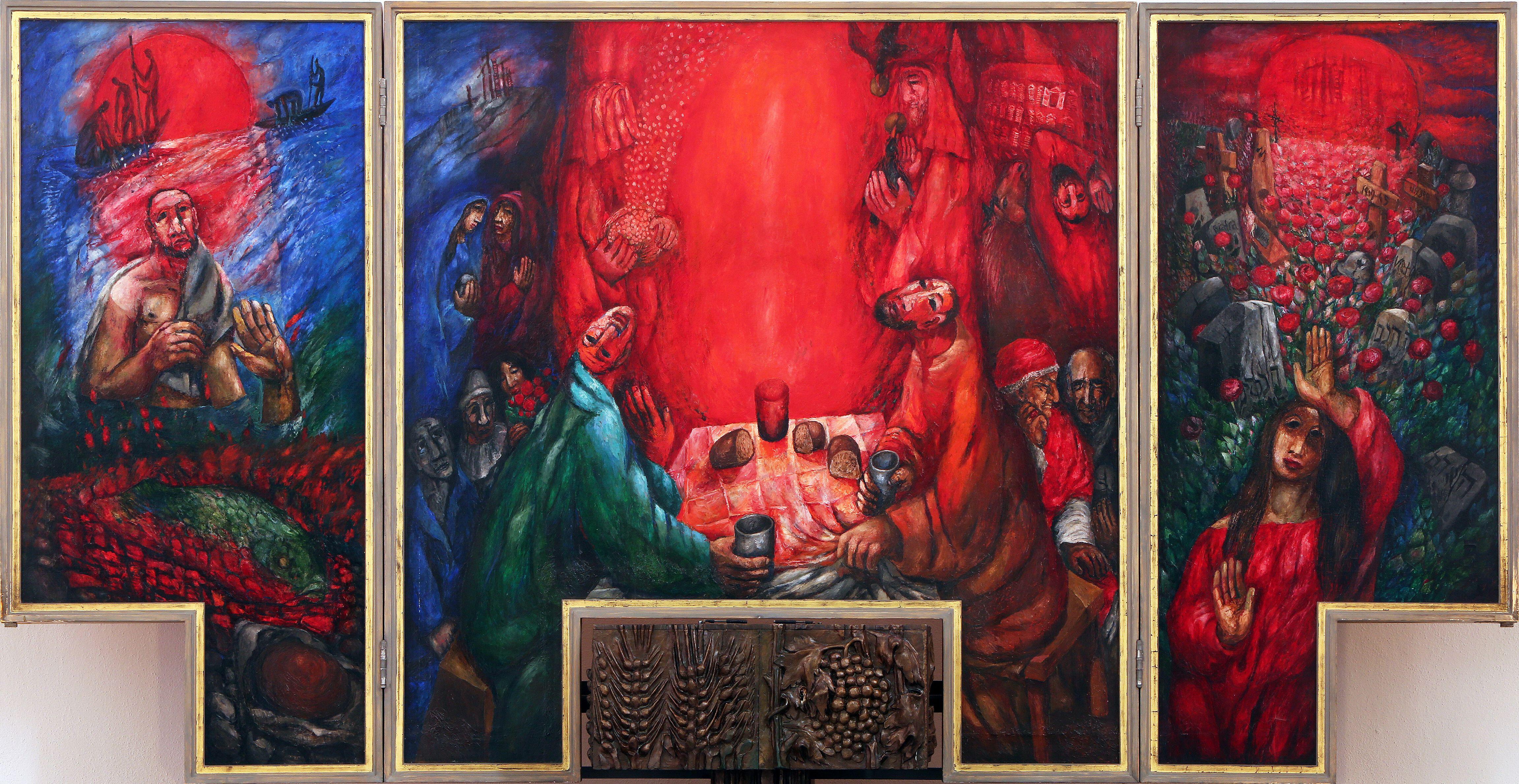
    Altarpiece by Sieger Köder (German, 1925–2015), 1970, St. Stephen’s Church, Wasseralfingen, Germany. Photo: Zvonimir Atletić / Alamy Stock Photo (ref. no. 2BABBYY).

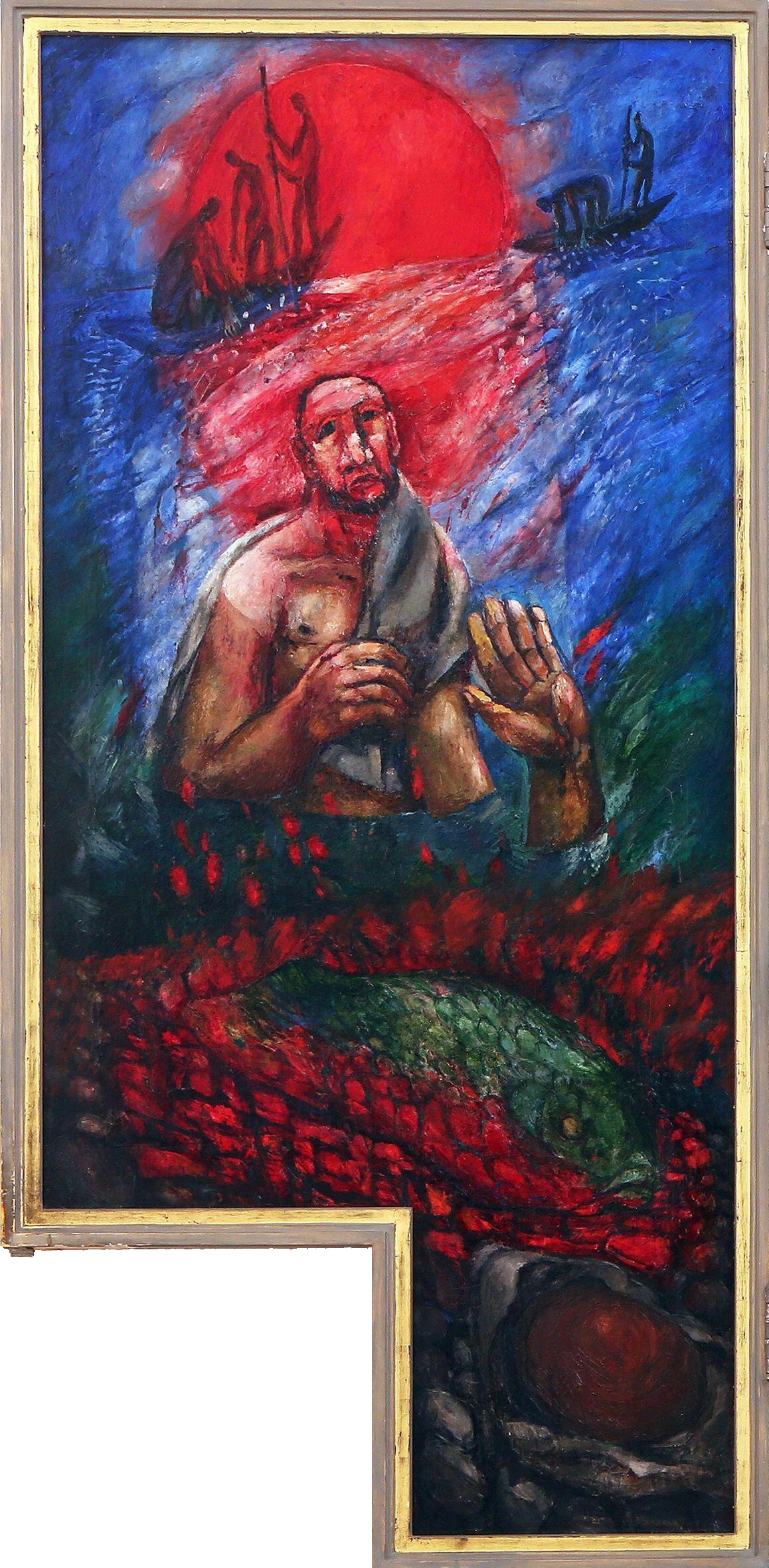
    When opened, the triptych reveals three Resurrection-themed panels. The inner left panel shows one of my favorite biblical episodes, which I call “Breakfast on the Shore”: Jesus’s resurrection appearance to Peter at dawn on the Sea of Galilee (John 21). Following Jesus’s instruction in Jerusalem (Matthew 28:7, 10), Peter had returned home with some of the other disciples and, not knowing what to do, took back up his fishing nets. He and six others are on the lake when a man calls out from the shore, “Children, do you have any fish?” They don’t. The man tells them to cast in their nets once more, and when they do, up comes a humongous catch. After which Peter exclaims, “It is the Lord!” Ever the impulsive one, he throws himself into the sea and pushes his way through the water to greet Jesus. They chargrill some of the fish and sit down to eat.

    Koder, Sieger_Breakfast on the Shore

    The scene is one of reconciliation. Peter had denied he knew Jesus three times the night of Jesus’s arrest, abandoning him in his time of need, and now, after breakfast, Jesus gives Peter three chances to reaffirm his love for him, asking him thrice, “Simon, son of John, do you love me?” The foregrounding of the hot coals in Köder’s painting is perhaps a subtle nod to the recent failure of Peter’s, as earlier in his Gospel John mentions that, in the courtyard of the high priest where Jesus was being tried, Peter warmed himself at a charcoal fire alongside Jesus’s captors (John 18:18). There’s also a hand coming up out of the water that I’m guessing references the earlier episode of Peter’s walking on water and then, when doubt in Jesus’s power set in, sinking, only to be saved by Jesus’s outstretched hand (Matthew 14:22–33). But Jesus forgives Peter’s weaknesses and disloyalty, restoring him to fellowship. He invites Peter to come and feast. The sun at the top indicates that it’s the dawn of a new era.

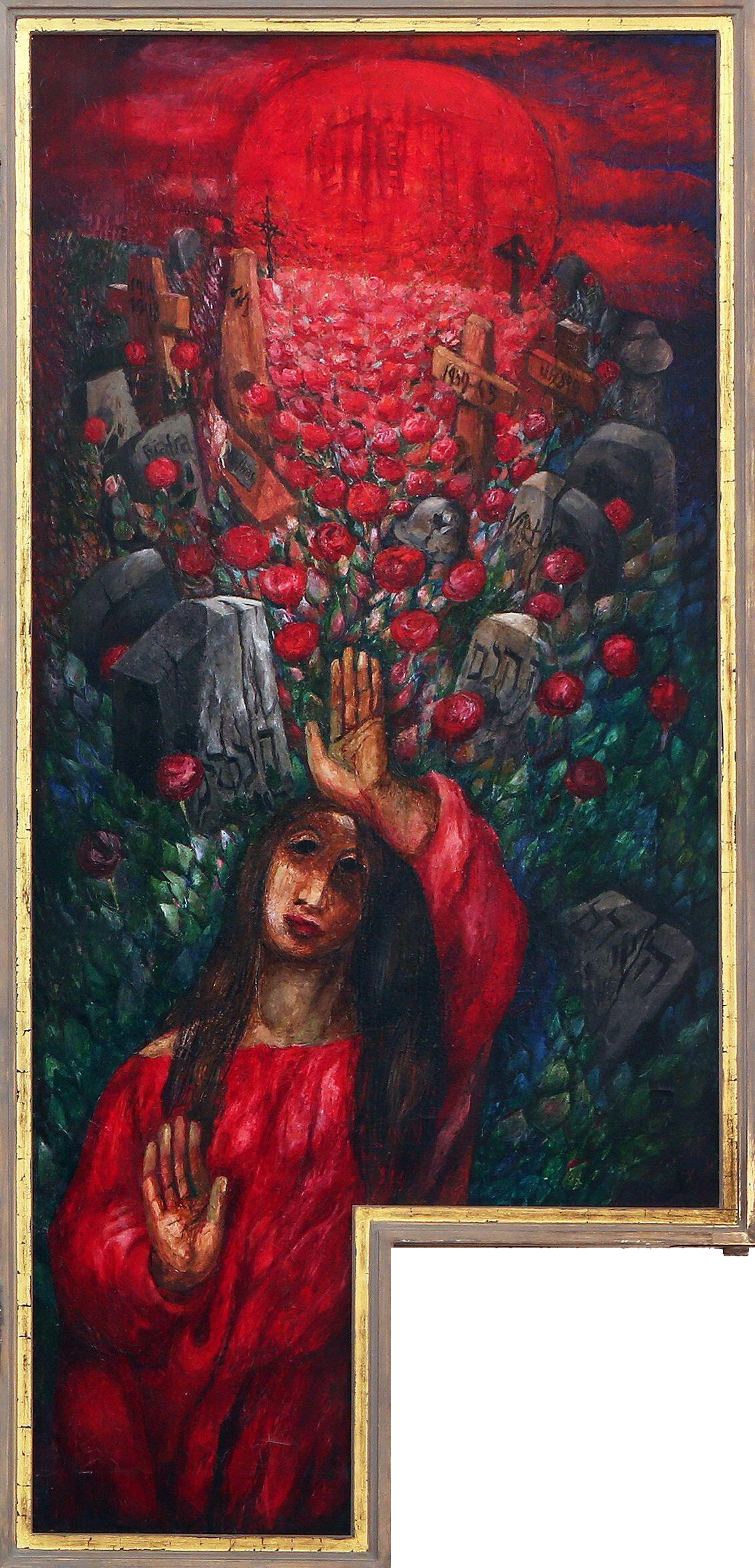
    The bright-red morning sun also appears on the inner right panel, which shows another very personal encounter between the risen Christ and a disciple: Mary Magdalene at the empty tomb. In Köder’s visual retelling, Mary wades through a sea of poppies—a red flower symbolic of sacrifice—her hand shielding her eyes from the brilliance of Jesus’s resurrection body. He who she initially thought to be the cemetery gardener is in fact her dear friend and Lord.

    Koder, Sieger_Mary Magdalene at the Tomb

    Look closely at some of the grave markers, and you’ll notice that they carry the names and/or dates of wars: “1914–1918,” “1939–1945,” “Vietnam,” “Biafra” (a reference to the Nigerian Civil War). The latter two were still raging on when Köder painted this. The artist was actually a prisoner of war during World War II, and underneath the cross representing that war in the painting is a bullet-blasted soldier’s helmet. I take these graves to imply that Jesus’s resurrection put death to death.

    I’m not sure what the Hebrew grave inscriptions say—anyone know?

    Update, 9/30/21: Dr. Franz Posset, a former student of the artist’s, emailed me today with transcriptions and translations of the Hebrew tombstone inscriptions:

    • האדם – Adam, The Man (lower right corner, next to Mary’s elbow)
    • חוה – Eve, The Woman (in the shadows at the right, behind the “Vietnam” tombstone)
    • החכם – The Wise (to the right of Mary’s raised hand)
    • כסילה – The Fool (to the left of Mary’s raised hand)

    Supper at Emmaus by Sieger Koder

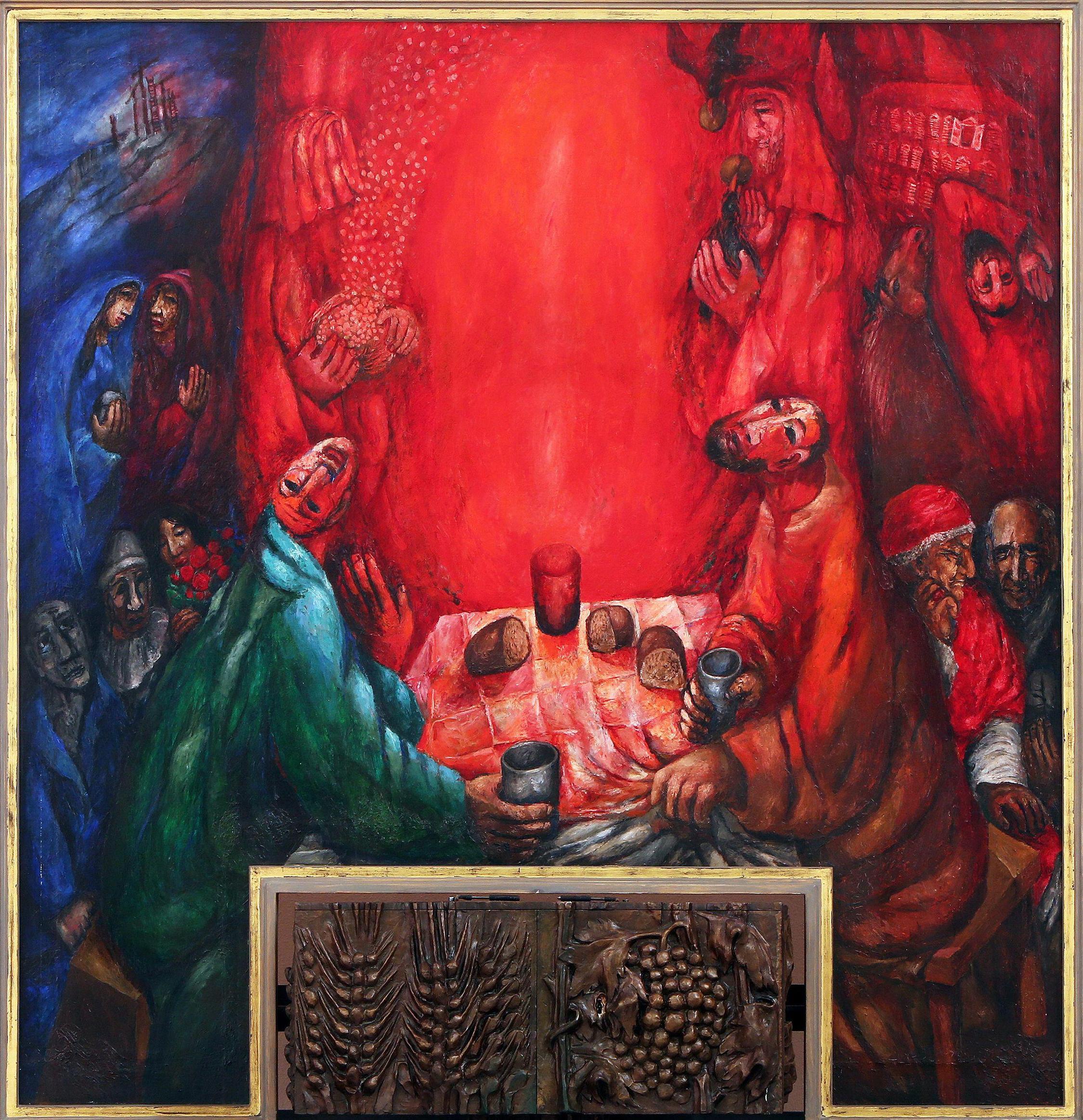
    The central panel of the altarpiece portrays the Supper at Emmaus as a sort of Transfiguration à la Mount Tabor, an unveiling of Christ’s glory. Luke tells us that after the resurrection Jesus appeared to Cleopas and another unnamed disciple, who were on their way home from Jerusalem; their hearts “burned within them” as he spoke about the scriptures, but their eyes weren’t opened to his true identity until he blessed and broke the bread at mealtime. In Köder’s painting, Jesus’s form is barely discernible through the red glow—he’s a pillar of light, really. Artists have always struggled to give an impression of what Jesus’s resurrection body might have looked like: it was a flesh-and-bone body, for sure, but a glorified one, not always immediately recognizable, and it seems as though he was able to walk through walls and disappear. Köder bathes him in the color of blood—of his passion, and of life. Köder’s nonrepresentational approach emphasizes the otherness aspect of the newly risen Christ and the marvel the two Emmaus disciples must have felt upon realizing who they were dining with.

    Jesus appears between Moses, who holds a basket of manna (Exodus 16), and Elijah, who cradles a raven with a morsel of bread in its beak, a reference to his being fed miraculously by God in the wilderness (1 Kings 17:1–7). The figure to the right of Elijah may be Paul (Saul) fallen off his horse on the road to Damascus.

    Koder, Sieger_Wasseralfingen Altarpiece (wide shot)
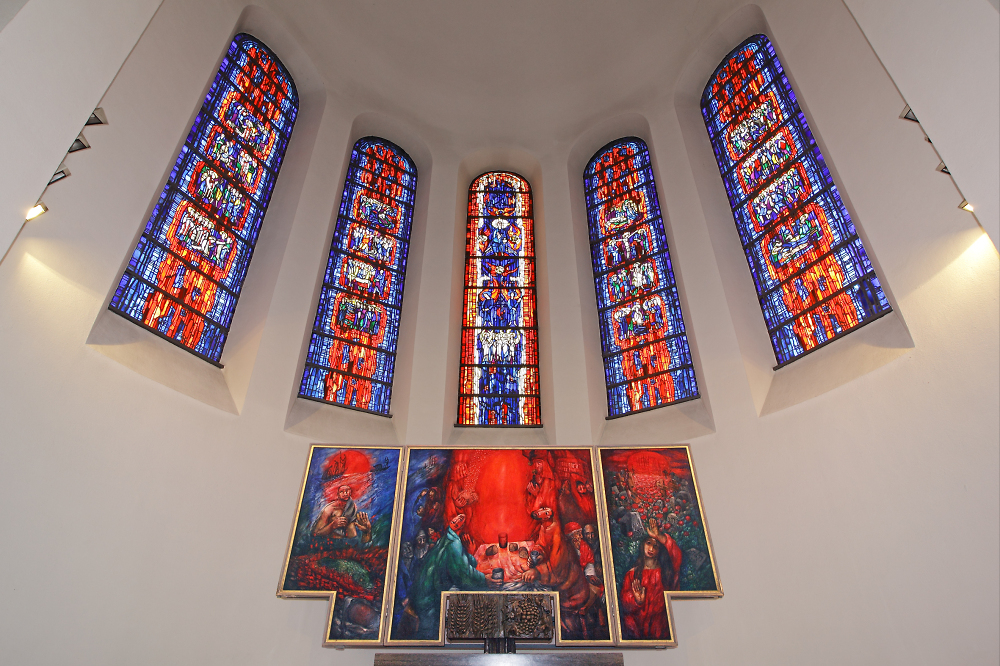
    East end of Saint Stephen’s, Wasseralfingen. Altarpiece by Sieger Köder, stained glass windows by Rudolf Haegele. Photo © Stadt Aalen.

    At Saint Stephen’s the Eucharist is celebrated regularly before this altarpiece. (The metalwork tabernacle below, decorated with stalks of grain and clusters of grapes, is where the eucharistic elements are stored.) Köder reminds partakers that they are covered (pardoned) by Jesus’s blood, that Christ is present in the meal, that he nourishes and sustains his people with his very self. Death has passed over us because it struck the firstborn of all creation, who bore the curse on our behalf. However, death could not keep him down, and on the third day he rose again, appearing to many, the firstborn of new creation. “Mary,” he called out to one of his closest followers outside his tomb, speaking her name in a familiar tone, sparking recognition and joy. “Come and have breakfast,” he called out to Peter. To the Emmaus disciples he illuminated the scriptures and finally revealed himself around a table. Christ invites us into fellowship with him, through his blood.

    P.S. It appears there is yet a third configuration of the altarpiece, as indicated by this photo, which includes a Madonna and Child, the Tower of Babel, and I can’t make out the left two panels.


    This post belongs to the weekly series Artful Devotion. If you can’t view the music player in your email or RSS reader, try opening the post in your browser.

    To view all the Revised Common Lectionary scripture readings for Proper 18, cycle A, click here.