Christmas, Day 10: Balulalow

LOOK: The Birth of Christ by Ulyana Tomkevych

Tomkevych, Ulyana_The Birth of Christ
Ulyana Tomkevych (Ukrainian, 1981–), The Birth of Christ, 2016. Egg tempera on gessoed wood, 11 1/2 × 12 in. Sacred Art Pilgrim Collection of John A. Kohan. Photo: Victoria Emily Jones, at East Meets West: Women Icon Makers of Western Ukraine, St. Christopher’s Episcopal Church, Chatham, Massachusetts, 2017.

Frosty yet warm, this icon by Ulyana Tomkevych of Ukraine is one of my favorite Nativity paintings. It shows Mary embracing her swaddled newborn, Jesus, amid a bleak midwinter. She reclines across a red blanket of flowers inspired by Ukrainian embroidery patterns, which hovers mystically above a line of barren trees, suggesting that Christ’s birth has ushered in a new springtime.

The wisps of white against the cool green-grays at the bottom suggest snowdrifts, whereas the faint rose tints at the top imply a suffusing warmth. The silver semicircle at the top, with its emanating beams, represents the mystery and presence of God breaking into the world.

Following Greek Orthodox tradition, Christ’s halo is inscribed with the Greek letters ώ Ό Ν (omega, omicron, nu), spelling “He who is” (see Exod. 3:14). Tomkevych is a member of the Ukrainian Greek Catholic Church, which is in communion with the Holy See but follows the Byzantine Rite.

LISTEN: “Balulalow” | Original German words by Martin Luther, 1535 (title: “Vom Himmel hoch da komm ich her”) | Translated into Scots by James, John, and Robert Wedderburn, 1567 | Music by Peter Warlock, from his Three Carols suite, 1923 | Performed by Sting on If on a Winter’s Night, 2009 [see full credits]

O my deare hert, young Jesu sweit,
Prepare thy creddil in my spreit
And I sall rock thee in my hert,
And never mair from thee depert.

But I sall praise thee evermore
With sangis sweit unto thy gloir.
The knees of my hert sall I bow,
And sing that richt Balulalow.

Literal English translation:

O my dear heart, young Jesus sweet,
Prepare thy cradle in my spirit
And I shall rock thee in my heart,
And nevermore from thee depart.

But I shall praise thee evermore
With songs sweet unto thy glory.
The knees of my heart shall I bow,
And sing that true Balulalow.

English translation, from the German, by Catherine Winkworth:

Ah! dearest Jesus, holy Child,
Make thee a bed, soft, undefiled
Within my heart, that it may be
A quiet chamber kept for Thee.

My heart for very joy doth leap;
My lips no more can silence keep.
I too must sing with joyful tongue
That sweetest ancient cradle song.

These two stanzas in Middle Scots are an extract from the longer “Ane Sang of the Birth of Christ,” also known by its first line, “I come from heuin to tell,” from the Ane Compendious Buik of Godly and Spirituall Sangis (1567). In this part of the hymn, the speaker asks Jesus to be at home in their heart and receive their sweet songs. Mary is the model for this reception, love, and adoration of the Christ child—she who cradled him, praised him, sang to him, and held him close.

The word balulalow is derived from the Scottish word for “lullaby.”

For all fifteen stanzas in Scots, see here, and for Catherine Winkworth’s full English translation, here. The hymn actually originated in German from the pen of Martin Luther, who titled it “Vom Himmel hoch da komm ich her” (From Heaven Above to Earth I Come). It spread to the Netherlands and the British Isles in the 1560s.

In his recording, the cross-genre English musician Sting uses neither the German folk tune that Luther paired with the text upon its first publication, nor the melody Luther composed for it in 1539. Instead Sting uses the 1923 setting written by the English composer Peter Warlock for his Three Carols suite.

In Sting’s rendition, which he arranged in collaboration with Robert Sadin, the female backing vocals evoke a wintry wind and a snare drum creates a forward momentum, while a cello supports Sting’s languid singing. The tone is tender and haunting.


This post is part of a daily Christmas series that goes through January 6. View all the posts here, and the accompanying Spotify playlist here.

Christmas, Day 9: “Today the Virgin cometh unto a cave . . .”

LOOK: Nativity icon from St. Catherine’s Monastery

Coptic Nativity icon (St Catherine's)
The Nativity of Christ, Egypt, 7th century(?). Encaustic on wood. Holy Monastery of St. Catherine, Sinai, Egypt. Photo courtesy of the Michigan-Princeton-Alexandria Expeditions to Mount Sinai.

This Coptic icon of the Nativity bears all the traditional elements of Nativity icons. It shows Mary reclining in a cave next to her newborn son, Jesus, who lies in a manger, being affectionately licked by an ox and ass. Why those two animals? Because the church fathers read Isaiah 1:3 into the scene, which says, “The ox knows its owner and the donkey its master’s crib.”

The starry semicircle at the top represents the heavens. A thick beam of light descends from it onto Christ, confirming his divine paternity. On either side, from behind the grassy hills, angels rejoice, bringing glad tidings of the birth.

From the right, three magi approach with their gifts (unusually, their horses are placed apart from them in the bottom left), and in the center, a shepherd plays a pipe while his flock frolics on the grass.

In the bottom left, Joseph sits dejectedly with his head in his hands. He is being assailed once again by doubt as to Jesus’s true paternity. Could Mary’s outrageous story really be true? Or was she sexually unfaithful? In some Nativity icons Satan appears to Joseph in the guise of an old man to tempt him to distrust Mary and to doubt Jesus’s divinity. Anyone would be a fool to believe it, he taunts. It’s possible that the man with the pointed red cap at the far right of this icon is meant to be the devil on his way to Joseph, but if so, it would be an odd compositional choice. Anyway, in Nativity icons, Joseph stands for all skeptics, for those who struggle to accept that which is beyond reason, especially the incarnation of God.

Next to Joseph, two midwives bathe Jesus in a basin. (Jesus appears twice in the composition. He’s identified by the cross-shape in his halo.)

Art historian Matthew J. Milliner, who specializes in the Byzantine era, describes the Orthodox iconography of the Nativity in a 2021 podcast episode of For the Life of the World [shared previously]:

There’s just something wonderful about the classic Nativity icon. When you look at this, you’ve got Joseph in the corner. . . . And then you have this dome that is overarching the scene. That is, speaking in Charles Taylor’s terms, that’s the “immanent frame”—that’s the cosmos as we know it. And it’s shattered! By what? By the light that comes from outside. In other words, the Kantian universe has been pierced and God has revealed himself and said, “This is how I choose to come into the world.”

And there you have the Virgin Mary, and she almost looks seed-like when you look at these icons. She’s on her side because, thank you very much, she just gave birth. And there’s Christ. And the donkey and the ox are there, symbolizing both Jew and Gentile. In other words, the book of Romans in one shot. Boom. Right there.

Then you’ve got the magi sometimes off in the distance, to symbolize all corners of the earth, to symbolize most in particular the Assyrian Church of the East, the expansion of Christianity all the way to the Pacific Ocean by like the fifth century, folks. Gotta remember that! These are the Christians whom we have lost contact with. The global reality of Christianity is communicated by these icons.

And then, of course, you’ve got the shepherds to symbolize, we might even say, all classes incorporated into this faith—not just across the globe, but across socioeconomic status. All of it is communicated just by meditating upon it.

And then you have this cavern—not some sweet little stable, but a cavern, a cave. And folks, it’s the cave of your own psyche as well. It’s a depth-psychology dimension of the Christian tradition. A Nativity icon is what God wants to do in your soul. This is intended to be a spiritual experience.

The dating of the particular icon pictured above has been debated. It is circulating in many places online with an attribution of “seventh century,” perhaps in part because of its use of encaustic (a common medium for earlier icons). But Father Akakios at St. Catherine’s Monastery at Mount Sinai, the institution that owns and houses the icon, told me that’s probably too early, that it’s more likely a later icon that incorporates earlier elements.

From the Sinai Digital Archive, it appears that Kurt Weitzmann, an art historian from Princeton University who had the icon photographed on one of his four research expeditions to Sinai in the late 1950s and early ’60s, proposes the sixteenth or seventeenth century as its likely time of creation. Cathy Pense Garcia, head of Visual Resources Collections at the University of Michigan (which manages the Sinai Digital Archive jointly with Princeton), was unable to confirm an approximate date and said that more scholarly research is needed.

It’s such a wonderful icon! I hope to see some academic writing about it in the future, as my research turned up next to nothing.

LISTEN: “Kontakion of the Nativity of Christ” by Romanos the Melodist, 6th century | Chanted by Fr. Apostolos Hill, 2016

Today the Virgin cometh unto a cave to give birth to the Word who was born before all ages, begotten in a manner that defies description. Rejoice, therefore, O universe, if thou should hear and glorify with the angels and the shepherds. Glorify him who by his own will has become a newborn babe and who is our God before all ages.

(Η Παρθένος σήμερον, τον προαιώνιον Λόγον, εν σπηλαίω έρχεται, αποτεκείν απορρήτως. Χόρευε, η οικουμένη ακουτισθείσα, δόξασον, μετά Αγγέλων και των ποιμένων, βουληθέντα εποφθήναι, Παιδίον νέον, τον προ αιώνων Θεόν.)

This is the prooimoion (prologue) to Romanos the Melodist’s kontakion on the Nativity of Christ; the other twenty-four stanzas can be read in a translation by Ephrem Lash in St. Romano, On the Life of Christ: Kontakia—Chanted Sermons by the Great Sixth-Century Poet and Singer (HarperCollins, 1995).


This post is part of a daily Christmas series that goes through January 6. View all the posts here, and the accompanying Spotify playlist here.

Easter, Day 4: Kriste aghdga

LOOK: Anastasis, Georgian Orthodox church fresco

Harrowing of Hell (Georgia)
Anastasis (Harrowing of Hell), ca. 1207. Fresco, St. Nicholas Church, Kintsvisi Monastery, Shida Kartli region, Georgia.

In this (partially damaged) icon of the Resurrection from the main church at Kintsvisi Monastery in the country of Georgia, Christ stands over the pit of hell, atop its broken gates. He has come to take back his own from this place of death. He heaves Adam up first, and Eve next. On the right stand Kings Solomon and David and John the Forerunner (aka John the Baptist). The deliverance they’ve been awaiting has come.

Fresh from the tomb, Christ holds aloft his cross as a victory staff. As is common in Orthodox icons, it has three horizontal beams: a short one on top, representing the titulus that read, “King of the Jews”; the main one, onto which Jesus’s hands were nailed; and a footrest at the bottom.

(Related post: “‘Done Is a Battle’ by William Dunbar”)

LISTEN: “Kriste aghdga” (Christ Is Risen), the Paschal troparion in a traditional Georgian setting from the Svaneti region | Performed by the Sheehan Family, 2020

Krist’e aghdga mk’vdretit
sik’vdilita sik’vdilisa
dam trgun velida saplavebis shinata
tskhovrebis mimnich’ebeli.

English translation:

Christ is risen from the dead,
trampling down death by death,
and upon those in the tombs bestowing life.

Frederica Mathewes-Green, an Eastern Orthodox author and speaker from Johnson City, Tennessee, wrote the following on her Facebook page last year:

The troparion [short hymn] for Pascha is this brief and punchy one, written by St. John of Damascus (d. 749):

Christ is risen from the dead,
trampling down death by death,
and upon those in the tombs bestowing life.

We sing it many, many times—surely hundreds of times—before Pascha concludes on the day of Pentecost. It is always sung a capella, without accompaniment (apart from the vigorous ringing of bells, in some congregations). It is set to many, many different melodies. Each ethnicity has a half-dozen favorite melodies, so the options are very broad. . . .

But when Orthodox of other nations hear it sung in a Georgian tone, they stop and listen.

Georgian church music is unique. It is always sung in three parts, honoring the Trinity; but what’s striking is the sound of it, unlike anything we have in the West. Someone who is trained in Georgian chant might be able to explain it, but I can’t. 

Let’s hear from Dr. John A. Graham, an American musicologist specializing in the history of Georgian liturgical music and who runs the website www.georgianchant.org:

“Kriste aghdga” (Christ is Risen) is an important Easter hymn in the Georgian Orthodox tradition. It is sung when the priest knocks on the doors of the church, symbolizing entrance to the tomb of Christ, just before entering the sanctuary space to commence the all-night liturgy service [on the Saturday before Easter].

Then it is repeated in groups of three throughout the All-Night vigil service (4-7 hours). It is also sung in every service after Easter until Pentecost.

The chant survives in many musical variants, as chanters in each village and region perfected their individual style.

The most popular variant, the one you heard above, is from Svaneti, a highland region in northwest Georgia. The style is influenced by Svan folk music. This variant begins with a solo sung by the middle voice. You can purchase the vocal score here, as sung by the Sheehan family, or see the free transcription that Graham provides.

Here’s the Orthodox Virtual Quarantine Choir, directed by Steve Jacobs, singing the chant in English, interspersed with a Paschal reading taken from Psalm 68:1–3 (“Let God rise up . . .”) and Psalm 118:24 (“This is the day . . .”):

In his article, Graham lists seven characteristics of traditional Georgian chant, among which are its three-part voicing, its close harmonies (“The dissonances are integral to the desired sound. The tension-release in the music is symbolic of our prayers and supplications to God.”), and an ending in unison. He posts videos of several other regional musical variants of the troparion in Georgian.

This song, as performed by the Capitol Hill Chorale, is on the Art & Theology Eastertide Playlist.

Christmas, Day 11: Hodie

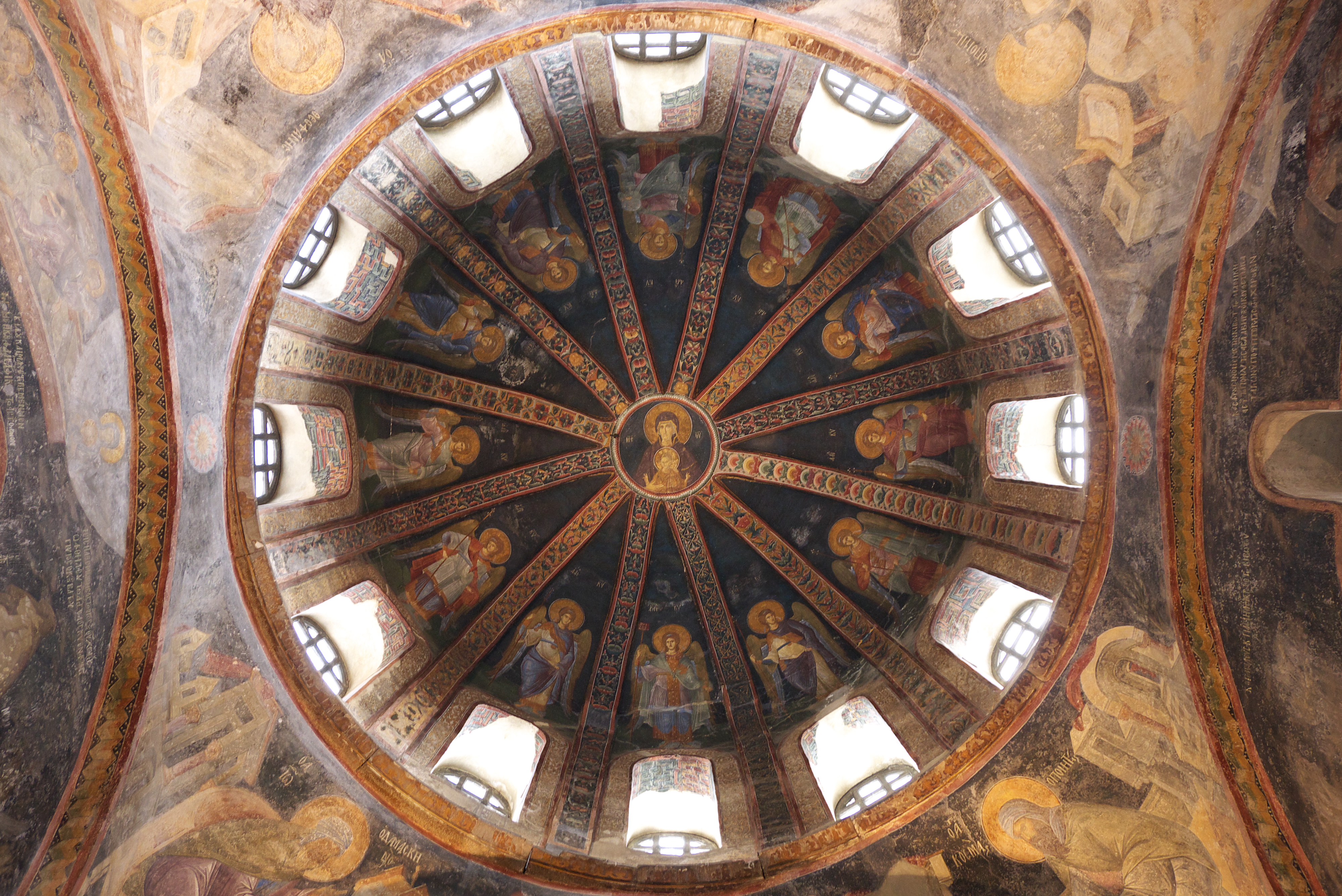
LOOK: Virgin and Child from Chora Church

Chora dome
The Virgin and Child surrounded by angels, 14th century, frescoed dome of the parecclesion (side chapel) of the Church of the Holy Saviour in Chora, Istanbul.

Virgin and Child (Chora Church)
Chora dome, detail

LISTEN: “Hodie,” early monastic chant from the Celtic Church in Ireland | Performed by Mary McLaughlin on Sacred Days, Mythic Ways: Ancient Irish Sacred Songs from Mythology to Monasteries (2012)

Refrain:
Hodie Christus natus est
hodie Salvator apparuit:
hodie in terra canunt angeli,
laetantur archangeli:
hodie exsultant justi, dicentes:
Gloria in excelsis Deo. Alleluia!

Benedictus qui venit in nomine Domini.
Deus dominus, et illuxit nobis. [Refrain]

Gloria Patri, et Filio, et Spiritui Sancto:
sicut erat in principio, et nunc, et semper,
et in sæcula sæculorum. Amen. [Refrain]

English translation:

Today Christ is born;
today the Savior has appeared;
today the angels sing,
the archangels rejoice;
today the righteous rejoice, saying:
Glory to God in the highest. Alleluia!

Blessed is he who comes in the name of the Lord!
The Lord is God, and he has made his light to shine upon us.

Glory be to the Father, and to the Son, and to the Holy Spirit,
as it was in the beginning, is now, and ever shall be, world without end.
Amen.

The texts that make up this Christmas chant are from the Latin Mass. The verses are the parts known as the Benedictus (Psalm 118[117]:26a, 27a) and the Gloria, which are sung at every Mass, and the refrain is the antiphon to the Magnificat that is sung at Vespers on Christmas Day.

The plainchant melody is from early medieval Ireland.