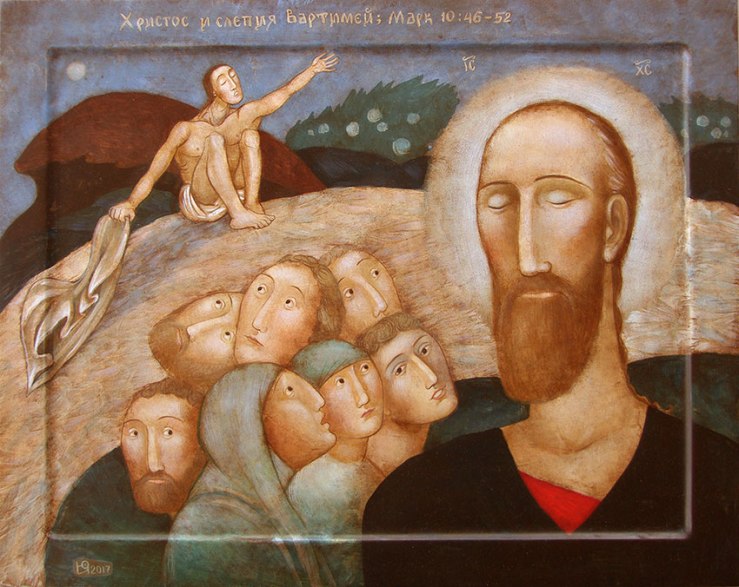
Julia Stankova (Bulgarian, 1954–), Christ and Bartimaeus, 2017. Tempera on primed wooden panel and lacquer technique, 36 × 45 cm.
And they came to Jericho. And as he was leaving Jericho with his disciples and a great crowd, Bartimaeus, a blind beggar, the son of Timaeus, was sitting by the roadside. And when he heard that it was Jesus of Nazareth, he began to cry out and say, “Jesus, Son of David, have mercy on me!” And many rebuked him, telling him to be silent. But he cried out all the more, “Son of David, have mercy on me!” And Jesus stopped and said, “Call him.” And they called the blind man, saying to him, “Take heart. Get up; he is calling you.” And throwing off his cloak, he sprang up and came to Jesus. And Jesus said to him, “What do you want me to do for you?” And the blind man said to him, “Rabbi, let me recover my sight.” And Jesus said to him, “Go your way; your faith has made you well.” And immediately he recovered his sight and followed him on the way.
—Mark 10:46–52 (cf. Matthew 20:29–34; Luke 18:35–43)
Here’s an introduction and acoustic performance by band leader Cam Huxford, who cowrote “Son of David” with fellow Ghost Ship member Shay Carlucci:
+++
“The Blind Suppliant” by Richard Crashaw
Silence, silence, O vile crowd;
Yea, I will now cry aloud:
He comes near, Who is to me
Light and life and liberty.
Silence seek ye? yes, I’ll be
Silent when He speaks to me,
He my Hope; ah, meek and still,
I shall ’bide His holy will.
O crowd, ye it may surprise,
But His voice holdeth my eyes:
O have pity on my night,
By the day that gives glad light;
O have pity on my night,
By the day would lose its light,
If it gat not of Thee sight;
O have pity on my night,
By day of faith upspringing bright;
That day within my soul that burns,
And for eyes’ day unto Thee turns.
Lord, O Lord, give me this day,
Nor do Thou take that away.
This post belongs to the weekly series Artful Devotion. If you can’t view the music player in your email or RSS reader, try opening the post in your browser.
To view all the Revised Common Lectionary scripture readings for Proper 25, cycle B, click here.
Today, January 6, is the feast of Epiphany (“manifestation,” “revelation,” “shining forth”)—also referred to as Theophany (“revelation of God”), or the Feast of Lights. While the Western church commemorates the visit of the Magi on this day, focusing on God’s revelation to the world through the birth of Christ, the Eastern church commemorates Jesus’s baptism, focusing on the Father and Spirit’s affirmation of the Son’s divinity at the beginning of his public ministry. Matthew 3:13–17 gives us the account:
Then Jesus came from Galilee to the Jordan to John, to be baptized by him. John would have prevented him, saying, “I need to be baptized by you, and do you come to me?” But Jesus answered him, “Let it be so now, for thus it is fitting for us to fulfill all righteousness.” Then he consented. And when Jesus was baptized, immediately he went up from the water, and behold, the heavens were opened to him, and he saw the Spirit of God descending like a dove and coming to rest on him; and behold, a voice from heaven said, “This is my beloved Son, with whom I am well pleased.”
Below is a selection of contemporary Theophany icons from Ukraine, Russia, Poland, Greece, and Romania. All but one of them bear a semicircle at the top, which signifies the “opening of the heavens” and the voice of God reaching down; in Ioan and Camelia Popa’s, God’s hand is even visible. (Representation of the Father is forbidden by tradition, though a hand is generally acceptable because the Bible itself uses anthropomorphic expressions like “God’s hand” and “God’s mighty arm.”) A dove descends from this aperture, a literalization of the Gospel writers’ simile.
On the shores of the Jordan stand one or more angels at the service of their Lord. Their hands are covered by their own cloaks as a sign of reverence—or in some representations, they hold garments to drape over Christ when he emerges from the water. (Early icons of Jesus’s baptism show him completely naked, emphasizing his self-emptying; now, however, it’s more common to see him in a loincloth.)
In Lyuba Yatskiv’s and the Popas’ icons—the most traditional of this bunch—there is an allegorical figure in the river by Christ’s feet, pouring out water from a jug. This man is a personification of the Jordan River, which miraculously dried up, temporarily, to allow the ancient Israelites to cross over into the Promised Land (Joshua 3:15–17). Some icons, though none pictured here, include a second allegorical figure, (Red) Sea, who is turning away, parting (see Psalm 114:3).
In George Kordis’s icon, instead of Jordan at Christ’s feet, there’s a serpent being crushed, a reference to Psalm 74:13: “You divided the sea by your might; you broke the heads of the sea monsters on the waters.” Visually, this recalls the Eastern church’s Resurrection icon, which depicts Christ breaking down the doors of hell, flattening Satan.
Back to Yatskiv and Popa. In these two there is an axe lying next to a tree, alluding to the sermon by John the Baptist that immediately preceded this episode, in which he proclaimed, “Even now the axe is laid to the root of the trees. Every tree therefore that does not bear good fruit is cut down and thrown into the fire” (Matthew 3:10).
Epiphany calls us to worshipfully behold the shining forth of Jesus as messiah and as the second person of the Trinity. To orient yourself to the Orthodox celebration of today’s feast, here are two liturgical hymns, the Troparion and the Kontakion, that will be sung congregationally:
When Thou, O Lord, wast baptized in the Jordan, worship of the Trinity wast made manifest; for the voice of the Father bore witness to Thee, calling Thee His beloved Son. And the Spirit in the form of a dove confirmed the truth of His word. O Christ our God, Who hath appeared and enlightened the world, glory to Thee.
. . .
On this day Thou hast appeared unto the whole world, and Thy light, O Sovereign Lord, is signed on us who sing Thy praise and chant with knowledge: Thou hast now come, Thou hast appeared, O Thou Light unappproachable.
They offer a perfect lens through which to view the following icons.
Jerzy Nowosielski (Polish, 1923–2011), The Baptism of Jesus Christ in the Jordan, 1964. Oil on canvas, 100 × 80 cm.Greta Leśko (Polish, 1979–), Baptism of Christ. Oil on board, 40 × 30 cm. Private collection.Greta Leśko (Polish, 1979–), Baptism of Christ, 2014. Oil on board, 40 × 40 cm.Two-sided processional cross and ripidions by Greta Leśko (Polish, 1979–), 2011. Mixed media on wood. Cross: 90 cm tall (without shaft); ripidions: 13 cm diameter. Church of the Exaltation of the Holy Cross in Górowo Iławeckie, Warmian-Masurian Voivodeship, Poland. (See reverse)Icon by Lyuba Yatskiv (Ukrainian, 1977–)Icon by Ulyana Tomkevych (Ukrainian, 1981–)Ivanka Demchuk (Ukrainian, 1990–), Baptism of Christ, 2015. Mixed media on canvas and wood, 30 × 40 cm.
There are many people and organizations committed to integrating faith and the arts, and they often organize opportunities for public participation. Here are some such opportunities being offered this spring and summer, organized by date. The last one, a weeklong course taught by David Taylor, looks especially appealing to me and my context, and I’m considering registering.
A few early-bird registration/application deadlines are coming up very soon, on March 31, so give these a gander sooner than later. Click on the links for information on schedules/syllabi, speakers, accommodations, and fee breakdowns. Room and board are not included in the cost quotes I’ve listed unless specifically noted.
If you’re reading this post sometime after spring 2017, or the application deadlines are too tight for you, you’ll be pleased to know that some of these events occur yearly, and if not, you’re sure to find similar ones. Check out the websites of the organizing bodies to see what they have going on.
Title:“Art and Theology” (course) Dates: March 26–29, 2017 Location: Ripon College Cuddesdon, Oxford, England Organizer:Art and Christianity Enquiry (ACE) Cost: £225 (~ $280 US) (includes room and board) Instructors: Christopher Irvine; Alison Milbank; Sophie Hacker; Stephen Stavrou; Laura Moffatt Description: “This short course is designed to give participants the opportunity to both engage with Christian art and to reflect through class presentations and discussion how art is perceived. Each day will balance theoretical input with visits to see art in churches, galleries, and chapels in Oxford. We will examine the contexts in which Christian art is viewed, suggest ways of how we may reflect theologically on contemporary art, and look at the place of art in churches within its architectural and liturgical context.” (I’m intrigued by the lecture title “Museums and Galleries as a Theological Resource”!)
Title:“Lux Ecclesiae: The Light of the Church” (lecture series) Dates: April 25–29, 2017 Location: Paraclete Retreat House, Cape Cod Bay, Massachusetts, USA Organizer:Community of Jesus Speakers: Msgr. Timothy Verdon; Filippo Rossi Cost: $1,000 (includes room and board; single-lecture options available) Description: “Practically from the beginning of its history, the Church has used architecture and the visual arts to express its life, investing thought, creative energies and resources. The reasons for this choice are theological and pastoral, but also anthropological: human beings want to ‘see’, are frustrated if they cannot see, define ‘seeing’ as understanding (as when, grasping a point, we say, ‘I see’), and desire above all things to see the God who, invisible in himself, became visible in Jesus Christ.” Monsignor Timothy Verdon, academic director of the Mount Tabor Ecumenical Centre for Art and Spirituality in Barga, Italy, will develop these themes in a series of seven lectures, and sacred artist Filippo Rossi will give a talk as well.
Title:Movies and Meaning Festival Dates: April 27–30, 2017 Location: KiMo Theatre, Albuquerque, New Mexico, USA Organizer:The Porch Cost: $189 Speakers: Alice Walker; Mona Haydar; Gareth Higgins; Brian McLaren; Malidoma Somé Description: The third annual Movies and Meaning Festival, an interfaith initiative, is centered on the theme “Hope in the Dark.” Over one weekend, participants will be inspired and challenged on this theme by artists and activists who work at the intersection of creativity, peace, spirituality, and social change. Films will serve as touchstones throughout the event; screenings include Pete’s Dragon; The Red Balloon; Mary andMax; Alice Walker: Beauty in Truth; Embrace of the Serpent; Reds; I Am Belfast; The ColorPurple; and more. Participants will walk away with a renewed spirit for social justice and tools for community healing. Continue reading “Upcoming courses, workshops, conferences”→
BLESSING: “Blessing for Getting the News” by Jan L. Richardson: August brought two devastating pieces of news to me; I wasn’t in the line of direct impact, but I hurt for the two families who were. A blessing by artist-author Jan L. Richardson came at just the right time. Here’s an excerpt:
. . . when the news comes, may it be attended by every grace, including the ones you will not be able to see now.
When the news comes, may there be hands to enfold and bless, even when you cannot receive their blessing now.
When the news comes, may the humming in your head give way to song, even if it will be long and long before you can hear it,
before you can comprehend the love that latched onto you in the rending— the love that bound itself to you even as it began its leaving and has never let you go.
ESSAY: “Transfiguring Gold: Andy Warhol’s Gold Marilyn Monroe” by James Romaine: In his latest visual meditation for ArtWay, art historian James Romaine writes on external versus essential beauty, and the Orthodox aesthetic, in one of Warhol’s most famous paintings. “A revelation of uncreated and transfiguring light” in the icon tradition, the use of gold, Romaine posits, was a theological choice on Warhol’s part, one influenced by his Byzantine Catholic faith. Warhol drew on celebrity imagery to encourage a transformation in viewers from material sight to metaphysical vision. This essay is adapted from a more extensive one titled “The Transfiguration of the Soup Can,” published in Beauty and the Beautiful in Eastern Christian Culture and linked to here with the author’s permission.
Andy Warhol (American, 1928–1987), Gold Marilyn Monroe, 1962. Silkscreen ink on synthetic polymer paint on canvas, 211.4 × 144.7 cm. Museum of Modern Art, New York.
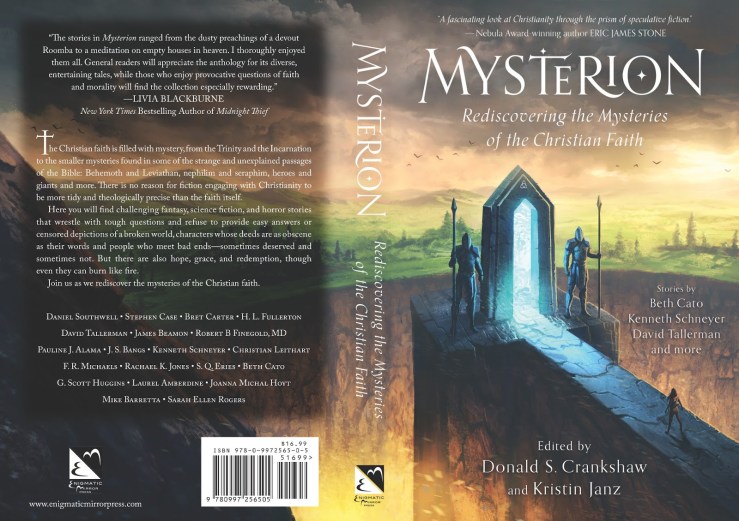
BOOK: Mysterion: Rediscovering the Mysteries of the Christian Faith, edited by Donald Crankshaw and Kristin Janz: Last week the husband and wife team of Donald Crankshaw and Kristin Janz published an anthology of science fiction, fantasy, and horror stories that engage with Christianity. It features twenty of the 450-plus submissions they received, all but four of which are published here for the first time. Describing their criteria for selection, Crankshaw writes in the introduction, “We wanted stories that were as untidy and as theologically imprecise as the Bible itself.” The result is a collection of diverse voices and approaches, exploring such topics as sin, forgiveness, the afterlife, the soul, mission, miracles, and supernatural agents. To read excerpts from the book, visit www.mysterionanthology.com.
Images shape our desires. As much as we like to think we’re immune to their influence, that we can encounter them without letting them tell us what is good or true or beautiful, they tend to work a subtle magic on us, especially after years of constant exposure.
I’m talking not just about advertisements and entertainment media, which perpetuate the myth that only one particular type of female body is attractive, and likewise one particular type of male body, and train us to desire that type for ourselves and for our partner.
I’m talking too about the seemingly innocuous images posted on social media. Studies have shown that regularly browsing Facebook, for example, can lead to depression, as users engage in social comparison that may cause them to resent both others’ lives as well as the image of themselves they feel they need to continuously maintain. A network member posts a photo of the just-because gift her amazing, so-thoughtful husband just bought her, and it makes you feel less loved. Another one posts a selfie taken from his scuba dive in Malta, and you wonder where all the adventure has gone in your life. A friend from high school posts a whole album of birthday photos of her two-year-old, and you are reminded of your ticking biological clock, or of her twenty-two-year-old in cap and gown, and you wish your kid had decided to go to college.
There’s nothing inherently wrong with images—creating or consuming. In fact, we need them. But we also need to beware of the propensity they have to plant themselves firmly in our minds and become idols. Whether it’s a perfume commercial on TV or an exotic dinner photo on Instagram, we need to break the power certain images have over us. Instead of allowing images to name us (“ugly,” “boring,” “unwanted,” “failure”), we must name them—denounce as false and unholy any image that claims ultimate authority in our lives, or that tries to redefine who we are against the definition scripture already gives us: we are Christ’s.
In his essay “The Desire of the Church,” published in The Community of the Word:Toward an Evangelical Ecclesiology (InterVarsity Press, 2005), Willie James Jennings discusses the distortion of sight and desire that is the result of the Fall. The tree of knowledge, he writes, was the first unholy icon in human history—an icon in the sense of being “a point of focus that facilitates desire and guides relationships” and “nurtures our seeing and knowing,” and unholy because to look on it was to begin the journey of disobedience. Gazing on the unholy icon of the tree, Adam and Eve saw themselves refracted through it, instead of gazing on God and seeing themselves reflected. By turning their gaze off God and fixating it on something lesser, they stopped seeing themselves, each other, and their Creator rightly.
“The only way to reverse this journey of disobedience,” Jennings says, “is to establish a new point of focus.” So into humanity comes the holy icon—Jesus Christ—whose life overcomes the fracture and fragment of desire. As the image of the invisible God, he reorients our gaze back onto the holy. Continue reading “Disciplining our eyes with holy images”→