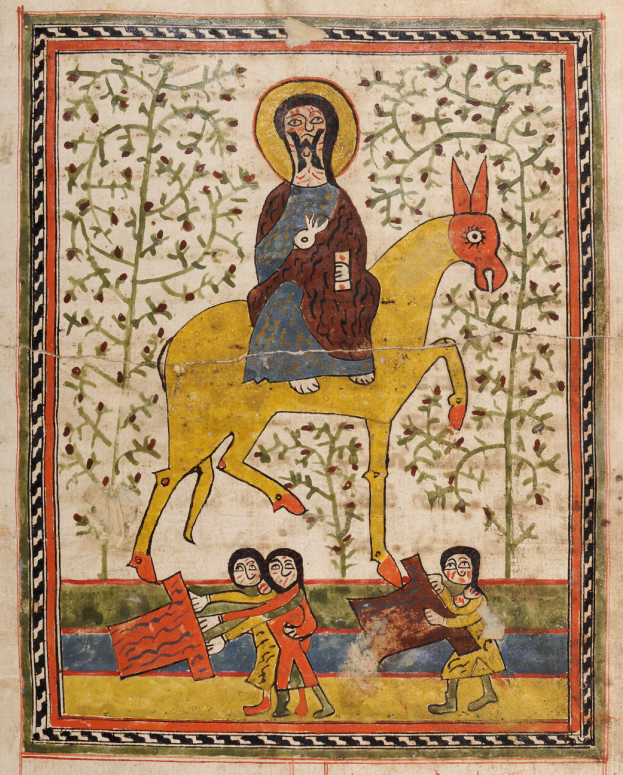
Christ’s Entry into Jerusalem, Alqosh, Iraq, 1723, from a Syriac Gospel lectionary. Collection of the Dominican Friars of Mosul (DFM 13, fol. 43v). Digitized in collaboration with the Centre Numérique des Manuscrits Orientaux (CNMO), Ankawa, Erbil, Iraq.
Made three centuries ago at a monastery in Iraq, this is one of three figurative paintings from a Syriac Gospel lectionary, the other two depicting Thomas touching Jesus’s wounds and the apocryphal saint George defeating a dragon. While the scribe is named in the manuscript as ʼEliyā bar Yaldā, the artist, if he is a different person (as they usually were), is not identified.
I love the fanciful coloration! Yellow and orange for the donkey, and a tricolored road of yellow, blue, and green. Plus, in the background, fruiting tree branches that climb and curl. The red striations on the figures’ necks and faces are, as far as I know, an idiosyncratic aesthetic choice of the artist’s; they may signify blood running through the veins, or perhaps the marks are simply decorative.
While the donkey is shown in profile, clopping along toward Jerusalem’s city center, Jesus rides sidesaddle and is oriented toward us, his eyes meeting ours. He holds a scroll in one hand, signifying that he is the fulfillment of Old Testament prophecies (most directly in this moment, Zechariah 9:9), and his right hand, which is heavily stylized, I can only assume is raised in a gesture of blessing, as it is in many other images of this subject.
At his feet, the people spread their cloaks, a sign of reverence.
Addendum: The following video of Palm Sunday celebrations in Iraq showed up in my Instagram feed a few hours after I published this blog post, and I thought it fitting to add.
LISTEN: “Hosanna! (Matthew 21:9 & 11)” by Frank Hernandez, for Steve Green’s Hide ’Em in Your Heart: Bible Memory Melodies, 1990 | Performed by Susanna and Rosalia, 2026
Blessed is he who comes in the name of the Lord Blessed is he who comes in the name of the Lord
Hosanna to the Son of David Hosanna in the highest Hosanna to the Son of David Hosanna, this is Jesus
Blessed is he (blessed is he) who comes in the name of the Lord Blessed is he (blessed is he) who comes in the name of the Lord
Hosanna to the Son of David Hosanna in the highest Hosanna to the Son of David Hosanna, this is Jesus
Hosanna (Hosanna) Hosanna (in the highest) Hosanna (Hosanna) Hosanna, this is Jesus
I learned this song two years ago when two girls from my church, sisters, sang it during the offertory for our Palm Sunday worship service. I asked them if they’d be willing to reprise their performance for my blog, as I love the sweetness of their voices together, and they obliged. They are thirteen and eleven years old.
Palm Sunday is an especially great day to utilize the children’s voices in your congregation for music or other parts of the liturgy, as Matthew mentions in his account of Christ’s entry into Jerusalem that “when the chief priests and the scribes . . . heard the children crying out in the temple and saying, ‘Hosanna to the Son of David,’ they became angry and said to [Jesus], ‘Do you hear what these are saying?’ Jesus said to them, ‘Yes; have you never read, “Out of the mouths of infants and nursing babies you have prepared praise for yourself” [Ps. 8:2]?’” (Matt. 21:15–16).
“Hosanna” is an expression that in this context means something like “Hooray for salvation!,” as John Piper puts it.
The enthusiasm of the masses upon Jesus’s arrival in Judea’s capital city for Passover, and especially their ascription to him of the messianic title “Son of David” (not to mention “prophet” and “wonderworker”), raised the hackles of the temple leadership. He was a threat to their authority and status and to their understanding of the scriptures. So they purposed, in collusion with Rome, to put him to death.
Holy Week starts this Sunday. Per usual, I’ll be publishing daily art and music pairings during that period (so, too, during the Easter Octave), but here is some additional art and music, and a theological reflection, for the occasion. You might also consider spending time with the Holy Week Playlist I curated on Spotify.
TENEBRAE SERVICE: Good Friday, April 2, 2021, Good Shepherd New York: Not all churches host a service on Good Friday, but for me, it is one of the most meaningful services of the year and helps make Easter all the more potent and celebratory. It wasn’t until 2011 that I attended my first Good Friday service—of the Tenebrae variety, Latin for “darkness,” meaning we started with multiple lit candles, and they were gradually extinguished throughout the evening, symbolizing the Light of the World dying out. If you’re curious about what such a service might look like, here’s a great example from 2021, from Good Shepherd New York. Filmed during the pandemic, it was a digital-only offering. As is typical, it combines song and scripture readings to tell the story of Christ’s death. Some Tenebrae services include a brief homily, but this one does not. I’ve included a list of time stamps to the songs below.
1:15: “When I Survey the Wondrous Cross” by Isaac Watts and Lowell Mason
6:26: “I Need Thee Every Hour” by Annie Hawks and Robert Lowry
24:28: “How Deep the Father’s Love for Us” by Stuart Townend
31:08: “Remember Me” by Paul Zach
35:50: “Were You There?,” African American spiritual (with a watercolor by Soyoung L Kim, inscribed with Isaiah 53:11a: “Out of the anguish of his soul he shall see and be satisfied”)
+++
INSTRUMENTAL MUSIC FOR GOOD FRIDAY: The one Facebook group I belong to is Liturgy Fellowship; I joined when I was a worship planner and stick around because of the many great resources, especially musical ones and ideas for marking holy days as a congregation, that are shared by Christians across denominations. One post I made note of is from Andrew Kerhoulas, the associate pastor at Grace Mills River in Mills River, North Carolina. As a prelude for their 2023 Good Friday service, he said, Grace Mills River musicians played an excerpt from the fifth movement of Olivier Messiaen’s Quartet for the End of Time. Here’s the full movement, performed by cellist Bingxia Lu and pianist Jackie Tu:
“The piece is avant-garde and not a little abrasive to those with pop music sensibilities,” Kerhoulas wrote to the group. “But once you know that it was written in 1941 by a French prisoner of war while in a German prison and first performed for fellow prisoners, it takes on depths of meaning. So too the cross: It is grotesque and horrific, but it becomes meaningful and even beautiful when you know the occasion—the deeper story—in which Jesus gave up his life.”
The church concluded its Good Friday service with a string quintet postlude, “On the Nature of Daylight” by Max Richter, played to the dimming of lights. Again, the following performance is not from Grace Mills River, but rather by Louisa Fuller, Natalia Bonner, John Metcalfe, Chris Worsey, and Ian Burdge for the fifteenth anniversary edition of The Blue Notebooks album.
Some people think that music used in Christian worship as a focal piece (i.e., not in the background) needs to have words to be worshipful and productive. I strongly disagree. Instrumental music conveys beauty and sets a mood and, yes, even communicates—often that which is difficult to express verbally. I love Grace’s thoughtful inclusion of these two modern and contemporary pieces from the classical tradition in their community’s observance of Good Friday.
+++
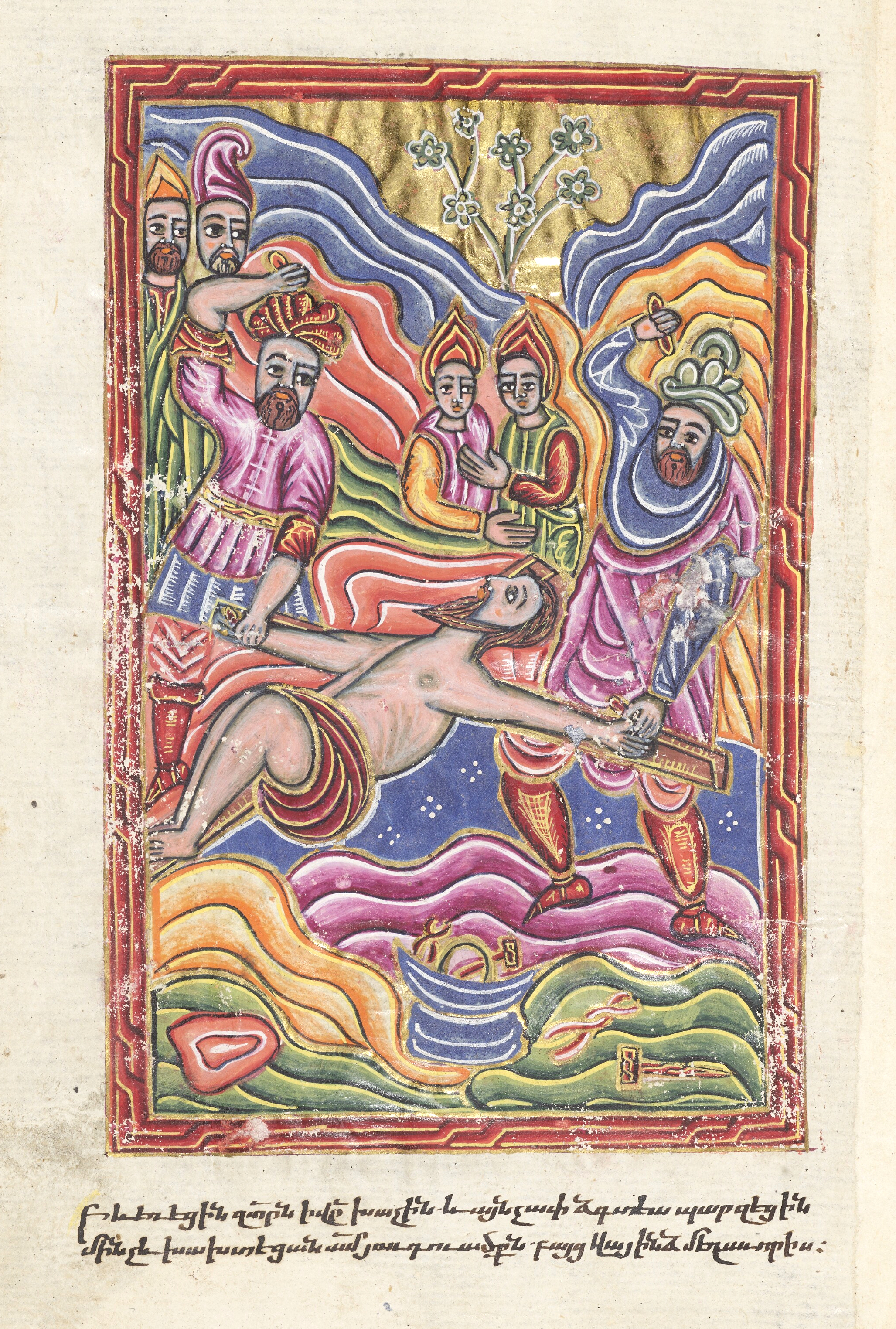
ART COMPILATION: “Crucifixion: Armenian Illuminated Manuscripts” by Levon Ounanian: This compilation brings together thirty-one Armenian miniatures of Christ’s passion. (Miniatures are painted illustrations in a manuscript, so called not because they’re small, though they usually are, but because artists often sketched them using a red lead pigment called minium.) According to the author, of the 31,000 Armenian manuscripts currently listed around the world, about 6,000 of them contain miniatures, not to mention the many more that contain non-narrative decoration.
Mesrop of Khizan (Armenian, active in Persia, ca. 1560–ca. 1652), The Nailing on the Cross, from an Armenian Gospel book, 1609. Oxford, Bodleian Library, MS. Arm. d.13, fol. 13v. Click to view the fully digitized manuscript.
+++
SONG: “Saare Paap” (सारे पाप) (All Sins), performed by James Bovas: In this video, James Bovas [previously] performs a Hindi version of a Malayam song about the Crucifixion. The Hindi lyrics and English translation were supplied to me by the Indian gospel media production company Sarah Creation.
सारे पाप और दाग ममटाकर, मुक्क्त देने के मलए मुक्क्त दाता ने बहाया, खून अपना क्रूस से खून के प्यासे भेडियों ने, आके घेरा यीशु को मारे कोिे टोकी कीले, धारे ननकली ज़ख्मों से मेरे मन तू याद कर ले, क्यों सहे दुुःख यीशु ने तेरा खानतर जान देकर, दी ररहाई यीशु ने श्राप सारे लेके मेरे, दे दी मुझको आमशषे यीशु के पावन लहू से, भाग्य मेरे खुल गए
To remove all the stains and sin, and to give salvation The Redeemer shed his blood on the cross Bloodthirsty wolves surrounded Jesus He was scourged, nailed, and a stream of blood issued forth from his wounds O my soul, never forget why Jesus suffered! He gave his life to set you free He took all my curses and gave me all the blessings By the holy blood of Jesus, my destiny changed forever
+++
ESSAY: “The Path from Death to Life” by Kurt Koch, Plough, March 30, 2024: A Catholic cardinal reflects on the dark side and the bright side of Holy Saturday. “As the day Jesus rested in the grave, Holy Saturday is the day of God’s concealment and silence in history,” Koch writes. “And yet, Holy Saturday also has a hopeful and joyful aspect. . . . [On this day] Jesus traveled to [Hades,] the place of greatest loneliness – a place completely bereft of any human relationships – and stirred the souls and limbs trapped by rigor mortis with the warming love of God. He transformed their grave into a place of new life.” This essay is anthologized in the revised and expanded edition of Bread and Wine: Readings for Lent and Easter (Plough, 2026).
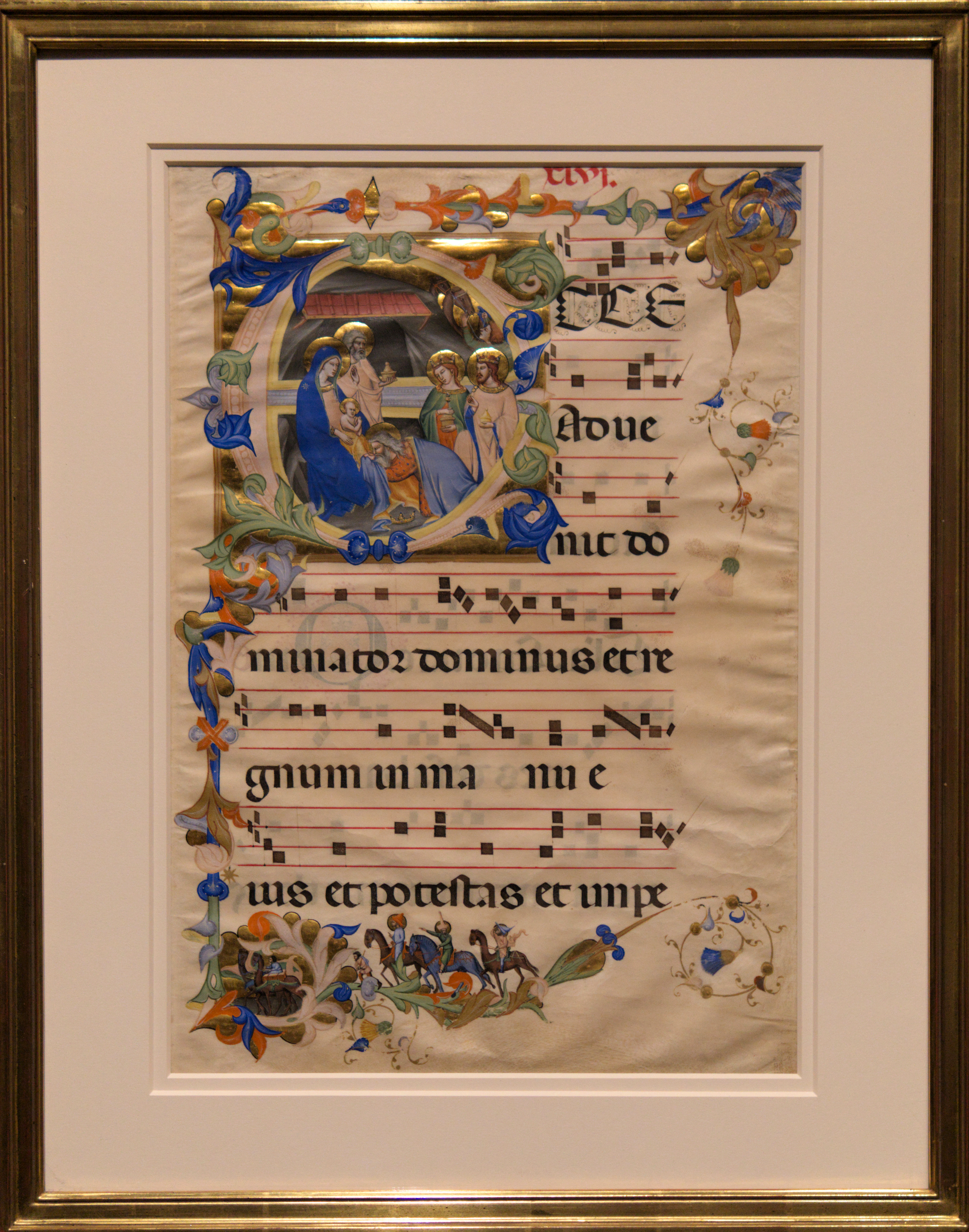
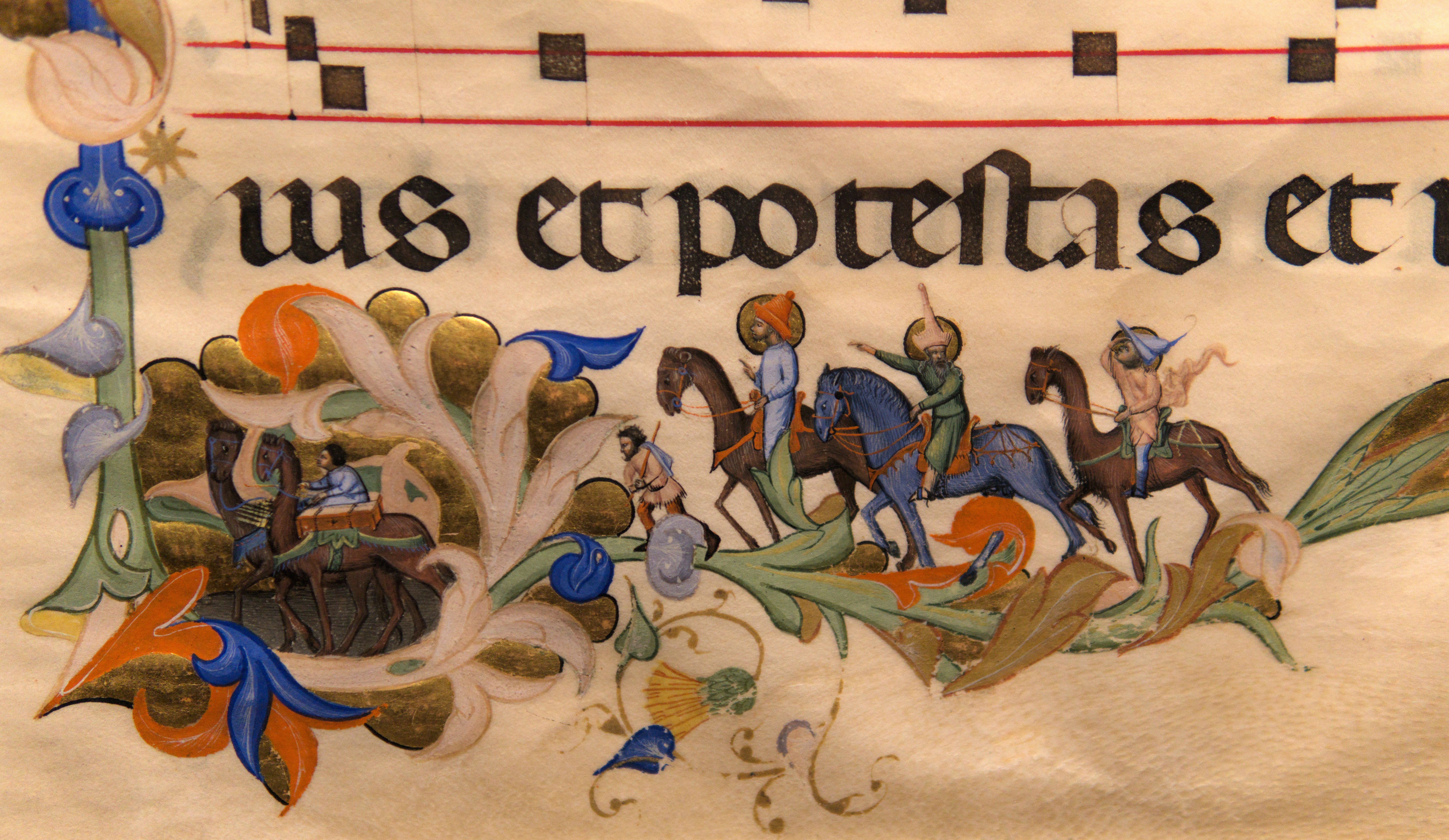
LOOK: Adoration of the Magi by Silvestro dei Gherarducci
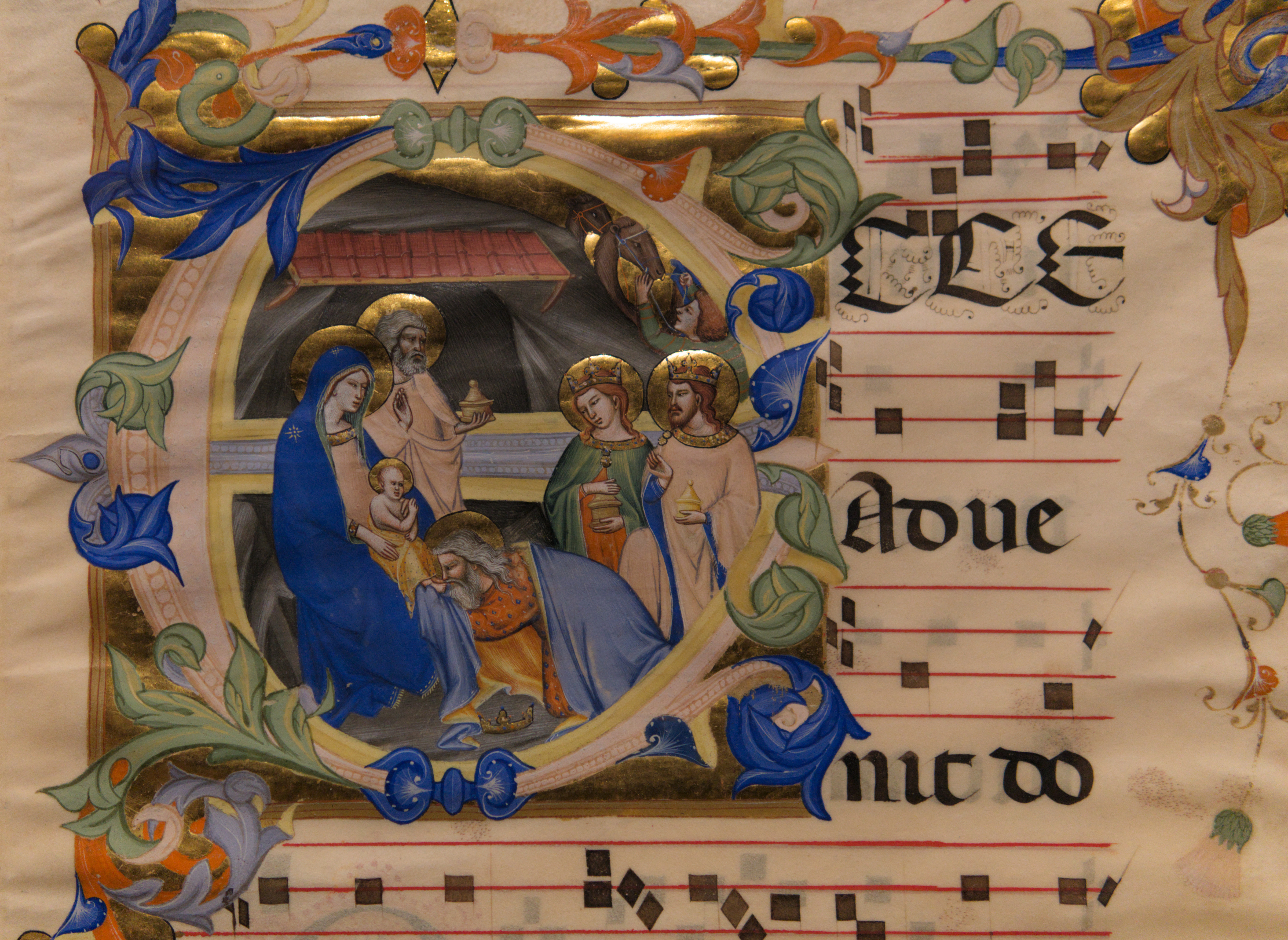
Silvestro dei Gherarducci (Italian, 1339–1399), Adoration of the Magi in an Initial E, cutting from a gradual, Florence, 1392–99. Illumination on parchment, 59 × 40 cm. Morgan Library and Museum, New York, MS M.653.5. All photos by Victoria Emily Jones. [object record]
(See commentary below.)
LISTEN: “Ecce advenit dominator Dominus” (Behold, the Sovereign Lord Is Come), introit for the Epiphany of the Lord, ca. 7th century | Performed by Floriani (men’s vocal ensemble), 2024
Ecce advenit dominator Dominus:
et regnum in manu eius
et potestas et imperium.

Deus, judicium tuum regi da,
et justitiam tuum filio regis.

Gloria patri,
et filio, et spiritui sancto,
sicut erat in principio,
et nunc, et semper,
in saecula saeculorum. Amen.
Behold, the Sovereign Lord is come,
and in his hand the kingdom,
and power, and dominion.

Give the king your justice, O God,
and your righteousness to a king’s son.

Glory be to the Father,
and to the Son, and to the Holy Spirit,
as it was in the beginning,
is now, and ever shall be,
world without end. Amen.
In the Roman Catholic Church, the introit (sung while the priest approaches the altar for the Eucharist) for the Mass of the Epiphany is derived from three Old Testament texts: Malachi 3:1, 1 Chronicles 29:12, and Psalm 72:1. It communicates the royalty of Christ.
The church has sung this cento since as far back as the seventh century. The musical notation has been preserved in graduals (books that collect all the musical items of the Mass).
Two years ago at the Morgan Library and Museum in New York, I saw an Ecce advenit leaf from a now-dispersed medieval gradual that caught my attention with its glimmering gold. It’s one of twenty-three cuttings that the museum owns from a manuscript made at the Camaldolese monastery of Santa Maria degli Angeli in Florence, Italy, in the late fourteenth century, for the monastery of San Michele a Murano in Venice. The illuminations are by the then-prior (head) of Santa Maria, Silvestro dei Gherarducci.
The primary image on the page is an Adoration of the Magi inside a letter E (for Ecce). When a scene or figures appear inside a large decorative letter at the start of a text section, it’s called a historiated initial.
In the scene, the Holy Family stands at the mouth of a cave—Jesus is seated on Mary’s lap, while Joseph stands beside them holding a vessel that the elder magus handed him, a gift for the Christ child. It was typical for artists to depict the three magi as different ages: young (beardless), middle-aged, and elderly (gray-haired). The oldest of the group kneels on the ground, lays down his crown, and kisses Christ’s feet while the other two await their turn. In the background, a servant restrains two bridled camels.
Across the top and left margins of the page is a colorful vine scroll, and in the lower margin there’s a bas-de-page depicting the magi following the star. I love their fantastic hats! The elder one, astride a horse, points the way forward (the guiding star shines from the left of the page near some blue foliage); the other two follow his direction on camels. In front of the caravan are two servants, one walking on foot with a bag slung over his shoulder, and the other riding a camel beside a second camel carrying a chest that contains the treasures the magi will bestow on the newborn king they’re journeying to pay homage to.
I like to imagine the community of Camaldolese monks in late medieval Venice singing from this choirbook on Epiphany, the lovingly wrought images of Christ-pursuing, Christ-worshipping magi enlivening their engagement with the gospel story and supplementing their own worship.
While monastic choirs have retained the monophonic style of music (that is, a single melody line sung in unison or traded off) that the church used for most of the Middle Ages—what we call Gregorian chant—over time, the church at large developed a taste for more elaborate, polyphonic music (that is, music with two or more simultaneous but relatively independent melodic lines), which came into full flower during the Renaissance and was sung in cathedrals.
To illustrate the difference between medieval monophony and Renaissance polyphony, here’s an example of the latter: the English composer William Byrd’s setting, from 1607, of the Ecce advenit. During his lifetime it was sung in Epiphany services in the Church of England as well as in the manor houses of recusant Catholic families (who were forced by law at the time to worship clandestinely).
Epiphany is no isolated and solitary act. It is a process: it is eternally typical of the Divine character. We will not merely look back over the long centuries at the manifestation that first flashed forth before the eyes of the Three Wise Men. Here and now, God is revealing Himself afresh before our very eyes. . . . For us too, clogged and choked by the dismal sand, there is a star that guides, a God who beckons. If only we would see!
Here are three sung invocations of the Holy Spirit, seeking his power, liberation, comfort, light, and renewal.
>> “Holy Spirit, Come with Power”: This hymn was written by Anne Neufeld Rupp in 1970, who set it to a Sacred Harp tune from 1844 attributed to B. F. White. It’s performed here by the Bel Canto Singers from Hesston College in Kansas, featuring Gretchen Priest-May on fiddle and Tim May on acoustic guitar.
I was introduced to this hymn through the Voices Together Mennonite hymnal, where it appears in both English and Spanish as no. 57.
>> “Mweya Mutsvene” (Holy Spirit, Take Your Place) by Joshua Mtima and The Unveiled:The Unveiled is a collective of Christian musicians from Harare, Zimbabwe, founded by Joshua Mtima in 2020. Here they sing one of their songs in Shona. An English translation is provided onscreen. [HT: Global Christian Worship]
>> “Ven Espíritu Divino (Secuencia de Pentecostés)” (Come, Spirit Divine) by Pablo Coloma, performed by Chiara Bellucci: The Spanish lyrics of this contemporary Christian song from the Latin American Catholic tradition are in the YouTube video description. They ask the Holy Spirit, “sweet guest of our souls,” to come bringing healing, regeneration, growth, joy, and charisms.
+++
SUBSTACK POST: “Veni Creator Spiritus: A Lush Middle English Hymn” by Grace Hamman, Medievalish: Dr. Grace Hamman shares Friar William Herebert’s (ca. 1270–ca. 1333) Middle English translation of the classic Latin Pentecost hymn attributed to Rabanus Maurus (ca. 780–856), “Veni Creator Spiritus” [previously]. Herebert uses words like vor-speker (for-speaker; i.e., intercessor), lodes-mon (lodesman; i.e., journeyman or navigator), and shuppere (shaper) as titles for the Holy Spirit.
+++
ORGAN WORK: “Improvisation on Veni Creator Spiritus” by Alfred V. Fedak: “Your congregation will hear the rushing of the Holy Spirit in this improvisatory prelude (taken from Fedak’s and Carl P. Daw’s oratorio The Glories of God’s Grace),” writes Selah Publishing. “Fedak effectively uses sweeping whole-tone scale passages and arpeggios to indicate the Spirit’s presence, while the pedal plays phrases of the hymn tune,” a medieval plainchant. The publisher has posted the following performance of the piece (audio only), by the composer himself, along with a selection of Pentecost art from the thirteenth to eighteenth centuries. [HT: Global Christian Worship]
There are many other works on organ (fantasias, partitas, fugues) based on the “Veni Creator Spiritus” tune; view a select list on Wikipedia.
+++
POEM:“Book of Hours”by Kimberly Johnson: “A pentecost of bloom: all the furred tongues / awag in the iris patch, windrush through the fireflower.” So opens the poem “Book of Hours” by Kimberly Johnson [previously], from her collection Uncommon Prayer (Persea, 2014). A book of hours is a genre of medieval prayer-book used by laypeople, which arranges prayers, scripture, and other devotional texts for reading at prescribed times of the day. Johnson’s “Book of Hours” draws on the fields of codicology (the study of manuscripts as physical objects) and botany to consider how God’s Spirit moves through and enlivens the material world, be it the irises, fire lilies, alyssum, and paperwhite narcissus in her garden, or the ink and natural pigments on calfskin—green verdigris, red cochineal, yellow curcumin—in the rare manuscripts library where she examines a book of hours whose embellished Latin text she can’t quite make out but whose beauty enraptures her nonetheless. These are but two untranslatable experiences of sensual, embodied communion with God that Johnson narrates in the collection, the paint flakes on her lips and the pollen on her wrist a chrism and a prayer.
LOOK: Incipit to the Gospel of John from the Book of Kells
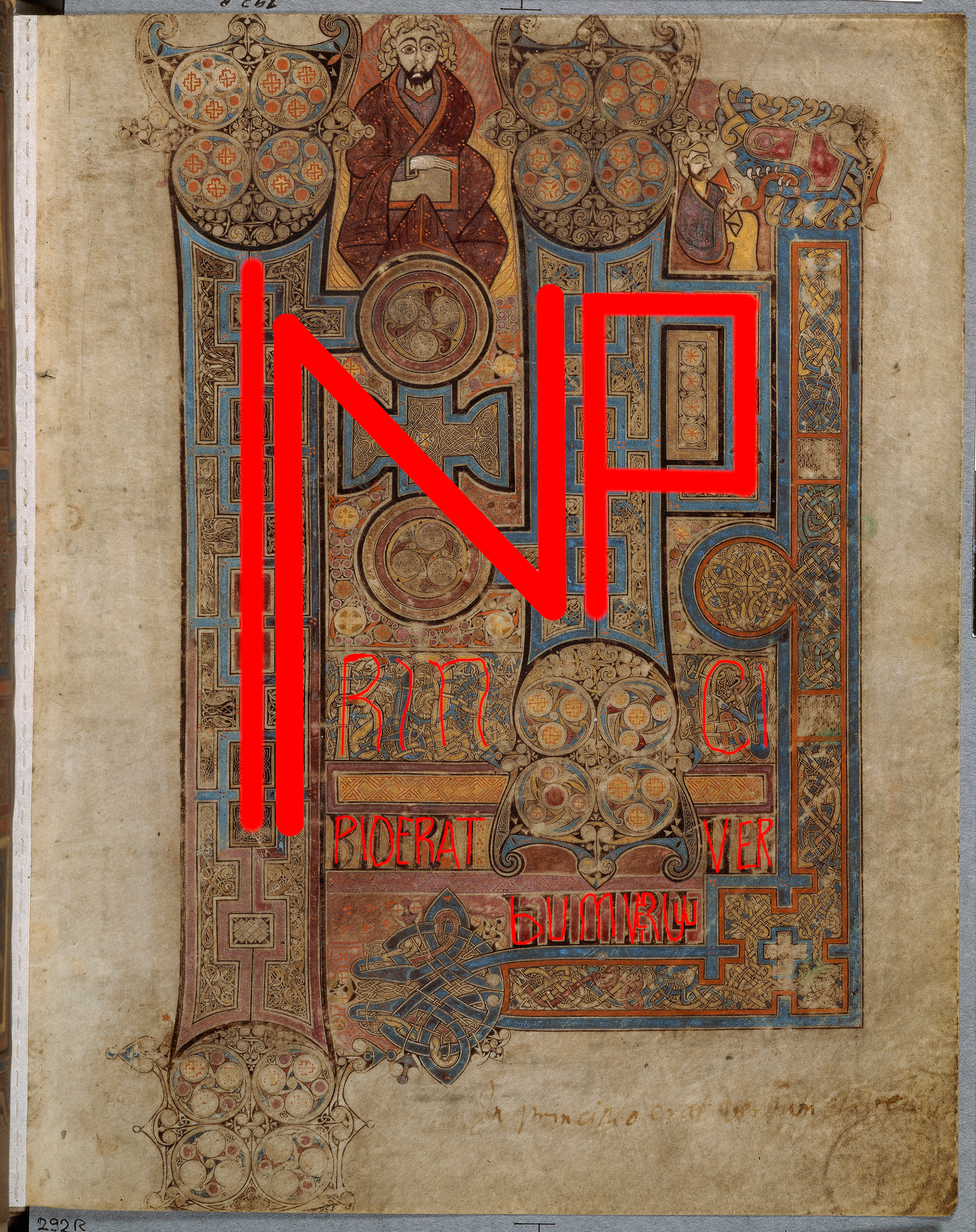
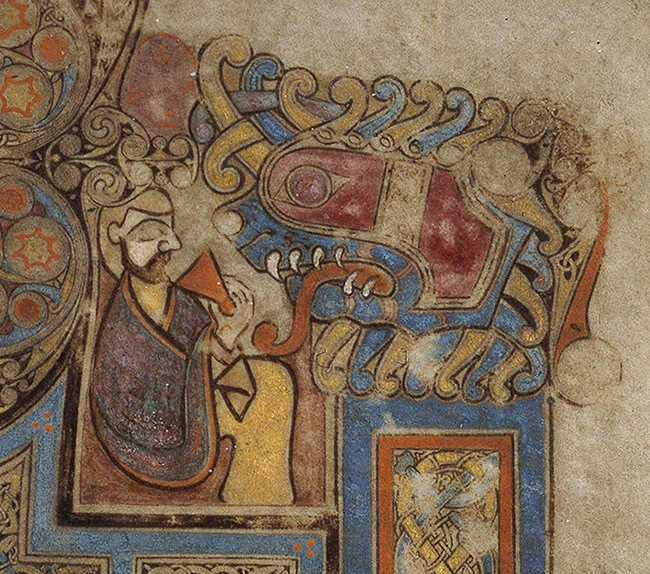
Incipit to the Gospel of John, Book of Kells, ca. 800. Trinity College Dublin MS 58, fol. 292r.
Made by Celtic monks in a Columban monastery around the year 800, the Book of Kells—an illuminated Gospel book named after the monastery of Kells in County Meath, Ireland, where it spent eight centuries—is one of the most beautiful manuscripts ever created. Pictured here is the lavishly decorated opening page of the Gospel of John, which bears the words “In p/rinci/pio erat ver/bum [et] ver[b]um” (“In the beginning was the Word, and the Word . . .”). The passage continues on the following page.
Bernard Meehan, the former head of research collections and keeper of manuscripts at Trinity College Dublin, describes the lettering on folio 292r:
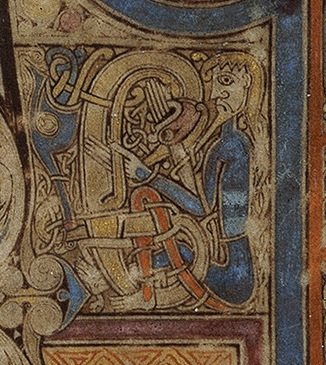
The letters IN P, filled with interlacing snakes, crosses and abstract ornament, dominate the composition. Snakes form the letters RIN and C, with C taking the form of a harp, played by the man who forms the letter I. The urge of the artist to decorate has taken precedence over legibility, to the extent that the letters ET and B are missing from the last line. [1]
Because some of the letters are difficult to discern, I’ve done my best to trace them in red in this graphic:
The text unfolds in four rows. The column on the left forms the I and doubles as the left stem of the N. The diagonal stroke of the N passes through the cross-shape, and its right stem is formed by another blue column, which also doubles as the stem of the P.
The following R, I, N, and C are beige and blue serpentine figures, tangled together, the latter shaped like a harp and being “played” by a seated man whose torso forms an I.
The remaining text is organized in two rows and is black. As Meehan mentioned, the artist-monk unintentionally omitted the ET and B in “et verbum.” And the final M is upside down, an artistic variation.
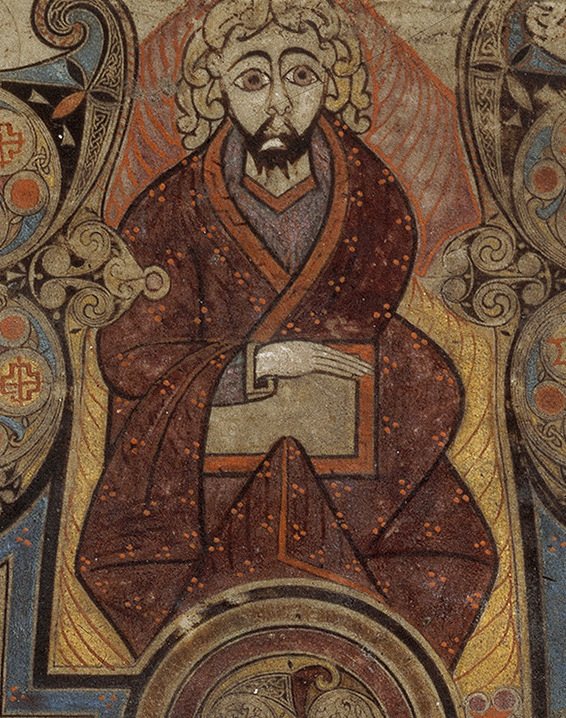
Scholars disagree on who the curly-haired figure at the top is, holding a book: some suppose it’s John the Evangelist, the author of the fourth Gospel, while others think it’s Christ the Logos. I’m in the latter camp. Christ is often shown in art sitting on a throne holding a book, representing the gospel—as on folio 32v of this very manuscript. And a full-page portrait of John already appears on the opposite page, folio 291v; granted, the iconography is similar, but it would be an unusual choice to repeat a person in the same pose on a single page spread. Also, as art historian Heather Pulliam points out, the yellow and red striations that encompass the figure resemble flame—a “throne of light,” writes Françoise Henry—an attribute more befitting of the figure of Christ than of John. [2]
The identity of the smaller figure on the right who’s drinking from a red chalice is also debated. Again, it could be either John or Christ. According to an apocryphal legend that first appeared in the second-century Acts of John and that was popularized in the thirteenth-century Golden Legend, a pagan priest challenged John to drink a cup of poisoned wine to test whether his God was truly powerful enough to protect him. John blessed the cup, downed the wine, and suffered no harm. That’s why in art one of John’s attributes is a chalice with a serpent in it, representing the poison rising out and the triumph of Christian faith.
On the other hand, the drinking figure may be Christ drinking the cup of suffering (John 18:11). The monstrous head to the right supports either interpretation—it could be Satan tormenting Christ in Gethsemane, or in John’s case, the threat of death by poison, or the evil intent of the pagan priest who sought to discredit him.
Additional possibilities have also been posited. Małgorzata Krasnodębska-D’Aughton argues that the man is meant to be a generic Christian partaking of the Eucharist, [3] whereas Pulliam suggests that the cup represents not the blood of Christ but “the chalice of wisdom received from the breast of Christ.” [4] She cites Augustine’s first tractate on the Gospel of John:
Thence John, who said these things, received them, brothers, he who lay on the Lord’s breast, and from the breast of the Lord drank in what he might give us to drink. But he gave us words; you ought then to receive understanding from the source, from that which he drank who gave to you; so that you may lift up your eyes to the mountains from where shall come your aid, so that from there you may receive, as it were, the cup, that is, the word, given you to drink; and yet, since your help is from the Lord, who made heaven and earth, you may fill your breast, from the source. [5]
In Pulliam’s interpretation, the man imbibes the words of God—that is, scripture—providing a model for us to emulate.
Bernard Meehan, The Book of Kells: An Illustrated Introduction to the Manuscript in Trinity College Dublin (Thames & Hudson, 1994, 2008), 34.
Heather Pulliam, Word and Image in the Book of Kells (Four Courts Press, 2006), 180–83; cf. Françoise Henry, The Book of Kells: Reproductions from the Manuscript in Trinity College, Dublin (Thames & Hudson, 1974).
Małgorzata Krasnodębska-D’Aughton, “Decoration of the In principio initials in early Insular manuscripts: Christ as a visible image of the invisible God,” Word and Image: A Journal of Verbal/Visual Enquiry 18, no. 3 (Fall 2002): 117.
Pulliam, Word and Image, 185.
Augustine, In Joannis Evangelium 1.1, PL 35: 1382.
LISTEN: “The Word Was God” by Rosephanye Powell, 1996 | Performed by the University of Pretoria Camerata, dir. Michael Barrett, 2022
In the beginning was the Word, and the Word was with God, and the Word was God.
The same was in the beginning with God.
All things were made that have been made. Nothing was made he has not made.
While this choral anthem is not a Christmas song per se, it is a setting of John 1:1–3, the opening of the great prologue of the Incarnation. These first three verses are about Christ’s eternal being, his oneness with the Father, and his active role in creation. I can’t hear them without anticipating verse 14: “And the Word was made flesh, and dwelt among us . . .”
“The Word Was God” is by Dr. Rosephanye Powell (pronounced ro-SEH-fuh-nee) (born 1962), an African American composer, singer, professor, and researcher. One of her most popular and widely recorded works, it is full of rhythmic energy and drive. Read detailed notes by Powell here, where she explains her musical choices and their theological significance.
LOOK: Jesus as Bridegroom of the Soul from the Rothschild Canticles
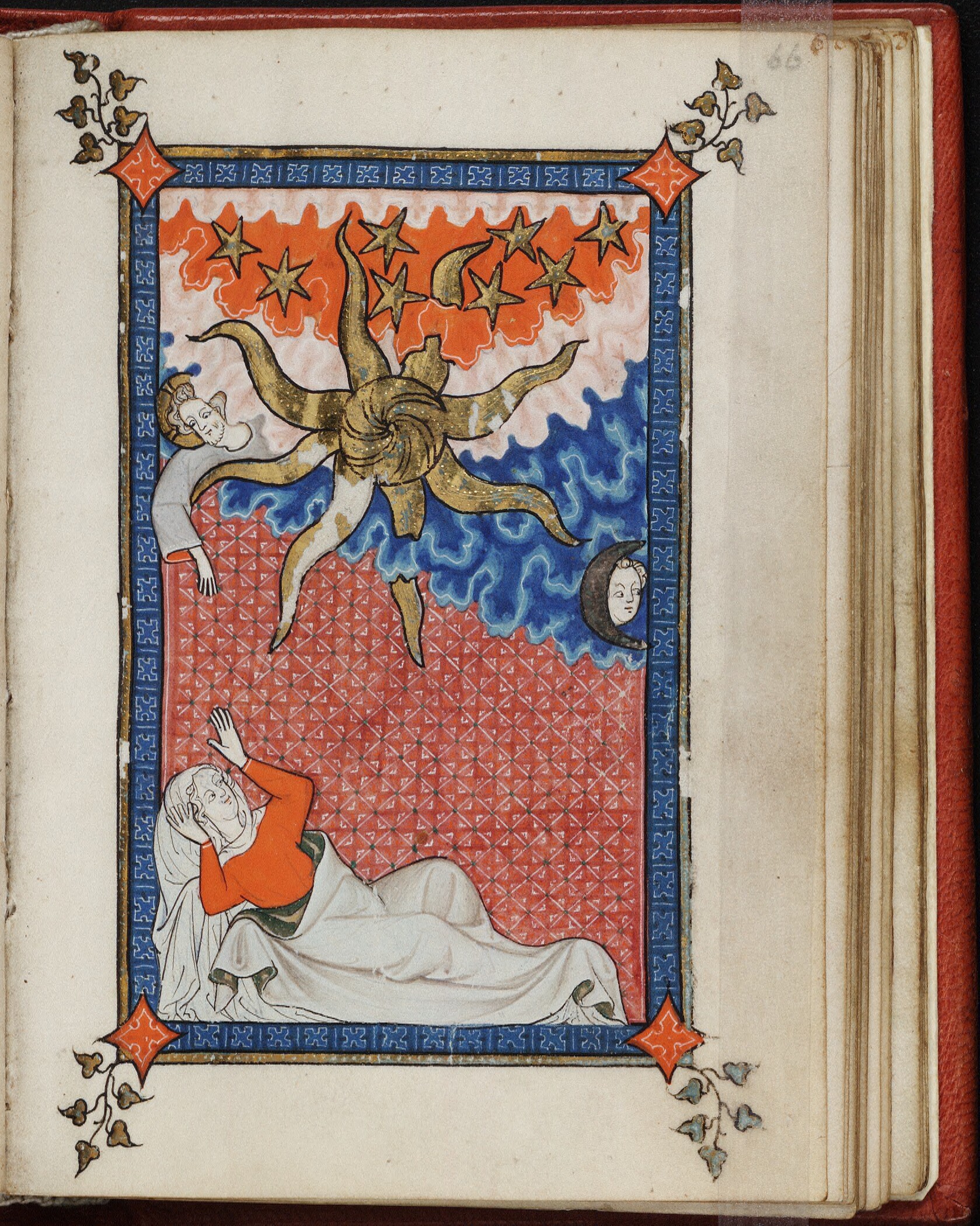
Jesus as Bridegroom of the Soul, from the Rothschild Canticles, Flanders or Rhineland, ca. 1300. Beinecke Library, Yale University, MS 404, fol. 66r.
The Rothschild Canticles from early fourteenth-century Flanders or the Rhineland (whose innovative Trinity miniatures I wrote about in 2021) is a cento of biblical, liturgical, and patristic citations accompanying an extraordinary program of images. Much of the content reflects the bridal mysticism that was popular at the time, emphasizing spiritual oneness with Christ. The compiler, artist(s), scribe(s), and original recipient of the manuscript are not known, but it was very likely made by a male monastic for a nun or canoness to use in her private devotions.
The miniature on folio 66r is the first in a five-miniature sequence (of which four survive) on the theme of mystical union. It shows the human soul, represented as a woman, about to receive her Bridegroom, Christ, in the marriage bed. Art historian Jeffrey Hamburger writes that in this image, “Christ emerges from the heavens with the energy of a cosmic explosion[,] . . . as a dramatic sunburst dissolving the mists. . . . Christ is the sun, its brightness, the light of the visio Dei. Just as sunlight generates heat, so Christ provokes desire.” [1] The artist uses that whirling sun with its tentacle-like rays as an attribute of Christ throughout the manuscript.
At her lover’s luminous descent, the Bride awakes from her sleep and raises her arms in ecstasy.
The face peeking out from behind the crescent moon on the right may be an angel, whose gaze directs us forward to the next scene, which shows the Bride reclining outdoors amid sprouting vines, “languish[ing] with love” (Song 2:5), and then being led into a wine cellar by the Bridegroom, to be inebriated by his sweet goodness (Song 2:4) .
The corresponding text on the facing page of this image, set inside a bedchamber, incorporates the following excerpts:
“I call you into my soul, which you are preparing for your reception, through the longing which you have inspired in it.”—Augustine, Confessions X.1
“God comes from Lebanon, the Holy One from the shady and thickly covered mountain.”—Habakkuk 3:3, used in medieval Advent liturgies
“I passed by you again and looked on you; you were at the age for love.”—Ezekiel 16:8
Plus miscellaneous adaptations of lines from the Song of Songs
In the Middle Ages it was common for Christian mystics, such as Mechthild of Magdeburg and Gertrude of Helfta, to describe and picture spiritual union in terms of physical union, as they “realized that bodily language better conveys the power, intensity, and personality of desire than overly spiritualized language does,” writes medievalist Grace Hamman. [2] And not only was the church, a corporate body, perceived as the bride of Christ, but so was the individual soul. The consummation of the marriage between Christ and his beloved was seen as eschatological, yes—coming at the end of time—but such intimate closeness and pleasure was also seen as something that could be enjoyed now on some level, as devotees commune with Christ through prayer, scripture reading, and the celebration of the Eucharist.
For the nun who used this book, it must have aided her in cultivating a deep love for Christ and strengthened her longing for that full and final coming together, when Christ will return to be with his bride.
LISTEN: Wachet auf, ruft uns die Stimme, BWV 140 by Johann Sebastian Bach, 1731| Words by Philipp Nicolai, 1599 (movements 1, 4, 7), and an anonymous other | Melody of movements 1, 4, and 7 by Philipp Nicolai, 1599
Here are two listening options—the first from an album, and the second a live performance that you can hear as well as watch.
>> Performed by the Monteverdi Choir and the English Baroque Soloists, dir. John Eliot Gardiner, on Bach: Cantatas BWV 140 and 147 (1992)
>> Performed by the Choir and Orchestra of the J. S. Bach Foundation, dir. Rudolf Lutz (soloists: Nuria Rial, Bernhard Berchtold, Markus Volpert), Evangelisch-Reformierte Kirche Trogen, Switzerland, 2008 (**The copyright owner has disallowed video embeds, but you can watch the video directly on YouTube by clicking the link below.)
In the libretto that follows, the capital letters in parentheses indicate which voice parts are singing that movement: soprano, alto, tenor, or bass.
1. Choral (SATB)
Wachet auf, ruft uns die Stimme,
der Wächter sehr hoch auf der Zinne,
wach auf, du Stadt Jerusalem.
Mitternacht heißt diese Stunde,
sie rufen uns mit hellem Munde,
wo seid ihr klugen Jungfrauen?
Wohlauf, der Bräut’gam kömmt,
steht auf, die Lampen nehmt,
Alleluia!
Macht euch bereit
zu der Hochzeit,
ihr müsset ihm entgegen gehn.

2. Rezitativ (T)
Er kommt, er kommt,
der Bräut’gam kommt,
ihr Töchter Zions, kommt heraus,
Sein Ausgang eilet aus der Höhe
in euer Mutter Haus.
Der Bräut’gam kommt, der einen Rehe
und jungen Hirschen gleich
auf denen Hügeln springt
und euch das Mahl der Hochzeit bringt.
Wacht auf, ermuntert euch,
den Bräut’gam zu empfangen;
dort, sehet, kommt er hergegangen.

3. Duett (SB) (Dialog - Seele, Jesus)
Wenn kömmst du, mein Heil?
 – Ich komme, dein Teil. –
Ich warte mit brennenden Öle.
Eröffne den Saal
  – Ich öffne den Saal –
zum himmlischen Mahl.
Komm, Jesu.
  – Ich komme, komm, liebliche Seele. –

4. Choral (T)
Zion hört die Wächter singen,
das Herz tut ihr vor Freuden springen,
sie wachet und steht eilend auf.
Ihr Freund kommt von Himmel prächtig,
von Gnaden stark, von Wahrheit mächtig,
ihr Licht wird hell, ihr Stern geht auf.
Nun komm, du werte Kron’,
Herr Jesu, Gottes Sohn,
Hosianna!
Wir folgen all
zum Freudensaal
und halten mit das Abendmahl.

5. Rezitativ (B)
So geh herein zu mir,
du mir erwählte Braut!
Ich habe mich mit dir
von Ewigkeit vertraut.
Dich will ich auf mein Herz,
auf meinen Arm gleich wie ein Sigel setzen,
und dein betrübtes Aug’ ergötzen.
Vergiß, o Seele, nun
die Angst, den Schmerz,
den du erdulden müssen;
auf meiner Linken sollst du ruhn,
und meine Rechte soll dich küssen.

6. Duett (SB) (Dialog - Seele, Jesus)
Mein Freund ist mein,
  – und ich bin dein, –
die Liebe soll nichts scheiden.
Ich will mit dir
  – du sollst mit mir –
im Himmels Rosen weiden,
da Freude die Fülle, da Wonne wird sein.

7. Choral (SATB)
Gloria sei dir gesungen,
mit Menschen- und englischen Zungen,
mit Harfen und mit Zimbeln schon.
Von zwölf Perlen sind die Pforten,
an deiner Stadt sind wir Konsorten
der Engel hoch um deine Thron.
Kein Aug’ hat je gespürt,
kein Ohr hat je gehört
solche Freude,
des sind wir froh,
io, io,
ewig in dulci jubilo.
1. Chorus (SATB)
Awake, calls the voice to us
of the watchmen high up in the tower;
awake, you city of Jerusalem.
Midnight the hour is named;
they call to us with bright voices;
where are you, wise virgins?
Indeed, the Bridegroom comes;
rise up and take your lamps,
Alleluia!
Make yourselves ready
for the wedding,
you must go to meet him.

2. Recitative (T)
He comes, he comes,
the Bridegroom comes!
O daughters of Zion, come out;
his course runs from the heights
into your mother’s house.
The Bridegroom comes, who like a roe
and young stag
leaps upon the hills;
to you he brings the wedding feast.
Rise up, take heart,
to embrace the Bridegroom;
there, look, he comes this way.

3. Duet (SB) (Dialogue - Soul, Jesus)
When will you come, my Savior?
  – I come, as your portion. –
I wait with burning oil.
Now open the hall
  – I open the hall –
for the heavenly meal.
Come, Jesus!
  – I come, come, beloved soul! –

4. Chorale (T)
Zion hears the watchmen sing,
her heart leaps for joy within her,
she wakens and hastily arises.
Her glorious beloved comes from heaven,
strong in mercy, powerful in truth;
her light becomes bright, her star rises.
Now come, precious crown,
Lord Jesus, the Son of God!
Hosanna!
We all follow
to the hall of joy
and hold the evening meal together.

5. Recitative (B)
So come in to me,
you my chosen bride!
I have to you
eternally betrothed myself.
I will set you upon my heart,
upon my arm as a seal,
and delight your troubled eye.
Forget, O soul, now
the fear, the pain
which you have had to suffer;
upon my left hand you shall rest,
and my right hand shall kiss you.

6. Duet (SB) (Dialogue - Soul, Jesus)
My friend is mine,
  – and I am yours, –
love will never part us.
I will with you
  – you will with me –
graze among heaven’s roses,
where complete pleasure and delight will be.

7. Chorale (SATB)
Let Gloria be sung to you
with mortal and angelic tongues,
with harps and even with cymbals.
Of twelve pearls the portals are made;
in your city we are companions
of the angels high around your throne.
No eye has ever perceived,
no ear has ever heard
such joy
as our happiness,
io, io,
eternally in dulci jubilo! [in sweet rejoicing]
Bach wrote this cantata during his time as cantor (music director) at St. Thomas Church in Leipzig, Germany, a post he served from 1723 until his death in 1750. (Imagine having Bach write and lead music for your church. During his first few years at St. Thomas, he composed a new cantata nearly every week for Sunday worship! His productivity is uncanny.) It premiered the twenty-seventh Sunday after Trinity Sunday, the final week of the liturgical year, on November 25, 1731, to correspond to the day’s assigned Gospel reading.
Bach scored the work for three vocal soloists—soprano (playing the Soul), tenor (the Watchman), and bass (Jesus)—a four-part choir, and an instrumental ensemble consisting of a horn, two oboes, taille, violino piccolo, strings, and basso continuo, including bassoon. Musicologist William G. Whittaker calls it “a cantata without weaknesses, without a dull bar; technically, emotionally and spiritually of the highest order. Its sheer perfection and its boundless imagination rouse one’s wonder time and time again.”
The first time I ever heard Bach’s Cantata 140 was in the Western music history course I took my first year of college. Our professor played a recording of the opening movement in class, then told us to go home and listen to the other six for homework—we would discuss them the next day. Sitting before my laptop at my dorm room desk, ensconced in my headphones, I was transported.
Bach’s Wachet auf, ruft uns die Stimme (Awake, calls the voice to us) is based on a chorale (congregational hymn) of the same name by the German Lutheran pastor, poet, and composer Philipp Nicolai, which conflates the parable of the ten virgins in Matthew 25 with the bridal theology of the Prophets and Revelation. The hymn appears in some English-language hymnals under the title “Wake, Awake, for Night Is Flying” (Catherine Winkworth) or “Sleepers, Wake! A Voice Astounds Us” (Carl P. Daw). Bach used the hymn’s three stanzas, both text and tune, for movements 1, 4, and 7.
The words of movements 2, 3, 5, and 6 are possibly by Picander (the pseudonym of Christian Friedrich Henrici), a frequent literary collaborator of Bach’s. Tender and rapturous, they draw on the imagery of the Song of Songs to describe the marriage of Christ and the human soul.
It’s a remarkable work. I encourage you to listen to it in one sitting—it’s twenty-eight minutes long—while you follow along with the lyrics. Revel in the love of Christ for you, his bride. Get excited for the sweet union to come.
As a bonus, here’s a gorgeous performance of the Nicolai hymn that forms the core of Bach’s cantata. It was arranged by F. Melius Christiansen in 1925 and performed in 2018 by the St. Olaf Massed Choirs under the direction of Anton Armstrong, using William Cook’s 1871 English translation:
Wake, awake, for night is flying, the watchmen on the heights are crying. Awake, Jerusalem, arise! Midnight’s solemn hour is tolling, his chariot wheels are nearer rolling; he comes; prepare, ye virgins wise. Rise up, with willing feet, go forth, the Bridegroom meet. Hallelujah! Bear through the night your well-trimmed light, speed forth to join the marriage rite.
Hear thy praise, O Lord, ascending from tongues of men and angels blending with harps and lute and psaltery. By thy pearly gates in wonder we stand, and swell the voice of thunder in bursts of choral melody. Hallelujah! No vision ever brought, no ear hath ever caught, such bliss and joy. We raise the song, we swell the throng, to praise thee ages all along.
Christianity has had a long and deep presence in Egypt. The art historical record is one means of exploring that.
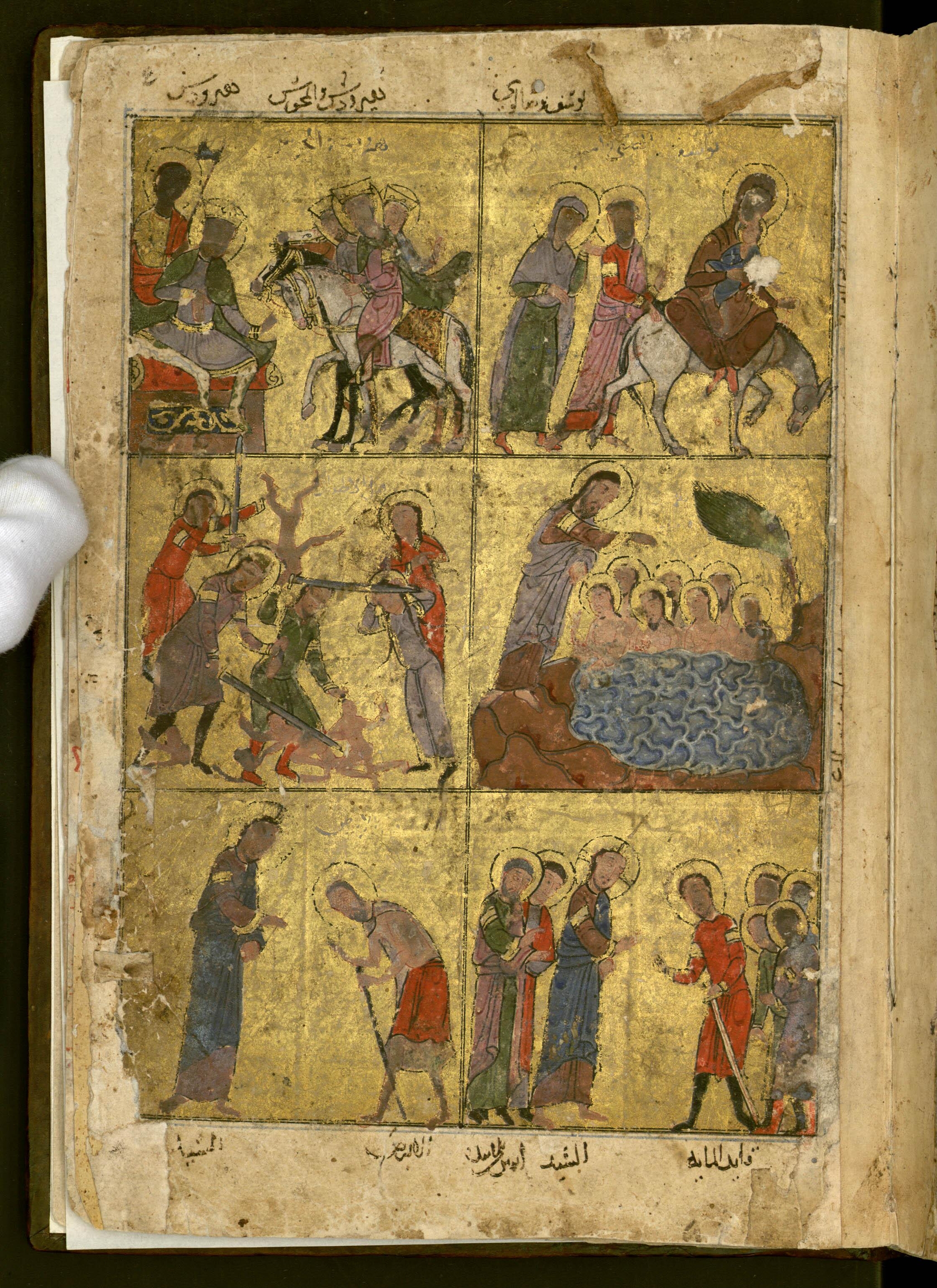
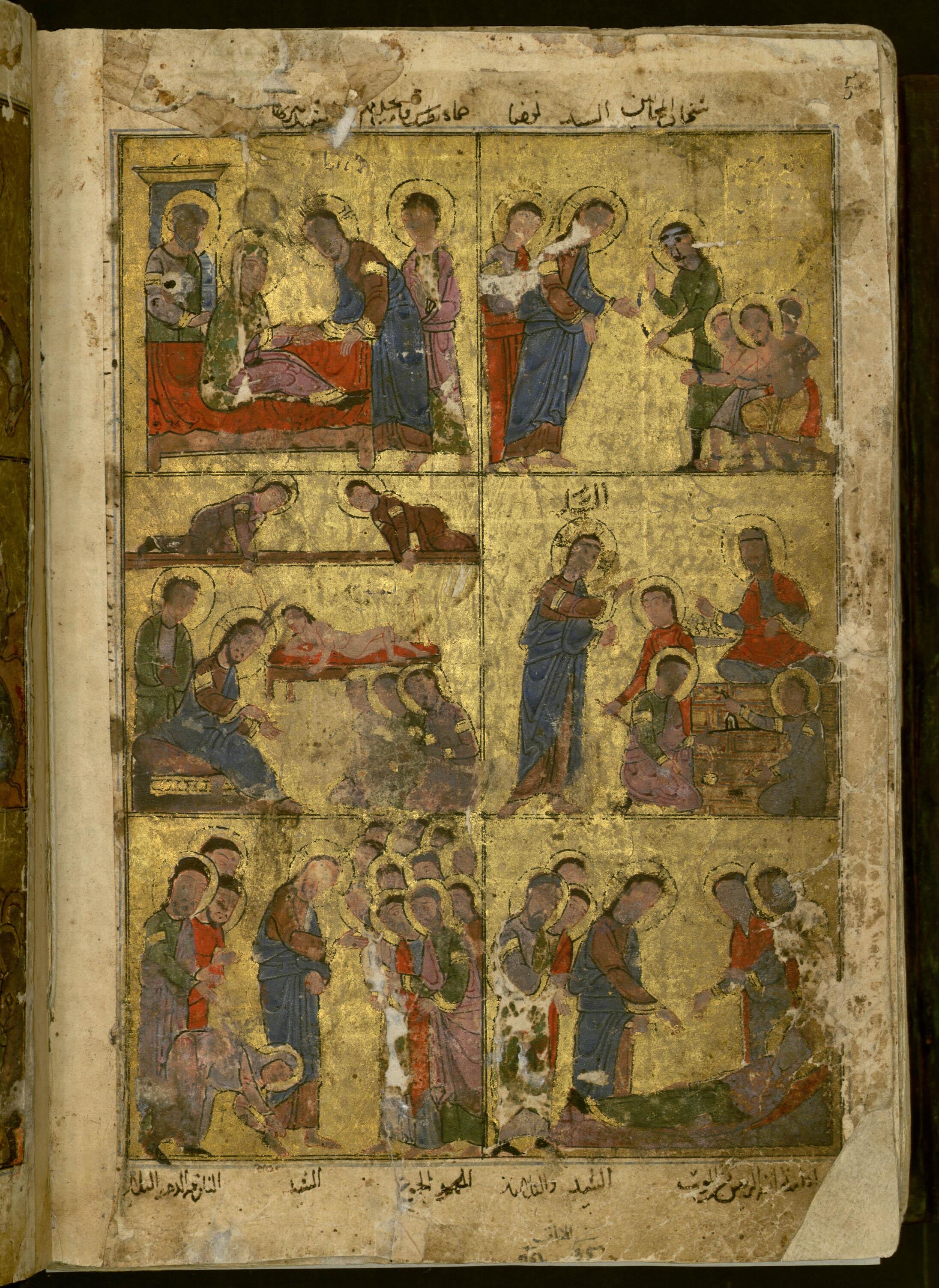
From mid-thirteenth-century Egypt there survives an illuminated New Testament written in Bohairic Coptic with glosses in Arabic. It was copied in Cairo in 1249–50 by Gabriel III (born al-Rashīd Farajallāh), who would serve as patriarch of Alexandria from 1268 to 1271, for the private use of a prosperous lay patron of the Coptic Church. The images are most likely the work of a single artist and his assistant.
This Coptic-Arabic New Testament is divided between two locations: the Four Holy Gospels in Paris (Institut Catholique, Ms. Copte-Arabe 1), and Acts of the Apostles and the Epistles in Cairo (Coptic Museum, Bibl. 94). In this post I will showcase the art from the Gospels portion.
Drawing on Byzantine and Islamic artistic influences, Copte-Arabe 1 “represents the culmination of painting in Egypt and the allied territory of Syria for the Ayyubid period [1171–1260] as a whole,” writes art historian Lucy-Anne Hunt. [1] The manuscript contains fourteen full-page miniatures and four Gospel headpieces. A later hand clumsily retouched in black ink some facial details that had become abraded over the years—so no, those marks most noticeable on folios 56v and 178v are not intended as mockery.
Of the fourteen full-page miniatures, four are portraits of the Evangelists (i.e., Gospel-writers): Matthew, Mark, Luke, and John. These are the most refined and celebrated paintings in the manuscript.
fol. 1v: Portrait of Matthew the Evangelistfol. 65v: Mark the Evangelist Receiving the Gospel from Peterfol. 105v: Portrait of Luke the Evangelistfol. 174v: Portrait of John the Evangelist
Each Evangelist is shown under a cusped arch—Matthew copying his Gospel in Arabic, Luke seated in front of a pulled-back curtain with a lotus design pattern, and John uniquely reclining, a pose adapted from secular models.
But the most interesting of the four Evangelist portraits is Mark’s, because there’s another figure with him. The owning institution labels the page “Marc l’évangéliste; Pierre lui donnant l’Evangile” (Mark the Evangelist; Peter giving him the Gospel). I had to look into this!
Traditionally, a man named John Mark is credited as the author of the Gospel that begins, “The beginning of the good news of Jesus Christ.” (It came to be called the Gospel of Mark by the end of the second century.) John Mark was a disciple of Peter, whom he is believed to have used as his primary source in composing his Gospel. The two were close companions, and Peter even refers to him as a son (1 Pet. 5:13). John Mark’s mother, Mary, hosted a house church that Peter was connected with (Acts 12:12). John Mark was also a cousin of Barnabas of Cyprus (Col. 4:10) and accompanied Paul in some of his apostolic travels (Acts 12:25; 13:1–5; 15:36–39).
Papias of Hierapolis, Irenaeus, Justin Martyr, Clement of Alexandria, Eusebius, Tertullian, and Origen—church fathers of the first two centuries of Christianity—all mention in their writings that Mark wrote his Gospels based on Peter’s eyewitness testimony and teachings. [2]
So folio 65v of Copte-Arabe 1 shows Peter passing on his intimate knowledge of Christ to Mark. As a sign of respect, Mark’s hands are covered with a cloth, ready to receive Peter’s notes.
Examining artistic precedents of this pair of men, Hunt writes:
Middle Byzantine iconographic sources can . . . be suggested for the Copte-Arabe 1 portrait of Mark with Peter (fol. 65v), which relates to the broad category of Evangelist portraiture with a second, usually inspiring figure. Mark appears seated, with Peter, who stands before him bearing the Gospel. More frequent are portraits of Peter dictating to Mark, the earliest known being that in the mutilated Greek New Testament in Baltimore (Walters Art Gallery W. 524) in which both are seated. Greek manuscripts with such portraits would have been accessible through the Syrian and Armenian communities. Two such twelfth century Gospels today in Jerusalem are the Greek Taphou 56 and the Armenian Theodore Gospels (Armenian Patr. 1796), showing the standing Peter dictating to the seated Mark. It has often been pointed out that secondary figures, either inspiring or presenting, are particularly common in Coptic and other oriental Christian art. [3]
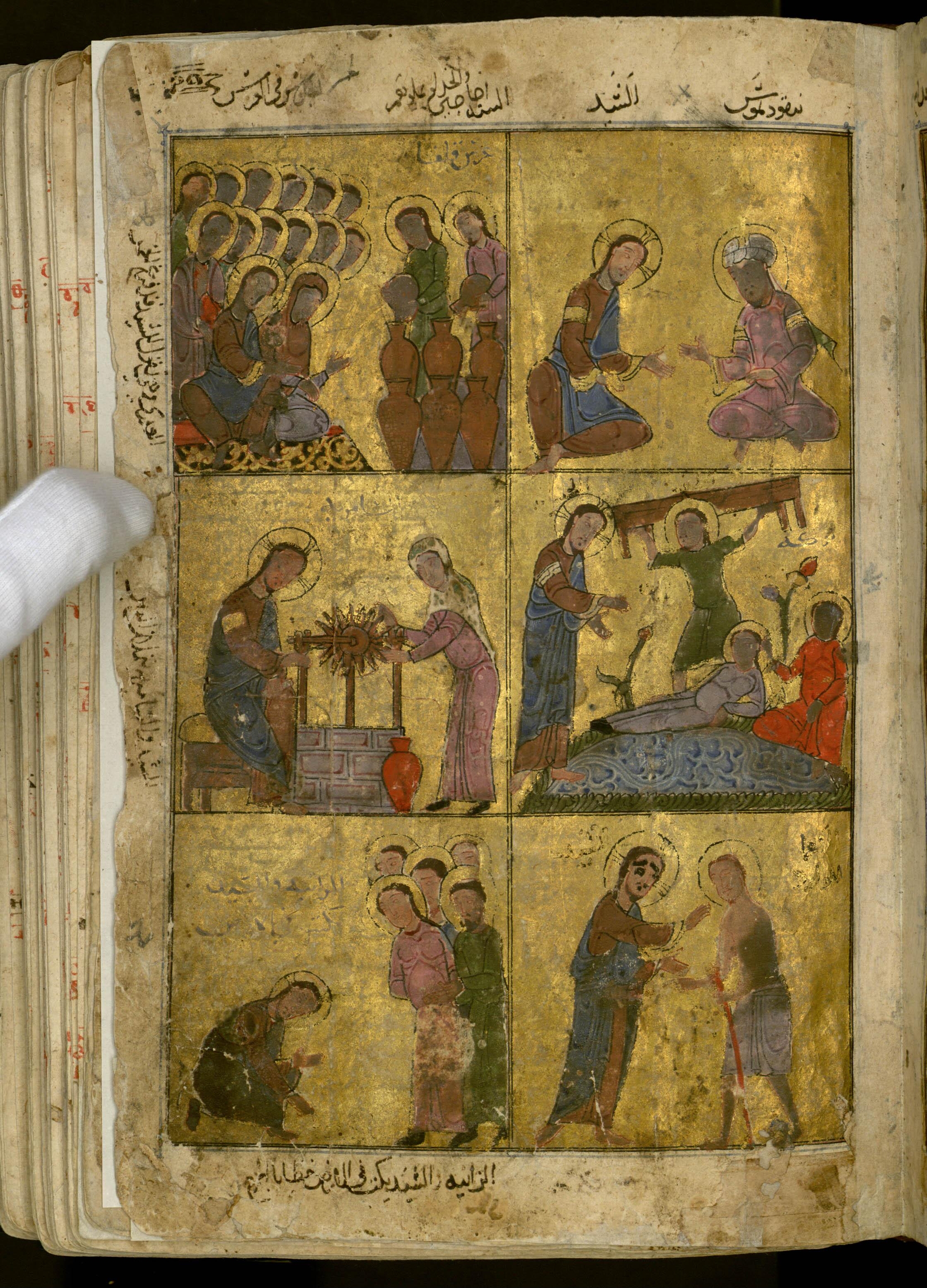
Now let’s take a look at the narrative images. I went through them all and attempted to identify each scene as best I could (I can’t read the Arabic inscriptions), which I label in the caption along with the scripture passage it illustrates. These descriptive titles are preceded by the folio number. Note that in manuscript studies, “fol.” or “f.” stands for “folio” (page), “v” stands for “verso” (a left-hand page), and “r” stands for “recto” (a right-hand page).
The first narrative scene in the manuscript, a header to the Gospel of Matthew, is a Nativity, with Mary reclining in the hollow of a cave and the Christ child lying swaddled beside her, adored by an ox and ass. An angel with folded hands peers reverently over a rocky outcrop, while shepherds approach from the left and magi from the right. Joseph is seated near his wife, eyeing the coming visitors.
fol. 2r: The Nativity (Matt. 1:25; 2:9–11; cf. Luke 2:1–7)
Later there follow six pages illuminating various stories from the Gospel of Matthew—the largest image sequence in the manuscript. As in the Gospels of Luke and John (there are none for Mark), these scenes are arranged on a grid system of six small squares to a page.
fol. 4v: The Magi before Herod (Matt. 2:7–8); The Flight to Egypt (Matt. 2:13–15); The Massacre of the Innocents (Matt. 2:16–18); John the Baptist Baptizes Converts (Matt. 3:1–12); Jesus Heals a Man with Leprosy (Matt. 8:1–4); A Centurion of Capernaum Seeks Healing for His Servant (Matt. 8:5–13)fol. 5r: The Healing of Peter’s Mother-in-Law (Matt. 8:14–15); Jesus Restores Two Demon-Possessed Men (Matt. 8:28–24); The Healing of the Paralytic (Matt. 9:1–8); The Calling of Matthew (Matt. 9:9–13); The Healing of the Woman with the Issue of Blood (Matt. 9:20–22); The Raising of Jairus’s Daughter (Matt. 9:18–19, 23–26)fol. 18v: Messengers from John the Baptist (Matt. 11:2–5); The Beheading of John the Baptist (Matt. 14:1–12); The Feeding of the Multitudes (Matt. 14:13–21); The Transfiguration (Matt. 17:1–13); Jesus Heals a Demon-Possessed Boy (Matt. 17:14–20); The Mother of James and John Requests a Favor (Matt. 20:20–28)fol. 19r: Jesus’s Disciples Fetch a Donkey (Matt. 21:1–6); Christ’s Entry into Jerusalem (Matt. 21:7–11); The Parable of the Wise and Foolish Virgins (Matt. 25:1–13); The Anointing at Bethany (Matt. 26:6–13); Jesus Washes His Disciples’ Feet (John 13:1–17); The Last Supper (Matt. 26:20–29)
From having seen other similar compositions, I know that the man holding the scroll and gesturing toward the donkey on folio 19r/1 is the prophet Zechariah, and that his scroll contains a portion of Zechariah 9:9: “Rejoice greatly, O daughter Zion! Shout aloud, O daughter Jerusalem! See, your king comes to you; triumphant and victorious is he, humble and riding on a donkey, on a colt, the foal of a donkey.”
fol. 56v: The Agony in the Garden (Matt. 26:36–46); The Kiss of Judas (Matt. 26:47–49); The Arrest of Christ (Matt. 26:50–56); Christ before Caiaphas (Matt. 26:57–66); The Denial and Repentance of Peter (Matt. 26:69–75); Christ before Pilate (Matt. 27:11–23)fol. 57r: Judas Returns the Blood Money and Hangs Himself (Matt. 27:1–10); Pilate Washes His Hands (Matt. 27:24–26); Christ Carries His Cross (Matt. 27:31); The Crucifixion (Matt. 27:33–56); The Deposition (Matt. 27:57–59); The Entombment (Matt. 27:59–61)
Strikingly, all the figures in this manuscript are given halos around their heads, not just holy figures—for example, King Herod, antagonistic Pharisees, Judas, the Roman soldiers who arrest and taunt Jesus, and the foolish virgins. I’m not sure the reason for this; it’s possible it marks the imago Dei in each and every human, even those who oppose Christ. I welcome the input of scholars better versed in Coptic art than I.
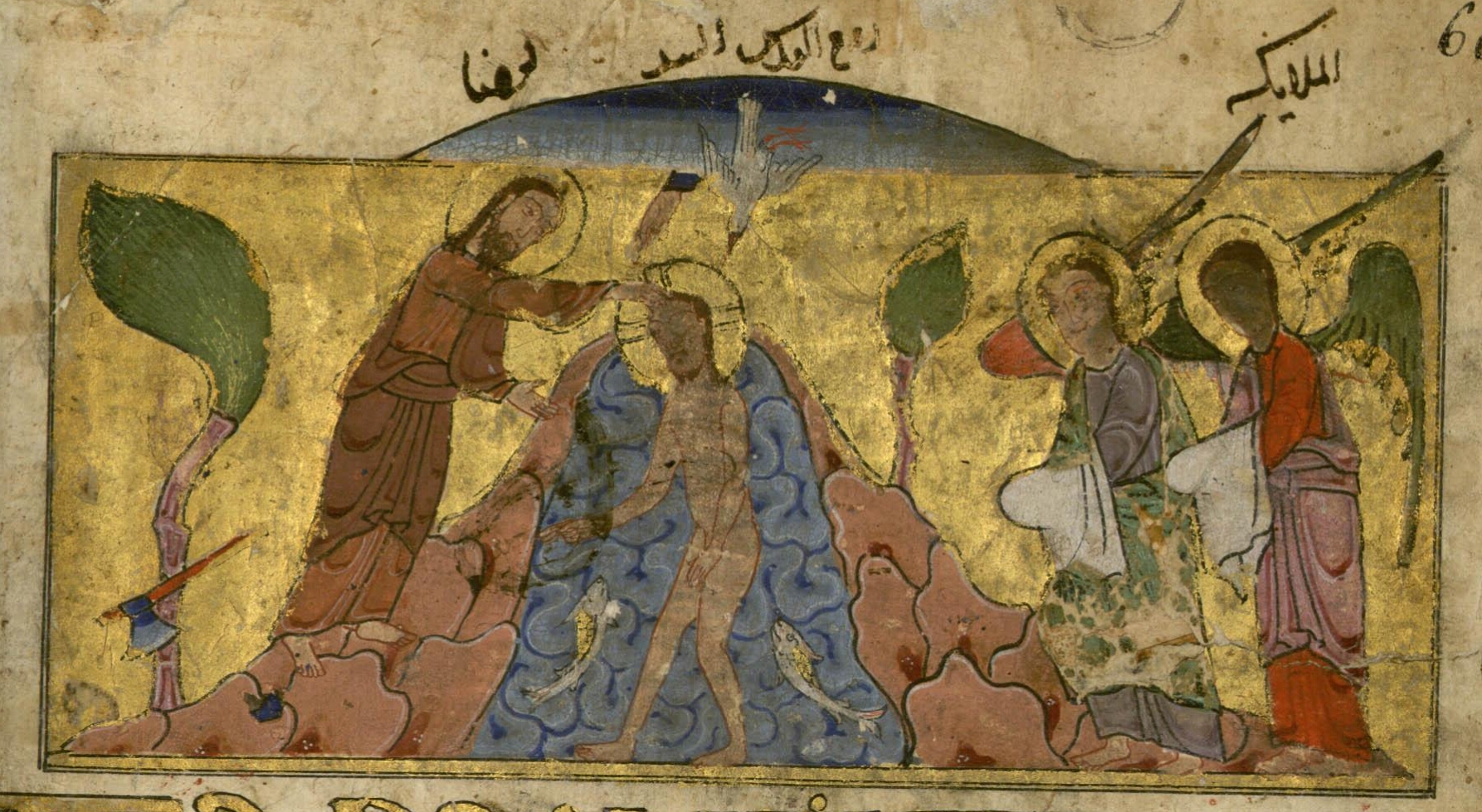
The headpiece to the Gospel of Mark portrays the Baptism of Christ. Fully nude, he is submerged in the Jordan River. John the Baptist stands on the bank and touches Christ’s head, while the hand of God the Father emerges from the heavens, pronouncing blessing over the Son, and the Holy Spirit as dove hovers above. Again, the manus velatae (veiled hands) motif appears, this time with the angels, signaling their reverence. On the left an ax cuts into the base of a tree, a reference to John the Baptist’s stark warning to the Sadducees and Pharisees who observe the baptisms: “Even now the ax is lying at the root of the trees; therefore every tree that does not bear good fruit will be cut down and thrown into the fire” (Matt. 3:10).
fol. 66r: The Baptism of Christ (Mark 1:9–11)
The next illumination is folio 106r, which opens the Gospel of Luke. It shows three scenes from Luke 1: the angel Gabriel announcing to the priest Zechariah that his wife, Elizabeth, will bear a son named John; Gabriel announcing to the virgin Mary that she will bear a son named Jesus; and Mary and Elizabeth rejoicing together in the unexpected news of their pregnancies and the divine deliverance they signal.
fol. 106r: The Annunciation to Zechariah (Luke 1:5–23); The Annunciation to Mary (Luke 1:26–38); The Visitation (Luke 1:39–56)
In the first full-page miniature from Luke (below), the third scene confuses me a bit. I’m fairly sure it’s supposed to be the twelve-year-old Jesus sitting among the doctors of the law in the temple at Jerusalem, as narrated in Luke 2:41–51; this episode is typically included in image cycles on the Life of Christ. But here he’s shown as a full-grown adult. The arch above the group is similar to the one shown in the previous frame where the infant Christ is presented in the temple forty days after his birth, suggesting that this is the temple, not a synagogue.
fol. 109v: The Birth of John the Baptist (Luke 1:57–58); The Presentation in the Temple (Luke 2:22–38); Christ Disputing with the Doctors in the Temple (Luke 2:46–47); Jesus Teaching in the Synagogue at Nazareth (Luke 4:16–20); The Religious Leaders Attempt to Push Jesus Off a Cliff (Luke 4:28–30); Jesus Raises the Son of the Widow of Nain (Luke 7:11–17)
Regardless, the next episode, portrayed on folio 109v/4, is one of my favorites in Luke’s Gospel: Jesus interpreting the Isaiah scroll at his hometown synagogue, announcing himself as the long-awaited Messiah and thereby launching his ministry.
When he came to Nazareth, where he had been brought up, he went to the synagogue on the Sabbath day, as was his custom. He stood up to read, and the scroll of the prophet Isaiah was given to him. He unrolled the scroll and found the place where it was written:
The Spirit of the Lord is upon me, because he has anointed me to bring good news to the poor. He has sent me to proclaim release to the captives and recovery of sight to the blind, to set free those who are oppressed, to proclaim the year of the Lord’s favor.
And he rolled up the scroll, gave it back to the attendant, and sat down. The eyes of all in the synagogue were fixed on him. Then he began to say to them, “Today this scripture has been fulfilled in your hearing.” (Luke 4:16–20; cf. Isa. 61)
When asked to expound, Jesus emphasizes how God’s plan of salvation is for all people, recounting two stories from the Hebrew scriptures in which God showed favor to Gentiles—namely, the widow of Zarephath and the Syrian general Naaman. Well, this really raises the ire of his Jewish audience, who believed the Messiah should act exclusively on their behalf. The artist of Copte-Arabe 1 shows on folio 109v/5 the culmination of this contentious encounter between the up-and-coming Jewish teacher making his way through Galilee and the old guard: an attempted murder!
When they heard this, all in the synagogue were filled with rage. They got up, drove him out of the town, and led him to the brow of the hill on which their town was built, so that they might hurl him off the cliff. But he passed through the midst of them and went on his way. (Luke 4:28–30)
On the following page, in the fifth frame, the Rich Man and Lazarus is one of Jesus’s three parables depicted in the manuscript. (The other two are of the Ten Virgins and the Good Samaritan.) The artist depicts not the impoverished, sore-laden Lazarus begging outside the wealthy Dives’s door in this life, but the afterlife. Lazarus, now whole, sits comfortably in Abraham’s bosom, while Dives, who lacked mercy on earth, is denied it in hell; he languishes in flames.
fol. 110r: Jesus Is Anointed by a Sinful Woman (Luke 7:36–50); The Parable of the Good Samaritan (Luke 10:25–37); The Healing of the Woman with a Bent Back (Luke 13:10–17); The Healing of the Man with Edema(?) (Luke 14:1–6); The Rich Man and Lazarus (Luke 16:19–31); The Healing of the Ten Lepers (Luke 17:11–19)
I’m not sure what the center right scene depicts, but given its placement in the sequence, its setting in a lavish interior, and Jesus’s clear presence at the left (as indicated by the cross in his halo; which I’d say precludes the figures being characters in a parable), my best guess is it represents the healing of the man with edema (dropsy), which takes place in the house of a prominent Pharisee.
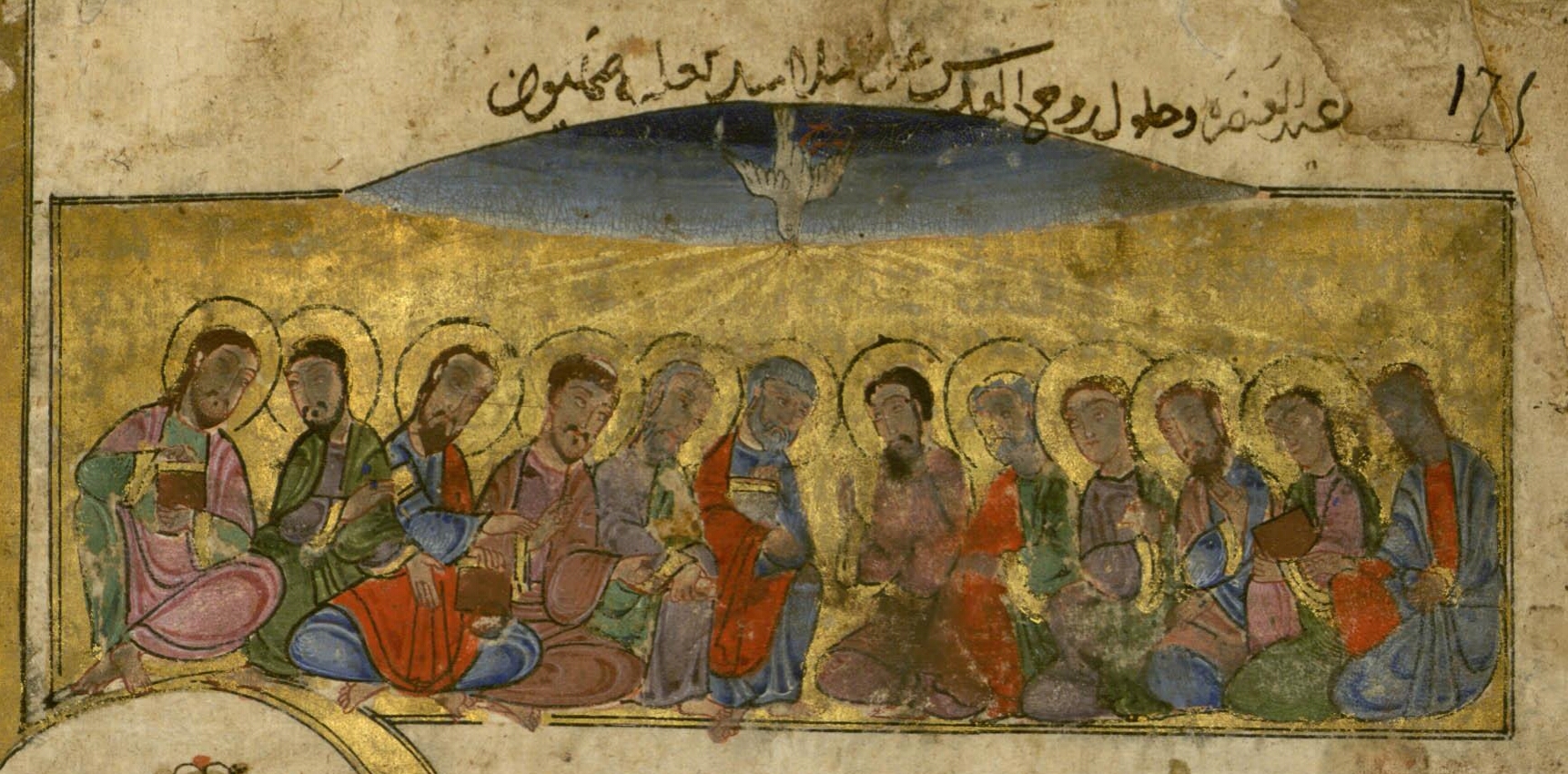
Further into the manuscript, our anonymous artist commences the fourth and final Gospel, John, with a depiction of the descent of the Holy Spirit on the apostles at Pentecost—an event described not in John’s Gospel but in the book of Acts.
fol. 175r: The Descent of the Holy Spirit (Acts 2:1–13)fol. 178v: The Wedding at Cana (John 2:1–12); Jesus Teaches Nicodemus (John 3:1–21); The Woman at the Well (John 4:1–26); The Healing at the Pool of Bethesda (John 5:1–15); The Woman Caught in Adultery (John 8:1–11); The Healing of the Man Born Blind (John 9:1–12)fol. 179r: The Raising of Lazarus (John 11:1–44); The Holy Women at the Tomb (Mark 16:1–8); The Road to Emmaus (Luke 24:13–27; cf. Mark 16:12); The Incredulity of Thomas (John 20:24–29); The Miraculous Catch of Fish (John 21:1–14); The Ascension (Luke 24:50–53)
Folio 179r also contains scenes whose scriptural referents are from other Gospels: four women arriving at Christ’s empty tomb on Easter morning (John mentions only Mary Magdalene, Matthew mentions two women, Mark mentions three, and Luke speaks generally of “the women”); the risen Christ meeting two pilgrims on the road to Emmaus; and Christ’s ascent into heaven. I suppose it’s because this final full-page miniature is Resurrection-themed, so the artist harmonizes the four Gospels, pulling relevant highlights from each.
Each month I put together a collection of thirty songs on Spotify—an assortment of psalms, hymns, and spiritual songs, old and new. Here’s the playlist for May:
+++
PRESS RELEASE: “Belmont University Launches Creative Arts Collective for Christian Life and Faith”: Supported by a $32 million grant from the Lilly Endowment, Belmont University in Nashville announced on March 26 the launch of a major new nationwide initiative: the Creative Arts Collective for Christian Life and Faith. “Positioned at the intersection of faith and artistry, the Creative Arts Collective is a vibrant community dedicated to exploring the divine through the lens of creativity. We believe in the transformative power of the arts to connect us with God’s profound narrative, uplifting spirits, and uniting hearts in a shared journey of discovery.”
The executive director is Rick Rekedal, who worked for twenty years at DreamWorks Animation on such projects as Shrek, Trolls, Prince of Egypt, Madagascar, Kung Fu Panda, and How to Train Your Dragon.
I’m looking forward to seeing what they do in the coming year!
+++
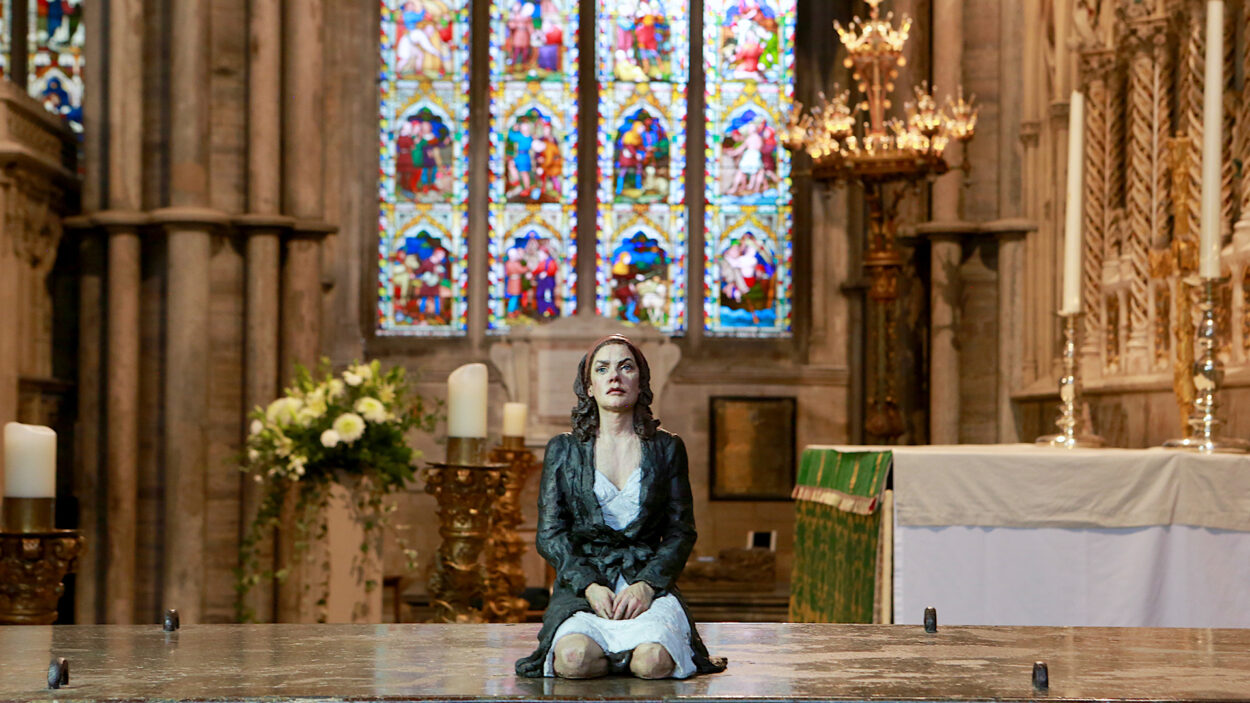
ART EXHIBITION: “Am I my brother’s keeper?” by Sean Henry, Ely Cathedral, England, April 26–September 1, 2024: Curated by Jacquiline Creswell [previously], this new exhibition places twenty-eight painted, contemporary figures from the oeuvre of British sculptor Sean Henry in various spaces in and outside the historic Ely Cathedral. The exhibition is titled after Cain’s indifferent response to God in Genesis 4, after he has just murdered his brother—a question that prompts us to consider our moral responsibility to care for and support one another.
Sean Henry (British, 1965–), T.P.O.L.R., 2005, bronze, and LM, 2014, bronze. From “Am I my brother’s keeper?,” an exhibition at Ely Cathedral, 2024. Photo courtesy of the cathedral.Sean Henry (British, 1965–), Hedda, 2018, ceramic. From “Am I my brother’s keeper?,” an exhibition at Ely Cathedral, 2024. Photo courtesy of the cathedral.
Henry “captures the human form with compassion, depicting the emotions, struggles, and joys that define us as human,” Creswell writes. “His figures also convey the vulnerability, strength and resilience that exist within each individual. They tell stories, evoke emotions and create connections with the viewer.” View more photos from the exhibition on Creswell’s Instagram page, and see also photos from the similar exhibition she curated for Salisbury Cathedral in 2011, Conflux: A Union of the Sacred and Anonymous.
+++
VIDEO INTERVIEW:“Faith Ringgold’s art of fearlessness and joy”: Faith Ringgold (1930–2024), the trailblazing artist best known for her story quilts documenting African American life, died this month at age ninety-three. This CBS Sunday Morning segment from 2021 is a good introduction to her and her work, which you can explore more of at www.faithringgold.com.
Faith Ringgold (American, 1930–2024), Church Picnic Story Quilt, 1988. Tie-dyed, printed fabrics and acrylic on cotton canvas, 74 1/2 × 75 1/2 in. High Museum of Art, Atlanta.Faith Ringgold (American, 1930–2024), The Flag Is Bleeding #2, from the American Collection series, 1997. Acrylic on canvas, painted and pieced border, 76 × 79 in. Pippy Houldsworth Gallery, London.
+++
HYMN FOR ASCENSION DAY (May 9):
“See the Conqueror mounts in triumph” is a ten-stanza hymn by Christopher Wordsworth, nephew of the great poet William Wordsworth, published in his collection The Holy Year in 1862. The Hymnology Archive provides the full lyrics, a revision history, a textual analysis, and sheet music for the tune Wordsworth preferred for it and the one Henry Smart wrote for it six years later. This is not a widely sung hymn, however. I’ve enjoyed hearing how contemporary songwriters have revitalized it through new tunes. Here are two examples:
>> Music by Jenny & Tyler, on Open Your Doors (2012): This married musical duo living in Nashville, Tennessee, uses a 6/8 time signature in their setting, and they’ve added a bridge.
>> Music by Wes Crawford, on Hymns for This World and the Next (2024): Wes Crawford, the worship pastor at Christ Church of Austin, released an album of thirteen retuned hymns this February, and “See the Conqueror” is one of them.
We need more Ascension hymns! Search this site’s “Ascension” tag to find a few more, as well as other Ascension Day content (sometimes mixed into roundups with other miscellany).
+++
ART COMPILATION: “Ascending Jesus—The Last Glimpse” by Aidan Kimmel: Fr. Aidan Kimmel has compiled eighteen medieval paintings depicting the Ascension of Christ, mostly from manuscripts. In several Jesus leaves behind footprints on the Mount of Olives. So delightful!
The Ascension, from a Bible moralisée made in Bruges, ca. 1455–60. The Hague, National Library of the Netherlands, KB, 76 E 7, fol. 219r. The foregrounded figures are Saint Peter and the Virgin Mary.
Then I saw in the right hand of the one seated on the throne a scroll written on the inside and on the back, sealed with seven seals, and I saw a mighty angel proclaiming with a loud voice, “Who is worthy to open the scroll and break its seals?” And no one in heaven or on earth or under the earth was able to open the scroll or to look into it. And I began to weep bitterly because no one was found worthy to open the scroll or to look into it. Then one of the elders said to me, “Do not weep. See, the Lion of the tribe of Judah, the Root of David, has conquered, so that he can open the scroll and its seven seals.”
Then I saw between the throne and the four living creatures and among the elders a Lamb standing as if it had been slaughtered, with seven horns and seven eyes, which are the seven spirits of God sent out into all the earth. He went and took the scroll from the right hand of the one who was seated on the throne. When he had taken the scroll, the four living creatures and the twenty-four elders fell before the Lamb, each holding a harp and golden bowls full of incense, which are the prayers of the saints. They sing a new song:
You are worthy to take the scroll and to break its seals, for you were slaughtered and by your blood you ransomed for God saints from every tribe and language and people and nation; you have made them a kingdom and priests serving our God, and they will reign on earth.
Then I looked, and I heard the voice of many angels surrounding the throne and the living creatures and the elders; they numbered myriads of myriads and thousands of thousands, singing with full voice,
Worthy is the Lamb that was slaughtered to receive power and wealth and wisdom and might and honor and glory and blessing!
Then I heard every creature in heaven and on earth and under the earth and in the sea and all that is in them, singing,
To the one seated on the throne and to the Lamb be blessing and honor and glory and might forever and ever!
And the four living creatures said, “Amen!” And the elders fell down and worshiped.
—Revelation 5 (NRSV)
LOOK: The Vision of the Lamb in the Midst of the Four Living Creatures, from a medieval English apocalypse
The Vision of the Lamb in the Midst of the Four Living Creatures and the Twenty-Four Elders, made in London, ca. 1255–60. Tempera, gold leaf, colored washes, and pen and ink on parchment, 12 9/16 × 8 7/8 in. (31.9 × 22.5 cm). J. Paul Getty Museum, Los Angeles, Ms. Ludwig III 1 (83.MC.72), fol. 5.
>> “He Is Lord (In Every People),” adapt. Gregory Kay: In this video from 2021, members of Spring Garden Church in Toronto take turns singing the popular twentieth-century worship song (of unknown authorship) “He Is Lord” in their native languages: English, Portuguese, Arabic, Korean, and Chinese. Greg Kay, one of the church’s copastors, added a fun refrain that highlights the global character of Christianity and the lordship of Christ over all creation, which everyone joins in on. Love this idea! [HT: Liturgy Fellowship]
>> Easter Medley performed by Infinity Song, feat. Victory Boyd:Infinity Song is a sibling band from New York City that was led for years by Victory Boyd, who is now focusing on her solo music career; its current members, represented in this video from 2021, are Abraham, Angel, Israel, and Thalia “Momo” Boyd. (Victory is singing lead.) The group combines the songs “In the Name of Jesus” by David Billingsley, “Jesus Is Alive” by Ron Kenoly [previously], and “Redeemer” by Nicole C. Mullen into an Easter medley at Fount Church in New York.
>> “Yessu Jee Utheya” (یسوع جی اُٹھیا) (Jesus Is Risen), performed by Tehmina Tariq:Tehmina Tariq is a prolific gospel singer from Islamabad, Pakistan. Here she performs a song in Urdu by Nadir Shamir Khan (words) and Michael Daniel (music). Press the “CC” button on the YouTube video player to follow along with the lyrics. For a more recent Easter song that Tariq recorded, see “Zinda Huwa Hai Masih” (The Messiah Is Risen). [HT: Global Christian Worship]
+++
MEDIEVAL MYSTERY PLAY: The Harrowing of Hell from the York cycle, produced by the YMPST (York Mystery Plays Supporters Trust): From the mid-fourteenth to mid-sixteenth century in England, during the feast of Corpus Christi in early summer, villagers used to enact stories from the Bible on moveable stages called pageant wagons, which would wheel through town making various stops for performance. Playing the roles of sacred personages were not professional actors but members of the trade guilds. Such plays were banned in Tudor times but since the mid-twentieth century have enjoyed a revival.
One of the few complete surviving English mystery play cycles, consisting of forty-eight individual verse dramas of about twenty minutes each, is the York Mystery Plays, named after the historic town where they originated. One of the plays, assigned to the town saddlers, is The Harrowing of Hell. The following video is a 2018 performance sponsored by the York Mystery Plays Supporters Trust, also available on DVD. You can follow along with the script at TEAMS Middle English Texts, though note that the players do adapt it lightly. Learn more at https://ympst.co.uk/.
A soul writhes in Hades, awaiting rescue by Christ, in the 2018 YMPST wagon play performance of The Harrowing of Hell
For a preview of the language, here’s Adam’s speech toward the end, after Christ binds Satan and casts him into a fiery pit (I love the alliterative phrase “mickle is thy might”!):
A, Jesu Lorde, mekill is thi myght That mekis thiselffe in this manere Us for to helpe as thou has hight Whanne both forfette, I and my feere. Here have we levyd withouten light Foure thousand and six hundreth yere; Now se I be this solempne sight Howe thy mercy hath made us clene.
Modern English translation:
Ah, Lord Jesus, mickle [great] is thy might That makest thyself in this manner To help us as thou hast said When both of us offended thee, I and my companion [Eve]. Here have we lived without light For four thousand six hundred years; Now see I by this solemn sight How thy mercy hath made us clean.
The YMPST performance incorporates modern elements in the music and costuming, including an electric guitar–driven rendition of the American gospel song “Ain’t No Grave” at the opening and closing.
+++
ART COMMENTARIES:
Below are discussions of two medieval English artworks of the Harrowing of Hell, one of my favorite religious subjects. In modern-day parlance, the word “hell” (an English translation of the Greek “Tartarus” or “Hades” or the Hebrew “Sheol”) typically connotes a place of eternal torment where the damned go, but in Christian theology it was long used more broadly to refer to the compartmentalized netherworld where both righteous and unrighteous souls go after death to await the general resurrection that will take place at Christ’s return.
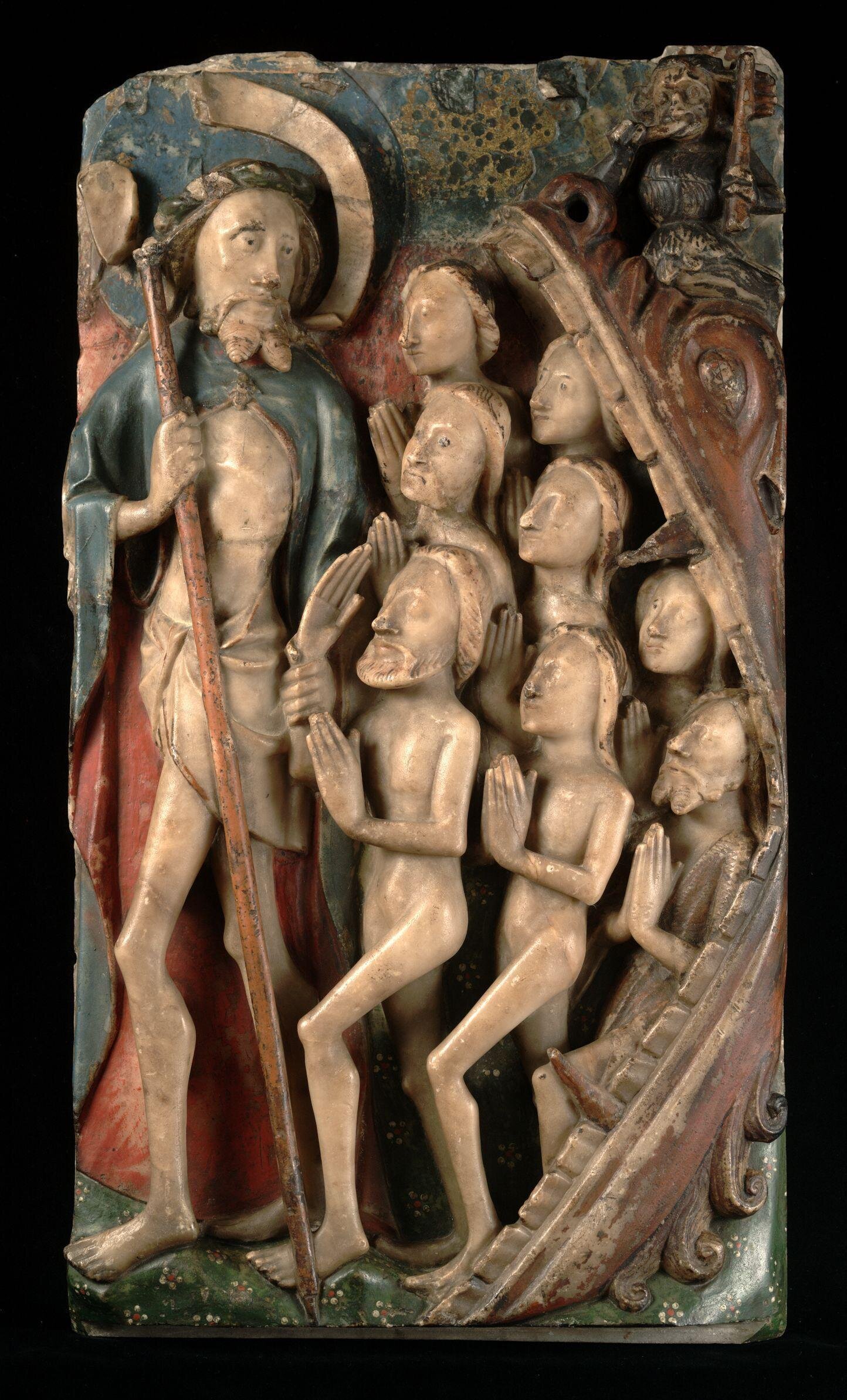
>> “The Harrowing of Hell” (Smarthistory video): Drs. Nancy Ross and Paul Binski discuss a fifteenth-century alabaster that’s in the collection of the Victoria and Albert Museum in London. What sticks out to me—the commentators mention it only briefly—is that Christ stands on a green, flowery lawn! The artist is probably alluding to the springtime, the new life, that Jesus’s resurrection ushered in: the redeemed exit the hellmouth, barefoot like their Lord, onto this lush grass. This detail reminds me a bit of Fra Angelico’s Noli me tangere fresco at San Marco in Florence.
The Harrowing of Hell, England, 15th century. Carved, painted, and gilt alabaster, 58 × 32 cm. Victoria and Albert Museum, London.
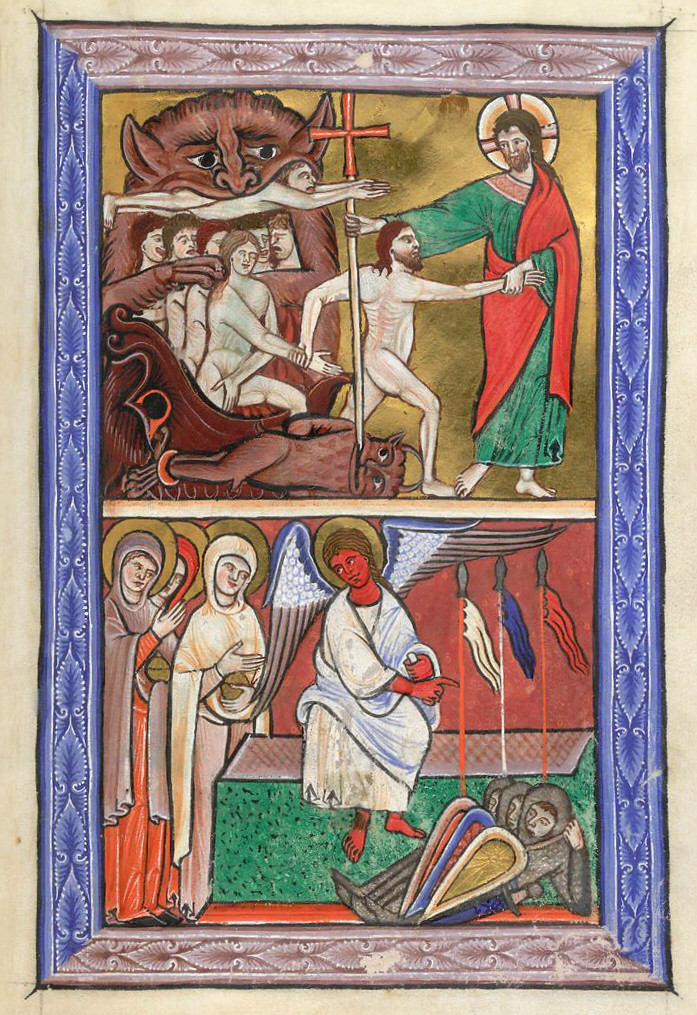
>> “Under the Earth” by Joanna Collicutt: The Visual Commentary on Scripture is a free online resource that provides material for teaching, preaching, researching, and reflecting on the Bible, art, and theology. For one of her three VCS-commissioned “visual commentaries” on Philippians 2:1–11, Rev. Dr. Joanna Collicut has selected an illumination of the Harrowing of Hell from a thirteenth-century psalter. The Christ Hymn that forms the meat of this passage celebrates Jesus’s descent and ascent, and in verse 10 it says that at his name, every knee will bow in heaven, on earth, and “under the earth.” This phrase had never stood out to me until now.
The Harrowing of Hell and The Holy Women at the Tomb, from an English psalter (BL Arundel 157, fol. 110), ca. 1220–40. Ink, tempera, and gold leaf on vellum, 29.5 × 20 cm. British Library, London.














 Art & Theology