Lift up your heads, O gates! and be lifted up, O ancient doors, that the King of glory may come in! Who is the King of glory? The LORD, strong and mighty, the LORD, mighty in battle. Lift up your heads, O gates! and be lifted up, O ancient doors, that the King of glory may come in! Who is this King of glory? The LORD of hosts, he is the King of glory. Selah
—Psalm 24:7–10
LOOK: Christ’s Descent into Hell from the Stuttgart Psalter [HT]
Christ’s Descent into Hell, from the Stuttgart Psalter, made at the scriptorium at St. Germain-des-Prés in Paris, ca. 820–30. Cod.bib.lat.fol.23, fol. 29v, Württembergische Landesbibliothek, Stuttgart, Germany. Click on image to see full page and explore further.
The above psalm passage is read at several times during the church year, depending on your tradition: during Advent, in relation to Christ’s coming into the world (see, e.g., here); on Palm Sunday, where the gates are those of Jerusalem; and on Ascension Day, when Christ (re)enters heaven. But in some illuminated psalters—such as the Stuttgart Psalter from ninth-century France—it is connected with Jesus’s descent into hell between his death and resurrection.
On the Psalm 24 page of the Stuttgart Psalter, the manuscript’s anonymous artist has depicted Christ storming the gates of hell, which are guarded by two winged, fire-spitting demons. Satan or Hades (Death) cowers in the bottom left corner, licked by flames and fearful of his imminent end. Encompassed in a green mandorla and accompanied by an angel, Christ breaches enemy territory, using a long slender cross to break down the doors behind which Satan has kept souls imprisoned. He is here to strike Death dead and gain back his beloveds in an awesome display of glory, power, and love.
LISTEN: “Lift Up Your Heads”| Text: Psalm 24:7–10 | Music by Joseph M. Martin and Jon Paige, 1996 | Performed by CMS College Choir Kottayam, dir. Vimal Kurian, 2015
Lift up your heads, you everlasting doors; open up and let the King of glory come in. Let the King of glory come in. (Repeat)
Who is the King of glory? Who is the King of glory? The Lord of hosts! He is the King of glory. The Lord of hosts! He is the King of glory.
Lift up your heads, you everlasting doors; open up and let the King of glory come in. Let the King of glory come in.
Alleluia, let us sing To the one eternal King; Alleluia evermore To the King and Lord of lords.
Who is the King of glory? Who is the King of glory? The Lord of hosts! He is the King of glory. The Lord of hosts! He is the King of glory.
Lift up your heads, you everlasting doors; open up and let the King of glory come in. Let the King of glory come in. (Repeat)
>> “How Asian Artists Picture Jesus’ Birth from 1240 to Today” by Victoria Emily Jones, December 18, 2023, Christianity Today: My first CT article was published this week! I was asked to curate and introduce a sampling of Nativity art from across Asia. By representing Jesus as Japanese, Indonesian, or what have you, these artists convey a sense of God’s immanence, his “with-us–ness,” for their own communities—and for everyone else, the universality of Christ’s birth.
I Wayan Turun (Indonesian, 1935–1986), In Bethlehem, 1958. Acrylic on canvas, 46 × 64 cm. Collection of Stichting Zendingserfgoed (Missionary Heritage Foundation), Zuidland, Netherlands.
>> “The Story of Christ in Chinese Art: Scholars at Peking University Make a Christmas Portfolio for LIFE,”Life, December 22, 1941, pp. 40–49: In doing research for my Christianity Today article, I found this old article from Life magazine that features eight Chinese watercolors on silk from the collection of Dr. William Bacon Pettus (1880–1959), an American educator and president of the California College of Chinese Studies in Peking (Beijing) in the 1920s and ’30s, which were being exhibited at New York’s American Bible Society at the time. With the ordination of six Chinese bishops by Pope Pius XI in 1926, the Chinese Catholic Church was transitioning from a mission church to an indigenous local church, and Chinese-style religious art—much of it coming out of the art department of the new Catholic University of Peking (Beiping Furen Daxue)—was part of that localization. Productivity seems to have continued at Furen during the Japanese occupation, as this article attests. Many of the students and faculty were recent converts to Christianity, though the article reports that non-Christians also enrolled and taught in the art program.
Lu Hongnian (Lu Hung-nien) ( 陸鴻年) (Chinese, 1914–1989), The Birth of Jesus, ca. 1941. Chinese watercolor on silk.
Here is one of the paintings by Lu Hongnian, who sometime after this article was published, in part through his having engaged the New Testament as inspiration for his paintings, became a Christian and took the name John. It shows the Holy Family in a mountainside cave, Mary gazing adoringly at her newborn son as Joseph brings more straw to cushion him. Beside them, an angel holds up a lantern for light, while two shepherd children approach from the entrance, eager to meet their Savior.
+++
SONGS:
>> “Philippians 2:5–11” by HARK Music: This song takes a traditional Thai melody, arranged by Tirasip Kraitirangul, and puts it to a Thai translation of the famous Christ Hymn from Philippians 2. It’s performed by the HARK Duriya Tasana Singers (feat. Somchairak Sriket and Damrongsak Monprasit) and Dancers, filmed on location at Chaloem Kanchanaphisek Park in Bangkok. The song is from HARK’s Thai Hymns Album (2014), which can be downloaded for free at https://harkpublications.com/?product=thai-hymns-album-2. The two-stringed bowed instrument you see at 3:21 is a saw u.
The Duriya Tasana (“Curators of the Arts”) ensemble was formed in 2012 under the commission of the Thai-Psalms Project, an endeavor to create Thai traditional and classical music settings for the psalms of the Bible. Many of the members are affiliated with the Bunditpatanasilpa Institute of Fine Arts in Bangkok. Thanks to my friend Janet, whose sister is preparing a move to Thailand, for alerting me to this group!
>> “Jesus You Come” by Tenielle Neda, performed with Jon Guerra: This song by the Australian singer-songwriter Tenielle Neda [previously], which she sings with Jon Guerra, makes a nice complement to the Thai song above. The performance is from “Songs for Hope: A TGC Advent Concert” on December 6, 2020.
+++
MIDDLE ENGLISH LULLABY: “As I lay upon a night”: Medievalist Eleanor Parker introduces a charming Christmas lullaby from fourteenth-century England, a dialogue between Mary and the Christ child, and provides a modern English translation of its thirty-seven stanzas. In the Middle Ages, says Rosemary Woolf, the subject matter of lullabies was often a prophecy of the baby’s future—presumably a romantic promise of great and happy achievements. But here it is the child who relates the future to his mother, thus providing the material for his own lullaby.
+++
ART VIDEO: “Third Sunday of Advent: Ethiopian Art: Gospel Book” by James Romaine: Every December, my friend James Romaine, an art historian who teaches at Lander University, publishes four videos on his Seeing Art History YouTube channel related to the themes of the season, part of his annual Art for Advent series. This year he’s chosen to focus on Ethiopian art, covering illuminations from two different manuscripts, a diptych icon, and a rock-hewn church.
In this video Romaine discusses the formal qualities of two paintings from a sixteenth-century Ethiopian Gospel-book, the identity of the figures, and the liturgical context of the book, including the use of the red veil that’s attached at the top, which, Romaine says, “both protects and sanctifies the icon,” creating a sense of anticipation for the Orthodox believer who, in faith, lifts the veil to see what is revealed.
SPOTIFY PLAYLIST:November 2023 (Art & Theology): In this month’s playlist I nod, in part, to All Saints’ Day (November 1), Christ the King Sunday (November 26), and world events. It includes “Ad Ana” (How Long), a setting of Psalm 13 in its original Hebrew by Miqedem (a Tel Aviv–based band made up of Shai Sol [previously] and three other musical artists from a mix of Jewish and Christian backgrounds), and “Touba” (Blessed), a sung recitation of the Beatitudes in Arabic by the Sakhnini Brothers [previously], Arab Christians from Nazareth, with oud and keyboard accompaniment.
As American Thanksgiving is November 23, you may also want to check out my Thanksgiving Playlist, comprising songs of gratitude. Originally created in 2021, each year I add to and remix the list as I encounter new recordings. One of the newer additions is “He Has Made Me Glad” by Leona Von Brethorst, based on Psalm 100, as arranged and performed on organ by the amazing Cory Henry.
The Christian life consists of both praise and lament, both tears and laughter—which is why in any given worship service or Art & Theology playlist or blog post, as in the biblical psalter, you can find songs that express joy and others, heaviness. They don’t negate one another but rather give fuller expression to the breadth of religious experience.
+++
NEW ALBUM: Some Mississippi Sunday Morning by Parchman Prison Prayer: After a bureaucratic process that took over three years, music producer Ian Brennan was finally granted permission in February to record a Sunday worship service at the Mississippi State Penitentiary, aka Parchman Farm, a notorious prison with a rich musical history. The prison chaplains convened a unique service of inmate singers from various Christian denominations ranging in age from twenties to seventies, who were given turns at the mic and even collaborated on a few tracks. Brennan said he wanted to give the men a platform for their voices to be heard. All profits from the album benefit the Mississippi Department of Corrections Chaplain Services.
“You can hear the way Sunday services are particularly restorative for someone incarcerated – not simply because of the promise of redemption, but the solace of not being alone,” writes Sheldon Pearce for the Guardian. “Some Mississippi Sunday Morning feels like these men reaching out for the things such a barbaric system tries to deny them: compassion, intimacy, and mercy. The songs are not just purges of anxieties accrued on the inside or calls for the Lord’s embrace, but also pleas to be acknowledged as a person and not an ID number.”
(Thanks to Art & Theology reader Ted Olsen for alerting me to this! He compared the album to Angola Prison Spirituals, recorded in the 1950s.)
+++
PODCAST EPISODE: “Sarah Clarkson: The Gift of Beauty,”Life with God: A Renovaré Podcast, October 20, 2023:Sarah Clarkson, author of This Beautiful Truth: How God’s Goodness Breaks into Our Darkness, speaks with Renovaré community life director Nathan Foster about her struggle with OCD and, amid the great suffering wrought by that illness, how God’s goodness has been mediated to her by beauty—in nature, poetry, music, story, tea, ritual, and so on. Responding to the idea that beauty is a luxury for the affluent, she says, “Well, [it is] if beauty is about having a perfect house. But beauty is healing those who have been hurt in a war zone. It’s creating shelters where children can have refuge. It’s rebuilding what has been destroyed. . . . Beauty is a defiance of the forces of evil and disorder and destruction because it is [their] opposite: where evil tears down, beauty creates; where there is absence, beauty fills.”
+++
PRESS RELEASE: “Toledo Museum of Art Adds Armenian Gospel Manuscript with 46 Paintings to the Collection”: After centuries passing through private collections, in June the Pozzi Gospels, a sixteenth-century illuminated manuscript from Armenia, entered the collection of the Toledo Museum of Art, which will make it more accessible to the public. (I’m not sure when the book will go on display. And it doesn’t have an object page on the museum’s website yet.) The artist and scribe of this extraordinary, sumptuous manuscript was Hakob Jughayets’i. His forty-six full-page miniatures and marginal decorations combine Christian iconography with Byzantine, Islamic, and Buddhist design elements.
The Sam Fogg gallery, which exhibited the manuscript last year as part of The Medieval Body, created this short video about it, narrated by art historian Jack Hartnell:
Hakob Jughayets’i (Armenian, ca. 1550–1613), The Pozzi Gospels, 1586. Paper with blind-stamped brown leather binding, 403 folios with 46 full-page illuminations and numerous marginal miniatures, 7 3/4 × 5 3/4 in. (19.8 × 14.5 cm). This spread shows the Creation of Eve and the Temptation of Eve.
VIRTUAL MUSIC COLLECTION: Armenian Spiritual Music Special Vol. 1: NTS Radio in London has curated ninety minutes of traditional Armenian Christian music. (They’ve done the same for Byzantine chant, Welsh hymns, Hildegard von Bingen, and numerous other categories.) I wish the lyrics and translations were provided, but regardless of my understanding of the words, what beauty. [HT: ImageUpdate]
“Lift up your hearts.” “We lift them up.” Ah me!
I cannot, Lord, lift up my heart to Thee:
Stoop, lift it up, that where Thou art I too may be.
“Give Me thy heart.” I would not say Thee nay,
But have no power to keep or give away
My heart: stoop, Lord, and take it to Thyself today.

Stoop, Lord, as once before, now once anew
Stoop, Lord, and hearken, hearken, Lord, and do,
And take my will, and take my heart, and take me too.
This poem was originally published in Time Flies: A Reading Diary (1885) and subsequently Verses (1893) and is in the public domain.
A devout Anglican from Victorian England and one of my favorite spiritual writers, Christina Rossetti (1830–1894) opens her poem “Sursum Corda” with a quotation from the ancient Eucharistic prayer compiled in the Book of Common Prayer: “Lift up your hearts . . .”
The Sursum corda, Latin for “Lift up your hearts,” is a Christian liturgical dialogue between priest/pastor and congregation that dates at least as far back as the third century (it’s mentioned in the Early Christian treatise Apostolic Tradition, as well as by Cyprian, Augustine, and Cyril of Jerusalem) and that is still used in Catholic, Orthodox, and Protestant churches today. Most, like my Presbyterian church, recite it as part of the celebration of the Eucharist, aka the Lord’s Supper, though some place it after the Call to Worship.
Here are the words used in the Roman Rite:
Priest: Dominus vobiscum.
People: Et cum spiritu tuo.
Priest: Sursum corda.
People: Habemus ad Dominum.
Priest: Gratias agamus Domino Deo nostro.
People: Dignum et iustum est.
Priest: The Lord be with you.
People: And with your spirit.
Priest: Lift up your hearts.
People: We lift them up to the Lord.
Priest: Let us give thanks to the Lord our God.
People: It is right and just.
Folio 1r from the Cambrai Missal, made in northern France, ca. 1120. Collection of Notre-Dame Cathedral, Cambrai, France. This page starts mid-liturgy with “Per omnia saecula saeculorum, amen” (Forever and ever, amen; or World without end, amen)—the inhabited initial P has a lion and a fantastical bird inside!—and then proceeds to the Sursum corda. The tildes indicate omitted letters.
The following is what my church uses—you’ll see it concludes with the Memorial Acclamation:
Pastor: The Lord be with you. People: And also with you. Pastor: Lift up your hearts! People: We lift them up to the Lord. Pastor: Let us lift up our hearts to the Lord our God. People: It is right to give him thanks and praise. Pastor: Therefore we proclaim the mystery of faith: All: Christ has died. Christ is risen. Christ will come again.
The phrase “Lift up your hearts” is taken from biblical passages such as Psalm 86:4—“Gladden the soul of your servant, for to you, O Lord, I lift up my soul”—and Lamentations 3:41, which says, in the context of confession and repentance, “Let us lift up our hearts as well as our hands to God in heaven.” The Sursum corda expresses an inclining of the whole self toward God in praise and offering.
Rossetti responds to this jubilant call with an admission of personal weakness. She lacks the power to lift up her heart, she says (perhaps because it’s so heavy); she needs God to lift it for her. She begs him four times to “stoop,” to condescend to her level, so that she might ascend to his throne. Line 4 contains a partial quotation of Proverbs 23:26: “My son, give me thine heart, and let thine eyes observe my ways.” She wants to give God her heart, but in her frail spiritual state, all she can do is bid him “take it.”
I often pray Rossetti’s poems, as I find her such a sensitive seeker, full of longing that so frequently reflects my own. You can find other Rossetti poems from the Art & Theology archives on my new Poetry Index tab. All her poems are accessible online, scattered across various volumes on Google Books, but if you want to read them all in one place and in physical book form, I recommend the Penguin Classics edition of her Complete Poems (which stands at a whopping 1221 pages!).
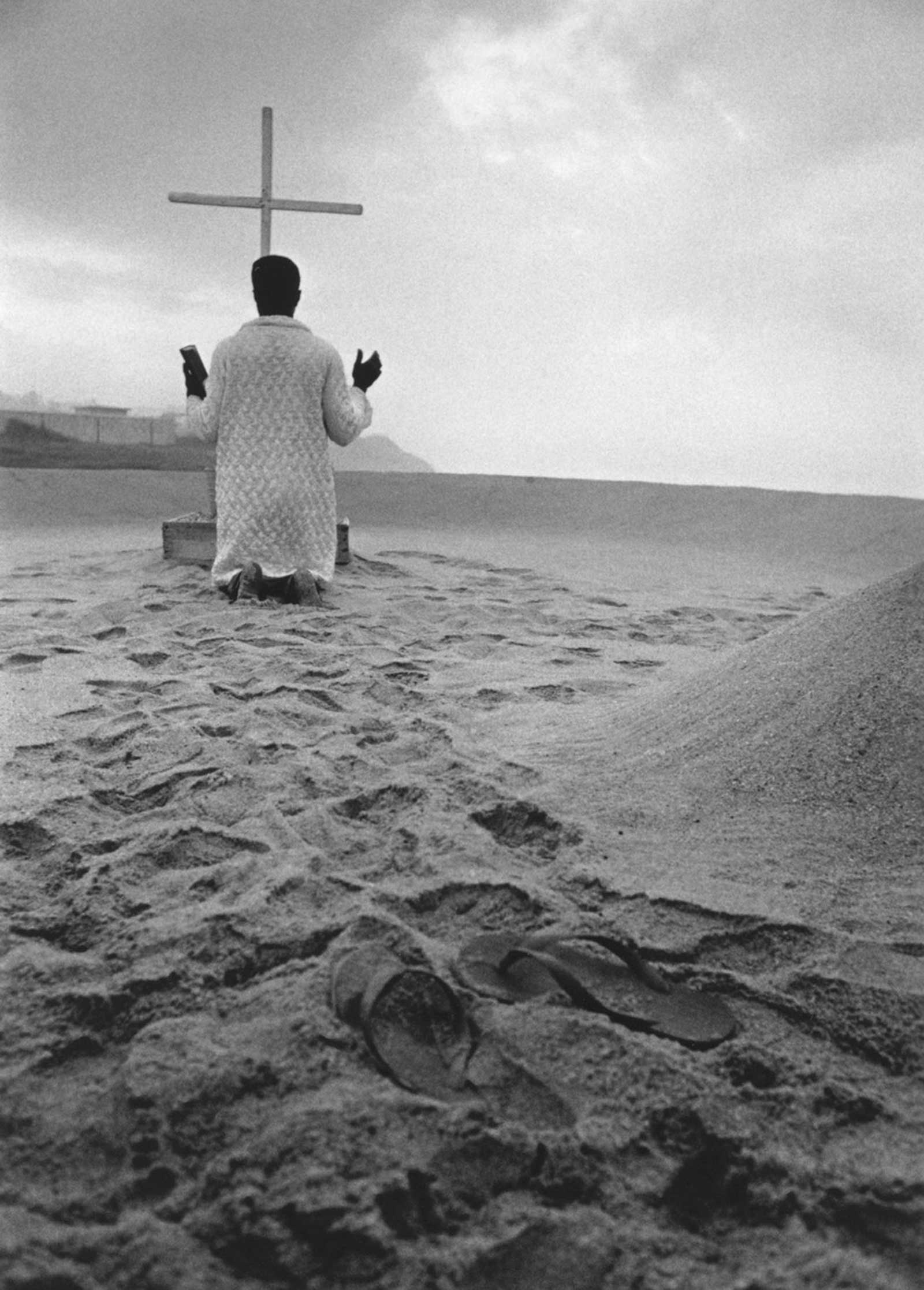
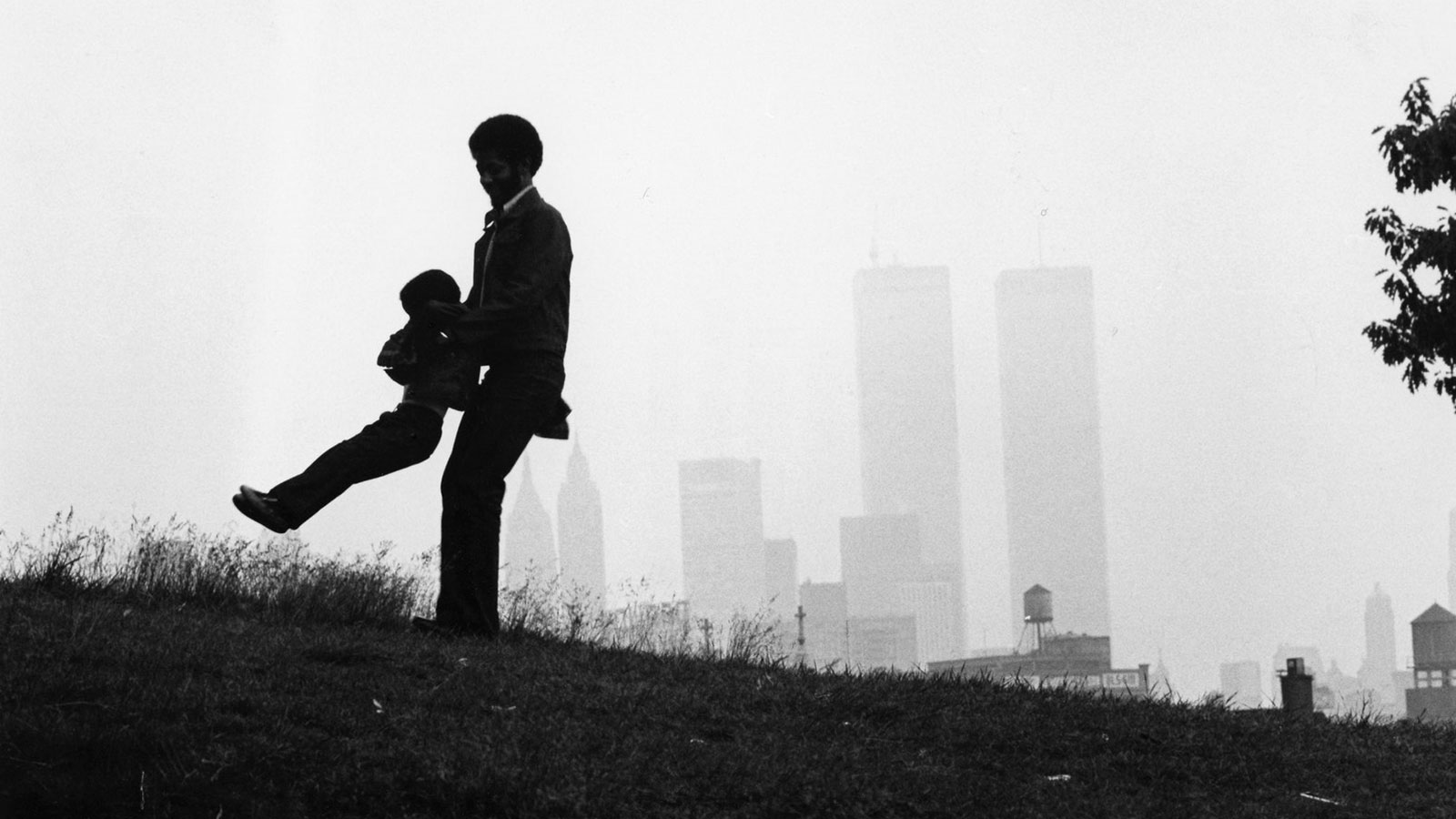
PHOTO COMPILATION: “Chester Higgins’s Life in Pictures”: Chester Higgins Jr. (b. 1946) is an American photographer whose work focuses on everyday Black life; “it is inside simple moments where I look for windows into larger meaning,” he says. He was a staff photographer for the New York Times for more than four decades, and his work is in the permanent collection of the Museum of Modern Art. This heavily illustrated New Yorker article is a good introduction to his oeuvre, in which religious belief and practice feature prominently. I found out about him through the photography compilation book Standing in the Need of Prayer: A Celebration of Black Prayer.
Chester Higgins (American, 1946–), Sunrise Prayer on Osu Beach, Accra, Ghana, 1973Chester Higgins (American, 1946–), Father Swinging Son, Brooklyn, 1972
+++
SONGS:
>> “El Shaddai” by Victory: On January 27 singer-songwriter Victory Boyd, who goes professionally by the mononym Victory, released her latest single, “El Shaddai.” El Shaddai is an ancient Hebrew name for God whose original meaning is unclear but which is often translated into English as “God Almighty”—although “God of the Mountains,” “the Full-Breasted God” (referring to God’s nourishment of God’s children), or “the All-Sufficient One” have also been posited. Its first appearance in the Bible is in Genesis 17:1, where God tells Abram, “’I am El Shaddai; walk before me, and be blameless.”
Read the lyrics in the YouTube video description.
>> “Come Unto Me” by Take 6: A friend recently introduced me to the American a cappella gospel sextet Take 6. Formed in 1980 on the campus of Oakwood College in Huntsville, Alabama, and still active, they incorporate sophisticated jazz harmonies into the tradition of Black gospel “quartet” singing. They are featured on Spike Lee’s Do the Right Thing soundtrack and have won ten Grammys.
This 1988 performance for a Heritage USA TV spot features the group’s six original vocalists: Claude V. McKnight III, Mark Kibble, Mervyn Warren, David Thomas, Cedric Dent, and Alvin Chea.
>> “He’s Got the Whole World in His Hands” by Peter Collins: I love what Peter Collins does with this African American spiritual! This video was his submission to Tyler Perry’s #HesGotTheWholeWorldChallenge from 2020 (which I featured here). It didn’t make the final cut, but I’m so glad it’s out there.
+++
LITERARY EXCERPT from The Color Purple by Alice Walker: This short passage from Alice Walker’s 1982 Pulitzer Prize–winning novel is taken from a conversation between the protagonist, Celie, and her friend Shug, about pleasure, gratitude, and grace. Shug refers to God as “it” (“God ain’t a he or a she”), and her statement about the necessity of enjoying God’s good creation and being open to surprise provides the source of the title.
I’m embarrassed to say that although I saw and really liked the 1985 Steven Spielberg film adaptation of The Color Purple, I’ve never read the book! I plan to rectify that before December, when another film adaptation—of the 2005 stage musical based on Walker’s novel—is coming out, directed by Blitz Bazawule. It stars Fantasia, H.E.R., Colman Domingo (Euphoria), Taraji P. Henson (Hidden Figures), Danielle Brooks (Orange Is the New Black), Jon Batiste, and more.
+++
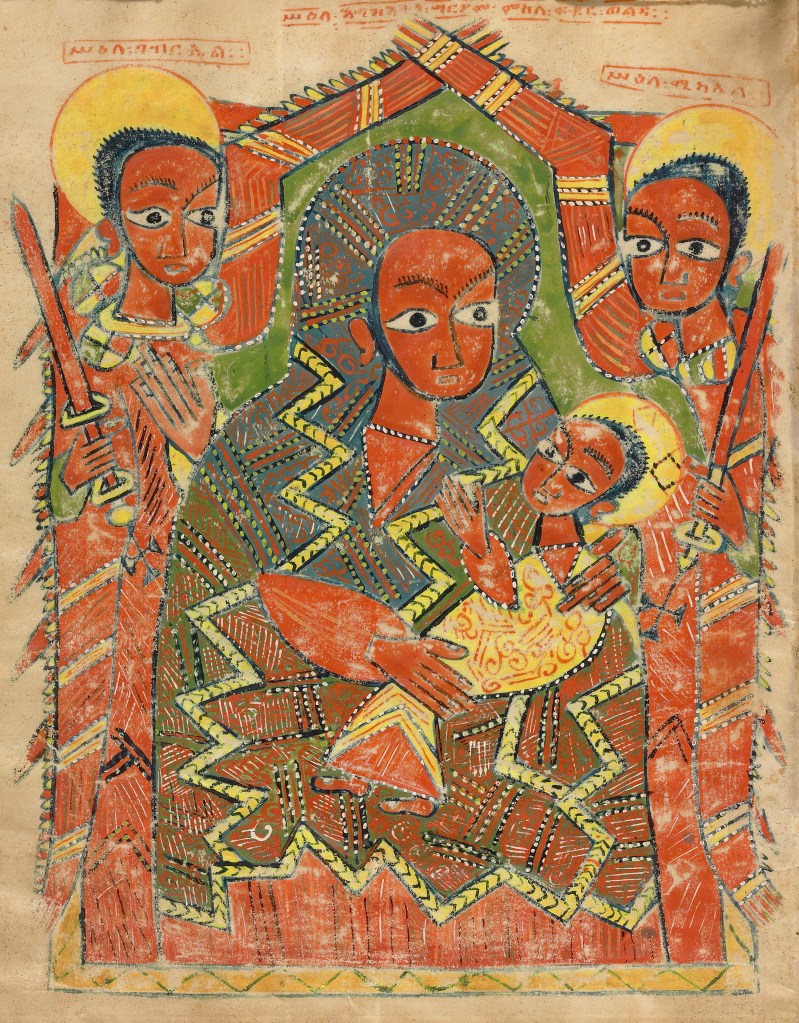
VIDEO: “Ethiopian Gospel Book”: In this six-minute instructional video, Dr. Beth Harris, executive director of Smarthistory, and Kelin Michael, a graduate curatorial intern of manuscripts at the Getty Museum, explore an early sixteenth-century Gospel book from Ethiopia. They discuss the book’s historical context and the formal qualities of its paintings, including the flatness of the figures and the colorful interlacing. They focus on a full-page illumination at the front of the Virgin and Child enthroned between two archangels, but they also touch on the book’s canon tables and its portrait of Saint John the Evangelist.
The Virgin and Child with the Archangels Michael and Gabriel, Ethiopia, ca. 1504–5. Tempera on parchment, 13 9/16 × 10 7/16 in. (34.5 × 26.5 cm). J. Paul Getty Museum, Los Angeles, Ms. 102, fol. 19v.
>> “Jesus Is Alive” by Ron Kenoly,performed in Japanese by Ruah Worship: Ruah Worship is a vocal ensemble made up of four siblings from Japan: (from left to right in video) Joshua Mine, Julia Mine, Erika Grace Izawa (née Mine), and Marian Mine. Here they sing an a cappella arrangement of a Ron Kenoly song, translated into Japanese by Hiromi Yamamoto and Kazuo Sano. Click on the “CC” (closed captioning) button for English subtitles. [HT: Global Christian Worship]
Their harmonies are wonderful! And they have lots of great videos on their YouTube channel, a mix of original songs and songs translated from other languages or written in Japanese. For another Easter-themed song they’ve recorded, see “Because He Lives.”
>>“I Went to the Garden” by Sam Hargreaves: Written in a bluegrass style from Mary Magdalene’s perspective, this song was released this year as part of the Resurrection People resource from the UK organization Engage Worship, where you can find downloadable videos (songs, webinars), sheet music, and church service outlines that include prayers, all-age ideas, readings, poems, sermon outlines, responses, and more. Sam Hargreaves is on lead vocals and acoustic guitar, Timo Scharnowski is on backing vocals and percussion, and David Hyde is on banjo and slide guitar.
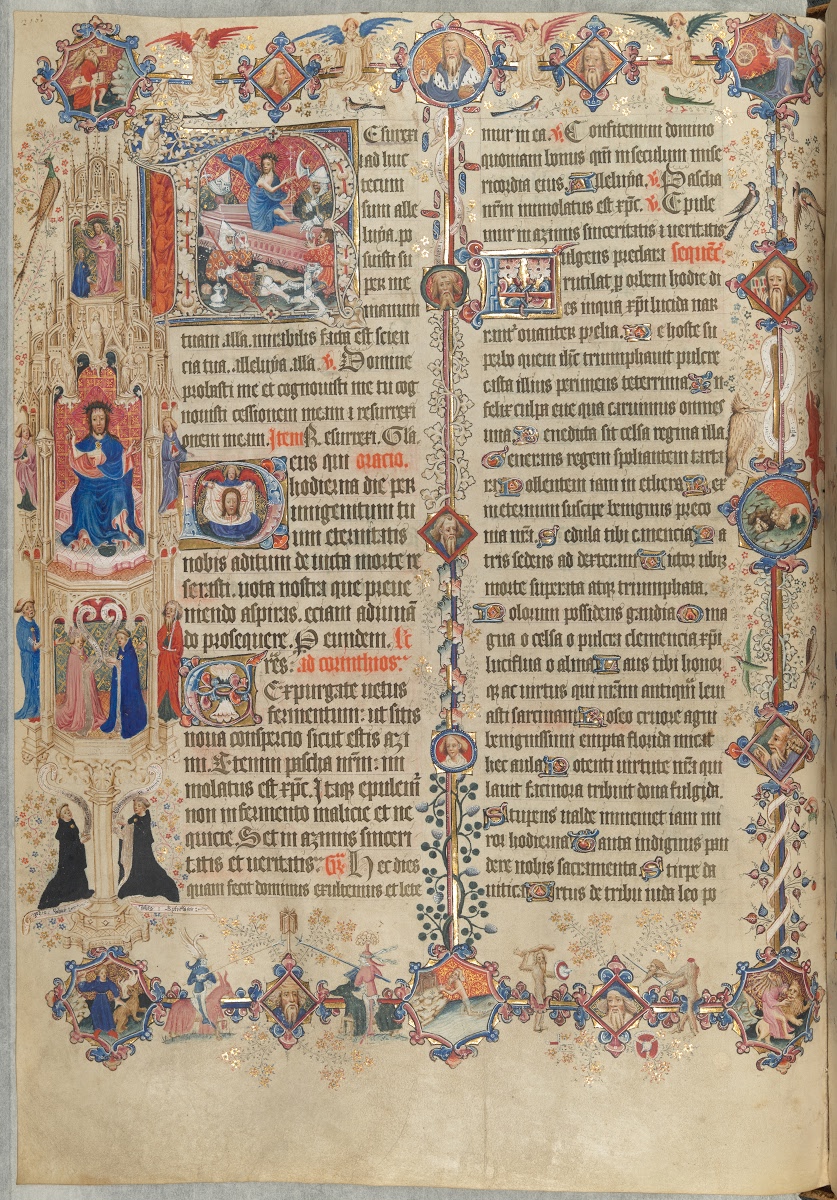
ART COMMENTARY: The Sherborne Missal: On this episode of the BBC Radio 4 program Moving Pictures, host Cathy Fitzgerald talks with art historians Alixe Bovey, Kathleen Doyle, Eleanor Jackson, and Paul Binski and scribe and illuminator Patricia Lovett about a page from the medieval illuminated Sherborne Missal that introduces the Mass for Easter Sunday. Made for the Benedictine abbey of St. Mary’s in Sherborne, Dorset, around 1400, this Christian service book amazingly survived the pillaging of the English Reformation intact.
Illuminated folio introducing the Mass for Easter Sunday, from the Sherborne Missal, Dorset, England, ca. 1399–1407. British Library, London, Add Ms 74236, page 216. Click on image to zoom in.
At the top is the historiated initial “R” for Ressurexit, with Christ emerging from his tomb. An elaborate border around the page contains scenes from the Old Testament, portraits of prophets, a bestiary-inspired scene, angels, birds, plants, fantastical knights, and two wodewoses (wild men) engaging in a bizarre confrontation. Such imagination! Learn why a daddy lion breathing on his cubs signified resurrection to the medieval mind, and in what sense Samson and Jonah are “types” of Christ.
“The thing to grasp about medieval art,” Binski says, “is that they don’t have the same categories and boundaries that we do. We have quite defined boundaries around what’s comic and what’s tragic, and what’s serious and what’s lightweight. In the Middle Ages, serious things and playful things accompanied one another; they were all part of the same thing.”
+++
CALL FOR ENTRIES:Chaiya Art Awards 2022/23: Submissions are now open—UK residents only—for this biannual competition on spiritually inflected visual art, this time on the theme of “Awe and Wonder.” In addition to the usual exhibition space for the longlisted finalists at London’s gallery@oxo, Chaiya has secured a second venue, the Bargehouse, which will allow for larger-scale artworks and installations. The top prize is ₤10,000. Deadline: August 31, 2022.
+++
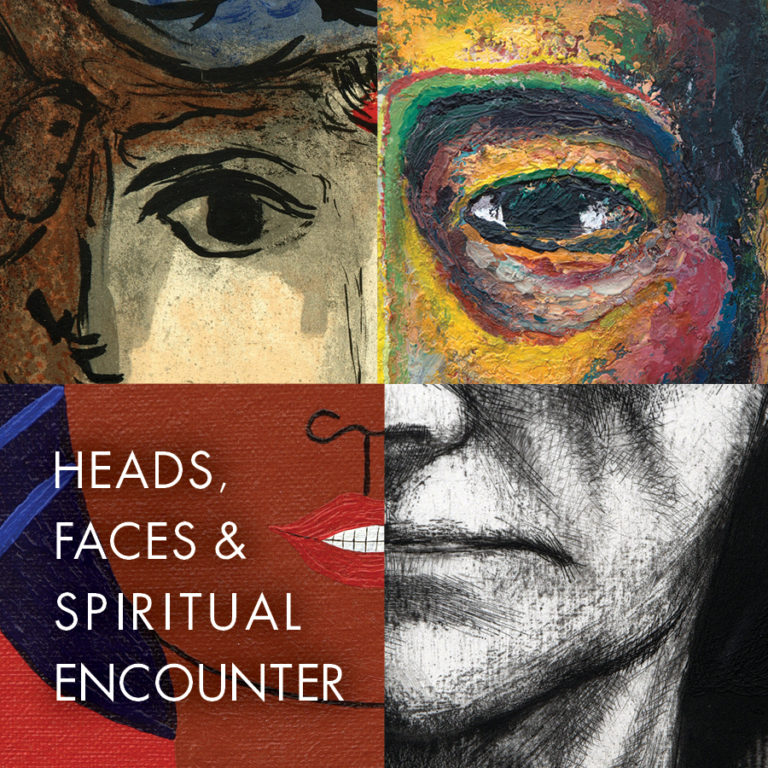
CIVA TRAVELING EXHIBITION: Heads, Faces, and Spiritual Encounter: Drawn from the collection of Edward and Diane Knippers and available for rental, this exhibition comprises forty-some artworks that all focus on the human face. There are works by modern heavyweights like Henri Matisse, Marc Chagall, David Alfaro Siqueiros, Georges Rouault, and Eric Gill, along with a few seventeenth-century portraits, African masks, and works by contemporary artists of faith. I saw the exhibition in Austin, Texas, in November and was really moved. Click on the link to browse the art and to inquire about rental.
LOOK: Adoration of the Lamb from the Escorial Beatus
Adoration of the Lamb, from the Escorial Beatus, Spain, 10th century
This folio is from an illustrated copy of Beatus of Liébana’s (d. ca. 800) hugely influential Commentary on the Apocalypse. The Beatus manuscripts (take a look on Pinterest for some real wacky, Revelation-based imagery) are one of the most significant book genres of the Middle Ages in northern Spain, and the Escorial Beatus (named after its current location) is a preeminent example. It probably originated in the famous scriptorium of San Millán de la Cogolla in La Rioja, Spain. Today it is kept in the Real Biblioteca del Monasterio de El Escorial, part of a royal complex situated at the foot of Mount Abantos in the Sierra de Guadarrama.
LISTEN: “Glory Hallelujah to the Risen Lamb” by Victor C. Johnson, 2009 | Performed by De Angelis Capella, 2019
Glory, glory, glory hallelujah to the risen Lamb! (×4)
Jesus hung on the cruel tree (Glory hallelujah to the risen Lamb!) He gave his life for the likes of me (Glory hallelujah to the risen Lamb!) Women came at the break of day (Glory hallelujah to the risen Lamb!) The angel rolled the stone away (Glory hallelujah to the risen Lamb!)
Glory, glory, glory hallelujah to the risen Lamb! (×4)
Glory, glory hallelujah Glory to the risen Lamb Glory, glory hallelujah Glory to the risen Lamb Glory, glory hallelujah Glory to the risen Lamb Glory, glory hallelujah Glory to the risen Lamb Glory, glory hallelujah Glory to the risen Lamb
Glory, glory, glory hallelujah to the risen Lamb! (×4)
You shall have the trumpet sounded throughout all your land. And you shall hallow the fiftieth year and you shall proclaim liberty throughout the land to all its inhabitants. It shall be a jubilee for you . . .
—Leviticus 25:9–10
The LORD has proclaimed to the end of the earth: Say to daughter Zion, “See, your salvation comes . . .”
—Isaiah 62:11
Immediately after the suffering of those days
the sun will be darkened, and the moon will not give its light; the stars will fall from heaven, and the powers of heaven will be shaken.
Then the sign of the Son of Man will appear in heaven, and then all the tribes of the earth will mourn, and they will see “the Son of Man coming on the clouds of heaven” with power and great glory. And he will send out his angels with a loud trumpet call, and they will gather his elect from the four winds, from one end of heaven to the other.
—Matthew 24:29–31
“Look, I tell you, lift up your eyes, and see that the fields are white for harvest.”
—John 4:35
LOOK: Middle Eastern manuscript illumination of a trumpeting angel
Written around 1270, Aja’ib al-Makhluqat wa Ghara’ib al-Mawjudat (The Wonders of Creation and the Oddities of Existence) by the Persian cosmographer Zakriya ibn Muhammad al-Qazwini was one of the best known and most copied texts in the medieval Islamic world. This leaf from a fourteenth-century illuminated version shows an angel blowing a long trumpet that resembles a karnay, an ancient brass instrument still used throughout Central Asia, especially Uzbekistan, to herald celebrations.
The British Museum website identifies the angel in this painting as Gabriel; however, according to the hadith (records of the traditions and sayings of the prophet Muhammad) and the verso of this page, it is the angel Israfil who will blow the horn on the Day of Resurrection. Similar representations can be found here, here, here, and here. I sent a query to the museum asking why they’ve titled the painting “The Angel Gabriel” and whether it might be a mistake, and they told me they are looking into it.
Even though the Bible never specifies Gabriel as the trumpeter of the last days, he has come to be associated with that role in Christian tradition. The Armenian church was the first to assign it to him beginning in the twelfth century, and John Milton did likewise in his seventeenth-century epic, Paradise Lost. Gabriel’s trumpet is also a familiar trope in African American spirituals.
Israfil is not mentioned in the Bible. However, because whole hosts of angels exist and so few are named in scripture, all three Abrahamic religions (Judaism, Christianity, Islam) have naturally taken to supplying some names of their own.
The unknown artist of this image has creatively imagined an angel’s wing that tapers off into what looks like an animal head!
I chose the image for its ability to evoke Christ’s return—which, FYI, Muslims are also waiting for.
LISTEN: “Days of Elijah” by Robin Mark, 1996 | Arranged by Keith Lancaster and performed by the Acappella Company on Glorious God: A Cappella Worship, 2007
These are the days of Elijah Declaring the Word of the Lord And these are the days of your servant Moses Righteousness being restored And though these are days of great trials Of famine and darkness and sword Still we are the voice in the desert crying Prepare ye the way of the Lord
Behold he comes Riding on the clouds Shining like the sun At the trumpet call So lift your voice It’s the year of Jubilee And out of Zion’s hill Salvation comes
And these are the days of Ezekiel The dry bones becoming as flesh And these are the days of your servant David Rebuilding a temple of praise And these are the days of the harvest The fields are as white in the world And we are the laborers in your vineyard Declaring the Word of the Lord
Behold he comes Riding on the clouds Shining like the sun At the trumpet call So lift your voice It’s the year of Jubilee And out of Zion’s hill Salvation comes
There’s no god like Jehovah There’s no god like Jehovah There’s no god like Jehovah There’s no god like Jehovah
In the fifth century BCE God told Israel through his prophet Malachi, “See, I am sending my messenger to prepare the way before me. . . . Lo, I will send you the prophet Elijah before the great and terrible day of the LORD comes” (Mal. 3:1a; 4:5; cf. Isa. 40:3).
Four hundred years later came John the Baptist, whom Jesus referred to as Elijah (Matt. 11:14)—preparing the way, preaching the Word.
Northern Irish singer-songwriter Robin Mark invokes Elijah and, implicitly, his new-covenant counterpart, John, in the first stanza of “Days of Elijah,” comparing the ministries of these two prophets to that of the church. Just as John the Baptist prepared the way for the Messiah’s first coming, we are to prepare the way for his second.
The refrain pictures that second coming as a jubilee celebration—as freedom, rest, wholeness, the world set right—announced by a trumpet blast.
We are in the last days, the time between Christ’s two advents. And though we await the fullness of redemption, we do not do so passively. Filled with Christ’s Spirit, we labor as agents of justice and resurrection and praise, as the song suggests.
Above I featured a fairly standard (and skillful!) version of “Days of Elijah” that could be sung by your average church congregation. But here’s one to really knock your socks off: an arrangement by the South African gospel group Joyous Celebration, which they performed live in Johannesburg last month:
Maybe it’s the ocean’s rhythmic tug that helps me sleep, my body’s own surge remembering its deepest pulse.
Think of those Celtic monks who scaled the slippery rocks carrying vellum and inks while the sea broke
and battered beneath them. High in a crevice, a hidden stone hut with cot and candle. The scribe
dips and swirls his quill to preserve the story—Luke’s genealogy, name after name, letters shaped
like birds in every color, a flight of messengers released into history. Each word unfurls the promise,
like Gabriel kneeling. The body knows that wings, like waves, can break through walls and enter,
that the secret of the story is love, that even as we sleep, its tides carry us in a wild safety.
The poem “What the Body Knows” by Jean Janzen is from her collection What the Body Knows (DreamSeeker Books / Cascadia Publishing House, 2015) and is used here by permission of the publisher.
The pages from the early ninth-century Book of Kells (IE TCD MS 58, fols. 200r, 200v, 201r, 201v, 202r) are sourced from the Digital Collections of the Library of Trinity College Dublin. They illuminate Luke 3:23–38 in the Latin Vulgate: Et ipse Iesus erat incipiens quasi annorum triginta ut putabatur filius Ioseph qui fuit Heli qui fuit Matthat qui fuit Levi . . . (“And Jesus himself began to be about thirty years of age, being, as was supposed, the son of Joseph, which was the son of Heli, which was the son of Matthat, which was the son of Levi . . .”) Click on the library link to zoom in and explore more, or on the individual images to view at full resolution.
MAVCORJournal is an open-access, peer-reviewed digital publication published by the Center for the Study of Material and Visual Cultures of Religion at Yale University. Its “Object Narrative” division is for explicating religious images, objects, monuments, buildings, spaces, performances, or sounds in 1500 words or less.
Visual culture encompasses not just “art” but also ephemera and what we might call “kitsch.” Because my field is art, I gravitate more to research in that vein, which is reflected in the five object narratives I’ve selected to highlight below. In addition to describing the object’s content, each writer also addresses, if applicable, its liturgical or devotional uses and includes relevant historical or cultural context. Click on the links to read more, and spend some time perusing the other offerings on MAVCOR’S website, https://mavcor.yale.edu.
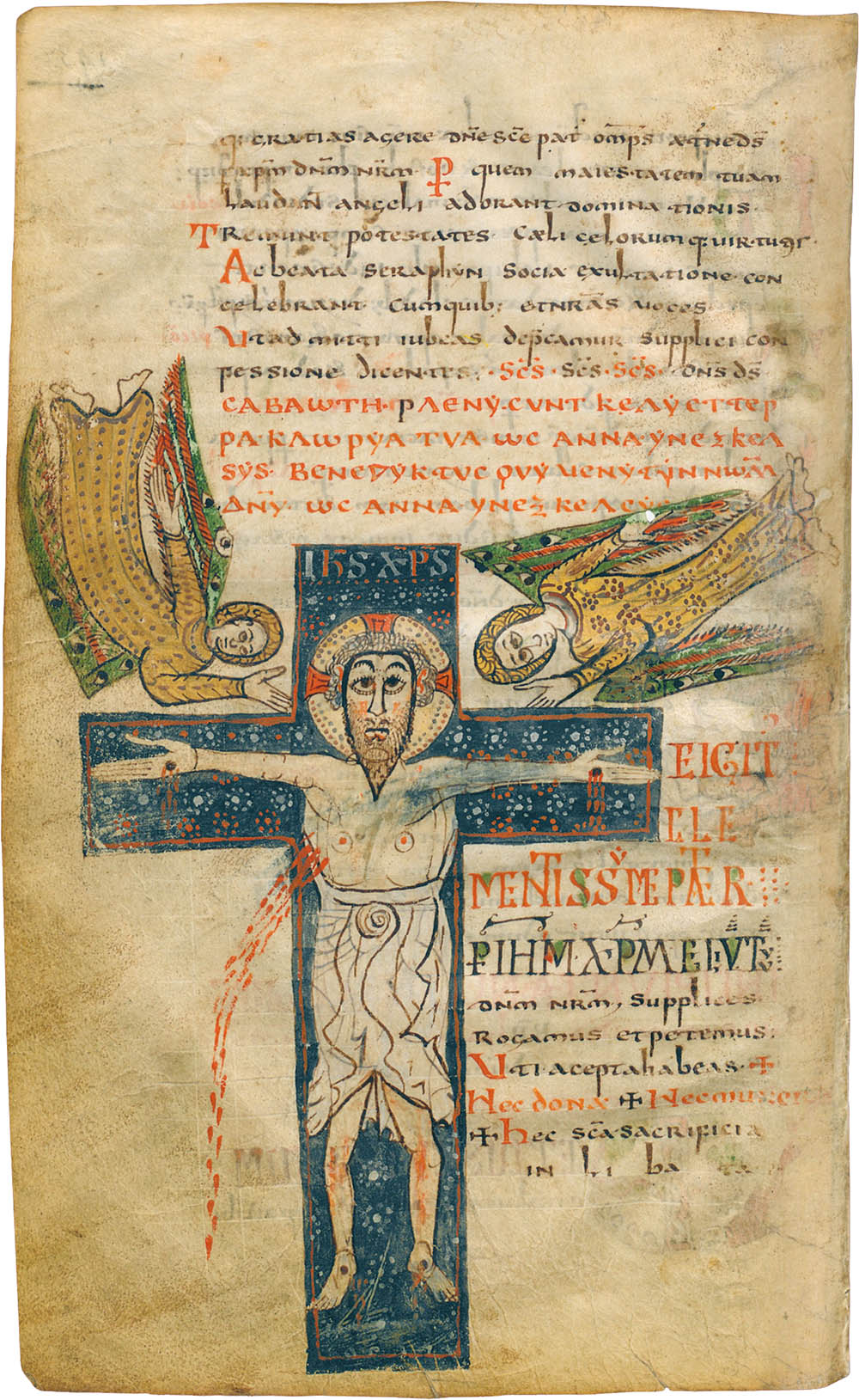
“Christ Crucified in the Gellone Sacramentary” by Lawrence Nees: This eighth-century manuscript illumination from the Frankish kingdom of Charlemagne is one of the earliest surviving images of Jesus on the cross, its viewership restricted to clergy. “He is . . . shown as if nailed to a cross, but this is no wooden cross and indeed no cross at all. It is colored deep blue, studded with white and red flower-like shapes suggesting stars, and indeed it actually is the letter T of the opening words of the Canon of the Mass, the consecration of bread and wine as the body and blood of Christ, in the Latin version here ‘Te igitur clementissime Pater . . . rogamus’ (‘Therefore we beseech Thee, most merciful Father’) . . .”
Crucifixion from the Gellone Sacramentary (Latin 12048, fol. 143v), made in France, ca. 790. Housed at the Bibliothèque nationale de France, Paris.
+++
“Kongo Triple Crucifix” by Cécile Fromont: The west central African kingdom of Kongo, which emerged in the fourteenth century, declared Christianity its official religion in 1509. Kongo participated in the commercial, political, and religious networks of the early modern Atlantic world, and its artists reformulated Christian figures from Europe into objects that are distinctly African—including the many brass crucifixes produced from the sixteenth through nineteenth centuries. (Read more in Fromont’s 2014 book The Art of Conversion: Christian Visual Culture in the Kingdom of Kongo, which I reviewed here.)
Triple Crucifix, central figure 16th–17th century; top and bottom figures 18th–19th century. Brass, iron nails, copper, wood, ultramarine pigment, 10 1/4 × 5 3/4 × 1 in. (26 × 14.5 × 2.5 cm). Metropolitan Museum of Art, New York.
+++
“Death Cart (La Muerte en su Carreta)” by Miguel de Baca: “Death carts” were instruments of penance used by the Penitente brotherhood of northern New Mexico and southern Colorado in the second half of the nineteenth century and the first half of the twentieth; this is the earliest known one. They were built in the style of an old oxcart, and seated inside was Doña Sebastiana, an allegorical figure of Death, wielding her bow and arrow. Each Good Friday, “an elected brother attached the heavy chassis to his torso with a horsehair rope and dragged it from the morada (meetinghouse) along the path to the calvario (Calvary site), inflicting abrasions upon his body as a demonstration of his faith and desire for closer union with God.” I must say, this skeletal figure with the close-set eyes and large forehead (and is that human hair and teeth?) terrifies me!
Nasario López, Death Cart (La Muerte en su Carreta), ca. 1860. Gesso, leather, cottonwood, pine, 51 × 24 × 32 in. (129.5 × 61 × 81.3 cm). Colorado Springs Fine Arts Center, Colorado Springs, Colorado.
“Georgia O’Keeffe, Black Cross with Stars and Blue”by Jeffrey Richmond-Moll: During a four-month stay in Taos, New Mexico, in the summer of 1929—her first visit to the Southwest—Georgia O’Keeffe painted four canvases of Penitente crosses with Taos Mountain visible in the distance. The Penitentes were a lay Catholic brotherhood whose rituals centered on the remembrance of Christ’s passion. They erected crosses all over the region, outside their moradas (meetinghouses) and along roadsides, which they picked up and carried on holy days.
Georgia O’Keeffe (American, 1887–1986), Black Cross with Stars and Blue, 1929. Oil on canvas, 40 × 30 in. (101.6 × 76.2 cm). Private collection.
+++
“James Latimer Allen, Madonna and Child” by Camara Dia Holloway: “Allen operated a studio in Harlem between 1926 and 1943, producing artistic and commercial photographs. . . . By contributing to the development of a new racial iconography, Allen’s Madonna and Child and other black Madonnas offered positive visual and material rejoinders to widely reproduced images that represented black women’s failure to parent their own children. The Mammy stereotype, the legend of Margaret Garner (known as the Black Medea), and portraits of white children held by their black nannies belong to this latter and negative set of portrayals.” This is a religious icon by and for African Americans, Latimer writes—one that reflects and affirms their own self-image.
James L. Allen (American, 1907–1977), Madonna and Child, 1930s. Photograph, 24.4 × 18.7 cm. New York Public Library.



.jpg)




 Art & Theology