Roundup: Mavis Staples documentary, baptizing the imagination, how medieval manuscripts were made, Nubian Christian art, and Twain’s war prayer

Mavis!: The HBO documentary Mavis! profiles gospel and soul music legend Mavis Staples, from her rise to stardom as part of the Staples Singers, whose Uncloudy Day was the first gospel album to sell one million copies, and her involvement in the civil rights movement, to her still active career as a solo artist. “I’ll stop singin’ when I have nothin’ left to say,” she says. “And that ain’t gonna happen!” Watch the trailer below.

Luci Shaw on art and Christian spirituality: In this 1998 article from Direction journal, the oh-so-quotable poet Luci Shaw writes about imagination, mystery, receptivity, sacramentality, the similarities between art and faith, and her muse, the Holy Spirit. Concludes with her poem “Ghostly,” which explores the Spirit’s different manifestations.

Making medieval manuscripts: Through narrated demonstrations, this video by the Getty Museum shows how paper, pens, ink, paint, book covers, and bindings were made during the Middle Ages—laborious processes! It also shows how the illuminators (visual artists) worked with the scribes (calligrapher-copyists), jobs typically filled by two separate people.

Christianity on the Middle Nile: The two largest Christian kingdoms in the medieval world were actually in modern-day Sudan, writes curator Julie Anderson in a British Museum blog post from 2014: the Makuria and the Alwa kingdoms. Many wall paintings and other objects have been excavated from Faras Cathedral and its adjoining tombs, such as the pottery lamp (with the inscription “Great is the name of God”) and sandstone frieze fragment in the British Museum’s collection. (The paintings are divided between the Sudan National Museum and the National Museum of Warsaw, as it was a Polish team that rescued them from flooding by Lake Nasser.)
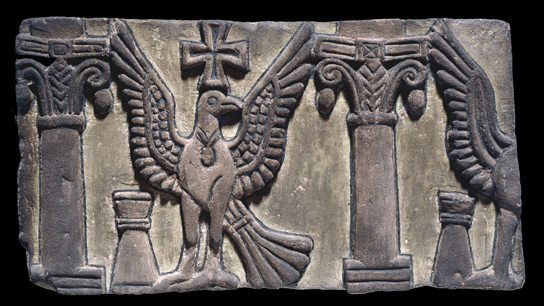
Faras Cathedral frieze fragment
Seventh-century sandstone frieze fragment from the former Faras Cathedral in Nubia. Collection of the British Museum.
Fiery Furnace fresco from Faras Cathedral
Fresco from the former Faras Cathedral in Nubia depicting the three youths in the fiery furnace. Collection of the National Museum of Sudan.

“The War Prayer” by Mark Twain: In his day Twain was radically opposed to American military intervention in Cuba and the Philippines and frustrated by the so-called patriotism that made his fellow countrymen so uncritically supportive of it. The stranger’s speech in Twain’s short story “The War Prayer,” set during a church service, exposes the ridiculousness of some of the prayers that go up during wartime even today.
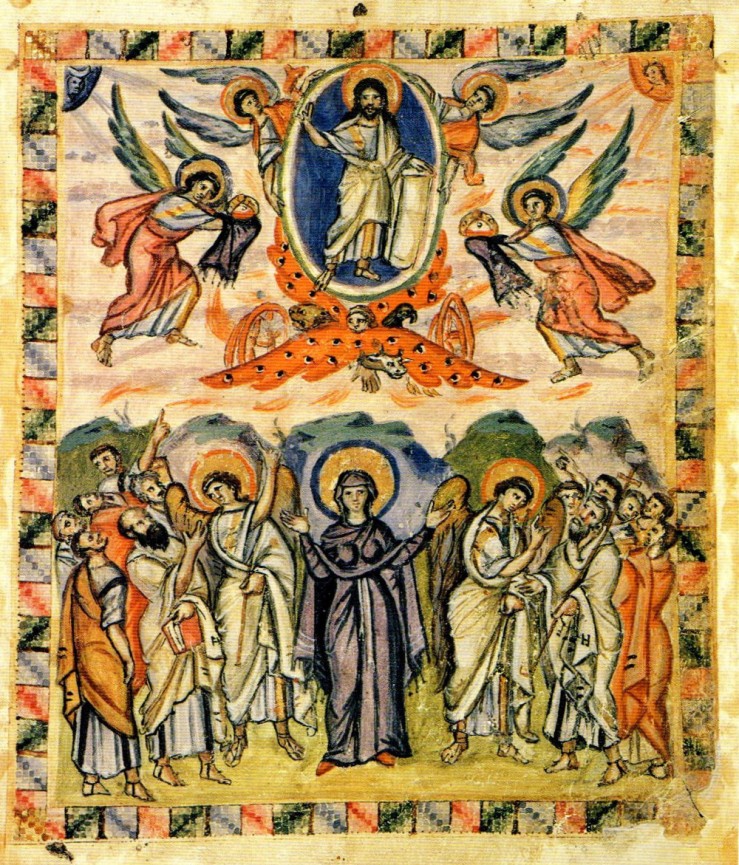
Christ ascending into Ezekiel’s vision

The sixth-century illuminated Syriac manuscript known as the Rabbula Gospels (after the signed name of its scribe) contains one of the earliest depictions of Christ’s ascension into heaven. A full-page miniature, it illustrates the narrative from Acts 1:6–11—but not strictly.

Ascension (Rabbula Gospels)
Ascension, fol. 13v from the Rabbula Gospels (cod. Plut. I, 56), Syria, 586. Tempera on parchment, 33 × 25 cm. Biblioteca Mediceo Laurenziana, Florence.

One embellishment to the story is the centralized presence of Mary on the bottom level. She is not mentioned in the biblical account of the event, but her attendance was likely. Here she stands in a frontal, orant pose and, unlike the other disciples, is nimbed. Whereas those around her are wracked with confusion, she understands the deep mysteries of her son’s birth, death, resurrection, and ascension, and she stands ready for his return.

Among the crowd is the apostle Paul—an anachronistic insertion, as his conversion occurred after the Ascension. The book he holds, signifying his contributions to the New Testament, is one of his identifying attributes.

The “two men . . . in white robes” mentioned in Acts 1:10 are interpreted as angels.

All these elements became standard in medieval iconography of the Ascension.   Continue reading “Christ ascending into Ezekiel’s vision”

Roundup: The art of celebration, cross-cultural exchanges in illuminated manuscripts, the history of color, and insect-wing blooms

The Art of Celebration (album): Rend Collective is a folksy worship band from the small coastal town of Bangor in Northern Ireland that is internationally known for its high-spirited, experimental songs of joy. The Art of Celebration is their fourth of five albums, the story of which is told in the video below. “This record is an attempt to reflect something of the irrepressible laughter in the heart of God,” says bandleader Gareth Gilkeson. “It’s a call to the cynical to once again choose celebration over condemnation and a reminder to the broken that ‘the joy of the Lord is our strength.’” You can preview songs from the album here and purchase it here, or catch the band on tour (they’re currently in the US). I’ve embedded one of my favorite songs from the album below: “My Lighthouse.”

+++

“Traversing the Globe through Illuminated Manuscripts” (exhibition): Through June 26, the J. Paul Getty Museum in Los Angeles is running an exhibition of illuminated manuscripts and painted book arts from the ninth through seventeenth centuries. From the website: “These highly prized objects allow us to glimpse, admire, and study a world gone by, as well as its peoples, different belief systems, and an interconnected global history of human thought and ideas about art.” Check out the Q&A with curator Bryan Keene—so fascinating. Also click the link above to find out about related events. Next up is a lecture on April 19 titled “A Medieval Picture Book and Its Judeo-Persian Lives: The Shah Abbas Bible in 17th-Century Safavid Iran.”

Virgin and Child (Ethiopian)
The Virgin and Child with the Archangels Michael and Gabriel, from a Gospel book, ca. 1480-1520, Gunda Gunde Monastery, Ethiopia. J. Paul Getty Museum, Los Angeles.
Northumberland Bestiary
Pen-and-ink wash-tinted drawing of a dragon riding an elephant, England, ca. 1250–1260. Northumberland Bestiary (Ms. 100), fol. 54, J. Paul Getty Museum, Los Angeles.

+++

The Brilliant History of Color in Art (book): Victoria Finlay’s latest book from Getty Publications, full of fun facts about the origins and science of color. The trailer below tells how Prussian blue, Indian yellow, lead white, and Tyrian purple came to be. Lapham’s Quarterly has a nifty infographic on the same topic.

+++

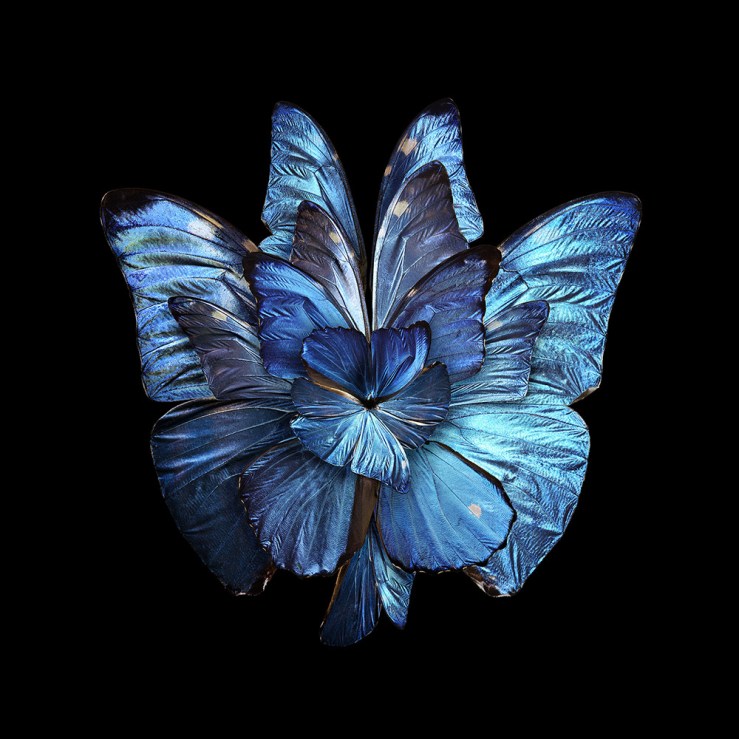
Mimesis (photomontage series): From 2012 to 2014 Paris-based artist Seb Janiak executed a series of twenty-two photographs that show insect wings pieced together in flower-like forms. Janiak says he believes that a spiritual reality undergirds the physical. “Using art to reveal what is behind the veil of matter is fascinating and full of discoveries,” he writes. See more Mimesis photos at the link above.

Mimesis by Seb Janiak
Seb Janiak (French, 1966–), Mimesis—Lacus Luxuriae, 2013. Chromogenic print, 180 × 180 cm.