            What is the Christ of God?
It is his touch, his sign, his making known,
His coming forth from out the all-alone,
            The stretching of a rod,

            Abloom with his intent,
From the invisible. He made worlds so:
And souls, whose endless life should be to know
            What the worlds meant.

            Christ is the dear “I am,”
The voice that the cool garden-stillness brake.—
The human heart to human hearts that spake,
            Long before Abraham.

            The word, the thought, the breath,—
All chrism of God that in creation lay,—
Was born unto a life and name this day;
            Jesus of Nazareth!

            With man whom he had made
God came down side by side. Not from the skies
In thunders, but through brother lips and eyes,
            His messages he said.

            Close to our sin he leant,
Whispering, “Be clean!” The high, the awful-holy,—
Utterly meek,—ah! infinitely lowly,—
            Unto our burden bent

            The might it waited for.
“Daughter, be comforted. Thou art made whole.
Son, be forgiven through all thy guilty soul.
            Sin—suffer ye—no more!

            “O dumb, deaf, blind, receive!
Shall he who shaped the ear not hear your cry?
Doth he not tenderly see, who made the eye?
            Ask me, that I may give!

            “O Bethany and Nain!
I show your hearts how safe they are with me.
I reach into my deep eternity
            And bring your dead again!

            “My kingdom cometh nigh.
Look up, and see the lightning from afar.
Over my Bethlehem behold the star
            Quickening the eastward sky!

            “From end to end, always,
The same Lord, I am with you. Down the night,
My visible steps make all the mystery bright.
            Lo! it is Christmas-day!”
This poem was originally published in Pansies: “…for Thoughts” by Adeline T. Whitney (London: Strahan & Co., 1872) and is in the public domain.
Adeline Dutton Train Whitney (1824–1906) was an American writer of poems and juvenile fiction, living in Massachusetts.
Wood scuplture of the Madonna and Child, Yorubaland, Nigeria, mid-20th century. Photo: Lee Boltin.
This sculpture by a Yoruba artist from Nigeria shows the Christ child seated on the lap of his mother, Mary, who wears a traditional Yoruba hairstyle and dress. If I had to guess, I’d say it’s probably by George Bandele Areogun (1908–1995), as it is commensurate in quality and style with his other work.
The image appears as figure 27 in the 1974 book The Faces of Jesus by Frederick Buechner (which contains an excellent selection of full-color art from around the globe!) with the vague caption “Madonna and Child, wood, Africa, contemporary.” At the time of publication, the sculpture was in the private collection of Maurice Lavanoux (1894–1974), a specialist in church art living in New York, but I don’t know its current whereabouts.
LISTEN: “Et incarnatus est” (And was incarnate) by J. S. Bach, from his Mass in B minor, BWV 232, completed 1749 | Performed by Robin Johannsen, Marie-Claude Chappuis, Helena Rasker, Sebastian Kohlhepp, Christian Immler, and the Akademie für Alte Musik Berlin, dir. René Jacobs, 2022
Et incarnatus est de Spiritu Sancto, ex Maria virgine; et homo factus est.
English translation: And [he] was incarnate by the Holy Spirit, of the Virgin Mary; and was made man.
Comprising twenty-seven movements in four parts, Bach’s B minor setting of the Latin Mass is widely regarded as one of the highest achievements of classical music. “Et incarnatus est” is the fourth movement of part 2, “Symbolum Nicenum” (Nicene Creed).
This post is part of a daily Advent series from December 2 to 24, 2023 (with Christmas to follow through January 6, 2024). View all the posts here, and the accompanying Spotify playlist here.
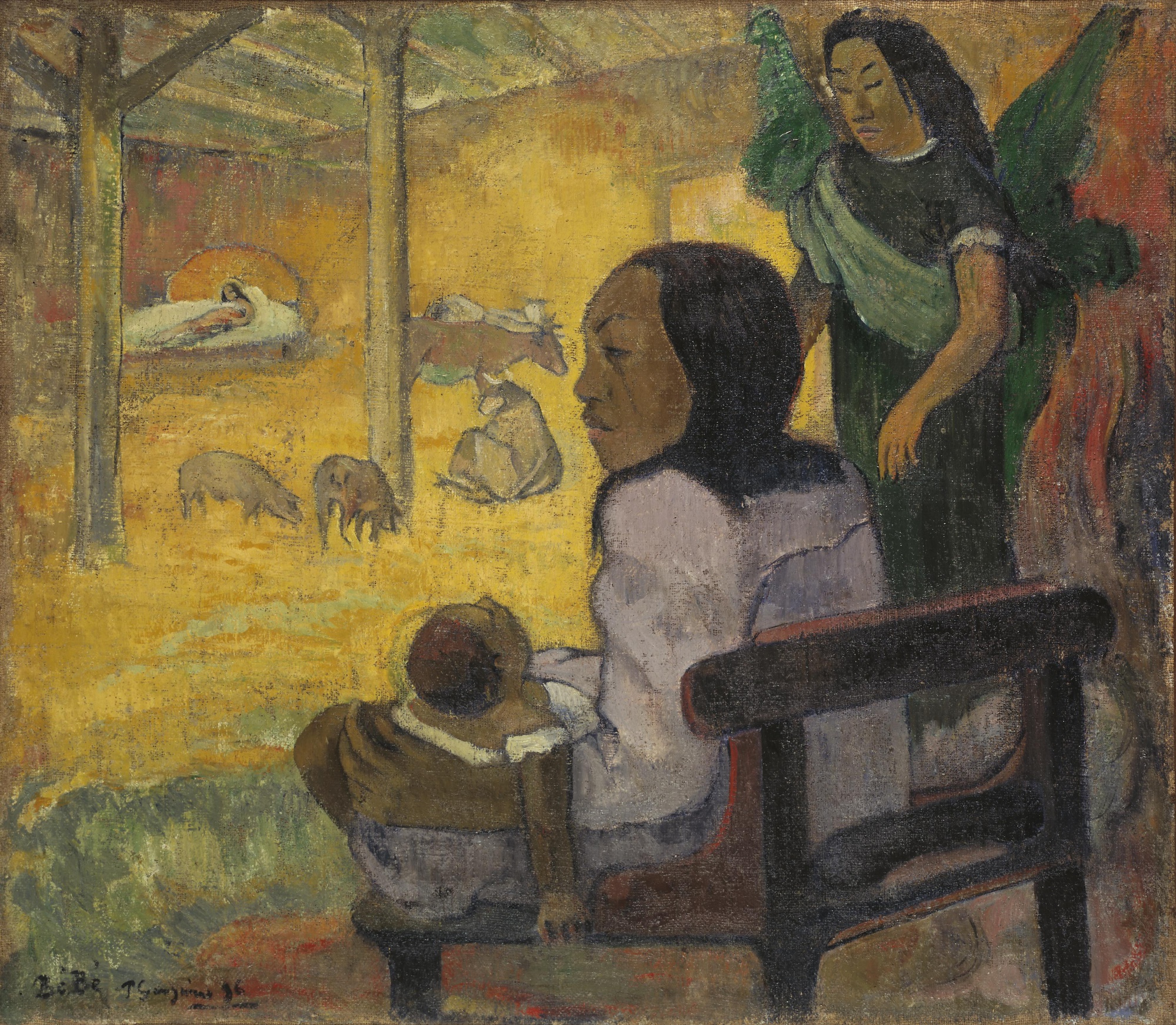
Paul Gauguin (French, 1848–1903), Be Be (The Nativity), 1896. Oil on canvas, 67 × 76.5 cm. State Hermitage Museum, St. Petersburg, Russia. A midwife holds the newborn Christ as his mother rests in the upper left corner.
O child of man,
Wombed in dark waters you retell
Millenniums, image the terrestrial span
From an unwitting cell
To the new soul within her intricate shell,
O child of man.

O child of man,
Whose infant eyes and groping mind
Meet chaos and create the world again,
You for yourself must find
The toils we know, the truths we have divined –
Yes, child of man.

O child of man,
You come to justify and bless
The animal throes wherein your life began,
And gently draw from us
The milk of love, the most of tenderness,
Dear child of man.

So, child of man,
Remind us what we have blindly willed –
A slaughter of all innocents! You can
Yet make this madness yield
And lift the load of our stock-piling guilt,
O child of man.
“Agnus Dei” is the seventh of nine titled sections of the poem “Requiem for the Living” by Cecil Day-Lewis, originally published in The Gate, and Other Poems (J. Cape, 1962) and compiled in The Complete Poems of C. Day Lewis (Stanford University Press, 1992).
Cecil Day-Lewis CBE (1904–1972) was one of the leading British poets of the 1930s, closely associated with W. H. Auden. He was born in Ireland of Anglo-Irish parents, his father a Church of Ireland clergyman, and was educated at Oxford, where he taught poetry from 1951 to 1956. In the 1940s he “turned from poetry of left-wing political statement to an individual lyricism expressed in more traditional forms” (Britannica) and served as poet laureate of England from 1968 until his death in 1972. In addition to writing poetry, he also wrote crime novels under the pseudonym Nicholas Blake, sixteen of which feature detective Nigel Strangeways. One of Day-Lewis’s four children is the actor Daniel Day-Lewis.
Following the popularity of last year’s “25 Poems for Christmas,” I’ve decided to publish a brand-new installment, and will perhaps make this a yearly tradition! All the selections can be read online—just follow the links.
Despite the pithy title of this post, not all the poems are “Christmas” poems, strictly speaking, but rather they encompass the season of Advent too, as well as Epiphany. Advent is a four-week season leading up to Christmas that is characterized by a mood of longing and expectation; it is oriented not only toward Jesus’s first coming but also toward his second. Christmas, of course, celebrates the birth of Jesus, the Word of God made flesh. And Epiphany, on January 6, commemorates the visit of the magi to the crib, representing God’s self-revelation to the wider world.
Each poem is accompanied by a micro-commentary or short descriptive blurb, which I suggest you read after reading the poem itself. There’s a benefit to first entering a poem without having any context—then after registering your initial impressions and questions, to consider another person’s framing or analysis or highlights, and reread. And then a third time! Each reading can potentially reveal new meaning.
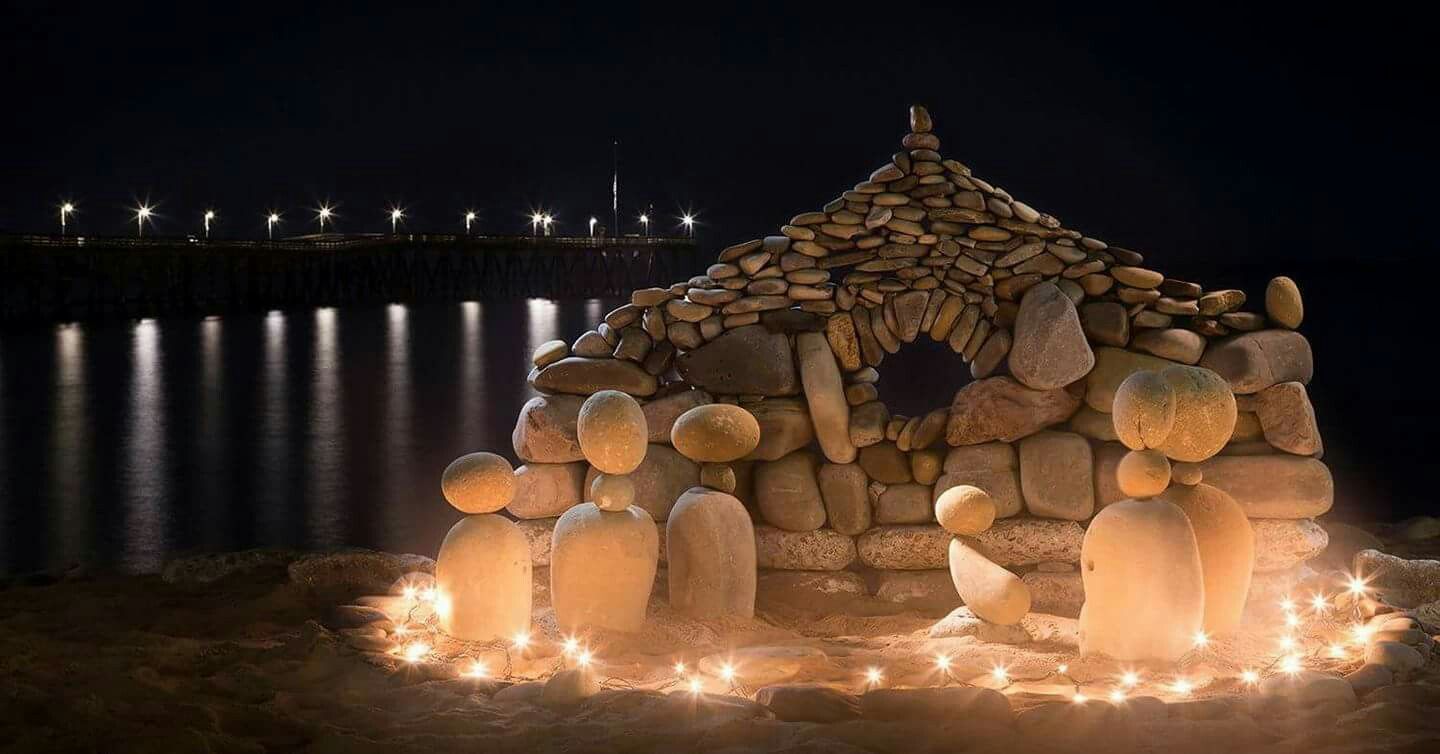
Stone Nativity by Juan Manuel Cisneros, Ventura, California, December 2016 [learn more]
1.“Haiku for an Advent Calendar” by Richard Bauckham: Church services during Advent tend to focus on messianic prophecies from the Hebrew Bible, rumblings of a coming savior. In this sequence of twenty-four haiku, Richard Bauckham pulls a detail from each book of the Jewish scriptures, finding anticipations of Christ. For example, Isaiah: “In the wilderness / a voice cries for centuries / seeking an echo.” Or Job: “God answered Job but / not his question. Maybe he / will do that again.”
2. “How Christ Shall Come” (anonymous): The cosmological Christ blew in from the four cardinal directions, coming as lover, knight, merchant, and pilgrim. So says this fourteenth-century Middle English lyric, rich in metaphor, compiled in a book of preaching aids and sermons by John Sheppey (d. 1360), bishop of Rochester. (It is unclear whether he is the author of the poem.) The great medieval literature scholar Carleton Brown gave it the title “How Christ Shall Come” in his landmark Religious Lyrics of the XIVth Century (1924), and Grace Hamman brought it to my attention recently in her wonderful monthly Substack, Medievalish, providing a modern English translation and commentary.
3.“Hawk Lies Down with Rabbit” by Seth Wieck: What would it look like for death to no longer have dominion in the animal world? Grappling with Isaiah’s end-time vision of a peaceable kingdom void of predation, this poem describes in graphic terms a bird of prey making its kill, feeding on flesh, and wonders how a hawk could still be itself with rewired impulses. Hear the author read and provide context for the poem on the Reformed Journal Podcast.
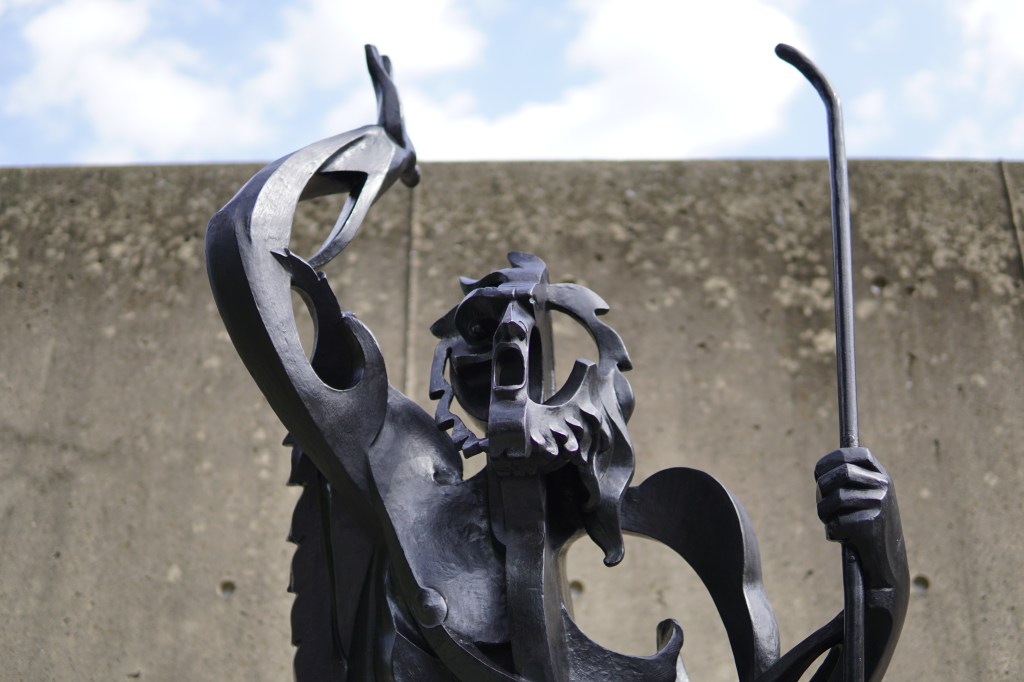
4.“john” by Lucille Clifton: Written in the voice of John the Baptist, this poem is part of an extraordinary sixteen-poem sequence titled “some jesus,” which features a range of biblical characters. In her retelling of his ministry as forerunner to the Messiah, Lucille Clifton casts John as a Black Baptist preacher, preparing his listeners to receive the one who “com[es] in blackness / like a star.” Clifton’s larger body of work would suggest that “blackness” here is multivalent, describing what Jesus comes into and as: the word suggests the darkness of the world that Christ entered, on the one hand, but also functions as a positive racial identifier. In Clifton’s revisioning, Christ comes as a Black man, wearing “a great bush / on his head”—which, again, could be read as an Afro, and/or as a mystical reference to the site at which God revealed himself to Moses in the Sinai desert. Luminous with truth, Christ comes, “calling the people brother.”
Pablo Gargallo (Spanish, 1881–1934), The Prophet (St. John the Baptist) (detail), 1933. Bronze, 91 3/4 × 29 1/2 × 19 in. Wurtzburger Sculpture Garden, Baltimore Museum of Art. Photo: Victoria Emily Jones.
5. “Christmas Mail” by Ted Kooser: Every December the story of an ancient birth comes alive again in couriers’ mailbags, in tin boxes at the ends of driveways, on mantels and fridges. This poem honors those postal workers who deliver good tidings in the form of Christmas cards, the magic spilling out the envelopes to make even the most tiresome routes sparkle a bit.
6. “December 25” by George MacDonald: Through the mid-nineteenth century, denominations influenced by the Reformed tradition, including the Church of Scotland in which George MacDonald was raised, typically did not observe Christmas, the rationale being that no one day should be thought of as holier than any other. But in his book-length dramatic poem Within and Without, MacDonald refers to December 25 as “this one day that blesses all the year”—and in this seven-liner from his Diary of an Old Soul, he describes Christmas as a gleaming blue sapphire, a structural center around which all the other jewels of the church calendar are oriented.
7. “On a Cardinal Climbing Down a Manhole to Restore Power to 400 Homeless People” by Michael Stalcup: On May 11, 2019, Cardinal Konrad Krajewski, the papal almoner (Pope Francis’s special appointee to distribute charity), crawled into a manhole and broke a police seal to personally restore power to a homeless shelter in Rome whose electricity had been shut off due to its failure to pay its bills. The shelter was occupied by some 450 people at the time, 100 of them children, who had been without electric light, hot water, and refrigeration for nearly a week. In this poem, which can be read Christologically, Michael Stalcup celebrates this defiant humanitarian act that brought light to a people living in darkness.
8. “Incarnation” by Amit Majmudar: “Inheart yourself, immensity. Immarrow, / Embone, enrib yourself.” So begins the five-poem sequence “Seventeens.” Musical and witty, this first poem is a plea to the great I AM to take on a body and “be all we are, and all we aren’t.”
9.“The Lord Is with Thee” by Micha Boyett: Written in 2010 as the third in a five-poem sequence commissioned by John Knox Presbyterian Church in Seattle, this poem centers on the Visitation episode described in Luke 1:39–58. It’s about Mary finding belonging in God’s story, especially through the companionship of her elder cousin Elizabeth, who has nurtured Mary’s faith since infancy and continues to do so in this her moment of crisis. “How easily she spoke of God, / as if he were a neighbor, a fish vendor on the street,” Mary admires. Elizabeth supports Mary physically, emotionally, and spiritually, holding her hair back as she vomits, protecting her from vicious rumors, affirming the work of God in her life, and accompanying her at the start of this wild path God has set them both on.
Odilon Redon (French, 1840–1916), Mystical Conversation, ca. 1896. Oil on canvas, 65 × 46 cm. Museum of Fine Arts, Gifu, Japan.
10.“Our Lady” by Mary Elizabeth Coleridge: The great-grandniece of the Romantic poet Samuel Taylor Coleridge, Mary Elizabeth Coleridge (1861–1907) grew up in a home visited by family friends Alfred Lord Tennyson, Anthony Trollope, John Ruskin, and Robert Browning, among others. In this poem she marvels at how God chose the common-born Mary for such a task as mothering the Christ, singing along with Mary’s Magnificat about how God raises up the lowly.
Source: Fancy’s Following (privately published, 1896). Public Domain.
11. “Traveling Man”by Marjorie Maddox: With his pregnant wife alongside, Joseph plods down south to Bethlehem, “convinced of the predestined / roll of dice chrismated with Miracle.” An epigraph from a Leonard Cohen song sets the tone.
12.“Sonnet in the Shape of a Potted Christmas Tree” by George Starbuck: This charming shape poem contrasts the extravagance of our popular celebrations of Christmas with the poverty of the first-century event it marks. The first half describes the furious wind of decorative activity that uproots evergreens from their natural habitats to bring them indoors and deck them with baubles and ribbon. I don’t know how to interpret “no scapegrace of a sect,” but “Daughter-in-Law Elect” refers to a duet from the Gilbert and Sullivan opera The Mikado. The turn comes with “a son born / now / now,” the latter two lines styled as the visible trunk of the tree; here the scene shifts to the simple stable of old, where Mary lies “spent” next to her newborn along with a cow and donkey, a sole “firework” guiding the magi and us all to the spot.
13.“Christmas (I and II)” by George Herbert: George Herbert (1593–1633) is one of the most celebrated poets of the English language. In part 1, a sonnet, of this two-part poem, he imagines himself a weary traveler who chances upon a humble inn where he unexpectedly finds his Lord, the infant Christ. It’s the inn of Bethlehem. Having then received rest from Christ his host, in the closing couplet he expresses his desire to reciprocate—to offer his own soul, lowly though it is, as a residence for Christ, praying that God first adorn it to make it hospitable. In the second part of the poem, Herbert uses a metaphysical conceit (extended metaphor) comparing his soul to a shepherd whose flock of thoughts, words, and deeds pastures on God’s word and who, like the shepherds of Bethlehem, sings glory to God. His shepherd-soul seeks eternal daylight, which he finds in the Son/sun, whose beams so intertwine with his song that the beams sing and his song shines.
14. “Descending Theology: The Nativity” by Mary Karr: The physicality of childbirth, from the contractions (which pierce the Virgin like a star, Karr writes) to the bodily fluids, is heavily featured in this poem. Jesus emerges from his mother “a sticky grub” with a “lolling head” and “sloppy mouth” that seeks out her breast for food. And as she feeds him physically, he feeds her spiritually. Then he falls asleep. His first nap, Karr writes, is a foretaste of the sleep of death he will eventually come to taste. But for now, he wakes up crying—as all babies do.
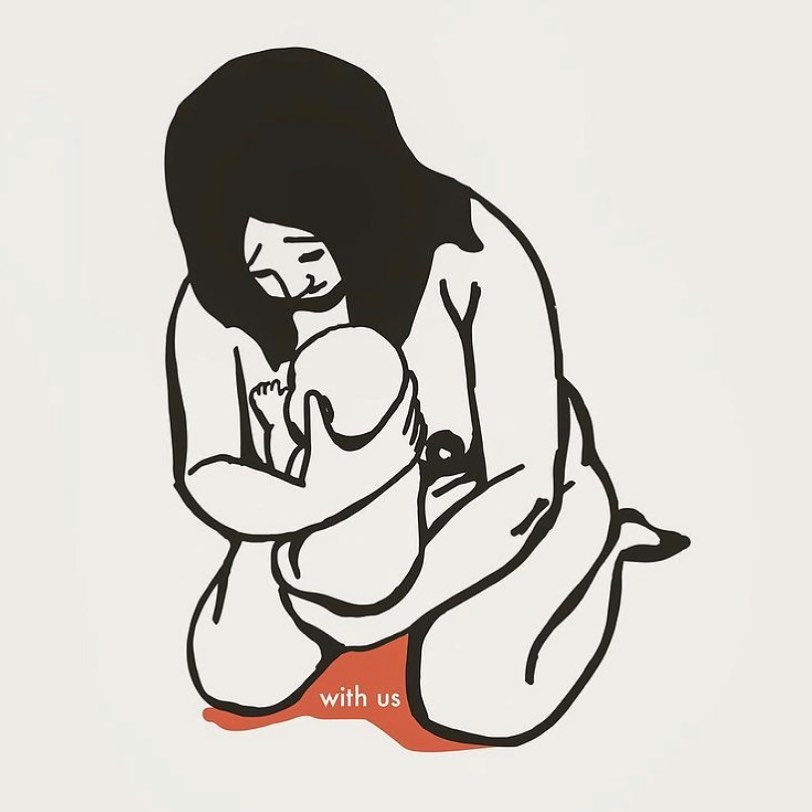
Scott Erickson (American, 1977–), With Us, Face to Face, 2016. Digital art. [available for purchase]
15.“from spiralling ecstatically this”by E. E. Cummings: What a fantastic opening line! The heavenly spheres whirling, twirling, down into the “proud nowhere”—Bethlehem—“of earth’s most prodigious night.” Heretofore living in mundanity, the domestic animals, hungry for miracle, for newness, are vouchsafed to be witnesses of this supernatural event, before which they kneel “humbly in their imagined bodies.” Overhead floats the “perhapsless mystery of paradise,” a phrase suggesting that heaven is beyond human understanding but not without certainty; it’s a declarative reality, not subjunctive, even if it can’t quite be put into words. Mary herself has no words—she silently, knowingly smiles, while the created world erupts in song around her. The “mind without soul” is a reference to Herod, who seeks to snuff out this new life, but to no avail.
The omission of spaces after punctuation marks (e.g., “a newborn babe:around him,eyes”) is not a mistake; that’s how E. E. Cummings liked it. Scholars say it’s to create a faster rhythm, but in this poem I don’t think that choice is as effective, as pauses and slow savoring seem more appropriate to its contemplative mood.
16.“How the Natal Star Was Born”by Violet Nesdoly: Narrated by the angel Gabriel, this poem imaginatively describes heaven’s nervously awaiting the birth of Jesus during the nine months following Gabriel’s dispatch to Mary, and then busting out in celebration when at last they hear his infant-cry. When his Son is born, instead of cigars, the Father passes out trumpets to his company of friends, who sound them all the way to Bethlehem’s fields, and pops open a bottle of champagne whose bubbles spray far and wide.
17. Sections 9–10 of “The Child” by Rabindranath Tagore: Hinduism was the religion of Rabindranath Tagore’s birth and upbringing, but he also held deep respect for Jesus Christ. (For more on the influence of Christianity on Tagore’s thought and writing, see chapter 4 of Rabindranath Tagore and Interfaith Dialogue by Manas Kumar Ghosh [DMin thesis, Charles Sturt University, 2010].) “The Child” is a free-verse poem that Tagore wrote in English in 1930 after seeing a passion play in Germany and then translated into Bengali in 1932 with the title “Sishutirtha” (Pilgrimage to Childhood). In it a “Man of faith” gathers people from all walks of life to join him on a “pilgrimage of fulfilment,” to “struggle [through the dark] into the Kingdom of living light.” Initially met with enthusiasm, the Man later becomes a target of the people’s anger and distrust, and they kill him. Disorientation ensues. But a man in the crowd is able to rally the others to repent and resume their quest, following the spirit of “the Victim.”
The final two sections, 9 and 10, are the selection I’ve chosen. (Scroll right to read the last.) At “the first flush of dawn,” when the time is ripe, the pilgrims arrive at a thatched hut in a palm grove, where they finally meet the eternal Light they’ve been seeking: “the mother . . . seated on a straw bed with the babe on her lap, / . . . the morning star.” Here is the Child of the title, humanity’s redeemer.
Source: The Child (London: George Allen and Unwin, 1931)
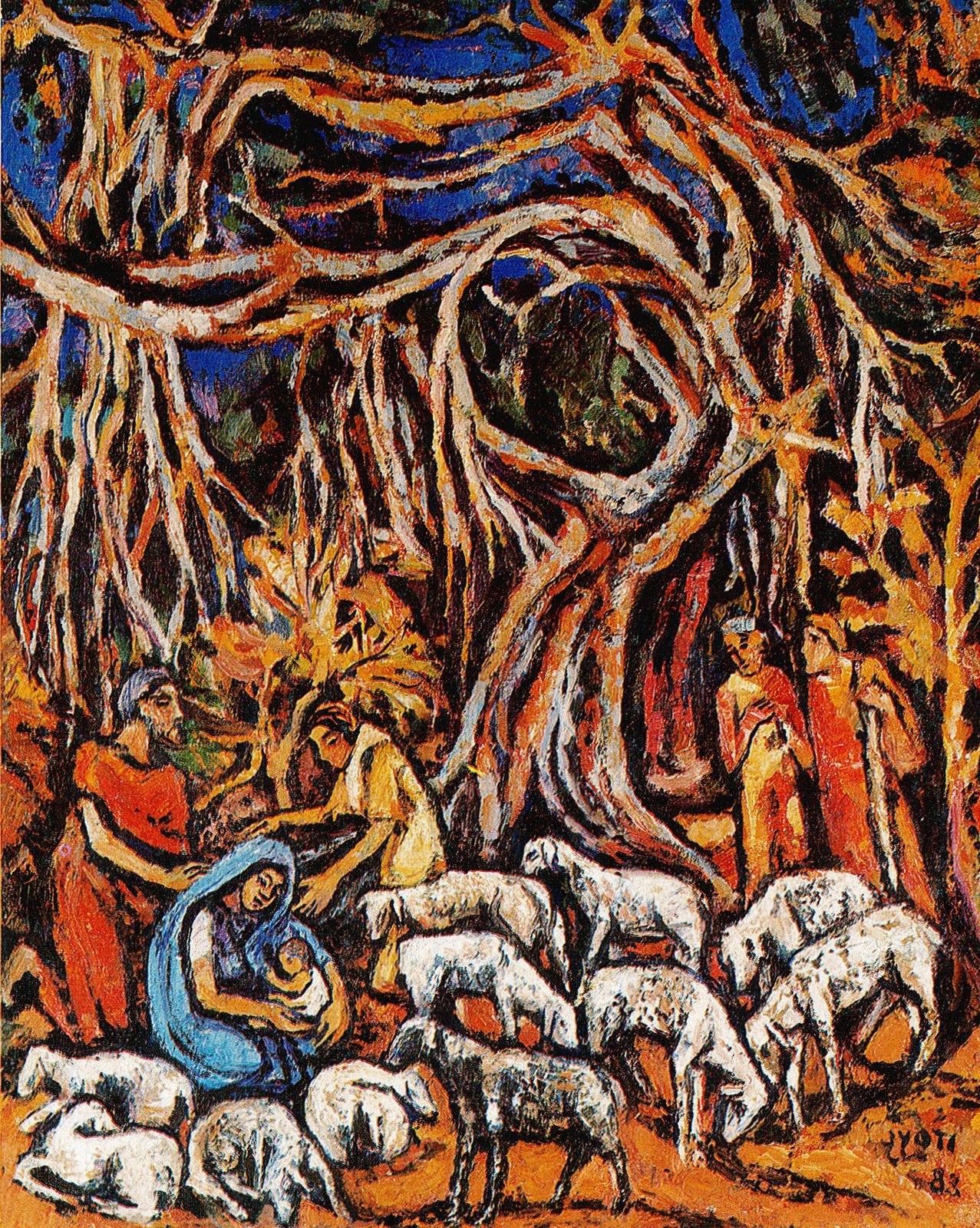
Jyoti Sahi (Indian, 1944–), Adoration of the Shepherds, 1983. Oil and acrylic on canvas.
18. “Love’s Bitten Tongue (11)”by Vassar Miller: This poem, “You, my God, lonesome man, Love’s bitten tongue,” is from a crown of twenty-two sonnets, a type of sequence in which the last line of each sonnet is repeated as the first line of the next, but each time with a new twist of syntax and sense. The crown as a whole expresses the poet-speaker’s struggle against her ego, and her desire for Christ (whom she gives such an evocative name in the title!). In this particular sonnet she describes waiting at the edge of her bed every Christmas Eve as a child in anticipation of both Santa’s arrival with gifts and the holy mystery of Christ’s birth, an admixture of sacred and profane longings that fill her still as an adult.
19. “Gloria in Profundis” by G. K. Chesterton: G. K. Chesterton’s poems are of variable quality, but this one is brilliant, emphasizing God’s descent from the rich heights of heaven into an obscure cave in a simple town. “Glory to God in the lowest!” it exclaims, a clever inversion of the angels’ song to the shepherds in Luke 2:14. The poem was originally published in a 1927 Christmas pamphlet with wood engravings by Eric Gill. The Latin title translates to “Glory in the Depths.”
Source: Gloria in Profundis by G. K. Chesterton (Ariel series pamphlet) (London: Faber and Gwyer, 1927); compiled in The Spirit of Christmas (New York: Dodd, Mead, 1985)
20.“Silent Night” by Bonnie Bowman Thurston: Rev. Dr. Bonnie Thurston invokes a tradition that says the night of Christ’s birth, there was a whole hour in which time stood still and all was silent. What a fascinating legend! Thurston told me its origin is northern European, said she remembers reading it in some scholarly Celtic studies; I wasn’t able to locate any such mentions, but the second-century Protoevangelium of James, chapter 18, probably written in Egypt or Syria, does describe everything momentarily freezing in place around Joseph as he steps out to find a midwife for Mary. Anyway, the poem ends with a striking metaphor! Word, flesh: fire. (Reminds me of this digital artwork by Scott Erickson.)
21. “After Luke 2:19” by Michelle Ortega: When the shepherds recounted to Mary what the angels had told them in the fields about Jesus being the promised Messiah, “Mary treasured all these words and pondered them in her heart,” Luke narrates in his Gospel. Poet Michelle Ortega expounds on this verse, emphasizing the relationship of Mary’s body to her son’s from conception to birth and now postpartum—an intimacy known well by mothers across the centuries. As wondrous as it was to be part of a cosmic story writ large in the skies, Ortega suggests that Mary treasured just as much as the grand pronouncements those small moments of being just an ordinary mama.
22. “Christmas: 1924”by Thomas Hardy: “We the civilized world have given Christianity a fair trial for nearly 2000 years, & it has not yet taught countries the rudimentary virtue of keeping peace,” lamented the British novelist and poet Thomas Hardy (1840–1928) in a letter to Florence Henniker dated February 25, 1900, during the Boer War. World War I only increased his cynicism, which is on display in this sour little epigram that opens with an ironic quotation of the angels’ proclamation to the shepherds the night of Jesus’s birth.
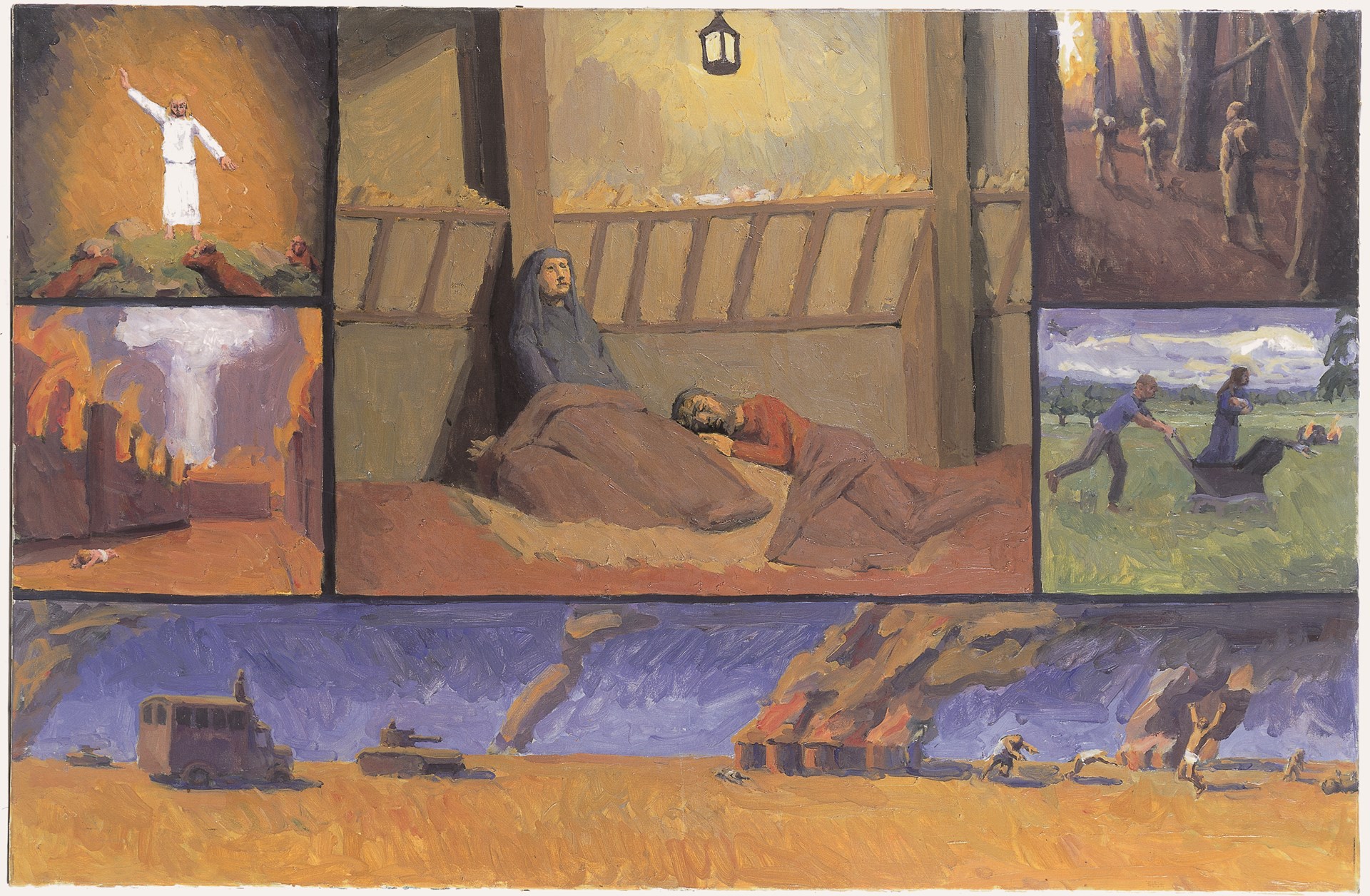
Francis Hoyland (British, 1930–), Nativity, 1961. Oil on canvas, 90 × 120 cm. Methodist Modern Art Collection, HOY/1963/1.
23. “Eating Baklava on New Year’s Eve” by Anya Krugovoy Silver: Poet Anya Silver (1968–2018) reads a spiritual benediction in her piece of baklava, layered and sweet and consumed on the eve of a new year.
Source: Second Bloom (Eugene, OR: Cascade Books, 2017)
24. “A Ballad of Wise Men”by George M. P. Baird: Jesus so often confounds the wisdom of the wise, starting with his birth. With gentle humor and in iambic rhythm and rhyme, this poem celebrates the simple access we all have to Christ.
Source: Rune and Rann (Pittsburgh: Aldine Press, 1916). Public Domain.
25. “Excrucielsis”by Hannah Main-van der Kamp: Originally published at ArtWay.eu as a response to the contemporary Romanian sculpture The Spring by Liviu Mocan, this poem alternates between the weary journeying toward truth of one of the biblical magi and that of a modern-day seeker similarly “longing for / the something more.” It can be a trudge, finding the Light—it involves risk, a willingness to follow the signs, and the tenacity to hold on to your “vision burden,” “clutch[ing] the weight” of it all the way over rough and varied terrain. But the epiphanic moment awaits, to sound like a trumpet blast. The title of the poem is a neologism combining the words “excruciating” and “excelsis” (Latin for “the heights”); “every excelsis contains something excruciating, that’s how we get to genuine excelsis,” the poet told me in an email. Read a related prose reflection by Main-van der Kamp here.
Source: The Slough at Albion (Victoria, BC: Ekstasis Editions, forthcoming)
Disclosure: This post contains Amazon affiliate links, meaning I earn a small commission from qualifying Amazon purchases originating from clicks on this site.
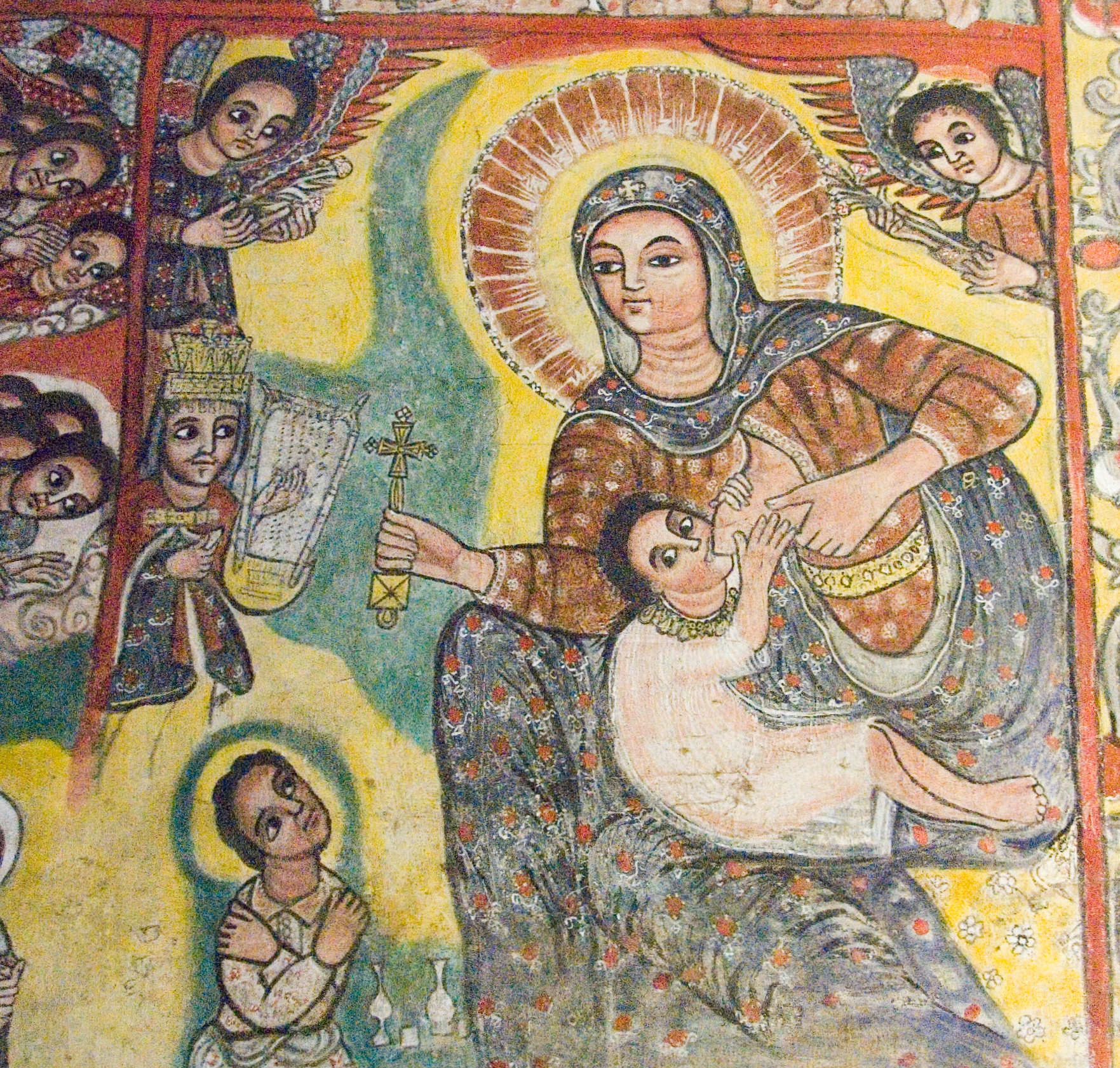
Maria lactans, late 18th century. Fresco, Church of Narga Selassie, Dek Island, Lake Tana, Ethiopia. Photo: Alan Davey.
Glory to that Voice that became a body,
and to the lofty Word that became flesh.
Ears even heard Him, eyes saw Him,
hands even touched Him, the mouth ate Him.
Limbs and senses gave thanks to
the One Who came and revived all that is corporeal.
Mary bore a mute Babe
though in Him were hidden all our tongues.
Joseph carried Him, yet hidden in Him was
a silent nature older than everything.
The Lofty One became like a little child,
yet hidden in Him was a treasure of Wisdom that suffices for all.
He was lofty but he sucked Mary’s milk,
and from His blessings all creation drinks.
He is the Living Breast of living breath;
by His life the dead were suckled, and they revived.
Without the breath of air no one can live;
without the power of the Son no one can rise.
Upon the living breath of the One Who vivifies all
depend the living beings above and below.
As indeed He sucked Mary’s milk,
He has given suck—life to the universe.
As again He dwelt in His mother’s womb,
in His womb dwells all creation.
Mute He was as a babe, yet He gave
to all creation all His commands.
For without the First-born no one is able
to approach Being, for He alone is capable of it.
Translated from the Syriac by Kathleen E. McVey in Ephrem the Syrian: Hymns (Classics of Western Spirituality) (Mahwah, NJ: Paulist Press, 1989), 100–101
Solomon Raj (Indian, 1921–2019), Avatharana (Incarnation), late 1980s, batik. Source: Living Flame and Springing Fountain (Indian Society for Promoting Christian Knowledge, 1993).
Avataraṇa (अवतरण), from which we get the word “avatar,” is a Sanskrit word that means stepping down from a higher position. It’s the word used in Hinduism to refer to the incarnation of a deity, to his or her descending to earth. The late Indian Lutheran pastor, artist, and theologian Solomon Raj, from Andhra Pradesh, used the word, with nuance, to refer to the incarnation of Christ.
In this batik—a type of dyed cloth artwork made using a wax-resist method—Raj shows Jesus diving through the ether, surrounded by angels. He hurtles headfirst from heaven to earth to be with humanity. Reproduced in the book Living Flame and Springing Fountain (1993), the image is accompanied by this verse-style reflection by Raj:
When God became man and came to us, the heavens donned a new robe of light. When the son of man came to this earth, the whole creation became renewed. The universe now is redeemed and kept for a glory yet greater than the first because the unknown and the unknowable One became man to live with mankind.
For more on the concept of Jesus as avatar from Christian perspectives, see:
Michael Amaladoss, “Jesus, the Avatar,” in The Asian Jesus (Maryknoll, NY: Orbis, 2006), 105–21
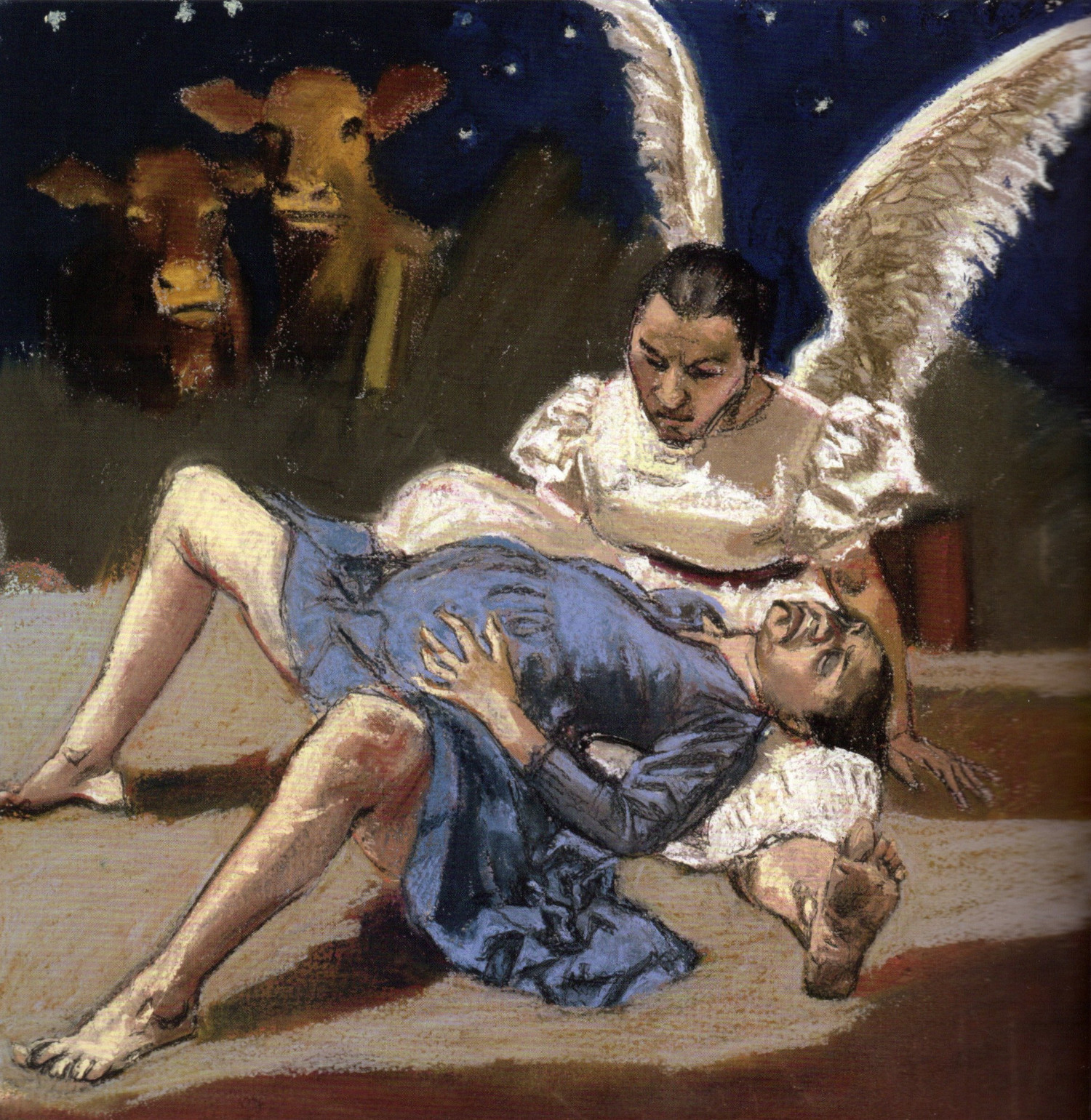
Paula Rego (Portuguese British, 1935–2022), The Nativity, 2002. Pastel on paper mounted on aluminum, 21 3/8 × 20 1/2 in. (54 × 52 cm). Palácio de Belém, Lisbon, Portugal. Source: Paula Rego: The Art of Story, p. 226.
It is time.
My body’s clock gongs
your salvation’s hour.
The water has left the pasture
and flowed toward the river’s mouth.
Follow or you will wither
in the desert that remains.
I will bleed for you
on this your first dark journey,
but in time, when life pushes you
headlong through black canyons,
the wounds will be your own.
May you learn early:
at the end light always shines.
It is here, child.
The time is come.
Breathe.
This poem was originally published in the Winter 1982/83 issue of Today’s Christian Woman and appears in the book Mary’s Journal: A Mother’s Storyby Evelyn Bence (Grand Rapids, MI: Zondervan, 1992). Used by permission of the author.(Thanks to Maureen E. Doallas, curator of the exhibition Mary, Mary, for introducing me to it!)
Evelyn Bence (born 1952) is a writer and editor living in Arlington, Virginia. She is the author of Room at My Table; Prayers for Girlfriends and Sisters and Me; Spiritual Moments with the Great Hymns; and the award-winning Mary’s Journal, a novel written in the voice of Jesus’s mother. She has served as religion editor at Doubleday, managing editor for Today’s Christian Woman, and senior editor at Prison Fellowship Ministries. Her personal essays, poems, and devotional reflections have appeared in various publications.
CHRISTMAS EVE SERVICE 2021, Good Shepherd New York:Good Shepherd New York is an interdenominational church located in the Chelsea neighborhood of Manhattan. When the pandemic hit in 2020, like many churches, they pivoted to online services. This video-only format enabled them to expand their music ministry, soliciting participation from nonlocal musicians, who collaborated virtually with the church’s in-house musicians to release some stellar worship music—beautiful arrangements and performances. While GSNY now meets again in person for worship, they also release separate digital worship services on their YouTube channel to reach a wider community. Last year I tuned in to their Christmas Eve service, which I really enjoyed, particularly the music. “Mary’s Lullaby,” written by associate pastor David Gungor and sung by his wife, Kate, with harmonizing vocals by Liz Vice, is my favorite from the list.
Children’s skit
4:31: Prelude: “Carol of the Bells,” cello solo by David Campbell
28:05: “Mary’s Lullaby” (by The Brilliance), feat. Kate Gungor and Liz Vice
30:03: Sermon by Michael Redzina
44:55: “Silent Night,” feat. Matthew Wright and Liz Vice
48:43: “Happy Xmas (War Is Over)” (by John Lennon)
Many of these songs were released last month on the Good Shepherd Collective’s debut Christmas album, Christmas, Vol. 01, available wherever music is sold or streamed.
Good Shepherd New York will be holding an in-person candlelight service at 5 p.m. on Christmas Eve this year in the Chapel of the Good Shepherd at 440 West 21st Street. Musician Charles Jones will be there.
+++
EXHIBITION WALK-THROUGH: Słowo stało się Ciałem (The Word Became Flesh), Warsaw Archdiocese Museum, March 3–31, 2021: Last year a collection of contemporary Ukrainian and Polish icons on the theme of Incarnation was exhibited in Warsaw. In this video, curator Mateusz Sora and Dr. Katarzyna Jakubowska-Krawczyk, head of the Department of Ukrainian Studies at the University of Warsaw, discuss some of the pieces. I don’t speak a lick of Polish, and closed captioning is not available, so I’m not sure what is said—but the camera gives a good visual overview. You can also view a full list of artists and photos of select icons in this Facebook post.
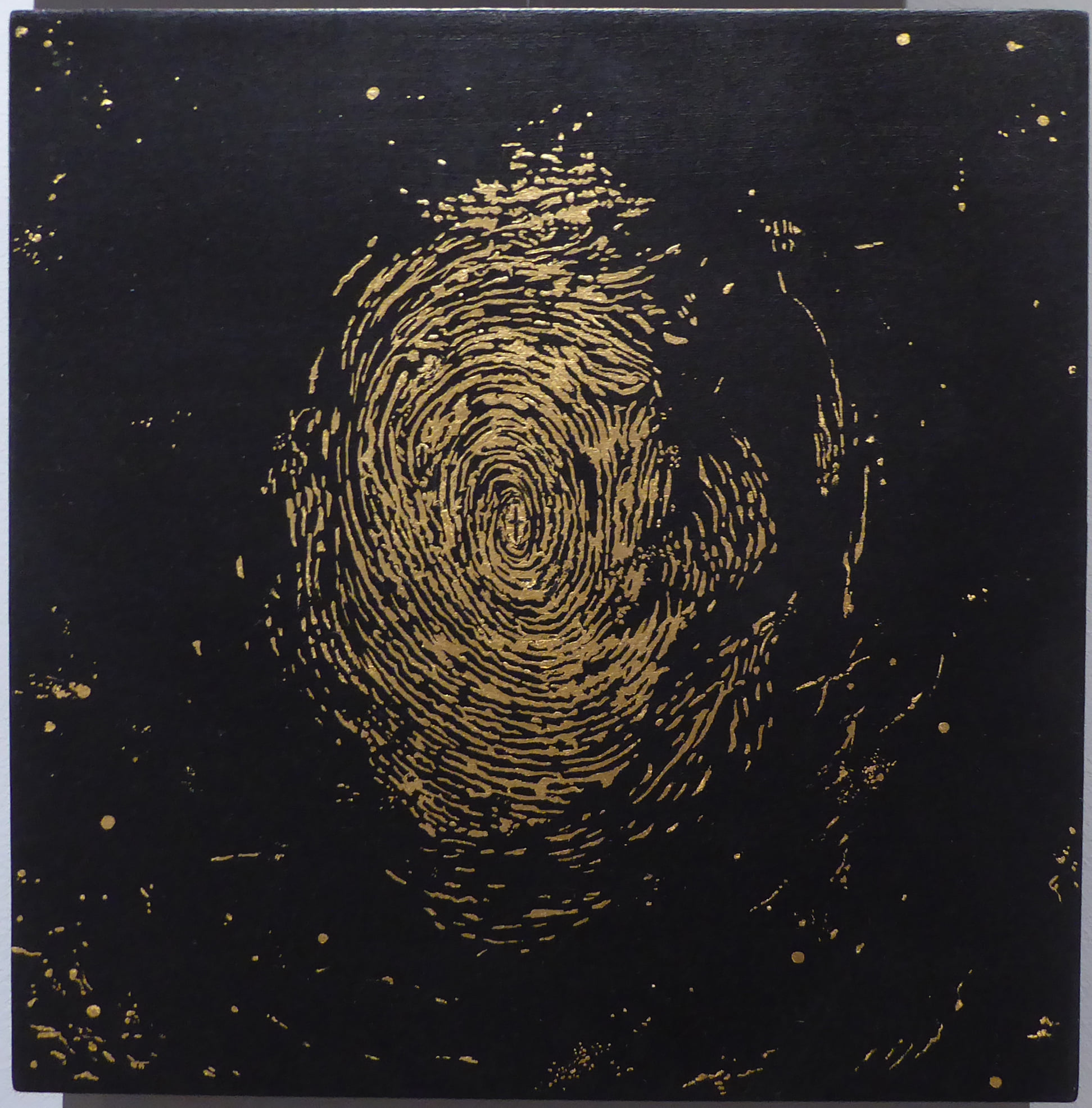
Kateryna Kuziv (Катерина Кузів) (Ukrainian, 1993–), Annunciation, 2020. Egg tempera and gilding on gessoed wood, 40 × 40 cm. [IG: @kateryna_kuziv]Borys Fiodorowicz (Polish), 3,1415926535879323846264338327, 2020. God has fingerprints! [IG: @borysfiodorowicz]
ON A RELATED NOTE: There’s a public exhibition of icons by several of these artists happening in North Carolina at Gordon-Conwell Theological Seminary–Charlotte through February 17, 2023: East Meets West: Women Icon Makers of Western Ukraine. I attended an earlier iteration of East Meets West in Massachusetts back in 2017 (mentioned here), and it was wonderful. The icons are owned by the American collector and former news correspondent to the USSR John A. Kohan, and he has added more pieces to this area of his collection since I last saw it.
There will be a special event on Wednesday, February 1, from 7 to 9 p.m., featuring a talk about the history of iconography by Professor Douglas Fairbairn and a video introduction by Kohan; RSVP here.
+++
ICON INTERPRETATION: “The ‘All-Seeing Eye of God’ Icon” by David Coomler: Icons expert David Coomler unpacks a preeminent example, and two variants, of this unusual icon type that emerged in Russia at the end of the eighteenth century, influenced by the “Eye of Providence” symbol found, for example, on the Great Seal of the United States. Moving from the center outward, four concentric circles show a young Christ Emmanuel, a sun-face, the Theotokos (Virgin Mary), and the angelic hosts, with Lord Sabaoth (God the Father) at the top and symbols of the Four Evangelists at the corners. Inscriptions include “As the burning coal that appeared to Isaiah, a sun arose from the virgin’s womb, bringing to those who wandered in darkness the light of the knowledge of God” (a variant of the Irmos, Tone 2, from the Easter Octoechos) and “My eyes [shall be] on the faithful of the land, that they may dwell with me” (Psalm 101:6).
All-Seeing Eye of God icon, Russia, late 19th or early 20th century
SONG:“Almajdu Laka” (Glory to You) (cover) by the Sakhnini Brothers: The Sakhnini family has lived in Nazareth—Jesus’s hometown!—for generations and is part of the town’s minority Arab Christian population. Adeeb, Elia, and Yazeed Sakhnini [previously] record traditional and original Arabic worship songs together as the Sakhnini Brothers. This is their latest YouTube release, just in time for Christmas. The song is by the Lebanese composer Ziad Rahbani. Turn on “CC” to view the lyrics in English, and see the full list of performers in the video description.
+++
BLOG SERIES: Twelve Days of Carols by Eleanor Parker: There’s a plethora of medieval English Christmas carols preserved for us in medieval manuscripts, a few of which are still part of the repertoire around the world but most of which have fallen into disuse or that are at least lesser known. Medievalist Eleanor Parker spotlights twelve from the latter category. She ran this series back in 2012–13 with the intention of doing twelve posts, one for each day of Christmas, but she stopped short at seven—so I’ve added links to additional carol-based posts of hers from other years. She provides modern translations of the Middle English and, in some cases, brief commentary.
Note that #11 contains an Old English word that Tolkien adopted in his Lord of the Rings!
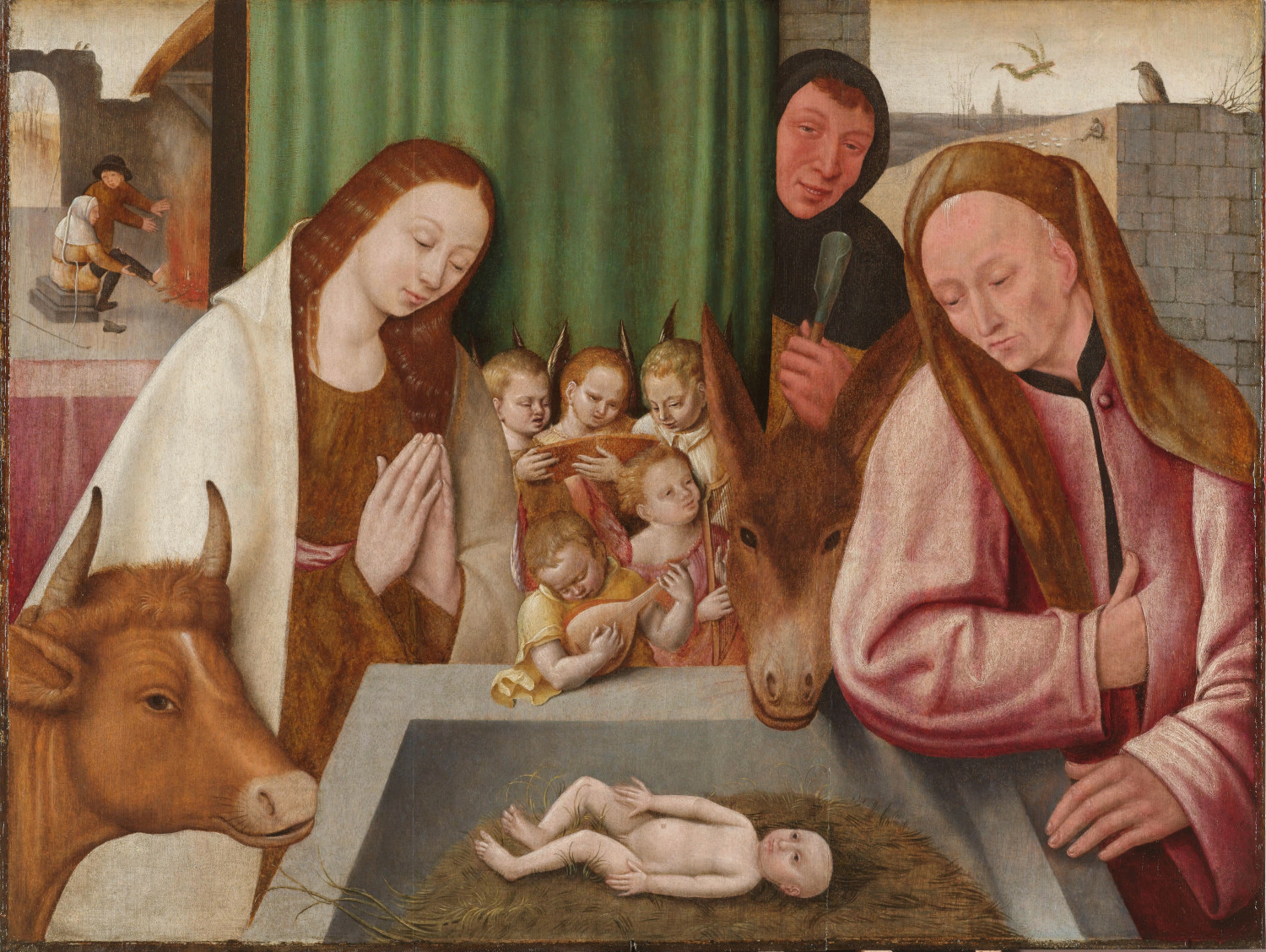
Unidentified artist (in the style of Hieronymus Bosch), Nativity, southern Netherlands, ca. 1550–1600. Oil on panel, 58 × 76 cm. Rijksmuseum, Amsterdam.
This painting in the style of Bosch shows Mary and Joseph adoring their newborn son, Jesus, who’s naked and bedded down in straw. A small angelic ensemble stands at the head of the manger with lute, harp, and songbook, softly serenading the family, while a shepherd sneaks a peek from behind a green curtain. It is as if we, the viewer, are standing opposite the shepherd on the other side of the manger, also looking down at the Christ child. Are we similarly rapt with wonder?
I love how the ox and the ass meet our gaze, acknowledge our presence!
I’m not sure of the significance of Joseph’s hand-in-jacket gesture (its association with stateliness wasn’t established until some two centuries later, from what I can tell), but it’s likely supposed to connote reverence or humility, as do Mary’s prayerful hands.
In the left background, two men warm their hands and feet outside by a fire, while at the right, an angel appears to another shepherd on a hillside, announcing the Messiah’s birth.
The lyrics of this song are loosely based on Ephrem the Syrian’s Nativity Hymn #2 from the fourth century. (All nineteen Nativity hymns by this early Christian poet-theologian are a treasure!)
Blessed is he Both hidden and seen Blessed is he Who left the height of majesty
You magnify all, come magnify me That I may tell about The glory of your birth Proclaim your grace to all the earth Holy One, Jesus, come!
Blessed is he Who gave us all Blessed is he Who gave us all that he has gained
O Father of all, your glorious day You gave not seraphim Nor sent the cherubim You gave your only Son instead Holy One, Jesus, come!
All glory to thee, entirely Glory to thee, from every tongue, entirely Your birth is enough For all of us
Great one became a child Pure one became defiled O Living One, laid in the tomb In you we are renewed Your washing washed us through Let us obtain life by your death Holy One, Jesus, come!
The Incarnation, the enfleshment of God in the person of Jesus, encompasses the God-man’s birth and death, as does this song. Salvation was wrought not through Jesus’s birth alone, or life alone, or death alone, or resurrection alone, but through all of it together.
At first I got tripped up on the line “Pure one became defiled,” because Jesus did not become defiled in the sense of succumbing to sin or moral corruption. However, in his ministry, he did touch lepers, bleeding women, and corpses, which, according to the Jewish purity laws at the time, would have made him ritually unclean. Looking back on these healings and raisings, Christians would say that rather than these people’s uncleanness transferring to him, his cleanness transferred to them. But the public perception was that he was defiling himself.
And then, of course, there’s 2 Corinthians 5:21: “For our sake God made the one who knew no sin to be sin, so that in him we might become the righteousness of God.” And Galatians 3:13: “Christ redeemed us from the curse of the law by becoming a curse for us—for it is written, ‘Cursed is everyone who hangs on a tree.’” What it means that Jesus “became sin” or “became a curse” has been the subject of much theological discussion! But suffice it to say that Jesus’s death on the cross involved not only physical debasement but also his bearing, in a metaphysical sense, the full weight of humanity’s transgressions.
Andy Bast is a singer-songwriter from Holland, Michigan. He is a musician and writer for the Christian collective Bellwether Arts and a regular contributor to Cardiphonia projects.
In careful hands
God held the molten world—
fragile filigree
of unfinished blown glass.

Then Mary’s word: Yes!
rose like a pillar of fire,
and Breath blew creation
into Christed crystal.
Sister Irene Zimmerman, OSF, is a Franciscan nun living in Milwaukee, Wisconsin. Born in 1932 into a large Catholic family on a farm near Westphalia, Iowa, she knew from an early age that she wanted to enter the religious life. She joined the School Sisters of St. Francis in 1954 and spent her career in various ministry roles, including high school English and French teacher, secretary, house mother in a German boarding school for girls, and music minister, along the way developing a keen interest in writing poetry. Now in her retirement, she continues to write and to sing in church choirs. She has published five original poetry collections.







 Art & Theology