Roundup: Christmas disco song by Boney M., dancing fish, Indian Madonna and Child paintings, and more

Wondering why I’m still posting Christmas content? Because Christmas is a twelve-day feast that began December 25 and extends through January 5. While the stores and most media have moved on, the church continues to celebrate. So I encourage you to keep your Christmas decorations up, keep singing and playing carols, and keep partying!

Here’s a link to my Christmastide playlist, comprising over twenty-seven hours of hand-picked sacred Christmas music. Also check out my Epiphany playlist for January 6.

+++

SONGS:

>> “Mary’s Boy Child / Oh My Lord” by Boney M.: The calypso carol “Mary’s Boy Child” was written in 1956 by Jester Hairston and popularized by Harry Belafonte, who recorded it that year. The most famous cover, though, is by Boney M., a reggae, funk, and disco band founded in 1975 in West Germany by the record producer Frank Farian. Its four original members were Liz Mitchell and Marcia Barrett from Jamaica, Maizie Williams from Montserrat, and Bobby Farrell from Aruba. Boney M. released their disco-lite version of “Mary’s Boy Child,” in medley with the new song “Oh My Lord” (by Frank Farian and Fred Jay), as a single in 1978 and then on their full-length Christmas album in 1981. It’s one of the best-selling singles of all time in the UK.

The song makes me smile so much—it’s bright and catchy—especially when I watch the music video, which shows the band singing and dancing in a white room wearing furry white coats. It’s one of two music videos they made for the song, the other cut together with kids enacting the Nativity.

>> “O Ho, Masih Aaya, Zameen Par” (Oh, Christ Has Come! There Is Joy on Earth!) by Akshay Mathews: This contemporary carol from India opens, “Oh, Christ has come! There is joy on earth, there is joy throughout the heavens. Oh, Christ has come!” Then it describes the Annunciation to the Shepherds. Read the Hindi lyrics here. In the video, singer-songwriter Akshay Mathews [previously], who lives in Delhi, triplicates himself using a clone effect so that he is shown playing all three accompanying instruments: guitar, keyboard, and hand drum.

>> “There’s a Fire in Bethlehem,” arr. Conrad Susa: I learned of this traditional Spanish villancico, “En Belén tocan a fuego,” from Calvin University’s 2022 Lessons and Carols Service, For God So Loved the Cosmos. As part of that program, the song was performed in English by the university’s Women’s Chorale, as arranged by Conrad Susa. It opens with imagery of the fire of God’s love flaring out from a stable, and develops into a scene of fish, rivers, and birds rejoicing in the birth of their Redeemer. There was a recording error that puts the lips out of sync with the sound, but the music otherwise comes across just fine.

I love the playful chorus, where the tempo picks up and the pianist shifts to staccato technique (detached and bouncy): “Fish in the river are glistening and dancing, dancing and leaping to celebrate his birthday.” In the sixteenth-note piano run that signals the transition between chorus and verse, I can picture the cavorting, splashing, and darting of our gill-bearing brothers. Although several animal characters make an appearance in Christmas songs, fish usually aren’t one of them. I like how the anonymous writer of this song includes them among the ones who celebrate Christ’s birth. Reminds me a bit of the animated Christmas short from Russia that I shared back in 2017.

To hear a professional recording by the Balthasar-Neumann-Chor, click here.

+++

ARTICLES:

>> “Modernism and Islamic motifs: How Indian artists envisioned Christ’s birth” by Cherylann Molan, BBC News Mumbai: This article explores a handful of Indian depictions of the Virgin and Child by Mughal-era artists, Jamini Roy, and Angelo da Fonseca, all of which present Jesus’s birth from a local perspective.
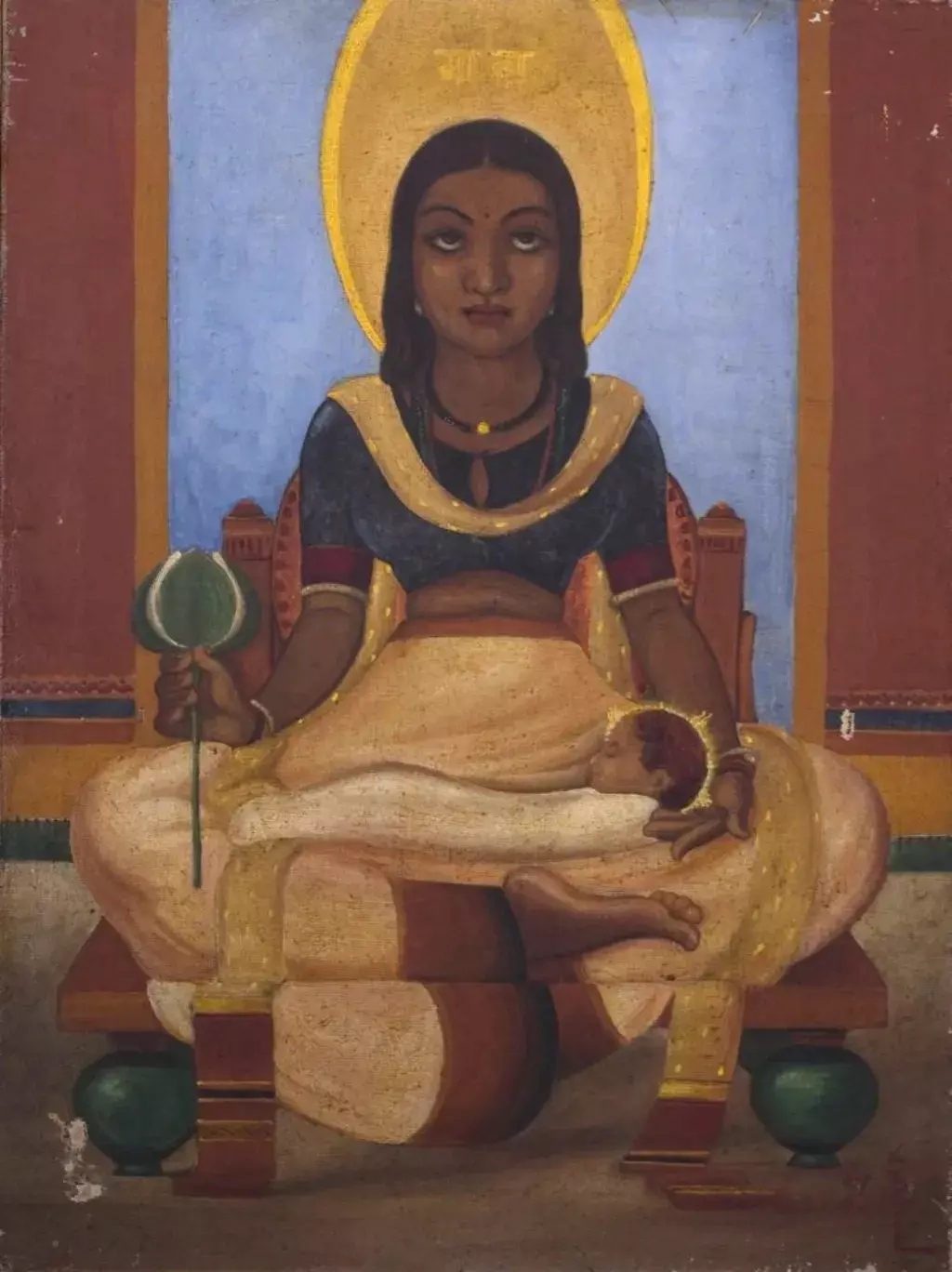
Fonseca, Angelo da_Mother and Child
Angelo da Fonseca (Indian, 1902–1967), Mother and Child, 1952. Watercolor on paper. Photo courtesy of the Xavier Centre of Historical Research, Goa.

>> “A Resolution for People Who Are Already Doing Their Best” by Kate Bowler, Everything Happens (Substack): “Every January, we perform this ritual together. We shake off the indulgence of the holidays and brace ourselves for improvement. We tell ourselves that this will be the year we get it together . . . that any mess was temporary . . . that with the right plan, the right habits, the right mindset, we can finally become the person we were always supposed to be. This is not a small thing. In the United States and Canada (bless us all), New Year’s resolutions have become a kind of secular sacrament—an annual recommitment to the belief that limits are a problem to be solved. But what if they aren’t?”

Kate Bowler [previously], an award-winning author, podcaster, and historian of American self-help, breaks the illusion of unlimited agency and shares the question she’s asking herself for the new year instead of “What should I fix?”

Easter sermon by Saint Ephrem (excerpt) + triptych by Jyoti Sahi

Sahi, Jyoti_Triptych of Salvation
Jyoti Sahi (Indian, 1944–), Triptych of Salvation, 2021. Acrylic, oil, and ocher on canvas, 24 × 48 in. All photos courtesy of the artist.

Death trampled our Lord underfoot, but he in his turn treated death as a highroad for his own feet. He submitted to it, enduring it willingly, because by this means he would be able to destroy death in spite of itself. Death had its own way when our Lord went out from Jerusalem carrying his cross, but when by a loud cry from that cross he summoned the dead from the underworld, death was powerless to prevent it.

Death slew him by means of the body which he had assumed, but that same body proved to be the weapon with which he conquered death. In slaying our Lord, death itself was slain. It was able to kill natural human life, but was itself killed by the life that is above the nature of mortals.

Death could not devour our Lord unless he possessed a body, neither could hell swallow him up unless he bore our flesh; and so he came in search of a chariot in which to ride to the underworld. This chariot was the body which he received from the Virgin; in it he invaded death’s fortress, broke open its strong room, and scattered all its treasure.

At length he came upon Eve, the mother of all the living. She was that vineyard whose enclosure her own hands had enabled death to violate, so that she could taste its fruit; thus the mother of all the living became the source of death for every living creature. But in her stead Mary grew up, a new vine in place of the old. Christ, the new life, dwelt within her. When death, with its customary impudence, came foraging for her mortal fruit, it encountered its own destruction in the hidden life that fruit contained. All unsuspecting, it swallowed him up, and in doing so released life itself and set free a multitude.

He who was also the carpenter’s glorious son set up his cross above death’s all-consuming jaws, and led the human race into the dwelling place of life. Since a tree had brought about the downfall of humankind, it was upon a tree that humankind crossed over to the realm of life. Bitter was the branch that had once been grafted upon that ancient tree, but sweet the young shoot that has now been grafted in, the shoot in which we are meant to recognize the Lord whom no creature can resist.

We give glory to you, Lord, who raised up your cross to span the jaws of death like a bridge by which souls might pass from the region of the dead to the land of the living. . . .

We give glory to you who put on the body of a single mortal and made it the source of life for every other mortal.

You are incontestably alive! Your murderers sowed your living body in the earth as farmers sow grain, but it sprang up and yielded an abundant harvest of people raised from the dead.

Come then, my brothers and sisters, let us offer our Lord the great and all-embracing sacrifice of our love, pouring out our treasury of hymns and prayers before him who offered his cross in sacrifice to God for the enrichment of all.

—Ephrem the Syrian, sections 3–4 and 9 of the Eastertide sermon “On Our Lord,” trans. the International Commission on English in the Liturgy in The Liturgy of the Hours, vol. 2 (New York: Catholic Book Publishing Co., 1976), 735–36

Ephrem the Syrian (ca. 306–373) was a prominent Christian theologian, hymnist, and teacher who is venerated as a saint and a doctor of the church. Born in Nisibis (in modern-day Turkey), he served as a deacon and later lived in Edessa, a center of Greek and Syriac theological and philosophical thought in Upper Mesopotamia. He spoke and wrote in Syriac, a dialect of Aramaic, and is the most significant of all the Syriac Christian fathers.

This sermon excerpt appears in the Roman Catholic Office of Readings for Friday of the Third Week of Easter. In translating the passage, the committee referenced the parallel text in Thomas Joseph Lamy’s Latin translation, “Sermo de Domino nostro,” columns 152–58, 166–68, in Sancti Ephraemi Syri Hymni et Sermones, vol. 1 (1882). Read Ephrem’s full sermon, in an English translation by A. Edward Johnston, at New Advent.

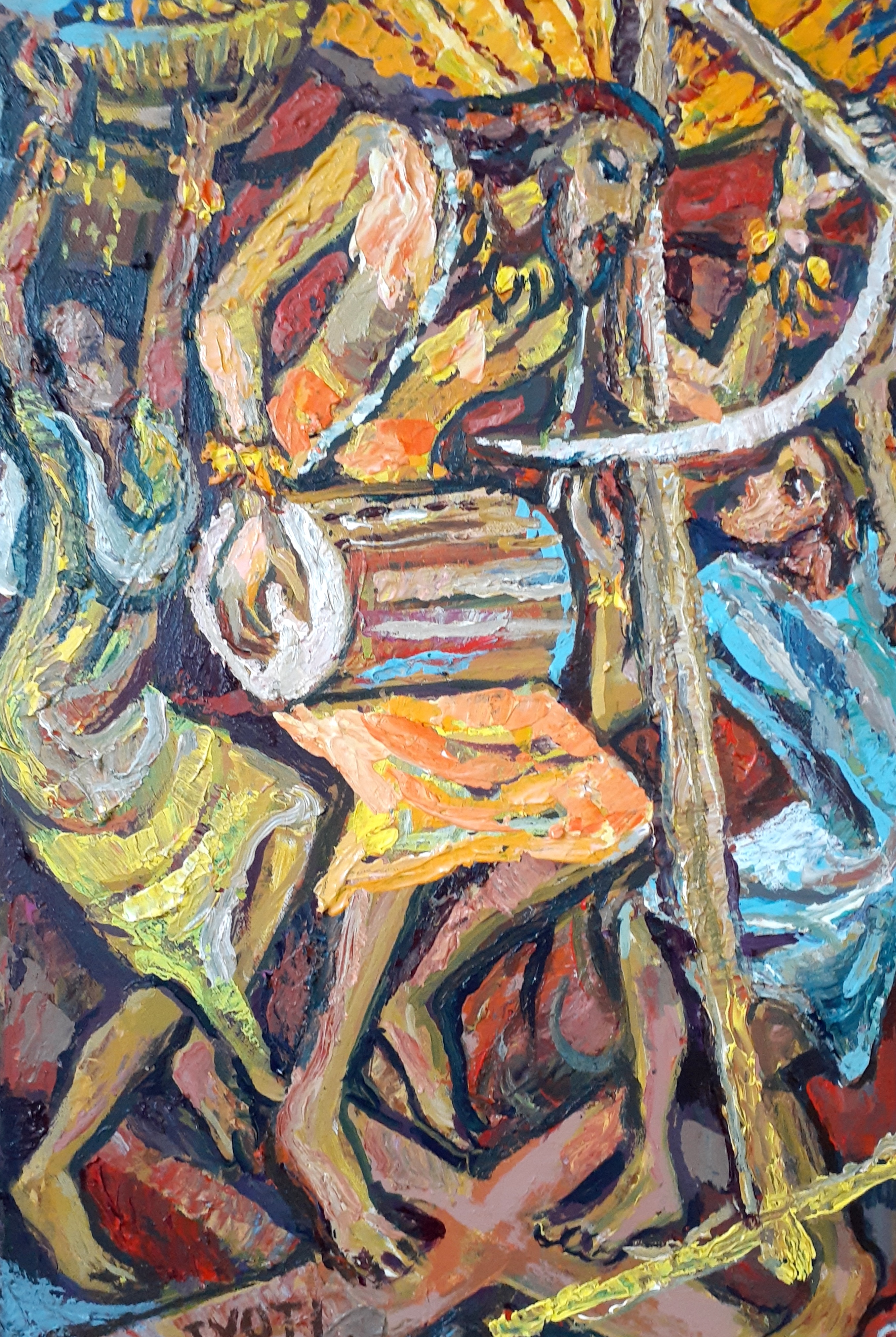
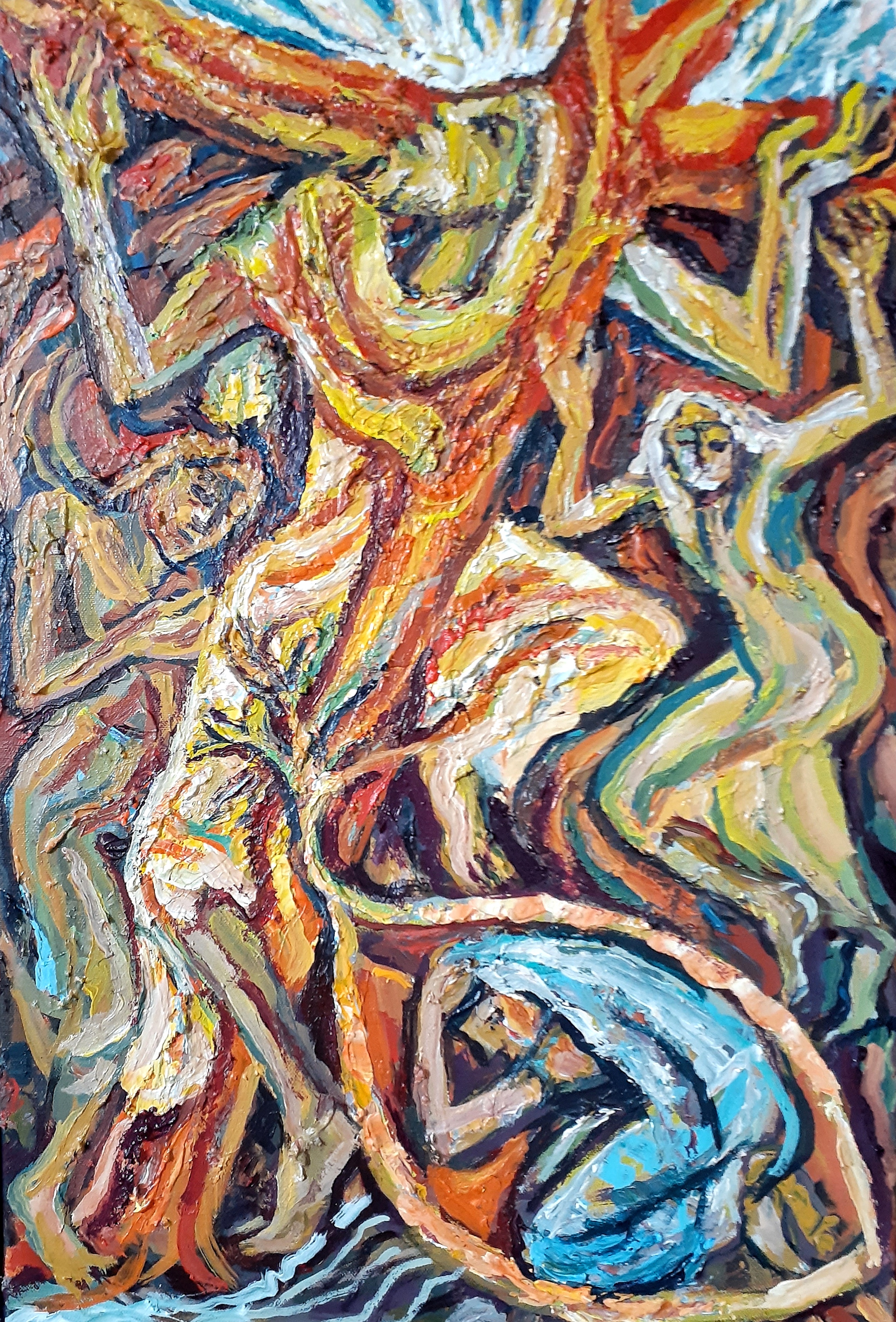
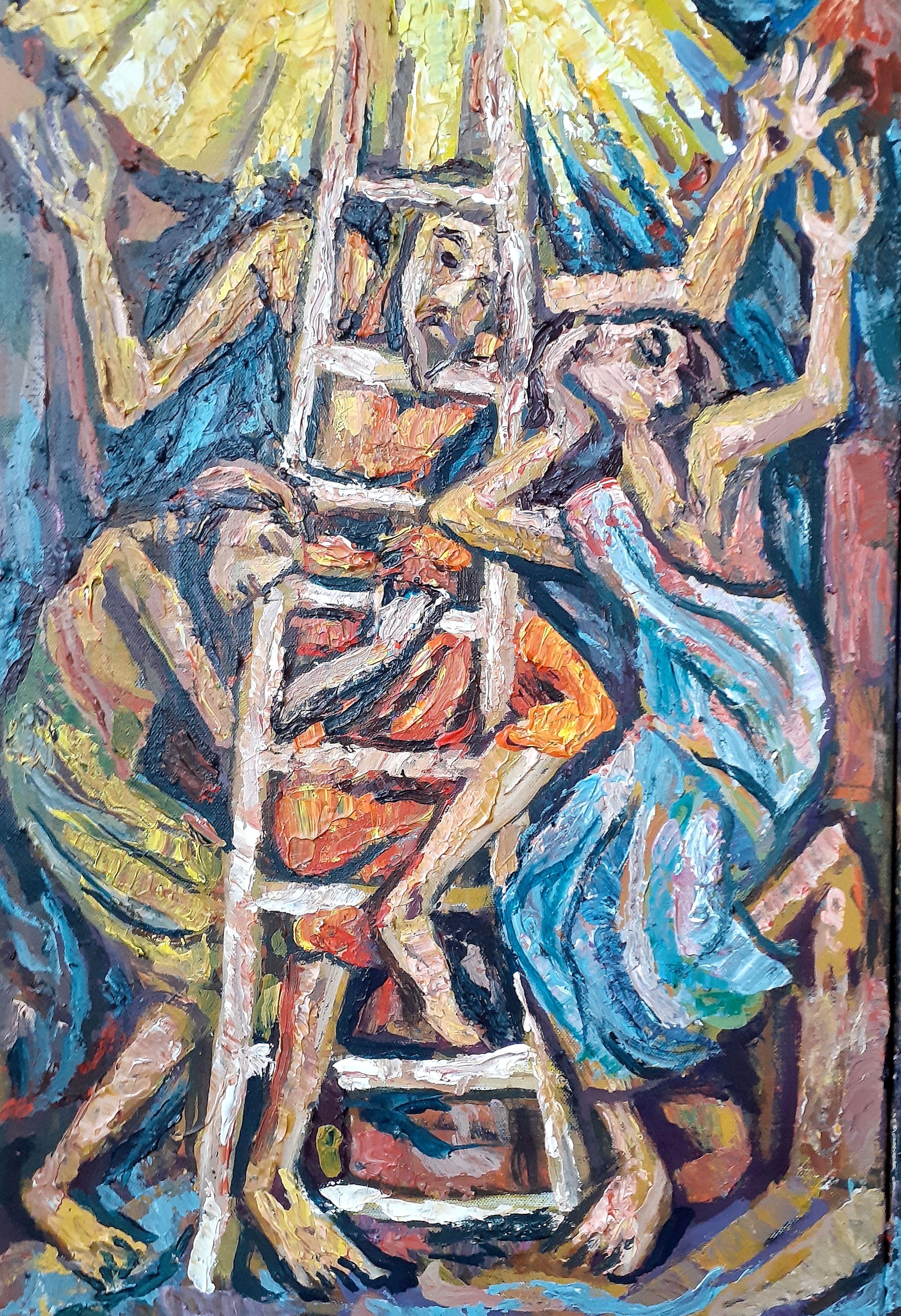
The three-paneled painting at the top of this post is by my friend Jyoti Sahi, one of the most theologically exploratory artists working today. I saw this triptych at an earlier stage of development when I visited his home in Silvepura Village, India, in 2019 and am so pleased by how it turned out. “It represents Christ ascending the cross (left), harrowing the underworld as the drummer (center), and rising like the sprout from the seed that is Mary, from whose womb he sprang forth (right),” Jyoti told me.

Sahi, Jyoti_Triptych of Salvation (left)
Sahi, Jyoti_Triptych of Salvation (central)

The central panel is based on iconography of the Anastasis, in which Jesus descends into Hades following his crucifixion to liberate those who have died. In such icons, Adam and Eve, who represent all of humanity, are “drawn up from the earth,” as Jyoti puts it. Jyoti portrays this rescue as a dance, with Jesus beating out the rhythms of redemption, as well as a time of planting and harvest (he wields a plow and a scythe). Jesus’s death tilled the soil, making conditions right for the dead to be raised to new life.

Jyoti has long been interested in the symbolism of the ladder and the seed, and both symbols are employed here. The ladder is an instrument of both descent and ascent, and the seed, as Christ himself taught, must “die”—be buried in the ground—before it yields life. In the right panel of the Triptych of Salvation, Jesus, having gone down into the earth, bursts forth from his casing, emerging as the tree of life, whose roots are watered by the river of life, which flows across all three panels. This tree is the cross transformed.

Sahi, Jyoti_Triptych of Salvation (right)

His arms raised again as they were on the cross but no longer pinned down, Jesus leads the dance of resurrection, and Adam and Eve and the others who have been delivered join in. They are the fruitful crop of Christ the Gardener.

For two similar paintings by Jyoti, see my blog posts “Jesus as Dancer” and “Jesus as Ladder.”

Christmas, Day 8: All the Way

LOOK: Avatharana by Solomon Raj

Raj, Solomon_Avatharana
Solomon Raj (Indian, 1921–2019), Avatharana (Incarnation), late 1980s, batik. Source: Living Flame and Springing Fountain (Indian Society for Promoting Christian Knowledge, 1993).

Avataraṇa (अवतरण), from which we get the word “avatar,” is a Sanskrit word that means stepping down from a higher position. It’s the word used in Hinduism to refer to the incarnation of a deity, to his or her descending to earth. The late Indian Lutheran pastor, artist, and theologian Solomon Raj, from Andhra Pradesh, used the word, with nuance, to refer to the incarnation of Christ.

In this batik—a type of dyed cloth artwork made using a wax-resist method—Raj shows Jesus diving through the ether, surrounded by angels. He hurtles headfirst from heaven to earth to be with humanity. Reproduced in the book Living Flame and Springing Fountain (1993), the image is accompanied by this verse-style reflection by Raj:

When God became man and came to us,
the heavens donned a new robe of light.
When the son of man came to this earth,
the whole creation became renewed.
The universe now is redeemed and kept
for a glory yet greater than the first
because the unknown and the unknowable One
became man to live with mankind.

For more on the concept of Jesus as avatar from Christian perspectives, see:

LISTEN: “All the Way from Heaven Down” by Thomas Whitfield | Performed by the Thomas Whitfield Company, on The Annual Christmas Services (1988)

All the way from heaven down
Just to save me
All the way from heaven down
Just to love me