All flesh is like grass and all its glory like the flower of grass. The grass withers, and the flower falls, but the word of the Lord endures forever.
—1 Peter 1:24–25
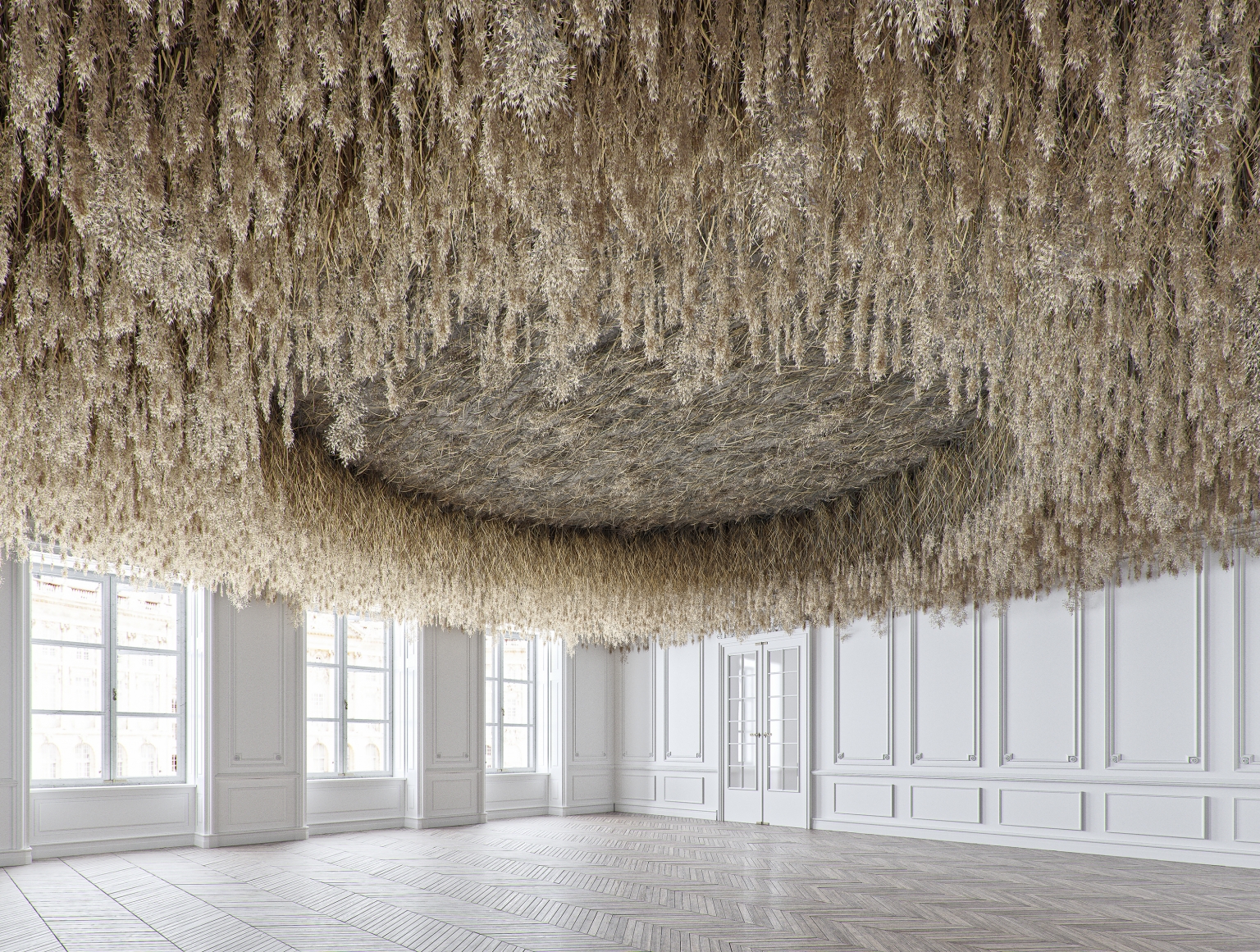
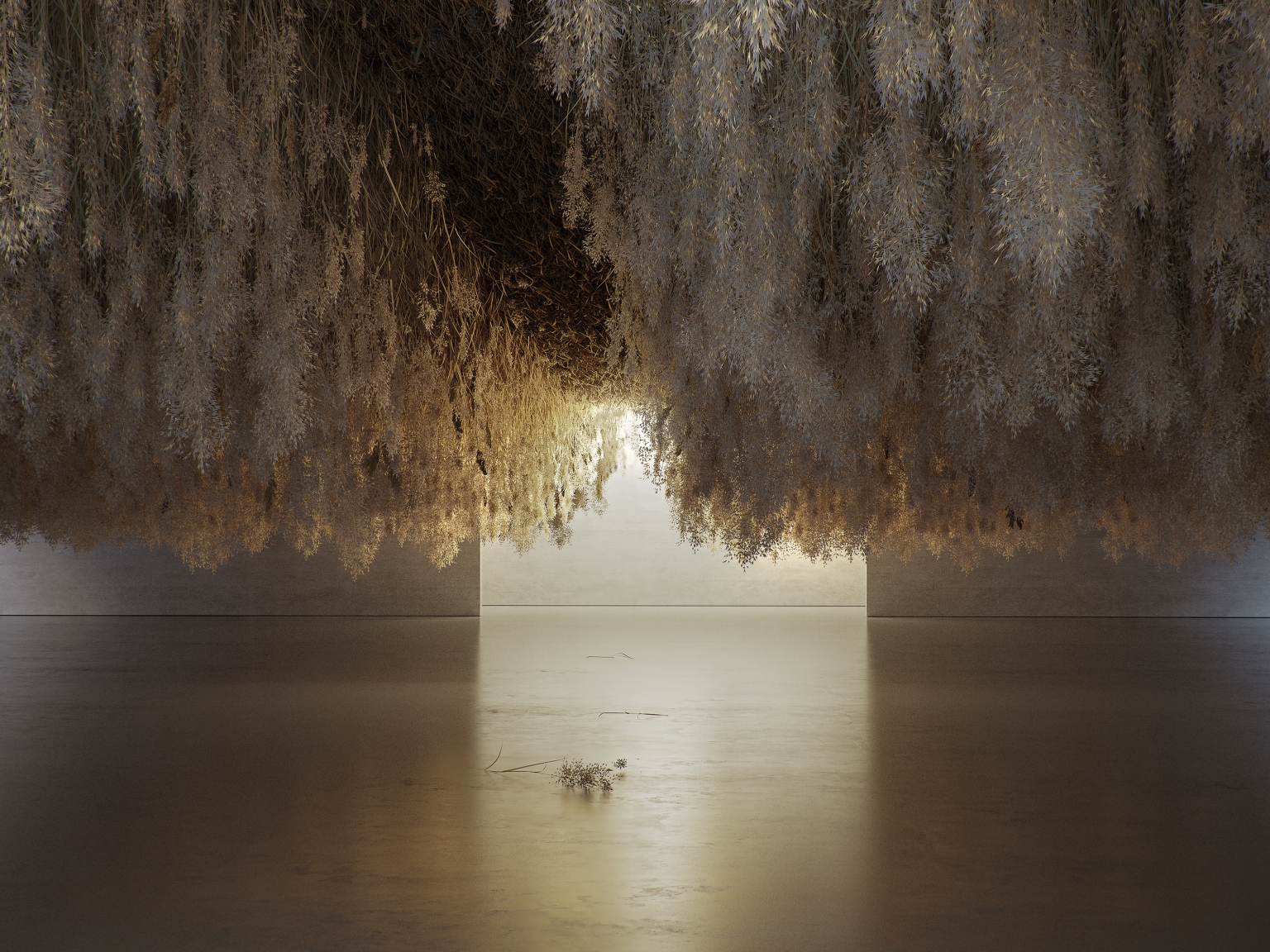
LOOK: French Exit by Tadao Cern
Tadao Cern (Lithuanian, 1983–), French Exit, 2020. Installation of dried grass.
In this installation by Tadao Cern, hundreds of thousands of dried grass stalks are suspended from the ceiling, creating a dense cloud under which viewers can walk. It’s an organic memento mori, a reminder of death. The title, French Exit, refers to the act of leaving a social gathering or a date without saying goodbye. The artist said he wanted viewers to consider their farewells.
Throughout the duration of the installation, some of the dead grass falls from the hovering field onto the floor, to be swept away.
Rowan Mersh (British, 1982–), Invisible Boundaries, 2009. Site-specific installation of cotton thread. Click to view more photos.
Artist’s statement: “A site-specific installation derived from the exploration of a derelict space in West London. I sought to challenge the notion of invisible boundaries created by passages of light and shadow within this broken environment. Over one hundred and fifty miles of cotton thread was used, strung between points of structural relevance, physically plotting paths of light and shadow throughout the course of the day. The result is the evolution of an alternative architectural landscape.”
LISTEN: “Break of Dawn” by Antoine Bradford, feat. Montell Fish, on Light Will Find You (2021)
When I can’t find my way home There You, there You are Calling me over to Your side I can’t escape Your eye
’Cause the light, the light The light of the world Is shining, shining all around Oh, the light, the light The light of the world Is shining, shining all around
What I’m saying, Lord You are my defender in the rain Through the pain and the times Through the things I can’t change I got You all on my mind You’re the one I wanna find You’re the one I wanna see I’ve been going through the motions Feeling all thesе deep emotions But You’re the onе that keep my soul straight floating I’m straight open, I see the light of day So I bow my head and pray
Oh, the light, the light The light of the world Is shining, shining all around Oh, the light, the light The light of the world Is shining, shining all around
The light, the light Light of the world Is shining, shining all around Oh, the light, the light The light of the world Is shining, shining all around
I can see the break of dawn My joy is coming in the morning I can see the break of dawn My joy is coming in the morning I can see the break of dawn My joy is coming in the morning I can see the break of dawn
AVANT-GARDE CLASSICAL: Klang—Die 24 Stunden des Tages (Sound—The 24 Hours of the Day) is a cycle of chamber-music compositions by the avant-garde German composer Karlheinz Stockhausen, which he worked on from 2004 until his death in 2007. (The intention was for there to be twenty-four pieces, but the cycle was unfinished at twenty-one.) The first two pieces in the cycle, on the themes of Ascension and Pentecost, were commissioned for the interdisciplinary Pause festival at Milan Cathedral by artache, a Milan-based nonprofit committed to showcasing contemporary artworks in public places of worship. The artistic director of artache at the time was Don Luigi Garbini, a priest at the church of San Marco in Milan and cofounding director of the artache initiative the Laboratorio di Musica Contemporanea al Servizio della Liturgia (Laboratory for Contemporary Music in the Service of the Liturgy).
>> No. 81: “KLANG, 1st Hour: Himmelfahrt (Ascension)” by Karlheinz Stockhausen, for organ or synthesizer, soprano, and tenor, 2004–5: This thirty-seven-minute piece premiered at Milan Cathedral on Ascension Day, May 5, 2005. The two hands of the organist almost always play in different, independent tempos of a chromatic time scale, while the soloists sing words or phrases associated with “ascension,” particularly the Ascension of Christ. According to the composer, “Asking a performer to break the barrier of time by playing simultaneously in different tempi is like submitting a man to physical disruption, allowing him to go in spirit form towards another world” (source). For musical analysis by Ed Chang, see here. The performance below is from the North American premiere at the Schwartz Center for the Performing Arts at Emory University in Atlanta on October 11, 2005, featuring organist Randall Harlow, soprano Teresa Hopkin, and tenor John Bigham.
>> No. 82: “KLANG, 2nd Hour: Freude (Joy)” by Karlheinz Stockhausen, for two harps and voice, 2005: This forty-minute piece premiered at Milan Cathedral on July 6, 2006. The text is taken from the medieval Pentecost hymn “Veni Creator Spiritus” [previously], which the harpists sing in spurts, “in alternation or sometimes together . . . , while plucking, picking, caressing, stroking, pinching, rubbing, striping, striking, pinking, jubilating,” as Stockhausen put it. In program notes dated February 15, 2006, he writes, “There is something unique about the adventure to combine two harps which are normally tuned in diatonic scales and to synthesise them into one large chromatic harp. . . . Pentecost unites what has been separated. My work FREUDE too.” For musical analysis by Ed Chang, see here. The performance below is from the Stockhausen Memorial Concert in Kürten, Germany, on December 16, 2017, featuring Marianne Smit and Miriam Overlach.
NEW DOCTORAL COHORT:The Sacred Art of Reading: The Eugene Peterson Center for Christian Imagination at Western Theological Seminary in Holland, Michigan, is offering a new, mostly remote, three-year DMin track called “The Sacred Art of Reading,” which begins this October, taught by Professor Chris E.W. Green. The program is centered on the reading of scripture—the Old Testament narrative books (Year 1), Old Testament poetry and wisdom literature (Year 2), and the Gospels and Apocalypse (Year 3)—alongside a number of additional primary texts, whose titles you can view on the website; authors include, among others, Avivah Gottlieb Zornberg, Amy-Jill Levine, Daniel Berrigan, Robert Alter, Shusaku Endo, and of course Eugene Peterson! Participants get together in person for one week each semester (times six semesters) and are responsible for, in addition to the $17,280 tuition, travel and lodging costs. The application deadline is June 30, 2023. Applicants must hold an MDiv degree or its educational equivalent and have at least three years of ministry experience since completing the MDiv. Here’s a condensed program description:
The Sacred Art of Reading cohort will be dedicated to collaboration in “the forbidding discipline of spiritual reading,” confident that such an undertaking cultivates the loving attentiveness, prophetic discernment, and childlike openness to surprise that characterize what St. Paul calls the faith that works by love. . . . The cohort is designed to cultivate an alternative awareness, one shaped by the slow, painstaking work of collaborative interpretation. And to that end, the heart of the program is the reading of the Christian Scriptures. The aim will be both philosophical and devotional, critical and celebratory, mystical and pastoral. No one reading method will be stipulated, but students will be encouraged to find ways to honor the traditions of the communities in which they learned to argue, to muse, and to pray.
Besides Scripture, the cohort will engage a wide range of texts including poems, memoirs, essays, treatises, sermons, and stories old and new, familiar and strange, sacred and “worldly,” in part and in whole, not so much in order to “plunder the Egyptians” as to bear glad witness to the wonder that God is never left without a witness because all truth, truly received, trues.
This approach really wets my whistle! I don’t have a master’s degree, so I’m out, but I feel so energized by the reading list and wanted to share the opportunity with you all, as the program seems doable for those with full-time jobs. A virtual interest meeting is being held on June 1. Click here to view other doctor of ministry cohorts at Western.
+++
FUNDRAISING CAMPAIGN: The Soil and The Seed Project: I’ve mentioned this project several times on the blog before, as I’m a big fan. A ministry of VMMissions (Virginia Mennonite Missions), The Soil and The Seed Project releases original music, art, and liturgies throughout the Christian year, especially suitable for families with littles. They launched in December 2021 and since then have put out seven collections, with their latest and largest yet—Vol. 7 // Ordinary Time—dropping this week. (Request a free download through their website, or stream the music through your favorite service.) Coinciding with this release, they have also launched a campaign to raise $27,000 by June 18 to cover the costs of recording, mixing, pressing, printing, shipping, etc., for future collections. Learn more in the five-minute video below, which features the new songs “In the Little Moments,” “Teach Me, O LORD,” and “Because of Jesus.”
The Soil and The Seed Project offers all their content for free, including physical CDs (as stock permits), and are committed to keeping it that way—which is why they need the support of donors. Donate to their campaign, and you can opt to receive stickers, notecards, and/or a T-shirt as a thank-you. Also note: they’ll be giving a concert at 6:30 p.m. on Saturday, June 3, at the Brethren & Mennonite Heritage Center in Harrisonburg, Virginia.
+++
SONG: “Holy Spirit” by Victoria Williams: “Part front-porch soothsayer, part quirky bayou princess, and part eternal child, Victoria Williams writes songs of indescribable originality that embrace the earthly and the divine with wit, charm, and understated vision,” writes Josh Kun for Bomb magazine. The song “Holy Spirit” [read lyrics] is from her 1990 album Swing the Statue!. It opens with the familiar invocation from a Gullah spiritual: “Kum ba yah, my Lord” (which translates to “Come by here”). She seeks God’s presence and then, given a renewed sensitivity to it, identifies and celebrates its flow throughout her daily goings. She feels the Holy Spirit while building a raft with friends on the shores of Louisiana’s Lake Bistineau and riding a New York City subway beside a whistling stranger, as well as in graveyards and at bars and out under open night skies. The Spirit flows through all of life. I can’t find the song online anywhere other than in this YouTube fan video, which sets it to photos. [HT: Jonathan Evens]
+++
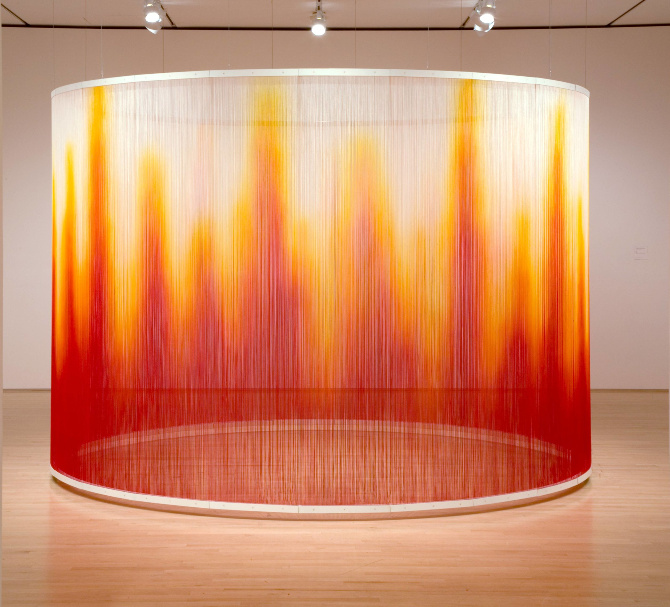
ARTWORK: Fire by Teresita Fernández: In the collection of SFMOMA, this ring of warm-colored silk yarn conveys something of the flickering quality of fire. At the link is a short video interview with the artist about the piece. Fernández says she is interested in the sensorial aspects of viewer engagement with art.
Teresita Fernández (American, 1968–), Fire, 2005. Silk yarn, steel armature, and epoxy, 243.8 × 365.8 cm. San Francisco Museum of Modern Art, California.
Fire was a highlight of the 2013 exhibition Beyond Belief: 100 Years of the Spiritual in Modern Art, jointly organized by SFMOMA and the Contemporary Jewish Museum. Here’s a video of the Lick Wilmerding High School Vocal Ensemble singing “Famine Song” by VIDA around the installation that year, a song inspired by the basket weavers of Sudan, who persist in their craft during times of hardship, their hands working natural fibers into beautiful, colorful vessels. “Weave, my mother; weave, my child; weave your baskets of rushes wild . . .”
Antony Gormley (British, 1950–), Blind Light, 2007. Fluorescent light, water, ultrasonic humidifiers, toughened low-iron glass, aluminum, 320 × 978.5 × 856.5 cm. Temporary installation at the Hayward Gallery, London. Photo: Stephen White.
Sir Antony GormleyOBERA is a leading contemporary sculptor and installation artist whose work focuses on the human figure. His Blind Light installation from 2007 consists of a large semitransparent glass chamber lit by fluorescent light and filled with a dense cloud of mist. “Upon entering the room-within-a-room, the visitor is disoriented by the visceral experience of the fully saturated air, in which visibility is limited to less than two feet.”
One visitor took a two-minute video of the experience:
Architecture is supposed to be the location of security and certainty about where you are. It is supposed to protect you from the weather, from darkness, from uncertainty. Blind Light undermines all of that. You enter this interior space that is the equivalent of being on top of a mountain or at the bottom of the sea. It is very important for me that inside it you find the outside.
Sometimes the human experience feels like a groping through fog. It’s hard to see the bigger picture. The not-seeing can be frustrating. There is a doorway leading out into the clear, into full vision—but our passage through isn’t granted us until the general resurrection. Meanwhile, “we walk by faith” (2 Cor. 5:7), stumbling alongside one another through mists of unknowing, but with God’s word and Spirit as guides, giving us glimpses of clarity and confidence to step forward. “For now we see through a glass, darkly; but then face to face,” the apostle Paul writes in anticipation of the day of the Lord. “Now I know in part; but then shall I know even as also I am known” (1 Cor. 13:12).
I’m quiet in cloudy waiting Assured of little but weaknesses Of faith and seeing And I’m wanting only to be filled In this day
And I know you’re coming soon But would you show me where you are right now In cloudy waiting
I’m craving the clouds of your returning Assured of little but a strength Beyond faith and seeing But I’m wanting only to be filled I’m wanting only to be stilled In this day
I know you’re coming soon But would you show me where you are right now In cloudy waiting
I’m hopeful for the fruits of faithfulness But they are slow in their growing And I’m quick to accuse When heavy silence comes
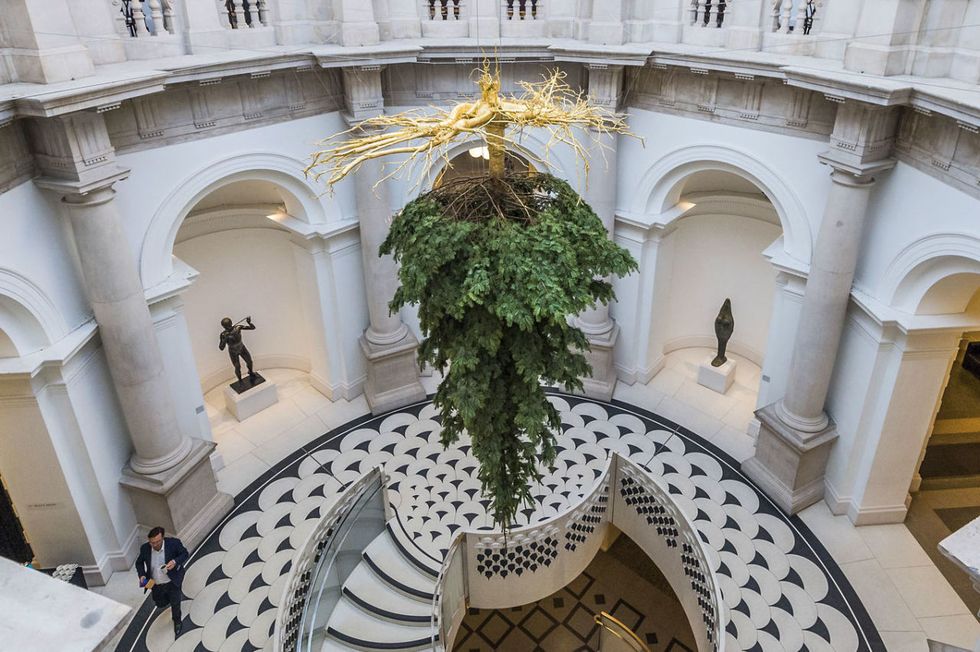
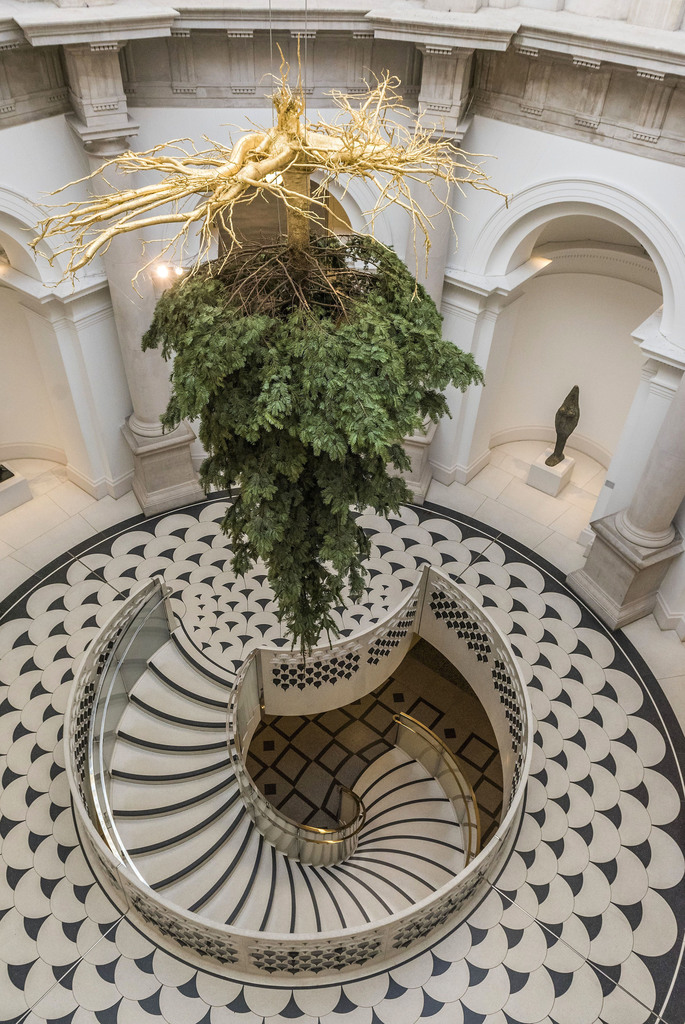
The Tate awarded Shirazeh Houshiary the Christmas Commission in 1993, and she came up with a novel interpretation of the theme: a live pine tree suspended upside down, its exposed roots coated in gold leaf. She described the piece as “taking earth back to heaven,” and the Tate says it reflects the artist’s interest “in astronomy, mysticism and the interplay between light and dark.”
As Houshiary’s Christmas Tree was so memorable, Tate Britain asked her to reprise it in 2016 down the center of the museum’s new spiral staircase designed by the architecture firm Caruso St John. So in December of that year it could be seen under the glass dome of the rotunda of the museum’s Thames-facing entrance, viewable from three different levels.
Though I didn’t get to see the installation in person, the photos instantly reminded me of the inverted tree that appears in some of the woodcuts and batiks of Indian Christian artist Solomon Raj (see, e.g., here and here). For him this symbol represents the Christian’s being rooted in God and bearing fruit in the world.
Neither Raj nor Houshiary, however, were the first to develop this symbol. The Katha Upanishad, an ancient sacred Hindu text, references something similar: “There is an eternal tree called the Ashvattha, which has its roots above and its branches below. Its luminous root is called Brahman, the Supreme Reality, and it alone is beyond death. Everything that exists is rooted in that point. There is nothing else beyond it” (2.3.1). The inverted tree is also mentioned in the Bhagavad Gita 15.1 and the Rig Veda 1.24.7. Furthermore, in his Timaeus Plato describes man as a “heavenly plant” with its branches on earth and its roots in heaven—and I wouldn’t be surprised to find the arbor inversa present in other religious and philosophical traditions as well.
Houshiary was not working from an intentionally Christian framework (nor a Hindu or Platonic one), but her installation’s linkage with the season of Christmas welcomes, I’d say, a Christological reading. As already mentioned, she acknowledged in her 1993 statement an interplay between heaven and earth—heaven being evoked through the tree’s gilded root system that towers above the viewer, catching the natural light from above. Our realm, earth, is where the ever-green life enters and expands.
I think of how Jesus Christ, the New Adam, human being par excellence and yet Eternal One who is from the beginning, came down from on high, bringing lushness, grafting humanity into the Divine.
Photo: Guy Bell
LISTEN: “Love Divine” | Words by Charles Wesley, 1747 | Music by Thomas Waller, first published 1869; arr. Wilder Adkins, 2015 | Performed by Justin Cross and Wilder Adkins on Hollow Square Hymnal, 2016; reissued as a single, 2018
Love divine, all loves excelling, joy of heav’n, to earth come down! Fix in us thy humble dwelling, all thy faithful mercies crown. Jesus, thou art all compassion; pure, unbounded love thou art. Visit us with thy salvation; enter ev’ry trembling heart.
Breathe, O breathe thy loving Spirit into ev’ry troubled breast. Let us all in thee inherit, let us find that second rest. Take away our bent to sinning; Alpha and Omega be. End of faith, as its beginning, set our hearts at liberty.
Come, Almighty, to deliver, let us all thy life receive. Suddenly return, and never, nevermore thy temples leave. Thee we would be always blessing, serve thee as thy hosts above, pray, and praise thee without ceasing, glory in thy perfect love.
Finish, then, thy new creation; pure and spotless let us be. Let us see thy great salvation, perfectly restored in thee. Changed from glory into glory, till in heav’n we take our place, till we cast our crowns before thee, lost in wonder, love, and praise.
“Love Divine, All Loves Excelling” is one of my absolute favorite hymns. It’s grand and passionate, tender and communal, and its many invocations have an Advent ring to them: Come down, Love! Make your home in us. Bring all your faithful mercies to a climax. Visit us with your salvation. Enter our trembling hearts. Breathe your spirit into us. Give us yourself. Lead us to ultimate rest. Be Alpha and Omega to us. Liberate. Deliver. Let us receive your life. “Suddenly return” . . . and never, never leave! Finish your new creation. Restore us in you.
Note that the second line appears in some hymnals without the comma following “joy of heav’n” and with a comma for the end punctuation, which, instead of acting as a petition, would indicate that the joy of heaven has already come down. The ambiguity, which different hymnal editors have resolved differently, is a perfectly comfortable one, as Jesus did come to earth once, and we beseech his return.
I know the hymn best from its pairing with the 1870 tune BEECHER by John Zundel, but Wilder Adkins uses a slightly earlier tune from the shape-note tradition that I quite like. It was composed by Thomas Waller (ca. 1832–1862) of Upson County, Georgia, who taught at Sacred Harp singing schools in the mid-nineteenth century.
Stephen Watson (American), Thirst, 2013. Shorter University Arnold Art Gallery, Rome, Georgia.
O God, you are my God; earnestly I seek you;
my soul thirsts for you;
my flesh faints for you,
as in a dry and weary land where there is no water.
—Psalm 63:1
+++
SONG: “Tzama Lecha Nafshi” (My Soul Thirsts for You) by Sasha Fishman | Performed by Shai Sol, 2016
Shai Sol is a singer-songwriter from Tel Aviv, Israel, and a Jewish follower of Yeshua (Jesus). Follow her on Facebook, Bandcamp, and/or YouTube.
+++
Artist Stephen Watson (previously) describes his 2013 installation Thirst: “These 2,500+ empty cups are arranged in the shape of a river. Unfilled, they create a dry river bed. In their multitude, they depict the severity of the thirst of an unquenched soul.”
This post belongs to the weekly series Artful Devotion. If you can’t view the music player in your email or RSS reader, try opening the post in your browser.
To view all the Revised Common Lectionary scripture readings for the Third Sunday in Lent, cycle C, click here.
New Gospel-book set promotes aesthetic reading experience: Photographer Bryan Chung and designer Brian Chung, both campus ministers (and no relation), believe that beauty is fundamental to understanding who God is. So they’ve teamed up for project Alabaster: a brand-new design of the holy Gospels, in four volumes, integrated with contemplative photographs. They’ve already well exceeded their funding goal on Kickstarter, which means there’s already a lot of interest in having Bible reading be a visual experience—and at a 7½ × 9½ trim, the books are definitely wieldy, meant to be regularly handled and read! If you want a guaranteed copy, be sure to back the project on Kickstarter, as the number of names in the system will determine the size of the print order. You have until October 7; the publication month is April 2017. This project aligns so well with my mission here at Art & Theology, and I’m thrilled to see it in the works.
+++
90-year-old man spends lifetime building a cathedral by hand: From Great Big Story: “For 53 years, Justo Gallego has been building a cathedral by hand on the outskirts of Madrid almost entirely by himself. Gallego has no formal architecture or construction training, but that hasn’t stopped him from toiling on this herculean task. At 90 years old, Gallego knows that he will not be able to finish the project in his lifetime. But he keeps at it anyway, day after day, driven by his faith.”
+++
Ana Maria Pacheco (Brazilian, 1943–), Shadows of the Wanderer, 2008. Polychromed wood sculpture, 260 × 390 × 605 cm. Installation view at Norwich Cathedral, 2010, via Pratt Contemporary Art.
Art installation at Chichester Cathedral speaks to the refugee experience:Shadows of the Wanderer by Brazilian-born artist Ana Maria Pacheco is on display in the north transept of Chichester Cathedral through November 14. A multipiece figurative sculpture in polychromed wood, it has as its centerpiece a young man carrying an elderly man on his back—a reference to the Aeneid’s Aeneas carrying his lame father out of the ruins of Troy. The cathedral has organized events around the installation, including a lecture by Christopher Wintle on the representation of suffering in Pacheco’s art (audio here, transcript here); a series of workshops for schools and colleges exploring the refugee experience, developed in partnership with Amnesty International; a debate titled “Refugees: Problem or Gift?”; an interview with the artist; and a woodcarving workshop. The photo above is an installation view from 2010 inside Norwich Cathedral; to see photos of the work in its current location at Chichester, click here.
+++
Addressing racial injustice as a church: Paul Neeley at Global Christian Worship has compiled an excellent list of resources for churches looking for ways to address racial tensions in America with an eye toward healing, including a prayer service of lament by Paul Burkhart; two litanies by Fran Pratt; a list of relevant hymns, curated by the Hymn Society; an article by Sandra Van Opstal, “Reconciling Witness And Worship: Six Ways To Begin”; and materials from the 2016 Reconciliation and Justice Network conference. I’d like to add to it the lecture series “Race and the Church,” especially Jemar Tisby’s “Understanding the Heart Cry of #BlackLivesMatter,” which I live-streamed with my church back in July. (It definitely sparked fruitful conversation.) For common objections to the movement, like “What about black-on-black crime?” and “Don’t #AllLivesMatter?,” he refers listeners to the video below, produced by MTV.
+++
SONG: “Light a Candle”: Also on Neeley’s website I found a video performance of the song “Light a Candle” by Mary Louise Bringle (words) and Lori True (music). It’s sung here, to a ukulele accompaniment, by Becky Gaunt, director of music and liturgy at St. Jude of the Lake Catholic Church in Mahtomedi, Montana.
She posted it on her Facebook page in July along with this note:
We cannot continue to let language divide us. We cannot continue to let language distract us from loving one another. We cannot continue to let words like “black lives matter” or “all lives matter” cause us to keep missing the point!
I’m sad and tired. And you probably are too. But now is NOT the time to be neutral! The Sun may be shining outside, but we need to come together and light a candle in this oppressive darkness. This beautiful song by Lori True (amazing text by Mary Louise Bringle) is my prayer right now. I invite you to pray this with me.
Gerard Sekoto (South African, 1913–1993), Boy with a Candle, 1943. Oil on canvas, 46.2 × 36 cm.
After years of hesitance, I’ve finally decided to try out this whole Twitter thing. My handle is @artandtheology. I will be sharing posts from the blog as well as retweeting others in the field. Feel free to engage with me there.
+++
Van Gogh’s Olive Trees reinterpreted as earthscape for aerial viewing: Last year the Minneapolis Institute of Art commissioned earthworks artist Stan Herd to recreate Vincent Van Gogh’s Olive Trees, an important painting in its collection, on a 1.2-acre plot of land so that people flying into the Minneapolis–Saint Paul Airport could look down from their windows and be welcomed to the city (and invited to the museum!). Watch Herd at work on the project in the video below.
+++
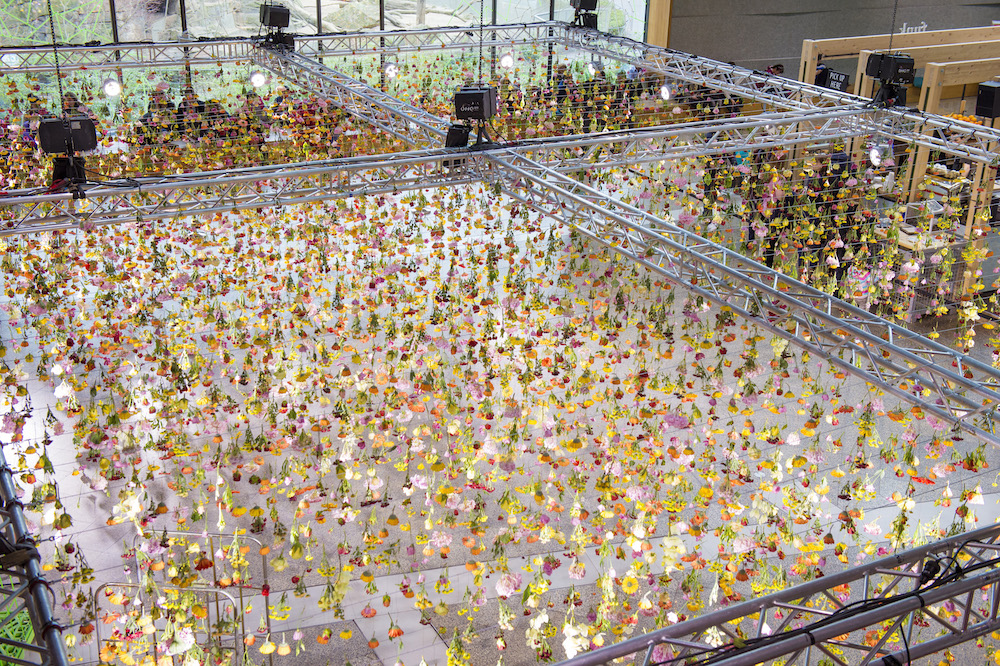
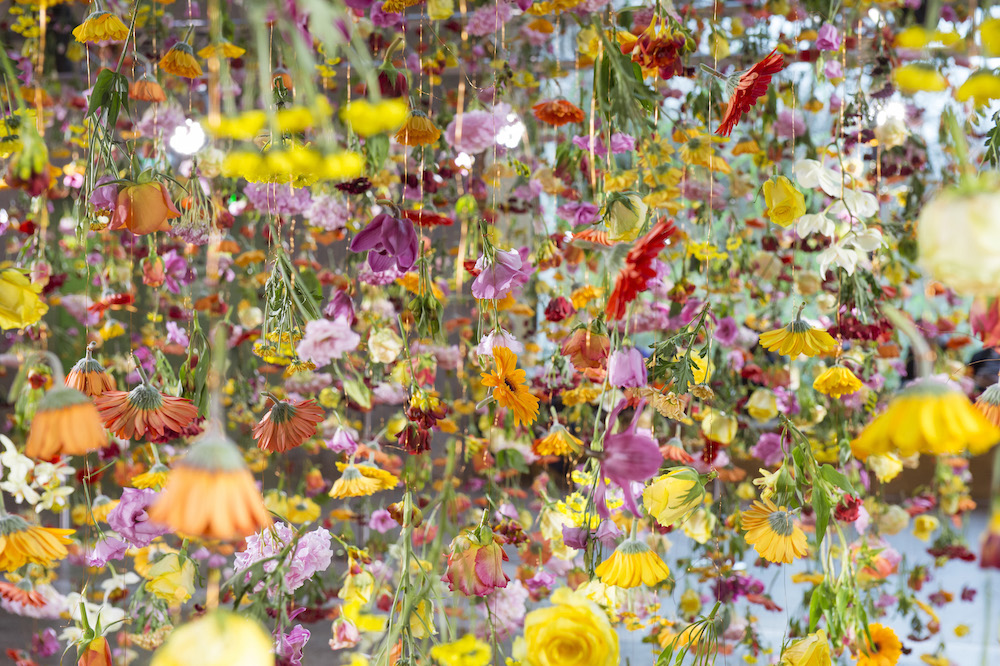
Deconstructed flower garden suspended in air: To herald the start of spring, London-based installation artist Rebecca Louise Law has suspended 30,000 live flowers from copper wire in the atrium of the concept shopping mall Bikini Berlin in Germany, giving shoppers a perhaps unexpected taste of natural beauty. Natural materials, especially flora, are Law’s specialty. Visit her website to view more of her stunning works (The Yellow Flower from Sasebo, Japan, is probably my favorite), or stop by Bikini Berlin anytime through May 1 to experience Garten.
Book and documentary collaboration on the Resurrection: In 2014 Zondervan published Raised? Finding Jesus by Doubting the Resurrectionby Jonathan K. Dodson and Brad Watson to demonstrate why the bodily resurrection of Jesus is believable and the possibilities it offers for a life of hope. As a tie-in to the book, Moving Works created a four-part documentary in which Benjamin and Jessica Roberts tell the story of how Christ’s resurrection has personally impacted them. Watch the documentary below, and click here to access related materials for small group study.
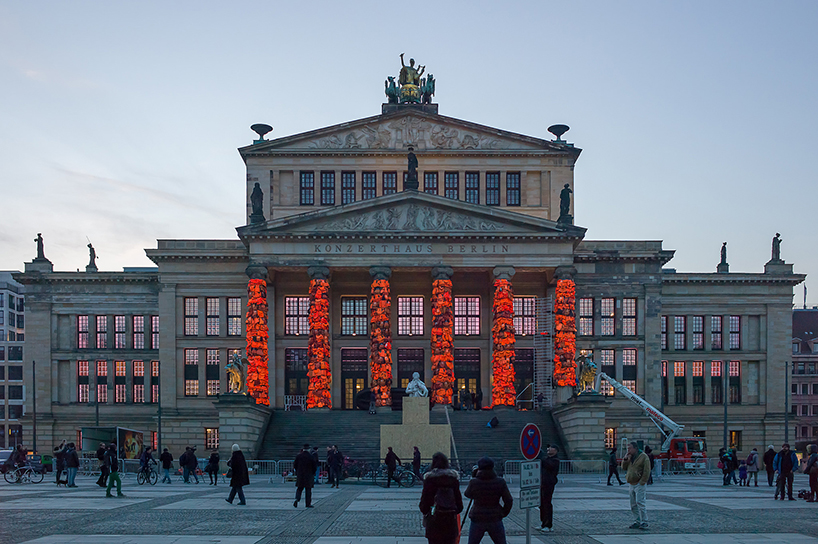
Last month the six front columns of Berlin’s historic Konzerthaus were decked out with fourteen thousand bright orange life jackets—an installation by Chinese artist Ai Weiwei, titled Safe Passage. A tribute to those who have risked their lives on the Mediterranean Sea to escape persecution in the Middle East and North Africa, the work was made to coincide with Cinema for Peace’s annual award gala on February 15, part of the Berlin International Film Festival. The money raised at this year’s gala was used to purchase five thousand rescue blankets and one thousand emergency baby kits (for births that have taken place at sea), which the Cinema for Peace Foundation delivered this past week to the Greek island of Lesbos, the most popular port of entry for people fleeing to Europe through Turkey.
Ai Weiwei’s crew finishes hanging life jackets on the sixth column of Berlin’s Konzerthaus, just before putting up an inflatable dinghy with the title of the installation: Safe Passage. Photo: Markus Winninghoff.
Safe Passage: installation of fourteen thousand life jackets by Ai Weiwei, Konzerthaus, Berlin, February 14–17, 2016. Photo: Oliver Lang.
Weiwei visited Lesbos in December to see for himself the human faces of the current refugee crisis. He shared on Instagram photos and videos he took inside a refugee camp, to show the world what’s going on in Lesbos, and has opened an additional studio there.
One thing that visually struck Weiwei were the giant mounds of life jackets heaped up on the beaches. Refugees shed them as soon as they disembark their boats, setting foot, at last, on land, and ready to start their new lives. Seeing in them a poignant symbol of the crisis, he asked the mayor of the island if he could take a small portion—and yes, fourteen thousand is only a small portion—with him to Europe to use for an art installation. His request was granted. Wrapped around the grand facade of Berlin’s nineteenth-century concert house, they bear witness to the scale of the crisis and even allude to its human cost: last year, a reported 3,770-plus refugees died while attempting to cross the Mediterranean, and the death toll for this year has already exceeded 400. Some of these deaths were due to defective life jackets sold to migrants by a Turkish company looking to cut down on production costs.
While some have questioned the efficacy of staging such a large awareness raiser in Germany, a country that has taken in more refugees than any other European Union member state, others point out that several antirefugee organizations have emerged there, such as Patriotic Europeans Against the Islamization of the West (PEGIDA), which calls on the German government to enact stricter asylum laws. Not all the German people are proud of the measures its country has taken to invite in Syrians, Afghans, and other huddled masses yearning to breathe free. Instead they fear the repercussions. Weiwei’s Safe Passage protests against that fear-based mentality that denies and excludes.
Weiwei has not been the first person to recycle used life jackets into art. Last December British artist Arabella Dorman incorporated three life jackets into her installation Flight in St. James’s Church in Piccadilly, London, which has them tumbling out of a capsized dinghy hanging from the ceiling. She also filled the Christmas crèche at the front of the church with a few dozen more: they cushion the ground where the sculpted figures kneel in adoration of the newborn Christ child. Continue reading “Discarded life jackets used by artists to raise awareness of refugee crisis”→






 Art & Theology