His face was like the sun shining with full force.
—Revelation 1:16
[. . .] make ready for the Face that speaks like lightning, Uttering the new name of your exultation Deep in the vitals of your soul. Make ready for the Christ, Whose smile, like lightning, Sets free the song of everlasting glory That now sleeps, in your paper flesh, like dynamite.
—Thomas Merton, from “The Victory” (1946)
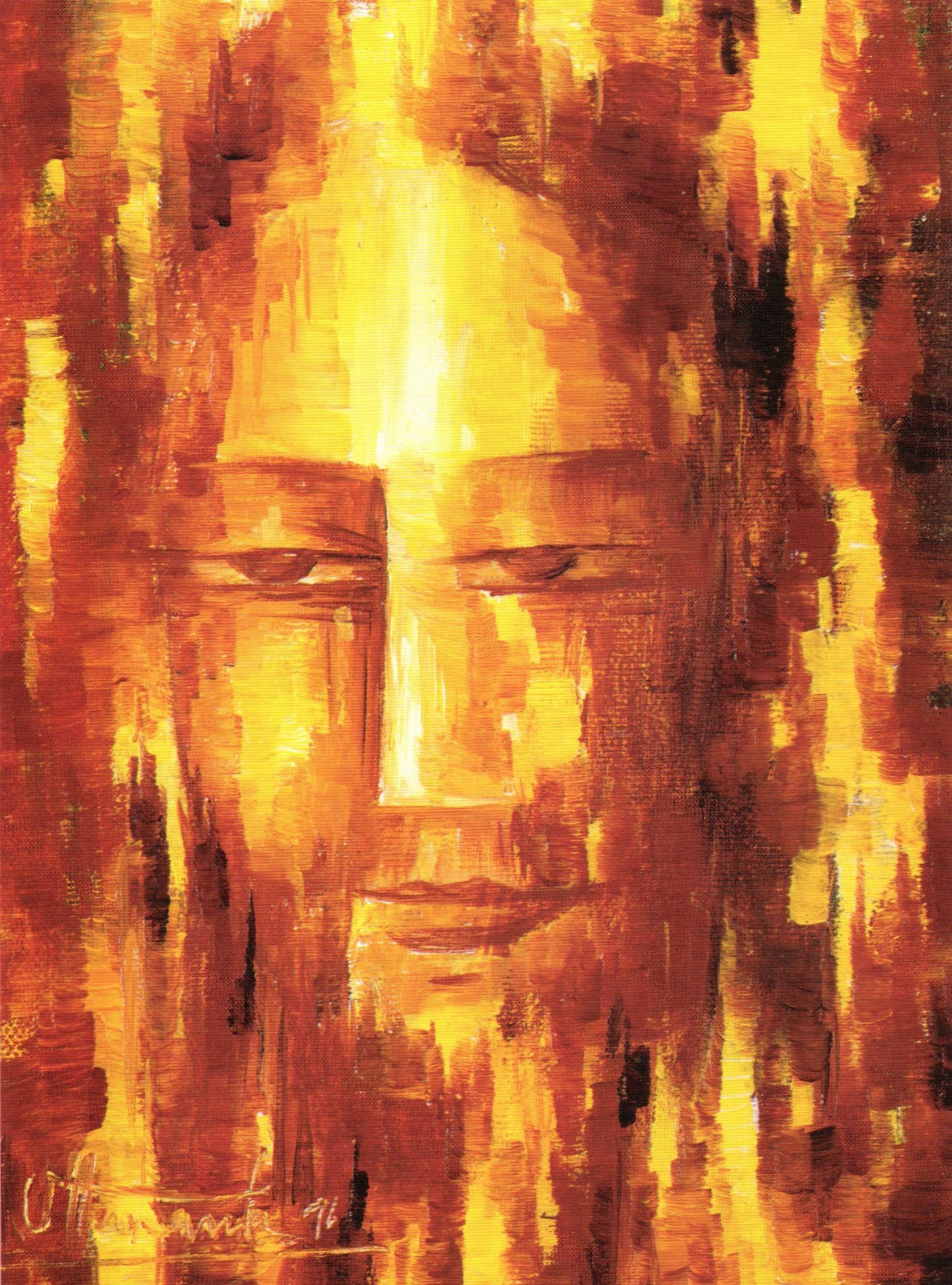
LOOK: Portrait of Jesus by Hatigammana Uttarananda
Hatigammana Uttarananda is a Sri Lankan Buddhist monk, artist, and scholar. His friendship with Fr. Aloysius Pieris, SJ—a Jesuit priest, liberation theologian, and founding director of the Tulana Research Centre for Encounter and Dialogue in Kelaniya—led him to study the Christian Gospels and to portray some of its stories in his paintings.
In his semiabstract Portrait of Jesus, Christ’s face gives off a deep radiance. He is both enlightened and enlightening.
“Bikku Uttarananda portrays Jesus with lowered eyelids, the enlightened one who has found the true meaning of life and is united in compassion with the suffering of all beings,” writes the Christian theologian Wesley Ariarajah in Christ for All People: Celebrating a World of Christian Art. “The rays of the light of life burst through his forehead; the colours are those of the saffron robes of the Buddhist monk and the fire of self-giving.”
LISTEN: “When Jesus Comes,” African American spiritual | Arranged by Alice Parker, 1988, and performed by The Musicians of Melodious Accord on Listen, Lord: A Cantata, Two Suites, and Eight Spirituals, 2010
When Jesus comes, he’ll outshine the sun Outshine the sun Outshine the sun When Jesus comes, he’ll outshine the sun Look away beyond the moon
When Jesus comes, we’ll sing Hosiana! . . .
When Jesus comes, we’ll shout Hallelujah! . . .
If you want to see King Jesus, keep prayin’ on . . .
Alice Parker (1925–2023) was an American composer, arranger, conductor, and teacher whose arrangements of hymns, spirituals, and folk songs of American, French, Spanish, Hebrew, and Ladino origin have become part of the repertoire of choirs around the world. In addition to arrangements, she also wrote original works, including operas, song cycles, cantatas, choral suites, and hymns. In 1985 she founded the professional choir Melodious Accord, with whom she released fourteen albums.
For the African American spiritual “When Jesus Comes,” she cites her source as The Negro Sings a New Heaven, a collection compiled by Mary Allen Grissom (University of North Carolina Press, 1930).
Among this month’s thirty spiritual songs of note are three by Indigenous artists of Turtle Island (North America):
>> “Ambe Anishinaabeg” from Cree composer Andrew Balfour’s Nagamo project, which explores the intersections of Indigenous song and Anglican choral music. The Ojibway text of “Ambe Anishinaabeg” was gifted to Balfour by Cory Campbell: “Ambe Anishinaabeg / Biindigeg Anishinaabeg / Mino-bimaadiziwin omaa” (Come in, two-legged beings / Come in, all people / There is good life here). On the album (and the playlist), the text is set to the “Gloria in excelsis Deo” by the late English Renaissance composer Thomas Weelkes; but in another iteration, captured in the following video, Balfour pairs the text with the music of William Byrd’s “Sing Joyfully” (itself a setting of Psalm 81:1–4). (Balfour has also written original music for Campbell’s text.) See the third roundup item for more about Nagamo.
>> “Jesus I Always Want to Be Near to You,” a solo by Doc Tate Nevaquaya (1932–1996) on Native American flute. Nevaquaya, who was Comanche, played an important role in the revival of the Native American flute in the 1970s, expanding the repertoire and playing techniques. This instrumental is one of twelve from the album Comanche Flute Music, originally released in 1979 by Folkway Records, which also includes Nevaquaya’s adaptations of non-Comanche flute melodies, his own compositions, and one piece by his son Edmund. As he states in his introduction to this track, “Jesus I Always Want to Be Near You” is an original Christian hymn written by the Comanche people. I couldn’t find the lyrics, but to listen to some more Comanche hymns, with words, see this video by Comanche Nation tribal members Anthony Nauni and Chad Tahchawwickah, and this recorded gathering at Lawton Indian Baptist Church in Oklahoma.
>> “naká·yè·ʔr sihskę̀·nęʔ (may it be that you have peace)” by Tuscarora singer Jennifer Kreisburg, a song of blessing from the new Yo-Yo Ma EP Our Common Nature. According to Sony Classical, the song expresses “hope for a future where humanity and nature coexist in harmony.” I just started listening to the album’s wonderful companion podcast, for which four of the seven episodes have been released.
+++
Also for November: See my Thanksgiving Playlist [introduction], comprising a hundred-plus songs of gratitude, with a few recent additions at the bottom; and my Christ the King Playlist [introduction], which I made for the final feast of the church year, celebrated Sunday, November 23, this year.
+++
ALBUM: Nagamo by Andrew Balfour: In May and June 2022, the Vancouver-based vocal ensemble musica intima teamed up with composer Andrew Balfour to create Nagamo (Cree for “sings”), a concert and CD recording that reimagines the Anglican choral tradition through an Indigenous lens. A child of the Sixties Scoop, Balfour was born in 1967 in the Fisher River Cree Nation near Winnipeg but at six weeks old was forcibly removed from his birth family by child welfare authorities of Manitoba and adopted by white parents. He says his childhood was happy, and that he was fortunate to have been put in a men and boy’s choir from a young age, where he received a musical education and international travel opportunities; but of course, the sudden rupture from his culture of origin left wounds.
With Nagamo, Balfour seeks to bring together his identities as Cree and as the son of Anglicans of Scottish descent, who raised him in the church (his father was a minister); his love of Renaissance choral music, much of which voices polyphonic praises to the God of Abraham, Isaac, and Jacob, and an Indigenous spiritual sensibility. The album comprises two original compositions (including one in Scots Gaelic), five Renaissance songs retexted (not translated) in Cree or Ojibway, and five unaltered works by William Byrd and Alfonso Ferrabosco. “The concept mines the fantastical question of what might have happened musically should Indigenous and European musics and cultural expressions come together in a manner collaborative and respectful, rather than divisive,” writes music journalist Andrew Scott for The WholeNote.
Examples of the adaptations include “Four Directions,” a recitation in Ojibway of the four cardinal directions—Ningaabiianong (West), Giiwedinong (North), Wabanong (East), Zhaawanong (South)—set to Thomas Tallis’s “Te lucis ante terminum” [previously], a prayer for protection through the night. And “Ispiciwin” (Journey), whose musical basis is Orlando Gibbons’s “Drop, drop, slow tears,” a Christian hymn of contrition, but whose Cree lyrics make reference instead to a smudging ceremony, a sacred cleansing ritual practiced by many Indigenous peoples. Here’s a mini-documentary about the Nagamo project:
Balfour “re-imagines how settler and Indigenous spiritualities can interact with one another. In essence, Balfour imagines a new system of power relations where both spiritualities can co-exist and engage in dialogue without the power imbalances of colonization,” Lukas Sawatsky writes in his master’s thesis Converging Paths: Settler Colonialism and the Canadian Choral Tradition, the final chapter of which explores Nagamo as a case study of “the reclaiming of settler-originated aesthetic models and genres by Indigenous people for their own storytelling purposes.” Sawatsky continues, “Through the lens of the Anglican choral tradition, Balfour synthesises his Indigenous cultural identity into music that proudly celebrates both parts, without resolving their differences. Through this, Balfour looks towards a world where the settlers and Indigenous people can exist without settler colonialism.”
+++
EVENT RECORDING:“A Timbered Choir: The Witness of Creation,”Wheaton College, Illinois, October 28, 2025: Last week the Marion E. Wade Center and the Conservatory of Music at Wheaton College presented “A Timbered Choir: The Witness of Creation,” an evening of music and poetry inspired by J. R. R. Tolkien’s and Wendell Berry’s love of creation and visions of stewardship. Readings and reflections by Wheaton professors from across the disciplines of biology, literature, and art culminated in the world premiere of a new Wade Center commission, a fifteen-minute choral cycle by Josh Rodriguez called A Timbered Choir, which sets to music three poems by Berry. “It was my aim to create a work which captures a sense of awe: at the trees which play such an important role in our fragile ecosystem, at the beauty and life-giving pleasure they provide for us, and at our urgent responsibility to care for them,” Rodriguez explains. “In this three-part tale on the life of trees, the audience is invited to witness an opening lullaby about the birth of the forest, followed by a desperate lament on the destruction of nature’s life-giving biodiversity, and a concluding celebration of nature’s resilience.”
The Wade Center is dedicated to promoting the study of seven British Christian writers: Owen Barfield, G. K. Chesterton, C. S. Lewis, George MacDonald, Dorothy L. Sayers, J. R. R. Tolkien, and Charles Williams. Wendell Berry—an American poet, novelist, and farmer especially known for his “Sabbath poems,” an expansive series he wrote over decades during his Sunday walks in the woods—is not part of their archive. But Wade Center Director Jim Beitler says they built this recent event around Berry because they want to encourage learners not just to look at the seven authors but to look with them, at the things they cared about. The center identified particular resonance between Berry and Tolkien.
Here are the time stamps from the video recording. The songs are performed by the Wheaton College Concert Choir under the direction of John William Trotter:
Opening remarks by Jim Beitler, director of the Wade Center
Also, the Armerding Center for Music and the Arts, where the event was held, is hosting tree-related art in the lobby: Cross of the Feast by Sung Hwan Kim (a crucifix in wood and mixed media made for a past KOSTA [Korean Students All Nations] Conference at Wheaton), permanently installed; and a set of graphite drawings by David Hooker, on display through Christmas break.
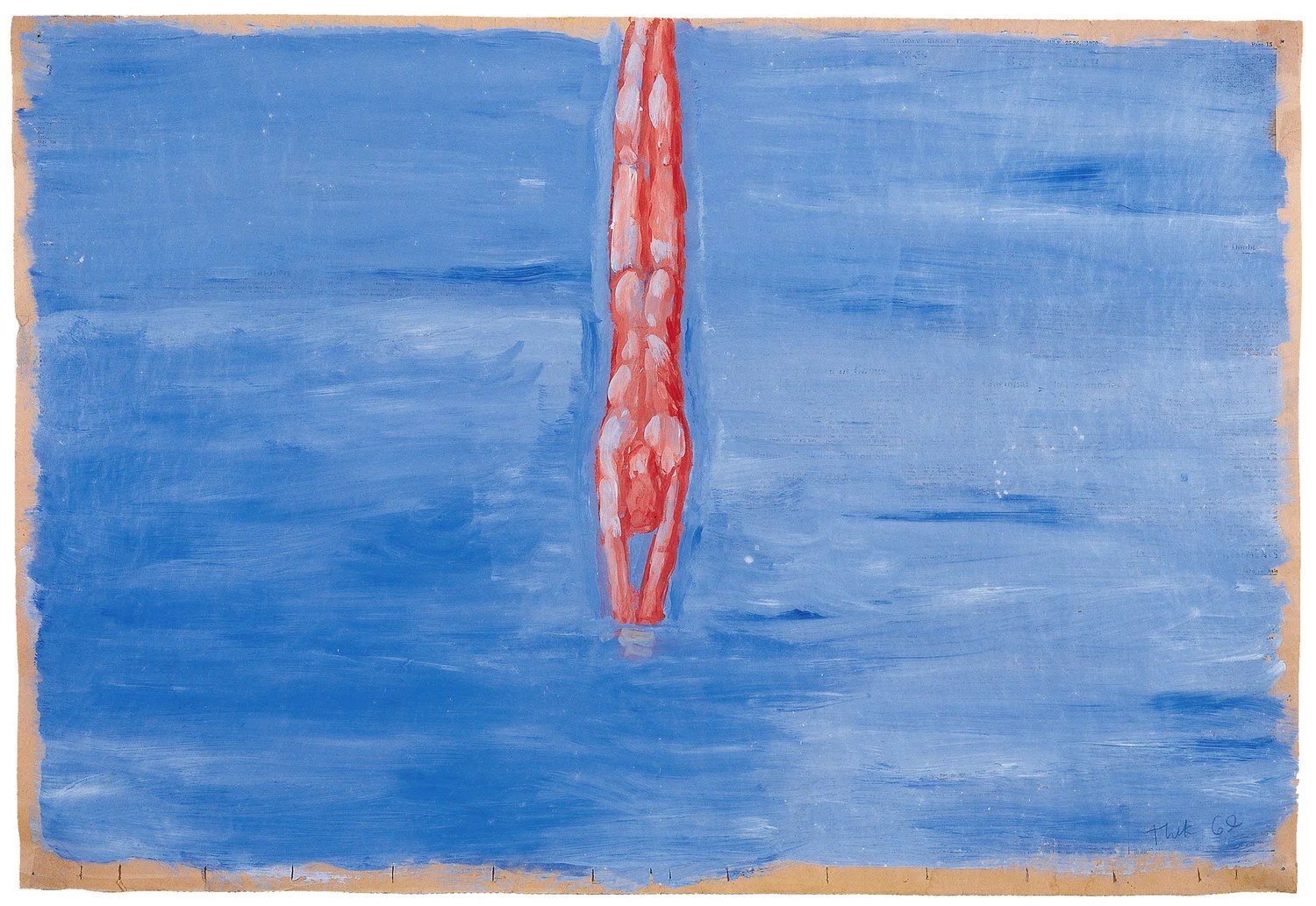
ARTICLE: “Regarding the Face of God: On the Paintings, Drawings, and Notebooks of Paul Thek” by Wallace Ludel, Triangle House Review:Last month I wrote about a chalk drawing by Paul Thek that the Archdiocese of Cologne curated for its latest exhibition at Kolumba museum. In preparation for writing, I did some basic research about the artist, who’s best known for his “Meat Pieces,” and was led to this fascinating article that focuses instead on his paintings, drawings, and notebooks, especially the religiosity and contradictions they are charged with.
Writer Wallace Ludel describes Thek’s “Diver” paintings of 1969–70, speculated to have been inspired by an ancient fresco inside the Tomb of the Diver in Paestum, Italy, as “at once ebullient and lonesome, womb-like and deathly.”
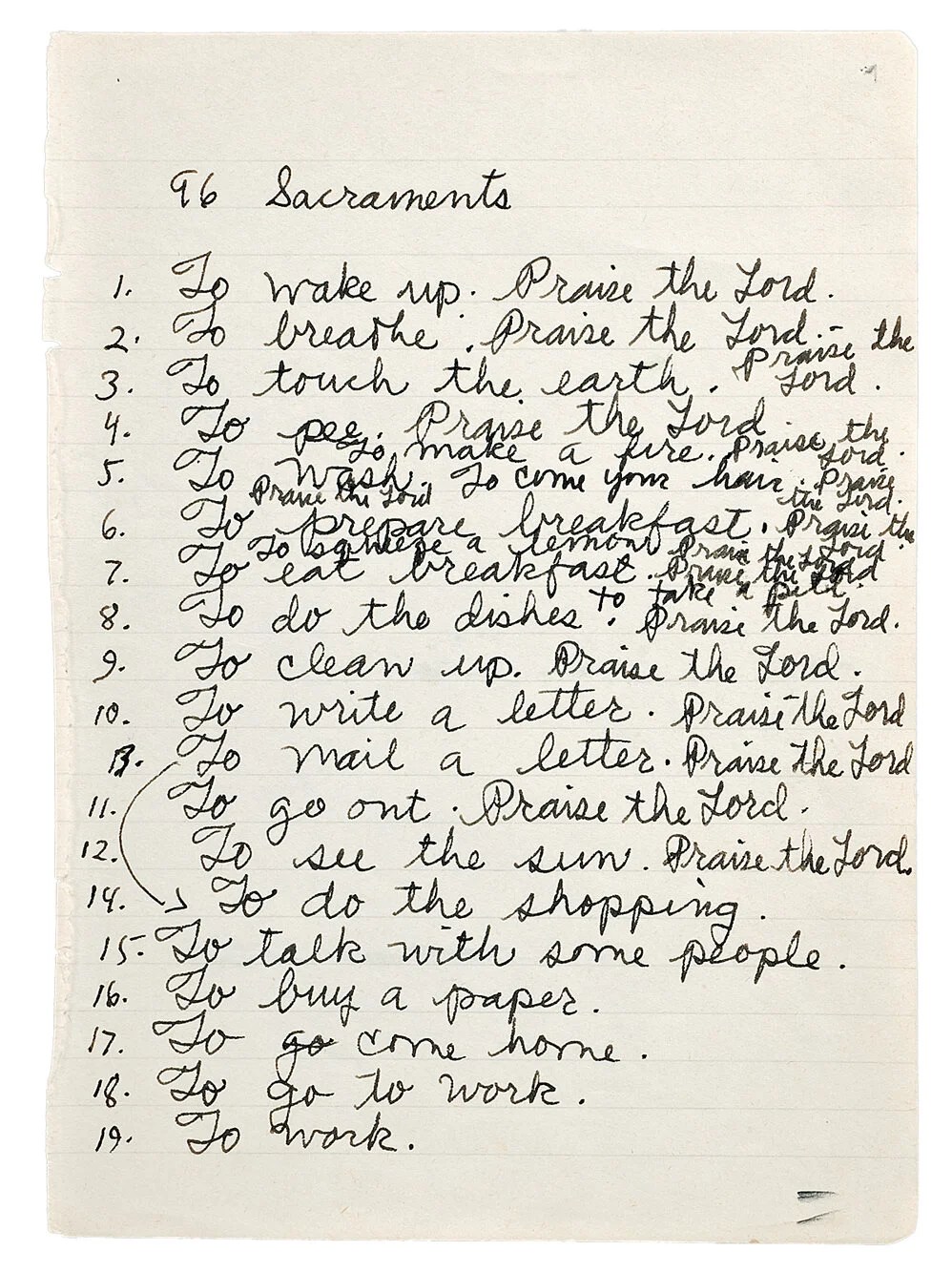
Thek identified as a “predominately gay” Catholic man and was even accepted as a novice by a Carthusian monastery in Vermont shortly before he died of AIDS in 1988. From 1970 onward, he kept notebooks where he copied long passages from spiritual texts and wrote his own devotional musings, as well as made drawings and watercolors and recorded various diaristic thoughts and mantras. One set of the pages, for example, titled “96 Sacraments,” enumerates ninety-six activities—“to breathe . . . to pee . . . to do the dishes . . . to forget bad things . . .”—each followed by the refrain “Praise the Lord.” This list evinces the spiritual influence of Brother Lawrence, who talked about “practicing the presence of God” in all things, which Thek remarked on in a 1984 letter to the Carthusians.
Thek is an artist I had never heard of prior to seeing his work exhibited at Kolumba. Visiting art museums, taking note of the works that intrigue you, and following up afterward with online searches to see and learn more is a great way to develop knowledge of the art that’s out there and to start to identify some of your own personal favorites—which is one of the primary questions I get asked. (“Where do you find all this art?”)
Here’s my new (nonthematic) playlist for the month of April!
But also, because Easter lasts through May 18, be sure to check out the 184 songs I handpicked for the season, which includes some new ones mixed in since the playlist’s original publication.
+++
NEW SONGS:
>> “He Lives” by Emma Nissen: Emma Nissen is a Latter-day Saint singer-songwriter from Arizona known for her gorgeous jazz vocals. Here she performs an original song about God the Father giving his Son, Jesus, to redeem the world through his life, death, and resurrection. “Let there be light, let there be love . . .”
>> “Living Among the Dead” by Caleb Stine: Alt-country singer-songwriter Caleb Stine, based in Baltimore, released this Johnny Cash–esque, resurrection-themed song just before Easter. The title and chorus come from the words the angels spoke to the women who went to Jesus’s tomb the Sunday after his death, looking for his body. “Why do you look for the living among the dead?” they asked. “He is not here but has risen. Remember how he told you, while he was still in Galilee, that the Son of Man must be handed over to the hands of sinners and be crucified and on the third day rise again” (Luke 24:5–7).
The first verse narrates that momentous visit to the tomb. The second verse fast-forwards to the present day and raises issues of poverty, mental illness, substance abuse, culture warring, and militarism, some caused and others exacerbated by the death-dealing policies or neglect of the government. Many people look to politicians for salvation, trusting in their often empty promises, embracing their divisive rhetoric, and ignoring major character flaws for the sake of power. This song cautions us not to go to a dry well for sustenance—not to quench our thirst for living water in places that cannot give it.
The third verse tells of a “thin man in a dusty hat” who regales the story of a carpenter who healed and fed people, who drove out demons from bodies and greedy opportunists from temple courtyards, who befriended those of little means and those who were ostracized. He addressed human suffering head-on with tenderness and self-sacrifice. When the chorus comes in a final time, I hear in it that this loving, serving, reconciling Christ is still living, his Spirit is still moving, and that we ought to get behind that movement, practicing resurrection where we live. “Be not of fear, be of light, lift your head.” As the body of Christ, we should follow him in doing the same deeds and proclaiming the same good news of liberation.
+++
BLOG POST: “50 Ways to Practice Resurrection during the 50 Days of Eastertide” by Tamara Hill Murphy: Spiritual director and writer Tamara Hill Murphy of Connecticut shares fifty simple ideas for celebrating the Easter season in your day-to-day, including retelling baptism stories, visiting a botanical garden, watching a movie that makes you laugh, swinging on the playground, cooking a new veggie recipe, building a new piece of furniture, or washing your car by hand. “I find a lot of joy . . . in seeing these ordinary choices during my day as ways to practice a life that trumps death, a resurrection kind of life,” Murphy writes.
+++
PODCAST EPISODE: “The Beauty—the Poetry—of Christian Experience” with Benjamin Myers, Faith & Imagination: I listen to at least a dozen podcast episodes a week, and this one has been one of my favorites of the past few months. Dr. Benjamin Myers is a literature professor at Oklahoma Baptist University and a former poet laureate of Oklahoma. Here, host Matthew Wickman interviews Myers about two of his six books: A Poetics of Orthodoxy: Christian Truth as Aesthetic Foundation (2020) and the poetry collection The Family Book of Martyrs (2022). They talk about the incarnation and its implications on art; the disclosure of the extraordinary in the ordinary; the inherently unsecular nature of all good poetry; how beauty mirrors grace; the importance of the humanities in Christian education (how it “thickens up” the soul); the obligation of Christian art to capture both the “something good” and the “something missing” of our lives; and how love calls us to the things of this world.
A few additional highlights for me:
Myers came to faith after attending a Lessons & Carols service, compelled by the beauty and truthfulness of the story it told.
“Beauty is not just in the eye of the beholder but also in the being of God.”
At 37:24, Myers reads a poem he wrote for his youngest daughter: “Elizabeth Discovers Rock and Roll.”
+++
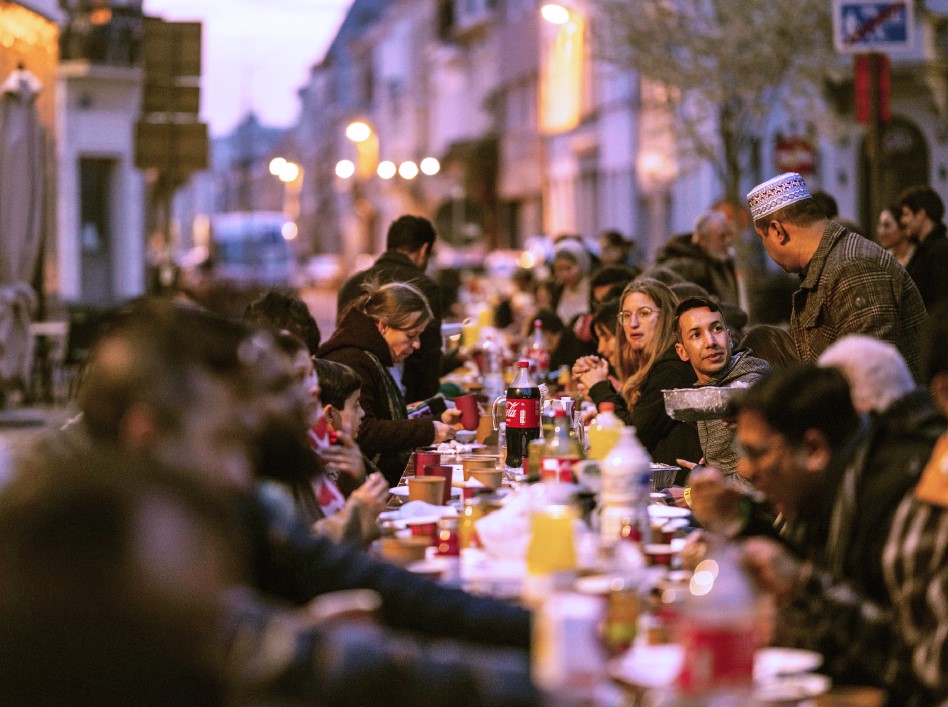
INSTAGRAM VIDEO:from AJ+: On March 31 in the Borgerhout district of Antwerp, a mile-plus-long table set up along the Turnhoutsebaan brought together city residents for a joint Easter-iftar dinner. Easter is the most sacred feast of the Christian year, celebrating the resurrection of Jesus; on Easter Sunday, Christians break the forty-day fast they’ve held for the duration of Lent. Lent almost always overlaps in part with Ramadan, a Muslim holy month of fasting that commemorates the prophet Muhammad’s first revelation. On each day of Ramadan after sunset, the fast is broken with an evening meal called an iftar.
Christians and Muslims in Antwerp broke their fasts together at an outdoor Easter-iftar dinner on March 31. Photo: Sanad Latifa.
Borgerhout carried out this interfaith initiative in collaboration with the FMV cultural association and other partners in the hopes of promoting dialogue, social cohesion, and connection. I love this idea of gathering folks together across lines of religious difference to enjoy community, good food, and spiritual celebration! For more information, see https://www.2kmsamenaantafel.be/.
+++
NEW ALBUM: Three Gifts by Liturgical Folk and Jon Guerra: Ryan Flanigan of Liturgical Folk and Jon Guerra have teamed up to release an EP of three songs, one for each of the three theological virtues: faith, hope, and love (1 Cor. 13:13). Here’s “the greatest of these”:
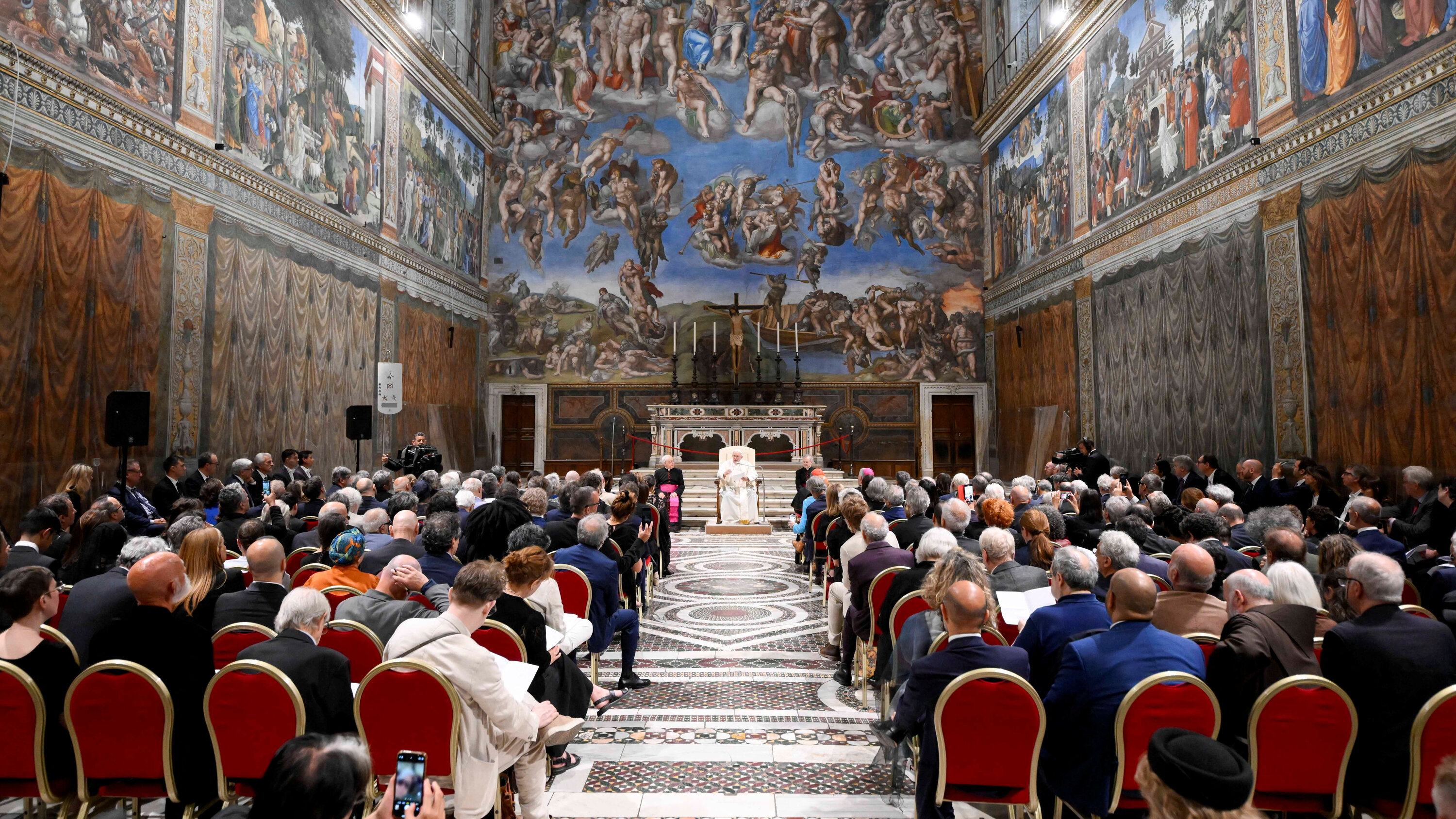
SPEECH: “Address of His Holiness Pope Francis to Artists for the 50th Anniversary of the Inauguration of the Vatican Museums’ Collection of Modern Art”: On June 23, at the invitation of Pope Francis, some two hundred select visual artists, filmmakers, composers, poets, and other creatives gathered at the Sistine Chapel to commemorate the fiftieth anniversary of the Vatican Museums’ Collection of Modern and Contemporary Art, inaugurated in 1973 by Pope John Paul VI. “One of the things that draws art closer to faith is the fact that both tend to be troubling,” Pope Francis said last Friday. “Neither art nor faith can leave things simply as they are: they change, transform, move and convert them.” He applauded how “artists take seriously the richness of human existence, of our lives and the life of the world, including its contradictions and its tragic aspects. . . . Artists remind us that the dimension in which we move, even unconsciously, is always that of the Spirit. Your art . . . propel[s] us forward.” For reporting on this event by the New York Times, see here.
Pope Francis addresses a group of artists, June 23, 2023. Photo: Vatican Media, via Reuters.
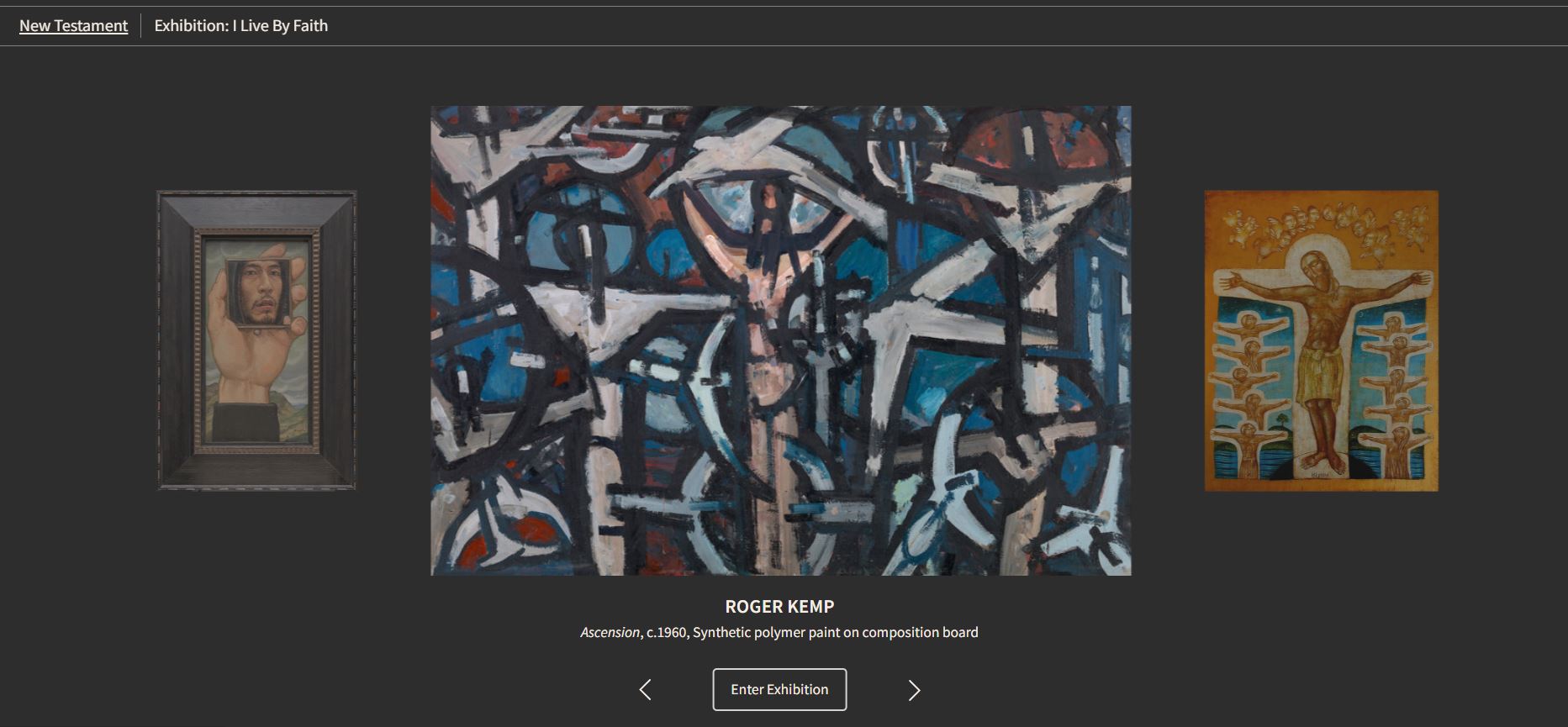
VISUAL COMMENTARY ON SCRIPTURE: “I Live by Faith (Galatians 2:15–21)” by Victoria Emily Jones: My latest set of commentaries for the VCS went live this month! It centers on one of Paul’s famous sayings: “I have been crucified with Christ, and it is no longer I who live, but it is Christ who lives in me.” I was bummed that one of the three commentaries I originally wrote had to be scrapped because the image permission was ultimately denied; I thus had to reconfigure and replace, and I ended up with two artworks in the three-piece exhibition that aren’t as diverse from each other as I had hoped. But still, each artwork brings a unique and compelling lens through which to examine this passage. (Note: If you’re viewing the exhibition on your phone, after you “Enter Exhibition,” you’ll need to expand the “Exhibition Menu” to access the “Show Commentary” button.)
VIDEO: “Abraham: An Interfaith Discussion at the Bode-Museum, Berlin”: Besides publishing written commentaries on works of art in dialogue with Bible passages, the Visual Commentary on Scripture also produces videos. This one brings together an Anglican Christian priest (who directs the VCS), a Jewish rabbi, and a Muslim theologian around a fifth-century ivory pyxis depicting Abraham, a figure held in common by all three faith traditions.
+++
POEM:“Gate A-4”by Naomi Shihab Nye: I’ve always loved this heartwarming poem about an unexpected moment of communion shared with strangers at an airport, made possible through kindness and the letting down of one’s guard. Listen to commentary by Joanne Diaz and Abram Van Engen on the Poetry for All podcast, episode 19; they answer the question “Why is this a poem?” Here’s a video of Nye reading it herself:
+++
NEW ALBUMS:
>> April 21: Worship for Workers by the Porter’s Gate: “In 2022 a group of songwriters, pastors, and professionals gathered in Nashville, Tennessee to write a series of worship songs for workers. Over three days they discussed the spiritual, emotional, and material struggles facing workers around the world today. Soon enough, they began to compose a series of songs specifically designed to help Christians carry their daily work before the Lord.” Here’s one of the thirteen songs on the album, “You Hold It All”:
The Worship for Workers album is part of a larger project, sponsored by the Brehm Center and a number of other institutions, to provide music, prayers, art, liturgies, and training to the church around the topic of work. It grew out of the book Work and Worship: Reconnecting Our Labor and Liturgy by Matthew Kaemingk and Cory Willson.
>> May 5: Glory Hour by Victory: Victory Boyd [previously] is a Grammy-winning soul and gospel artist who got her start singing with her siblings in the group Infinity Song but whose career really kicked into high gear when she worked as a songwriter for Kanye West’s Jesus Is King (2019). Glory Hour is her second full-length album as a solo artist; its title refers to the time of the morning when the sun rises. Most of the tracks are original songs or spoken word, but there are also three classic hymns/gospel songs: “His Eye Is on the Sparrow,” “Great Is Thy Faithfulness,” and “I Know It Was the Blood.” Here’s the music video for “Just like in Heaven,” based on the Lord’s Prayer:
>> May 19: Seven Psalms by Paul Simon: Paul Simon released this original seven-movement composition about doubt and belief as a single thirty-three-minute track, as it is meant to be listened to in one sitting. I’m a Simon fan; one of my early blog posts is a review of his and Garfunkel’s debut album, Wednesday Morning, 3 A.M. But if I’m honest, I was underwhelmed by this much-anticipated release. I’m in the minority there, so I think I’ll need to give it another listen. What do you think of it? Here’s the trailer:
>> June 2: Byrd: Mass for Five Voicesby the Gesualdo Six: One of my favorite vocal ensembles has just come out with an album of songs by William Byrd—his setting of the Mass along with a handful of motets. A Catholic composer in Protestant England in the late Renaissance, Byrd wove together musical “notes as a garland to adorn certain holy and delightful phrases of the Christian rite,” as he wrote in the preface to his second book of Gradualia (1607). Here’s the Gesualdo Six’s performance of his “Afflicti pro peccatis nostris,” a Latin prayer, a desperate plea for sanctification, that translates to “Afflicted by our sins, each day with tears we look forward to our end: the sorrow in our hearts rises to thee, O Lord, that you may deliver us from those evils that originate within us”:
VIRTUAL ARTIST RESIDENCY: 2023 Inbreak Residency: Led by Dea Jenkins, the organization Inbreak, which promotes social healing through the arts, is hosting its third annual (virtual) residency, open to US-based artists of any discipline interested in exploring the intersections of art, faith, and race in the United States. The residency provides a collaborative environment and opportunities for artistic development and creative leadership growth, with group workshops, group feedback sessions, studio visits, and a curriculum featuring a curated selection of viewings, readings, and dialogue prompts. It culminates in a live or virtual exhibition.
Applications are due by November 20, 2022; you are required to submit work samples, an artist statement and/or short bio, and a community-focused project proposal. Four applicants will be selected for the 2023 cohort, which runs from January to May, and each given a $500 stipend.
+++
SONG: “Lux Aeterna”: “Lux Aeterna” (Eternal Light) is the Communion antiphon for the Roman Catholic Requiem Mass. The traditional Latin text has been set to music by many composers. Recorded at All Hallows’ Gospel Oak in London in May 2021, this performance by the Gesualdo Six is of the setting by Spanish Renaissance composer Cristóbal de Morales. I share it in anticipation of All Saints’ Day on November 1.
The lyrics translate as follows:
May eternal light shine upon them, Lord, with your saints forever, for you are good.
Grant them eternal rest, Lord, and may light perpetual shine upon them, with your saints forever, for you are good.
The video came out of the Interfaith Sacred Art Forum and the Sacred Art in Collections pre-1900 Network, both launched last year as part of the National Gallery’s Art and Religion research strand. In their inaugural 2021–22 season, the theme was “Crossing Borders,” and they have used two paintings in the museum’s collection as a foundation for wide-ranging events and activities. The theme for 2022–23 is “The Art of Creation,” and the two paintings around which conversations and activities are based are Rachel Ruysch’s Flowers in a Vase (1685) and Claude Monet’s Flood Waters (1896).
+++
VIDEO: “Introducing Annie Dillard” by Tish Harrison Warren: In this video from the Trinity Forum, Anglican priest and writer Tish Harrison Warren introduces the forum’s fall reading, the Pulitzer Prize–winning classic Pilgrim at Tinker Creek (1975) by Annie Dillard. The book comprises Dillard’s evocative reflections on her time spent wandering about and observing the lively woods, creeks, and natural world of Virginia’s Roanoke Valley while she convalesced from illness.
“She [Dillard] has taught me, in the words of Eugene Peterson, to pray with my eyes open,” Warren says. “She has taught me to notice God at work in the world in ways that I wouldn’t.”
I hear Dillard quoted all the time, but I’m embarrassed to say that I have not yet read this quintessential book of hers! Though I do own it. I have now pulled it off the shelf and put it in my “to read imminently” stack. 😊
+++
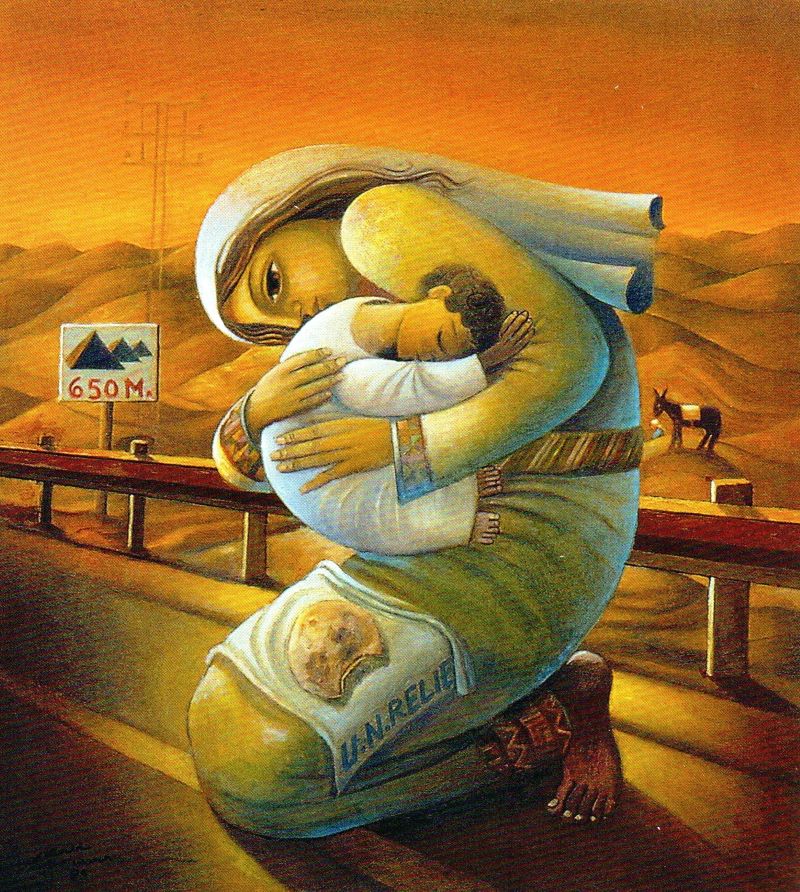
VISUAL MEDITATION: “The Taste of Palestine” by Meryl Doney, on the art of Sliman Mansour: Sliman Mansour is a Palestinian Christian artist whose work centers on the Palestinian struggle against the Israeli occupation. This ArtWay article is a great, concise introduction to his work, spotlighting four of his paintings: Picking Olives; The Flight to Egypt; Hagar; and The Holy Family in an Olive Grove.
Sliman Mansour (Palestinian, 1947–), The Flight to Egypt, 1984. Oil on canvas.
Last month my friend Becky Hadeed, food photographer and creator and host of The Storied Recipe podcast, released an episode called “Honoring the Women of Palestine,” where she interviews Mai of Almond and Fig. Mai discusses growing up in Palestine and shares some of the ways she seeks to connect with her Middle Eastern heritage from her kitchen in Chicago.
The song “Compassionate and Wise,” which appears on an album of the same name recorded by Father Cyprian Consiglio in 2006, represents a cross-pollination of Hinduism, Buddhism, and Christianity.
An earlier version, simply called “Dedication of Merit,” was first sung at a Buddhist-Christian conference at a Benedictine convent in Indiana the week after the September 11 terrorist attacks on the World Trade Center in New York City. The Rev. Dr. Heng Sure, an American Chan Buddhist monk, was asked to offer a dedication of merit (similar to what Christians would call an intercessory prayer, though it’s phrased more like a benediction). For this he and a colleague translated a passage from the Mettā Sutta, the Buddha’s discourse on developing and sustaining loving-kindness. Their translation reads:
May every living being, Our minds as one and radiant with light, Share the fruits of peace With hearts of goodness, luminous and bright.
If people hear and see How hands and hearts can find in giving, unity, May their minds awake, To Great Compassion, wisdom, and to joy.
May kindness find reward; May all who sorrow leave their grief and pain; May this boundless light Break the darkness of their endless night.
Because our hearts are one, This world of pain turns into paradise. May all become compassionate and wise, May all become compassionate and wise.
In reciting the dedication, Sure spontaneously matched it with a melody by Canadian singer-songwriter Loreena McKennitt, which she had written in 1994 for the song “Dark Night of the Soul,” a setting of verse by the sixteenth-century Spanish Catholic mystic Saint John of the Cross. Conference attendees, their hearts full of grief over the falling of the Twin Towers, joined in singing, lifting up their collective longing for light to break through the darkness.
A few years later at a different Buddhist-Christian gathering, Sure met Father Cyprian Consiglio, a Camaldolese Benedictine monk, author, and musician from California. He shared the song with him, struck by its similarity to some of the prayers Consiglio had offered that week.
With the blessing of Sure and McKennitt, Consiglio and his regular collaborator John Pennington, a percussionist, recorded a new arrangement of the song in 2006 under the title “Compassionate and Wise.” Here they are performing it with friends on June 28, 2018, at the “Arise, My Love” concert in Santa Cruz to raise money for New Camaldoli Hermitage in Big Sur, California, where Consiglio has been the prior since 2013:
(The song starts at 2:43, following Consiglio’s spoken introduction.)
Their version has slight lyrical alterations and opens with two Sanskrit chants that Consiglio learned from the monks and nuns at Saccidananda Ashram (nicknamed Shantivanam, “Forest of Peace”), a Camaldolese Benedictine monastery in Tannirpalli, South India. The first chant, which is from the Rig Veda but also appears in the Yajur Veda, is known as the Mahamrityunjaya Mantra (Great Mantra for Conquering Death). The second is a svasti pāṭhaḥ, an invocation for the welfare of all.
The following Sanskrit and its English translation were provided to me by Consiglio:
We worship the true God who is the Supreme Being Who is fragrant and nourishes all beings May he liberate us from death for the sake of immortality Like a cucumber is severed from its bondage to the creeper
May all be happy May all be free from disease May all realize what is good May none be in misery May the nonvirtuous be virtuous May the virtuous attain tranquility May the tranquil be freed from the bonds of death May the freed make others free Peace, peace, peace
And here is the sung English that follows:
May every living being, Our minds as one and radiant with light, Share the fruits of peace, Our hearts of goodness luminous and bright.
If people hear and see, Our hands and hearts can find, in giving, unity. May their minds awake To Great Compassion, wisdom, and to joy.
May goodness find reward; May all who sorrow leave their grief and pain; May this boundless light Dispel the darkness of their endless night.
Because our hearts are one, This world of pain turns into paradise. May all become compassionate and wise, May all become compassionate and wise.
This song is full of interfaith exchanges. A melody written to set the text of a Carmelite Christian friar was adapted to fit a Buddhist dedication of merit and is introduced by a Benedictine Christian monk with a passage from the Hindu scriptures! For more information on the song’s history, see urbandharma.org.
Explaining the significance of a dedication of merit (and metta practice) to his Christian readers, Consiglio writes on the hermitage blog, “We can dedicate whatever closeness to God we have to the good of someone else.” I myself wouldn’t use the phrase “dedication of merit” or its derivatives to describe what I’m doing when I intercede to God for others, but I see what Consiglio means, and I think it’s this: “The prayer of the righteous is powerful and effective” (James 5:16). Through Christ, God hears our prayers, and it is our duty in prayer to think more widely than just our own needs or the needs of those in our immediate circles—though that can be a good starting point. As the apostle Paul says, “I urge that supplications, prayers, intercessions, and thanksgivings be made for everyone” (1 Tim. 2:1, emphasis mine).
What if our prayers extended to enfold all living beings? I was always taught to avoid genericisms in prayer, and while there is value in direct naming, there is also a beauty to those kinds of broad prayers often heard on the lips of children—for “the whole world,” for “peace everywhere.”
Perhaps you are uncomfortable by the lack of doctrinal specificity in “Compassionate and Wise,” or by what you might call “syncretism” (the mixing of belief systems). But as Consiglio says, there is nothing in the song that contradicts Christianity. The song arose out of an interreligious context, so it’s meant to invite the participation of people of various faith backgrounds.
“Because our hearts are one” refers to a unity of intention or desire. The singers may not be united in theological particulars, nor even around the deity they’re addressing, but they are one in their wish for universal well-being, for liberation from the bonds of death and a walking together in friendship across boundaries of difference.
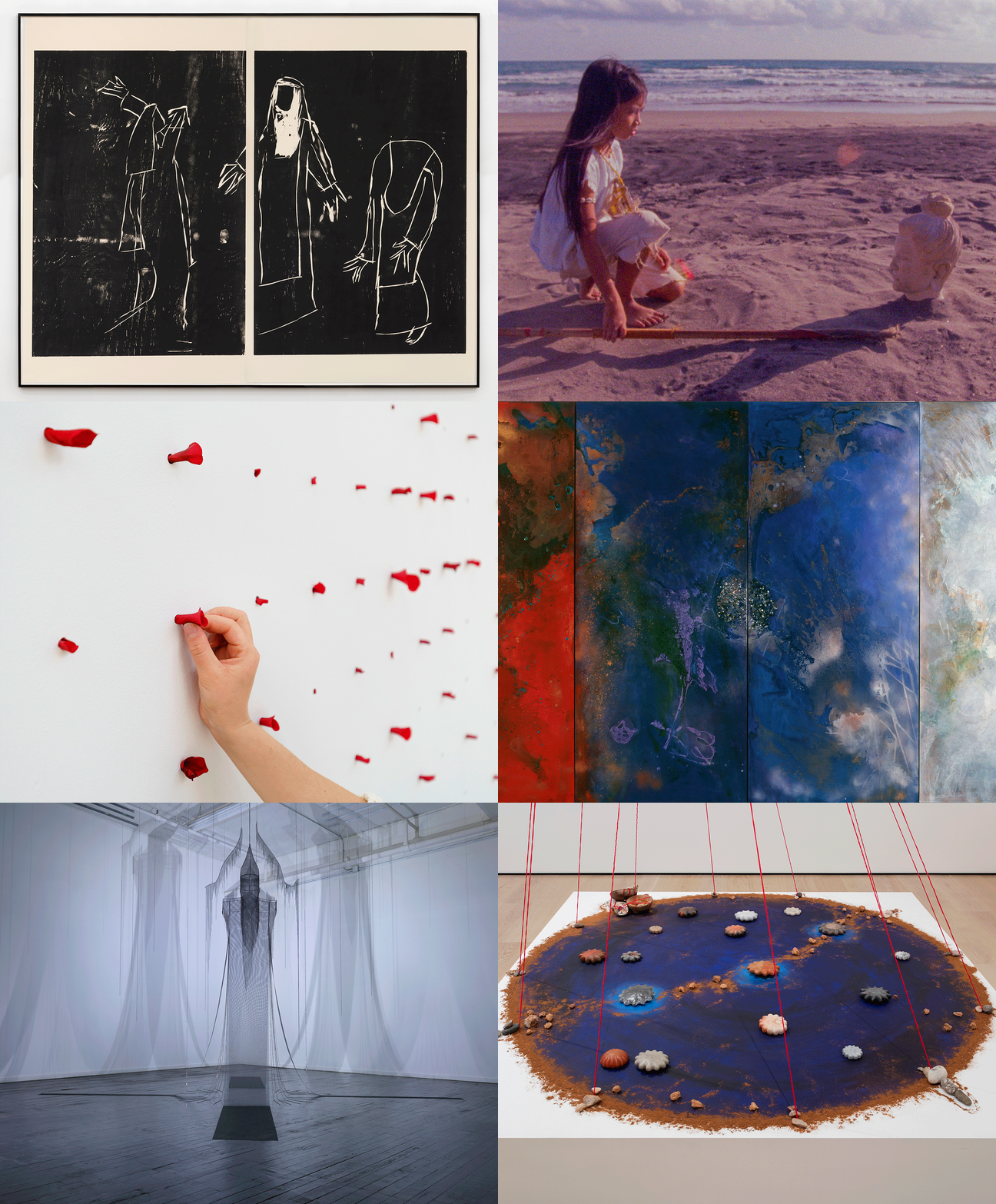
EXHIBITION: Here After, Bridge Projects, Los Angeles, May 7–July 30, 2022: This latest offering from the spirituality-forward art gallery Bridge Projects looks amazing! I appreciate their commitment to featuring religiously and ethnically diverse artists, as well as a range of styles and media.
Andrea Büttner, Dancing Nuns, 2007; Tuan Andrew Nguyen, video still from The Boat People, 2020; Belu-Simion Fainaru, Monument for Nothingness, 2012–22; Bonita Helmer, The Four Worlds (Tiferet), 2002–5; Afruz Amighi, Guardian, 2021; Mercedes Dorame, Orion’s Belt—Paahe’ Sheshiiyot—a map for moving between worlds, 2018
The group exhibition features thirty-seven artists who explore the idea of paradise—both how it has been pursued on earth across history, and how it is imagined after life. From Pure Land Buddhism’s chant “Namu Amida Butsu” (“I take refuge in Amida Buddha”) to Christianity’s prayer for the Kingdom to be “on earth as it is in heaven,” the concepts of paradise are as diverse as those who hope for it.
In Here After, works like William Kurelek’s Farm Boy’s Dream of Heaven (1963) envision an eschatological beyond in figurative form, while works by Bonita Helmer and Zarah Hussain do so in more abstract terms. Andrea Büttner and Claire Curneen’s works point to a vulnerable, sensual bodiliness, embedded in the surface of the world where all things come to pass. There is a land beyond the river by Gyun Hur and Tuan Andrew Nguyen’s The Boat People make space for remembrance of those who have passed, while Afruz Amighi, Mercedes Dorame, and Charwei Tsai position the viewer between worlds, feet firmly planted on the ground yet gazing at the glory and wonder of the beyond. In his installation Skywall, David Wallace Haskins plunges into the boundless sky and its immaterial light, letting all the expansive beauty grip the viewer. Kate Ingold intones the rhythmic mantras of what the divine is not with minute stitches, employing almost impossible patience to painstakingly outline absence. Kris Martin lodges small contradictions in the mind, which, in time, grow to be distracting puzzles—the candle in a sealed box, whose existence cannot be proven with the senses. And Tatsuo Miyajima uses digital counters to display the uncountable, unending dimension of existence.
+++
SONGS:
>> “O Jesus, Crowned with All Renown,” performed by Jon and Amanda McGill: The Monday to Wednesday preceding Ascension Day is known as Rogationtide, a short liturgical period (observed by most Anglicans, Episcopalians, Catholics, and others) in which we pray that God blesses the crops so that they yield a good harvest. It falls on May 23–25 this year. The hymn “O Jesus, Crowned with All Renown” is especially associated with the Rogation Days. It was written in 1860 by Edward White Benson, archbishop of Canterbury, and is typically paired with the tune KINGSFOLD.
O Jesus, crowned with all renown, Since thou the earth hast trod, Thou reignest, and by thee come down Henceforth the gifts of God. Thine is the health and thine the wealth That in our halls abound, And thine the beauty and the joy With which the years are crowned.
Lord, in their change, let frost and heat And winds and dews be giv’n; All fostering power, all influence sweet, Breathe from the bounteous heav’n. Attemper fair with gentle air The sunshine and the rain, That kindly earth with timely birth May yield her fruits again.
That we may feed the poor aright, And gathering round thy throne, Here, in the holy angels’ sight, Repay thee of thine own: That we may praise thee all our days, And with the Father’s name, And with the Holy Spirit’s gifts, The Savior’s love proclaim.
“Rogation” is derived from the Latin verb rogare, which means “to ask.” In the liturgies of Rogation Days, we ask the Lord to bless the fields, the crops, and the hands of farmers who produce our food. Worship on Rogation Days teaches us that we depend upon God’s favor over his land. We ask him for goodness over not just an abstract idea of our “land” but the very real earth beneath our feet in our backyards, our neighborhoods, and whatever part of the earth our feet hit the ground. As we’ve become a post-industrial society, the prayers for Rogation Days have expanded to include not only prayers for farmers and fishermen, but also for commerce and industry, and for all of us as stewards of creation.
>> “The Twelve: An Anthem for the Feast of Any Apostle,” words by W. H. Auden and music by William Walton: In 1965 the dean of the choir school at Christ Church, Oxford—Dr. Cuthbert Simpson—approached poet W. H. Auden and composer William Walton to write a choral anthem for use on apostolic feast days. “The Twelve” is the result. In this video filmed at Keble College, Oxford, in July 2021, it is performed by the vocal ensembles VOCES8 and Apollo5 (both directed by Barnaby Smith), with Peter Holder on organ. Learn more about the background and structure of the anthem here.
This performance appears on Renewal?, a concept album released February 25 that combines new works by Paul Smith (cofounder of VOCES8) and Donna McKevitt with works by three influential modern composers: William Walton, John Cage, and William Henry Harris. “Multifaceted texts by Lal Ded, Edmund Spenser, W. H. Auden, Lord Byron, Pablo Neruda, Maya Angelou, and Edna St. Vincent Millay offer space to consider our world, past and present, and meditate on a response to build a better future.”
You can read the full text of “The Twelve” in the YouTube video description. It begins,
Without arms or charm of culture, Persons of no importance From an unimportant Province, They did as the Spirit bid, Went forth into a joyless world Of swords and rhetoric To bring it joy.
+++
VISUAL MEDITATIONS:
Ascension Day occurs every year on the Thursday that falls forty days after Easter (see Acts 1:1–3). This year it is May 26. Here are two Ascension-themed visual meditations from ArtWay.eu.
>> On the Reidersche Tafel, by Nigel Halliday: This ivory bas-relief, which was probably originally embedded in a book cover, is the earliest known representation of the Ascension. It shows Jesus striding up a mountain, being pulled up into heaven by the hand of God the Father. (Mark and Luke use the passive voice to describe the Ascension: “he was taken up into heaven.”) He is dressed in a toga and holding a scroll. Learn more from Nigel Halliday at the above link, or visit this Instagram post I made two years ago.
The Women at Christ’s Tomb and the Ascension, Milan or Rome, ca. 400. Ivory plaque, 18.7 × 11.5 cm. Bayerisches Nationalmuseum (Bavarian National Museum), Munich, Germany.
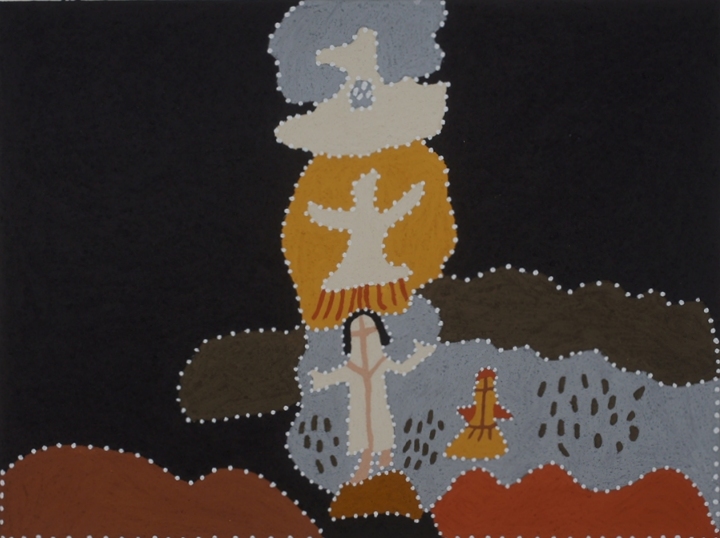
>> On Ngambuny Ascends by Shirley Purdie, by Rod Pattenden: Ngambuny is the Gija name for Jesus. Aboriginal Australian artist Shirley Purdie sets his ascension within the indigenous landscape of the Bungle Bungle Range, using her characteristic style of dotted outlines. “Purdie draws on her cultural tradition to locate the presence of God within the skin of her land,” writes the Rev. Dr. Rod Pattenden. “Her work is literally painted with the earth, as she collects ochres from the land she is responsible for and mixes it with glue to attach to her warm hued canvases.” Pattenden offers a fascinating reading of Purdie’s Ngambuny Ascends, discussing the use of black ocher, God as Creator Spirit alive in the earth, and more.
Shirley Purdie (Gija, 1948–), Ngambuny Ascends, 2013. Natural ocher on canvas, 60 × 80 cm. Private collection. The artist is represented by the Warmun Art Centre in Warmum, WA, Australia.
PLAYLIST: I can’t keep up with all the quality Christian (or, for artists who eschew that label, spiritually inflected?) music recordings that are out there—recent releases as well as back catalogs dating as far back as the thirties. There really is a breadth, and I sometimes get frustrated when I hear people claim otherwise. (Yes, there’s a lot of really crummy Christian music too . . . but that doesn’t mean the entire genre should be dismissed!) During this season of Ordinary Time I’m going to endeavor to release a monthly Spotify playlist consisting of a random assortment of thirty psalms, hymns, and spiritual songs, each by a different artist. Here’s June’s:
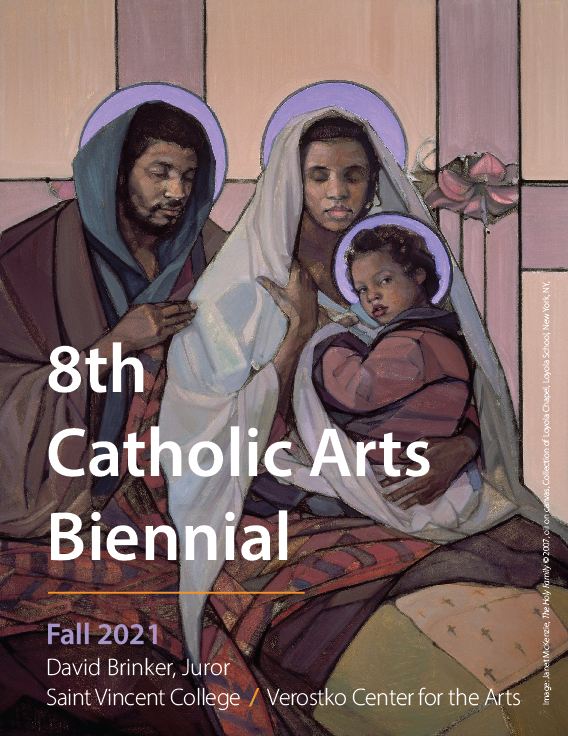
CALL TO ARTISTS:8th Catholic Arts Biennial: Saint Vincent College in Latrobe, Pennsylvania, has issued a call for submissions for its eighth biannual juried exhibition of Christian-themed art. “This Biennial encourages submissions that expand representations of Christ, the Virgin Mary, biblical narratives, and the lives of the saints beyond Eurocentric presentations. Artwork made by women and persons of color is strongly encouraged. In addition to depictions of traditional Christian subjects, artists are urged to submit works that address social concerns from perspectives of faith pertinent to the contemporary moment. Works investigating the diversity of the human experience enlivened by Gospel values are also desired.”
Artists can be of any religious or denominational affiliation and can submit up to three works by the deadline of June 25. In addition to being exhibited September 6–October 29, 2021, at the Verostko Center for the Arts, the finalists will also be eligible for a top prize of $1,000, plus other cash prizes. The juror this year is David Brinker, director of the Museum of Contemporary Religious Art at Saint Louis University. (The painting on the promotional poster is The Holy Family by Janet McKenzie, a previous winner.)
+++
SONGS:
>> “Prarthana Kelkaname” (Hear Our Prayer): Jijo Hebron, a Christian worship leader from Kerala, India, and his wife Niveda Jijo released this YouTube recording on Sunday, in which they sing to God in the Malayalam language. The song’s English meaning is below. [HT: Global Christian Worship]
Hear our prayer and supplication, oh Lord It is the promise in your Son’s name: Whatever we ask, it will be granted. There is no one to take care of my worries apart from you Who stands as my father and mother
>> “Morning Prayer” by Langhorne Slim: From the album Strawberry Mansion, released this January.
+++
ANIMATED SHORT: If Anything Happens I Love You: “In the aftermath of tragedy, two grieving parents journey through an emotional void as they mourn the loss of a child.” Written and directed by Will McCormack and Michael Govier and animated by Youngran Nho and team, this thirteen-minute film won Best Animated Short at the 2021 Oscars. It’s amazing how much I feel for these characters after such a short time of getting to know them. Streaming on Netflix.
+++
ARTICLE: “Art and Interfaith Conversation” by Andrew Smith: Birmingham, England, is a religiously diverse city, home not only to Christians but also to Muslims, Sikhs, Hindus, Buddhists, Jews, and others. The Church of England recognizes this rich presence and has on staff a director of interfaith relations for the bishop of Birmingham, Canon Dr. Andrew Smith. Smith is interested in how art and artifacts can be used to develop conversations between people of different faiths and to create new conversations, and here he discusses a Birmingham Conversations project he led along that vein: multifaith group tours at the Birmingham Museum and Art Gallery and St. Philip’s Cathedral. These he embarked on with a posture primarily of learning, not teaching. [HT: Still Life]
Smith served as a consultant for the museum’s faith gallery, which highlights religious objects from various traditions. He discusses the importance of honoring the integrity of each object’s spiritual significance, and some of the difficulties of creating a space that’s welcoming to people of all faiths when certain faiths regard certain imagery as problematic or even forbid it. He also shares some of the responses of non-Christian participants to specific works of Christian art, in both the museum and the cathedral. Some from the latter are recorded in the following video:
The Birmingham Conversations also commissioned two local artists, Jake Lever and Mandy Ross, to produce work informed by their visits over a yearlong period to different places of worship around Birmingham.
Jake Lever (British, 1963–), Dance, 2016. Ink and gouache on paper.
Sarah, you massaged my sacrum
with a tennis ball when I was in labor.
Like a priestess of the body, you
wiped the newborn Ismail clean
of birthblood and whispered first
holy words into his ear. You are his mother
too. We are kin. No decrees
of man or God can make this truer
than it is, nor can it be cloven.

We did not begin with the husband we shared,
but in Egypt, with divine
intelligence arrowed from eye to eye
across a patio of pagan strangers,
when I was royalty and you were trembling
in the house. You knew exile and I
knew exile. You suffered and I suffered.

Like matter, kinship can be changed
but not destroyed. Cruelty tarnishes,
but cannot dissolve it. We are kin
from bread baked together,
salted, broken, eaten, sacred
as a challah braid at sunset on the Night of Power;
from the battering waters of the sea we crossed;
from the Tree of Life whose branches
we burned to stay alive. Kin
we are from knowledge of the Name;

you had the first letters, I had the last
and, putting them together, we
spelled out the Secret.
“Kin” by Mohja Kahf is from Hagar Poems (University of Arkansas Press, 2016). Reprinted by permission of The Permissions Company, Inc., acting on behalf of the publisher.
Mohja Kahf is a Syrian American poet, novelist, and scholar of Arabic literature, postcolonial studies, and Arab and Arab American feminism. Born in Damascus but moving to the midwestern US as a child, she was raised in a devout Muslim household. In her creative work and scholarship, she both respects and interrogates her own faith tradition.
Her second poetry collection, Hagar Poems, gives voice to several female characters from the Qur’an and Islamic history, many of whom are also present in the biblical narrative. Part 1 focuses on Hajar (or Hagar, as she’s called in the Bible) and, to a lesser extent, Sarah, the ancient matriarchs of Islam and Judaism, respectively. The remaining two parts spotlight Zuleikha (Potiphar’s wife); Asiya (Moses’s adoptive mother); Balqis (the queen of Sheba); Maryam (Mary); Khadija, Aisha, and Fatima (wives of Muhammad); Nusaiba (a disciple of Muhammad’s); and Hamamah (an Ethiopian princess-turned-slave known primarily as the mother of Bilal, a Muslim convert). The stories of these women are sometimes transposed into contemporary times. For example, Hajar goes to the moon, sees a therapist, participates in an AIDS march, and is visited by a caseworker responding to a report of domestic violence.
Like a few others in the volume, the poem I’ve selected here explores the relationship between Hagar and Sarah as a metonym for the relationships between modern-day adherents of the two religions they represent, on both personal and political scales (i.e., the Arab-Israeli conflict). But “Kin” is revisionist and aspirational, reimagining a more congenial, mutually supportive, compassionate sisterhood between the two matriarchs, and therefore also a brighter future for their descendants. It might be said that patriarchy made Hagar and Sarah rivals. Both suffered abuse within the system and at different points inflicted it as each gained privilege over the other and vulnerabilities and power dynamics shifted.
According to the biblical story (Gen. 12:10–20), a famine in Canaan drove Abraham and his wife Sarah to seek relief in Egypt. Fearful that his life would be endangered because of Sarah’s beauty (kings were, after all, known to go to extreme measures to get what they want), Abraham presents Sarah to the royal court as his sister, implying that she is sexually available. Pharaoh thus acquires her for his harem and, in gratitude for the giving over of his “sister,” lavishes Abraham with livestock and servants. But as judgment against Pharaoh’s act of (unwitting) adultery, God strikes him and his household with plagues, which is when Pharaoh realizes that he has been deceived. He orders Abraham and Sarah to leave Egypt.
It’s not until Genesis 16:1 that we meet Hagar, identified as “an Egyptian slave” (or, as some translations have it, a handmaid or servant) owned by Sarah. Presumably Sarah acquired—and yes, I use that disgusting term again, because women were treated as possessions in ancient Mesopotamia, including by other women—Hagar during her time in Egypt.
When Sarah cannot get pregnant, she forces Hagar to have sex with Abraham to bear him an heir. But when Hagar conceives Ishmael, Sarah becomes jealous, and the abuse worsens to the point that Hagar runs away. But God visits Hagar in the wilderness with words of comfort and reassurance. She returns to Abraham’s household and gives birth to Ishmael. Sometime later, Sarah herself miraculously conceives and gives birth to a son, Isaac, after which she casts out Hagar and Ishmael, no longer having need of them. God again comes to Hagar and to her son, both of them weak from thirst and on the verge of death. He reveals to them a well and promises to make of Ishmael a great nation, just as he promised of Isaac. “You are the God who sees me,” Hagar exults (Gen. 16:13).
According to Jewish midrash, before her enslavement to Sarah, Hagar was actually an Egyptian princess—that is, a daughter of Pharaoh’s. When Pharaoh witnessed the power of Sarah’s God, who came to Sarah’s defense by unleashing pestilence on Pharaoh’s house, he gave Hagar to her, saying, “Better that my daughter be a maidservant in this house than a mistress in another house” (Genesis Rabbah 45:1). In other retellings, Pharaoh gives her away reluctantly as penance, not wanting to incur any more of God’s wrath. And in yet another version, leaving Egypt with Sarah is Hagar’s idea, as she wishes to follow the one true God.
Islamic tradition also affirms Hagar’s royal birth, though according to the Qisas Al-Anbiya, she was the daughter of the king of Maghreb, whom Pharaoh killed, thus capturing her. Notably, neither Sarah nor Hagar are mentioned by name in the Qur’an; they are only briefly alluded to in Surah Ibrahim 14:37, where Abraham says in prayer, “I have settled some of my family in a barren valley near your Sacred House.” Hagar is, however, mentioned amply in the hadith.
In “Kin,” Kahf is interested in what binds Sarah and Hagar—and Jews and Muslims—together. Both women were subjected to gendered oppression, including sexual abuse, and had no recourse against it. Both were, at different times, strangers in a strange land—first Sarah in Egypt, then Hagar in Canaan and later the wilderness of Paran. Both experienced miraculous interventions by God and even heard his voice. Both were mothers. They shared, at least initially, a husband and a home—they baked and broke bread together. Their family lines would diverge, but the two, Kahf writes, were as intertwined as the braids of a challah loaf. “Kin / we are from knowledge of the Name”—both knew and embraced the same God, as would their spiritual descendants.
The poem is written to Sarah from Hagar’s perspective. Hagar looks back with empathy to their first meeting, when “I was royalty” (as rabbinic tradition has it) “and you were trembling / in the house.” Kahf idealistically envisions an intimacy between the two, and a cooperative spirit—for example, Sarah giving Hagar a sacral massage while she’s in labor, afterward welcoming Ishmael into the world with love and devotion.
This picture is not what we get in the sacred texts, where Sarah regards Hagar with bitterness and hostility and mistreats her, and, if Sarah’s complaints can be trusted, Hagar lords it over Sarah when Hagar becomes pregnant with Abraham’s first son.
But what if the women had been friends? What if Ishmael and Isaac had been raised together as brothers? How might those strong familial ties and goodwill have impacted subsequent generations and influenced Jewish-Muslim relations in the present day?
Like Kahf, Indian American Jewish artist Siona Benjamin also explores gender and religious identity through her work, focusing especially on the biblical matriarchs. Also like Kahf, she is interested in the midrashic process by which exegetes, be they scholars or artists, approach the stories of scripture with a spirit of seeking and inquiry, responding with creative interpretations that read between the lines and ponder implications.
Siona Benjamin (Indian American, 1960–), Beloved (Sarah and Hagar), 2004. Gouache on paper, 20 × 16 in. From the Finding Home series.
In her painting Beloved (Sarah and Hagar), Sarah wears a kippah on her head and tefillin (small boxes with passages from the Torah curled inside) on her arms, while Hagar wears a hijab and a misbaḥah (string of prayer beads). The two women are wound together in a tight embrace—“reflections of each other,” the artist says. They’re also wounded together, their bodies blown apart, blood dripping like tears from the rifts. To the side is a pair of amputee Israeli soldiers, whose surveillance camera has identified three Palestinian suicide bombers. Integrated into the foliate decoration around the border are guns and grenades.
Benjamin says this painting represents the eventual reuniting of Sarah and Hagar after Hagar’s banishment, an invented outcome but one that expresses hope for reconciliation between Jews and Muslims, and particularly between Israel and Palestine. When we recognize the shared humanity of the “other,” and how they are just as beloved of God, it becomes impossible to view them as the enemy, to be occupied or killed.
Did Sarah and Hagar ever share the kind of closeness Benjamin envisions in Beloved? Probably not. But does that mean the two nations they founded must forever be at war? Let us pray for peace and pursue it.
Instead of finger-pointing or offering political solutions, these two artistic works—one by a Muslim, one by a Jew—serve as prayers of lament and hope. They probe beneath the surface of Sarah and Hagar’s story and imagine future possibilities.
Below you will find a mix of annotated links to songs, interviews, articles, and art showings of interest: “The Sound of Silence” on classical guitar; an acoustic ecologist whose job is to record nature’s music; giving up books for Lent; two interfaith art exhibitions (Faces of Prayer in Vienna and To Bough and ToBend in Los Angeles); and two new folk music albums (Old Wow by Sam Lee and Civil Dawn by the Pharaoh Sisters).
+++
MUSIC VIDEO: “The Sound of Silence” (arr. Lawson, Trueman): Classical guitarist Miloš Karadaglić collaborated with members of the string orchestra 12 Ensemble on this instrumental rendition of Simon & Garfunkel’s “The Sound of Silence.” [HT: Philip Chircop]
This is the title track of Karadaglić’s fifth album, Sound of Silence, released last fall. To watch him perform the piece in London’s Air Studios, as filmed by Classic FM in October for Live Music Month 2019, click here.
+++
PODCAST EPISODE: “Silence and the Presence of Everything,”On Being interview with Gordon Hempton: “Acoustic ecologist Gordon Hempton collects sounds from around the world. He’s recorded inside Sitka spruce logs in the Pacific Northwest, thunder in the Kalahari Desert, and dawn breaking across six continents. An attentive listener, he says silence is an endangered species on the verge of extinction. He defines real quiet as presence—not an absence of sound but an absence of noise.”
Such a unique vocation—listening to places, preserving natural soundscapes. “I hear music coming from the land,” Hempton says. “Some of the most sublime symphonies have been hidden away in something as simple as a driftwood log.” Among his other favorite “musics” are “grass wind” (“the tone, the pitch, of the wind is a function of the length of . . . the blade of grass”) and sounds from “the most musical beach in the world,” Rialto Beach.
Earth is a solar-powered jukebox. . . . We can go to the equator, listen to the Amazon, where we have maximum sunlight, maximum solar energy. The solar panels, the leaves, are harvesting that and cycling it into the bioacoustic system. And, to my ears, that’s a little too intense. That’s a little bit too much action.
Then we can jump up into Central America, and we can still feel and hear the intense solar energy, but it’s beginning to wane.
And we notice a really big difference when we start getting into the temperate latitudes, of which I particularly enjoy recording in because it’s not just about the sound, but it’s about something that I call the “poetics” of space. . . .
“Silence is really wonderful, isn’t it?” he beams. “Even when we just let it exist, it feeds our soul.”
+++
ESSAY: Last year Leah Slawson gave up books for Lent. When I first read that headline, I balked. Books are so life-giving to me! But as I read on, I came to understand Slawson’s reasoning (with which I can identify), and, while I’m not fasting from reading, I admire her choice. “I put a high value on reading, but I am keenly aware that I can use it as an escape from thinking my own thoughts or from noticing my feelings. . . . Reading, for me, is a distraction from the hard work of writing, and since it is so worthy of an activity, I feel justified and redeemed. I even read and study as a way to fool myself into thinking I am practicing faith; when really, I am just reading about someone else’s spiritual practice.” [HT: Rachel A. Dawson]
+++
EXHIBITIONS:
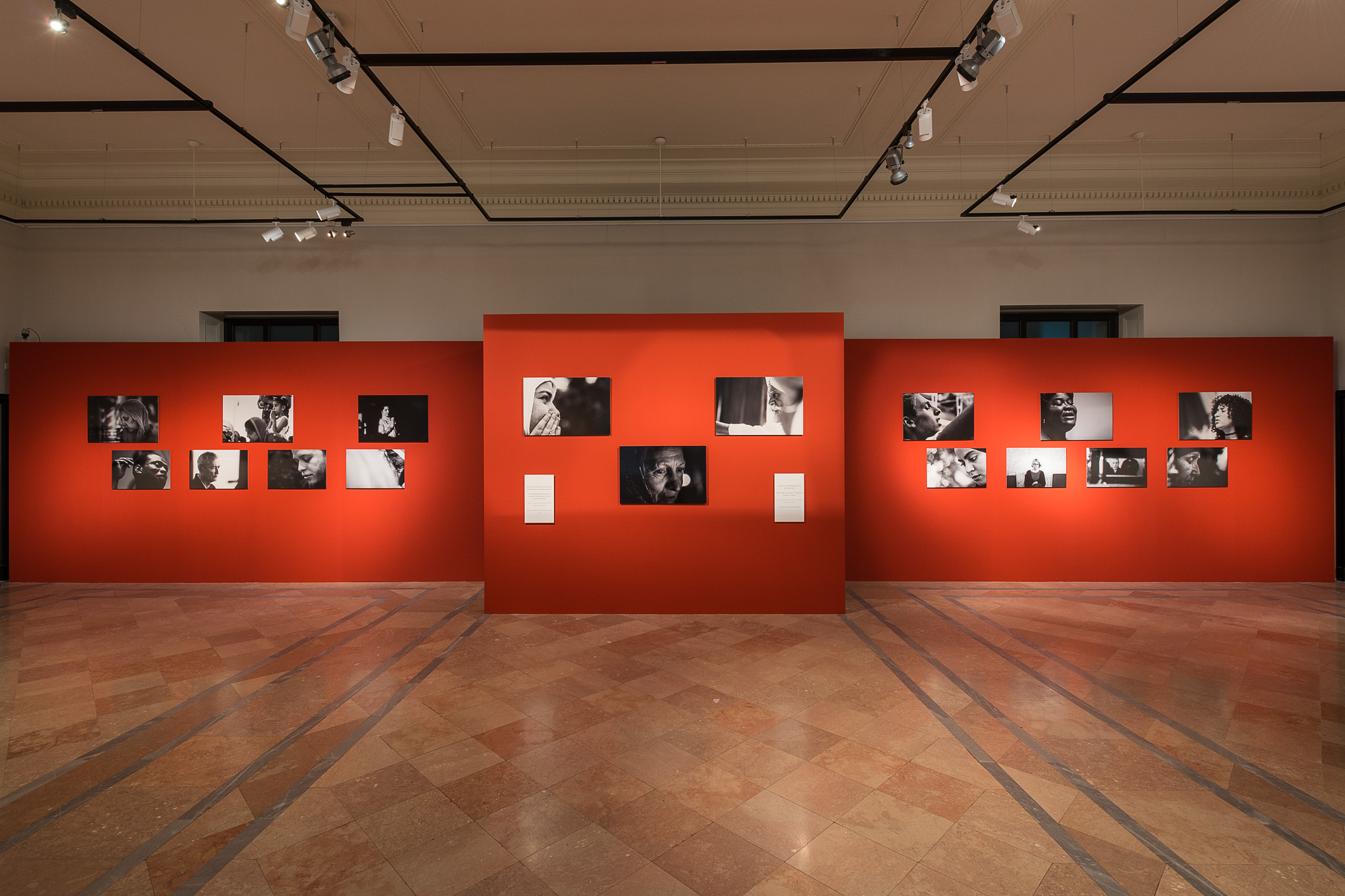
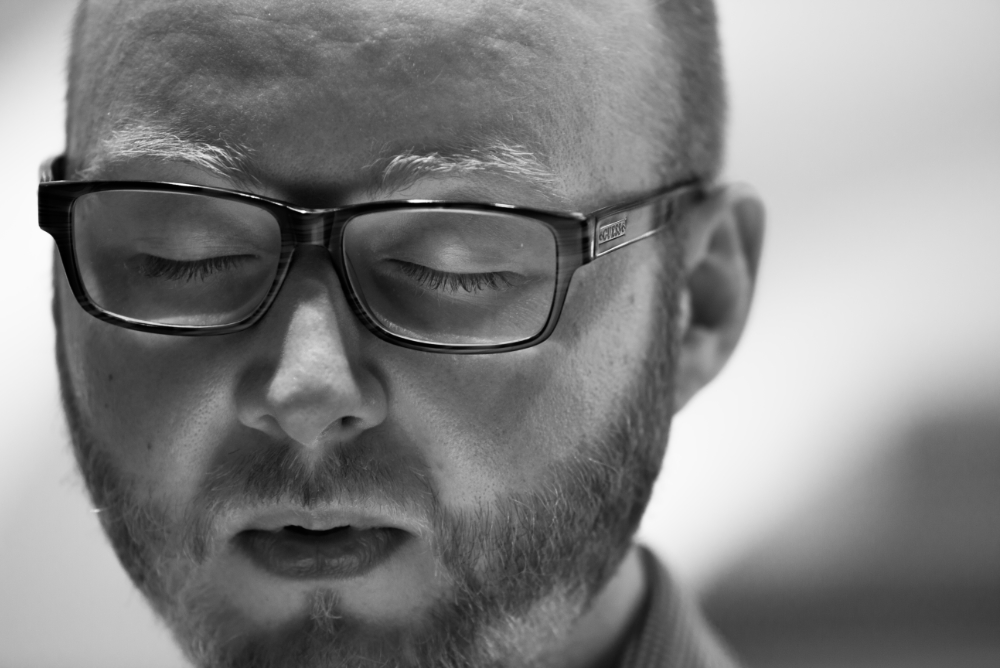
>> Faces in Prayer: Photography by Katharina Heigl,Weltmuseum Wien, Vienna, December 5, 2019–March 24, 2020: A series of thirty-one intimate black-and-white photographs showing people of different faiths in prayer. To capture these shots, photographer Katharina Heigl visited churches, temples, mosques, synagogues, and other places of worship in Austria and Israel, but, important to the display, there are no labels to tell you who is praying to which god(s). That’s because Heigl wishes to emphasize the universality of the human impulse to communicate with the Divine. There are signs, however, that reproduce quotes from anonymous sources, printed in German, English, Hebrew, and Arabic, such as “Prayer is like an oasis of calm inside me. Like a tree giving me shade.” [HT: ArtWay]
Exhibition view of “Faces in Prayer: Photography by Katharina Heigl” (2019–20) at the Weltmuseum Wien, Vienna
Photograph by Katharina Heigl, from the “Faces in Prayer” series
>> To Bough and To Bend,Bridge Projects, Los Angeles, March 11–April 25, 2020: Officially launched last October, Bridge Projects is an LA exhibition space with public programs connecting art history, spirituality, living religious traditions, and contemporary art practices. Their second exhibition, To Bough and To Bend, opens Wednesday, with thirty-two participating artists.
“The Tree of Life is found in both the beginning of the Jewish Tanakh and in the last book of the Christian Scriptures. The Bodhi Tree is said to be the site of Siddhārtha Gautama’s awakening as the Buddha. Ancient Chinook prayers address God as the ‘Maker of Trees.’ As the novelist Richard Powers said, trees are rightly called ‘architecture of imagination.’ Their shade and branches have been sites of contemplation, suffering, and imagining our renewal.
“Today, trees still speak: blunt stumps communicate deforestation and charred limbs speak of Los Angeles fires started by our own hands—or our negligence. New discoveries of communicating root systems speak to a tangled web of connections just below the surface of the visible world, just as LA’s iconic—and imported—palms evoke a colonial past. In To Bough and To Bend, artists explore these ecological issues and look to both religious and contemporary art practices that help us listen to these old friends, so that we might relearn to ‘walk slowly and bow often’ and find our way back into the living world we share.”
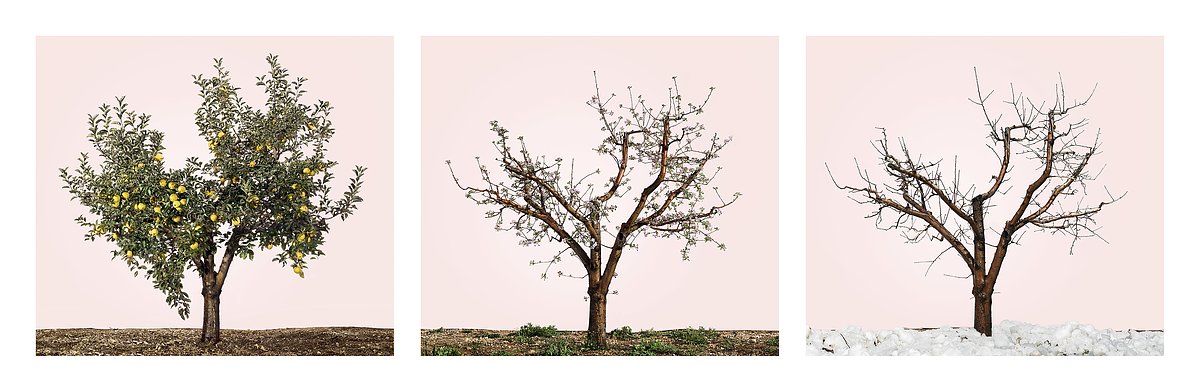
Tal Shochat (Israeli, 1974–), Lessons in Time 3 (Yellow Apple Tree), 2016. C-prints, mounted and framed, 39 1/4 × 44 in. each. Photo courtesy of the artist and Meislin Projects.
The opening celebration on March 14 will consist of a communal poetry reading followed by a Tu B’Shevat (New Year of the Trees) ritual presentation by community organizer Michal David. Other events are: “Called to Shine: Trees in Myth, Symbol, and Art”; a live interview with artist Lucas Reiner on his Trees as Stations of the Crossproject; a talk on indigenous trees of Southern California, given by a member of the Tongva tribe; a discussion of art’s role in nature preservation; a lecture by Dr. Kimberly Ball on Yggdrasil, the tree of life in Norse mythology; “Paradise and Agony in the Garden: Sacred Trees in Italian Renaissance Art”; Dr. Duncan Ryūken Williams on the intersections of Buddhism and ecology; a bonsai demonstration; and a poetry reading and song performance by Iranian-born writer Sholeh Wolpé.
+++
NEW ALBUMS: Both these were released in January.
>>Old Wow by Sam Lee: An avid collector and reinterpreter of traditional songs, Britfolk artist Sam Lee is acclaimed for “breaking the boundaries between folk and contemporary music and the assumed place and way folksong is heard . . . not only inviting in a new listenership but also interrogating what the messages in these old songs hold for us today.” He studied under the Scottish storyteller and ballad singer Stanley Robertson (1940–2009) and, in addition to singing, plays the Jew’s harp and the Indian shruti box. Other instruments in his unique fusion include the klezmeresque cello, tabla, Japanese koto, ukulele, violins, and percussion.
Below are two music videos from his latest album, Old Wow. The first is “Lay This Body Down,” a song about death; in the choreographed video, Lee is tugged and caressed by a gaggle of deceased souls, who at the end enfold him in the ground. “The Moon Shines Bright,” on the other hand, which features Elizabeth Fraser, is about life: its call (fitting for Lent) is to “Rise, arise, wake thee, arise / Life, she is calling thee / For it might be the mothering of your sweet soul / If you open your eyes and see.” I’ve heard many different iterations of this song, which usually appears on Advent/Christmas albums with verses about the Nativity, Crucifixion, etc., but this adaptation was gifted to Lee by an elderly Gypsy woman named Freda Black and is absent of overt Christological references.
>> Civil Dawn by the Pharaoh Sisters: The Pharaoh Sisters is a folk outfit from Winston-Salem, North Carolina, whose debut album has arrived! Influenced by mountain, old-time, and gospel traditions, the band consists of Austin Pfeiffer on acoustic guitar and lead vocals, Jared Meyer on acoustic guitar and backing vocals, Kevin Beck on lap steel guitar, and John Daniel Ray on upright bass. “Their music blends the cowboy sensibilities of Western-native frontman and lyricist Austin Pfeiffer with the Appalachian traditions of dark imagery and poignant guitars from their current home in the foothills of the Blue Ridge.”
The biblical narrative is deeply embedded in the album, with many sideways references to specific scriptures. Topography is used symbolically throughout—fissures, canyons, mountains—and helps establish the central metaphor of Jesus as a pioneer, opening up a new frontier for us, leading us through the wilderness into the land of promise.
The album’s title, Civil Dawn, is a scientific term referring to when the center of the sun is six degrees below the horizon in the morning—in other words, the moment before the sun rises. The first song, which muses on the paradoxical character of Jesus, ends with a yearning for “Healing wings / Righteous sun,” a subtle nod to Malachi 4:2. That leads into “Awake, my soul, to the sun,” a prayer that we would incline ourselves toward the Light that’s already shining. As the journey continues, there’s darkness, dryness, a feeling of lostness and thirst. But we are not abandoned by our co-traveler, who is our light, our rest and refreshment, our way-maker. The last song, “Homecoming,” celebrates the “pioneer man with sun-scorched hands” who “guides on a trail he’s blazed”—an evocative image, which makes me think of Christ’s glorious wounds (in many traditional religious paintings, the nail prints emit light), but also, in light of the whole record, Isaiah 58:11: “The LORD will guide you always; he will satisfy your needs in a sun-scorched land and will strengthen your frame. You will be like a well-watered garden, like a spring whose waters never fail.”



 Art & Theology