The people who walked in darkness have seen a great light; those who lived in a land of deep darkness— on them light has shined. . . . . . . . . . . . . . . . . . . . . . . . . . . For a child has been born for us, a son given to us; authority rests upon his shoulders, and he is named Wonderful Counselor, Mighty God, Everlasting Father, Prince of Peace. Great will be his authority, and there shall be endless peace for the throne of David and his kingdom. He will establish and uphold it with justice and with righteousness from this time onward and forevermore. The zeal of the LORD of hosts will do this.
—Isaiah 9:2, 6–7
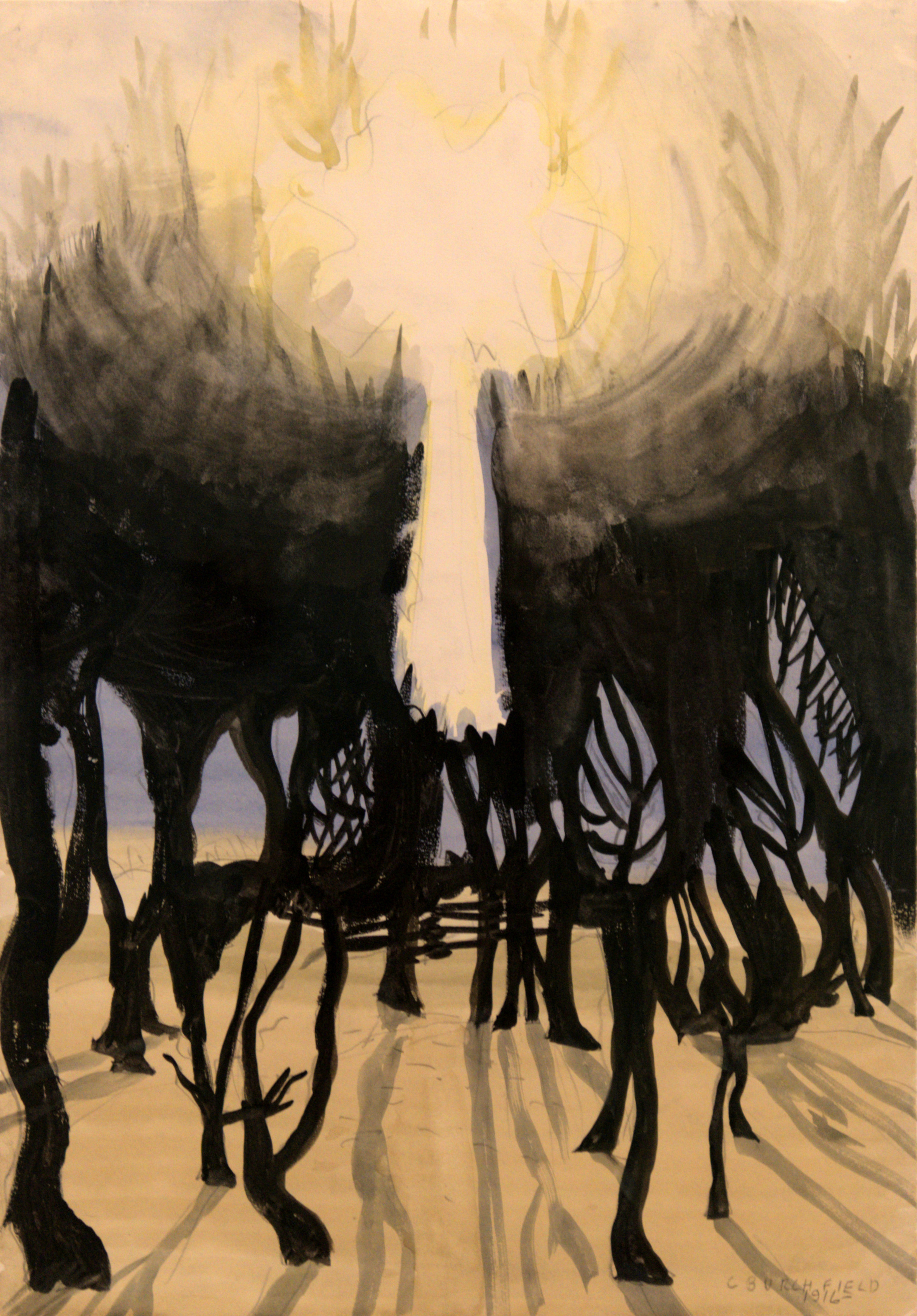
LOOK:Sunlight in Forest by Charles Burchfield
Charles Burchfield (American, 1893–1967), Sunlight in Forest, 1916. Watercolor and graphite pencil on paper, 20 × 13 15/16 in. (50.8 × 35.4 cm). Whitney Museum of American Art, New York Photo: Victoria Emily Jones. [object record]
LISTEN: “Isaiah’s Prophecy” | Words by Joanna Forbes L’Estrange, after Isaiah 9:2, 6–7 | Music by Alexander L’Estrange | Performed by London Voices, dir. Ben Parry, with Richard Gowers on organ, on Winter Light (2024)
The people who walked in darkness, who live in a land of dark, the people who walked in darkness, have seen a great light.
Refrain: And all because a child is born! And all because a child is born! To us a son is given.
He’ll be the Wonderful Counselor, the Everlasting Father. He’ll be the Wonderful Counselor, he’ll be the Prince of Peace. [Refrain]
He’ll reign on the throne of David, establishing and upholding it. He’ll reign on the throne of David from then and evermore.
Ending: And all because a child is born! And all because a son is giv’n! The people who walked in darkness will walk, will walk in the light— walk in the light!
This work by the British choral composer Alexander L’Estrange has a steady, funky groove, with a time signature that alternates between 7/8, 4/4, and 3/4.
“The contrast between ‘the people who walked in darkness’ and the ‘child is born’ is highlighted by the shift from the harmonic minor tonality of the verses to the major tonality of the refrain,” L’Estrange writes in his composer’s note. “Enjoy the moment at the end of each refrain where the organist stops playing and the choir sings ‘to us a son is given,’ taking us back to the minor for the next verse.”
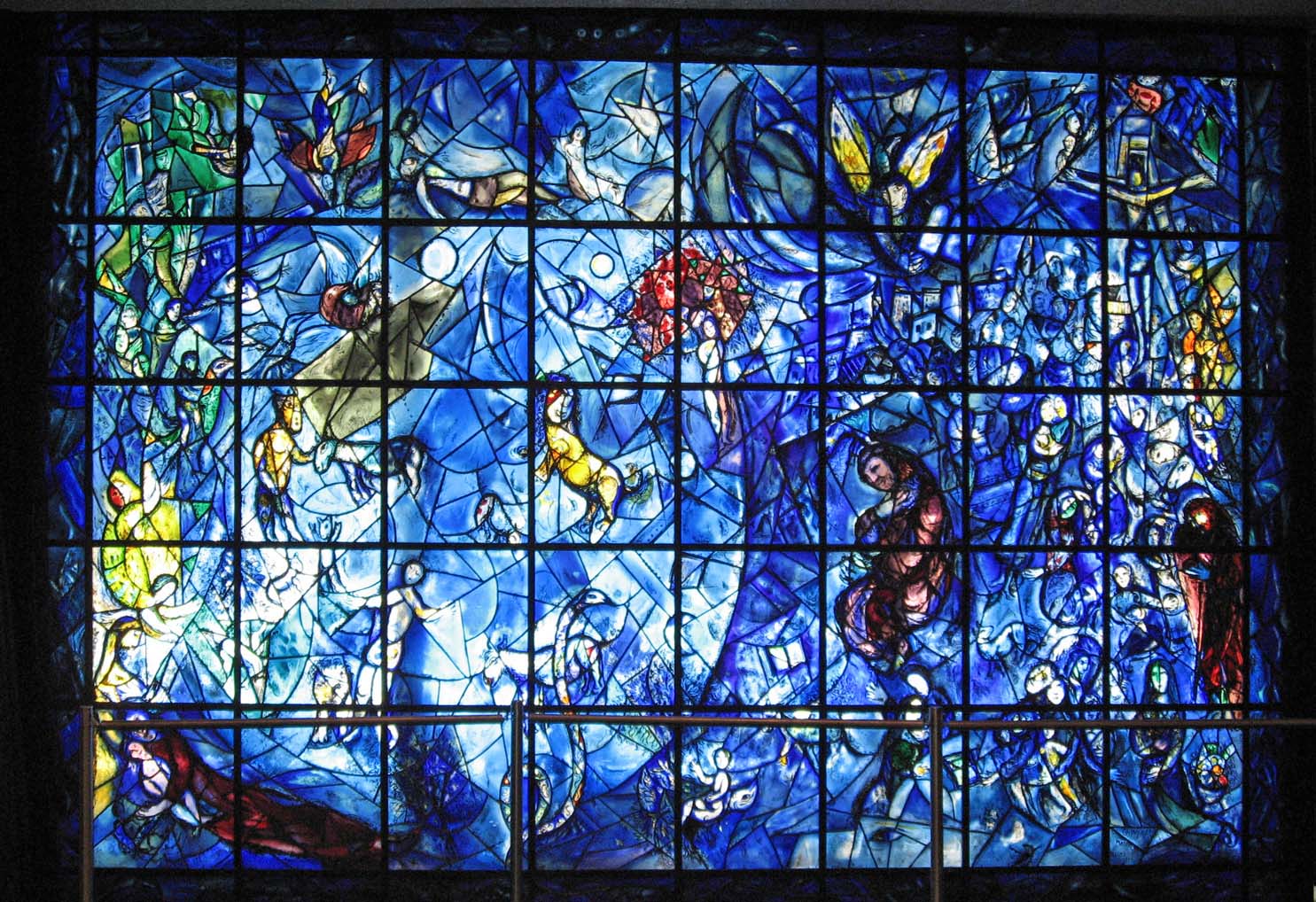
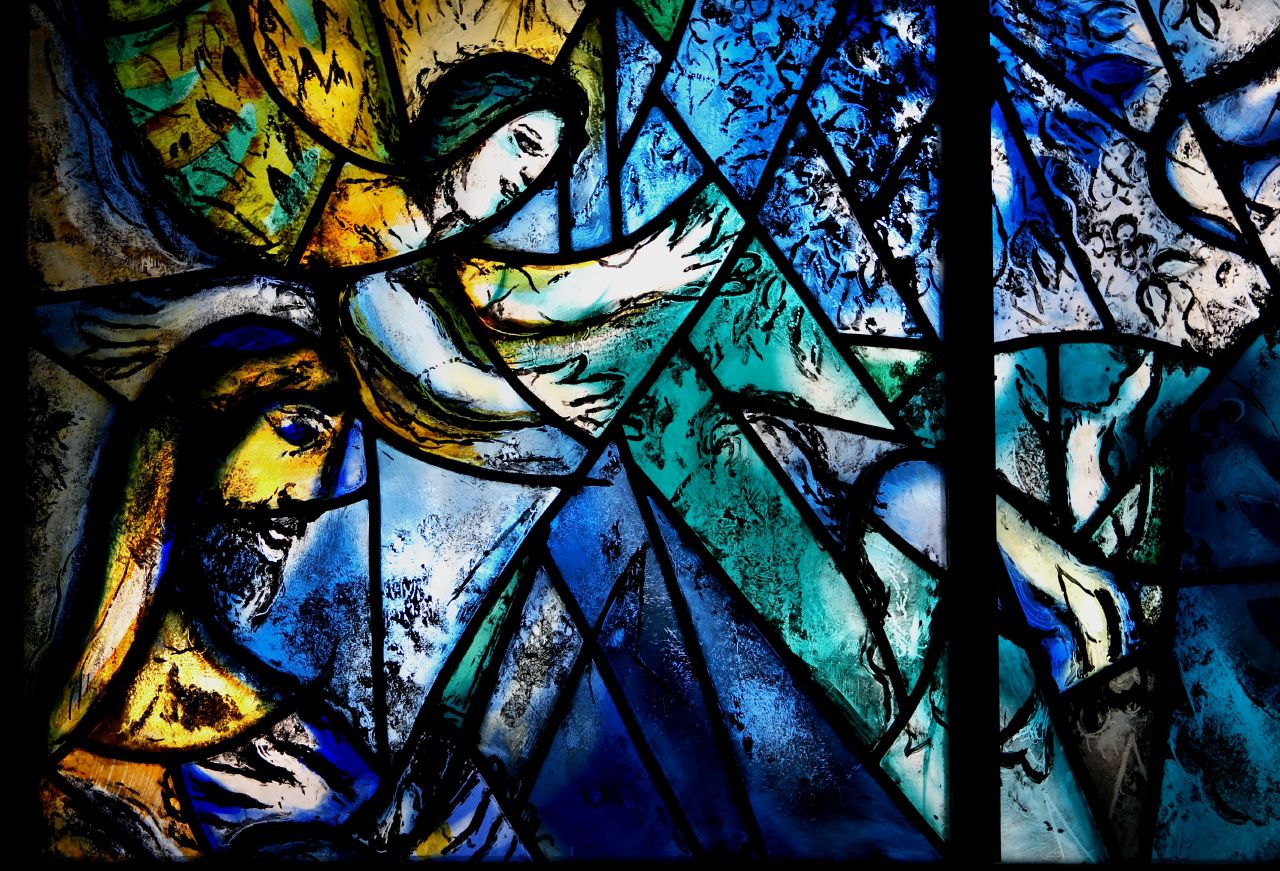
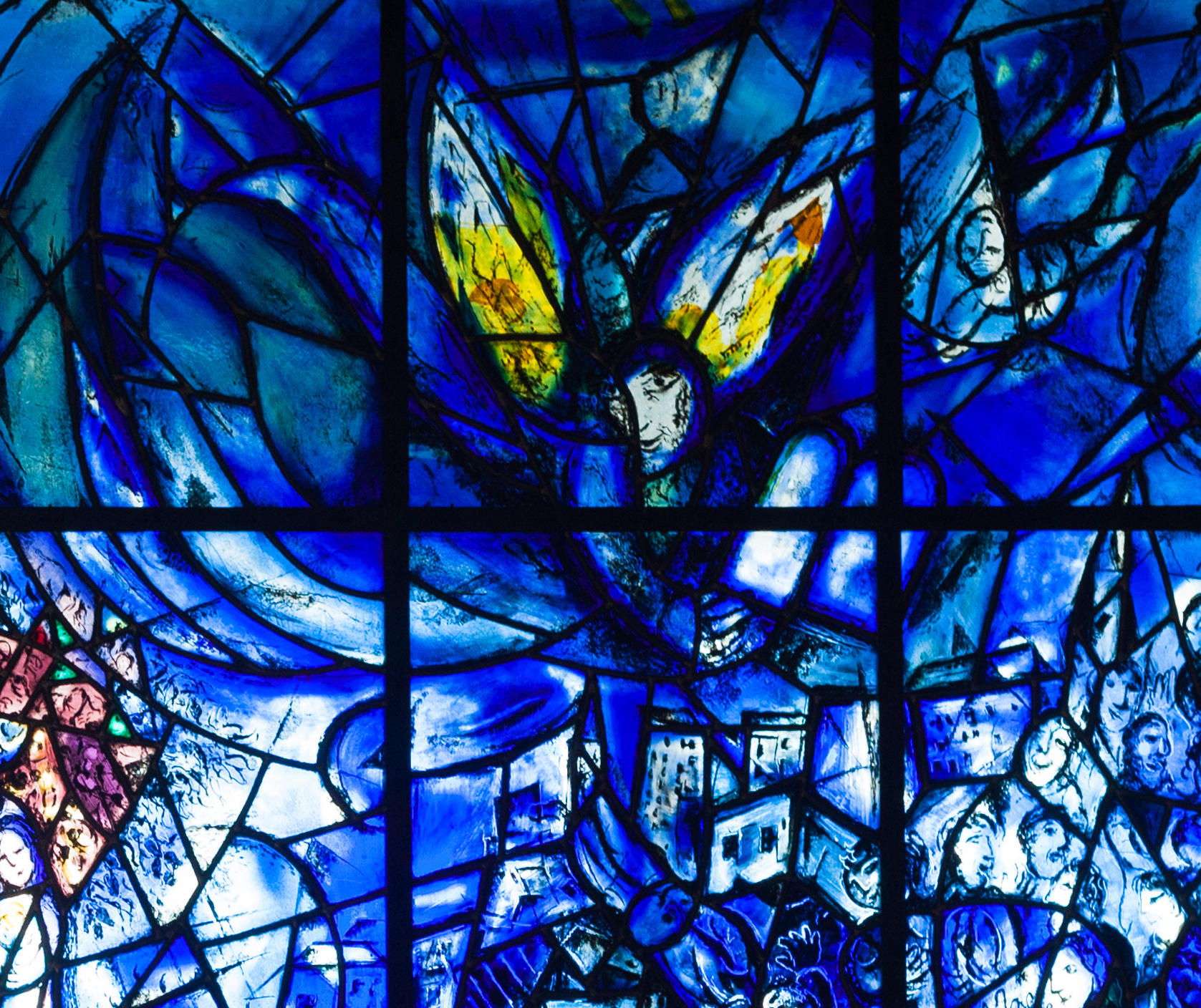
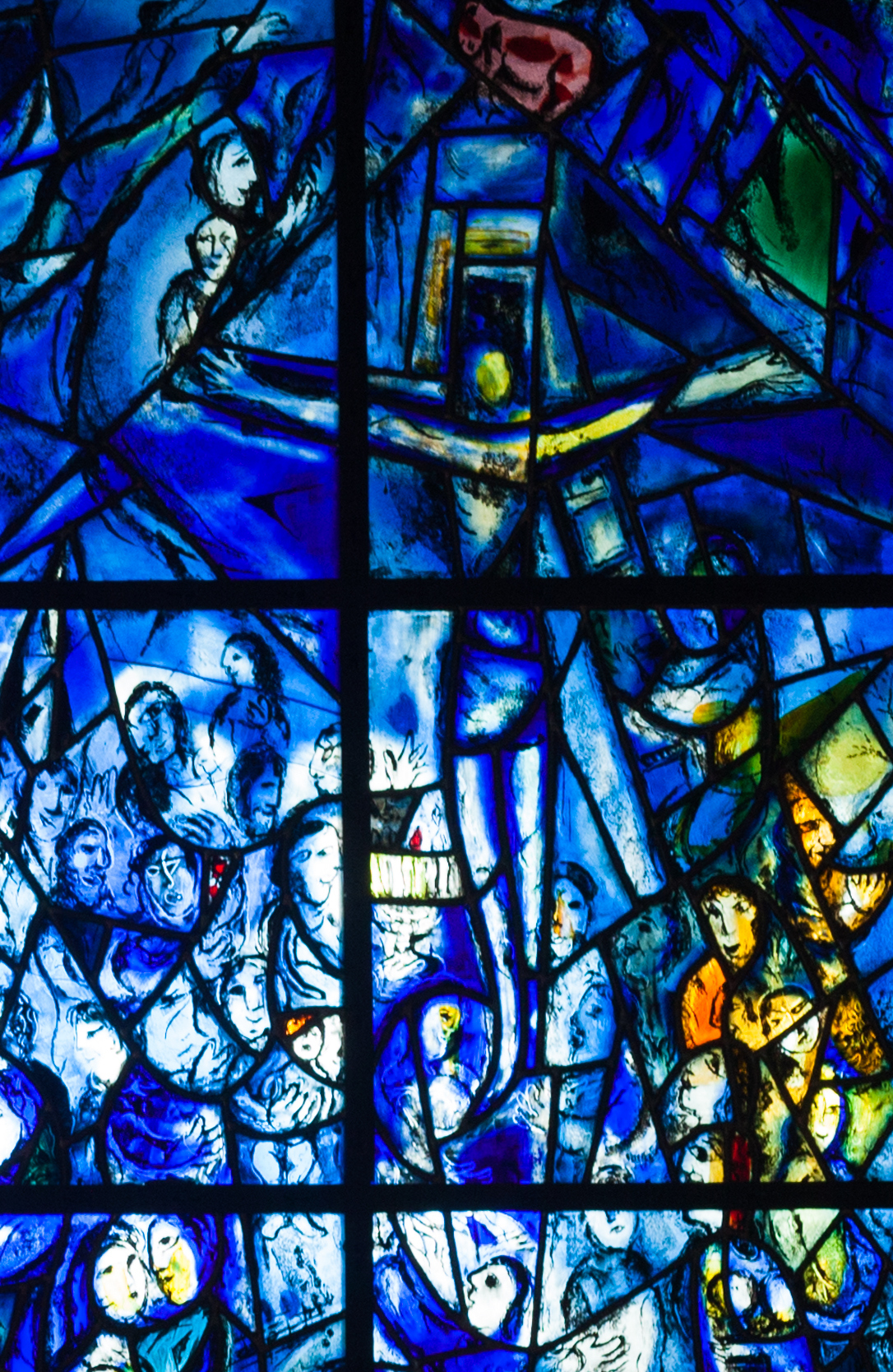
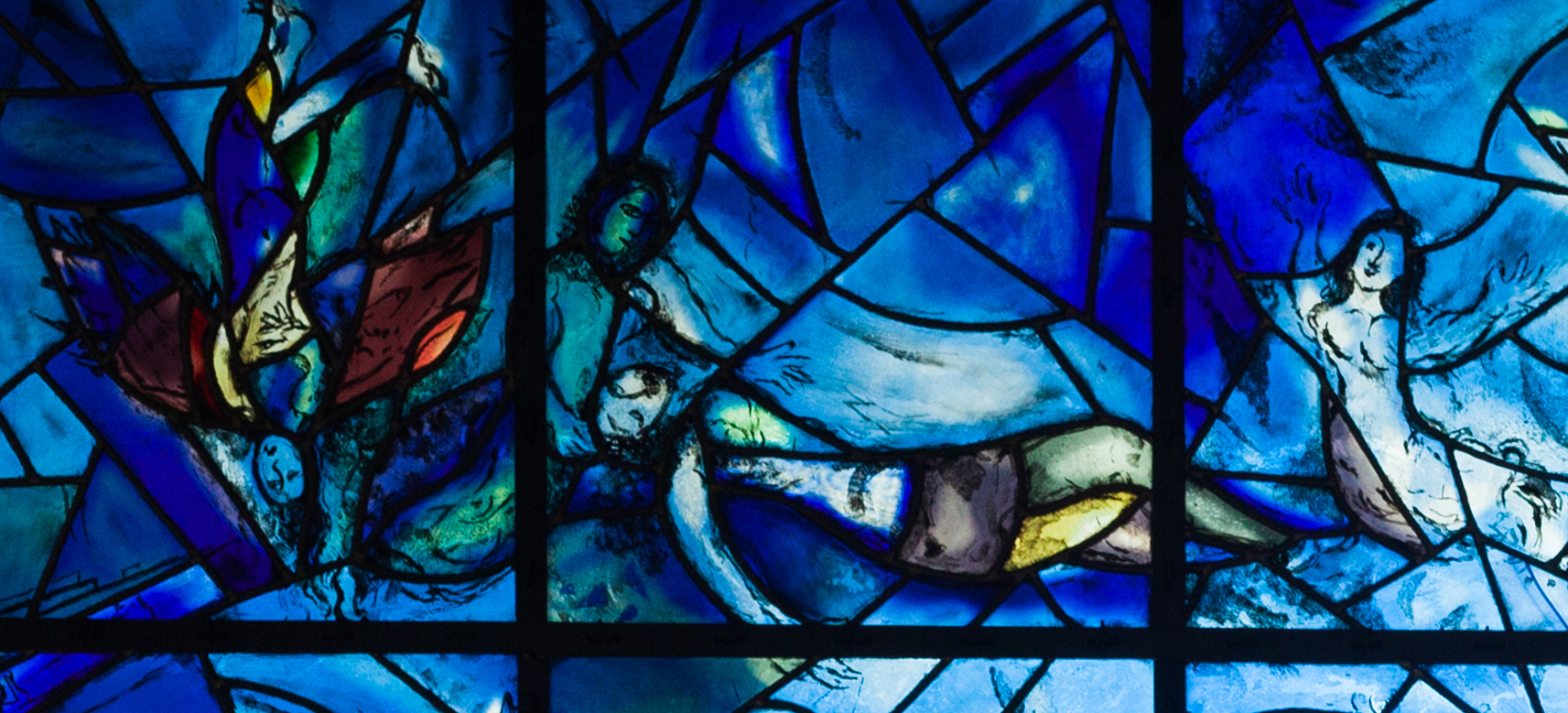
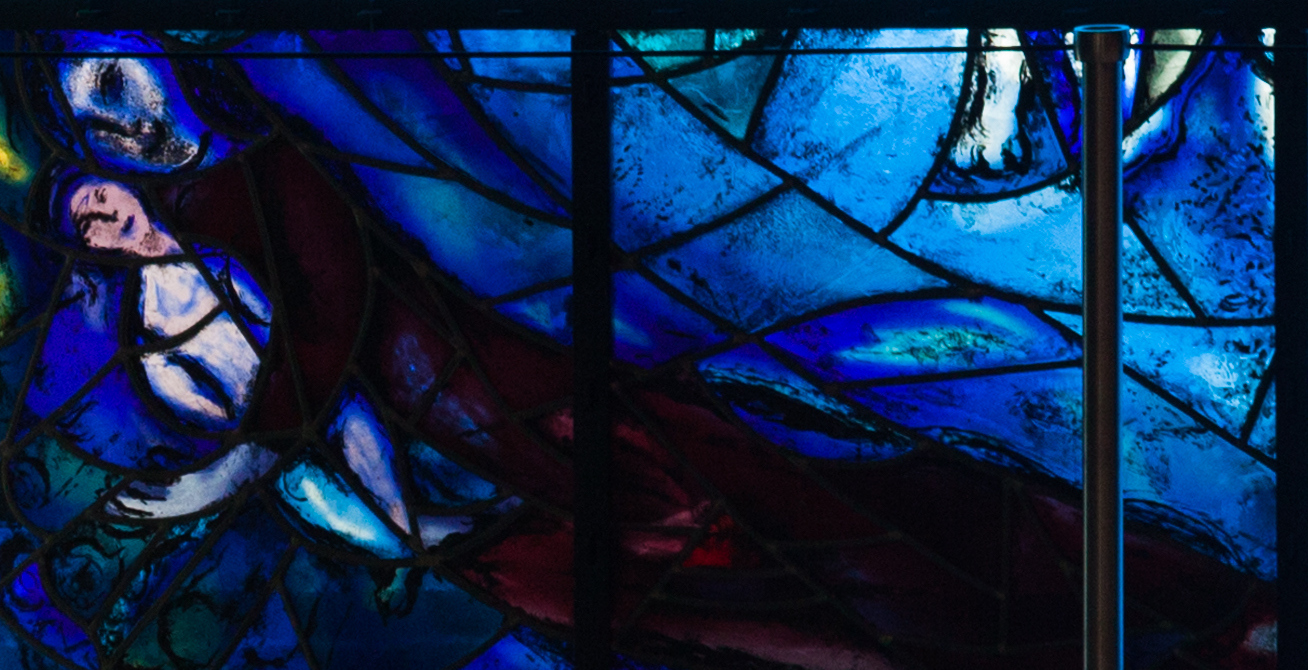
Marc Chagall (Russian/French, 1887–1985), Peace Window, 1964. Stained glass, 12 × 15 ft. Public lobby, General Assembly Building, United Nations Headquarters, New York. Manufactured by Brigitte Simon and Charles Marq.
This stained glass window by Marc Chagall was commissioned as a memorial for the Swedish diplomat Dag Hammarskjöld (1905–1961), who served as the second secretary-general of the United Nations, and for the fifteen other UN staff and peacekeepers who died with him when their plane crashed on the way to a peace negotiation for the Congo Crisis in Northern Rhodesia. The artist’s handwritten dedication reads, “A tous ceux qui ont servi les buts et principes de la Charte des Nations Unies et pour lesquels Dag Hammarskjöld a donné sa vie” (To all who served the purposes and principles of the United Nations Charter, for which Dag Hammarskjöld gave his life).
Chagall’s design was executed by master glassmakers Brigitte Simon and Charles Marq of Atelier Simon-Marq.
Chagall was born in 1887 into a Hasidic Jewish family in Vitebsk, Russia (now Belarus). He moved to Paris in 1910 to develop his art, becoming a French citizen in 1937. When Nazis took over the country, threatening Chagall’s safety, he was successfully extricated to the United States with the help of Alfred Barr, director of the Museum of Modern Art in New York. He returned to France for good in 1948. His impressive body of work, marked by a spiritual vivacity, includes—in addition to stained glass—paintings, drawings, book illustrations, stage sets, ceramics, and tapestries.
His 1964 Peace Window in New York City—not to be confused with his similar but much larger Peace Window of 1974 in the Chapel of the Cordeliers in Sarrebourg, France—is full of biblical allusions.
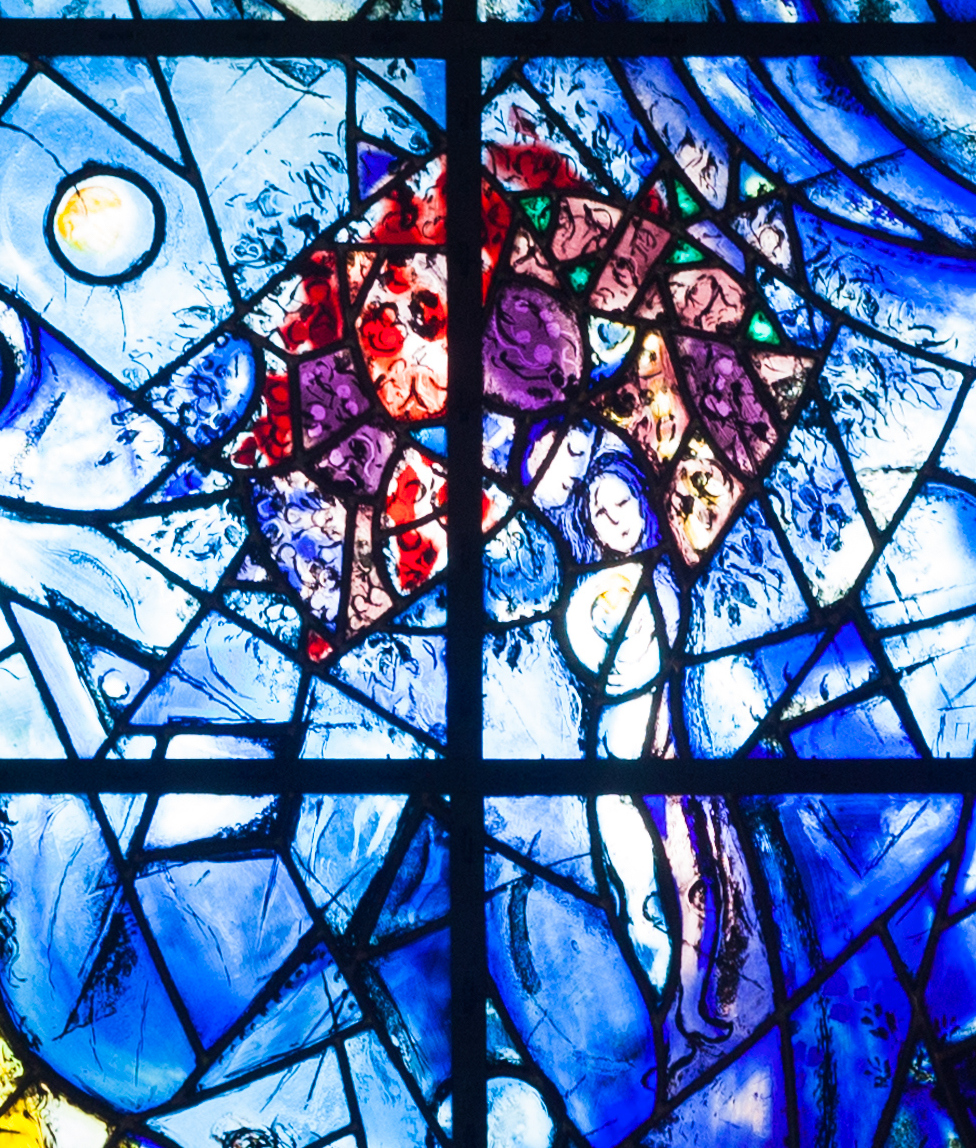
My eyes are drawn first to the red and purple bouquet in the center, under which stands an amorous couple. Who are they? What do they represent? I can think of several possibilities:
1. Adam and Eve. In the sketch Chagall made for the window, the woman is very clearly naked, though she’s less obviously so in the final window. That Eve, pre-fall, is traditionally portrayed unclothed, and that Chagall’s later Peace Window unequivocally portrays Adam and Eve within a red tree, lends credence to the interpretation of these figures as our primordial foreparents, in which case the flowering mass would stand for the tree of life in the garden of Eden (Gen. 2:9).
2. The Annunciation—the angel Gabriel coming to Mary to announce that she had been chosen to birth and mother God’s Son. The male head is bodiless, emerging from the crimson bloom (suggesting, perhaps, a supernatural entity), and there’s a yellow glow at the woman’s breast, perhaps signifying the conception of Christ. What’s more, the woman appears to be cradling something—her pregnant belly?
3. God and the human soul, or Christ and his church. One traditional Jewish interpretation of the poetic book of scripture known as the Song of Solomon is that it celebrates the love between humanity and the Divine. Medieval Christians, similarly, spoke of the book as an allegory of the future marriage of Christ and the church, his bride, drawing too on the New Testament book of Revelation, which culminates in a mystical union, a picture of cosmic harmony, heaven and earth inseparably joined.
4. The kiss of Justice and Peace. Psalm 85:8–11, a common Advent text, speaks of the divine attributes that coalesce to accomplish salvation (in the Christian reading, in the Incarnation):
Let me hear what God the LORD will speak, for he will speak peace to his people, to his faithful, to those who turn to him in their hearts. Surely his salvation is at hand for those who fear him, that his glory may dwell in our land.
Steadfast love and faithfulness will meet; righteousness and peace will kiss each other [emphasis mine]. Faithfulness will spring up from the ground, and righteousness will look down from the sky.
5. The kiss of Joy. Beethoven’s Ninth Symphony was a favorite of Dag Hammarskjöld’s, and its performance, at least the “Ode to Joy” chorus in its final movement, is a United Nations Day concert tradition. Hammarskjöld described the work as “a jubilant assertion of life,” championing universal peace and brotherhood. One of the lines from Friedrich Schiller’s text that Beethoven set exclaims that “Joy . . . kiss[es] . . . the whole world!”
I suspect some or all of these ideas were at play when Chagall designed the window. Or even just romantic love in general (with other types of love portrayed elsewhere in the composition), as he often painted himself and his wife Bella kissing or embracing.
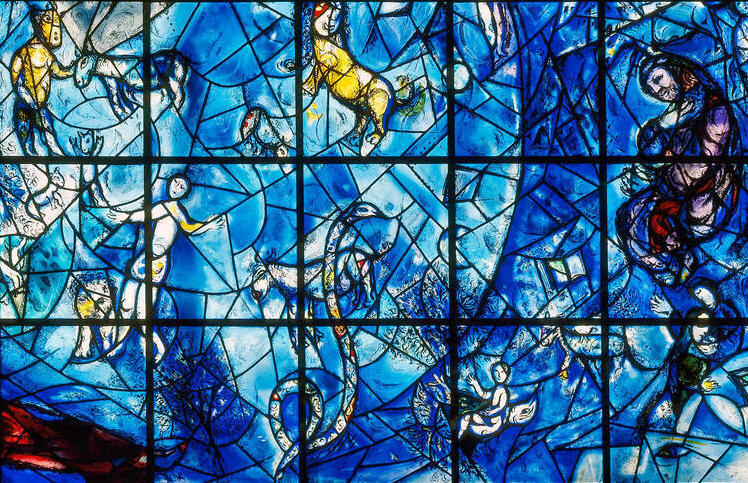
After this tableau, my eyes go to the large male figure cloaked in purple just right of center. I take him to be the prophet Isaiah, beholding a vision of wild animals and children cavorting together in harmony (see Isaiah 11). A boy, for example, reaches his hand out toward a viper and is not harmed.
But it’s also possible that’s meant to be Isaiah at the bottom left of the window, his face illumined by the beauty spread out before him, which an angel gestures to, guiding the prophet’s imagination:
On the top right, another angel delivers the Ten Commandments to the people of God.
Next to this communication of God’s word is the death of God’s Word in the flesh, Jesus Christ, around whom the crowds have gathered. A man ascends a ladder propped against the cross, the ladder being a multivalent symbol harking back to Jacob’s dream at Bethel and evoking notions of descent and ascent.
Vignettes below include a couple embracing with an infant in hand, a woman being fed at a table (the Eucharist?), a family reading a book (probably the Bible), a woman making music, and another bearing flowers.
At the top left is a lamentation scene that evokes those of Christ deposed from the cross. A man in a loincloth lies dead or wounded on the ground, his head cradled by a loved one, while at his feet another mourner throws her arms up in grief. This is the cost of human violence.
By contrast, in the bottom left corner, a mother cradles her child, evoking scenes of the nativity of Christ—of Mary with her newborn son.
All these characters—human, animal, and divine—are sprawled across a warm azure background, playing out love, suffering, death, peace, joy, and reconciliation.
LISTEN: “Oracles” by Steve Bell, on Keening for the Dawn (2012)
O ancient seer, your vision told Of desert highways streaming home To the mountain of the Lord Where nations sound a righteous song forevermore
And on that mountain men will forge From cruel implements of war The tools to till and garden soil The rose will bloom and faces shine with gladdening oil
And it will surely come to pass Justice will reign on earth at last The wolf will lie down with the lamb No beast destroy, no serpent strike the child’s hand
And God himself will choose the sign A frightened woman in her time Will bear a son and name him well God with us! O come, O come, Emmanuel!
ADVENT SERIES: Restful Advent by Tamara Hill Murphy:Tamara Hill Murphy [previously] is one of my favorite spiritual writers, her thoughtful words and curation of resources having served as a well of inspiration for me over the years. Each year, similar to Art & Theology but with the sensibilities and expertise of an Anglican spiritual director, she publishes a new daily Advent and Christmastide guide through her Substack, Restful, running this year from November 30 to January 5. Each post in the series includes lectionary readings, art, music, a prayer, and a simple practice to help us notice God’s presence during these waiting days. This time around, the Daybook will feature excerpts from Claude Atcho’s new book Rhythms of Faith along with ideas from The Liturgical Home by Ashley Tumlin Wallace and some of my own formerly published art commentaries.
“The Daybook is a way to pay attention to Christ’s three arrivals—then, now, and still to come—and to walk through December with a quieter heart and a stronger hope,” Murphy writes.
Murphy is offering Art & Theology readers a 50% discount to Restful using this link, which brings the subscription cost down to $4/month (let it run for two months if you want to receive the full Christmastide Daybook) or $32/year, which will give you access to her year-round content. The offer expires January 5, 2026.
+++
BLOG POST: “The Sacred Journey of Advent” by Ashley Tumlin Wallace, The Liturgical Home: “Advent,” writes Wallace, “is a season of preparation, for the coming of Christ at Christmas, and also for His return in glory at the end of time.” This is a great introduction to the season that kicks off the new church year.
+++
SONGS:
One of the scripture texts of Advent is Isaiah 40:3–5:
A voice cries out: “In the wilderness prepare the way of the LORD; make straight in the desert a highway for our God. Every valley shall be lifted up, and every mountain and hill be made low; the uneven ground shall become level, and the rough places a plain. Then the glory of the LORD shall be revealed, and all flesh shall see it together, for the mouth of the LORD has spoken.”
The Gospel-writers Matthew (3:3), Mark (1:3), and Luke (3:4) all see this exclamatory figure as John the Baptist, who told people to prepare for God’s coming by repenting of sin, since holding on tightly to ways of unlove erects barriers to God’s entry into one’s life. Here are two songs based on this Advent passage.
>> “Prepare the Way” by Maverick City Music and Tribl, feat. Chandler Moore and Siri Worku, on Tribl I (2021): This song repeats, again and again, the Advent mantra “Prepare the way,” embedding John the Baptist’s invitation deeply into hearts and minds. Its tag beseeches Christ to come with the fire of purging, the rain of refreshment, and the oil of blessing. To welcome this coming, this transformation and growth, we need to decenter ourselves, ceding to God the place of primacy, from which he works our good and his glory.
>> “Prepare the Way” by Christopher Walker, on Rise Up and Sing, 3rd ed., vol. 3 (2009): This 1991 song is by Christopher Walker, a church music composer, lecturer, and choral conductor originally from the UK but now living in Santa Monica, California. Published by OCP (Oregon Catholic Press), it would make a great song for a children’s Advent choir.
+++
2018 SERIES: Advent Caravan: Walking with the Holy Family by Sarah Quezada: I learned about Sarah Quezada’s work at the intersection of faith, justice, and culture through Tamara Hill Murphy (see first roundup item) in 2018, when Quezada published a five-part series reflecting on the likelihood that Mary and Joseph traveled to Bethlehem for the census not alone but in a caravan. Interweaving personal story, biblical interpretation, and current events, Quezada considers how the holy couple’s experience in the final months of Mary’s pregnancy connects to the reality of people on the move seeking hope, peace, joy, and love today.
While the series is not hosted online, I received permission from Quezada to reproduce it here.
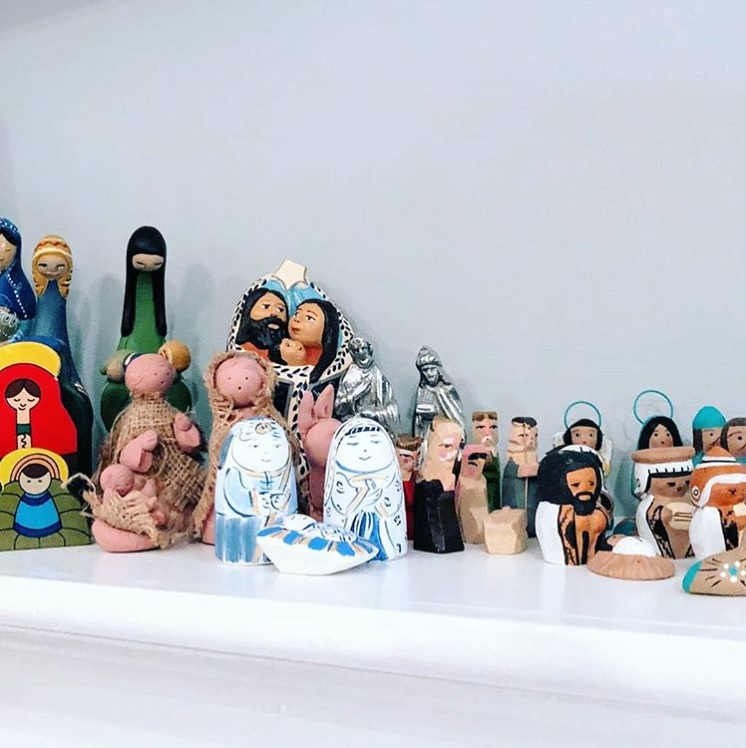
On Instagram, Quezada also shared a photo of her friend’s Advent mantel, where she combined figurines from her various nativity sets to form a “caravan” of travelers.
Photo via @sarahquezada
+++
YOUTUBE PLAYLIST: Jouluradion Hoosianna: Jouluradio is a Finnish radio station that broadcasts annually from November 1 to January 6, playing all Advent and Christmas music. Since 2012, every year they premiere a new arrangement and video performance of the popular Scandinavian Advent hymn “Hoosianna” (Hosanna, an Aramaic expression meaning “Save now!”), which Lutheran and Catholic churches in Finland sing on the first Sunday of the season. Based on Matthew 21:9, its lyrics greet the approaching Christ, affirming his identity and craving the deliverance only he can bring:
Hoosianna, Daavidin Poika,
kiitetty olkoon hän!
Kiitetty Daavidin Poika,
joka tulee Herran nimeen.
Hoosianna, hoosianna,
hoosianna, hoosianna!
Kiitetty Daavidin Poika,
joka tulee Herran nimeen.
Hosanna, Son of David,
Most blessed Holy One,
Hosanna, Son of David,
Who comes in the name of the Lord!
Hosanna, hosanna, hosanna
In the highest!
Hosanna, Son of David,
Who comes in the name of the Lord!
This hymn was written by the German composer, educator, and piano and organ virtuoso Georg Joseph Vogler in 1795 while working in Sweden as court conductor as well as tutor to the crown prince Gustav IV Adolf.
The Jouluradio commissions, which the station has compiled in a YouTube playlist, encompass a range of genres, including jazz, hip-hop, choral, pop, and electronic. Below is a list of previous years’, of which I’ve embedded the two asterisked ones on this page. Jouluradio typically releases their annual “Hoosianna” the day before Advent, so 2025’s will likely be posted this Saturday. [HT: Gracia Grindal]
*2015: Sointi Jazz Orchestra, arr. Jukka Perko (I don’t really understand the narrative in the video. I think the man is remembering a time in his childhood when he got lost in the woods, and then was found by his mother?)
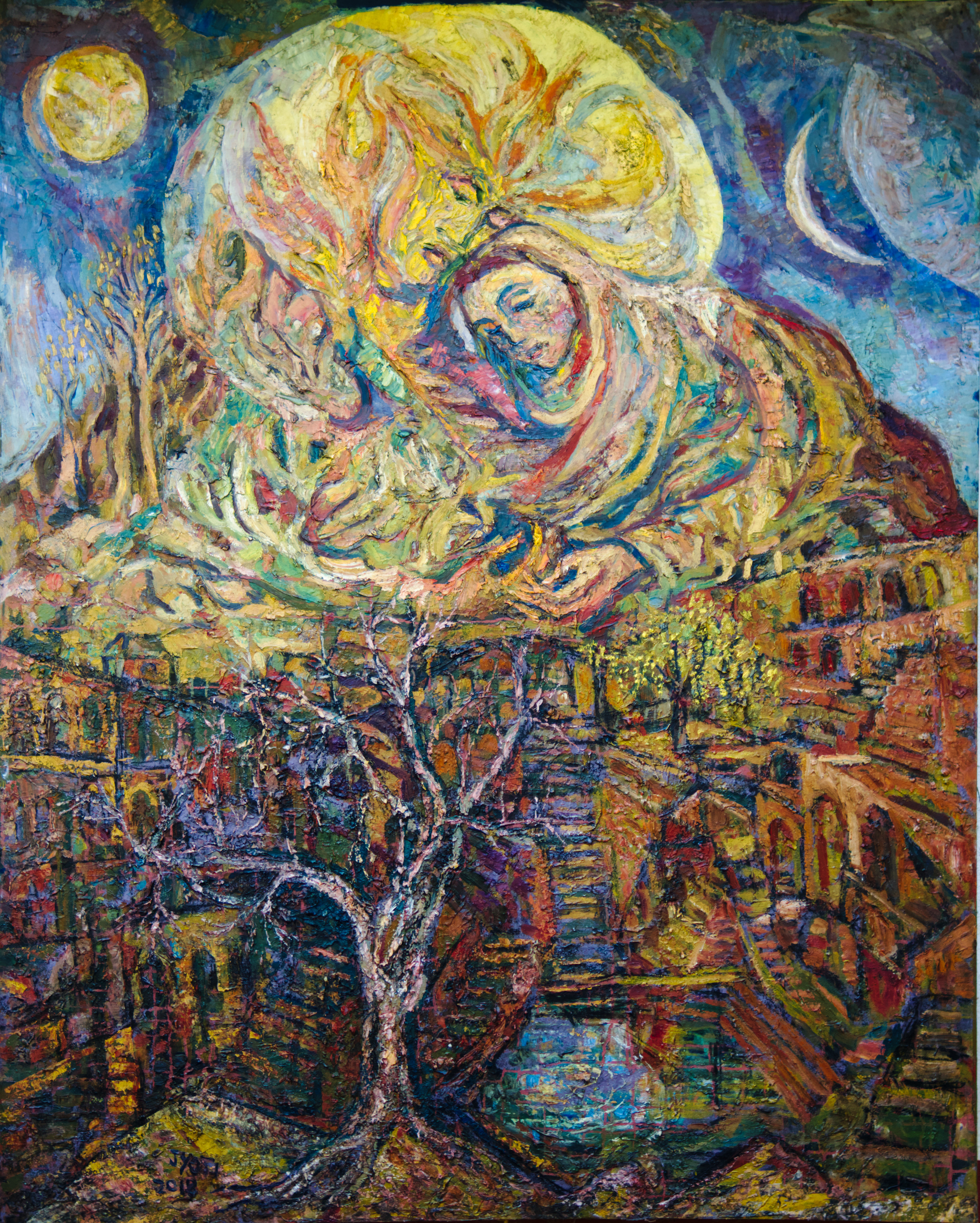
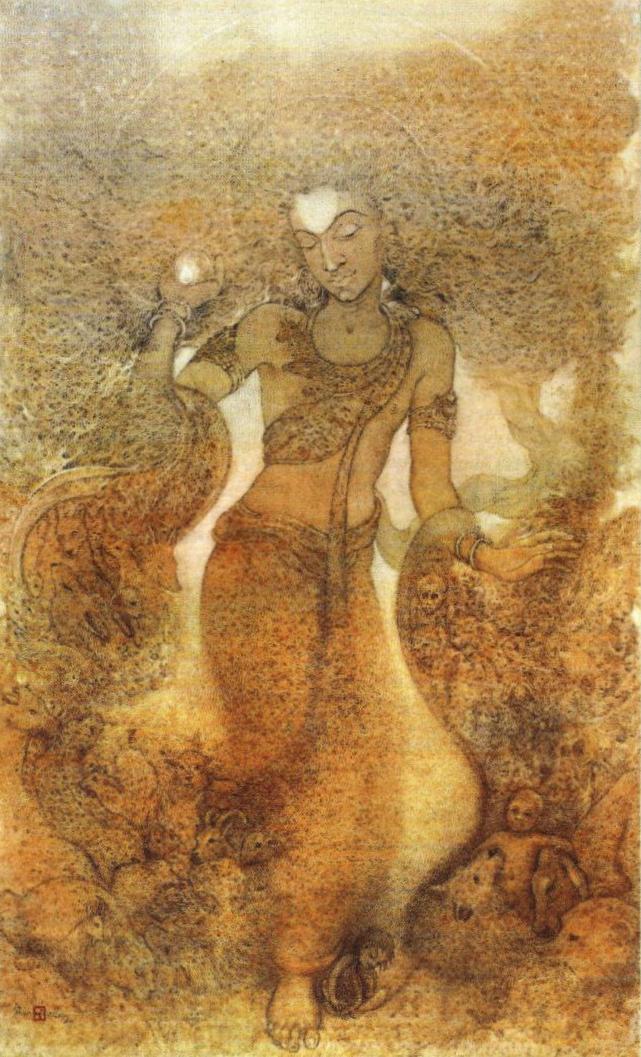
Jyoti Sahi (Indian, 1944–), Beulah, 2018. Oil and acrylic on canvas, 5 × 4 ft. Photo: Victoria Emily Jones.
In Isaiah 62:2–5, God talks to Zion about her future. He says that on the day of the Lord,
The nations shall see your vindication and all the kings your glory, and you shall be called by a new name that the mouth of the LORD will give. You shall be a beautiful crown in the hand of the LORD and a royal diadem in the hand of your God. You shall no more be termed Forsaken, and your land shall no more be termed Desolate, but you shall be called My Delight Is in Her and your land Married, for the Lord delights in you, and your land shall be married. For as a young man marries a young woman, so shall your builder marry you, and as the bridegroom rejoices over the bride, so shall your God rejoice over you.
The painting Beulah by the Indian Christian artist Jyoti Sahi (pictured below) takes its title from the Hebrew word for “married” that’s used in Isaiah 62:4. He told me the image pictures the coming together of heaven and earth, the sun marrying the land, which can also be read as Christ uniting with his bride. Christ comes as dawn, his head like flame, like the great I AM revealed to Moses in the burning bush. His glory, the yellow halo around his head, encompasses the female figure. He leans in, tenderly resting his head on hers, and their hands touch.
Beulah shows the reunion not only of humanity and the Divine at the end of time, but also of the land and the Divine. As the Isaiah passage states, the earth, too, will be redeemed and made to flourish once again.
The two figures here form a sacred mountain. A river of life flows down between them, watering the new city, which is a wilderness no longer. This is Isaiah’s vision wrapped up into John the Revelator’s.
Jyoti Sahi touches up a detail of his painting Beulah. Photo: Victoria Emily Jones.
LISTEN: “The Reign of Mercy” by Kate Bluett and Paul Zach, 2021 | Performed by Paul Zach and Lauren Plank Goans on Advent Songs by the Porter’s Gate, 2021
Oh may our world at last be just And hilltops echo with your peace A harvest come from barren dust The reign of mercy never cease He comes as rain upon the grass High heaven’s sun to earth descends Not as the seasons that will pass But with a light that never ends
Oh come to him and find your rest Who saw the poor and came as one Who hears the cries of the oppressed And rules till all oppression’s done Someday he’ll come to reign as king And we will see his justice done Our souls will magnify and sing The Christ whose kingdom now is come
And all the mighty and the strong Will bow before him on that day The silenced fill the world with song The poor and lowly he will raise And all our bitterness and tears Our violence and our endless wars Will end at last when he draws near Come soon, come soon, oh Christ our Lord
The third Sunday of Advent is traditionally known as Gaudete (Joy) Sunday, a day of celebrating the joyful reality that God is near. Advent is characterized by our waiting and yearning for Christ, which can feel heavy, especially as we look around and within and see so much brokenness. But on this day we are reminded to embrace a spirit of joy as we wait and as we yearn—much like a child waits with eager anticipation to unwrap a gift, or lovers to be reunited after a time of separation.
The following ten songs help us to inhabit the gladsome aspects of the Advent season, paving the way to Christmas.
1. “First Song of Isaiah” by Jack Noble White (1976) | Arranged and performed by Advent Birmingham, feat. Annie Lee, on Canticles (2020): Here’s an upbeat rendition, with xylophone and ukelele, of Jack Noble White’s choral setting of Isaiah 12:2–6. “You shall draw water with rejoicing from the springs of salvation. . . . Cry aloud, inhabitants of Zion, ring out your joy!” In the Book of Common Prayer this text appears in the section “Morning Prayer, Rite 2,” where it is labeled Canticle 9, “The First Song of Isaiah: Ecce, Deus.”
2. “Rejoice Greatly, O Daughter of Zion” from Messiah by George Frideric Handel (1741) | Performed by Regula Mühlemann (2019): A setting of Zechariah 9:9–10, this aria from Handel’s most famous oratorio features coloratura in the vocals—that is, elaborate, fast-paced ornamentation, trills, runs, and wide leaps—that accentuates the prophecy’s joyful message of a coming king. It’s sung by the Swiss soprano Regula Mühlemann, accompanied by the Sächsische Staatskapelle Dresden under the direction of Alondra de la Parra. For a Broadway-style arrangement of this piece, see here.
3. “Joy (Elizabeth)” by Poor Bishop Hooper, on Firstborn (2018): This song by Jesse and Leah Roberts voices Elizabeth’s awe upon visiting with her younger relative Mary, who is newly pregnant with the Son of God. Elizabeth radiates such joy in the Messiah that her preborn son, John, catches it too, leaping in her womb.
4.“Joy” by Kirk Franklin and Donald Malloy| Performed bythe Georgia Mass Choir, feat. Dorothy Anderson and Kirk Franklin, on I Sing Because I’m Happy (1992): Sweet, beautiful, soul-saving joy! That’s what Jesus gives. The Georgia Mass Choir testifies with vigor, led by the Grammy-winning artist Kirk Franklin. In 1996 this song was adapted for Whitney Houston for the film The Preacher’s Wife, with Christmas-specific lyrics, but I really dig Dorothy Anderson’s solo work in this original recording.
5. “Rejoice” by Victory Boyd, on Glory Hour (2023): This anthem by singer-songwriter Victory Boyd is based on Nehemiah 8:10: “Do not be grieved, for the joy of the LORD is your strength.” Victory often incorporates scripture recitations into her songs, and here she speaks Psalm 27:1–6 as a bridge, which has thematic crossovers with the Nehemiah verse. In this live performance from the February 4, 2024, episode of the Hour of Power television program, she is accompanied by the Hour of Power Orchestra, conducted by Marc Riley.
6. “Joy” by Shakti, on Shakti with John McLaughlin (1976):Shakti is an acoustic fusion band that combines Indian music with elements of jazz; they were active in the 1970s and re-formed in 2020. Recorded at the Montreux Jazz Festival in 1976, this instrumental improvisation features John McLaughlin on guitar, L. Shankar on violin, Zakir Hussain on tabla (hand drums), and T. H. “Vikku” Vinayakram on ghatam (clay pot).
7. “There Will Be Joy” by Paul Zach and Kate Bluett (2022): “Sorrow has an ending / Something new is coming / Oh, there will be joy!”
8. “Come That Day” by Ken Wettig, on Behold and Become (2019): Ken Wettig served for eight years as pastor of Early Church, a Mennonite congregation in Harrisonburg, Virginia, before becoming a community minister at Coracle. This song he wrote is one that Early Church sings in its worship services. It celebrates the coming day of the Lord, when death will be no more and Christ will bring about total restoration. On that day, all chaos will be stilled, swords will be beaten into plowshares, the poor will be filled, and loved ones taken too soon will embrace one another once again. The song is an invocation: it beseeches Christ to come, to bring the promised consummation of his kingdom.
Wettig has given me permission to post the lead sheet for “Come That Day,” which he freely offers for noncommercial use. Click the link to download a PDF.
9. “Peace and Joy,” Shaker hymn (1893) | Performed by the Rose Ensemble, feat. Kim Sueoka, on And Glory Shone Around (2014): One of the less recognized roots of bluegrass and old-time music is the Shaker tradition. This hymn, performed here by the Rose Ensemble, hails from the late nineteenth-century Shaker community in Mount Lebanon, Columbia County, New York. It beckons us “Awake!” and hear the angels whispering forth the blessings of Christ. “Happy are they who gather these gifts” of peace and joy ushered in by the Incarnation. The fabulous soprano soloist is Kim Sueoka.
10. “Carol of the Bells” – Music by Mykola Leontovych (1914), based on a traditional Ukrainian folk chant | Words by Peter Wilhousky (1936) | Arranged by Isaac Cates and performed by Ordained on Carol of the Bells(2014): The composer, conductor, and pianist Isaac Cates plays piano accompaniment for his choir, Ordained, in this original arrangement of a Christmas classic. Dramatic and haunting, energizing too, “Carol of the Bells” is one of my favorite choral songs of the season—I never tire of hearing it! I love the build in volume and the interplay of voices in imitation of church bells.
(All Art & Theology posts are optimized for viewing in a web browser—ideally on a computer, but they should also display adequately on a phone. If you’re receiving this post by email, simply click on the hyperlinked title at the top of the message for a better reading experience.)
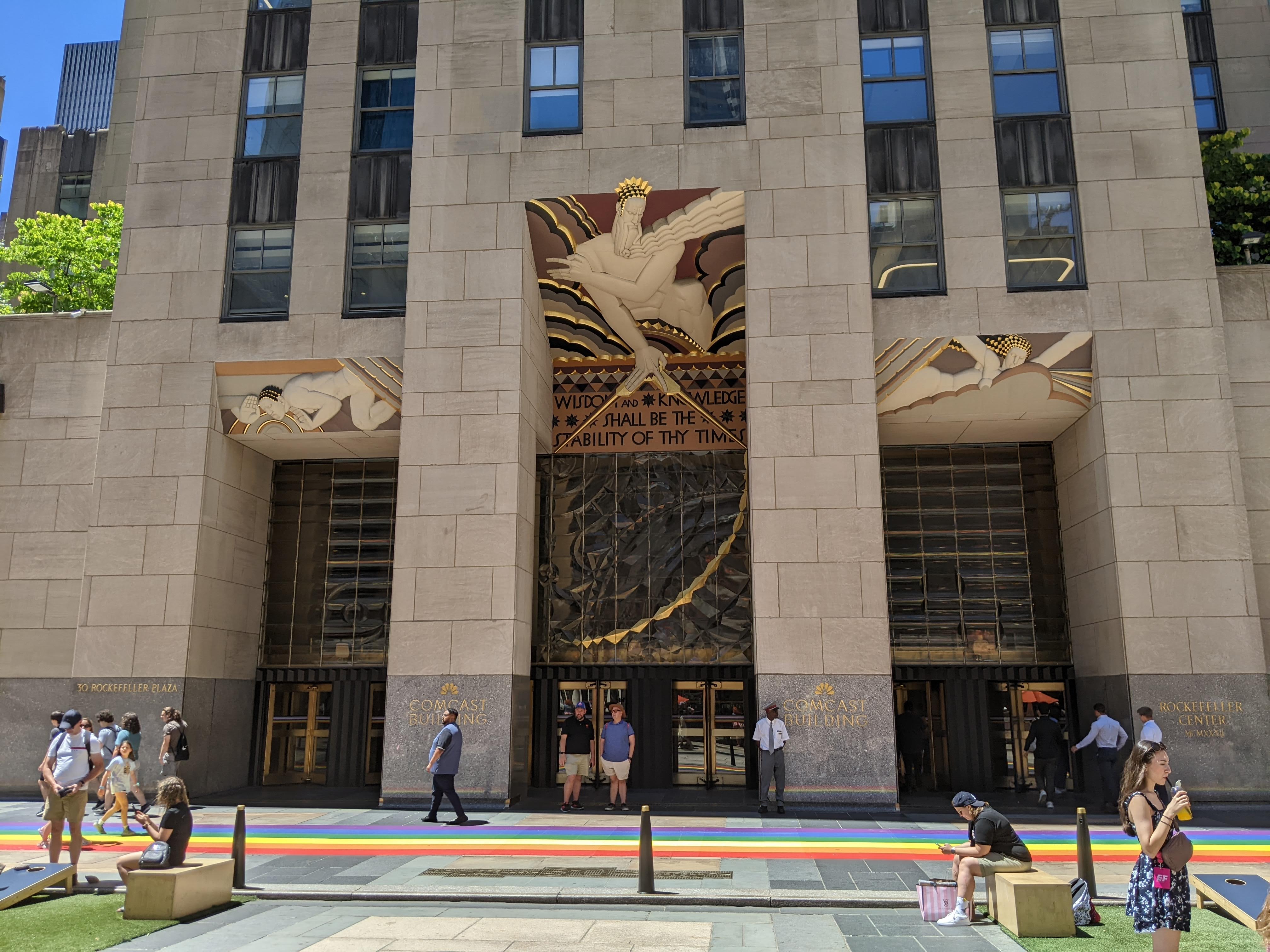
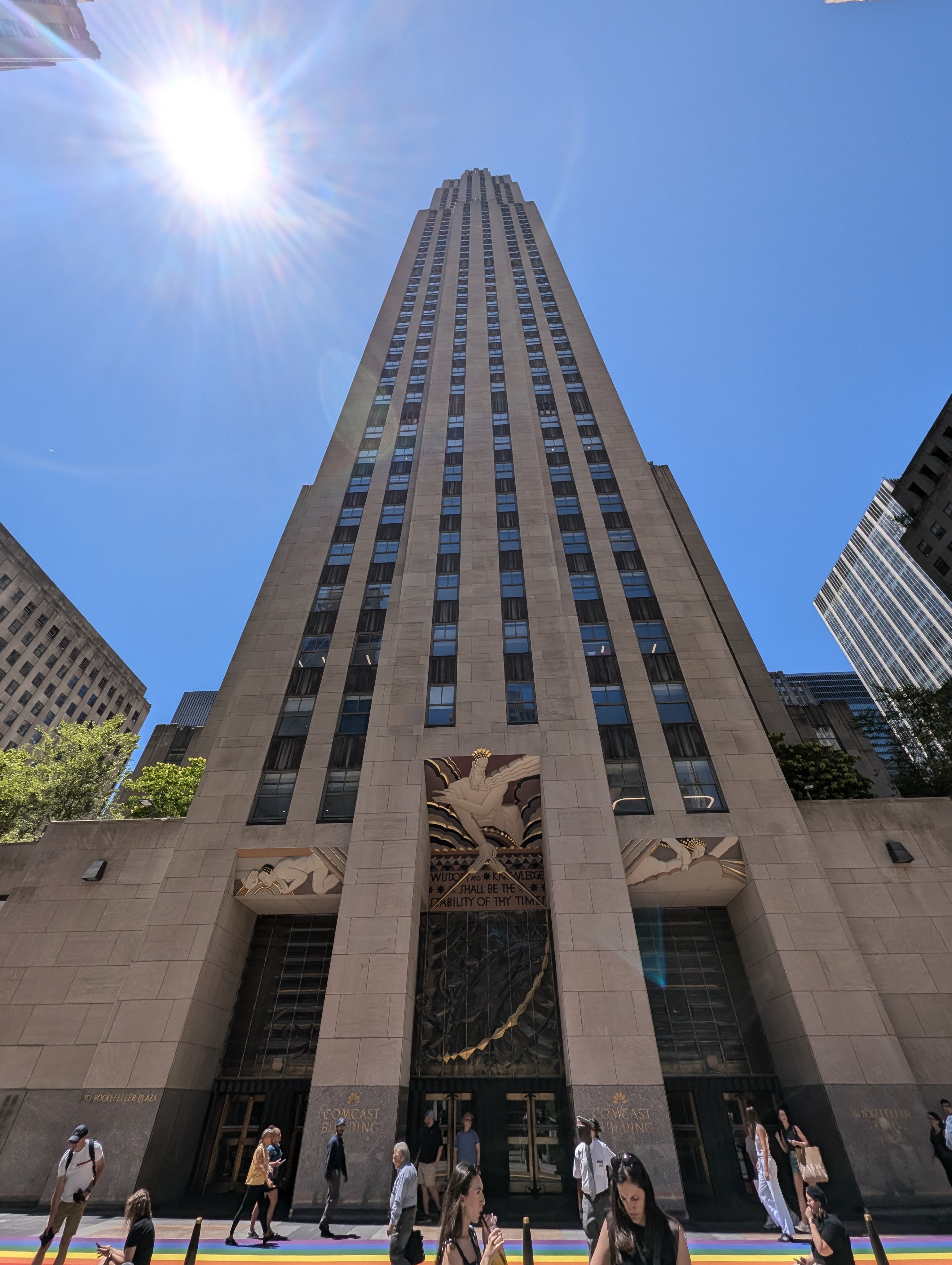
30 Rock. Home to NBC Studios and a slew of other business offices, it’s an iconic skyscraper in midtown Manhattan, towering 850 feet and capped by the ticketed Top of the Rock Observation Deck. It forms the backdrop to the famous ice-skating Rink at Rockefeller Center and, in December, New York City’s largest Christmas tree. Designed by architect Raymond Hood, it was originally named the RCA Building (1933–1988) after its main tenant, and then the GE Building (1988–2015), but since 2015 it has been the Comcast Building.
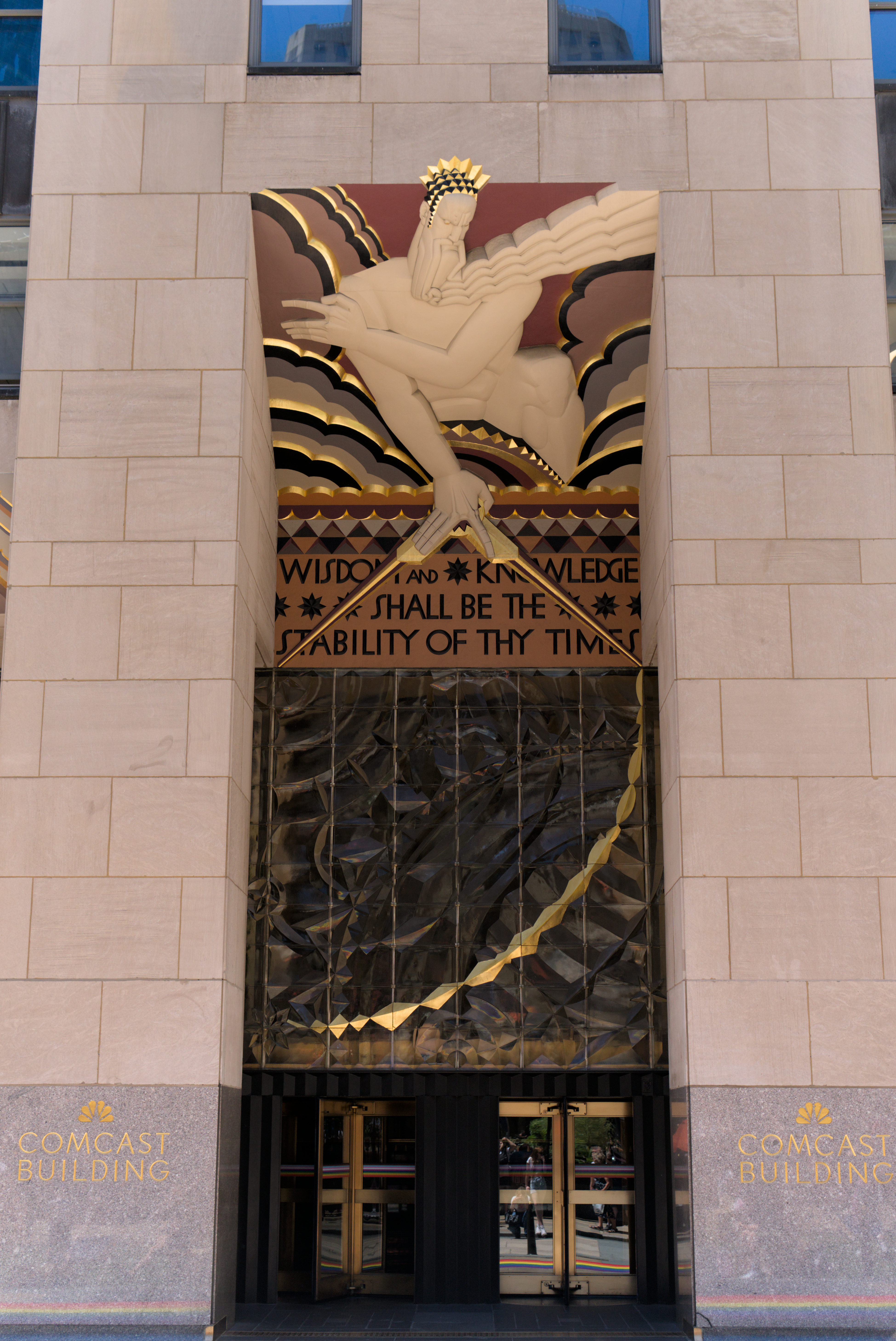
In June I stopped by to take in the art deco sculptures on the exterior, particularly the three limestone bas-reliefs over the main entrance, depicting Wisdom in the center, flanked by Sound on the left and Light on the right. This sculpture group was carved by Lee Lawrie (1877–1963) and painted and gilded by Léon-Victor Solon (1873–1957), who designed the color scheme for Rockefeller Center. Underneath is a trifold screen comprising 240 rectangular blocks of glass cast in eighty-four different molds, executed by Corning Glass Works.
Lee Lawrie (American, 1877–1963), Wisdom, with Light and Sound, 1933. Polychromed limestone, 240 cast-glass bricks. Comcast Building, 30 Rockefeller Plaza, New York City. Photo: Victoria Emily Jones.
I wanted to see how the iconography works, as I knew the central lintel to feature a Bible verse. It’s an excerpt from Isaiah 33:6: “And wisdom and knowledge shall be the stability of thy times, and strength of salvation: the fear of the LORD is his treasure” (KJV). In this oracle from the eighth century BCE, the prophet Isaiah is speaking to the people of Israel as they face threats from Assyria. He assures them that a wealth of salvation, wisdom, and knowledge is theirs as long as they revere God.
It’s not surprising that for this commercial building built in 1933, the biblical quote is truncated to exclude mention of God—the ancient prophet’s words are appropriated to suit a modern corporate context in religiously pluralistic America. Instead of (explicitly) honoring a divine source of wisdom and knowledge, the decorative program celebrates human ingenuity, which is practiced by workers inside the building in the fields of media, medicine, law, and finance, among others.
So what of the imagery that this Bible verse captions?
The central figure of this work represents the genius which interprets to the human race the laws and cycles of the cosmic forces of the universe, and thus rules over all of man’s activities. On the right of the central panel is represented Light, and on the left, Sound—two of these cosmic forces. The compass of the genius marks, on the glass screen below, the cycles of Light and Sound.
Although there are other cosmic forces which govern the universe, Mr. Lawrie selected those of Light and Sound because they are an active and vital part of everyday life, and particularly because within contemporary times great discoveries have been made by means of them, and man’s technical knowledge of the laws of these two forces has been vastly enlarged.
The official title of the sculpture group is Wisdom, a Voice from the Clouds, with Light and Sound. A commanding presence, Wisdom, depicted as a nude male with a long windswept beard, measures, discerns, harnesses, creates. With his right hand he wields a compass to scribe a circle, and with his left he shoves back clouds of ignorance. He embodies humanity’s accumulated philosophical and scientific knowledge and creative power. The male and female figures on either side of him “herald the advent of radio (sound) and the motion picture industry and television (light), two industries that were achieving global significance as the Center was being built,” the Rockefeller Center website says. Circles emanate from Sound’s mouth, and electrical signals from Light’s raised arms.
It’s a humanistic artwork, exuding optimism and complemented throughout the Center by other works such as the four lobby murals by José Maria Sert collectively titled Man’s Intellectual Mastery of the Material Universe (1934), which picture the evolution of machinery, the abolition of slavery, the suppression of war, and the conquest of disease; American Progress (1937), another mural, by Sert; Lee Lawrie’s bronze Atlas(1937), showing the titular Titan holding the celestial vault on his shoulders; and Paul Manship’s gilded bronze Prometheus (1934), depicting the Titan champion of humanity who stole fire (representing technology and culture) from the gods and gave it to humans.
In the art at Rockefeller Center, human agency and advancement are emphasized, but the Christian God is not entirely absent from the narrative they collectively tell. Frank Brangwyn’s Man’s Search for Eternal Truth (1933) in the south corridor of the 30 Rock lobby addresses the importance of Jesus’s teachings in the Sermon on the Mount, particularly on love and brotherhood, depicting modern folks gathered around an elevated Christ figure and an inscription that reads, “Man’s ultimate destiny depends not on whether he can learn new lessons or make new discoveries and conquests, but on his acceptance of the lesson taught him close upon two thousand years ago.”
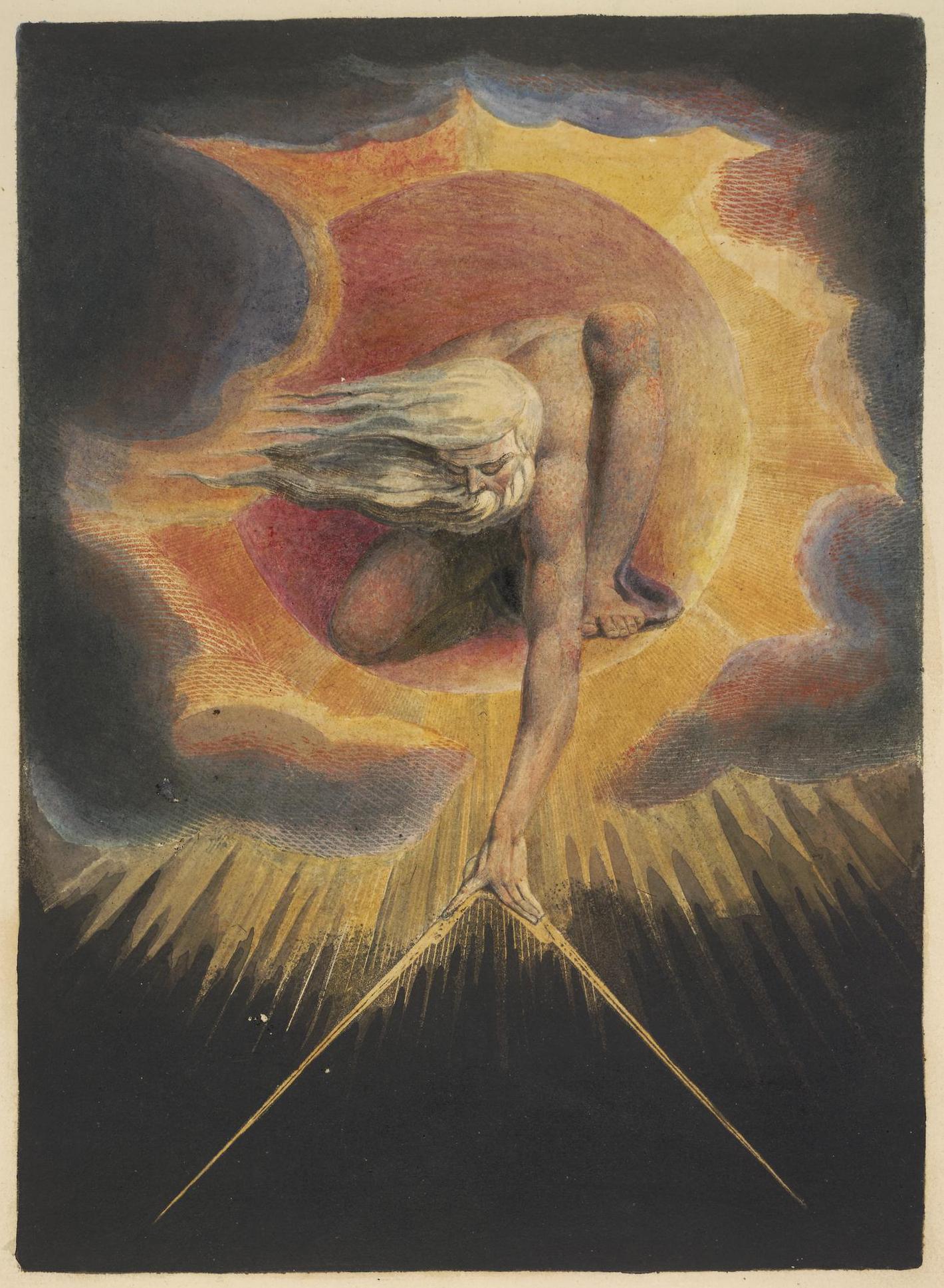
A key visual influence on Lawrie’s Wisdom sculpture was William Blake’s Ancient of Days, a hand-colored relief etching that shows a white-bearded nude male crouching in a heavenly sphere with a large golden compass, creating the world. This is Urizen, a mythological deity invented by Blake to personify reason and law.
William Blake (British, 1757–1827), The Ancient of Days, 1794. Relief etching with watercolor, 23.3 × 16.8 cm. This hand-colored print is the frontispiece to Blake’s poem Europe, a Prophecy, copy D, owned by the British Museum in London.
Urizen is a reconfigured version of Yahweh in the Old Testament. The title of Blake’s print is taken from a prophetic vision of the Divine in the book of Daniel: “As I looked, thrones were set in place, and the Ancient of Days took his seat. His clothing was as white as snow; the hair of his head was white like wool. His throne was flaming with fire, and its wheels were all ablaze” (Dan. 7:9 NIV).
This verse has inspired centuries’ worth of iconography picturing God as an old man—because hey, he’s ancient (in fact, he’s the oldest being there is, as he has always existed), and Daniel saw him with white hair! Also, age and wisdom are traditionally correlated.
Depictions of God the Father as a fully anthropomorphized, aged being with white hair didn’t show up until the late Middle Ages and didn’t become a trend until the Renaissance.
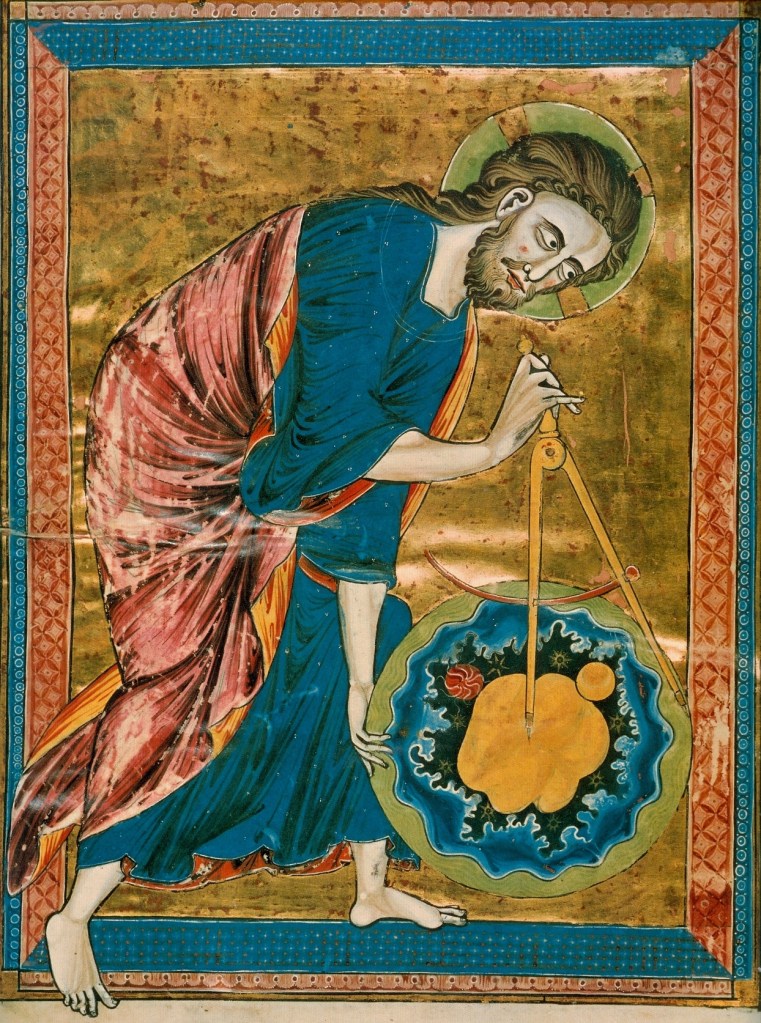
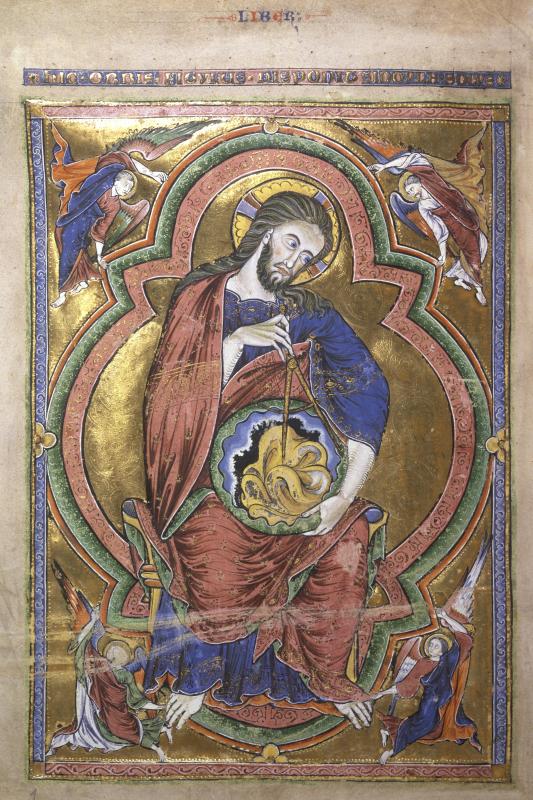
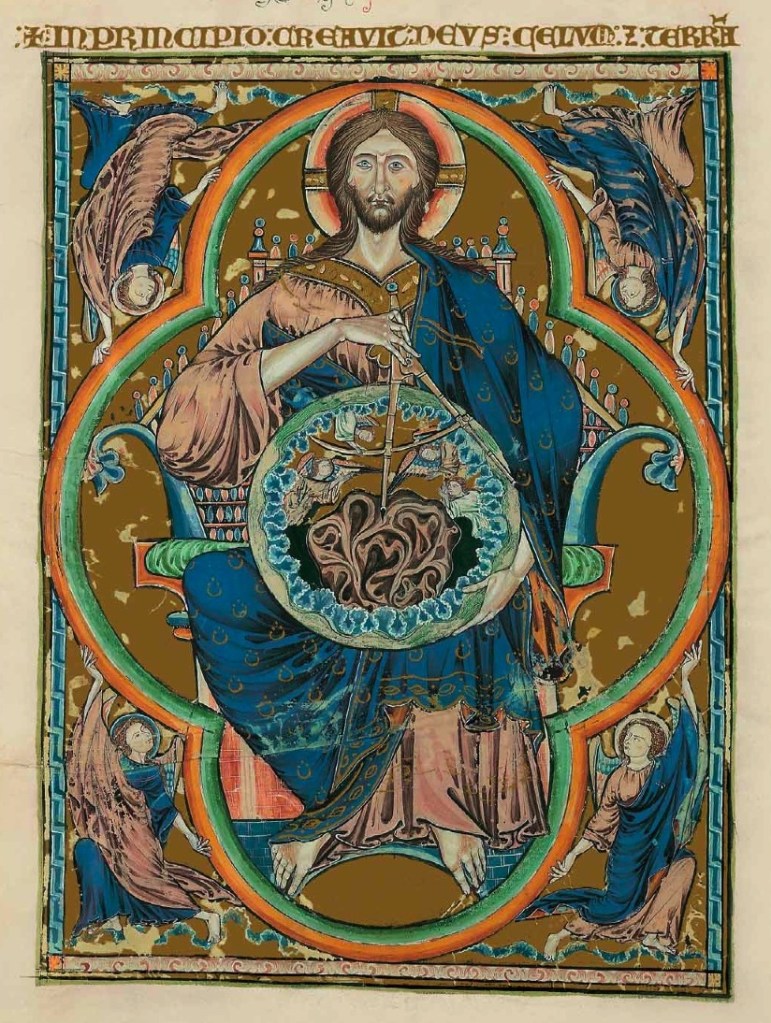
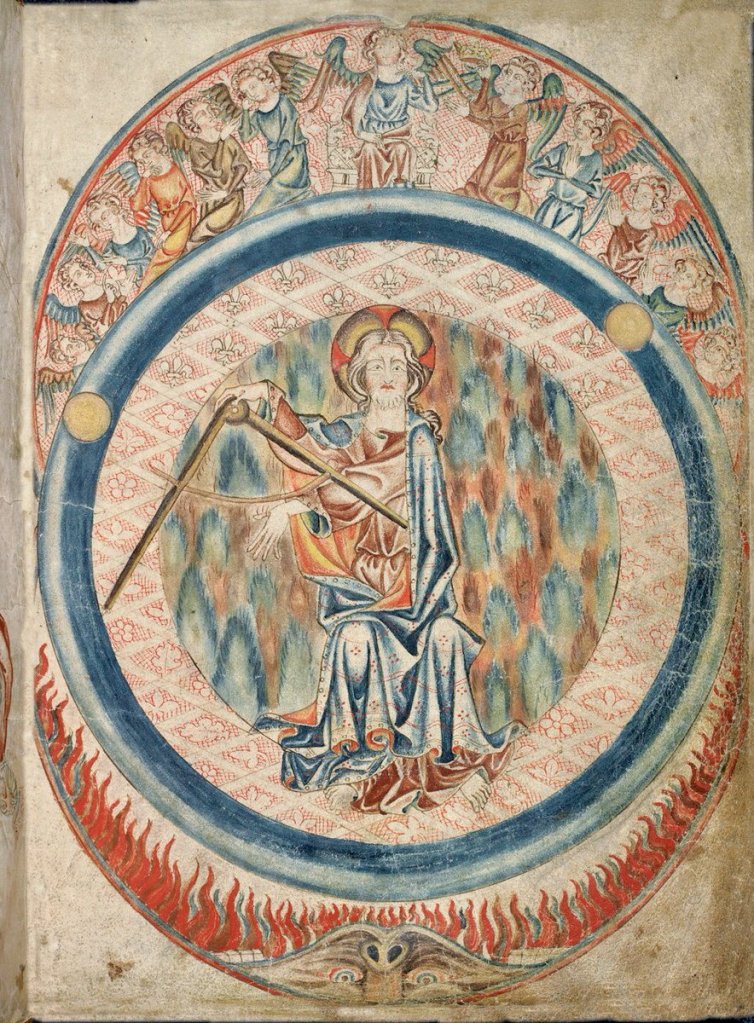
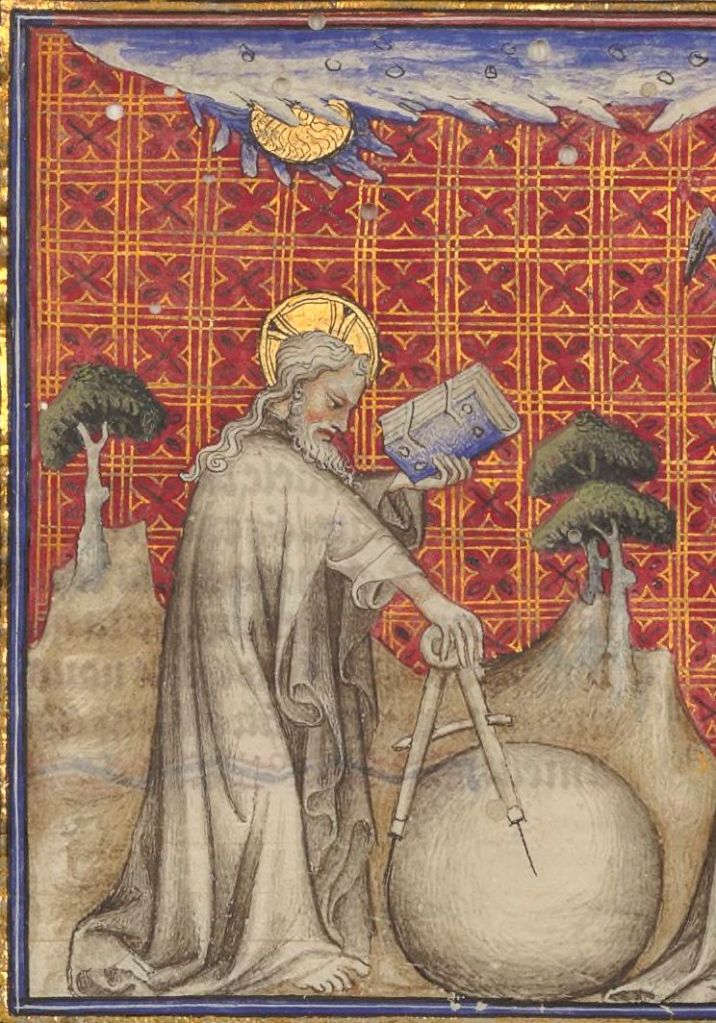
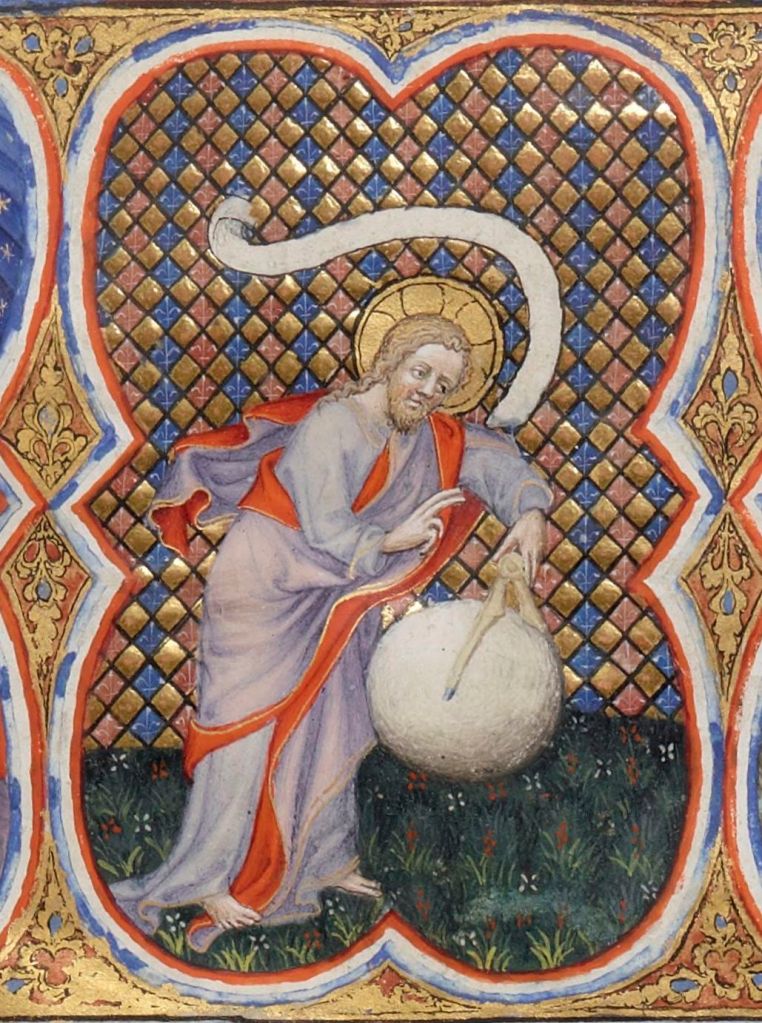
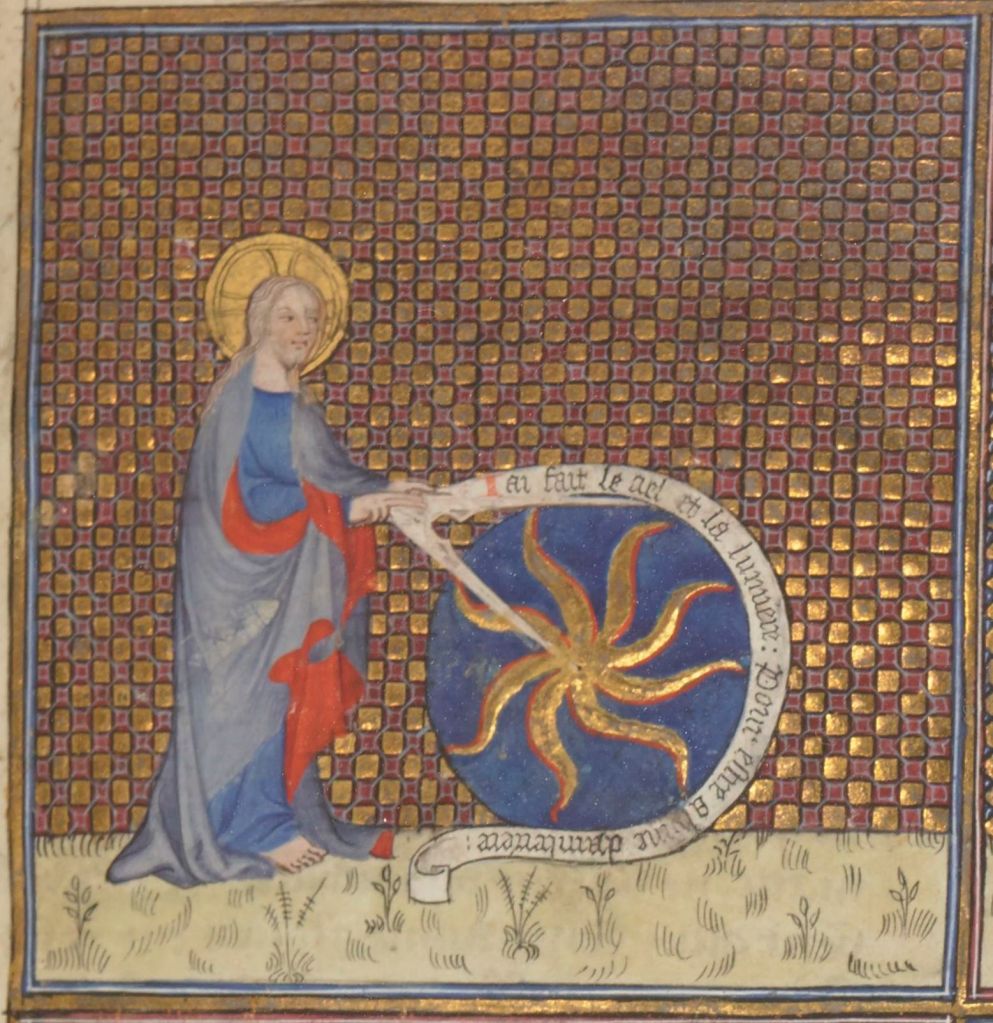
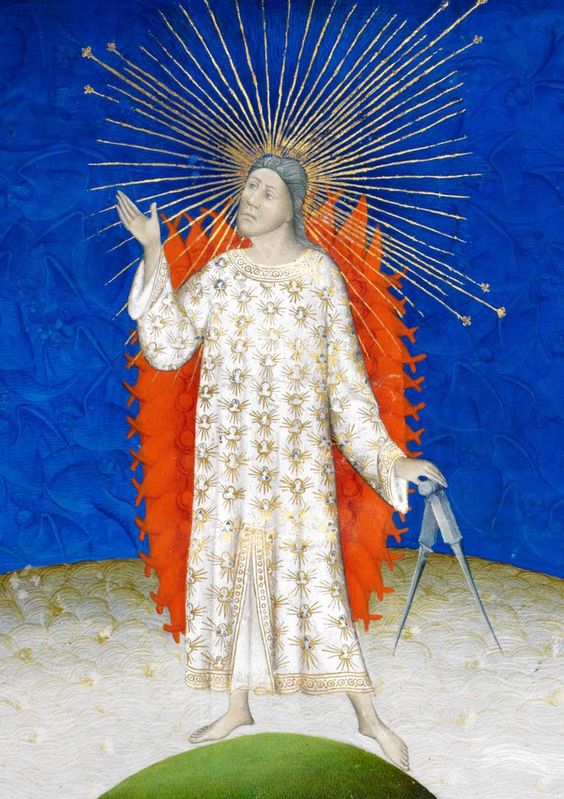
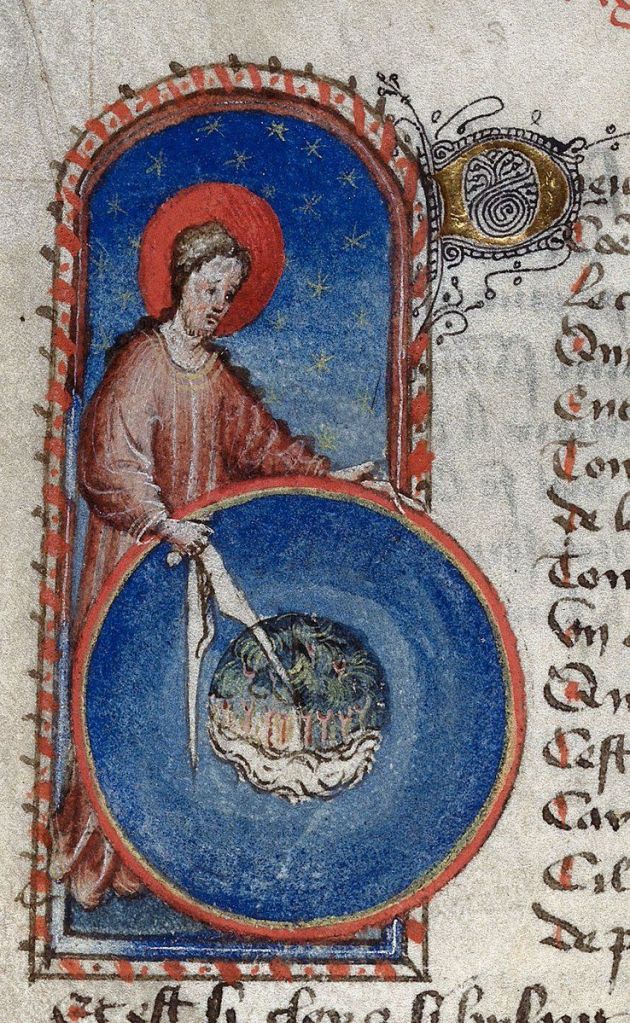
When medieval artists portrayed scenes from Genesis 1 and 2, they typically cast Christ in the role of Creator, intentionally avoiding depicting the first person of the Trinity, who is spirit, but also drawing on New Testament references like John 1:1–4 and Colossians 1:15–17 that describe Christ as participating in the creation of the universe. They often gave him a compass, an architectural tool, to show him marking out the planet Earth and celestial bodies with studied precision. Christ is sometimes identified with the person of Wisdom in Proverbs 8, who proclaims that “when he [God] prepared the heavens, I was there: when he set a compass upon the face of the depth . . .” (v. 27 KJV, emphasis mine).
From a Bible moralisée, France, ca. 1225–50. Vienna, Österreichische Nationalbibliothek, Cod. 2554, fol. 1v.From a Bible moralisée, France, ca. 1225–50. Vienna, Österreichische Nationalbibliothek, Cod. 1179, fol. 1v.From the Bible of St. Louis (Bible of Toledo), vol. 1, fol. 1v, France, 1226–34. Toledo Cathedral, Toledo, Spain.From the Holkham Bible Picture Book, England, ca. 1327–35. London, British Library, Add. 47682, fol. 2r.From a French translation of Augustine’s De Civitate Dei (The City of God), France, ca. 1370–80. Paris, Bibliothèque nationale de France, Français 22913, fol. 2v. From the Bible historiale of Jean de Berry, France, 1380–90. Paris, Bibliothèque nationale de France, Français 20090, fol. 3r. From Histoire ancienne, depuis la création (Ancient History, Since Creation), France, 15th century. Bibliothèque nationale de France, Français 250, fol. 13r.From a Bible historiale, France, 1411. London, British Library, Royal 19 D III, fol. 3.From a verse redaction of L’Image du monde, France, 1425–50. London, British Library, Harley MS 334, fol. 34v.
In his epic poem Paradise Lost, John Milton describes how the “Omnific Word” created all that is:
. . . . . . . . . . . . . . . . . . . . . . . . . . . . and in his hand He [Jesus] took the golden compasses, prepared In God’s eternal store, to circumscribe This universe, and all created things: One foot he centered, and the other turned Round through the vast profundity obscure, And said, “Thus far extend, thus far thy bounds, This be thy just circumference, O world.” (VII.224–31)
In his making of Ancient of Days, Blake was no doubt influenced by the many visual and literary depictions of God as architect of the universe, as compass-wielding geometer, that came before. And so Lawrie, too, implicitly drew on this heritage when he sculpted the majestic figure of Wisdom for the main building of Rockefeller Center.
At first glance, you might interpret the prominent trio at the Center’s entrance as God creating the heavens and the earth, assisted by angels. But while Christian iconography factored into the design, and a Judeo-Christian sacred text forms the inscription, the sculpture group is mainly meant to represent the promise of science and technology.
Construction began at 30 Rockefeller Plaza during the Great Depression (though the Center was conceived prior to that national economic crisis, in 1927); John D. Rockefeller Jr. said he wanted to build a place where New Yorkers could come and surround themselves with art and motifs that celebrated the best of the human spirit. When you step off West 49th or 50th Street into the plaza that’s featured in so many New York City–set movies and TV shows, Rockefeller’s wish was that you’d feel hopeful and energized.
When I was there, during Pride Month (hence the temporarily rainbow-painted sidewalk), the mood was indeed uplifting, with locals and tourists alike passing through with ice-cream cones and lemonades and conversation. It being summer, the Rink was transformed into an al fresco dining area with umbrella-topped tables providing some relief from the heat.
While my faith in humanity’s future is rooted in God and not ultimately our own capabilities, I am obviously grateful for and supportive of progress and achievement. God wants us to grow in knowledge and skill and to use them responsibly and imaginatively to better the world.
In his essay “On Fairy-Stories,” J. R. R. Tolkien says that we humans are “sub-creators” under God, expressing the image of our Creator by exercising creativity. While he was talking specifically about writers creating fantasy worlds, the principle applies to people in any vocation, whether you’re making a book, a bed, or a nanochip. God bids us, “Create!” That we would see ourselves in Lawrie’s Wisdom, crowned and bearing power and authority, is therefore not necessarily arrogant or sacrilegious, as the cultural mandate in Genesis 1:28 charges humans with the noble task of cultivating the stuff of creation, including discovering and leveraging the physical laws of nature, for the flourishing of all.
The Old Testament reading in the Revised Common Lectionary for this coming Sunday, Trinity Sunday, is Isaiah 6:1–8:
In the year that King Uzziah died, I saw the Lord sitting on a throne, high and lofty, and the hem of his robe filled the temple. Seraphs were in attendance above him; each had six wings: with two they covered their faces, and with two they covered their feet, and with two they flew. And one called to another and said,
Holy, holy, holy is the LORD of hosts; the whole earth is full of his glory.
The pivots on the thresholds shook at the voices of those who called, and the house filled with smoke. And I said, “Woe is me! I am lost, for I am a man of unclean lips, and I live among a people of unclean lips, yet my eyes have seen the King, the LORD of hosts!”
Then one of the seraphs flew to me, holding a live coal that had been taken from the altar with a pair of tongs. The seraph touched my mouth with it and said, “Now that this has touched your lips, your guilt has departed and your sin is blotted out.” Then I heard the voice of the Lord saying, “Whom shall I send, and who will go for us?” And I said, “Here am I; send me!”
Wow. What a truly awesome passage!
I’d like to share two songs inspired by it as well as two visual artworks. The first song is a choral work by the English composer and organist Sir John Stainer (1840–1901), titled “I Saw the Lord.” It was performed by The Sixteen under the direction of Harry Christophers and appears on the ensemble’s 2009 album A New Heaven.
The first stanza is the King James Version of Isaiah 6:1–4, and the second stanza is the third verse of “Ave, colenda Trinitas,” an anonymous Latin hymn of the eleventh century, translated by John David Chambers (1803–1893).
I saw the Lord sitting upon a throne, high and lifted up, and his train filled the temple. Above it stood the seraphims: each one had six wings; with twain he covered his face, and with twain he covered his feet, and with twain he did fly. And one cried unto another, Holy, holy, holy is the LORD of hosts: the whole earth is full of his glory. And the posts of the door moved at the voice of him that cried, and the house was filled with smoke.
O Trinity! O Unity! Be present as we worship thee, And with the songs that angels sing Unite the hymns of praise we bring. Amen.
Christian biblical commentators have discerned in Isaiah 6 two Trinitarian references: the three “holys” pronounced by the angels (v. 3), and the use of both a singular and plural pronoun in God’s question in verse 8: “Whom shall I send, and who will go for us?” (emphasis mine; cf. Gen. 1:26). Unity in plurality. Further, the New Testament relates this passage to both Jesus (John 12:41) and the Holy Spirit (Acts 28:25). That’s why it’s commonly read on Trinity Sunday, and why Stainer has appended to it a Trinitarian hymn text.
Of Stainer’s musical setting, William McVicker writes,
It is often said that I saw the Lord was written with the acoustics of St Paul’s [Cathedral in London] in mind. It is scored for double choir with an independent organ part. The music’s drama is achieved by the simple, largely homophonic texture, and the interplay of the two chorus parts with that of the organ. Stainer breaks into an imitative texture at the words ‘and the house was filled with smoke’ and again in the final verse section, which is reminiscent of a Victorian part-song.
The music is grandiose, majestic, as one would expect for the encounter it frames, which involves robes, thrones, angelic attendants, shaking doorposts, smoke, and an all-pervasive divine glory.
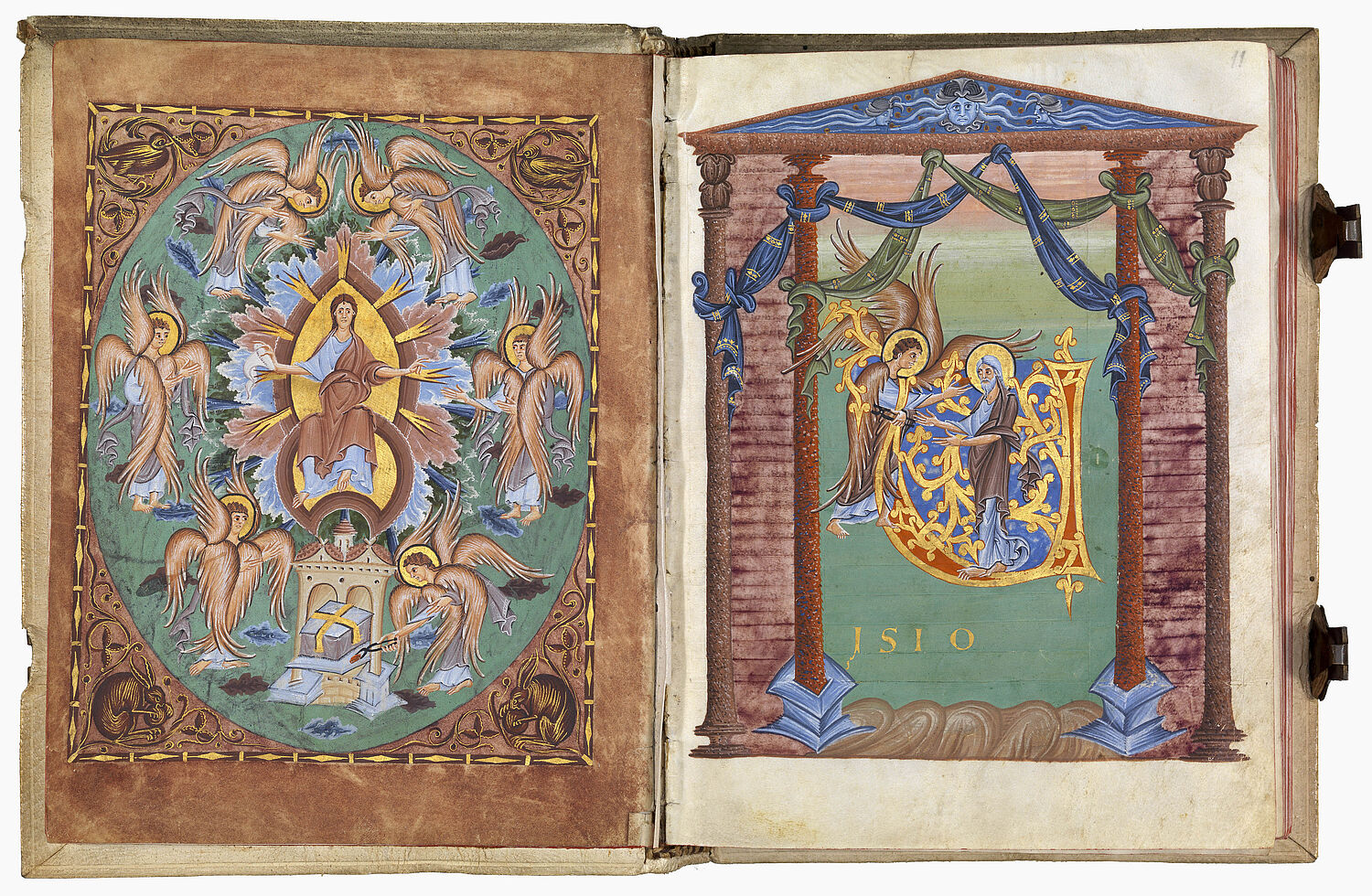
I suggest listening to Stainer’s choral piece as you look on the following page spread from a high medieval German manuscript produced in Reichenau. The manuscript is a copy of Jerome’s (Latin) commentary on Isaiah, with glosses added in the Alemannic dialect of Old High German, and these are the only two images inside.
Miniature depicting the prophet Isaiah’s vision of God and decorative initial page showing the cleansing of the prophet, from an Isaias glossatus made in Reichenau, Germany, ca. 1000. Staatsbibliothek Bamberg, Msc.Bibl.76, fols. 10v–11r. [browse full manuscript]
The island monastery of Reichenau on Lake Constance in southern Germany was an important center of illuminated manuscript production in the Ottonian period (919–1024) of the Holy Roman Empire. The miniatures painted there are among the finest of the Middle Ages. (For another example, see the one I shared back in 2020.)
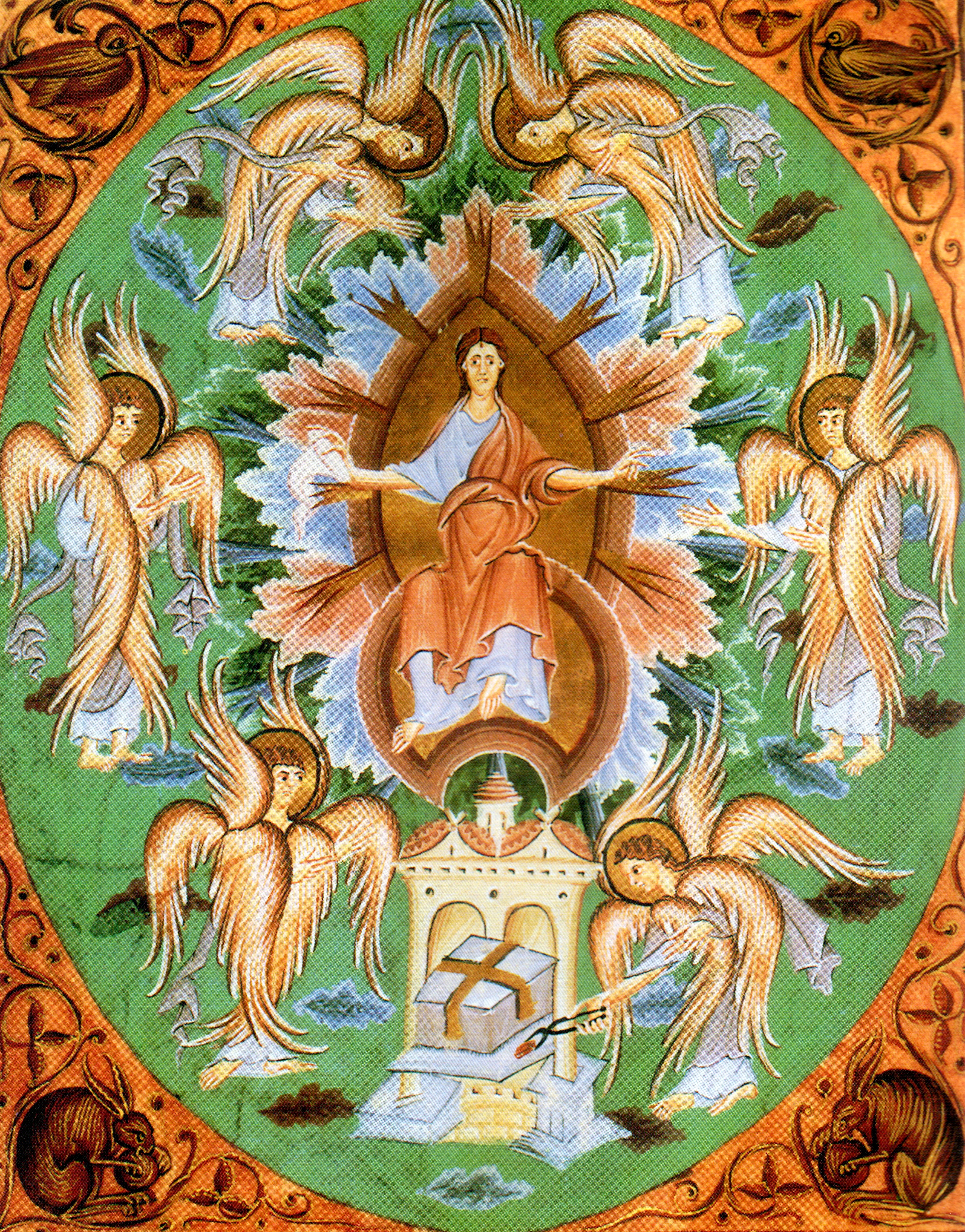
On folio 10v of the Isaias glossatus that’s kept at the Bamberg State Library, God in the form of Christ sits in a mandorla from which trifold bursts of light shine forth, backed by mauve and powder-blue billows of smoke. In his right hand he holds a scroll that represents the word he speaks to Isaiah in 6:9–13, and the words he will continue to supply him with throughout his ministry. Hovering above a smaller-scale temple, God is attended by six seraphim (lit. “burning ones”), one of whom removes a hot coal from the altar with tongs. All this takes place within a green oval, which is surrounded by a brown and gold decorative border of vine tendrils housing two birds and two hares.
On the opposite page, folio 11r, the tong-bearing seraph touches the coal to Isaiah’s lips, purging his speech and thus fitting him for the office of prophet. This cleansing act is in response to Isaiah’s humble confession of sin, having beheld God’s holiness: “Woe is me! I am lost, for I am a man of unclean lips . . .” (v. 5). The artist shows Isaiah’s hands open and arms outstretched, welcoming God’s cleansing and accepting the call to service: “Here am I; send me!” (v. 8). Notice that this exchange takes place within the letter V, from the opening of Isaiah, “Visio Esaiae” (The vision of Isaiah . . .). The miniature is a historiated initial—that is, an enlarged letter at the beginning of a paragraph that contains a picture.
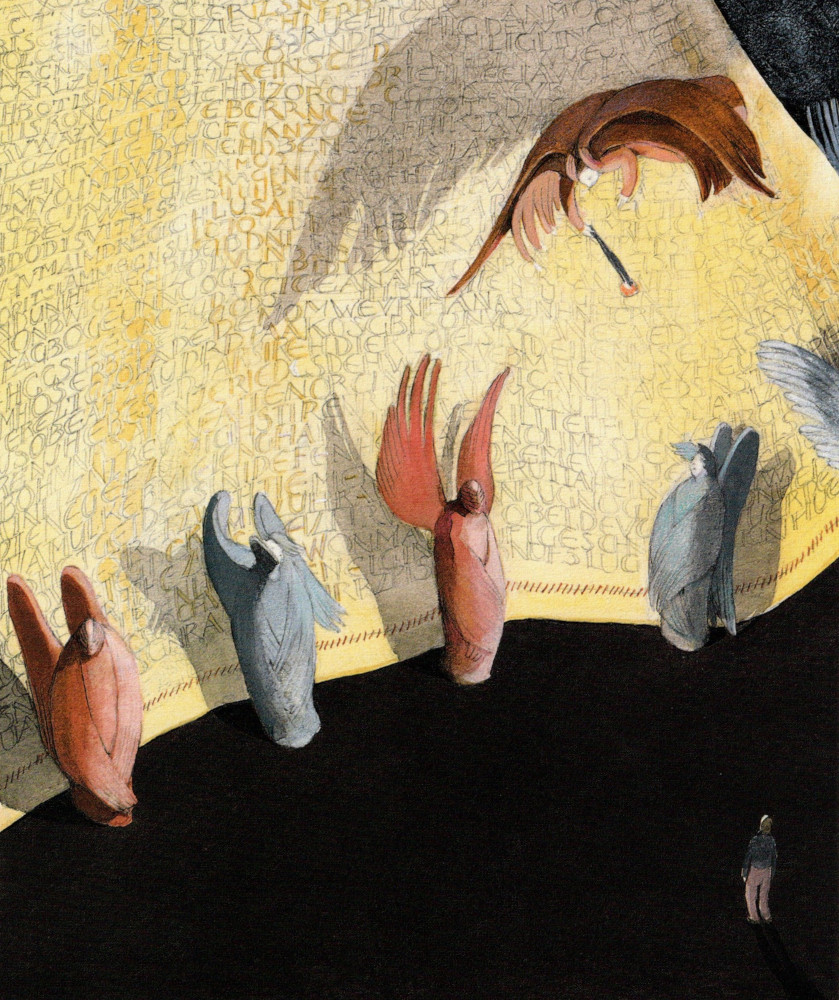
Now let’s shift gears to two Isaiah 6–based works that were made in a folksier idiom. Take in this pen, ink, and watercolor image by the award-winning Austrian illustrator Lisbeth Zwerger, from her book Stories from the Bible (North-South Books, 2002), originally published in German as Die Bibel in 2000:
Lisbeth Zwerger (Austrian, 1954–), Isaiah’s Calling, 2000, an illustration from Stories from the Bible (North-South Books, 2002)
This book contains some of the most imaginative biblical artworks of the past century (I shared a sampling on Instagram), and I recommend it for all Christian bookshelves!
In contrast to the frontal wide shot given by the anonymous Reichenau artist, in Isaiah’s Calling Zwerger zooms in on just one detail of the scene, structured along a diagonal. Isaiah stands at the bottom right in the dark, dwarfed by the immense train of God’s robe, which is pure light. It contains letters that I can’t make out into words; can you? I would have assumed they spell out the passage from Isaiah 6 (in German?), but it’s possible they’re not meant to be intelligible—just a further indicator of God’s mysteriousness. The artist has also deliberately chosen not to show God’s face.
Five blue- and red-plumed seraphim—one mostly out of frame, save for one of his wings—stand at the hem of the royal garment, while a sixth flies down toward Isaiah with that burning coal.
At the hem of Christ’s robe is where the woman from Capernaum with the issue of blood finds healing (Luke 8:43–48), and it’s also here at God’s hem that Isaiah is made well, restored.
For a musical complement to Zwerger’s painting, I recommend the song “Lofty and Exalted” by Lenny Smith. It’s from 1993, but Smith didn’t release a recording until 2020, on the album Splendor and Majesty.
Lofty and exalted, reigning from your throne The train of your robe fills the temple Seraphim above you, calling out your name Proclaiming how good and how lovely
Refrain: Holy, holy, Lord The earth is full of your glory Holy, holy, Lord The earth is full of your praise
“God’s real exalted status and prestige is that He loves being with the lowest of the low,” Smith writes on the song’s Bandcamp page. And in the YouTube description for the song, he reminisces, “Oh for the days when a bunch of us just got together in my basement and just played and sang for hours . . . to our hearts’ content. We had no ulterior motives at all. It was just fun and exhilarating. No audience or pastors or video cameras or aspirations to become worship leaders or famous artists. Oh for those simple, lovely days!”
Smith was involved in the Jesus Movement of the 1960s and ’70s. He has written some two hundred church songs, the most famous of which is “Our God Reigns.” I know him best for “But for You,” through the cover by the Welcome Wagon on their debut album.
Stylistically, this musical adaptation of Isaiah 6 is much different from John Stainer’s. The composition is simple, just a few chords and easily singable (it would work great congregationally), and the instrumentation consists of guitar and piano. It’s also exuberant in tone. Perhaps Stainer’s piece better holds the gravitas of Isaiah’s vision, but Smith’s captures its joy.
In his Prophecy of Isaiah: An Introduction and Commentary, J. Alec Motyer writes, paradoxically, that God’s “transcendent holiness is the mode of God’s immanence, for the whole earth is full of his glory” (77), reminding us that however otherworldly this mystic moment might have felt to Isaiah, the glory of God is profoundly thisworldly too, suffusing the everyday. “God’s glory isn’t ‘up there’ away from us,” writes SALT Project in their lectionary commentary for this Sunday, “but rather fills the whole earth and is intimately, actively involved in our lives, calling and sending us in service to God’s mission in the world.”
Every artistic interpretation—visual, musical, or what have you—of a scripture text has the potential to open us up to the text in new ways. No single interpretation should become totalizing; we need all kinds! I’m so appreciative of those who take the time to sit with a Bible passage and then respond to it in paint or in song, whether that be medieval monks laboring away in the scriptorium with their gold leaf and color pigments or contemporary storybook illustrators with their watercolors, a Victorian organist knighted by the queen and serving a cathedral or folk musicians jamming with friends in informal, at-home worship.
LOOK: Virgin and Child with a Prophet catacomb fresco
Virgin and Child with a Prophet, 3rd century. Fresco in the Catacomb of Priscilla on the Via Saleria, Rome. Photo: Scala / Art Resource. [view wider shot]
Deep in the Catacomb of Priscilla in Rome, one of the early Christian underground burial places (named after the donor of the land), is an arched ceiling fresco of a woman breastfeeding her child under an apple tree. Beside her a man points up to a star that’s resting over their heads among the fruit.
Dating to the third century, this image is the earliest known depiction of the Virgin Mary, and one of the oldest of Christ. The identity of the third figure is less sure, but it’s most likely the Gentile prophet Balaam, who, in the power of God’s Spirit, prophesied to King Balak of Moab that “a star shall come out of Jacob, and a scepter shall rise out of Israel” (Num. 24:17).
Although this prophecy had a more immediate fulfillment in King David, it has also been interpreted in a messianic sense since as early as Justin Martyr (ca. 100–165), who wrote, “And that he [Christ] should arise like a star from the seed of Abraham, Moses showed beforehand when he said, ‘A star shall arise from Jacob, and a leader from Israel’” (Dialogue with Trypho, chap. 106).
Irenaeus (ca. 130–200) wrote that the star the magi followed to seek out the newborn Christ was the one prophesied by Balaam (Against Heresies, bk. 3, chap. 9.2), and Origen (ca. 185–254) maintained that Numbers 24:17 was the Hebrew Bible verse the magi found that instigated their journey (Against Celsus, bk. 1, chap. 60).
Arched ceiling detail from Gallery 3 of the Catacomb of Priscilla, Rome. The central image, in stucco, portrays a shepherd and two sheep, while at the far right, oriented in a different direction, is a fresco of the Virgin and Child. The artworks are damaged by age.
Other suggestions put forward as to the identity of the pointing figure in this catacomb fresco have been a magus; the Hebrew prophet Isaiah, who declared that “a virgin shall conceive” (Isa. 7:14) and enjoined his people to “arise, shine; for thy light is come, and the glory of the Lord is risen upon thee” (Isa. 60:1); and, from Hans-Ruedi Weber, John the Baptist, who “came as a witness to testify to the light, so that all might believe. . . . The true light, which enlightens everyone, was coming into the world” (John 1:6–9).
LISTEN: “There Shall a Star from Jacob Come Forth” (original title: “Es wird ein Stern aus Jacob aufgeh’n”), from Christus, Op. 97 | Original German text compiled by Christian Charles Josias von Bunsen, 1846, from Numbers 24:17 and the hymn “Wie schön leuchtet der Morgenstern” by Philipp Nicolai, 1599; English translation of lines 4–10 by Catherine Winkworth, 1863 | Music by Felix Mendelssohn, 1846–47, based on Nicolai’s hymn tune | Performed by the St. Olaf Choir, the St. Olaf Cantorei, the St. Olaf Chapel Choir, the Manitou Singers, Viking Chorus, and the St. Olaf Orchestra, dir. Robert Scholz, on Love Divine, Illumine Our Darkness: Christmas at St. Olaf, 2002
There shall a star from Jacob rise up, And a sceptre from Israel come forth, To dash in pieces princes and nations.
How brightly beams the morning star! With sudden radiance from afar, With light and comfort glowing! Thy word, Jesus, inly feeds us, Rightly leads us, Life bestowing. Praise, oh praise such love o’erflowing.
The musical work “Es wird ein Stern aus Jacob aufgeh’n” (There Shall a Star from Jacob Come Forth) is from an unfinished oratorio by Felix Mendelssohn (1809–1847), which the composer’s brother Paul gave the name Christus and published posthumously as Opus 97. The first performance took place in 1852.
The first three lines are taken from Numbers 24:17, while the latter portion is from the Lutheran hymn “Wie schön leuchtet der Morgenstern” (How Brightly Beams the Morning Star) by Philipp Nicolai, written in 1597 and first published in 1599 with the title “Ein geistlich Brautlied der gläubigen Seelen von Jesu Christo ihrem himmlischen Bräutigam, gestellet über den 45. Psalm des Propheten David” (A spiritual wedding song of the faithful soul about Jesus Christ, her heavenly groom, made over the 45th psalm of the Prophet David). The tune it was published with was adapted by Nicolai, it appears, from an older tune found in the Strasbourg Psalter of 1538—which is further adapted here by Mendelssohn.
In Mendelssohn’s piece, the first two lines about an emerging luminary from the lineage of Jacob are lovely and lofty, repeated in different and overlapping voices over the course of a minute-plus. But then the third line cuts in with emphatic force: “To dash in pieces princes and nations.” Its violence is jarring, very far from the peaceful sentiments we’re used to associating with this time of year! Even as it adds drama and interest to the composition, its militant language is unsettling.
But it does honor the larger context of Balaam’s prophecy:
So he [Balaam] uttered his oracle, saying,
“The oracle of Balaam son of Beor, the oracle of the man whose eye is clear, the oracle of one who hears the words of God and knows the knowledge of the Most High, who sees the vision of the Almighty, who falls down but with eyes uncovered: I see him but not now; I behold him but not near— a star shall come out of Jacob, and a scepter shall rise out of Israel; it shall crush the foreheads of Moab and the heads of all the Shethites [a Moabite tribe]. Edom will become a possession, Seir [an alternative name for Edom] a possession of its enemies, while Israel does valiantly. One out of Jacob shall rule and destroy the survivors of Ir [‘City’].”
(Num. 24:15–19)
The mercenary prophet Balaam had been hired by Balak, king of Moab, to curse Israel. See, the Israelites had escaped slavery in Egypt some forty years prior and were looking for land to settle. Having been refused passage through, they had just conquered Amorite country, which used to belong to Moab, and Balak feared Moab would be next.
Despite being a non-Israelite, Balaam heard words from Yahweh, Israel’s God. Balak recognized Balaam as an authority, as did others, and thought he might be persuaded for a fee to issue a prophecy in Moab’s favor. But Balaam told him he would speak only the words of Yahweh.
The passage above is the fourth and final oracle Balaam pronounced on this mission to Moab. In it he says that Moab and Edom would be conquered—a prophecy that came to pass with King David (2 Sam. 8:2–12; cf. Ps. 60:8).
Christians, as we have seen, often extract verses from longer Old Testament passages, prophetic or otherwise, and read into them messianic significance—pointers to Jesus Christ. Even the New Testament authors, and Jesus himself, did this. Did the Old Testament authors intend such meanings? Probably not in most places, not to the extent that premodern Christian interpreters suggested. (That’s not to say Jesus didn’t fulfill biblical prophecies. Quite the contrary!)
But many Christian biblical scholars acknowledge what’s been called the sensus plenior, or “fuller sense,” of scripture—a term popularized by Raymond E. Brown in his book The Sensus Plenior of Sacred Scripture (1955). Sensus plenior, Brown writes, is “that additional, deeper meaning, intended by God but not clearly intended by the human author, which is seen to exist in the words of a biblical text (or group of texts, or even a whole book) when they are studied in the light of further revelation or development in the understanding of revelation.”
Some people consider this kind of reading to be distortive. But others, including myself, consider it creative. Rabbinical literature often does the same thing: finds meaning in and beyond a scripture passage’s strict historical context that the original authors likely did not intend but that open up the text in new ways. Sensus plenior says that studying a book of the Bible only in its historical and immediate textual context and for what it would have meant to its original audience is limiting, incomplete. Of course, the opposite approach, which does run rampant in many Christian communities, is also problematic: divesting scripture passages of their contexts, reflexively backfilling all the Old Testament with “Jesus” at the expense of understanding the texts on their own terms.
I think the application of “To dash in pieces princes and nations” (a paraphrase from Balaam’s prophecy) to Jesus’s birth is confusing, as Jesus was nonviolent, rejecting conquest. Perhaps you could say that Christ’s rule would (rhetorically) dash Herod’s kingdom to pieces, as it challenged the modus operandi of empire. There’s a new caesar in town, a new king on the throne, and his law of love, his gospel of peace, trumps the laws and proclamations of all earthly rulers.
The last six lines of Mendelssohn’s song return to the sweet, gentle tones of the song’s opening, exulting in the radiant glory of Christ, the Morning Star (Rev. 22:16), who shines forth from the pages of God’s word.
This post is part of a daily Advent series from December 2 to 24, 2023 (with Christmas to follow through January 6, 2024). View all the posts here, and the accompanying Spotify playlist here.
Frank Wesley (Indian, 1923–2002), The Promise of Peace, 1994. Watercolor, 50 × 30 cm.
Frank Wesley (1923–2002) [previously] is one of the twentieth century’s most celebrated Indian Christian artists. His watercolor The Promise of Peace appears on the cover of the March 1996 issue of Image: Christ and Art in Asia, the monthly magazine of the Asian Christian Art Association, which is where I sourced it from. Painted in warm brown earth tones and based on Isaiah 11:1–9, it shows an Indianized Jesus ushering in the peaceable kingdom of God. The ACAA provides the following commentary:
Christ is the shoot rising from the stump, and the Spirit of the Lord’s presence is shown in the white egg/flame/pearl in the upraised right hand and in the white heart shape centred on Jesus’ brow. A faint halo encircles his head, while a second halo sweeps from the right hand down to the left hand, under which the needy of the land shelter. The little child living at peace with many different animals is visible in the bottom right-hand corner, and the child playing unharmed with the viper is seated at the foot of Jesus. On the left-hand side of the painting a wide variety of creatures are playing happily together. The bracelet on Jesus’s left upper arm carries the symbol for Peter while that on the right upper arm signifies Paul. The symbols of the four gospel writers can be seen in the necklet.
LISTEN: “O Lord, May Your Kingdom Come” | Words by Greg Scheer, based on Isaiah 11:6–9, 2014 | Music by Eric Sarwar, based on the Raga Mishra Shivranjani, 2014 | Led by Eric Sarwar at the Calvin Symposium on Worship, 2019
Refrain: اے خدا تیری بادشاہی آئ (Transliteration: Aey Khuda, teri badshahi, aey) O Lord, may your kingdom come
Where the wolf and lamb Shall lie down as kin And a child shall lead them [Refrain]
Where the cow shall graze And its calves will play With the cubs of the lion [Refrain]
Where the babe in arms Shall fear no harm From the snake or the adder [Refrain]
May your kingdom come May your will be done On earth as in heaven [Refrain]
Born and raised in Pakistan, Rev. Dr. Eric Sarwar is a musician, global missiologist, and the pastor of Artesia City Church in Southern California, made up of Indian and Pakistani immigrants. He is also the founding president of the Tehillim School of Church Music and Worship in Karachi, which fosters the academic study of the ethnomusicology, missiology, and tradition of Christian worship in communities across Pakistan and the overseas diaspora. He plays the harmonium and is fluent in English, Hindi, Punjabi, and Urdu. He is the author of Psalms, Islam, and Shalom: A Common Heritage of Divine Songs for Muslim-Christian Friendship (Fortress Press, 2023) and is a frequent organizer of zabur (psalm) festivals.
In the video above, extracted from a Vespers service, Sarwar leads attendees of the 2019 Calvin Symposium on Worship in Grand Rapids, Michigan, in an anthem he wrote with Greg Scheer, joined on stage by other musicians from the symposium. The refrain is in Urdu and English.
This post is part of a daily Advent series from December 2 to 24, 2023 (with Christmas to follow through January 6, 2024). View all the posts here, and the accompanying Spotify playlist here. “O Lord, May Your Kingdom Come” is not on Spotify.
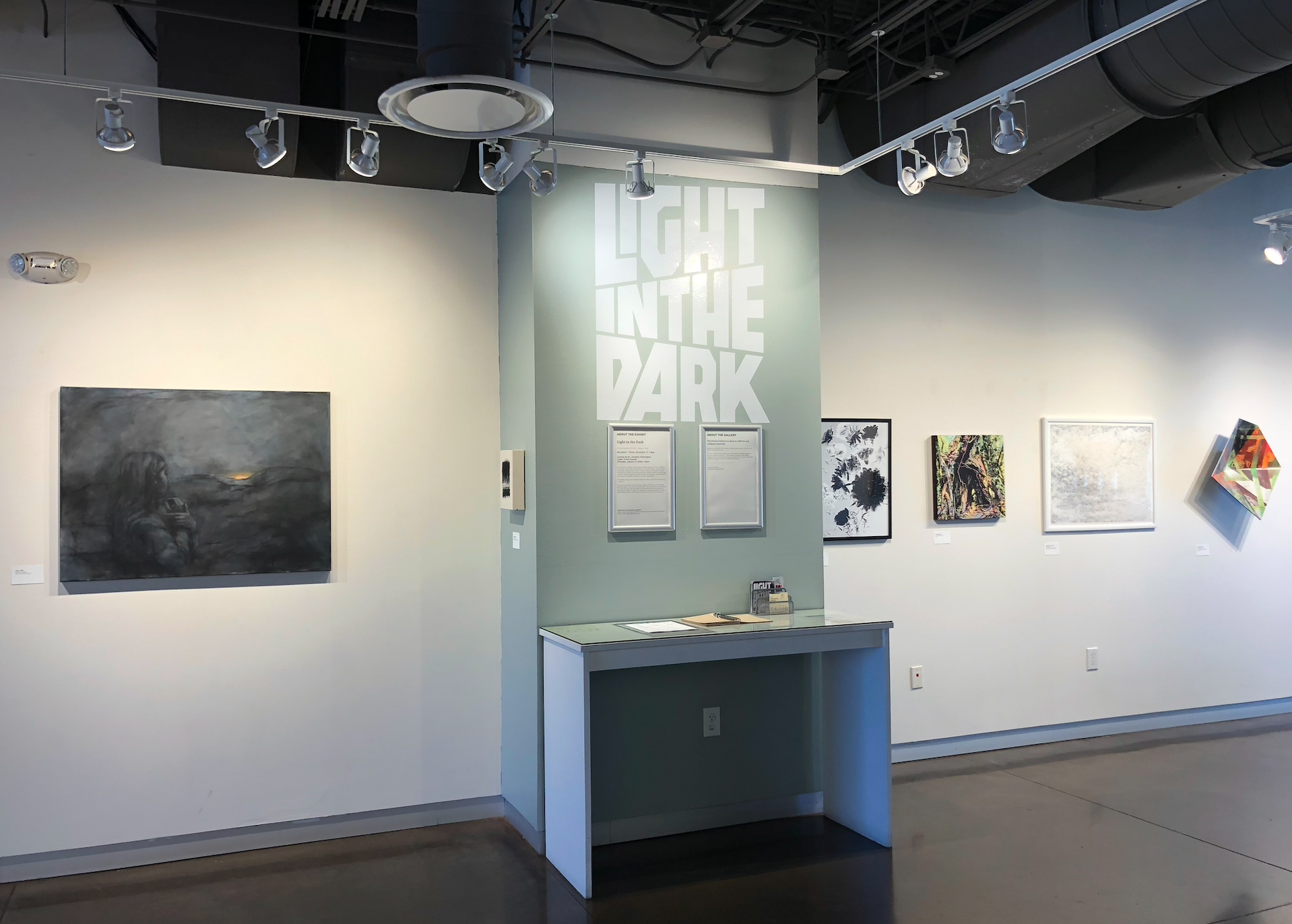
>> Light in the Dark, Sojourn Church Midtown, Louisville, Kentucky, November 17, 2023–January 7, 2024: Organized by Sojourn Arts, this juried exhibition features work by twenty-four artists from throughout the United States. It explores contrasts between light and dark, a powerful artistic as well as biblical theme with strong connections to the Christmas story. A complementary lecture on “Light in the Gospels” by Dr. Jonathan Pennington will take place on January 11, 2024.
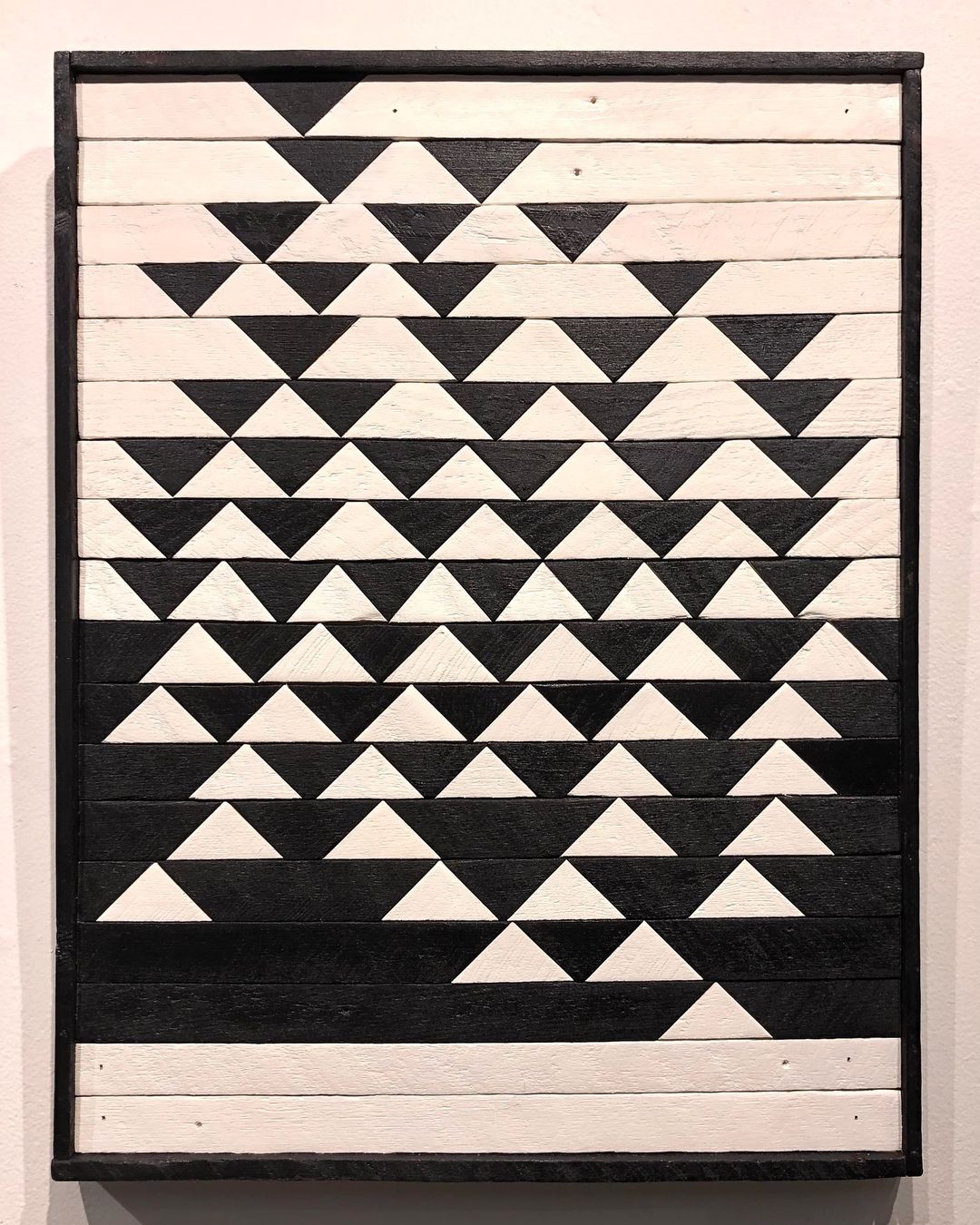
Brandon Hochhalter, The Incredible Power of Light, 2023. Reclaimed lath wood from homes in Old Louisville, 18 × 24 × 1 in. [artist’s website]
>> Wilson Abbey Advent Windows, 935 W. Wilson Ave., Chicago, December 1, 2023–January 6, 2024: A business under the umbrella of Jesus People USA, Wilson Abbey in uptown Chicago is a neighborhood gathering place for coffee, art shows, workshops, theater, dance, film screenings, and live music. Every December since 2016, they have installed a three-story-tall Advent calendar in their windows to be enjoyed from the streets, with one new artwork revealed each day from December 1 to 24. Directed by the building manager, Karl Sullivan, the project commissions local artists to contribute a painting, photograph, or other graphic work, and this year there are twenty-three participating artists. It will be a brand-new series of images, all on the theme “The Soul Felt Its Worth”—which, Sullivan told me, will “explore the idea of the Christ child coming to earth as a promise of justice and care for those who are seen by God, showcasing people groups who may not be seen, or whom we may not want to see because their problems are bigger than us.”
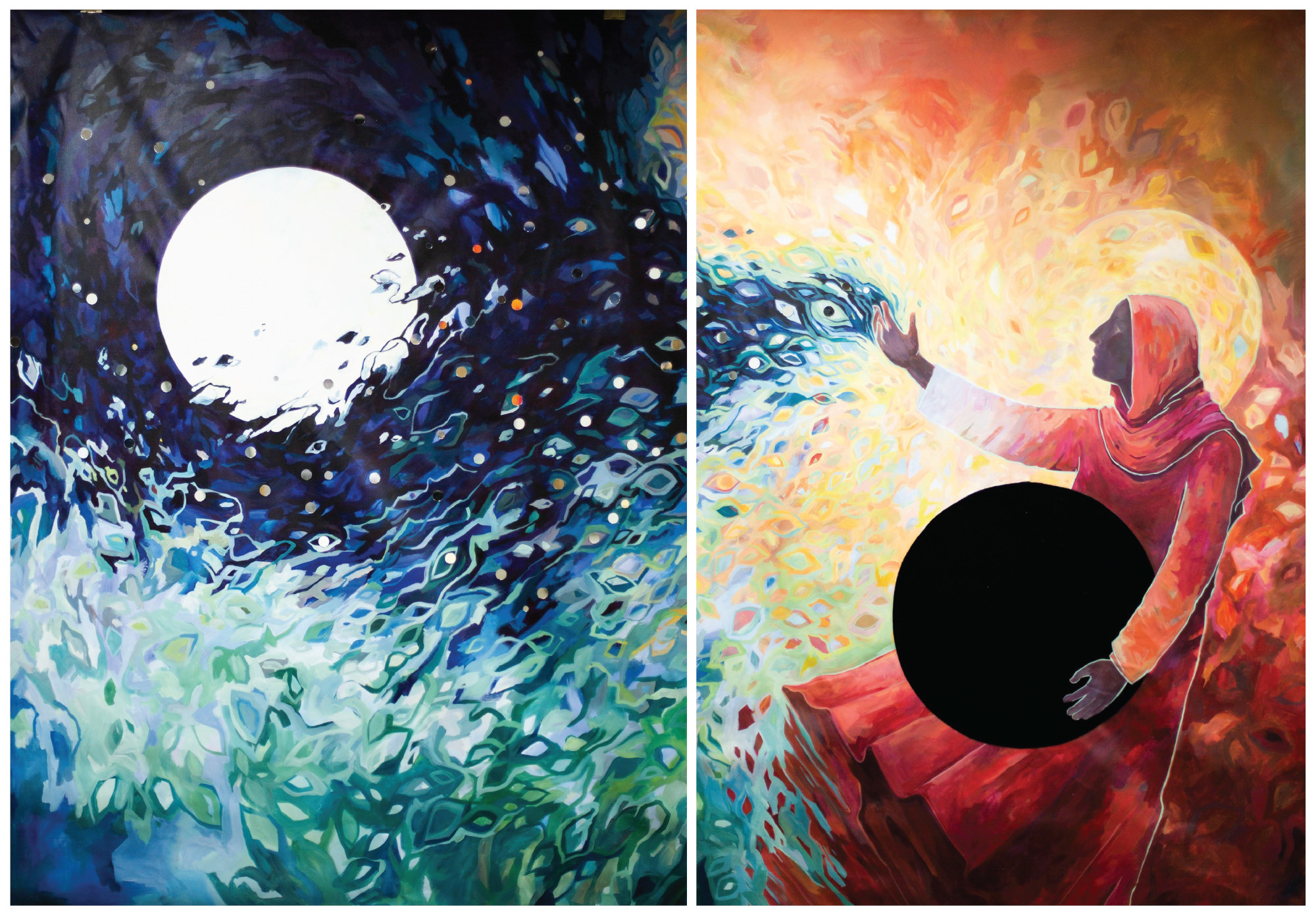
Below are two of the paintings from a previous iteration of the project, which together form an Annunciation scene. The drone video that follows was shot in 2020 by Mike Angelo Rivera.
Stop by 935 West Wilson Avenue in Chicago to see the progressively illuminated windows throughout the month of December (the full display will be up from December 24 to January 6), or follow along on Facebook or Instagram @wilsonabbeywindows. What a unique gift to the city! A fun way to engage the community.
+++
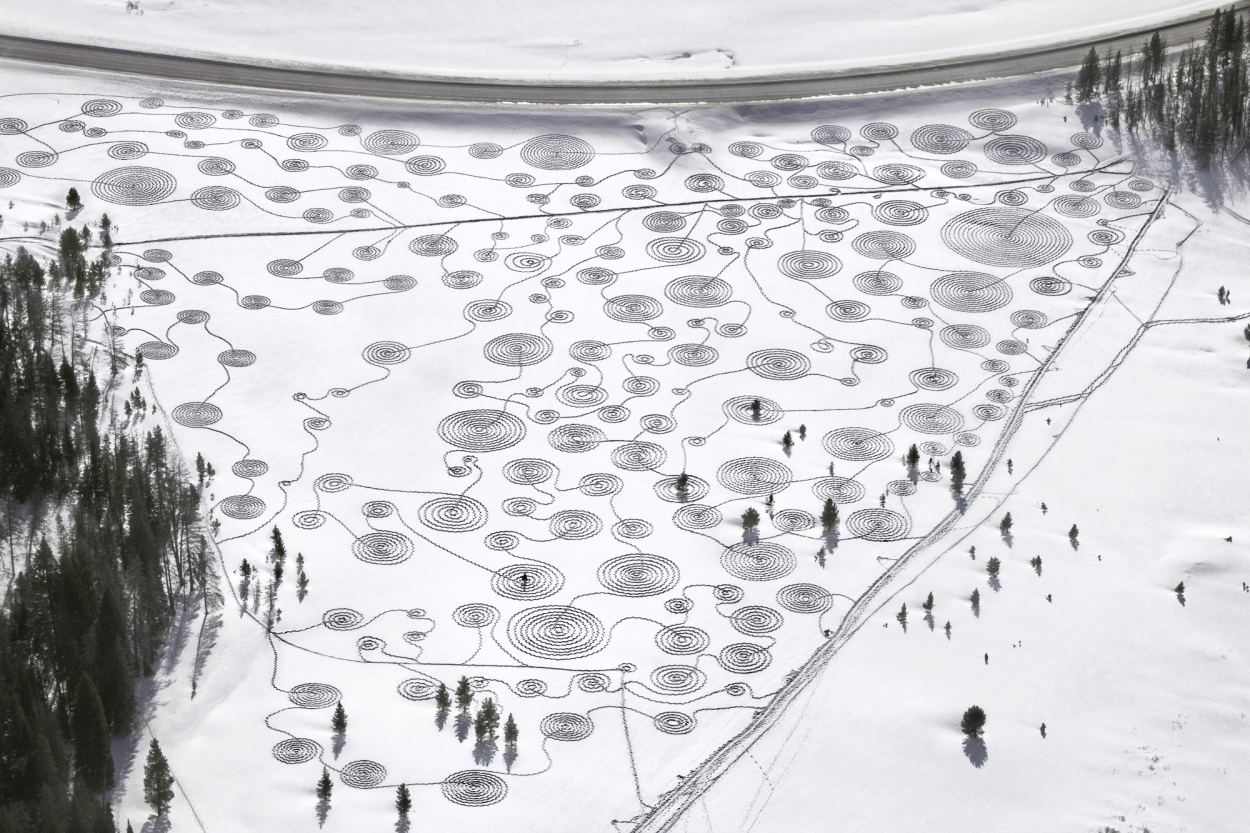
LAND ART: Snow Drawings by Sonja Hinrichsen: German-born, San Francisco–based artist Sonja Hinrichsen creates large-scale, ephemeral “snow drawings” in wintry locations around the world with the help of local volunteers who don snowshoes and track through the snow in patterns. She then photographs the land art from a helicopter or ski lift. These are amazing! Here’s a video by Cedar Beauregard of a drawing in progress at Rabbit Ears Pass, Colorado:
Snow Drawing by Sonja Hinrichsen, Rabbit Ears Pass, Colorado, 2012







 Art & Theology