25 Poems for Christmas, vol. 3

This is the third installment of my annual “25 Poems for Christmas” series. Included too, on the front end, are poems for Advent, the four-week season of preparation, hope, and expectation leading up to Christmas.

[Read volume 1] [Read volume 2]

1. “Advent (III)” by W. H. Auden, from For the Time Being: Voiced by the Chorus, who cry out from “a dreadful wood / Of conscious evil,” this is the third section of part 1 of Auden’s book-length Christmas poem in nine parts, For the Time Being—“the only direct treatment of sacred subjects I shall ever attempt,” he said. He wrote the poem in 1941–42. He had originally conceived it as the libretto of an oratorio that Benjamin Britten would write the music for, but the text turned out to be too complex, and Britten abandoned the project. The final two lines of this section set us up for the seemingly impossible feat of divine incarnation: “Nothing can save us that is possible: / We who must die demand a miracle.”

Source: For the Time Being: A Christmas Oratorio (Princeton University Press, 2013)

2. “Advent” by R. A. (Robert Alan) Rife: Ten sensory metaphors for Advent, conveying its mood of anticipation.

Source: https://innerwoven.me/ (author’s website)

3. “O Orient Light” by James Ryman: Loosely influenced by the O Antiphons (a set of short chants used in medieval Advent liturgies), this Middle English lyric is by the fifteenth-century Franciscan friar James Ryman of Canterbury; it’s one of 166 sacred poems he published in a 1492 collection. Each stanza consists of one rhyme repeated six times, and the Latin refrain translates to “O Christ, king of the nations, / O life of the living.” The fourth stanza is a standout, connecting the salvation wrought by Christ to the healing properties of plants: “O Jesse root, most sweet and sote, / In rind and root most full of bote, / To us be bote, bound hand and foot, / O vita viventium.”

Source: Cambridge University Library, MS Ee. 1.12; compiled in The Early English Carols, ed. Richard Leighton Greene, 2nd ed., revised and enlarged (The Clarendon Press, 1977). Public Domain.
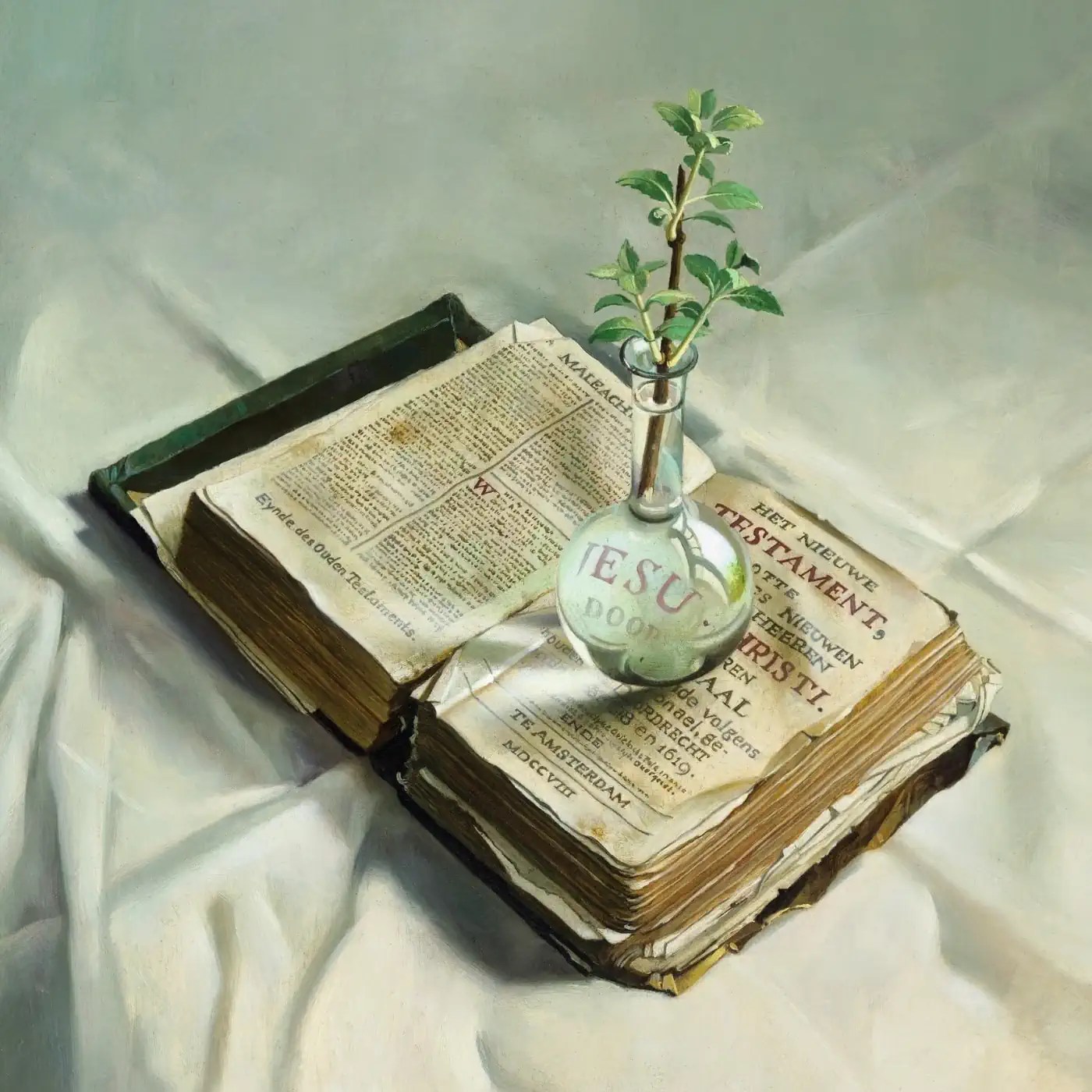
Helmantel, Henk_New Life II
Henk Helmantel (Dutch, 1945–), Nieuw Leven II (New Life II), 1999 (after the 1972 original that was stolen). Oil on canvas, 27 × 24 cm.

4. “Merger Poem” by Judy Chicago: “Merger Poem” is an aspiration that artist Judy Chicago wrote to accompany her 1979 monumental artwork The Dinner Party, a celebration of the richness of women’s heritage, expressed as place settings around a table, that is housed at the Brooklyn Museum. Her vision in the poem is not theistic, at least not explicitly so, but she uses the language of “Eden,” and her descriptions evoke passages from Isaiah about a future harmony, a merging of heaven and earth, in which justice and equity are achieved at last—not to mention the strong eschatological tones that feasting has in Christianity. Each line begins with “And then,” cumulatively generating a longing in the reader for “then” to arrive.

Source: The Dinner Party, exh. cat. (San Francisco Museum of Modern Art, 1979) | https://judychicago.com/

5. “truth” by Gwendolyn Brooks: “And if sun comes / How shall we greet him?” the speaker asks at the opening of this poem. The sun here represents truth, revelation, illumination, which we may seek with weeping and prayer but which can be dreadful when it actually comes. It’s often more comfortable to stay asleep in the dark than to confront the stark brightness of day. But oh, what we miss when we do! Gwendolyn Brooks uses the pronoun “him” for the sun, and it’s easy to read the poem Christologically: you can read it in the sense of any of Christ’s three comings—as a baby in Bethlehem, in personal, inner ways (he reveals himself, and seeks entrance, to human hearts), or as a king and judge at the end of time. Did you catch the reference to Revelation 3:20?

Source: Annie Allen (Harper & Row, 1949); compiled in Blacks (Third World Press, 1987)
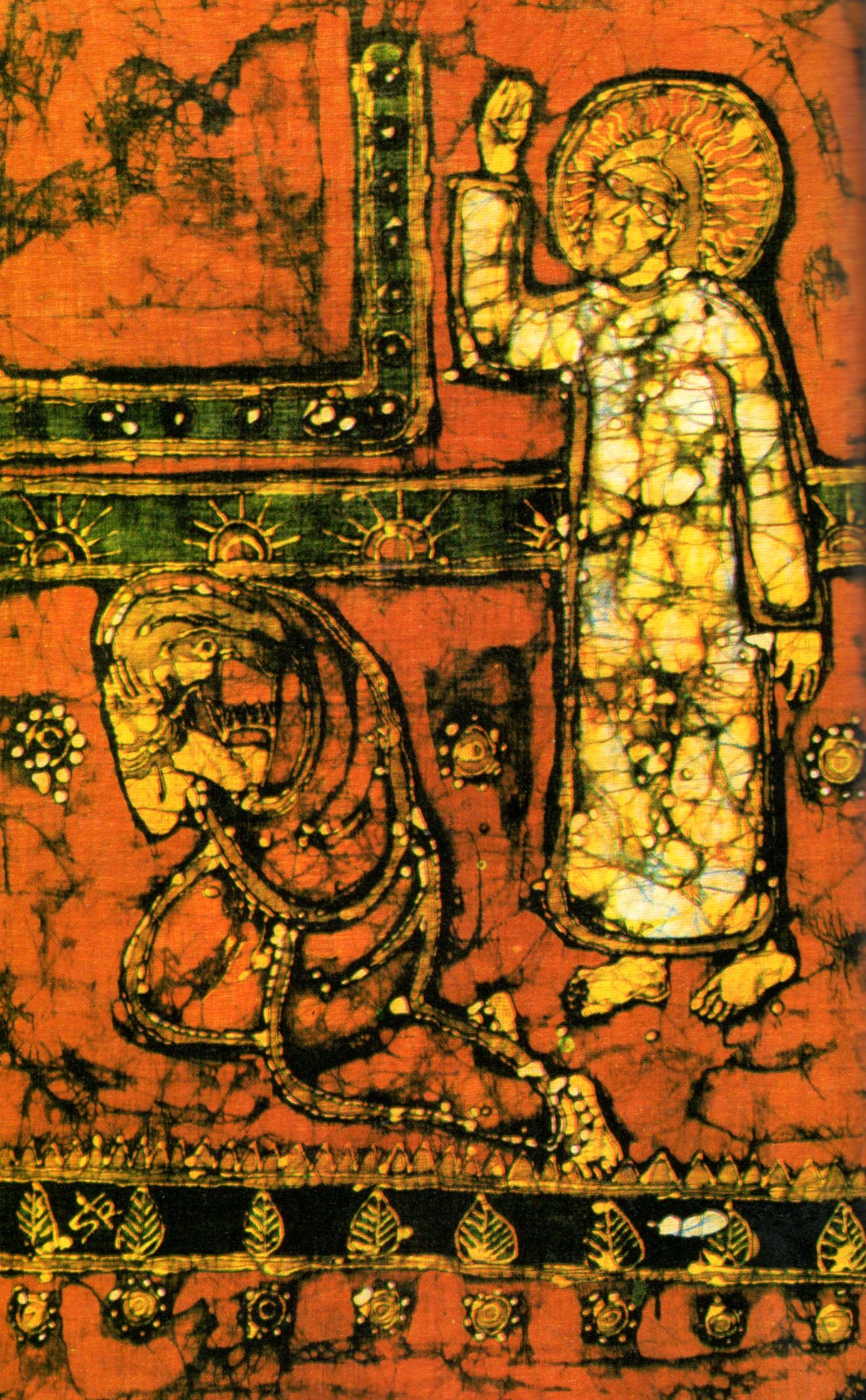
Raj, Solomon_Waiting for My Lord
P. Solomon Raj (Indian, 1921–2019), Waiting for My Lord, batik, published in Living Flame and Springing Fountain (ISPCK, 1993)

6. “Advent” by Mary Jo Salter: In this poem a mother and daughter are building a gingerbread house when a wintry gust tears a shutter on their actual house off its hinges, the shock of the thud causing, inside, a gingerbread wall to split. I think “house,” here, could be a metaphor for a faith structure; a house of belief. Shutters are doing a lot of work in the text: one falls off in a storm, and the daughter’s Advent calendar consists of twenty-five shutters, one opened each day until Christmas to reveal a Bible verse or narrative scene.

I’m not quite sure how to interpret the poem overall, but it seems to be addressing themes of (in)stability, brokenness and repair, the desire to believe versus the impulse to shut out belief, openness (“The house cannot be closed”), (dis)enchantment, the mother-child bond, and safety and danger (the Christmas story, like faith itself, characterized by both). I can’t decide if the “blank” in the final tercet sounds hopeful or bleak: does it connote possibility or lack? And is the mother suggesting in the final line (a repurposing of the final line from stanza 15) that what’s most real to her is not Mary and the baby Jesus but herself and her own child, right there in that moment?—or is she finding a point of kinship with Mother Mary in the love she feels for her offspring?

Source: Open Shutters (Knopf, 2003)

7. “Nativity” by Li-Young Lee: “What is the world?” asks a little boy in the darkness; and again as an adult. A poem of spiritual questing, Li-Young Lee’s “Nativity” deals with existential questions, ending with a tercet that evokes Isaac Watts’s famous carol line “Let every heart prepare him room.” Within us we must make a manger, a “safe place,” to receive the wild God.

Source: Book of My Nights (BOA Editions, 2001)

8. “Nazareth” by Drew Jackson: Ancient Nazareth, where Jesus grew up, was an insignificant village that many believed no good could come out of (see John 1:46). This poem by public theologian Drew Jackson accentuates Jesus’s origins there, his identity as a “southsider” (Nazareth is in southern Galilee). Today some urban neighborhoods on the “South Side” are disparaged, their residents dismissed as poor and lacking education and potential. God chose to incarnate in a rural neighborhood with a similar reputation, not simply dropping in and then leaving but, as the second person of the Trinity, being formed and nurtured in that environment. “Nazareth” is from Jackson’s debut poetry collection, in which he works his way through the first eight chapters of Luke’s Gospel, drawing out the theme of liberation and making contemporary connections.

Source: God Speaks Through Wombs: Poems on God’s Unexpected Coming (InterVarsity, 2021) | https://drewejackson.com/

9. “The Visitation” by Calvin B. LeCompte Jr.: The poet imagines the fields that Mary passes on her way to her cousin Elizabeth’s house joining in the Magnificat, praising the Savior in her womb.

Source: I Sing of a Maiden: The Mary Book of Verse, ed. Sister M. Thérèse (Macmillan, 1947)

10. “My Darling” by Alexandra Barylski: Mary and Joseph are cuddling in bed as she reflects on the divine interventions that brought and kept them together. The poem references the legend, originating in the second-century Protoevangelium of James and repeated in the seventh-century Gospel of Pseudo-Matthew, that Joseph was chosen to wed Mary when from his staff, submitted to the high priest along with those of other single men, there miraculously emerged a dove. Mary expresses appreciation for Joseph’s “visionary love,” patience, and courage in their relationship, his spiritual leadership and support.

Source: Reformed Journal, May 11, 2021
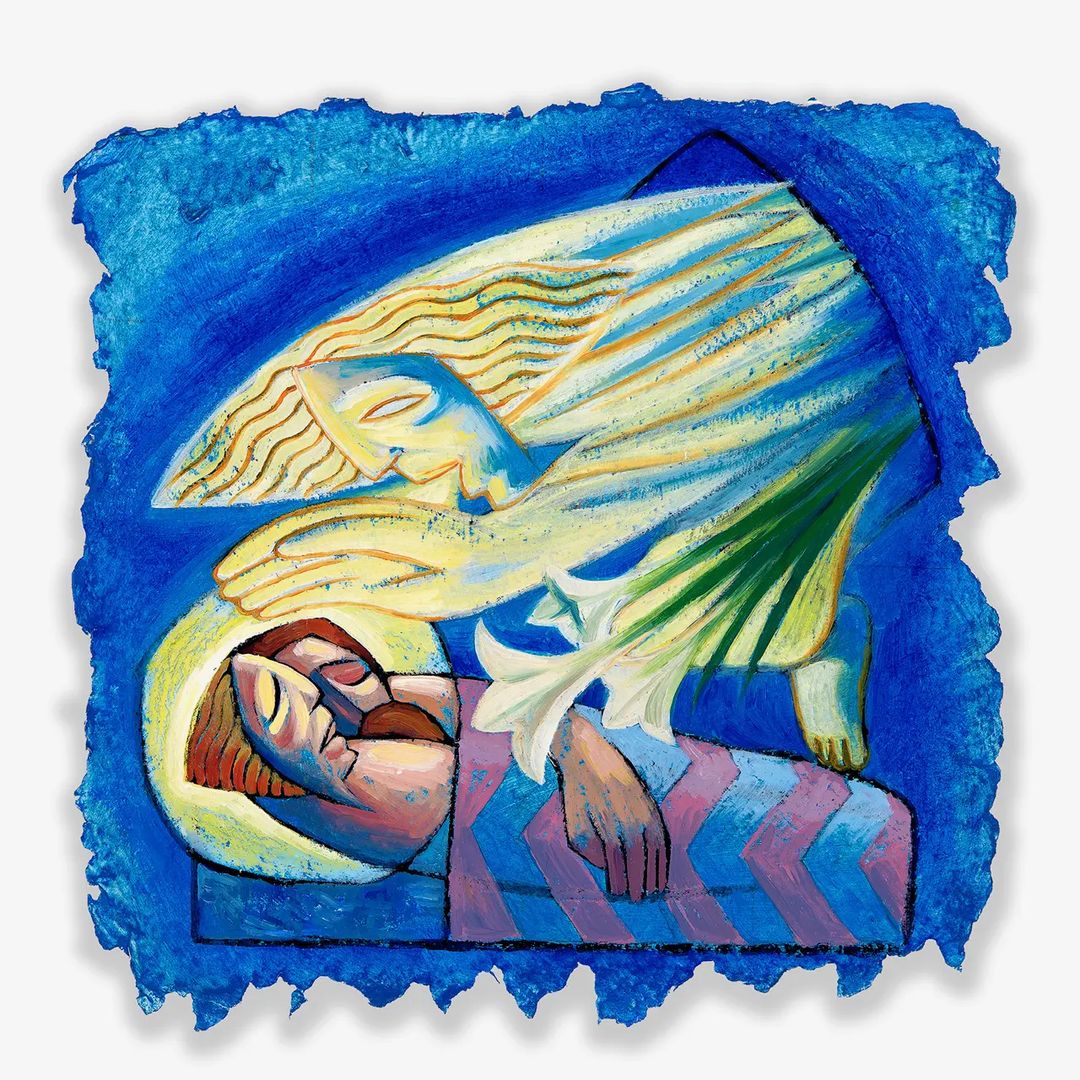
Mynheer, Nicholas_Annunciation
Nicholas Mynheer (British, 1958–), Annunciation, 2017. Oil on handmade paper, 20 × 20 cm.

11. “A Blessing for the New Baby” by Luci Shaw: The speakers of this poem give a lovely benediction over Christ—preincarnate and then embryonic in the first stanza, then out of the womb in the second and third.

Source: Accompanied by Angels: Poems of the Incarnation (Eerdmans, 2006) | https://lucishaw.com/

12. “Love’s Delights” by Meister Eckhart, rendered by Jon M. Sweeney and Mark S. Burrows: The medieval German mystic Meister Eckhart didn’t write poetry, but many of his sermons have a poetic quality to them, so contemporary poet Mark S. Burrows and writer Jon M. Sweeney, working from an English translation of the Middle High German by Frank Tobin, reworked select excerpts into verse. Adapted from a sermon Meister Eckhart preached on Isaiah 60:1, this poem meditates on the downward movement of love that raises up.

Source: Jon M. Sweeney and Mark S. Burrows, Meister Eckhart’s Book of the Heart: Meditations for the Restless Soul (Hampton Roads, 2017)

13. “Word Become Flesh” by Seth Wieck: Pregnancy, childbirth, and nursing take a toll on the body. Voiced by Mary, this poem highlights the bodily realities of Jesus’s first coming—Mary swollen, bruised, cracked, and bleeding. She was wounded for our transgressions, in the sense that she endured kicks to the ribs, postpartum hemorrhoids, etc., in order to bring forth our Savior, and by these wounds, because they gave life to Jesus, our healing was made possible. The last sentence is a zinger. Mary gives (physical) birth to Jesus, and he gives (spiritual) birth to her.

Source: Fathom, December 21, 2017 | https://www.sethwieck.com/

14. “Prince of Peace” by Brian Volck: The poet provides his own introduction to this poem on his website: “Octavian Augustus, first emperor of Rome, was known by many titles, including Divi Filius (Son of God) and Princeps Pacis (Prince of Peace). An inscription in Asia Minor states that Augustus’s birth ‘has been for the whole world the beginning of the gospel (εύαγγέλιον) concerning him.’ How strange, then, to use the same names for a contemporaneous but obscure Palestinian Jew, whose understanding of peace, politics, and power was so radically different. How strange to have so long diluted the scandal of the gospel (good news) with accommodations to an Augustan vision of a peace built on the use or threat of lethal violence. Here’s a Christmas poem calling attention to that contrast in a conscious act against forgetting.”

Source: Flesh Becomes Word (Dos Madres, 2013) | https://brianvolck.com/

15. “The Burning Babe” by Robert Southwell: Consisting of sixteen lines in iambic heptameter, this poem by the Jesuit martyr-saint Robert Southwell [previously] relates a mystical vision of the Christ child, who appears to the narrator on a cold winter’s night, enflamed and hovering in midair. The poem develops the metaphor of the love of Christ as a fiery furnace that both warms and purifies.

Source: St Peter’s Complaint, and Other Poems (London, 1595). Public Domain.
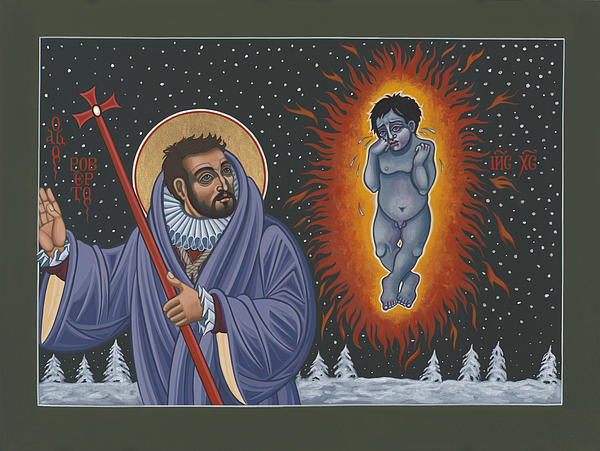
McNichols, William Hart_Robert Southwell and the Burning Babe
William Hart McNichols (American, 1949–), Holy Poet-Martyr St. Robert Southwell and the Burning Babe, 2015. Acrylic on wood. [purchase reproduction]

16. “Advent 1966” by Denise Levertov: This poem is shocking in its horror. Written in 1966, it picks up Southwell’s image of the Burning Babe and transposes it to the napalmed villages of Vietnam, where children were being physically (not symbolically or ethereally, as in Southwell’s poem) set on fire by chemical weapons deployed by the US military. Denise Levertov [previously], who was an antiwar activist as well as a poet, uses repetition to strong effect, conveying a sense of the seemingly relentless carnage (the war produced an estimated two million civilian casualties, more than half the total number). Though addressing a specific historical event, this elegy for the innocent provokes us to consider where similar atrocities are happening today.

Source: To Stay Alive (New Directions, 1971); compiled in Making Peace, ed. Peggy Rosenthal (New Directions, 2006)

17. “Christmas Eve” by Christina Rossetti: The Victorian poet Christina Rossetti [previously] opens this lyric with two paradoxes that characterize Christmas—bright darkness and chilly warmth—referencing the general mood of cheer and comfort that coexists with the bleak English midwinter. Why this mirth? Because “Christmas bringeth Jesus, / Brought for us so low.” Jesus was brought down from heaven in the Incarnation, but he would be brought lower still: his spirits sunken in Gethsemane, his body buried in a grave. The second stanza evokes a wedding: dressed in a bridal gown of gauzy snow, earth receives her heavenly Bridegroom.

Source: Time Flies: A Reading Diary (London, 1885); compiled in The Complete Poems (Penguin, 2001). Public Domain.

18. “Hill Christmas” by R. S. Thomas: In a poor rural Welsh village, parishioners make their way across snowy fields, weather-beaten, on Christmas to feed their bodies and souls with a snow-white bread loaf and crimson wine. In the celebration of the Eucharist, they hear love cry “in their heart’s manger.” Then they return to the day’s chores. I think the last line refers to a wayside crucifix.

Source: Laboratories of the Spirit (Macmillan, 1975); compiled in Collected Poems, 1945–1990 (Dent, 1993)

19. “back in the day” by Carl Winderl: In a practice known as “setting lambs on,” when a baby lamb dies in birth, sheep farmers will often take a live lamb (an orphan, or a twin or triplet from another ewe) and cover it in the skin of the deceased one so that, when the grieving mother smells the familiar scent of her deceased offspring, she accepts the lamb as her own. In Carl Winderl’s poem, Mother Mary reflects on that practice and has a premonition of a dead lamb.

Source: Christian Century, December 27, 2023

20. “Hymn 4 on the Nativity of Christ” by Ephrem the Syrian: St. Ephrem, a church father from the fourth century, wrote his theology in verse and is one of the most significant Early Christian hymnists. His Nativity hymns are my favorite; I’m particularly struck in Hymn IV by his meditation on how the Christ who suckles at Mary’s breast also gives suck to the whole world. “He is the Living Breast of living breath,” as Kathleen E. McVey translates the Syriac.

Source: Ephrem the Syrian: Hymns, trans. Kathleen E. McVey (Classics of Western Spirituality) (Paulist Press, 1989)
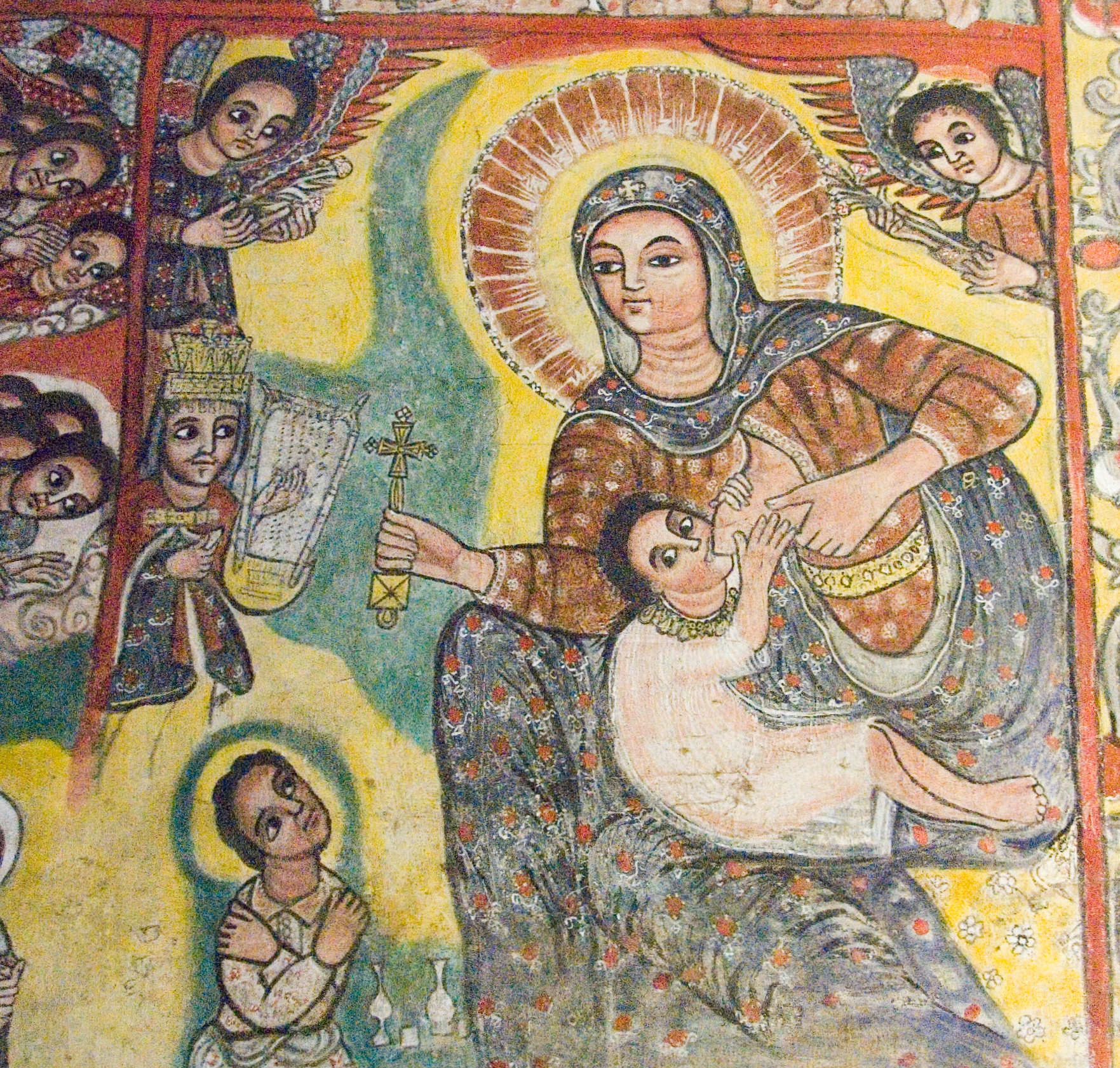
Maria lactans (Ethiopian)
Maria lactans, late 18th century. Fresco, Church of Narga Selassie, Dek Island, Lake Tana, Ethiopia. Photo: Alan Davey.

21. “Nativity” by Scott Cairns: This is the first in a pair of ekphrastic poems called “Two Icons,” in which the poet, who is Greek Orthodox, describes an icon from his home prayer corner. The first three stanzas engage in constructive wordplay: Jesus is wrapped in swaddling bands by his mother, and she is rapt—enraptured, wholly absorbed—by him. She holds him in her gaze and in her hands, and is beholden to him. Icons are about just that: beholding Christ and the sacred mysteries and deepening our affection for the One who holds us in affection. In Nativity icons our gaze is directed to “the core / where all the journeys meet, appalling crux and hallowed cave and womb,” where we are beckoned, like the magi, to bow before the incarnate God.

Source: Compass of Affection: Poems New and Selected (Paraclete, 2006)

22. “Star of the Nativity” by Joseph Brodsky: The Nobel Prize–winning Russian poet Joseph Brodsky was born into a Jewish family, but he was captivated by the story of Jesus’s birth and wrote many poems about it. The final stanza of this one gives us the unique perspective of the Star of Bethlehem, looking down—the Father’s beaming pride.

Source: Nativity Poems (Farrar, Straus and Giroux, 2001)

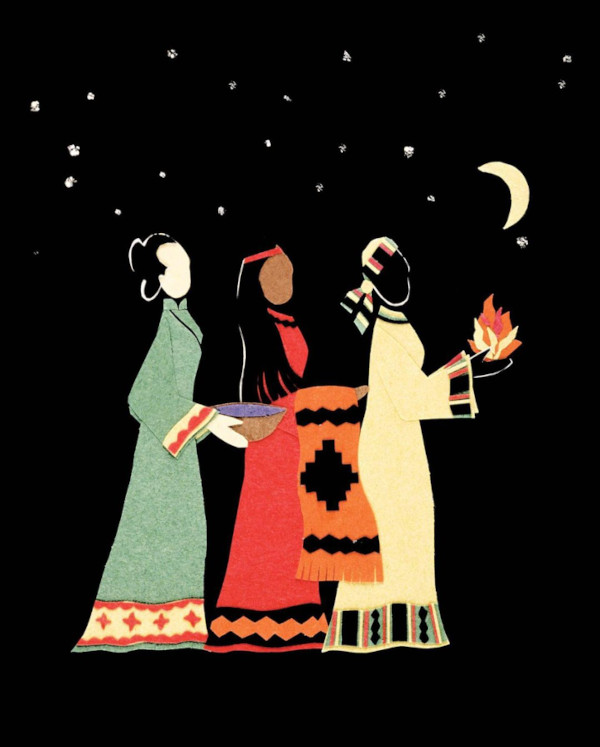
23. “Wise Women Also Came” by Jan Richardson: The Gospel of Matthew tells us that when Jesus was born, wise men came from the east to worship him. But wise women came too, Jan Richardson surmises. They came during Mary’s labor—midwives assisting with the birth. They came with lamps, fresh water, and blankets.

Source: Night Visions (Wanton Gospeller, 2010)
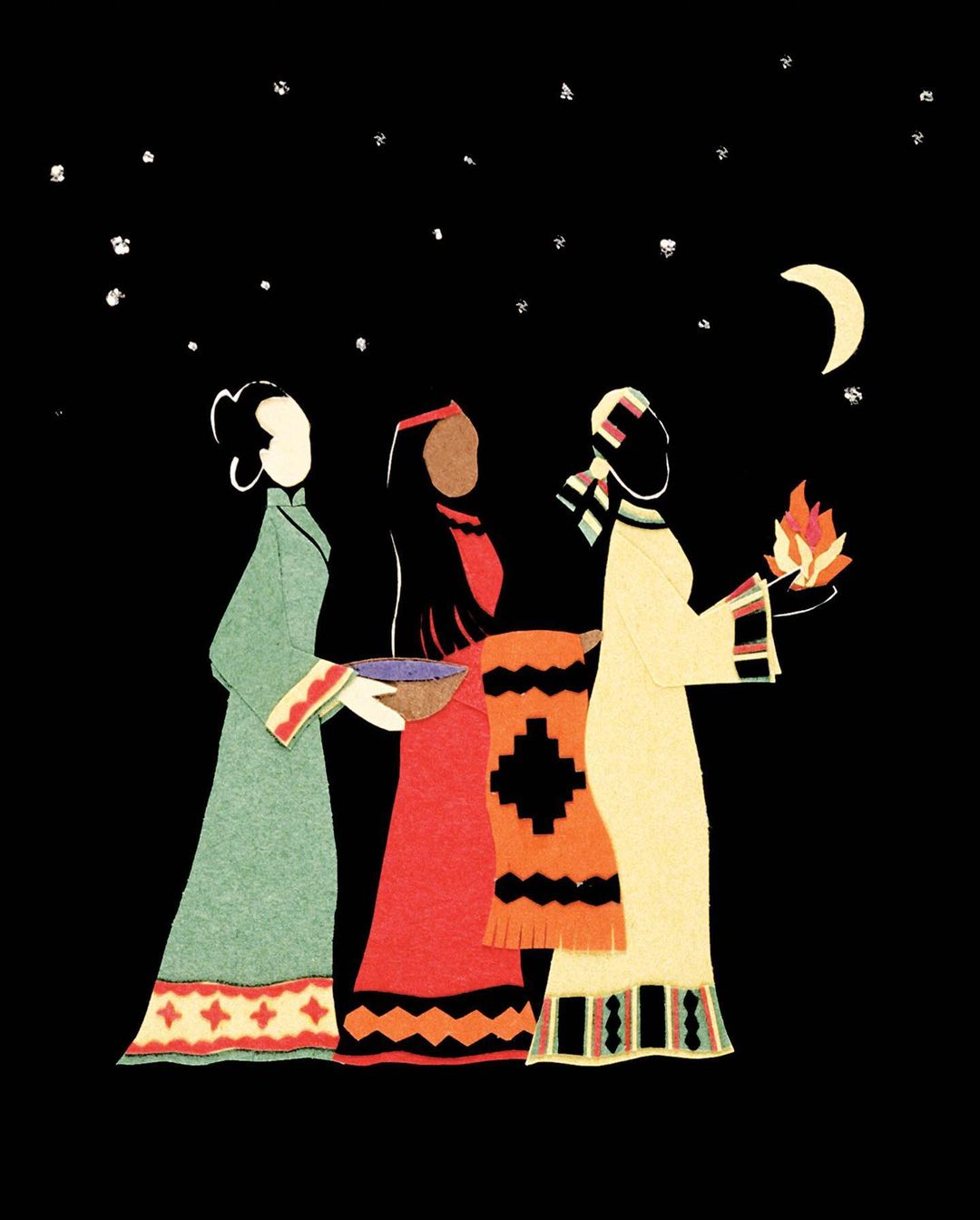
Richardson, Jan_Wise Women Also Came
Jan Richardson (American, 1967–), Wise Women Also Came, 1995. Collage. [purchase reproduction]

24. “Green River Christmas” by John Shea: Theologian and storyteller John Shea reflects on how, after experiencing something scary or unpleasant (like getting a shot or a teeth cleaning), mothers often give their child a treat. Christmas is a kind of supreme treat after the penitential season of Advent, during which we confronted the state of our spiritual health and remedied any shortfalls. Think, too, of the liturgy of (somber) confession and (sweet) pardon every Sunday at church, a prelude to the feast of bread and wine. At the Lord’s Table, we are fed—the gifts of God for the people of God. The Eucharist is the subtext of the final stanza, where Shea describes the presentation of Jesus in the temple forty days after his birth. There he is received by “the long-starved arms / of Simeon and Anna.” They had hungered for salvation, endured a long period of waiting; now they are filled.

Source: Seeing Haloes: Christmas Poems to Open the Heart (Liturgical Press, 2017)

25. “Taking Down the Tree” by Jane Kenyon: “Tick, tick, the desiccated needles drop.” This poem is about the passing of time—the death of another year—and the glumness that often sets in after the holidays are over, but it’s also about the storage of memories. In many households, Christmas ornaments are a multigenerational collection of memories. As with hanging them on the tree, taking them off and packing them away is a ritual that may prompt us to revisit certain past experiences or periods in our life. After we unplug the stringed lights and wrap up the baubles for safekeeping, then what? How will we inhabit the twelve months until next Christmas?

Source: Collected Poems (Graywolf, 2005)
Ten Songs of Joy for Gaudete Sunday

The third Sunday of Advent is known as Gaudete Sunday, gaudete (pronounced GOW-deh-tay) (Latin for “rejoice”) being the first word of the introit of the day’s Mass, taken from Philippians 4:4–6 and Psalm 85:1:

Gaudete in Domino semper íterum díco, gaudéte: modéstia véstra nóta sit ómnibus homínibus: Dóminus prope est. Nihil sollíciti sítis: sed in ómni oratióne petitiónes véstrae innotéscant apud Déum. Benedixísti, Dómine, térram túam: avertísti captivitátem Jácob.

Rejoice in the Lord always; again I say, rejoice. Let your forbearance be known to all men. The Lord is at hand. Do not be anxious over anything; but in all manner of prayer, let your requests be made known unto God. Lord, you have blessed your land; you have put an end to Jacob’s captivity.

It is customary for priests to swap out their purple vestments for pink today, and for those who use an Advent wreath to light not a purple candle but a pink one. Some churches favor a spare aesthetic in their sanctuaries for the first two weeks of Advent but break out the flowers for this the third. The approximate halfway point of the penitential Advent season, Gaudete Sunday is a special time to rejoice in the nearness of God’s coming as well as God’s presence with us here even now in the waiting, and to receive a foretaste of the bigger celebration to come on Christmas Day.

Here are ten songs for you to enjoy this Gaudete Sunday. If you’d rather listen to them as a YouTube playlist, click here.

Richardson, Jan_Visitation
The Hour of Lauds: Visitation by Jan Richardson [for sale]

1. “Songs of Joy” by Garrison Doles, written late 1990s, on A Songmaker’s Christmas, 2012: “Songs of joy we hopefully sing, expanding our spirits, the season to know . . .” So opens this song by the late singer-songwriter Garrison Doles (d. 2013) [previously]. In 2009 his wife, the artist Jan Richardson, created a video combining the song with five of the seven collages from her Advent Hours cycle (which can be purchased as reproductions). Read the lyrics and songwriter’s statement here.

2. “My Soul Doth Magnify the Lord” by O’Landa Draper and the Associates, on Live…A Celebration of Praise, 1994: A trailblazing gospel choir director, O’Landa Draper was one of the top gospel artists of the nineties. This song of his is based on the Magnificat, the praise song Mary sings in the company of her cousin Elizabeth following the conception of Christ (see Luke 1).

3. “El burrito de Belén” (The Little Donkey of Bethlehem) by Hugo Cesar Blanco, 1972, performed by the band Matute, 2020: This is a Venezuelan carol about a person riding their donkey, with hurried excitement, from the sabanero (savanna) to Bethlehem to see the newborn Christ. Read the lyrics and translation here.

4. “Ecce mundi gaudium” (Behold the Joy of the World), England, 13th century, arranged and performed by the Mediæval Bæbes on Worldes Blysse, 1998: Written in Latin, this thirteenth-century carol is about the Virgin giving birth to the Son, our joy—announced to the shepherds by an angel and to the magi by a star. Despite the upbeat tempo throughout, the last two verses are about Herod’s raging and the Massacre of the Innocents. The soloist is Katharine Blake, the founder and musical director of Mediæval Bæbes. Read the original lyrics here, clicking on individual lines for the English translation.

5. “Kya Din Khushi Ka Aaya” (क्या दिन खुशी का आया) (What a Happy Day), performed by Akshay Mathews, 2021: A Hindi Christmas carol from India. Read the lyrics here.

6. “Repeat the Sounding Joy,” a fragment from “Joy to the World” arranged by Craig Courtney, performed by the Capital University Chapel Choir, 2019: A super-fun, one-minute choral work.

7. “Now Let Us Sing,” traditional, adapt. John L. Bell, 1995, performed by Katarina Ridderstedt, 2015: Katarina Ridderstedt (née Lundberg) is a rhythm teacher, musician, cantor, and choir director from Gotland, Sweden, who records music under the name Musikat. This video of hers introduced me to a charming little quatrain whose origins I don’t know (it’s credited as “Traditional”), but this version comes from Scotland’s Iona Community [previously]: “Now let us sing with joy and mirth, / praising the one who gave us birth. / Let every voice rise and attend / to God whose love shall never end.”

(Update, 1/6/25: “Now let us sing” is of Scottish origin, first appearing during the Protestant Reformation in the congregational song collection The Gude and Godlie Ballatis; the earliest extant edition of this book is from 1567, but it is thought to have been originally published in 1540. The tune was originally a drinking tune. For his rendition, published in Come All You People: Shorter Songs for Worship, John L. Bell essentially rewrote the first stanza, retaining only the first line of the original.)

8. “Brother” by Jorge Ben Jor, on A Tábua de Esmeralda, 1974: Known by the stage name Jorge Ben or (since the 1980s) Jorge Ben Jor, Jorge Duílio Lima Menezes (b. 1939) is a Brazilian singer-songwriter and musician whose characteristic style fuses elements of samba, funk, rock, and bossa nova. In this song he enjoins us to prepare a joyful path for the coming Christ—who is both Lord and friend—with love, flowers, and music.

9. “Alleluia, He Is Coming (I Looked Up)” by Martha E. Butler, 1979: This song is sometimes used in church services for Palm Sunday or Easter, but I think it makes a fitting Advent song as well—especially with the newer last verse that is sometimes used, as in the first video below. “Alleluia, he [Christ] is coming! Alleluia, he is here,” the refrain proclaims. Read about the inspiration behind the song, in the words of the songwriter, here. Allow me to sneak in two different performances. The first is by Donna Rutledge, Becky Buller, and Todd Green of First Baptist Church of Manchester, Tennessee, from 2020; theirs is a lovely rendition with strong vocals and a poignant violin part, but I do prefer a brisker pace (listening to the video at a playback speed of 1.25 is perfect, in my estimation):

The second is by the South African group Worship House, from their 2016 album Project 5 (Live in Johannesburg):

10. “Joy Will Come” by Paul Zach: The refrain of this song by Paul Zach of Virginia is based on Psalm 30:5b: “Weeping may linger for the night, but joy comes with the morning.” I also hear echoes of Psalms 18 and 121 throughout. The song is a reminder that through the dark nights we experience, we have hope; we have a Savior who will not abandon us.

Roundup: Doubting Thomas, practicing stillness, living with grief, and more

SPOTIFY PLAYLIST: October 2023 (Art & Theology): Each month I compile a nonthematic mix of thirty faith-inflected songs from a range of sources. October’s playlist is now live. One track I’ll draw your attention to, with a live performance video below, is the soul-baring prayer “Doubting Thomas” by Chris Thile of Nickel Creek; read the lyrics, with annotations, here. (Also, Paul Demer has a nice cover of this song on YouTube.)

+++

MEDITATION EXERCISE: “Stillness—Richard Rohr’s Daily Meditations”: From the Center for Action and Contemplation comes this one-minute video that takes the most memorable line from Psalm 46, progressively paring it down and creating meditative space around each subtraction.

Be still and know that I am God
Be still and know that I am
Be still and know
Be still
Be

Rev. Dr. Cynthia Bourgeault, an Episcopal priest, writer, and retreat leader, mentions this chant in her book Chanting the Psalms. “Each time the line is repeated,” she writes, “key words are taken away. The result is a funnel-like effect that leads straight down into silence. . . . Each phrase expresses its own unique meaning and understanding as the prayer moves toward utter simplicity” (185). Bourgeault recommends working with the recording “Be Still and Know” found on the album Songs of Presence: Contemplative Chants for the New Millennium from Praxis Publishing House; I couldn’t find the audio online, but I did find a song by The River’s Voice (Trish and Richard Bruxvoort Colligan) that’s also based on this exercise of Fr. Rohr’s: “Be (Still and Know That I Am God)”:

+++

PODCAST EPISODES: Here are two podcast episodes I caught up with recently and enjoyed. Both links include transcripts.

>> “Jan Richardson: Stubborn Hope,” Everything Happens with Kate Bowler, October 27, 2020: Kate Bowler, a historian and cancer survivor who has done much academic work on the prosperity gospel, talks with spiritual writer Jan Richardson [previously], whose husband died unexpectedly in 2013, about the hidden rooms of grief, being disciplined by hope, and how the concept of blessing in the Jewish and Christian traditions differs from the #blessed culture of social media. Don’t miss the three discussion questions in the show notes.

>> “Esau McCaulley: How Far to the Promised Land?,” No Small Endeavor, September 14, 2023: Lee C. Camp interviews public theologian Esau McCaulley, a professor of New Testament at Wheaton College and a New York Times opinion writer, about his new memoir, How Far to the Promised Land: One Black Family’s Story of Hope and Survival in the American South. I’ve heard rave reviews from multiple corners about this book, and this conversation has really whetted my appetite to read it!

+++

POEM COMMENTARY: “Learning about Constellations” by Saddiq Dzukogi, commentary by Pádraig Ó Tuama: On this episode of On Being’s Poetry Unbound podcast, host Pádraig Ó Tuama unpacks a poem written by Saddiq Dzukogi in the aftermath of his one-year-old daughter’s death. It’s from his 2021 collection Your Crib, My Qibla.

Roundup: Feast of Mary Magdalene; holiness of people and place; black squares

Richardson, Jan_The Hours of Mary Magdalene
The Hours of Mary Magdalene by Jan L. Richardson

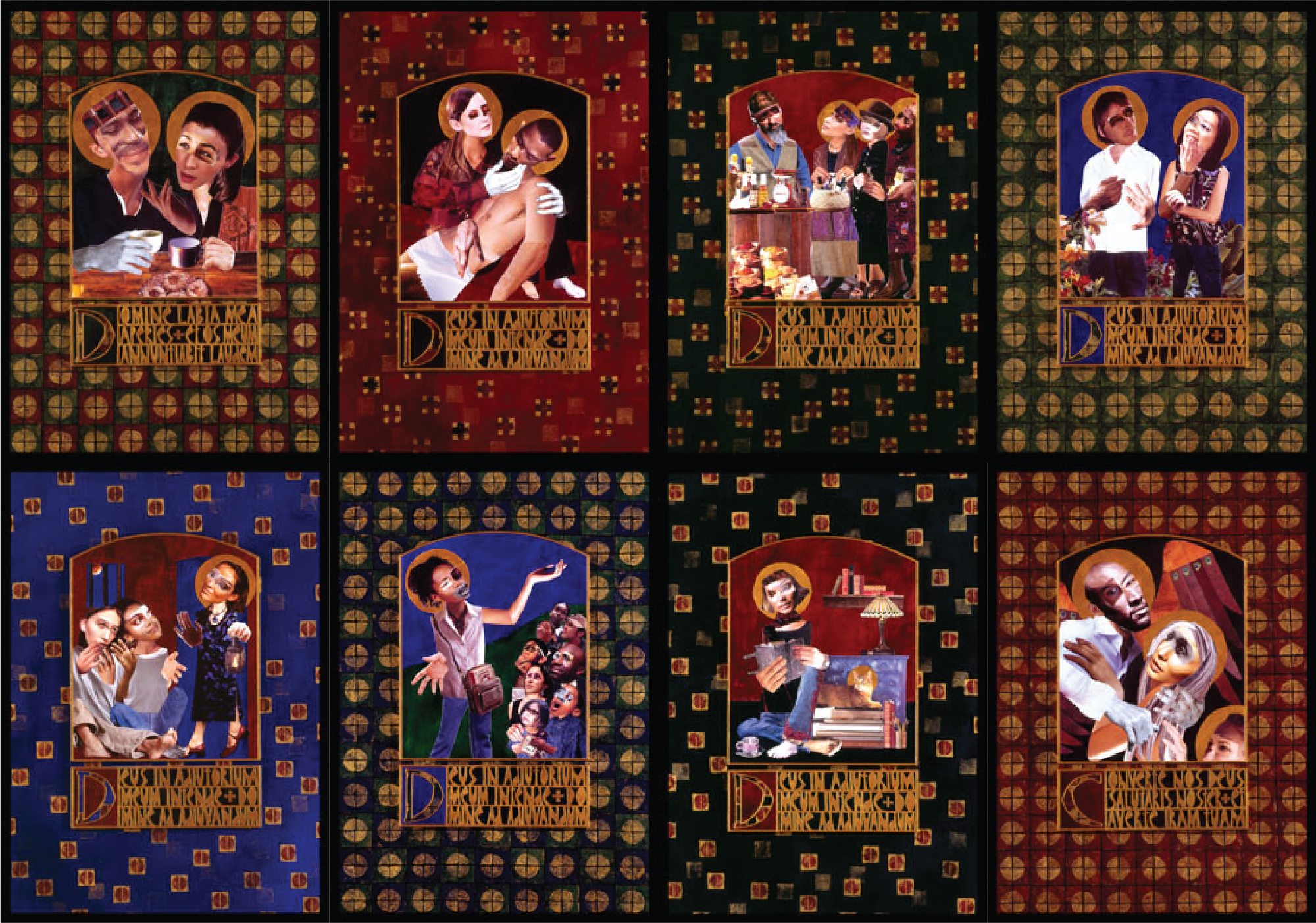
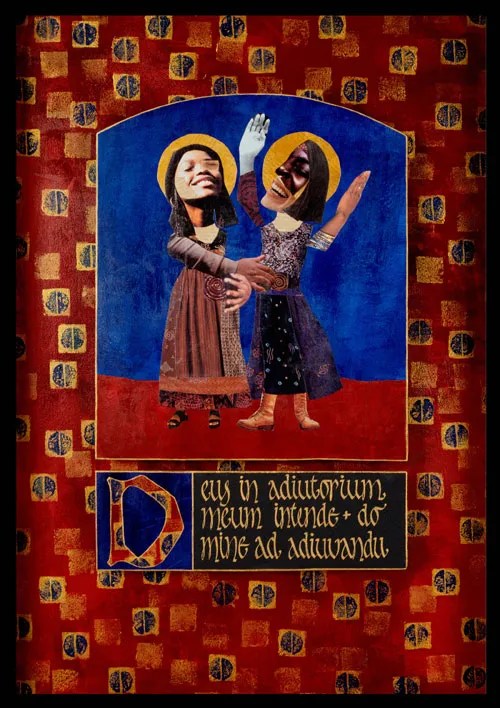
ART CYCLE: The Hours of Mary Magdalene by Jan L. Richardson: July 22 is the feast day of Mary Magdalene, one of Jesus’s closest disciples and the first witness and preacher of the Resurrection. American artist, writer, and minister Jan L. Richardson created a sequence of collages picturing events from her life, drawing on both the biblical narratives and medieval legends. The structure and presentation (decorative borders, Latin script) were inspired by medieval books of hours, used for the praying of the Divine Office. The text below each image reads, Deus, in adiutorium meum intende; Domine, ad adiuvandum me festina (“O God, come to my assistance; O Lord, make haste to help me”), the first verse of Psalm 70, which is prayed at the start of each of the canonical hours.

According to legend, after Jesus’s ascension Mary Magdalene moved to southern France, where she preached the gospel and performed miracles. The last thirty years of her life she lived as a hermit in a cave. Each time she prayed the hours, she was lifted up to heaven by angels, then brought back down at the end of her devotions.

Richardson put together a delightful little video showcasing the art cycle as well as the song “Mary Magdalena” by her late husband, Garrison Doles.

You can purchase these images as digital downloads from Richardson’s website:

  1. Matins: The Blessing Cups: Mary Magdalene and Jesus at Tea
  2. Lauds: After the Cross: The Magdalene’s Farewell
  3. Prime: Shopping for Spices: The Three Marys on Holy Saturday
  4. Terce: Touch Me Not: Resurrection Morning
  5. Sext: Release: Mary Magdalene Freeing Prisoners
  6. None: L’Evangeliste: Mary Magdalene Preaching in France
  7. Vespers: At Her Prayers: Mary Magdalene with a Book of Hours
  8. Compline: Magdalene Ascending: The Divine Hours

+++

DANCE: “Holy, Holy, Holy”: Choreographed by Betsey Beckman to a song by Karen Drucker, this dance number affirms the sacredness of every human being. It was filmed inside St. Gregory of Nyssa Episcopal Church in San Francisco, a church that “invites people to see God’s image in all humankind, to sing and dance to Jesus’ lead, and to become God’s friends.” Beckman dances with Dawon Davis and Corey Action throughout the worship space, which comprises a rectangular room where the Liturgy of the Word is celebrated and an octagonal rotunda for the Liturgy of the Table. The Dancing Saints icon that covers the walls is by Mark Doox. [HT: Global Christian Worship]

+++

MUSIC:

>> “Locus iste” by Anton Bruckner, performed by VOCES8: The British vocal ensemble VOCES8 performs Anton Bruckner’s sacred motet “Locus iste” (This Place) at Les Dominicains de Haute-Alsace in Guebwiller, France. Bruckner composed it in 1869 for the dedication of the Votivkapelle (votive chapel) at the New Cathedral in Linz, Austria, where he had been a cathedral organist. The text—a Latin gradual for church dedications and their anniversaries—is informed by Jacob’s saying, after his dream of the ladder uniting heaven and earth, that “surely the Lord is in this place; and I knew it not” (Gen. 28:16), and by the story of the burning bush where Moses is told to “put off thy shoes from off thy feet, for the place whereon thou standest is holy ground” (Exod. 3:5).

Locus iste a Deo factus est,
inaestimabile sacramentum;
irreprehensibilis est.

This place is made by God,
a priceless sacrament;
it is without reproach.

(Or, alternatively:)
This dwelling is God’s handiwork;
a mystery beyond all price,
that cannot be spoken against.

>> “Tabernacle” by Josh Rodriguez, performed by Mary Vanhoozer: A modernist piano composition inspired by Psalm 19, dedicated to the composer’s father-in-law, the theologian Kevin Vanhoozer.

Tabernacle is a musical triptych shaped by the drama of Psalm 19. While this word, tabernacle, is loaded with religious affection within both Jewish and Christian traditions, some modern readers may not be familiar with its implications. Merriam-Webster offers three related definitions: “a house of worship, a receptacle for the consecrated elements of the Eucharist, or a tent sanctuary used by the Israelites during the Exodus.” By extension, it has come to represent a “dwelling place” or a “temporary shelter.” In short, this is no ordinary space, rather it is a place that is set apart, made holy for a terrifying transformative encounter with the Divine.

Fragments of a prayerful hymn-like melody appear underneath this canopy of sounds. Shifting metric changes, polyrhythms, and percussive primal-sounding harmonies climax in a loud, noisy quote from the 16th-century Genevan Psalter.

More extensive program notes can be found in the YouTube video description.

+++

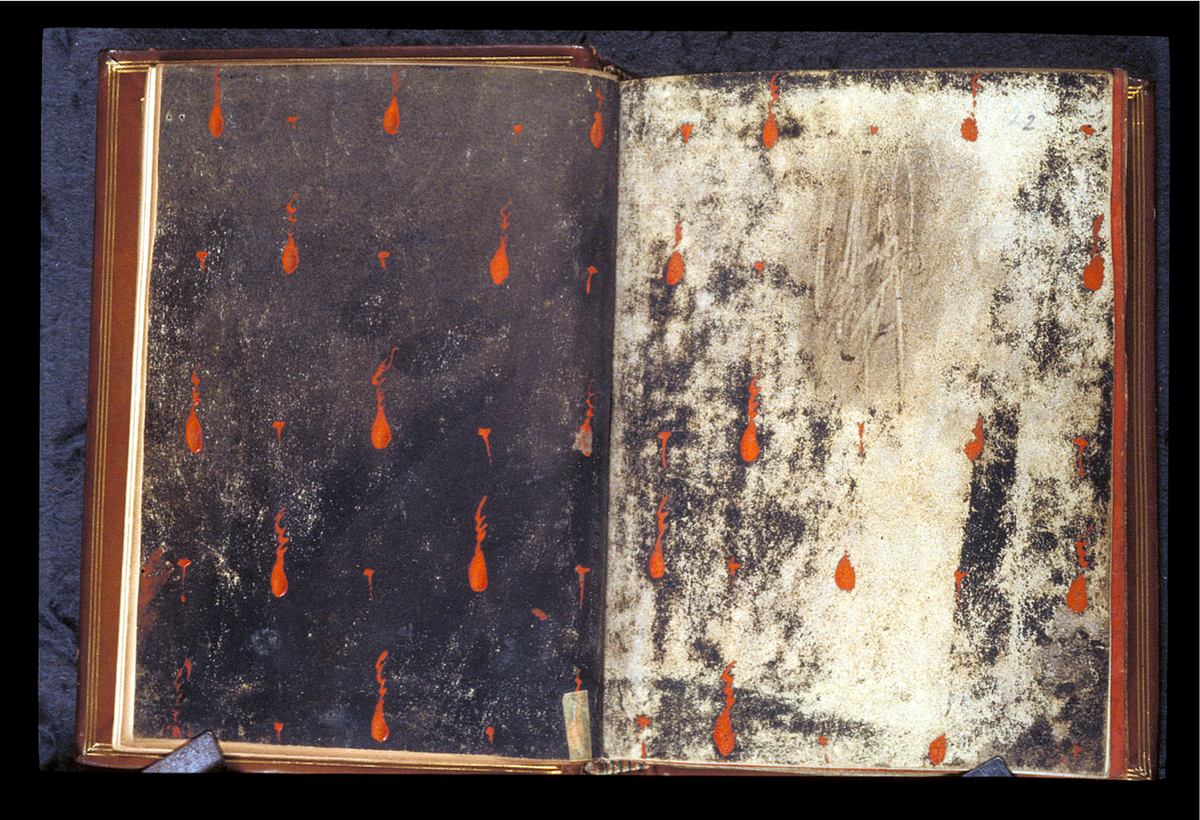
ESSAY: “Precedents of the Unprecedented: Black Squares Before Malevich” by Andrew Spira, Public Domain Review: Considered one of the seminal works of modern art, Kazimir Malevich’s Black Square (1915) has been cast as a total break from all that came before it. Yet searching across more than five hundred years of images related to cosmology, religious devotion, mourning, humor, politics, and philosophy, art historian Andrew Spira uncovers a slew of unlikely foreshadows to Malevich’s radical abstraction.

Et sic in infinitum
Robert Fludd’s black square representing the nothingness that was prior to the universe, from his Utriusque Cosmi (1617). On each side of the square is written “Et sic in infinitum…” (“And so on to infinity…”).

Blood of Christ
Black pages with red drops of blood, signifying the wounds of Christ, from a psalter and rosary of the Virgin, ca. 1500. The recto is worn from devotional engagement, damaged through kissing and rubbing, perhaps.

For a much more extensive treatment of the topic, see Spira’s Foreshadowed: Malevich’s “Black Square” and Its Precursors, published this month. And for a faith-positive (non-nihilistic) reading of Malevich’s Black Square that honors the artist’s own views, see pages 209–25 of Jonathan A. Anderson and William A. Dyrness’s Modern Art and the Life of a Culture, where they discuss the work in relation to the Russian icons tradition and “apophatic or ‘negative’ theology—a mode of theology that meditates on the absolute Fullness and Otherness of God by way of negating the verbal, visual and conceptual forms used to signify (and to ‘grasp’) God” (220).

Roundup: Ethiopian illuminations, convent cradles, Women’s Christmas, and more

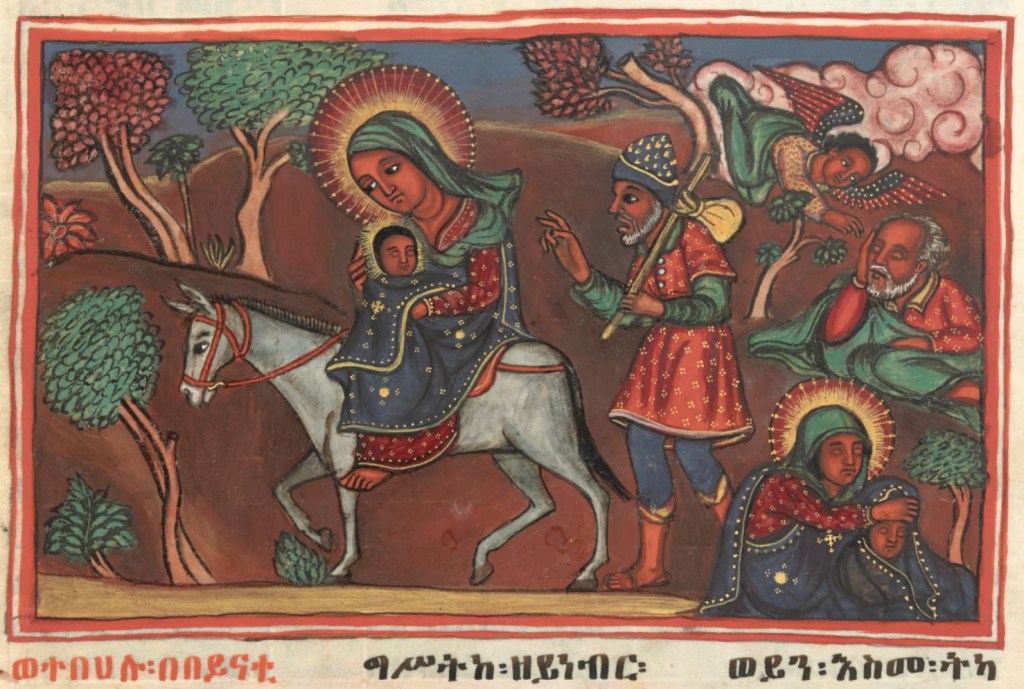
“The Christmas Story: Images from Ethiopic Manuscripts” by Eyob Derillo: The British Library has a fantastic collection of Christian manuscripts from seventeenth- and eighteenth-century Ethiopia. This blog post by curator Eyob Derillo shows Christmas-related illuminations from four different ones. Follow the links in the captions to explore each manuscript further.

Flight to Egypt (Ethiopian)
“Flight into Egypt,” from the Nagara Māryām (History and Miracles of the Blessed Virgin Mary), Ethiopia, ca. 1730–55. British Library Or. 607, fol. 17r.

You can follow Derillo on Twitter @DerilloEyob. He’s always posting fascinating things about Ethiopian art and its intersection with the country’s history, culture, politics, and Christianity, including lots of Ethiopian saints’ stories!

If you enjoyed the blog post, I recommend the highly accessible book The Road to Bethlehem: An Ethiopian Nativity, an interweaving of ancient (apocryphal) tales surrounding Jesus’s birth that flourished in Ethiopia, compiled and told by Elizabeth Laird, with the biblical narrative. It’s illustrated in full color with images from the British Library’s collection and is perfectly appropriate for children (and adults!). I’ve perused the Ethiopian manuscripts on the BL website but am not able to decode several of the images because I’m unfamiliar with the tales and cannot read Ge’ez, and Laird’s book helped me out in that respect, at least in part. For a deeper dive into Ethiopian art—which is inextricable from its patrons’ and makers’ Christian spirituality—see the informative and beautifully produced Ethiopian Art: The Walters Art Museum, a catalog from another museum that houses a fine collection of Ethiopian art.

+++

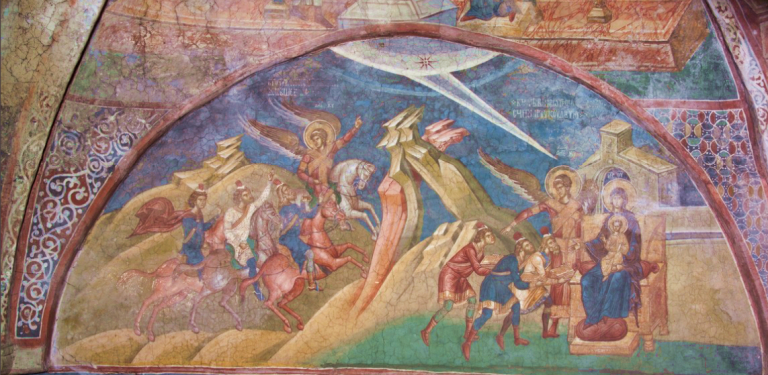
The Angel of the Lord in icons of the Magi: In this recent post from Icons and Their Interpretation [previously], icons consultant David Coomler spotlights a fresco from Decani Monastery in Serbia that shows an angel on horseback leading the magi to the Christ child, emphasizing supernatural direction. He identifies the same, idiosyncratic figure in a 1548 painting by Frangos Katelanos at Varlaam Monastery in Meteora, Greece, comparing it to two more common appearances of an angel with the magi in Eastern iconography: on foot beside the newborn king’s “throne,” presenting the magi to him.

Journey and Adoration of the Magi (icon)
Journey of the Magi and Adoration of the Magi, 14th century. Fresco, Decani Monastery, Serbia. View a modern copy here.

+++

SONG MEDLEY: “Christmas Around the World” by Acapals: Acapals is a collaboration of four friends and a penguin who share a love for making a cappella music (despite not sharing much in the way of geography, culture or language).” They are Nick Hogben, tenor, from England; Leif Tse, baritone, from Hong Kong; Jacky Höger, alto, from Germany; and Prayer Weerakitti, soprano, from Thailand. In this video each of them arranged a holiday song in their native language, which they sing together: “Hark! The Herald Angels Sing” (English), “Silent Night” (Cantonese), “Es ist ein Ros’ entsprungen” (German), and “New Year Greeting” (Thai). [HT: Global Christian Worship]

+++

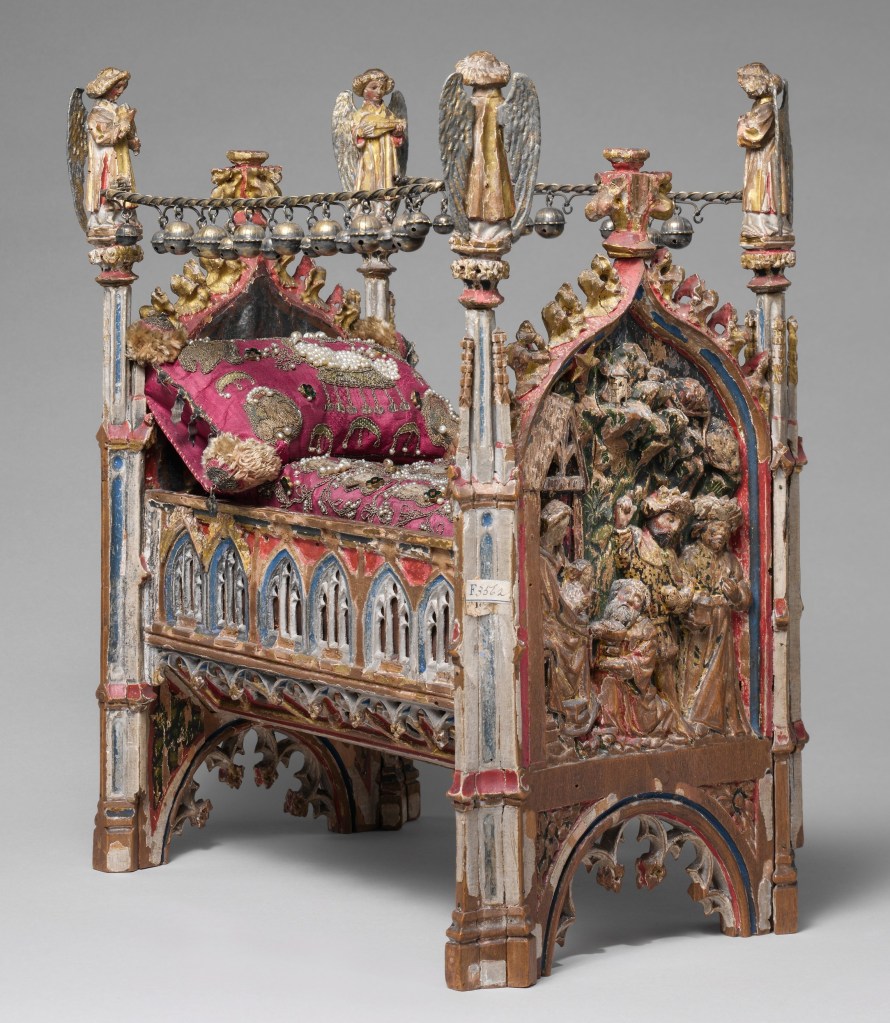
“The Cloister and the Cradle” by Shannon Reed: Some medieval nuns and lay religious women cared for baby Jesus dolls (ceramic or wooden) as a devotional practice—dressing them, playing with them, “feeding” them, singing to them, rocking them in cradles. Full of wit and tenderness, this Vela magazine essay by Shannon Reed explores that practice. “It is difficult to separate my modern reaction to the sight of a grown woman (in a habit!) acting in such bizarre ways, carrying a doll around and pretending it’s real,” Reed writes. “But I try to remember that for these women, this was an empowering opportunity to be Mary, most holy, most blessed.”

Reed considers women’s agency in the Middle Ages, mystical visions made tangible, and the desire for maternal intimacy, incorporating personal stories and reflections, as a single woman without children, about attending baby showers, nannying through grad school, shopping for godchildren, and teetering between enjoyment of her non-mom status and an inclination to mother. As a thirty-two-year-old woman who also does not have kids (though I am married) and is content but constantly surrounded by reminders of what I’m missing, I can relate to a lot of the feelings and experiences Reed articulates here. I chanced upon this essay when trying to find more information about a Beguine cradle I saw at the Met, pictured below (spurred, too, by the description of a Virgin and Child ivory). I found myself unexpectedly moved by the author’s vulnerability and by the connections she draws between modern-day longings for and expressions of motherhood and those played out in medieval Christian convents.

Beguine cradle (The Met)
Crib of the Infant Jesus, 15th century, from the Grand Béguinage in Louvain (now at the Metropolitan Museum of Art). Click to view details of the carved Nativity and Adoration of the Magi at the head and foot and, on the embroidered coverlet, Jesus’s family tree.

To learn more about how some medieval women mediated their relationship with Christ in part through dolls and cradles, see “Crib of the Infant Jesus” from Feminae: Medieval Women and Gender Index, “Cradling Power: Female Devotions and Early Netherlandish Jésueaux” by Annette LeZotte, “Female Spirituality and the Infant Jesus in Late Medieval Dominican Convents” by Ulinka Rublack, and “Encounter: Holy Beds” by Caroline Walker Bynum.

+++

The Sanctuary Between Us: A Retreat for Women’s Christmas by Jan Richardson: Every year artist, writer, and Methodist minister Jan Richardson provides a new compilation of her art, blessings, and spiritual reflections as a free PDF download. The subtitle references the Irish custom of Nollaig na mBan, or Women’s Christmas, observed particularly in County Cork and County Kerry. “Women’s Christmas originated as a day when the women, who often carried the domestic responsibilities all year, took Epiphany [January 6] as an occasion to celebrate together at the end of the holidays, leaving hearth and home to the men for a few hours.” In this spirit Richardson offers an opportunity “to pause and step back from whatever has kept you busy and hurried in the past weeks or months, . . .  spend[ing] time in reflection before diving into what this new year will hold.”

“Blessing to Summon Rejoicing,” “Blessing of Memory,” “Blessing the Body,” and “Blessed Are You Who Bear the Light” are among the several benedictions, thoughtfully introduced and many accompanied by collages, paintings, or encaustics. Some sections also include questions for personal reflection. For example: “How do you experience—or desire to experience—remembering in community? Who are the people who hold your memories with you? Are there ways you experience memory as a sacrament, a space where you know the presence and grace of God at work in your life? For whom might you be (or become) a sanctuary of memory as you help them hold their stories and their lives?”

Wise Women Also Came by Jan Richardson
Wise Women Also Came © Jan L. Richardson [purchase]

The poem “Wise Women Also Came,” printed as an interlude, is especially compelling, describing how, in addition to the wise men mentioned in the biblical narrative, wise women also came to Jesus’s birth bearing gifts—“water for labor’s washing, / fire for warm illumination, / a blanket for swaddling.”

Roundup: Bad-news blessing, the transfiguration of Marilyn Monroe, Christian speculative fiction anthology, European sacred art tour

BLESSING: “Blessing for Getting the News” by Jan L. Richardson: August brought two devastating pieces of news to me; I wasn’t in the line of direct impact, but I hurt for the two families who were. A blessing by artist-author Jan L. Richardson came at just the right time. Here’s an excerpt:

. . . when
the news comes,
may it be attended
by every grace,
including the ones
you will not be able
to see now.

When the news comes,
may there be hands
to enfold and bless,
even when
you cannot receive
their blessing now.

When the news comes,
may the humming
in your head
give way to song,
even if it will be
long and long
before you can
hear it,

before you can
comprehend the love
that latched onto you
in the rending—
the love that bound itself to you
even as it began its leaving
and has never
let you go.

Read more, and view original accompanying artwork, at http://paintedprayerbook.com.

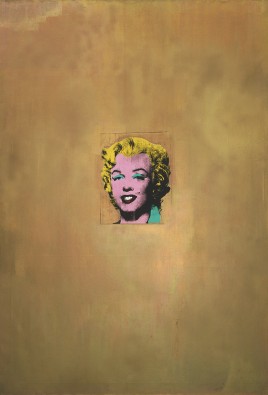
ESSAY: “Transfiguring Gold: Andy Warhol’s Gold Marilyn Monroe” by James Romaine: In his latest visual meditation for ArtWay, art historian James Romaine writes on external versus essential beauty, and the Orthodox aesthetic, in one of Warhol’s most famous paintings. “A revelation of uncreated and transfiguring light” in the icon tradition, the use of gold, Romaine posits, was a theological choice on Warhol’s part, one influenced by his Byzantine Catholic faith. Warhol drew on celebrity imagery to encourage a transformation in viewers from material sight to metaphysical vision. This essay is adapted from a more extensive one titled “The Transfiguration of the Soup Can,” published in Beauty and the Beautiful in Eastern Christian Culture and linked to here with the author’s permission.

Gold Marilyn Monroe by Andy Warhol
Andy Warhol (American, 1928–1987), Gold Marilyn Monroe, 1962. Silkscreen ink on synthetic polymer paint on canvas, 211.4 × 144.7 cm. Museum of Modern Art, New York.

BOOK: Mysterion: Rediscovering the Mysteries of the Christian Faith, edited by Donald Crankshaw and Kristin Janz: Last week the husband and wife team of Donald Crankshaw and Kristin Janz published an anthology of science fiction, fantasy, and horror stories that engage with Christianity. It features twenty of the 450-plus submissions they received, all but four of which are published here for the first time. Describing their criteria for selection, Crankshaw writes in the introduction, “We wanted stories that were as untidy and as theologically imprecise as the Bible itself.” The result is a collection of diverse voices and approaches, exploring such topics as sin, forgiveness, the afterlife, the soul, mission, miracles, and supernatural agents. To read excerpts from the book, visit www.mysterionanthology.com.

Mysterion cover

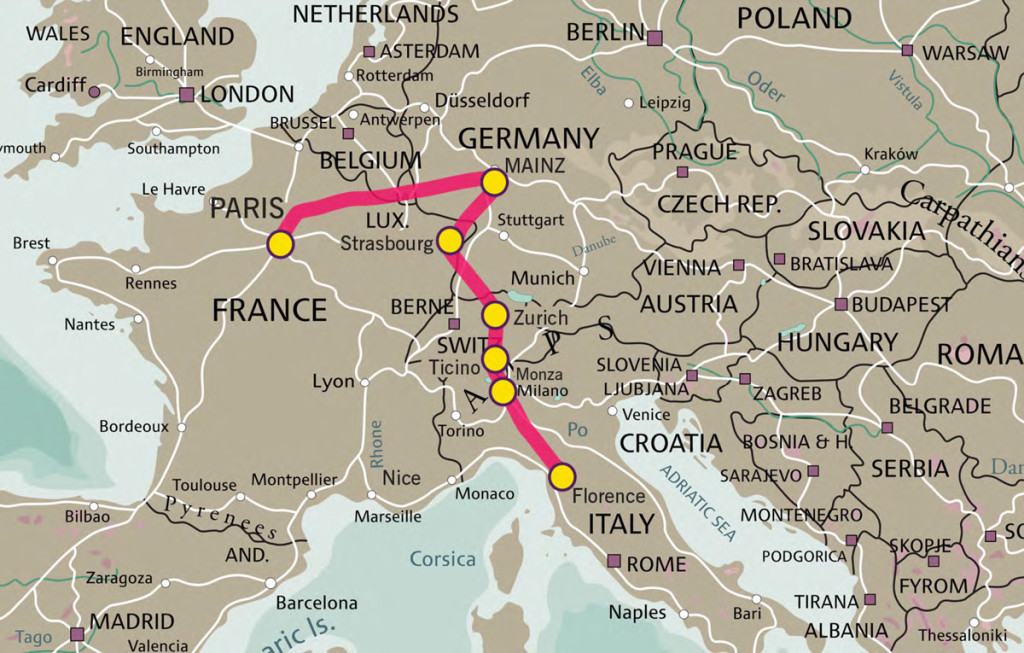
TOUR: “Reformanda 2017: Sacred Arts Today, Catholic and Protestant”: The Mount Tabor Ecumenical Centre for Art and Spirituality, founded by the Community of Jesus in Massachusetts, has organized a four-leg European tour for next May 10–30 that will explore the face of sacred art from the last five hundred years since the Reformation. With stops in France, Germany, Switzerland, and Italy, the itinerary includes visits to churches and contemporary art exhibitions, symposium lectures and discussions led by Msgr. Timothy Verdon, and Gloriae Dei Cantores choral concerts. Registration is now open.

Reformanda Tour Map