Kolumba and KMSKA: Medieval and contemporary art in conversation (part 2)

This a continuation of yesterday’s article. In part 1 I shared three room highlights from my visit to Kolumba museum in Cologne, Germany, run by the city’s Catholic archdiocese; in this final part I will do the same for KMSKA in Antwerp, Belgium, whose Old Masters galleries received a “contemporary injection” in an exhibition that wrapped this week. All photos are my own.

[Content warning: This article contains female nudity: a controversial Renaissance painting of the Virgin Mary, and three photographs of women who have just given birth.]

KMSKA, Antwerp

The Royal Museum of Fine Arts Antwerp, or KMSKA for short, is a world-famous museum whose collection spans seven centuries, from the Flemish Primitives to the Expressionists.

When I was there last month, the featured exhibition was Collected with Vision: Private Collections in Dialogue with the Old Masters, which ran from April 4 to October 12, 2025. Organized in conjunction with Geukens & De Vil Projects, it interwove postwar and contemporary works by internationally renowned artists from Belgian private collections with the existing museum collection, “expanding the transhistorical approach already in place. The exhibition offers a reflection on the history of art collecting and asks probing questions about social issues such as gender, power and identity. The role of museums and collectors is the focal point. Do the interventions create a harmonious dialogue with 700 years of art history, or do they give rise to challenging contrasts?” Featured artists included Cindy Sherman, Olafur Eliasson, David Claerbout, Francis Alys, Christian Boltanksi, Tracey Emin, Marlene Dumas, Luc Tuymans, and Louise Bourgeois.

The galleries of the exhibition were organized by theme: Holy, Impotence, Horizon, Image, Entertainment, Profusion, Lessons for Life, Fame, The Salon, Heroes, Evil, The Madonna, Suffering, Redemption, Prayer, Heavens, and Power.

I’ll spotlight what I consider the most successful and intriguing pairings.

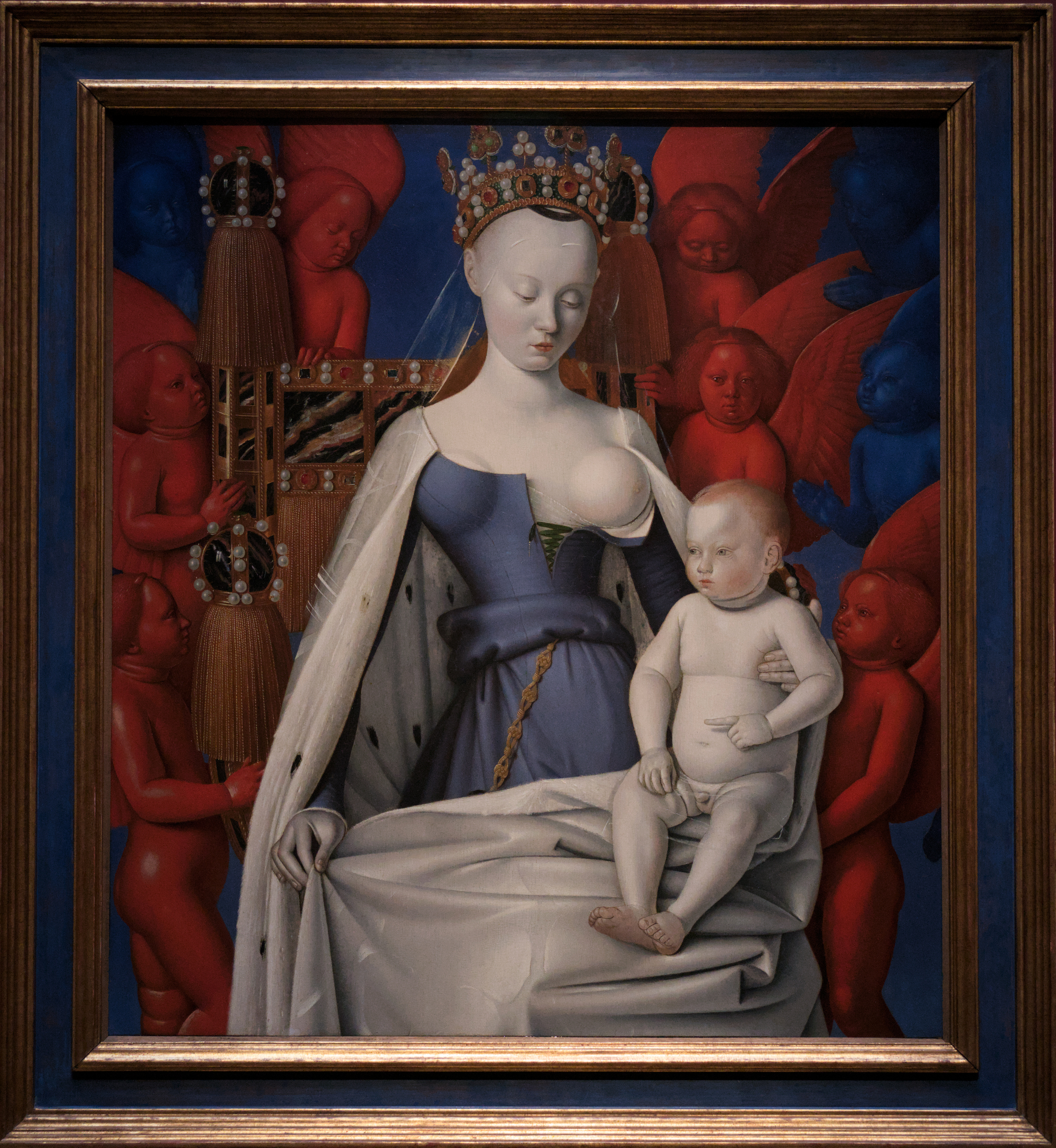
First, the “Madonna” room, anchored by the famous Madonna Surrounded by Seraphim and Cherubim by the late medieval French court painter Jean Fouquet. It’s the right wing of a diptych that originally hung above an altar at the Collegiate Church of Notre-Dame in Melun.
Fouquet, Jean_Madonna Surrounded by Seraphim and Cherubim
Jean Fouquet (French, 1410/30–1477/81), Madonna Surrounded by Seraphim and Cherubim, ca. 1450. Oil on panel, 92 × 83.5 cm. Koninklijk Museum voor Schone Kunsten Antwerpen (KMSKA, Royal Museum of Fine Arts Antwerp).

The painting is historically significant—I first encountered it in a college art history course. Commissioned by Etienne Chevalier, treasurer to King Charles VII of France, it portrays the Virgin Mary as the Queen of Heaven, baring her breast ostensibly to nourish the Christ child with her milk. She was probably modeled after Agnès Sorel, the king’s recently deceased mistress and mother of three of his daughters, considered the ideal of feminine beauty at that time in western Europe: pale-skinned, with a high forehead, and fashionable in her ermine cloak.

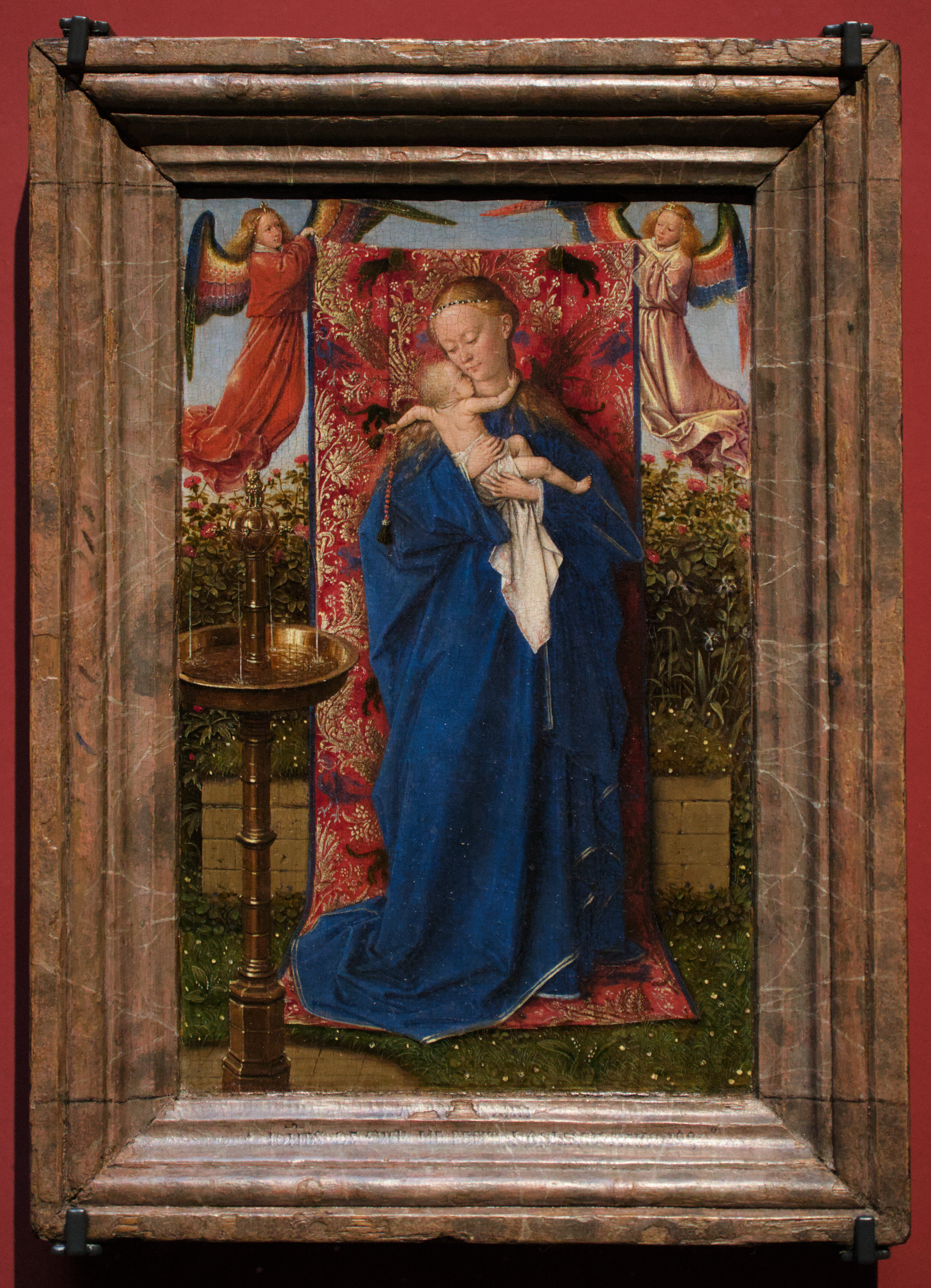
Though I can appreciate the technical excellence of this painting and the intense reds and blues of the angels, I don’t really like it. Mary seems cold, not very maternal. There’s also an eroticization of her body—not because her breast is exposed, which was common in Marian art, but because it seems to be on display for the viewer; her son’s not interested in feeding—that’s wholly inappropriate for the subject. Why you’d want to memorialize your boss’s sex partner in such a way is beyond me. I’m no prude, but I much prefer Jan van Eyck’s Madonna at the Fountain, on display in the same room:
van Eyck, Jan_Madonna at the Fountain
Jan van Eyck (Flemish, 1390/99–1441), Madonna at the Fountain, 1439. Oil on panel, 19 × 12 cm. Koninklijk Museum voor Schone Kunsten Antwerpen (KMSKA, Royal Museum of Fine Arts Antwerp).

This small painting originally hung not in a church but in someone’s house. Though there’s still an air of formality, it has all the tenderness and connection that the other one lacks. Mother and son embrace in a garden of roses, irises, and lilies of the valley, he reaching round her neck and holding a string of prayer beads, she gazing adoringly at him. They stand beside a fountain, recalling Jesus’s discussion in John 4 about the “living water” he gives to those who thirst. The original wood frame bears the artist’s motto: “As well as I can.”

The deeply engrained portrait of motherhood embodied by the Virgin Mary is juxtaposed most potently with a series of three black-and-white portraits of new mothers by the Dutch photographer Rineke Dijkstra.
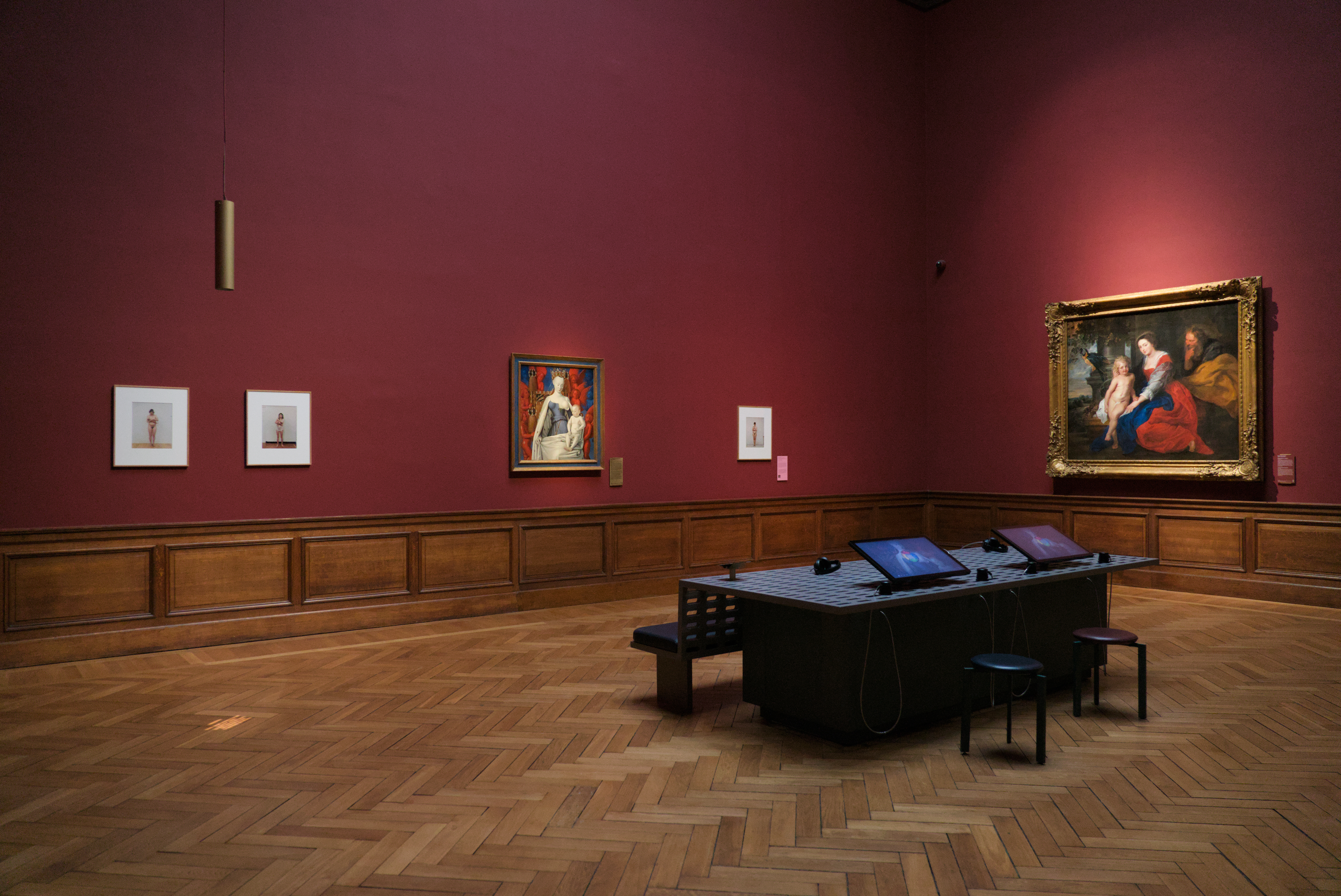
"Madonna" gallery
Gallery 2.17 (“The Madonna”) from the KMSKA exhibition Collected with Vision: Private Collections in Dialogue with the Old Masters

The accompanying text read:

Jean Fouquet portrays motherhood as something sacred. Mary as a symbol of purity and devotion is richly dressed in cool colours. Rineke Dijkstra homes in on the vulnerable reality. Her mothers are scantily clad and marked by childbirth. Both works are innovative: Fouquet may have painted his Mary for the first time from a real person, and in its day the painting was regarded as ‘modern’. Dijkstra shows motherhood in all its rawness, a taboo usually withheld from view.
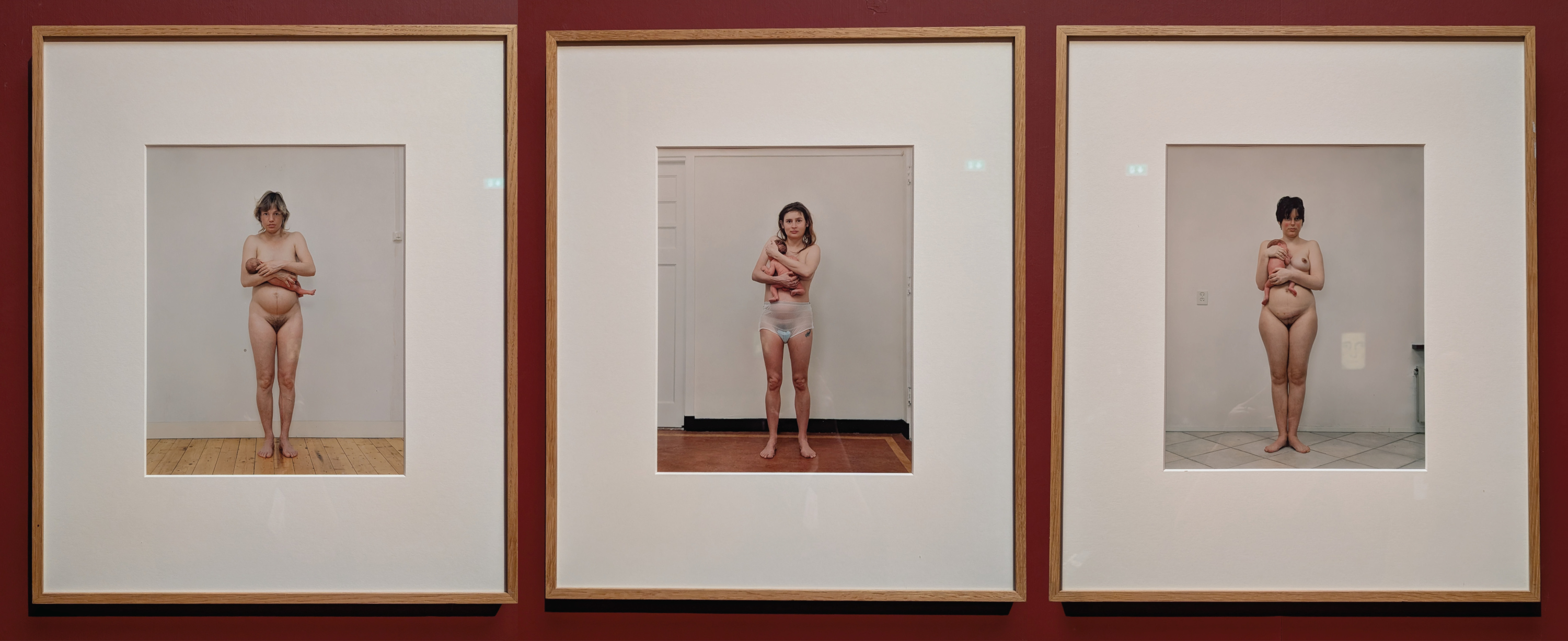
Dijkstra, Rineke_New Mothers
Rineke Dijkstra (Dutch, 1959–), Tecla (Amsterdam, The Netherlands), Julie (Den Haag, The Netherlands), and Saskia (Harderwijk, The Netherlands), 1994. Digital prints. Private collection. [Composite photo by author]

Julie wears hospital pads and mesh underwear, which women often do for several weeks after giving birth to manage postpartum bleeding and urinary incontinence. As for Tecla, blood is running down her leg. And Saskia bears a scar from her cesarean section. A linea nigra (dark line) zips down the abdomen of all three, a temporary pigmentation increase caused by increased hormone levels. I love this triptych that shows motherhood’s glorious, messy, alterative impact on the body—the real physicality of the vocation of bearing children into the world.

I wish there were more imagery of Mary like this, as it would, I think, deepen the wonder of the Incarnation and enhance women’s ability to identify with Mary and thus further enliven her story.

Also in the Madonna gallery was a unique “light poetry” installation by Nick Mattan and Angelo Tijssens—one of seventeen spread throughout the second floor, collectively titled Licht dat naar ons tast (Light that reaches for us). KMSKA had commissioned this couple to bring to life the short verses the museum’s late writer-in-residence Bernard Dewulf had written in response to the galleries’ stated themes.

“Inspired by the museum’s many reading and praying figures, as well as James Ensor’s expressive hand sketches, [Mattan and Tijssens] sought a subtle way to make [Dewulf’s] words tangible,” the museum writes. Their solution was to project them onto the gallery floors from brass cylinders suspended from the ceiling. The words shine like faint specks of light, becoming legible only when a visitor holds their hands, a sweater, or something else up to the light.

Here my husband “holds” a poem written in the voice of Mary:
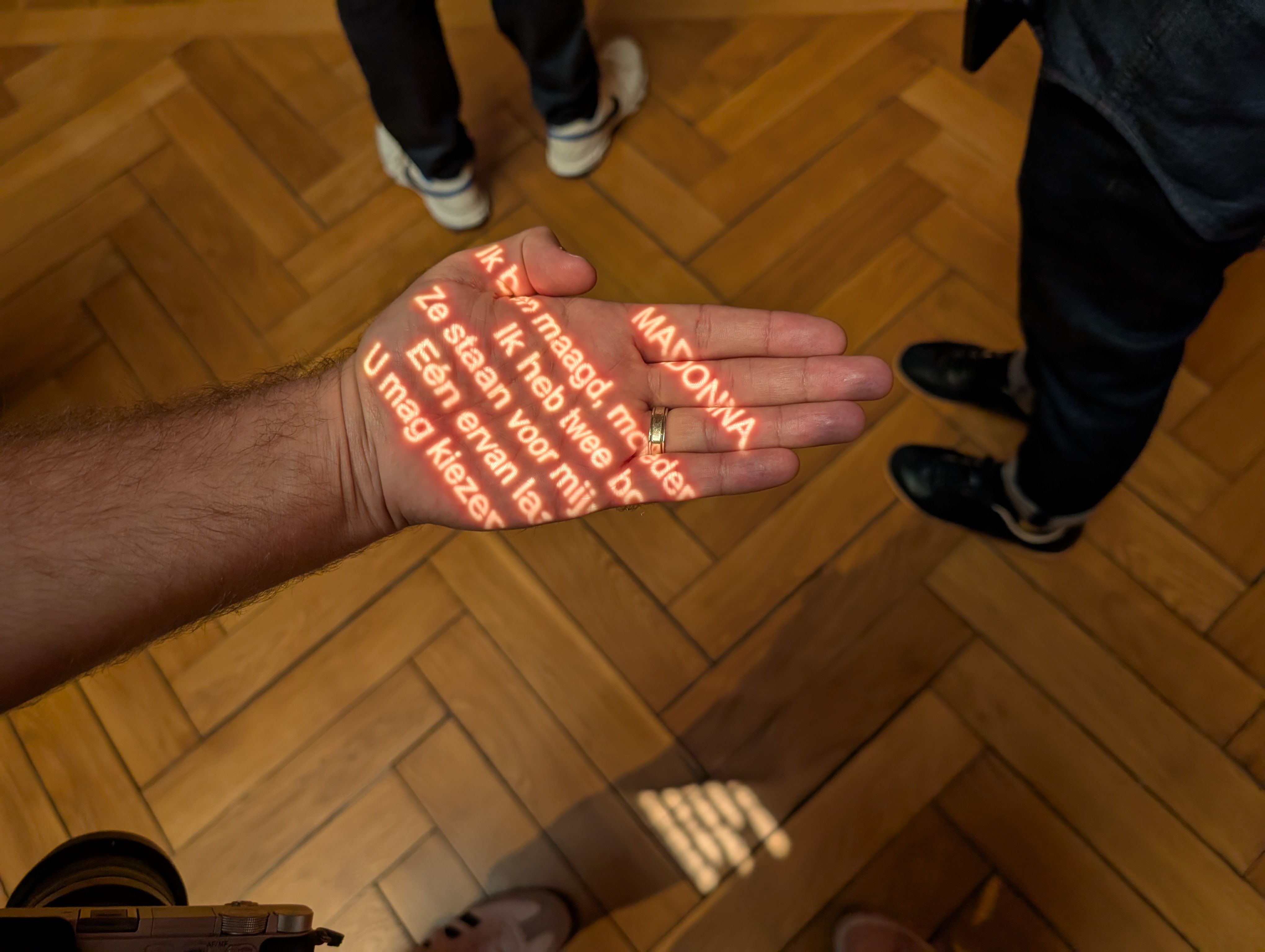
Light that reaches for us
Nick Mattan (Belgian, 1987–) and Angelo Tijssens (Belgian, 1986–), Licht dat naar ons tast (Light that reaches for us), 2023, featuring seventeen poems by Bernard Dewulf. Commissioned by and permanently installed at the Koninklijk Museum voor Schone Kunsten Antwerpen (KMSKA, Royal Museum of Fine Arts Antwerp).

“Madonna” by Bernard Dewulf

Virgin, mother, wife –
I have two breasts
that stand for my three souls.
I show you one of them,
and whose it is is yours to choose.

Translated from the original Dutch by David Colmer

Kind of cheeky! Dewulf speaks of Mary’s three identities and lets us decide if the breast she bares in Fouquet’s painting represents her naked innocence, her nurturing impulse, or her desire to please her husband. (Traditionally in art, it has always stood for the second.)

Though I can’t read Dutch and thus had to consult the KMSKA app for translations of the poems, the thrill of discovery was there in each room. View other visitor engagements with Licht dat naar ons tast on Instagram.

The next gallery I entered was themed “Suffering.”
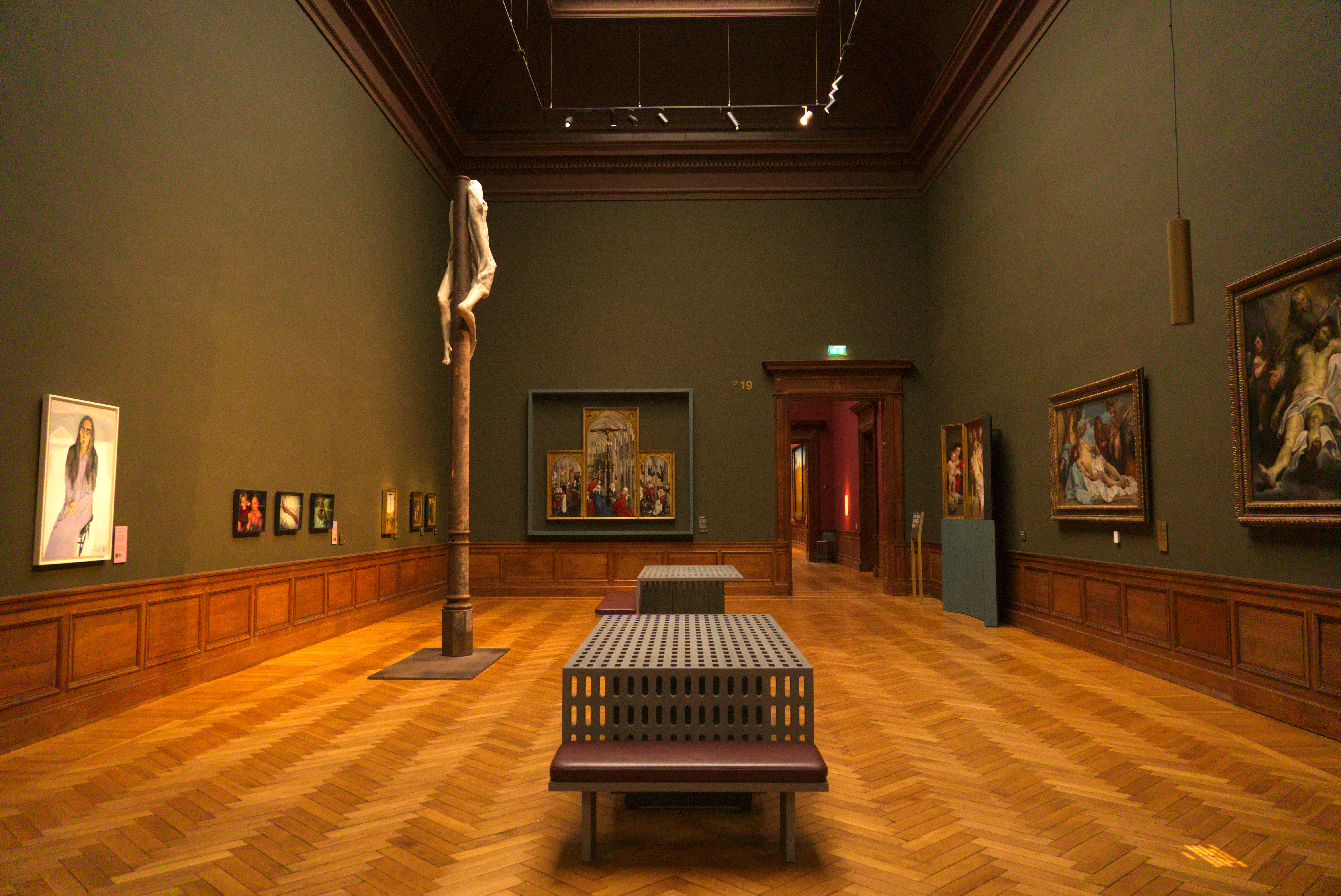
Suffering gallery
Gallery 2.19 (“Suffering”) from the KMSKA exhibition Collected with Vision: Private Collections in Dialogue with the Old Masters

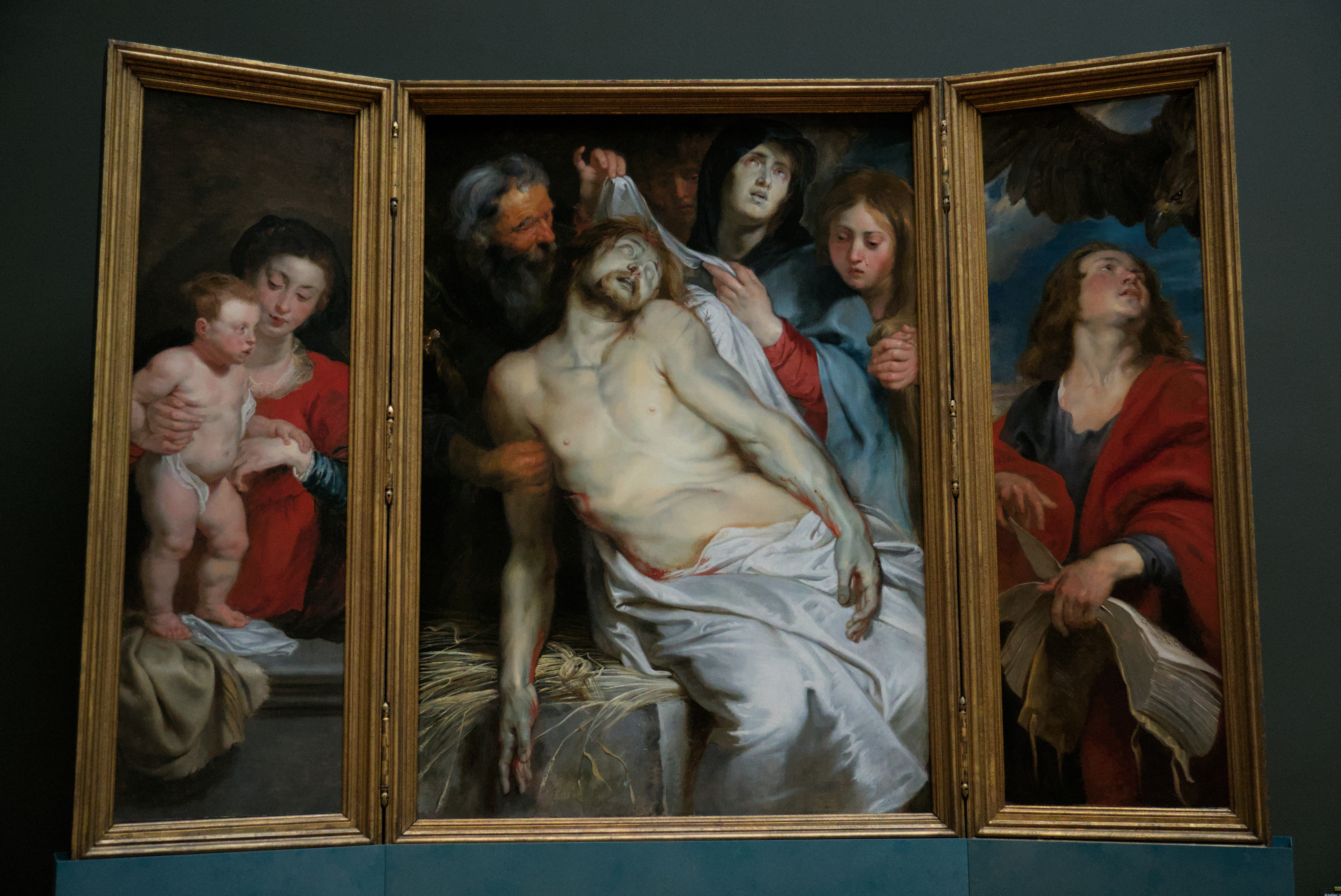
As one would expect, it’s inhabited by several Old Master paintings of Christ’s passion, most notably a triptych by the Flemish Baroque artist Peter Paul Rubens.
Rubens, Peter Paul_Christ on the Straw
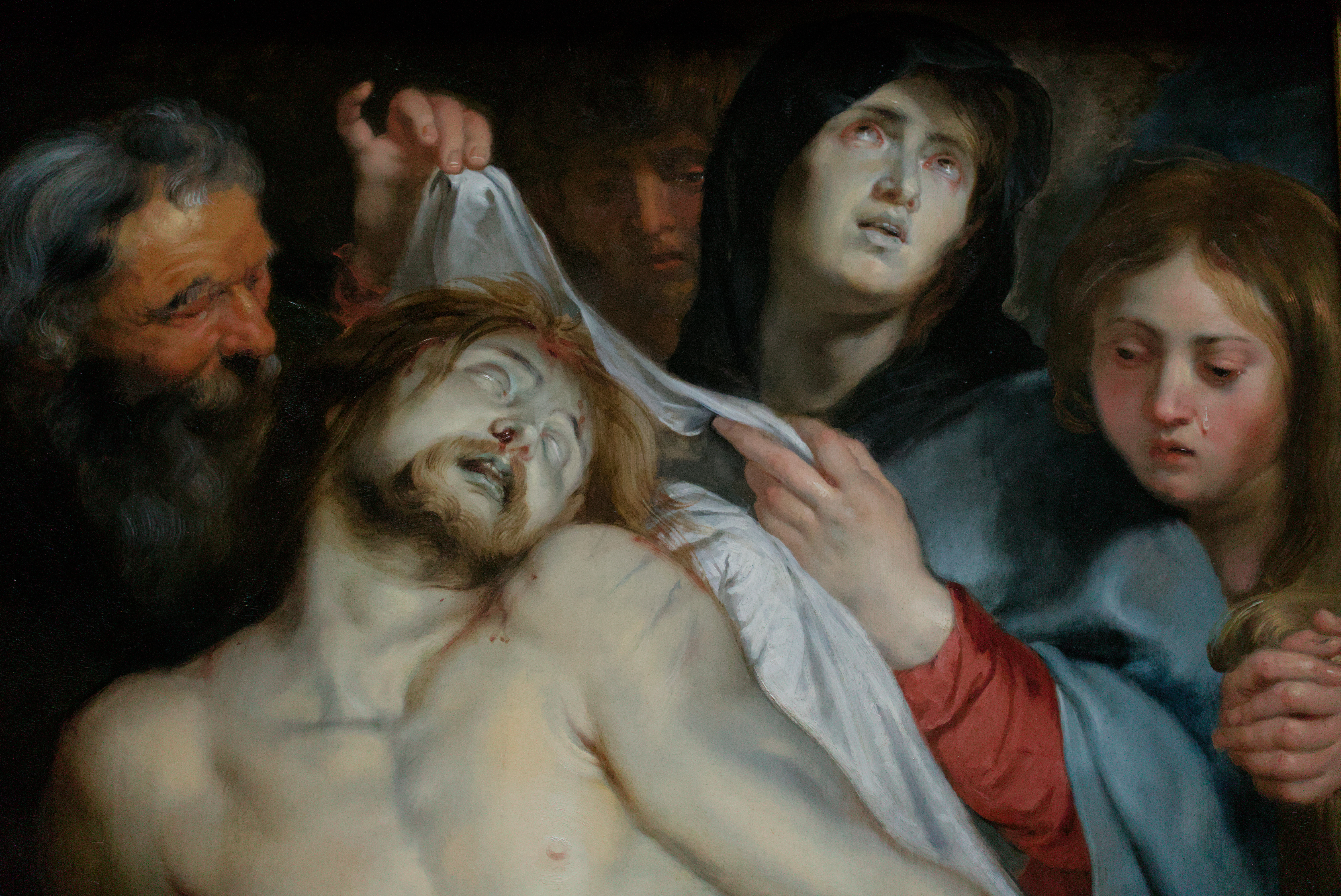
Peter Paul Rubens (Flemish, 1577–1640), Epitaph of Jan Michielsen and His Wife Maria Maes (aka Christ on the Straw, Madonna, and Saint John), 1618. Oil on panel, 138 × 178 cm. Koninklijk Museum voor Schone Kunsten Antwerpen (KMSKA, Royal Museum of Fine Arts Antwerp).

Rubens, Peter Paul_Christ on the straw (detail)

The central panel shows the dead Christ being laid out on a marble slab and wrapped in a shroud by Joseph of Arimathea, while his mother and Mary Magdalene (and the apostle John in the background) mourn him. The left wing shows Mary supporting the pudgy little baby Jesus as he takes some of his first steps, while the right wing shows John, whose symbol is the eagle, writing his Gospel that will place Jesus’s death in the context of the larger story of his life of ministry and his resurrection.

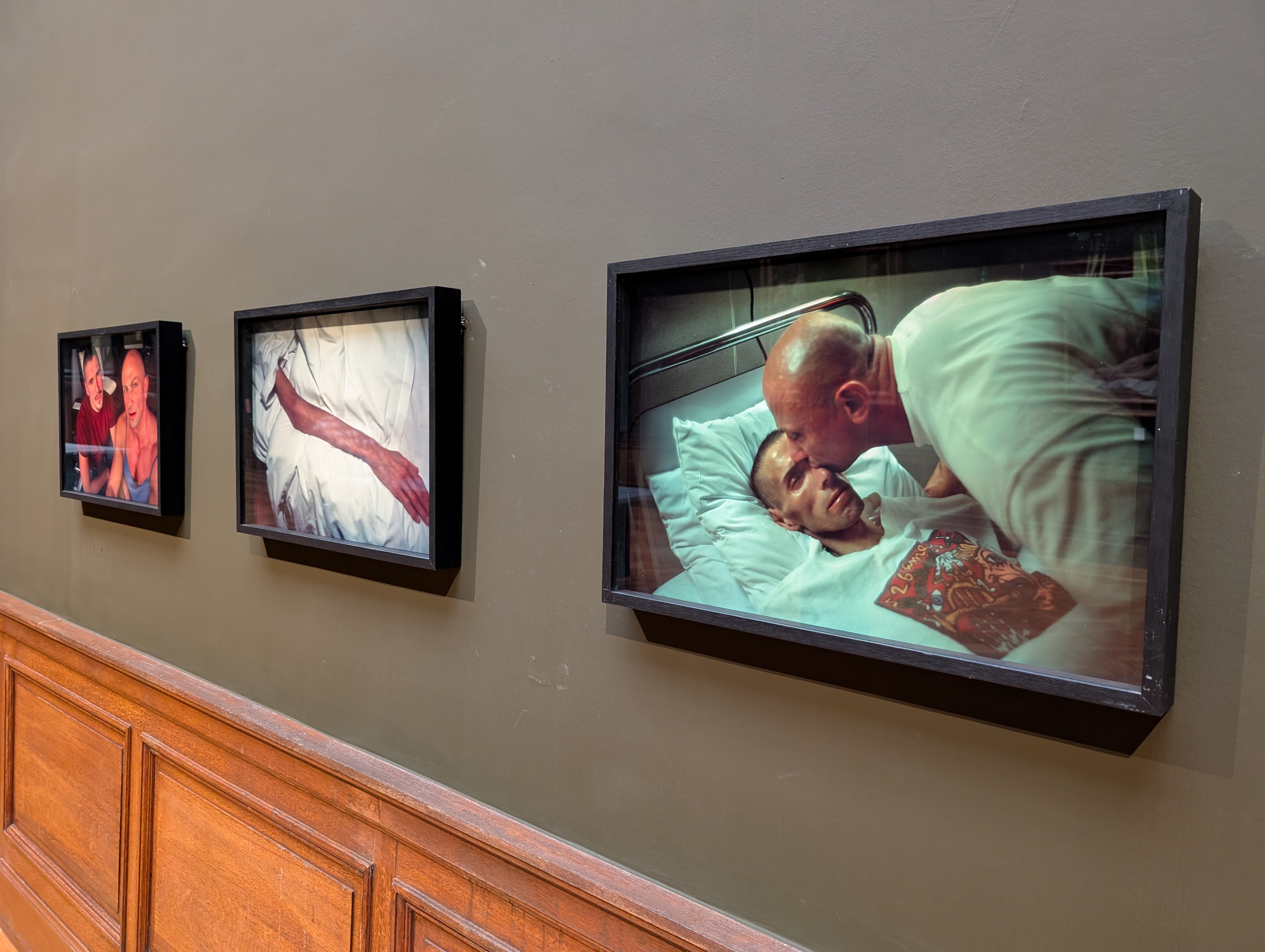
This painting, along with Anthony van Dyck’s Lamentation over the Dead Christ and The Holy Trinity by a follower of Rubens’s (which shows God the Father cradling the dead body of God the Son in an image type sometimes referred to as the Mystic Pietà), are juxtaposed with three photographs by Nan Goldin that show the impact of AIDS on her friend, the Parisian gallery owner Gilles Dusein, and his partner, the artist Gotscho.
Photos by Nan Goldin
Nan Goldin (American, 1953–), Gilles in Hospital, Gilles’ Arm, and Gotscho Kissing Gilles, 1993. C-prints. Private collection.

Dusein’s emaciated arm, resting weakly on a hospital sheet, recalls the limp arm of Christ in paintings of the Deposition and Entombment; and Gotscho’s kiss, the love and grief of Jesus’s mother and friends as they watched their loved one suffer and succumb to death.

By displaying these disparate artworks from vastly different contexts across from each other, we are encouraged to draw connections between the suffering of Christ and that of the LGBTQ+ community. While Christians in Rubens’s day would sit before images of Jesus in pain or sorrow or having died a torturous and untimely death, and deepen their empathy and love, so too might we do well to sit prayerfully, humbly, empathetically, with contemporary images of suffering, seeking to enter the stories they tell.

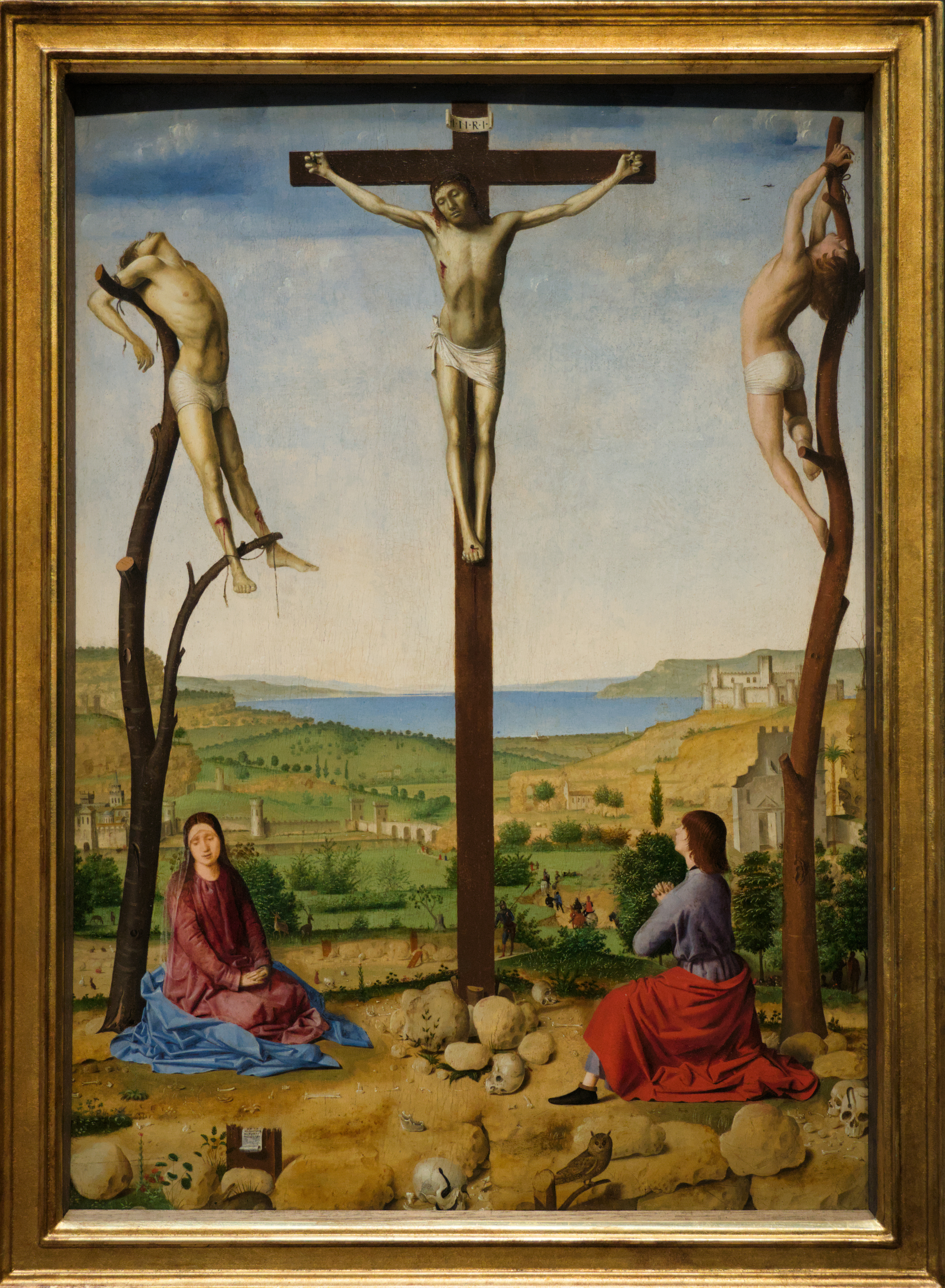
Calvary by Antonello da Messina (another version of which is at the National Gallery in London) also hangs in this gallery. While the crucified Christ seems at peace with his death, the other two on their crosses writhe in pain.
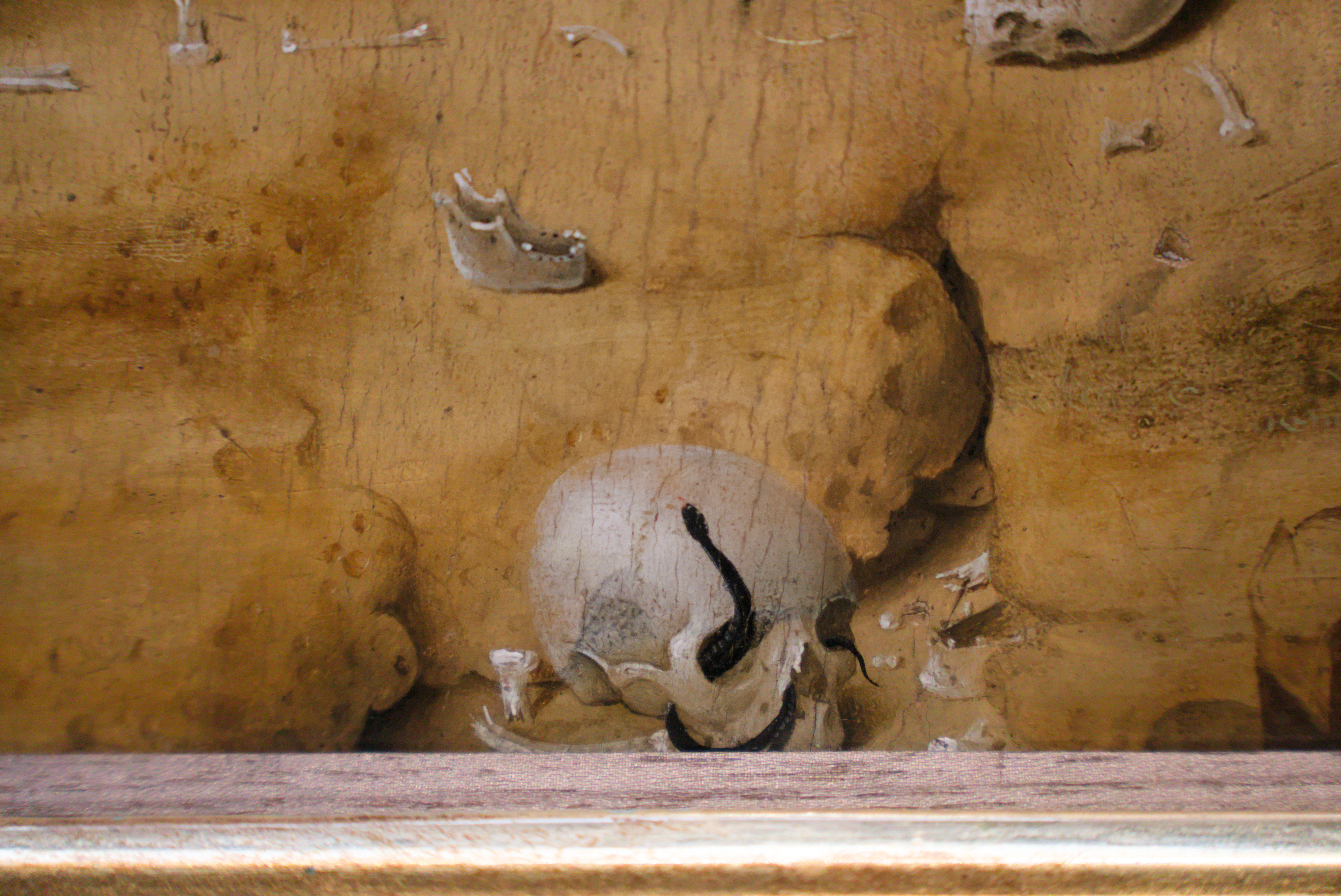
Antonello da Messina_Calvary
Antonello da Messina (Italian, 1430–1479), Calvary, 1475. Oil on panel, 52.5 × 42.5 cm. Koninklijk Museum voor Schone Kunsten Antwerpen (KMSKA, Royal Museum of Fine Arts Antwerp).

Antonello da Messina_Calvary (detail)

Compare these figures to contemporary Belgian artist Berlinde de Bruyckere’s Schmerzensmann (Man of Sorrows), on loan from the collection of David and Indré Roberts (see wide-view photo above). The piece consists of a wax and resin mold of a contorted human form, its skin stretched and broken, its legs wrapped around a tall rusty pole.

“Man of Sorrows” is also the title of an Early Netherlandish painting by Albrecht Bouts and a modern painting by James Ensor, which KMSKA displays side-by-side.
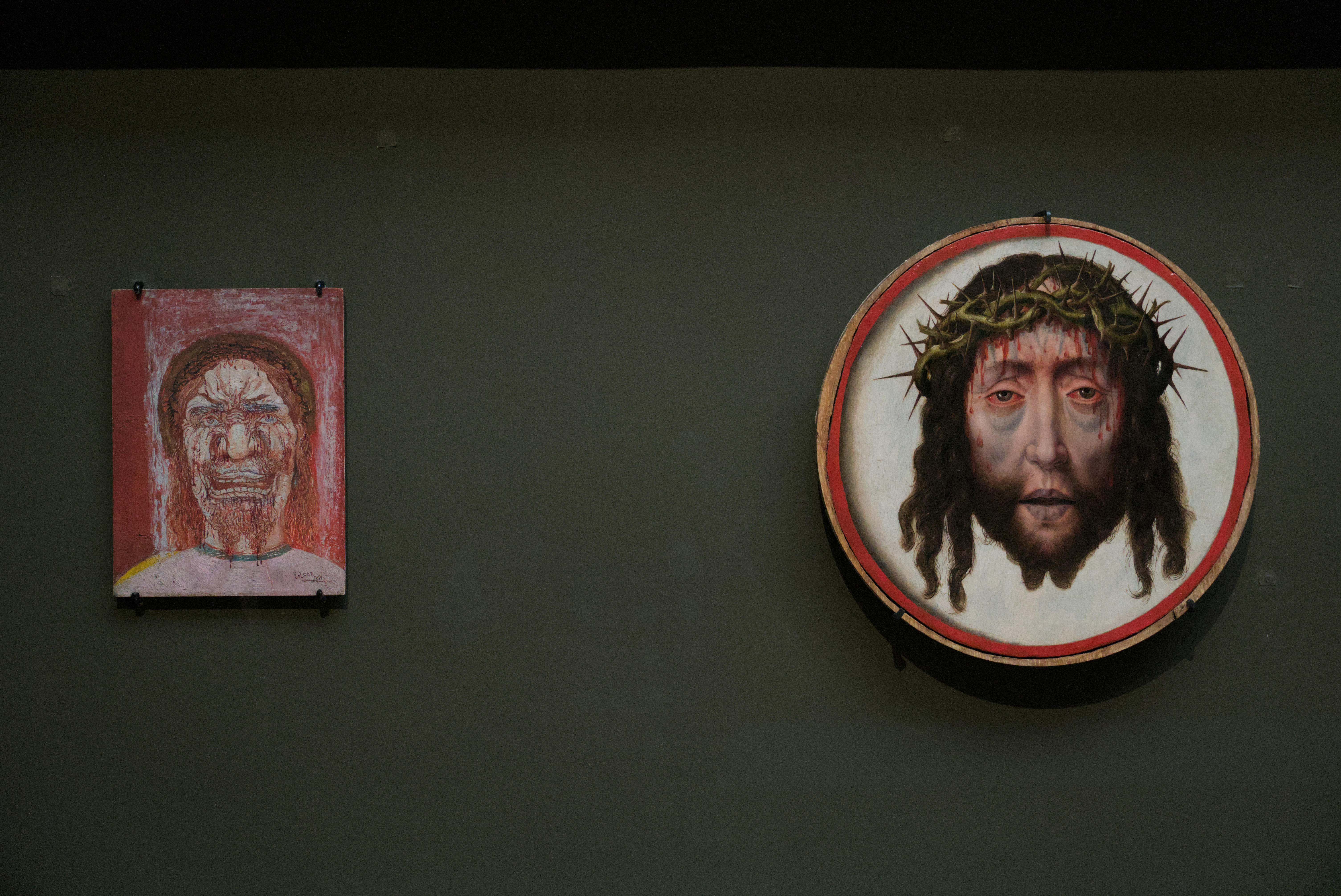
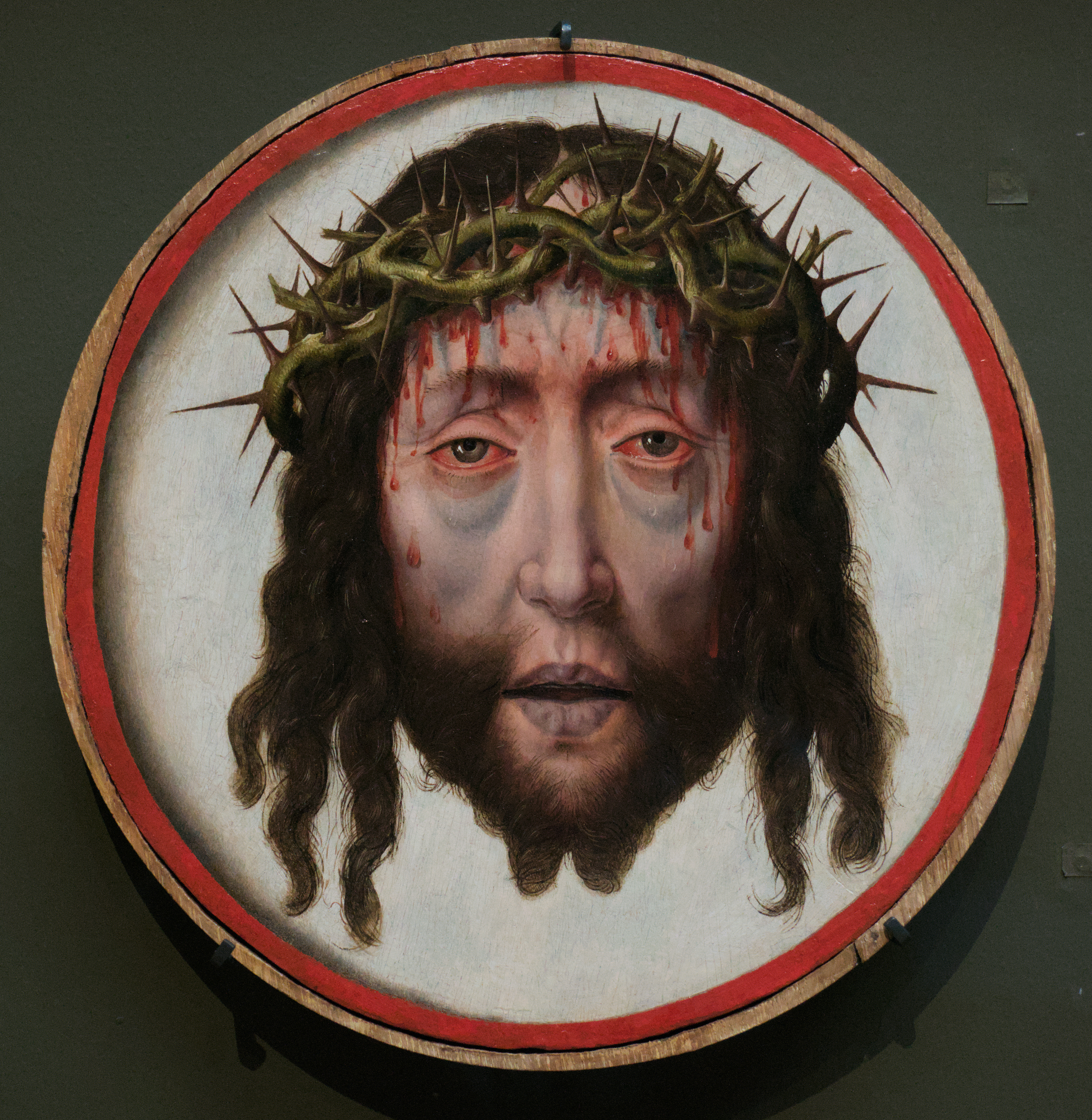
Bouts, Albrecht_Man of Sorrows
Albrecht Bouts (Flemish, 1451/55–1549), Man of Sorrows, 1500–1525. Oil on panel, diameter 29 cm. Koninklijk Museum voor Schone Kunsten Antwerpen (KMSKA, Royal Museum of Fine Arts Antwerp).

The earlier one is an incredibly moving image of pathos. Christ wears a thick, twisted, mock crown whose thorns dig holes into his forehead and draw blood. His eyes are red with tears and sunken in, and his lips are turning blue with the pallor of death. I find it quite beautiful, insofar as an image of suffering can be beautiful. (That’s a topic for another day.)
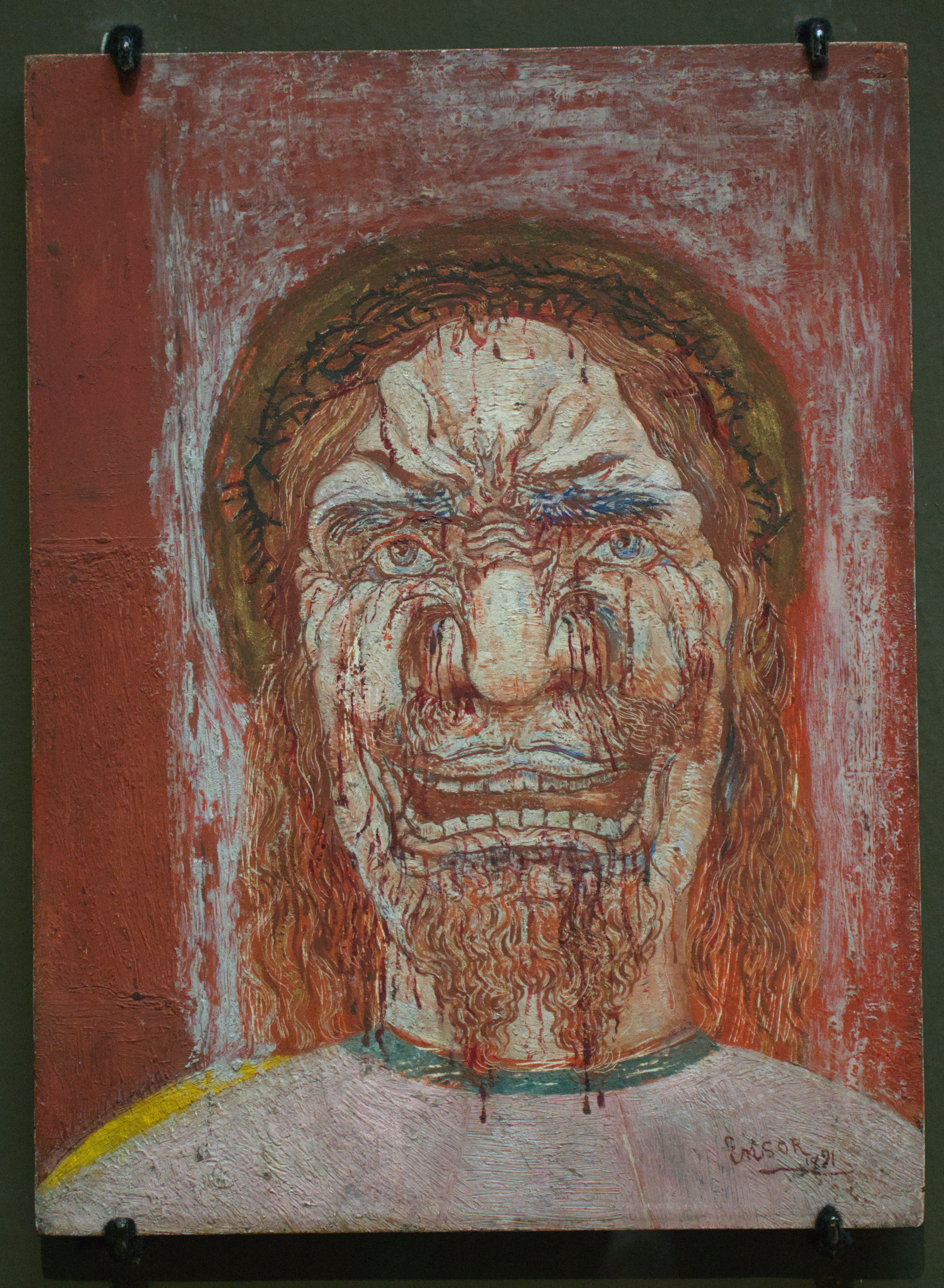
Ensor, James_Man of Sorrows
James Ensor (Belgian, 1860–1949), Man of Sorrows, 1891. Oil on panel, 20 × 15.5 cm. Koninklijk Museum voor Schone Kunsten Antwerpen (KMSKA, Royal Museum of Fine Arts Antwerp).

The Ensor painting, on the other hand, is decidedly not beautiful. In fact, I think it’s the ugliest image of Christ I’ve ever seen, with his crumpled face, scraggly hair, and bared teeth. There’s something very unsettling about his expression, and no wonder, as the curatorial text informs that Ensor drew inspiration from the masks of demon characters in Japanese theater. “His [Ensor’s] Jesus screams with rage about the injustice inflicted on him,” the label says. Is that what that expression is? To me he looks sinister. Like he’s growling at us. And I dislike his dinky crown that he wears like a headband; give me Bouts’s gnarly one instead.

I’m in favor of Christ images that show the rage he must have felt, but I don’t think Ensor is successful if that was his aim. To name a few modern artists who were: Guido Rocha (Tortured Christ, 1975) and David Mach (Die Harder, 2011), both of whom capture Jesus’s cry of dereliction on the cross.

The final themed gallery I’ll call out is “Heavens.”
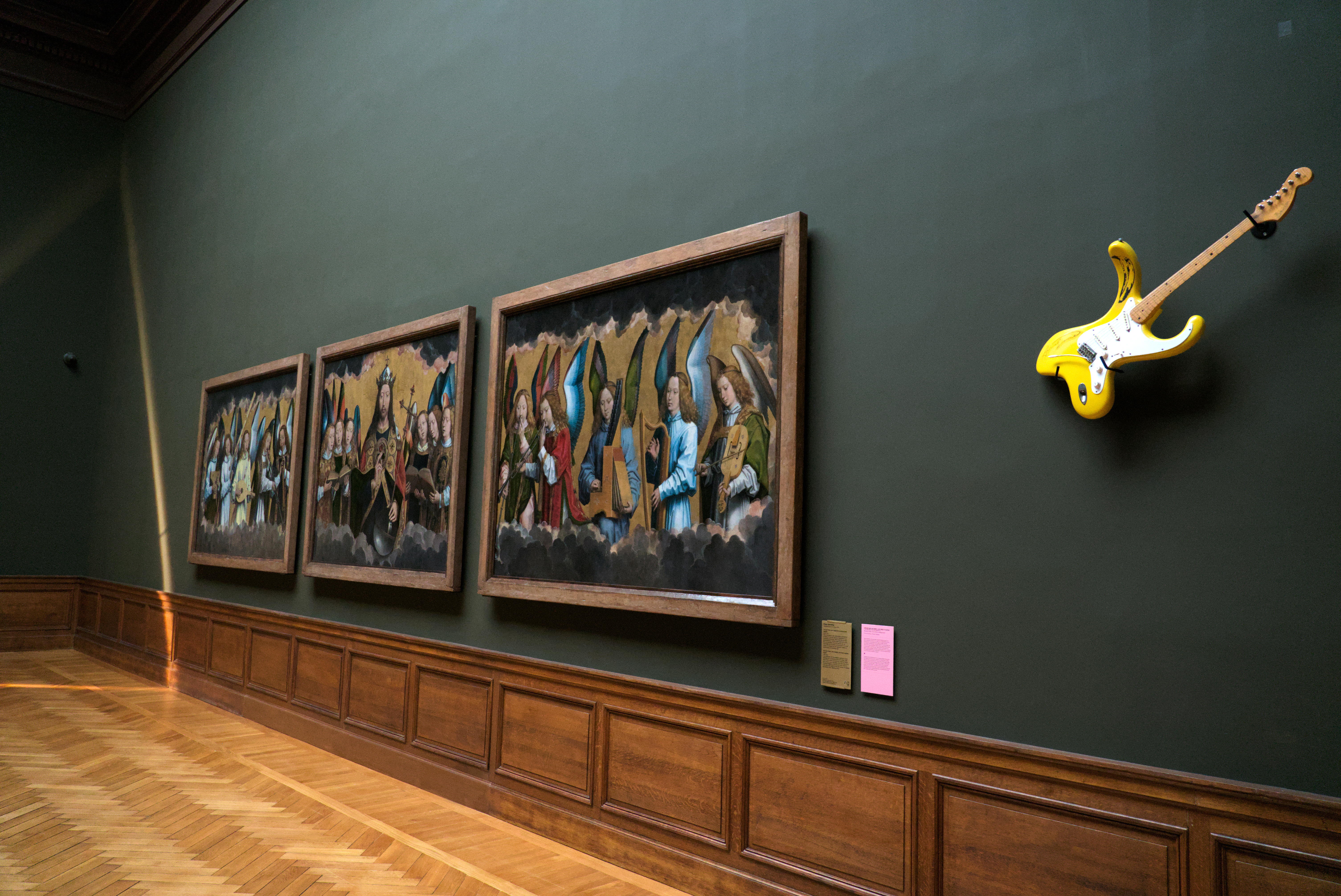
Heavens gallery
Gallery 2.22 (“Heavens”) from the KMSKA exhibition Collected with Vision: Private Collections in Dialogue with the Old Masters

The dominant Old Master work is a set of three panels from the upper tier of a colossal altarpiece that Hans Memling painted for the church at the Benedictine Abbey of Santa Maria la Real in Najera in northern Spain. All the other panels are lost.

The museum titles the central panel God the Father with Singing Angels—but I think the figure is more properly God the Son, Jesus Christ, portrayed as Salvator Mundi (Savior of the World). In his left hand he holds a cross-surmounted crystal globe, signifying his dominion over the earth, and with the other hand he gestures blessing. He wears a tiara and a red cope decorated with gold-thread embroidery, pearls, and precious stones, and his collar bears the words Agyos Otheos (Holy God).
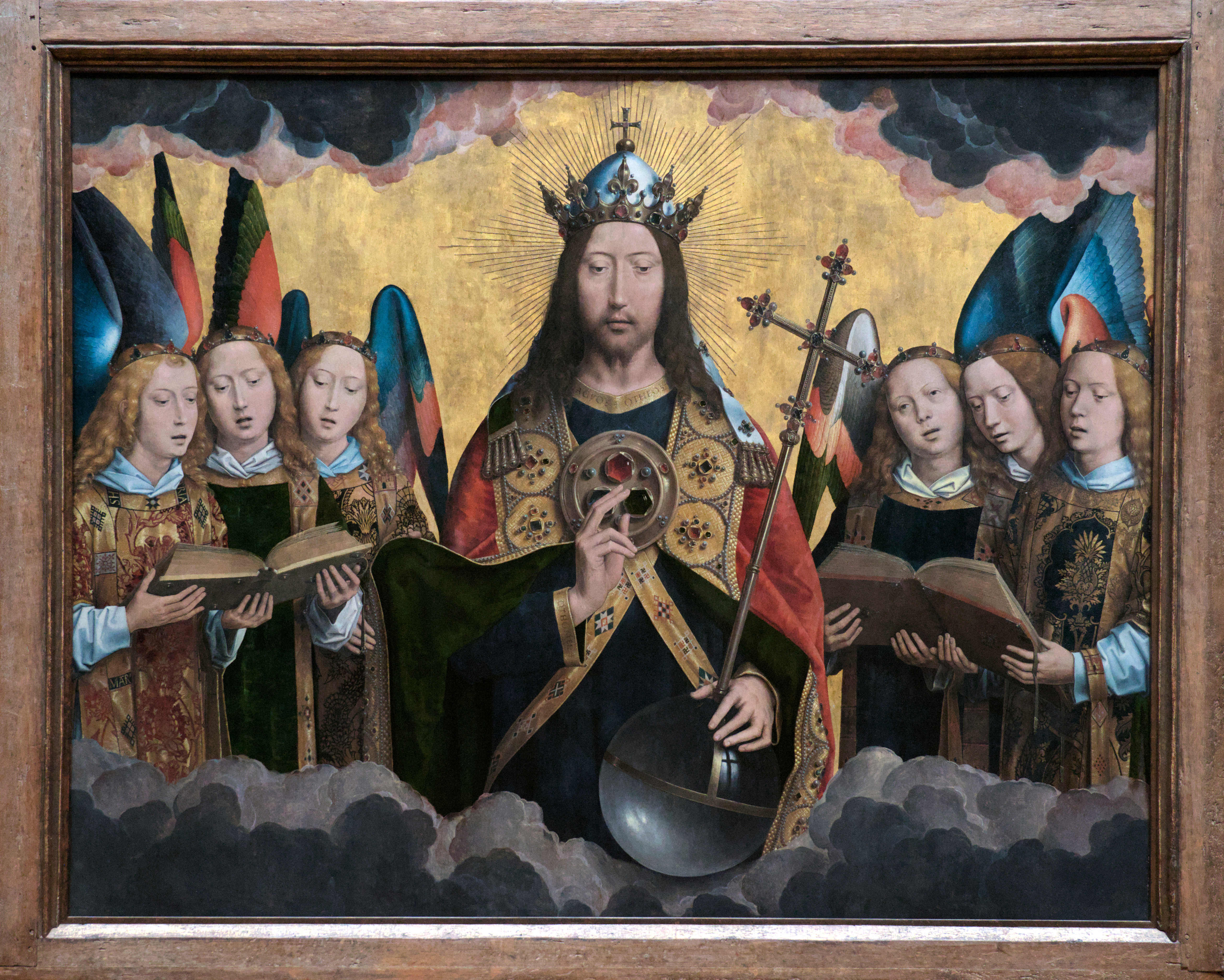
Memling, Hans_God the Father with Singing Angels
Hans Memling (German Flemish, ca. 1430–1494), God the Father with Singing Angels, 1483–94. Oil on panel, 164 × 212 cm. Koninklijk Museum voor Schone Kunsten Antwerpen (KMSKA, Royal Museum of Fine Arts Antwerp).

Surrounding him is a musical band of angels, singing his praises from songbooks and, in the flanking panels, playing a variety of wind and string instruments: (from left to right) a psaltery, a tromba marina, a lute, a trumpet, a shawm, a straight trumpet, a looped trumpet, a portative organ, a harp, and a fiddle.
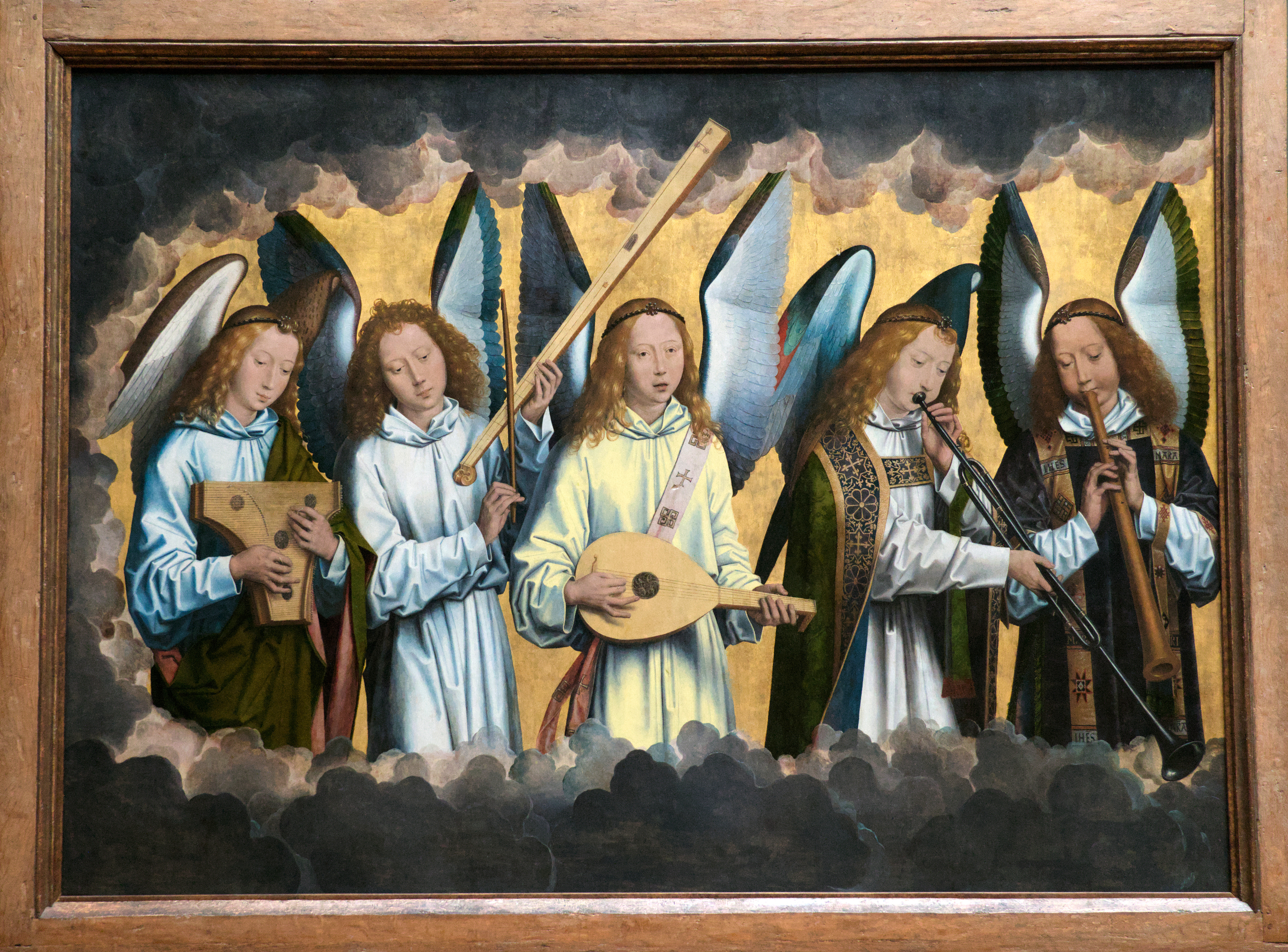
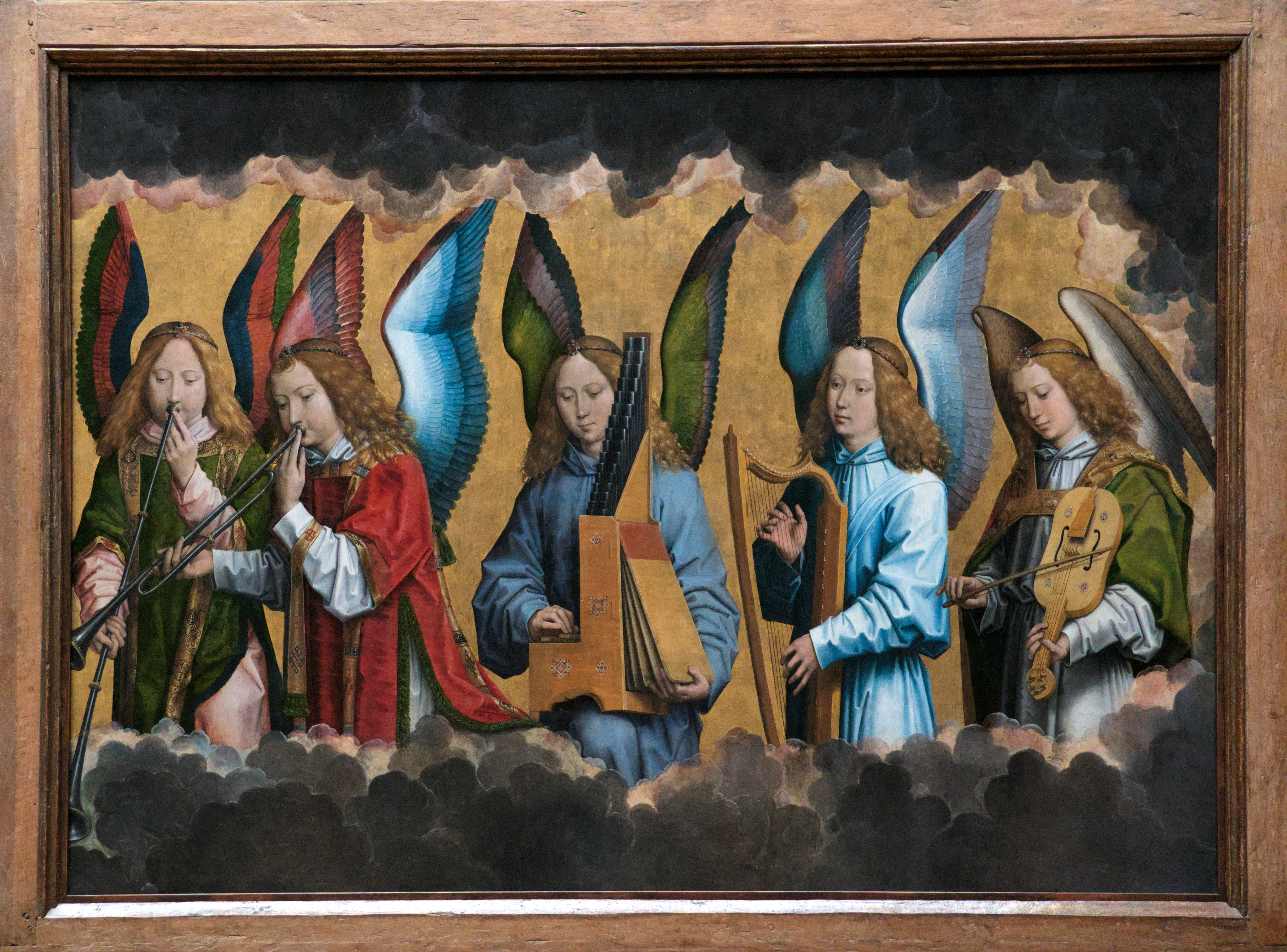
Memling, Hans_Music-Making Angels
Hans Memling (German Flemish, ca. 1430–1494), Music-Making Angels (left), 1483–94. Oil on panel, 165 × 230 cm. Koninklijk Museum voor Schone Kunsten Antwerpen (KMSKA, Royal Museum of Fine Arts Antwerp).

Memling, Hans_Music-Making Angels
Hans Memling (German Flemish, ca. 1430–1494), Music-Making Angels (right), 1483–94. Oil on panel, 165 × 230 cm. Koninklijk Museum voor Schone Kunsten Antwerpen (KMSKA, Royal Museum of Fine Arts Antwerp).

This ensemble probably evokes for you a particular sound—something like Tallis or Palestrina—soaring polyphonic vocals, a gentle yet majestic accompaniment. But instead, a different soundtrack played, audibly, in the room: songs from the 1967 debut album of the American rock band the Velvet Underground, several of which use religious language to describe the experience of doing drugs. “Heroin” opens like this:

I don’t know just where I’m going
But I’m gonna try for the kingdom, if I can
’Cause it makes me feel like I’m a man
When I put a spike into my vein

And I’ll tell you things aren’t quite the same
When I’m rushing on my run
And I feel just like Jesus’ son

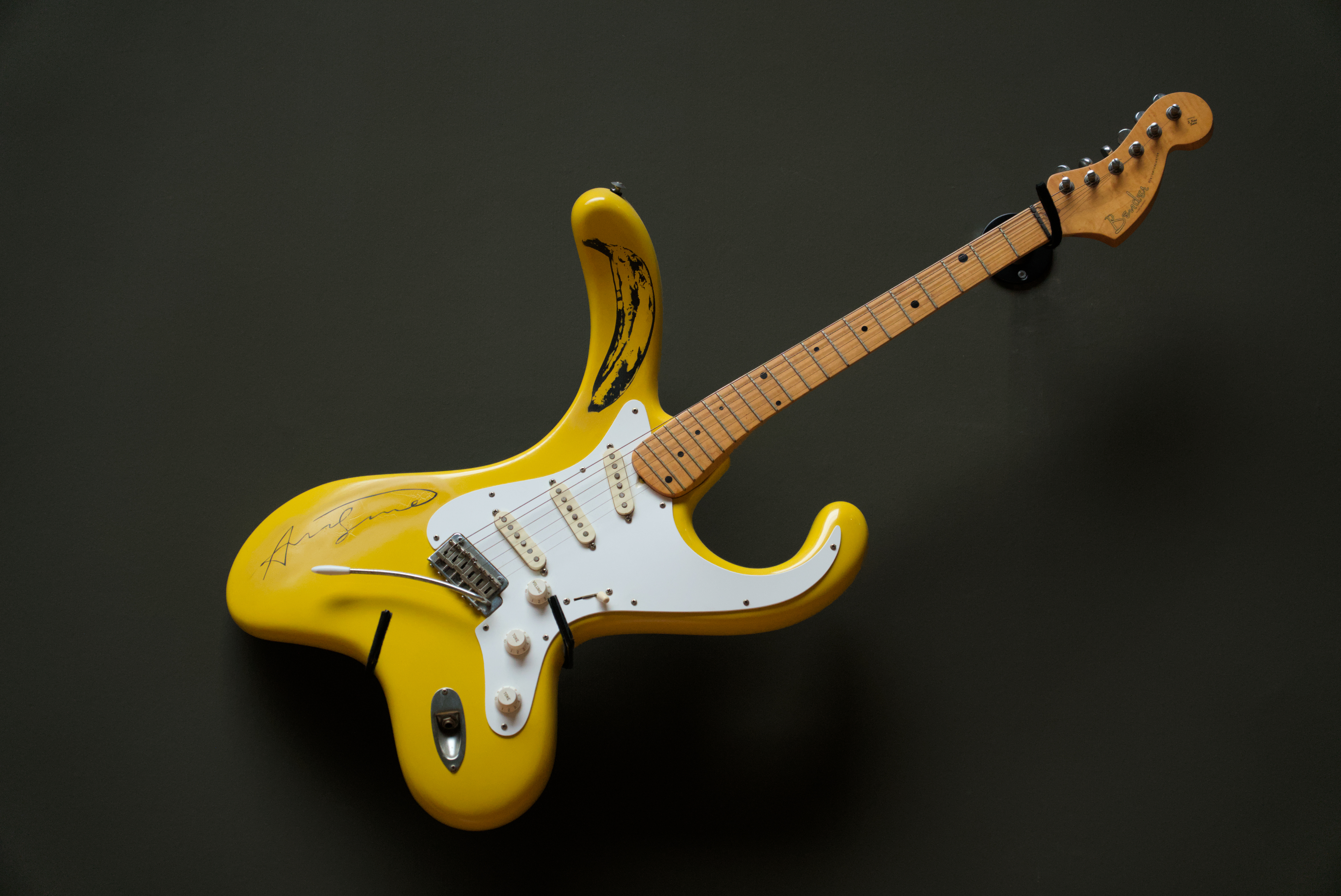
This aural element was complemented, on the gallery wall, by the guitar of Lou Reed, the band’s lead singer and songwriter. It’s signed by Andy Warhol, who produced and championed the Velvet Underground & Nico album and made its banana cover art, replicated on the instrument.
Lou Reed's guitar
Lou Reed’s “Banana Guitar,” from a private collection

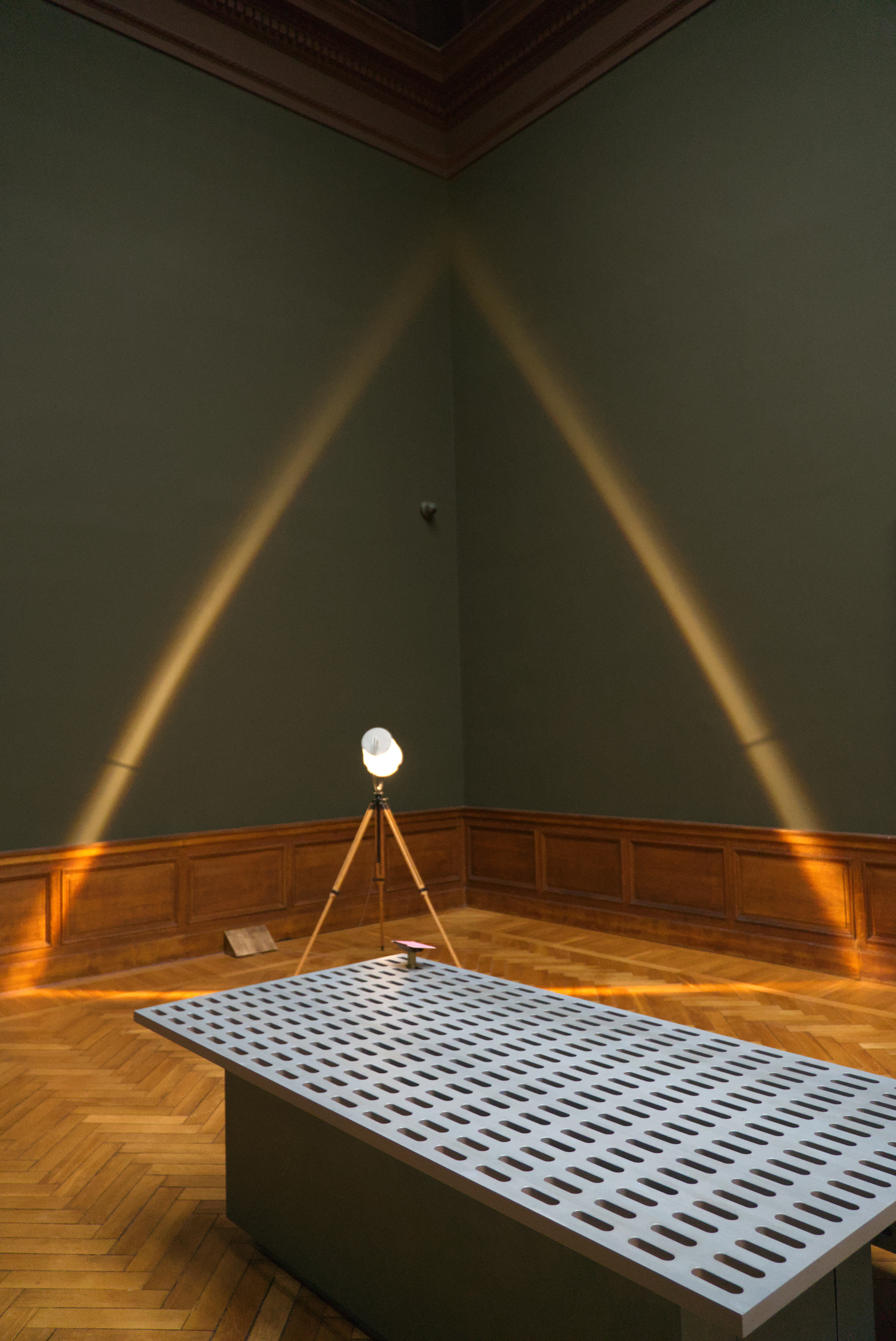
Adding to the mix, in the corner of the room was an installation by the Copenhagen-born and -based artist Olafur Eliasson, called Lighthouse Lamp. “Affixed to a tripod, a lamp situated within a Fresnel lens—a compact lens which was developed for lighthouses—emits a band of white light in 360 degrees,” the artist’s website explains. In this space, the beam takes on a triangular shape.
Eliasson, Olafur_Lighthouse Lamp
Olafur Eliasson (Icelandic Danish, 1967–), Lighthouse Lamp, 2004. Mixed media. Collection of Filiep and Mimi Libeert.

There was also an altarpiece of The Last Judgment and the Seven Acts of Mercy by Bernard van Orley, which references Jesus’s teaching in Matthew 25 about one’s entry into heaven being contingent on whether, in this life, you feed the hungry, give shelter to the homeless, visit the prisoner, and so on.

The “Heavens” gallery begs the question: How does one define “heaven”? Is it a physical place? A state of mind? An encounter? I think of related words like bliss, beatitude, communion, the sublime.

The celestial scene painted by Memling—and remember, it’s only partial, as the rest is missing—is beautifully rendered, but it also encapsulates what has become the popular cliché of heaven: angels on clouds, strumming harps, and a regal God swaying his scepter. Music-making, angelic beings, and the reign of God are all certainly a part of how the Bible describes heaven. But it’s also so much more. It’s a garden and a city. It’s healing and restoration. It’s the righting of wrongs. It’s all things made new. It’s jubilee. It’s a wedding—deep and lasting union between God and humanity. It’s an eternal interlocking of God’s space and ours (earth). It’s a global, transhistorical community of faith, gathered together around Christ their head, worshipping him in diverse languages, musical styles, dances, and other cultural expressions. It’s the culmination of the greatest story ever told.

Today, Memling’s vision of heaven probably fails to captivate most people, even Christians. So it’s an interesting experiment to compare it to how others conceive of the concept.

Eliasson’s Lighthouse Lamp wasn’t a commission on or explicit treatment of the theme, but the curator saw fit to place it beside Memling, because heaven is often conceived of as a light-filled space, and light can evoke the divine. For this reason, Memling painted his background gold. What’s more, the three-sidedness of Eliasson’s light beam may, for some, evoke the Trinity, the classical Christian doctrine of Father, Son, and Holy Ghost that Memling alludes to with the three precious stones on the fibula of Christ’s mantle.

Still, other folks experience what could be termed “heavenly” transcendence through the use of mind-altering substances, as did the members of the Velvet Underground, whose drug trips gave birth to their experimental music—which, in turn, has taken others to a transcendent place.


Whether in special exhibitions or displays of their permanent collections, I want to see more of this in museums: bringing old and new artworks into conversation with one another around universal themes, in the same room. (In some museums, the labels sometimes cross-reference works in other galleries, but that’s not the same.) Although there are benefits to the traditional approach of laying out art chronologically to give you discrete pictures of different historical eras and allow you to progress by time period, a thematic approach that compiles works from across time also has its benefits.

I’ve found cross-temporal art displays to be especially vitalizing, because instead of trying to tell history, they more naturally invite personal reflection and tend to be less academic in tone. Such an approach makes the art accessible to a larger number of people, especially those who don’t frequent museums. It helps us see the relevance of the Old Masters (or whatever the museum’s collection focus) for today—how the subjects they depicted often address topics or questions we still ask or wonder about or that reflect aspects of the common human experience, such as joy, suffering, family, death, betrayal, or festivity. Creating relationships between works made centuries apart, highlighting similarities and differences, can give us a broader perspective.

And for this museumgoer (pointing at myself) who is attracted to medieval and early Renaissance art and sometimes bypasses the contemporary galleries, the integrative approach is more engaging. Giving contemporary works a point of connection with the works I’m already inclined to like helps me enter into them more easily and fruitfully, and I’m more likely to spend time with them than if they were segregated.

New and old don’t have to be equally represented—Kolumba skews heavily contemporary, whereas KMSKA lets its strengths shine with the Old Masters, and yet the occasional unexpected intervention from years past or future always caused me to pause and be curious. Over the last several years I’ve been noticing other museums engaging in similar playful exchange—plopping a contemporary work into the medieval section, or vice versa, in a way that provides some kind of illumination.

This was my first and only visit to KMSKA, and as I understand, there’s not the same degree of intermixing of old and new year-round; this was a special exhibition that brought in contemporary works from outside, as the institution itself owns very few. But they did do something similar last year with the exhibition What’s the Story?, and the dangling light poems by Bernard Dewulf are a permanent fixture in the Old Masters galleries.

Have you been to a museum where works from different time periods were displayed side-by-side to create a discourse, and if so, did that choice enhance your engagement, insight, or appreciation? I’d love to hear what other museums are doing this!


This article took me some forty hours to write and to select and edit photos for. If you appreciate learning about my museum experiences and having access to high-resolution, downloadable art images, would you please consider adding to my “tip jar” (PayPal), or sponsoring a book from my Amazon wish list? Thank you!

Advent, Day 10: Lo, He Comes

To him who loves us and freed us from our sins by his blood and made us a kingdom, priests serving his God and Father, to him be glory and dominion forever and ever. Amen.

Look! He is coming with the clouds;
    every eye will see him,
even those who pierced him,
    and all the tribes of the earth will wail on account of him.

So it is to be. Amen.

—Revelation 1:5b–7

LOOK: The Last Judgment by Jan van Eyck  

van Eyck, Jan_Last Judgment
Jan van Eyck (Netherlandish, ca. 1390–1441), The Last Judgment, ca. 1436–38. Oil on canvas, transferred from wood, 22 1/4 × 7 2/3 in. (56.5 × 19.7 cm). Metropolitan Museum of Art, New York.

What is your reaction to this image? Terror? Awe? Gratitude? Disgust? Intrigue? Indifference?

I’m often repulsed by how the Last Judgment was interpreted by medieval and Renaissance artists, with graphic displays of torture intending to compel people to righteous living through fear. To be sure, the subject has made for some truly remarkable paintings, full of fantastical grotesqueries and masterfully executed—like this one—but I worry that the scare tactics such paintings use are not helpful and are even harmful.

Nonetheless, the Last Judgment is an unavoidable topic in scripture. The Bible refers several times to God as judge and describes a final accounting of sin upon Christ’s return, resulting in reward for the righteous and punishment for the unrighteous. It’s also in our creeds: “He [Jesus Christ] will come again to judge the living and the dead” (see 2 Tim. 4:1; 1 Pet. 4:5). Those who seek to be faithful to scripture must reckon with the idea of the Last Judgment. Advent, which is penitential in character, has historically been a period for the church to do that. As the Episcopal priest and author Fleming Rutledge points out in her published collection of Advent sermons, judgment is one of the four traditional themes of the season—the other three being death, heaven, and hell.

The early Northern Renaissance master Jan van Eyck’s Last Judgment from ca. 1436–38 is one of history’s most famous and most gruesome. “The diabolical inventions of Bosch and Brueghel,” writes art historian Bryson Burroughs, “are children’s boggy lands compared to the horrors of the hell [van Eyck] has imagined.”

The midground portrays the resurrection of the dead, who rise up out of their graves on land or at sea to be judged by Christ. One of the inscriptions on the frame is Revelation 20:13: “And the sea gave up the dead which were in it; and death and hell delivered up the dead which were in them: and they were judged every man according to their works.”

In the center Saint Michael the Archangel, dressed in his jewel-studded armor and with sword unsheathed, stands atop the giant batlike wings of Death personified, which are inscribed with the words CHAOS MAGNVM (“great chaos”) and UMBRA MORTIS (“shadow of death”). Death is a skeletal figure who excretes the damned through his bowels into hell’s dark slime, where bestial demons tear at, choke, devour, crush, and impale them. One man’s legs are being ripped apart at the anus.

Even kings and clergymen are part of the tragic death-heap—see the bishop’s miter, the cardinal’s galero, the royal crown. Not all who say, “Lord, Lord,” will enter heaven (Matt. 7:21); even the most outwardly pious will have their sins exposed on the last day, and those who prove to be hypocrites, who have harmed others and shamed God without repentance, will be thrown into the pit.

Shooting down like arrows into this pit is the double inscription ITE VOS MALEDICTI IN IGNEM ETERNAM (“Go, ye cursed, into everlasting fire”), taken from Matthew 25:41. And Deuteronomy 32:23–24, a warning from God via Moses to the people of God in their disobedience, is one of the inscriptions on the frame:

I will heap mischiefs upon them; I will spend mine arrows upon them. They shall be burnt with hunger, and devoured with burning heat, and with bitter destruction: I will also send the teeth of beasts upon them, with the poison of serpents of the dust.

Perhaps your chest is tightening right now, your stomach churning. How does this picture cohere with the God of love and mercy?

Look up.

See Jesus Christ, the Son of Man, coming in glory. See his glowing stigmata, beacons of love and mercy. He is dressed in a long, red, open mantle and is barefoot, revealing all five wounds. All around him, angels bear the instruments of his passion: the cross, the three nails, the crown of thorns, the lance, the sponge-tipped reed. See him flanked by all the ranks of the redeemed, including, on a larger scale, the Virgin Mary and John the Baptist, the first two witnesses of Jesus’s divinity.

VENITE BENEDICTI PATRIS MEI, read the inscriptions fanning out from Christ’s elbows: “Come, ye blessed of my Father” (Matt. 25:34). This good word is taken from Jesus’s parable of the sheep and the goats, in which he teaches that those who feed the hungry, clothe the naked, shelter the immigrant, care for the sick, and visit the imprisoned will be honored by God on the last day.

Another benediction is inscribed on the picture’s frame:

And I heard a loud voice from the throne saying,

“See, the home of God is among mortals.
He will dwell with them;
they will be his peoples,
and God himself will be with them and be their God;
he will wipe every tear from their eyes.
Death will be no more;
mourning and crying and pain will be no more,
for the first things have passed away.” (Rev. 21:3–4 NRSV)

Van Eyck’s Last Judgment does not stand alone. For centuries it has been configured as a diptych (two-paneled artwork) with a Crucifixion on the left and is thus intended to be read in light of God’s supreme act of vulnerable love and self-giving:

van Eyck, Jan_Crucifixion and Last Judgment
Jan van Eyck (Netherlandish, ca. 1390–1441), The Crucifixion; The Last Judgment (with recently conserved frame), ca. 1436–38. Oil on canvas, transferred from wood, each panel 22 1/4 × 7 2/3 in. (56.5 × 19.7 cm). Metropolitan Museum of Art, New York.

Originally these two paintings very likely served as the wings of a triptych with a painted or sculpted centerpiece, or as the doors to a tabernacle or reliquary shrine. In 2019 the Metropolitan Museum of Art had the frames restored from their modern brass color to their original red.

So, what are we to make of this image today? Is there value in meditating on it?

I’ve presented it here, so I think it’s definitely worth knowing about. It’s a stunning art object that gives us a glimpse into the religious imagination of late medieval Christians. But I would also advise caution, especially to those who have been traumatized by hell teachings in the past. While Christians are called to cultivate a holy fear of God, a soberness around the weight of our sin and the power of God’s justice, this fear is not supposed to be the kind of fear that induces anxiety or paralyzes. That kind of fear will never lead us to love God.

We are never meant to think on hell apart from the grace Christ extends to us with his pierced and outstretched hands, which plead our case before God. Van Eyck holds both together in this painting, but the more visually immersive bottom half seems to indulge some pretty sick fantasies that could well generate an unhealthy fear of God if one were to stay stuck there, not to mention create the false impression that God is monstrously vindictive.

There is debate within Christianity, and has been since the patristic era, whether Jesus’s justice is merely punitive or ultimately restorative—that is, whether hell is a place of eternal conscious torment or a place where one is purged of evil and that will in the end be emptied. (There is biblical support for both views, which I won’t get into here.) There is also disagreement as to whether the Bible’s language about hell, such as its being a place of “fire” and “brimstone” (sulfur) (e.g., Rev. 21:8), is meant to be taken literally or figuratively.

Whatever the duration, physical nature, and ultimate purpose of hell, I want to emphasize that biblical passages about the Last Judgment ought not drive us to despair; they should drive us into the arms of Christ, who receives into his presence all those who trust in his merits and turn from their wickedness. The wounds that Christ so prominently displays in van Eyck’s painting are tokens of divine forgiveness as well as a model of the kind of selfless love we are to follow, a love vulnerable enough to receive injury but never to inflict it. Those who tumble into the depths of the underworld to be ravaged by externalizations of their own destructive evils have rejected the call to “do justice, love mercy, and walk humbly with [their] God” (Mic. 6:8). Many of them are ones who on earth bore much power but used it to abuse others or were neglectful.

For more on the characterization of Jesus as judge in the art and theology of the Middle Ages (whose influence was felt in the Renaissance and later eras), see chapter 2, “The Judge,” of Jesus through Medieval Eyes by Grace Hamman. “The promise of answering unanswered evil, acknowledging the recognized and unrecognized wrongs of the mortal world—everlasting justice and compassion—is ultimately what Christ the Judge signifies. It’s a promise, a prophecy, and a call for action now,” Hamman writes (28). She discusses how neighborliness and fear of God are twinned: “Am I seeing the immortal being, the image of God, Jesus himself, in every person I encounter?” medieval imagery prompted viewers to ask (37). “Jesus the Judge reminds us of our divine community and invites a fear that guides us to love our neighbor as we love ourselves. . . . Fear of Jesus the Judge becomes a gift for our practice of justice, in the radiant light of his justice. Such a fear softens flinty hearts” (21, 36). In the chapter Hamman does also acknowledge the complications and misuses of fear in the medieval church and its legacy today.

I urge you to consider the van Eyck diptych in light of the retuned hymn below as you meditate on Christ’s return and his role as judge.

LISTEN: “Lo! He Comes with Clouds Descending” | Words by Charles Wesley, 1758 | Music by Thomas Vito Aiuto, 2012 | Performed by the Welcome Wagon on Precious Remedies Against Satan’s Devices, 2012

Lo! he comes with clouds descending,
once for favored sinners slain;
thousand, thousand saints attending
swell the triumph of his train.

Ev’ry eye shall now behold him,
robed in dreadful majesty;
those who set at naught and sold him,
pierced, and nailed him to the tree,
deeply wailing, deeply wailing,
shall the true Messiah see.

Ev’ry island, sea, and mountain,
heav’n and earth, shall flee away;
all who hate him must, confounded,
hear the trump proclaim the day:
Come to judgment, come to judgment!
Come to judgment, come away!
Alleluia, alleluia!
God appears on earth to reign.

The dear tokens of his passion
Still his dazzling body bears,
Cause of endless exultation
To his ransomed worshippers.
With what rapture, with what rapture
Gaze we on those glorious scars!
Alleluia, alleluia!
God appears on earth to reign.

Yea, amen! Let all adore thee,
high on thine eternal throne;
Savior, take the pow’r and glory,
claim the kingdom for thine own.
O come quickly, O come quickly;
everlasting God, come down.
O come quickly, O come quickly;
everlasting God, come down.
O come quickly, O come quickly;
everlasting God, come down.

I’m struck by the bright, celebratory, homey tone of the new tune Rev. Vito Aiuto gave this old Wesley hymn about Christ’s second coming. One might expect, with its verses about judgment, to have a dark or foreboding tone. But for those who are in Christ, his return, and even the day of judgment, will be an occasion of rejoicing!

Note that “dreadful” here is used in the archaic sense of inspiring awe or reverence.


This post is part of a daily Advent series from December 2 to 24, 2023 (with Christmas to follow through January 6, 2024). View all the posts here, and the accompanying Spotify playlist here.

Lamb for Sinners Slain (Artful Devotion)

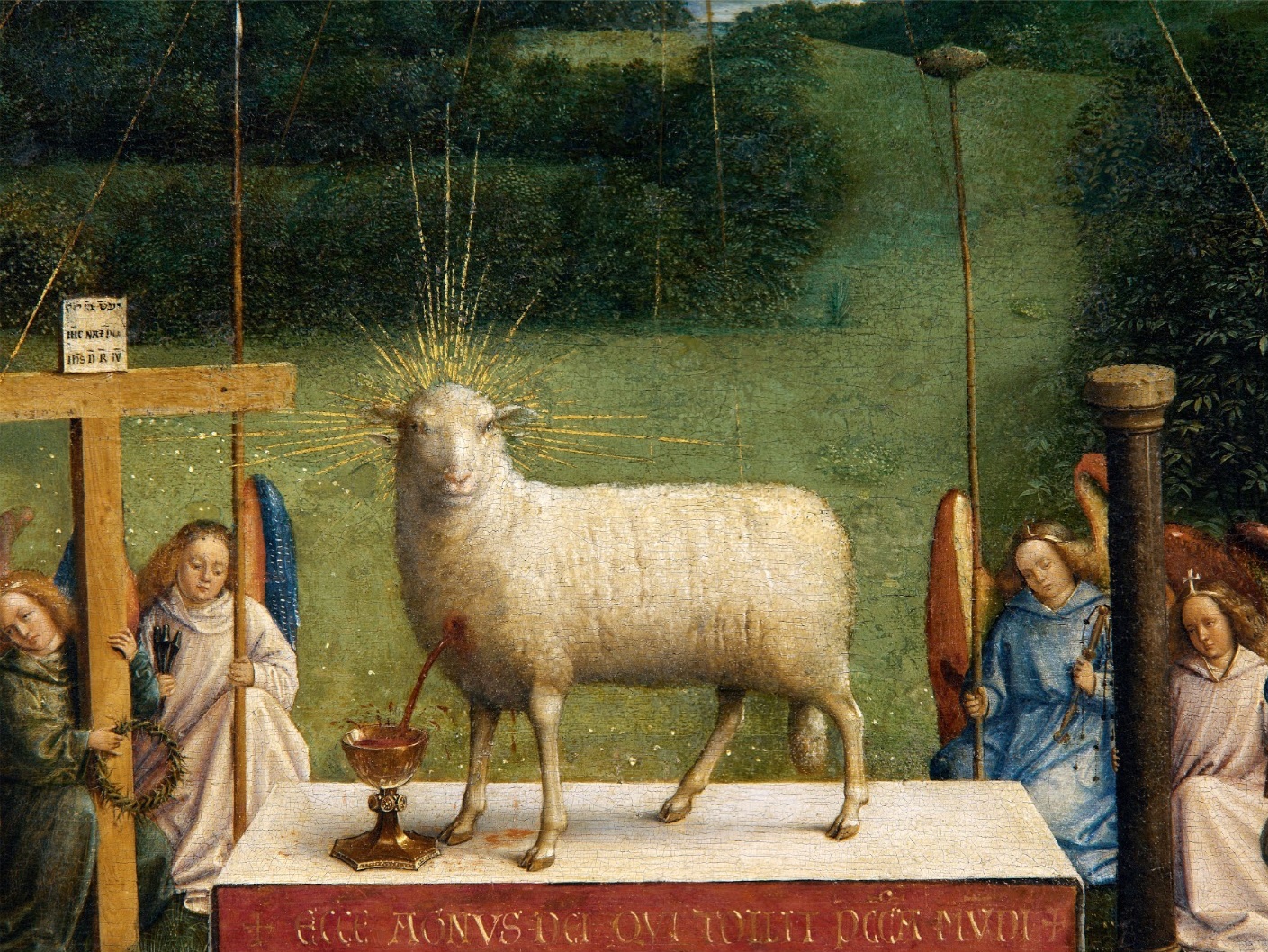
Adoration of the Mystic Lamb (Ghent Altarpiece)
Hubert and Jan van Eyck, Adoration of the Mystic Lamb, 1426–32. Oil on panel, 54 1/5 × 95 3/10 in. (137.7 × 242.3 cm). Lower central interior panel of the Ghent Altarpiece, St. Bavo Cathedral, Ghent, Belgium.

. . . you were ransomed . . . not with perishable things such as silver or gold, but with the precious blood of Christ, like that of a lamb without blemish or spot. He was foreknown before the foundation of the world but was made manifest in the last times for the sake of you who through him are believers in God, who raised him from the dead and gave him glory, so that your faith and hope are in God.

—1 Peter 1:18–22

+++

SONG: “I Will Praise Him” by Margaret J. Harris, 1898 | Arranged and performed by The Isaacs, on The Isaacs Naturally: An Almost A Cappella Collection, 2009

When I saw the cleansing fountain
Open wide for all my sin,
I obeyed the Spirit’s wooing,
When He said, “Wilt thou be clean?”

I will praise Him! I will praise Him!
Praise the Lamb for sinners slain;
Give Him glory, all ye people,
For His blood can wash away each stain.

Then God’s fire upon the altar
Of my heart was set aflame;
I shall never cease to praise Him:
Glory, glory to His Name!

I will praise Him! I will praise Him!
Praise the Lamb for sinners slain;
Give Him glory, all ye people,
For His blood can wash away each stain.
Glory, glory to His Name!

[Related posts: “Worthy Is the Lamb” (Artful Devotion)”; “No Other Fount (Artful Devotion)”]

+++

Ghent Altarpiece (open)
Ghent Altarpiece (open view) by Hubert and Jan van Eyck, 1432. Oil on twelve panels, 11 × 15 ft. (3.4 × 4.6 m). St. Bavo Cathedral, Ghent, Belgium.

The monumental Ghent Altarpiece by Northern Renaissance painters Hubert and Jan van Eyck [previously] is one of the world’s finest art treasures—every student who’s taken Art History 101 knows this piece, and it has been the subject of much scholarship.

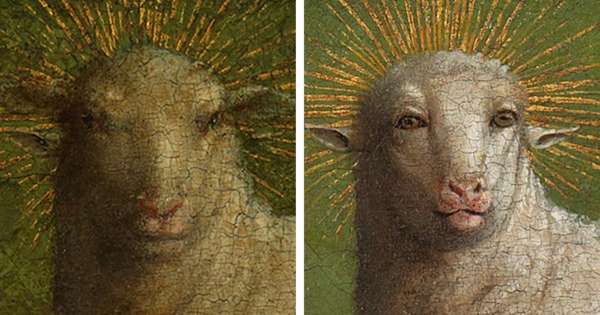
Perhaps you know it from the detail photos of the recently restored Adoration of the Mystic Lamb panel that went viral in January.

Ghent Altarpiece restoration
Before restoration (left) vs. after restoration (right)

Over the past three years, conservators under the leadership of Belgium’s Royal Institute for Cultural Heritage removed the overpaint that was added to the van Eyck brothers’ original in the mid-sixteenth century, revealing a strikingly humanoid face on the Agnus Dei that surprised everyone. (The rest of the painting is much more naturalistic.) Social media users made fun of the cartoonish appearance of the lamb, but Hélène Dubois, head of restoration, says this lamb has a more “intense interaction with the onlookers.”

The haloed lamb who stands on an altar and bleeds into a chalice is the focal point of the entire fifteen-foot polyptych. He is, of course, a symbol of the self-sacrificial Christ. Angels surround him holding instruments of the passion, and the Latin inscription on the antependium (altar hanging) translates to “Behold the Lamb of God, who takes away the sins of the world” (John 1:29).

Mystic Lamb (detail)

You can zoom in on all the altarpiece panels and take a look at the restoration process (ongoing since 2010, with the upper interior panels to be tackled in 2021) at the Closer to Van Eyck website, which I’ve mentioned before—though the site appears not to have been updated in a while.

If you’d like to learn more, the Google Arts & Culture online exhibition Inside the Ghent Altarpiece is a great place to start, as is the altarpiece’s Wikipedia page. If you prefer to learn audiovisually, you might enjoy these two Smarthistory videos:


This post belongs to the weekly series Artful Devotion. If you can’t view the music player in your email or RSS reader, try opening the post in your browser.

To view all the Revised Common Lectionary scripture readings for the Third Sunday of Easter, cycle A, click here.

Three poems on Jan van Eyck’s Annunciation

One of the most celebrated paintings of the Northern Renaissance, Jan van Eyck’s 1430s Annunciation depicts the moment of Christ’s conception in a world of forms that have weight and volume and shade and texture that was largely unprecedented in European painting at the time. The extraordinary realism of the Annunciation—its deep, rich, subtly gradated colors, varied textural details (from hard, polished gems to soft, fragile flower petals and plush velvet), and intricate play of light and shadow—were enabled by the use of oil paint, a medium that was not widely used then. van Eyck’s “virtuoso handling of the medium . . . represented a turning point in its eventual adoption as the major painting medium in Europe in the sixteenth century,” replacing egg tempera.

van Eyck, Jan_Annunciation
Jan van Eyck (Netherlandish, ca. 1390–1441), The Annunciation, 1434/36. Oil on canvas transferred from panel, 35 1/2 × 13 7/16 in. (90.2 × 34.1 cm). National Gallery of Art, Washington, DC.

This three-foot-tall painting probably originally formed the left wing of a triptych, whose other panels, now lost, may have depicted the Nativity or the Adoration of the Magi and the Visitation or the Presentation in the Temple. It likely spent its first centuries in the ducal chapel of a Carthusian monastery in Dijon, then-capital of Burgundy (van Eyck served as court painter to Philip the Good, duke of Burgundy, from 1425 to 1441), and has since passed through various other rich and powerful hands, including those of King William II of the Netherlands and Czar Nicholas I of Russia. It is now in the collection of the National Gallery of Art in Washington, DC, where it is viewed by people from all over the world.

Several iconographic elements in van Eyck’s Annunciation were already standard for the subject: the dove, the lilies, the Bible laid open to Isaiah 7:14. But van Eyck also introduced his own sophisticated program of typological imagery, which plays out in the background frescoes and the niello floor designs, connecting Old and New Testaments—in addition to other innovative touches that we will explore below.

He was also one of the first artists to locate this momentous event inside a church (as opposed to a portico or domestic space), which would become a popular choice in the Low Countries. In her 1999 Art Bulletin article “Van Eyck’s Washington Annunciation: Narrative Time and Metaphoric Tradition,” Carol J. Purtle argues that van Eyck was connecting the Lukan narrative of the Annunciation with the Golden Mass (“Missa Aurea”), a liturgical drama that was popular in the Netherlands at the time. Taking place yearly on Ember Wednesday (the Wednesday following the third Sunday of Advent), the Golden Mass featured a reenactment of the Annunciation, dove and all, by two young choirboys.

There’s much to lavish attention on in this painting, but I’d like to let three poets be our eyes: Pimone Triplett, Terri Witek, and Peter Steele, each of whom has written a poem reflecting on their encounter with the Annunciation by van Eyck. (The vivid poetic description of a work of visual art is known as ekphrasis, and it is an ancient tradition that I’ve seen explode in recent decades.) Notice what the poets notice in the painting as they pore over van Eyck’s artistic choices and their spiritual import. There is some overlap in their discoveries, but the landing point, and even the emphasis, of each poem is unique.

(Related post: “Book Review: The Annunciation: A Pilgrim’s Quest by Mark Byford”; ekphrastic poems I’ve written about: “Ecce Homo” by Andrew Hudgins and “Nick Mynheer’s Simon and Jesus” by Jonathan Stockland)

+++

“The Annunciation” by Pimone Triplett

Starts with a stream of gold that’s ridden
      by a relentlessly linear dove,
ready to pierce a young girl’s head.

            Then, her face, her gaze looking up, out
past the easel and later, past the frame,
      eyes raised as if to ask a question. Take

the virgin robe, for instance, which van Eyck has made
      to fall luxuriously as a second chance
across the old storyline etched below her.

            And, further down, the church’s intricately
strict apse, each floorboard, painstaked as lace, showing here,
      David’s lesson in beheading, there Samson’s

tearing down the temple—that history
            interrupted by her silken, layered folds:
each blue built up from perfecting the oil.

            His favorite signature, “As best I can”
or “As I was able, but not just as I wished.”
      Imagine the endless effort: a man

in the distance, deep in the could have been,
      who sat before the easel, hours, perhaps,
past his patience for lasting regrets,

            flat refusals—the quick-drying water-based
attempts flung around a room.
      And how, alone with pigment barrels, chamber pots,

the canvasses stretched, the fire exhumed,
      he poured a stream of oil back and forth,
watching it catch the light, change a wooden bowl.

            For the sake of making the mundane
seem to marry the mysterious,
      her eyes raised—lacquered, slippery wells, caught—

her startled acceptance. Since it’s her choosing
      to be chosen that mattered, largest figure
in the frame, the virgin form layered

            with gold light, blue, her pale hands open
for the god imagined sick with thin horizon,
      and ready to enter thickness now, the body’s

blood, gristle, vertebrae, whorled fingerprint.
      The oil spread back and forth. His wrist stiffened.
“As I was able, but not just as I wished.”

            So, out to pay the right kind of attention
to detail, as if, in the lengthening
      carelessness of cracked roads leading away

from his town, beneath a matted pulp
      of the year’s leaves, he wished he could hear
silence taking shape: a weed, say, starting

            to split the surface, part vegetal
altar and example of dumb, green change.
      Or, say, through the window, a flock of geese

receding, advancing, by turns, as the sky’s gray
      sometimes meets the double strength gray of sea,
he might have looked between the shapes,

            their invisible lines blooded, some racing ahead,
others falling behind, each filling in, quickly,
      empty spaces where the wings once beat.

And still, she looks up, asking to be entered.
      So that if she turned away from shadows, wood panels,
chamber pots, winter coats lined against the wall,

            he might have looked so far into the difficult
that he finally could believe: behind her gaze,
      beneath her brow, under the layers of

shell, salt, finally skin-white, lay the mind
      of a mother giving birth to a father
and a son, the flesh—a color, an instant, spared.

“The Annunciation” by Pimone Triplett appears in Ruining the Picture (Northwestern University Press, 1998) and is reprinted here by permission of the publisher. Copyright © 1998 by Pimone Triplett. All rights reserved.

Pimone Triplett’s poem explores the physicality of the oil-paint medium, focusing on van Eyck’s innovations in that area and as one who both accepts and transcends his limitations. She refers to the personal motto with which he signed several of his paintings (although not this one): Als ich chan, which means “As best I can.” Even with as advanced a painter’s toolkit as he developed and his great skill, how could he possibly succeed in depicting the holy mysteries?

The physicality of the artist’s studio, too, comments on the Incarnation. Christ came into a world of chamber pots! Triplett describes Jesus’s coming into human being, his traveling those seven thin gold rays of light into the womb of his mother, where he takes on flesh: “the god imagined sick with thin horizon, / and ready to enter thickness now, the body’s // blood, gristle, vertebrae, whorled fingerprint.”

There are also some lovely lines that touch on Mary’s agency (“it’s her choosing / to be chosen that mattered”; “she looks up, asking to be entered”) and her role as the Second Eve, whose obedience leads to the redemption of humanity (her robe “fall[s] luxuriously as a second chance” over the Old Testament story line told in the floor below her).

van Eyck, Jan_Annunciation (detail)
The two most visible floor designs depict Samson destroying the temple of Dagon, killing the Philistines inside, and David cutting off the head of Goliath. These and other Old Testament scenes are framed by stylized columbine and clover and roundels bearing signs of the zodiac.

I’m not entirely sure how to interpret the last stanza. It’s possible that “father” refers to van Eyck as the father of oil painting: his many Marian paintings in this medium cemented his reputation as such, so in that sense Mary gave birth to him as an artist, as well as, of course, to her son Jesus. Shell and salt were ground into pigments to render realistic flesh tones, and the slow drying time of oil paint enabled artists to better blend colors on the canvas, creating subtle variations, and to develop the painting gradually. But why “a color, an instant, spared”? Any thoughts?

+++

“Take a World” by Terri Witek

The Annunciation by Jan Van Eyck, 1434–36

Take a world in which each flower’s an Easter lily
and books chivvy open to the place where our names leap.
Then step into the temple where Mary,

gown belled like a Christmas tree angel’s,
speaks with a real one. Their hands negotiate:
Mary is asking why light curls to ribbony rainbow

on the angel’s back while through her own body
it shoots in stiff gold arrows. The angel nods, grins.
Nothing more gorgeous than their drapery-softened

gesticulation, the room’s blue-propped lilies
and plump ottoman. It’s enough to make us think
they’re standing in the world, two women alert

to the heft of their clothes as Mary asks,
“Who, me?”, her eyes sliding sideways to her painter,
master of distraction. She can’t see Jehovah

behind her, his one blazing window, though we can,
we see the room’s whole depth falling into light
as we wait for someone not transfixed by dilemma

who’s standing where we are. As we wait for Joseph.

“Take a World” by Terri Witek appears in Fools and Crows (Orchises Press, 2003) and is reprinted here by permission of the poet. Copyright © 2003 by Terri Witek. All rights reserved.

Terri Witek’s poem focuses on the paradox of the Annunciation’s being both an entirely thisworldly and yet profoundly otherworldly moment. The two figures in van Eyck’s painting have bulk and heft, and their clothes hang on their bodies, subject to the laws of gravity, and yet in the scene they inhabit, everything is so carefully placed, so perfect—so divine. Witek mentions the stained glass window in the back, which shows God in a mandorla, standing underneath his fiery chariot on a globe labeled ASIA and holding an open book and a scepter; the light that comes through this window and fills the room is thus refracted through him who is all-sovereign.

(Note: The iconography in the window is very similar to the type known as Christ in Majesty, though there’s no cross-shape inside the halo; I wonder whether the figure is meant to be Jesus in his then-future exaltation. But the art historians I’ve read identify him, along with Witek, as God the Father. I think a case could be made for either.)

van Eyck, Jan_Annunciation (detail)
To the left of the stained glass window, the baby Moses is presented to Pharaoh’s daughter, while on the right, God presents Moses with a scroll bearing the words of Exodus 20:7: “You shall not take the name of the Lord your God in vain.”

van Eyck, Jan_Annunciation (detail)
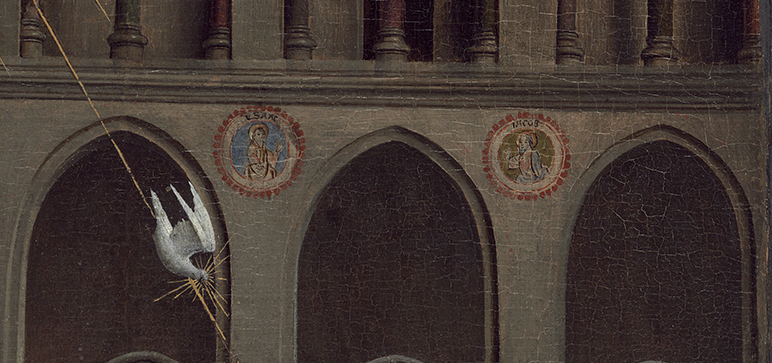
Gabriel tells Mary that Jesus “will reign over the house of Jacob forever, and of his kingdom there will be no end” (Luke 1:33). The two roundels painted on the rear wall depict Isaac blessing Jacob (Gen. 27).

I especially like how Witek points out the contrast between the pleasant, blended, colorful way light interacts with the angel’s wings and the severe, narrow manner in which it comes diving toward Mary—and humorously suggests that Mary’s expansis manibus gesture is her asking why. This observation unpeeled for me an additional layer of van Eyck’s possible meaning: how God’s coming to Mary was direct and piercing. His messenger, sure, has a soft rainbow glow, but the actual implantation of God in the womb happens with a laser focus that sears Mary in ways that will be all the more keenly felt as the years go by (see Simeon’s prophecy in Luke 2:34–35).

I got stuck on the last two lines, though: Why do we wait for Joseph? Isn’t he peripheral to the event? And was he not also “transfixed by dilemma” for a time, as he debated whether to say yes or no to God’s plan? So I asked the poet what she had in mind. She said how, standing before the painting, we, like Mary, become transported into this drama that lifts us up to a heavenly plane (I’m paraphrasing here), where we interact vicariously with Gabriel. We need someone to bring us back down to earth, so “we will be glad of Joseph, the human, the touch of the everyday real,” Witek explained to me.

The room “falling into light” describes the painted scene but also the public gallery where the painting is on display, and the name Joseph also has a double meaning, as Witek’s husband’s name is Joseph. In their museum going, his presence sometimes shakes her gently out of her reveries, reminding her that it’s time “to move on to the next painting, though it might not be as gorgeous,” she told me.

+++

“Waiting for the Revolution” by Peter Steele

If love is ‘the bright foreigner’, then here’s
      not Amour himself but still
a follower afire, his wings a blend
      of peacock and rainbow, the pearled cope
blooming to crimson on its ground of gold,
      his hair a downspill from the lock
of a coronet badged with jewels, the fingered sceptre
      a rod of crystal, and the smile
something they practise in another country.

This is not wasted on the woman who,
      her hands come up from the shell of a robe
which seems to have been steeped in ocean when
      darkness and light were still contending,
gazes now from the blaze of being at
      van Eyck, the Duke of Burgundy,
a Tsar made out of ice and marble, or
      whoever gives the alms of an hour
in minute-hungry fuming Washington.

Outside, a beat or two of an angel’s wings
      away on the Capitol is Freedom,
one of the later products of the Bronze
      Age, equipped with shield and sword,
a wreath for some earthly use or other, plumes,
      an eagle-crested helmet. She eyes
the status quo from her eminence and murmurs,
      ‘The past is prologue’, a Delphic saying
which she construes as ‘blessed are those in possession’.

I have been in and out of the world worlds,
      amphibious and double-hearted,
and still am. The shimmer of July
      speaks now for a perpetual
immobility, bronzing the will. The pavement
      beneath woman and angel shows
Goliath down and done with, Samson at grips
      with a sheltering enslaving place:
and for some want of the white bird of esprit

that plunges goldrayed into the woman’s mind,
      I’m in the middle. They say that she
has her consent to the revolution printed
      upside down for easier reading
in heaven. It may be so, but I’m guessing that
      the words in their reversal figure
a world swung round upon its axis, the all-
      clear given to those in quest
of the bright foreigner who lightens angels.

“Waiting for the Revolution” by Peter Steele appears in Plenty: Art into Poetry (Melbourne: Macmillan Art Publishing, 2003).

Peter Steele (1939–2012), a Jesuit priest from Australia, opens and closes his poem with a phrase from a 1849 journal entry by Ralph Waldo Emerson that says, “Love is the bright foreigner, the foreign self.” Steele interprets Jesus as that “bright foreigner” from heaven, Love, Amour, whose light gives angels their light. Those who search for themselves, he suggests implicitly, can find themselves in Jesus, who created them in love and calls them back into that love that is the ground of their being.

Before moving to this conclusion, Steele first relishes the painting’s fabulous details, especially the clothing: Gabriel’s elaborate, brocaded silk cope, with gold embroidery and green fringe, and Mary’s ultramarine robe trimmed in ermine. He also notes the angel’s wry and mysterious smile, an expression that draws me in every time I see this painting.

van Eyck, Jan_Annunciation (detail)

He considers how Mary’s eyes gazed out first at van Eyck the painter, then at the painting’s various owners over the centuries, and now at any visitor to or resident of Washington, DC, who stands before it in its dimly lit gallery on the National Mall.

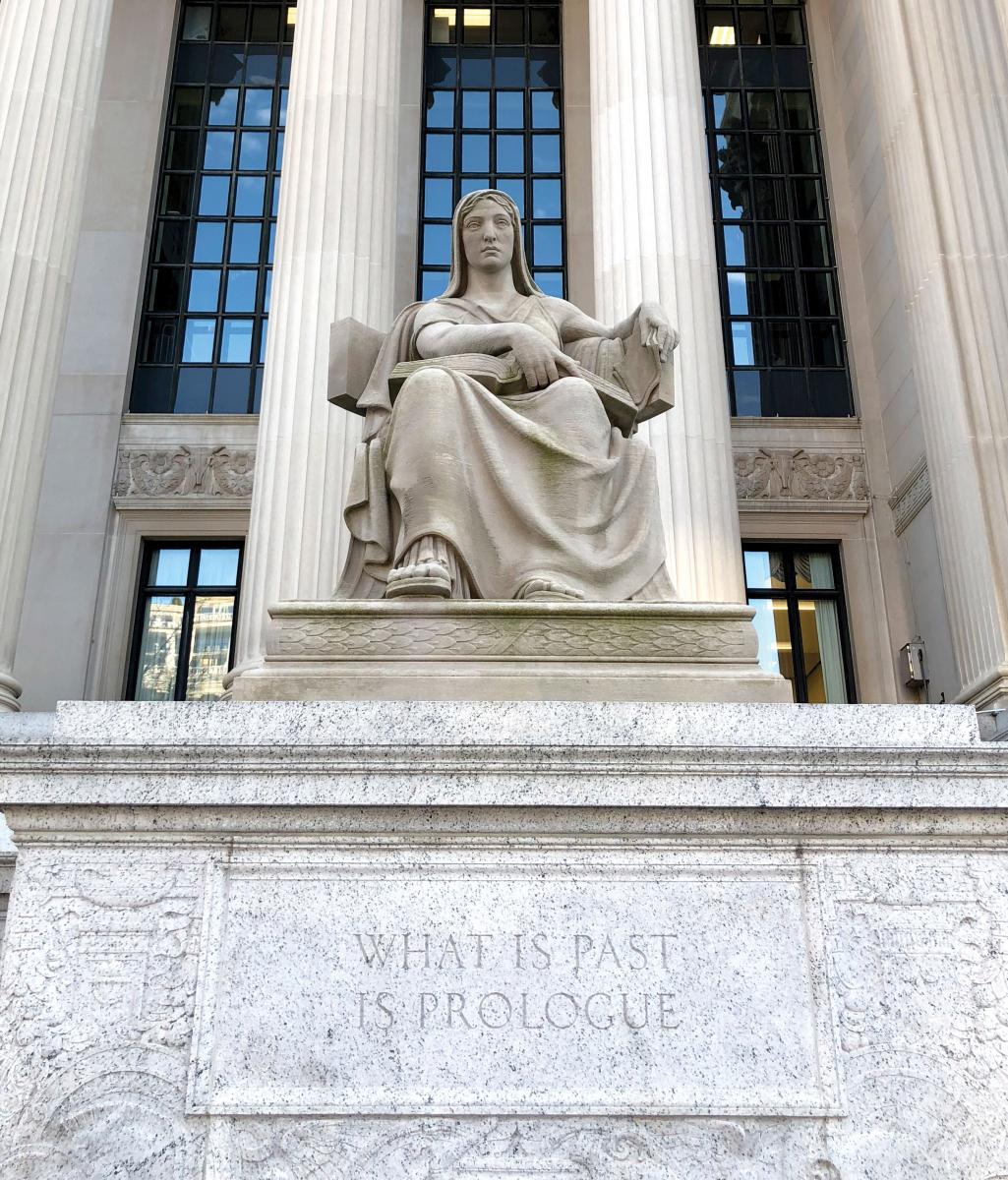
Its location in the United States capital city prompts Steele to contrast it with the nearby monument originally known as Freedom Triumphant in War and Peace or Armed Freedom, an allegorical figure in bronze that crowns the Capitol building. He has Freedom reciting a famous line from act 2, scene 1 of Shakespeare’s The Tempest—“What’s past is prologue”—spoken by the villainous Anthony in an attempt to convince Sebastian to murder his sleeping father and thus make himself king; the idea is that his whole life up to this point was merely an introduction to the great story that will be underway if he goes through with the plan. (The line is inscribed on the base of Robert Aitken’s sculpture Future, located on the northeast corner of the National Archives Building, which shows a young woman holding an open blank book and contemplating the things to come.) Steele imagines this saying, in the mouth of Freedom, as bearing the subtext “Blessed are those in possession” (or, in its original Latin, Beati sunt possidentes), a proverb popularized by the Prussian general and military theorist Carl von Clausewitz in reference to the possession of power and force.

Freedom (Capitol)
Thomas Crawford (American, 1814–1857), Statue of Freedom, 1863. Bronze, 19 1/2 ft. tall. Atop the dome of the US Capitol, Washington, DC.

What Is Past Is Prologue
Robert Aitken (American, 1878–1949), Future, 1935. Indiana limestone, 20 × 8 × 12 ft. (sculpture), plus 12 × 12 × 15 ft. (base). Outside the National Archives Building, Washington, DC. Photo: Rania Hassan.

The two government-commissioned artworks and two quotes Steele’s poem references ping around in my mind as I think about how they relate to the Annunciation. The picture of Freedom as a colossal helmeted woman bearing a sword differs from the smaller, quieter way “Freedom” comes to reign in the Christmas story: that is, as a babe in a manger. And the self-protecting, self-aggrandizing path commended by Clausewitz butts heads against the self-emptying ethic at the heart of Christianity. So does the motivation of the Shakespearean character—treacherous, underhanded—who was the first to say, “What’s past is prologue.” But when considered in light of Luke 1 and even the Future sculpture in DC, this “Delphic” (obscure, ambiguous) saying from the Bard can be seen as alluding to Mary’s position at the Annunciation, at the turning point of history. Mary is fated to act; the past has set the stage for her yes, and for all that will happen next. The New Testament is as yet unwritten—until her bravely submissive response to the angel’s invitation sets God’s grand redemption plan, on hold for four hundred years, into motion once again, and what we call “gospel,” good news, arrives on earth at last in the person of Christ.

In van Eyck’s Annunciation, as in many others, the words AVE GRA[TIA] PLENA (“Hail, full of grace”) stream forth from Gabriel’s mouth in gold lettering, to which Mary replies, ECCE ANCILLA D[OMI]NI (“Behold the handmaiden of the Lord” [Luke 1:38]). Amusingly, van Eyck renders her response upside-down, a device he also uses in the Ghent Altarpiece, presumably so that God can read it from heaven. Steele playfully interprets the inversion as signaling the upside-down nature of God’s incoming kingdom; the world has been turned on its head by Mary’s yes—which is why that yes is rotated 180 degrees!

One aspect of this upside-down-ness is how Mary contradicts the aforementioned adage, used in diplomacy, “Blessed are those in possession.” In scripture Mary is called blessed, but not because she seizes or owns or controls anything. Quite the opposite: because she relinquishes her right to go on living a normal, play-it-safe life. And because she is humble, God raises her up, and those like her. (She sings about this in her Magnificat.) That’s not at all to say that Mary is passive or lacks agency. She stands actively with open hands to receive grace, to receive God himself, and to gift him to the world. She “consent[s] to the revolution.”

I’m reminded of the song “Canticle of the Turning,” written by Rory Cooney in 1990 based on Mary’s Magnificat and set to the traditional Irish tune STAR OF THE COUNTY DOWN. Listen to an acoustic performance by Katherine Moore:

“The world is about to turn.”

+++

van Eyck, Jan_Annunciation

For a further in-depth look at the symbolic significance of the architecture and objects in Jan van Eyck’s Annunciation—including the wall paintings and windows in the background, the nielli in the floor, the footstool in the foreground, and the missing boards in the ceiling—see Early Netherlandish Painting: The Collections of the National Gallery of Art by John and Oliver Hand and Martha Wolff, pages 76–86: a PDF of the entire book is provided for free download by the National Gallery of Art. See also the NGA’s special webpage for this collection highlight.

Interacting with artworks online: A few new(ish) resources

The global push to make art more accessible to the public has led to some impressive digital creations in the past year. The following are ones I’ve really enjoyed exploring, some released as recently as this month. They all focus on a particular artwork or era or (in the case of the Jewish art database) faith tradition. I will cover the more all-encompassing digital art initiatives/databases and commendable museum websites in a future series of posts, where I will give them more individualized attention. Some of the creations below represent single projects within those broader initiatives.

“The Audacity of Christian Art”: Written and presented by Dr. Chloë Reddaway, this series of seven short films looks at paintings from the (London) National Gallery’s Renaissance collection and explores some ingenious artistic responses to the challenge of painting Christ.

As curator of art and religion at the museum, Reddaway’s role is to understand more about the paintings’ religious content and context. (Her main academic background is theology.) She also lectures for the MA in Christianity and the Arts at King’s College London. I love how she defines her primary research interest: “visual theology, especially the recovery of historic works of art as a resource for contemporary theology.”

The trailer for “The Audacity of Christian Art” is below, followed by links to all seven episodes. All are shot in ultra-high resolution and feature stunning details.

Episode 1: “The Problem with Christ”
Episode 2: “Christ Is Not Like a Snail: Signs and Symbols”
Episode 3: “Putting God in His Place: Here, Everywhere, and Nowhere”
Episode 4: “Time and Eternity: Yesterday, Today, and Always”
Episode 5: “This World and the Next: Christ on Earth, Christ in Heaven”
Episode 6: “So Near and Yet So Far: Visions and Thresholds”
Episode 7: “Unspeakable Images: When Words Fail”

+++

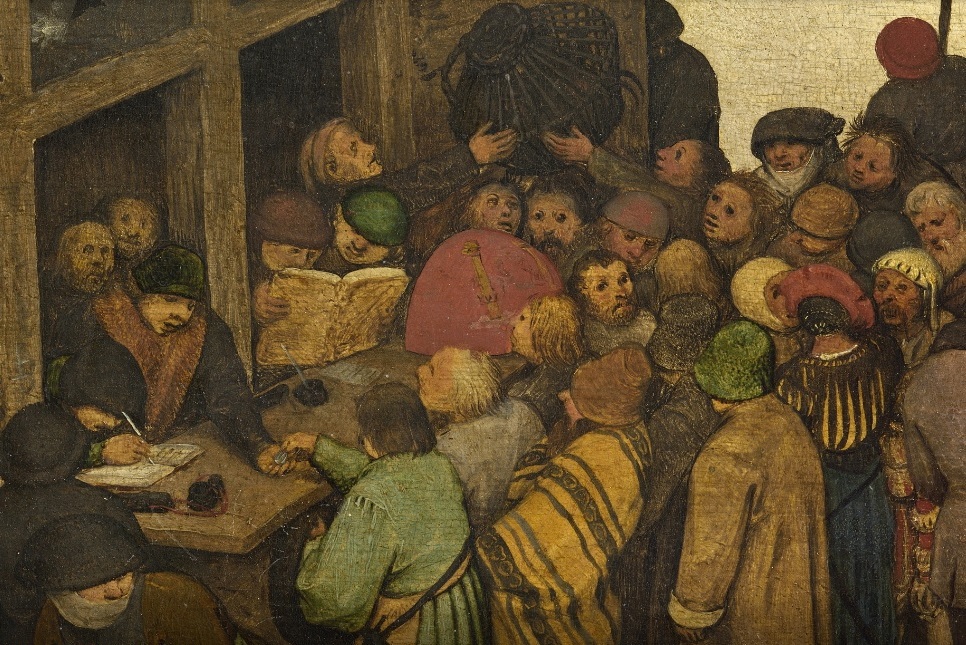
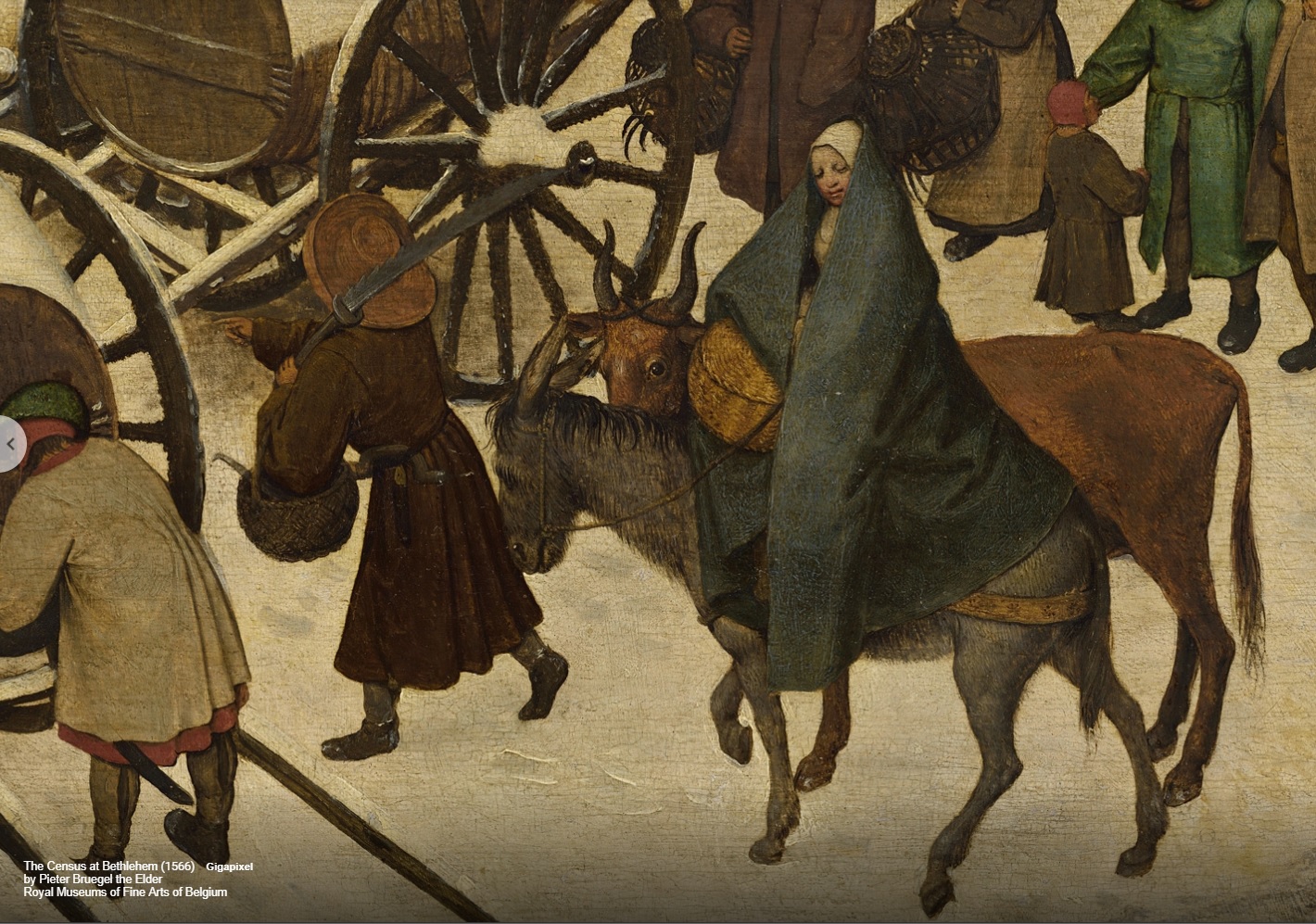
The Census at Bethlehem by Pieter Bruegel: “Online exhibitions” are something I’ve seen more and more of recently—that is, the presentation of artworks in a digital rather than physical space, using tools unique to that medium to enhance the viewing experience. Last year Google Arts and Culture launched one in conjunction with the Royal Museums of Fine Arts of Belgium, centered around Pieter Bruegel’s The Census at Bethlehem (1566), which sets Mary and Joseph’s census registration within the hustle and bustle of a Brabant village. The interface guides you through a sequence of bite-size commentaries, sometimes presented as text alongside an image detail, sometimes as a short video. What makes it an “exhibition” is that other works are shown alongside it to locate it within a larger tradition of Netherlandish painting. One frame, for example, shows how Bruegel furthered the innovative “alla prima” technique introduced by Hieronymus Bosch.

Census at Bethlehem by Pieter Bruegel
Pieter Bruegel the Elder (Dutch, 1525/30–1569), The Census at Bethlehem, 1566. Oil on panel, 116 × 164.5 cm (46 × 64.8 in.). Royal Museums of Fine Arts of Belgium, Brussels.

I studied this painting in college (through slides and textbook reproductions) but have never seen it in this much detail and am now all the more in awe of it. Bruegel’s paintings, which almost always depict a flurry of activity, lend themselves particularly well to this viewing format: it’s helpful to be guided through the various vignettes, each one a window into sixteenth-century Dutch life. Up close, you can see kids blowing up pig-bladder balloons and running across the ice pushing cow jaws they got from the butcher; you can see adults patronizing a tavern in the hollow of a tree, called “In De Swaen”; and much more.

Census at Bethlehem (detail)

Census at Bethlehem detail

Census at Bethlehem detail

+++

“Jheronimus Bosch, the Garden of Earthly Delights”: Created in 2016 by a thirty-four-person team, this “interactive documentary” provides an in-depth audiovisual tour though the Dutch artist’s most famous—and, arguably, most bizarre—painting. The interior of the triptych shows, in the central panel, life before the Flood—a depraved orgy in which humans cavort shamelessly with a whole host of beastly creatures conjured from the artist’s imagination.   Continue reading “Interacting with artworks online: A few new(ish) resources”