
Roundup: Social music with Dan Zanes, the Green Man, and more

Lancaster Digital Collections has published twelve webpages of “iconography-inspired sacred art,” with downloadable images made available by permission of the artists. I especially like the paintings of Janet McKenzie [previously] and Khrystyna Kvyk [previously].
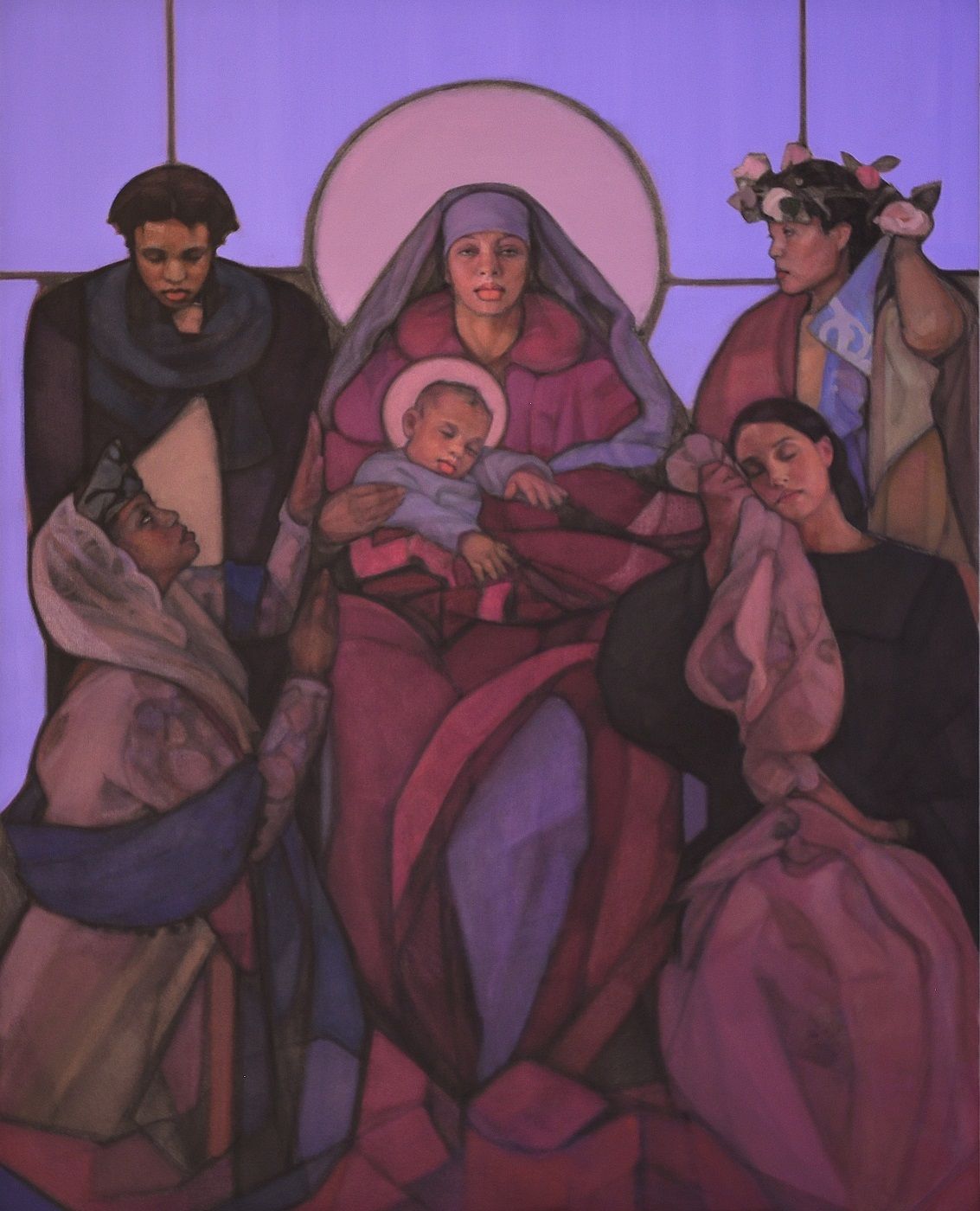
McKenzie, Janet_The Divine Journey
Janet McKenzie, The Divine Journey: Companions of Love and Hope, 2017. Oil on canvas, 48 × 36 in. Memorial Church, Harvard University, Cambridge, Massachusetts.

Kvyk, Khrystyna_The Descent into Hell
Khrystyna Kvyk (Ukrainian, 1994–), The Descent into Hell, 2023. Acrylic on gessoed wood, 40 × 40 cm. Private collection.

+++

FREE ZOOM CONVERSATION: Social music with Dan Zanes, July 16, 2025, 8 p.m. ET: I met the Baltimore-based folk musicians Dan and Claudia Zanes [previously] two years ago at a local family concert they put on. Joyous, bighearted, faith-filled, community-focused, committed to social justice—I love who they are and what they’re about and all the rich music they share.

In a social media post on June 11, Dan posed the question, “Is there anyone out there who wants to become a music maker and help uplift their community?” Followed by a generous offer: “I can teach you how to play guitar and sing songs (and write songs if you want). No cost, this is a different approach. It will be through a series of Zoom lessons (unless you live down the street). Whether you’re a beginner or someone who’s been dabbling and wants to take it out of the house, I can get you to a confident place so you can play for and with people.” The caveat? You just have to promise to put in the practice and to share your music freely in your community! And to teach someone else what you’ve learned.

“There are so many ways to make positive social change,” Dan says, “and creating music in our communities is certainly one of them.” I believe he has already selected a set of students to take on, but having received so many messages of interest, he has also decided to host a Zoom conversation on social music this coming Wednesday evening. On July 9, he wrote on social media:

Social music in chaotic times, people! Let’s talk about it. I’ve been hearing from many folks who want to be more useful in their communities and see music as the way.

Yes! Music can be healing, galvanizing, uplifting, energizing, and calming. Imagine if every community had many more music makers to play for the young folks, the elders, to lead singalongs and dance parties, to offer songs during times of loss and celebration. Of course it’s happening now, and still I believe there’s so much more that is possible.

If you’re interested in joining the meeting, send Dan an Instagram message @danzanes or a Facebook message @danandclaudiazanes and he’ll send you the link.

To give you a sense of Dan and Claudia’s vibes, here’s one of their original songs, which they debuted on their YouTube channel in 2020:

+++

ONLINE RETREAT: “Read for Your Life: Creating a Story-Formed Home” with Sarah Clarkson, August 5, 2025: Join author Sarah Clarkson [previously] for a daylong online retreat exploring children’s literature, childhood reading, and the development of imagination. “My goal,” she writes, “is to provide a vision for the beauty of the reading life, some good research, and a generous stack of practical booklists to help you begin to outfit and build a home library for the children in your life.” The cost is $35. The event begins at 9:30 a.m. UK time, but all live sessions will be recorded and offered on-demand afterward to registrants.

+++

PODCAST EPISODE: “The Green Man,” Gone Medieval, June 23, 2025: In this episode, Dr. Eleanor Janega talks with Imogen Corrigan, author of The Green Man: Myth and Reality (Amberley, 2025), about the enigmatic “green man” figure, or foliate head, which can be found in almost every pre-Reformation English cathedral and in many churches, decorating arches, corbels, roof bosses, choir stalls, and chancel screens. Corrigan claims that “the image has to be one of the most misunderstood, misinterpreted and misrepresented in the history of church carvings,” having nothing to do with pagan fertility rites. She suggests, rather, that the Green Man gestures toward the resurrection of, and resurrection in, Christ—to spiritual rebirth and eternal life.

Green Man misericord
Misericord from King’s Lynn Minster, England, ca. 1370s, depicting a Green Man disgorging oak leaves. Photo: Lucy Miller. (Click on image for great compilation!)

The two medievalists speak on location at St Mary’s at Minster-in-Thanet and St Nicholas-at-Wade in Kent. The conversation really starts to pick up at 19:47.

+++

This past month has seen the death of two rock ’n’ roll legends whose music, which played regularly on Oldies 100.7 WTRG, formed part of the soundtrack of my 1990s childhood: Brian Wilson (of the Beach Boys) and Sly Stone (of Sly and the Family Stone).

Much has been written about both trailblazers. I just want to mention two things:

1. Love and Mercy, the 2014 film directed by Bill Pohlad about Brian Wilson (played by Paul Dano and John Cusack), is excellent. Elliot Roberts makes the case that it’s the best music biopic ever made, and I’m inclined to agree; New York Times film critic Alissa Wilkinson also cites it as her favorite, at least within the rock genre. The story alternates between Wilson’s production of the Pet Sounds album in the mid-sixties and his abusive psychological treatment under his therapist and conservator Eugene Landy in the late 1980s, which coincided with his meeting Melinda Ledbetter, who would become his wife. The title is taken from one of Wilson’s solo songs from 1988. Here’s the film trailer:

2. Active from 1966 to 1983, Sly and the Family Stone was one of the very few multiracial, mixed-gender bands of the time, modeling integration when the notion was still fairly new in America. Perhaps you’ve heard their most famous hit, “Everyday People,” a call for unity across lines of difference (“There is a blue one who can’t accept the green one / For living with a fat one, tryna be a skinny one . . .”). Sly Stone was the front man—singer, songwriter, multi-instrumentalist, and producer. As is common among so many African American musicians, he got his musical start in church; from infancy, he was immersed in gospel music as a member of the Church of God in Christ, and his musical talent was nurtured there. I learned that in the fifties, he and three of his four siblings even formed a gospel group called the Stewart Four, locally releasing a single in August 1956. Here’s the B-side, “Walking in Jesus’ Name,” with a thirteen-year-old Sly singing lead:

Advent, Day 23: He Comes

LOOK: Mary with the Midwives by Janet McKenzie

McKenzie, Janet_Mary with the Midwives
Janet McKenzie, Mary with the Midwives, 2003. Oil on canvas, 54 × 42 in. Collection of Catholic Theological Union, Chicago. [purchase reproduction]

LISTEN: “Mary” by Buffy Sainte-Marie, on Illuminations (1969)

Yonder I see a star
Oh, see how bright it’s burning
Joseph, my time is come
The Son of God is yearning
To come, to come

Ask the man for some room to spare
And a candle dimly burning
Joseph, my time is come
The Son of God is yearning
To come, to come

Pain of birth is surely great
And yet my fate’s been told me
Do I see an angel bright
Descending to behold me
He comes, he comes, he comes

(Related post: “Deliverance,” a poem by Evelyn Bence)

Roundup: Call for art, Nepali worship song, Magdalene triptych, and more

CALL FOR ART: Light in the Dark, Sojourn Arts: Sojourn Arts, a ministry of Sojourn Midtown church in Louisville, Kentucky, is accepting entries for wall-hung visual artworks on the theme “Light in the Dark” for its juried art show this Advent and Christmas. It is free to enter (see email submission instructions at link), but selected artists will be responsible for shipping costs to the venue. Three cash prizes will be awarded. Deadline: October 8, 2023. Open to continental US artists only.

Light in the Dark
background image by Steven Homestead

+++

SONGS:

>> “O My Hope (A Prayer of Saint Isaac the Syrian)” by Symon Hajjar: Symon Hajjar is a singer-songwriter from Tulsa, Oklahoma. I love, love, love his setting of this passage (lightly adapted from an English translation by Sebastian Brock) from the writings of Isaac the Syrian, a seventh-century theologian from Mesopotamia. Because the song would work well for Epiphany, Hajjar released it as the final track on his album Finally Christmas (2015), although it’s not available on Bandcamp as all the other tracks are.

O my Hope, pour into my heart the inebriation that consists in the hope of you. O Jesus Christ, the resurrection and light of all worlds, place upon my soul’s head the crown of the knowledge of you, and open before me suddenly the door of mercies; cause the rays of your grace to shine out in my heart. . . . I give praise to your holy nature, Lord, for you have made my nature a sanctuary for your hiddenness, a tabernacle for your mystery, a place where you can dwell, a holy temple for yourself.

[see Isaac of Nineveh (Isaac the Syrian): ‘The Second Part’, Chapters IV-XLI, pp. 14–15, 8]

Currently, Hajjar writes and performs kids’ songs under the name Hot Toast Music.

>> “Mahima Mariyeko Thumalaai” (महिमा मारिएको थुमालाई) (Glory to the Lamb Who Was Slain), arranged and performed by Psalms Unplugged: This song is #505 from Nepali Khristiya Bhajan, the definitive Nepali-language hymnal; the words are by Rev. Solon Karthak, and the music is by the late Kiran Kumar Pradhan, the most influential writer of Nepali hymns, who was particularly active in the 1990s. Inspired by Revelation 5:12, its refrain translates to “Glory to the Lamb who was slain / Praise to the Lord of lords / Shouts to the King of kings.” Read the original Nepali lyrics here.

The musicians who form the Nepali worship collective Psalms Unplugged are extraordinary. In this video are Subheksha Rai Koirala (vocals), John Rashin Singh (flute), Ayub Bhandari (keys), Sagar Pakhrin (guitar), and Enosh Thapa Magar (drums). The group’s mission is to see the transformation of lives through the preservation, cultivation, and spread of Nepali Christian music.

+++

LECTURE: “Janet McKenzie’s Women: Mothers, Midwives, and Missionaries” by Sister Barbara E. Reid, OP, September 27, 2015, Catholic Theological Union, Chicago: In this lecture, New Testament scholar Barbara Reid, OP, discusses three painted artworks by Janet McKenzie featuring women of the Bible, all in the collection of Catholic Theological Union: The Succession of Mary Magdalene, a triptych that shows Mary Magdalene deaconing with Susanna and Joanna (Luke 8:1–3), seated with Jesus Christ, her commissioning teacher (John 20:17), and preaching the Resurrection to Peter and John (John 20:2–9, 18); Mary with the Midwives, showing the Mother of God in the early stages of labor; and one of McKenzie’s most reproduced images, Epiphany, which replaces the traditional three wise men with wise women!

Mary Magdalene triptych (Janet McKenzie)
Janet McKenzie, The Succession of Mary Magdalene (triptych), 2008. Left to right: Companion; The One Sent; Apostle of the Apostles. Collection of Catholic Theological Union, Chicago.

Professor Reid’s talk starts at 13:55. Before that, there is an introduction by Barbara Marian from Harvard, Illinois, who commissioned the paintings and donated them to CTU (“The giftedness of women and our call to minister in the church must be made visible, no longer hidden or ignored and devalued,” she says), and by CTU President Mark Francis, CSV. Because the feast day of Mary Magdalene is coming up on July 22, it’s a particularly apt time of the liturgical year to share this!

+++

VIDEO: “12 Ways to Be a Christian” by SALT Project: The nonprofit production company SALT Project creates beautiful short films for churches and other clients. In sixty seconds, this one lists (and visualizes) twelve practical ways of living Christianly. The video is fully customizable to include your church’s name, logo, worship times, and website; click here for prices.

Advent art slideshow and devotional

Advent is just around the corner, commencing Sunday, November 27. To support Christians in their seasonal journey toward Christmas, I’ve developed two companion resources: a slideshow of art images for congregational use, and a devotional booklet for individuals or small groups that offers written reflections on these images.

The structural backbone is a liturgical text written by Jonathan Evens, which has as its refrain the plea “Come, Lord Jesus, come.” It looks forward to Christ’s second advent but also, necessarily, back to his first, in all its various aspects. Along with themes of peace, love, and sacrifice, you are invited to consider

  • what it meant for Jesus to be born of woman—coming as seed and fetus and birthed son;
  • the poverty Jesus shared with children around the world;
  • culturally specific bodies of Christ, like a dancing body and a yogic body;
  • how we are called to bear God into the world today;
  • and more.

Art is a great way to open yourself up to the mysteries of God, to sit in the pocket of them as you gaze and ponder. “Blessed are your eyes because they see,” Jesus said. Theologians in their own right, artists are committed to helping us see what was and what is and what could be. Here I’ve taken special care to select images by artists from around the world, not just the West, and ones that go beyond the familiar fare. You’ll see, for example, the Holy Spirit depositing the divine seed into Mary’s womb; Mary with a baby bump, and then with midwives; an outback birth with kangaroos, emus, and lizards in attendance; Jesus as a Filipino slum dweller; and Quaker history married to Isaiah’s vision of the Peaceable Kingdom.

My vision is for the two-minute slideshow to be shown in church on the first day of Advent during the main service. Two minutes is not nearly enough time to take in twenty-four images, so the slideshow is really just an invitation to deeper, one-on-one engagement with the images throughout the week, and that’s where the booklet comes in—as an aid to contemplation. To reinforce the practice and to make it more communal, pastors might consider drawing one image per week into his or her sermon, or discussion could be built into the Sunday school hour. There are twenty-eight days in Advent this year but only twenty-three reflections, so I’ll leave it up to you how to parse them out.

A humongous thanks to the artists and institutions who have granted permission for use of their work. Copyright of the images is retained by them, except where “Public Domain” is indicated, and reproduction outside the context of this slideshow and booklet is prohibited without their express permission. You of course are encouraged to show the slides publicly, and to distribute the booklet, but you must not charge a fee.

I hope these images fill you with wonder and holy desire—to know Christ more and to live into the kingdom he inaugurated two thousand-plus years ago from a Bethlehem manger.

Download the slideshow as a PowerPoint file.

Download the devotional booklet as a PDF. (Note: This version is slightly edited from the original.)

Want to have the booklet print and bound? Use this print-ready version. (I recommend a coil bind with a clear plastic front cover and a vinyl back cover. This will run you about $20 each at most commercial print centers, or less for larger quantities. Be sure to print double-sided, head-to-head.)

I realize that Sara Star’s The Crowning might be too graphic for some churches. Although I personally am compelled by it and obviously endorse it through its inclusion (what better complement to the line “Coming down the birth canal”?), I offer the following as alternative image suggestions for those who might want to substitute it with something more abstract or sanitized: Through the Needle’s Eye by Grace Carol Bomer; the Dieu parmi nous (God Among Us) panel from La Nativité du Seigneur (The Nativity of the Lord) by Sophie Hacker; Motherhood by Matthew Gill; or Nativity by Paula Rego. Please note that I have NOT received copyright clearance for any of these alternates, which means that if you were to use one, you would be responsible for securing the proper permission.

If you have any questions about how to use these resources, or if you’d like to share any feedback with me—either on how the images or format were received in your congregation, or suggestions for future improvement—feel free to contact me at victoria.emily.jones@gmail.com, or use the comment field below. This is really my first attempt to bring the principles of this blog out into the local church, so I’m eager to see what kind of fruit it bears.