Advent, Day 4: Swords into Plowshares

One day

[. . .]

God
will come forward

to settle the conflicts between us
finally          the one
true witness

even the finality of holocaust
will melt away
like lowland snow

the military hardware
translated into monkey bars
where children play

the hardened postures
crumbled
like ancient statues

children will wave through the gunholes
of tanks
rumbling off to the junkyard

people will find hands
in theirs
instead of guns

learn to walk
into their gardens
instead of battle

Oh House of Israel
let’s walk in the sunlight ways
of his presence

—Isaiah 2:2–5, translated by David Rosenberg in A Poet’s Bible: Rediscovering the Voices of the Original Text (New York: Hyperion, 1991)

LOOK: Isaiah’s Vision of Eternal Peace by Mordecai Ardon
Ardon, Mordecai_Isaiah's Vision of Eternal Peace
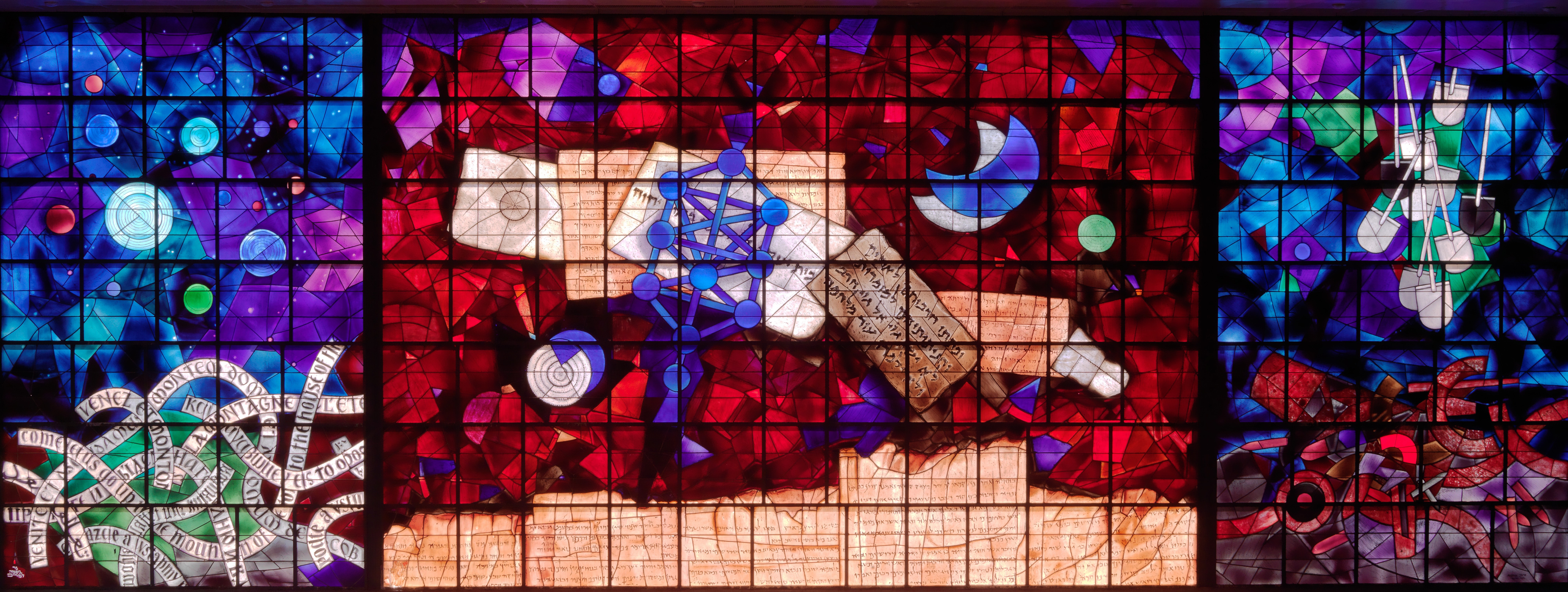
Mordecai Ardon (Israeli, 1896–1992) (designer) and Charles Marq (French, 1923–2006) (fabricator), Isaiah’s Vision of Eternal Peace, 1982–84. Stained glass, 6.5 × 17 m. Old National Library of Israel building, Givat Ram campus, Hebrew University of Jerusalem. Photo: Hanan Cohen.

Born in 1896 to a Jewish family in the village of Tuchów in what is today Poland, Mordecai Ardon studied art in Germany under Paul Klee and Wassily Kandinsky. When the Nazis came to power in 1933, he moved to Jerusalem, becoming a teacher in 1935 at Palestine’s chief art academy, the Bezalel School of Arts and Crafts, which he directed from 1940 to 1952. Known for their vibrant tones and stirring rhythms, Ardon’s paintings often explore the connections between the visible and the invisible and reflect his interest in mysticism and antiquity.

From 1982 to 1984 Ardon carried out a commission by the National Jewish University and Library (now the National Library of Israel) in Jerusalem to develop a monumental triptych of stained glass. His painted designs were translated into the medium of stained glass by the French master glazier Charles Marq, a frequent collaborator of Marc Chagall’s. The result is titled Isaiah’s Vision of Eternal Peace.
Ardon, Mordecai_Isaiah's Vision of Eternal Peace (left)

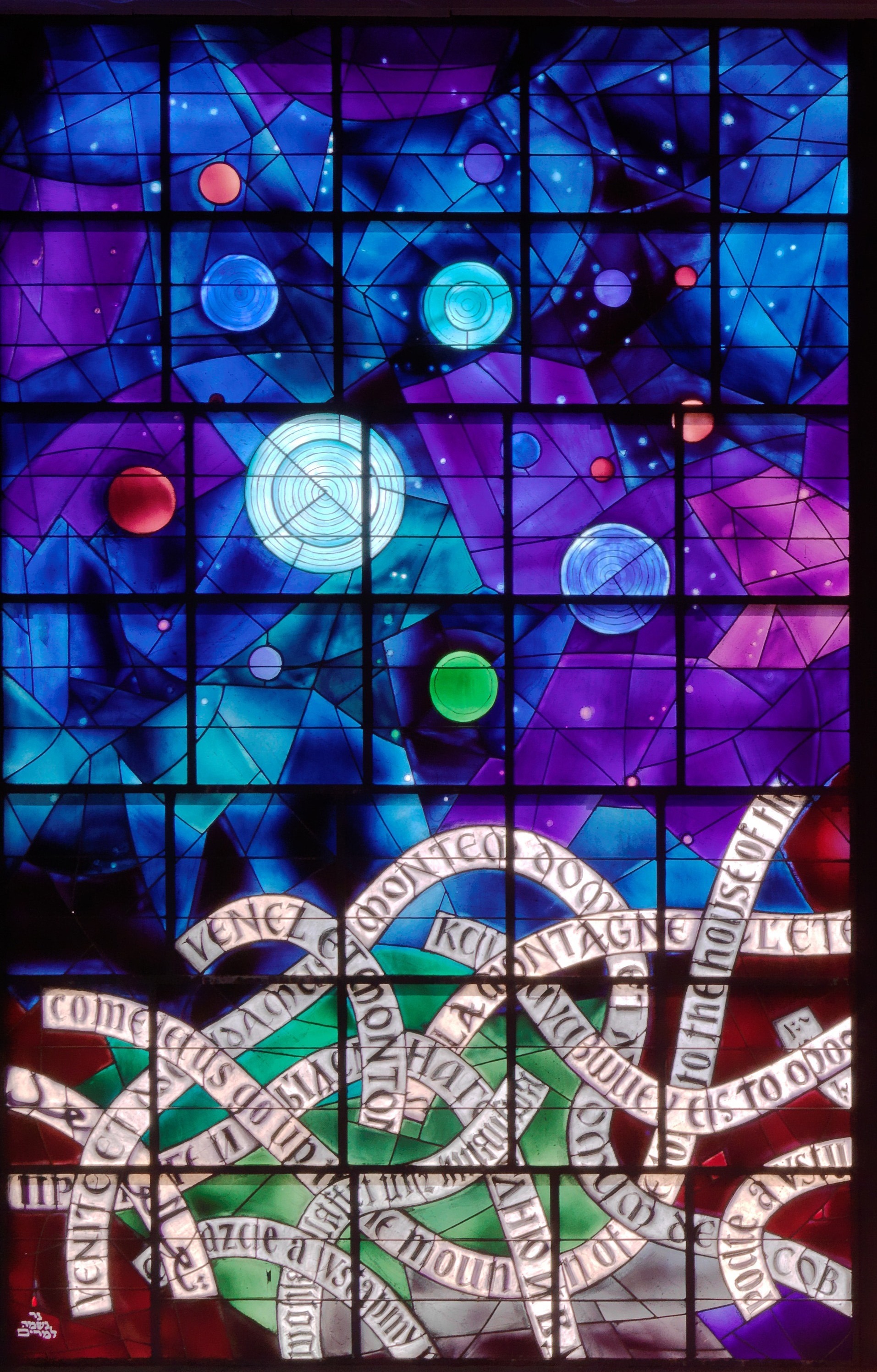
The left panel illustrates Isaiah 2:2–3:

In days to come the mountain of the LORD’s house shall be established as the highest of the mountains and shall be raised above the hills; all the nations shall stream to it. Many peoples shall come and say, “Come, let us go up to the mountain of the LORD, to the house of the God of Jacob, that he may teach us his ways and that we may walk in his paths.”

Winding like roads, the white bands contain the boldfaced line in various languages—I can detect English, Russian, Polish, Arabic, Latin, and French—representing the peoples of the world streaming to Jerusalem.
Ardon, Mordecai_Isaiah's Vision of Eternal Peace (center)

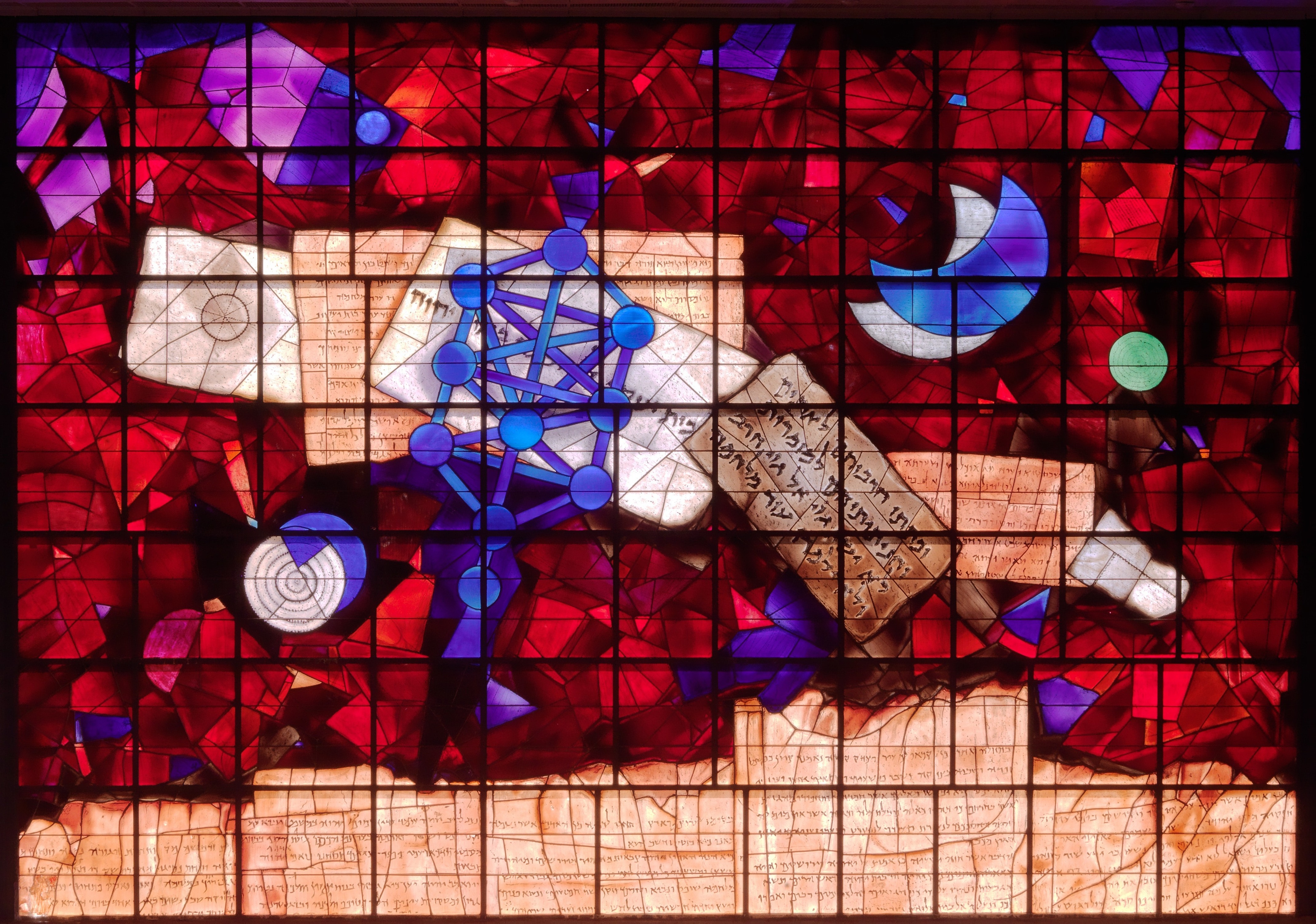
The center panel depicts a merging of the earthly and heavenly Jerusalems. At the bottom stand the city walls, made up of the seventeen sheets of parchment that comprise the Great Isaiah Scroll from Qumran, dating to around 100 BCE. Floating above are Kabbalistic symbols, including the Tree of the Sefirot, signifying the Divine Presence. There are also several Hebrew texts from Jewish history that I can’t identify.
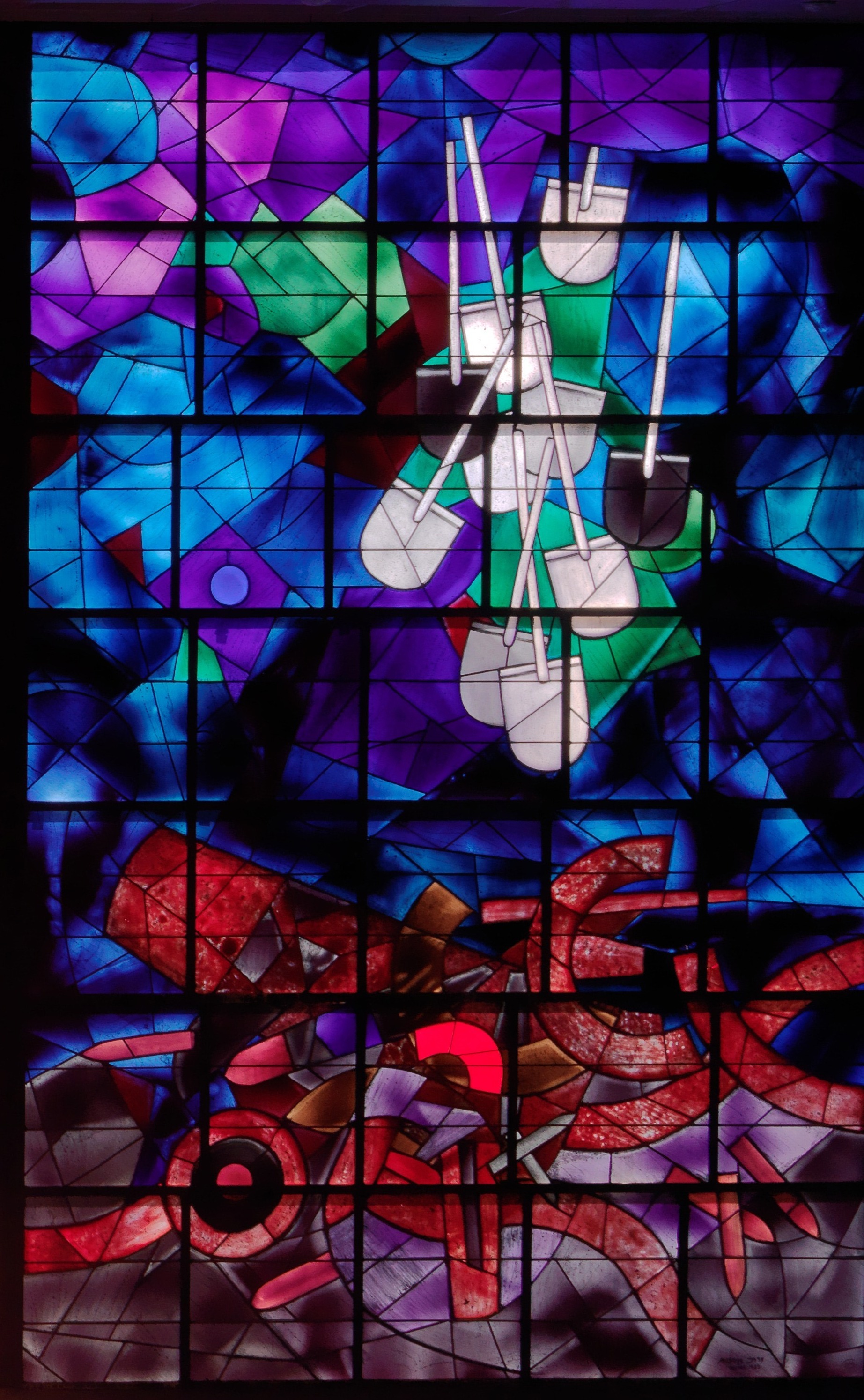
Ardon, Mordecai_Isaiah's Vision of Eternal Peace (right)

The right panel visualizes the fulfillment of Isaiah 2:4: “. . . they shall beat their swords into plowshares and their spears into pruning hooks; nation shall not lift up sword against nation; neither shall they learn war any more.” All the machinery of war—tanks and fighter jets, guns and bullets—lies in a garbage heap at the base, and shovels emerge overhead as the weapons are transformed into farming tools.

This glasswork covers an entire wall of the old National Library of Israel building on the Givat Ram campus of Hebrew University. The library moved into a new building in October 2023, situated between the Knesset and the Israel Museum in the heart of Jerusalem. But Ardon’s window remains in its original building at HUJI, which has become a multipurpose space.

LISTEN: “Lo Yisa Goy (Study War No More)” (ֹא יִשָּׂא גוֹי) | Traditional Jewish folk song, arr. Linda Hirschhorn and Fran Avni | Performed by Vocolot, on Behold! (1998)

לֹא יִשָּׂא גוֹי אֶל גוֹי חֶרֶב
לֹא יִלְמְדוּ עוֹד מִלְחָמָה

(Transliteration:
Lo yisa goy el goy cherev
Lo yilmadu od milchama)

(Translation:
Nation will not take up sword against nation
Nor will they train for war anymore)

And into plowshares [they’ll] beat their swords
Nations shall learn war no more

The lyrics of this traditional Jewish antiwar song come from the original Hebrew of Isaiah 2:4, a text held sacred by both Jews and Christians. The song looks with prayerful hope toward the day when global peace will be a reality.

If this is the glorious end state to which we all are headed, the future that God has envisioned and charted for us, then why do we participate in violence now? When governments try to control people through violence, and those people respond with violence, that response only provokes violent retaliation, and so the cycle continues on and on—militancy and death. The line between aggressor and defender becomes blurred. We’ll never get closer to the Isaiah 2 ideal by asserting ourselves with weapons.

May the people of God be a people who refuse violence even when the state commands it, even when we’ve been hit tremendously hard and the urge for payback is intense. May we not become what we fear, inflicting terror because we have been terrorized. And may God bring peace and healing to people and nations who have been victims of war; so too perpetrators of war. To those just trying to survive and be free in this fallen world as best they know how.

The first chapter of Isaiah, which precedes the famous “swords into plowshares” chapter, contains this word from the Lord to his people:

When you stretch out your hands,
I will hide my face from you;
even though you make many prayers,
I will not listen;
your hands are full of blood.
Wash yourselves clean, make yourselves clean;
remove the evil of your doings
from before my eyes;
cease to do evil,
learn to do good;
seek justice,
rescue the oppressed,
defend the orphan,
plead for the widow.

—Isaiah 1:15–17

So let us renounce our vindictiveness and “wash ourselves clean.” And then let us sing this song (1) as a prayer that the Messiah, whom Christians recognize to be Jesus of Nazareth, would come to actualize this beautiful vision of peace, but (2) also as a pledge, committing ourselves to the path of life—to, in the words of the apostle Paul, “overcom[ing] evil with good” (Rom. 12:21).

I like Vocolot’s “Lo Yisa Goy” arrangement best; it has a celebratory mood, as if the coming peace is in sight. But what follows is a handful of others that carry more of a lamentful tone, which is also appropriate as we consider the persistence of war and how short we fall of God’s plan for human flourishing that’s never at the expense of others.

For harp and voice by Estela Ceregatti of Brazil, 2020:

A cappella by the American Midwest female vocal trio Rock Paper Scissors, 2010:

For strings, by La Roche Quartett from Germany, 2018:

A virtual choir under the direction of Andrea Salvemini, 2020:

The last performance employs an increasing number of instruments as the song progresses: guitar, recorder, keyboard, cello, percussion, and accordion. It also includes steps to an Israeli circle dance performed by participants in isolation because this was during the days of COVID quarantines; elsewhere online you can find communal performances where the circle is closed.

Some versions add these two lines as a verse, adapted from Micah 4:4:

And every man ’neath his vine and fig tree
Shall live in peace and unafraid
Palm Sunday: Jerusalem, Jerusalem

LOOK: Palm Sunday by Justin O’Brien

O'Brien, Justin_Palm Sunday triptych
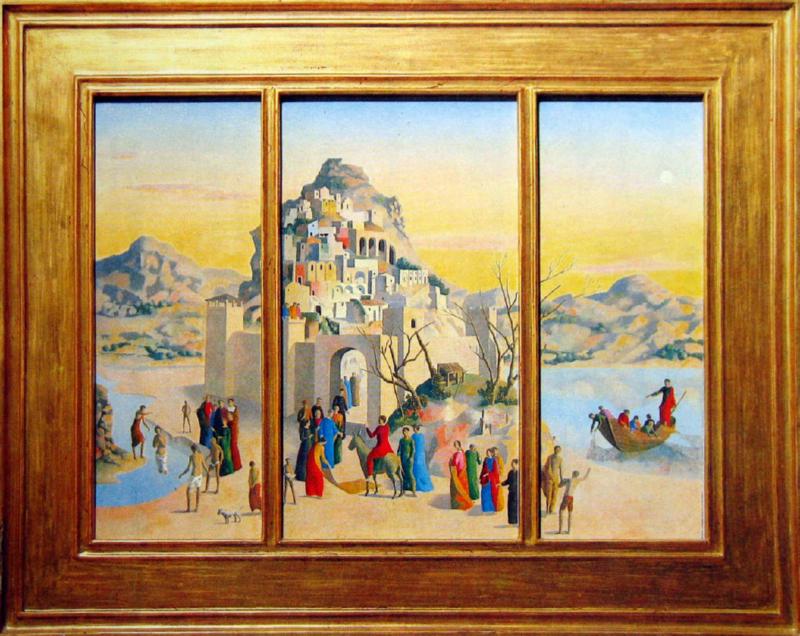
Justin O’Brien (Australian, 1917–1996), Palm Sunday, 1962. Oil on canvas, 45.5 × 62 cm.

This triptych (three-paneled artwork) by Australian artist Justin O’Brien portrays three scenes from the life of Christ. On the left wing is the Baptism of Christ, where he’s anointed by God’s Spirit for his messianic role, and on the right is the Miraculous Draught of Fishes, a story of miraculous abundance. The center panel shows Jesus about to enter the gates of a hilltop city representing Jerusalem. He rides a donkey and is dressed in red, the color of martyrdom. One man lays down his cloak before Jesus’s dusty path as a sign of reverence. Now the people welcome him in, but in just a few short days many will turn on him.

O’Brien grew up in a Catholic household in Sydney. In 1948–49 he visited Italy and fell in love with the work of the Proto- and Early Renaissance painters from Tuscany, like Duccio and Piero della Francesca. Most of O’Brien’s paintings are on religious subjects, despite his renunciation of Catholicism in 1954. Though he self-identified as agnostic for the second half of his life, he continued to be artistically inspired by the stories of the New Testament. He moved to Rome in 1967 and spent the remainder of his days there, returning to his home country of Australia every few years for exhibitions.  

LISTEN: “Jerusalem Interlude,” excerpted from “The Holy City” | Words by Frederick E. Weatherly, 1892 | Music by Stephen Adams (pseudonym of Michael Maybrick), 1892; arr. Noble Caine, 1946 | Performed by the Aeolians of Oakwood University on Aeolianology Acappella, vol. 2, 2015

Jerusalem, Jerusalem
Lift up your gates and sing
Hosanna in the highest
Hosanna to your king

This is the refrain of the Victorian choral ballad “The Holy City” by the English lawyer, author, lyricist, and broadcaster Frederick E. Weatherly (best known for writing “Danny Boy”) and his regular collaborator, the English composer Michael Maybrick, who published under the pen name Stephen Adams. The song became hugely popular in the UK and the US at the beginning of the twentieth century, and is even mentioned in James Joyce’s Ulysses (1920). It is sung by early Hollywood musical superstar Jeanette MacDonald in the 1936 film San Francisco.

Lyrics to the complete song are below, as is a video performance by the Aeolians from 2020:

Last night I lay a-sleeping
There came a dream so fair
I stood in old Jerusalem
Beside the temple there
I heard the children singing
And ever as they sang
Methought the voice of angels
From heav’n in answer rang

“Jerusalem, Jerusalem!
Lift up your gates and sing
Hosanna in the highest
Hosanna to your king!”

And then methought my dream was chang’d
The streets no longer rang
Hush’d were the glad Hosannas
The little children sang
The sun grew dark with mystery
The morn was cold and chill
As the shadow of a cross arose
Upon a lonely hill

“Jerusalem, Jerusalem!
Hark! how the angels sing
Hosanna in the highest
Hosanna to your king!”

And once again the scene was chang’d
New earth there seem’d to be
I saw the Holy City
Beside the tideless sea
The light of God was on its streets
The gates were open wide
And all who would might enter
And no one was denied
No need of moon or stars by night
Or sun to shine by day
It was the new Jerusalem
That would not pass away

“Jerusalem, Jerusalem!
Sing, for the night is o’er!
Hosanna in the highest!
Hosanna for evermore!”

The song’s speaker has a dream about Christ’s celebrated entry into Jerusalem, with crowds surrounding him and shouting his praises. But then the mood turns dark and hushed as a cross is erected on Golgotha and the newly hailed king is crucified. However, the mood revolves back to one of celebration in the final verse as the New Jerusalem comes down, permanently displacing all sorrow, its gates thrown open wide in universal welcome and the wounded but victorious Jesus seated on the throne.

The Aeolians’ isolation of the first refrain for their “Jerusalem Interlude,” which echoes Psalm 24:7–10 [previously], makes a perfect antiphon for Palm Sunday. Though the words are exultant, the music has an aching quality that foreshadows the suffering that is soon to come and that matches the tone of Jesus’s lament over Jerusalem on this day: “As he came near and saw the city, he wept over it, saying, ‘If you, even you, had only recognized on this day the things that make for peace! But now they are hidden from your eyes’” (Luke 19:41–42; cf. Matt. 23:37–39).

The American jazz composer Duke Ellington used the refrain’s melody as the basis of the opening of his “Black and Tan Fantasy” (1927), in which a cornet and trombone play dolefully in parallel harmony. Can you hear the clopping donkey?

Addendum, 4/23/25: Here’s another arrangement of the song I like, by African Vocals, an a cappella group from Namibia. The following video shows one of the performances from their 2019 Germany tour. Soloist Reinhard Kungairi Kahambuee (who doesn’t come into frame until fifty seconds in) is wonderful! Note that at 1:40, the tempo becomes bright, lively, and more rhythmic, with the addition of hand claps.

Roundup of religious art exhibitions

Religion is heavily present in every medieval and Renaissance art museum collection, and curators are constantly organizing exhibitions that highlight this fact. To a smaller extent, religion is also present in contemporary art, and my appreciation goes out to those institutions that have picked up on this and have chosen to mount shows with religion up front and center. Here’s a list of just some such exhibitions currently running that have crossed my radar. (Follow the links to view more images.)

+++

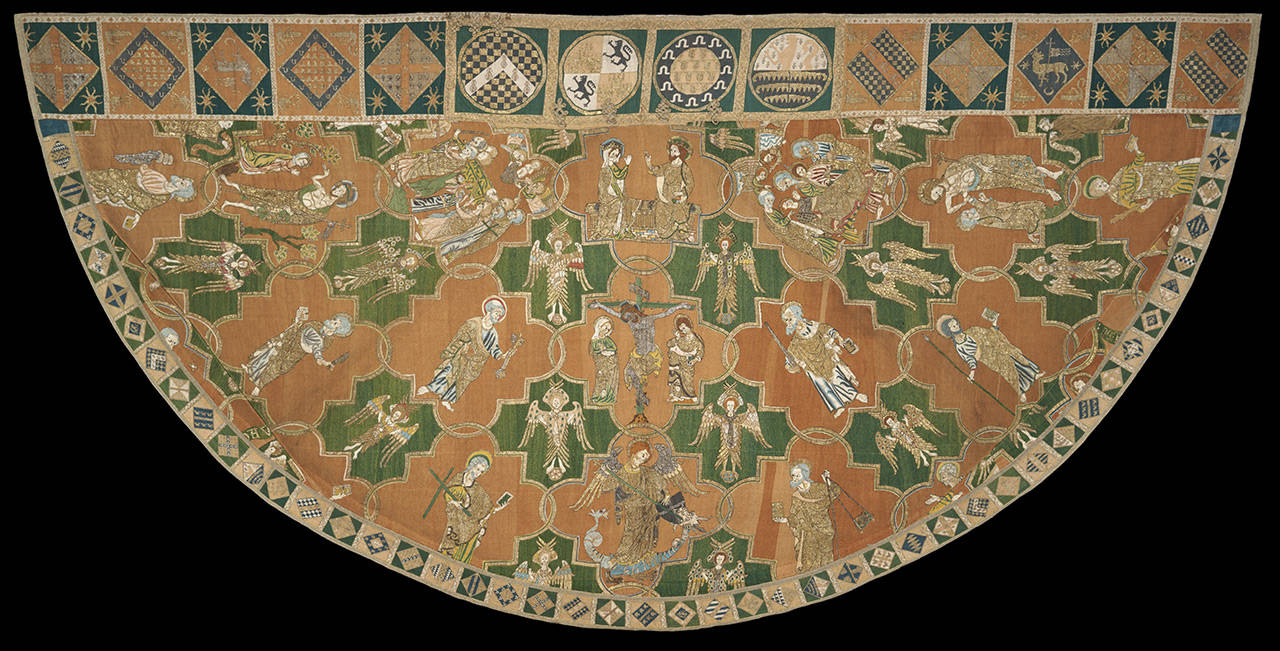
“Opus Anglicanum: Masterpieces of English Embroidery,” Victoria and Albert Museum, London, October 1, 2016–February 5, 2017: In medieval Europe, embroidered textiles were indispensable symbols of wealth and power. Owing to their quality, complexity, and magnificence, English embroideries (referred to as opus Anglicanum, “English work”) enjoyed international demand among kings, queens, popes, and cardinals, and here one hundred of them are brought together. Treasures include the Butler-Bowdon Cope, the Syon Cope, and the Tree of Jesse Cope—ceremonial cloaks made for use in church services and processions, featuring images from the lives of Christ, the Virgin, and the saints. (I love the interactive zoom function on these! To help you navigate the densely packed imagery, details of interest are tagged and can be clicked on to magnify and to reveal a textbox of information.) Hear contemporary embroiderer James Merry discuss some of the aspects of their technique and design that blow him away:

Syon Cope
The Syon Cope, 1310–20, England. Collection of the Victoria and Albert Museum, London.

+++

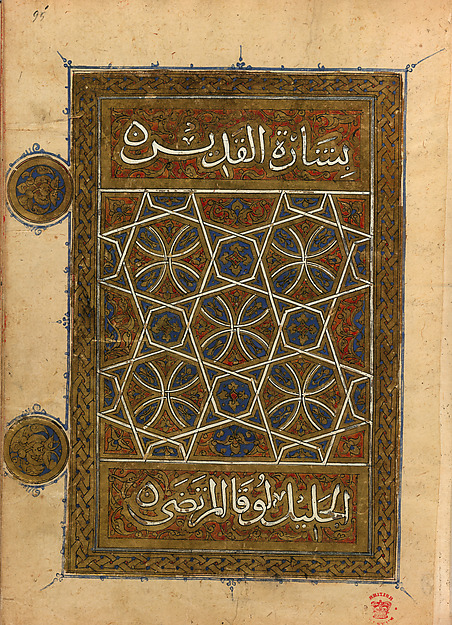
“Jerusalem 1000–1400: Every People Under Heaven,” Metropolitan Museum of Art, New York City, September 26, 2016–January 8, 2017: “This landmark exhibition demonstrates the key role that the Holy City played in shaping the art of the period from 1000 to 1400. In these centuries, Jerusalem was home to more cultures, religions, and languages than ever before. Through times of peace as well as war, Jerusalem remained a constant source of inspiration that resulted in art of great beauty and fascinating complexity. This exhibition is the first to unravel the various cultural traditions and aesthetic strands that enriched and enlivened the medieval city. It features some 200 works of art from 60 lenders worldwide.” I especially love the four Gospels in Arabic borrowed from the British Library, whose geometric illuminations bear an obvious Islamic influence.

Arabic Gospels
Folio from an Arabic Gospel-book, 1335, Jerusalem. Opaque watercolor, gold, and ink on paper, 10 5/8 × 7 7/8 in. (27 × 20 cm). Collection of the British Library (Add. MS 11856).

+++

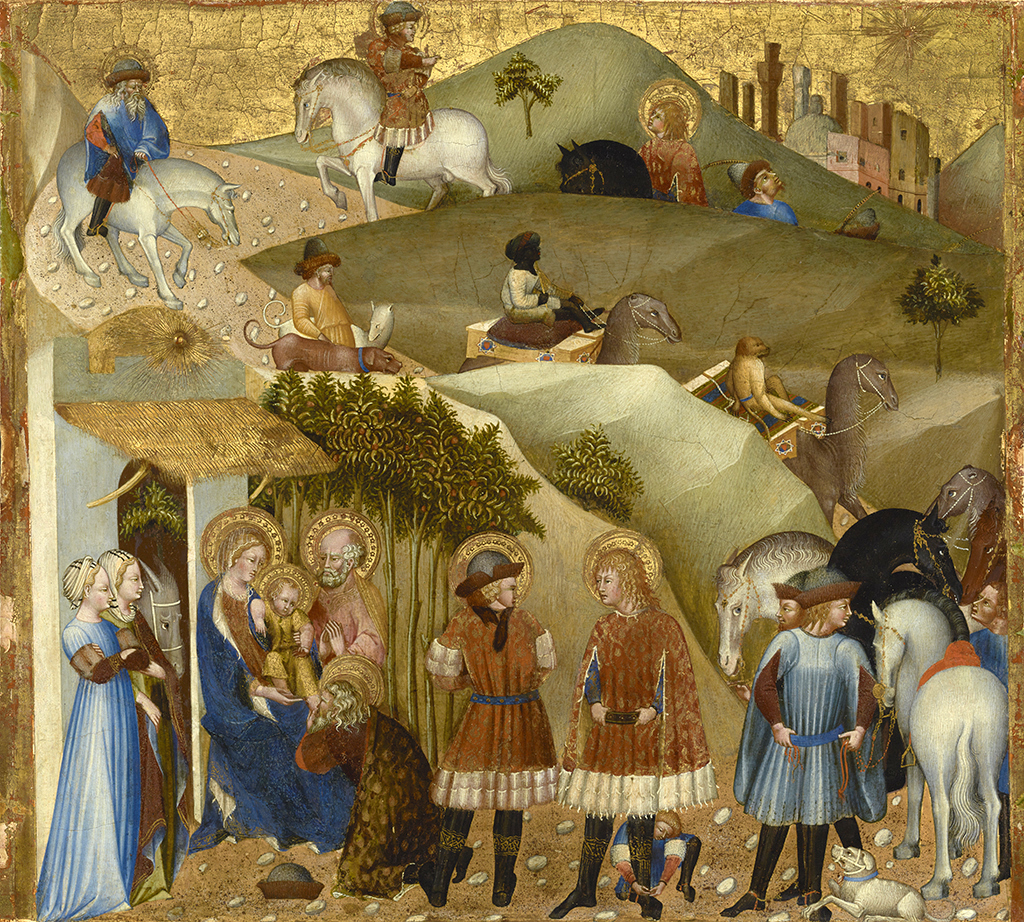
“The Shimmer of Gold: Giovanni di Paolo in Renaissance Siena,” Getty Center, Los Angeles, October 11, 2016–January 8, 2017: “Manuscript illuminator and panel painter Giovanni di Paolo was one of the most distinctive and imaginative artists working in Siena, Italy, during the Renaissance. This exhibition reunites several panels from one of his most important commissions—an altarpiece for the Branchini family chapel in the church of San Domenico in Siena—for the first time since its dispersal, and presents illuminated manuscripts and paintings by Giovanni and his close collaborators and contemporaries. Through recent technical findings, the exhibition reveals his creative use of gold and paint to achieve remarkable luminous effects in both media.”

Adoration of the Magi by Giovanni di Paolo
Giovanni di Paolo (Italian, ca. 1403–1482), The Adoration of the Magi, 1427. Tempera and gold leaf on panel. Kröller-Müller Museum, Otterlo, the Netherlands.

+++

“The Key” (organized by Caravan), Riverside Church, New York City, September 21–November 6, 2016: Founded by US Episcopal priest Paul-Gordon Chandler, Caravan develops initiatives that use art as a bridge for intercultural and interreligious dialogue. The organization’s 2016 exhibition is in the last leg of its Cairo-London-New York journey. It showcases the work of forty Middle Eastern and Western artists from different monotheistic faith backgrounds, each of whom was given a four-foot-tall fiberglass ankh to develop into a work of art. Known as the “Key of Life,” the ankh is an ancient hieroglyph originating in Egypt but spreading throughout Asia Minor; today it is used as a symbol of pluralism, tolerance, and harmony. I especially like the ones by Sergio Gomez, Arabella Dorman, Fatma Abdel Rahman, and Isaac Daniel.

The Key exhibition (Caravan)

+++

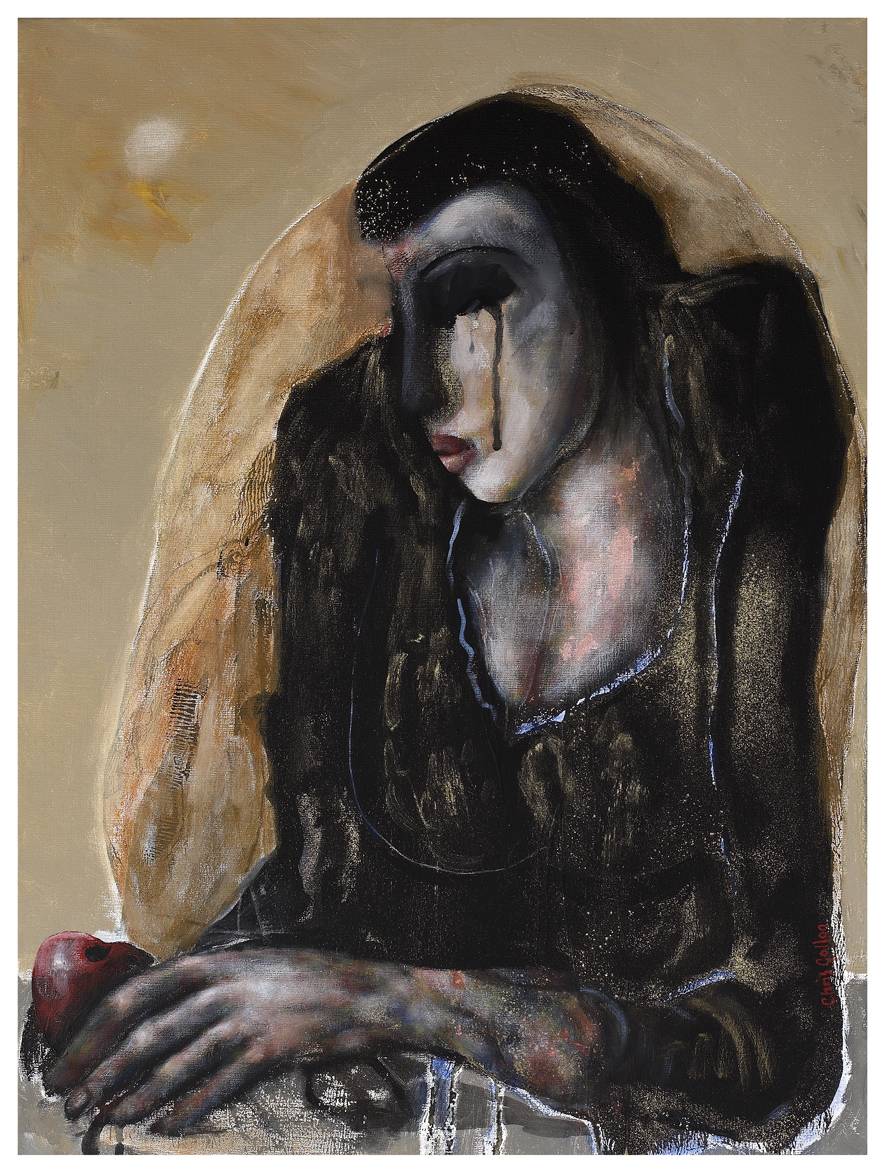
“Incarnation, Mary & Women from the Bible,” Romsey Abbey, Hampshire, England, October 12–November 6, 2016: Having already stopped at Guildford, Norwich, Chichester, Durham, and Hereford Cathedrals, Chris Gollon’s latest series of paintings on women of the Bible is now at Romsey Abbey. It includes the standards, like Eve, Rachel, Hannah, Delilah, Bathsheba, the two Marys (the Virgin, and Magdalene), and Salome, as well as some unnamed and even implied women, like Judas’s wife. It also includes some extrabiblical female saints, like Lucy, Cecilia, Julian of Norwich, and Ethelflaeda. I’m really attracted to the sad quality of many of Gollon’s women, and to the emphasis on hands (much like Eduardo Kingman!).

Contemplation of Eve by Chris Gollon
Chris Gollon (British, 1953–), The Contemplation of Eve, 2011. Acrylic on canvas, 24 × 18 in. (61 × 46 cm).

+++

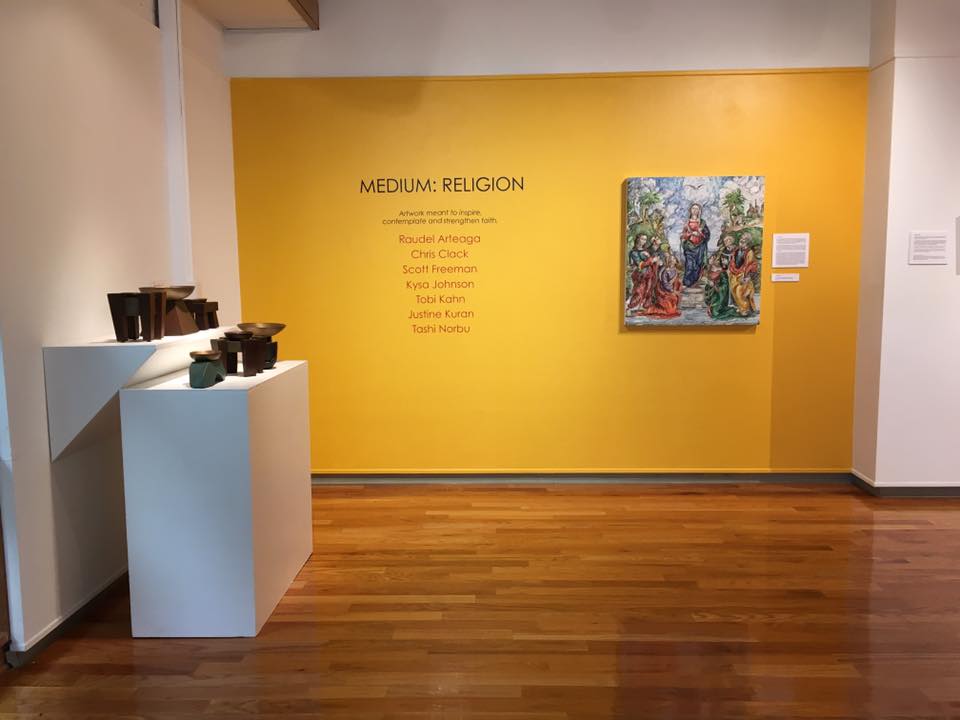
“Medium: Religion,” Gallery of Art and Design, University of Central Missouri, Warrensburg, Missouri, September 22–October 28, 2016: This exhibition—“meant to inspire, contemplate, and strengthen faith”—features seven contemporary artists whose work engages religion: Tobi Kahn, who creates Jewish ceremonial art like etrog containers, shalom bat chairs, and omer counters; Chris Clack, whose work explores the relationship between Christianity and science; Kysa Johnson, whose Immaculate Conception series links images of the Virgin with asexually reproducing yeast and bacteria; Justine Kuran, known for her quilled hamsas (palm-shaped amulets); Scott Freeman, whose The Wall Remaining laments the long-suffered disunity between Jews and Christians; Tashi Norbu, trained in the art of traditional Tibetan Buddhist thangka painting; and Raudel Arteaga, who deconstructs famous religious paintings into their geometric basics.

medium-religion-exhibition

+++

“Illuminations: Works by Vanessa German, Peter Oresick, and Christopher Ruane,” Carlow University Art Gallery, Pittsburgh, Pennsylvania, September 8–December 9, 2016: “‘Illuminations’ features the work of three local artists who evoke the traditions of icon painting or biblical parables to bring out focus on the overlooked and to cast light into the shadows of our present day,” says gallery director Sylvia Rhor. Works include responses to last year’s Charleston church shootings, literary figures painted in the style of Russian icons, and sacred stories updated through the use of photography and digital technology.

illuminations-exhibition-poster