
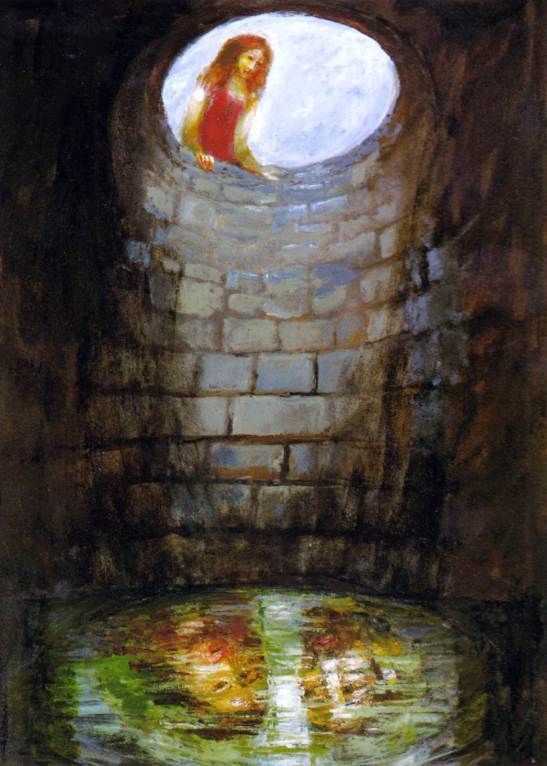
It joined us together, the well;
the well led me into you.
No one between us but light
deep in the well, the pupil of the eye
set in an orbit of stones.

Within your eyes, I,
drawn by the well,
am enclosed.
Translated by Jerzy Peterkiewicz, from Collected Poems by Karol Wojtyla (Random House, 1982)
This contemplative poem was originally published in Polish in Kraków’s leading Catholic periodical, Tygodnik Powszechny (Universal Weekly), on May 7, 1950, when Karol Wojtyla was a twenty-nine-year-old parish priest. It’s the sixth in a sequence of eight poems collectively titled “Song of the Brightness of Water” (Pieśń o blasku wody), all reflecting on Jesus’s encounter with the Samaritan woman in John 4.
Karol Wojtyla (1920–2005) was a theologian, philosopher, poet, and priest best known for serving as head of the Catholic Church as Pope John Paul II from 1978 until his death. He traveled more than any other pope (visiting 129 countries), helped end Communism in Eastern Europe, fostered interfaith dialogue, and promoted human rights. He was canonized on April 27, 2014. Born, raised, and educated in Poland, in 1938–39 Karol studied Polish philology (literature and language) at Jagiellonian University, but his academic pursuits were interrupted by the Nazi occupation. He avoided conscription in the German military by working as a manual laborer in a quarry—which he did while secretly taking seminary courses in Kraków from 1942 to 1946 (Catholicism was suppressed at the time) and participating in the underground theater scene as both an actor and a playwright. After graduating, he was ordained to the priesthood.
Throughout the first half of his adult life—as a student, young parish priest, bishop, archbishop, and cardinal—Karol wrote and published poetry anonymously and then pseudonymously under the names Andrzej Jawień and Stanisław Andrzej Gruda. After he became pope, many of these poems were compiled into a collection, translated into English with Vatican approval, and released in book form under his given name. Karol continued writing poetry during his pontificate, but at a much slower pace. His most famous writings are in prose and include the landmark encyclical Evangelium Vitae (The Gospel of Life) on human dignity, the international bestseller Crossing the Threshold of Hope, and a series of 129 addresses titled The Theology of the Body.
Jerzy Peterkiewicz (1916–2007) was a Polish poet, novelist, and translator. In 1940 he fled his home country, arriving in England as a war refugee with no knowledge of the language. He went on to become a literature professor at London University, and in 1960, with coeditor and cotranslator Burns Singer, he published the influential anthology Five Centuries of Polish Poetry, 1450–1950. He was later chosen by a papal commission to translate the poetry of Pope John Paul II (Karol Wojtyla).
 Art & Theology