
You fall, sparrow-bone, God-eyed leaf,
black hair of ox, kernel of wheat,
gold blown from the stalk. You lift wood,
trudge, and lurch, your back pulped. You would
spit up the cup-dregs for relief—

but no, you want not; you believe
your master’s dream. You toss your dreams
like chaff to the breeze. You lift wood.
You fall,

            thin coin,

                          widow’s all,

                                       copper seed
into the mouth of the box. She
brushed you a hundred times, so good
to hold, but better to drop. Wood
weights you, snapped bone, wind-flung leaf.
You fall.
This poem was originally published in Christianity and Literature 59, no. 2 (Winter 2010) and is anthologized in Imago Dei: Poems from Christianity and Literature, ed. Jill Peláez Baumgaertner (Abilene Christian University Press, 2012). Used by permission of the poet.
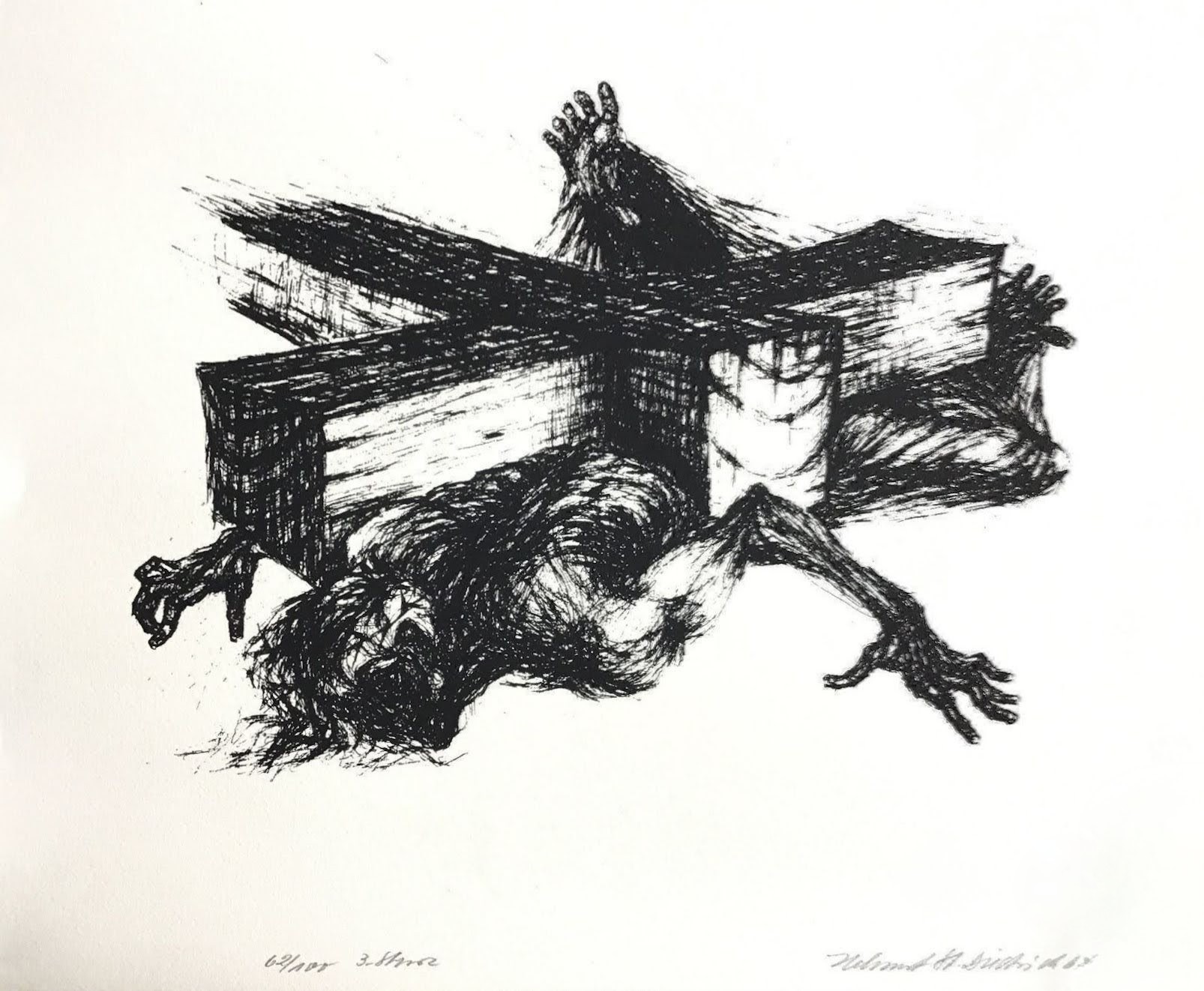
Originating in the Middle Ages, the Stations of the Cross is a Christian devotional practice in which participants commemorate the journey Jesus took down the Via Dolorosa (Way of Sorrows) to his death—either on location in the Holy Land, physically following a demarcated route, or, more accessibly, in their imaginations, through the aid of images or meditative texts. Traditionally, there are fourteen stations, the third, seventh, and ninth of which are “Jesus falls.” At these stopping places, Christians reflect on the crushing weight of sin and wood, on Jesus’s intensifying exhaustion, and yet, too, on his perseverance to get up each time and, pushing through the debility, to continue his trek to its fatal, foreordained end.
In his poem “Sparrow Lament,” William Woolfitt alludes to Jesus’s three falls on his way to Golgotha: “You fall,” “You fall,” “You fall.” He uses a string of metaphors from the natural world for the falling Christ: He’s a sparrow bone (spat out by a predator?), a floating leaf, a shed bovine hair, a grain of wheat blown loose from its stalk. These are wistful images of solitariness, passage, decease—and yet the descriptor “God-eyed” indicates that the path Christ is on is governed by divine providence.
The sparrow reference, given further weight by its use in the poem’s title, evokes Jesus’s teaching in Matthew 10:28–31: “Do not fear those who kill the body but cannot kill the soul; rather, fear the one who can destroy both soul and body in hell. Are not two sparrows sold for a penny? Yet not one of them will fall to the ground apart from your Father. And even the hairs of your head are all counted. So do not be afraid; you are of more value than many sparrows.”
The Father has willed the Son to drink the bitter cup of suffering and death, which, despite Jesus’s distressed plea less than twenty-four hours prior that the cup be removed, he downs in trust, casting off any dreams he had for living into old age. As he carries out his calling, he stumbles, he falls to the ground—but not apart from the will of his Father.
In the middle of the poem, the lineation—the arrangement of words using lines and line breaks—mimics a downward motion. Like the drop of the storied widow’s coin into the offering box (Mark 12:41–44; Luke 21:1–4). Most biblical interpreters assume that Mary, Jesus’s mother, was a widow by the time Jesus started his ministry, since Joseph is never mentioned in any of the Gospel accounts after the episode of Jesus disappearing in the temple at age twelve. Woolfitt refers to Jesus as “widow’s all”—Mary’s everything, her firstborn son, whom she sacrificially gives to the world, knowing God will bless her gift. She doesn’t hoard this dear treasure of hers. She surrenders him to God’s greater plan.
It wasn’t an easy choice to make. Mothers instinctively want to hold on to their children, and tight. Many intrusively fear dropping them as infants and would do anything to spare them pain. Well, Mary drops her son, on purpose. She relinquishes him, “copper seed,” whose death bears fruit, yields dividends.
William Woolfitt is a writer across the genres of poetry, fiction, and essay. His poetry collections are The Night the Rain Had Nowhere to Go (Belle Point, 2024), Spring Up Everlasting (Mercer, 2020), Charles of the Desert (Paraclete, 2016), and Beauty Strip (Texas Review, 2014). He is an associate professor of creative writing at Lee University in Cleveland, Tennessee, where he lives with his wife and two children. He founded and edits Speaking of Marvels, a blog that features interviews with authors of chapbooks, novellas, and books of assorted lengths.









 Art & Theology


