
They went to a place called Gethsemane, and [Jesus] said . . . “My soul is deeply grieved, even to death. . . . Abba, Father, for you all things are possible; remove this cup from me, yet not what I want but what you want.”
—Mark 14:32, 34, 36
LOOK: Can you drink the cup I am about to drink? by John Kiefer
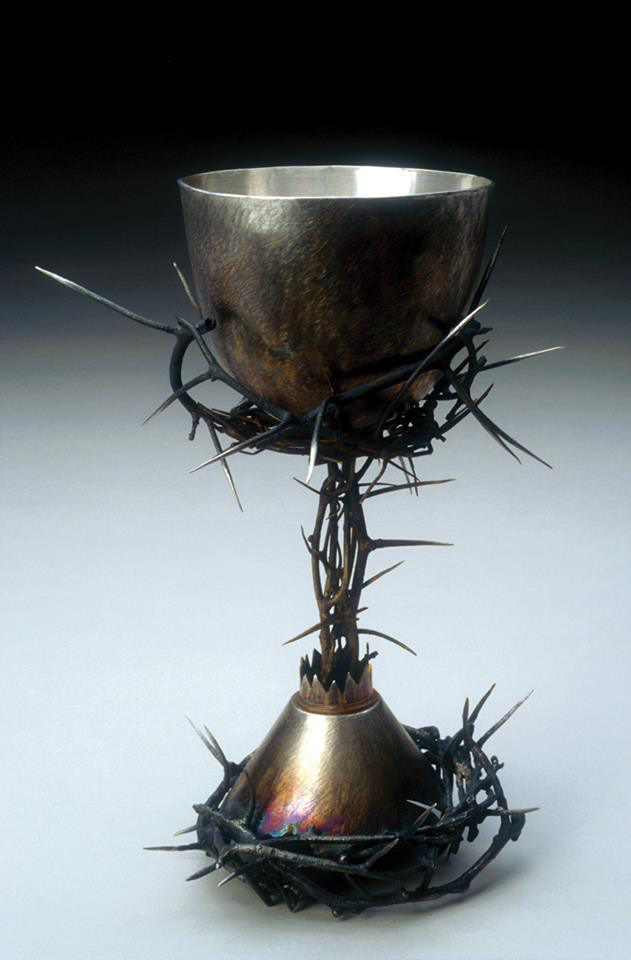
Fr. John Kiefer is a Catholic priest, metalsmith, and woodworker from Indiana. His piece Can you drink the cup I am about to drink? is from the collection of Sandra and Bob Bowden in Chatham, Massachusetts, and is part of the traveling exhibition they loan out called Come! The Table Is Ready.
Can you drink is a silver chalice enwrapped ominously, cup and foot, by thorns. In the Bible, a cup often symbolizes one’s portion or destiny that comes from God. Jesus’s cup entails suffering and premature death. Deeply distraught, Jesus asks his Father, if it be possible, to remove the cup.
Request denied.
Within eighteen hours of voicing this prayer, Jesus is taken, tried, tortured, and killed—“tast[ing] death for everyone” (Heb. 2:9).
Some biblical commentators have interpreted the cup Jesus must drink as God’s wrath over sin, as that metaphor—cup as bitter-tasting divine punishment poured out—was a common one in the ancient Near East, including in the Bible. But that doesn’t make sense if we pull in what Jesus says to James and John earlier, in Matthew 20:22 (cf. Mark 10:38): “Are you able to drink the cup that I am about to drink?” They affirm yes, and Jesus corroborates: “You will indeed drink my cup . . .”
This is why the cup is best understood more generally as one of suffering. So argues Raymond E. Brown in his magisterial two-volume work The Death of the Messiah, albeit conceding that “some of the connotation of the classical cup of wrath or judgment may be preserved in Mark [14:36], not in the sense that Jesus is the object of wrath, but inasmuch as his death will take place in the apocalyptic context of the great struggle of last times when God’s kingdom overcomes evil” (1:170).
LISTEN: “Prayer in the Garden of Gethsemane (Kiss of Judas)” by Seraphim Bit-Kharibi, 2022
Archimandrite Seraphim Bit-Kharibi [previously] is an Assyrian Orthodox priest living in the country of Georgia. He is one of the few priests in the world who celebrates the Divine Liturgy in Aramaic, the language of Jesus. The video above shows him chanting the words Jesus prayed in the garden of Gethsemane the night before his execution.
I wasn’t able to find the full text he uses (and my email inquiry went unanswered), but I’m fairly sure the core is this:
ܘܦܪܩ ܩܠܝܠ ܘܢܦܠ ܥܠ ܐܦܘܗܝ ܘܡܨܠܐ ܗܘܐ ܘܐܡܪ ܐܒܝ ܐܢ ܡܫܟܚܐ ܢܥܒܪܢܝ ܟܣܐ ܗܢܐ ܒܪܡ ܠܐ ܐܝܟ ܕܐܢܐ ܨܒܐ ܐܢܐ ܐܠܐ ܐܝܟ ܕܐܢܬ (Source)
Abba, en yeshtira l’chsu meni hana kasa; ela lethana ’abdwok, w’la d’ili. (Source)
“Father, if it is possible, let this cup pass from me; nevertheless not my will, but your will.”
The anguish really comes across in these sung tones.
 Art & Theology