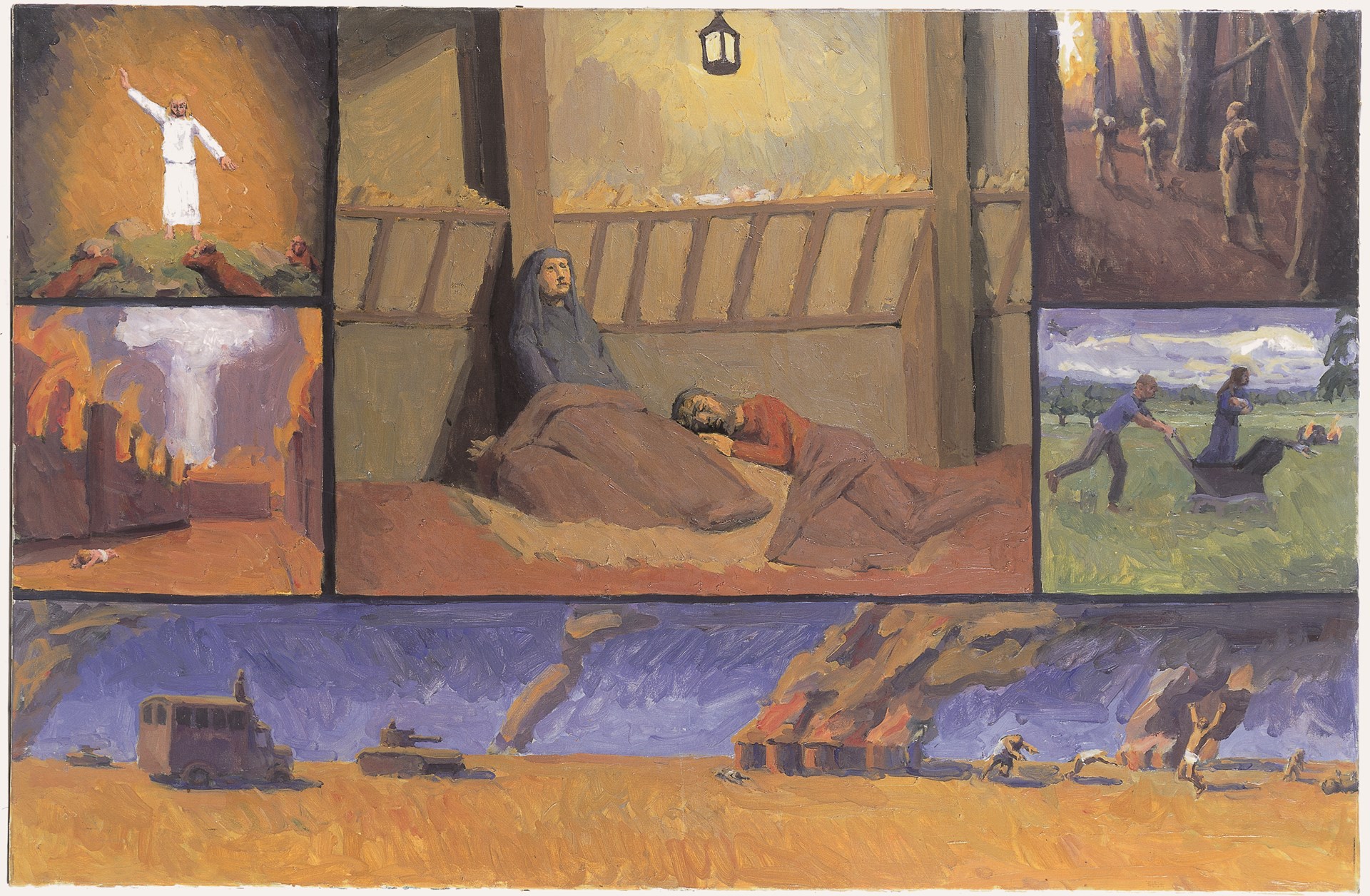
Twelve Advent Stations by Mark Cazalet

Mark Cazalet (b. 1964) is a contemporary artist based in London whose work centers on color and balances empiricism and lyricism. He works across media—painting, drawing, printmaking, and (in collaboration with fabricators) stained glass, etched and engraved glass, printed enamel on glass, tapestries, and mosaics. A major part of his career has been fulfilling ecclesiastical commissions and making sacred art. But all of his work, regardless of subject matter, is shot through with a sacramental impulse.

Last year Cazalet made a series of twelve “Advent Stations” that move circuitously through the story of Jesus’s first coming, marked as it was by mystery, vulnerability, risk, and glory. These include modernized versions of scenes you’d find in traditional Infancy of Christ cycles, such as the Annunciation to Mary, the Annunciation to the Shepherds, the Dream of the Magi, and the Flight to Egypt, but also new ones, drawing us into the grand sweep—sometimes rushing, sometimes quiet—of gospel hope. “The overarching theme,” he told me, “is pregnancy, birth, nurturing, waiting, escape, migration, and finally, in the mistle thrush’s morning song, the greeting of the new day’s limitless potential.”

The artist’s choice of substrate is unique: He painted his stations in oil on domestic wooden objects, such as bread boards, meat and cheese boards, children’s lunch trays, washboards, chapati rolling boards, and a baker’s peel. By using these ordinary boards mainly from home kitchens, Cazalet further situates the biblical Advent story in the everyday. That many of the boards are used for preparing or serving bread underscores Jesus’s self-declaration as “the living bread that came down from heaven,” whose flesh Christians eat ritually as a means of interabiding (John 6).

Cazalet’s Advent Stations debuted last December at his home church, St Martin’s in Kensal Rise, London, where they were installed one per week from Advent through Candlemas. The project was a collaboration with fellow parishioners Richard Leaf, who wrote a poem for each station, and Pansy Cambell, who calligraphed the poems.

That exhibition spawned interest from Chelmsford Cathedral in Essex, where all the artworks and poems are on display from December 1, 2025, through February 2, 2026. The cathedral is already home to two commissioned works of Cazalet’s: the monumental multipanel painting The Tree of Life and an engraved and etched glass window depicting St. Cedd.

The word “station” in the title of Cazalet’s recent series refers to a stopping place along a route. In the Middle Ages, the Roman Catholic Church developed a devotional practice known as the Stations of the Cross, which breaks down the passion of Christ into fourteen distinct episodes fit for contemplation. The idea was that those who could not travel physically to Jerusalem for Lent to walk the Via Dolorosa (the processional route Jesus took to Golgotha) could at least walk the path in spirit, using a series of images as prompts to pause, pray, and reflect.

(Cazalet also made a set of twenty Stations of the Cross in 2024.)

Used by Christians in various denominations, this practice has been adapted for other seasons of the church year. While there are no official Advent Stations or Stations of the Nativity, Cazalet has come up with twelve.

All photos in this article are by the artist and are used with his permission.

Advent Station 1: The Breath of God
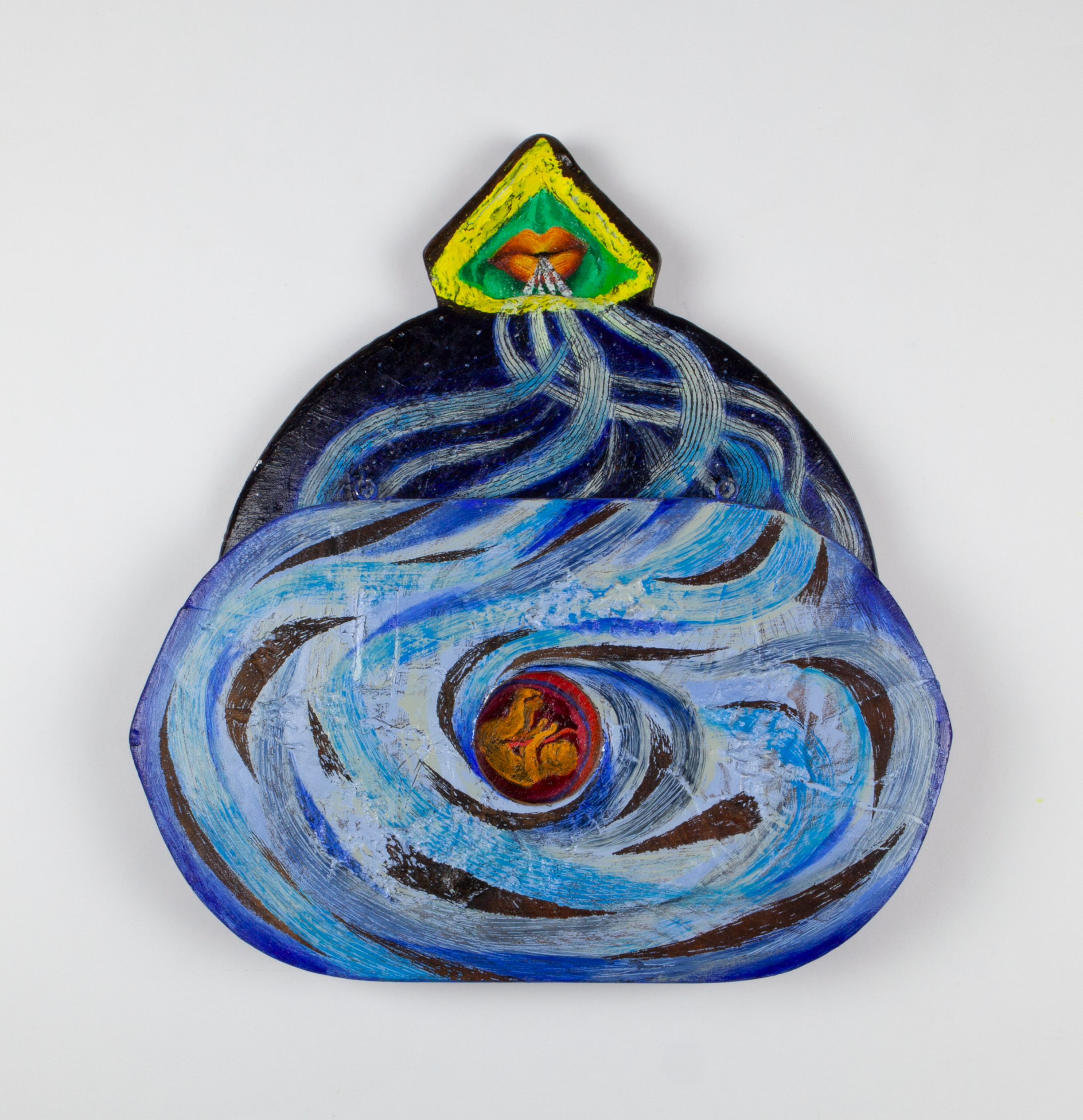
Advent Station 1. The Breath of God (closed)
Mark Cazalet, Advent Station 1: The Breath of God (closed), 2024

A mystical visualization of the Word becoming flesh, the first station has two configurations. In its closed form, it shows the mouth of God blowing through space, the divine breath coalescing around a woman’s uterus to form an embryo, the child who will be called Jesus. Wisps of blue swirl dynamically around this firstborn of new creation.

The triangular shape evokes the Trinity, as the Incarnation was an act involving Father (initiator), Son (enfleshed one), and Holy Spirit (overshadower / inseminating agent).
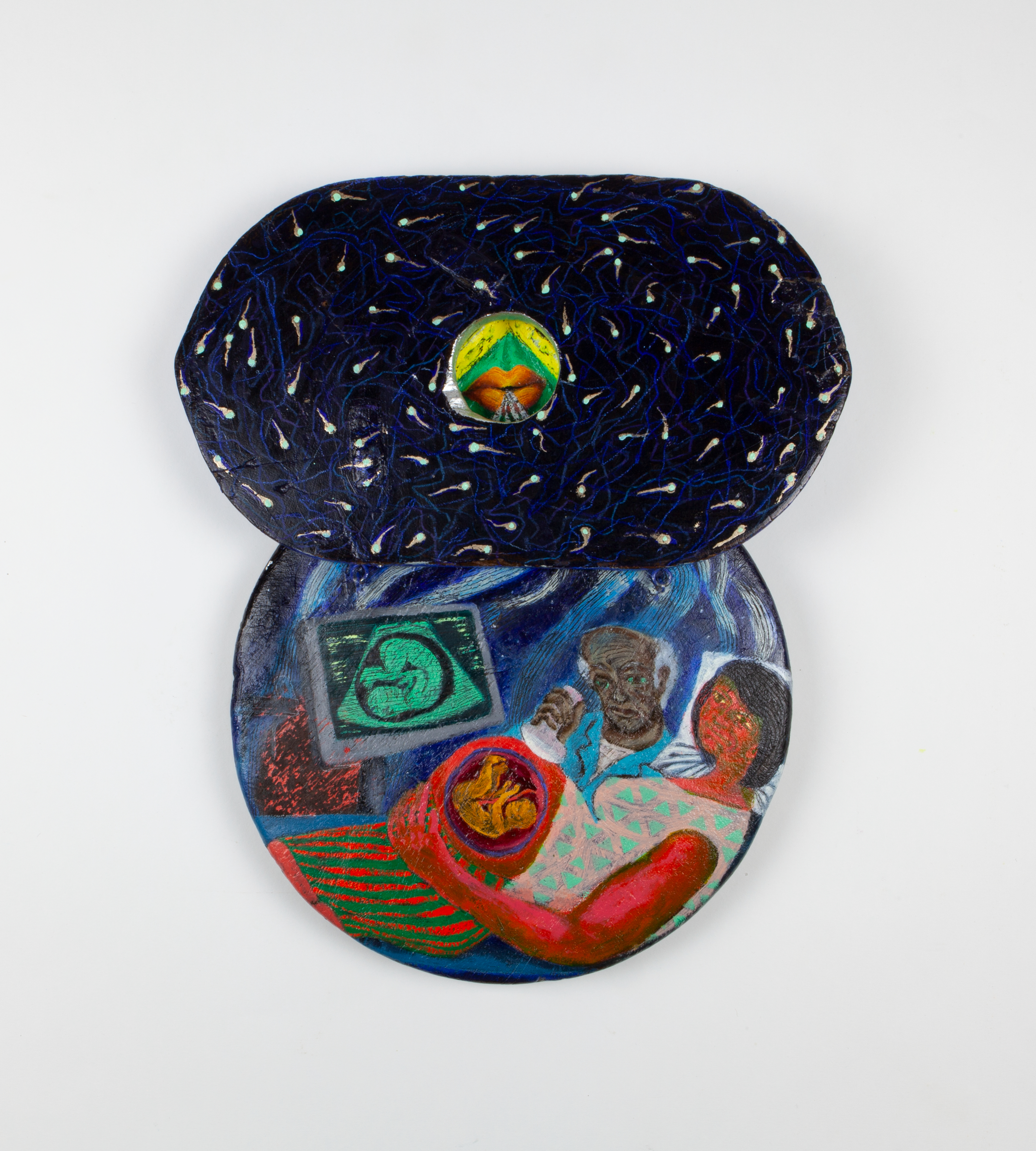
Advent Station 1. The Breath of God (open)
Mark Cazalet, Advent Station 1: The Breath of God (open), 2024

In the exhibition, an attached ribbon instructs viewers, “Lift me.” When you do, the bottom board flips up to reveal a pool of swimming sperm cells, as God created the male gamete needed to make a male child and supernaturally (nonsexually) deposited it into Mary, where it fertilized one of her eggs.

The virginal conception of Christ is a mystery beyond knowing; no amount of scientific head-scratching will bring us closer to understanding the mechanics, nor do we need to. But I like the reminder from this unusual artistic interpretation that all the necessary human genetic material was present—Mary supplying hers, and God supplying the rest. Jesus was not some kind of alien transplanted into a human womb, but rather was made up of all the human stuff we are, and grew by stages inside his mother over a period of nine months. And yet, while fully human, he’s also—marvel of marvels—fully God.

On the round board below, we see that the isolated uterus from the first view belongs to Mary, who lies in bed while Joseph serves as ultrasound technician, shining a light that discloses the still-developing Christ child on a video monitor.

Advent Station 2: John the Baptist on the Beach
Advent Station 2. John the Baptist on the Beach
Mark Cazalet, Advent Station 2: John the Baptist on the Beach, 2024

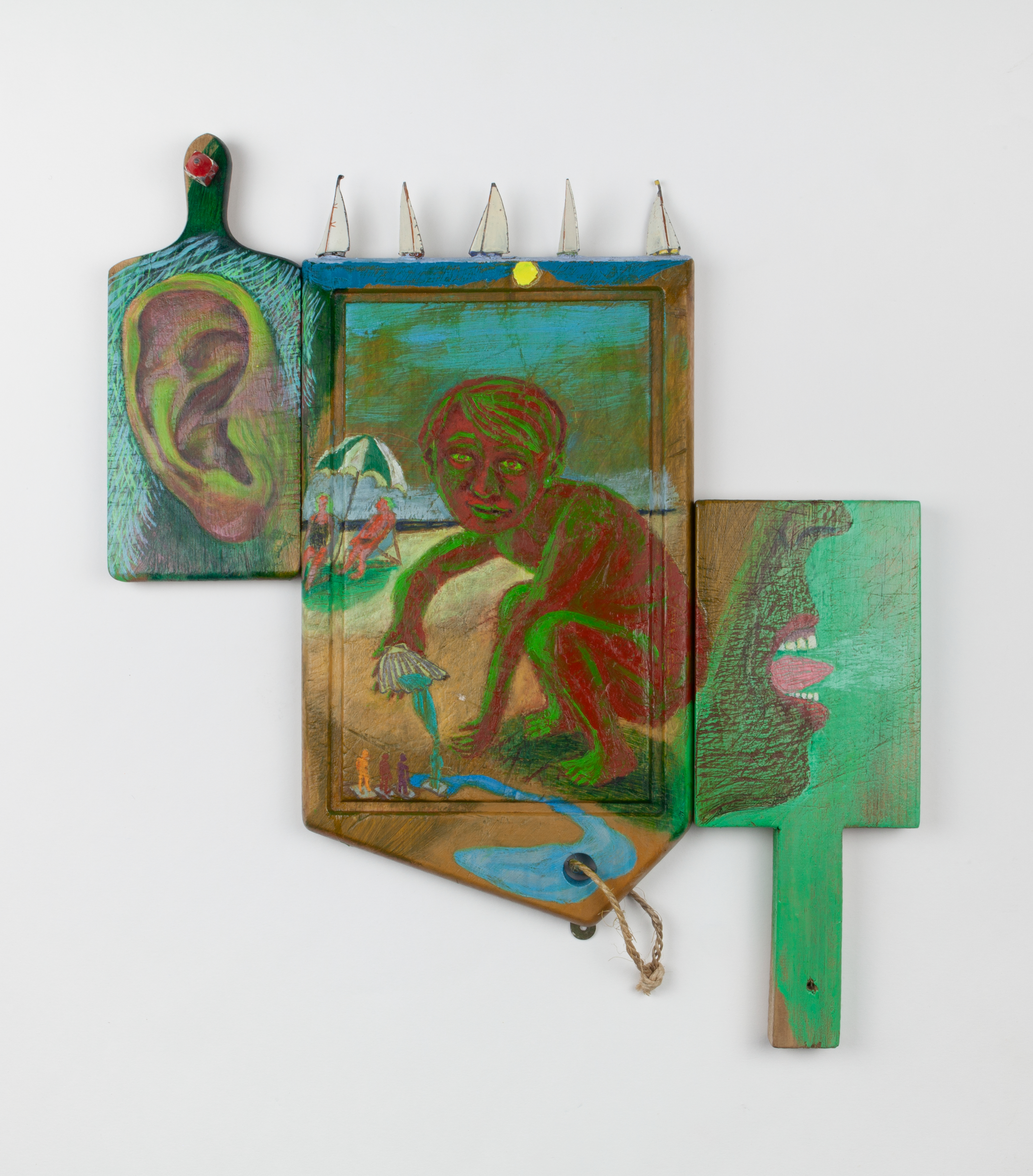
The breath/wind motif is subtly carried over into this second Advent station, with sailboats lining the top of the center board.

This scene shows a young John the Baptist playing on the beach, with his parents, Zechariah and Elizabeth, lounging in swimsuits under a nearby umbrella. John crouches in the sand, pouring water from a seashell (the implement he uses to baptize Jesus in many traditional paintings, most famously Piero della Francesca’s) onto toy figurines who have queued up for the affusion. The water cuts a mini river through the sand, alluding to the Jordan.

The two side panels, which show a close-up of an open ear and an open mouth, likely refer to, in his prophetic ministry as an adult, John’s hearing the word of God and proclaiming it. His is “the voice of one crying out in the wilderness: ‘Prepare the way of the Lord; make his paths straight’” (Mark 1:3). John is regarded as an Advent figure because, by preaching repentance from sin, he prepared the people for the coming of the Messiah.

Advent Station 3: The Annunciation
Advent Station 3. The Annunciation
Mark Cazalet, Advent Station 3: The Annunciation, 2024

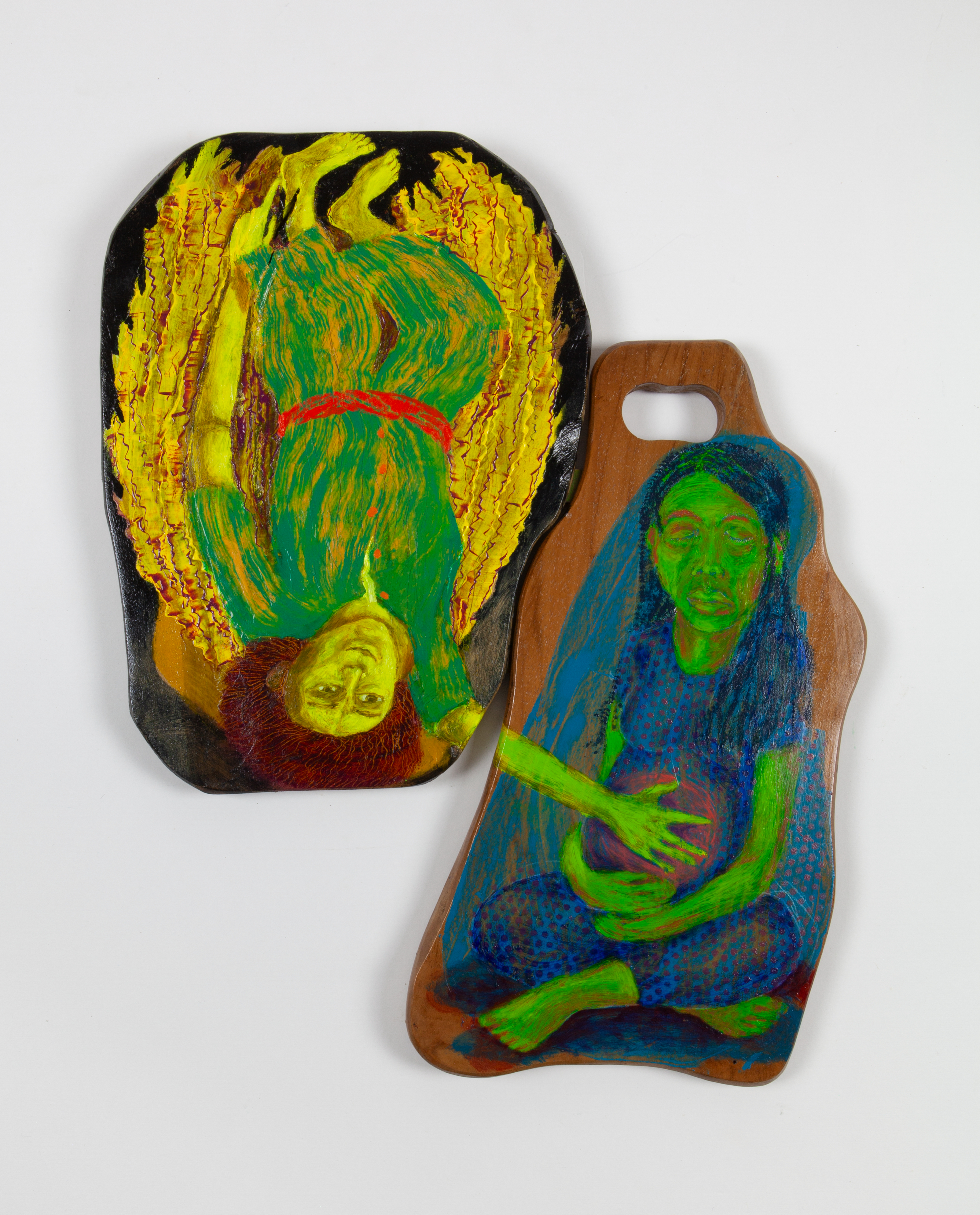
The Annunciation, portraying the angel Gabriel’s message to Mary that she has been chosen to bear God’s Son, is one of the most frequently depicted biblical scenes of all time. How could any artist possibly make it new?

Cazalet refreshes the encounter by showing Gabriel dipping down headfirst from the heavens, the unconventional orientation perhaps a playful allusion to the topsy-turvy nature of Christ’s kingdom. He reaches across the gap to touch the belly of Mary, a young Black woman in a polka-dot dress who is seated on the floor with her eyes closed, rapt in prayer. This consensual touch is what effects the Incarnation.

Mary wears blue and even exudes a blue aura, blue being her traditional color, associated with heaven (the sky realm) and hope. Gabriel’s skin has a golden sheen—the color of divinity, purity, holiness. The coming together of blue and yellow creates green, symbolizing life, growth, and renewal.

Advent Station 4: Bethlehem Motel
Advent Station 4. Bethlehem Motel
Mark Cazalet, Advent Station 4: Bethlehem Motel, 2024

The innkeeper couple in Bethlehem are a cultural invention, biblical scholars tell us, spawned by a misleading English translation of Luke 2:7, which says “there was no room for them [Mary and Joseph] in the inn” (KJV). The Greek word translated “inn,” kataluma, more properly means “guest room”: Because the census had brought many out-of-towners to the area, the guest rooms of Joseph’s relatives were full, but they made space for the pregnant couple in the lower room of the house where animals were kept for the night.

Despite the lack of an innkeeper character in scripture, it has become a popular element in storytelling about the Nativity in art, song, and sermons, as it prompts us to consider whether we are making room for Christ in our busy, overcrowded lives. And not just Christ, but anyone in need—of shelter or other forms of care.

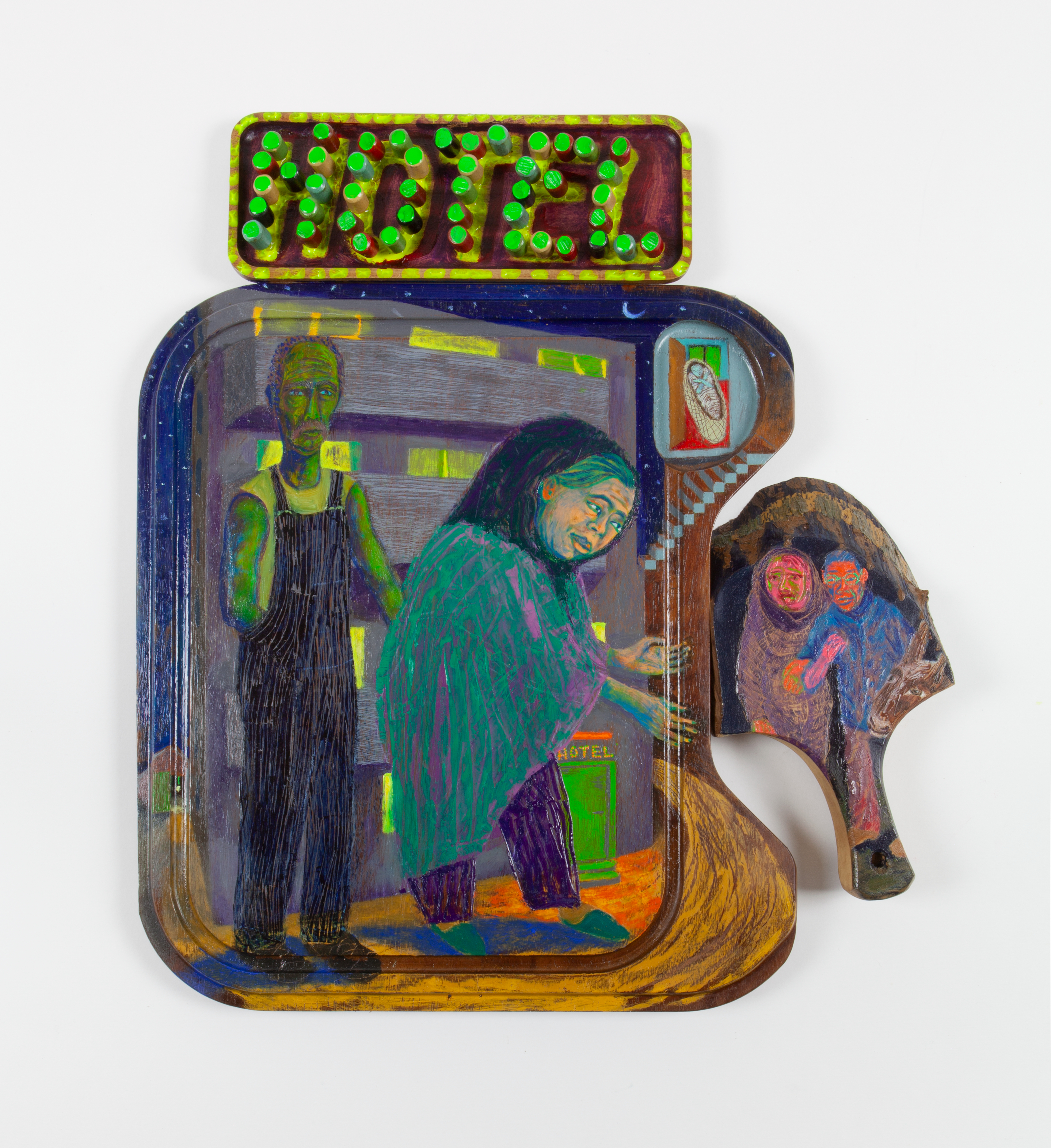
Cazalet shows Mary and Joseph approaching a motel door as the female owner, sympathetic, comes out to greet them. A niche above their heads, hovering like a thought bubble, shows what the couple desires: a place to give birth and to lay their son.

Advent Station 5: The Incarnation (A Blessing Conferred)
Advent Station 5. The Incarnation (A Blessing Conferred)
Mark Cazalet, Advent Station 5: The Incarnation (A Blessing Conferred), 2024

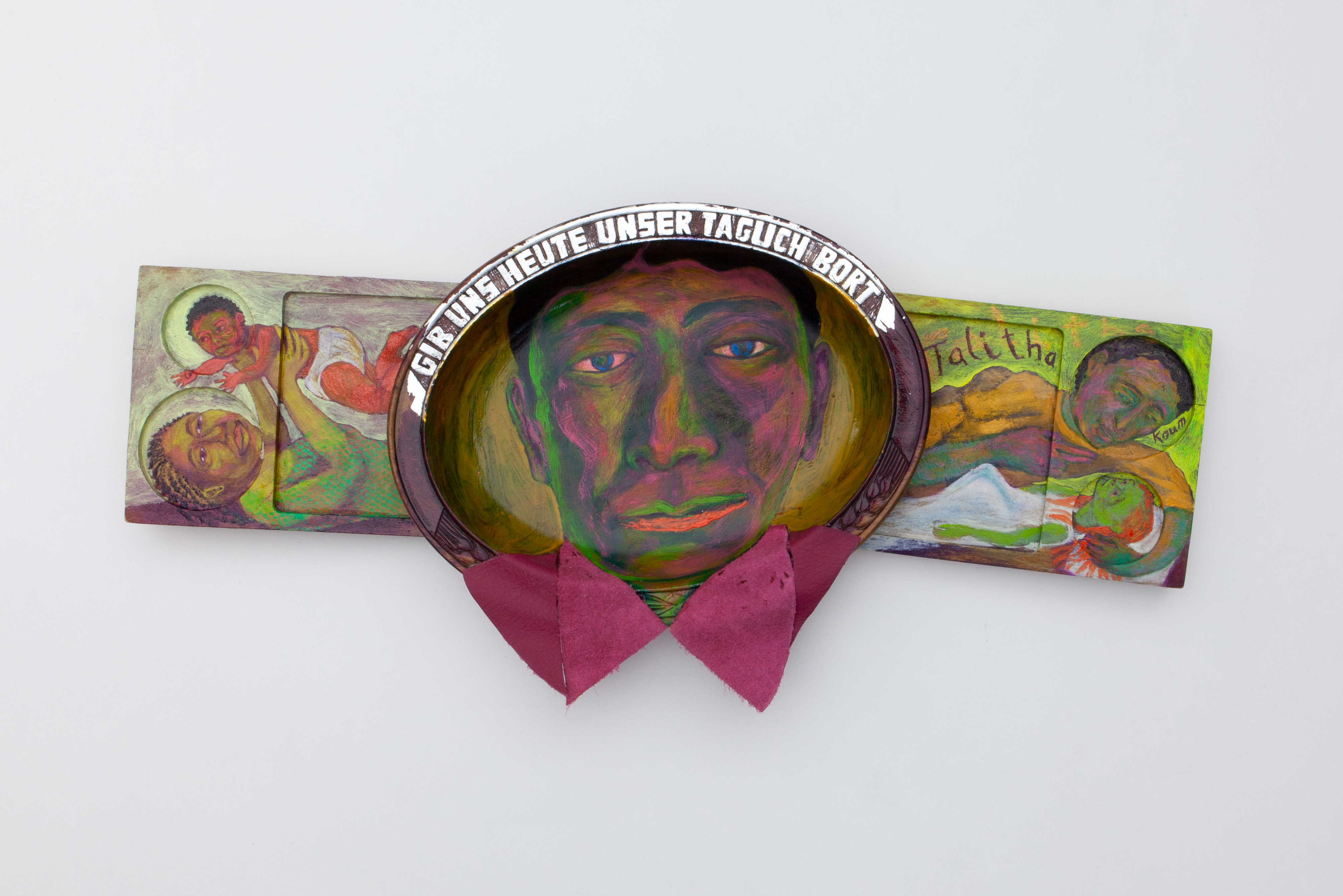
The fifth station features an unconventional combination of images. The left board shows Mary lying on her back, holding the wiggly infant Christ above her. She beams with maternal love.

On the right board, an adult Christ, similarly positioned, leans over the dead daughter of the synagogue leader Jairus. “Talitha koum,” Jesus gently instructs, cradling the girl’s head—Aramaic for “Little girl, get up” (Mark 5:41). With his words, she rises back to life.

The central image, a Head of Christ, is painted on a wooden bread plate from Germany—these plates were sometimes also used as church collection plates—whose rim reads, “Gib uns heute unser täglich brot” (Give us this day our daily bread). Carved sheaves of wheat poke out from under Jesus’s pink cloth collar.

“My intention is that Mary’s love for her son as she raised him taught him the care and compassion to want to help a child in extremis,” Cazalet told me. “The man is formed by the mother’s love, and our childhoods set the pattern of our response to others.”

Notice how, from behind the Christ head, the two adjoining boards emerge like wings, suggesting freedom.

Advent Station 6: The Shepherds See the Star
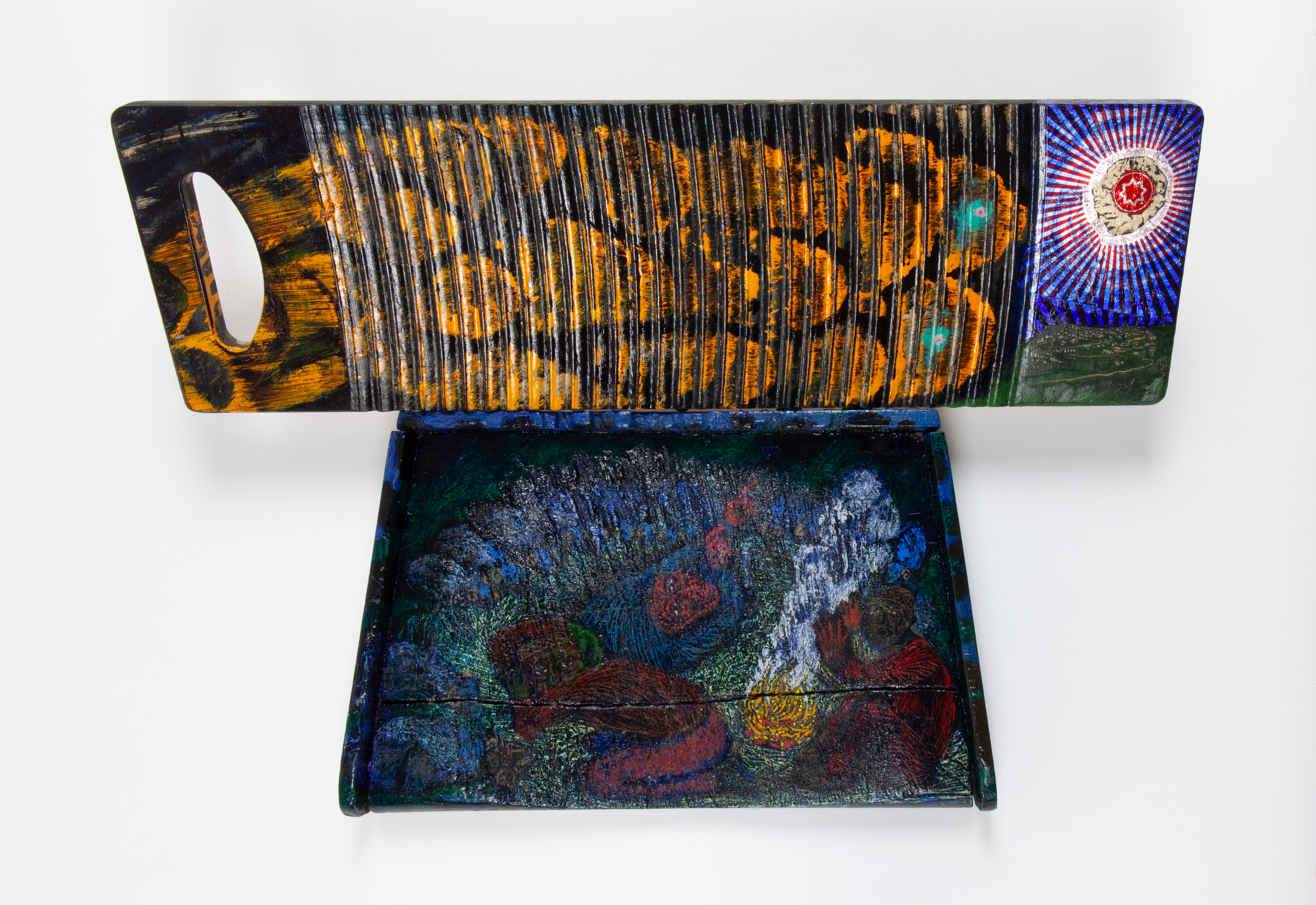
Advent Station 6. The Shepherds See the Star
Mark Cazalet, Advent Station 6: The Shepherds See the Star, 2024

The sixth station portrays the glory of the Lord rippling across the night sky above three shepherds tending their flocks. Content and unassuming, they are gathered round a warm fire when suddenly, an angel appears to announce to them the birth of Christ. One of the shepherds cowers in fear while another gesticulates toward a brightly beaming star in the near distance—rendered with a Tunnock’s milk chocolate tea cake wrapper.

Advent Station 7: The Magi Dreaming
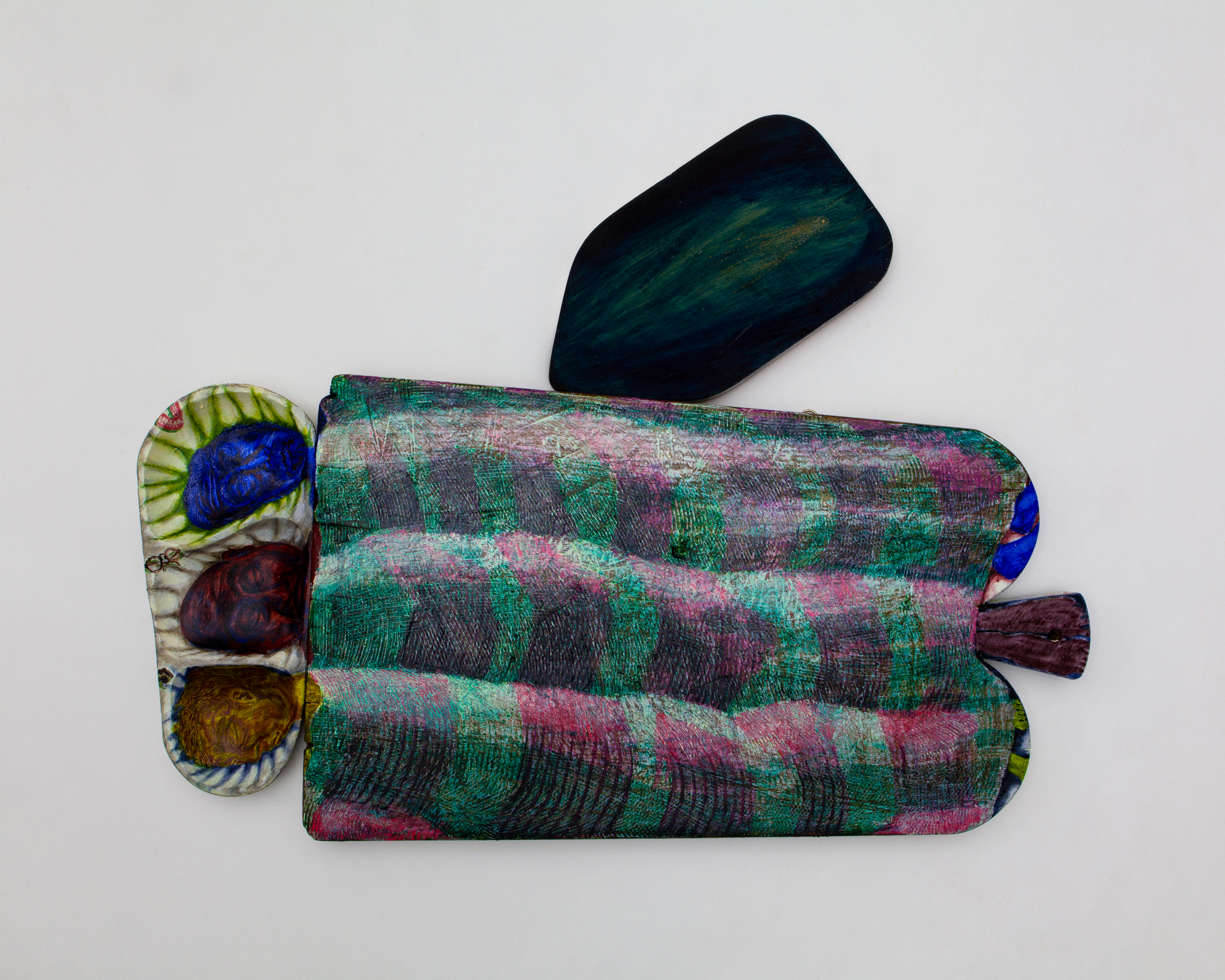
Advent Station 7. The Magi Dreaming
Mark Cazalet, Advent Station 7: The Magi Dreaming, 2024

Having followed a star to Jerusalem from their home back east, the magi enter the court of Herod to inquire where they can find the newborn king of the Jews whom the star heralds, to pay him homage. Herod hadn’t heard of such a king, but immediately he feels threatened—“king of the Jews” is his title—and, unbeknown to the visiting dignitaries, decides to crush this young rival. After consulting with Jewish scholars, he discerns Bethlehem as the birthplace. He divulges this information to the magi and asks them to report back once they’ve found the child so that he, too, can honor him. He hides his true motive under a lie.

The magi have a transformative encounter with Jesus in Bethlehem. Falling asleep after that momentous day, they receive a warning from God not to return to Herod. So they avoid him on their way back home.

As in medieval visual treatments of the Dream of the Magi, Cazalet has the magi sharing a bed. (There’s nothing salacious about it—it’s just a compositional practicality, to show the three men in one space, having the same dream at the same time.) Their toes peep out from under the covers. That surface, by the way, is flat—Cazalet skillfully creates the illusion of convexity through painting, suggesting bodies underneath.

Beside the magi’s heads are three small personal objects: earbuds, glasses, and dentures, which allude to the proverbial principle “See no evil, hear no evil, speak no evil.” “I was musing if this trinity of pilgrim searchers were perhaps aspects of the one true pilgrim, parts of a single whole disciple,” the artist told me.

Advent Station 8: Herod Syndrome
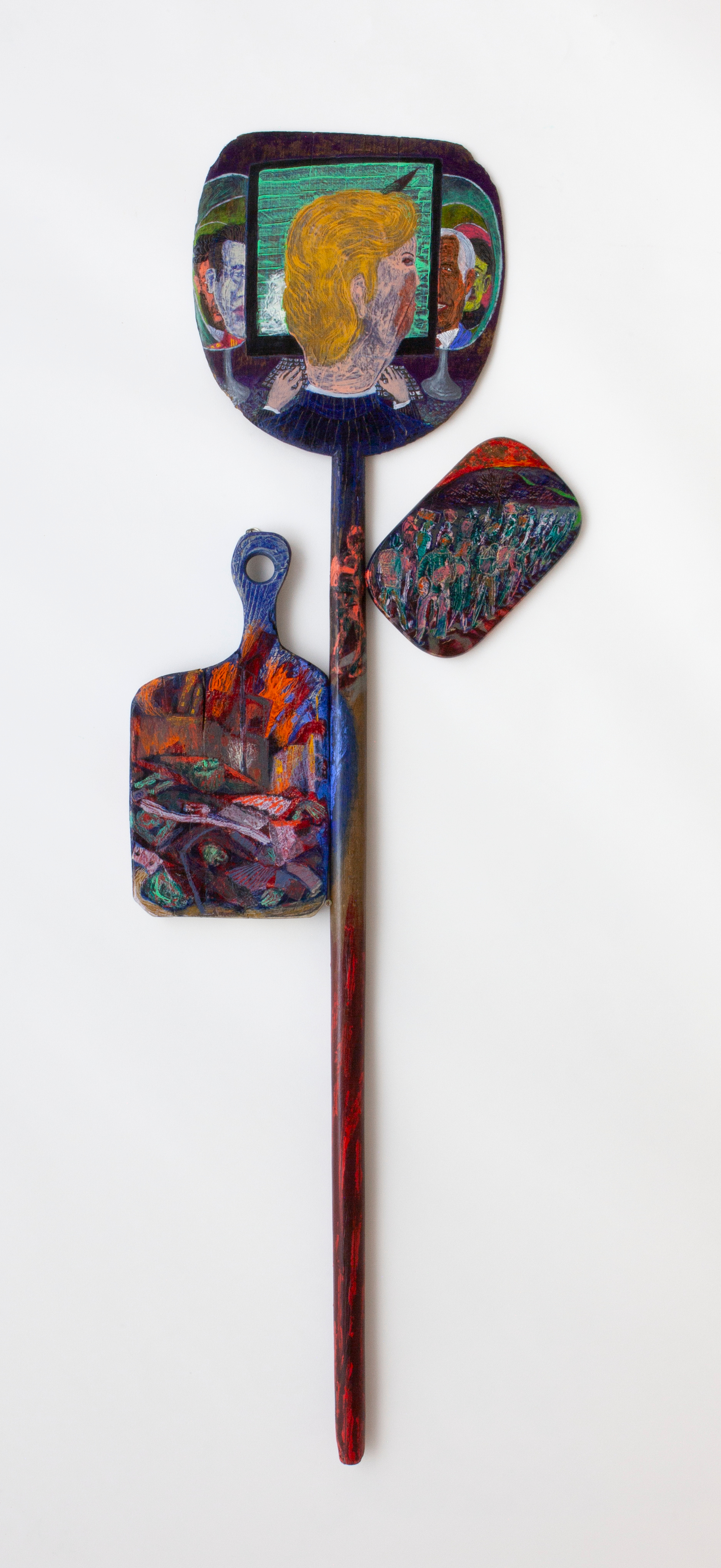
Advent Station 8. Herod Syndrome
Mark Cazalet, Advent Station 8: Herod Syndrome, 2024

Thwarted by the magi, Herod fumes with rage. He will not be dethroned by this so-called messiah. So he orders his soldiers to kill all the boys in Bethlehem aged two and under, thinking that Jesus will be among them. In his self-obsession, he cares nothing for the good of the people; he cares only for the consolidation of his own power.

Station 8 is Cazalet’s modern take on the Massacre of the Innocents. At the helm of a computer keyboard is a presidential figure launching a missile on whomever he has deemed the enemy, while other likeminded autocrats—I believe that’s Saddam Hussein, Kim Jong Un, Vladimir Putin, and Adolf Hitler—look over his shoulder approvingly, their faces reflected endlessly in mirrors using a technique called mis en abyme (“put in the abyss”). This panel, the transferring surface of a baker’s peel, sits at a height to emphasize the pompousness of rulers like Herod, who see themselves as above others and above the law.

Such an attitude can have dire consequences. “Below we see the devastation of a civilian population, defenceless against the technological onslaught,” Cazalet describes, “and the perpetual streams of migrants fleeing who knows where to be vilified as more foreign mouths to feed.”

The power mania that gripped Herod, that led to his lashing out in violence, is still alive and well today in national and global politics.

Advent Station 9: The Flight to Egypt (Forced Migration)
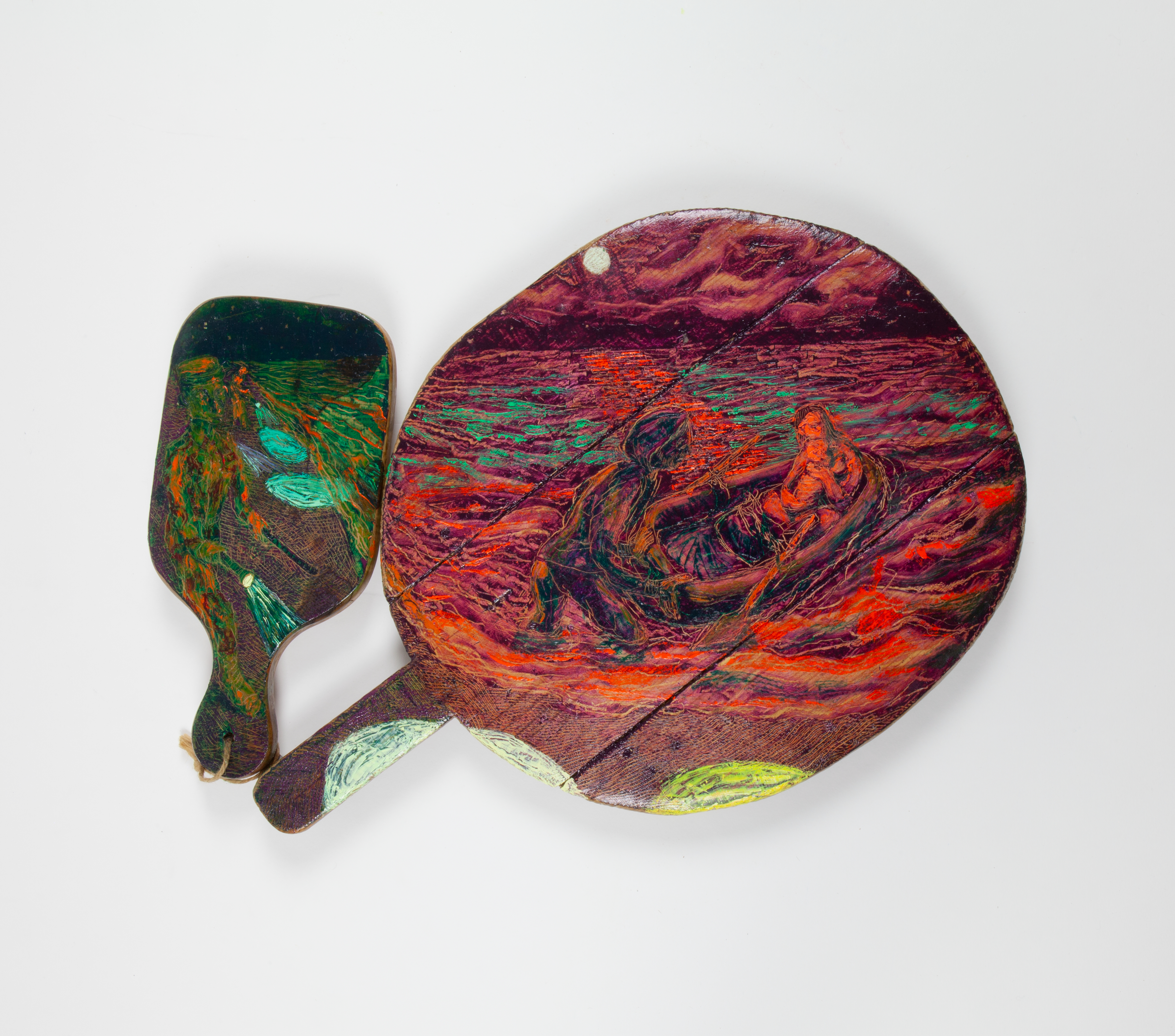
Advent Station 9. The Flight to Egypt (Forced Migration)
Mark Cazalet, Advent Station 9: The Flight to Egypt (Forced Migration), 2024

To protect their son from Herod’s murder decree, Mary and Joseph flee with him across the border to Egypt. Cazalet reimagines their flight through the lens of today’s refugee crisis. In station 9, the Holy Family boards an inflatable raft, braving choppy seawaters in search of asylum. They’re bathed in a menacing red.

On the adjoining panel, border patrol officers, with flashlights and batons, stand on the shore, seeking to bar the entry of strangers into their land.

Advent Station 10: The Exiles Return
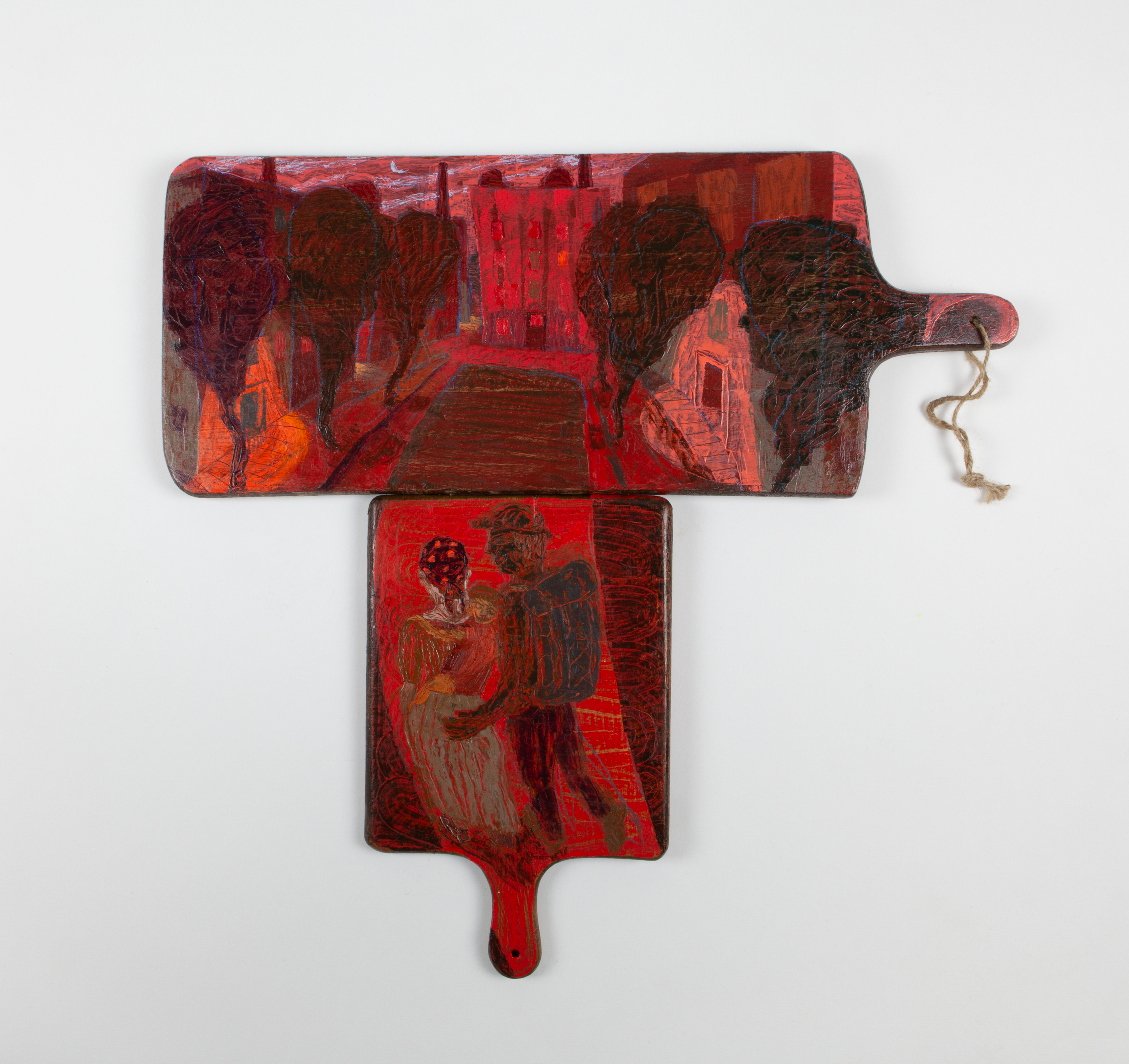
Advent Station 10. The Exiles Return
Mark Cazalet, Advent Station 10: The Exiles Return, 2024

Egypt grants refuge to the Holy Family, and they settle there for an undisclosed period of time—until Joseph receives word from an angel that it’s safe to return to their homeland.

Station 10 shows the family arriving at sunset in their beloved Nazareth, all their belongings reduced to what could fit in a single backpack. As they approach a tree-lined boulevard, Jesus clings to his mother’s back, looking behind at where they’ve come from. He has not yet known this town but will come to love it. He will call it home until his ministry beckons him beyond it more than two decades later.

Advent Station 11: Faithful Waiting and Watching (Anna and Simeon)
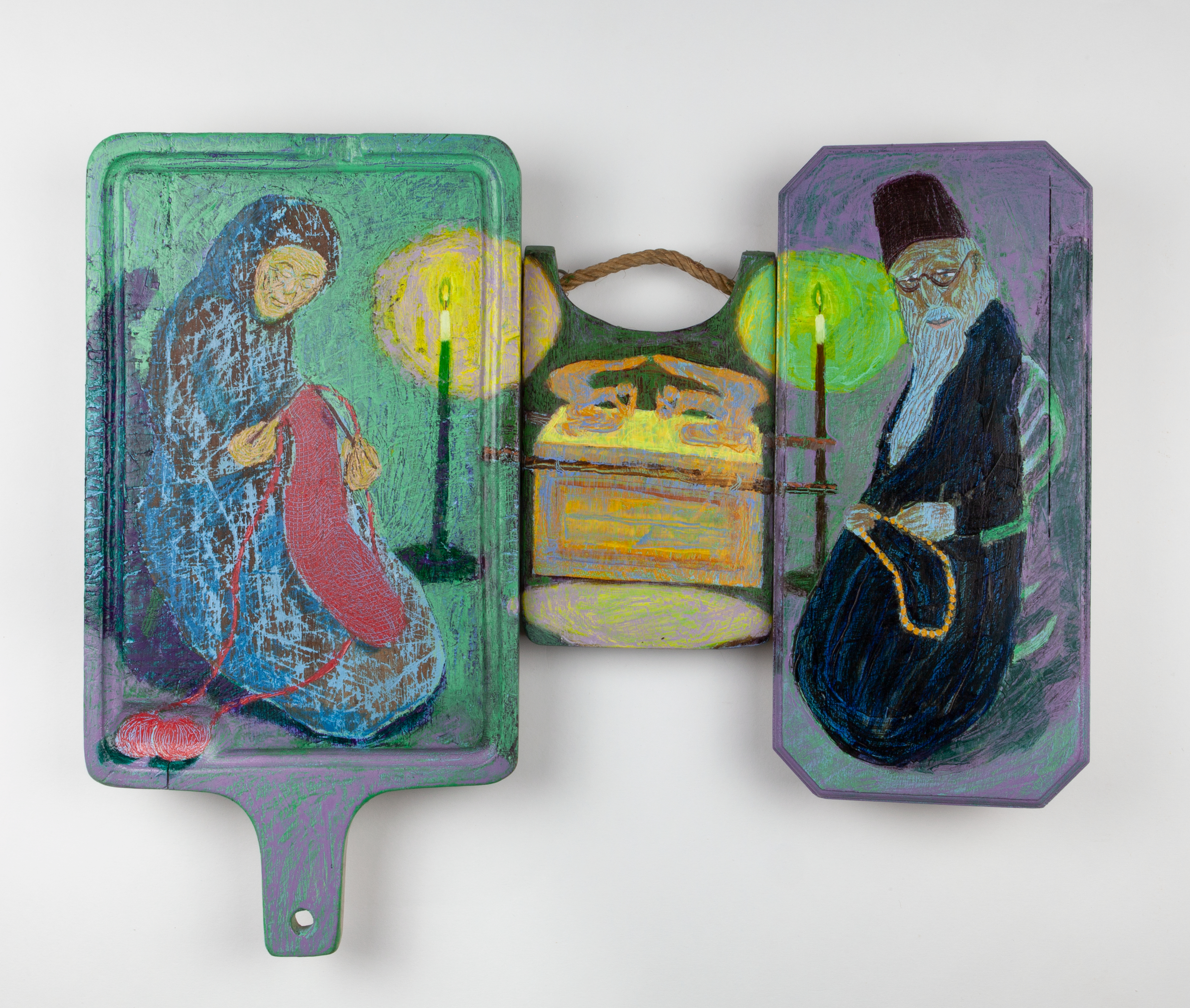
Advent Station 11. Faithful Waiting and Watching (Anna and Simeon)
Mark Cazalet, Advent Station 11: Faithful Waiting and Watching (Anna and Simeon), 2024

This is my favorite of all the stations. While the Presentation of Christ in the Temple is standard fare in Christian art—showing Mary handing Jesus to Simeon, a devout Jew interpreted by most artists as a priest, forty days after Jesus’s birth, with Joseph and the prophet Anna standing off to the side—Cazalet isolates the elderly Anna and Simeon, zeroing in on their faithful act of waiting for the Messiah.

Illuminated by candlelight, Anna knits a scarf, communing with God in the solitude, while Simeon fingers a string of prayer beads. Their eyes are weary and downcast, and yet they possess a steadfast hope that their Savior is on his way.

Linking their two spaces is the ark of the covenant, a sacred wooden storage chest plated in gold and topped by two hammered-gold cherubim. Containing the tablets of the law, Aaron’s rod, and a pot of manna, the ark was kept in the holy of holies, the innermost sanctum of the temple, where it signified God’s presence.

Waiting can often feel useless—like nothing’s happening or will ever happen. But Anna and Simeon continued to wait on the Lord, to count on his promise. And finally, before they died, they were granted the grace to see and to hold the One they had so fervently longed for: the Christ, Emmanuel, “God with us.”

Advent Station 12: The Mistle Thrush Greets the New Day
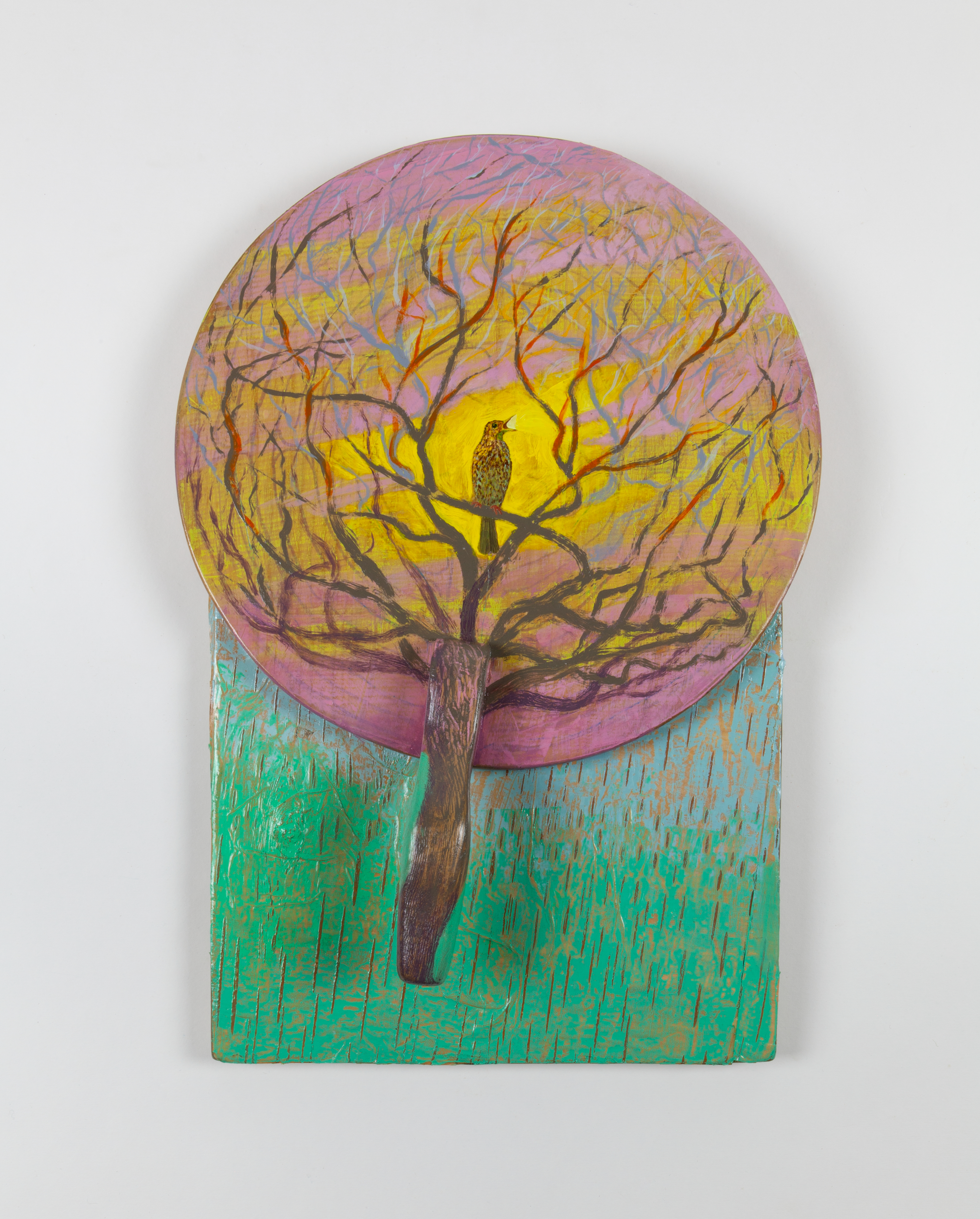
Advent Station 12. The Mistle Thrush Greets the New Day
Mark Cazalet, Advent Station 12: The Mistle Thrush Greets the New Day, 2024

The Advent path we’ve just walked has included an unplanned pregnancy, persecution, and displacement but also miracles, play, and surprise.

Cazalet’s Advent Stations end with a bird in a tree, singing its heart out as a pink and yellow dawn spreads across the sky. The twisted branches become streamers, blowing as if in celebration. (There’s that breath of God again!) Out of the bird’s beak shoots light.

The board that forms the grassy ground is incised with knife marks, perhaps suggesting woundedness—although maybe it’s a turning over of the soil to promote new growth.

The flame-like hues in and around the tree evoke the burning bush of Exodus 3, from which God spoke his name: I AM THAT I AM.

This Advent tree, bare yet lively, calls us to embrace each new day as a gift from the One who is and was and is to come, remembering how Christ came to show us who God is and to feel and heal our brokenness, and he will come again to make all things new.


The Advent Stations by Mark Cazalet, with accompanying poems by Richard Leaf rendered in calligraphy by Pansy Cambell, are on display at Chelmsford Cathedral in eastern England through February 2, 2026. They are available for sale, but until they’re purchased, Cazalet wants to show them in other churches and cathedrals. They’re tentatively scheduled for exhibition in Southwark Cathedral in London during Advent 2026.
Advent, Day 9: Baptism of Repentance

The beginning of the good news of Jesus Christ.

As it is written in the prophet Isaiah,

“See, I am sending my messenger ahead of you,
    who will prepare your way,
the voice of one crying out in the wilderness:
    ‘Prepare the way of the Lord;
    make his paths straight,’”

so John the baptizer appeared in the wilderness, proclaiming a baptism of repentance for the forgiveness of sins. And the whole Judean region and all the people of Jerusalem were going out to him and were baptized by him in the River Jordan, confessing their sins. Now John was clothed with camel’s hair, with a leather belt around his waist, and he ate locusts and wild honey. He proclaimed, “The one who is more powerful than I is coming after me; I am not worthy to stoop down and untie the strap of his sandals. I have baptized you with water, but he will baptize you with the Holy Spirit.”

—Mark 1:1–8

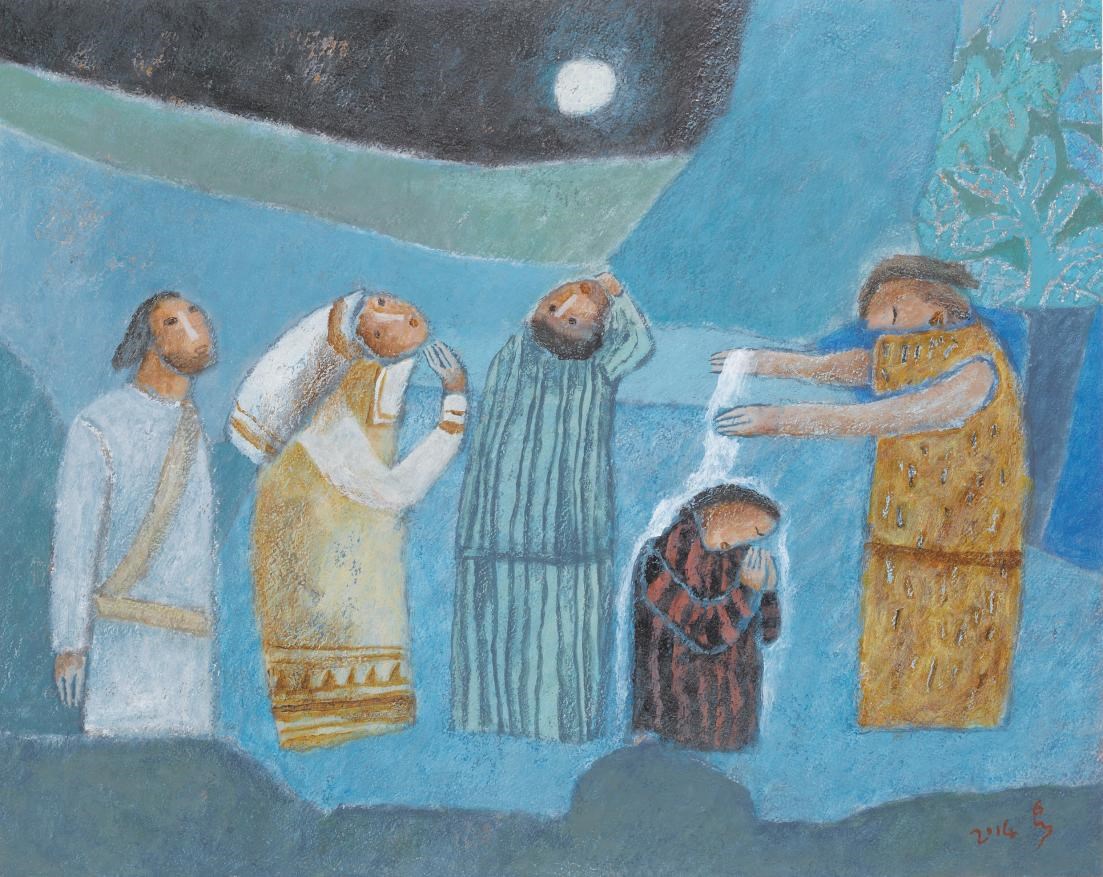
LOOK: Waiting for the Messiah by Sister Kim Ok-soon

Sister Kim Ok-soon_Waiting for the Messiah
Sister Kim Ok-soon (김옥순 수녀), 메시아를 고대하며 (Waiting for the Messiah), 2014. © Daughters of St. Paul.

LISTEN: “Hallelujah Sang the People” by Bruce Spelman, on You Don’t Know What You’re Paddling In (1972); reissued on the anthology album All God’s Children: Songs from the British Jesus Rock Revolution, 1967–1974 (2023)

John the Baptist came onto the earth
He came by natural birth
Though his parents, they were old and they were gray
John the Baptist called unto the crowds:
“There’s gonna come a day
When Christ the Savior comes down from the clouds!”

John the Baptist went down to the stream
His thoughts were like a dream
Yet he was sure that Christ was soon to come
The people gathered round at Jordan’s side
Where they could be baptized
And no one who came there would be denied

Refrain:
“Hallelujah!” sang the people
God the Son is coming down
“Hallelujah!” sang the people
Our Savior’s coming down

Jesus Christ will come down to the earth
A lowly man by birth
And yet he truly is the Son of God
He will come to earth to set us free
From sin and misery
Oh, and still his life will end in tragedy

But his message will be heard abroad
The teaching of the Lord
And the people will believe the words he speaks
He must surely be the holy Son
The prophet said he’d come
The Father, Son, and Spirit, all are one [Refrain ×2]

Roundup: Restful Advent; preparing the way; walking with the Holy Family

ADVENT SERIES: Restful Advent by Tamara Hill Murphy: Tamara Hill Murphy [previously] is one of my favorite spiritual writers, her thoughtful words and curation of resources having served as a well of inspiration for me over the years. Each year, similar to Art & Theology but with the sensibilities and expertise of an Anglican spiritual director, she publishes a new daily Advent and Christmastide guide through her Substack, Restful, running this year from November 30 to January 5. Each post in the series includes lectionary readings, art, music, a prayer, and a simple practice to help us notice God’s presence during these waiting days. This time around, the Daybook will feature excerpts from Claude Atcho’s new book Rhythms of Faith along with ideas from The Liturgical Home by Ashley Tumlin Wallace and some of my own formerly published art commentaries.

“The Daybook is a way to pay attention to Christ’s three arrivals—then, now, and still to come—and to walk through December with a quieter heart and a stronger hope,” Murphy writes.

Murphy is offering Art & Theology readers a 50% discount to Restful using this link, which brings the subscription cost down to $4/month (let it run for two months if you want to receive the full Christmastide Daybook) or $32/year, which will give you access to her year-round content. The offer expires January 5, 2026.

+++

BLOG POST: “The Sacred Journey of Advent” by Ashley Tumlin Wallace, The Liturgical Home: “Advent,” writes Wallace, “is a season of preparation, for the coming of Christ at Christmas, and also for His return in glory at the end of time.” This is a great introduction to the season that kicks off the new church year.

+++

SONGS:

One of the scripture texts of Advent is Isaiah 40:3–5:

A voice cries out:
“In the wilderness prepare the way of the LORD;
    make straight in the desert a highway for our God.
Every valley shall be lifted up,
    and every mountain and hill be made low;
the uneven ground shall become level,
    and the rough places a plain.
Then the glory of the LORD shall be revealed,
    and all flesh shall see it together,
    for the mouth of the LORD has spoken.”

The Gospel-writers Matthew (3:3), Mark (1:3), and Luke (3:4) all see this exclamatory figure as John the Baptist, who told people to prepare for God’s coming by repenting of sin, since holding on tightly to ways of unlove erects barriers to God’s entry into one’s life. Here are two songs based on this Advent passage.

>> “Prepare the Way” by Maverick City Music and Tribl, feat. Chandler Moore and Siri Worku, on Tribl I (2021): This song repeats, again and again, the Advent mantra “Prepare the way,” embedding John the Baptist’s invitation deeply into hearts and minds. Its tag beseeches Christ to come with the fire of purging, the rain of refreshment, and the oil of blessing. To welcome this coming, this transformation and growth, we need to decenter ourselves, ceding to God the place of primacy, from which he works our good and his glory.

>> “Prepare the Way” by Christopher Walker, on Rise Up and Sing, 3rd ed., vol. 3 (2009): This 1991 song is by Christopher Walker, a church music composer, lecturer, and choral conductor originally from the UK but now living in Santa Monica, California. Published by OCP (Oregon Catholic Press), it would make a great song for a children’s Advent choir.

+++

2018 SERIES: Advent Caravan: Walking with the Holy Family by Sarah Quezada: I learned about Sarah Quezada’s work at the intersection of faith, justice, and culture through Tamara Hill Murphy (see first roundup item) in 2018, when Quezada published a five-part series reflecting on the likelihood that Mary and Joseph traveled to Bethlehem for the census not alone but in a caravan. Interweaving personal story, biblical interpretation, and current events, Quezada considers how the holy couple’s experience in the final months of Mary’s pregnancy connects to the reality of people on the move seeking hope, peace, joy, and love today.

While the series is not hosted online, I received permission from Quezada to reproduce it here.

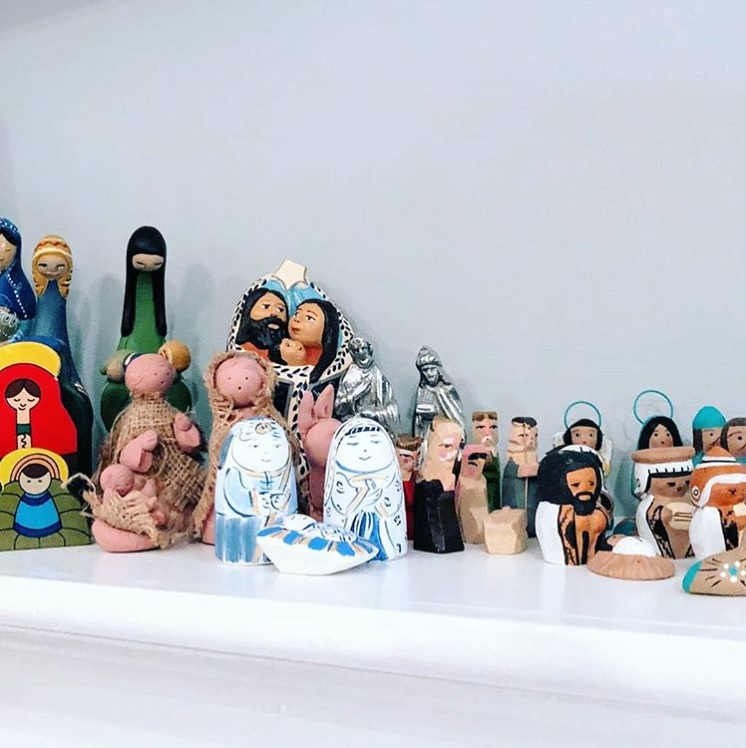
On Instagram, Quezada also shared a photo of her friend’s Advent mantel, where she combined figurines from her various nativity sets to form a “caravan” of travelers.

Advent caravan
Photo via @sarahquezada

+++

YOUTUBE PLAYLIST: Jouluradion Hoosianna: Jouluradio is a Finnish radio station that broadcasts annually from November 1 to January 6, playing all Advent and Christmas music. Since 2012, every year they premiere a new arrangement and video performance of the popular Scandinavian Advent hymn “Hoosianna” (Hosanna, an Aramaic expression meaning “Save now!”), which Lutheran and Catholic churches in Finland sing on the first Sunday of the season. Based on Matthew 21:9, its lyrics greet the approaching Christ, affirming his identity and craving the deliverance only he can bring:

Hoosianna, Daavidin Poika,
kiitetty olkoon hän!
Kiitetty Daavidin Poika,
joka tulee Herran nimeen.
Hoosianna, hoosianna,
hoosianna, hoosianna!
Kiitetty Daavidin Poika,
joka tulee Herran nimeen.
Hosanna, Son of David,
Most blessed Holy One,
Hosanna, Son of David,
Who comes in the name of the Lord!
Hosanna, hosanna, hosanna
In the highest!
Hosanna, Son of David,
Who comes in the name of the Lord!

This hymn was written by the German composer, educator, and piano and organ virtuoso Georg Joseph Vogler in 1795 while working in Sweden as court conductor as well as tutor to the crown prince Gustav IV Adolf.

The Jouluradio commissions, which the station has compiled in a YouTube playlist, encompass a range of genres, including jazz, hip-hop, choral, pop, and electronic. Below is a list of previous years’, of which I’ve embedded the two asterisked ones on this page. Jouluradio typically releases their annual “Hoosianna” the day before Advent, so 2025’s will likely be posted this Saturday. [HT: Gracia Grindal]

“Dialogue at Midnight: Elizabeth to John” by Sister Maura Eichner, SSND (poem)

Degas, Edgar_Pregnant Woman
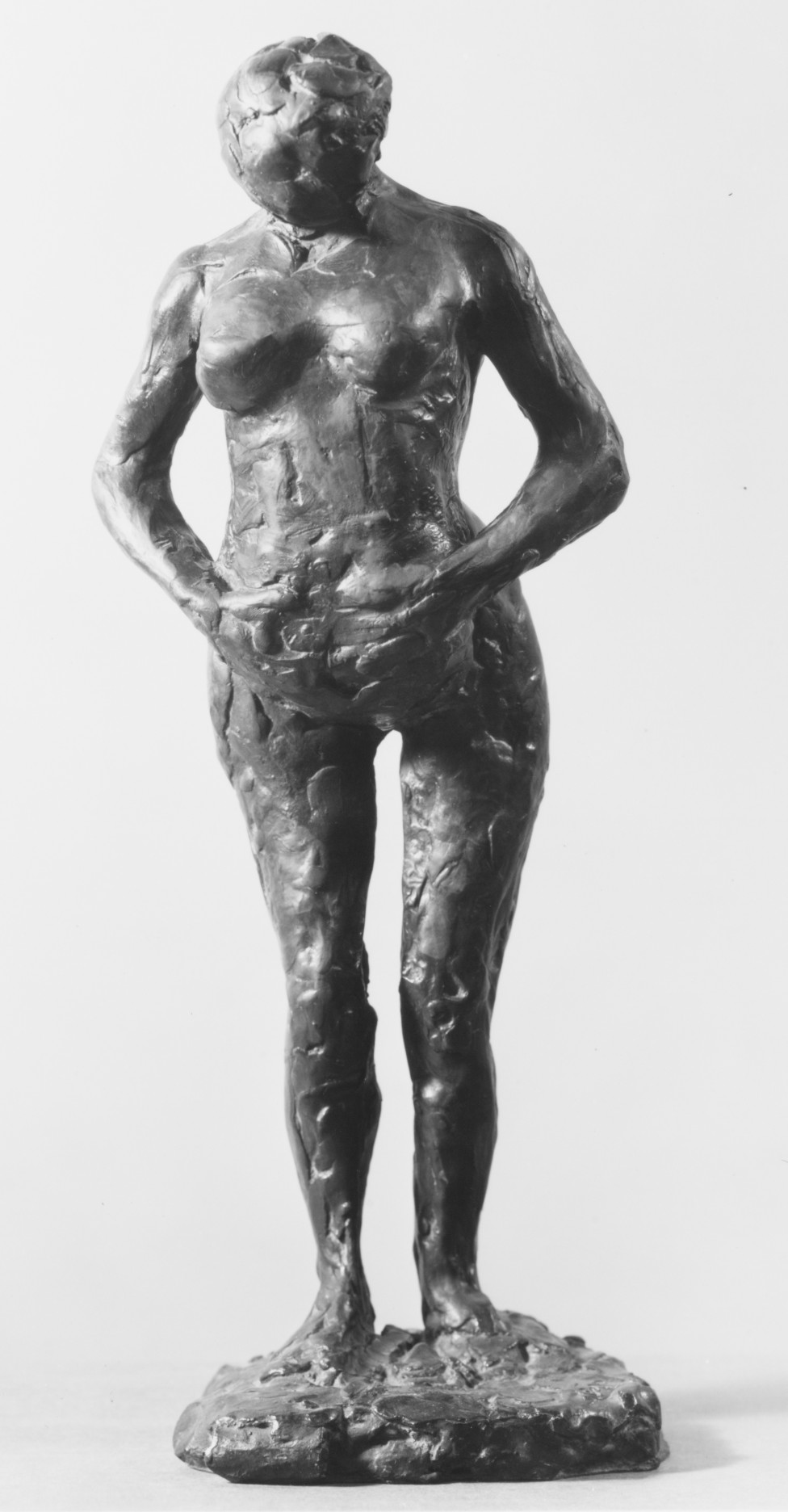
Edgar Degas (French, 1834–1917), Pregnant Woman, modeled ca. 1896–1910, cast 1920. Bronze, 16 3/4 × 5 3/4 × 5 5/8 in. (42.5 × 14.6 × 14.3 cm). Metropolitan Museum of Art, New York.

My son, from the chalk
hills of this old flesh
how you have sailed
beyond the waters of
your father’s doubt.

I feel the small skiff
of your body. Yesterday
you leaped (rapids or
waterfall) when young
Mary walked into my arms.

What we women know.
And how much we keep
within the heart, secret
as the honeycomb that is
your skull growing in me.

My son John, trust this
first solitude. Here in the
ancient cave of my body,
sail inland water
safe from followers,

kings and dancing girls.

This poem appears in After Silence: Selected Poems of Sister Maura Eichner, SSND (Notre Dame of Maryland University, 2011), copyright © the Atlantic-Midwest Province of the School Sisters of Notre Dame. 


In anticipation of the Feast of the Nativity of John the Baptist on June 24, I offer this tender poem by Sister Maura Eichner in which the elderly Elizabeth speaks to her son, John, while he’s still in utero. She senses his life will end early and wishes to keep him safe forever, away from the burdens and perils of a prophetic vocation, away from Herod’s order of imprisonment, away from the lethal spite of Herodias and her daughter-pawn, Salome, whose dancing trophy of choice is John’s head on a platter.

Elizabeth is faithful to God and God’s will—just yesterday, in the company of her also-pregnant cousin Mary, she praised God for the coming Messiah whom even the fetal John recognized, leaping. But as great an honor as it is that her son has been chosen to herald the Messiah, her maternal instinct is to shield and protect him. In the dark of midnight, while her husband, Zechariah, is asleep, she whispers her fears rolled up in a charge, instructing John to savor the shelter of her womb while he still can, as soon he will enter the world’s wilderness and eventually preach himself to a martyr’s death.

For scripture texts that inform Sister Maura’s “Dialogue at Midnight,” see Luke 1 and Matthew 14:1–12.


Sister Maura Eichner, SSND (1915–2009), was a Catholic nun, poet, and professor of literature and creative writing. Born Catherine Alice Eichner in Brooklyn, New York, she took vows with the School Sisters of Notre Dame in 1933 at age eighteen. In 1943 she was assigned to teach in the English Department at the College of Notre Dame of Maryland (now Notre Dame of Maryland University) in Baltimore, where she continued until 1992, serving also as department chair. She published ten books of poetry during her lifetime, including The Word Is Love (1958) and Hope Is a Blind Bard (1989), and maintained correspondence with such writers as Flannery O’Connor, Richard Wilbur, Katherine Anne Porter, and Eudora Welty. She experimented with a diversity of poetic forms and subject matter and disliked religious poetry that is redolent of “thin piety” and “decoratively sweet nosegays,” she told The New York Times in a 1959 interview.

Advent, Day 9: Pave Every Road

LOOK: Shine Forth Upon These Clouded Hills by Nathan Florence

Florence, Nathan_Shine Forth Upon These Clouded Hills
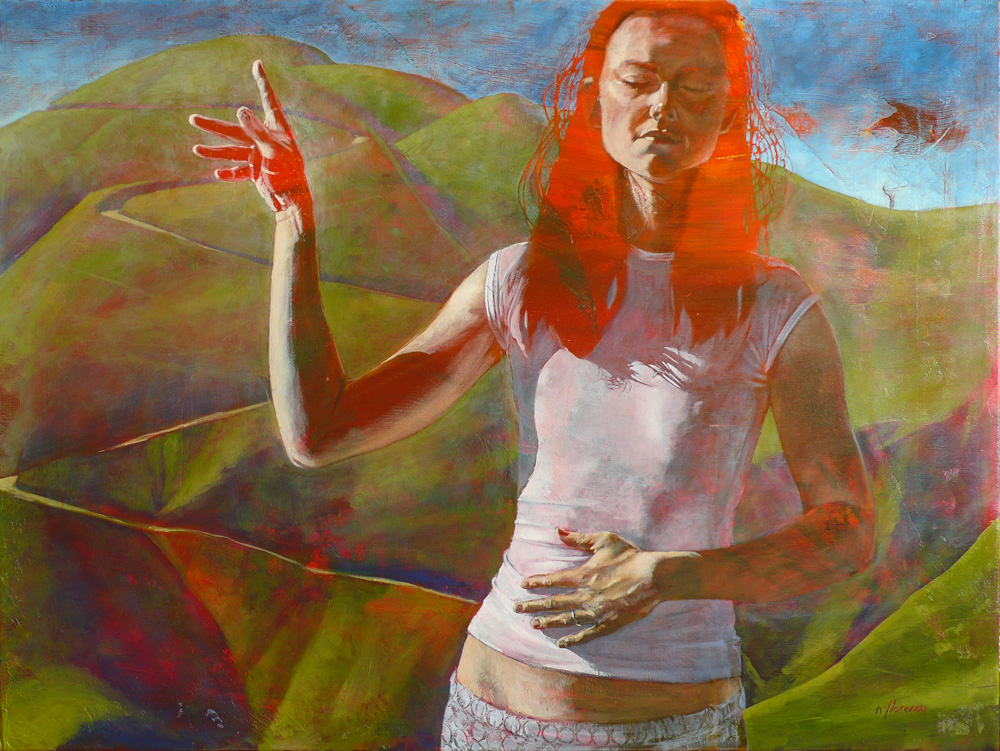
Nathan Florence (American, 1972–), Shine Forth Upon These Clouded Hills. Oil on canvas, 30 × 40 in.

LISTEN: “Pave Every Road” by Caroline Cobb, on A Home and a Hunger: Songs of Kingdom Hope (2017)

Pave every road with repentance
Bring the proud heart low
Let the humble heart sing
Break down all your walls, your defenses
Swing wide your gates
For the coming of the king

Lo, he has come to rebuild the ruins
Lo, he has come, set them captives free
I know he has come to bind up the broken
It’s the year of his favor
The year of Jubilee

People livin’ in the darkness
Lift up your heads and see the sun
I see a new day dawnin’
It brings good news for everyone

I see the sun risin’

One day we’ll all hear a trumpet
He will return with reckoning
I’ll follow my king into glory
Who here is comin’ with me?
Yeah!

I see the sun risin’

Get up, get ready
Get up, get ready
Get up, get ready
For the king to come

Who here is comin’ with me?

“Make Way” by Brent Newsom (poem)

Isaiah 40:3–5

This panting land
hawks up roadblocks
over ground hell-bent
against the premise
of a path. Desert
of rock, not dunes.
Hot wind
rattling leaves
of a distant, lone
acacia tree,
scraggly signpost
pointing everyway
into the craggy, cave-
laden wilderness.
Boulders big enough
to cast a shadow
one might shelter in,
or try, in the sun-fried
afternoon. The grade
grows steep
as the valleys deepen
like the dark of death.
Runnels of loosened
smaller rocks where rain
must once have rushed—
rain, in such a place.

What wildness welcomes
a road? What valley
straightens its spine,
what mountain stoops
from its jeweled throne?
But look: a path
flat and straight
through the jagged
crags and ravines.
A route between
two backwaters—
road enough
for a man to walk
beside a donkey,
on which might ride
a woman with child—
from Nazareth away
to Bethlehem. A way.

Originally published in Remembering That It Happened Once: Christmas Carmen for Spiritual Life All Year Long, ed. Dennis L. Johnson (Eugene, OR: Wipf & Stock, 2021). Used by permission of the poet.

Brent Newsom is a poet from central Oklahoma. He is a recipient of the Maureen Egen Writers Exchange Award in poetry from the organization Poets & Writers and the Foley Poetry Prize from America magazine. He wrote the libretto for A Porcelain Doll, an opera based on the life of deaf-blind pioneer Laura Bridgman, and is the author of Love’s Labors (CavanKerry Press, 2015), which was a finalist for the Oklahoma Book Award in poetry. His poems have also appeared in the Southern Review, the Hopkins Review, Windhover, Relief, and other journals.

Advent, Day 8: A Messenger in the Wilderness

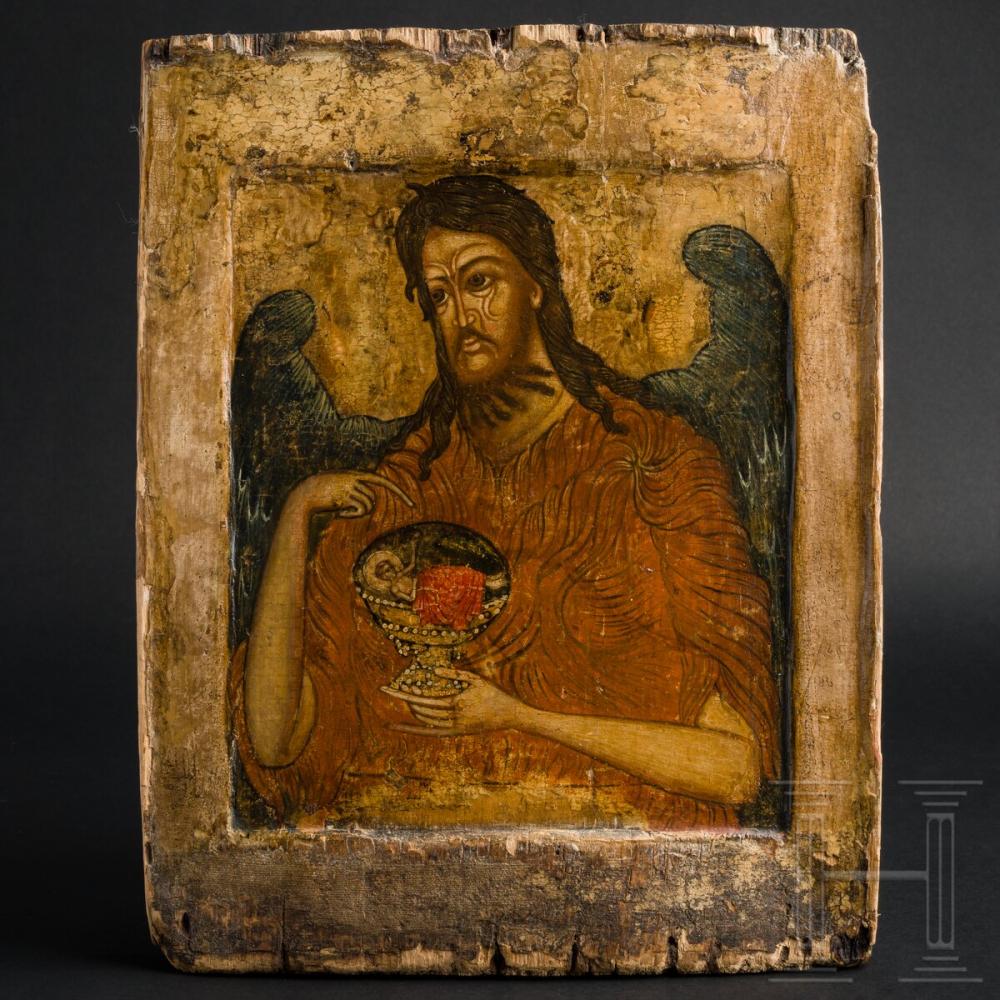
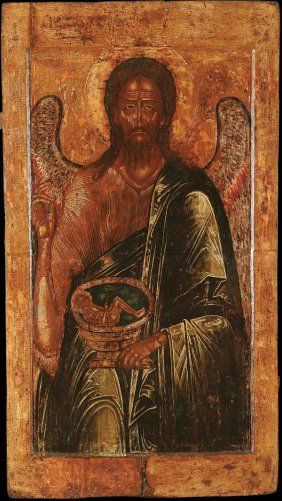
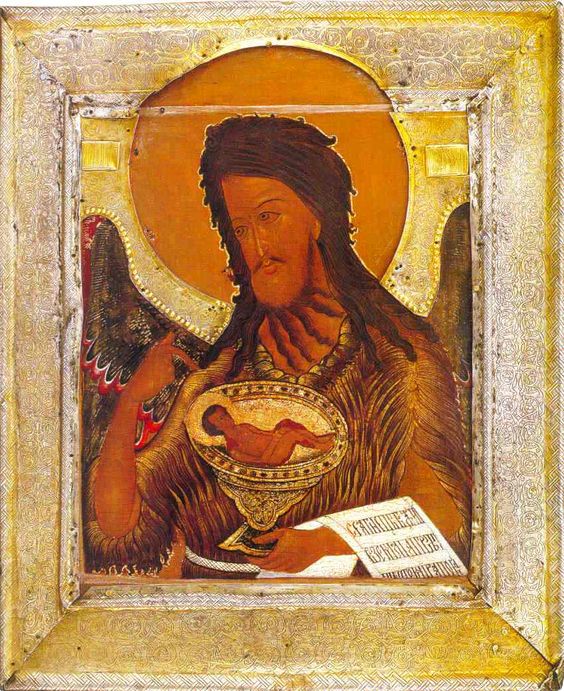
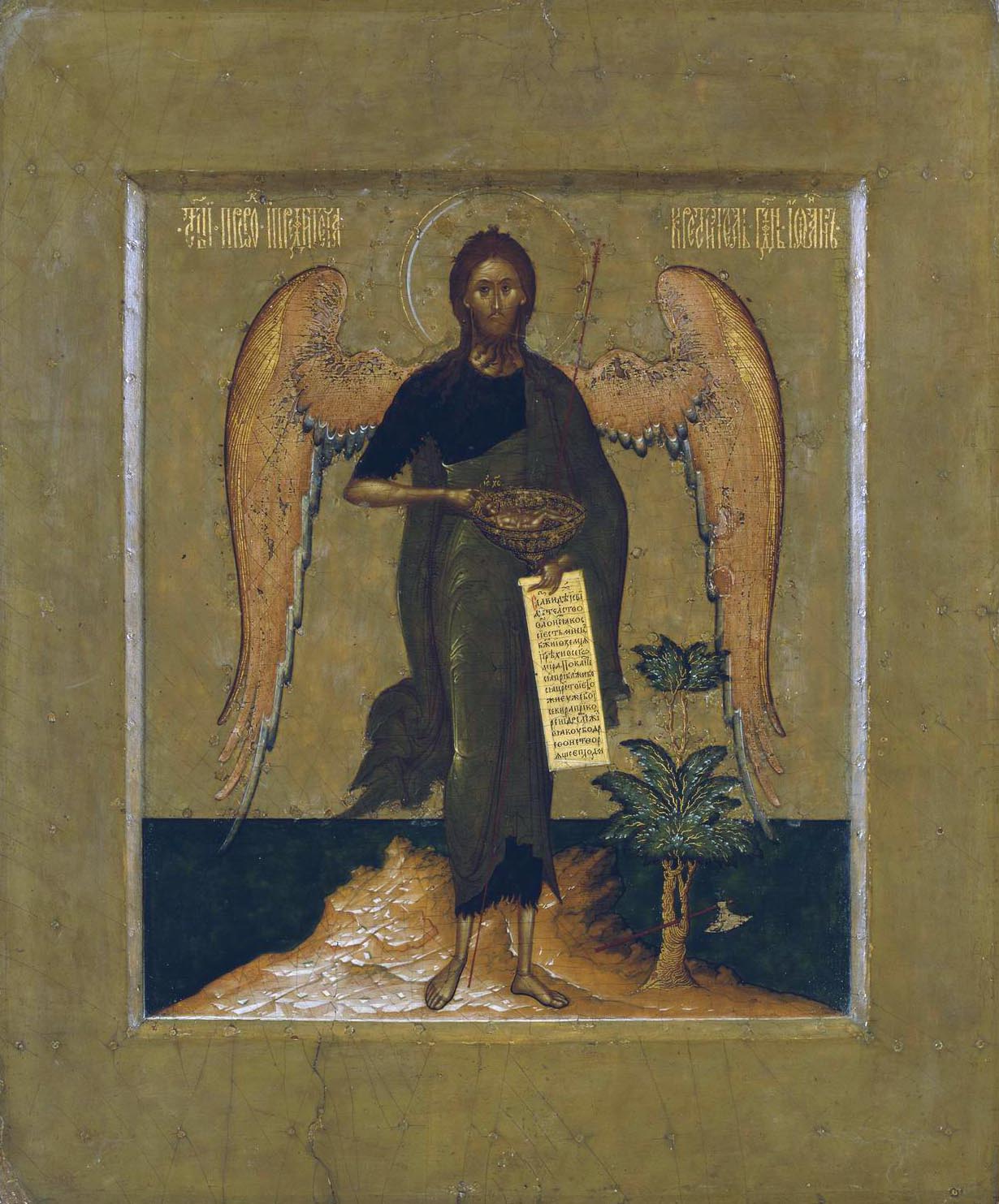
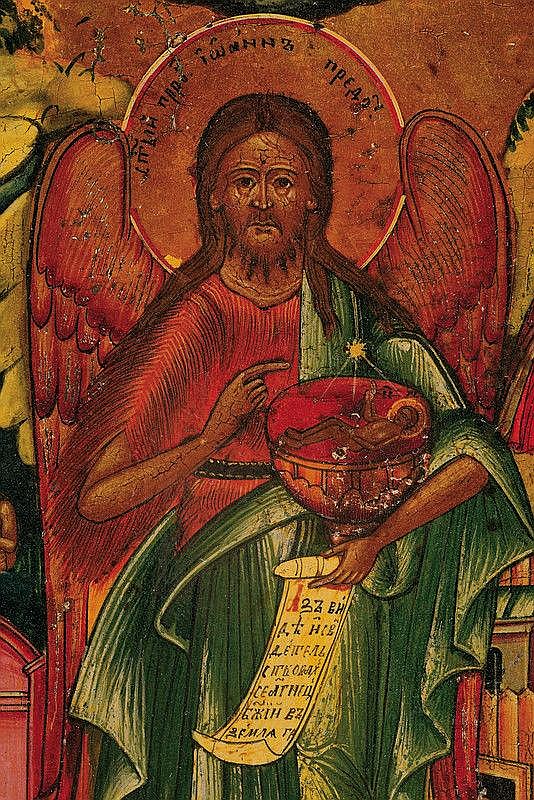
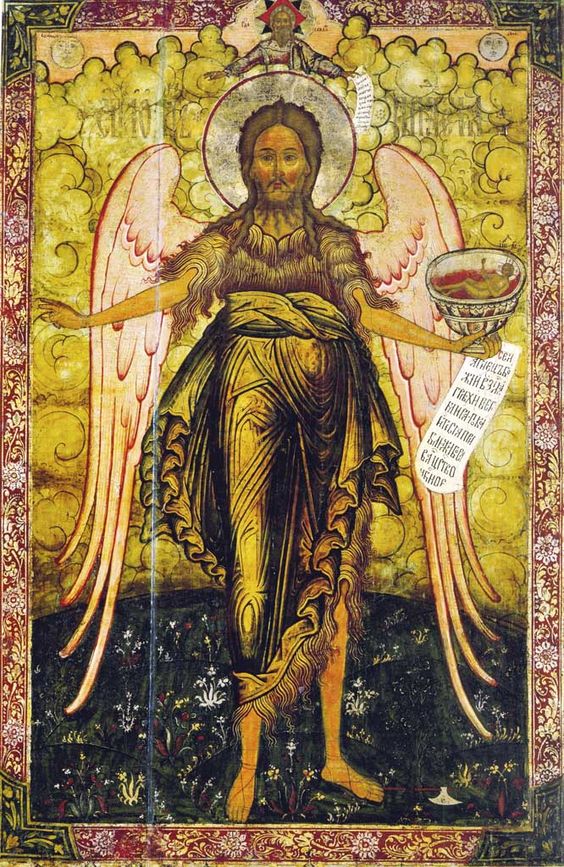
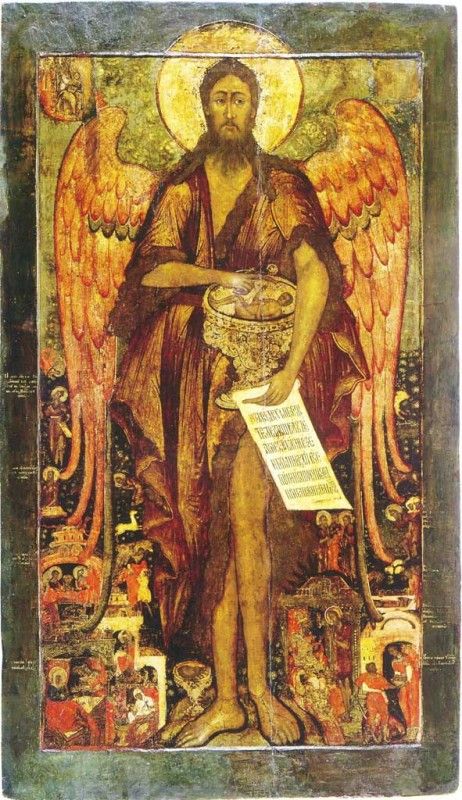
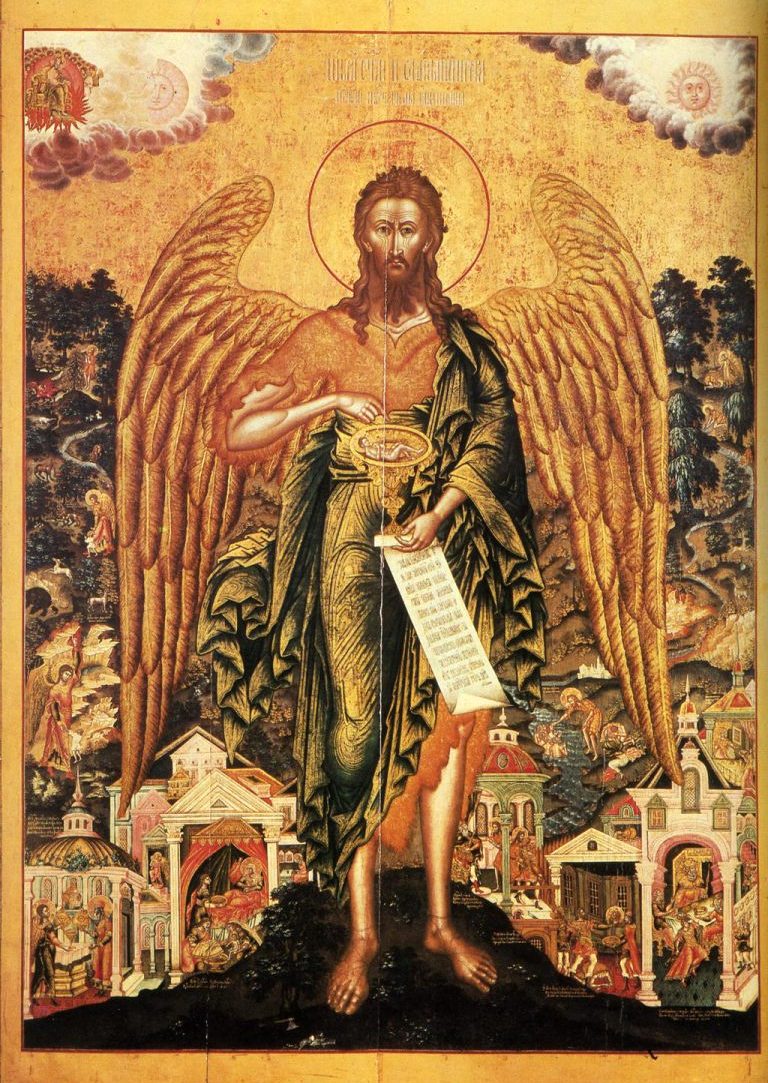
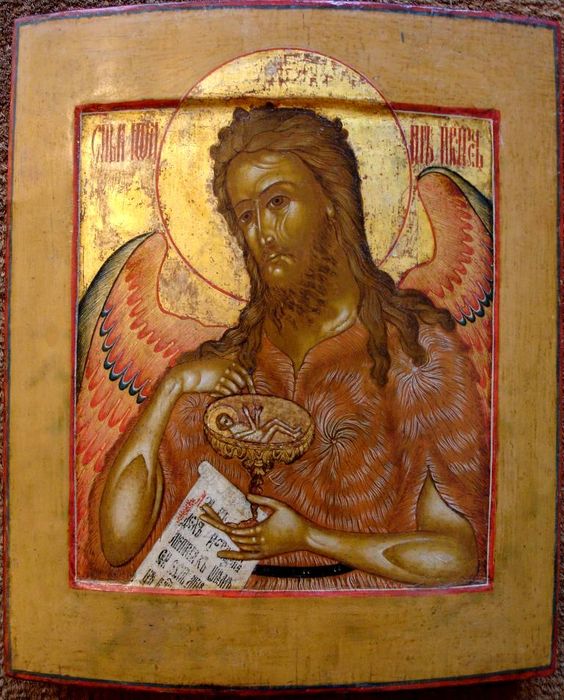
LOOK: John the Baptist, Angel of the Desert icon

Angel of the Desert
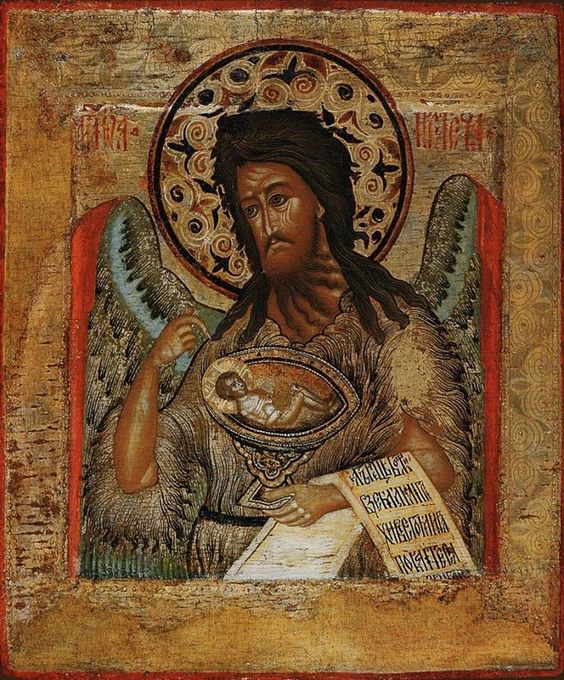
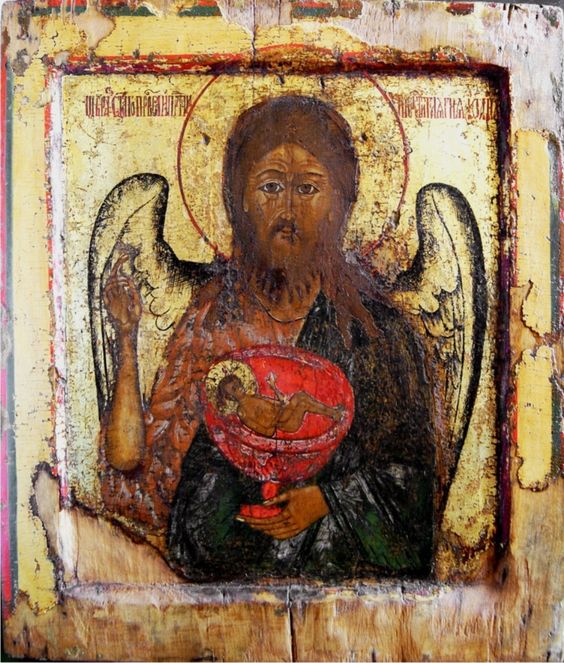
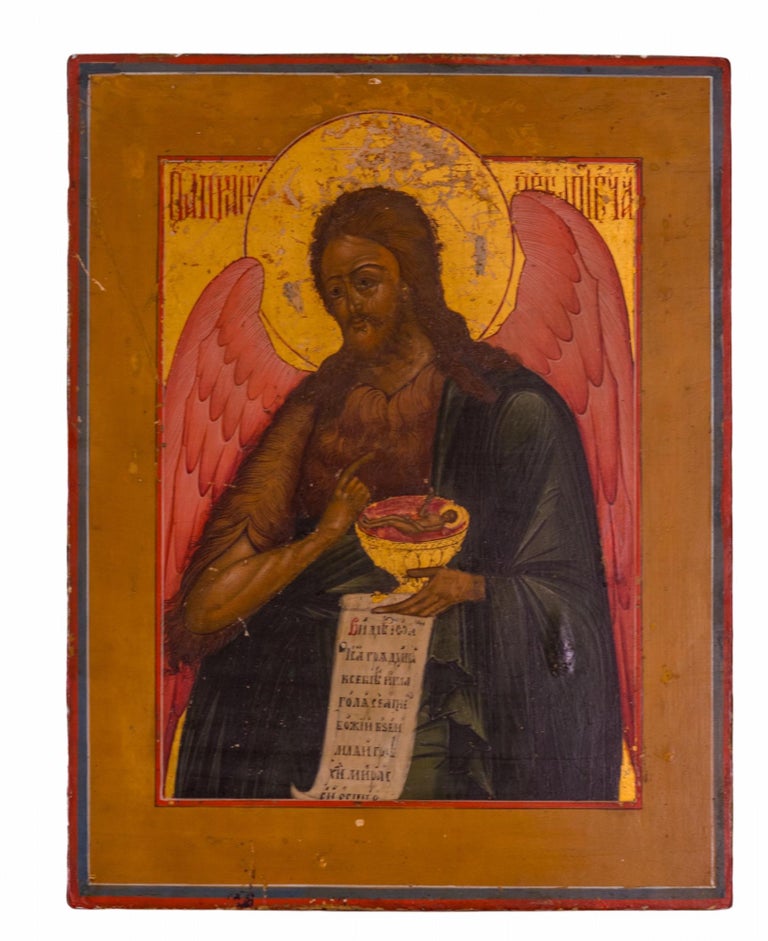
John the Baptist, Angel of the Desert, Russia, 17th or 18th century

John the Baptist served as a bridge between the old and new covenants, calling on people to repent of their sins and produce good fruit in preparation for the arrival of the Messiah. “The kingdom of heaven is at hand!” he vigorously proclaimed on the banks of the river Jordan. “Get ready.”

Eastern Orthodox icons sometimes portray John the Baptist with wings, as the word “angel” means “messenger.” God had announced through his prophet Malachi, “See, I am sending my messenger [mal’āḵ] to prepare the way before me, and the Lord whom you seek will suddenly come to his temple. The messenger of the covenant in whom you delight—indeed, he is coming, says the LORD of hosts” (Mal. 3:1). The Hebrew word, mal’āḵ, that is translated as “messenger” in this passage is translated elsewhere in the Old Testament as “angel.” Christian commentators see this prophecy as fulfilled in John the Baptist.

The iconography of John the Baptist as Angel of the Desert/Wilderness first started appearing in the sixteenth century and is present only in the East. In addition to having two wings, he wears camel skins, an allusion to his asceticism (Matt. 3:4). He usually holds an unfolded scroll bearing his words from Matthew 3:2—“Repent, for the kingdom of heaven has come near”—as well as a poteiron (liturgical chalice) in which lies a naked Christ Emmanuel, evoking the Eucharist. John points to Christ, the source of our salvation.

Sometimes it is John’s own severed head that lies in the chalice instead. This variation references his martyrdom, commemorated each year on August 29.

I’ve compiled a range of John the Baptist, Angel of the Desert icons that include the Christ child in a eucharistic cup. They are all from seventeenth-, eighteenth-, or nineteenth-century Russia; many are in private collections, and a few are in the State Tretyakov Gallery in Moscow.

LISTEN: “What Is the Crying at Jordan?” | Words by Carol Christopher Drake, 1950s | Tune: ST. MARK’S BERKELEY, an Irish melody from Danta De: Hymns to God, Ancient and Modern, 1928 | Performed by the Miserable Offenders on Keepin’ the Baby Awake: Music for Advent and Christmas, 2012

What is the crying at Jordan?
Who hears, O God, the prophecy?
Dark is the season, dark our hearts,
and shut to mystery.

Who, then, shall stir in this darkness,
prepare for joy in the winter night?
Mortal, in darkness we lie down, blindhearted,
seeing no light.

Lord, give us grace to awake us,
to see the branch that begins to bloom;
in great humility is hid all heaven
in a little room.

Now comes the day of salvation;
in joy and terror the Word is born!
God comes as gift into our lives;
oh let salvation dawn!

The “crying at Jordan” in the first line of this modern hymn refers not to weeping but to a loud uttering—that of John the Baptist preparing the way for the Messiah through the preaching of repentance. When, in response to John’s ministry, the priests and Levites asked him who he was, he declared, “I am the voice of one crying out in the wilderness, ‘Make straight the way of the Lord,’ as the prophet Isaiah said” (John 1:23; cf. Isa. 40:3; Matt. 3:3).

The third stanza refers to Mary’s pregnancy, echoing the closing couplet of the poet John Donne’s “Annunciation” sonnet: “Thou hast light in dark, and shutst in little room, / Immensity cloistered in thy dear womb.” This is an idea that many Christians, both before and after Donne, have mused on and marveled at.

Thank you to my friend Peggy, who introduced me to this remarkable Advent hymn!

Advent, Day 8: A Voice Cries Out

LOOK: Baptism by Water by John Patrick Cobb

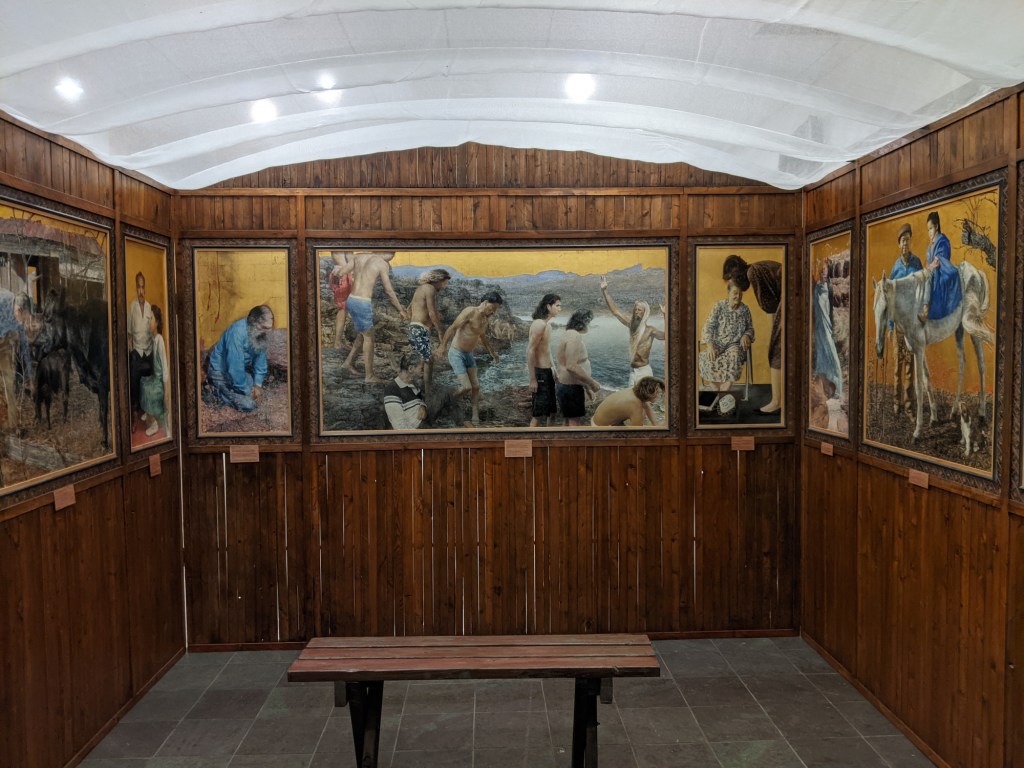
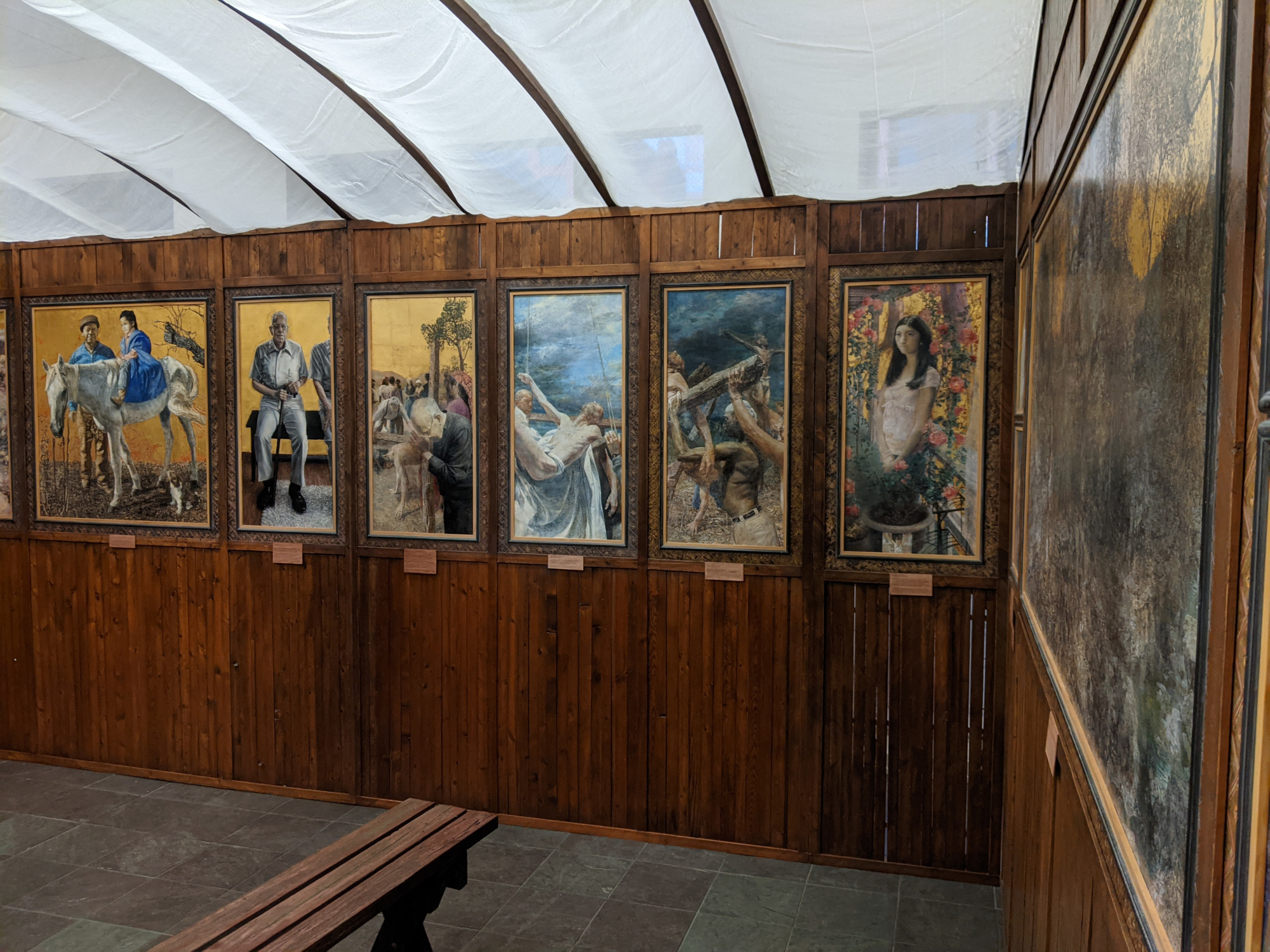
At the 2021 Christians in the Visual Arts (CIVA) conference in Austin, Texas, I got to experience local artist John Patrick Cobb’s Ikon Chapel, a traveling, custom-built wooden structure housing twenty of Cobb’s egg tempera paintings depicting his friends, family, and neighbors as saints and prophets in our modern world. The young and the elderly, farmers, water well drillers, artists, teachers, nurses, Holy Cross brothers, custodians, the unhoused, people with disability or mental illness—these are among those he honors in paint and gold leaf.

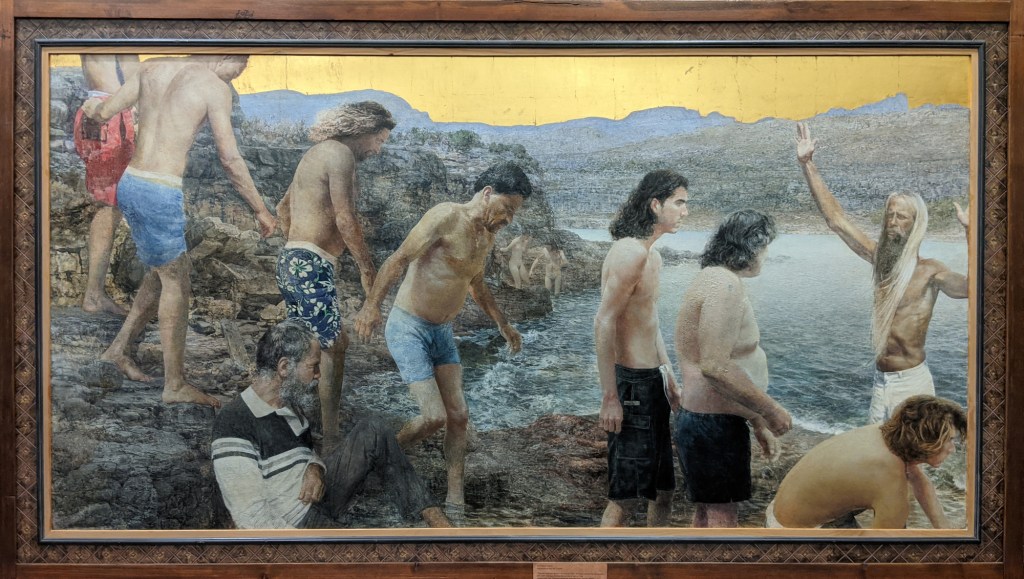
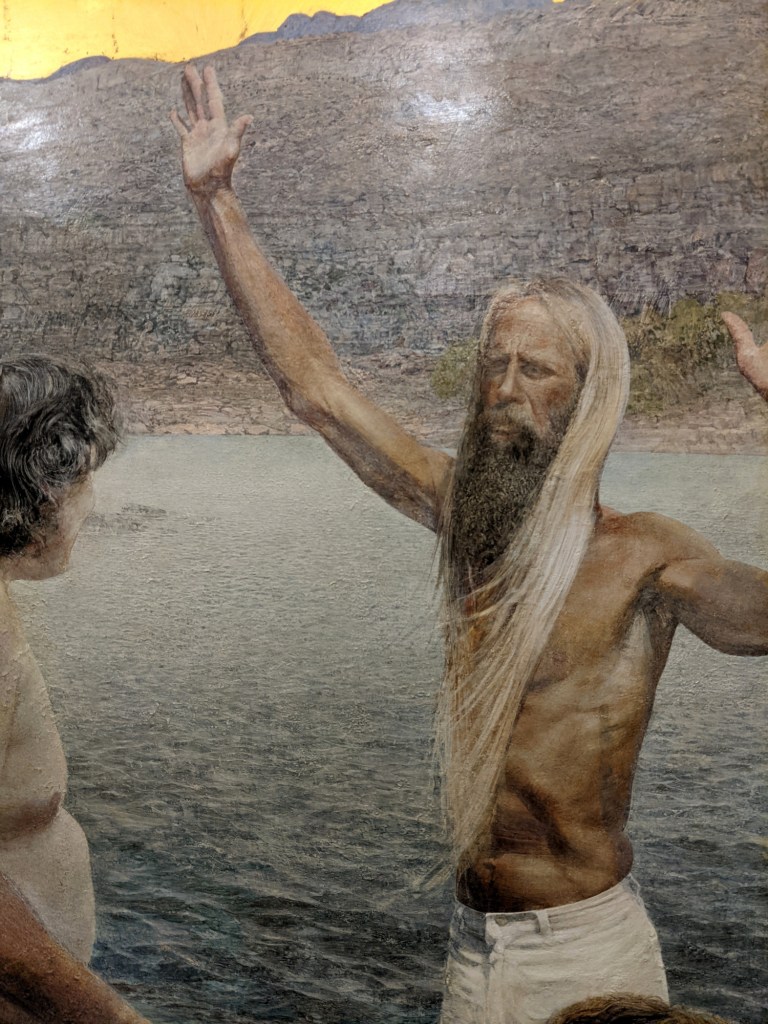
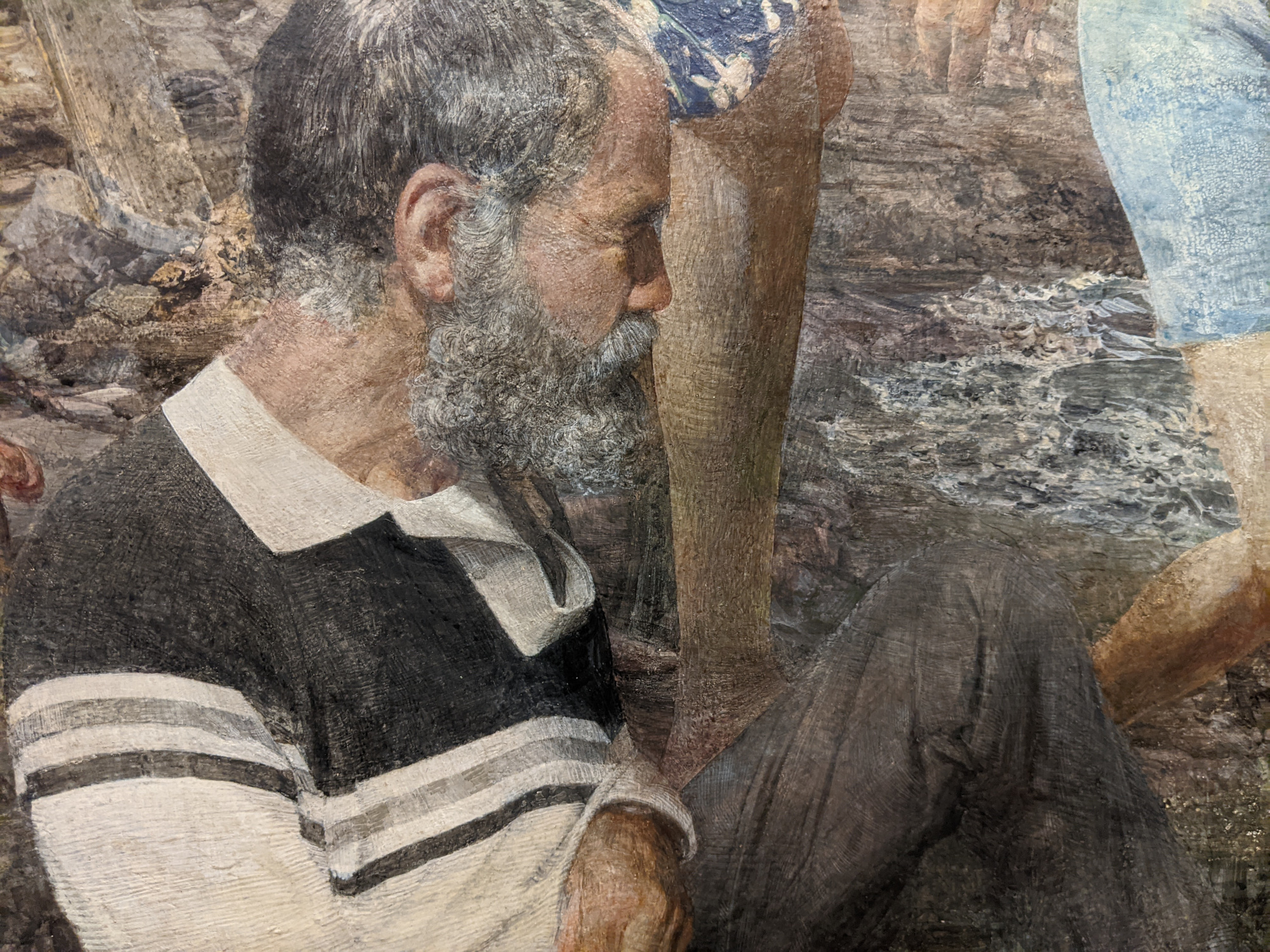
Baptism by Water is, along with its companion piece, Baptism by Fire, the largest painting in the series, at over six feet long. It is a lakeside scene portraying John the Baptist—the long-haired, bleach-blonde guy at the far right—calling folks to repentance. Several men climb down the rocky shoreline to enter the cleansing waters and be raised to new life. The models are all associated in real life with water—surfers, plumbers, fishermen. And this is a local setting: Hippie Hollow on Lake Travis in Central Texas, a famous nude swimming hole.

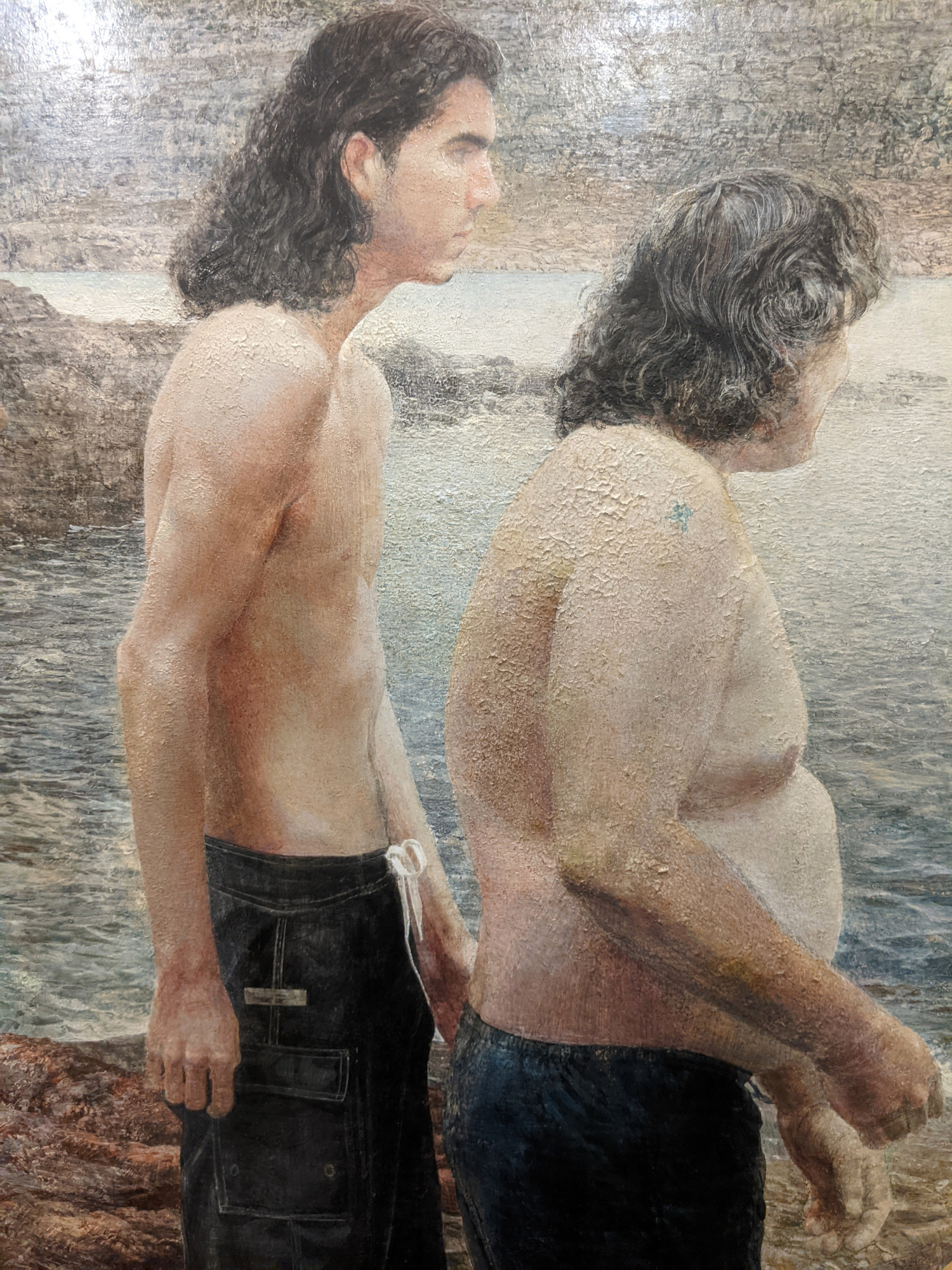
Jesus, says Cobb, is the young man with the black hair and black trunks. Cobb deliberately made him indistinguishable from the others to emphasize his full humanity. He looks beyond John the Baptist, perhaps mentally preparing for the solitary forty-day fast in the desert he’s about to embark on.

In the wall text in the Ikon Chapel, Cobb describes the seated, shirted man in the foreground as reminiscent of the Gerasene demoniac (Mark 5:1–20):

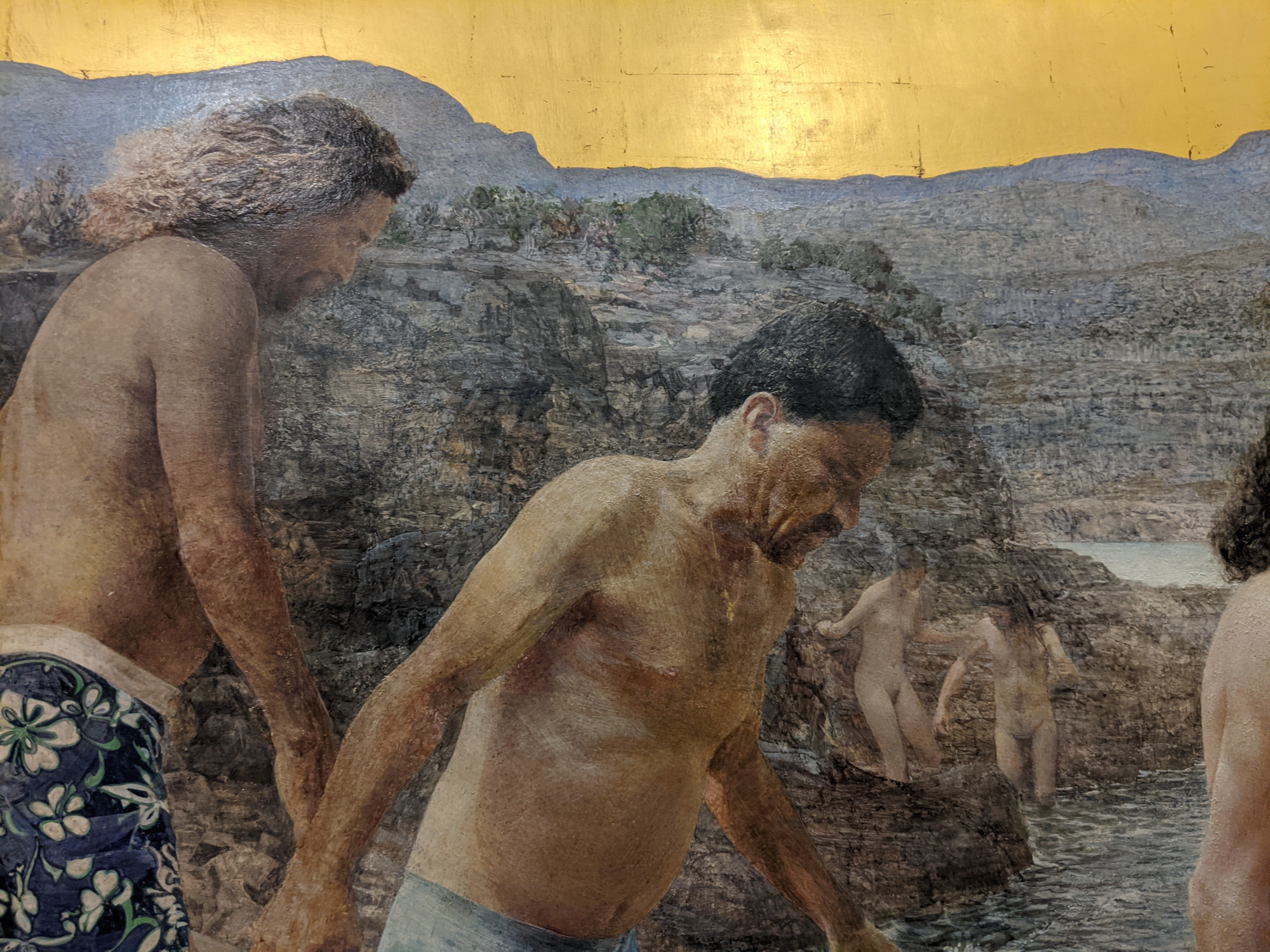
The figure in the near ground, clothed, was a man who lived in the nook of the sea wall in Galveston and slept in the nearby graveyard at 61st Street. On the worst winter days I would bring him a coffee, and finally asked him one day if I could include him in my painting. He would sometimes drink himself into a frenzy and yell and scream at the cars in horrific anger. His leg had been broken and had healed in a precarious angle. I felt as though if there were anyone who deserved the peace and the Holy Spirit, it would be him.  

At the bottom right, one of the figures twists away, rejecting John’s call. The model’s name is Jonah, so Cobb wanted to use him as a Jonah figure, resisting (at least initially) the divine plan.

In the background Adam and Eve are skinny-dipping.

Detail, John the Baptist

Detail, Jesus
Detail, Jesus (left)

Detail, Adam and Eve
Detail with Eve and Adam in background

Detail
Detail of a local unhoused man with a leg impairment and alcoholism, for whom the artist wishes God’s peace

I was fortunate enough to get to know Cobb a bit over lunch one day while I was in Austin, and then later at an outdoor gathering he and his wife, Tina, hosted on their property. At the time, he was preparing for an extended trip to Italy to restore some Renaissance frescoes in a village chapel.

To learn more about this remarkable body of work, see the book Chapel Ikons: Biblical Meditations on Living the Spiritual Life in the Modern World (Treaty Oak, 2020), which reproduces all twenty-five paintings in full color with detailed commentaries by William Y. Penn Jr. The postscript says that Cobb and Penn are looking for a permanent institutional home with resources to preserve the chapel ikons for public viewing and study and that if interested, you should contact wpenn@me.com.

I also commend to you the article “Art on Board: John Cobb’s Panel Paintings Hit the Texas Highways” by Ginger Henry Geyer from Image no. 47 (Fall 2005), and for a quick video tour of the Ikon Chapel, see the first forty seconds of this video from Austin’s Mexic-Arte Museum.

LISTEN: “A Voice Cries Out” by Nicholas Andrew Barber and Ken Canedo, based on Isaiah 40:1–11 (2020)

Refrain:
A voice cries out in the desert
Come prepare the way of the Lord
God is coming, make straight for him a highway
Come prepare the way of the Lord

Every valley shall be exalted
Every mountain shall be made low
Then shall the Word of God be known
All the earth shall proclaim
The glory of the Lord [Refrain]

Go upon the highest mountain
Zion, herald of good news
Lift your voice, cry out with all your soul
Jerusalem, proclaim
Glad tidings in the Lord [Refrain]

Have no fear, O cities of Judah
Here is your God
See, the Lord is coming now with power
Our God is here
The mighty and the strong [Refrain]

Like a shepherd, he feeds his flock
He gathers the lambs
See, he carries them gently in his arms
So tenderly
With a mother’s love [Refrain]


This post is part of a daily Advent series from December 2 to 24, 2023 (with Christmas to follow through January 6, 2024). View all the posts here, and the accompanying Spotify playlist here. “A Voice Cries Out” is not on Spotify.

25 Poems for Christmas, vol. 2

Following the popularity of last year’s “25 Poems for Christmas,” I’ve decided to publish a brand-new installment, and will perhaps make this a yearly tradition! All the selections can be read online—just follow the links.

Despite the pithy title of this post, not all the poems are “Christmas” poems, strictly speaking, but rather they encompass the season of Advent too, as well as Epiphany. Advent is a four-week season leading up to Christmas that is characterized by a mood of longing and expectation; it is oriented not only toward Jesus’s first coming but also toward his second. Christmas, of course, celebrates the birth of Jesus, the Word of God made flesh. And Epiphany, on January 6, commemorates the visit of the magi to the crib, representing God’s self-revelation to the wider world.

Each poem is accompanied by a micro-commentary or short descriptive blurb, which I suggest you read after reading the poem itself. There’s a benefit to first entering a poem without having any context—then after registering your initial impressions and questions, to consider another person’s framing or analysis or highlights, and reread. And then a third time! Each reading can potentially reveal new meaning.

Ventura Stone Nativity
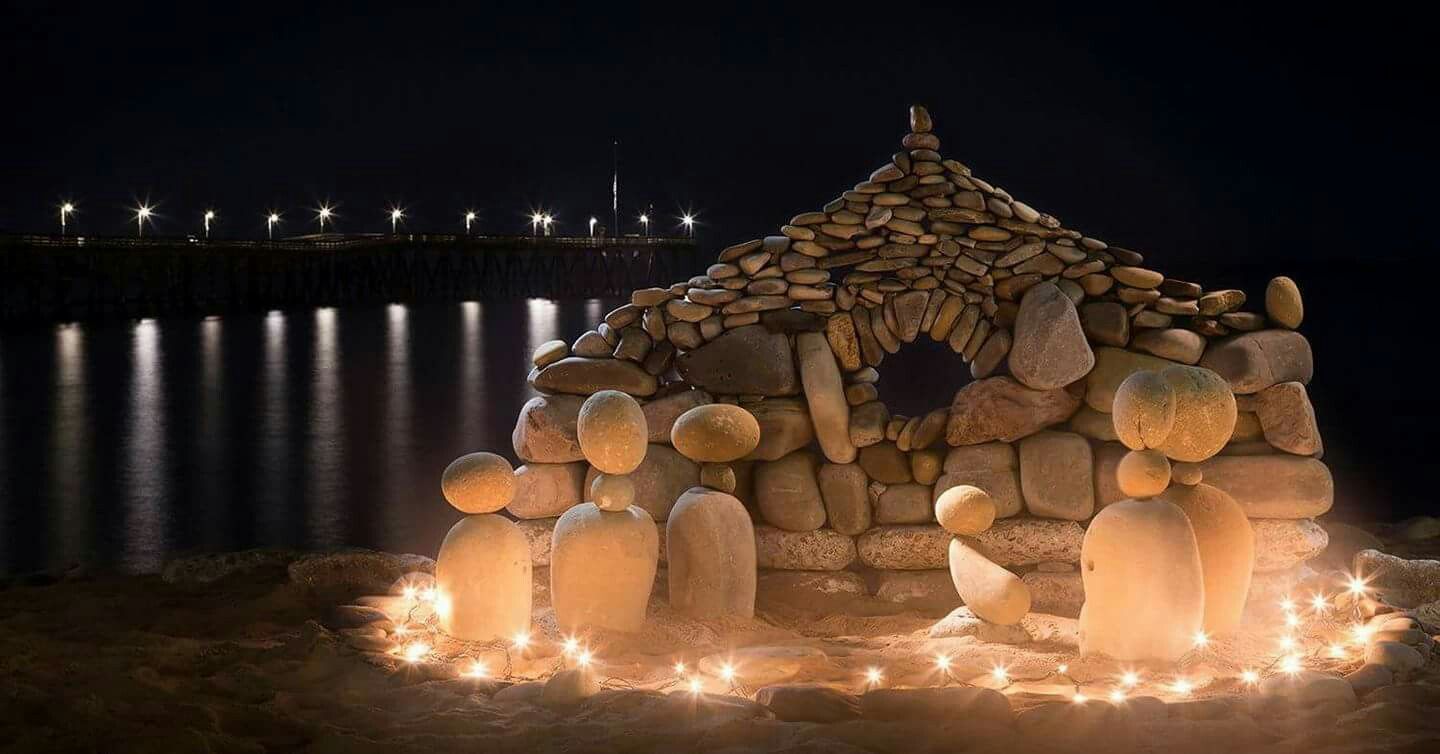
Stone Nativity by Juan Manuel Cisneros, Ventura, California, December 2016 [learn more]

1. “Haiku for an Advent Calendar” by Richard Bauckham: Church services during Advent tend to focus on messianic prophecies from the Hebrew Bible, rumblings of a coming savior. In this sequence of twenty-four haiku, Richard Bauckham pulls a detail from each book of the Jewish scriptures, finding anticipations of Christ. For example, Isaiah: “In the wilderness / a voice cries for centuries / seeking an echo.” Or Job: “God answered Job but / not his question. Maybe he / will do that again.”

Source: Tumbling into Light: A Hundred Poems (London: Canterbury Press Norwich, 2022) | https://richardbauckham.co.uk/

2. “How Christ Shall Come” (anonymous): The cosmological Christ blew in from the four cardinal directions, coming as lover, knight, merchant, and pilgrim. So says this fourteenth-century Middle English lyric, rich in metaphor, compiled in a book of preaching aids and sermons by John Sheppey (d. 1360), bishop of Rochester. (It is unclear whether he is the author of the poem.) The great medieval literature scholar Carleton Brown gave it the title “How Christ Shall Come” in his landmark Religious Lyrics of the XIVth Century (1924), and Grace Hamman brought it to my attention recently in her wonderful monthly Substack, Medievalish, providing a modern English translation and commentary.

Source: Merton College MS 248, fol. 139b. Public Domain.

3. “Hawk Lies Down with Rabbit” by Seth Wieck: What would it look like for death to no longer have dominion in the animal world? Grappling with Isaiah’s end-time vision of a peaceable kingdom void of predation, this poem describes in graphic terms a bird of prey making its kill, feeding on flesh, and wonders how a hawk could still be itself with rewired impulses. Hear the author read and provide context for the poem on the Reformed Journal Podcast.

Source: Reformed Journal, January 31, 2023 | https://www.sethwieck.com/

4. “john” by Lucille Clifton: Written in the voice of John the Baptist, this poem is part of an extraordinary sixteen-poem sequence titled “some jesus,” which features a range of biblical characters. In her retelling of his ministry as forerunner to the Messiah, Lucille Clifton casts John as a Black Baptist preacher, preparing his listeners to receive the one who “com[es] in blackness / like a star.” Clifton’s larger body of work would suggest that “blackness” here is multivalent, describing what Jesus comes into and as: the word suggests the darkness of the world that Christ entered, on the one hand, but also functions as a positive racial identifier. In Clifton’s revisioning, Christ comes as a Black man, wearing “a great bush / on his head”—which, again, could be read as an Afro, and/or as a mystical reference to the site at which God revealed himself to Moses in the Sinai desert. Luminous with truth, Christ comes, “calling the people brother.”

Source: Good News About the Earth (New York: Random House, 1972); compiled in The Collected Poems of Lucille Clifton (Rochester: BOA Editions, 2012)

Gargallo, Pablo_The Prophet
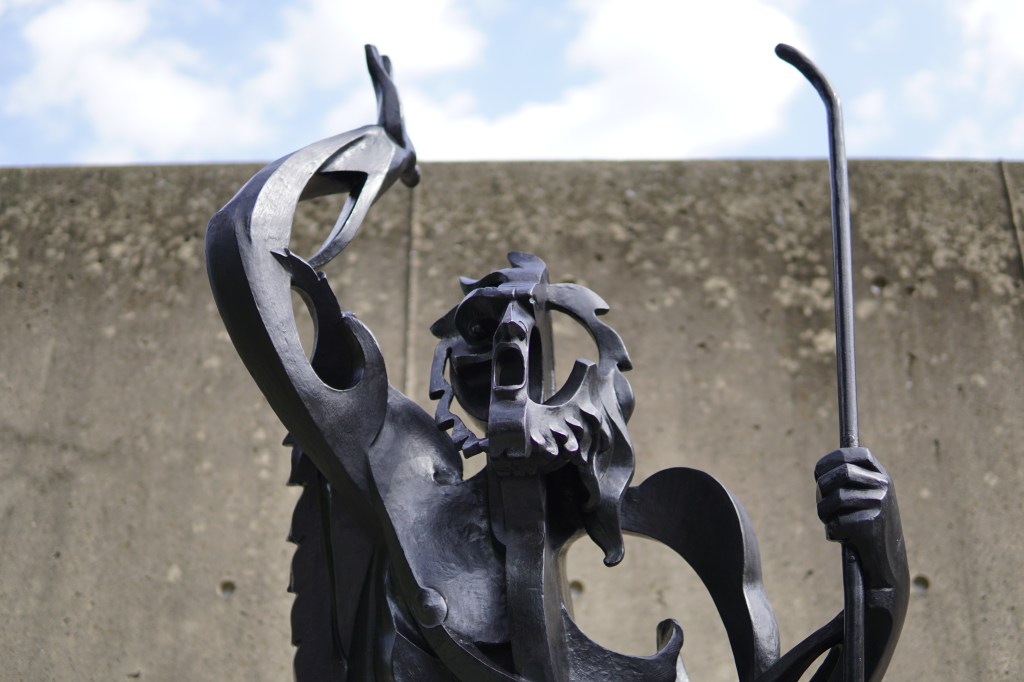
Pablo Gargallo (Spanish, 1881–1934), The Prophet (St. John the Baptist) (detail), 1933. Bronze, 91 3/4 × 29 1/2 × 19 in. Wurtzburger Sculpture Garden, Baltimore Museum of Art. Photo: Victoria Emily Jones.

5. “Christmas Mail” by Ted Kooser: Every December the story of an ancient birth comes alive again in couriers’ mailbags, in tin boxes at the ends of driveways, on mantels and fridges. This poem honors those postal workers who deliver good tidings in the form of Christmas cards, the magic spilling out the envelopes to make even the most tiresome routes sparkle a bit.

Source: Poetry Foundation | https://www.tedkooser.net/

6. “December 25” by George MacDonald: Through the mid-nineteenth century, denominations influenced by the Reformed tradition, including the Church of Scotland in which George MacDonald was raised, typically did not observe Christmas, the rationale being that no one day should be thought of as holier than any other. But in his book-length dramatic poem Within and Without, MacDonald refers to December 25 as “this one day that blesses all the year”—and in this seven-liner from his Diary of an Old Soul, he describes Christmas as a gleaming blue sapphire, a structural center, around which all the other jewels of the church calendar are oriented.  

Source: The Diary of an Old Soul (privately published, 1880). Public Domain.

7. “On a Cardinal Climbing Down a Manhole to Restore Power to 400 Homeless People” by Michael Stalcup: On May 11, 2019, Cardinal Konrad Krajewski, the papal almoner (Pope Francis’s special appointee to distribute charity), crawled into a manhole and broke a police seal to personally restore power to a homeless shelter in Rome whose electricity had been shut off due to its failure to pay its bills. The shelter was occupied by some 450 people at the time, 100 of them children, who had been without electric light, hot water, and refrigeration for nearly a week. In this poem, which can be read Christologically, Michael Stalcup celebrates this defiant humanitarian act that brought light to a people living in darkness.

Source: Commonweal, April 2020 | https://www.michaelstalcup.com/

8. “Incarnation” by Amit Majmudar: “Inheart yourself, immensity. Immarrow, / Embone, enrib yourself.” So begins the five-poem sequence “Seventeens.” Musical and witty, this first poem is a plea to the great I AM to take on a body and “be all we are, and all we aren’t.”

Source: Heaven and Earth (West Chester, PA: Story Line Press, 2011) | http://www.amitmajmudar.com/

9. “The Lord Is with Thee” by Micha Boyett: Written in 2010 as the third in a five-poem sequence commissioned by John Knox Presbyterian Church in Seattle, this poem centers on the Visitation episode described in Luke 1:39–58. It’s about Mary finding belonging in God’s story, especially through the companionship of her elder cousin Elizabeth, who has nurtured Mary’s faith since infancy and continues to do so in this her moment of crisis. “How easily she spoke of God, / as if he were a neighbor, a fish vendor on the street,” Mary admires. Elizabeth supports Mary physically, emotionally, and spiritually, holding her hair back as she vomits, protecting her from vicious rumors, affirming the work of God in her life, and accompanying her at the start of this wild path God has set them both on.

Source: The By/For Project | https://www.michaboyett.com/

Redon, Odilon_Mystical Conversation
Odilon Redon (French, 1840–1916), Mystical Conversation, ca. 1896. Oil on canvas, 65 × 46 cm. Museum of Fine Arts, Gifu, Japan.

10. “Our Lady” by Mary Elizabeth Coleridge: The great-grandniece of the Romantic poet Samuel Taylor Coleridge, Mary Elizabeth Coleridge (1861–1907) grew up in a home visited by family friends Alfred Lord Tennyson, Anthony Trollope, John Ruskin, and Robert Browning, among others. In this poem she marvels at how God chose the common-born Mary for such a task as mothering the Christ, singing along with Mary’s Magnificat about how God raises up the lowly.

Source: Fancy’s Following (privately published, 1896). Public Domain.

11. “Traveling Man” by Marjorie Maddox: With his pregnant wife alongside, Joseph plods down south to Bethlehem, “convinced of the predestined / roll of dice chrismated with Miracle.” An epigraph from a Leonard Cohen song sets the tone.

Source: Begin with a Question (Brewster, MA: Paraclete, 2022) | http://www.marjoriemaddox.com/

12. “Sonnet in the Shape of a Potted Christmas Tree” by George Starbuck: This charming shape poem contrasts the extravagance of our popular celebrations of Christmas with the poverty of the first-century event it marks. The first half describes the furious wind of decorative activity that uproots evergreens from their natural habitats to bring them indoors and deck them with baubles and ribbon. I don’t know how to interpret “no scapegrace of a sect,” but “Daughter-in-Law Elect” refers to a duet from the Gilbert and Sullivan opera The Mikado. The turn comes with “a son born / now / now,” the latter two lines styled as the visible trunk of the tree; here the scene shifts to the simple stable of old, where Mary lies “spent” next to her newborn along with a cow and donkey, a sole “firework” guiding the magi and us all to the spot.

Source: The Works: Poems Selected from Five Decades (Tuscaloosa: University of Alabama Press, 2003)

13. “Christmas (I and II)” by George Herbert: George Herbert (1593–1633) is one of the most celebrated poets of the English language. In part 1, a sonnet, of this two-part poem, he imagines himself a weary traveler who chances upon a humble inn where he unexpectedly finds his Lord, the infant Christ. It’s the inn of Bethlehem. Having then received rest from Christ his host, in the closing couplet he expresses his desire to reciprocate—to offer his own soul, lowly though it is, as a residence for Christ, praying that God first adorn it to make it hospitable. In the second part of the poem, Herbert uses a metaphysical conceit (extended metaphor) comparing his soul to a shepherd whose flock of thoughts, words, and deeds pastures on God’s word and who, like the shepherds of Bethlehem, sings glory to God. His shepherd-soul seeks eternal daylight, which he finds in the Son/sun, whose beams so intertwine with his song that the beams sing and his song shines.

Source: The Temple: Sacred Poems and Private Ejaculations (Cambridge, 1633). Public Domain.

14. “Descending Theology: The Nativity” by Mary Karr: The physicality of childbirth, from the contractions (which pierce the Virgin like a star, Karr writes) to the bodily fluids, is heavily featured in this poem. Jesus emerges from his mother “a sticky grub” with a “lolling head” and “sloppy mouth” that seeks out her breast for food. And as she feeds him physically, he feeds her spiritually. Then he falls asleep. His first nap, Karr writes, is a foretaste of the sleep of death he will eventually come to taste. But for now, he wakes up crying—as all babies do.

Source: Sinners Welcome (New York: HarperCollins, 2006) | https://www.marykarr.com/

Erickson, Scott_With Us, Face to Face
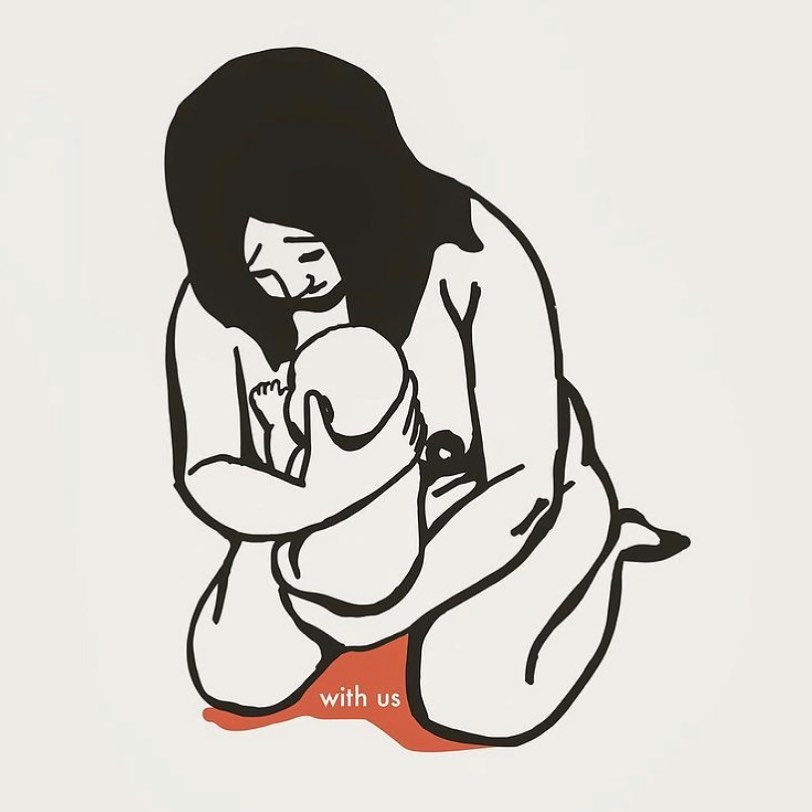
Scott Erickson (American, 1977–), With Us, Face to Face, 2016. Digital art. [available for purchase]

15. from spiralling ecstatically this by E. E. Cummings: What a fantastic opening line! The heavenly spheres whirling, twirling, down into the “proud nowhere”—Bethlehem—“of earth’s most prodigious night.” Heretofore living in mundanity, the domestic animals, hungry for miracle, for newness, are vouchsafed to be witnesses of this supernatural event, before which they kneel “humbly in their imagined bodies.” Overhead floats the “perhapsless mystery of paradise,” a phrase suggesting that heaven is beyond human understanding but not without certainty; it’s a declarative reality, not subjunctive, even if it can’t quite be put into words. Mary herself has no words—she silently, knowingly smiles, while the created world erupts in song around her. The “mind without soul” is a reference to Herod, who seeks to snuff out this new life, but to no avail.

The omission of spaces after punctuation marks (e.g., “a newborn babe:around him,eyes”) is not a mistake; that’s how E. E. Cummings liked it. Scholars say it’s to create a faster rhythm, but in this poem I don’t think that choice is as effective, as pauses and slow savoring seem more appropriate to its contemplative mood.

Source: Atlantic, December 1956; compiled in E. E. Cummings: Complete Poems, 1904–1962, exp. ed., ed. George J. Firmage (New York: Liveright, 2016)

16. “How the Natal Star Was Born” by Violet Nesdoly: Narrated by the angel Gabriel, this poem imaginatively describes heaven’s nervously awaiting the birth of Jesus during the nine months following Gabriel’s dispatch to Mary, and then busting out in celebration when at last they hear his infant-cry. When his Son is born, instead of cigars, the Father passes out trumpets to his company of friends, who sound them all the way to Bethlehem’s fields, and pops open a bottle of champagne whose bubbles spray far and wide.

Source: Calendar (Surrey, BC: SparrowSong Press, 2004) | https://violetnesdoly.com/

17. Sections 9–10 of “The Child” by Rabindranath Tagore: Hinduism was the religion of Rabindranath Tagore’s birth and upbringing, but he also held deep respect for Jesus Christ. (For more on the influence of Christianity on Tagore’s thought and writing, see chapter 4 of Rabindranath Tagore and Interfaith Dialogue by Manas Kumar Ghosh [DMin thesis, Charles Sturt University, 2010].) “The Child” is a free-verse poem that Tagore wrote in English in 1930 after seeing a passion play in Germany and then translated into Bengali in 1932 with the title “Sishutirtha” (Pilgrimage to Childhood). In it a “Man of faith” gathers people from all walks of life to join him on a “pilgrimage of fulfilment,” to “struggle [through the dark] into the Kingdom of living light.” Initially met with enthusiasm, the Man later becomes a target of the people’s anger and distrust, and they kill him. Disorientation ensues. But a man in the crowd is able to rally the others to repent and resume their quest, following the spirit of “the Victim.”

The final two sections, 9 and 10, are the selection I’ve chosen. (Scroll right to read the last.) At “the first flush of dawn,” when the time is ripe, the pilgrims arrive at a thatched hut in a palm grove, where they finally meet the eternal Light they’ve been seeking: “the mother . . . seated on a straw bed with the babe on her lap, / . . . the morning star.” Here is the Child of the title, humanity’s redeemer.

Source: The Child (London: George Allen and Unwin, 1931)

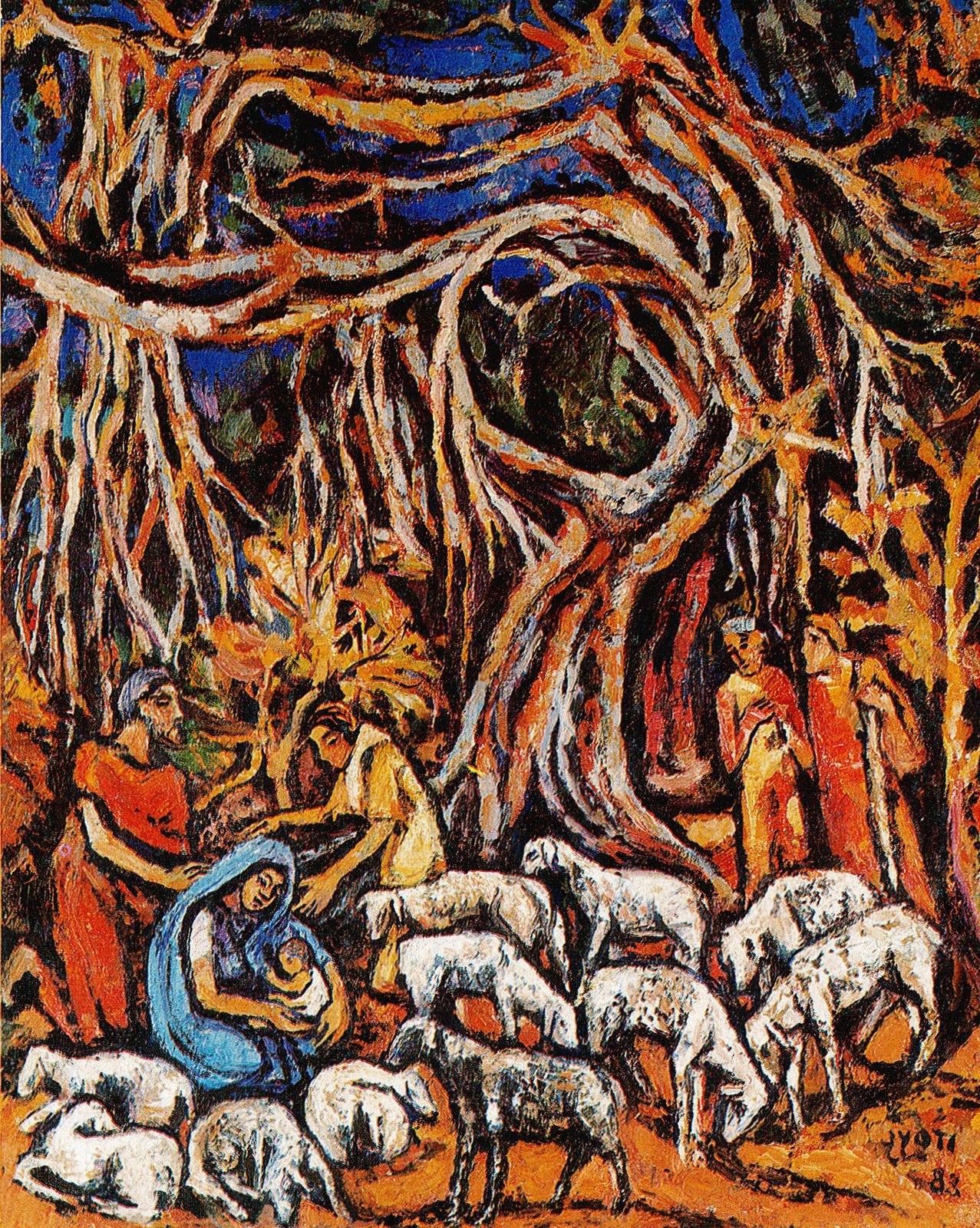
Sahi, Jyoti_Adoration of the Shepherds
Jyoti Sahi (Indian, 1944–), Adoration of the Shepherds, 1983. Oil and acrylic on canvas.

18. “Love’s Bitten Tongue (11)” by Vassar Miller: This poem, “You, my God, lonesome man, Love’s bitten tongue,” is from a crown of twenty-two sonnets, a type of sequence in which the last line of each sonnet is repeated as the first line of the next, but each time with a new twist of syntax and sense. The crown as a whole expresses the poet-speaker’s struggle against her ego, and her desire for Christ (whom she gives such an evocative name in the title!). In this particular sonnet she describes waiting at the edge of her bed every Christmas Eve as a child in anticipation of both Santa’s arrival with gifts and the holy mystery of Christ’s birth, an admixture of sacred and profane longings that fill her still as an adult.

Source: Struggling to Swim on Concrete (New Orleans: New Orleans Poetry Journal Press, 1984); compiled in If I Had Wheels or Love: Collected Poems of Vassar Miller (Dallas: Southern Methodist University Press, 1991)

19. “Gloria in Profundis” by G. K. Chesterton: G. K. Chesterton’s poems are of variable quality, but this one is brilliant, emphasizing God’s descent from the rich heights of heaven into an obscure cave in a simple town. “Glory to God in the lowest!” it exclaims, a clever inversion of the angels’ song to the shepherds in Luke 2:14. The poem was originally published in a 1927 Christmas pamphlet with wood engravings by Eric Gill. The Latin title translates to “Glory in the Depths.”

Source: Gloria in Profundis by G. K. Chesterton (Ariel series pamphlet) (London: Faber and Gwyer, 1927); compiled in The Spirit of Christmas (New York: Dodd, Mead, 1985)

20. “Silent Night” by Bonnie Bowman Thurston: Rev. Dr. Bonnie Thurston invokes a tradition that says the night of Christ’s birth, there was a whole hour in which time stood still and all was silent. What a fascinating legend! Thurston told me its origin is northern European, said she remembers reading it in some scholarly Celtic studies; I wasn’t able to locate any such mentions, but the second-century Protoevangelium of James, chapter 18, probably written in Egypt or Syria, does describe everything momentarily freezing in place around Joseph as he steps out to find a midwife for Mary. Anyway, the poem ends with a striking metaphor! Word, flesh: fire. (Reminds me of this digital artwork by Scott Erickson.)

Source: Remembering That It Happened Once: Christmas Carmen for Spiritual Life All Year Long, ed. Dennis L. Johnson (Eugene, OR: Wipf & Stock, 2021)

21. “After Luke 2:19” by Michelle Ortega: When the shepherds recounted to Mary what the angels had told them in the fields about Jesus being the promised Messiah, “Mary treasured all these words and pondered them in her heart,” Luke narrates in his Gospel. Poet Michelle Ortega expounds on this verse, emphasizing the relationship of Mary’s body to her son’s from conception to birth and now postpartum—an intimacy known well by mothers across the centuries. As wondrous as it was to be part of a cosmic story writ large in the skies, Ortega suggests that Mary treasured just as much as the grand pronouncements those small moments of being just an ordinary mama.

Source: Mary, Mary: Contemporary Poets and Artists Consider Mary (Arlington, VA: St. Michael’s Episcopal Church, 2021), a free e-book accompanying an art exhibition

22. “Christmas: 1924” by Thomas Hardy: “We the civilized world have given Christianity a fair trial for nearly 2000 years, & it has not yet taught countries the rudimentary virtue of keeping peace,” lamented the British novelist and poet Thomas Hardy (1840–1928) in a letter to Florence Henniker dated February 25, 1900, during the Boer War. World War I only increased his cynicism, which is on display in this sour little epigram that opens with an ironic quotation of the angels’ proclamation to the shepherds the night of Jesus’s birth.

Source: Winter Words in Various Moods and Metres (New York: Macmillan, 1928). Public Domain.

Hoyland, Francis_Nativity polyptych
Francis Hoyland (British, 1930–), Nativity, 1961. Oil on canvas, 90 × 120 cm. Methodist Modern Art Collection, HOY/1963/1.

23. “Eating Baklava on New Year’s Eve” by Anya Krugovoy Silver: Poet Anya Silver (1968–2018) reads a spiritual benediction in her piece of baklava, layered and sweet and consumed on the eve of a new year.

Source: Second Bloom (Eugene, OR: Cascade Books, 2017)

24. “A Ballad of Wise Men” by George M. P. Baird: Jesus so often confounds the wisdom of the wise, starting with his birth. With gentle humor and in iambic rhythm and rhyme, this poem celebrates the simple access we all have to Christ.  

Source: Rune and Rann (Pittsburgh: Aldine Press, 1916). Public Domain.

25. “Excrucielsis” by Hannah Main-van der Kamp: Originally published at ArtWay.eu as a response to the contemporary Romanian sculpture The Spring by Liviu Mocan, this poem alternates between the weary journeying toward truth of one of the biblical magi and that of a modern-day seeker similarly “longing for / the something more.” It can be a trudge, finding the Light—it involves risk, a willingness to follow the signs, and the tenacity to hold on to your “vision burden,” “clutch[ing] the weight” of it all the way over rough and varied terrain. But the epiphanic moment awaits, to sound like a trumpet blast. The title of the poem is a neologism combining the words “excruciating” and “excelsis” (Latin for “the heights”); “every excelsis contains something excruciating, that’s how we get to genuine excelsis,” the poet told me in an email. Read a related prose reflection by Main-van der Kamp here.

Source: The Slough at Albion (Victoria, BC: Ekstasis Editions, forthcoming)


Disclosure: This post contains Amazon affiliate links, meaning I earn a small commission from qualifying Amazon purchases originating from clicks on this site.

Advent, Day 8: Prepare Ye the Way

In those days John the Baptist appeared in the wilderness of Judea, proclaiming, “Repent, for the kingdom of heaven has come near.” This is the one of whom the prophet Isaiah spoke when he said,

“The voice of one crying out in the wilderness:
‘Prepare the way of the Lord;
make his paths straight.’”

—Matthew 3:1–3

LOOK: Painted staircases by Xomatok

Xomatok stairway
Painted staircase by Xomatok (b. 1985), Lima, Peru, 2021. All photos by Jeremy Flores.

Xomatok stairway
Xomatok stairway

From Colossal:

Artist Xomatok translates the vibrant, geometric motifs of handwoven Andean blankets, or llicllas, into large-scale works that mark the pathways through the hilly Alisos de Amauta neighborhood in Lima, Peru. Painted during the course of two months as part of the Municipality of Lima’s Pinta Lima Bicentenario, the 13 interventions were a collaborative undertaking by the artist and local residents, who transformed the public staircases that wind through the district into multi-level canvases. The resulting patterns are kaleidoscopic and highlight a spectrum of bright colors and symmetries often associated with the traditional textiles.

View more photos.

LISTEN: “Prepare Ye the Way of the Lord” by Stephen Schwartz, from the musical Godspell (1971)

The following video clip is the opening sequence of the 1973 film adaptation of the stage musical Godspell, which stars David Haskell as John the Baptist:

So. much. joy!

The ram’s horn issues its call. Ballet dancer, student, struggling actress, waitress, cab driver, businessman, businesswoman, parking attendant—they all leave their jobs, casting off their workplace trappings to accept John’s invitation to new and abundant life. They meet him at The Angel of the Waters, a sculpted fountain in New York City’s Central Park. They throw themselves into the fountain like children, receiving their baptism, their initiation into the upside-down kingdom of God.

But John notices Jesus standing at a distance, stripped down and ready for his own baptism. John’s lighthearted visage turns heavy for a moment in recognition that Jesus’s baptism is into suffering and death.

I wrote about Godspell two years ago when I featured one of its songs, “Turn Back, O Man,” to go along with a lectionary reading from Ezekiel. The musical is wacky, with the ragtag disciples forming a comic troupe to act out Jesus’s parables and teachings from the Gospel of Matthew. Some Christians find it all too silly and irreverent. Others, like me, see it as capturing an important element of the Good News, which is joy. This is what Godspell’s creator, John-Michael Tebelak, wanted to get across.

Perhaps the festive tone of the opening number seems disjunctive with what we know of John from the Gospels—a desert ascetic who preached about vipers and axes and fire and winnowing forks, warning his hearers of the wrath to come. Point taken.

However, while his message is a sobering one, repentance need not be a dour affair. We must take honest stock of our sins, yes, laying them out in confession before God, but scripture assures us many times over of God’s pardon, and that’s something to rejoice in! There is a joy to repentance and to following the way of Christ. Turning off the death-road, onto the road of life. As we unload the burdens that have accrued on our backs, we are freed to walk upright once again.

“Repent, for the kingdom of heaven is at hand!” John cries out on the riverbank.

I’d encourage you to read that not as a threat but as an invitation. The kingdom of heaven is marked by grace and possibility. It’s a pearl, it’s a seed, it’s a feast. When we embrace the gospel, our cities become a playground where we enact the values of Christ, childlike as they are, preparing the world to receive her coming King.