Roundup: Ellsworth Kelly’s “Austin,” new book by Jonathan Anderson, religion in pop art, and more

PRINT INTERVIEWS:

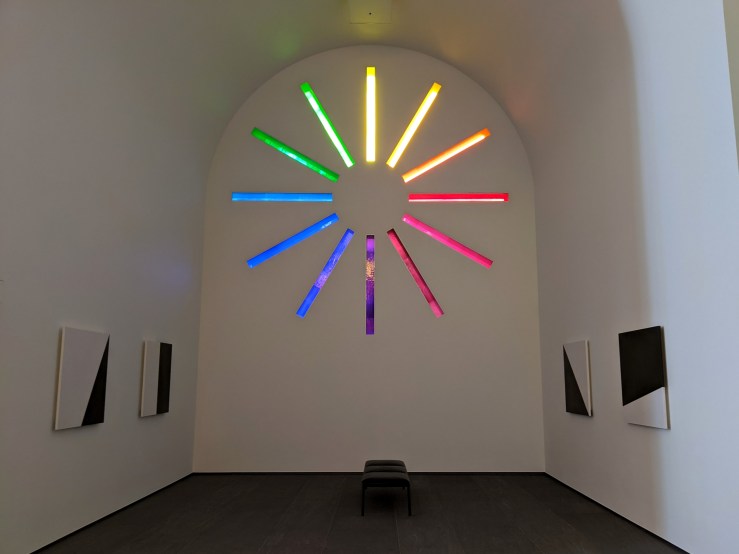
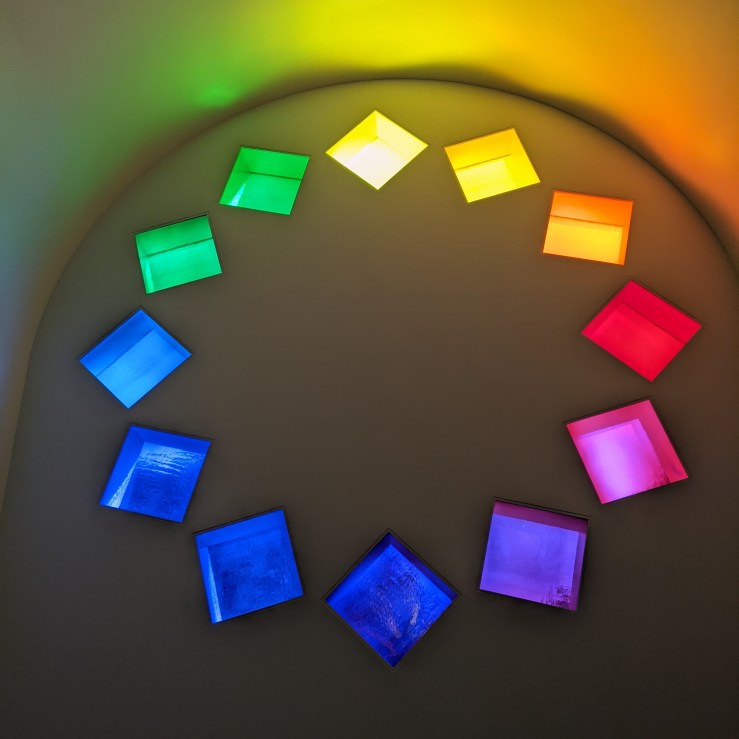
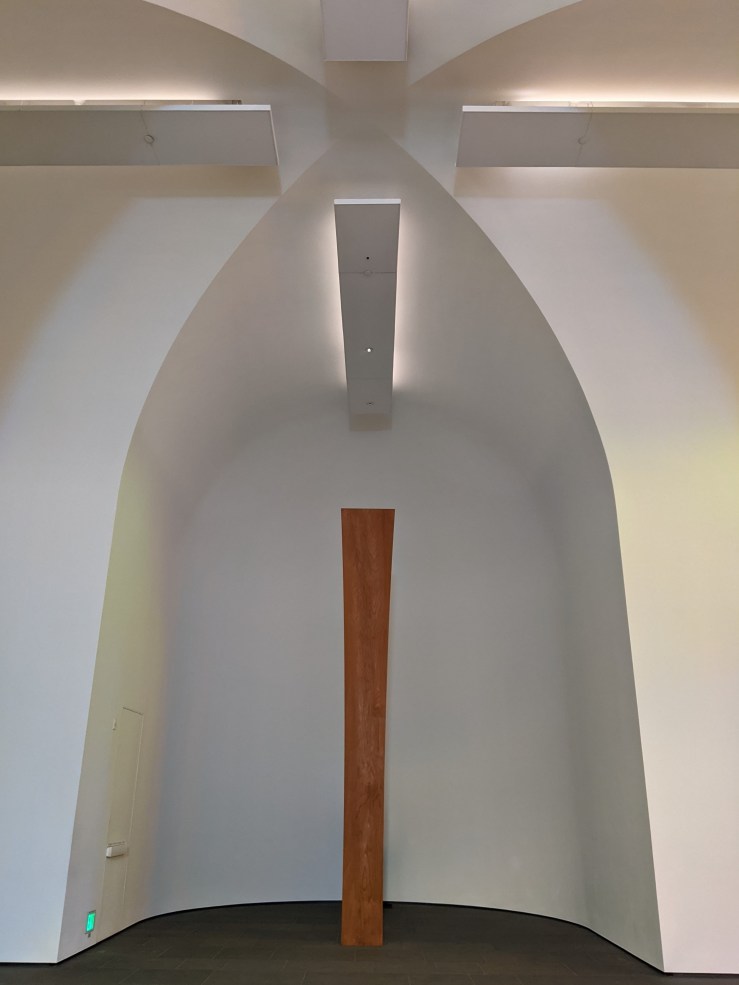
>> “What Remains: The Making of Ellsworth Kelly’s Last Work,” Image interview with Rick Archer: I got to experience Ellsworth Kelly’s Austin—a modernist “chapel” containing three stained glass windows, fourteen black-and-white marble panels (Stations of the Cross), and a redwood totem—while in Texas for a CIVA conference in 2021; see some of my photos below. Kelly was an atheist inspired by Romanesque church architecture, and the architect he chose to collaborate with on Austin, Rick Archer, is a Christian. In this wonderful new interview by Bruce Buescher, Archer discusses his working relationship with Kelly, Kelly’s desire for randomization and form over meaning, the technical and architectural challenges of bringing Kelly’s vision to life, religious references, and the artist’s objective for the space. “I hope when people go in here, they will experience joy,” Archer remembers Kelly saying.
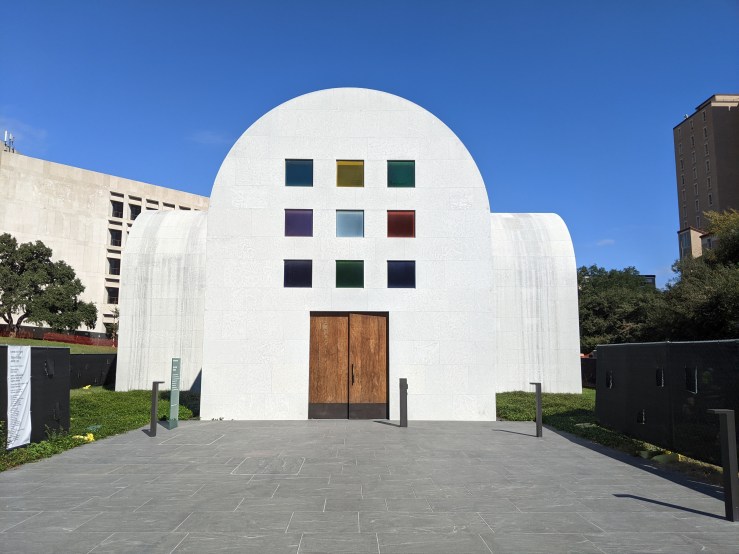
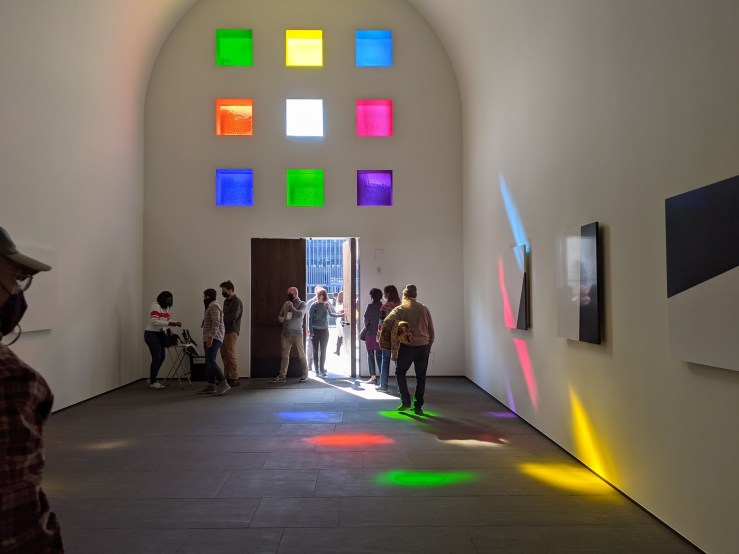
  • Austin by Ellsworth Kelly
  • Austin by Ellsworth Kelly
  • Austin by Ellsworth Kelly
  • Austin by Ellsworth Kelly
  • Austin by Ellsworth Kelly

>> “The Invisibility of Religion in Contemporary Art: An interview with Jonathan A. Anderson” by Matthew J. Milliner: Jonathan Anderson [previously] is one of the most important people working across the disciplines of art and theology, and I’m thrilled that his book The Invisibility of Religion in Contemporary Art is now available from the University of Notre Dame Press!
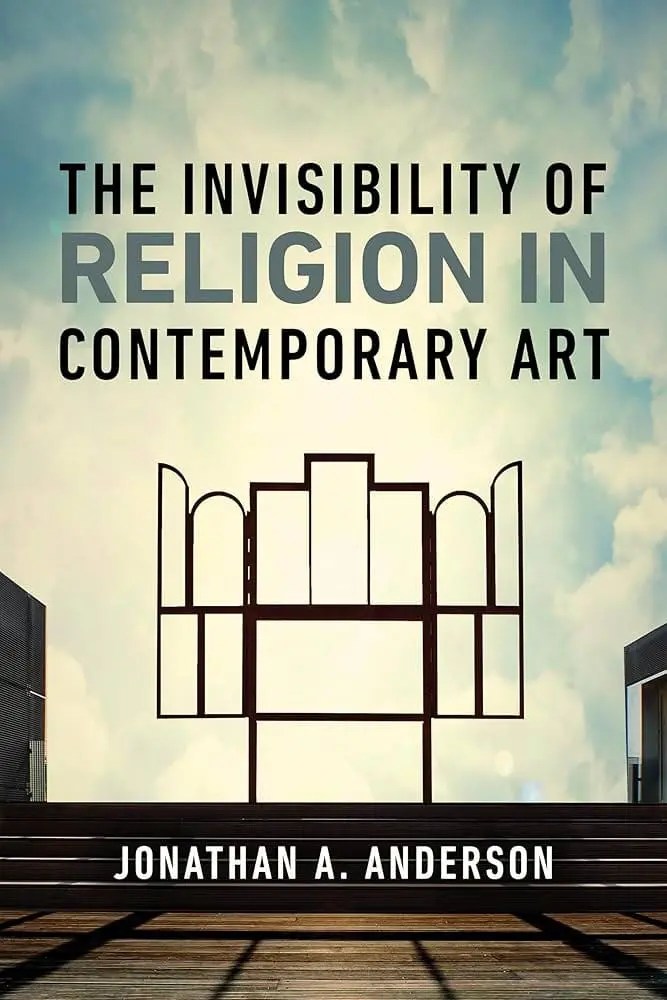
Invisibility of Religion in Contemporary Art

In this recent interview for Comment magazine, Anderson explains his purpose in writing the book:

I have become increasingly convinced that so many pivotal artists and artworks over the past century are deeply shaped by religious traditions and seriously engaged in theological questioning, but this remains severely under-interpreted or misinterpreted in the scholarship about these artists. One might see these threads running through an artist’s artworks and personal writings and even discuss these topics with the artist in their studio, but when one moves to the scholarly writing and teaching about that same artist, that language consistently disappears or is transposed into another register—usually politics, occasionally a highly esoteric spirituality. I wanted to understand, at a non-superficial level, why this was the case, and I wanted to see how other ways of speaking and writing about this topic might be possible.

Don’t miss, at the end of the article, his three hopes for the field of “art and theology,” which I very much share!

+++

LECTURE: “The Problems and Possibilities of Visual Theology: The Ascension as a Case Study” by Jonathan A. Anderson: With Ascension Day coming up on May 29, it’s timely to share this talk given by Jonathan Anderson (see previous roundup item) a few years ago at Duke Divinity School, where he worked as a postdoctoral associate of theology and the visual arts from 2020 to 2023. Anderson explores a handful of images depicting the Ascension of Christ, a particularly challenging subject because of the spatial ambiguity. The scriptural accounts of the event (Luke 24:50–53 and Acts 1:6–11) beg the question, “What does ‘lifted up’ mean? Where is Jesus?” Attempting to work out these spatial difficulties visually can be theologically and exegetically productive, Anderson claims—even if it sometimes leads to unsatisfying results, as, Anderson says, it often does in Western art from the Renaissance onward. By contrast, when artists foster intertextual readings across the biblical canon and focus not so much on what the Ascension looks like as a historical event but rather on what it means, they are generally more successful.

Here are some time stamps, with links to the artworks discussed:

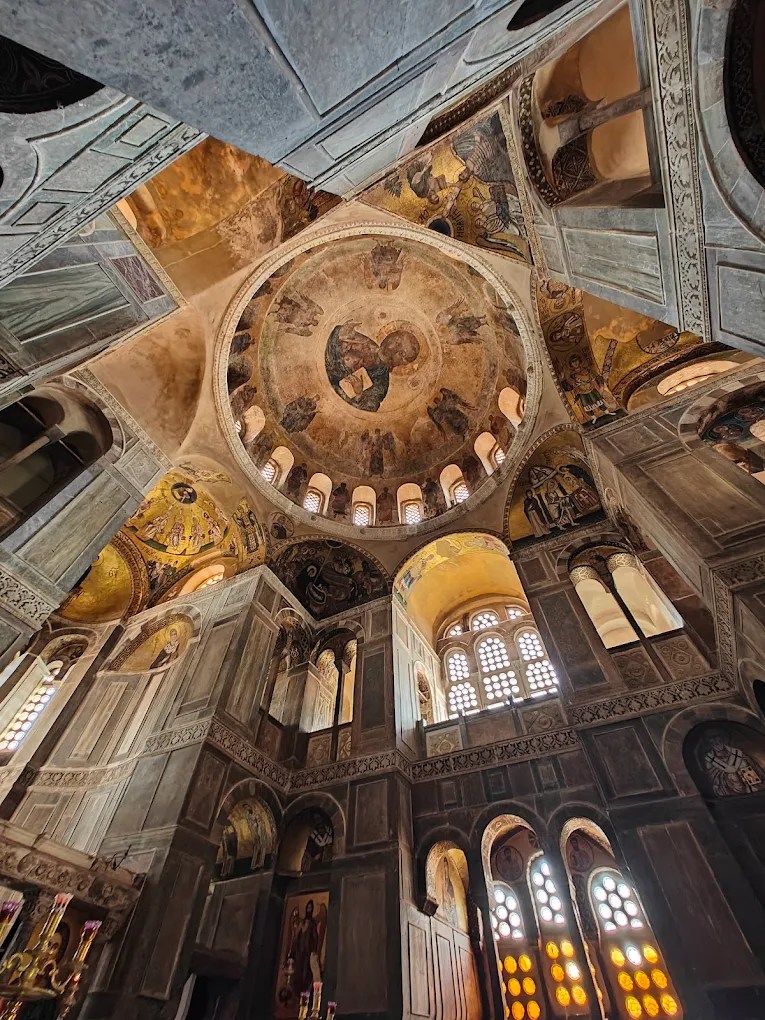
Hosios Loukas
Katholikon of Hosios Loukas monastery, Boeotia, Greece, 1011–12

+++

INSTRUMENTAL JAZZ: “Prayer” by Cory Wong: This video shows a live performance of Cory Wong’s “Prayer” on July 4, 2023, at Gesù music hall in Montreal. Wong, on guitar at far left, is joined by Ariel Posen on guitar, Victor Wooten on bass, and Nate Smith on drums. I learned about Wong through his collaborative album with Jon Batiste, Meditations (2020), which includes a version of this piece featuring Batiste’s piano playing.

+++

EXHIBITION: OMG! Reli Popart, Museum Krona, Uden, Netherlands, April 5–September 7, 2025: This exhibition at Museum Krona (housed in the complex of the still-active Birgittine Abbey of Maria Refugie in Uden, Netherlands) explores the connection between the pop art movement and Christianity through works by artists such as Andy Warhol, Corita Kent, Niki de Saint Phalle, and especially Dutch artists, including Woody van Amen and Wim Delvoye. Pop art is characterized by the use of imagery from popular culture, sourced from television, magazines, comic books, ads—and sometimes from the trash bin.

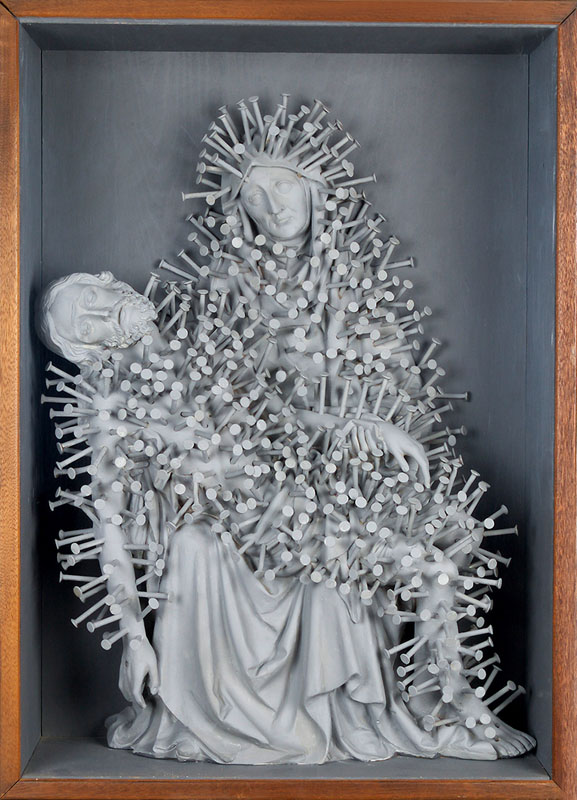
Jacques Frenken [previously], for example, built a body of work by salvaging discarded plaster sculptures of Christ and the saints—mass-produced for Catholic devotional use—and reconstructing them into assemblages. For his Spijkerpiëta, he “brought the Pietà back into our midst and accentuated the pain it radiates with nails,” the artist said.
Frenken, Jacques_Spijkerpieta
Jacques Frenken (Dutch, 1929–2022), Spijkerpiëta (Nail Pietà), 1967. Plaster, paint, iron, wood. Museum Krona, Uden, Netherlands.

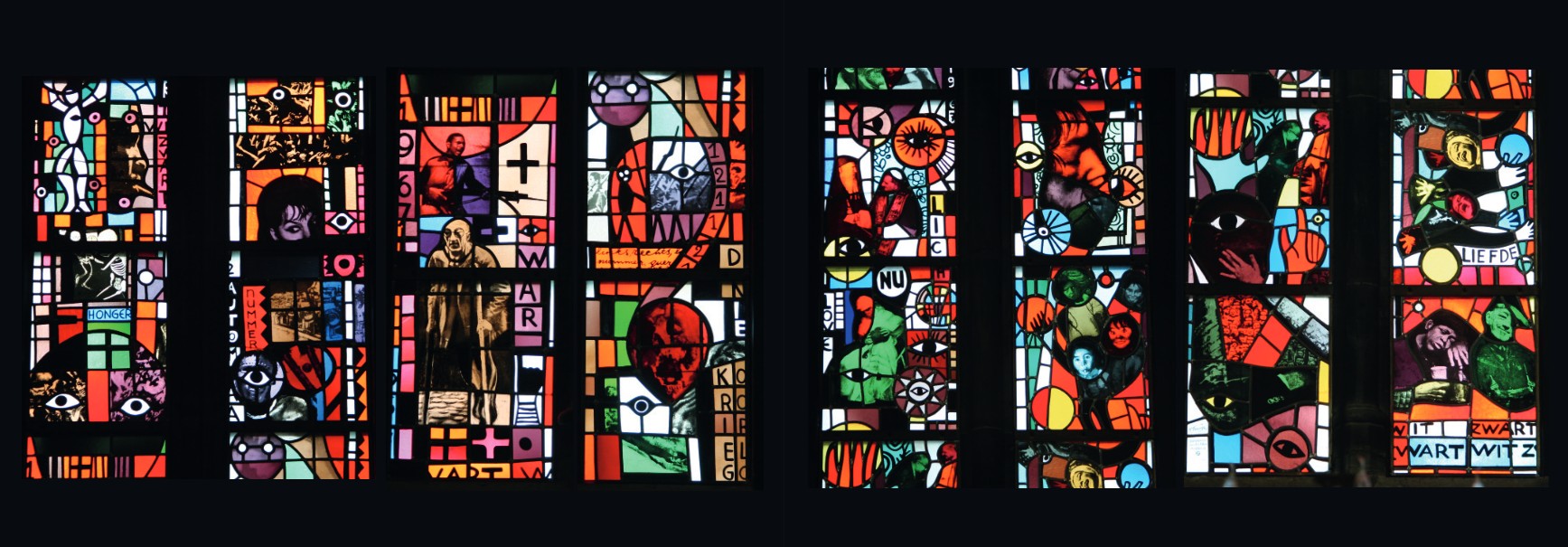
Another artist represented in the exhibition is Hans Truijen, who was commissioned in the 1960s by St. Martin’s Church in Maastricht to design eight stained glass windows for their worship space. The four along the left aisle of the nave depict human and divine suffering, whereas those on the right express hope, love, freedom, and happiness. He chose photographic images from various periodicals, including ones of the Vietnam War, and transferred them to glass using a special screen-printing process.
Truijen, Hans_Stained glass
Hans Truijen (Dutch, 1928–2005), Studies for the eight stained glass windows commissioned by St. Martinuskerk, Wyck-Maastricht, Netherlands, 1966–68. Courtesy of the artist’s son, Marc Truijen.

Roundup: Cello in a canyon, John Cage and silence, and more

SPOTIFY PLAYLIST: March 2025 (Art & Theology):

(See also my Lent Playlist.)

+++

ANIMATED VIDEO: “Why Jesus Warns Us About Giving, Praying, and Fasting Publicly” by BibleProject: Giving, praying, and fasting are the three major practices of Lent, which begins March 5 this year. Jesus encouraged his followers to engage in all three, but in his Sermon on the Mount he also cautioned them not to do so with the motive of being seen by others. That’s why Matthew 6 is one of the lectionary readings for Ash Wednesday, the first day of Lent. Written by Tim Mackie and Jon Collins and directed by Rose Mayer, with art direction by Joshua Espasandin and PMurphy, the following BibleProject video exposits this teaching.

BibleProject is a nonprofit in Portland, Oregon, that offers free videos, podcasts, articles, and classes to help people experience the Bible in a way that is approachable and transformative.

+++

SONGS from Advent Birmingham [previously]:

The following two songs are from the music ministry of the Cathedral Church of the Advent in downtown Birmingham, Alabama. The ministry flourished under the leadership of Rev. Dr. Zac Hicks, who served as the church’s canon for worship and liturgy from 2016 to 2021. (He is now pastor of Church of the Cross, also in Birmingham.)

The music videos used to be available on YouTube, but it appears that the church has undergone some restructuring, and they have been removed. For now, though, they are still available through Facebook, and the audio releases are available through streaming services.

>> “Lord, Who Throughout These Forty Days”: This 1873 hymn by Claudia Frances Hernaman recounts the forty days Jesus spent in fasting and prayer in the Judean wilderness at the outset of his ministry and beseeches God to give us strength, like Jesus, to fight temptation, to die to self, and to live by his word and with a keen sense of his abiding presence. It’s set to an American folk tune from the Sacred Harp tradition, known as LAND OF REST, which has roots in the ballads of northern England and Scotland. The hymn is sung by Madison Craig (née Hablas), with Emma Lawton (née Dry) and Annie Lee on background vocals, Joey Seales on pump organ, Charley Rowe on cajon, and Zac Hicks on acoustic guitar.

>> “Spring Up, O Well”: This is an original song by Zac Hicks, sung by Jordan Brown. It draws especially on the narrative in John 4, where Jesus tells a Samaritan woman at a well, “Everyone who drinks of this water will be thirsty again, but those who drink of the water that I will give them will never be thirsty. The water that I will give will become in them a spring of water gushing up to eternal life” (vv. 13–14). The exclamation “Spring up, O well!” in the song’s refrain comes from Numbers 21:17, where the Israelites praise God for providing them water in the desert, and that musical phrase is adapted from the old children’s church song “I’ve Got a River of Life.”

+++

SHORT FILM: “Silences,” dir. Nathan Clarke: Shot in 2016 at Box Canyon near Laity Lodge in the Texas Hill Country, this contemplative short film features cellist Steuart Pincombe playing a short improvisation that interacts with the natural space. The impromptu music making was for him an exercise in prayer.

Three years earlier, also while on retreat at Laity Lodge, Pincombe’s wife shot him doing the same inside the newly constructed Threshold, an interactive, site-specific, permanent outdoor installation by Roger Feldman consisting of three curved walls:

The Threshold improvisation, Pincombe writes, “stemmed from a particular note (and its harmonic overtones) that naturally resonated in the space—the cello’s lowest strings were tuned to match this strongest resonation. Playing with the confusion of resonances (or pitches) was an important part of this short musical and spatial exploration—pitches are bent or adjusted in a way that create audible pulses in the sound and play on the conflicts of resonation within the space.”

+++

ESSAY: “Silence in an Age of Mass Media: John Cage and the Art of Living” by Dr. Jonathan A. Anderson, ARTS (Spring 2017): Many twentieth- and twenty-first-century artists have explored the necessities and possibilities for aesthetic stillness and silence, Anderson writes. In this essay he considers the composer John Cage (1912–1992), best known—and most excoriated—for his modernist piano composition 4′33″ (1952), in which the pianist sits at the bench for four minutes and thirty-three seconds, playing no notes. The point was to attune the audience to the ambient sounds of the concert hall (coughing, rustling, creaking, mechanical humming, outside traffic, etc.), testing the distinction between “music” and “noise.” Cage found the fundamental difference between the two to be not in the qualities of sound but in the attentiveness of the listener.

I was pleasantly surprised to learn from Anderson’s article that even after Cage left Christianity (in which he was raised) and turned to Zen Buddhism, he continued to link his love for the givenness of environmental sounds to Jesus’s admonition to “consider the lilies” (Luke 12:27). “Cage sought to quiet his own aesthetic ‘worry’ for musical meaning,” Anderson writes, “and to instead receive the given sounds of the world as richly meaningful in themselves.”

+++

VIDEO: Lenten Jazz Vespers, Duke University Chapel, March 23, 2023: This Jazz Vespers service combines the liturgical traditions of Vespers with the musical improvisation of jazz. Exploring the theme of hope, the service is presided over by Rev. Racquel C. N. Gill, minister for intercultural engagement at Duke University Chapel. Musical leadership is provided by the John Brown Little Big Band.

Here are the time stamps:

  • 0:01: Song: “I Came to Tell You” by Trinity Inspirational Choir
  • 5:40: Welcome and Prayer
  • 8:33: Song: “Miracle (It’s Time for Your Miracle)” by Marvin Sapp
  • 14:38: Poetry reading: “Dark Testament (8)” by Pauli Murray
  • 16:11: Song: “Be Ye Steadfast” by Arthur T. Jones
  • 21:25: Scripture reading: Romans 5:1–11
  • 24:02: Song: “Through It All” by Andraé Crouch
  • 28:10: Sermon by Rev. Bruce Puckett, assistant dean of Duke University Chapel
  • 35:56: Response
  • 52:18: Prayer and Benediction
  • 54:36: Song: “Down on My Knees” by John P. Kee

Advent, Day 13: There Sprang a Flower

LOOK: Lily Among the Thistles by Laura Lasworth

Lasworth, Laura_Lily Among the Thistles
Laura Lasworth (American, 1954–), Lily Among the Thistles, 2001. Oil on wood panel. From the Love’s Lyric series, based on the Song of Songs.

This still-life painting by Seattle-based artist Laura Lasworth shows a beautiful cut lily sharing a vase with a bouquet of twelve thorny, withered stems. The water in which they sit is red. The work’s title is taken from the Song of Songs 2:1–2: in Latin, “Ego flos campi, et lilium convallium. Sicut lilium inter spinas, sic amica mea inter filias,” or from the New Revised Standard Version:

I am a rose of Sharon,
    a lily of the valleys.

As a lily among brambles,
    so is my love among maidens.

While the Song of Songs, written in the wisdom tradition of Solomon, is first and foremost a collection of poems exploring the human experience of love and sexual desire, most Christians also interpret it as an allegory of the love between Christ and his church, or God and the individual soul. In that reading, Christ is the “lily of the valley” who speaks here.

Early Christian writers such as Origen, Hippolytus, Ambrose, Jerome, and Augustine associated the lily of Song of Songs 2:1 with Christ; in the Middle Ages, Venantius Fortunatus (ca. 530–610), Peter Damian (1007–1072), and Bernard of Clairvaux (1090–1153), among others, followed suit. I’m familiar with this floral metaphor for Jesus from a gospel song I grew up singing!

From the fourteenth century onward, in images of the Annunciation, Western artists commonly portrayed either a lily vase on a table, or the angel Gabriel presenting a lily to Mary. The lily became a symbol both Christological and Mariological, signifying the flowering of the Incarnation: God’s pure Son emerging from the virginal stem of Mary.

On December 10, Jonathan A. Anderson, a professor of theology and the arts at Regent College in Vancouver, gave the homily in chapel, using Luke 1:26–38 as his scripture text and exploring Lasworth’s Lily Among the Thistles in relation to it.

Thorns and thistles are an image of cursedness throughout scripture, starting in Genesis 3:17–18, Anderson points out. But in Lasworth’s painting, a lily rises up from the center of that cursedness. “If the thistles visually articulate the groaning of creation and the sorrows of humanity, the lily symbolically inaugurates a newness of life, somehow flowering right in the midst of this,” Anderson says. “The audacious proclamation of Advent is that the Son of God—the Creator and Healer of all things, our tree of life—was born into the brambles of human history and into the bloody heritages that still cry out daily from the ground.”

Anderson considers the polyvalence of Lily Among the Thistles:

In one sense, this is an icon of Christ’s appearance in human history. In another sense, this vase is also an individual heart—my heart, your heart—that has heard the Annunciation for itself amidst its own sorrows and deathliness. . . . Or we might also see this as an icon of creation, simultaneously groaning for the reconciliation of all things and blooming with new creation. And surely, it is an icon of the church, in which we harbor various fertility altars overgrown with thorns and thistles, and yet in which we are a people of the incarnation, people in whom new creation has begun, people through whom the light of the Spirit is already casting the shadows of the redemption of all things.

LISTEN: “There sprang a Flower from out a thorn” | Traditional English carol compiled in Richard Hill’s Commonplace Book (Balliol College MS 354, fol. 222v), early 16th century; translated from Middle English by Jessie L. Weston, 1911 | Music by Dominic Veall, 2017

1. There sprang a Flower from out a thorn,
To save mankind that was forlorn,
As prophets spake before that morn:
Deo Patri sit Gloria!

2. There sprang a well at Maid Mary’s foot,
That turned all this world to good,
Of her took Jesu flesh and blood:
Deo Patri sit Gloria!

. . .

4. From diverse lands three kings were brought,
For each one thought a wondrous thought,
A King to find and thank they sought:
Deo Patri sit Gloria!

5. Richly laden with gifts they fare,
Myrrh, frankincense, and gold they bear,
As clerks in sequence still declare:
Deo Patri sit Gloria!

. . .

9. There shone a star in heaven bright,
That the men of earth might read aright
That this Child was Jesu, King of Might:
Deo Patri sit Gloria!

This song is a choral setting by London-based composer Dominic Veall of a late medieval lyric that begins, “Ther ys a blossum sprong of a thorn”—or, as Jessie L. Weston modernizes it, “There sprang a Flower from out a thorn.” The recording omits stanzas 3, 6, 7, and 8, but you can read the full lyrics here. The Latin refrain translates to “Glory be to God the Father!”

Pentecost roundup: “All Flesh” by Steve Thorngate, animated fabrics, and more

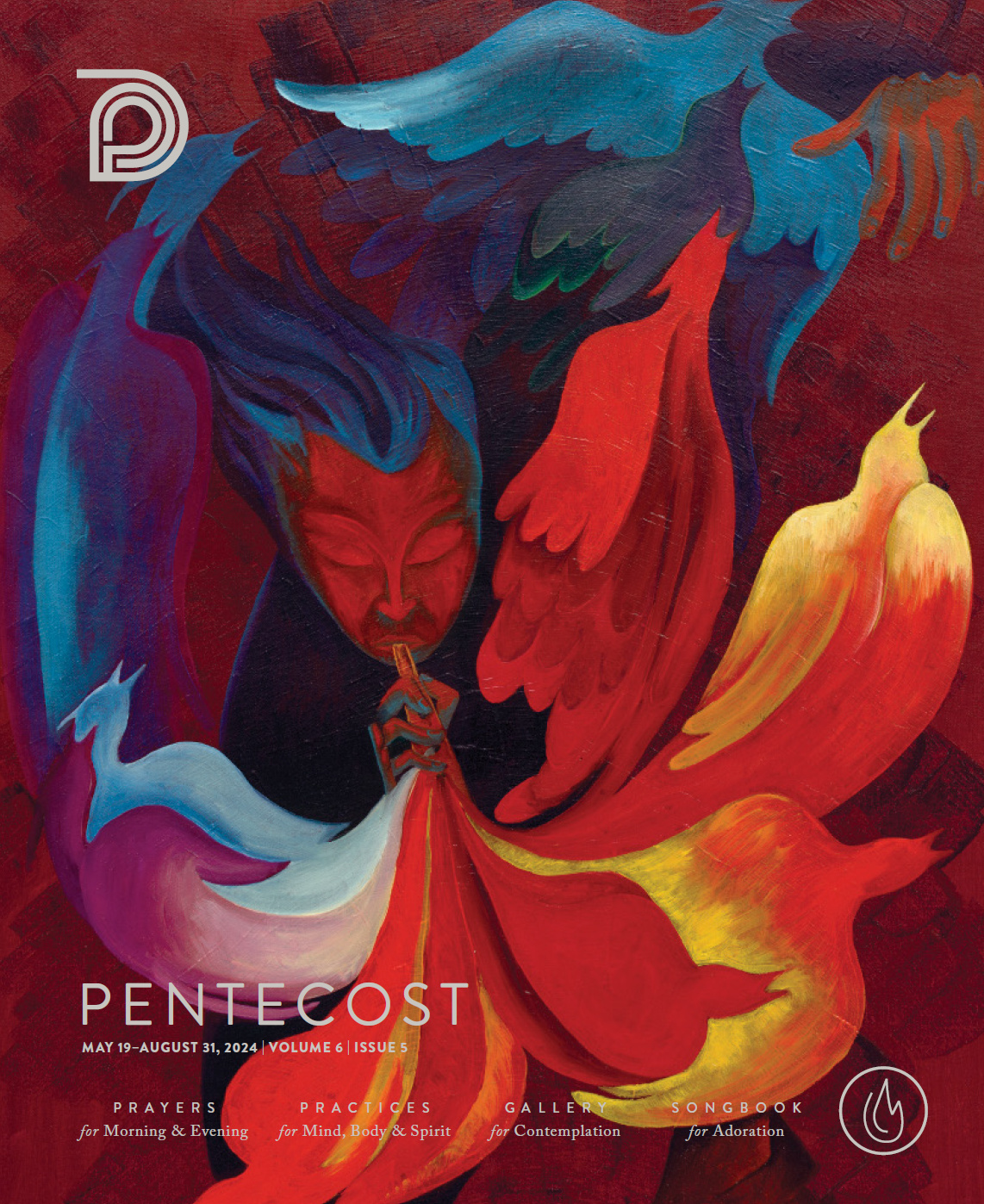
LIVING PRAYER PERIODICAL: Pentecost 2024: The latest edition of the Daily Prayer Project’s Living Prayer Periodical is available for purchase! Pentecost is this Sunday, May 19, so grab your copy soon. The booklet provides a distinct liturgy of scripture and prayer for each day of the week, through August 31, as well as art with accompanying reflections, songs, spiritual practice essays, and, new this issue, a poem! I curate the art and poetry for the DPP. The cover image is cropped from a painting by the Guatemalan artist Juan Francisco Guzmán (it’s reproduced in full in the interior). And the poem we feature, which I wrote a short commentary for to help readers engage it more meaningfully, is “Not Like a Dove” by Mary F.C. Pratt; I’m grateful to the directors for taking a risk with this unusual, even difficult, poem, which rewards those willing to sit with its imagery over time.

Pentecost LPP 2024

+++

SERMON (text only): “When the Spirit Comes” by N. T. Wright: Preached May 23, 2010, at Durham Cathedral, where he was bishop at the time, this Pentecost sermon by the esteemed N. T. Wright is a rousing call to stand, like Jesus, at the place where heaven and earth collide: in the Spirit. Here are two excerpts:

  • “The point about Pentecost is that it’s the point at which two worlds collide and look like they are now going to be together for keeps. The two worlds are of course heaven and earth. . . .
              The whole point of heaven and earth in Jewish thought is that they are meant to meet and merge. And the point of the gospel story as Luke has told it in his first volume is that Jesus had come to bring the life of heaven and earth together. That is the meaning of the ‘kingdom of God’. Thy kingdom come, he taught us to pray, on earth as in heaven. The disciples, we may presume, had been praying that prayer, among others, in the fifty days since Easter. And now the prayer is answered.”
  • “When the Spirit comes, the Spirit will prove the world wrong [in how things are run] . . . which is not a comfortable message, and it’s not meant to be. But if we can at least recognise that discomfort, and see it as the thing you should expect when the two worlds collide, we can put our shoulders back, take a deep breath – in other words, breathe in God’s breath – and get on with the task to which the New Testament commits us but in which . . . we feel a strange reluctance.
              Of course we can get it wrong, and of course we will find it awkward. But how much more wrong would it be not to try! How much more awkward, when God finally brings heaven and earth fully together, will it be to discover that we had continued to live in the split-level world when we were invited, by Ascension and Pentecost together, to dare and to risk the possibility of bringing them together in our own lives and in our own witness! Because of course none of this is in the last analysis ‘about’ us. If we are embarrassed at the heaven-and-earth conjunction, we are forgetting that we are not, after all, the centre of attention in all this. Jesus went on to say that the Spirit would glorify him, not us: he will take what belongs to Jesus and declare it to us and through us to the world.”

+++

MUSIC:

>> “All Flesh” by Steve Thorngate: This playfully serious song is rooted in Joel 2:28–29, which Peter quotes in his sermon at Pentecost: “I will pour out my spirit on all flesh; your sons and your daughters shall prophesy, your old men shall dream dreams, and your young men shall see visions. Even on the male and female slaves, in those days I will pour out my spirit.” Thorngate wrote it several years ago, but this recording, new this year, is the first he’s released, and it’s available only on Bandcamp for now.

>> “Ruach” by Delvyn Case, performed by the Mivos Quartet: Inspired by the story of Pentecost in Acts 2, this sacred concert work for string quartet, writes composer Delvyn Case, “bring[s] to our awareness many different ways ‘breath’ and ‘spirit’ can become sonically and dramatic present. Throughout the piece the performers are asked to make various kinds of breath sounds with their instruments and their own voices, blurring the line between music and sound. Overall, the piece emphasizes idea of the spirit as a powerful force that is surprising, shocking, and fundamentally resistant to control.”

>> “Sweet, Sweet Spirit” by Doris Akers, performed by Ruah Worship: Consisting of siblings Joshua Mine, Julia Mine, Erika Grace Izawa, and Marian Mine, Ruah Worship from Japan performs original worship songs as well as covers. I especially love their a cappella arrangements of Black gospel songs. Here they sing a song by Gospel Music Hall of Famer Doris Akers (1923–1995), about the sweetness of the Holy Spirit, who revives communities and fills them with love.

+++

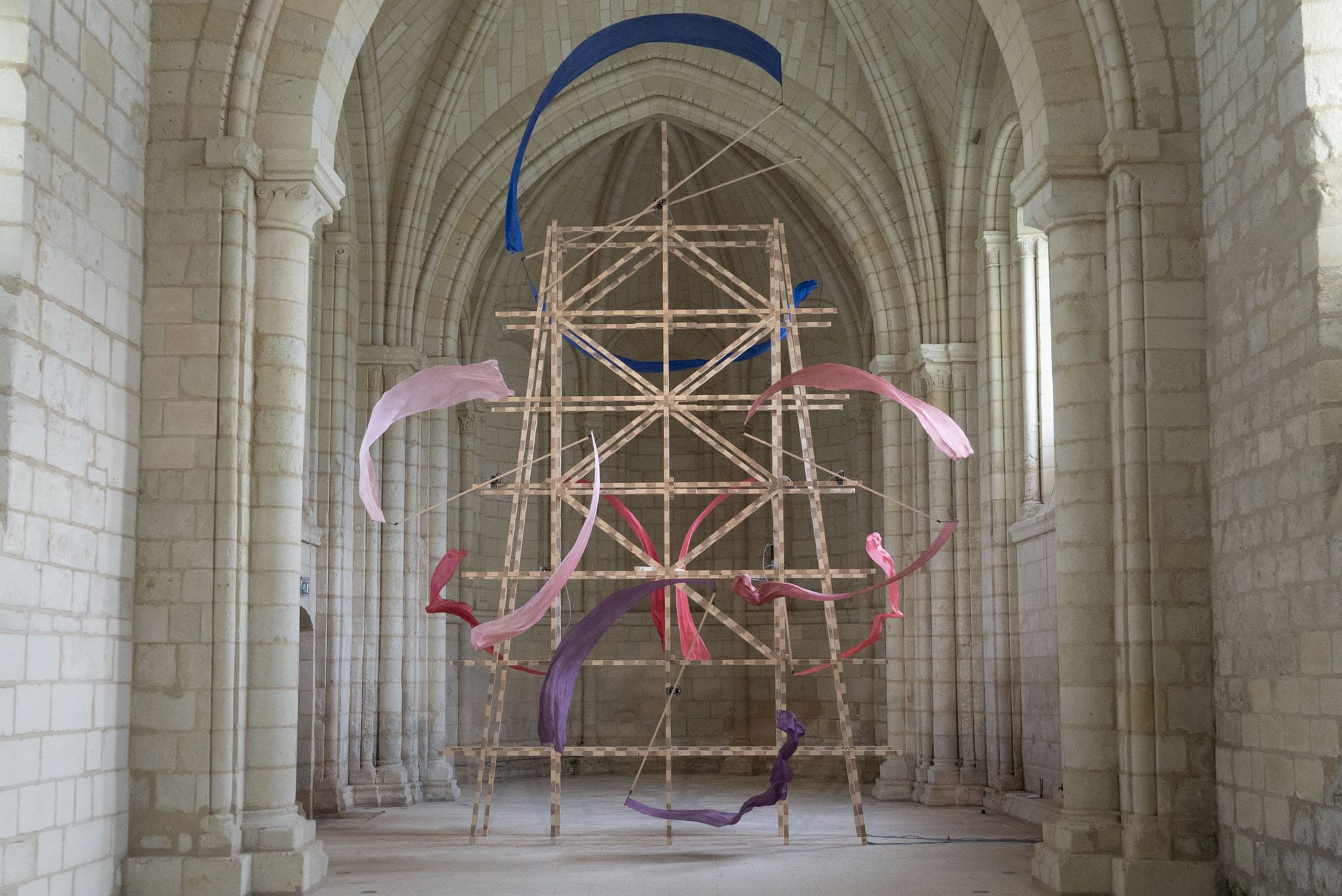
ART INSTALLATION: Fanions et Carillons by Pinaffo & Pluvinage: I learned of this kinetic sculpture by the French artist duo Marion Pinaffo (b. 1987) and Raphaël Pluvinage (b. 1986) in a Colossal article in February and thought of the movement of the Holy Spirit. Fanions et Carillons, French for “Pennants and Chimes,” was commissioned by Fontevraud Abbey and was on display earlier this year in one of the abbey’s twelfth-century chapels. Inspired by the historical striking clocks of churches, the automaton comes to life every half hour, sending fourteen pennants of blue, red, pink, and purple swinging and swirling.

Fanions et Carillons
Marion Pinaffo and Raphaël Pluvinage (aka Pinaffo & Pluvinage), Fanions et Carillons, 2023. Painted wood, motor, silk, electronic, 4 × 2 × 7 m. Temporary installation at the Chapelle St-Benoît, Abbaye Royale de Fontevraud, Anjou, Maine-et-Loire, France.

On their website, Pinaffo & Pluvinage write of the piece, “Although its mechanics are simple and rudimentary, using rotational or pendulum movements, it doesn’t produce the sound of bells, but rather animates fabrics. A set of 14 inert pennants awaken in turn to create ephemeral forms that mutate, respond and compose. Like a harmony of chimes creating a melody, this ensemble creates a choreography lasting a few minutes at regular intervals.” Whereas one might associate a certain rigidness and predictability with clocks, in this piece there’s a freedom, with the pennants moving at different rates and occasionally reversing direction.

+++

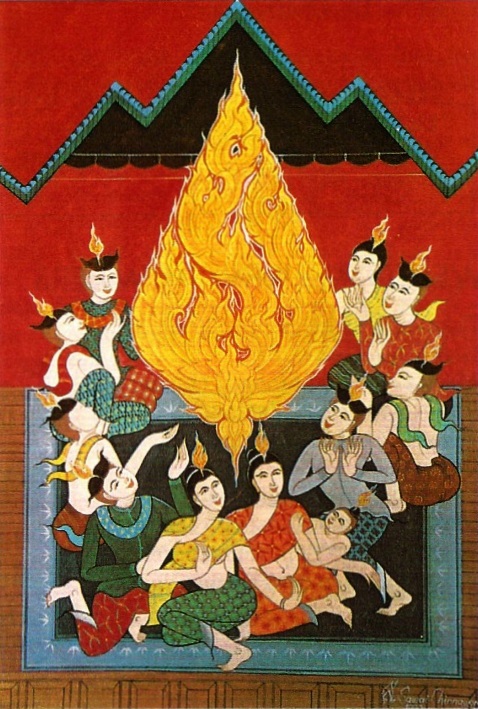
ARTICLE: “Painting Pentecost: Painter Sawai Chinnawong saturates the outpouring of the Spirit with the colors Thai art traditionally associates with the holy” by Amos Yong and Jonathan A. Anderson, Christian Century: Adapted from the book Renewing Christian Theology: Systematics for a Global Christianity (Baylor University Press, 2014), this article explores one of the Pentecost paintings of Thai Christian artist Sawai Chinnawong, who adopts and adapts a Thai Buddhist visual vernacular in terms of color choices, design elements, and the gestures and postures of figures. I’m appreciative of how the painting shows both men and women, and even a child, present at Pentecost and being recipients of the gift of the Spirit, as they surely were.

Chinnawong, Sawai_Pentecost
Sawai Chinnawong (Thai, 1959–), Pentecost, 1997. Acrylic on canvas.

(Related post: “Pentecost art from Asia”)

Some Christians are uncomfortable with art that transposes biblical events into other cultural contexts. But I think it’s a beautiful picture of the global character of the gospel, which has taken root in countries all over the world. As the authors write, in addition to celebrating a historic event, Chinnawong’s Pentecost “prompts us to see this as another event altogether: the outpouring of the Spirit in a room in 21st-century Bangkok rather than first-century Jerusalem. Chinnawong sets the scene here not out of disregard for the historical particularity of the original event but as a means of imagining and visually praying for the Spirit’s presence in his own historical moment. For Chinnawong, the Holy Spirit’s filling is not isolated to a single event, a particular moment, or one place but may be repeated at any time and place and for any people. Thus the circle of believers being filled with the Spirit is repeatedly repopulated and renewed.”

Roundup: Religion and Contemporary Art

WEBSITE LAUNCH: The Foundation for Spirituality and the Arts: From a September 20 press release: “The Foundation for Spirituality and the Arts is pleased to announce the debut of our new website, fsa.art. Complementing in-person programming in Charleston and New York City, fsa.art functions as FSA’s online curatorial wing. It hosts both commissioned and curated content as well as a selection of features spotlighting significant artists, scholars, exhibitions, and publications from recent decades. We hope this site will be a valuable and inspiring resource that fosters dialogue, community, and innovation in the field of spirituality and the arts.”

FSA is “devoted to nurturing connections between spirituality and contemporary art. . . . By encouraging a mutual flow of creativity and faith from both artists and scholars, we hope to initiate fresh channels of spiritual enrichment from new depths of artistic expression. Nurturing innovative and experimental collaborations between a wide range of communities, we aspire to integrate estranged voices together in a spirit of harmony, openness, and inquisitiveness.”

At the heart of their programming is their annual series of residencies, open to visual artists, performers, composers, choreographers, curators, writers, and theologians. Visit their website to find out more, and follow them on Instagram @foundation.spirituality.arts. Below are four artworks I’ve encountered through their social media postings.

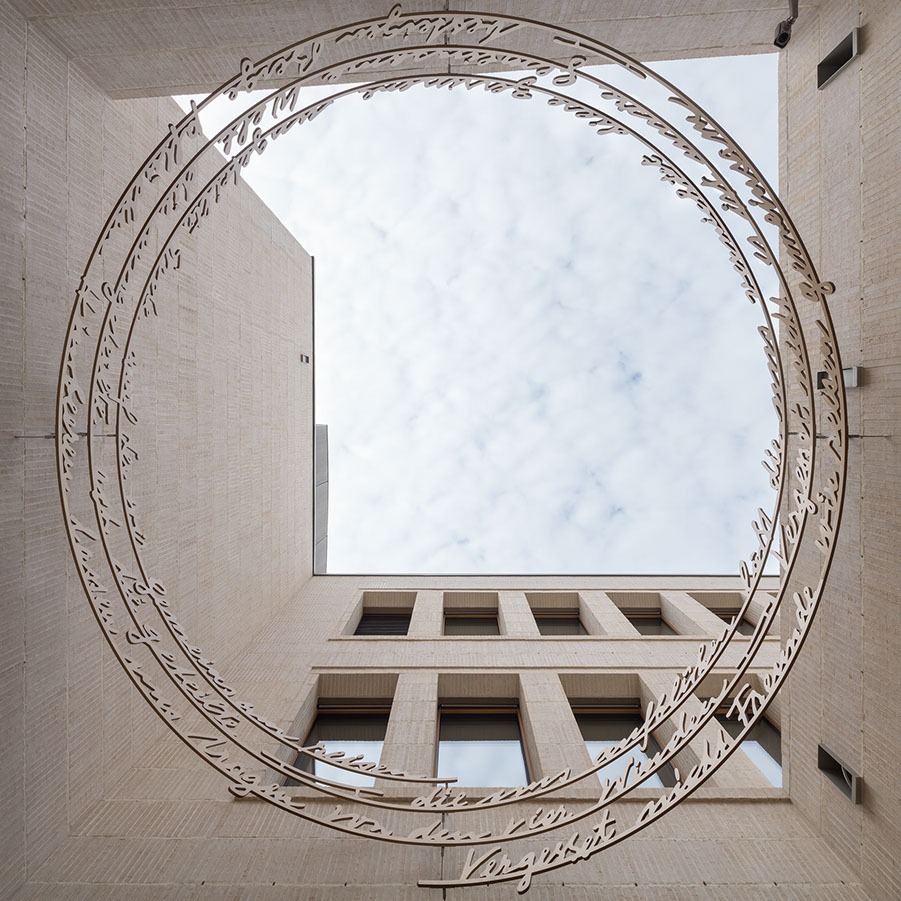
Kristen, Tom_Gemeinsam
Tom Kristen (German, 1968–), Gemeinsam (Together), 2019. Jewish Synagogue and Community Center, Regensburg, Bavaria. Photo: Marcus Eben. Floating above the center’s atrium, this gilded bronze spiral text is taken from Rose Ausländer’s poem “Gemeinsam”: “Vergesst nicht, Freunde, wir reisen gemeinsam. . . . Es ist unsre gemeinsame Welt.” (“Don’t forget, friends: we travel together. . . . It is our common world.”)

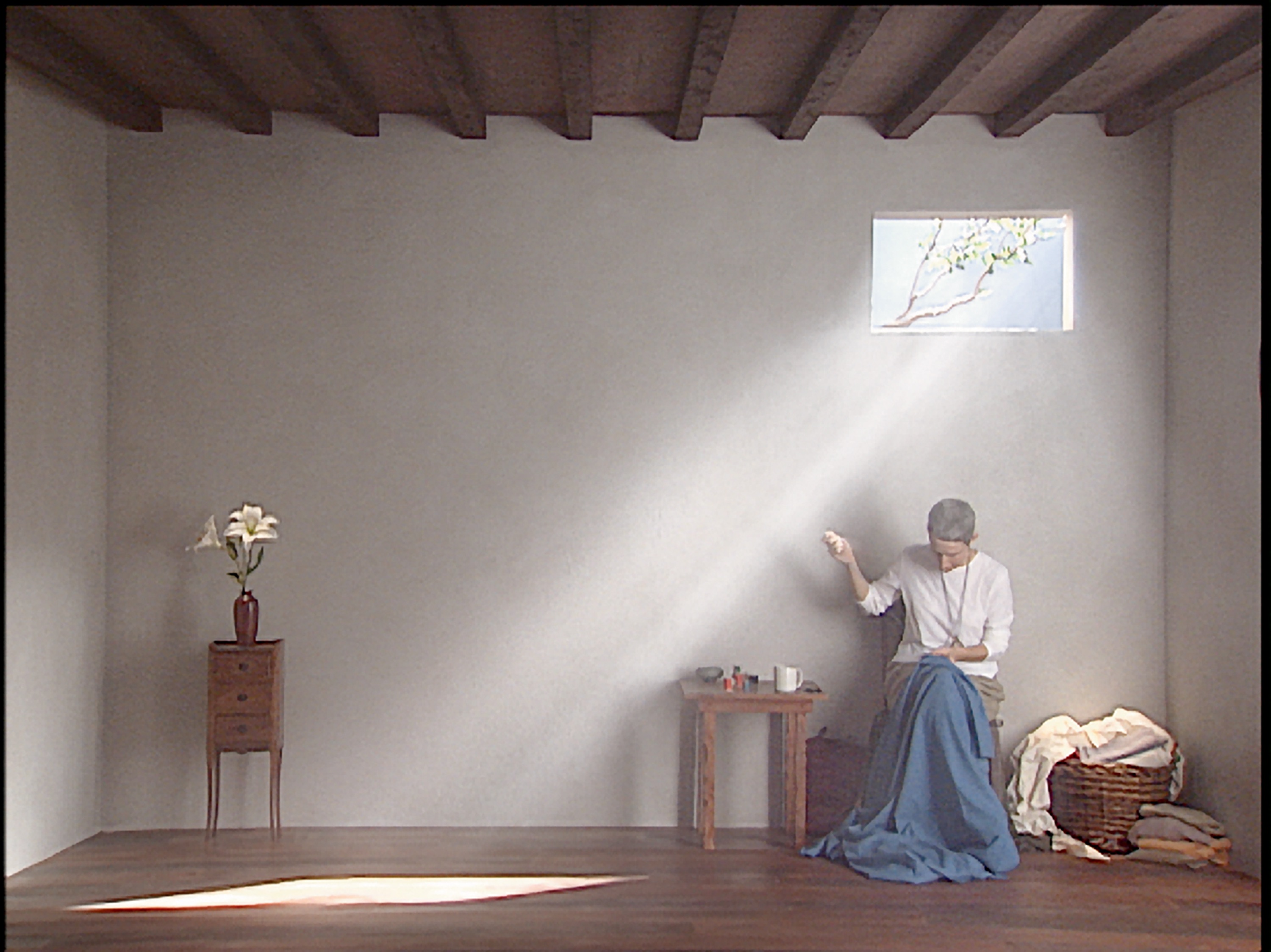
Viola, Bill_Catherine's Room (still)
Bill Viola (American, 1951–), Still from Catherine’s Room, 2001. Color video polyptych on five flat panel displays, 18:39 minutes, performer: Weba Garretson. Photo: Kira Perov, courtesy Bill Viola Studio.

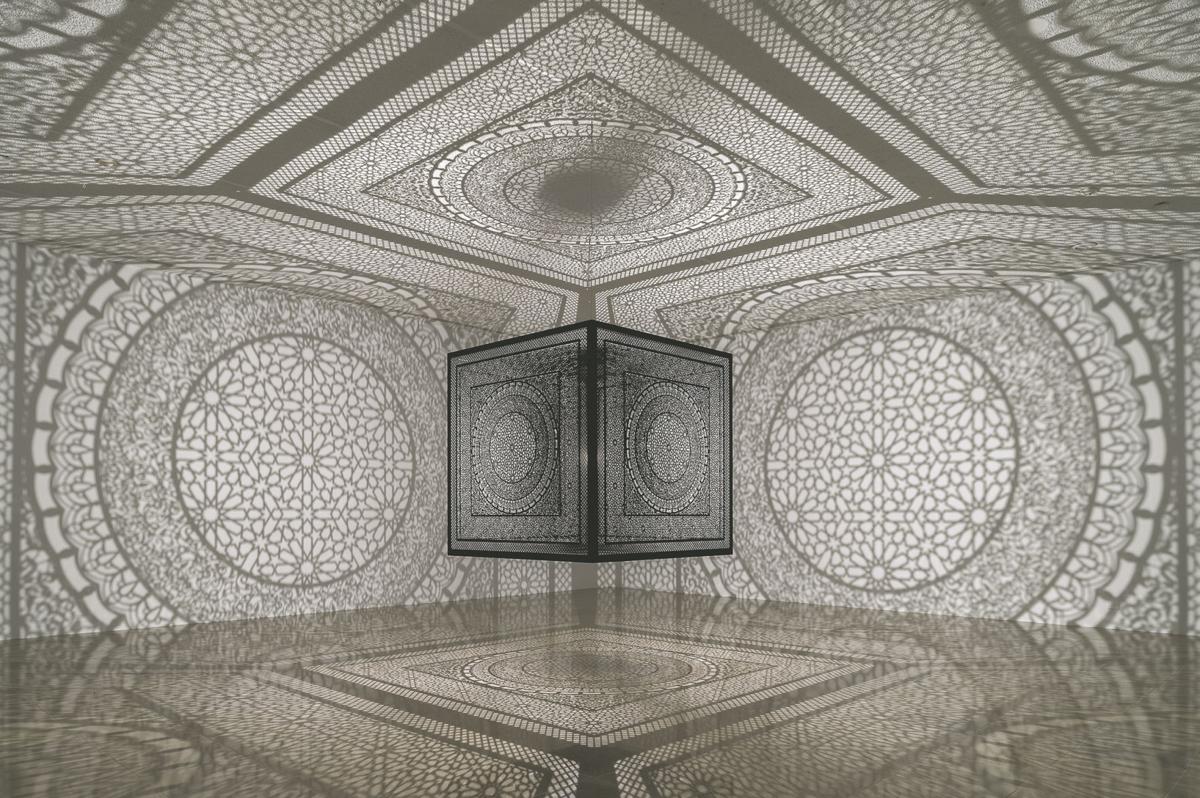
Agha, Anila Quayyum_Intersections
Anila Quayyum Agha (Pakistani American, 1965–), Intersections, 2013. Lacquered wood and halogen bulb, 78 × 78 × 78 in. (cast shadows: 43.5 × 43.5 × 16 ft.). Installation view at Rice Gallery, Houston, Texas, 2015.

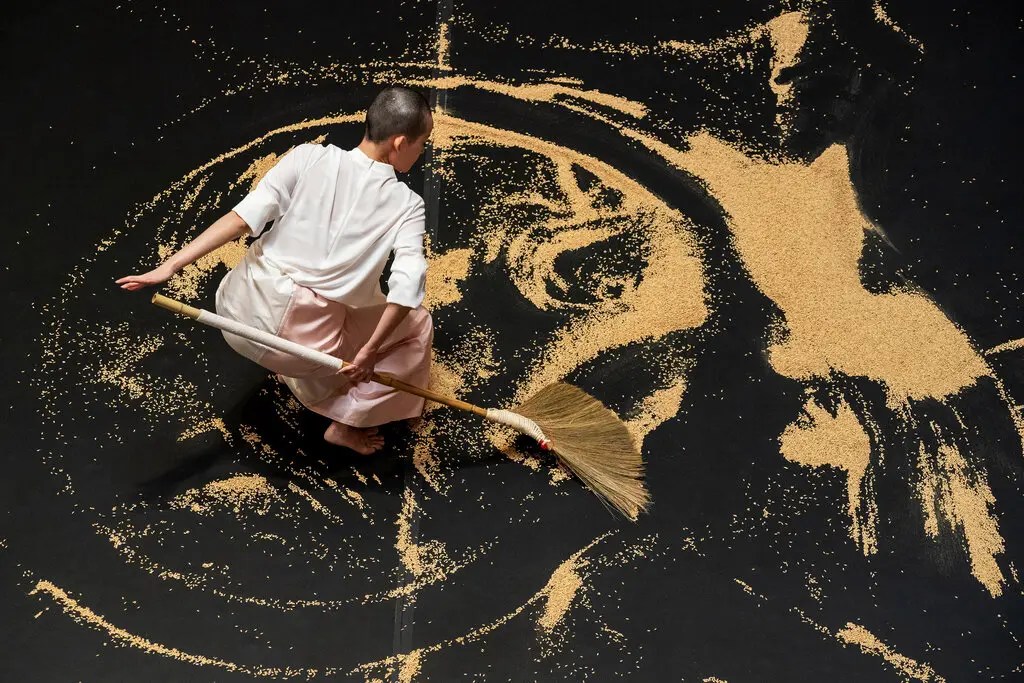
Mingwei, Lee_Our Labyrinth
Lee Mingwei (Taiwanese American, 1964–), Our Labyrinth, 2015–present. Photo: Stephanie Berger. In this performance work, single dancers, dressed in floor-length sarongs and wearing ankle bells, take turns sweeping a mound of rice in patterns on the floor in a designated gallery space. This iteration from 2020 at the Metropolitan Museum of Art was a collaboration with choreographer Bill T. Jones, and the performer in the photo is I-Ling Liu. [Watch on YouTube]

+++

LECTURE: “The New Visibility of Religion in Contemporary Art” by Jonathan A. Anderson: Religion is becoming more visible in contemporary art and more discussable, says artist, art critic, and theologian Jonathan Anderson in his September 17 talk sponsored by Bridge Projects in Los Angeles. Danh Vo, Kris Martin, Andrea Büttner, Deana Lawson, Arthur Jafa, Genesis Tramaine, Hossein Valamanesh, Theaster Gates, Zarah Hussain, Francis Alÿs, Louise Bourgeois, Sol LeWitt, Sean Kelly, Gerhard Richter, James Turrell—these are just some of the many contemporary artists who have engaged substantively with religion in their work, either through form or content or through the ways in which they frame the work’s central questions. Curators and art historians are recognizing this more and more, and it’s being reflected in exhibitions and scholarship. Anderson highlights several such instances from the past two decades, celebrating religion’s increased visibility but also pointing out where there’s room for improvement. The talk starts at 6:36:

At 28:58, Anderson outlines four interpretive horizons, or fundamental hermeneutics, within which religion is becoming visible, intelligible, and meaningful in contemporary art: anthropological (31:00), political (37:43), spiritual (42:51), and theological (48:42). He discusses the problems and possibilities of each—ways in which it has been productive or insightful, and ways in which it’s limiting. The fourth horizon, the theological, is the least developed in the art world and the most contested, he says.

He concludes,

A more concentrated and well-developed mode of theological inquiry has much to contribute to the history, theory, and criticism of contemporary art without being reductive, but instead opening much of what’s going on in contemporary art. And so going forward, I do envision a mode of study that keeps all these horizons in view, and a mode of discourse that keeps all these horizons in view, while especially developing the potential for the modes of critical writing capable of addressing theological conceptualities, genealogies, and implications that are in play in so much of the art being made today. And that involves thinking better from both directions, developing concepts and capacities—skills, really—where art criticism might operate with a more agile, historically sensitive understanding of religion and theology (a richer theological intelligence), and theology might operate with a more agile, historically sensitive understanding of art and criticism (a richer art historical intelligence, or visual intelligence).

The last half hour is Q&A. What he says at 1:03:59 is fascinating! If you enjoyed this talk, check out, too, the one he gave ten years ago, “The (In)visibility of Theology in Contemporary Art Criticism,” which I published detailed notes on and which became a chapter in the book Christian Scholarship in the Twenty-First Century: Prospects and Perils, edited by Thomas M. Crisp, Steve L. Porter, and Gregg A. Ten Elshof.

As a side note, Anderson teaches two courses at Duke Divinity School, where he is a postdoctoral associate in the DITA program: “Contemporary Art and Theology” and “Visual Art as Theology.” The latter looks at the history of primarily Christian art as a domain of primary theological reasoning and biblical commentary, done in visual-spatial terms rather than in verbal-written terms. His hope is that divinity students—future biblical scholars, theologians, pastors, etc.—will become more literate in the visual-spatial forms of theology. I mention this because it’s what I’m about too!

+++

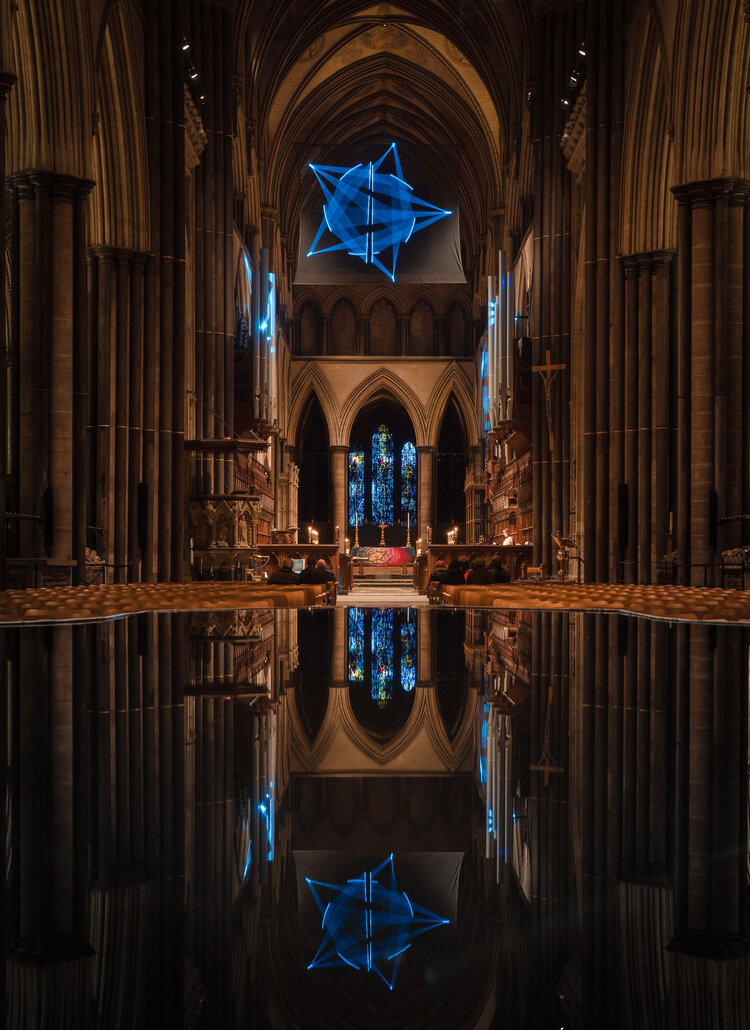
PODCAST EPISODE: “Jacquiline Creswell: Curating in Sacred Spaces,” Exhibiting Faith: Hosted by critic and art historian David Trigg, this is the first episode of a brand-new podcast about the intersection of art and faith, featuring a range of guests for whom those two elements have played a significant role. First up is Jacquiline Creswell, a visual arts adviser and curator who has, since 2009, organized more than forty-five exhibitions in sacred spaces. She has been central to the development of the visual arts programs at Salisbury, Ely, and Chichester Cathedrals. She discusses some of the projects she has worked on and how they’ve been received by the congregation and the wider public, how the setting of an artwork can alter its meaning and the way people engage with it, the logistical challenges of placing art in historic churches, and more.

I was interested to learn that she is from a Jewish background, even though most of her jobs have been with Christian institutions. Check out the eight objectives she lists on her website, which have guided her curatorial work and which I find exciting; the first is “To present artwork which is engaging, that encourages a spiritual response and may at times challenge conventional perceptions.”

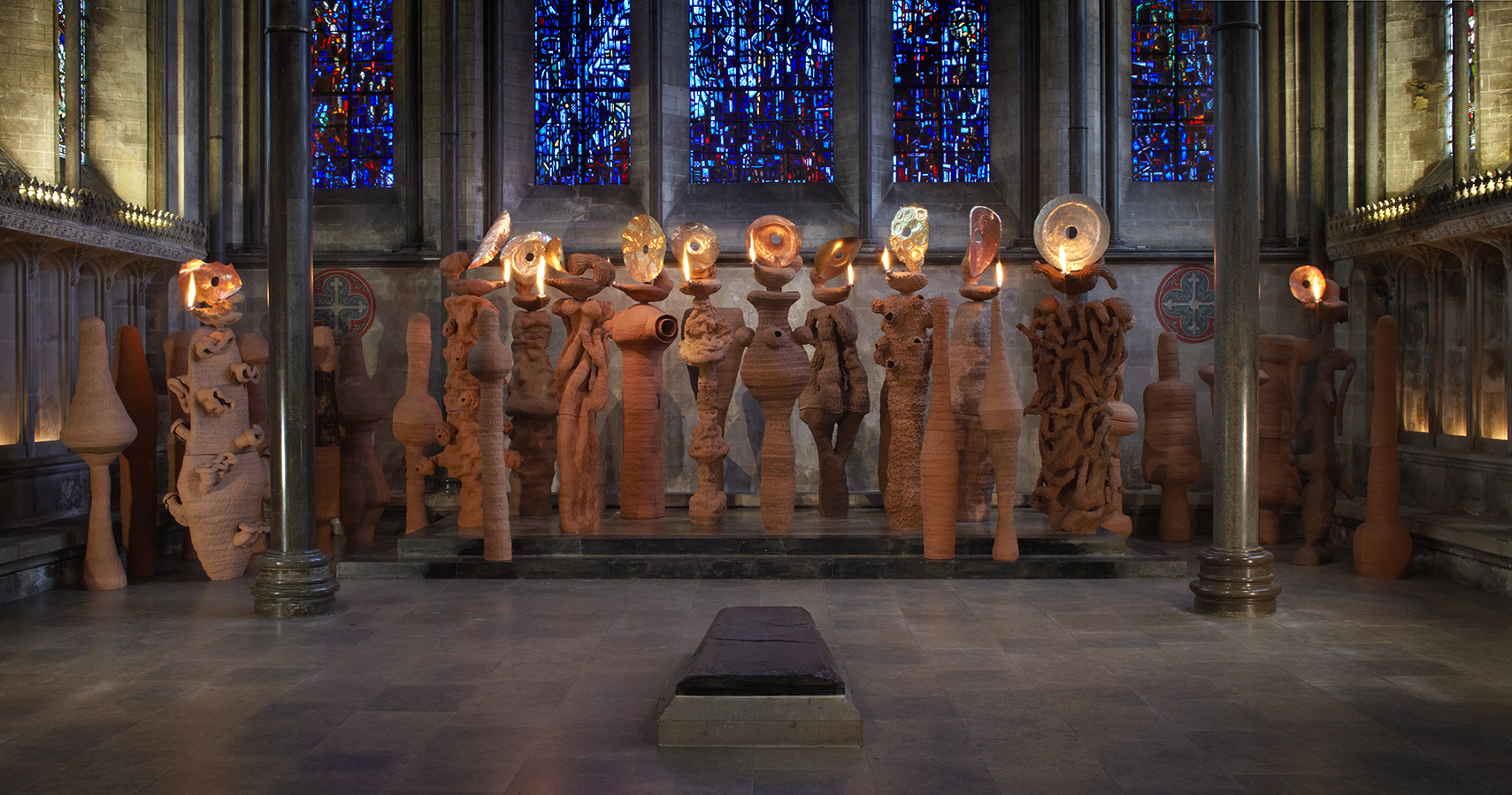
Pope, Nicholas_Apostles Speaking in Tongues
Nicholas Pope (British, 1949–), The Apostles Speaking in Tongues Lit By Their Own Lamps, 1996, installed 2014. Thirty-three figures in terracotta, metal, wick, paraffin, and flame. Trinity Chapel, Salisbury Cathedral. Photo: FXP, London.

Haebich, Jayson_Star of Bethlehem
Jayson Haebich (born in Australia, living in Hong Kong and London), Star of Bethlehem, 2016. Interactive laser installation at Salisbury Cathedral, England.

New episodes of Exhibiting Faith are released once a month. The second (and latest) episode is an interview with Dubai-born, Birmingham-based textile artist Farwa Moledina, whose Women of Paradise (2022) scrutinizes the portrayal of Muslim women in the canon of Western art. Moledina also discusses her experience of Ramadan during lockdown and how it resulted in By Your Coming We Are Healed (2020), two sufras (floor mats for communal dining) made up of photographs of plated dishes submitted to her by participants in the virtual iftars she hosted, arranged according to Islamic design principles of symmetry, abstraction, and recurrence.

+++

SHORT FILM SERIES: At the Threshold: Theology on Film, dir. Sean Dimond: At the Threshold is the latest project from UNTAMED, a documentary film studio in Seattle that “pursue[s] stories of spiritual and narrative depth, with a bias for hope, risk, and redemption.” Filmed in Belgium, Germany, and the UK, it profiles six Christian theologians from Europe, each one humble, open-hearted, and reflective.

  1. “The Open Narrative of Love” with Lieven Boeve, Leuven, Belgium: Boeve reflects on how God interrupts people’s self-enclosed stories. Christianity, he says, is itself an open narrative, not a closed one, and it leads us not away from the world but right into it. One of the filming locations in this short is a rural landscape in Borgloon where Pieterjan Gijs and Arnout van Vaerenbergh built Reading between the Lines, an open-air chapel created to imagine a church inseparable from the world around it.
  2. “The Greater Part” with David Brown, St Andrews, Scotland: Brown talks about prayer, the Bible as part of a living tradition, the church’s call to be creatively other, and the only time he ever saw his father cry. He also cites some of the poets, novelists, and composers/singer-songwriters he admires.
  3. “The Radiance” with Perry Schmidt-Leukel, Muenster, Germany: “The fractcal structure of religious diversity” is of deep interest to Schmidt-Leukel, a Christian who draws insights from Buddhism and who was criticized by Cardinal Joseph Ratzinger for doing so.
  4. “Danseuse” with Ann Loades, Durham, England: A feminist theologian, Loades is one of only two people ever to be awarded a CBE for services to theology. The Christian tradition is responsible for the devaluation of women, she says, but that tradition also contains resources for its own transformation. She also discusses dance as prefiguring the resurrection body.
  5. “To Imagine That” with Garrick Allen, Glasgow, Scotland: Allen sees the book of Revelation as being about how to live in a system that is unjust. “This is John’s response to an oppressive system, and it gives us space to rethink what a just system would look like in our world—to begin to imagine that.”
  6. “Begin with the End” with Judith Wolfe, St Andrews, Scotland: “We have to take seriously the claim that we do not yet live in the world as it will be, and as we will be, and that we have to live towards an eschaton, a presence of God in the world, which is not only not yet apparent, but is not even comprehensible to us. So how do we live authentically in this life?”

From the studio: “Theology offers a home for the vast and the intimate. No question is foreclosed. Visually immersive, poetic, and global in scale, these narrative and theological short films invite viewers into a conversation about life and its limits which is as vibrant as it is challenging. This series isn’t about promoting theological ideas we necessarily agree with, but rather we are exploring the connections between vulnerable life, big questions, and the diversity of theological work being done today. It’s not that we are on the threshold of discovering God, but that perhaps God is already on the threshold of our lives, knocking to enter through our wounds, deepest desires, and questions.”

7 Hours of Interviews on Religion and the Arts

Created, written, and hosted by Robert Lawrence Kuhn, Closer To Truth is a public television series that explores fundamental questions relating to the cosmos, consciousness, religion, and the search for ultimate reality and purpose. The program boasts a robust website featuring over four thousand video interviews with scientists, philosophers, theologians, artists, and other scholars and practitioners.

I am particularly interested in the seven hours’ worth of interviews on art and religion/God that fall under the “Art Seeking Understanding” rubric. They are separated into three- to twelve-minute segments spread across these eight topical series:

  • Art and the Philosophy of Religion: “Can art inform topics in philosophy of religion? Can the existence and varieties of art address or affect theological questions about God, faith, belief, worship?”
  • Arguing God from the Arts?: “Is it possible to infer something of the nonphysical, divine existence of God from the physical, human existence of art? Can one argue for God from art?”
  • Can the Arts Reveal God’s Traits?: “If God is the Creator of human beings and art is a feature of human sentience, then can examining the arts help discern characteristics of God? Can one infer from various aspects of art various traits of God?”
  • Arts and Religious Experience: “What is the relationship between experiencing art and experiencing God? Can the arts generate or trigger religious experience? If so, can it be validated?”
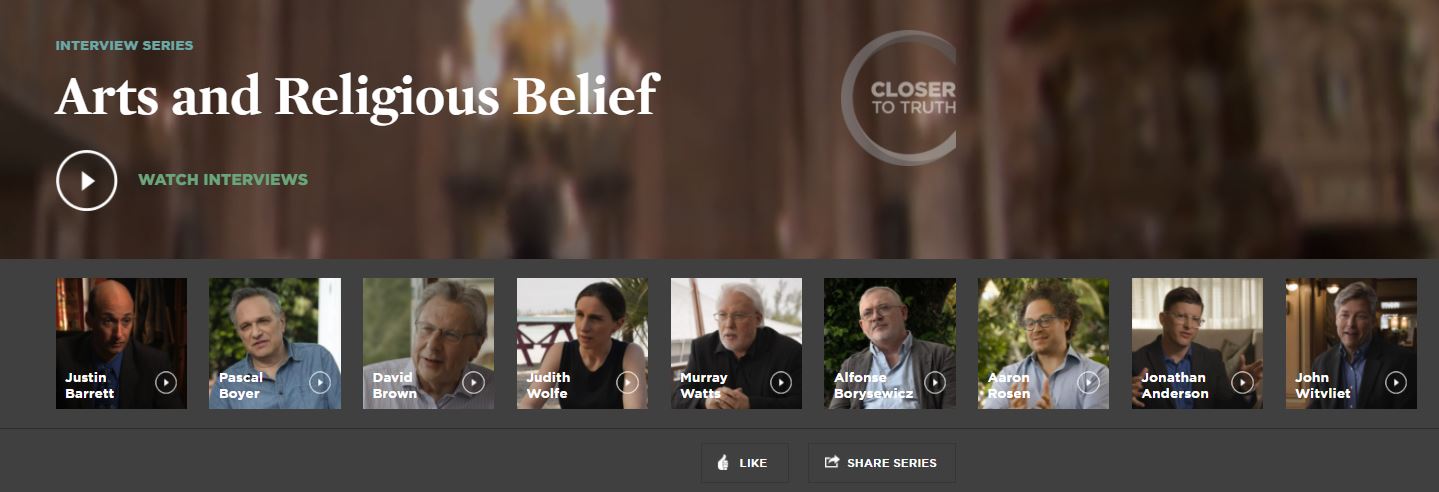
  • Arts and Religious Belief: “Is there a relationship between diverse arts and belief in God? Can the arts express or encourage religious belief? If so, can it be validated?” (*This is my favorite.)
  • Arts and Religious Practice (Liturgy): “Why are the arts so deeply embedded in religious settings and services? How do the arts work in religious spaces and activities? What are differences among the arts, say music and painting, in the liturgy?” (*This is my second favorite!)
  • Arts and Religious Reality: “Art is deeply involved in the practice of religion, embedded in the rituals and liturgy of almost every religion. But how could the ubiquity of the arts in religion affect whether or not religion is real?”
  • Co-Evolution of Art and Religion: “Did art and religion co-evolve in parallel as archeology and anthropology suggest, and if so, what would be the significance? What do art and religion have in common that could enable their common, co-temporal development?”
Closer to Truth screen cap

Interviewees include Nicholas Wolterstorff, Matthew Milliner, Jonathan A. Anderson, Judith Wolfe, Aaron Rosen, Alfonse Borysewicz, John Witvliet, and others. I’m disappointed by the lack of diversity among interviewees—the program is very heavy on white male Christians—but I am nevertheless grateful for the wisdom these individuals share, and for the efforts of the Closer To Truth team to coax it out, capture it onscreen, and present it freely to the public.

Here are a few interviews I’ll call your attention to:

These videos and many more can also be found on Closer To Truth’s YouTube channel.

Roundup: Four talks and an interview

Hi friends. I’m preparing for a trip to Bangalore, India, later this month, to meet an artist whose work I admire, Jyoti Sahi [previously]. I apologize for being slow to respond to emails lately, but I do appreciate each and every message I receive from my readers! I read them all and will try my best to respond just as soon as I get the chance. Please note: email is the best way to get in touch with me, as I’ve found that Facebook, Instagram, and Twitter messages tend to get buried under a slew of notifications and are harder for me to tag and track. Thank you again for your support of Art & Theology, and for all your questions, encouragements, personal introductions, invitations, and art recommendations.

In this roundup I want to share a few recorded lectures that I’ve listened to in the past month and have really enjoyed; I hope you will too. The first two are by art historians speaking to secular audiences at museums about the (Protestant) art of the Dutch Golden Age—which I saw a lot of this spring during my visit to the Netherlands! The second two are by Christian professors speaking at Christian academic institutions, from different angles, about prophetic art. And lastly, Biola University interviews Krista Tippett, one of my absolute favorite podcast hosts.

+++

“Dutch Art of the Golden Age, 1600–1675” by Dr. Eric Denker, National Gallery of Art, Washington, DC, July 14, 2019: In this hour-long lecture, Eric Denker discusses some of the highlights from the National Gallery of Art’s seventeenth-century Dutch art collection: paintings by Emanuel de Witte, Jan van der Heyden, Salomon van Ruysdael, Aelbert Cuyp, Ludolf Bakhuizen, Hendrick ter Brugghen (of the Utrecht Caravaggisti), Frans Hals, Johannes Cornelisz Verspronck, Judith Leyster, Thomas de Keyser, Rembrandt, Jan Steen, Pieter de Hooch, Willem Claesz Heda, Johannes Vermeer, Ambrosius Bosschaert, and Adriaen Coorte. These include scenes of everyday life (such as church and domestic interiors), landscapes, portraits, and still lifes.

https://youtu.be/u-Qoko2-Rfw

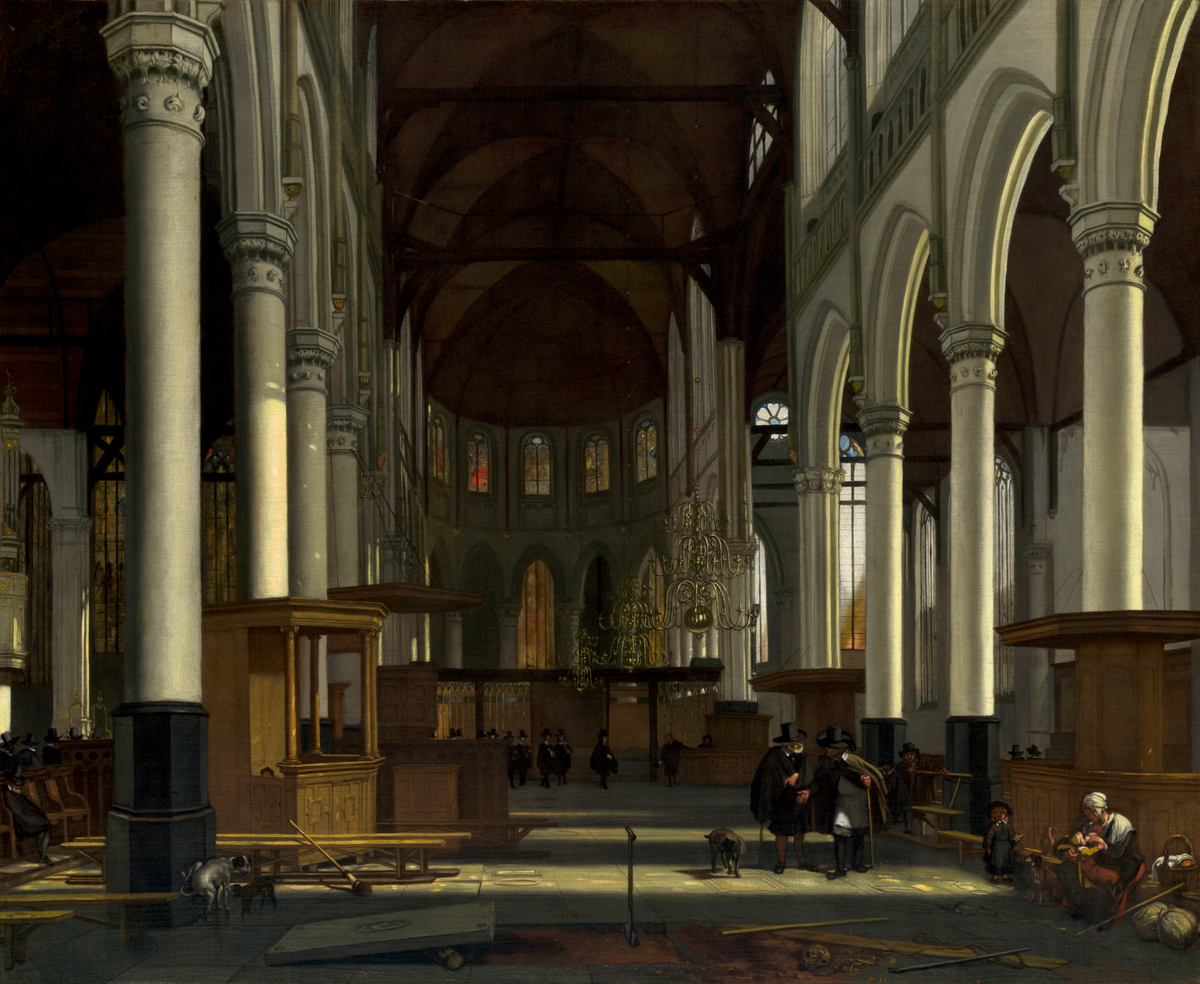
Interior of the Oude Kerk, Amsterdam by Emanuel de Witte
Emanuel de Witte (Dutch, ca. 1616–1691/92), The Interior of the Oude Kerk, Amsterdam, ca. 1660. Oil on canvas, 31 11/16 × 39 3/8 in. (80.5 × 100 cm). National Gallery of Art, Washington, DC.

I especially appreciated him pointing out details from de Witte’s Interior of the Oude Kerk, Amsterdam, which brings together death (a burial plot has just been dug up under the stone floor, with a skull visible in the upturned dirt heap) and life (a woman nursing her infant on a bench at the right). Unlike the French and Italian painting of the time, Denker says, in Dutch painting “there is nothing too vulgar . . . to portray. They felt that they inhabited God’s world, and that everything that existed in that world was necessarily of God’s making.” Hence the dog relieving himself on a column!

+++

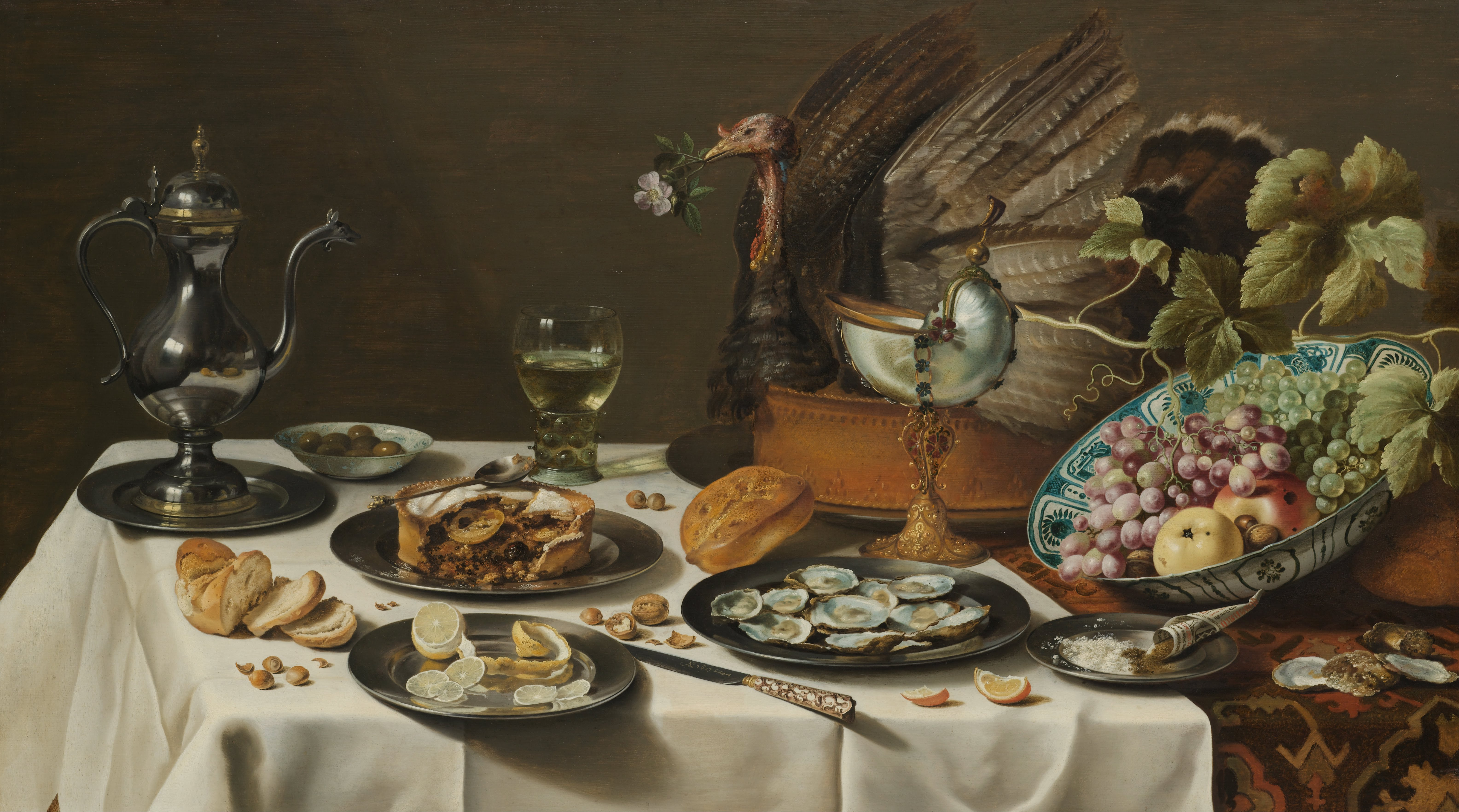
“Food for Thought: Pieter Claesz. and Dutch Still Life” by Dr. John Walsh, Yale University Art Gallery, September 25, 2015: The Dutch coined the word “still life” (stilleven) to describe pictures of things that are incapable of movement or that lack a soul. In the Dutch conception, such paintings weren’t just for looking at but also for meditating on; the aim, in other words, was visual pleasure and moral edification. John Walsh outlines various categories: vanitas paintings, breakfast pieces, kitchen still lifes, pipe-smoking pieces, arrangements of food and wares on a table, fruit pieces, compositions of dead game and weapons, and flowers.

Walsh discusses many different paintings in detail, by many different artists (not just by the premier one in the lecture title), including a few examples of contemporaneous still lifes from Italy and Spain. He really made them come alive for me! The feasts of meats and cheeses, fruits and vegetables, for example, with all their subtle richness of texture and color, are a celebration of God’s goodness. In honor of Thanksgiving in a few weeks, here’s Pieter Claesz’s Still Life with a Turkey Pie:

Claesz, Pieter_Still Life with a Turkey Pie
Pieter Claesz (Dutch, 1597/98–1660), Still Life with a Turkey Pie, 1627. Oil on panel, 29 1/2 × 51 9/10 in. (75 × 132 cm). Rijksmuseum, Amsterdam.

+++

“Practicing the Prophetic: Liturgy, Formation, and Discernment for Public Life” by Dr. James K.A. Smith, Seattle Pacific University, October 16, 2019: James K.A. Smith has made a name for himself writing about worship, worldview, and cultural formation, through such books as You Are What You Love: The Spiritual Power of Habit and his Cultural Liturgies series. The first half of this talk, which starts at 6:15, is a good introduction to his work in that arena, as he discusses the liturgical nature of public life—how “the rhythms and rituals of public life aren’t just something we do; they are also doing something to us.” Cultural forces can de-form us, he says, in often insidious ways, such that we don’t even realize the deformation. Smith is all about getting us to take stock of what we’ve been conscripted to want, to love, to hope for; to perform a “liturgical analysis” on the social imaginary that we’ve absorbed through our culture’s images, stories, myths, rituals, practices, etc. And for a toolkit, he offers St. Augustine.

The second half of the talk (starting at about 33:40) is devoted to “the art of prophetic hope,” which “requires both the renewal of the Christian imagination and an outward offering of a Christian imagination for the sake of the world.” He continues: “What’s at stake in our liturgical formation is really a restorying of the imagination. It’s a restoring of the imagination because it’s a restorying of the imagination. And if Christianity has something to offer our neighbors, I think that will be most powerfully and prophetically embodied in the arts, which meet people on the register of the imagination.” I am always so compelled by Smith’s words; they’re all so quotable. But particularly germane to the Art & Theology project I have going here, and also to the upcoming Advent season, is what he says about a truly “Christian” art being that which holds together hurt and hope:

There is nothing more scandalous than Christian eschatology, I realize. And yet nothing speaks more directly to a hurtful and fearful world. This eschatological orientation, which is at the heart of the prophets, fuels art that is suspended between the already and the not yet. The unique imaginative capacity of the arts speaks to this ineffaceable human hunger for restoration even while honoring the heartbreak of our present pilgrimage. A Christian eschatology nourishes a distinct imagination that refuses to be constrained by the catalog of the currently available and instead imagines a world to come breaking into the present. Art that is infused with this eschatological imagination at once laments and hopes. In its lament, it honors our experience of brokenness, the heartbreak of the now. And in its hope, it gives voice to our longings. It neither wallows in romanticized tragedy nor escapes to sentimental naivete. Such eschatological art is like an embodied form of the Lord’s Prayer. Each such work is its own requiem, such that what Jan Swafford says of Mozart’s Requiem could be true of all such eschatological art. He says, “It’s full of death and hope, lacerating sorrow and uncanny beauty.”

I like this “uncanniness” metaphor. Uncanniness is an apt descriptor of such art that paints beauty with ashes, that can walk the soul through the valley of the shadow of death on the way to a feast in the wilderness. Such art stops us short in its uncanny, even paradoxical, ability to embody both hurt and hope.

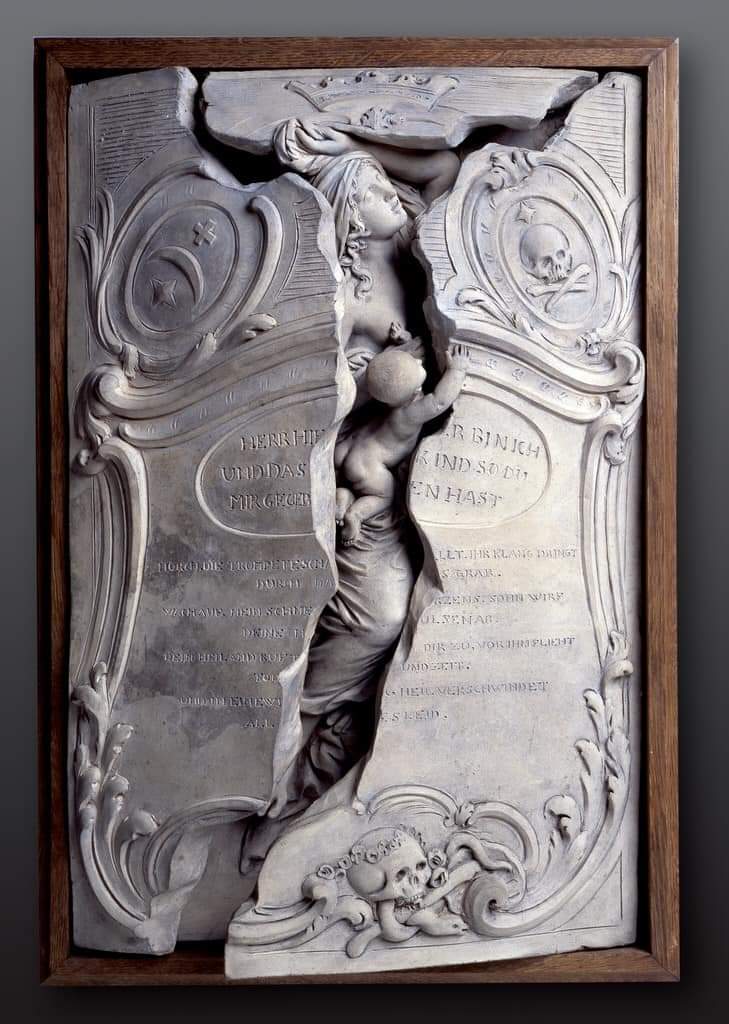
By way of example, he discusses the Tomb of Maria Magdalena Langhans (1723–1751), who died in childbirth, along with her baby, on Holy Saturday; the Memorial to Fallen Workers in Hamilton, Ontario; and Sugar and Spice by Letitia Huckaby [previously].

Nahl, Johann August_Tomb of Madame Langhans
Johann August Nahl (German, 1710–1781), Tomb of Mme. Maria Magdalena Langhans, 1751–53. Sandstone. (This is an 18th-century replica; the original is in the village church of Hindelbank in Bern, Switzerland.)

+++

“Turn and Face the Strange: Thoughts on Ergonomics and Artistry” by Jeffrey Overstreet, Sacrament & Story conference, Brehm Cascadia, Bellevue, Washington, April 5, 2019: “This is a presentation about the courage that artists must have in order to behold, and then bear witness to, new visions of beauty and truth,” says film critic and professor Jeffrey Overstreet [previously here and here]. He teaches his students at Seattle Pacific University (a Christian institution) to ask, like Miles Morales, “What’s up, danger?” To go outside the walls, to the wild edges, and be still, and then to report on that encounter. Films he discusses, whose characters (or director) “go to the edge of the water,” so to speak, include Babette’s Feast, The Secret of Kells, The Fits, Moonrise Kingdom, and 24 Frames.

+++

An Interview with Krista Tippett by Jonathan A. Anderson, Biola University presidential luncheon, La Mirada, California, February 22, 2017: Journalist Krista Tippett is the most talented interviewer I know—time after time initiating open, hospitable, genuinely mutual conversations with a range of subjects. (It’s no wonder she’s won a Peabody Award and a National Humanities Medal! The latter for “thoughtfully delving into the mysteries of human existence.”) Here Jonathan A. Anderson, the director of Biola University’s Center for Christianity, Culture, and the Arts, interviews her, and it’s so rich!

After graduating from Brown in 1983, Tippett became a foreign correspondent in divided Berlin. After years of that, she earned an MDiv from Yale. In 2003 she created the NPR show Speaking of Faith, which, despite initial skepticism from many corners, became wildly popular and evolved into On Being. Her upbringing was Christian, but she interviews people from all different faith traditions—poets, clergy, scientists, doctors, historians, activists, etc.—always opening with the question “What is your spiritual background?” The show’s tagline is “Pursuing deep thinking, social courage, moral imagination and joy, to renew inner life, outer life, and life together.” Again and again, On Being brightens my outlook, builds my compassion, and gives me hope and inspiration, and I’m so grateful to Tippett for creating that space.

In her interview at Biola, Tippett describes what it was like to discover theology as “one of humanity’s great disciplines,” as “carrying questions and virtues and substantive riches that should be able to find a way in public life true to their depth and their wisdom.” She discusses her desire to be true to the intellectual and spiritual content of faith—the latter almost absent in public talk; how she responds to the criticism of being “soft” on religious voices; and she gives tips for conversing with those you disagree with. When Anderson opened up the Biola project to critique by asking her the problems and possibilities with their approach to Christian liberal arts education, she had this beautiful response: “Whatever our particularity is, that is our gift to the world.” To immerse oneself fully in a particular religious tradition is not a narrowing but a deepening, she said; being deeply who you are and having convictions and seeking truth is not incompatible with living lovingly and peaceably in a pluralistic world!

Tippett is the author of Speaking of Faith: Why Religion Matters—and How to Talk About It (Penguin, 2008) and Becoming Wise: An Inquiry into the Mystery and Art of Living (Penguin, 2016). Her radio show / podcast, On Being, has a vast archive, and I only just became a listener two years ago, but here are some episodes that I remember particularly enjoying:

Doubting Thomas “Combine” by Robert Rauschenberg

Modern American artist Robert Rauschenberg (1925–2008) is probably best known for his “Combines,” a term he invented to describe a series of works that present found objects on canvas and therefore combine aspects of painting and sculpture. Art critic Jonathan A. Anderson and theologian William A. Dyrness address the religious references that proliferate through his oeuvre, and that of many other late nineteenth- and twentieth-century artists, in their book Modern Art and the Life of a Culture: The Religious Impulses of Modernism* (Downers Grove, IL: InterVarsity Academic, 2016), part of IVP’s Studies in Theology and the Arts series. The following excerpt is taken from pages 308–9.

Untitled by Robert Rauschenberg
Robert Rauschenberg (American, 1925–2008), Untitled, ca. 1955. Oil, paper, fabric, and newspaper on canvas with string, nail, funnel, and wood, 31 1/2 × 25 1/8 × 9 in. (80 × 63.8 × 22.9 cm). San Francisco Museum of Modern Art.

Rauschenberg’s Untitled black painting with a funnel (c. 1955) is presented as a kind of figure: the open circular collar of a t-shirt positions a head relatively high in the field, and the fragment of a sleeve on the right-hand edge indicates a lifted hand. Nearly all of the collaged scraps of cloth and paper on the surface are painted over in flat black paint—one of the few portions that is not is a prayer card just to the right of the center of the painting that displays a reproduction of Carl Bloch’s Doubting Thomas (1881). Flurries of red, yellow, green and white paint have been slashed across the surface immediately below this image (the only place such color appears in the painting), which within the figure suggested by the cloth fragments correspond to the position of the wound in Christ’s side, as depicted in the prayer card. The painting’s surface subtly stands in for the wounded body of the resurrected Jesus, and as such the ball of twine placed in the funnel on the left side of the panel becomes doubly suggestive of incarnation (descending downward into the funnel) and ascension (being pulled upward out of the funnel). But if Rauschenberg is allegorizing the surface of the painting with the resurrected body of Christ, then he is also placing himself (and the viewer) in the position of the incredulous Thomas. It is a painting that powerfully articulates both a longing to touch and see (Lk 24:39; cf. Lk 6:19) and the persistence and seeming ineluctability of doubt in the age of modernity (including doubt that images, much less paintings, can any longer serve as vehicles for the kind of religious touching and seeing that we long for). Like much modern art, this is not a work of unbelief as much as it is of fragilized belief, one that is caught oscillating (or struggling) between doubt and belief.

For a recent interview with Anderson, conducted by Rev. Jonathan Evens, visit Artlyst. See also the conference talk Anderson gave in 2012 on “The (In)visibility of Theology in Contemporary Art Criticism.”


* This is an Amazon affiliate link, meaning that Art & Theology will earn a small commission on any purchase that originates here.

Jonathan Anderson on the (in)visibility of theology in contemporary art criticism

Jonathan A. Anderson is an associate professor of art at Biola University, an interdenominational Christian university in southern California. In addition to being a practicing artist, he researches and writes on modern and contemporary art criticism, especially its relationship to theology. Along with William Dyrness, he has written the first book in InterVarsity Press’s new Studies in Theology and the Arts series: Modern Art and the Life of a Culture: The Religious Impulses of Modernism.

Below is a video of Anderson presenting a paper titled “The (In)visibility of Theology in Contemporary Art Criticism” at the 2012 conference Christian Scholarship in the Twenty-First Century: Prospects and Perils, sponsored by Biola University’s Center for Christian Thought. In it he examines the problematic absence of theologically informed criticism from contemporary art discourse and posits what is (and is not) needed to redress the problem. He very clearly articulates some of my frustrations with the contemporary art world, giving lots of examples and helpful breakdowns as well as advice for Christians writing about art.

On this blog I write primarily for nonscholars, as well as for the church, not the art world (though I’m thrilled if the art world wants to listen in!). So while I do very much approach art theologically, I know I’m not exactly the voice Anderson is looking for; furthermore, I cover a limited range of art here, restricting myself, for the most part, to Anderson’s first category of “religious” art, below.

Still, I share Anderson’s desire to see a new method of criticism develop, one that takes religious belief seriously instead of sweeping it under the rug. And I try, from my own little corner, to model said method—to “work productively in the rift.”

Here’s the presentation, followed by some highlights.

His starting point is October founder Rosalind Krauss’s pronouncement, in 1979, of an “absolute rift” between art and religion. He elaborates:

The textbooks of twentieth-century art history, theory, and criticism, as well as major museum collections, readily testify to the fact that the institutional art world regards Christianity as having made negligible contributions to the fine arts during the twentieth century, and unfortunately that’s a judgment I largely agree with. But the reverse is also true: for the most part, the church has little regard for the canon of twentieth-century art as having made contributions to the development and deepening of Christian thought. For most of the last century, the worlds of contemporary art theory and Christian theology developed into distinct cultural configurations that have been remarkably disengaged from each other, often to the point of mutual unintelligibility.

The twenty-first century has seen a return of religion to art, Anderson says, but it has been a return riddled with problems. His agenda here is to (1) articulate where the primary problem in the rift lies, (2) offer an argument for how we might think of the return of religion to the art discourse, and (3) suggest ways in which Christians can work productively in the rift.

[03:13] Where does the rift between art and religion lie?

[04:28] In his landmark book On the Strange Place of Religion in Contemporary Art, James Elkins says the rift exists not in the art itself but in the academic writing about art.

[05:43] Art Since 1900 identifies and articulates the four primary critical methods that have framed the modern and contemporary art discourse: psychoanalysis, social art history, formalism and structuralism, and poststructuralism and deconstruction. (“Theology” is not one of them.)

[18:48] Summarizing Elkins: “Religious content is unable to survive the suspicious interpretative operations of avant-garde theory and criticism, which relentlessly reads behind and beneath the subject matter and pictorial composition of an artwork.”   Continue reading “Jonathan Anderson on the (in)visibility of theology in contemporary art criticism”