Christmas, Day 9: Pretty Little Baby

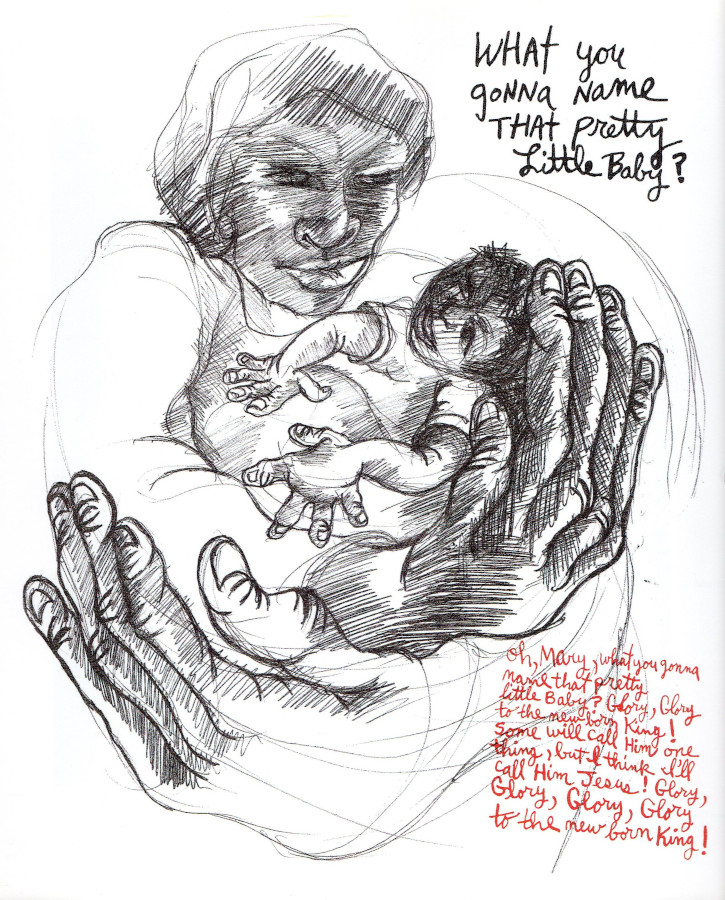
LOOK: What You Gonna Name That Pretty Little Baby? by Aminah Brenda Lynn Robinson

Robinson, Aminah_Mother and Child_reduced
Aminah Brenda Lynn Robinson (American, 1940–2015), What You Gonna Name That Pretty Little Baby?, 1992. Pen and ink on typewriter paper. © Aminah Brenda Lynn Robinson Trust.

Aminah Brenda Lynn Robinson (1940–2015) was an artist working in multiple media whose work celebrates Black history and culture. She was a lifelong resident of Columbus, Ohio, and bequeathed her art, writings, home, and personal property to the Columbus Museum of Art, who established the Aminah Robinson Legacy Project in 2020.

The drawing above is one of twenty-six from Robinson’s excellent book The Teachings: Drawn from African-American Spirituals (Harcourt Brace Jovanovich, 1992). These drawings, she writes in the introduction, “have grown from the stories and songs that were given to me by my family and my early teachers, and I offer them here to the children of today’s troubled world and the children of tomorrow. They carry a message of dignity, knowledge, and wisdom . . . speak of survival, of freedom and determination, of love and faith, of justice and of hope . . .”

The artist’s estate is represented in the US by Fort Gansevoort in New York, which is currently showing Aminah Brenda Lynn Robinson: Character Studies through January 25.

Another exhibition of her work, Aminah Robinson: Journeys Home, a Visual Memoir, will be touring nationally for the next few years: to the Springfield Museum of Art in Ohio (February 1–July 13, 2025), the Newark Museum of Art in New Jersey (October 16, 2025–March 1, 2026), the Mobile Museum of Art in Alabama (March 26, 2026–January 9, 2027), and two remaining venues to be announced. This is a major exhibition that brings together Robinson’s drawings, prints, paintings, textiles, collages, homemade books, dolls, “hogmawg” sculptures (made of a mixture of mud, clay, twigs, leaves, lime, animal grease, and glue), and “RagGonNon” pieces (monumental swaths of fabric encrusted with buttons, beads, and other found objects) to create a portrait of her life.

LISTEN: “Mary, What You Gonna Name That Pretty Little Baby?,” African American spiritual | Arranged by Alex Bradford, 1961 | Performed by Princess Stewart and Marion Williams on Black Nativity: Gospel on Broadway! (Original Broadway Cast), 1962

Mary, Mary, what you gonna name that pretty little baby?
Mmm, mmm, pretty little baby
Glory be to the newborn King

Some call him one thing, I think I’ll call him Jesus
Mmm, mmm, sweet Jesus
Mmm, mmm, (ain’t he sweet?) sweet Jesus
Glory be to the newborn King

Some call him Jesus, I think I’ll call him Wonderful
Mmm, mmm, wonderful
Mmm, mmm, he’s so wonderful
Glory be to the newborn King

Some call him Wonderful, I think I’ll call him Emmanuel
Mmm, mmm, King Emmanuel
Mmm, mmm, (ain’t he the king?) Emmanuel
Glory be to the newborn King

Some call him Emmanuel, I’m gonna call him the Prince of Peace
Mmm, mmm, Prince of Peace
Glory be to the newborn King

Some call him Prince of Peace, I’m gonna call him Jesus
Mmm, mmm, sweet Jesus
Mmm, mmm, (ain’t he sweet?) sweet Jesus
Glory be to the newborn King

Mary, Mary, what you gonna name that pretty little baby?
Mmm, mmm, pretty little baby
Glory be to the newborn King

This Christmas spiritual, a dialogue between an unnamed visitor and the new mother Mary, has been recorded by many artists. I think I like the original cast recording from the Langston Hughes musical Black Nativity best, featuring soloist Princess Stewart on the first verse and Marion Williams on the remaining six, backed by the Stars of Faith.

But here’s a handful of other versions I like. Because the song was passed down orally, it has taken on different lyrical variations and accrued new verses. Some reference the wise men.

>> “The Virgin Mary Had One Son” by the Staple Singers, arr. Roebuck “Pops” Staples, on The 25th Day of December (1962):

>> “The Virgin Mary Had One Son” by Josh Garrels, on The Light Came Down (2016):

>> “What ’Cha Gonna Call the Pretty Little Baby” by the National Lutheran Choir, dir. David M. Cherwien, arr. Ronald L. Stevens, on Christ Is Born (2016):

>> “Glory to the Newborn King” by Chicago a Cappella, dir. Jonathan Miller, arr. Robert Leigh Morris, on Holidays a Cappella Live (2002):

>> “Virgin Mary Had One Son” by Joan Baez and Bob Gibson, live at the 1959 Newport Folk Festival (see also “Virgin Mary,” a bonus track on the 2001 Vanguard reissue of Baez’s 1966 album Noël):

Advent, Day 22: The Light Came Down

LOOK: Light Shower by Bruce Munro

Munro, Bruce_Light Shower
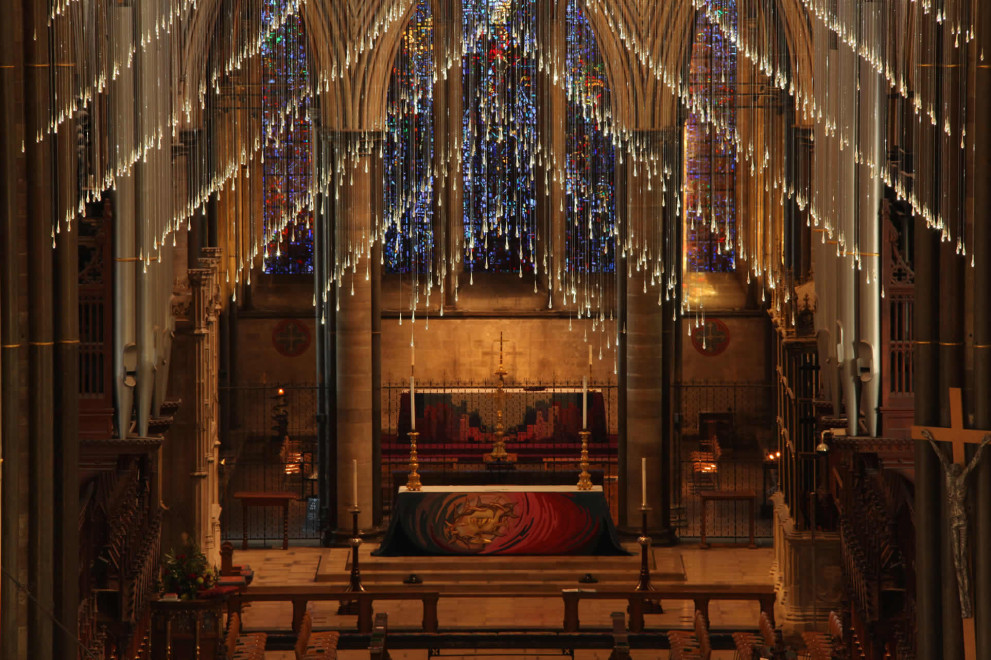
Bruce Munro (British, 1959–), Light Shower, 2010. Temporary installation at Salisbury Cathedral, England.

For Christmas 2010, Salisbury Cathedral commissioned a site-specific light installation from multimedia artist Bruce Munro. Called Light Shower, the piece consists of an invisible wire matrix suspended from the ceiling above the transept, from which dangle hundreds of optical fibers lit with tiny LEDs. As the title implies, they look like drops of light descending like rain.

LISTEN: “The Light Came Down” by Josh Garrels, on The Light Came Down (2016)

There is a light
Bright star shining
In the dark night
Old tales come true

All of our fears
Hopes and prayers
He has heard
And answered us

The light came down
Cast the darkness away
He appeared
A helpless child
The light of God came down

There is a light
A new day dawning
Old things pass
All things made new

Prophets have spoken
All he would accomplish
When the light of God
Would dwell with men

The light came down
Cast the darkness away
He appeared
A helpless child
The light of God came to save us
To the world that he made us
O Lord and Savior
Alleluia


This is the final post in the 2023 Advent series (daily Christmas posts will follow through January 6). View all the posts here, and the accompanying Spotify playlist here.

Roundup: Sing Me High Music Festival, visual LP shot on Mayne Island, and more

SPOTIFY PLAYLIST: August 2023 (Art & Theology): Here’s this month’s!

+++

MUSIC FESTIVAL: “Sing Me High,” August 11–12, 2023: Celebrating music and faith in the Shenandoah Valley. Next Friday evening and all day Saturday at the Brethren & Mennonite Heritage Center in Harrisonburg, Virginia, various folk, bluegrass, and acoustic musicians from the region will be performing: the Walking Roots Band [previously], Chatham Rabbits, Maya de Vitry, Spectator Bird, Honeytown, Juniper Tree, Tide Spring, Good Company, Ebony Nicole, Ears to the Ground Family (read my review of their debut album), Shekinah, Ryan Scarberry, Clymer & Kurtz, and the Rain Pickers. Buy your tickets ahead or at the gate. I’ll be there! (In the audience, that is.)

Below are songs by three different bands/artists who will be playing at the festival: “Praise to God (Whirlwinds),” a new setting by the Walking Roots Band of an eighteenth-century hymn by Anna Barbauld (recorded on The Soil and The Seed Project, vol. 4 and appearing on the Art & Theology Thanksgiving Playlist); “Again, Amen” by Spectator Bird (sisters Rachel and Lindsey FitzGerald); and “Grieve and Rejoice” by Ryan Scarberry, director of music at Incarnation Anglican Church in Williamsburg, Virginia.

+++

ONLINE EVENT: “In Memoriam: An Evening Celebrating Frederick Buechner’s Literary Contributions,” August 15, 2023: “Celebrated as one of the foremost spiritual writers of his generation, Frederick Buechner’s witty, vivid, and rich writing has inspired readers’ minds and stirred hearts through his more than 30 published books for six decades. One year after his passing, Frederick Buechner (July 11, 1926–August 15, 2022) remains an influential voice for writers across genres, from novelists and memoirists to homileticians and theologians alike. For those writers who feel not religious enough for religious readers, or too religious for non-religious readers, Buechner’s voice has been a welcome, guiding light.

“On the one-year-anniversary of Frederick Buechner’s passing, Image is hosting space for community members to gather and share their appreciation for Buechner’s literary contributions. From themes of paying attention to one’s life and stewarding one’s grief, to the unexpected influences on one’s vocation and the ordinary miraculous moments of everyday life, Buechner’s words offer a variety of invitations through which one might come to see the world and one’s place within it more deeply. Image community members are invited to bring a favorite selection of Buechner’s writing to read aloud and to briefly reflect on the difference his words have made for their life.” Register for this free, moderated, open-mic-style time of sharing and reflections at the link above.

+++

DOCUMENTARY: The Sea in Between (2013) by Mason Jar Music: Blayne Johnson and his family, who reside in Mayne Island, British Columbia, are big fans of Portland, Oregon-based indie singer-songwriter Josh Garrels. In 2012 Johnson reached out to Garrels and some of the folks at Mason Jar Music, the Brooklyn-based creative collective Garrels has worked with, to invite them up to his home for a relaxing getaway, and to play for his family and neighbors. Mason Jar specializes in live performance videos, so they sent a small crew and a handful of musicians with the intention of shooting a few of those at various locations around the island—along the bay, on a farm, in a church. Then they decided to extend the footage from the week into a feature-length documentary, directed by Matt Porter, which you can watch for free on YouTube (embedded directly below). The song recordings were released afterward on an album of the same name, along with others that didn’t make the final cut of the film.

The Sea in Between, the film, is about vocation, the creative process, patronage, faith, family, community, and the beauty of place, and it centers on the joy of making and experiencing music together. Besides Garrels, the musicians are Dan Knobler (slide guitar, mandolin), Jay Kirkpatrick (banjo, accordion), Russell Durham (violin), Charlaine Prescott (cello), Jason Burger (drums), Chad Lefkowitz-Brown (clarinet, flute, saxophone), and Gabriel Gall (miscellaneous), who served as music director and wrote the orchestrations. Michelle Garrels and Matt Porter play the aquarion (glass marimba), and everyone contributes vocals. Perhaps my favorite song from the film is “Pilot Me” (not to be confused with the Edward Hopper hymn “Jesus, Savior, Pilot Me”; this is a Garrels original):

+++

SONG: “O nata lux” by Thomas Tallis, performed by VOCES8: “O nata lux de lumine” (O Light Born of Light) is the office hymn at Lauds of the Feast of the Transfiguration, celebrated August 6. Here VOCES8 performs a setting from the English High Renaissance by Thomas Tallis, inside St. Bartholomäus-Kirche in Pegnitz, Germany.

O nata lux de lumine,
Jesu redemptor saeculi,
Dignare clemens supplicum
Laudes precesque sumere.

Qui carne quondam contegi
Dignatus es pro perditis,
Nos membra confer effici
Tui beati corporis.
O Light born of Light,
Jesus, redeemer of the world,
with loving-kindness deign to receive
suppliant praise and prayer.

Thou who once deigned to be clothed in flesh
for the sake of the lost,
grant us to be members
of thy blessed body.

Lent, Day 36 (Last Supper)

While they were eating, Jesus took a loaf of bread, and after blessing it he broke it, gave it to the disciples, and said, “Take, eat; this is my body.” Then he took a cup, and after giving thanks he gave it to them, saying, “Drink from it, all of you; for this is my blood of the covenant, which is poured out for many for the forgiveness of sins.”

—Matthew 26:26–28 (cf. Mark 14:22–24; Luke 22:17–20)

The Lord Jesus on the night when he was betrayed took a loaf of bread, and when he had given thanks, he broke it and said, “This is my body that is for you. Do this in remembrance of me.” In the same way he took the cup also, after supper, saying, “This cup is the new covenant in my blood. Do this, as often as you drink it, in remembrance of me.” For as often as you eat this bread and drink the cup, you proclaim the Lord’s death until he comes.

—1 Corinthians 11:23b–26

LOOK: The Last Supper III by Bruce Onobrakpeya

Onobrakpeya, Bruce_Last Supper III
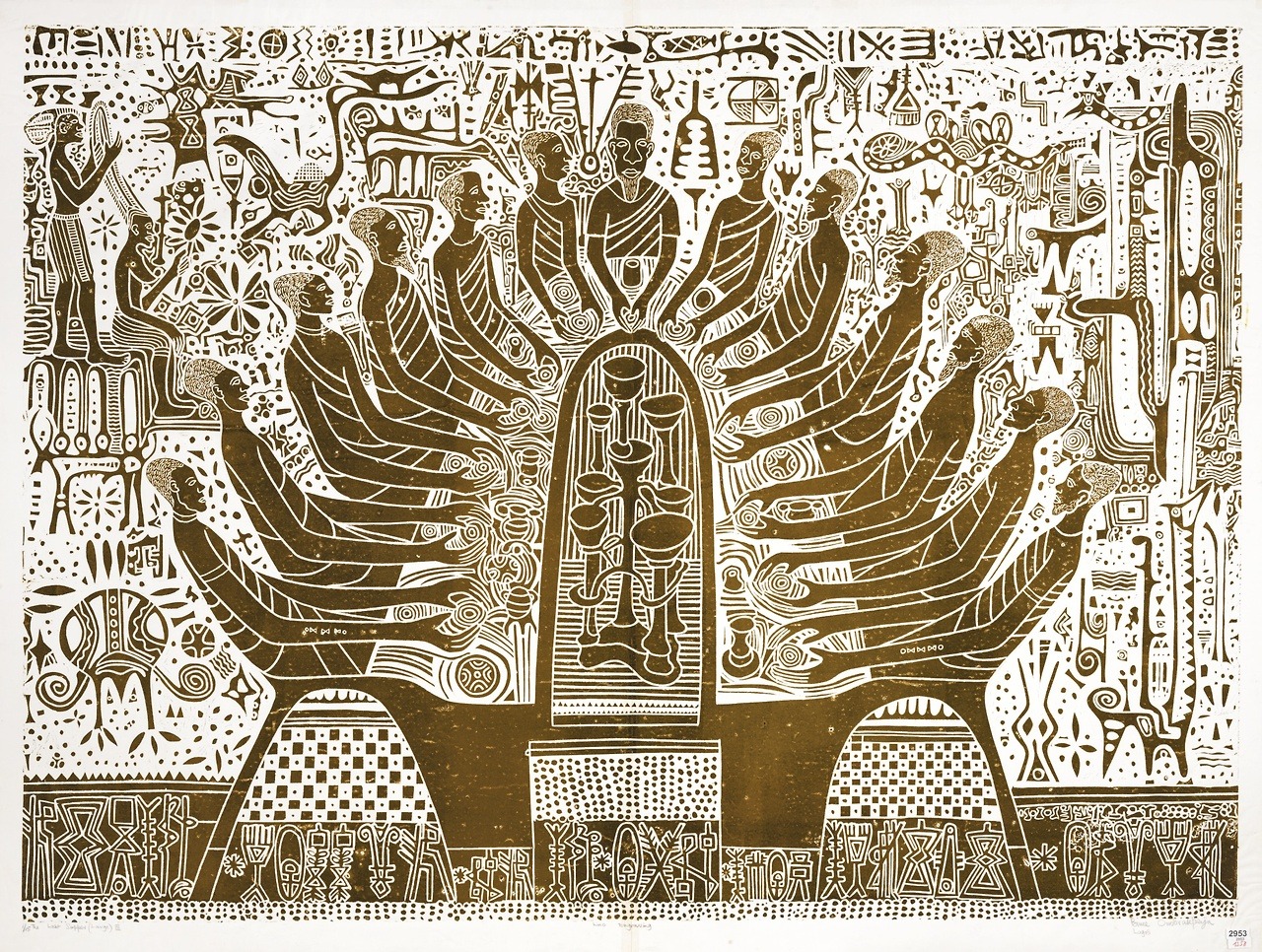
Bruce Onobrakpeya (Nigerian, 1932–), The Last Supper III. Lino engraving on rice paper, 58 × 62 3/4 in. (147 × 195 cm). Edition 1/15.

A pioneer of modern African art, Bruce Onobrakpeya is an internationally renowned Nigerian printmaker, painter, and sculptor of Urhobo heritage. He was raised Christian and has fulfilled several commissions on Christian themes, especially from 1967 to 1981. (I wrote about his Stations of the Cross series of colored linocut prints on my old blog.) His work also explores Urhobo traditional religion, culture, and history and the modern world of Nigeria.

In Onobrakpeya’s Last Supper III, Jesus sits at the head of an oblong table with his twelve disciples, making eye contact with the viewer. The food and drink are highly stylized, but the men appear to be breaking bread. The background features the Ibiebe alphabet, a script of ideographic geometric and curvilinear glyphs that Onobrakpeya developed.

LISTEN: “Take, Eat” by Josh Garrels, on Chrysaline (2019)

Take, eat
This is my body
Broken for your healing
This is my blood
Shed for remission
And forgiveness of your sin

Do this to remember what I’ve done for you
Do this to remember me

Roundup: Pippy the Piano, “The Cobblestone Gospel,” and more

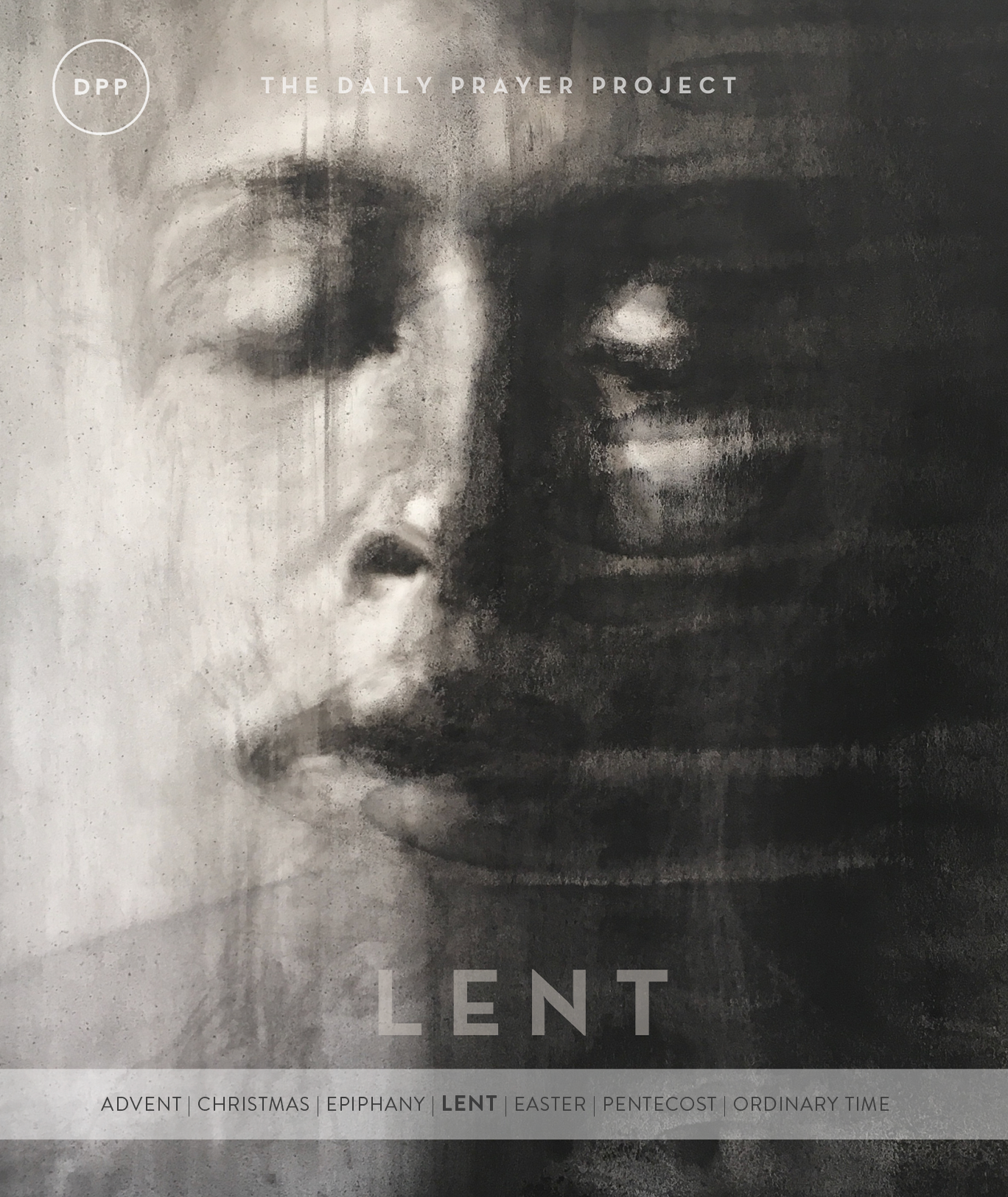
The Lent 2021 edition of the Daily Prayer Project prayerbook is now available, covering February 17–April 3. (I serve as curator.) The stunning cover image is Prayers of the People I by Meena Matocha, who works in charcoal, ashes, acrylic, and wax. You can purchase the booklet in either digital or physical format.

In the opening letter, Project Director Joel Littlepage writes, “Lent is a season that disturbs many people. Maybe that includes you. Among Protestant Christian communities that I have been a part of over the years, Lent can either be seen as a ‘graceless,’ ‘harsh,’ ‘legalistic’ part of the Christian year or, on the other hand, trivialized into a time to ‘pick something to give up,’ like a seasonal spiritual diet plan. Both these characterizations miss the mark.” He goes on to describe the bidirectionality of the Lenten journey: downward, as we are crucified with Christ, and upward, toward the victory of resurrection and new life. “It is a season to sense again the path of the Christian life.”

+++

NEW CHILDREN’S BOOK: Pippy the Piano and the Very Big Wave by Roger W. Lowther, illustrated by Sarah Dusek: My friend Roger Lowther [previously], director of Community Arts Tokyo and host of the Art Life Faith podcast, has written his first children’s book, which released in December. It’s inspired by the story of a church in Kamaishi, who after the 2011 tsunami found their beloved piano upside down and covered in mud and debris but, rather than discard it, decided to spend enormous amounts of time and money to restore it—a picture of God’s love for his precious creation, and the lengths he went to to demonstrate that love. Hollywood and Broadway actor Sean Davis reads the book in the video below. [Available on Amazon]

+++

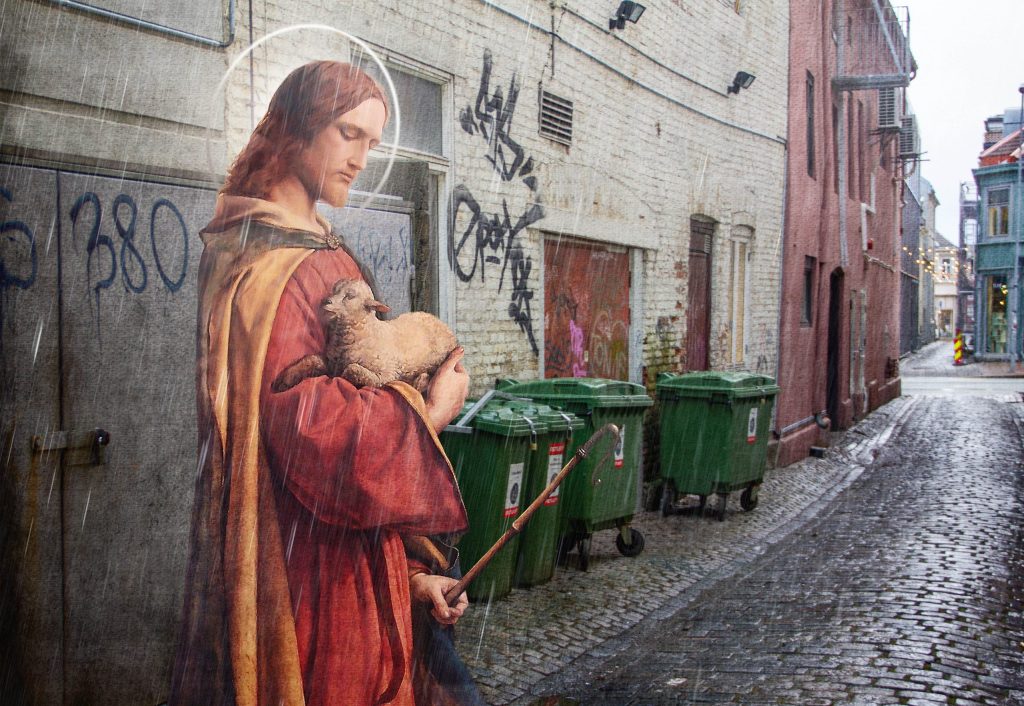
EXHIBITION: The Cobblestone Gospel by Trygve Skogrand, Vår Frue Kirke (Our Lady Church), Trondheim, Norway, July 2020–April 2021: “An exhibition of collages of historic low-church art merged with photographs of our own contemporary surroundings. The essence of the works is the meeting. Between painting and photography, the mystical and the mundane, and how the meeting makes both worlds renewed and re-visibled.” The original advertising says the exhibition is open Mondays through Saturdays from 12 to 3 p.m., but I’m not sure whether COVID has changed that; you can contact the church here.

Skogrand, Trygve_Found
Trygve Skogrand (Norwegian, 1967–), Found, 2020. Collage / pigment print on paper.

Skogrand, Trygve_The Beloved
Trygve Skogrand (Norwegian, 1967–), The Beloved, 2020. Collage / pigment print on paper.

In October Skogrand described the impetus behind his work to Edge of Faith magazine:

When I was a child, I went to a Christmas party at our local church. At the end of the party, every child got a small bag of gifts to take home. In the bag: a pack of raisins, a small orange, some sweets – and a prayer card showing Jesus in paradise. Oh, how beautiful I thought the small prayer card was! Jesus and butterflies and a sunset and flowers AND a golden glittery border. A wonder of loveliness and holiness!

Move on twenty years. I was 30, had started working as an artist, and found the bible card again. I had changed, and the card too. Instead of seeing loveliness, I found the card rather sad. It looked to me as if Jesus was imprisoned in a dusty and suffocating make-believe paradise.

Then it struck me: What if I remove the paradise?

I have now been working with the merging of high and low historical Christian art with our contemporary surroundings for twenty years. For me, this process not only binds together what nowadays normally is shown as sundered but also re-actualizes the classical art and infuses the everyday, modern surroundings with holiness.

+++

MUSIC VIDEO: “Fear Thou Not” by Josh Garrels: This beautiful new setting of Isaiah 41:10 by Josh Garrels appears on Garrels’s 2020 album Peace to All Who Enter Here [previously]. “Fear thou not; for I am with thee: be not dismayed; for I am thy God: I will strengthen thee; yea, I will help thee; [and] I will uphold [you] with the right hand of my righteousness” (KJV).

+++

SHORT FILM: A Colorized Snowball Fight from 1896 Shows Not Much Has Changed in the Art of Winter Warfare: This is pure joy! “A short clip, originally captured by Louis Lumière in 1896, documents a rowdy snowball fight [bataille de boules de neige] on the streets of Lyon, France. Thanks to Saint-Petersburg, Russia-based Dmitriy Badin, who used a combination of the open-source software DeOldify and his own specially designed algorithms to upscale and colorize the historic footage, the video of the winter pastime is incredibly clear, revealing facial features and details on garments.”

Advent, Day 5: Peace

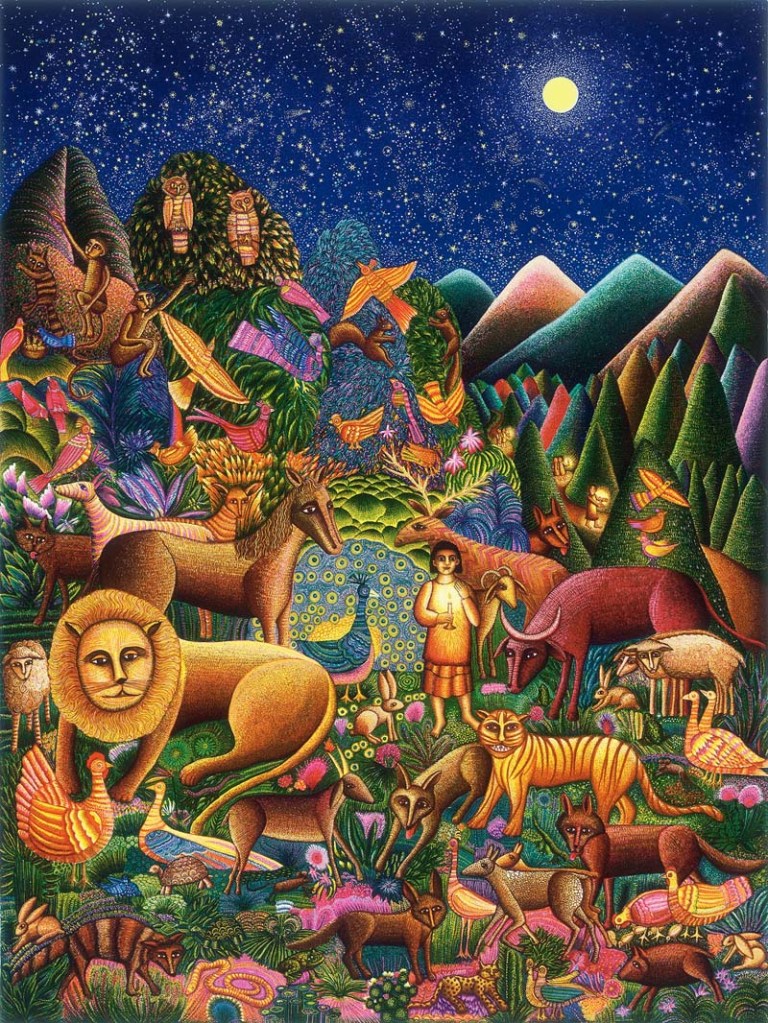
LOOK: John August Swanson (American, 1938–), Peaceable Kingdom, 1994. Serigraph, edition of 250, 30 × 22 1/2 in.

Swanson, John August_Peaceable Kingdom

John August Swanson, a Los Angeles–based artist of Mexican and Swedish heritage, says his style is “influenced by the imagery of Islamic and medieval miniatures, Russian iconography, the color of Latin American folk art, and the tradition of Mexican muralists.” In this forty-seven-color serigraph (limited-edition screen print), monkeys, frogs and lizards, mice and rabbits, owls and peacocks, a pig and a turtle accompany the wolves, lambs, leopard, goat, lion, ox, and snake of Isaiah 11, a vision of creation restored and at peace.

LISTEN: “O Day of Peace” | Words by Carl P. Daw Jr., 1982 | Music by Josh Garrels, on The Light Came Down, 2016

O day of peace that dimly shines
Through all our hopes and prayers and dreams
Guide us to justice, truth, and love
Delivered from our selfish schemes

May swords of hate fall from our hands
Our hearts from envy find release
Till by God’s grace our warring world
Shall see Christ’s promised reign of peace

Then shall the wolf dwell with the lamb
Nor shall the fierce devour the small
As beast and cattle calmly graze
A little Child shall lead them home

Then the meek shall learn to love
All creatures find their true accord
The hope of peace shall be fulfilled
For all the earth shall know the Lord

(Related post: “The Peaceable Kingdoms of Edward Hicks”)


For each day of the first week of Advent I am publishing one art-and-song pairing as an invitation for seasonal reflection.

Roundup: Santo Spirito, Joan of Arc, “Halo My Path,” and more

VIDEO: “Ned Bustard: Making Good”: Cursive Films profiles Ned Bustard [previously], a graphic designer, linocut artist, and founder of Square Halo Books. Asked how he as a Christian defines success in his field, he responds with a quote by his friend Kurt Thompson: “We were made in joy to make things in and for joy.” So instead of asking, “Am I successful?,” we should be asking ourselves, “Am I doing what I was designed to do?,” Bustard says.

+++

ESSAY: “I’d Like to Learn to Love It Anyway” by Helena Sorensen: In this personal essay from the Rabbit Room, Sorensen reflects on the world’s brokenness and beauty, a world where there is grief and disappointment and uncertainty and scarring but also love and springtime and strength and song. She opens by recounting her eleven-year-old son’s very visceral feeling of pain in reaction to the death of a baby bird, and his exasperated “What’s the point of it all?” She then introduces a song that crystallizes her son’s struggle—“Letter to the Editor” by J Lind—while sharing her own struggles, since adolescence, to accept her body. There’s no theodicy here, no theological explanations for suffering; just an aspiration to live with openness and gratitude and perspective, and to take the bad along with the good, the cost of being human.

+++

NEW POEM: “Santo Spirito” by Jacqueline Osherow: (Read the poem before reading my commentary; I don’t want the latter to influence your first impressions!) Osherow is Jewish and also a lover of Renaissance art, having previously lived in Florence for a year and a half. And she has been enamored of birds since childhood. These influences coincide in her long free-verse poem “Santo Spirito” (Italian for “Holy Spirit”), subtitled “Autobiography with Doves.” Here she traces the presence, and sometimes absence, of the dove as symbol of the Holy Spirit in Italian master paintings of the Annunciation and the Baptism of Christ. Osherow said she does not read the New Testament but experiences Christian narrative and theology through art, which has “been working / on me all along, its proselytizing / deftly subliminal // like the edgy / come-ons urban / legend claims / were strategically / concealed in / advertisements.” (Still, she says, “I remain a Jew, . . . no matter / what I look at, what / I see.”)

Santo Spirito
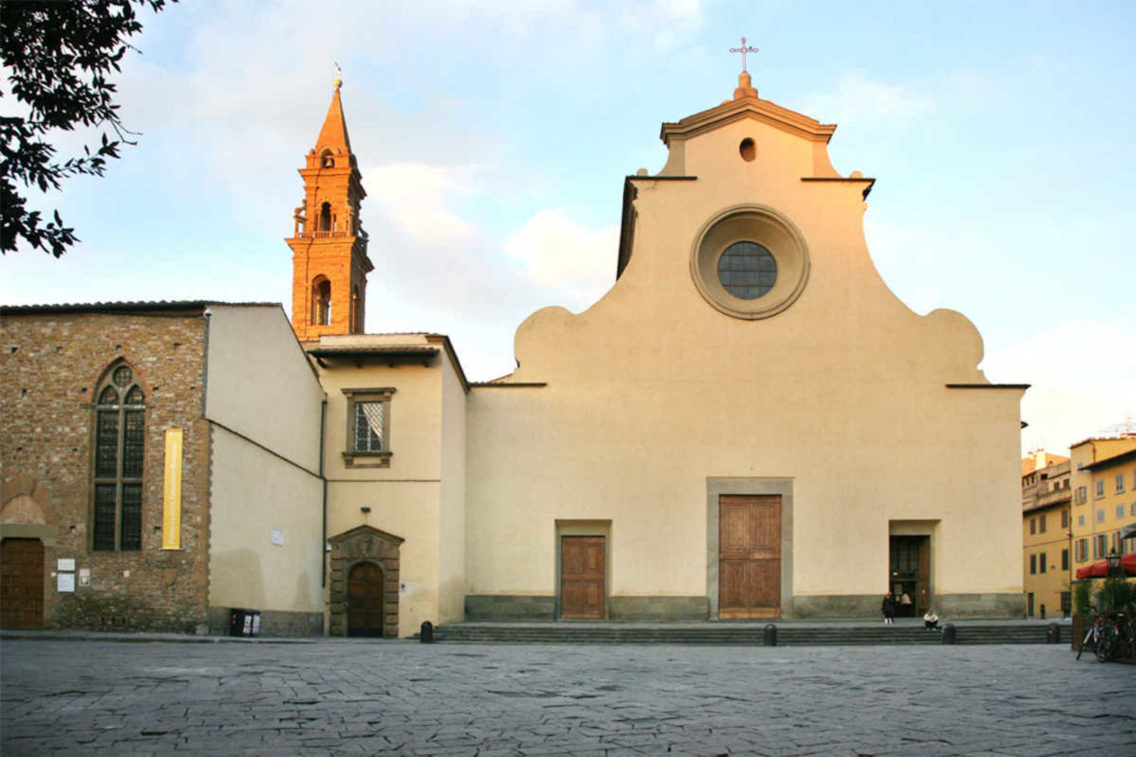
Basilica di Santo Spirito, Florence

The poem is a reflection on divine revelation and hiddenness, precision and mystery, the visible and invisible. Where and how does God’s spirit reside? What is holy, or can we say only when we encounter it? The poem hinges on the fifteenth-century Florentine church the poem takes its title from. Santo Spirito has a strikingly plain façade, a “supple blankness / wide-open, burning, / immaculate, . . . infinite,” like an unrolled scroll without writing. After a catalog of religious art that pictures and describes, Osherow pauses in front of this emptiness that is likewise inviting. Yes to artists’ visions, she says, to doves and other literalisms, to the transcription and translation of God’s word, to apologetic discourse and theologizing, to bumbling our way toward truth—but yes also to the way of unknowing.

My junior year of college I, too, lived in Florence—just a few minutes’ walk from Santo Spirito, in fact—so this poem is full of memories for me, and I love Osherow’s candid reflections on specific artworks in the city:

Plus these two:

  • The Baptism of Christ by Piero della Francesca, made for the Priory of San Giovanni Battista at Sansepolcro in Tuscany, now in the National Gallery, London
  • The Annunciation panel of an altarpiece Piero della Francesca made for the Franciscan convent of Sant’Antonio da Padova in Perugia, now in the Galleria Nazionale dell’Umbria

Jacqueline Osherow read her poem recently for an Image-sponsored Zoom event followed by a Q&A (video link available on poem page). There were supposed to be photo slides of the paintings keyed to relevant stanzas, but the display doesn’t correct until 8:03.

+++

NEW SONG: “Halo My Path” by Josh Rodriguez: The words to this “quarantine chorale” are excerpted and adapted from a Puritan prayer titled “Voyage,” from the compilation The Valley of Vision. Composer Josh Rodriguez said he wrote the song “as I watched the bravery of medical professionals, the difficult decisions that government leaders faced, the disproportionate suffering of the poor, the unrest in my own heart. . . . I hope this prayer will challenge us to fight against the selfishness that resides in our hearts, to persevere in the long road to recovery, to appreciate once again that simple privilege of life together.” I’m grateful to Rodriguez for throwing this beautiful phrase into high relief: “Halo my path,” an address to God. Make bright my way, sanctify it, illuminate it with gentleness and love so that my every step is into the light of these virtues, not into the darkness of causticity and hate. The song is an aspiration to bless, to sow gladness rather than grief.

Halo my path with gentleness and love,
smooth every temper;
let me not forget how easy it is to occasion grief;
may I strive to bind up every wound,
and pour oil on all troubled waters.
May the world be happier because I live.
Halo my path.

+++

NEW ALBUM: Peace to All Who Enter Here by Josh Garrels: A mix of calming hymns and worship songs, including two previously unreleased originals: “Fear Thou Not” and “Creation Song.” I’ve long had a strong emotional connection to the opening song, “Turn Your Eyes Upon Jesus,” so I was hooked from the beginning!

“in the month of march the world entered a time of quarantine,” Josh’s wife Michelle writes on the album’s Bandcamp page. “our life of work- and school-from-home continued basically as usual. but beyond the boundaries of our yard, the world was rapidly shifting. instinctively for us, it was a time to pray & praise. when we enter into praise in times of uncertainty, we feel God’s goodness, the everything in His hands. His peace is a real, sustaining thing. josh began these days by firelight in the garage, mornings of prayer while winter melted away into hopeful spring. in the afternoons he’d turn on the recording gear & sing out praises. You’ll hear the click of the wood stove, the chirping of birds, our five children playing in the front yard. there was a spontaneity to this recording, & the result is sweet. . . . we hope you encounter the peace of Christ as you enter here, finding hope & faith restored in these turbulent times.”

+++

FILMS:

May 30 is the feast day of Joan of Arc, a French peasant girl who, during the Hundred Years’ War, claimed to have received visions from God instructing her to fight against English domination. She participated in military campaigns with the French army but was eventually captured and, after a trial financed by the English crown, burned at the stake. She was later sainted.

Joan of Arc has been the subject of many films. Here are two I’ve seen, both of which abandon glamorous military heroics to focus instead on some of the less flashy parts of her life, with Jeannette being set during her pre- and early adolescence, and The Passion during her trial.

Jeannette: The Childhood of Joan of Arc (2017): A thrash metal period musical is certainly a unique approach to take for Joan’s story, and this movie is . . . eccentric. It shows Joan, played by nonprofessional actors at ages eight and thirteen, as a shepherd girl in rural France, deeply pained by the English oppression of her people. “Our Father who art in heaven, your name is so far from being hallowed, and your reign from coming,” she laments. Pious beyond her years, she struggles to discern God’s will, and once she does, to follow it. She’s helped along by visions of the nun Madame Gervaise—whom writer-director Bruno Dumont splits into two singing, dancing figures played by twins—and others.

The ridiculousness of this art-house film will be off-putting to some, but I feel it does serve a function: we furrow our brows and roll our eyes and wonder if it’s for real, much like those contemporaries of Joan’s who were dismissive of her strange claims and behaviors.

The dialogue is adapted from Charles Péguy’s 1910 mystery play The Mystery of the Charity of Joan of Arc.

The Passion of Joan of Arc (1928): Starring Renée Falconetti in a legendary performance, this silent film classic paints Joan as a Christ figure who’s mocked and martyred for her refusal to betray God’s will. There are allusions throughout to Christ’s passion: shadows form a cross on the wall; Joan weaves a crown of straw; there’s a bloodletting scene; et cetera. Expressionistic lighting and painfully intimate close-ups immerse viewers in Joan’s subjective experience. (As a sidebar, Falconetti was thirty-five when she played the role, whereas Joan was only nineteen when she was tried and martyred; I think because Falconetti’s portrayal is so iconic, people often forget how young Joan was.)

Director Carl Theodor Dreyer was very concerned with documentary authenticity, so he enlisted the leading expert on Joan of Arc, Pierre Champion, as a historical adviser on the film. The script is based heavily on transcripts of Joan’s trial and execution, which are held at the Bibliothèque Nationale in Paris. The French ecclesiastical court, allied with the English, press Joan on the veracity of her visions, her certainty of salvation, her support of Charles VII, her wearing of men’s clothing; she continues to insist that she is fulfilling the mission God called her to. Though the historical Joan was subjected to twenty-two interrogation sessions spread out over a few months, by necessity the movie telescopes them into a brief timespan.

Many composers have written scores for the film. The Criterion release gives three options: Richard Einhorn’s Voices of Light oratorio, which takes a traditional, maximalist approach; a score by Goldfrapp’s Will Gregory and Portishead’s Adrian Utley, utilizing electric guitars, voices, synthesizers, brass, harp, and percussion; and a minimalist piano score by Mie Yanashita. However, purists say the film should be watched in silence, as Dreyer preferred.