The hour has come for the Son of Man to be glorified. Very truly, I tell you, unless a grain of wheat falls into the earth and dies, it remains just a single grain, but if it dies it bears much fruit.
—John 12:23–24
Jesus spoke these words after his entry into Jerusalem to the acclamation of throngs, and then proceeded to prophesy his own death.
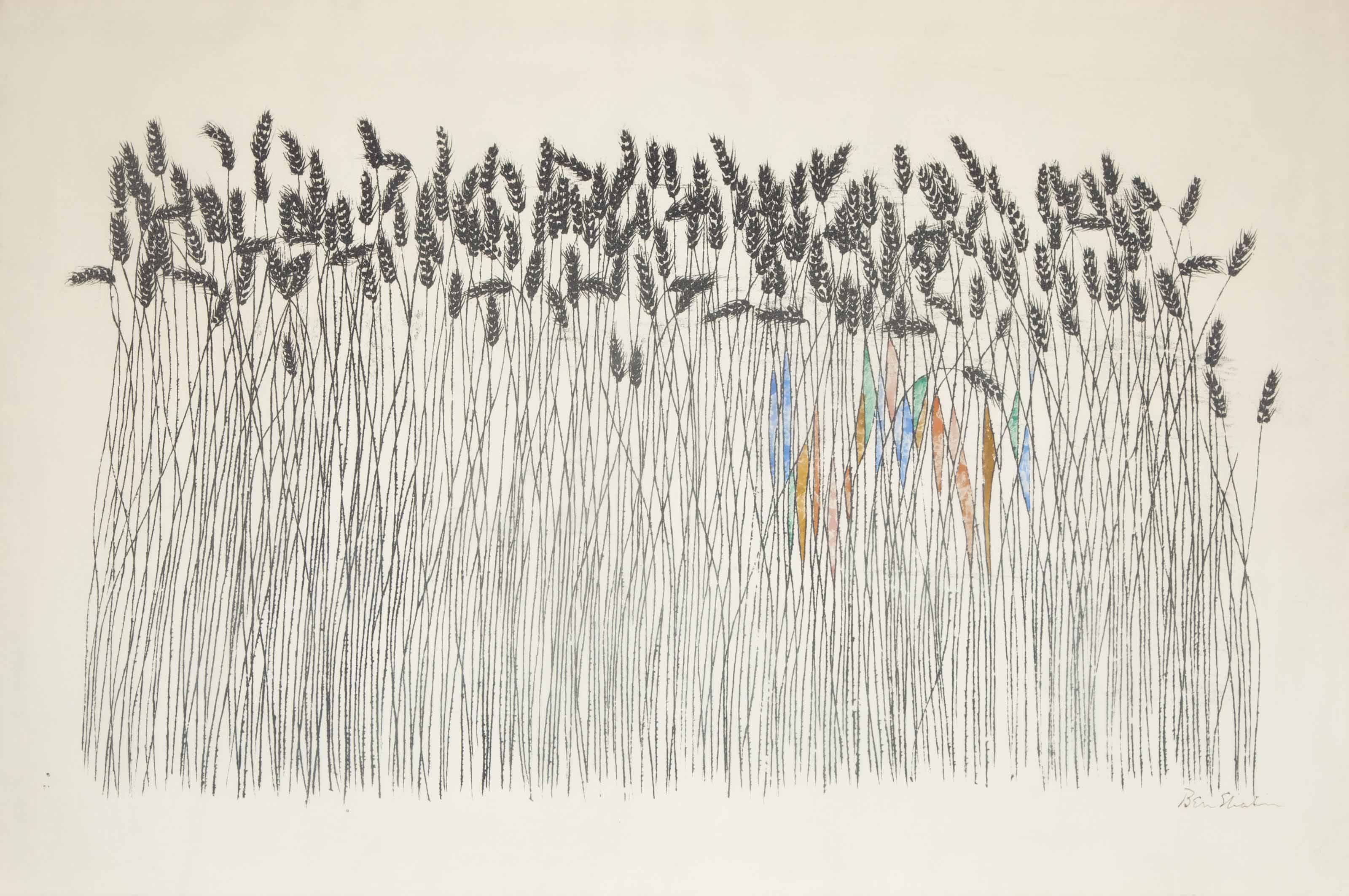
LOOK: Wheat Field by Ben Shahn
Ben Shahn (American, 1898–1969), Wheat Field, 1958. Photolithograph, 16 × 25 1/2 in. (40.7 × 64.7 cm).
This piece for violin and piano was commissioned by City Church Philadelphia (now Resurrection Philadelphia), where it premiered in March 2019. The recording features David Danel on violin and Bethany Danel Brooks on piano.
>> The Divine Dark, vol. 1: This three-song EP was released December 15, 2024, on Re-Echo Records, a new label for music created by artists from Resurrection Philadelphia church. “The Divine Dark is an ongoing series of original arrangements and compositions for devotion, contemplation, and edification. The series takes its name from a phrase that emerged in the fifth century among Christian mystics to describe the ineffable unknowableness of God . . . in all his kindness, grace, and mystery.”
The first volume features new arrangements by Joshua Stamper [previously] of two seventeenth-century German hymns (both translated into English by Catherine Winkworth, and sung here by Sarah Long), plus one new hymn that Stamper wrote with his wife, Kory Stamper, whose refrain is taken from Psalm 127:4. The songs quietly explore the mysteries of salvation, the Eucharist, and God’s sovereignty as well as some of the paradoxes of God’s character, such as his being both storm and shelter (wild and thundering, but also safe and enfolding).
Volume 2 of The Divine Dark is likely to release later this year.
>> It Is Good to Be Here with You by Nick Chambers: Out today, the first full-length album by singer-songwriter Nick Chambers. These songs of spiritual seeking touch on sobriety, divine nearness, ambiguity and wonder, the pursuit of understanding or insight, the longing to be held and loved, and more. Chambers deftly weaves voices from scripture—the blind beggar Bartimaeus, who cried out to Christ for mercy; the sons of Korah, who thirsted for God like a deer thirsts for water; the apostle Paul, who experienced a frustrating tension between desire and action—with his own poetic voice, finding companionship with those ancient seekers who were transformed by their encounters God. There’s reference to the wrestling patriarch Jacob, the blazing bush-vision of Moses, Elijah in a wilderness cave, the mount of Transfiguration, the eighth day of creation. Besides biblical texts, the songs bear influences from writers Rainer Maria Rilke, Madeleine L’Engle, Gregory of Nyssa, and Esther de Waal.
The album features some co-writing contributions by Jon Guerra (“Hold Me”), Paul Zach (“A Sweeter Word,” “Always Already”), and Tyson Matthews (“It Is Good to Be Here with You”).
My favorite tracks: “To an Unknown God,” “Hear,” “Thanks Be to God.”
+++
NEW ART COMMISSION: Memorial to Enslaved Persons by Harmonia Rosales, King’s Chapel, Boston:Harmonia Rosales, an Afro-Cuban artist born and raised in Chicago and living in Los Angeles, is at work on a three-part commission for the historic King’s Chapel at 58 Tremont Street in Boston, a church originally built in wood in 1686 and then rebuilt in stone in the 1750s. One of the oldest churches in the United States, it (and its adjacent burying ground) is one of the stops along the Freedom Trail, and it still has an active congregation.
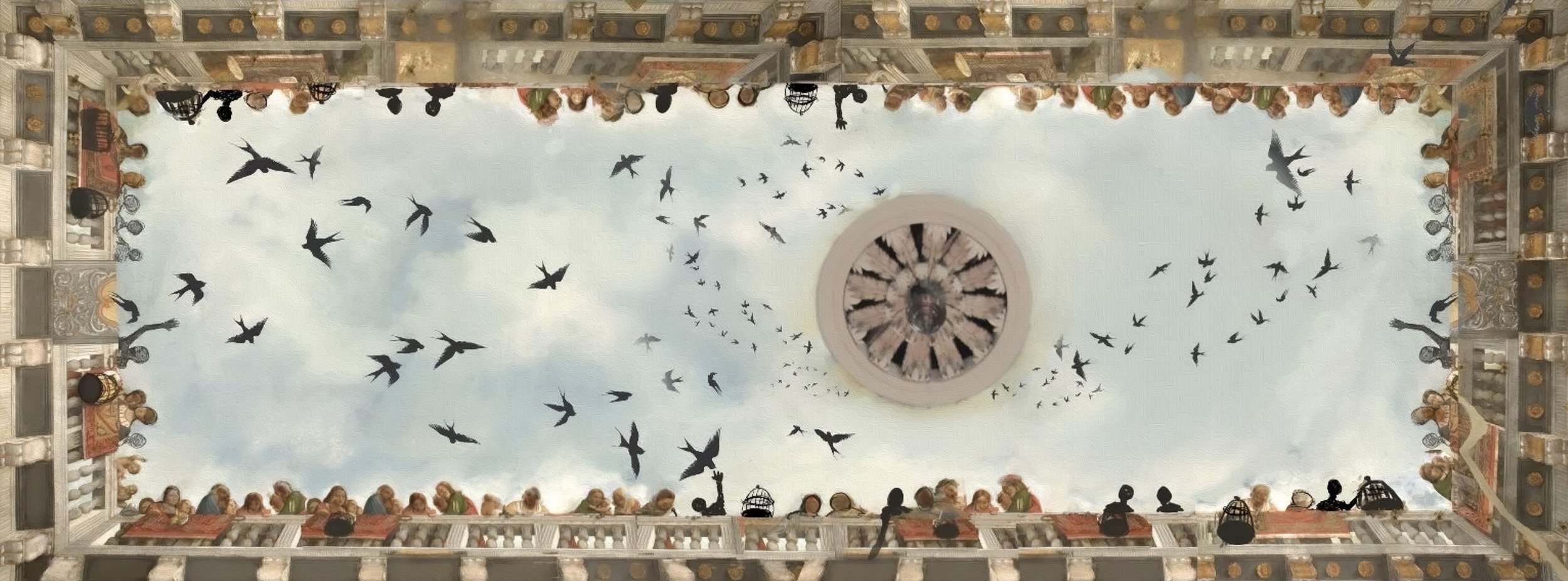
Conceptual image of the mural by Harmonia Rosales that’s being installed this year on the ceiling of King’s Chapel in Boston, Massachusetts
Despite being in the North, King’s Chapel has links to the slave trade. Historical documents reveal that at least 219 persons, most of them of African descent but at least two of them Native American, were enslaved by ministers and members of the church throughout its history, and that even after slavery was abolished in Massachusetts in 1783, donations to the church continued to flow in from people whose wealth depended on Southern slave labor, such as textile magnates. You can read more details in Slavery and King’s Chapel, the thirty-two-page report published by King’s Chapel’s Ad Hoc Committee on Slavery in 2018.
Until at least the mid-nineteenth century, people of color, both enslaved and free, who attended King’s Chapel were relegated to the balcony seats. We know the names of 182 enslaved attendees from the church’s baptismal, marriage, and burial registers. “As a community of faith,” the church writes on its website, “we are working to recover, honor, and remember these long-overlooked members of our community. We hope to make their lives and their presence in early Boston visible in new and powerful ways as we tell a more complete version of our history for our congregation, our city, and the 4 million people who walk the Freedom Trail each year.”
In addition to setting up a “living fund” to “provide monetary support for programs and engagement centered around reparative justice and reconciliation in the community,” the church has hired artist Harmonia Rosales, in partnership with the MASS Design Group, to create a physical commemoration of this history, which has three components: a figurative sculpture in the church’s courtyard, a collection of bronze birds perched throughout the church’s exterior and grounds, and a trompe l’oeil ceiling mural in the sanctuary. The memorial will be unveiled later this year. Here are two videos about it:
>> “How a Freedom Trail landmark is reckoning with its ties to slavery,” GBH News, July 19, 2023: This news segment features interview clips of Cassandra Dumay and Jessie Sage O’Leary, Boston University journalism students who are inquiring further into King’s Chapel’s links to the colonial slave trade; Rev. Joy Fallon, senior minister at King’s Chapel; Marissa Cheifetz, director of the King’s Chapel History Program; and memorial committee member David Waters.
>> “VCS Creative Conversations: Ben Quash with Harmonia Rosales,”Visual Commentary on Scripture,February 27, 2025: Theologian and VCS director Ben Quash sits down with artist Harmonia Rosales inside King’s Chapel to discuss her latest commission for that space, plus her paintings Birth of Oshun, The Creation of God, Strangler Fig, and more. Raised in the Santería religious tradition, in her art Rosales draws Yoruba deities (the orishas) into play with Christian ones and centers Black women. Speaking of the VCS’s commitment to showcasing biblical engagement from diverse vantage points, Quash tells Rosales, “We’ve always said that these conversations should not just be about the Bible’s importance to Christians or Jews, but the Bible’s importance to those of other traditions, as something to bounce off, to use, sometimes to object to. And you are a wonderful example of how to do that in a way that’s constantly creative and generous.”
+++
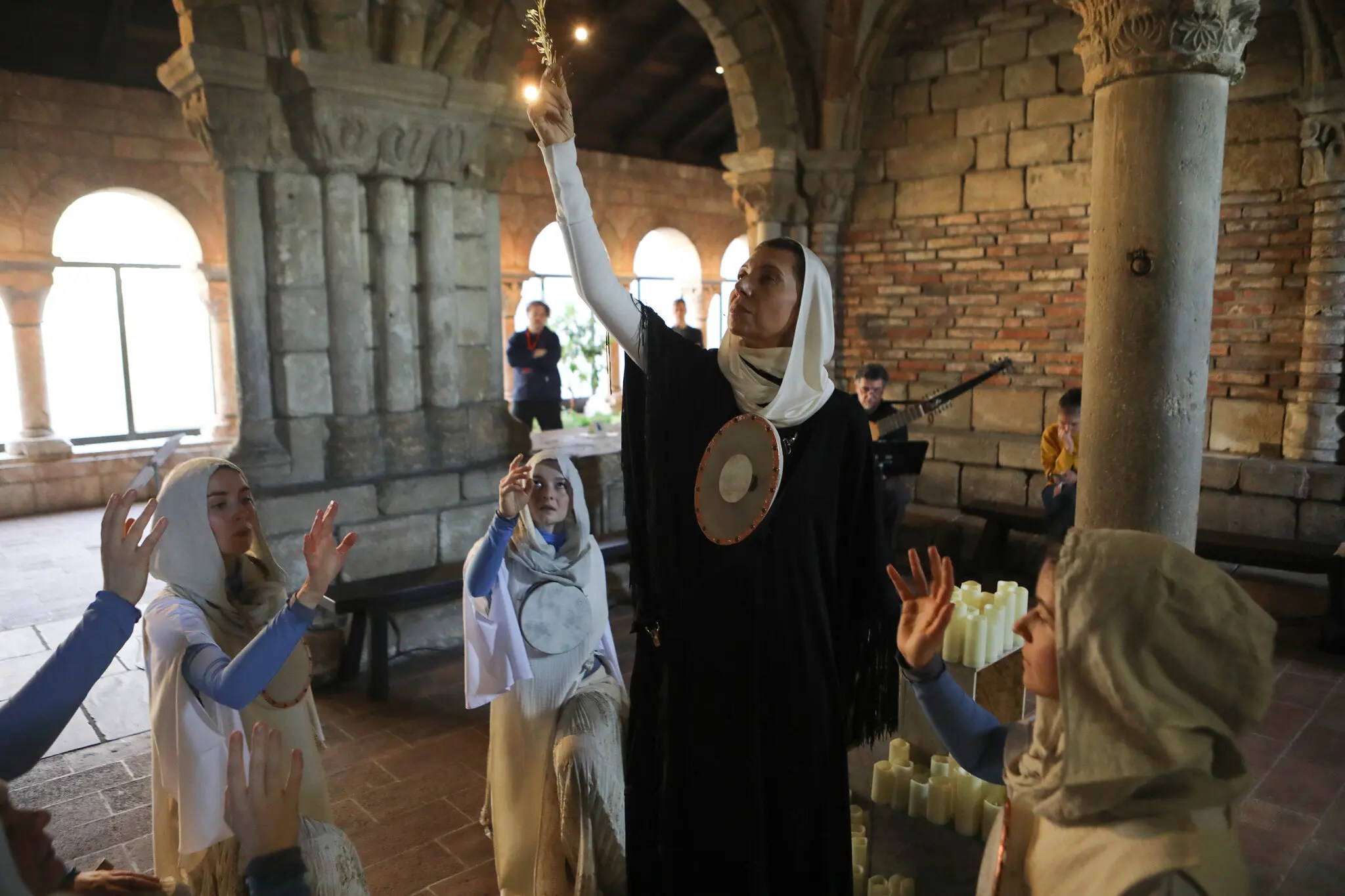
ARTICLE: “At the Cloisters, Sor Juana’s Words Ring Out in Song” by Elisabeth Vincentelli, The New York Times:Primero Sueño (First Dream) is a new opera by Magos Herrera and Paola Prestini that adapts to music the seventeenth-century mystical poem of the same title by the Mexican Catholic nun Sor Juana Inés de la Cruz, one of the greatest literary works of the Hispanic Baroque. Commissioned by the Metropolitan Museum of Art’s Department of Live Arts (MetLiveArts) and VisionIntoArt, it was conceived as a processional opera that meanders throughout the Met Cloisters, audience in tow—an appropriate choice, as the poem is about the soul’s journey. It premiered January 23, with Herrera playing Sor Juana, the nun in black, “sing[ing] in an earthy mezzo that complements the heavenly harmonies of the six nuns in white, performed by the German vocal ensemble Sjaella.” Accompaniment was provided by harps, hand percussion, theorbo, and Spanish guitar. Here’s a trailer (not filmed on location):
Magos Herrera, center, as Sor Juana in a rehearsal of the opera Primero Sueño at the Met Cloisters. Photo: Earl Wilson / The New York Times.
The Cloisters—a building designed to evoke a medieval European monastery and housing a sizeable portion of the Met’s medieval art collection—is one of my favorite spaces in all of New York. What a delight that Herrara, Prestini, and team utilized its halls and rooms as staging ground for this dramatic, musical reimagining of a historic sacred poem by a pioneering female Christian writer.
+++
INTERFAITH ART EXHIBITION: Cloud of Witnesses: Images of Faith and Divinity Today, St John’s Waterloo, London, March 4–April 27, 2025: A juried exhibition featuring the work of twenty-six artists from the UK, funded and supported by Art + Christianity; The God Who Speaks; St John’s Church, Waterloo; the Catholic Bishops’ Conference of England and Wales; Culham St Gabriel Trust; and Bible Society. Click here to view the exhibition catalog.
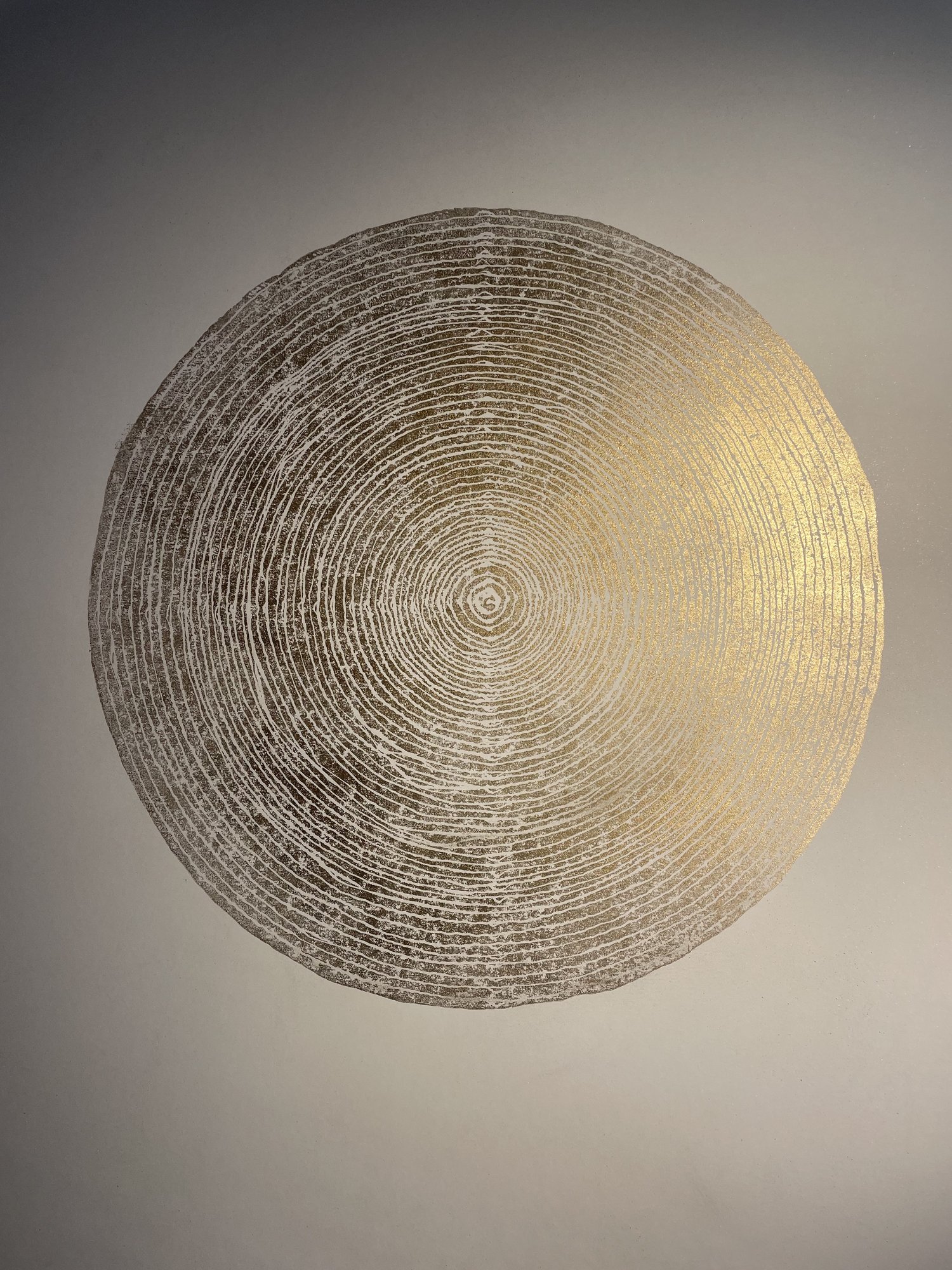
The image used for the cover of the exhibition catalog is Life 1, a linocut by Svetlana Atlavina consisting of fifty golden concentric circles that she said represent the vibrations of the heart—the sounds constantly being emitted from our cardiac valves, which mean we’re alive.
Svetlana Atlavina, Life 1, 2024. Handmade linocut with gold ink on 300g white Somerset paper, 70 x 50 cm.
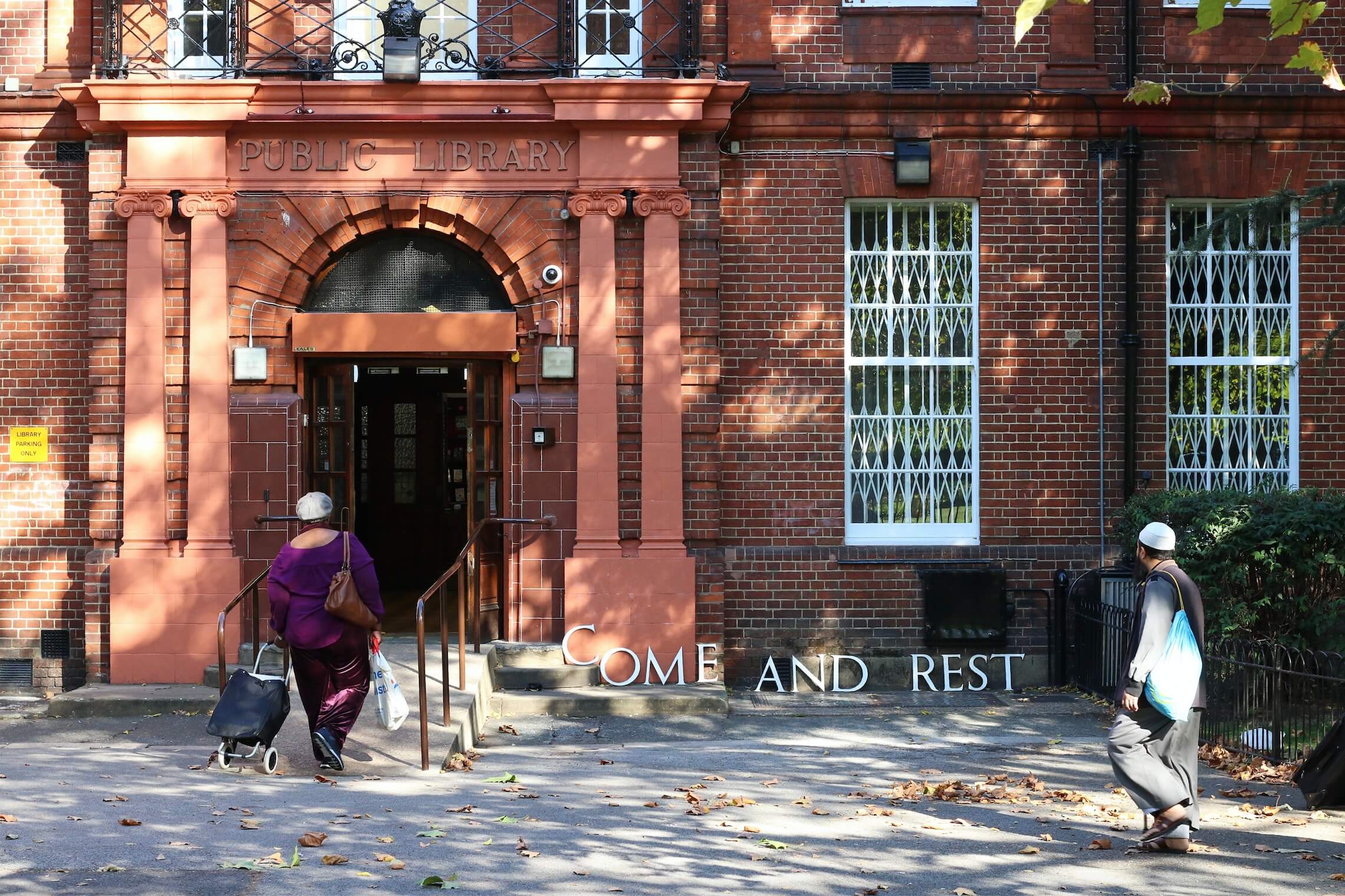
The work that I find most compelling is the eight-piece series of COME AND REST photographs by Kirsty Kerr.
Kirsty Kerr, COME AND REST: Bethnal Green Library, 2018. Photograph of a public intervention, from a series, 30.5 × 44 cm. Documentation by Will Alcock.
COME AND REST documents a series of public interventions informed by the demolition and rebuilding of Bethnal Green Mission Church. Taking letters from a scripture text that had hung on the old building (Jesus’ words: ‘Come to me and I will give you rest’), Kirsty spelt the phrase in Bethnal Green locations, recording the process with local filmmaker Will Alcock. The words were a gentle yet radical proclamation: of welcome, refuge, and quiet protest against loneliness and exhaustion often synonymous with city life. The act of spelling them out became a performed prayer, symbolic of the church’s continued presence and God’s enduring invitation.
Against the backdrop of this racially and religiously diverse neighbourhood, the words were both witnessed to and overlooked by passers-by of all faiths and none.
Kerr displayed Christ’s invitation in fields and basketball courts, on street corners and scaffolding and bandstand steps, outside subway stops and housing estates and libraries. View the full series here, using the right scroll arrow. I also enjoyed exploring the artist’s other projects on her website.
+++
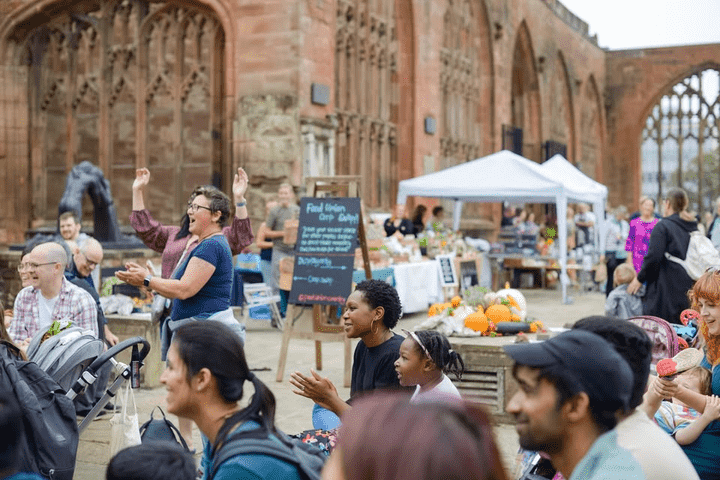
EVENT: Taste of Heaven Intercultural Worship Festival, Coventry Cathedral, May 24, 2025: Organized by Intercultural Churches UK. “The Taste of Heaven Festival will be an exciting opportunity to celebrate the rich cultural diversity and creativity of the UK church through live performances, workshops, food and worship. The festival will take place in the iconic venue of Coventry Cathedral and its beautiful surrounding ruins. The day will trace our history of increasing diversity, by highlighting different cultural worship expressions from Celtic to Choral, South Asian and Caribbean, to more recent immigrant communities including Middle Eastern, African, and Hong Kong. It will culminate in a celebration of Intercultural Worship, demonstrating how churches can draw from different cultural streams in their corporate worship.” Tickets range from £10 to £25. Register here. [HT: Global Christian Worship]
+++
SPOTIFY PLAYLIST: April 2025 (Art & Theology): The song selections on my short monthly playlists are somewhat random—a smorgasbord of what I’ve been listening to, a mix of brand-new releases and older faves—but for thematic playlists keyed to where we are in the liturgical calendar during April, see my Lent Playlist, Holy Week Playlist (I’m especially proud of this one!), and Eastertide Playlist.
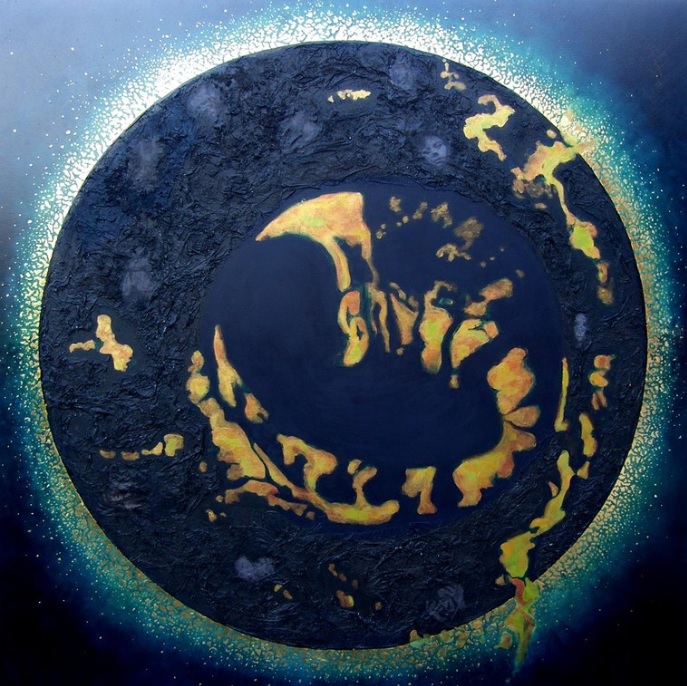
Gerda Smelik (Dutch, 1964–), Advent, 2006. Acrylic, oil paint, gold leaf, paper, wood chips, sand, glue, and photographs on canvas, 160 × 160 cm.
Dutch artist Gerda Smelik says about this mixed media piece:
Advent, a period of reflection and expectation, is portrayed by a globe with a fetus inside. The dark colours stand for the brokenness of life; the light around the fetus and the rays of gold around the globe already announce a better world. When you look at the painting up close, you discover that the suffering of the world is depicted by means of portraits of people in danger and distress.
Make a womb of all this wounded world Make a womb of all this wounded world And make a womb of all this wounded world
Come to be born, to bear us to our birth Make these rags of time our swaddling bands O hidden spring of light Come to us Wisdom, come unspoken Name Come Root, and Key, and King, and holy Flame O quickened little wick so tightly curled Be folded with us into time and place Unfold for us the mystery of grace
Make a womb of all this wounded world Make a womb of all this wounded world And make a womb of all this wounded world
“O Come, O Come, O Hidden Spring of Light” is from Stamper’s PRIMEMOVER, a double album of experimental jazz and classical chamber works commissioned by Resurrection Philadelphia from 2015 to 2021 for services marking holy days and seasons in the church calendar: Ash Wednesday, Good Friday, Easter, Pentecost, and Advent.
PRIMEMOVER is “a meditation on the Divine benediction over our corporeal world,” Stamper writes. “The hovering One . . . has bounded into our wounded world and unbound us from our own trajectory. . . . The abstract is made concrete.”
And, he continues, “It might just be the only record out there featuring everyone from members of the Dirty Projectors to Marilynne Robinson to Beyoncé-collaborators to the former Archbishop of Canterbury to avant-classical violin players from the Czech Republic.”
I love to see churches commissioning smart, exploratory, unconventional music like this!
SONGS: The following two songs appear on the Art & Theology Lent Playlist on Spotify. (Note: I’ve also integrated some Lovkn, Sarah Juers, and a few others into the list since originally publishing it.)
>> “Kyrie / Oh Death,” performed by Susanne Rosenberg: March 11 marks one year since the coronavirus outbreak was officially declared a pandemic, and the tremendous number of lives lost is staggering. (A friend from Japan reminded me that it’s also the ten-year anniversary of the Great Tōhoku earthquake and tsunami that killed some 16,000 people; 3/11, he says, is as important in Japan as 9/11 is in the United States.) This lament by Susanne Rosenberg, one of Sweden’s foremost folk singers, seems appropriate. It combines a twelfth-century Kyrie chant with the Appalachian folk song “Oh Death,” the latter made famous by Ralph Stanley. Kyrie eleison, Christe eleison, Greek for “Lord, have mercy, Christ, have mercy,” is a short, repeated invocation used in many Christian liturgies, and Rosenberg seamlessly integrates it with these few lines: “Oh Death, oh Death, won’t you spare me over till another year?” The video recording is from a February 2010 concert in Dublin, and a similar version of the medley, in a different key, appears on Rosenberg’s album of the same year, ReBoot/OmStart.
>> “Washed in the Blood,” performed by Pokey LaFarge and Harry Melling: The Devil All the Time (2020) isn’t a great movie, but it has a great soundtrack. Harry Melling—known for his roles as Dudley Dursley in the Harry Potter series and, more recently, Harry Beltik in TheQueen’s Gambit—plays a spider-handling preacher named Roy, and singer-songwriter Pokey LaFarge (whose style pulls from ragtime, jazz, country, and blues) plays his guitar-playing sidekick, Theodore. The two actors sing as their characters in the film, this classic hymn by Elisha Hoffman. Love it!
+++
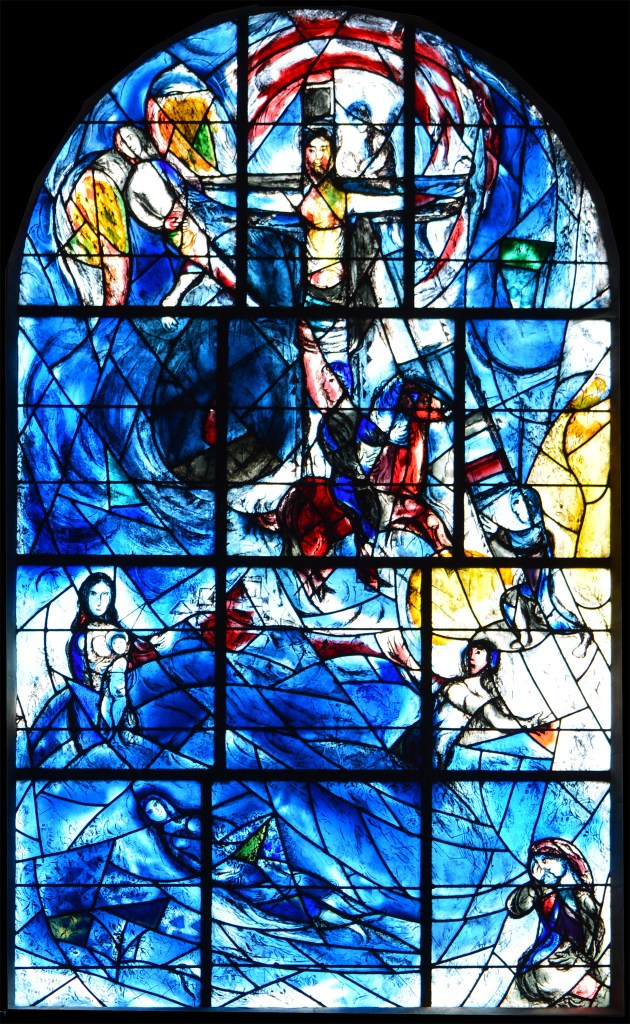
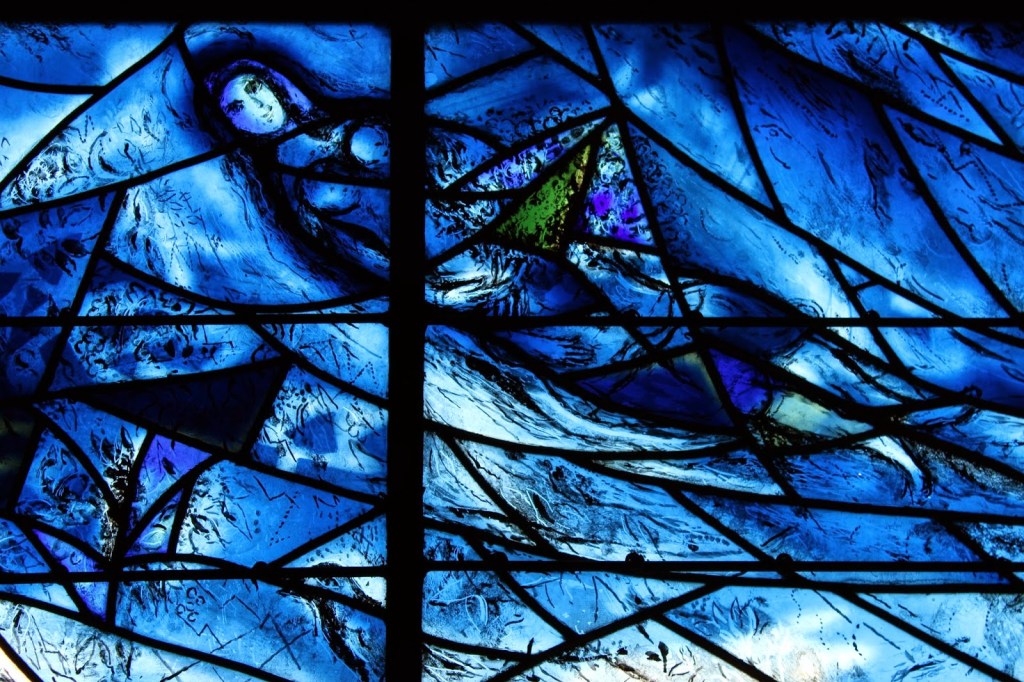
SERMON: “Chagall at Tudeley” by Rev. James Crockford, University Church, Oxford, April 7, 2019: This sermon, preached on Passion (Palm) Sunday two years ago, is an excellent example of how pastors can draw on visual art as a theological and homiletical resource—not to merely illustrate a point already made or to add some pretty dressing to a sermon, but taking it on its own terms and allowing it to generate insight and guide the congregation someplace new. Crockford uses the East Window in All Saints’ Church in Tudeley, Kent, England, designed by the Russian Jewish artist Marc Chagall, to open up profound discussion on human loss, hope, renewal, and the cross. [HT: Jonathan Evens]
The window was commissioned by the parents of twenty-one-year-old Sarah d’Avigdor-Goldsmid, who in 1963 drowned off the coast of Sussex in a boating accident. “What I see in that East Window,” Crockford says, “is a remarkable exercise in the nature of suffering, and the interaction of human tragedy with the reality of Christ’s death and victory on the cross. It is a carefully composed centrepiece that asks us to face the depths of an abiding experience of grief, and to be faced with that grief each time we remember the grief of God, in broken bread and wine outpoured. But the window also shows a bigger picture – one that does not shut out the pains of our past, and the wounds in our hearts – and you’ll notice, when we come to it, that the scene of Sarah’s death still takes up over half of the window – but the bigger picture asks us to frame our grief and suffering on the centrality and promise of a God who, in Christ, is both suffering and victorious, broken and yet glorious, wounded but risen and standing among us to breathe Peace.” You can read the full transcript, or listen to an audio recording, at the link above.
East Window, All Saints’ Church, Tudeley, Kent, designed by Marc Chagall and executed by Charles Marq. Installed 1967. Photo: George Rex.Detail photo by Jonathan Evens
+++
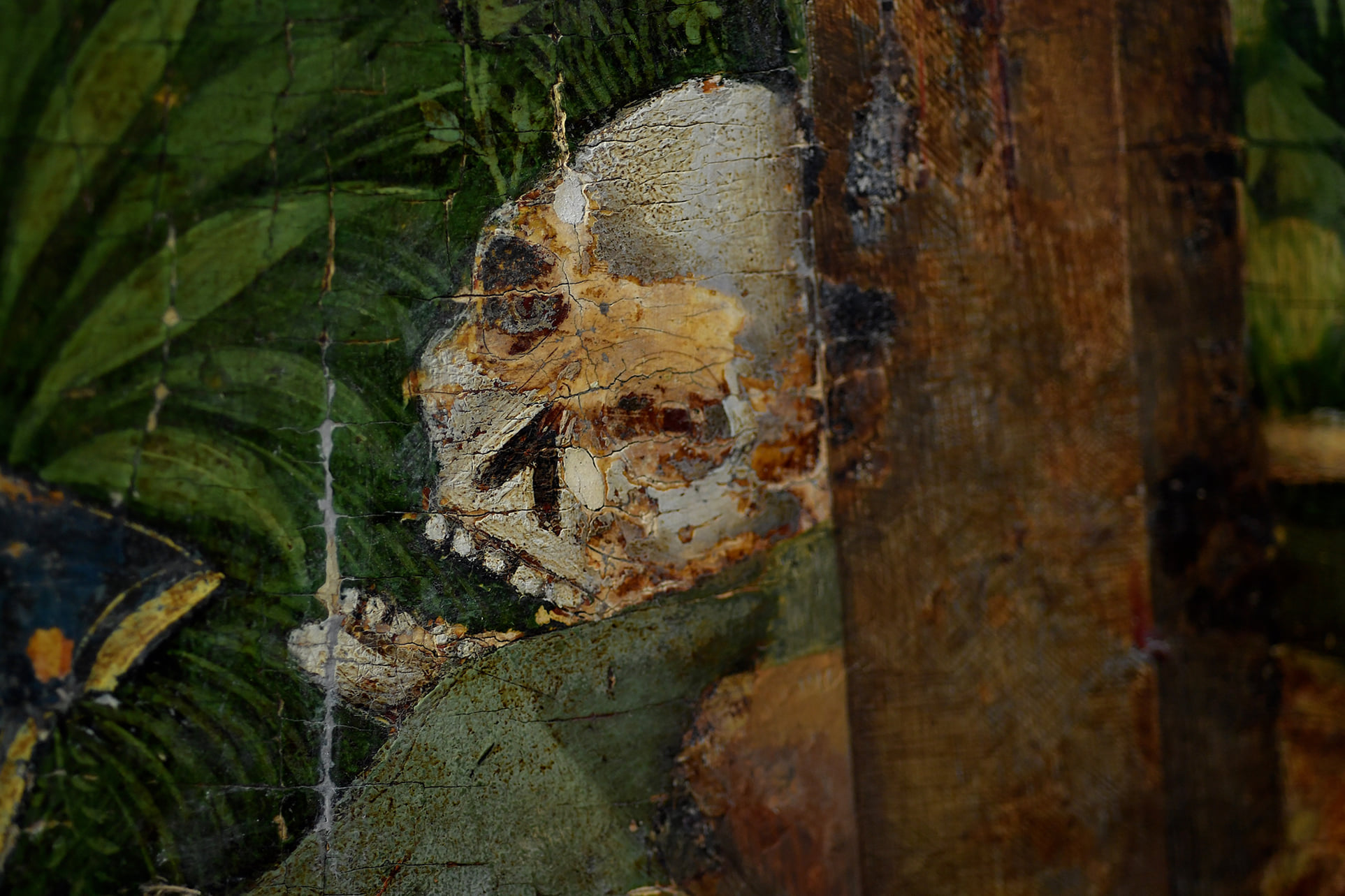
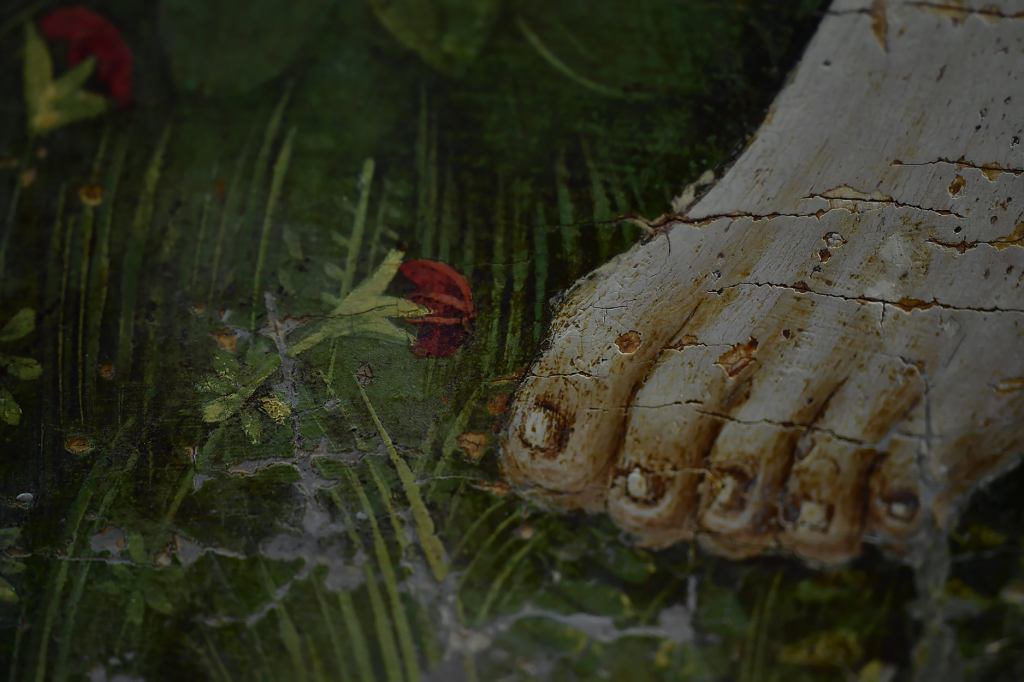
ART RESTORATION:“Hidden Gem: The Crucifixion by the Master of the Lindau Lamentation”: A Crucifixion painting from around 1425 by the Master of the Lindau Lamentation was recently restored by conservator Caroline van der Elst, and this short video documents part of that process. The Museum Catharijneconvent in Utrecht, the Netherlands, acquired the painting in 1875, but since then it had lain mostly forgotten in storage until being rediscovered by a staff member a few years ago, who recognized it as a masterpiece worthy of restoration efforts and public display. After the surface dust and discolored varnish were removed, in addition to other treatments, it was unveiled last year as the centerpiece of the Body Language exhibition (check out that link!), which ran from September 25, 2020, to January 17, 2021.
Curators Micha Leeflang and Annabel Dijkema discuss how the painting was made, how it was originally used, and its theological significance, and van der Elst explains some of the conundrums she faced while restoring the work—when it came to light, for example, that the azurite background was added in the sixteenth century. View the full painting here.
Master of the Lamentation of Christ in Lindau, Crucifixion (detail), ca. 1425. Tempera on panel, 125 × 89 cm. Catharijneconvent Museum, Utrecht, the Netherlands. Photo: Marco Sweering.
+++
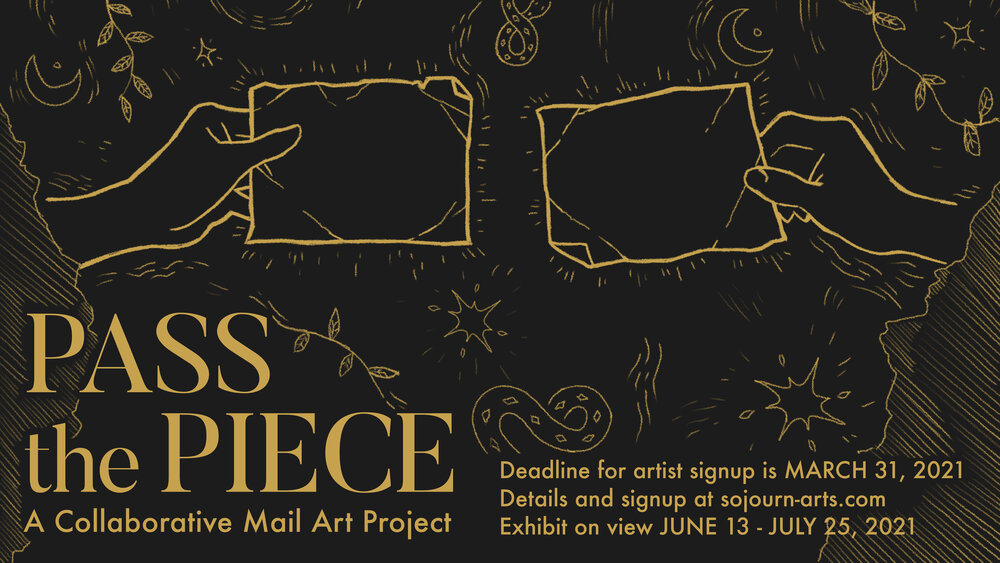
CALL FOR ARTISTS: Pass the Piece: A Collaborative Mail Art Project: A neat opportunity for artistic collaboration, organized by Sojourn Arts [previously] and open to US artists ages 13+. “Pass the Piece is a collaborative mail art project to be exhibited at Sojourn Arts in June 2021. Deadline for participating artists to sign up is March 31, 2021. Project is limited to 100 participants. We’re mailing out up to one hundred 8″ × 10″ panels, one to each participating artist. Each artist will start a panel that another artist will complete. Each artist will finish a panel that someone else started. Each artist will have their work exhibited and have a printed zine-style catalog of each piece from the exhibit. Artworks will be auctioned online with 50% going to the artists and 50% going towards Sojourn Arts interns’ travel expenses for the upcoming CIVA conference.”
NEW ALBUM: for / waters by Joshua Stamper:Joshua Stamper [previously] composed this four-movement instrumental piece about marriage for pianist Bethany Danel Brooks and violinist David Danel, who are themselves married and perform on the recordings. Its title and that of each movement is taken from Isaiah 35, which was read at the couple’s wedding.
Stamper writes,
Marriage, ideally, is about two people in a state of mutual belonging. But marriage is more than a state of belonging: it includes an ongoing journey toward and into belonging. It encompasses the trajectories and momentum of individuals towards each other, even before an initial connection takes place. People are therefore in relationship with each other before they are “in relationship” with each other. From this perspective, marriage might be understood as another mystical manifestation of the inscrutable and unknowable fault line between free will and providence. Two lives are always in reference to one another before the initial “hello,” because though individual trajectories have not yet crossed, they will. This interweaving begins early: each life is conditioned, shaped, sensitized to see, hear, feel the other. Home is created in each for each.
Stamper goes on to describe how he reflects these ideas through the structure, melodic and rhythmic motifs, harmonies, and other musical elements of for / waters. Read more and stream/purchase at Bandcamp.
“Joshua Stamper has been a restless composer and collaborator for over twenty-five years. His work reflects a deep interest in the intersection points between seemingly disparate musics, and a profound love for the intimacy, charm, and potency of chamber music. Equally at home in the jazz, classical, avant-garde, and indie/alternative worlds, his work ranges from large-scale choral and instrumental works to art-pop song cycles to chamber jazz suites. Joshua has worked as an orchestral arranger and session musician for Columbia / Sony BMG and Concord Records, and for independent labels Domino, Dead Oceans, Important Records, Sounds Familyre, Smalltown Supersound, and Mason Jar Music, collaborating with such luminaries as Todd Rundgren, Robyn Hitchcock, Sufjan Stevens, Danielson, and Emil Nikolaisen.” [source]
Through the needle’s eye
the rich man came
squeezing through stars of razor light
that pared his body down to thread.
Gravity crushed his heart’s chime
and his breath that breathed out worlds
now flattened as fire between walls,
the impossible slit stripped him
admitting him
to stitch the human breach.
This poem was first published in What a Light Thing, This Stone (Sow’s Ear Press, 1999) and is used here by permission of the author.
My research interests have to do mainly with art’s theological potential and its ability to, as Walter Brueggemann puts it, “disclose” truths that are “closed” by prose. I love how it often surprises, and how it can make connections I would have never thought to make myself.
Suzanne Underwood Rhodes’s poem “Advent” demonstrates these values magnificently. Its topic is the Incarnation. But her mooring point is not John 1 or Luke 1–2 or Philippians 2 or any other scripture text traditionally associated with the doctrine. Instead she draws on the famous aphorism of Jesus that’s recorded in Matthew 19:24: “It is easier for a camel to go through the eye of a needle than for a rich person to enter the kingdom of God.”
In this Gospel interaction, Jesus is explaining how terribly difficult it is for wealthy people to enter heaven because they tend to cling tightly to their earthly wealth rather than to God; they let it make claims on them, and they trust in its promises, to the neglect of the claims and promises of God. While the needle saying, in context, pertains to human beings passing from earth to heaven, Rhodes turns it on its head to suggest the movement of God from heaven to earth. A seeming impossibility—infinity becoming finite, God becoming man. But “with God, all things are possible” (Matt. 19:26). To save us, he would give up all the riches of heaven, assuming the role of a servant and ultimately giving up his very life.
Rhodes uses harsh, uncomfortable words—“squeezing,” “razor,” “pared,” “crushed,” “flattened,” “stripped”—to convey a sense of compression into human flesh. God’s breath, once so powerful and expansive that it brought the universe into existence, is now, in the person of the Son, walled in by a rib cage and dependent on oxygen. His heart pumps actual blood. Thus pared down to thread, he slips through the needle “to stitch the human breach,” to repair what we have torn through our disobedience. Severed from God no longer, we are held together with him by Christ himself.
Musical composition: “As by Fire between Walls” by Joshua Stamper
The evocative imagery of this poem has inspired artists in other media to respond in kind. One of them is composer Joshua Stamper, who, commissioned in 2014 by City Church Philadelphia, wrote a four-and-a-half-minute experimental jazz piece for chamber orchestra titled “As by Fire between Walls.”
It starts with minor chords on the piano, floating around ethereally. Then a violin tremolo kicks in (suggestive of the “razor light”), and other sharp bowing techniques (“par[ing] his body down”). Then soulful, wordless vocals. Then a staccato rhythm played on the mellotron, and percussion. Brass too. It’s a wonderfully wrought piece of music, a soundscape of the Incarnation, inclining the ear back toward Rhodes’s words and the heart to the grand story of scripture.
Painting: Through the Needle’s Eye the Rich Man Came by Grace Carol Bomer
Suzanne Rhodes is a friend of visual artist Grace Carol Bomer’s, who has a studio practice in Asheville, North Carolina. In 1993, Bomer was invited by the Asheville Art Museum to exhibit eight of her paintings for a Christmas show. Through the Needle’s Eye the Rich Man Came, inspired by Rhodes’s “Advent,” is one of those eight.
Grace Carol Bomer (Canadian American, 1948–), Through the Needle’s Eye the Rich Man Came, 1993. Mixed media on torn canvas on wood, 48 × 48 in.
About it, Bomer says,
The Christ of Christmas is God incarnate, the focal point or fulcrum of history. To show this glorious Incarnation, I chose to paint a piercing V (fulcrum) of light rending cloth (canvas on wood). The torn canvas symbolizes the veil of the temple. . . .
It was my personal challenge to show in painting that Christ is God, Spirit and flesh, in a way that would not be trite and sentimental. The Renaissance nativities are infected with beautiful Platonic realism, suited for Christmas card sentimentality. I feel they do not adequately exalt the “mystery hidden for ages,” the Christ of power and glory. Jesus Christ is Spirit and flesh, Son of God and Son of Man. Reality is both “abstract” and “realistic.” So too, art must seek to find this mysterious balance in order to proclaim the gospel. Art totally divested of realism, like Abstract Expressionism, becomes meaningless. Art must proclaim creation, fall, and redemption. I would like the poetic nuances in my work to stimulate the imagination to “see” in the abstract painting the spiritual truths that cannot be painted realistically.
In this piece there are suggestions of blood on doorways, symbolizing a Passover fulfilled, as Christ pushes open the door separating God and man.
So this painting integrates the coming down with the at-one-ing that happens at the cross, the physical tear of the canvas alluding simultaneously to the “human breach” of Rhodes’s poem and the tearing of the temple veil, which symbolizes humanity’s reconciliation to God. Birth and death are wrapped up in a single image, as both are key to Christ’s salvation project.
See how a poet’s imagination and craft can unfold the beauty and wonder of a heady doctrine with such concision? In Literature: Structure, Sound, and Sense, Laurence Perrine defines poetry as “a kind of language that says more and says it more intensely than does ordinary language” (509). That’s just what Suzanne Underwood Rhodes does in “Advent.” And that intense language of hers has inspired works of musical and visual art that explore even further what it means that the Son of God, the “Rich Man” from heaven, constricted himself for our sakes, becoming impossibly small, taking up residence in a virgin’s dark womb, in humanity’s dark world, so that he could stitch back together our ruptured relationships with the Father and with one another.



 Art & Theology