In these long, last days She has borne creation’s Crown; Heavy, sore, afraid, The weight of love is bearing down.
Refrain: We will wait. Even so, Come, Lord, come. We will wait. Even so, Come, Lord, come.
In these long, last days We must bear the weight of sin, Broken, torn, alone, Till you bring your peace to reign. [Refrain]
Bridge: Don’t forget us, Lord, Don’t forget us, Lord, While we wait. (×3) [Refrain ×2]
Sister Sinjin was founded in 2016 by three young moms wanting to record an Advent album: Elise Erikson Barrett, Elizabeth Duffy, and Kaitlyn Ferry. Barrett left the group to focus on her work in the nonprofit and philanthropic sectors, and Duffy and Ferry recorded two more albums. This September the duo announced a name change to A Bright Abyss to reflect the evolution of their vocational identities (they are both now psychotherapists) and music, a genre they call “psychoanalytic folk.”
The lyrics of “In These Long, Last Days,” one of seven original songs on Sister Sinjin’s debut album, were written by Barrett; the music and additional lyrics, by Ferry. The first stanza refers to Mary’s pregnancy with Jesus—her carrying that bundle of Word-made-flesh inside her, eagerly awaiting the birth.
As Mary waited for the Messiah’s first coming, feeling the signs of its nearness in her body, so we await his second, and with it the rebirth of heaven on earth. We do so bearing the weight not of presence but of absence. God is with us in the Spirit, in word and sacrament, and through Christ’s ecclesial body—but the incarnate Christ, the God-man, physically ascended back into the divine realm. “Come back!” we exclaim during Advent, yearning for the return he promised. “Don’t forget us.”
Until that day, we will wait. Even so, come, Lord, come.
ADVENT SERIES: Restful Advent by Tamara Hill Murphy:Tamara Hill Murphy [previously] is one of my favorite spiritual writers, her thoughtful words and curation of resources having served as a well of inspiration for me over the years. Each year, similar to Art & Theology but with the sensibilities and expertise of an Anglican spiritual director, she publishes a new daily Advent and Christmastide guide through her Substack, Restful, running this year from November 30 to January 5. Each post in the series includes lectionary readings, art, music, a prayer, and a simple practice to help us notice God’s presence during these waiting days. This time around, the Daybook will feature excerpts from Claude Atcho’s new book Rhythms of Faith along with ideas from The Liturgical Home by Ashley Tumlin Wallace and some of my own formerly published art commentaries.
“The Daybook is a way to pay attention to Christ’s three arrivals—then, now, and still to come—and to walk through December with a quieter heart and a stronger hope,” Murphy writes.
Murphy is offering Art & Theology readers a 50% discount to Restful using this link, which brings the subscription cost down to $4/month (let it run for two months if you want to receive the full Christmastide Daybook) or $32/year, which will give you access to her year-round content. The offer expires January 5, 2026.
+++
BLOG POST: “The Sacred Journey of Advent” by Ashley Tumlin Wallace, The Liturgical Home: “Advent,” writes Wallace, “is a season of preparation, for the coming of Christ at Christmas, and also for His return in glory at the end of time.” This is a great introduction to the season that kicks off the new church year.
+++
SONGS:
One of the scripture texts of Advent is Isaiah 40:3–5:
A voice cries out: “In the wilderness prepare the way of the LORD; make straight in the desert a highway for our God. Every valley shall be lifted up, and every mountain and hill be made low; the uneven ground shall become level, and the rough places a plain. Then the glory of the LORD shall be revealed, and all flesh shall see it together, for the mouth of the LORD has spoken.”
The Gospel-writers Matthew (3:3), Mark (1:3), and Luke (3:4) all see this exclamatory figure as John the Baptist, who told people to prepare for God’s coming by repenting of sin, since holding on tightly to ways of unlove erects barriers to God’s entry into one’s life. Here are two songs based on this Advent passage.
>> “Prepare the Way” by Maverick City Music and Tribl, feat. Chandler Moore and Siri Worku, on Tribl I (2021): This song repeats, again and again, the Advent mantra “Prepare the way,” embedding John the Baptist’s invitation deeply into hearts and minds. Its tag beseeches Christ to come with the fire of purging, the rain of refreshment, and the oil of blessing. To welcome this coming, this transformation and growth, we need to decenter ourselves, ceding to God the place of primacy, from which he works our good and his glory.
>> “Prepare the Way” by Christopher Walker, on Rise Up and Sing, 3rd ed., vol. 3 (2009): This 1991 song is by Christopher Walker, a church music composer, lecturer, and choral conductor originally from the UK but now living in Santa Monica, California. Published by OCP (Oregon Catholic Press), it would make a great song for a children’s Advent choir.
+++
2018 SERIES: Advent Caravan: Walking with the Holy Family by Sarah Quezada: I learned about Sarah Quezada’s work at the intersection of faith, justice, and culture through Tamara Hill Murphy (see first roundup item) in 2018, when Quezada published a five-part series reflecting on the likelihood that Mary and Joseph traveled to Bethlehem for the census not alone but in a caravan. Interweaving personal story, biblical interpretation, and current events, Quezada considers how the holy couple’s experience in the final months of Mary’s pregnancy connects to the reality of people on the move seeking hope, peace, joy, and love today.
While the series is not hosted online, I received permission from Quezada to reproduce it here.
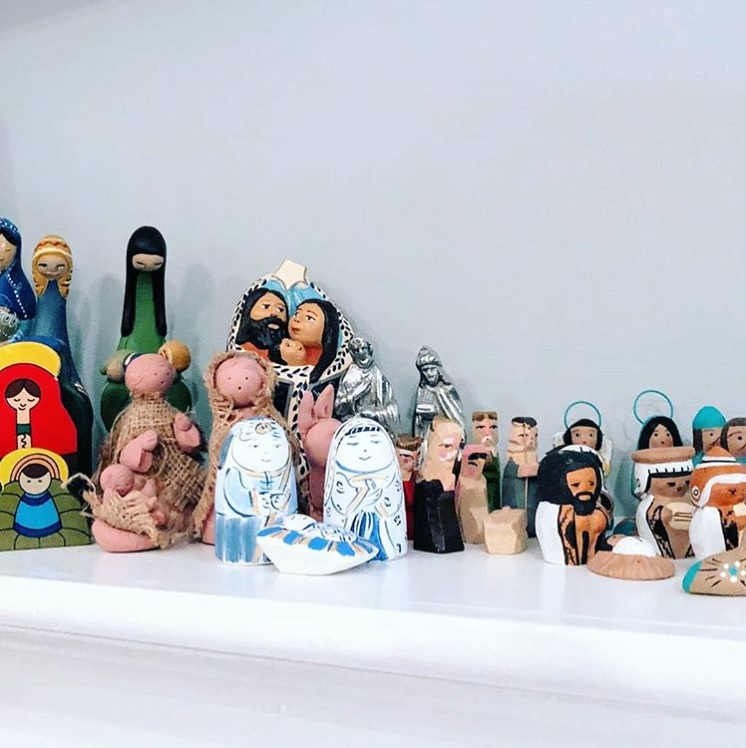
On Instagram, Quezada also shared a photo of her friend’s Advent mantel, where she combined figurines from her various nativity sets to form a “caravan” of travelers.
Photo via @sarahquezada
+++
YOUTUBE PLAYLIST: Jouluradion Hoosianna: Jouluradio is a Finnish radio station that broadcasts annually from November 1 to January 6, playing all Advent and Christmas music. Since 2012, every year they premiere a new arrangement and video performance of the popular Scandinavian Advent hymn “Hoosianna” (Hosanna, an Aramaic expression meaning “Save now!”), which Lutheran and Catholic churches in Finland sing on the first Sunday of the season. Based on Matthew 21:9, its lyrics greet the approaching Christ, affirming his identity and craving the deliverance only he can bring:
Hoosianna, Daavidin Poika,
kiitetty olkoon hän!
Kiitetty Daavidin Poika,
joka tulee Herran nimeen.
Hoosianna, hoosianna,
hoosianna, hoosianna!
Kiitetty Daavidin Poika,
joka tulee Herran nimeen.
Hosanna, Son of David,
Most blessed Holy One,
Hosanna, Son of David,
Who comes in the name of the Lord!
Hosanna, hosanna, hosanna
In the highest!
Hosanna, Son of David,
Who comes in the name of the Lord!
This hymn was written by the German composer, educator, and piano and organ virtuoso Georg Joseph Vogler in 1795 while working in Sweden as court conductor as well as tutor to the crown prince Gustav IV Adolf.
The Jouluradio commissions, which the station has compiled in a YouTube playlist, encompass a range of genres, including jazz, hip-hop, choral, pop, and electronic. Below is a list of previous years’, of which I’ve embedded the two asterisked ones on this page. Jouluradio typically releases their annual “Hoosianna” the day before Advent, so 2025’s will likely be posted this Saturday. [HT: Gracia Grindal]
*2015: Sointi Jazz Orchestra, arr. Jukka Perko (I don’t really understand the narrative in the video. I think the man is remembering a time in his childhood when he got lost in the woods, and then was found by his mother?)
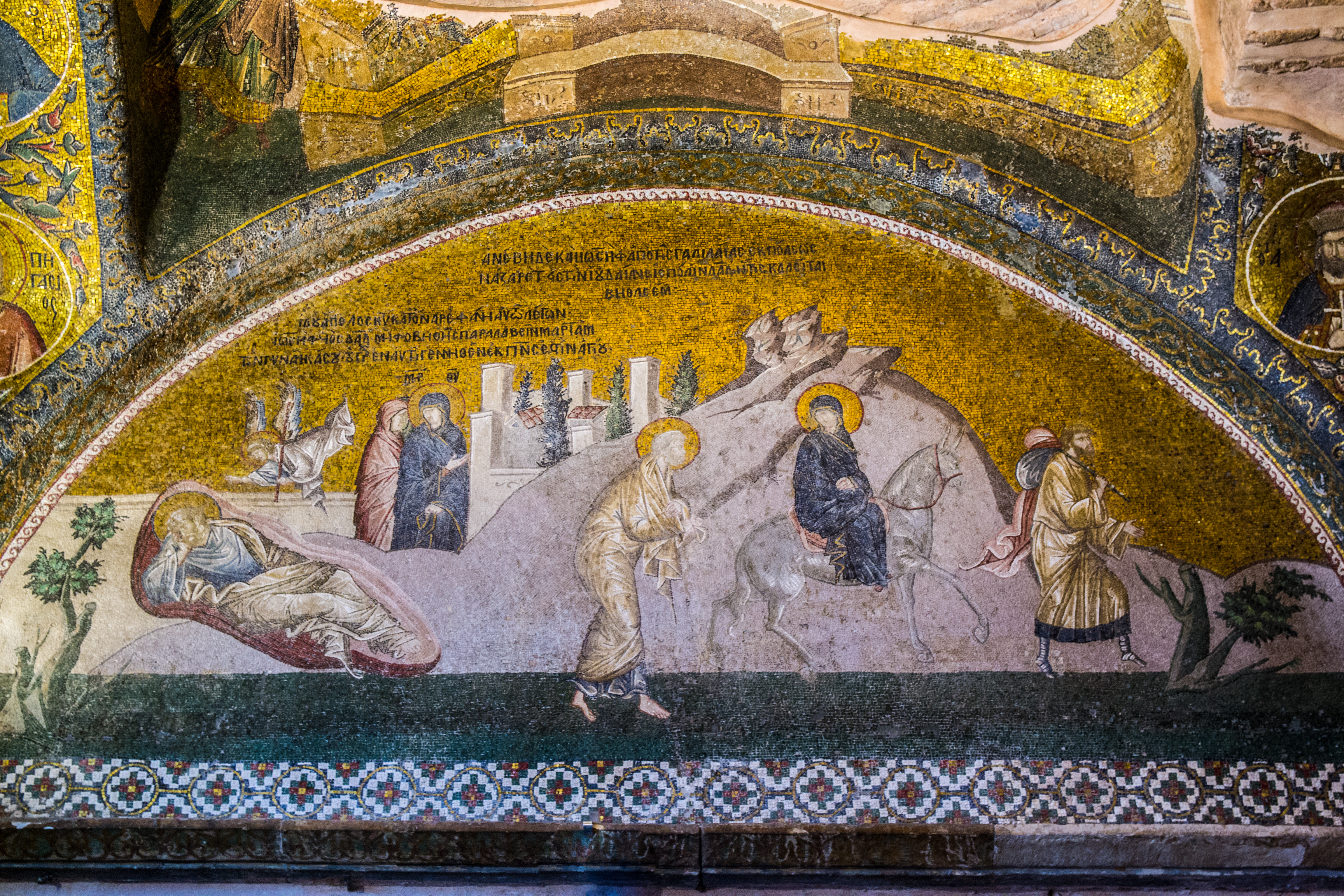
LOOK: Journey to Bethlehem mosaic from the former Chora Church
Joseph’s Dream and the Journey to Bethlehem, 1315–20. Mosaic, outer narthex, Kariye Camii (Chora Mosque) (formerly Chora Church), Istanbul, Turkey.
Among the finest artworks of the Palaeologan Renaissance, this Late Byzantine mosaic is in the lunette directly above the north door of a thirteenth-century church in Istanbul (formerly Constantinople), through which the clergy would have entered. It shows on the left an angel appearing to Joseph in a dream to corroborate Mary’s story of the miraculous conception of the son in her womb, and on the right the couple traveling to Bethlehem to register for the census, their donkey led by one of Joseph’s sons from a previous marriage (an apocryphal character from the Protoevangelium of James 17:1–2 and the Gospel of Pseudo-Matthew 13). I believe the scene in the middle background is the Visitation, in which Mary visits her older cousin Elizabeth in the hill country for support during her early months of pregnancy.
The building the mosaic was made for has changed possession and uses over the centuries. Originally a Byzantine church called the Church of the Holy Savior at Chora, it was converted to a mosque in 1511, over a half century after the Ottoman conquest of Constantinople. Because of the important cultural heritage it contains—namely, its Christian mosaics and frescoes—the secular Turkish Republic turned it into a museum in 1945 by court decree. In 2019 that decree was overturned, and the following year it was reconsecrated as a mosque.
It just reopened to the public May 6 of this year. Visitors are allowed daily, excluding Fridays, from 9 a.m. to 6 p.m. except during Muslim prayer times, which vary based on the sun but last for an hour in the early afternoon and an hour in the late afternoon. During prayer, the mosaics and frescoes in the “naos” (nave) are covered with curtains to honor the prohibition in the hadith against visual representations of human beings. But the images in the exonarthex, like the one shown here, remain uncovered at all times.
LISTEN: “Lift Up Your Heads” (original title: “Macht hoch die Tür”) | Original German words by Georg Weissel, 1623; translated into English by Catherine Winkworth, 1855 | Tune: TRURO, Anon., from Thomas Williams’s Psalmodia Evangelica, 1789 | Performed by Sufjan Stevens and friends on Silver & Gold, 2012
1. Lift up your heads, ye mighty gates! Behold, the King of Glory waits; The King of kings is drawing near, The Savior of the world is here. Life and salvation he doth bring, Wherefore rejoice and gladly sing: We praise thee, Father, now, Creator, wise art thou!
2. A Helper just he comes to thee, His chariot is humility, His kingly crown is holiness, His scepter, pity in distress, The end of all our woe he brings; Wherefore the earth is glad and sings: We praise thee, Savior, now, Mighty in deed art thou!
3. O blest the land, the city blest, Where Christ the Ruler is confessed! O happy hearts and happy homes To whom this King in triumph comes! The cloudless Sun of joy he is, Who bringeth pure delight and bliss. We praise thee, Spirit, now, Our Comforter art thou!
4. Fling wide the portals of your heart; Make it a temple set apart From earthly use for heaven’s employ, Adorned with prayer and love and joy. So shall your Sovereign enter in And new and nobler life begin. To thee, O God, be praise For word and deed and grace!
5. Redeemer, come! I open wide My heart to thee; here, Lord, abide! Let me thy inner presence feel, Thy grace and love in me reveal; Thy Holy Spirit guide us on Until our glorious goal is won! Eternal praise and fame We offer to Thy name!
Georg Weissel (1590–1635) was a German Lutheran minister and hymn writer. He wrote “Macht hoch die Tür” (Lift Up Your Heads) in 1623 for the dedication, during Advent, of the newly built Altroßgärter Kirche in Konigsberg, where he served as pastor until his death. The hymn is rooted in Psalm 24, especially verses 9–10:
Lift up your heads, O gates! and be lifted up, O ancient doors, that the King of glory may come in! Who is this King of glory? The LORD of hosts, he is the King of glory. Selah
Likely written by King David on the occasion of the ark of the covenant’s coming to Jerusalem after being taken back from the Philistines (2 Sam. 6), this psalm directs its hearers to open wide the city gates to welcome in God’s presence, symbolized by this precious gold-plated chest. In his hymn, Weissel turns this directive into a metaphor, telling worshippers to open the gates of their hearts so that God can enter in and abide there.
Weissel’s hymn has an odd meter of 88.88.88.66—six lines of eight syllables, followed by two lines of six syllables. Many hymnals of the past century have modified the hymn’s structure to create four-line stanzas instead, each line of equal measure, nixing the shorter ending couplets and combining what remains.
On his 2012 Christmas album, Silver & Gold, Sufjan Stevens and a small vocal ensemble sing what in the original hymn is stanzas 1a and 3a. The group sings the four-part harmonies to a simple piano accompaniment for the first verse and a cappella the second.
For a contemporary arrangement that covers more lyrical ground, see Josh Bales’s 2018 recording of the hymn, from his album Come Away from Rush and Hurry:
I’ve paired this hymn with an artwork of the Journey to Bethlehem to show how “the King of kings is drawing near,” bringing life and salvation. Will you “fling wide the portals of your heart” to receive him?
This panting land hawks up roadblocks over ground hell-bent against the premise of a path. Desert of rock, not dunes. Hot wind rattling leaves of a distant, lone acacia tree, scraggly signpost pointing everyway into the craggy, cave- laden wilderness. Boulders big enough to cast a shadow one might shelter in, or try, in the sun-fried afternoon. The grade grows steep as the valleys deepen like the dark of death. Runnels of loosened smaller rocks where rain must once have rushed— rain, in such a place.
What wildness welcomes a road? What valley straightens its spine, what mountain stoops from its jeweled throne? But look: a path flat and straight through the jagged crags and ravines. A route between two backwaters— road enough for a man to walk beside a donkey, on which might ride a woman with child— from Nazareth away to Bethlehem. A way.
Brent Newsom is a poet from central Oklahoma. He is a recipient of the Maureen Egen Writers Exchange Award in poetry from the organization Poets & Writers and the Foley Poetry Prize from America magazine. He wrote the libretto for A Porcelain Doll, an opera based on the life of deaf-blind pioneer Laura Bridgman, and is the author of Love’s Labors (CavanKerry Press, 2015), which was a finalist for the Oklahoma Book Award in poetry. His poems have also appeared in the Southern Review, the Hopkins Review, Windhover, Relief, and other journals.
LISTEN: “Joseph mon cher fidèle” (Joseph, My Dear Faithful One), traditional carol from the French West Indies | Performed by Robert Mavounza on Bakwa Nwel (2005)
Marie:
Joseph, mon cher fidèle,
Cherchons un logement,
Le temps presse et m’appelle
A mon accouchement.
Je sens le fruit de vie,
Ce cher enfant des cieux,
Qui d’une sainte vie,
Va paraître à nos yeux.

Joseph:
Dans ce triste équipage,
Marie allons chercher,
Par tout le voisinage,
Un endroit pour loger.
Ouvrez, voisin la porte,
Ayez compassion
D’une vierge qui porte
Votre rédemption.

Les voisins de Bethléem:
Dans toute la bourgade,
On craint trop les dangers,
Pour donner le passage
A des gens étrangers,
Au logis de la lune,
Vous n’avez qu’à loger,
Le chef de la commune
Pourrait bien se venger.

Marie:
Ah! Changez de langage,
Peuple de Bethléem,
Dieu vient chez nous pour gage,
Hélas! Ne craignez rien.
Mettez-vous aux fenêtres,
Ecoutez ce destin,
Votre Dieu, votre Maître,
Va sortir de mon sein.

Les voisins de Bethléem:
C’est quelque stratagème
On peut faire la nuit,
Quelque tour de bohème,
Quand le soleil ne luit.
Sans voir ni clair, ni lune,
Les méchants font leurs coups,
Gardez votre infortune,
Passants, retirez-vous!

Joseph:
O ciel quelle aventure,
Sans trouver un endroit,
Dans ce temps de froidure,
Pour coucher sous le toit.
Créature barbare,
Ta rigueur te fait tort,
Ton coeur déjà s’égare
En ne plaignant mon sort.

Marie:
Puisque la nuit s’approche
Pour nous mettre à couvert,
Ah! Fuyons ce reproche,
J’aperçois au désert
Une vieille cabane,
Allons mon cher époux,
J’entends le boeuf et l’âne
Qui nous seront plus doux.

Joseph:
Que ferons-nous Marie,
Dans un si méchant lieu,
Pour conserver la vie
Au petit Enfant-Dieu?
Le monarque des anges
Naîtra dans un bercail
Sans feu, sans drap, sans langes
Et sans palais royal.

Marie:
Le ciel, je vous assure,
Pourrait nous secourir,
Je porte bon augure,
Sans crainte de périr.
J’entends déjà les anges
Qui font d’un ton joyeux,
Retentir les louanges,
Sous la voûte des Cieux.

Joseph:
Trop heureuse retraite,
Plus noble mille fois,
Plus riche et plus parfaite
Que le louvre des rois!
Logeant un Dieu fait homme,
L’auteur du paradis,
Que le prophète nomme
Le Messie promis.

Marie:
J’entends le coq qui chante,
C’est l’heure de minuit,
O ciel! Un dieu m’enchante,
Je vois mon sacré fruit,
Je pâme, je meurs d’aise,
Venez mon bien-aimé!
Que je vous serre et baise!
Mon coeur est tout charmé.

Joseph:
Vers Joseph votre père
Nourrisson plein d’appas,
Du sein de votre mère
Venez entre mes bras!
Ah! Que je vous caresse,
Victime des pêcheurs,
Mêlons, mêlons sans cesse,
Nos soupirs et nos pleurs.
Mary:
Joseph, my dear faithful one,
Let us search for lodging;
Time is pressing and calling me
To give birth.
I feel the fruit of life,
This dear child from heaven
Who, with a holy life,
Will appear before our eyes.

Joseph:
In this sad predicament,
Let us search, Mary,
Throughout the neighborhood
For a place to stay.
Open the door, neighbor;
Have compassion
For a virgin who carries
Your redemption.

The people of Bethlehem:
Throughout the town,
There is too much fear of danger
To offer shelter
To strangers.
Under the moonlight
Is where you can go lodge;
The town’s ruler
Might seek revenge [on us].

Mary:
Ah! Change your words,
People of Bethlehem;
God comes to us as a pledge.
Alas! Do not fear.
Stand by your windows,
Listen to this destiny:
Your God, your Master,
Will come forth from within me.

The people of Bethlehem:
It’s some kind of ploy,
Which they can work at night,
Some vagabond trick,
When the sun isn’t shining.
Without seeing clearly, without the moon,
The wicked carry out their deeds.
Keep your misfortune;
Passersby, be gone!

Joseph:
Oh heavens, what a hardship,
To not find a place
In this cold weather,
A roof to sleep under.
Barbaric creatures,
Your harshness does you wrong;
Your heart is gone astray,
Not sympathizing with my fate.

Mary:
As the night draws near
To wrap us with its cover,
Ah! let us escape this reproach.
I see in the desert
An old shed.
Come, my dear husband:
I hear the ox and the donkey
Who will be kinder to us.

Joseph:
What shall we do, Mary,
In such a wretched place,
To preserve the life
Of the little Child of God?
The king of angels
Will be born in a manger,
Without fire, without sheets,
And without a royal palace.

Mary:
Heaven, I assure you,
Will come to our aid;
I carry good omens,
And no fear of perishing.
I already hear the angels,
In a joyful tone,
Resounding with praises
Under the vault of heaven.

Joseph:
What a blessed retreat,
A thousand times nobler,
Richer, and more perfect
Than the abode of kings!
Lodging a God made man,
The author of paradise,
Whom the prophet calls
The promised Messiah.

Mary:
I hear the rooster singing;
It’s the hour of midnight.
Oh heavens! A god enchants me.
I see my sacred fruit;
I faint, and am overcome with joy.
Come, my beloved [son]!
Let me hold you and kiss you!
My heart is completely charmed.

Joseph:
Come to Joseph, your father,
Darling boy;
Come into my arms
From your mother’s breast!
Ah! Let me caress you,
Sacrifice for sinners!
Let’s mingle, let’s mingle without ceasing,
Our sighs and our tears.
* This English translation by Djasra Ratébaye was commissioned in 2023 by Art & Theology.
Written as a dialogue between Mary, Joseph, and the people of Bethlehem as the couple first arrives in town, this traditional Christmas carol is from the French Caribbean islands of Guadeloupe and Martinique. As for its approximate date of origin, I found several of its verses appearing as far back as 1703, with a complete version showing up in an 1817 carol collection, but it very well could have circulated prior to that.
The song was famously recorded by Manuela Pioche, Henri Debs, and Guy Alcindor in 1969 on Noël Aux Antilles (reissued on CD in 1993), but overall, I prefer Robert Mavounza’s recording from 2005. In Mavounza’s version, a chorus of voices sings what sounds like “waylo” after every line. The person who translated the song for me is neither Guadeloupean nor Martinican and wasn’t sure of the meaning of the word; he suggested that it’s either a wordless vocable used for embellishment, or else a creole word.
“Joseph mon cher fidèle” is part of the popular repertoire of the Chanté Nwel, the tradition of communal carol singing (with live percussion accompaniment!) that takes place throughout December in Guadeloupe and Martinique. It’s one of the most convivial times of the year.
The Holy Couple’s anxious search for lodging as Mary’s labor pangs begin is a feature of many retellings of the Christmas story, though it’s not present in either of the two Gospel narratives of Christ’s birth. Luke simply says that Joseph “went to be registered [in Bethlehem for the census] with Mary, to whom he was engaged and who was expecting a child. While they were there, the time came for her to deliver her child. And she gave birth to her firstborn son and wrapped him in bands of cloth and laid him in a manger, because there was no place in the guest room” (Luke 2:5–7 NRSV).
Centuries of misinterpretation of the Greek word kataluma as “inn” (instead of the more accurate “guest room”) has led to the invention of an innkeeper character who coldly refuses the needy parents the accommodations they seek. By extension, the whole of Bethlehem is often characterized as inhospitable, for how dare they let the King of the universe be born in a lowly stable? In all historical likelihood, Mary and Joseph were welcomed by family when they got to Bethlehem, but the house where they were staying was full because of the large number of out-of-towners present for the census registration. Adapting to space limitations, Mary and Joseph stayed with their baby in the room where the animals were kept, which would have been attached to the family’s living quarters. Mary most likely would have been assisted by one or more midwives in giving birth and surrounded by family afterward.
Nevertheless, “Joseph mon cher fidèle” is a part of the tradition that imagines a more tense and harrowing birth narrative. When Joseph and Mary arrive in Bethlehem and, hurried by Mary’s increasingly regular contractions, desperately knock on doors to ask for lodging, they are turned away again and again. The townspeople know how suspicious Herod is of strangers, how easily threatened, and they don’t want to risk his ire by harboring one, so they tell the strange couple to go sleep outside somewhere. When Mary tells them she is about to give birth to God, they accuse the couple of trickery and lies; if “God” comes forth from this woman, they chide, it would be some kind of wicked conjuration they produced under the dark cover of shadows.
Joseph reprimands the people of Bethlehem for their rejection and mistrust while Mary resourcefully sets her sights on a distant stable. Joseph laments its unsuitability for such a son as theirs, but Mary reassures him that it will suit Jesus just fine and that God will protect them all through the night. The humble shelter, Joseph concedes, will be made magnificent and holy by the Holy One who inhabits it.
At the hour of midnight, Jesus starts to crown. Mary is ecstatic to meet her son at last, and Joseph sweeps him up into her arms to be showered with love and kisses.
I love that Joseph gets more treatment in this carol than in most others. He gets the last word—the final stanza is in his voice—which is full of such fatherly affection. He and Mary sigh together in relief for a safe delivery and cry together tears of joy, which mingle with the wails of their newborn.
Despite the conflict and stress in the narrative, the music is bright and upbeat throughout. This is, after all, a party carol! Mary maintains a steadfast faith in the God who called and empowered her for the task of bringing God-in-flesh into the world.
This post is part of a daily Advent series from December 2 to 24, 2023 (with Christmas to follow through January 6, 2024). View all the posts here, and the accompanying Spotify playlist here.


 Art & Theology