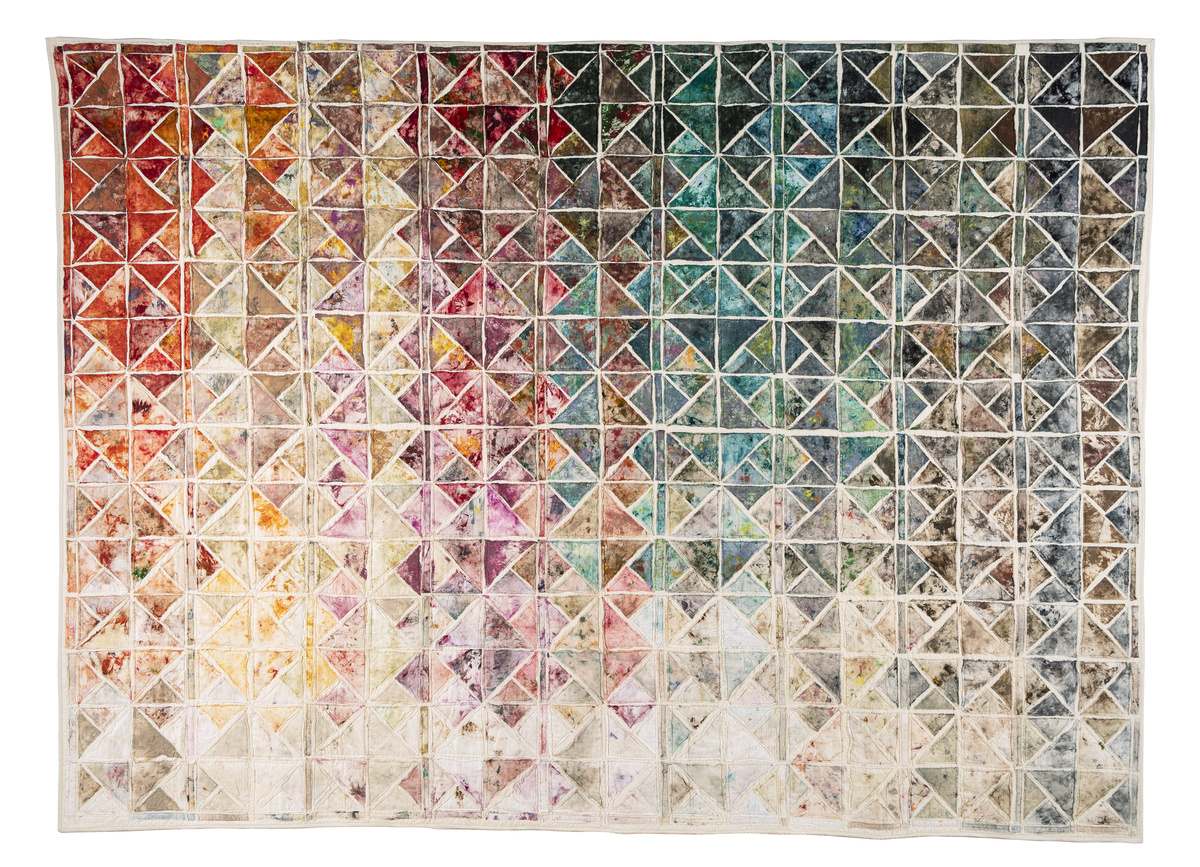
LOOK: the rain bows and the rainbows by Katy Mixon
Katy Mixon (American, 1984–), The rain bows and the rainbows (one day we will switch sides), 2018. Oil paint and used hand rags on muslin, 100 × 138 in.
I saw this quilt by Katy Mixon in December 2021 at the exhibition Break the Mold: New Takes on Traditional Art Making at the North Carolina Museum of Art. I was struck first by its prismatic color, and then by its title—which, the artist told me, comes from a dream she had after her close friend died. To bow, long o, is to bend into a curve; as a noun, a bow is a weapon used to propel an arrow, or a knotted ribbon typically worn by young girls. To bow, short o (as in “ow”), is to incline in respect or submission. The multiple meanings of this homograph open the title to different readings.
But the overall meaning points to the multihued arc that appears in the sky after a rainfall, as sunlight refracts through water vapor.
In the Judeo-Christian tradition, the rainbow is a sign of God’s covenant with Noah and has come to symbolize divine promise more generally, or hope—after the bleakness, beauty.
Mixon’s making process involves upcycling rags, which is itself a kind of redemptive act, saving used scraps and piecing them together into a new whole.
“Katy Mixon’s ‘quilts’ began as an outgrowth of her painting process,” the NCMA exhibition text read. “She routinely wipes her hands, palette knives, and other tools with baby wipes, which she then tosses into her studio’s garbage can. ‘One day [I] looked at the trash and realized it was full of all this hastily discarded color,’ she notes. She began saving the vibrant detritus with no specific purpose in mind, but after remembering her grandmother’s homemade quilts and discovering the famed African American quiltmakers of Gee’s Bend, Alabama, Mixon had a plan for her colorful scraps. ‘For me, the quilted works are alternate endings in the painting’s life cycle,’ Mixon says. ‘Painting as a practice, with the used rags as kaleidoscopic evidence.’”
Describing her technique, Mixon told me: “I compose the pieced tops and work with local longarm quilters to add the batting and backing. I finish each piece with hand stitching, often using crewel embroidery to define brush marks and tonal variations.”
LISTEN: “Joyful” | Words by Kate Bluett | Music by Paul Zach | Performed by Paul Zach with Taylor Leonhardt and Nick Dahlquist, on Christmas Hymns (2022)
The MP3 file of the song is embedded here with Paul Zach’s permission.
Come, O Lord, and make us joyful as you came to Mary’s womb; buried deep beneath our sorrows, where our hopes take root and bloom. Be the promise that sustains us through the seasons of the years, ’til at last we see your radiance when you shine beyond our tears.
Come, O Lord, and show your mercy as you came in Bethlehem; let us see the sunlight bursting through the shadows once again. Let us hear the song of glory where the silence held us fast. We will come to you rejoicing from the shackles of the past.
Come, O Lord, as living water; make our deserts green again, where the wellspring of our laughter will refresh us like the rain. After all the years of waiting for the promise long foretold, come at last, and let the day break in the morning of your joy!
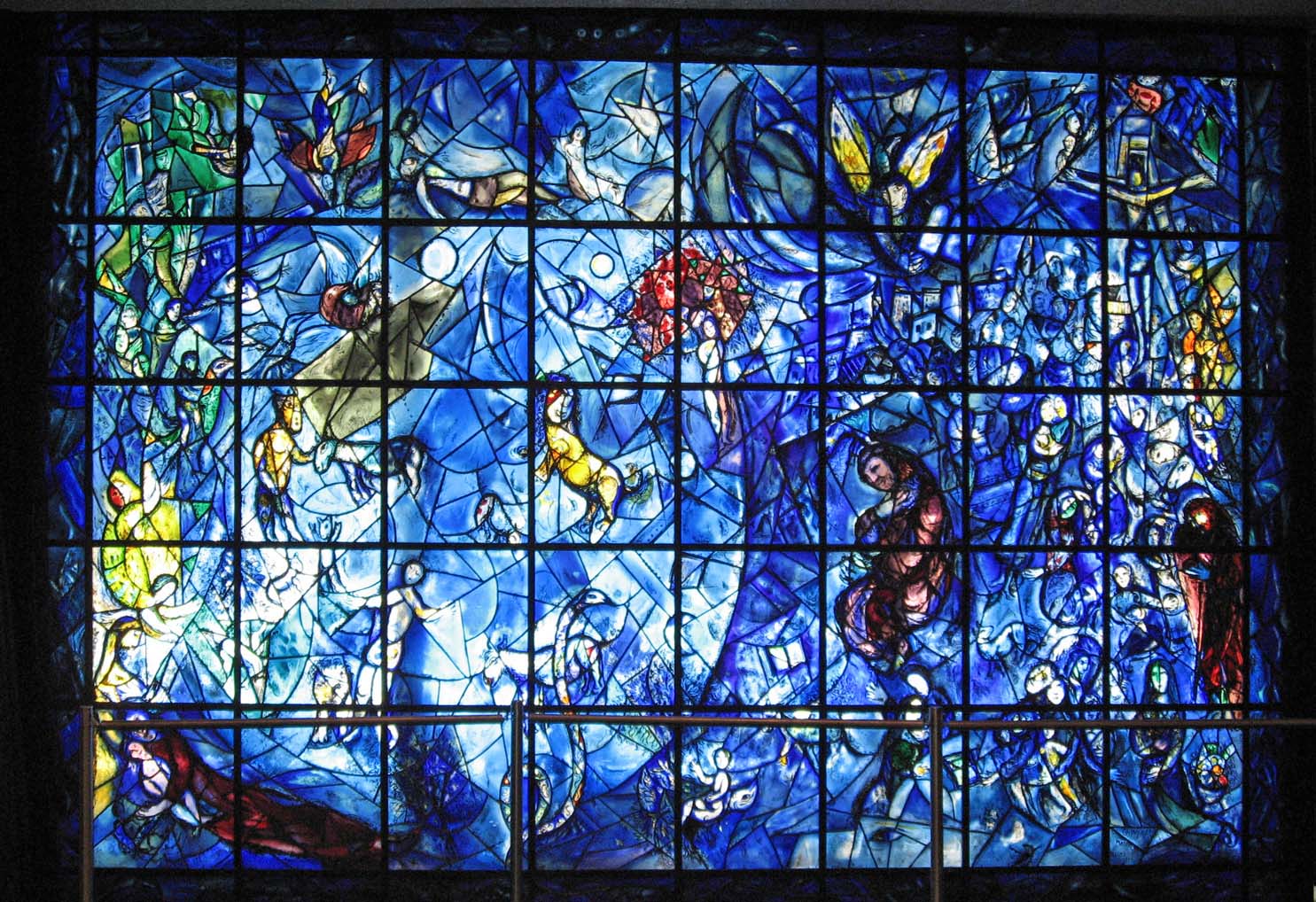
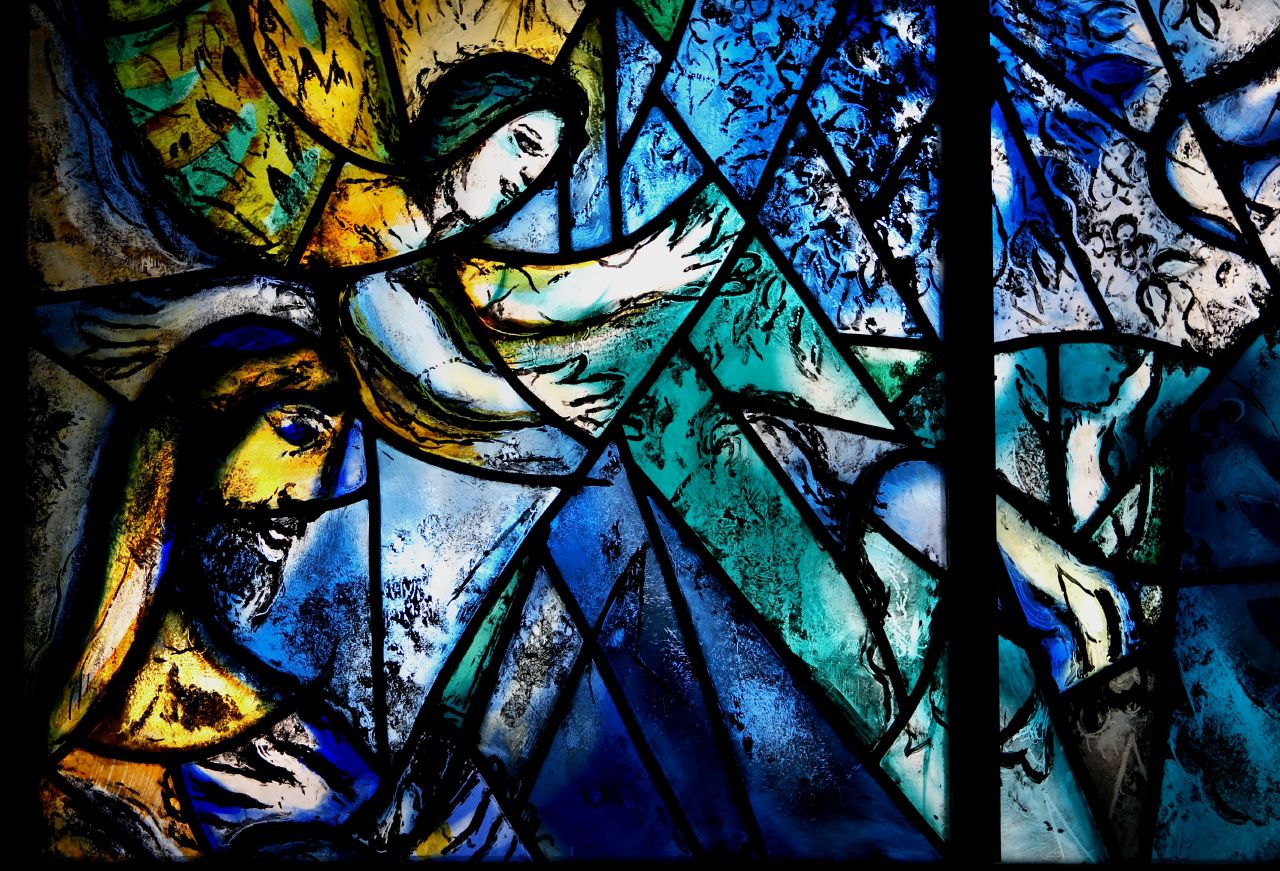
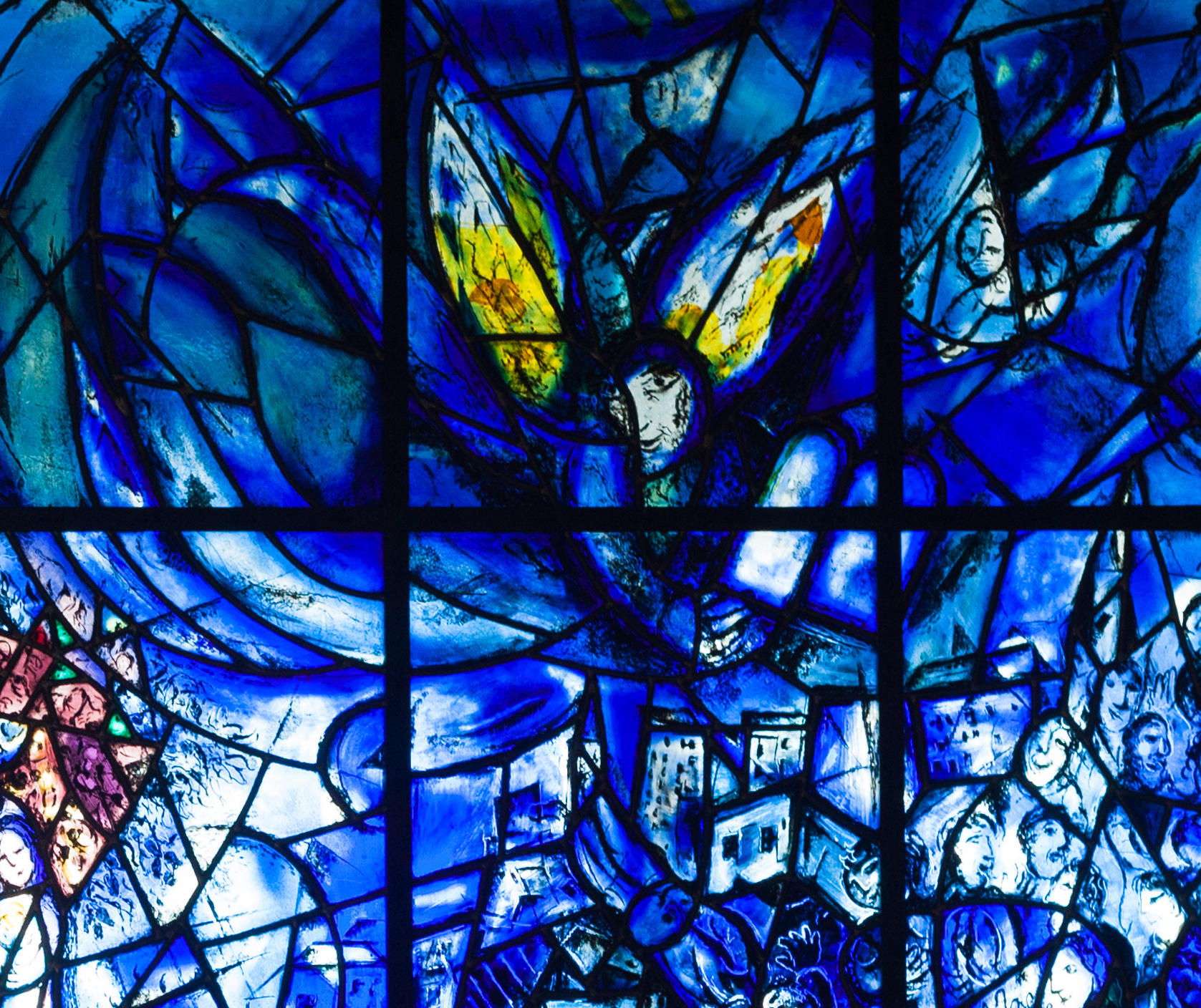
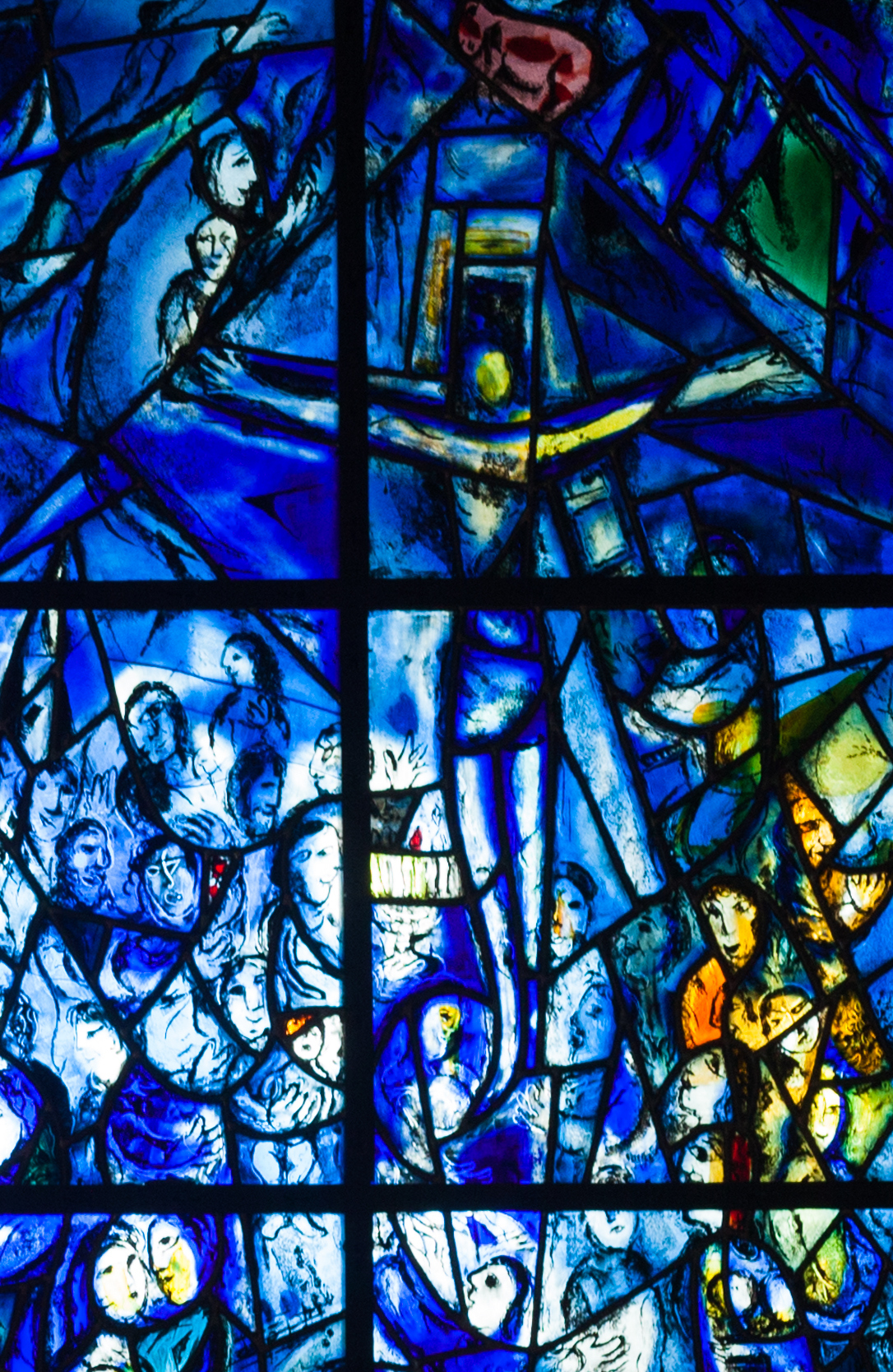
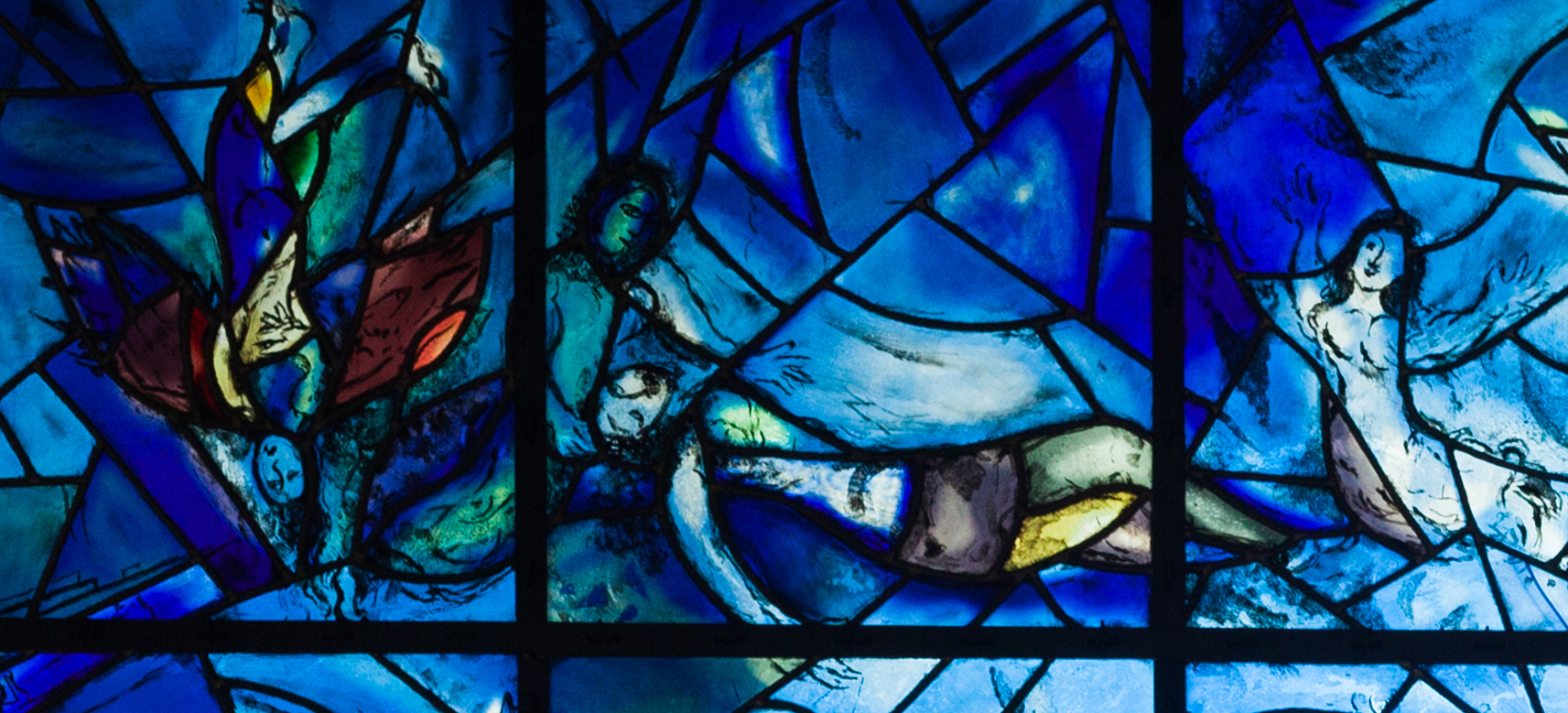
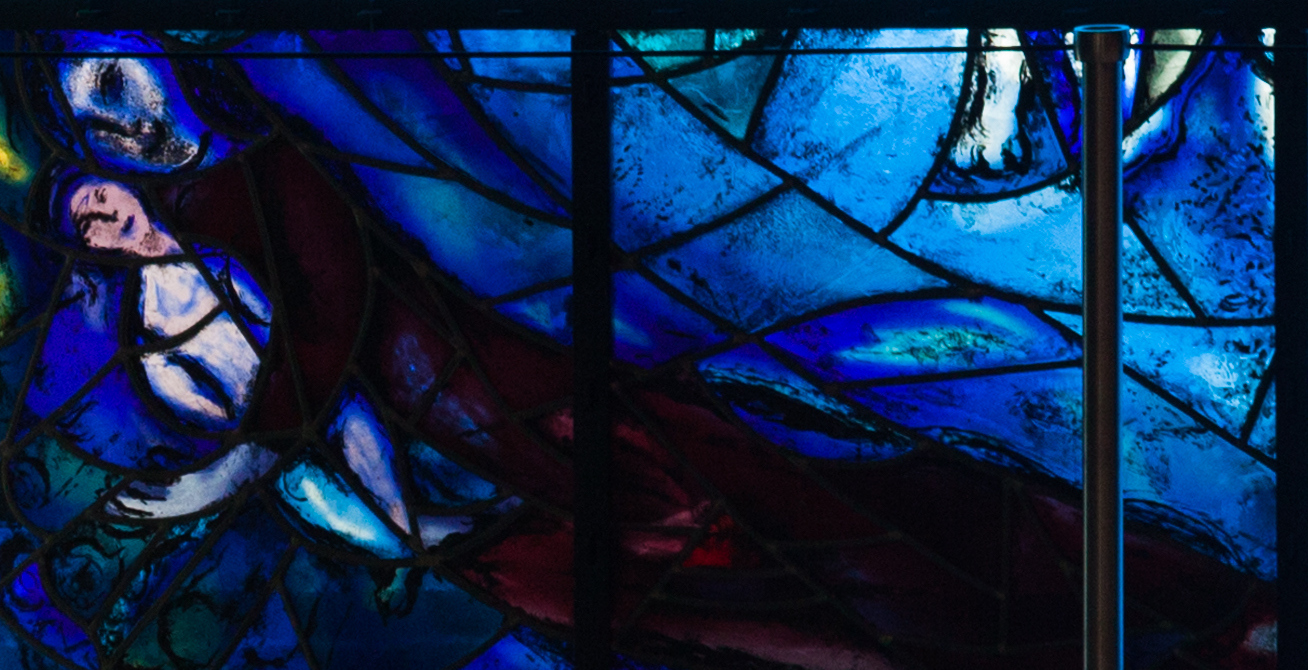
Marc Chagall (Russian/French, 1887–1985), Peace Window, 1964. Stained glass, 12 × 15 ft. Public lobby, General Assembly Building, United Nations Headquarters, New York. Manufactured by Brigitte Simon and Charles Marq.
This stained glass window by Marc Chagall was commissioned as a memorial for the Swedish diplomat Dag Hammarskjöld (1905–1961), who served as the second secretary-general of the United Nations, and for the fifteen other UN staff and peacekeepers who died with him when their plane crashed on the way to a peace negotiation for the Congo Crisis in Northern Rhodesia. The artist’s handwritten dedication reads, “A tous ceux qui ont servi les buts et principes de la Charte des Nations Unies et pour lesquels Dag Hammarskjöld a donné sa vie” (To all who served the purposes and principles of the United Nations Charter, for which Dag Hammarskjöld gave his life).
Chagall’s design was executed by master glassmakers Brigitte Simon and Charles Marq of Atelier Simon-Marq.
Chagall was born in 1887 into a Hasidic Jewish family in Vitebsk, Russia (now Belarus). He moved to Paris in 1910 to develop his art, becoming a French citizen in 1937. When Nazis took over the country, threatening Chagall’s safety, he was successfully extricated to the United States with the help of Alfred Barr, director of the Museum of Modern Art in New York. He returned to France for good in 1948. His impressive body of work, marked by a spiritual vivacity, includes—in addition to stained glass—paintings, drawings, book illustrations, stage sets, ceramics, and tapestries.
His 1964 Peace Window in New York City—not to be confused with his similar but much larger Peace Window of 1974 in the Chapel of the Cordeliers in Sarrebourg, France—is full of biblical allusions.
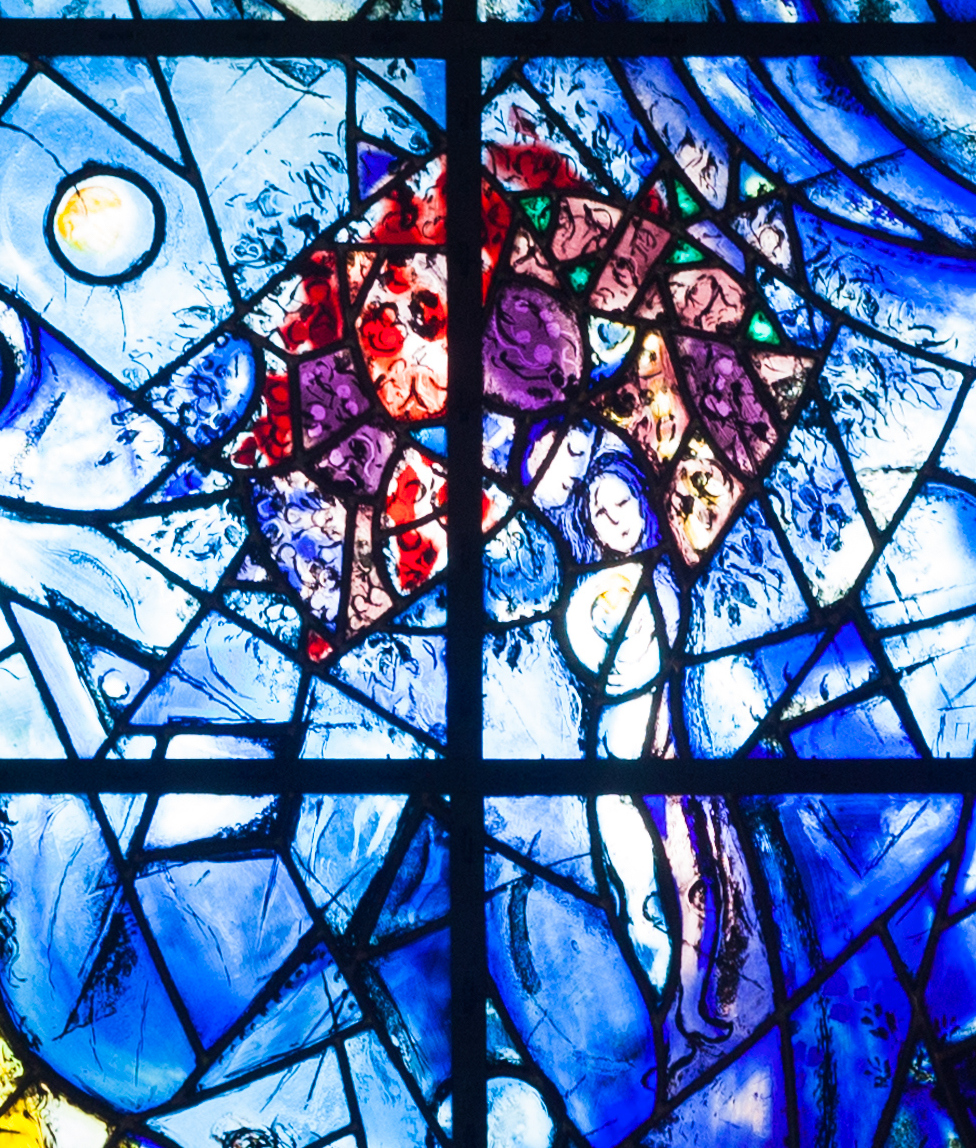
My eyes are drawn first to the red and purple bouquet in the center, under which stands an amorous couple. Who are they? What do they represent? I can think of several possibilities:
1. Adam and Eve. In the sketch Chagall made for the window, the woman is very clearly naked, though she’s less obviously so in the final window. That Eve, pre-fall, is traditionally portrayed unclothed, and that Chagall’s later Peace Window unequivocally portrays Adam and Eve within a red tree, lends credence to the interpretation of these figures as our primordial foreparents, in which case the flowering mass would stand for the tree of life in the garden of Eden (Gen. 2:9).
2. The Annunciation—the angel Gabriel coming to Mary to announce that she had been chosen to birth and mother God’s Son. The male head is bodiless, emerging from the crimson bloom (suggesting, perhaps, a supernatural entity), and there’s a yellow glow at the woman’s breast, perhaps signifying the conception of Christ. What’s more, the woman appears to be cradling something—her pregnant belly?
3. God and the human soul, or Christ and his church. One traditional Jewish interpretation of the poetic book of scripture known as the Song of Solomon is that it celebrates the love between humanity and the Divine. Medieval Christians, similarly, spoke of the book as an allegory of the future marriage of Christ and the church, his bride, drawing too on the New Testament book of Revelation, which culminates in a mystical union, a picture of cosmic harmony, heaven and earth inseparably joined.
4. The kiss of Justice and Peace. Psalm 85:8–11, a common Advent text, speaks of the divine attributes that coalesce to accomplish salvation (in the Christian reading, in the Incarnation):
Let me hear what God the LORD will speak, for he will speak peace to his people, to his faithful, to those who turn to him in their hearts. Surely his salvation is at hand for those who fear him, that his glory may dwell in our land.
Steadfast love and faithfulness will meet; righteousness and peace will kiss each other [emphasis mine]. Faithfulness will spring up from the ground, and righteousness will look down from the sky.
5. The kiss of Joy. Beethoven’s Ninth Symphony was a favorite of Dag Hammarskjöld’s, and its performance, at least the “Ode to Joy” chorus in its final movement, is a United Nations Day concert tradition. Hammarskjöld described the work as “a jubilant assertion of life,” championing universal peace and brotherhood. One of the lines from Friedrich Schiller’s text that Beethoven set exclaims that “Joy . . . kiss[es] . . . the whole world!”
I suspect some or all of these ideas were at play when Chagall designed the window. Or even just romantic love in general (with other types of love portrayed elsewhere in the composition), as he often painted himself and his wife Bella kissing or embracing.
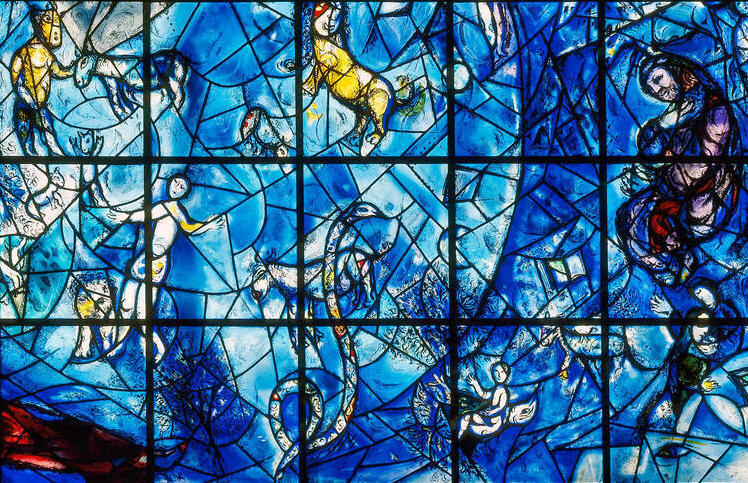
After this tableau, my eyes go to the large male figure cloaked in purple just right of center. I take him to be the prophet Isaiah, beholding a vision of wild animals and children cavorting together in harmony (see Isaiah 11). A boy, for example, reaches his hand out toward a viper and is not harmed.
But it’s also possible that’s meant to be Isaiah at the bottom left of the window, his face illumined by the beauty spread out before him, which an angel gestures to, guiding the prophet’s imagination:
On the top right, another angel delivers the Ten Commandments to the people of God.
Next to this communication of God’s word is the death of God’s Word in the flesh, Jesus Christ, around whom the crowds have gathered. A man ascends a ladder propped against the cross, the ladder being a multivalent symbol harking back to Jacob’s dream at Bethel and evoking notions of descent and ascent.
Vignettes below include a couple embracing with an infant in hand, a woman being fed at a table (the Eucharist?), a family reading a book (probably the Bible), a woman making music, and another bearing flowers.
At the top left is a lamentation scene that evokes those of Christ deposed from the cross. A man in a loincloth lies dead or wounded on the ground, his head cradled by a loved one, while at his feet another mourner throws her arms up in grief. This is the cost of human violence.
By contrast, in the bottom left corner, a mother cradles her child, evoking scenes of the nativity of Christ—of Mary with her newborn son.
All these characters—human, animal, and divine—are sprawled across a warm azure background, playing out love, suffering, death, peace, joy, and reconciliation.
LISTEN: “Oracles” by Steve Bell, on Keening for the Dawn (2012)
O ancient seer, your vision told Of desert highways streaming home To the mountain of the Lord Where nations sound a righteous song forevermore
And on that mountain men will forge From cruel implements of war The tools to till and garden soil The rose will bloom and faces shine with gladdening oil
And it will surely come to pass Justice will reign on earth at last The wolf will lie down with the lamb No beast destroy, no serpent strike the child’s hand
And God himself will choose the sign A frightened woman in her time Will bear a son and name him well God with us! O come, O come, Emmanuel!
. . . each day a misery and a marvel, each person also.
—Rachel E. Hicks, from “Accumulated Lessons in Displacement”
A white American born in the foothills of the Himalayas to international school educators, Rachel E. Hicks is a second-generation third-culture kid (TCK) whose writing reflects decades of living as a global nomad, exploring themes of memory, connection, suffering, exile (both physical and spiritual), hospitality, and hope. She grew up in six countries—India, Pakistan, the United States, Jordan, the Democratic Republic of the Congo, and Hong Kong—and spent seven years as an adult in Chengdu, China, where she worked for the relief and development organization Food for the Hungry.
In 2013, she, her husband, and their two kids repatriated to the US, settling in Baltimore, where they live today. Hicks has lived in Baltimore longer than in any other city. But even with this rootedness, “the soil of each place in which I’ve lived still clings,” she says.
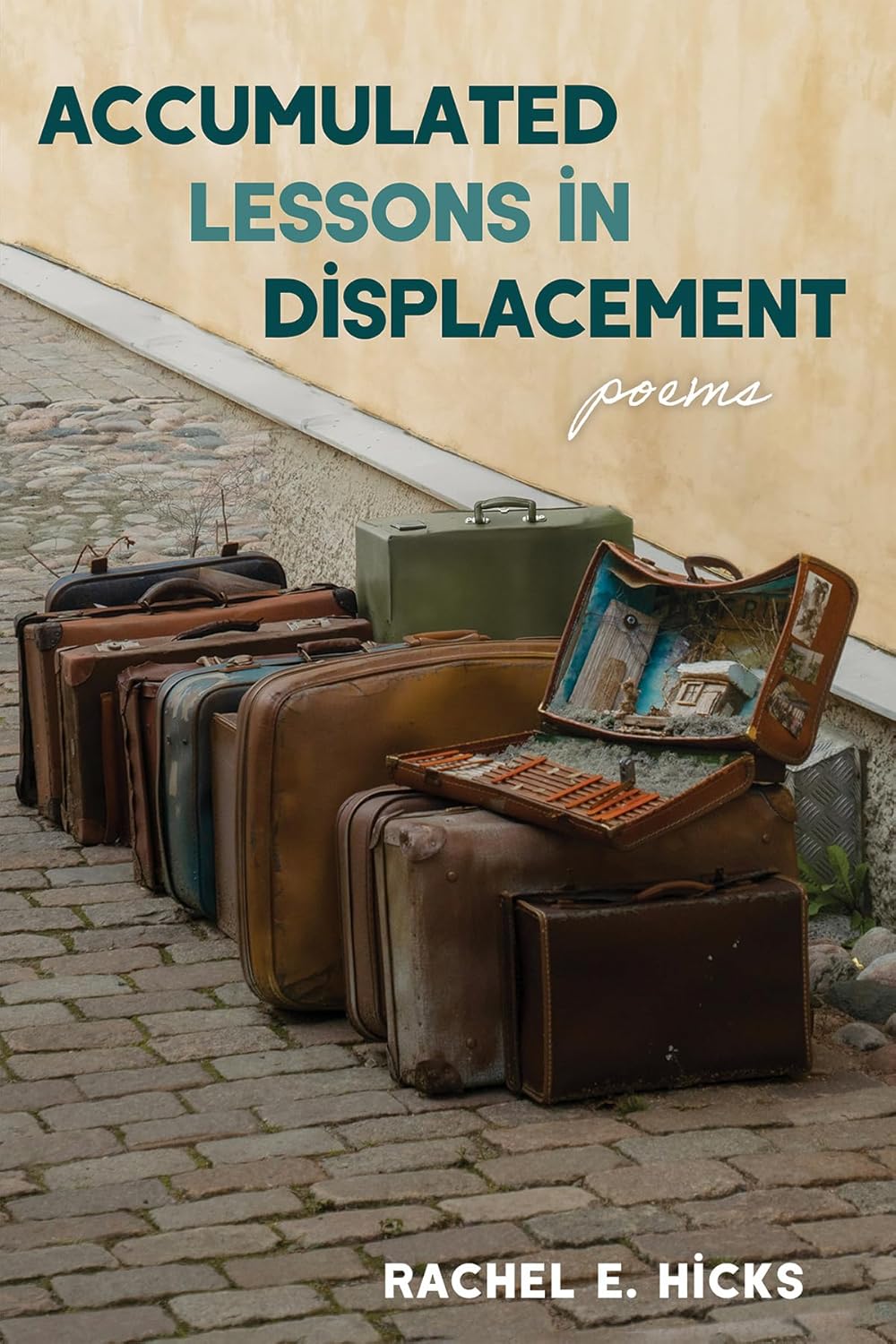
In her debut poetry collection, Accumulated Lessons in Displacement (Wipf & Stock / Resource Publications, 2025), Hicks grapples with the experience of being a “perpetual pilgrim”—on her way to a particular place but also attuned to the significance of each moment along the way. “Pilgrims learn to walk a life of paradox: even though their hearts are set on their final destination, they walk through each day alive to its possibilities, people and lessons,” she wrote in a 2014 blog post.
What is “home”? How can we bear to leave home, whether forced to do so by war, famine, or natural disaster, or we choose to for opportunity or ministry? What do we do with feelings of alienation when we find ourselves in a culture not our own or in which we don’t fit well? How do we live cross-culturally? How do we make a home where we’re at? What are our responsibilities to place? Who is our neighbor?
“I believe that many—all?—of us live our lives with some sense of exile,” Hicks writes on her blog. “We experience it and are aware of it to varying degrees, but it’s there. So many of our quests, our longings, our purpose-seeking, and the stories we create and tell are about trying to find our way home. Home being that place—literal or figurative—in which we feel wholeness and true belonging.”
Accumulated Lessons is divided into two parts: “Bright Sadness, Bitter Joy” and “A Deeper Knowing.” The term “bright sadness”—a translation of the Greek word charmolypê—comes from the Eastern Orthodox tradition, and it describes the paradoxical state of mourning over sin while rejoicing in God’s grace. It can also describe the paradox of living a life of joy amid suffering.
I was trying to learn the word for joy
that settles awkwardly in grief’s nest, an oversized bird. I didn’t want to scare it away.
So says the speaker in the book’s title poem, “Accumulated Lessons in Displacement.” Unfolding over eight sections, this persona poem draws on Hicks’s own experience of abrupt displacement from Kinshasa as a teenager, as well as the experiences of Bosnian refugee friends, and Syrian refugees she had only read about in the news.
It opens with a reflection on “home” in all its ordinariness—the yellow coffee cup, the dusty houseplant, the sunlit window seat—and laments that “no footpath exists leading back to these things,” which, the reader is led to presume, have been destroyed by armed conflict, or its residents blocked from returning by threat of death.
The poem contains several arresting images, like the green threads of a sweater on barbed wire tracing a path across miles. A boy who collects bullet casings to make a necklace for his sister. Charred diary pages dancing around a blown-out living room, “ma[king] a strange poem in my heart.”
Hicks wrestles with the savage violence humans are capable of:
It makes no sense that a soldier can press a button
and somewhere a baby ignites into flame. And he goes home and brushes his teeth.
What we do to each other, to other created souls. Always I carry this burden like a child on my hip.
Another powerful poem in the collection is “Visit to Sarajevo,” where Hicks describes visiting the Bosnian-Herzegovinan capital with her friend Dragan, who was forced to flee it as a young married adult with a child in the 1990s after the city was besieged by Serbian forces. Hicks had met Dragan and his family in 2000 through her husband, Jim, who worked alongside him at a refugee resettlement agency in Phoenix, Arizona, and the families became close. Meeting up years later in Dragan’s hometown, Dragan leads Hicks through the once-familiar streets “in a haze of pride, nostalgia, nightmare,” giving her a tour of sites both historically significant and deeply personal.
Hicks’s passport country too has its national traumas, one of which was precipitated by 9/11, when in 2001, terrorists flew planes into the World Trade Center in New York City, killing almost three thousand people. In “Disaster Chaplaincy Training,” she describes a course she took, taught by a Ground Zero worker, to become further equipped for her work in China, which was focused on disaster preparedness and response. In the course, she learned how to “loiter with intent” in zones of disaster, “acclimat[ing] to [suffering’s] pungency.” Make sure, said the instructor, to “let them see you cupping a small ball / of hope—toss it up, catch it.”
Nationwide crisis struck the US again when on April 12, 2015, a young Black man from Baltimore, Freddie Gray, died of a spinal cord injury while in police custody, allegedly due to police brutality—though none of the six involved officers was ultimately held responsible. Gray’s death led to civil unrest in Baltimore (which Hicks had recently made her home) and throughout the country, as citizens demanded recognition, in word and practice, that “Black lives matter.”
Hicks wrote “The Morning After Freddie Gray’s Funeral” while Baltimore was on lockdown. Fumbling for words, she tries to explain to her children what’s going on as she, too, tries to educate herself more deeply about the history of racism in America and the longstanding grievances of the Black community she lives in. In the poem, she harvests mint from her garden to brew a gallon of black mint tea to share with her neighbor—
as what? An offering, apology?
A way to say I’m trying—learning about all that fuels these fires still smoldering this hushed morning?
The staining of the clear water as the tea steeps becomes a metaphor.
Accumulated Lessons in Displacement addresses global suffering, more localized suffering, as well as personal and family suffering.
One example of the latter has to do with Hicks’s daughter’s diagnosis, following an ankle sprain, with complex regional pain syndrome (CRPS), Ehlers-Danlos syndrome (EDS), and postural orthostatic tachycardia syndrome (POTS), chronic conditions that cause extreme nerve pain. “Bright Sadness” describes a return car ride from a fruitless medical visit, her daughter crying and gasping in agony in the back seat, when offhandedly, Hicks insists, “Turn your cries into opera!” This unexpected and ridiculous suggestion defuses, if for just a moment, the intense situation, resulting in “joy-laughing” amid plaintive contralto tones all the way home.
“Post-Miracle (I)” celebrates her daughter’s miraculous healing, holds the strange, tentative, empty-handed feeling of a fervent prayer request graciously granted. But then comes “Post-Miracle (II),” written when, after two months of her daughter being pain-free, the CRPS returned. Hicks wrestles with gratitude for the brief reprieve and anger at God’s “undoing” the miracle. She wonders about some of the healings Jesus performed in the Gospels, and whether they stuck.
“Post-Miracle (II)” is one of the few poems in the collection with end rhyme, each quatrain following an abba pattern. Perhaps the choice to work with a rhyme scheme for this particular subject represents, consciously or subconsciously, her attempt to make things rhyme again, to harmonize the reality of chronic pain with a good and loving God, to impose structure on the chaos.
Several of Hicks’s poems engage with biblical stories: the Suffering of Job, the Parable of the Prodigal Son, the Massacre of the Innocents, Zacchaeus encountering Jesus, the Walk to Emmaus. She performs poetic midrash, imaginatively interpreting and expanding the texts to connect with them on a deeper level.
Besides the biblical authors, some of her literary conversation partners in this collection are Frederick Buechner, Henri Nouwen, Simone Weil, Czesław Miłosz, Dostoevsky, G. K. Chesterton, Gregory of Nyssa, Paul Kingsnorth, and Karen Blixen.
Although there’s a heaviness to much of the material, it’s not overwhelming, as small graces are woven throughout: complimentary walnuts from a fruit shop owner on a winter Sunday; laughter over language barriers; refreshment from a water hose; the scent of turmeric and cardamom at a Punjab store in Baltimore, reminders of the poet’s birthplace; “the comfort of the priest’s thick thumb / upon my forehead, the signature of / Jesus,” on Ash Wednesday; dandelions and buttercups brushing ankles; a cairn at West Clear Creek; the monks at Great Lavra, Greece, making room for the dispossessed; bundles of sheep ascending limestone slopes at dawn in the Cotswolds; the delightful word cusp; her son’s euphoria upon gliding down a mountain on skis; the slow labor of opening a pomegranate and obtaining its ruby-red seeds for her daughter to eat.
The book is shot through with joy—a joy that coexists with suffering and that is sustained through faith.
“These are poems to live by—to help you stay human, love people, find joy in sorrow, pay attention to the world around you, open yourself to God, welcome mystery, and understand our times at a deeper level,” Hicks wrote in an email announcing the launch of the book. “You’ll journey all around the world and find it—in spite of its sorrow—full of beauty and worth loving.”
One of my favorite poems is “Just Before,” a perfect reading for the upcoming Advent season. It spans four cities of the world—places where people work, play, pray, and rest; places of economic disparity, of spiritual longing as well as mundane concerns—in each imagining the moment just before Jesus returns. In the midst of our threshing corn or lighting a lamp or settling a legal dispute or herding sheep, Jesus will come with a beauty that blossoms all the way out to the horizon, calling all nomads home.
“Just Before” by Rachel E. Hicks
When Jesus comes again in all his glory, somewhere in the Sichuan mountains tires will crackle over corn spread out on the road— easy threshing—while a small child urinates in the gutter, absorbed in watching the car shoot by.
As the first rent opens a fingernail tear in the hazy sky, a woman in the foothills above Rishikesh will lay down her firewood burden and light the clay Diwali lamp in the chilling dusk, circling her cupped hands in blessing.
In the pause before the clamor of heaven’s trumpets, the jurors’ waiting room in Baltimore’s civic court will throb with the quiet turning of pages, a buzzing phone in the hand of a tired man, berating himself for forgetting to bring coffee.
Just before we are aware of him, Jesus will pause to survey the view; two shepherd boys amidst boulders in the Wadi Rum hills south of Amman wipe sleep from their eyes and stand amazed at the blood-red poppies at their feet stretching to the eastern horizon.
Purchase Accumulated Lessons in Displacement here. (Update, 11/14/25: Wipf & Stock is offering a 50% discount through November 30, 2025; use code CONFSHIP at checkout. Media mail shipping is free.)
“Just Before” is reproduced with permission from Wipf and Stock Publishers, www.wipfandstock.com.
PODCAST: Poetry for All, hosted by Joanne Diaz and Abram Van Engen:Poetry for All “is for those who already love poetry and for those who know very little about it. In this podcast, we read a poem, discuss it, see what makes it tick, learn how it works, grow from it, and then read it one more time.” I’ve consistently enjoyed this podcast since its launch in 2020, having learned about it through cohost Abram Van Engen [previously], an academic who often writes and speaks about poetry for general Christian audiences. Here are some of my favorite episodes of the ninety-seven that have been released to date:
Three haiku by Kobayashi Issa, translated from the Japanese by Robert Hass: The first: “The snow is melting / and the village is flooded / with children.” Learn the characteristics of what Joanne Diaz calls “the perfect poetic form.”
“spring song” by Lucille Clifton: One of my favorite poems by one of my favorite poets. “This joyful poem caps a sequence of sixteen poems called ‘some jesus,’ which walks through biblical characters (beginning with Adam and Eve) and ends on four poems for Holy Week and Easter. [Clifton] wrote other poems on the Bible as well, including ‘john’ and ‘my dream about the second coming,’ which reimagine a way into biblical characters to make their stories fresh.”
“Elegy for My Mother’s Mind” by Laura Van Prooyen: This episode is unique in that it has the poet herself on to read and discuss the poem, which in this case navigates the complexities of memory, loss, and familial relationships.
“View but This Tulip” by Hester Pulter: Ashamedly, I had never heard of this seventeenth-century female poet before listening to this episode, so I’m grateful to guest Wendy Wall, cocreator of the award-winning Pulter Project website, for introducing me to her! “In this episode we discuss [Pulter’s] work with emblems, her scientific chemistry experiment with flowers, and her wonderment (both worried and confident, doubtful and awestruck) about the resurrection of the body and its reunification with the soul after death.”
“From Blossoms” by Li-Young Lee: A much-anthologized poem ostensibly about eating summer peaches, but more deeply, it’s about joy. “One of the things that draws me to this poem,” says Van Engen, “is that joy is actually very hard to write about . . . without it sounding naive or sentimental or withdrawn or unaware.”
“Primary Care” by Rafael Campo: Dr. Rafael Campo is both a poet and a practicing physician. Here he uses blank verse to explore the experience of illness and suffering.
+++
POEMS:
>> “For V. the Bag Lady, Great in the Kingdom of Heaven,” “Damascus Road,” “The Sower,” and “Crosses” by Paul J. Pastor: The Rabbit Room received permission to reproduce four poems from Paul J. Pastor’s [previously] new poetry collection, The Locust Years, which “explores a world of mystery and sorrow, desolation and love. Rooted in the Pacific Northwest, these poems offer readers an invitation to walk along a path pebbled with profound joy and deep loss.” I’ll be sharing another on the blog next week, courtesy of Wiseblood Books.
>>“Undone”by Michael Stalcup: The rise of blogging in the aughts and its descendant, Substacking, in the last few years has meant that poets and other writers can share their work directly with their reading publics and give them insight into their creative process if they wish. On his Substack, the Thai American poet Michael Stalcup [previously] recently shared one of his new poems that’s based on the story of the woman caught in adultery in John 8:1–11. He explains how the poem’s form, a blend of the Petrarchan sonnet and the chiasmus, contributes to its meaning.
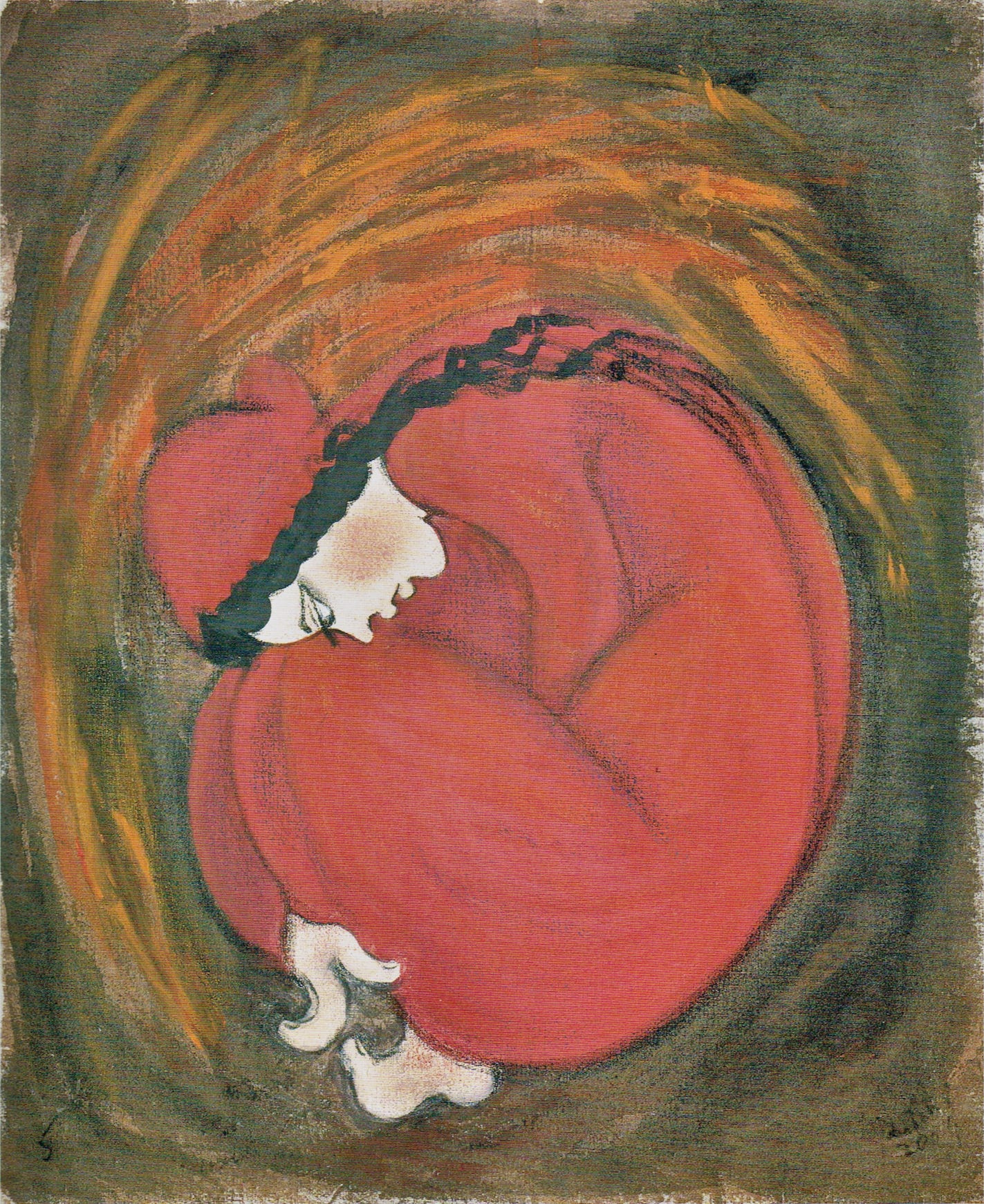
Nalini Jayasuriya (Sri Lankan, 1927–2014), Go, Sin No More, 2004. Mixed media on cloth, 23 × 19 in. Published in The Christian Story: Five Asian Artists Today, ed. Patricia C. Pongracz, Volker Küster, and John W. Cook (Museum of Biblical Art, 2007), p. 119.
Blessed be the paps which Thou hast sucked. —Luke 11:27
Suppose he had been Tabled at thy Teats, Thy hunger feels not what he eats: He’ll have his Teat ere long (a bloody one). The Mother then must suck the Son.
Scholar Kimberly Johnson [previously] unpacks these four lines about the body of Christ, who as an infant drank milk from his mother’s breast, and whose sacrificial death opened up his own breast whence flows the blood that nourishes us all. Johnson teases out the overlap of physical and spiritual in the poem, highlighting the maternal sharing of one’s own substance that links both couplets. At the eucharistic table, we are bidden to come and eat; or, in the stark metaphorical language of Crashaw, come and suck Christ’s bloody teat.
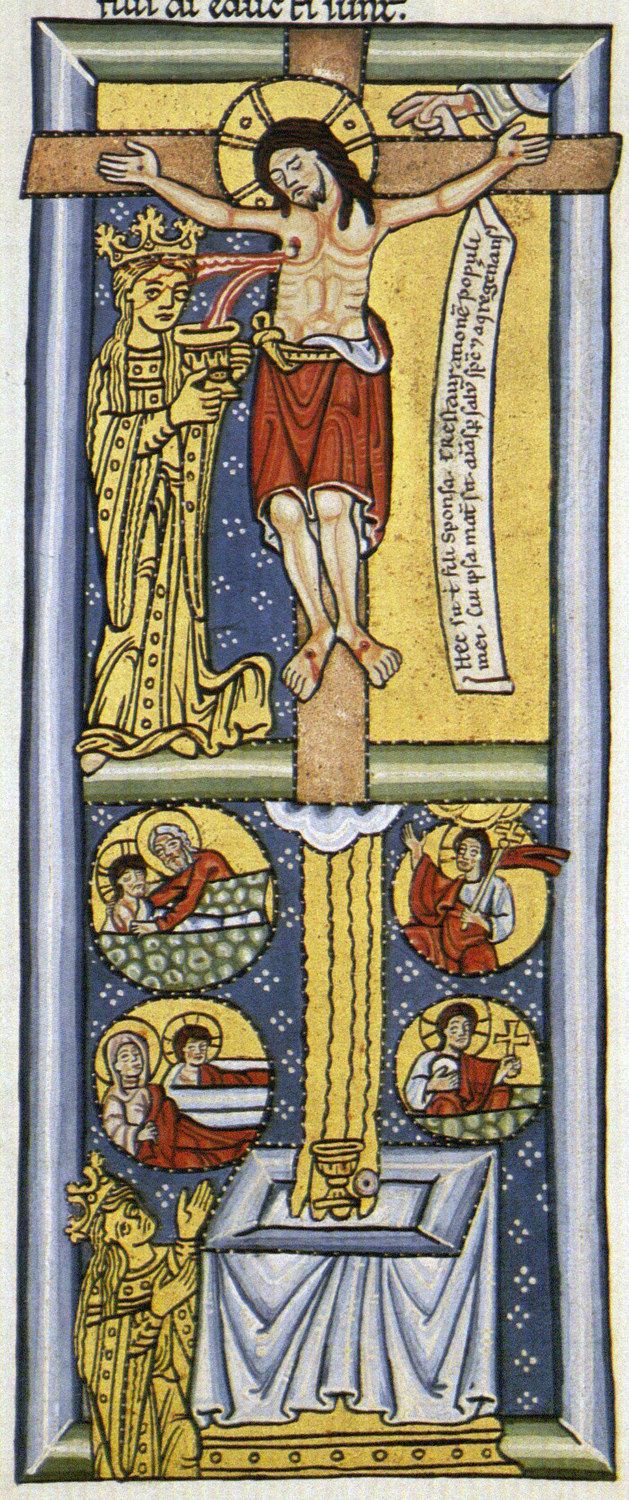
I plan to write an essay sometime about Christ as a nursing mother, as I’ve seen the image pop up in medieval writings and some visual art, including from Kongo and Ethiopia. In the meantime, here’s an illumination of the sixth vision in part 2 of Hildegard of Bingen’s Scivias (Know the Ways), painted under the supervision of Hildy herself. It shows the crucified Christ feeding Ecclesia (his bride, the church) with blood from his breast.
“The Crucifixion and the Eucharist,” from Scivias (Know the Ways) II.6, Rupertsberg Abbey, Germany, before 1179. Rupertsberg Codex, fol. 86r, Hildegard Abbey, Eibingen, Germany. The original manuscript from Hildegard’s lifetime was lost in 1945, but a faithful copy was made in 1927–33, which is the source of the color reproductions now available.
+++
ESSAY: “Only One Heart: The Poetry of Franz Wright as Emblem of God’s Grace” by Bonnie Rubrecht, Curator: “Are You / just a word? // Are we beheld, or am I all alone?” These three lines typify the poetry of Franz Wright (1953–2015), the Pulitzer Prize–winning author of Walking to Martha’s Vineyard, God’s Silence, and other collections. “Wright’s work is often described as confessional, colored by irony and humor. His irreverence, juxtaposed with honesty and humility, make his poetic voice unique in addressing God. Writers and poets often traffic in spiritual themes, but few modern poets echo the prophetic Old Testament tradition of crying out, approaching God with the concision and raw emotion that Wright does. He excels in voicing the concerns and ruminations of the human experience of suffering, while simultaneously shifting towards his own embodiment of grace.”
A praising of God is what laughter is, because it lets a human being be human.
Laughter is a praise of God, because it lets a human being be a loving person.
Laughter is praise of God because it is a gentle echo of God’s laughter, of the laughter that pronounces judgment on all history.
Laughter is praise of God because it foretells the eternal praise of God at the end of time, when those who must weep here on earth shall laugh.
The laughter of unbelief, of despair, and of scorn, and the laughter of believing happiness are here uncannily juxtaposed, so that before the fulfillment of the promise, one hardly knows whether belief or unbelief is laughing.
Soichi Watanabe (Japanese, 1949–), You Shall Laugh, 2011. Oil on canvas, 16 × 12 in. (41 × 31 cm). Kwansei Gakuin University Chapel, Kobe, Japan. Photo courtesy of the artist.
Soichi Watanabe is a Japanese Christian artist who served as the 2008–9 artist in residence at the Overseas Ministries Study Center (OMSC) in New Haven, Connecticut (now at Princeton Theological Seminary). OMSC published a catalog of his work, titled For the Least of These: The Art of Soichi Watanabe, in 2010, featuring forty-three of his paintings.
Watanabe doesn’t supply facial features for his human figures because he wants viewers to be able to see themselves in the characters portrayed. He concentrates on form and color.
I was introduced to this painting of his through the OMSC-sponsored Zoom presentation he gave on February 3, 2021. There he said, “We can laugh as the love of God is being poured out on us . . . the laughter of knowing that the Lord is with us in pain and sorrow.” The wave shape at the bottom, he told me in an email, is a reference to the tsunami of March 11, 2011, which wiped out his home city of Ishinomaki and accelerated his mother’s dementia.
Watanabe also painted a companion piece, With Those Who Weep, which shows the same three figures huddled together in a mass, one comforting the two who are crying. Together, the paintings encourage us to fully feel our griefs and our hurts, and to be present to one another through those experiences, but also to hold on to joy, which transcends circumstance.
The artist pointed out to me that the three figures in You Shall Laugh resemble a flower spreading out its petals. The kanji for “bloom,” he says, originally meant “laugh” and was written as “birds sing, flowers laugh.”
LISTEN: “Jesus soll mein erstes Wort” (Jesus shall be my first word) from Gott, wie dein Name, so ist auch dein Ruhm (God, as your name is, so also your praise is to the ends of the world) (BWV 171) | Words by Picander (Christian Friedrich Henrici), 1728 | Music by Johann Sebastian Bach, 1728 | Performed by Kathleen Battle and Itzhak Perlman on J. S. Bach: Arias for Soprano and Violin, 1991
Jesus soll mein erstes Wort
In dem neuen Jahre heißen.
Fort und fort
Lacht sein Nam in meinem Munde,
Und in meiner letzten Stunde
Ist Jesus auch mein letztes Wort.
Jesus shall be my first word
uttered in the new year.
Again and again
his name laughs in my mouth,
and in my last hour
Jesus will also be my last utterance.
This aria is the fourth movement of a cantata Bach composed for his church in Leipzig for New Year’s Day 1729. January 1 is also the Feast of the Holy Name of Jesus, since Jesus was given his name when he was eight days old (Luke 2:21). Read the full libretto of BWV 171 here, and listen to the full cantata here. (It’s only sixteen minutes.)
For the excerpt I’ve chosen a recording by the legendary American operatic soprano Kathleen Battle, who is accompanied by the equally famous Israeli American violinist Itzhak Perlman.
Purvis Young (American, 1943–2010), Untitled, 1990s. Paint on fiberboard, 65 1/16 × 47 5/8 in. (165.3 × 121 cm). Smithsonian National Museum of African American History and Culture, Washington, DC. Photo: Victoria Emily Jones. [object record]
From the gallery label at the Smithsonian National Museum of African American History and Culture, where I first encountered this painting in 2019:
Purvis Young was a long-time resident of Overtown, a Black neighborhood in Miami, Florida. He began drawing while in jail, after a vision led him to embrace the idea of becoming an artist. He educated himself about the history of art, and focused on a daily routine of making art, much of it on public surfaces and walls. In Untitled, as in much of Young’s work, angels and horses are prominently featured; angels represent goodness and horses represent freedom. Just as he had found salvation through art, he hoped his own art would bring harmony to his neighborhood, and to the world.
In the foreground of the painting, four angels look onto a scene of what appears to be celebration. Myriad figures hold aloft circular items—tambourines? halos? Is this the gathering of saints in heaven, where goodness and freedom abound?
Kama simcha yesh bevetcha, kshe’kulam sharim beyachad Al shehaya al sheyieh ve’al kol she’Ata oseh Hayu yamim tovim yoter, ach le’olam lo nevater Al hasimcha ha’arucha, she’od tavo ken hi tavo
Im lo nashir unehalel ha’avanim lo ishteku Kol habria lecha koret, baruch haba Maran Ata Bein im od shana o od me’ah, lecha namtin betsipia Hu she’ala, gam od yered ve’az tatchil hachagiga [Refrain]
Outro: Hineh ma tov uma naim, kshe’kulanu mehalelim Sharim beyachad le’Elohim, kol echad hu chelek, kulam bifnim
ENGLISH TRANSLATION:
There’s so much joy in Your home, when everyone is singing About what was, and what will be, and about everything You’re doing There were better days, but we’ll never give up On the joy that has been prepared, that will come, yes, joy will come
Refrain: Lift up your hands; we’re celebrating before Yeshua [Jesus] We’ll see Your goodness in heaven, but also in the land of the living We’ll lift our voices to the heavens, filling them with song We’ll celebrate as a family, when we come again into Your home
If we won’t sing and worship, the stones will not remain silent All of creation is calling for You, “Blessed are You! Come, Lord. Maranatha.” Whether it takes a year or a hundred, we’ll wait for You with expectancy He who ascended will descend again, and then our celebration will start [Refrain]
Outro: How good and pleasant it is, when all of us worship Singing together to God, everyone takes part, everybody is in
Shilo Ben Hod is a Messianic Jewish worship leader from Israel. He sings this song of his in Hebrew with his wife, Sarah, and other family and friends.
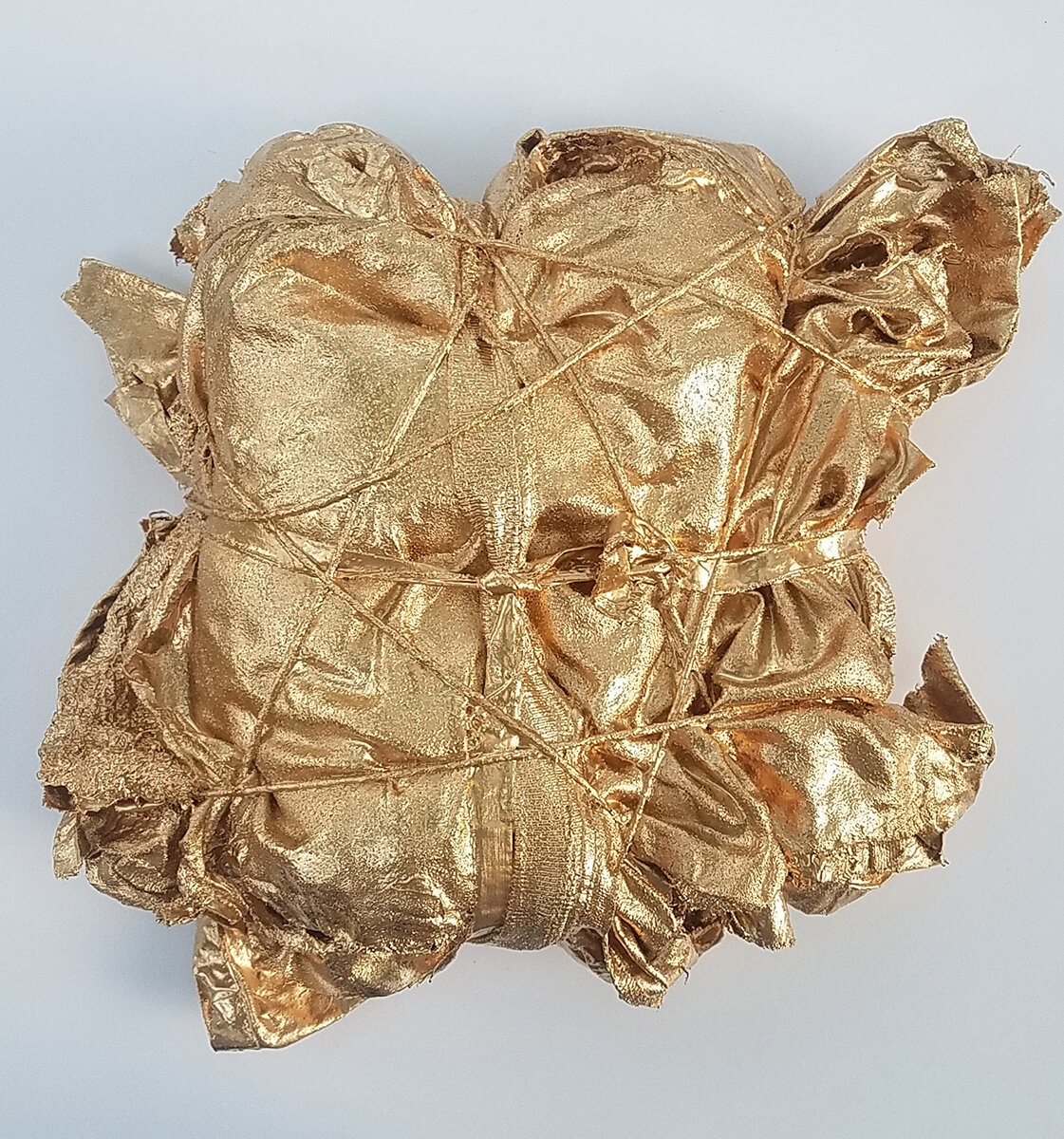
ART SERIES: Magnificat by Mandy Cano Villalobos:Mandy Cano Villalobos [previously] is a multidisciplinary artist from Grand Rapids, Michigan. Her Magnificat series consists of bundles of discarded clothing, bound in string and meticulously hand-coated with imitation gold. The title—the Latin name of Mary’s praise song that opens, “My soul magnifies the Lord!”—invites associations with the Christmas story, including the image of the swaddled Christ child, a gift to the world that surprises and delights.
Mandy Cano Villalobos (American, 1979–), Magnificat XV, 2019. Cloth, string, and imitation gold.Installation of select pieces from the Magnificat and Cor Aurum series by Mandy Cano Villalobos, December 2020, Sojourn Midtown, Louisville, Kentucky
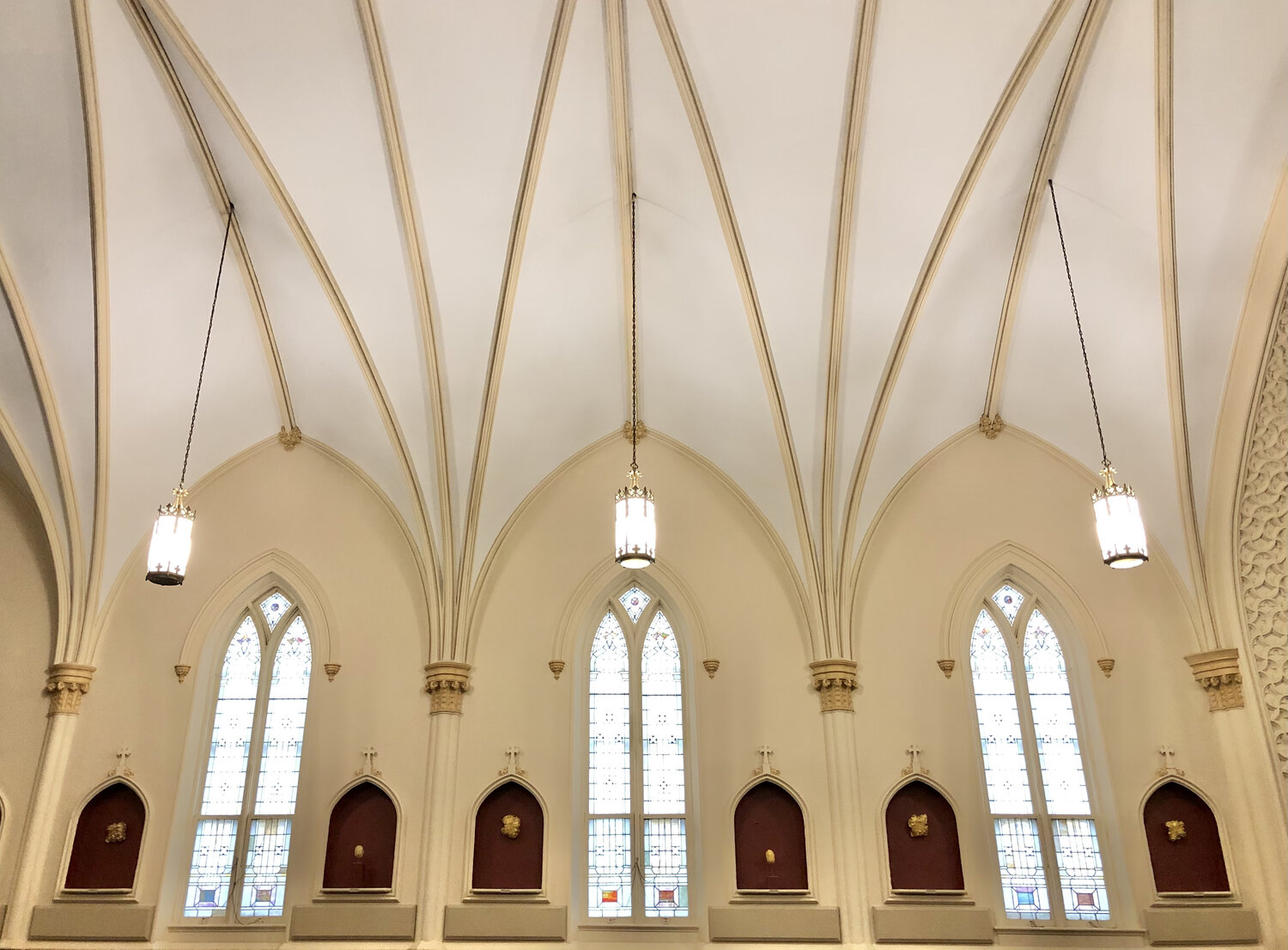
The series debuted in 2019 at Cano Villalobos’s solo show All That Glitters at the Urban Institute for Contemporary Arts (UICA) in Grand Rapids. I first encountered it, though, through online promotions of Sojourn Midtown’s Advent 2020 installation to correspond with the church’s sermon series Wrapped in Flesh, for which twelve of the artist’s works, some from her related Cor Aurum (Heart of Gold) series, were placed in niches around the sanctuary.
“The objects, all made of wood and fabric covered in imitation gold, point to something both humble and glorious,” writes Michael Winters, Sojourn Midtown’s arts and culture director. “Like these small sculptures of rags and gold, the birth of Jesus was also marked by humility and glory.”
+++
ARTICLE: “My Swaddled Savior” by Jeff Peabody, Christianity Today: Pastor Jeff Peabody of Tacoma, Washington, describes the traditional Japanese art of furishoki, or wrapping goods in cloths, as he reflects on Jesus having been swaddled as an infant, a wrapped gift given to the world. “Jesus came to us in furoshiki, wrapped in cloths,” he writes.
+++
BLOG POST: How to receive gifts and enjoy feasting without shame, by Tamara Hill Murphy: In this old blog post of hers, spiritual director and The Spacious Path author Tamara Hill Murphy absolves us of the guilt we so often feel around (1) receiving (unreciprocated) gifts and (2) feasting. We should receive both presents and food, she says, as means of grace. Too often we’re embarrassed when we receive a gift from someone to whom we gave no gift, or a gift of lesser value, and so instead of receiving their gift with joy, we receive it with shame or an annoying sense of obligation. But Murphy says she hopes to receive gifts this way: “When Jesus told us to come to him as little children, he must have been imagining the way children openly, delightedly, innocently receive gifts. Children do not question their place as ones worthy of receiving gifts. Children boldly believe the beauty of unearned kindness.”
As for food, how many times have you been to a Christmas party or dinner and heard people bemoan all the fat and sugar they’ve been consuming, and about how they’ll have to punish their body in the new year to work off the extra calories, to shrink themselves back down to size? Feasting, though, is a spiritual discipline, a way to celebrate important events, like the birth of Christ, with family and friends. Feel no shame about indulging in gustatory pleasures this Christmas! Take in the sweet, the creamy, and the juicy! Murphy’s mom’s motto for hospitality is a wise one: “While we feast, we savor.”
On her blog A Clerk of Oxford, medievalist Eleanor Parker also affirms the virtue of feasting, noting how the popular modern practice of fasting in January runs counter to medieval Christian practice:
Since the late 20th century it’s become common to invert the traditional relationship between fasting and feasting in the Christmas season. The ancient custom was to fast in Advent in preparation for the feast, and then to celebrate for at least twelve days after Christmas (and to some degree, all through January). Now we do it the other way around; for many people the feast is followed by a penitential fast, in the form of ‘Dry January’ or New Year’s resolutions about eating less and going to the gym. As a manifestation of the desire for a fresh start, this ‘new year, new you’ impulse is natural enough, but it does strike me as strange that it’s so often framed in negative terms. There’s an odd sense, encouraged mostly perhaps by journalists and advertisers, that the indulgence of Christmas is a ‘sin’ which has to be atoned for – as if eating and drinking with friends and family, to celebrate the turn of the year from darkness to light, is a moral lapse for which one must subsequently make amends by privation and self-punishment. We are much less kind to ourselves in these weeks after Christmas than the strictest confessor would have been in the Middle Ages. Feasting at Christmas is not something to atone for, but a proper observance due to the season; and that feasting is also the sustenance we need to carry us into the New Year with energy and strength.
+++
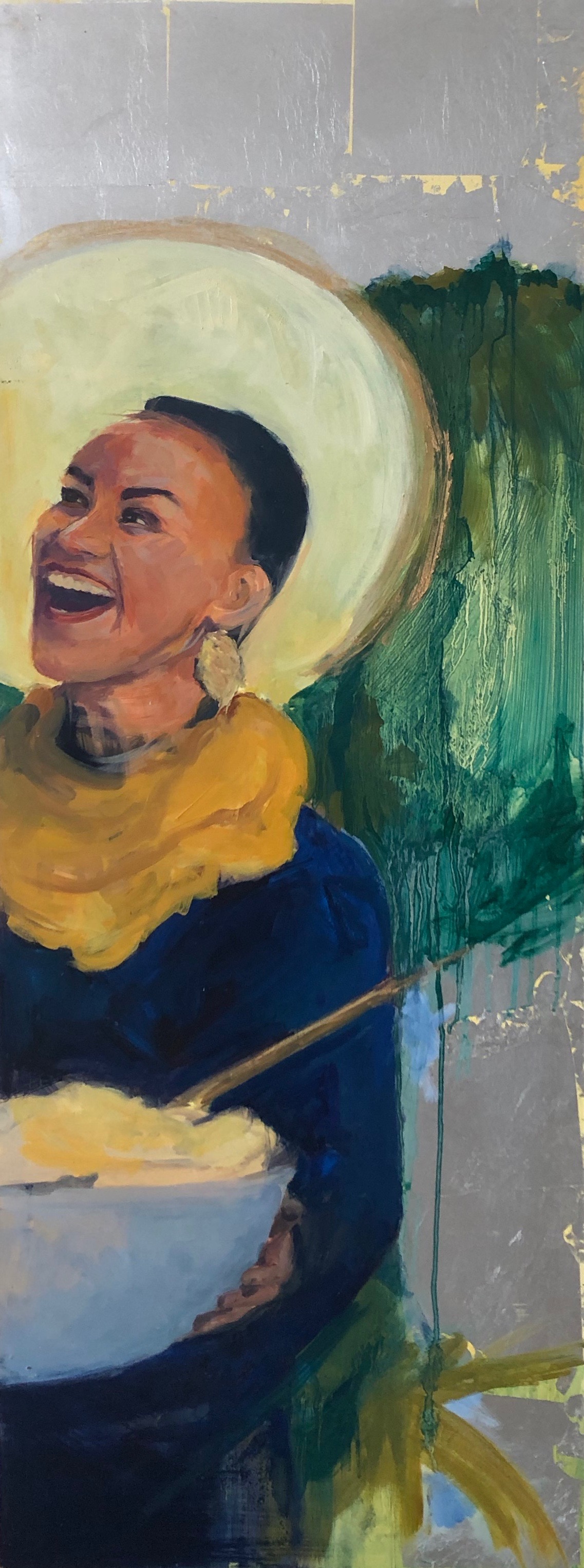
VIDEO: “Our Vocation of Delight: On Advent, Beauty, and Joy” by Christen Yates: In this thirty-minute “Space for God” Advent devotional from Coracle, artist Christen Yates (Instagram @christenbyates) invites us to experience the Christian “duty of delight” through engaging a selection of artworks by herself, Sedrick Huckaby, Letitia Huckaby, and Ashley Sauder Miller. She opens with a liturgical commission she fulfilled for the Advent season while serving as artist in residence at her church in Charlottesville: a portrait painting of congregation member Arley Bell (née Arrington), a baker who is now the owner of Arley Cakes in Richmond. Waiting for her dough to rise, Arley captures the joyful expectancy of Advent.
Christen Yates (American, 1977–), Advent: Arley, baker, 2016. Oil and gold and silver leaf on board, 48 × 18 in. Collection of All Souls Charlottesville, Charlottesville, Virginia. Photo courtesy of the artist.
The third Sunday of Advent is traditionally known as Gaudete (Joy) Sunday, a day of celebrating the joyful reality that God is near. Advent is characterized by our waiting and yearning for Christ, which can feel heavy, especially as we look around and within and see so much brokenness. But on this day we are reminded to embrace a spirit of joy as we wait and as we yearn—much like a child waits with eager anticipation to unwrap a gift, or lovers to be reunited after a time of separation.
The following ten songs help us to inhabit the gladsome aspects of the Advent season, paving the way to Christmas.
1. “First Song of Isaiah” by Jack Noble White (1976) | Arranged and performed by Advent Birmingham, feat. Annie Lee, on Canticles (2020): Here’s an upbeat rendition, with xylophone and ukelele, of Jack Noble White’s choral setting of Isaiah 12:2–6. “You shall draw water with rejoicing from the springs of salvation. . . . Cry aloud, inhabitants of Zion, ring out your joy!” In the Book of Common Prayer this text appears in the section “Morning Prayer, Rite 2,” where it is labeled Canticle 9, “The First Song of Isaiah: Ecce, Deus.”
2. “Rejoice Greatly, O Daughter of Zion” from Messiah by George Frideric Handel (1741) | Performed by Regula Mühlemann (2019): A setting of Zechariah 9:9–10, this aria from Handel’s most famous oratorio features coloratura in the vocals—that is, elaborate, fast-paced ornamentation, trills, runs, and wide leaps—that accentuates the prophecy’s joyful message of a coming king. It’s sung by the Swiss soprano Regula Mühlemann, accompanied by the Sächsische Staatskapelle Dresden under the direction of Alondra de la Parra. For a Broadway-style arrangement of this piece, see here.
3. “Joy (Elizabeth)” by Poor Bishop Hooper, on Firstborn (2018): This song by Jesse and Leah Roberts voices Elizabeth’s awe upon visiting with her younger relative Mary, who is newly pregnant with the Son of God. Elizabeth radiates such joy in the Messiah that her preborn son, John, catches it too, leaping in her womb.
4.“Joy” by Kirk Franklin and Donald Malloy| Performed bythe Georgia Mass Choir, feat. Dorothy Anderson and Kirk Franklin, on I Sing Because I’m Happy (1992): Sweet, beautiful, soul-saving joy! That’s what Jesus gives. The Georgia Mass Choir testifies with vigor, led by the Grammy-winning artist Kirk Franklin. In 1996 this song was adapted for Whitney Houston for the film The Preacher’s Wife, with Christmas-specific lyrics, but I really dig Dorothy Anderson’s solo work in this original recording.
5. “Rejoice” by Victory Boyd, on Glory Hour (2023): This anthem by singer-songwriter Victory Boyd is based on Nehemiah 8:10: “Do not be grieved, for the joy of the LORD is your strength.” Victory often incorporates scripture recitations into her songs, and here she speaks Psalm 27:1–6 as a bridge, which has thematic crossovers with the Nehemiah verse. In this live performance from the February 4, 2024, episode of the Hour of Power television program, she is accompanied by the Hour of Power Orchestra, conducted by Marc Riley.
6. “Joy” by Shakti, on Shakti with John McLaughlin (1976):Shakti is an acoustic fusion band that combines Indian music with elements of jazz; they were active in the 1970s and re-formed in 2020. Recorded at the Montreux Jazz Festival in 1976, this instrumental improvisation features John McLaughlin on guitar, L. Shankar on violin, Zakir Hussain on tabla (hand drums), and T. H. “Vikku” Vinayakram on ghatam (clay pot).
7. “There Will Be Joy” by Paul Zach and Kate Bluett (2022): “Sorrow has an ending / Something new is coming / Oh, there will be joy!”
8. “Come That Day” by Ken Wettig, on Behold and Become (2019): Ken Wettig served for eight years as pastor of Early Church, a Mennonite congregation in Harrisonburg, Virginia, before becoming a community minister at Coracle. This song he wrote is one that Early Church sings in its worship services. It celebrates the coming day of the Lord, when death will be no more and Christ will bring about total restoration. On that day, all chaos will be stilled, swords will be beaten into plowshares, the poor will be filled, and loved ones taken too soon will embrace one another once again. The song is an invocation: it beseeches Christ to come, to bring the promised consummation of his kingdom.
Wettig has given me permission to post the lead sheet for “Come That Day,” which he freely offers for noncommercial use. Click the link to download a PDF.
9. “Peace and Joy,” Shaker hymn (1893) | Performed by the Rose Ensemble, feat. Kim Sueoka, on And Glory Shone Around (2014): One of the less recognized roots of bluegrass and old-time music is the Shaker tradition. This hymn, performed here by the Rose Ensemble, hails from the late nineteenth-century Shaker community in Mount Lebanon, Columbia County, New York. It beckons us “Awake!” and hear the angels whispering forth the blessings of Christ. “Happy are they who gather these gifts” of peace and joy ushered in by the Incarnation. The fabulous soprano soloist is Kim Sueoka.
10. “Carol of the Bells” – Music by Mykola Leontovych (1914), based on a traditional Ukrainian folk chant | Words by Peter Wilhousky (1936) | Arranged by Isaac Cates and performed by Ordained on Carol of the Bells(2014): The composer, conductor, and pianist Isaac Cates plays piano accompaniment for his choir, Ordained, in this original arrangement of a Christmas classic. Dramatic and haunting, energizing too, “Carol of the Bells” is one of my favorite choral songs of the season—I never tire of hearing it! I love the build in volume and the interplay of voices in imitation of church bells.
John Linnell (British, 1792–1882), Wheat, ca. 1860. Oil on canvas, 94.2 × 140.6 cm. National Gallery of Victoria, Australia.
Summer ends now; now, barbarous in beauty, the stooks arise
        Around; up above, what wind-walks! what lovely behaviour
        Of silk-sack clouds! has wilder, wilful-wavier
Meal-drift moulded ever and melted across skies?

I walk, I lift up, I lift up heart, eyes,
        Down all that glory in the heavens to glean our Saviour;
        And, eyes, heart, what looks, what lips yet gave you a
Rapturous love’s greeting of realer, of rounder replies?

And the azurous hung hills are his world-wielding shoulder
        Majestic—as a stallion stalwart, very-violet-sweet!—
These things, these things were here and but the beholder
        Wanting; which two when they once meet,
The heart rears wings bold and bolder
        And hurls for him, O half hurls earth for him off under his feet.
The beauty of Christ suffuses the landscape in “Hurrahing in Harvest” by Gerard Manley Hopkins, written September 1, 1877, while he was studying theology at St Bueno’s College in the Vale of Clwyd, Wales. A hurrah is a jubilant shout, an exclamation of joy, and in this poem the object of that joy is the kingdom of God manifest in a late summer day during the wheat harvest. Hopkins wrote to his friend and fellow poet Robert Bridges—the man who championed his work and is responsible for its being known at all—that “the Hurrahing Sonnet was the outcome of half an hour of extreme enthusiasm as I walked home alone one day from fishing in the Elwy.”
Stooks are bound sheaves of wheat, and Hopkins describes them as savage-looking (“barbarous in beauty”), perhaps suggesting their resemblance to an unkempt head of hair. In their wonderfully wild way, when propped up, they point to the clouds, which glide along moving aerial sidewalks—the wind (“wind-walks”). Through metaphor, Hopkins refers to the clouds as “silk-sack[s]” (they’re bulky yet smooth, substantial yet wispy) and not snowdrift but “meal-drift” (mounds of coarsely ground white grain). The clouds are willful and wavy; they mold together and melt into sky.
Hopkins lifts up his eyes and heart—language reflecting the Sursum corda of the liturgy—to behold the day’s glory. “Down” in line 6 can be read as an adverb or verb: Hopkins looks down across the valley, or he “downs” the scene, takes it all in. And seeing the freshly reaped fields, he “glean[s]” Christ. He likens the rapture he feels to receiving a kiss of greeting from a lover, real and round. Addressing his eyes and heart, he says that no adoring human gaze nor tender human lips have ever imparted such pleasure as Christ imparts through nature.
In the final stanza Hopkins perceives the hills as the majestic shoulders of Christ supporting the sky. He compares Christ to a stallion (wild, strong) and a violet (delicate, humble).
The image of a stallion returns in the second-to-last line, where he says his own heart “rears” (raises upright) wings, which enable him to launch himself upward, his legs pushing off the ground. It’s a leaping of the spirit, an ascent of the soul—an intimate meeting of self and Savior in the goodness of the cloudy-blue afternoon. The Divine is always here, he says, “and but the beholder / Wanting”; that is, lacking awareness.
Throughout the poem there’s a strong sense of propulsion, carried in part by all the alliteration: “barbarous in beauty,” “wind-walks,” “silk-sack,” “wilder, wilful-wavier,” “meal-drift moulded . . . melted . . . ,” “glory . . . glean,” “realer, rounder replies,” “hung hills,” “world-wielding,” “stallion stalwart,” “heart . . . hurls.”
Hopkins’s eyes have been oriented to perceive the spiritual in the material, and the result is ecstasy.
Gerard Manley Hopkins (1844–1889) was a preeminent English poet and a Jesuit priest, whose most famous works include “The Wreck of the Deutschland,” “Pied Beauty,” “God’s Grandeur,” and “The Windhover.” In 1866 he converted from Anglicanism to Roman Catholicism, a decision that estranged him from his family; then he entered the Jesuit novitiate in 1868 and was ordained to the priesthood in 1877. He spent the last five years of his life as a classics professor at University College Dublin, struggling with depression, during which time he wrote the “terrible sonnets,” so-called because of their expression of deep anguish and desolation. Very few of his poems were published during his lifetime, and widespread recognition didn’t come until nearly three decades after his death, in 1918, when his friend Robert Bridges edited the first collection of his poems. Hopkins was the most innovative poet of the Victorian era, his “sprung rhythm” creating new acoustic possibilities and anticipating the modernist movement.
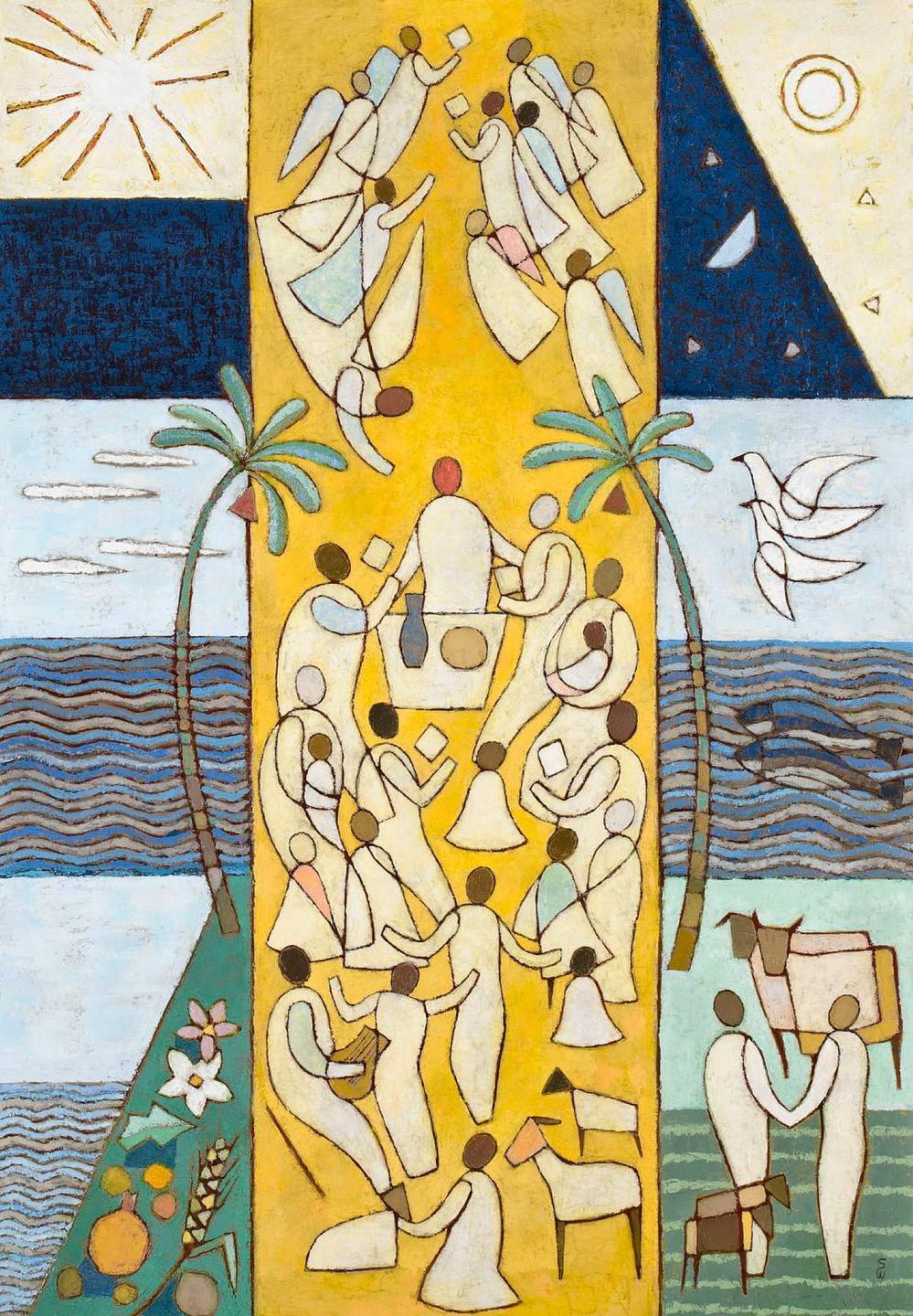
Soichi Watanabe (Japanese, 1949–), To God Be the Glory, 2009. Acrylic on canvas, 52 × 39 in. Collection of the Overseas Ministries Study Center at Princeton Theological Seminary.
This is the paschal feast,
the Lord’s passing from death to life:
so cries the Spirit.
No type or telling, this, no shadow.
Pasch of the Lord it is, and truly.

You have protected us, Jesus,
from endless disaster.
You spread your hands like a mother
and, motherlike, gave cover with your wings.
Your blood, God’s blood, you poured over the earth,
giving life, because you loved us.

The heavens may have your spirit, paradise your soul,
but oh, may the earth have your blood!

This feast of the Spirit
leads the mystic dance through the year.
New is this feast and all-embracing;
all creation assembles at it.

Joy to all creatures, honor, feasting, delight!
Dark death is destroyed
and life is restored everywhere.
The gates of heaven are open.
God has shown himself human,
humanity has gone up to God.
The gates of hell are shattered,
the bars of Adam’s prison broken.
The people of the world below have risen from the dead,
bringing good news:
what was promised is fulfilled.
From the earth has come singing and dancing.

This is God’s passing!
Heaven’s God, showing no stinginess,
has joined us together with God in the Spirit.
The great marriage hall is full of guests,
all dressed for the wedding,
no guest rejected for want of a wedding garment.
The paschal light is the bright new lamplight,
light that shines from the virgins’ lamps.
The light in the soul will never go out.
The fire of grace burns in us all,
spirit, divine, in our bodies and in our souls,
fed with the oil of Christ.

. . . . . . . . . . . . . . . . . . . . .

Join, then, all of you, join in this great rejoicing.
You who’ve been working the vineyard from the early hour
and you who came later,
come now and collect your wages.
Rich and poor, sing and dance together.
You who are hard on yourselves, you who are easy,
honor this day.
You who have fasted and you who have not,
make merry today.

The meal is ready: come and enjoy it.
The calf is a fat one: you will not go away hungry.
There’s kindness for all to partake of and kindness to spare.

Away with pleading of poverty:
the kingdom belongs to us all.
Away with bewailing of failings:
forgiveness has come from the grave.
Away with your fears of dying:
the death of our Savior has freed us from fear.
Death played the master: he has mastered death.
The world below had scarcely known him in the flesh
when he rose and left it plunged in bitter mourning.

Isaiah knew it would be so. [Isa. 14:9]
The world of shadows mourned, he cried, when it met you,
mourned at its being brought low, wept at its being deluded.
The shadows seized a body and found it was God;
they reached for earth and what they held was heaven;
they took what they could see: it was what no one sees.
Where is death’s goad? Where is the shadows’ victory?

Christ is risen: the world below [hell] is in ruins.
Christ is risen: the spirits of evil are fallen.
Christ is risen: the angels of God are rejoicing.
Christ is risen: the tombs are void of their dead.
Christ has indeed arisen from the dead,
the first of the sleepers.

Glory and power are his for ever and ever. Amen.
This text is a composite of excerpts from two Easter sermons spuriously attributed to John Chrysostom (ca. 347–407) and drawing inspiration from Hippolytus of Rome (ca. 170–ca. 235), which I adapted from Walter Mitchell’s English translation from the original Greek that appears in Adalbert Hamman, OFM, ed., Early Christian Prayers (Chicago: Regnery Gateway, 1961), 31–35. The source texts can be found in the Patrologia Graeca59:741–46 and 59:721–24. They probably date to the fourth century.





 Art & Theology