Woman gathering flowers, first century CE. Detached fresco, 38 × 32 cm, from the Villa Arianna in Stabiae, Campania, Italy, now in the Collection of the Museo Archeologico Nazionale di Napoli, Naples, Italy. The woman may be Primavera (a personification of spring) or Flora (the Roman goddess of flowers, fertility, and abundance), or simply a generic maiden at leisure.
Spring bursts today,
For Christ is risen and all the earth’s at play.

Flash forth, thou Sun,
The rain is over and gone, its work is done.

Winter is past,
Sweet Spring is come at last, is come at last.

Bud, Fig and Vine,
Bud, Olive, fat with fruit and oil and wine.

Break forth this morn
In roses, thou but yesterday a Thorn.

Uplift thy head,
O pure white Lily through the Winter dead.

Beside your dams
Leap and rejoice, you merry-making Lambs.

All Herds and Flocks
Rejoice, all Beasts of thickets and of rocks.

Sing, Creatures, sing,
Angels and Men and Birds and everything.

All notes of Doves
Fill all our world: this is the time of loves.
This poem was originally published in A Pageant, and Other Poems(London, 1881) and is in the public domain.
One of the most celebrated poets of the Victorian era, Christina Georgina Rossetti (1830–1894) was an English writer of Romantic, devotional, and children’s poems. She was the youngest of four siblings, among them the Pre-Raphaelite artist Dante Gabriel Rossetti, several of whose paintings she sat for, famously modeling for the Virgin Mary. A devout Anglican whose verse gives vivid expression to the life of faith and to spiritual longing, she is recognized as a saint by the Church of England and the Episcopal Church, who celebrate April 27 as her feast day.
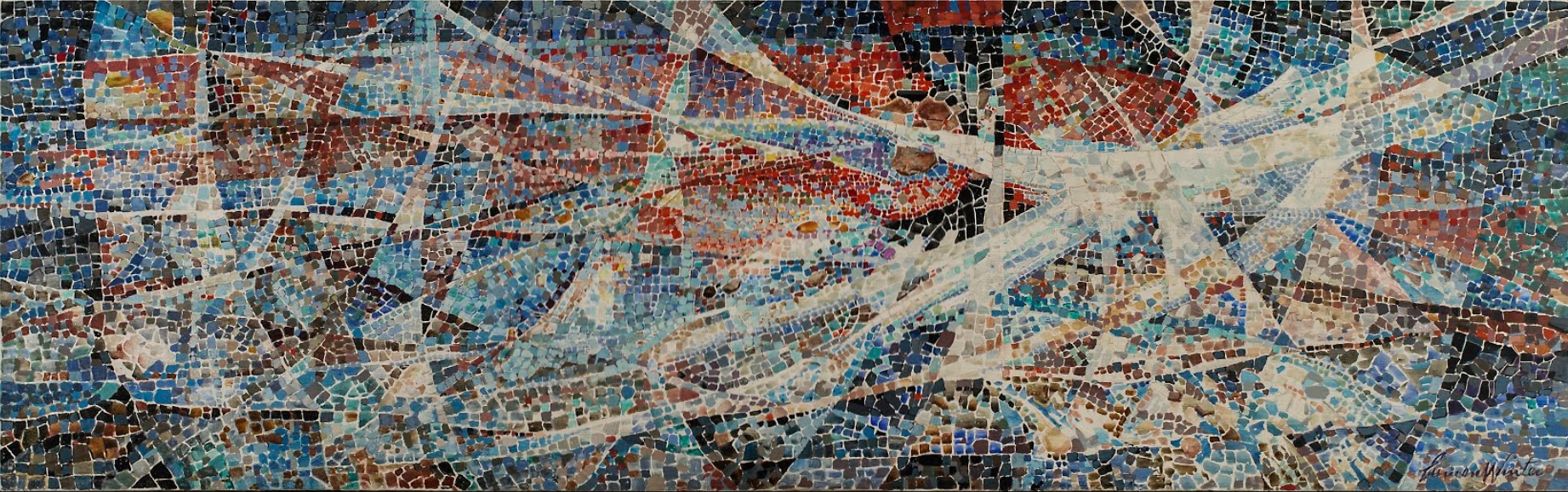
Lumen Martin Winter (American, 1908–1982), Voice of the Bell, 1965. Oil on board, 18 × 52 in. Long Island Museum of American Art, History, and Carriages, Stony Brook, New York. This was a design for a mosaic mural for the entranceway of a school on Staten Island.
LISTEN:“Hallelujah Day” | Music by Abe Janowitz and Julius Grossman, 1955 | Performed by the Deep River Boys, accompanied by Sten Carlbergs kvartett, 1955
Sing, sing the whole day long Sing the hallelujah song This is Hallelujah Day!
Sing, sing till early dawn A great new chorus will be born On this hallelujah holiday
Hallelujah, have a little lujah Sound that magic melody Everybody’s singing You can feel it in the air Celebrating, congregating From the mountains to the sea Everybody’s singing Hallelujah everywhere
Hallelujah (3×) What a joyous holiday Hallelujah (3×) This is Hallelujah Day!
Sing, sing the whole day long Sing the hallelujah song This is Hallelujah Day!
Sing, sing till early dawn A great new chorus will be born On this hallelujah holiday
Hallelujah (3×) What a joyous holiday
Bells are ringing (Ding-dong, ding) We’re all singing Hallelujah This is Hallelujah Day! Hallelujah Day!
This swing song was originally released in Norway in 1955 by the African American gospel group the Deep River Boys, which at the time consisted of Harry Douglass (baritone), Edward Ware (bass), Jimmy Lundy (first tenor), and Vernon Gardner (second tenor). They attained quite the popularity in Scandinavia and even recorded some songs in Swedish and Norwegian. Here they’re accompanied by an instrumental jazz quartet led by Sten Carlberg of Sweden.
The song makes me laugh with its silliness, particularly the bell imitations! But I dig it. “Hallelujah” is a Hebrew word meaning “God be praised!” (Hallelu = praise; Yah = Yahweh.) I found no statements from the artists involved about what occasion is being celebrated in the song, but it seems that it very well could be Easter. A day when church bells all around the world call believers—like every Sunday, but today with special vigor—to gather together in worship of their risen Savior.
The third Sunday of Advent is known as Gaudete Sunday, gaudete (pronounced GOW-deh-tay) (Latin for “rejoice”) being the first word of the introit of the day’s Mass, taken from Philippians 4:4–6 and Psalm 85:1:
Gaudete in Domino semper íterum díco, gaudéte: modéstia véstra nóta sit ómnibus homínibus: Dóminus prope est. Nihil sollíciti sítis: sed in ómni oratióne petitiónes véstrae innotéscant apud Déum. Benedixísti, Dómine, térram túam: avertísti captivitátem Jácob.
Rejoice in the Lord always; again I say, rejoice. Let your forbearance be known to all men. The Lord is at hand. Do not be anxious over anything; but in all manner of prayer, let your requests be made known unto God. Lord, you have blessed your land; you have put an end to Jacob’s captivity.
It is customary for priests to swap out their purple vestments for pink today, and for those who use an Advent wreath to light not a purple candle but a pink one. Some churches favor a spare aesthetic in their sanctuaries for the first two weeks of Advent but break out the flowers for this the third. The approximate halfway point of the penitential Advent season, Gaudete Sunday is a special time to rejoice in the nearness of God’s coming as well as God’s presence with us here even now in the waiting, and to receive a foretaste of the bigger celebration to come on Christmas Day.
Here are ten songs for you to enjoy this Gaudete Sunday. If you’d rather listen to them as a YouTube playlist, click here.
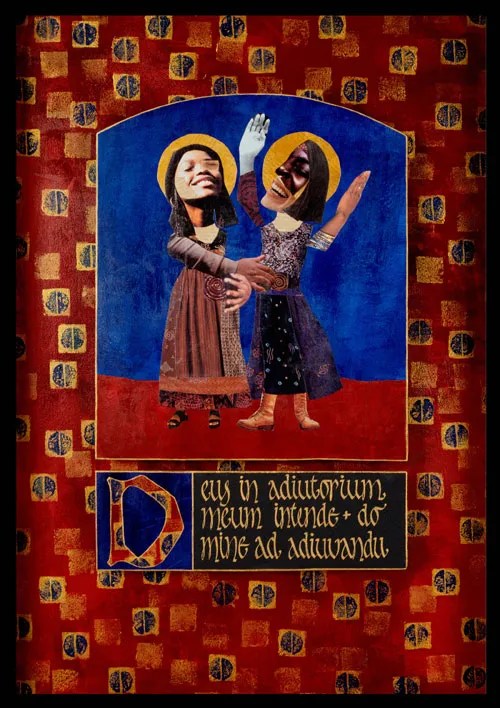
The Hour of Lauds: Visitation by Jan Richardson [for sale]
1. “Songs of Joy” by Garrison Doles, written late 1990s, on A Songmaker’s Christmas, 2012: “Songs of joy we hopefully sing, expanding our spirits, the season to know . . .” So opens this song by the late singer-songwriter Garrison Doles (d. 2013) [previously]. In 2009 his wife, the artist Jan Richardson, created a video combining the song with five of the seven collages from her Advent Hours cycle (which can be purchased as reproductions). Read the lyrics and songwriter’s statement here.
2. “My Soul Doth Magnify the Lord” by O’Landa Draper and the Associates, on Live…A Celebration of Praise, 1994: A trailblazing gospel choir director, O’Landa Draper was one of the top gospel artists of the nineties. This song of his is based on the Magnificat, the praise song Mary sings in the company of her cousin Elizabeth following the conception of Christ (see Luke 1).
3. “El burrito de Belén” (The Little Donkey of Bethlehem) by Hugo Cesar Blanco, 1972, performed by the band Matute, 2020: This is a Venezuelan carol about a person riding their donkey, with hurried excitement, from the sabanero (savanna) to Bethlehem to see the newborn Christ. Read the lyrics and translation here.
4. “Ecce mundi gaudium” (Behold the Joy of the World), England, 13th century, arranged and performed by the Mediæval Bæbes on Worldes Blysse, 1998: Written in Latin, this thirteenth-century carol is about the Virgin giving birth to the Son, our joy—announced to the shepherds by an angel and to the magi by a star. Despite the upbeat tempo throughout, the last two verses are about Herod’s raging and the Massacre of the Innocents. The soloist is Katharine Blake, the founder and musical director of Mediæval Bæbes. Read the original lyrics here, clicking on individual lines for the English translation.
6. “Repeat the Sounding Joy,”a fragment from “Joy to the World” arranged by Craig Courtney, performed by the Capital University Chapel Choir, 2019: A super-fun, one-minute choral work.
7. “Now Let Us Sing,” traditional, adapt. John L. Bell, 1995, performed by Katarina Ridderstedt, 2015: Katarina Ridderstedt (née Lundberg) is a rhythm teacher, musician, cantor, and choir director from Gotland, Sweden, who records music under the name Musikat. This video of hers introduced me to a charming little quatrain whose origins I don’t know (it’s credited as “Traditional”), but this version comes from Scotland’s Iona Community [previously]: “Now let us sing with joy and mirth, / praising the one who gave us birth. / Let every voice rise and attend / to God whose love shall never end.”
(Update, 1/6/25: “Now let us sing” is of Scottish origin, first appearing during the Protestant Reformation in the congregational song collection The Gude and Godlie Ballatis; the earliest extant edition of this book is from 1567, but it is thought to have been originally published in 1540. The tune was originally a drinking tune. For his rendition, published in Come All You People: Shorter Songs for Worship, John L. Bell essentially rewrote the first stanza, retaining only the first line of the original.)
8. “Brother” by Jorge Ben Jor, on A Tábua de Esmeralda, 1974: Known by the stage name Jorge Ben or (since the 1980s) Jorge Ben Jor, Jorge Duílio Lima Menezes (b. 1939) is a Brazilian singer-songwriter and musician whose characteristic style fuses elements of samba, funk, rock, and bossa nova. In this song he enjoins us to prepare a joyful path for the coming Christ—who is both Lord and friend—with love, flowers, and music.
9. “Alleluia, He Is Coming (I Looked Up)” by Martha E. Butler, 1979: This song is sometimes used in church services for Palm Sunday or Easter, but I think it makes a fitting Advent song as well—especially with the newer last verse that is sometimes used, as in the first video below. “Alleluia, he [Christ] is coming! Alleluia, he is here,” the refrain proclaims. Read about the inspiration behind the song, in the words of the songwriter, here. Allow me to sneak in two different performances. The first is by Donna Rutledge, Becky Buller, and Todd Green of First Baptist Church of Manchester, Tennessee, from 2020; theirs is a lovely rendition with strong vocals and a poignant violin part, but I do prefer a brisker pace (listening to the video at a playback speed of 1.25 is perfect, in my estimation):
The second is by the South African group Worship House, from their 2016 album Project 5 (Live in Johannesburg):
10. “Joy Will Come” by Paul Zach: The refrain of this song by Paul Zach of Virginia is based on Psalm 30:5b: “Weeping may linger for the night, but joy comes with the morning.” I also hear echoes of Psalms 18 and 121 throughout. The song is a reminder that through the dark nights we experience, we have hope; we have a Savior who will not abandon us.
Juneteenth (June 19) is a federal holiday in the United States celebrating the liberation of enslaved African Americans in Texas in 1865. Abraham Lincoln had issued the Emancipation Proclamation on January 1, 1863, but it was not implemented in places still under Confederate control, and because Texas, being on the westernmost edge of the Confederacy, was farthest from the military action of the Civil War, Texans could conveniently continue to enslave, as there were no soldiers there to enforce the executive decree. But when Union troops, both white and Black, arrived in Galveston Bay on June 19, 1865, two months after the official end of the war, they saw to it by threat of force that the 250,000-plus enslaved Black people in the state were freed.
Also known as Emancipation Day or Jubilee Day (after the year of release mandated by ancient Israelite law), Juneteenth has been celebrated by African American communities in Texas ever since the first anniversary of the freeing event. Historically, the church has been at the center of these celebrations, as the formerly enslaved attributed their liberation to God, to whom they gave effusive thanks and praise. In the twentieth century, Juneteenth expanded into other states but still remained very niche, until 2021, when, after decades of lobbying by Black activists, President Joe Biden signed into law the Juneteenth National Independence Day Act, moving the holiday into the mainstream.
Juneteenth marks not only that one historic day but also, more broadly, freedom as an ongoing struggle. It’s not as if the illegalizing of chattel slavery, or even the passage of the Civil Rights Act of 1964, ended racial oppression or prejudices, which manifest today in, for example, the racial wealth gap, voter suppression, and disparities in policing. We have made important progress as a country, for sure, but there’s still a ways to go until everyone breathes free.
Bishop T. D. Jakes of The Potter’s House in Dallas says that Juneteenth must involve a reckoning with our nation’s sordid past and a commitment to identifying and rooting out whatever sordidness persists. “It’s vital we all must remember when liberty and justice is delayed or denied, it causes traumatic ripples throughout future generations. . . . As we collectively stop to acknowledge and learn from the delayed liberties of our nation’s ancestors, we must not allow those same systems to repeat injustices.”
In recognition of Juneteenth, I’ve compiled on Spotify 118 songs of Black joy, liberation, and faith. From Beyoncé to Duke Ellington, Adolphus Hailstork to Rhiannon Giddens, Mary Lou Williams to Richard Smallwood, these artists jubilate, extol, lament, protest, revel, testify, and hope.
I acknowledge the complications of me, a white person, offering this playlist. I have grappled with how to appropriately celebrate Juneteenth and how to balance its predominant tone of joy (am I allowed to feel joy?) with an honest accounting of past and present evils that mark the Black experience in America, especially slavery and its legacy. One basic piece of advice I’ve heard is to center Black voices. Listen to and lift up Black historians, Black theologians, Black novelists, Black songwriters, etc.
The Art & Theology Juneteenth Playlist combines sacred and so-called secular music written and/or performed by Black artists and exhibiting a spirit of defiant joy. It emphasizes the beauty, power, creativity, and divine belovedness of Black people.
Honoring the religious roots of Juneteenth and the faithful ongoing witness of the Black church, I have incorporated many Christian songs, especially those that speak to the imago Dei and to God’s faithfulness, guidance, and deliverance. The Bible is full of divine deliverance tales: the Israelites from slavery in Egypt; Daniel from the lions’ den; the three Hebrew boys from the fiery furnace; Jonah from the belly of the whale; Paul and Silas from prison. “Didn’t my Lord deliver Daniel? Then why not every man?” sings one spiritual. Another, “Go Down, Moses,” confronts Pharaoh, a stand-in for white Southern enslavers, with the demand “Let my people go,” while yet another exults in the toppling of Pharaoh’s power—“Pharaoh’s army got drownded.” The spiritual “Satan, We’re Gonna Tear Your Kingdom Down” addresses the Enemy directly, expressing resolve to overthrow demonic systems and ideologies, such as white supremacy.
There are also plenty of feel-good vibes on the playlist, lighter songs like Lee Dorsey’s “Occapella,” Count Basie’s “Jumpin’ at the Woodside,” and Jon Batiste’s “Freedom” (with its stylish, smile-inducing music video that I can’t get enough of!):
Its first verse is: “This joy that I have—the world didn’t give it to me. . . . The world didn’t give it, and the world can’t take it away.” “This strength,” “this love,” and “this peace” follow in subsequent verses—otherworldly qualities given to us by God, as Caesar makes explicit in the original, and which no one can ever steal from us. No matter what harm people may do to us, we still possess these inner gifts, which help us face whatever comes.
Composed in the antebellum South, “No More Slavery Chains for Me” (aka “Many Thousands Gone” or “No More Auction Block”) holds together proclamation and grief. The speaker boldly asserts her freedom: “No more slavery chains,” “no more auction block,” “no more peck of corn,” “no more driver’s lash,” “no more mistress’ call,” “no more children stole from me.” It could be spoken by someone who is still enslaved but who refuses to tolerate that condition any longer, or it could be spoken by someone recently freed, rejoicing in what she has escaped. But the solemn refrain, “Many thousands gone,” remembers the multitudes whom slavery has killed. Here’s a performance by mezzo-soprano Shirley Verrett, an international opera star active from the late 1950s through 1990s:
Often words fail to capture the emotional intensity one might feel. “Triptych: Prayer / Protest / Peace” by Max Roach, from his 1960 avant-garde jazz album We Insist!: Freedom Now Suite, featuring Abbey Lincoln, consists almost entirely of wordless vocal expressions, screaming, and sighing, along with drumming by Roach. It’s mournful and alarming. The only words are at the beginning of part 3: “I need peace.” Cued up here (starting at 5:50) is Lincoln and Roach’s performance of the first two parts of “Triptych” for a Belgian TV station that aired January 10, 1964. (The earlier song in the video is “Tears for Johannesburg,” from the same suite.)
In the liner notes for We Insist!, Nat Hentoff writes that “Triptych” is a “final, uncontrollable unleashing of rage and anger that have been compressed in fear for so long that the only catharsis can be the extremely painful tearing out of all the accumulating fury.”
From the same era and genre is “They Say I Look Like God” from The Real Ambassadors, a jazz musical by Dave Brubeck and Iola Brubeck that never made it to the stage but that was recorded in the studio in 1961 and released a year later. Sung by Louis Armstrong, the song opens with these humorous lines, which Armstrong delivers with chilling earnestness:
They say I look like God Could God be black? My God If all are made in the image of Thee Could Thou perchance a zebra be?
This is one-half of the first of four verses, all of which are interspersed with lines of scripture from Genesis 1 and 1 John 4 intoned, like a liturgical chant, by the trio Lambert, Hendricks & Ross, affirming the inherent goodness of Black folks, bearers of the divine breath. Verses 2 and 3 are addressed to God, pleading that he would show “that our creation was meant to be.” The final verse expresses longing for the day
When God tells man he’s really free Really free Really free Really free
The creation narrative of Genesis 1 is also where Sho Baraka’s “Black as Heaven” opens—with beautiful Blackness, sacred humanity. Historically the color white has been used to symbolize goodness, purity, and heaven, but Baraka turns that symbol inside out and declares that he is “black as heaven.” If God created all humans in his image and many of those humans have black skin, then Blackness is a reflection of God. The Creator loves what he created, and we should too.
Heaven is full of Black saints and will continue to fill with such. The song lists many from across the fields of politics, music, history, education, theology and homiletics, agricultural science, and the culinary arts: Dr. Martin Luther King Jr., King Ezana of Aksum, King Lalibela of the Zagwe dynasty, Mahalia Jackson, Athanasius, Mary McLeod Bethune, George Washington Carver, David Walker, Edna Lewis, Carter G. Woodson, Bishop G. E. Patterson, Sister Rosetta Tharpe. These men and women are all “black as gold,” not in the sense that they are commodities or currencies, but rather are holy, luminous; and black as life-giving soil.
This is one of the songs commissioned for the 2022 documentary Juneteenth: Faith and Freedom [previously], and it includes a rap by Mag44 of Zambia. There’s so much richness in it, and I encourage you to follow along and sit with the lyrics, investigating any unfamiliar references and, depending on your background, humbly receiving the critiques or gladly receiving the affirmations.
In addition to hip-hop and jazz, the playlist is full of songs from the civil rights movement, such as “Woke Up This Morning with My Mind.” This old gospel song was recorded by Roosevelt and Uaroy Graves in 1936 and adapted in 1961 by the Rev. Robert Wesby, a Baptist minister from Aurora, Illinois. Wesby first sang it while spending time in jail in Hinds County, Mississippi, as a Freedom Rider, replacing the repeated word “Jesus” with one of Jesus’s key platform goals, “freedom”: “Woke up this morning with my mind stayed on freedom.”
This song became an important one in civil rights marches, and is led in the above recording by the famous activist Fannie Lou Hamer. For subsequent verses, she sings “Walkin’ and talkin’ with my mind . . . ,” “Singin’ and prayin’ with my mind . . . ,” “Ain’t no harm to keep your mind . . .” Stayed on freedom.
“Ain’t No Grave” is another traditional gospel song, first recorded by Bozie Sturdivant in 1942 and then by Sister Rosetta Tharpe in 1946–47. It’s about the general resurrection, when the saints will be called up out of their graves, but it’s also about indestructibility, the refusal to be or stay buried. I chose a more recent arrangement performed by jazz vocalist Tiffany Austin [previously], from her 2018 album Unbroken:
Hers starts off with the percussive sounds of a ring shout, a style borrowed from the Gullah Geeche of South Carolina’s Sea Bird Islands, and then goes on to incorporate scat singing. It’s full of enthusiastic energy!
One of the most powerful songs on the playlist is “Make It Home” by Tobe Nwigwe, written after the murder of George Floyd in May 2020. The song is “for the nappy heads in heaven, with a nappy-head Christ by they side”—for Blacks who have died.
It’s also a prayer and a blessing for Blacks who are living. “I pray you catch a wave that doesn’t subside. . . . May your streets be paved with gold. Hope my whole hood make it home.” He prays that his friends, family, and neighbors are able to make it safely back to their homes each night and are not killed in the streets. But “home” operates on other levels as well. To be at home with yourself, for example, is to feel whole, confident, secure in your body. Home also implies belonging. And of course “home” can also mean heaven, that place of ultimate freedom and rest. Are we creating the necessary conditions for freedom and rest here on earth as it is in heaven?
Collectively, the songs on this playlist reflect the multifaceted spirit of Juneteenth, which encapsulates exultation, passion, power, praise, irrepressibility, resistance, sorrow, anger, and hope and trust. Like Juneteenth itself, the playlist is a looking back and a looking forward. We Americans are a people “on our way.” The work of emancipation is unfinished. These Black artists invite us to join the work.
I invite you, as a way of commemorating the holiday, to:
1. Choose one of the songs and pray from it.
2. Choose one of the artists and explore more of their oeuvre.
3. Choose one of the older songs and explore its origin and history, learning more about the context from which it arose and how it has been received over the decades. Listen to other renditions to see the different ways it’s been interpreted.
The image on the playlist cover is cropped from a photo I took a few years ago at Duke University Chapel of the linocut Ain’t No Grave by Steve A. Prince (2019), which shows a dancing winged figure emerging from the head of Carlotta Walls LaNier, the youngest of the Little Rock Nine, as she integrates the city’s high school in 1957. It is an embodiment of LaNier’s mighty spirit, and that of other Black “agents of God,” to use Prince’s term, who pursue freedom for themselves and others.
In those days John the Baptist appeared in the wilderness of Judea, proclaiming, “Repent, for the kingdom of heaven has come near.” This is the one of whom the prophet Isaiah spoke when he said,
“The voice of one crying out in the wilderness: ‘Prepare the way of the Lord; make his paths straight.’”
—Matthew 3:1–3
LOOK: Painted staircases by Xomatok
Painted staircase by Xomatok (b. 1985), Lima, Peru, 2021. All photos by Jeremy Flores.
Artist Xomatok translates the vibrant, geometric motifs of handwoven Andean blankets, or llicllas, into large-scale works that mark the pathways through the hilly Alisos de Amauta neighborhood in Lima, Peru. Painted during the course of two months as part of the Municipality of Lima’s Pinta Lima Bicentenario, the 13 interventions were a collaborative undertaking by the artist and local residents, who transformed the public staircases that wind through the district into multi-level canvases. The resulting patterns are kaleidoscopic and highlight a spectrum of bright colors and symmetries often associated with the traditional textiles.
The following video clip is the opening sequence of the 1973 film adaptation of the stage musical Godspell, which stars David Haskell as John the Baptist:
So. much. joy!
The ram’s horn issues its call. Ballet dancer, student, struggling actress, waitress, cab driver, businessman, businesswoman, parking attendant—they all leave their jobs, casting off their workplace trappings to accept John’s invitation to new and abundant life. They meet him at The Angel of the Waters, a sculpted fountain in New York City’s Central Park. They throw themselves into the fountain like children, receiving their baptism, their initiation into the upside-down kingdom of God.
But John notices Jesus standing at a distance, stripped down and ready for his own baptism. John’s lighthearted visage turns heavy for a moment in recognition that Jesus’s baptism is into suffering and death.
I wrote about Godspell two years ago when I featured one of its songs, “Turn Back, O Man,” to go along with a lectionary reading from Ezekiel. The musical is wacky, with the ragtag disciples forming a comic troupe to act out Jesus’s parables and teachings from the Gospel of Matthew. Some Christians find it all too silly and irreverent. Others, like me, see it as capturing an important element of the Good News, which is joy. This is what Godspell’s creator, John-Michael Tebelak, wanted to get across.
Perhaps the festive tone of the opening number seems disjunctive with what we know of John from the Gospels—a desert ascetic who preached about vipers and axes and fire and winnowing forks, warning his hearers of the wrath to come. Point taken.
However, while his message is a sobering one, repentance need not be a dour affair. We must take honest stock of our sins, yes, laying them out in confession before God, but scripture assures us many times over of God’s pardon, and that’s something to rejoice in! There is a joy to repentance and to following the way of Christ. Turning off the death-road, onto the road of life. As we unload the burdens that have accrued on our backs, we are freed to walk upright once again.
“Repent, for the kingdom of heaven is at hand!” John cries out on the riverbank.
I’d encourage you to read that not as a threat but as an invitation. The kingdom of heaven is marked by grace and possibility. It’s a pearl, it’s a seed, it’s a feast. When we embrace the gospel, our cities become a playground where we enact the values of Christ, childlike as they are, preparing the world to receive her coming King.
Wassily Kandinsky (Russian, 1866–1944), Three Sounds, 1926. Oil on canvas, 23 5/8 × 23 1/2 in. Solomon R. Guggenheim Museum, New York.
the silent stars descend to us
come angel seraph sheep pear-tree

o holy o cold
dawn come in snow

offspring of day
light is lily above us

glory birds, calling birds
sun, the fields shining

the day, the earth, skies
peace, contemplation and music

hosanna, no, holly stand
suddenly tree displayed

the yonder star our comfort
bring time again

joy, excelsis a-leaping
world and hope embrace

lullay image and sing sing
a happy new begin
“seasonal ghazal” by Harry Gilonis appears in the chapbook The Twelve Poems of Christmas, vol. 3, ed. Carol Ann Duffy (Candlestick Press, 2011), and in Haphazard by Starlight: A Poem a Day from Advent to Epiphany by Janet Morley (SPCK, 2013). Used by permission of Harry Gilonis.
A ghazal is a traditional Arabic verse-form originating in seventh-century Arabia and spreading in the medieval era into Africa, Spain, Persia, South Asia, and Turkey, where it has continued to develop. It is made up of five to fifteen self-contained couplets connected loosely by mood or theme, however allusive. The poet Agha Shahid Ali compares each ghazal couplet to “a stone from a necklace” that should continue to “shine in that vivid isolation.”
Harry Gilonis’s “seasonal ghazal” doesn’t adhere to all the principles of the classic form (which involve rhyme and refrain), but it does give us autonomous couplets of roughly equal length that unfold without linearity, and these all center on the twinned seasons of Advent and Christmastide. Gilonis composed the poem using a cut-up technique, in which he printed out pages’ worth of sacred and secular English carol texts, excised words or short phrases that stood out to him, and rearranged those excised fragments into varying combinations, creating a medley of seasonal keywords that strikes a new chord.
By separating the words from their original syntactic contexts and collaging them together in new ways, he defamiliarizes and thus revivifies them. Traditional elements of the Christmas story are playfully refreshed.
The poem captures the magic and wonder of the season and a hint of its yearning and lament. For example, the exultant excelsis, Latin for “highest,” from the angels’ song to the shepherds is followed one stanza later by lullay, an archaic word used to soothe children to sleep and voiced in the “Coventry Carol” by mothers of ancient Bethlehem who lullaby into eternal rest their infant sons who are about to be slain by Herod. Elevated choral anthems contrasted with deep, mournful groans. Christmastide is full of “light” and “glory,” but there’s also “cold.”
The line “world and hope embrace” is particularly compelling—a picture of hope throwing its arms around a weary and skeptical world, and the world hugging back.
Because of the poem’s fragmentary nature, the grammatical mood of some of the verbs can’t be definitively discerned, but I read the following, in addition to the Hebrew-derived “hosanna” (“save us, please!”), as imperatives addressed to God: “descend,” “come,” “bring,” and the final word, open and expansive, “begin”—a curtailment of the noun “beginning.”
Jesus’s birth was a new and universal beginning. Can you hear echoes of Isaiah?: “See, I am doing a new thing! Now it springs up; do you not perceive it?” (Isa. 43:19a NIV). Many Christians see in this Hebrew Bible passage the promise of a messianic kingdom inaugurated by Jesus’s birth but not yet brought to completion. The speaker of “seasonal ghazal” seems to recognize the salvation project that’s in motion but longs for “the day” of the Lord, “the earth, skies” reunited. “Begin,” he beckons. Bring in the new era.
What word combinations in this poem stick out to you? What meaning(s) do you see?
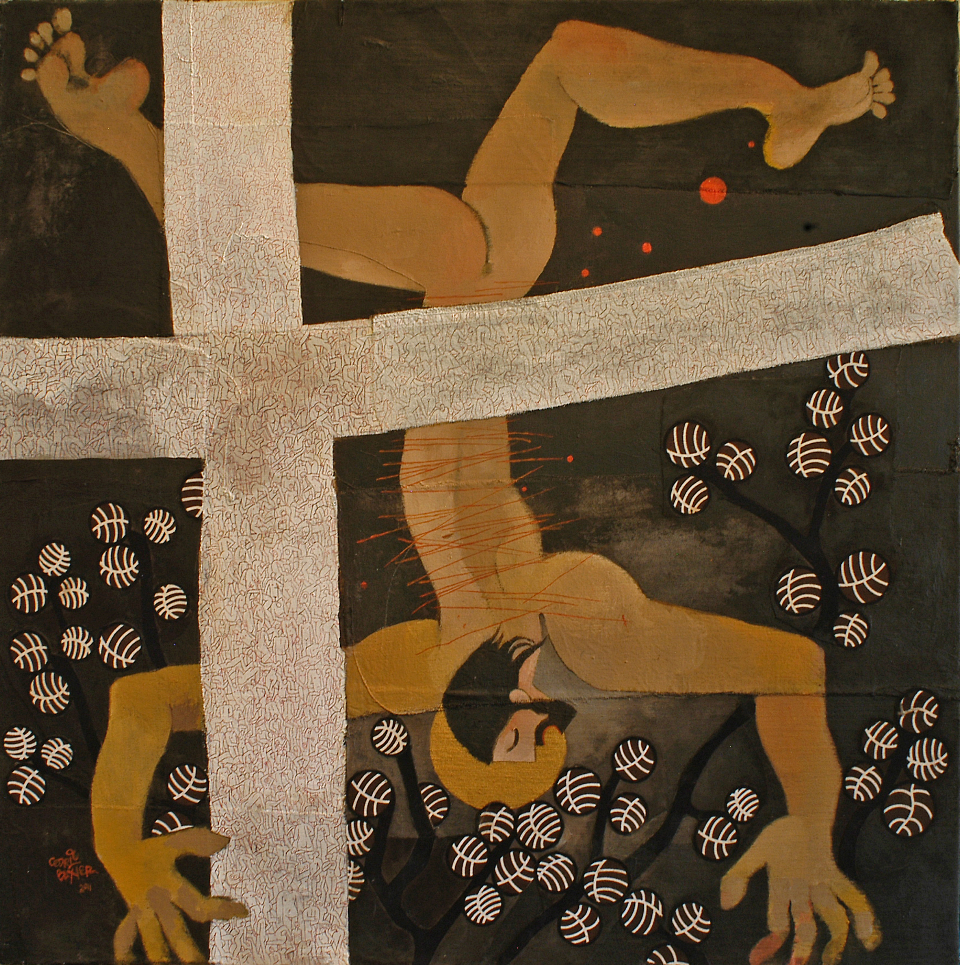
Cedric Baxter (Australian, 1930–), Jesus Striped and Stripped, 2011. Acrylic, collage, and pen on canvas, 91 × 91 cm. Collection of the Uniting Church in Australia. [learn more]
Christ came juggling from the tomb,
flipping and bouncing death’s stone pages,
tossing those narrow letters high
against the roots of dawn spread in cloud.
This Jesus, clown, came dancing
in the dust of Judea, each slapping step
a new blossom spiked with joy.

Hey! Listen—that chuckle in the dark,
that clean blast of laughter behind—
Christ comes juggling our tombs,
tossing them high and higher yet,
until they hit the sun and break open
and we fall out, dancing and juggling
our griefs like sizzling balls of light.
This poem is from Christographia by Eugene Warren (St. Louis, MO: The Cauldron Press, 1977), a chapbook of thirty-two numbered poems that “attempt to express personal views of, & perspectives on, Christ.”The book’s title comes from a series of sermons by the Puritan poet and preacher Edward Taylor.
Gene Warren Doty (1941–2015) was an American poet in the Anabaptist tradition who taught in the English department of Missouri S&T for forty-two years. Throughout his career he explored a variety of non-Western poetic forms, including haiku, renga, tanka, sijo, and ghazals. He is the author of seven books of poetry: Christographia, Rumors of Light, Geometries of Light, Fishing at Easter, Similitudes, Nose to Nose, and Zero: Thirty Ghazals. Until 1988 his books and poems were signed “Eugene Warren,” Warren being the surname of his adoptive father, George, who raised him; but from 1988 onward he used the surname of his biological father, Floyd Doty.
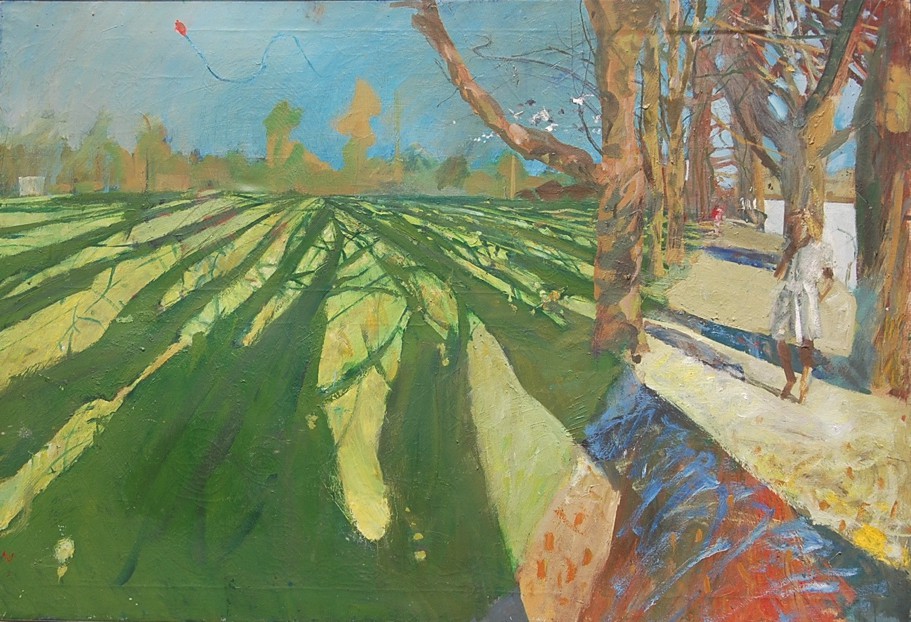
Stan Smith (British, 1929–2001), Kites Over Twickenham, ca. 1985. Oil on canvas, 82 × 121 cm.
What is this unfolding, this slow-
going unraveling of gift held
in hands open
to the wonder and enchantment of it all?

What is this growing, this rare
showing, like blossoming
of purple spotted forests
by roadside grown weary with winter months?

Seasons affected, routinely disordered
by playful disturbance of divine glee
weaving through limbs with sharpened shards of mirrored light,
cutting dark spaces, interlacing creation,
commanding life with whimsical delight.

What is this breaking, this hopeful
re-making, shifting stones, addressing dry bones,
dizzying me with blessings,
intercepting my grieving
and raising the dead all around me?
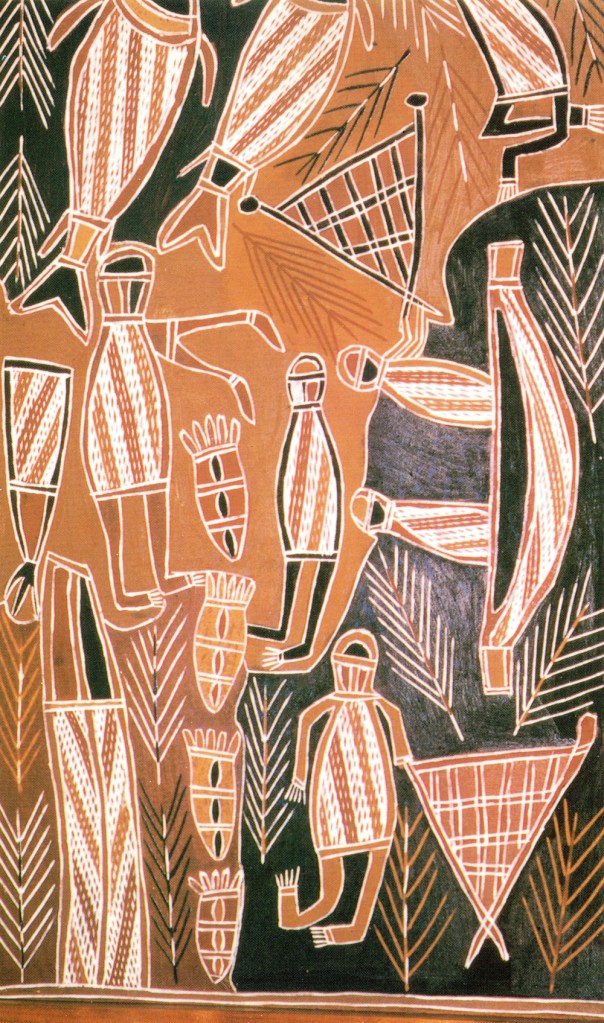
George Garawun (Djinang [Aboriginal Australian], 1945–1993), Calling the Disciples, natural earth pigments on eucalyptus bark, Maningrida Church, Arnhem Land, Northern Territory, Australia. Source: The Bible Through Asian Eyes, p. 93.
some Jesus
has come on me

i throw down my nets
into the water he walks

i loose the fish
he feeds to cities

and everyone calls me
an old name

as i follow out
laughing like God’s fool
behind this Jesus
“the calling of the disciples” by Lucille Clifton is the eleventh poem in a sixteen-poem sequence titled “some jesus,” originally published in Good News About the Earth (Random House, 1972) and later compiled in The Collected Poems of Lucille Clifton 1965–2010(BOA Editions, 2012).Used with permission.
ALBUM REVIEW:“Let’s Go Down: Joy and Humility in Psallos’s Philippians Album” by Victoria Emily Jones: Psallos’s latest album, a musical adaptation of Paul’s letter to the church at Philippi, released on Thursday, and, as I’ve come to expect from the collective, it’s a brilliant work of art, with much to discover! In this review I wrote for the Gospel Coalition, I of course couldn’t address all the album’s intricacies, but I trace a few main themes and motifs. This is the New Testament epistle that gives us such memorable lines, phrases, and passages as “Rejoice in the Lord always!,” “Be anxious for nothing,” “the peace of God that passes all understanding,” “I can do all things through Christ who strengthens me,” and the glorious Christ Hymn (“Let this mind be in you, which was also in Christ Jesus, who, being in the form of God . . .”). It’s delightful to hear what Psallos does with these oft-quoted verses and, even more, to be guided in understanding the larger context in which they appear.
It’s near impossible to choose favorite tracks, as they gain impact from being heard all together and in order, but if Ihad to choose, I’d say “Complete My Joy,” “Hymnos Christou,” “I Am Better Than You” (feat. Shai Linne), and “Will You Go Down?” (feat. Taylor Leonhardt).
+++
POETS’ PANEL:“Surprised by Joy: Poetry about Happiness,” recorded at the Festival of Faith and Writing, April 2018: In Rewrite Radio Episode 29 (a production of the Calvin Center for Faith and Writing), poets Anya Silver, Tania Runyan, Barbara Crooker, and Julie Moore “discuss the landscape of joy amidst suffering in their personal and public lives. Joy, distinct from happiness, can be a form of religious practice. They explore questions regarding what cheapens joy, how Christians view joy, and how to ‘balance the scale’ of joy and pain in writing.” Zora Neale Hurston, Ælfric of Eynsham, Ralph Waldo Emerson, Christian Wiman, Jane Kenyon, John Milton, Dietrich Bonhoeffer, Thornton Wilder, and the apostle Paul are just some of the additional voices they draw into their conversation. They each read three to four of their own poems, and there is an audience Q&A starting at 57:54. A transcript is provided.
Silver and Runyan are two of my favorite poets, and this is such a rich hour spent with them and two of their colleagues.
+++
INTERVIEW: “It’s Not a Poem Until You Discover Something: An Interview with Scott Cairns” by Andy Patton: In this conversation, poet Scott Cairns talks about writing as a discipline, the writer as reader (“The writing life is primarily the reading life”), staying conversant with tradition, the fallacy of originality, the one quality shared most between prayer and poetry, and writing not as giving, serving, but as getting, receiving.
+++
LECTURE: “What Did Jesus Look Like?” by Joan E. Taylor, St. Paul’s Cathedral, London, June 2, 2019: Historian Joan E. Taylor, a professor of Christian origins and Second Temple Judaism at King’s College London, discusses the influences on early depictions of Jesus in art and what they tell us about what he did, or definitely didn’t, look like. This talk is a great intro to her research on the topic, but if you want to learn more, I recommend her full-color book What Did Jesus Look Like? (T&T Clark, 2018), which goes into much more detail, examining artistic, literary, and archaeological evidence, including first- and second-century coins, textiles, skulls, and Egyptian mummy portraits. She also dedicates two chapters to the three most famous acheropitae (images “made without [human] hands”): the Veil of Veronica, the Mandylion, and the Shroud of Turin.
In her talk, Taylor shows how most of the visual representations of Jesus in the Early Christian era were based on Greco-Roman imagery of Zeus Olympus or Zeus Serapis (strong, powerful, seated on a throne; this image came after Constantine), Dionysus (young, curly-haired, beardless), or philosophers. These images aim to show us the meaning of Jesus but not necessarily his physical reality.
Interestingly, Taylor points out that while it’s common to picture Jesus in a long robe (stolē, plural stolai) with baggy sleeves, such clothing indicated social privilege in Jesus’s time, and in Mark 12:38, Jesus explicitly denounces those who parade around in such dress! Jesus would have worn a short, simple tunic, probably undyed—which is how he is depicted in the frescoes from the ancient Dura-Europos house church in present-day Syria.
She also identifies a common strain in early Christian and non-Christian writings that describes Jesus as “little and ugly and undistinguished” (Celsus), probably owing largely to the messianic interpretation of Isaiah 53:2: “he had no form or majesty that we should look at him, nothing in his appearance that we should desire him.” However, there were some claims to the contrary—for example, from Origen—that stated that Jesus was the epitome of physical beauty; after all, divinity must be beautiful, right? We often find throughout art history an attempt to backfill the earthly life of Jesus with his resurrected, ascended, glorified form.
Taylor is not suggesting, as far as I can tell, that all artistic representations of Jesus must be historically authentic to have validity. Rather, she says that if we are going to imagine Jesus humanly doing things—healing the paralytic, for example, or preaching the Sermon on the Mount—we will inevitably have to picture him in our mind, and we might as well have as accurate a picture as possible. She reminds us that if we imagine Jesus as supremely beautiful and well kept and richly arrayed instead of as the poor, bedraggled itinerant that he was, there’s a dissonance with his message; he becomes no longer one of the people but apart from them.
+++
ARTICLE: “Are Images of Jesus a Violation of the Commandments?” by Chad Bird: “Different groups within Christianity disagree as to whether Jesus should be depicted in icons, crucifixes, paintings, or other visual media. In this article, Chad Bird [scholar in residence at 1517] approaches the question from the angle of both the commandments and the incarnation.”
The most pushback I receive on my blogging ministry comes from those who believe it is inherently wrong, even “idolatrous,” to represent Jesus visually. Bird addresses this concern in much the same way I do when asked, and in such a succinct way!

_-_Napoli_MAN_8834.jpg)


 Art & Theology