
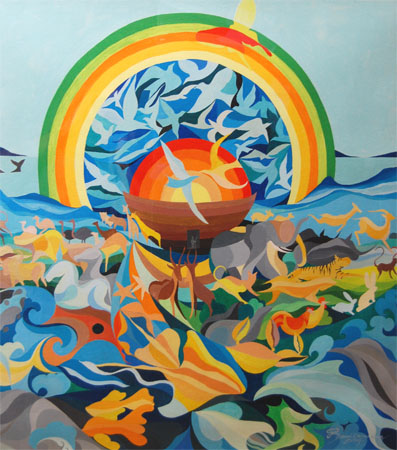
Then God said to Noah and to his sons with him, “Behold, I establish my covenant with you and your offspring after you, and with every living creature that is with you, the birds, the livestock, and every beast of the earth with you, as many as came out of the ark; it is for every beast of the earth. I establish my covenant with you, that never again shall all flesh be cut off by the waters of the flood, and never again shall there be a flood to destroy the earth.”
And God said, “This is the sign of the covenant that I make between me and you and every living creature that is with you, for all future generations: I have set my bow in the cloud, and it shall be a sign of the covenant between me and the earth. When I bring clouds over the earth and the bow is seen in the clouds, I will remember my covenant that is between me and you and every living creature of all flesh. And the waters shall never again become a flood to destroy all flesh. When the bow is in the clouds, I will see it and remember the everlasting covenant between God and every living creature of all flesh that is on the earth.”
God said to Noah, “This is the sign of the covenant that I have established between me and all flesh that is on the earth.”
—Genesis 9:8–17
+++
MUSIC: Keyboard Sonata in C Major (K. 159, L. 104) by Domenico Scarlatti | Arranged for banjo by Béla Fleck and for mandolin by Edgar Meyer | Performed by Béla Fleck and Chris Thile on Perpetual Motion (2001)
+++
This art and music may seem inappropriately light and bright for the first Sunday of Lent, a season that’s stereotypically thought of as gloomy and self-deprecating. But the Old Testament reading the Revised Commentary Lectionary assigns to this day is God’s covenant with Noah after the Flood, a passage filled with great hope.
Contrary to popular misconceptions, Lent does not mean forty days of beating yourself up. It literally means “springtime,” and it’s a time of renewal in preparation for Easter. Self-examination is a major component, yes, but so is grabbing hold of the divine promise—of God’s wondrous love and mercy.
In my church’s liturgy (and this is common across denominations), the confession of sin is always followed by words of assurance—a verse of scripture, spoken by the pastor, that reminds us of the pardon we receive through Christ. We are not left in the darkness of our failures; we are brought into the light, and given power to live as children of the light. Repentance is a joyous thing! That’s why the Constitution on the Sacred Liturgy, a Second Vatican Council document, refers to Lent as the “joyful season.” It’s joyful because God’s mercy is amazing.
After forty days on a dark boat, and then some, Noah, his family, and a whole bunch of animals come out to a renewed earth, and to a promise painted across the sky in bright colors that never again will all God’s creation be destroyed. Similarly, during Lent we choose to enter a period of darkness, taking stock of our sin. It may be a rocking journey, but it’s ultimately a period of regeneration, and when we arrive at Easter we receive, as confirmation of the new life that’s possible, the resurrected Christ. He’s there for us all along—we need not wait till Lent’s over to enter his forgiveness and to rise with him. But we also don’t want to skip over the necessary steps of first acknowledging the depth of our sin, and confessing it with a contrite heart.
+++
Excerpt from “The Agreement” by Henry Vaughan, from Silex Scintillans:
But while Time runs, and after it
Eternity, which never ends,
Quite through them both, still infinite,
Thy covenant by Christ extends;
No sins of frailty, nor of youth,
Can foil His merits, and Thy truth.And this I hourly find, for Thou
Dost still renew, and purge and heal:
Thy care and love, which jointly flow,
New cordials, new cathartics deal.
But were I once cast off by Thee,
I know—my God!—this would not be.
+++
Tomorrow is Ash Wednesday, and I have a poem planned for publication here at Art & Theology. But I also wrote a short visual meditation for the Anglican Church in North America, which you can find at the bottom of their Lent website, https://giftoflent.org/. It’s on Ted Prescott’s mixed-media artwork All My Sins, which incorporates paper ash, the residue left over from the artist’s burning of a list of his personal sins.

This post belongs to the weekly series Artful Devotion. If you can’t view the music player in your email or RSS reader, try opening the post in your browser.
To view all the Revised Common Lectionary scripture readings for the First Sunday of Lent, cycle B, click here.
 Art & Theology