Trinity Sunday Roundup

Today, June 4, is Trinity Sunday! Here’s a handful of art and music items on the topic.

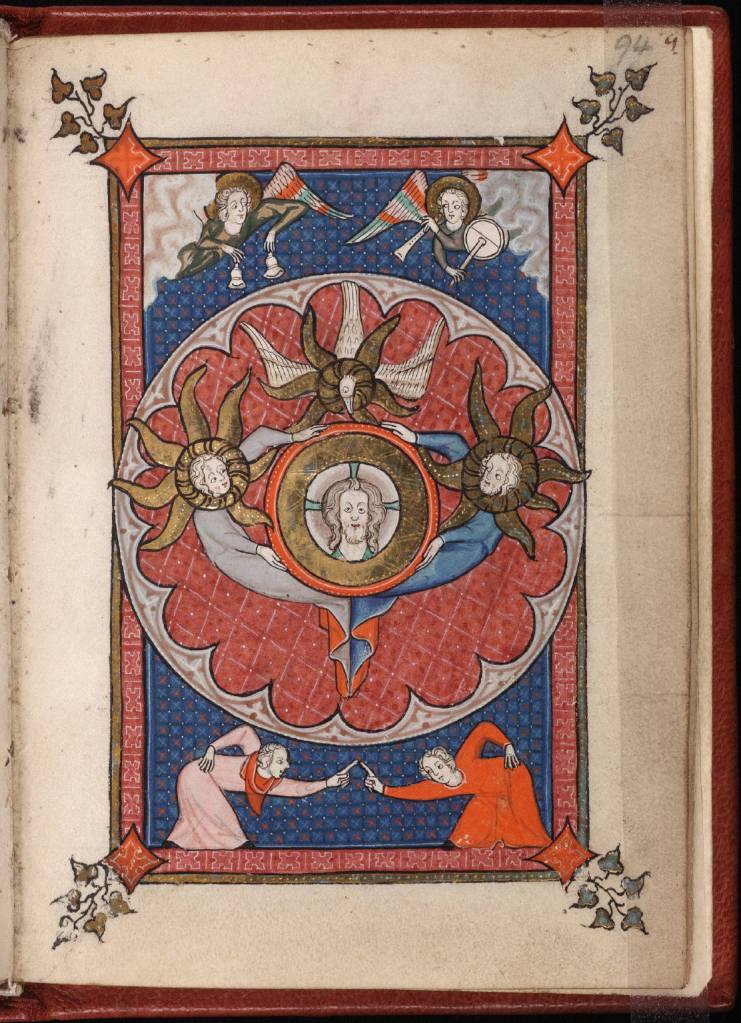
VISUAL MEDITATION: “The Wheeling Playfulness of the Trinity” by Victoria Emily Jones: The Rothschild Canticles [previously] from ca. 1300 Flanders contains some of the most inventive and delightful artistic renderings of the Trinity that I’ve ever seen. I key in on four of them in today’s visual meditation for ArtWay

Beinecke MS 404, fol. 94r

+++

MUSICAL COMMENTARY: “Theology in Sound and Motion: Perichoresis, for Brass Quintet” by Delvyn Case: Delvyn Case provides musical and theological commentary on his brass quintet composition “Perichoresis” (2006), inspired by the divine dance of the Trinity. “Its overall mood is joyous, an ecstatic whirling-about in which all three members become lost in the ecstasy of divine fellowship,” he writes. “At the exact moment of the dance when one member moves, the other fills in the spot left vacant.” “Perichoresis” premiered by Boston’s Triton Brass and appears on Case’s 2018 album Strange Energy. About this piece, Bible scholar and theologian Walter Brueggemann said, “I . . . have pondered ‘perichoresis’ for a long time. This is the finest exposition of that thick idea that I have encountered.”

+++

SONGS:

>> “Trinity Song” by Paul Zach: Performed in 2021 by Solomon Dorsey with Liz Vice and Madison Cunningham, this song by Paul Zach evolved into “God of Grace and Mystery” for The Porter’s Gate’s 2022 album Climate Vigil Songs. This earlier iteration has a Trinitarian focus that’s just lovely. “God of all eternity / Father, Spirit, and the Son / Ever-loving Three-in-One / O divine community / . . . / Calling us to join your dance . . .”

>> “One-Two-Three” by the Chosen Gospel Singers: This song was recorded in Los Angeles for Specialty Records and released as a single in 1952, with singers J. B. Randall (bass), E. J. Brumfield (tenor), George Butler (tenor), Fred Sims (tenor), and Oscar Cook (baritone). It opens with a repetition of the lines “One, two, three / One-in-Three and the Trinity.” The refrain is:

One for the Father
Two for the Son
Three for the Holy Ghost
All made of one

The song is largely eschatological. The first verse is about John the Revelator’s vision of the New Jerusalem descending, among other wonders; it ascribes a vision of the Trinity to John, even though that is not explicit as such in either John’s Gospel or the Apocalypse (but see “The Trinity in the Book of Revelation” by Edwin Reynolds). The second verse anticipates our singing and praising the Triune God in heaven, dressed in our brand-new robes. It also mentions David and Goliath, and I’m honestly not sure how that relates. But with gospel songs, floating lyrics are common, taken from one song and spliced into another, some more coherent than others in their new context.

+++

ESSAY: “The Hospitality of Abraham in the Work of Julia Stankova, Painter of Bulgarian Icons” by François Bœspflug: The first half of this peer-reviewed article introduces readers to the Bulgarian artist Julia Stankova, rehearsing her biography and examining her relationship to the icons tradition. The second half explores twelve of her paintings on the subject of the three angelic visitors to Abraham and Sarah in Genesis 18, whom the narrator suggests are a manifestation of God (“The LORD appeared to Abraham at the oaks of Mamre . . .”); because of the number of visitors, many Christians interpret this passage as revealing something of God’s triune nature, and for this reason traditional icons of the story are often titled The Trinity.

Stankova, Julia_The Hospitality of Abraham
Julia Stankova (Bulgarian, 1954–), The Hospitality of Abraham, 2004. Tempera on primed wooden panel and lacquer technique, 46 × 41 cm.

Since the publication of this article in 2019, Stankova has made at least three more paintings on the subject, all of which foreground Sarah and are titled Sarah’s Smile. She has just heard the angels announce that she will conceive a son in her old age.

+++

POEM: “After Rublev’s Trinity by Carrie Purcell Kahler: Published in Image no. 99 (Winter 2018), p. 21, this ekphrastic poem by Carrie Purcell Kahler interprets the famous fifteenth-century Trinity icon by Andrei Rublev. Sometimes referred to as “the hospitality of Abraham,” this biblical episode, as the iconographers interpret it, is really about the hospitality of God, who extends a hand to humanity, ever inviting us to sit at his table.

Rublev, Andrei_Trinity
Andrei Rublev (Russian, 1360–ca. 1430), The Trinity, ca. 1411. Tempera on wood, 141.5 × 114 cm. Tretyakov Gallery, Moscow.

A new choral setting of this poem by Garrett John Law is premiering today at Holy Trinity Episcopal Church in Covina, California, where Law serves as music director and organist. I believe it can be heard on the 10:30 a.m. PT worship service livestream on the church’s YouTube channel, but I’m not sure whether the performance will be archived online for later viewing. (Update, 6/12/23: Here it is! Sung by Holy Trinity’s seven-person choir.)

Holy Wednesday: Gallows

LOOK: Portrait of Judas by Julia Stankova

Stankova, Julia_Portrait of Judas
Julia Stankova (Bulgarian, 1954–), Portrait of Judas, 2004. Tempera, gouache, watercolor, and lacquer technique on wood, 45 × 60 cm.

In this painting by Julia Stankova, Judas presses in for his infamous kiss, identifying Jesus to his captors. Stankova portrays the moment as one of double woe, leading to the death of both Jesus and Judas. To heighten the emotional impact, she tightly crops the composition, eliminating all other figures besides the two. Jesus closes his eyes to receive with grace what has been a long time coming. Judas keeps his open. With one arm, he embraces his former friend; with the other, he holds a branch that’s ornamented, forebodingly, with his own dangling corpse. The Bulgarian inscription names the painting: Portrait of Judas.

Adapted from my commentary originally published in the two-part IMB article “Journey to the Cross: Artists Visualize Christ’s Passion.”

LISTEN: “Gallows of My Desire” by Kris MacQueen, on Good Morning. Happy Easter. 3 (2014)

Tonight we ate together
Bread and the wine cooked rare
You looked so disappointed
When I took off down the stairs
We took the road together
But I just exited right
I’ll see you in a little while
And again on the other side

Refrain:
I stood above you
Like a conqueror
And you stood beside me like a friend
I kissed you goodbye
At the gates of hell
But you’ve always called my bluff
Yeah, you know my every tell

Tonight I’m taking matters
Into my guilty hands
Just sold the Prince of Peace out
For a little stretch of land
There’s nothing like the yoke
Of the innocent when they die
It came upon me like a stone
When I saw the deed was mine [Refrain]

Now I’m swinging in the gallows
Of my own desire
My spirit is departing to God knows where
Is there a grace sufficient
To receive this broken soul?
You bled out for the whole wide world
How ’bout your very own? [Refrain]

But I always knew I’d bow to you in the end

Kris MacQueen is a singer-songwriter and former pastor from Kitchener, Ontario. Since 2019 he has been recording music with his wife, Liv, under the name The MacQueens. It is their voices on “Gallows.” This song was released in 2014 on a little six-song compilation album of Passion-Easter-Pentecost music put out by Morning and Night Music, which is no longer available. I asked MacQueen if he’d be willing to post his contribution online so that you all can enjoy it, and he obliged!

The song is in the voice of Judas, who is feeling the full weight of his betrayal—the innocent Christ’s death a yoke or a millstone around his neck. Many Christian interpreters think that Judas gave Jesus up to the authorities as a way to force his hand; impatient with Jesus’s not seizing power from Rome, Israel’s political oppressors, he thought that an arrest would be just the inciting event Jesus needed to finally unleash the forces of heaven against the empire, obtaining vindication and freedom for God’s people. Judas, according to this theory, was genuinely shocked and horrified when Jesus submitted to the capture and then the death sentence.

By asserting his own plans and desires counter to God’s, Judas effectively builds his own death trap, as the guilt over the consequences of his betrayal leads him to suicide. But before tying that noose, maybe, we can only hope, he sought redemption for his wrongdoing. His return of the blood money seems to indicate as much. He was clearly remorseful. MacQueen’s Judas prays from the gallows, pleading the blood of Jesus. If Jesus’s blood can save even the most odious of sinners, he reasons, then surely it avails for me. But he’s not so sure; he poses it as a question, a challenge, even.

The final line of the song suggests that in the end, perhaps Judas was finally able to see the rightness of Jesus’s way and was able to bow not to the king he imagined or wanted him to be, but to the king he was—the Prince of Peace, the servant-Christ, the sacrificial Lamb.

Lazarus (Artful Devotion)

Stankova, Julia_Resurrection of Lazarus
Julia Stankova (Bulgarian, 1954–), Resurrection of Lazarus, 2006. Painting on wooden panel, 30 × 40 cm.

Now a certain man was ill, Lazarus of Bethany, the village of Mary and her sister Martha. It was Mary who anointed the Lord with ointment and wiped his feet with her hair, whose brother Lazarus was ill. So the sisters sent to him, saying, “Lord, he whom you love is ill.” But when Jesus heard it he said, “This illness does not lead to death. It is for the glory of God, so that the Son of God may be glorified through it.”

Now Jesus loved Martha and her sister and Lazarus. So, when he heard that Lazarus was ill, he stayed two days longer in the place where he was. Then after this he said to the disciples, “Let us go to Judea again.” The disciples said to him, “Rabbi, the Jews were just now seeking to stone you, and are you going there again?” Jesus answered, “Are there not twelve hours in the day? If anyone walks in the day, he does not stumble, because he sees the light of this world. But if anyone walks in the night, he stumbles, because the light is not in him.” After saying these things, he said to them, “Our friend Lazarus has fallen asleep, but I go to awaken him.” The disciples said to him, “Lord, if he has fallen asleep, he will recover.” Now Jesus had spoken of his death, but they thought that he meant taking rest in sleep. Then Jesus told them plainly, “Lazarus has died, and for your sake I am glad that I was not there, so that you may believe. But let us go to him.” So Thomas, called the Twin, said to his fellow disciples, “Let us also go, that we may die with him.”

Now when Jesus came, he found that Lazarus had already been in the tomb four days. Bethany was near Jerusalem, about two miles off, and many of the Jews had come to Martha and Mary to console them concerning their brother. So when Martha heard that Jesus was coming, she went and met him, but Mary remained seated in the house. Martha said to Jesus, “Lord, if you had been here, my brother would not have died. But even now I know that whatever you ask from God, God will give you.” Jesus said to her, “Your brother will rise again.” Martha said to him, “I know that he will rise again in the resurrection on the last day.” Jesus said to her, “I am the resurrection and the life. Whoever believes in me, though he die, yet shall he live, and everyone who lives and believes in me shall never die. Do you believe this?” She said to him, “Yes, Lord; I believe that you are the Christ, the Son of God, who is coming into the world.”

When she had said this, she went and called her sister Mary, saying in private, “The Teacher is here and is calling for you.” And when she heard it, she rose quickly and went to him. Now Jesus had not yet come into the village, but was still in the place where Martha had met him. When the Jews who were with her in the house, consoling her, saw Mary rise quickly and go out, they followed her, supposing that she was going to the tomb to weep there. Now when Mary came to where Jesus was and saw him, she fell at his feet, saying to him, “Lord, if you had been here, my brother would not have died.” When Jesus saw her weeping, and the Jews who had come with her also weeping, he was deeply moved in his spirit and greatly troubled. And he said, “Where have you laid him?” They said to him, “Lord, come and see.” Jesus wept. So the Jews said, “See how he loved him!” But some of them said, “Could not he who opened the eyes of the blind man also have kept this man from dying?”

Then Jesus, deeply moved again, came to the tomb. It was a cave, and a stone lay against it. Jesus said, “Take away the stone.” Martha, the sister of the dead man, said to him, “Lord, by this time there will be an odor, for he has been dead four days.” Jesus said to her, “Did I not tell you that if you believed you would see the glory of God?” So they took away the stone. And Jesus lifted up his eyes and said, “Father, I thank you that you have heard me. I knew that you always hear me, but I said this on account of the people standing around, that they may believe that you sent me.” When he had said these things, he cried out with a loud voice, “Lazarus, come out.” The man who had died came out, his hands and feet bound with linen strips, and his face wrapped with a cloth. Jesus said to them, “Unbind him, and let him go.”

Many of the Jews therefore, who had come with Mary and had seen what he did, believed in him.

—John 11:1–45

+++

SONG: “Lazarus” by David Wimbish (of the band The Collection), on The Collection EP (2011)


Live-in-studio arrangement for Little Fella Media, from 2015:

Looked in your eyes, they were burning like cigarettes
On top of a head that could resurrect Lazarus
Up from the grave that somehow made you cry
Both of your hands were rough like a carpenter’s
So accustomed to nails and to hammers
Never would’ve thought those nails would cut inside
Oh your hands were blessed one holy, holy night

We found your grace, it was waiting inside of a
Dead dark place with few survivors
It seems that you lived in places I reckoned you wouldn’t
And all that we saw were people that had no hope
And you changed my eyes into flaming kaleidoscopes
I saw something that I thought for sure was fiction
But the peace that it brought me erased all of my conviction

There was a knife buried deep inside
The part of our hearts where we learned how to love something
Other than us; it was built on a sandy shore
Hoping the waves wouldn’t come to the door and
Greet us with disdain and heaviness, one of
Redemption, washing away all the thoughts we had
Run to before

Will you rescue me from my disbelief?
Would you please rescue me from being a thief
Of things that will burn up when it’s the end?
Dust collects, yeah, dust it upsets and
We are only dust at best but
You can breathe dust back to life again
Oh flood the whole world, and dust will walk again

(Related posts: “‘Dry Bones’ by Rebekah Osborn”; “‘Oh Mary, Don’t You Weep’: Death, Resurrection, and the New Exodus”)


This post belongs to the weekly series Artful Devotion. If you can’t view the music player in your email or RSS reader, try opening the post in your browser.

To view all the Revised Common Lectionary scripture readings for the Fifth Sunday of Lent, cycle A, click here.

Son of David, I Want to See (Artful Devotion)

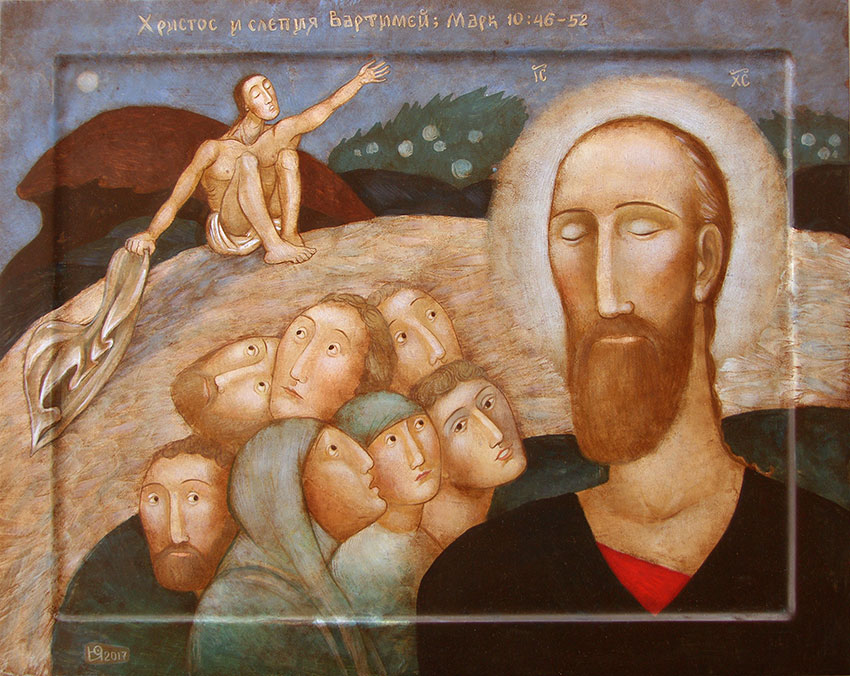
Christ and Bartimaeus by Julia Stankova
Julia Stankova (Bulgarian, 1954–), Christ and Bartimaeus, 2017. Tempera on primed wooden panel and lacquer technique, 36 × 45 cm.

And they came to Jericho. And as he was leaving Jericho with his disciples and a great crowd, Bartimaeus, a blind beggar, the son of Timaeus, was sitting by the roadside. And when he heard that it was Jesus of Nazareth, he began to cry out and say, “Jesus, Son of David, have mercy on me!” And many rebuked him, telling him to be silent. But he cried out all the more, “Son of David, have mercy on me!” And Jesus stopped and said, “Call him.” And they called the blind man, saying to him, “Take heart. Get up; he is calling you.” And throwing off his cloak, he sprang up and came to Jesus. And Jesus said to him, “What do you want me to do for you?” And the blind man said to him, “Rabbi, let me recover my sight.” And Jesus said to him, “Go your way; your faith has made you well.” And immediately he recovered his sight and followed him on the way.

—Mark 10:46–52 (cf. Matthew 20:29–34; Luke 18:35–43)

+++

SONG: “Son of David” by Ghost Ship, on The Good King (2013)

Here’s an introduction and acoustic performance by band leader Cam Huxford, who cowrote “Son of David” with fellow Ghost Ship member Shay Carlucci:

+++

“The Blind Suppliant” by Richard Crashaw

Silence, silence, O vile crowd;
Yea, I will now cry aloud:
He comes near, Who is to me
Light and life and liberty.
Silence seek ye? yes, I’ll be
Silent when He speaks to me,
He my Hope; ah, meek and still,
I shall ’bide His holy will.
O crowd, ye it may surprise,
But His voice holdeth my eyes:
O have pity on my night,
By the day that gives glad light;
O have pity on my night,
By the day would lose its light,
If it gat not of Thee sight;
O have pity on my night,
By day of faith upspringing bright;
That day within my soul that burns,
And for eyes’ day unto Thee turns.
Lord, O Lord, give me this day,
Nor do Thou take that away.


This post belongs to the weekly series Artful Devotion. If you can’t view the music player in your email or RSS reader, try opening the post in your browser.

To view all the Revised Common Lectionary scripture readings for Proper 25, cycle B, click here.

Hail to the King (Artful Devotion)

Entry into Jerusalem by Julia Stankova
Julia Stankova (Bulgarian, 1954–), The Entry into Jerusalem, before 2002. Tempera, gouache, watercolors, and lacquer technique on wood, 40 × 22 cm.

The next day the large crowd that had come to the feast heard that Jesus was coming to Jerusalem. So they took branches of palm trees and went out to meet him, crying out, “Hosanna! Blessed is he who comes in the name of the Lord, even the King of Israel!” And Jesus found a young donkey and sat on it, just as it is written, “Fear not, daughter of Zion; behold, your king is coming, sitting on a donkey’s colt!”

—John 12:12–15

+++

SONG: “King of Kings and Lord of Lords” | Music: Traditional Hebrew folk tune | Words: Sophie Conty and Naomi Batya (stage name: Nomi Yah), 1974 | Performed by Glenn Tompkins, 2011 | CCLI #23952

This Hebrew folk melody, with its gradually increasing tempo, is in the tradition of the Israeli hora, or round dance. In 1974 two Christian gal pals, Sophie Conty and Naomi Batya, put their own words to it when they were only thirteen. Since then the song has been published in at least sixteen hymnals. I learned about it two Palm Sundays ago when we sang it at my church. Tying it to that particular liturgical occasion was, I think, a really insightful choice on the part of the music leader. The beats are evocative of a clopping donkey, and the quickening pace builds tension, as when Christ approached the swell of praises in Jerusalem that preceded his doom.

It was hard to search for recordings of “King of Kings” because the title is such a common one. I’ve found that it is often performed by children’s choirs (replete with side steps and hand motions!), and the rock band Petra covered it in the late eighties. I chose to feature this solo accordion arrangement because it best captures the flavor of the song. Even without a vocalist, it’s easy to follow along:

King of Kings and Lord of Lords
Glory, hallelujah
King of Kings and Lord of Lords
Glory, hallelujah

Jesus, Prince of Peace
Glory, hallelujah
Jesus, Prince of Peace
Glory, hallelujah


This post belongs to the weekly series Artful Devotion. If you can’t view the music player in your email or RSS reader, try opening the post in your browser.

To view all the Revised Common Lectionary scripture readings for Palm Sunday, cycle B, click here.