Medieval roundup: Julian of Norwich, stained glass at York Minster, Jewish hymn from Andalusia, and more

PODCAST EPISODES:

>> “Jack’s Bookshelf: Julian of Norwich” with Dr. Grace Hamman, Pints with Jack: The “Jack’s Bookshelf” podcast series explores the authors and books that influenced the life and writings of C. S. Lewis. Hosted by David Bates, this episode covers Julian of Norwich (ca. 1343–after 1416), an English anchorite and mystic who authored what editors call Revelations of Divine Love or The Showings, the first English-language book by a woman. The most famous quote from this work is “Sin is behoovely, but all shall be well, and all shall be well, and all manner of thing shall be well.” Medieval scholar Grace Hamman [previously] unpacks the quote and discusses other key passages and themes from Julian, as well as what little we know of her biography. An excellent introduction!

>> “Ben Myers—The Divine Comedy,” Life with God: One of the many gifts my parents have given me over the years was a four-month study-abroad stay in Florence during my junior year of college, where one of my courses was devoted to reading and studying—in its original Italian and in the author Dante Alighieri’s hometown!—the masterful trilogy of narrative poems known as La Divina Commedia, or The Divine Comedy in English. Moving through hell, purgatory, and heaven, it is an allegory of the soul’s journey toward God. I enjoyed hearing Dr. Benjamin Myers [previously], director of the Great Books Honors Program at Oklahoma Baptist University, discuss this deeply influential work from the early fourteenth century, and sharing one of his own poems, “Listening to Reggae at the Nashville Airport.”

+++

VIRTUAL TOURS OF CATHEDRALS:

Cathedrals are, among other things, repositories of sacred art. I’m so appreciative of digitization initiatives that seek to make some of those treasures available to global publics online. Here are two admirable examples.

>> The York Minster Stained Glass Navigator: York Minster in northeastern England has the largest collection of medieval stained glass in the UK, with the earliest pieces dating from the late twelfth century. On behalf of the Chapter of York, the York Glaziers Trust is undertaking to photograph it all. These photos are available for viewing online through the cathedral’s “Stained Glass Navigator,” which enables you to hover over panels to identify the scenes, zoom in for higher resolution, and see where each panel in situated in the context of the window’s larger narrative.

I especially recommend exploring the extraordinary Great East Window, which depicts the beginning and the end of all things. The top section opens with the seven days of creation, followed by other select scenes from the Old Testament, but the bulk of the window—and my favorite sequence—consists of scenes from the book of Revelation. The bottom row depicts historical and legendary figures associated with the history of York Minster.
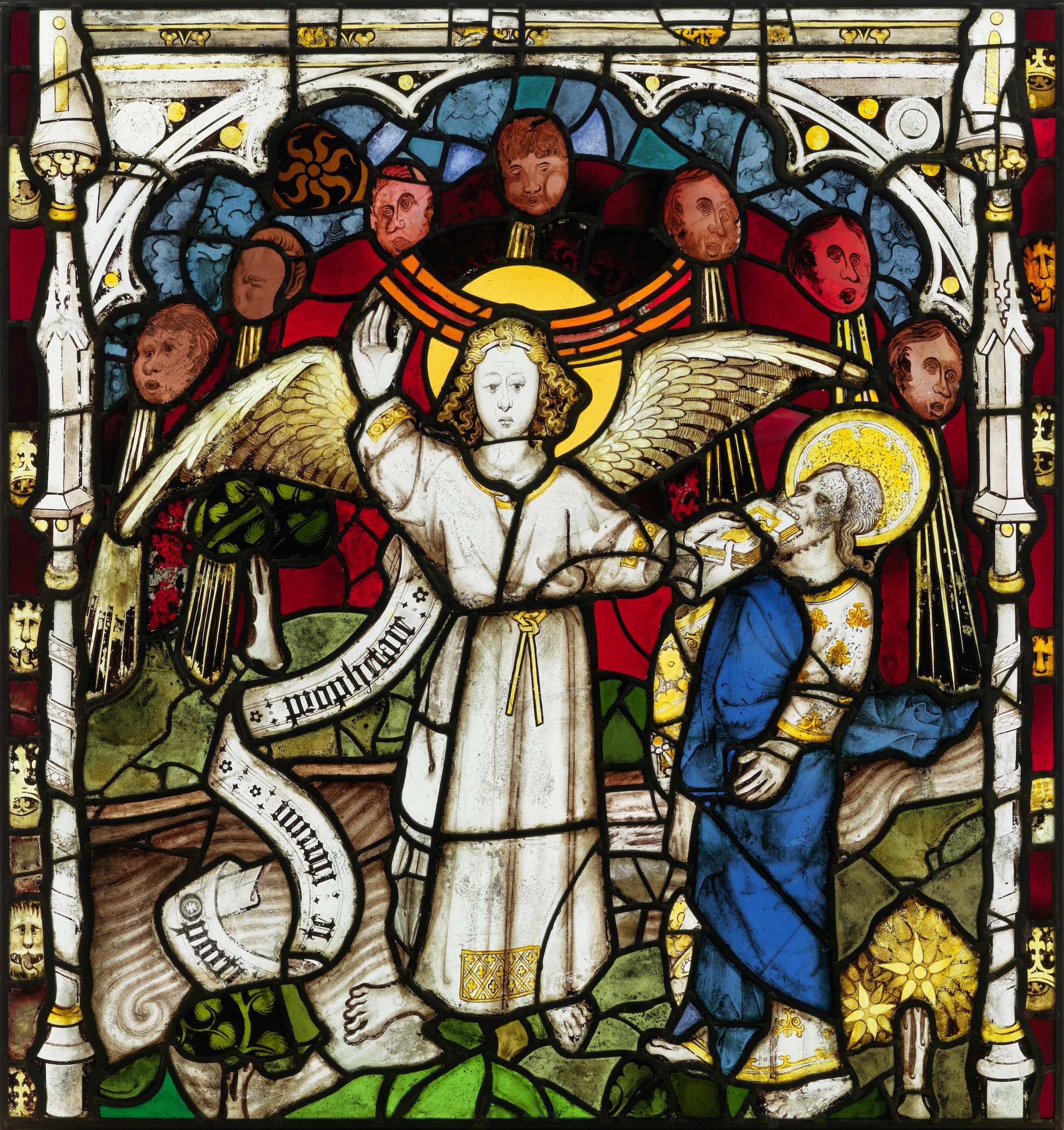
St. John takes the book from the angel (York)
John Thornton of Coventry (British, fl. 1405–1433), St. John Takes the Book from the Angel (Rev. 10:8–11), 1405–8. Stained glass panel from the Great East Window, York Minster, York, England. Photo courtesy of the York Glaziers Trust.

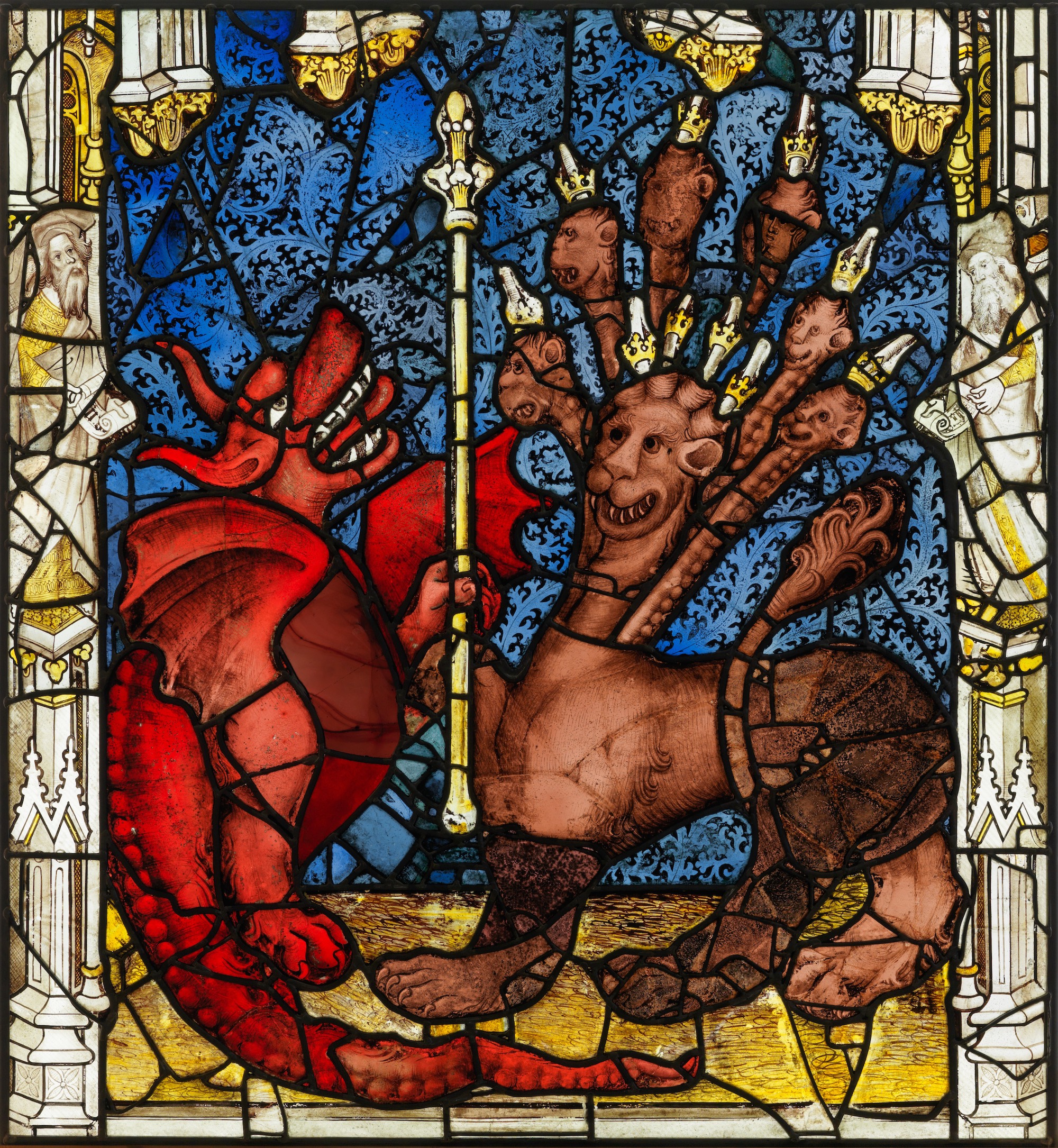
The Dragon gives power to the beast (York)
John Thornton of Coventry (British, fl. 1405–1433), The Dragon Gives Power to the Beast (Rev. 13:1–3), 1405–8. Stained glass panel from the Great East Window, York Minster, York, England. Photo courtesy of the York Glaziers Trust.

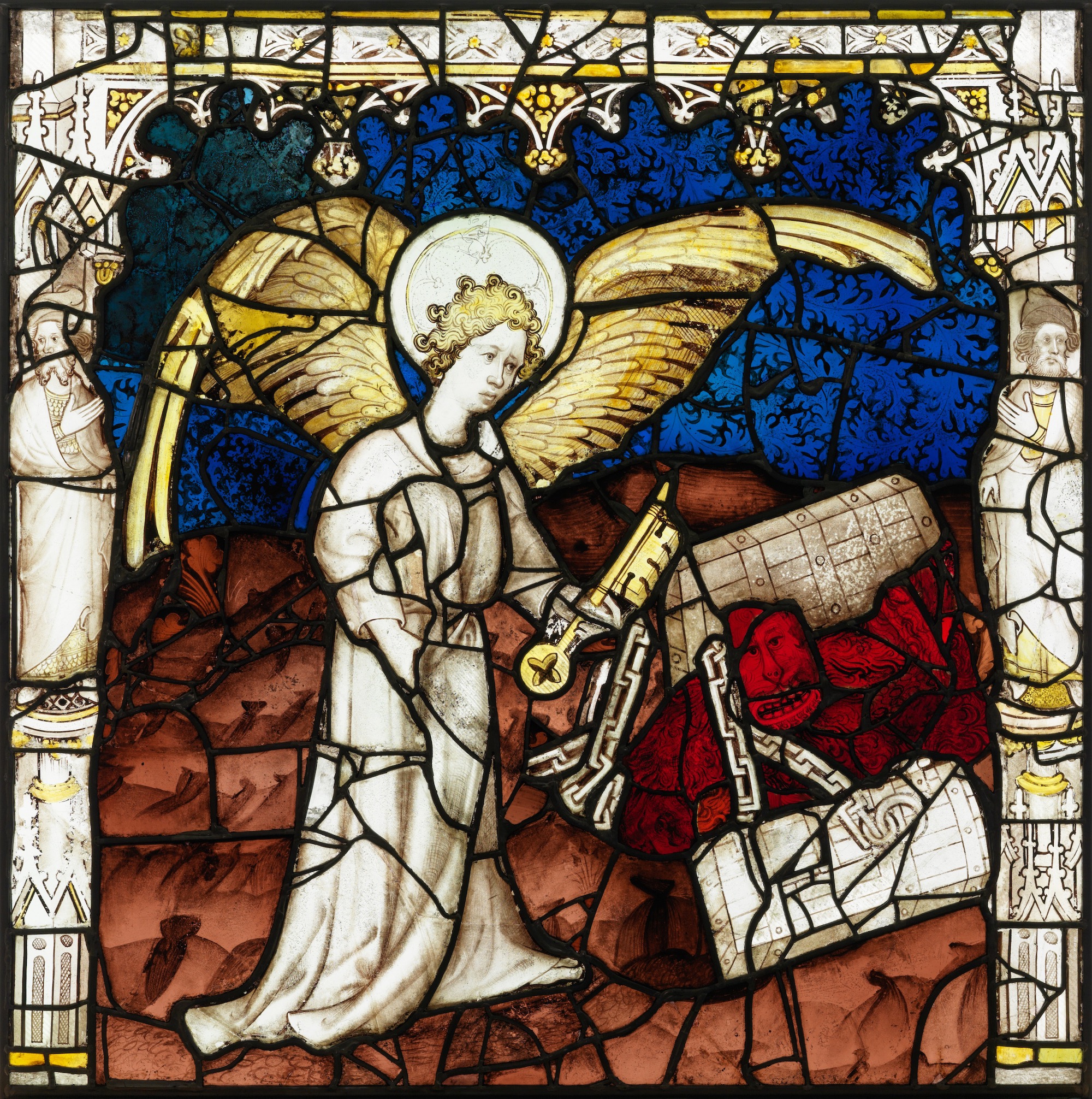
Satan chained in the bottomless pit (York)
John Thornton of Coventry (British, fl. 1405–1433), Satan Chained in the Bottomless Pit (Rev. 20:1–3), 1405–8. Stained glass panel from the Great East Window, York Minster, York, England. Photo courtesy of the York Glaziers Trust.

>> Life of a Cathedral: Notre-Dame of Amiens: Located in the heart of Picardy in northern France, Amiens Cathedral is one of the largest Gothic churches of the thirteenth century, renowned for the beauty of its three-tier interior elevation, its prodigious sculpted decoration, and its stained glass. This website put together by Columbia University’s Media Center for Art History offers a detailed virtual tour of the cathedral, drawing attention to its architectural features and artworks, from the many stone relief sculptures over its four portals (my favorite) to the octagonal labyrinth that adorns the marble floor in the nave to the early sixteenth-century misericords in the choir stall.
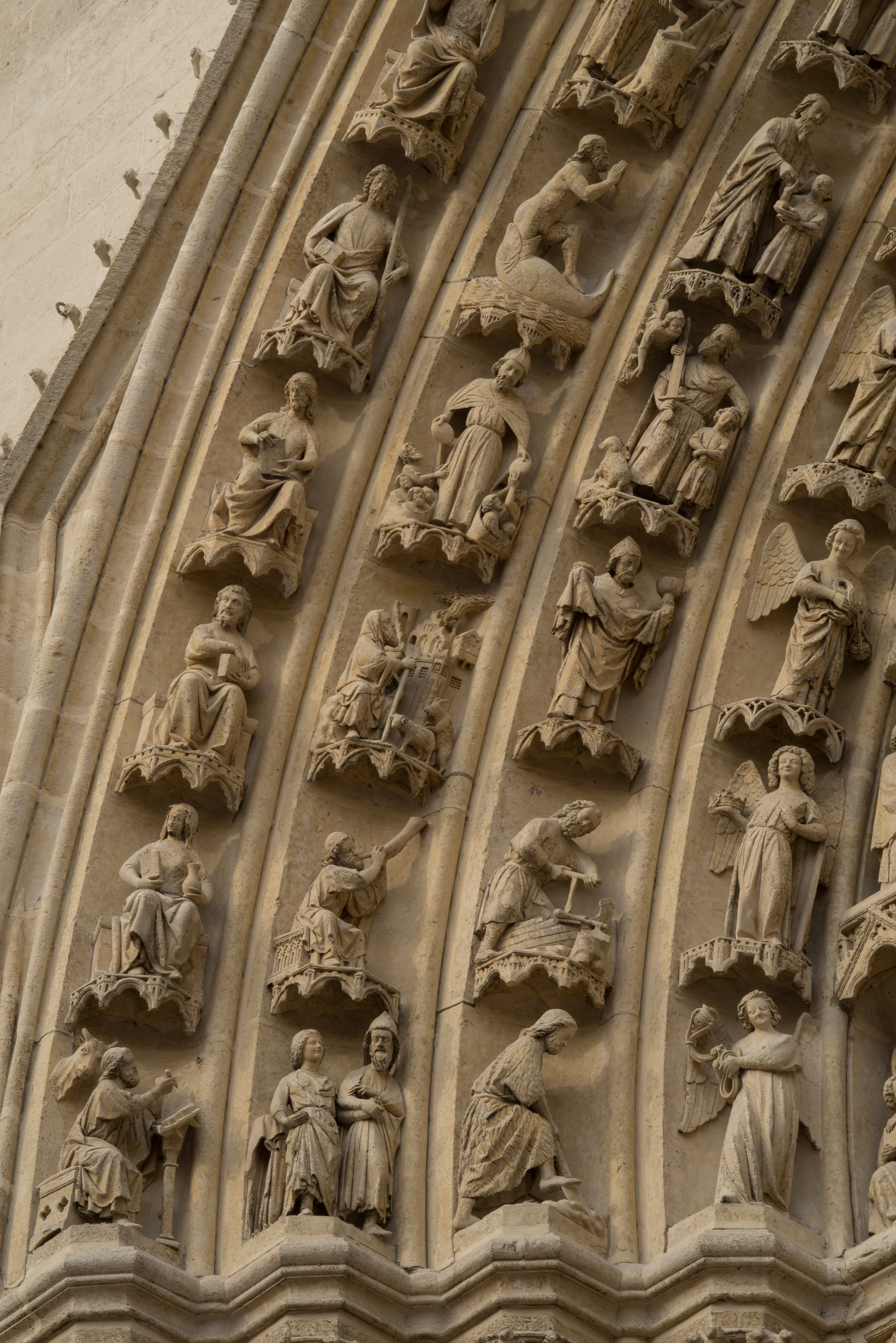
Voussoir close-up, Amiens Cathedral
Detail of voussoirs from the south transept portal of St. Honoré at Amiens Cathedral, ca. 1240, featuring Adam working the ground, Noah building the ark, Jonah being disgorged from the fish, Hosea marrying Gomer, and other biblical figures and vignettes

+++

SONG: “Adon Olam,” performed by the Maqamat Masters, feat. Nissim Lugas: The well-loved text of this traditional Hebrew prayer in five stanzas probably originated in medieval Spain, having been first found in a thirteenth-century siddur (Jewish prayer book) from Andalusia. Drawn from the language of the Psalms, it praises God for both his transcendence and his immanence. He is incomparably great, the ruler over all, and yet he’s also a personal God, a refuge for those who call on him. The prayer’s title and opening phrase translates to “Master of the Universe” or “Eternal Lord.”

Various tunes have been used for the singing of this prayer over the centuries. The Maqamat Masters perform it here with a melody based on the traditional Armenian folk tune NUBAR NUBAR, arranged by Elad Levi and Ariel Berli. They also add to the prayer a few lines from the ghazals of the Persian Sufi poet Saadi (1210–ca. 1292), about the burning fire of God’s love; Lugas sings this Farsi passage from 3:06 to 4:08.

“Maqamat Masters is a unique group of musicians that coalesced around their work together teaching at the Maqamat School of Eastern Music in Safed, Israel,” 12 Tribes Music writes. “Each of the musicians is a master in a different traditional musical genre from the Middle East, and they bring their personal voices and decades of explorations together, to create a magical, new and innovative sound.”

+++

VIRTUAL EXHIBITION: The Faras Gallery: Treasures from the Flooded Desert: In 1960, Faras, a small town in Sudan near the Egyptian border, was one of the archaeological sites designated for flooding by the waters of the Nile to create Lake Nasser. Responding to an international call by UNESCO to preserve the area’s cultural heritage before it would be buried beneath the new reservoir, a Polish team led by Professor Kazimierz Michałowski proceeded with salvage excavations in 1961–64. Their efforts uncovered the wonderfully preserved ruins of a medieval cathedral, active from the eighth to fourteenth centuries (it was built on the remains of an early seventh-century church) and containing over 150 religious paintings, a trove of Nubian Christian art. By agreement with Sudan, half of the findings went to Poland’s National Museum in Warsaw, while the other half are kept in Sudan’s National Museum in Khartoum.


Nubian Madonna and Child
Wall Painting with Bishop Marianos under the protection of Christ and the Mother of God, early 11th century, excavated from Faras Cathedral in modern-day Sudan. Secco tempera on plaster, 247 × 155.5 cm. National Museum, Warsaw.

Excavation of Faras Cathedral

Curated by Paweł Dąbrowski and Magdalena Majchrzak and hosted by Google Arts & Culture, this virtual exhibition spotlights the wall paintings and artifacts from Faras that are housed in Warsaw. It discusses the importance of the discovery of the cathedral and the technical challenges of detaching the paintings (tempera on dry mud plaster) from the walls. It also includes digital reconstructions of the cathedral’s interior and exterior in 3D stereoscopy, as well as video elements. Here is one of the four videos from the exhibition:
Advent, Day 28: All Will Be Well

All shall be well, and all shall be well, and all manner of thing shall be well.

—Julian of Norwich, Revelations of Divine Love (late 14th century)

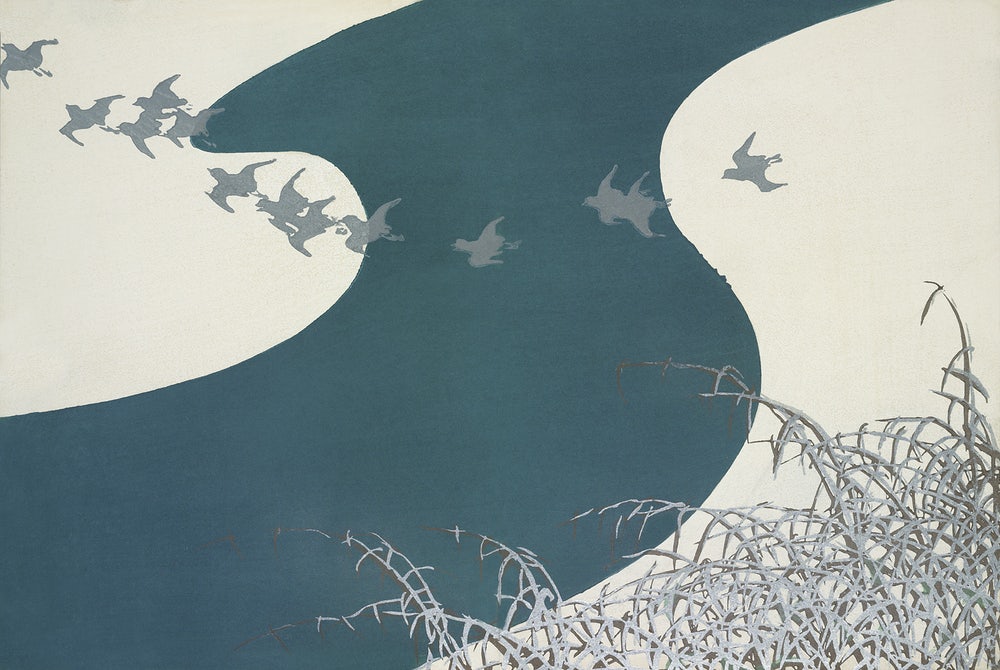
LOOK: River in Winter by Kamisaka Sekka

Kamisaka Sekka (Japanese, 1866–1942), Fuyu no kawa (River in Winter), from volume 3 of the woodblock-printed book Momoyogusa (A World of Things), 1909–10. Ink, color, and metallic pigments on paper, 11 3/4 × 17 11/16 in. (29.8 × 44.9 cm).

LISTEN: “All Will Be Well” by Jessica Gerhardt, 2020

All will be well, and all will be well, and all will be well.
(Repeat 24×)

Advent, Day 12: The New Eve

LOOK: Prado Annunciation by Fra Angelico

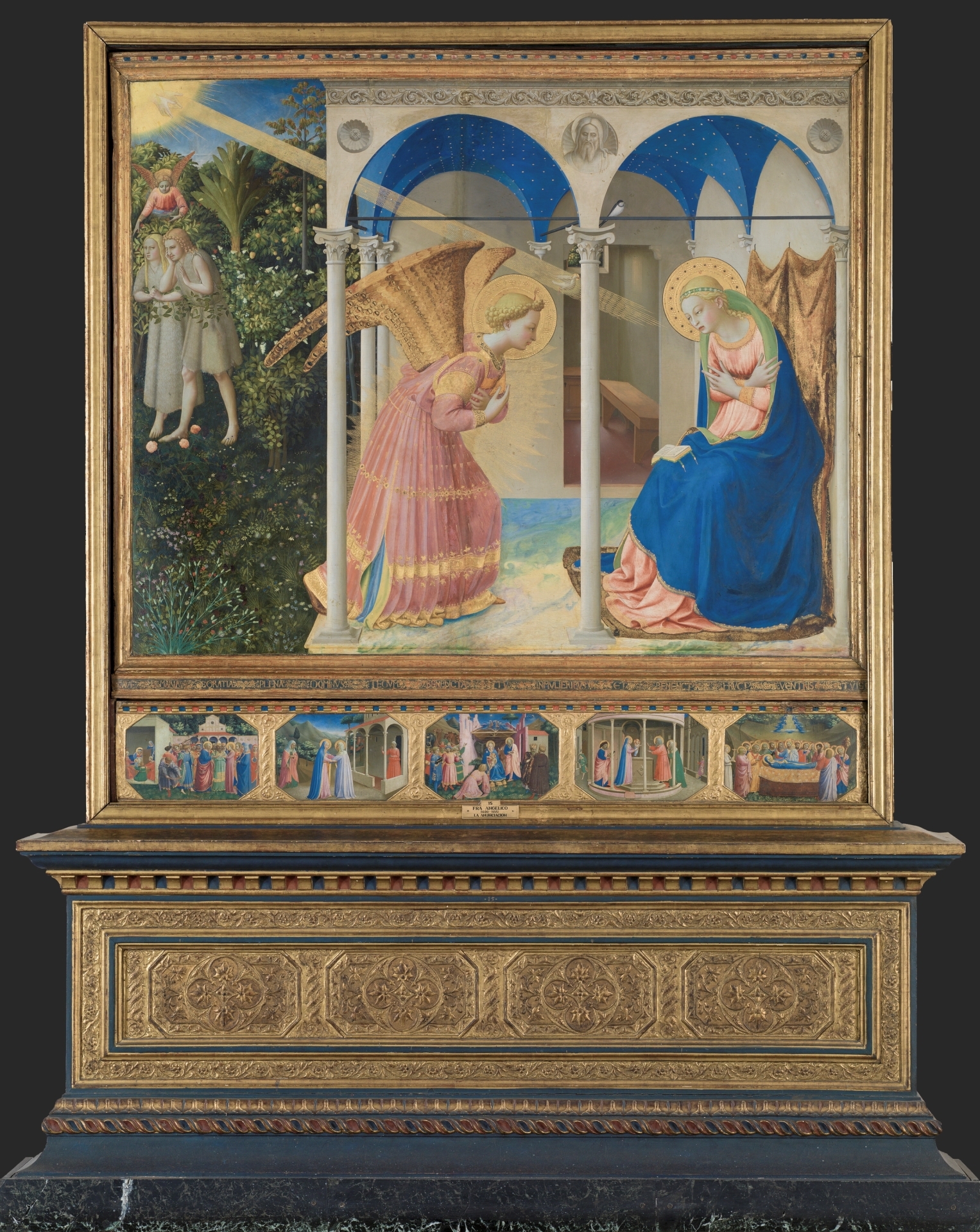
Fra Angelico_The Annunciation (Prado)
Fra Angelico (Italian, ca. 1395–1455), The Annunciation, ca. 1426. Tempera and gold on wood panel, 162.3 × 191.5 cm. Museo del Prado, Madrid.

The Annunciation was a favorite subject of the Early Renaissance artist Fra Angelico [previously], and he painted it multiple times throughout his career. Once was for an altarpiece for the convent of San Domenico in Fiesole, near Florence, now in the Prado Museum in Madrid.

In this version Mary sits on a draped chair under the portico of a domestic space, reading the scriptures, when suddenly this otherworldly being, dressed in rose and radiating, approaches. It’s the archangel Gabriel. His foot crosses the threshold of paradise into Mary’s space—the divine stepping into the human realm. Will you do it? he asks. Be mother to God?

Mary’s initial fear and perplexity eventually give way to glad acceptance. The artist compresses the episode—the arrival, the ask, the cogitation, the answer—into this singular freeze frame. When Mary says yes to God’s plan to become flesh of her flesh and so work out the salvation of the world, God releases his Spirit, who rides a stream of light from the heavens into her womb. At this miraculous moment, Jesus is conceived.

Gabriel crosses his hands over his chest in humble reverence, a gesture mirrored by Mary. Both are still before the profound mystery of the Incarnation.

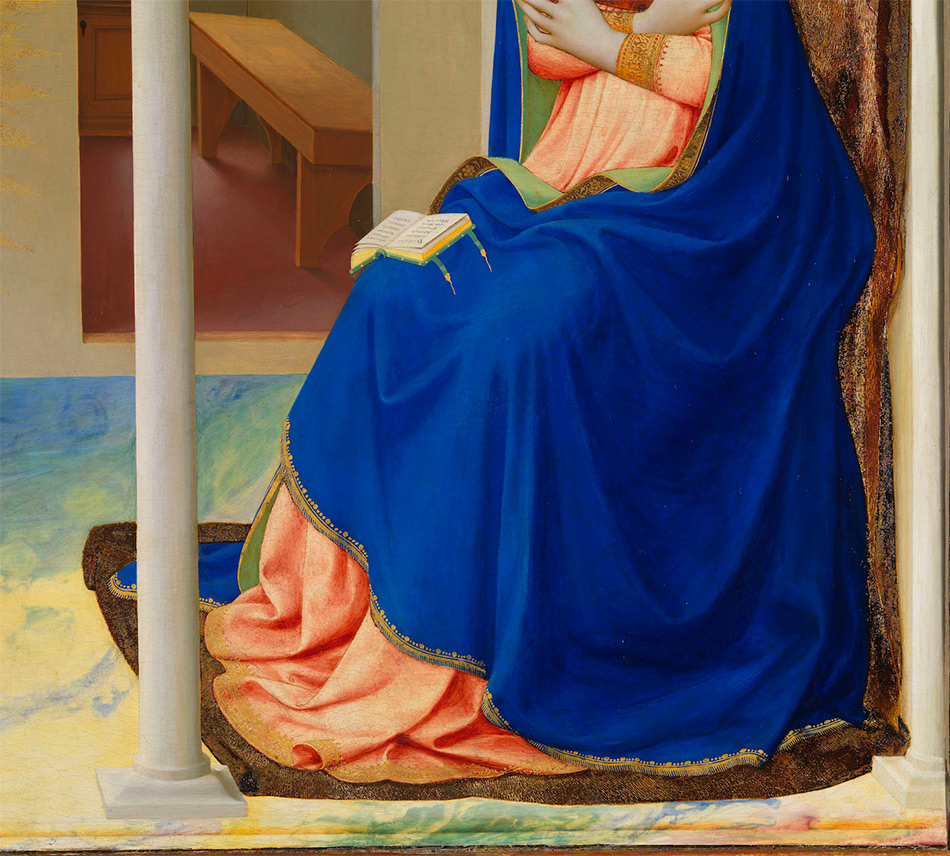
Fra Angelico used ultramarine—the finest and most expensive of all pigments, made from lapis lazuli, a semiprecious stone imported to Europe from the Middle East—to paint Mary’s mantle as well as the star-studded ceiling above her. Blue represents heaven, and here Mary is clothed with it and overshadowed by it.

Prado Annunciation (detail)

The male figure in the carved roundel above the central column is, I’d say (based on the unambiguous Montecarlo Altarpiece), the prophet Isaiah, who wrote centuries before the event that “the Lord himself shall give you a sign; behold, a virgin shall conceive, and bear a son, and shall call his name Immanuel” (Isa. 7:14).

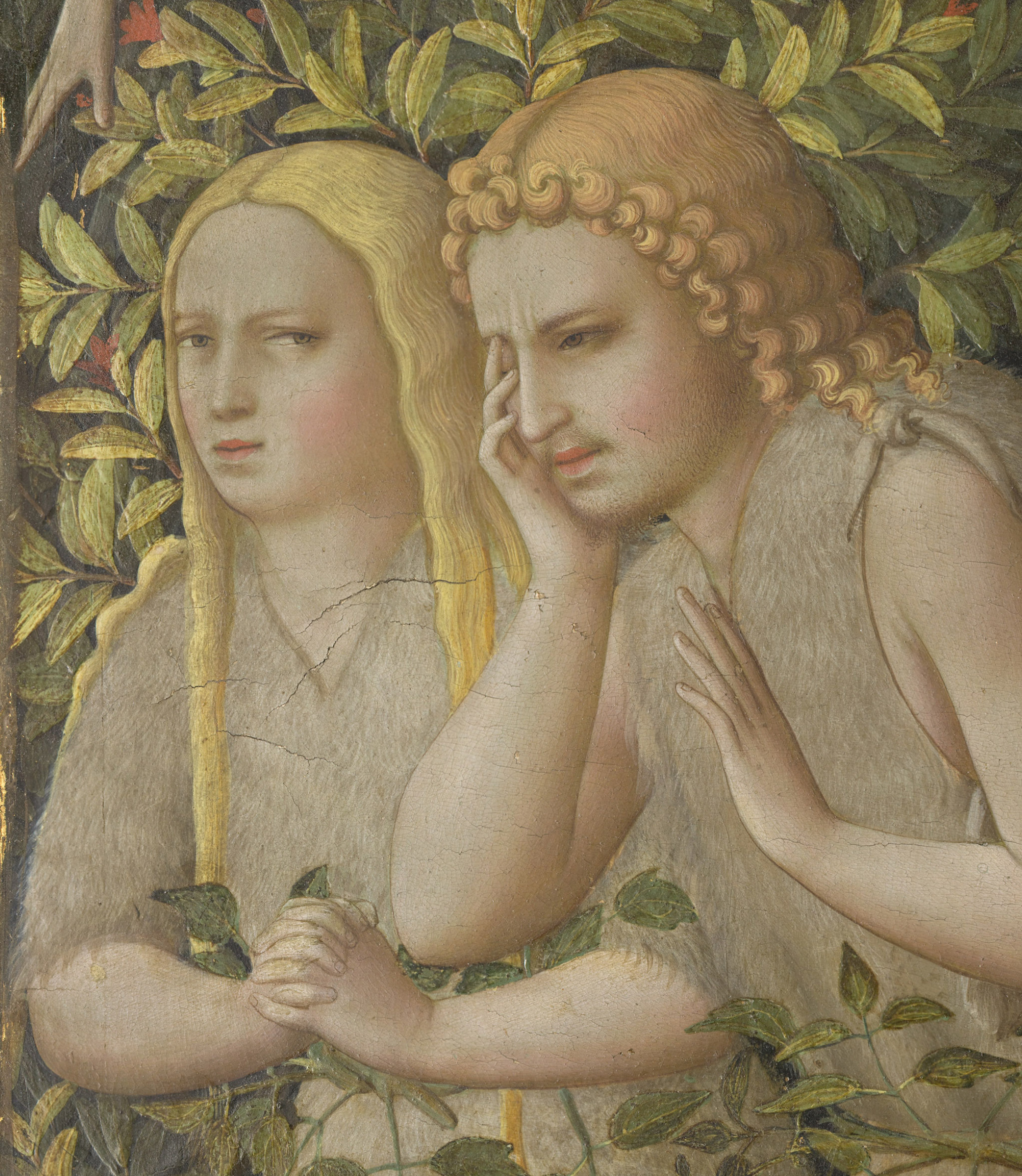
But Fra Angelico goes even further back than the Old Testament prophets. On the left side of the panel he shows our foreparents, Adam and Eve, being cast out of paradise, having broken God’s trust. They blush in shame—they wince, they cover their face. By including this catalyzing event from salvation history in his painting of the Annunciation, the artist is telling a larger narrative. In particular, he is drawing connections, mainly contrastive, between Adam and Eve and Christ and Mary.

Prado Annunciation (detail)

In his epistles, the apostle Paul talks about Christ as the Second Adam, or the New/Last Adam (Rom. 5:12–21; 1 Cor. 15:22–23, 45), who came to restore what was lost with the first Adam. Whereas Adam disobeyed God and caused sin to enter the world, Christ lived a life of perfect obedience to the Father, thereby redeeming humanity. The early church fathers, starting with Justin Martyr, Irenaeus, and Tertullian in the second century, extended this corollary with another: Mary as the Second Eve. Whereas Eve rejected God’s will, Mary embraced it, and her obedient yes, like Eve’s disobedient no, had repercussions for all of humanity. As the arts lecturer John Skillen puts it, our undoing in the Expulsion is undone by the Annunciation.

We see on the left an angel driving humanity out of Eden, but on the right, another angel welcomes humanity back in. And in a glorious reversal of the order of first creation, where Eve was created from Adam, here the Second Adam is created from the Second Eve, knit together from her DNA.

In the first issue of her Medievalish newsletter from last December, Dr. Grace Hamman discusses Fra Angelico’s Prado Annunciation in terms of chronos (ordinary time measured in seconds and hours) and kairos (moments outside of time). “Fra Angelico recognizes something that is easy to forget: because God is outside of time, not bound by chronology like us creatures, this painting offers a ‘God’s-eye view’ of salvation history,” she writes, portraying a simultaneity of “falls” that the fourteenth-century contemplative writer Julian of Norwich expounds on:

When Adam fell, God’s Son fell; because of the true union which was made in heaven, God’s Son could not be separated from Adam, for by Adam I understand all mankind. Adam fell from life to death, into the valley of this wretched world, and after that into hell. God’s Son fell with Adam, into the valley of the womb of the maiden who was the fairest daughter of Adam, and that was to excuse Adam from blame in heaven and on earth; and powerfully he brought him out of hell. (Revelations of Divine Love, chap. 51)

“There was never a moment,” Hamman continues, “even in the expulsion from Eden, that Emmanuel was not with us, if one is given the eyes of kairos.”

This came a few weeks after we discussed the artwork, along with several others on the Annunciation, on Hamman’s podcast, Old Books with Grace. It’s such a generative painting!

And the Annunciation is only the main panel. Along the predella (base) are depicted the Marriage of the Virgin, the Visitation, the Nativity, the Presentation of Christ in the Temple, and the Dormition (the “falling asleep,” or death, of Mary).

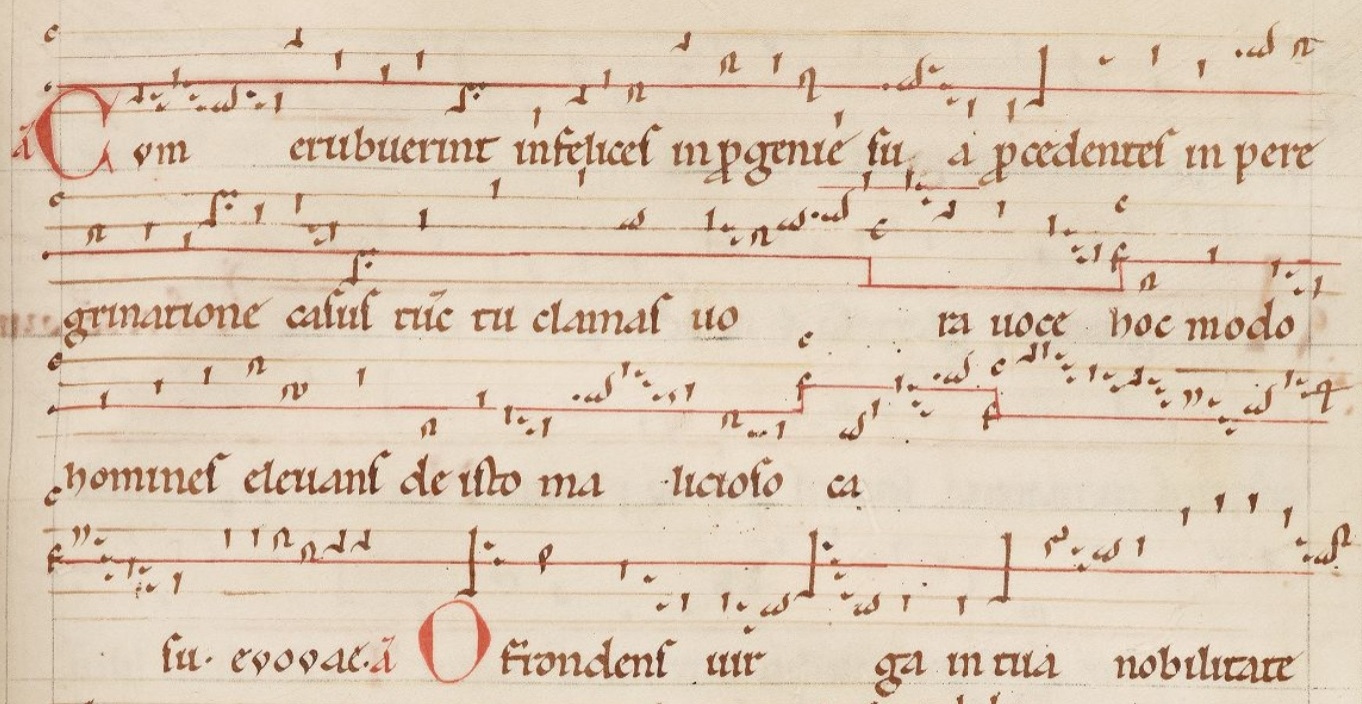
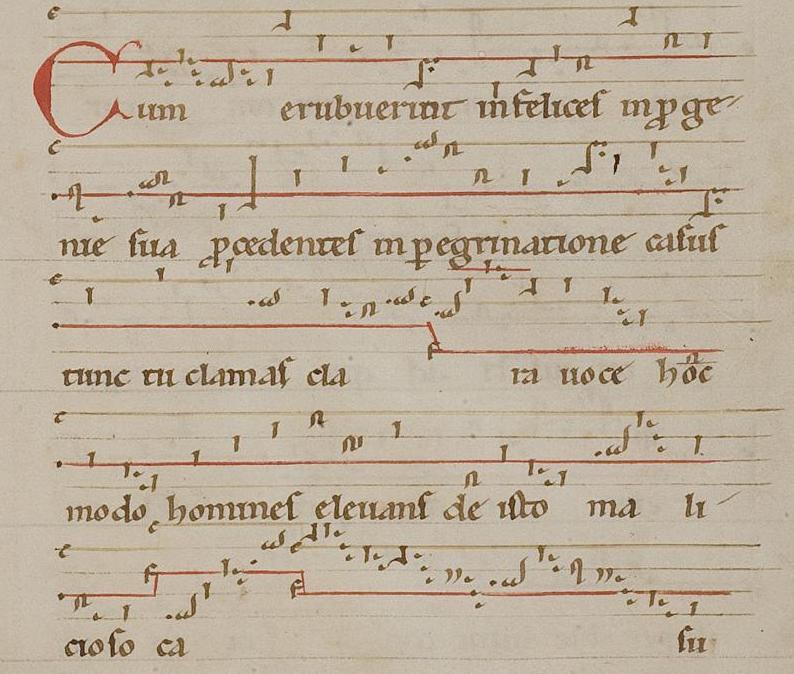
LISTEN: “Cum erubuerint infelices” (While Downcast Parents Blushed) by Hildegard of Bingen, ca. 1175 | Performed by La Reverdie on Sponsa Regis: La victoire de la Vierge dans l’œuvre d’Hildegard, 2003

Cum erubuerint infelices
in progenie sua,
procedentes in peregrinatione casus,
tunc tu clamas clara voce,
hoc modo homines elevans
de isto malicioso
casu.
While downcast parents blushed,
ashamed to see their offspring
wand’ring off into the fallen exile’s pilgrimage,
you cried aloud with crystal voice,
to lift up humankind
from that malicious
fall.

Trans. Nathaniel M. Campbell [source]

The Benedictine abbess Hildegard of Bingen (1098–1179) was a visionary theologian, poet, composer, singer, artist, gardener, and physician. She wrote on scientific and medical subjects in addition to theology, which she conveyed not only through prose but also through poetry, music, dramas, and illuminations. She was quite the medieval polymath!

I first learned about Hildegard in a Western music history survey course in college, in a unit centered on her Ordo Virtutum (Play of the Virtues). I couldn’t believe I had never heard about this amazing sister in the faith before. In 2012 she was formally canonized by the Roman Catholic Church—a long time coming!—and Pope Benedict XVI even named her a “doctor of the church,” a title given to saints who have made a significant contribution to theology or doctrine.

The corpus of surviving musical compositions by Hildegard is larger than that of any other medieval composer. More than half of these are antiphons, short free verses sung before and after each set of psalms during monastic prayer.

“Cum erubuerint” is one such antiphon. Hildegard would have sung it with her sisters at her monastery on the Rupertsberg and later the abbey at Eibingen as part of the Divine Office.

The song addresses the Virgin Mary, whose yes to Gabriel set into motion the Incarnation and thus humanity’s deliverance from spiritual exile.

As are many of Hildegard’s compositions, “Cum erubuerint” is highly melismatic—that is, it features long melodic phrases sung to one syllable. For example, I counted thirteen notes on the first syllable, “Cum”! The highest pitch occurs on clara (“clear”), referring to the definitive quality of Mary’s consent, bright and luminous, to this new thing that God is doing. An agent of God’s grace, Mary speaks a word that cuts through the mists of confusion through which we’ve been wandering, lost, uplifting us from the fall (casu), whose depths are underscored by that word’s being pitched the lowest. In her fiat, Mary is essentially saying, “Let there be light.”

Symphonia armonie celestium revelationum (Symphony of the Harmony of Celestial Revelations) is the title Hildegard gave to her collection of musical compositions, which are preserved in two manuscripts:

  • Dendermonde (D), Belgium, Sint-Pieters-en-Paulusabdij, Cod. 9 (ca. 1175). This one is considered by scholars to be the more authoritative. It was prepared under Hildegard’s supervision as a gift for the monks of Villers and contains fifty-seven songs.
  • Riesenkodex (R), Wiesbaden, Hessische Landesbibliothek, Hs. 2 (ca. 1180–85). This revised and enlarged edition, which includes seventy-five songs, was produced at the Rupertsberg scriptorium not long after Hildegard’s death.

“Cum erubuerint” appears in both.

Cum erubuerint by Hildegard
D 155r
Cum erubuerint (R 467r)
R 467r

Click here for a modern transcription from the International Society of Hildegard von Bingen Studies.

In her critical edition of Hildegard’s Symphonia, Barbara Newman writes,

Hildegard’s creations, compared with a contemporary hymn by Abelard or a sequence by Adam of St. Victor, will sound either primitive or unnervingly avant-garde. In a sense they are both. As a Benedictine, she was acquainted with a large repertoire of chant, but she lacked formal training and made no attempt to imitate the mainstream poetic and musical achievements of her day. Various scholars have hypothesized that she was influenced by German folksong, yet her compositions lack the two essential traits of a popular tune: it must be easy to remember and easy to sing. The difficult music of the Symphonia is sui generis. In [Sr. Maria Immaculata] Ritscher’s words, it is ‘gregorianizing but not Gregorian’ and impossible to classify in terms of any known contemporary movement. (27–28)

And regarding Hildegard’s lyrical texts:

Until the advent of modern vers libre, scholars were reluctant even to dignify Hildegard’s songs with the title of poetry. In style they are much closer to Kunstprosa, a highly wrought figurative language that resembles poetry in its density and musicality, yet with no semblance of meter or regular form. (32–33)

The above performance of “Cum erubuerint” is by La Reverdie, a medieval and Renaissance vocal ensemble that started in 1986 with two pairs of sisters from Italy.

But in addition, here are a few instrumental versions I particularly like:

>> Tina Chancey of the early music ensemble Hesperus plays the melody on kemenche, a bowed instrument from the Black Sea region of Turkey:

>> Riley Lee on shakuhachi (bamboo flute):

>> Noël Akchoté on electric guitar:

The song also appears, under the title “From This Wicked Fall,” on the Billboard-topping Vision: The Music of Hildegard Von Bingen (1994), a classical-electronic crossover album of seventeen of Hildegard’s works arranged by Richard Souther. In Souther’s version, nonlexical vocables (sung by soprano Emily Van Evera and mezzo-soprano Sister Germaine Fritz, OSB) replace the Latin text.