Pamela Mordecai (born 1942) is a Jamaican poet, novelist, short story writer, and scholar of Caribbean literature and culture, living in Toronto. Born and raised in Kingston, she earned a PhD in English from the University of the West Indies and has taught language arts at secondary and postsecondary levels. She often writes in Jamaican Creole, such as for de Man (1995)—a verse play about the crucifixion of Jesus—and the two follow-up collections of narrative poems about Jesus’s parents: de book of Mary (2015) and de book of Joseph (2022).
South African photographer Justin Dingwall (born 1983) seeks to depict beauty in difference. For his Albus series—Latin for “white” or “bright”—he worked with South African models and activists Thando Hopa and Sanele Junior Xaba, who have albinism. Albinism is a hereditary condition that affects melanin production, resulting in little to no pigmentation in the skin, hair, and eyes. It is more prevalent in sub-Saharan Africa than in the rest of the world, and people with the condition often face marginalization, discrimination, and even deadly violence.
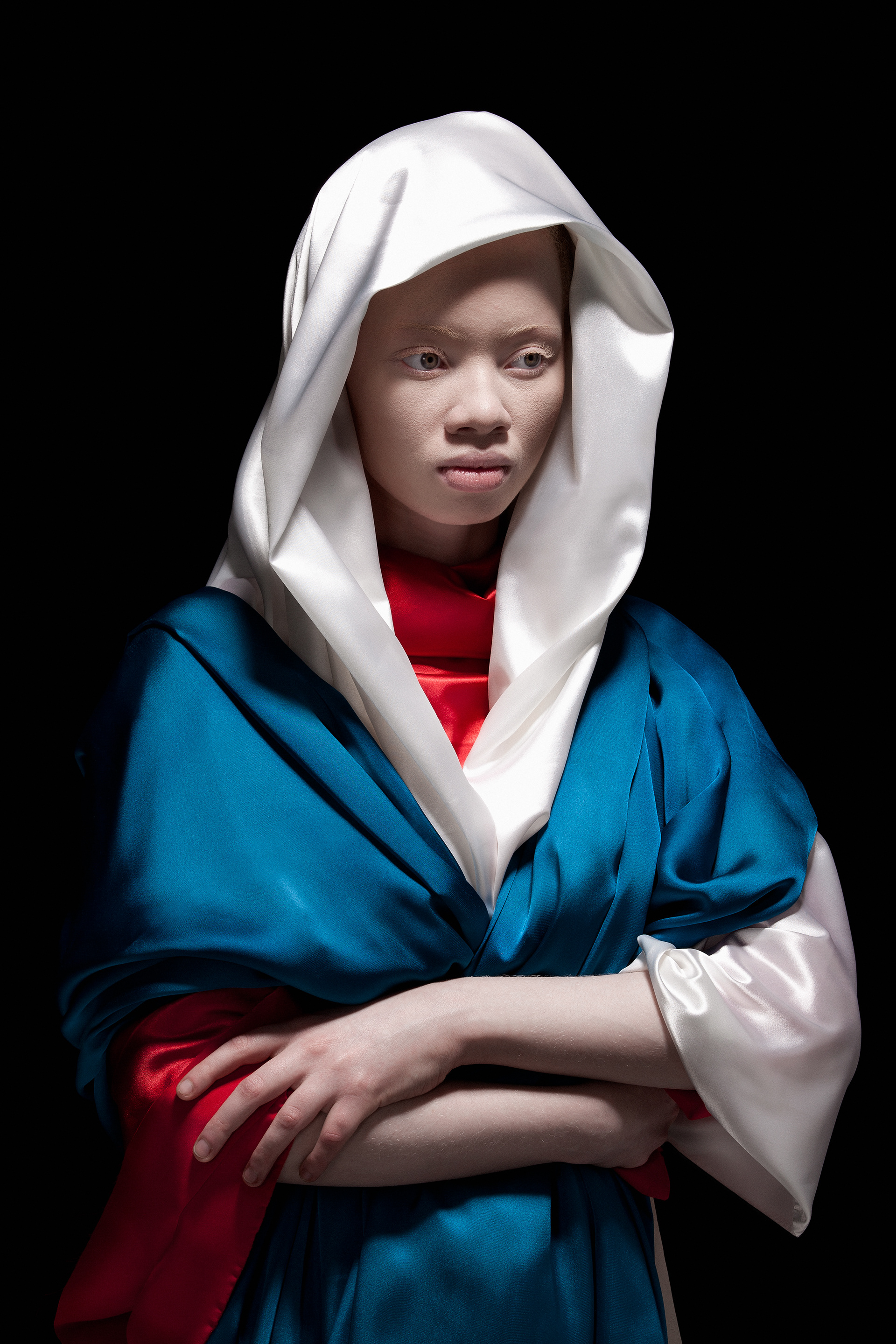
In many ways Dingwall’s Albus series, which comprises several dozen photographs, is about metamorphosing perceptions about albinism, subverting the idea that it’s a curse; “by using butterflies my aim was to influence the viewer’s vision to be transformed, allowing them to view albinism in a new light—as something unique and beautiful,” he said. But the theme of transformation, of death and rebirth, as portrayed in some of the photos of Xaba, also connects with the narrative of Jesus’s passion, death, and resurrection, the model’s poses evoking traditional Christian imagery. (Not to mention how some of the photos of Hopa, not pictured here, intentionally reference Mother Mary.)
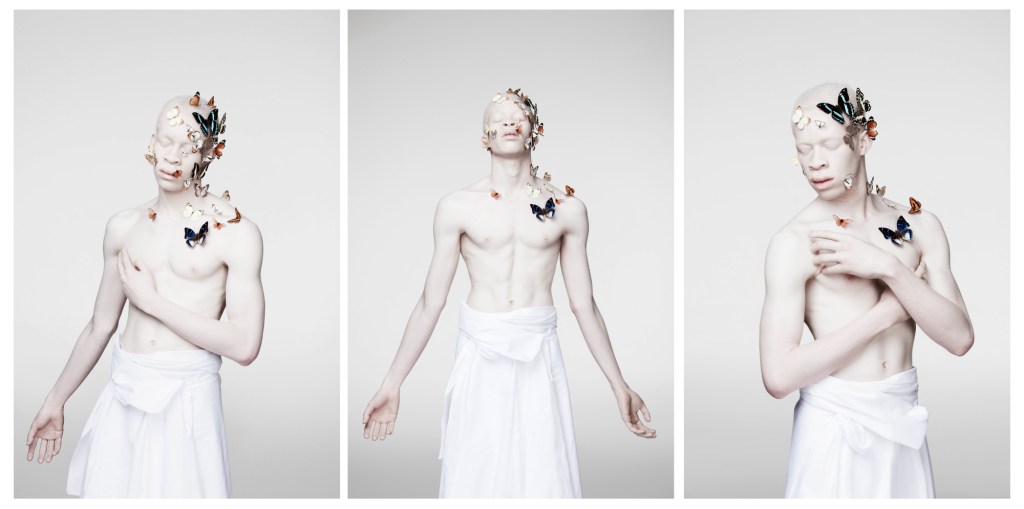
Rhapsody I, II, and III form a passion triptych of sorts, a sequence of three photos that show a male figure, clothed in a loincloth, falling into darkness—and yet, illuminated from above, he looks up toward the light.
Justin Dingwall, Rhapsody I, II, III, 2015
I’m reminded of Jesus speaking to his Father in Gethsemane, and at his crucifixion. Of all the art that shows him stumbling on his way to Calvary (“Jesus falls” makes up three of the fourteen stations of the cross). And especially of his slumped body being lowered from the cross. All the supporting characters, however, are absent, intensifying our focus on this lone Christ figure.
Consider some of the compositional similarities between Dingwall’s three Rhapsody photographs and the following explicitly Christological artworks. (To view the full caption, click on the the image.)
William Blake (British, 1757–1827), The Agony in the Garden, ca. 1799–1800. Tempera on tinned iron, 27 × 38 cm. Tate, London. http://www.tate.org.uk/art/work/N05894
Penny Warden (British, 1956–), Station 9: Jesus Falls for the Third Time, 2005. Oil on canvas, 6 × 3 ft. Blackburn Cathedral, Lancashire, England. http://www.thejourney.me.uk/
Rembrandt Harmensz. van Rijn (Dutch, 1606–1669), Christ on the Cross, 1631. Oil on canvas, glued to panel, 39 3/8 × 28 3/4 in. (100 × 73 cm). Église Saint-Vincent, Le Mas-d’Agenais, Lot-et-Garonne, France. http://www.wikipaintings.org/en/rembrandt/christ-on-the-cross-1631
Greg Semu (New Zealand Samoan, 1971–), Auto Portrait with Crucifix, 1997. A/P selenium-toned fiber-based silver gelatin handprint. http://www.gregsemu.photography/unnerved
Descent from the Cross, South Netherlandish, early 16th century. Oak, polychromy and gilding, 23 3/4 × 11 1/4 × 4 3/4 in. (60.3 × 28.6 × 12.1 cm). Metropolitan Museum of Art, New York. http://www.metmuseum.org/art/collection/search/462888
Suggestive of burial, Embrace by Dingwall shows a man wrapped, cocoon-like, in white linen, lying against a black ground. His face, again, catches the light, and he appears to be at peace. He is resting in this silent, in-between time that precedes the emergence of new life.
Justin Dingwall, Embrace, 2015
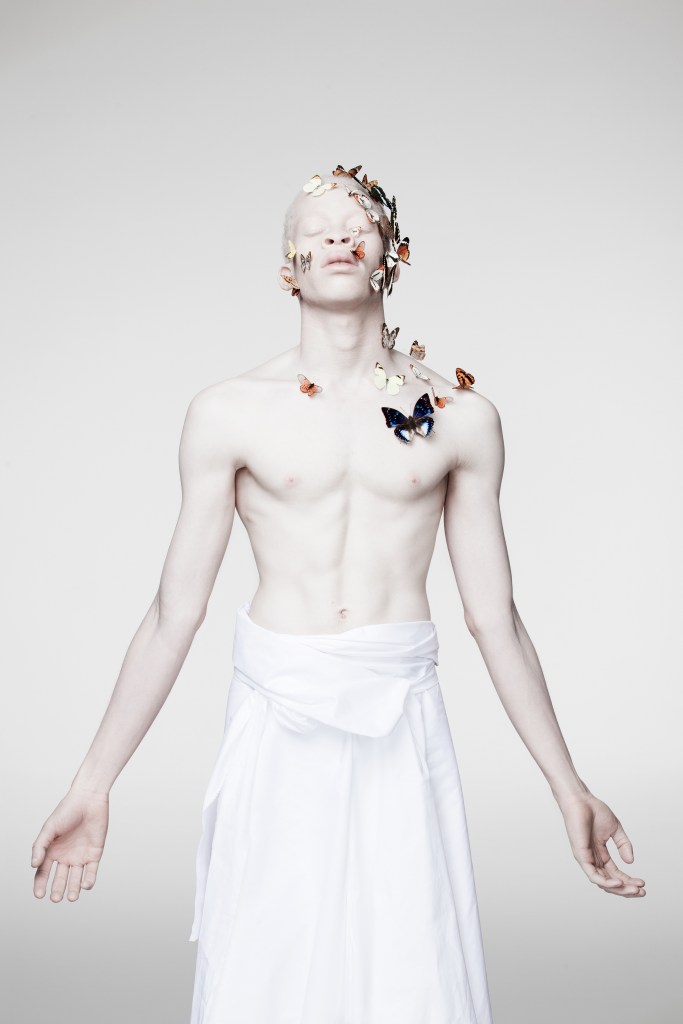
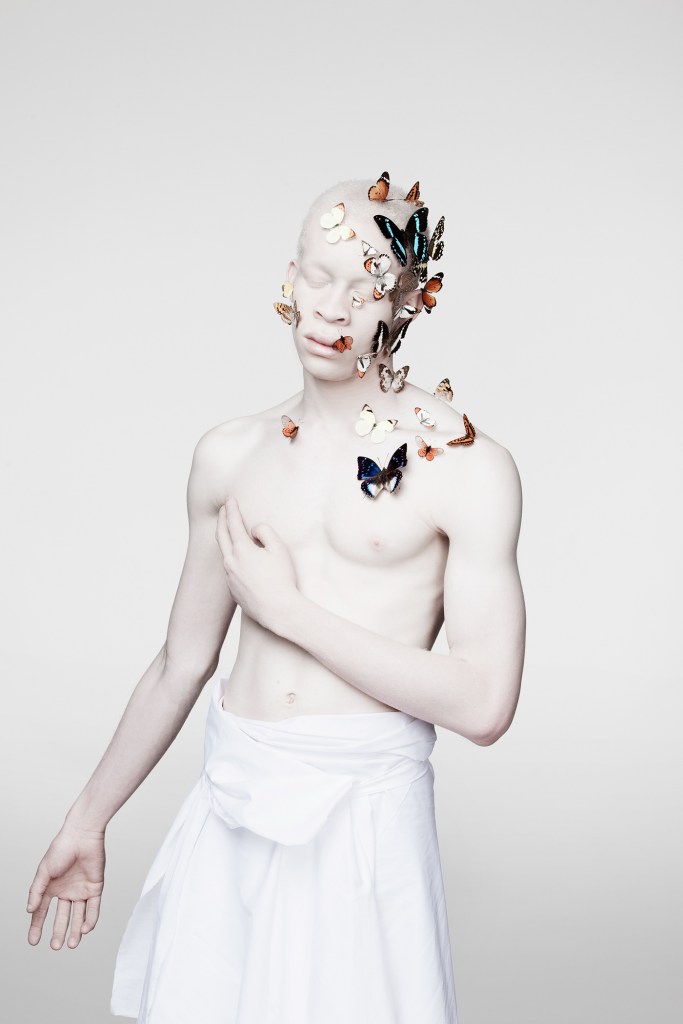
More explicitly inspired by Christian visual traditions is Dingwall’s Liberty triptych, which shows our Christ figure risen from death, glowing, and covered in butterflies, symbol of resurrection.
Justin Dingwall, Liberty I, II, III, 2015
In Liberty II, the man extends his arms at a roughly forty-five-degree angle from his trunk, palms upward, in a beatific gesture. His eyes are closed as he bathes in light. Christ is often shown in this pose in art of the resurrection, emerging triumphant from his tomb and proudly revealing his transfigured wounds. Dingwall’s image, though, is quieter, more interior.
Liberty I is reminiscent of Jesus inviting Thomas to see and touch his wounds, and especially of Bramantino’s The Risen Christ (see tiled gallery below). People have long marveled at the incredible luminosity of Christ in the latter painting—how the light seems to come from within (the setting is nighttime, as the moon in the background indicates).
So in many ways these photographs by Dingwall are continuous with Christian art history, but they are also open enough to be read in a multitude of other ways or applied to different contexts. Though the nature of Jesus’s resurrection and what it accomplished are, Christians believe, unique in history, stories of death and rebirth are universal, traversing all cultures and religious traditions.







 Art & Theology


