Roundup: Theological spinoff of “The Twelve Days of Christmas,” Advent art with Elissa Yukiko Weichbrodt, and four new Christmas song recordings

POEM SERIES: “Twelve Days of Advent” by Kate Bluett: This year on her blog, writer Kate Bluett [previously] is publishing a series of original metrical verses based loosely on the cumulative song “The Twelve Days of Christmas.” She calls it the Twelve Days of Advent and through it explores the theology of Christ’s coming. I love this creative, sacred spin on the popular seasonal ditty! Here’s where the series currently stands (my favorite poems are in boldface):

  1. “A Partridge in a Pear Tree”: Bluett imagines, in the tree of the knowledge of good and evil, a bird singing (representing, as I take it, God’s word), but Adam and Eve heed not his song, and, taking the tree’s forbidden fruit, find themselves exiled. The bird weeps for the alienation of his two friends, and wings his way east of Eden, into the home of a young maiden, a daughter of Eve, who receives him, shelters him, an act that leads to restoration. Bluett uses some of the language of late medieval English folksong, such as “with a low, low, my love, my love” and “welaway.”
  2. “Two Turtledoves”
  3. “Three French Hens”
  4. “Four Calling Birds”: This poem is brilliant. In it the four matriarchs in Jesus’s genealogy speak to Mary, tenderly calling her “Child” and rejoicing in her “bringing forth our life’s tomorrow.” Tamar, Rahab, Ruth, Bathsheba—they’ve long awaited redemption, and now they’re at its threshold. Mary’s yes to God’s call “set[s] [their] dry bones stirring, thrumming / with a hope [they’d] hardly dared.” They inform her that her vocation will involve great suffering (as we know, she’ll experience the brutal death of her son)—but her willingness to give up her son to the cross, to endure that rupture, will mean new life for the world.
  5. “Five Gold Rings”
  6. “Six Geese a-Laying”: Picking up the Isaianic language of the wilderness being made glad, the poetic speaker sings an eschatological vision of flocks coming home to “the orchard of the rood” (rood = cross) to lay and hatch eggs in nests once empty, now brimming with life.
  7. “Seven Swans a-Swimming”

I eagerly await the remaining five poems!

+++

SUBSTACK SERIES: “Art + Advent 2025” by Elissa Yukiko Weichbrodt: The art historian Elissa Yukiko Weichbrodt [previously], author of Redeeming Vision and the Loving Look Substack, is one of my favorite writers. This Advent she is writing a weekly series of art reflections centered on the themes of hope, peace, joy, and love.

>> “Week 1 // Hope: Abraham’s Oak and Sarah’s Laughter”: Looking at Henry Ossawa Tanner’s painting Abraham’s Oak, Weichbrodt writes about shadowy promise. She also considers, with reference to an early Byzantine mosaic of the Hospitality of Abraham, how to hope again after being wounded, as Sarah did, is a vulnerable thing. “As Advent begins, I find myself peering into a Tanner-like mist, seeing the dim outline of longed-for goodness taking shape in the distance. Sometimes I’m full of hope, but I’m also, like Sarah, sometimes full of armored laughter.”
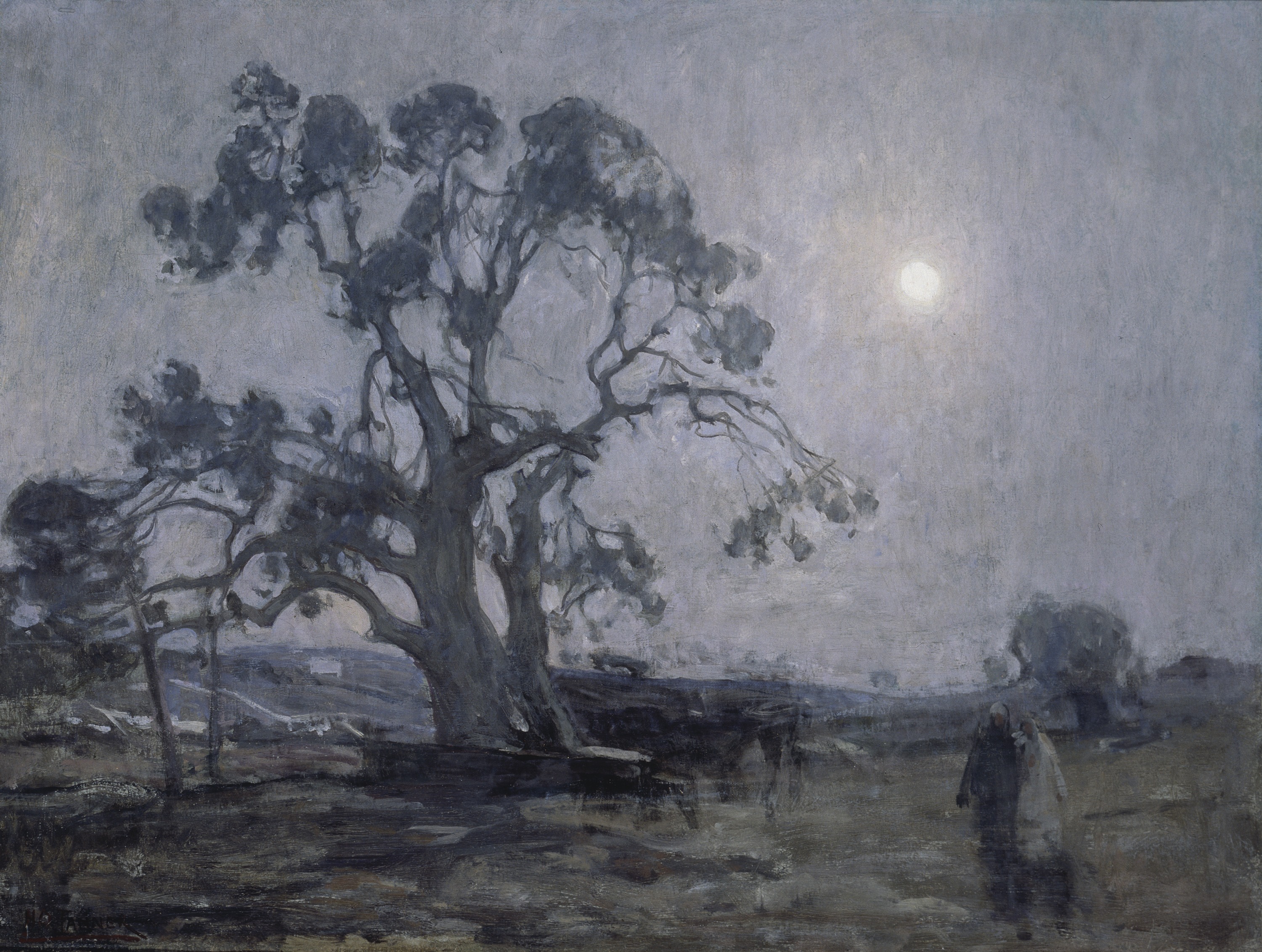
Tanner, Henry Ossawa_Abraham's Oak
Henry Ossawa Tanner (American, 1859–1937), Abraham’s Oak, 1905. Oil on canvas, 21 3/8 × 28 5/8 in. (54.4 × 72.8 cm). Smithsonian American Art Museum, Washington, DC.

>> “Week 2 // Peace: A Stitch Pulling Tight”: “How do we do repair work in a fraying world with our own, fraying selves? What thread can stitch together all these gaping wounds?” Weichbrodt asks. She looks at Mary Weatherford’s monumental painting Gloria (new to me!), finding in the hot coral neon light blazing across the canvas resonance with Renaissance paintings of the Annunciation, which portray the Light of the World as the stitch that mends the tear between God and humanity.
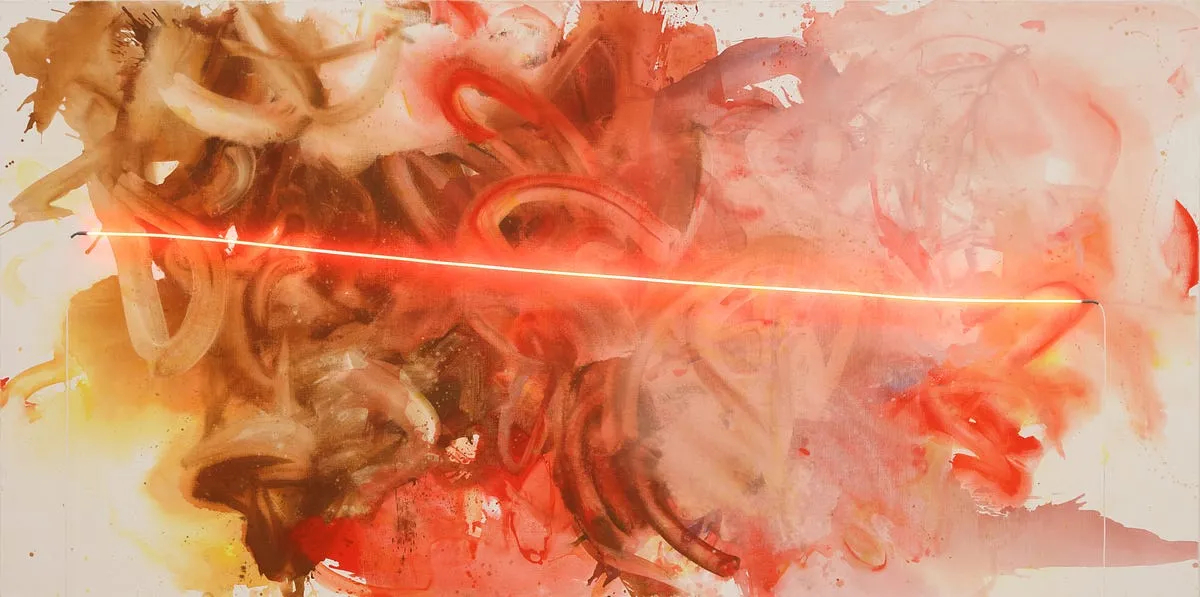
Weatherford, Mary_Gloria
Mary Weatherford (American, 1963–), Gloria, 2018. Flashe paint and neon on linen, 117 × 234 in. (297.2 × 594.4 cm). High Museum of Art, Atlanta.

>> “Week 3 // Joy: Far as the Curse Is Found”: In this post, Weichbrodt explores nine Visitation paintings and one extraordinary embroidery. “Every time I see [a Visitation artwork],” Weichbrodt writes, “I encounter joy. It’s not that Mary and Elizabeth are always smiling. Often, their expressions are quite serious. But joy—deep, sustained, sustaining joy—circulates between them like an electrical current.” Justice, threshold, and fecundity are among the supplementary themes touched on.
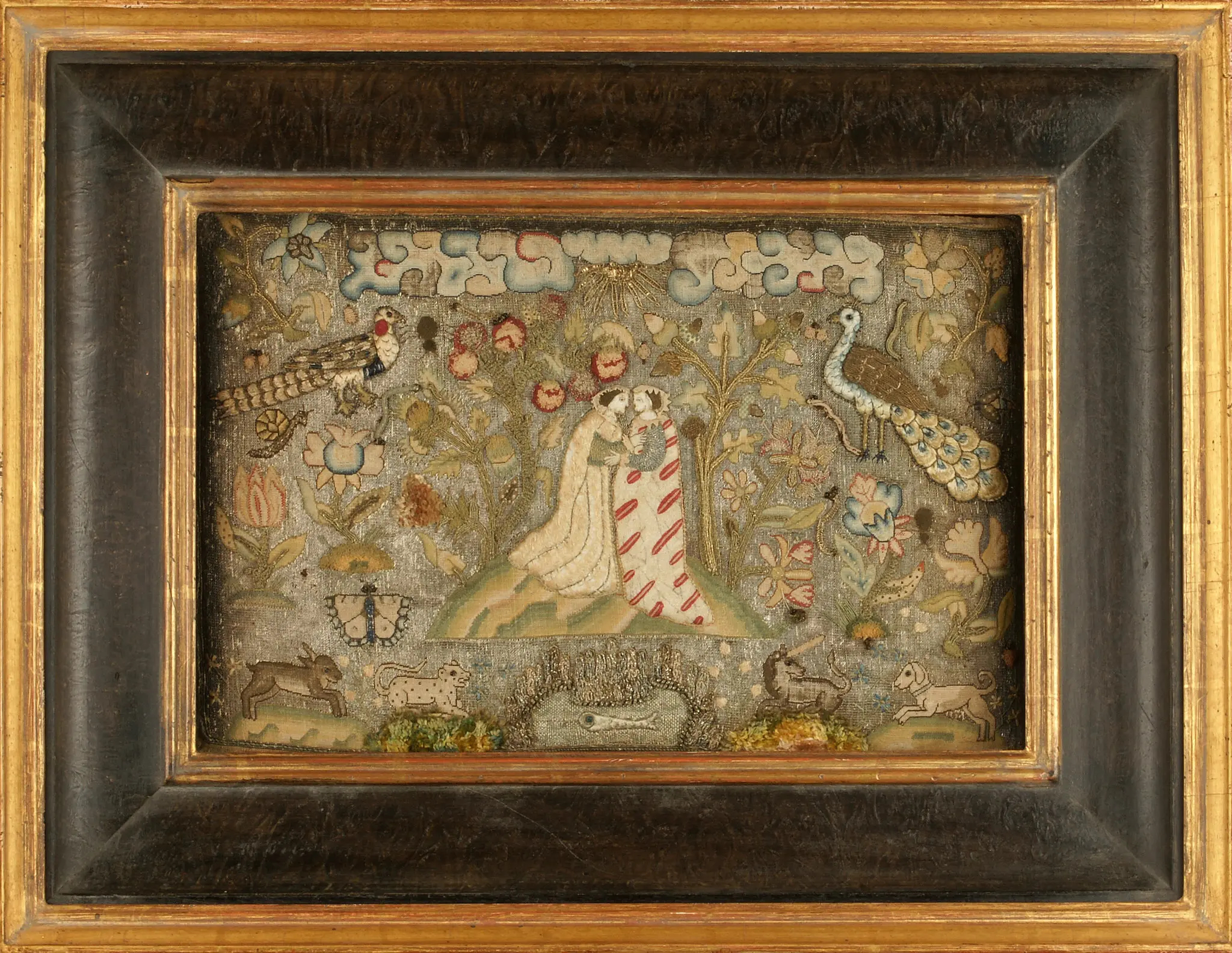
Visitation embroidery
The Visitation, England, first half of 17th century. Embroidery, 44.1 × 57 cm (framed). Ashmolean Museum, University of Oxford.

Weichbrodt’s final Advent 2025 post, on love, will be published this Saturday.

+++

SONGS:

Here are four newly released Christmas songs of note: two originals, one lyrical adaptation of a classic, and a new arrangement.

>> “War on Christmas” by Seryn: Seryn’s new album is titled War on Christmas. Here’s the title track:

The refrain is:

There is a war on Christmas
But it’s not the one you think
It’s in the news, it’s out of mind
It happens overseas
Cause as we sing the hymns and songs
With families by our sides
There is a war on Christmas
Someone’s fighting to survive

“War on Christmas” is a phrase some Christian conservatives in the US use to express their feeling of having their faith traditions attacked by the sinister forces of pluralism when people or signage greet them with a generic “Happy Holidays” instead of “Merry Christmas.” I roll my eyes big-time when I hear people complain about this, because it’s ridiculous for any American to assert that they are impeded from or ostracized for celebrating Christmas in this country, or to take offense that a stranger does not automatically assume their particular religious affiliation.

Seryn’s song affirms that yes, there is a war on Christmas—only it’s a war not against personal religious freedoms in America but against peace, love, and the other values Christ came to teach and embody. When humans wage literal wars with literal weapons, killing and maiming each other and inducing mass terror—that’s an assault against Christ’s mass, with its message of welcome and reconciliation. So, too, when we perpetuate hate, whether on personal, national, or global scales. As another Christmas song puts it, “Hate is strong and mocks the song of ‘Peace on earth, goodwill to men.’”

>> “O New Commingling! O Strange Conjunction!” by the Anachronists: The lyrics to this new song by the Anachronists [previously]—Corey Janz, Andrés Pérez González, and Jonathan Lipps—are a paraphrase from the sermon “On the Theophany, or Birthday of Christ” by Gregory of Nazianzus (ca. 329–390), one of the most influential and poetic theologians of the early church. Gregory delivered the sermon, labeled “Oration 38” in the Nicene and Post-Nicene Fathers series, at Christmastime in 380 in Constantinople, where he served as bishop. In section 13, the Anachronists’ source for the song, he expresses awe at the beautiful mystery of the Incarnation. Below is an excerpt from the public-domain NPNF translation.

The Word of God Himself—Who is before all worlds, the Invisible, the Incomprehensible, the Bodiless, Beginning of Beginning, the Light of Light, the Source of Life and Immortality, the Image of the Archetypal Beauty, the immovable Seal, the unchangeable Image, the Father’s Definition and Word—came to His own Image, and took on Him flesh for the sake of our flesh, and mingled Himself with an intelligent soul for my soul’s sake, purifying like by like; and in all points except sin was made man. . . . O new commingling; O strange conjunction; the Self-Existent comes into being, the Uncreate is created, That which cannot be contained is contained. . . . He Who gives riches becomes poor, for He assumes the poverty of my flesh, that I may assume the richness of His Godhead. He that is full empties Himself, for He empties Himself of His glory for a short while, that I may have a share in His fullness. What is the riches of His goodness? What is this mystery that is around me? I had a share in the image; I did not keep it; He partakes of my flesh that He may both save the image and make the flesh immortal. He communicates a second Communion far more marvelous than the first.

(Related post: Andy Bast sets to music a Nativity hymn by St. Ephrem)

>> “Away in a Manger (Then to Calvary)” by Sarah Sparks: Singer-songwriter Sarah Sparks [previously] released a new EP, Christmas Hymns, last month, comprising five classic carols, including one with revised lyrics that further draw out the significance of the Incarnation. I’m a big fan of Sparks’s voice and her no-frills acoustic style.

Away in the manger
No crib for a bed
The great King of Heaven
Does lay down his head
The stars he created
Look down where he lay
The little Lord Jesus
Asleep on the hay

And there in the manger
The Maker of earth
In riches and glory?
No, born in the dirt
With oxen and cattle
With shepherds and sheep
No stranger to weakness
He loves even me

And there in the manger
Is our Servant-King
He sits with the lowly
He washes their feet
Away in the manger
Then to Calvary
His birth, life, and death
And his raising for me

And there in the manger
Is my greatest friend
His mercy, his patience
His grace know no end
Be near me, Lord Jesus
For all of my days
In life and in death
Till we meet face to face

>> “Angels We Have Heard on High” by the Petersens: Last Friday the Petersens [previously] released a music video—shot at Wonderland Tree Farm in Pea Ridge, Arkansas—debuting their new bluegrass arrangement of one of my favorite Christmas carols. Banjo, mandolin, fiddle, acoustic guitar, dobro, upright bass—I love the instrumentation of the bluegrass genre and what it adds here, and the Petersens are consummate performers.  

Advent, Day 15: Promise

LOOK: the rain bows and the rainbows by Katy Mixon

Mixon, Katy_The rain bows and the rainbows
Katy Mixon (American, 1984–), The rain bows and the rainbows (one day we will switch sides), 2018. Oil paint and used hand rags on muslin, 100 × 138 in.

I saw this quilt by Katy Mixon in December 2021 at the exhibition Break the Mold: New Takes on Traditional Art Making at the North Carolina Museum of Art. I was struck first by its prismatic color, and then by its title—which, the artist told me, comes from a dream she had after her close friend died. To bow, long o, is to bend into a curve; as a noun, a bow is a weapon used to propel an arrow, or a knotted ribbon typically worn by young girls. To bow, short o (as in “ow”), is to incline in respect or submission. The multiple meanings of this homograph open the title to different readings.

But the overall meaning points to the multihued arc that appears in the sky after a rainfall, as sunlight refracts through water vapor.

In the Judeo-Christian tradition, the rainbow is a sign of God’s covenant with Noah and has come to symbolize divine promise more generally, or hope—after the bleakness, beauty.

Mixon’s making process involves upcycling rags, which is itself a kind of redemptive act, saving used scraps and piecing them together into a new whole.

“Katy Mixon’s ‘quilts’ began as an outgrowth of her painting process,” the NCMA exhibition text read. “She routinely wipes her hands, palette knives, and other tools with baby wipes, which she then tosses into her studio’s garbage can. ‘One day [I] looked at the trash and realized it was full of all this hastily discarded color,’ she notes. She began saving the vibrant detritus with no specific purpose in mind, but after remembering her grandmother’s homemade quilts and discovering the famed African American quiltmakers of Gee’s Bend, Alabama, Mixon had a plan for her colorful scraps. ‘For me, the quilted works are alternate endings in the painting’s life cycle,’ Mixon says. ‘Painting as a practice, with the used rags as kaleidoscopic evidence.’”

Describing her technique, Mixon told me: “I compose the pieced tops and work with local longarm quilters to add the batting and backing. I finish each piece with hand stitching, often using crewel embroidery to define brush marks and tonal variations.”

LISTEN: “Joyful” | Words by Kate Bluett | Music by Paul Zach | Performed by Paul Zach with Taylor Leonhardt and Nick Dahlquist, on Christmas Hymns (2022)

The MP3 file of the song is embedded here with Paul Zach’s permission.

Come, O Lord, and make us joyful
as you came to Mary’s womb;
buried deep beneath our sorrows,
where our hopes take root and bloom.
Be the promise that sustains us
through the seasons of the years,
’til at last we see your radiance
when you shine beyond our tears.

Come, O Lord, and show your mercy
as you came in Bethlehem;
let us see the sunlight bursting
through the shadows once again.
Let us hear the song of glory
where the silence held us fast.
We will come to you rejoicing
from the shackles of the past.

Come, O Lord, as living water;
make our deserts green again,
where the wellspring of our laughter
will refresh us like the rain.
After all the years of waiting
for the promise long foretold,
come at last, and let the day break
in the morning of your joy!

Roundup: “Harrowing of Hades” audio drama, Easter chant in Arabic, and more

HYMN TEXT: “Lights” by Kate Bluett: Kate Bluett [previously] is a Catholic poet and lyricist from North Texas who frequently participates in cross-denominational music collaborations. Her work has been published by Oregon Catholic Press and GIA Publications and recorded by the Porter’s Gate and Paul Zach, among others. I enjoy following her at https://katebluett.home.blog/, where she regularly shares new metrical verses she has written, tied to the liturgical calendar. Last Eastertide she published a text called “Lights,” which muses on candle flames, stars, and other light sources as reflections of the light of the risen Christ.

+++

AUDIO DRAMA: Anastasis: The Harrowing of Hades by Creative Orthodox: Creative Orthodox is the moniker of Michael Elgamal, a Coptic Orthodox artist and storyteller born in Egypt and living in Canada. Last May he released an audio drama, adapted from a graphic novel, about Christ’s epic descent into the underworld to reclaim the Old Testament righteous. This theatrical medium, which relies on voice acting, sound effects, and music to tell a story, was a very popular form of entertainment in the 1920s–40s before the advent of television but is much rarer today—which is a shame, because I find it really engaging! See the YouTube description for a full list of credits (script, score, actors, etc.).

+++

BLOG POST: “Iconography of the Descent of Jesus Christ into Hell” by Daria Chechko: A brief history and compilation of Anastasis icons.

Dionysius_Descent into Hell icon
Dionysius (Russian, ca. 1440–ca. 1508), Christ’s Descent into Hades, from Ferapontov Monastery, ca. 1495–1504. Tempera on wood, 31.2 × 10.5 cm. State Russian Museum, Saint Petersburg.

+++

SONGS:

>> “Christ Is Risen” (لمسيح قام) by Ribale Wehbé: Ribale Wehbé is a Lebanese singer specializing in Byzantine chant. Here she sings a traditional Easter chant in Arabic, arranged by Joseph Yazbeck.

>> “Hallelujah, Hosanna” (हाल्लेलुयाह होशन्ना) by One Tribe: Originally written in Tamil by pastors Dudley Thangaiah and Paul Thangaiah, “Hallelujah, Hosanna” is sung here in Hindi by the Indian Christian worship collective One Tribe. Turn on “CC” for closed captioning, and view the full credits in the YouTube video description. [HT: Global Christian Worship]

>> “He Did Rise” by Monroe Crossing: A bluegrass song about the women’s discovery of the empty tomb on Easter morning, written by Mark Anderson and performed here by his band, Monroe Crossing, at a music festival in Lexington, Kentucky, in 2009. Anderson is on the double bass. [HT: Global Christian Worship]

+++

SPOTIFY PLAYLIST: May 2025 (Art & Theology): An assortment of psalms, hymns, and spiritual songs, old and new. For my Easter-specific playlist from 2022 (with a smattering of new additions since, including a large batch from Cardiphonia at the bottom), see here.

Advent, Day 21: Reign of Mercy

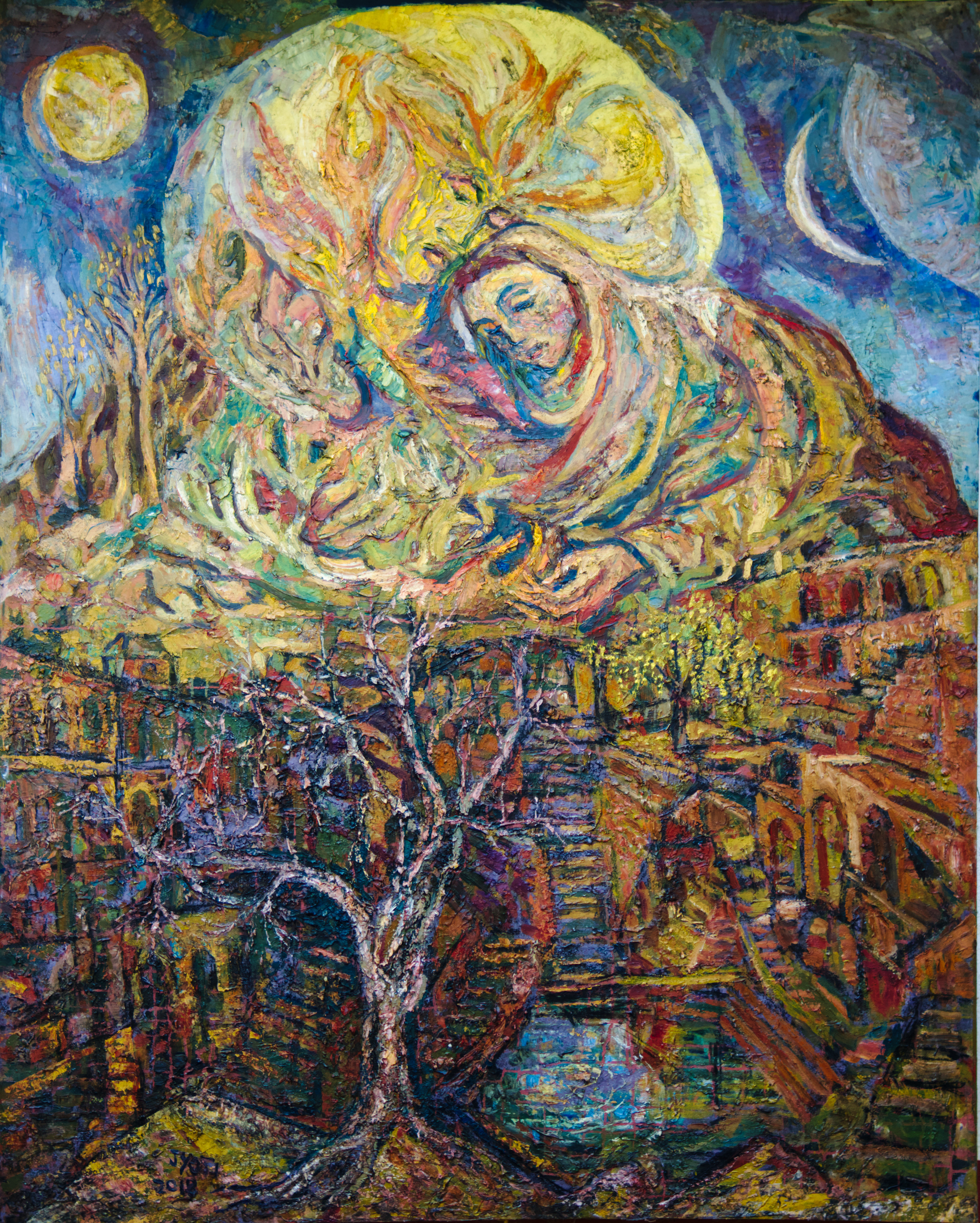
LOOK: Beulah by Jyoti Sahi

Sahi, Jyoti_Beulah
Jyoti Sahi (Indian, 1944–), Beulah, 2018. Oil and acrylic on canvas, 5 × 4 ft. Photo: Victoria Emily Jones.

In Isaiah 62:2–5, God talks to Zion about her future. He says that on the day of the Lord,

The nations shall see your vindication
    and all the kings your glory,
and you shall be called by a new name
    that the mouth of the LORD will give.
You shall be a beautiful crown in the hand of the LORD
    and a royal diadem in the hand of your God.
You shall no more be termed Forsaken,
    and your land shall no more be termed Desolate,
but you shall be called My Delight Is in Her
    and your land Married,
for the Lord delights in you,
    and your land shall be married.
For as a young man marries a young woman,
    so shall your builder marry you,
and as the bridegroom rejoices over the bride,
    so shall your God rejoice over you.

The painting Beulah by the Indian Christian artist Jyoti Sahi (pictured below) takes its title from the Hebrew word for “married” that’s used in Isaiah 62:4. He told me the image pictures the coming together of heaven and earth, the sun marrying the land, which can also be read as Christ uniting with his bride. Christ comes as dawn, his head like flame, like the great I AM revealed to Moses in the burning bush. His glory, the yellow halo around his head, encompasses the female figure. He leans in, tenderly resting his head on hers, and their hands touch.

Beulah shows the reunion not only of humanity and the Divine at the end of time, but also of the land and the Divine. As the Isaiah passage states, the earth, too, will be redeemed and made to flourish once again.

The two figures here form a sacred mountain. A river of life flows down between them, watering the new city, which is a wilderness no longer. This is Isaiah’s vision wrapped up into John the Revelator’s.

Jyoti Sahi
Jyoti Sahi touches up a detail of his painting Beulah. Photo: Victoria Emily Jones.

LISTEN: “The Reign of Mercy” by Kate Bluett and Paul Zach, 2021 | Performed by Paul Zach and Lauren Plank Goans on Advent Songs by the Porter’s Gate, 2021

Oh may our world at last be just
And hilltops echo with your peace
A harvest come from barren dust
The reign of mercy never cease
He comes as rain upon the grass
High heaven’s sun to earth descends
Not as the seasons that will pass
But with a light that never ends

Oh come to him and find your rest
Who saw the poor and came as one
Who hears the cries of the oppressed
And rules till all oppression’s done
Someday he’ll come to reign as king
And we will see his justice done
Our souls will magnify and sing
The Christ whose kingdom now is come

And all the mighty and the strong
Will bow before him on that day
The silenced fill the world with song
The poor and lowly he will raise
And all our bitterness and tears
Our violence and our endless wars
Will end at last when he draws near
Come soon, come soon, oh Christ our Lord

Gaudete! Ten Songs for Advent Rejoicing

(This article is an all-new edition of last year’s “Ten Songs of Joy for Gaudete Sunday.”)

The third Sunday of Advent is traditionally known as Gaudete (Joy) Sunday, a day of celebrating the joyful reality that God is near. Advent is characterized by our waiting and yearning for Christ, which can feel heavy, especially as we look around and within and see so much brokenness. But on this day we are reminded to embrace a spirit of joy as we wait and as we yearn—much like a child waits with eager anticipation to unwrap a gift, or lovers to be reunited after a time of separation.

The following ten songs help us to inhabit the gladsome aspects of the Advent season, paving the way to Christmas.

Geyser
Øystein Sture Aspelund (Norwegian, 1984–), GVariations #08, Pamir Mountains, Tajikistan [HT]

1. “First Song of Isaiah” by Jack Noble White (1976) | Arranged and performed by Advent Birmingham, feat. Annie Lee, on Canticles (2020): Here’s an upbeat rendition, with xylophone and ukelele, of Jack Noble White’s choral setting of Isaiah 12:2–6. “You shall draw water with rejoicing from the springs of salvation. . . . Cry aloud, inhabitants of Zion, ring out your joy!” In the Book of Common Prayer this text appears in the section “Morning Prayer, Rite 2,” where it is labeled Canticle 9, “The First Song of Isaiah: Ecce, Deus.”

2. “Rejoice Greatly, O Daughter of Zion” from Messiah by George Frideric Handel (1741) | Performed by Regula Mühlemann (2019): A setting of Zechariah 9:9–10, this aria from Handel’s most famous oratorio features coloratura in the vocals—that is, elaborate, fast-paced ornamentation, trills, runs, and wide leaps—that accentuates the prophecy’s joyful message of a coming king. It’s sung by the Swiss soprano Regula Mühlemann, accompanied by the Sächsische Staatskapelle Dresden under the direction of Alondra de la Parra. For a Broadway-style arrangement of this piece, see here.

3. “Joy (Elizabeth)” by Poor Bishop Hooper, on Firstborn (2018): This song by Jesse and Leah Roberts voices Elizabeth’s awe upon visiting with her younger relative Mary, who is newly pregnant with the Son of God. Elizabeth radiates such joy in the Messiah that her preborn son, John, catches it too, leaping in her womb.

4. “Joy” by Kirk Franklin and Donald Malloy | Performed by the Georgia Mass Choir, feat. Dorothy Anderson and Kirk Franklin, on I Sing Because I’m Happy (1992): Sweet, beautiful, soul-saving joy! That’s what Jesus gives. The Georgia Mass Choir testifies with vigor, led by the Grammy-winning artist Kirk Franklin. In 1996 this song was adapted for Whitney Houston for the film The Preacher’s Wife, with Christmas-specific lyrics, but I really dig Dorothy Anderson’s solo work in this original recording.

5. “Rejoice” by Victory Boyd, on Glory Hour (2023): This anthem by singer-songwriter Victory Boyd is based on Nehemiah 8:10: “Do not be grieved, for the joy of the LORD is your strength.” Victory often incorporates scripture recitations into her songs, and here she speaks Psalm 27:1–6 as a bridge, which has thematic crossovers with the Nehemiah verse. In this live performance from the February 4, 2024, episode of the Hour of Power television program, she is accompanied by the Hour of Power Orchestra, conducted by Marc Riley.

6. “Joy” by Shakti, on Shakti with John McLaughlin (1976): Shakti is an acoustic fusion band that combines Indian music with elements of jazz; they were active in the 1970s and re-formed in 2020. Recorded at the Montreux Jazz Festival in 1976, this instrumental improvisation features John McLaughlin on guitar, L. Shankar on violin, Zakir Hussain on tabla (hand drums), and T. H. “Vikku” Vinayakram on ghatam (clay pot).

7. “There Will Be Joy” by Paul Zach and Kate Bluett (2022): “Sorrow has an ending / Something new is coming / Oh, there will be joy!”

8. “Come That Day” by Ken Wettig, on Behold and Become (2019): Ken Wettig served for eight years as pastor of Early Church, a Mennonite congregation in Harrisonburg, Virginia, before becoming a community minister at Coracle. This song he wrote is one that Early Church sings in its worship services. It celebrates the coming day of the Lord, when death will be no more and Christ will bring about total restoration. On that day, all chaos will be stilled, swords will be beaten into plowshares, the poor will be filled, and loved ones taken too soon will embrace one another once again. The song is an invocation: it beseeches Christ to come, to bring the promised consummation of his kingdom.

Wettig has given me permission to post the lead sheet for “Come That Day,” which he freely offers for noncommercial use. Click the link to download a PDF.

9. “Peace and Joy,” Shaker hymn (1893) | Performed by the Rose Ensemble, feat. Kim Sueoka, on And Glory Shone Around (2014): One of the less recognized roots of bluegrass and old-time music is the Shaker tradition. This hymn, performed here by the Rose Ensemble, hails from the late nineteenth-century Shaker community in Mount Lebanon, Columbia County, New York. It beckons us “Awake!” and hear the angels whispering forth the blessings of Christ. “Happy are they who gather these gifts” of peace and joy ushered in by the Incarnation. The fabulous soprano soloist is Kim Sueoka.

10. “Carol of the Bells” – Music by Mykola Leontovych (1914), based on a traditional Ukrainian folk chant | Words by Peter Wilhousky (1936) | Arranged by Isaac Cates and performed by Ordained on Carol of the Bells (2014): The composer, conductor, and pianist Isaac Cates plays piano accompaniment for his choir, Ordained, in this original arrangement of a Christmas classic. Dramatic and haunting, energizing too, “Carol of the Bells” is one of my favorite choral songs of the season—I never tire of hearing it! I love the build in volume and the interplay of voices in imitation of church bells.

Roundup: New choral setting of R. S. Thomas poems, “Christ Jesus Knew a Wilderness,” “St. Gabriel to Mary flies,” and more

WORLD PREMIERE: “Yr Oedd Gardd / There Was a Garden” by Alex Mills, March 29, 2024, Saint Deiniol’s Cathedral, Bangor, Wales: On Good Friday this year, a new setting of seven unpublished R. S. Thomas poems, curated from the archives of the R. S. Thomas Research Centre, will be performed for the first time by Saint Deiniol’s Cathedral Choir under the direction of Joe Cooper, accompanied by devotional readings. The choral composition is by Alex Mills [previously], and it was commissioned by Saint Deiniol’s for Holy Week. The title comes from John 19:41–42: “Now there was a garden in the place where he was crucified, and in the garden there was a new tomb in which no one had ever been laid. And so, because it was the Jewish day of Preparation, and the tomb was nearby, they laid Jesus there.”

Thomas was a priest in the Church of Wales and one of the twentieth century’s greatest poets, his works exploring the cross, the presence and absence of God, forgiveness, and redemption.

This is the second commission Mills has fulfilled for the cathedral; last year he wrote “Saith Air y Groes / Seven Last Words from the Cross,” a choral setting of the seven short phrases uttered by Jesus from the cross, according to the Gospel writers, but in Welsh.

+++

CONTEMPORARY HYMNS/GOSPEL SONGS BY WOMEN:

I try to be intentional about featuring the work of women throughout the year, but as March is Women’s History Month, I wanted to call attention to these three sacred songs by Christian women from the generation or two before me.

>> “Christ Jesus Knew a Wilderness” by Jane Parker Huber (1986): Born in China to American Presbyterian missionaries, Jane Parker Huber (1926–2008) is best known as a hymn writer and an advocate for women in the church. This hymn—which can be found in A Singing Faith (1987), among other songbooks—is particularly suitable for Lent. Huber wrote the words, pairing them with an older tune by George J. Elvey. Lucas Gillan, a drummer, educator, church music director, composer, and occasional singer-songwriter from Chicago and founding member of the jazz quartet Many Blessings, arranged the hymn and performs it here with his wife, Anna Gillan, a project commissioned by Saint Matthew Lutheran Church in Walnut Creek, California. What a great violin part!

Christ Jesus knew a wilderness
Of noonday heat and nighttime cold
Of doubts and hungers new and old
Temptation waiting to take hold

Christ Jesus knew uncertainty
Would all forsake, deny, betray?
Would crowds that followed turn away?
Would pow’rs of evil hold their sway?

Christ Jesus knew an upper room
An olive grove, a judgment hall
A skull-like hill, a drink of gall
An airless tomb bereft of all

Christ Jesus in our wilderness
You are our bread, our drink, our light
Your death and rising set things right
Your presence puts our fears to flight

>> “For Those Tears I Died (Come to the Water)” by Marsha Stevens-Pino (1969): I grew up in an independent Baptist church in the southern US, and though the worship music consisted almost entirely of traditional hymns, I have a faint recollection of a woman singing this song as an offertory one Sunday. (Or maybe I heard it on a Gaithers’ television special at my grandma’s house?) It is a very early CCM (contemporary Christian music) song that was popular with the emerging Jesus Movement. Marsha Stevens-Pino (née Carter) (born 1952) of Southern California wrote it in 1969 when she was sixteen and a brand-new Christian, and it was recorded by Children of the Day in 1971.

In the video below, excerpted from the DVD Stories and Songs, vol. 1, it is sung by Callie DeSoto and Maggie Beth Phelps with their father, David Phelps.

>> “The First One Ever” by Linda Wilberger Egan (1980): An alumna of the Union Theological Seminary School of Sacred Music with a background in voice and organ, Linda Wilberger Egan (born 1946) has served Lutheran, United Methodist, and Presbyterian congregations as music director throughout her career. Based on Luke 1:26–38, John 4:7–30, and Luke 24:1–11, her hymn “The First One Ever” honors the gospel witness of biblical women: Mother Mary, who said yes to God’s plan for her life, bearing the Messiah into the world; the unnamed woman of Samaria, who, after Jesus personally revealed his messianic identity to her, evangelized her whole village; and Mary Magdalene, Joanna, and Mary the mother of James, the first people to receive the news of Jesus’s resurrection and to preach it to the apostles.

The hymn is sung in the following video by Lauren Gagnon at St. Mark’s Episcopal Church in Chenango Bridge, New York, accompanied by her husband, Jacob Gagnon, on guitar.

+++

SUBSTACK POST: “St. Gabriel to Mary flies / this is the end of snow & ice” by Kristin Haakenson: Kristin Haakenson, creator of Hearthstone Fables, is an artist, farmer, and mom from the Pacific Northwest who shares art and reflections inspired by the sacred and the seasonal, place and past. In this most recent post of hers, she discusses the yearly intersection of Lent and the Feast of the Annunciation. “In a time when the Annunciation isn’t celebrated as universally within the Church as it once was, it may feel somewhat disjointed to stumble upon this joyful feast – celebrating the conception of Jesus – during the penitential season of Lent,” she writes. “This timing, though, is part of a revelatory harmony within the Christian calendar. When we step back to see it in the context of the rest of the liturgical year – and also in the context of the natural, astronomical seasons – the theology embedded in this system of sacred time begins to absolutely bloom.”

+++

LITURGICAL POEM: “Annunciation 2022” by Kate Bluett: Kate Bluett from Indiana writes metrical verse around the liturgical calendar and is also one of the lyricists of the Porter’s Gate music collective. In this poem (which she said was inspired in part by the timing of this blog post!) she brings the Annunciation into conversation with the Song of Solomon in such resonant ways.

Annunciation (Gladzor Gospels)
Toros Taronatsi (Armenian, 1276–ca. 1346), The Annunciation to the Virgin Mary, 1323, from a Gospel-book made at Gladzor Monastery, Siunik, Armenia. MS 6289, fol. 143, Matenadaran Collection (Mesrop Mashtots Institute of Ancient Manuscripts), Yerevan.

On Holy Saturday I’m planning to feature a song that connects the Song of Solomon to the women at Jesus’s tomb! If you haven’t read that Old Testament book or it’s been a while, I’d encourage you to do so, as then you’ll be able to more easily identify the references in Bluett’s poem and the upcoming song I’ve scheduled for the Paschal Triduum.

Christmas, Day 4: Herod Rages On

When Herod saw that he had been tricked by the magi, he was infuriated, and he sent and killed all the children in and around Bethlehem who were two years old or under, according to the time that he had learned from the magi. Then what had been spoken through the prophet Jeremiah was fulfilled:

A voice was heard in Ramah,
wailing and loud lamentation,
Rachel weeping for her children;
she refused to be consoled, because they are no more.

—Matthew 2:16–18

Even though we often omit it from our Christmas pageants and sermons, the Massacre of the Innocents recounted in Matthew 2 is part of the Christmas story. December 28 is set apart yearly to commemorate the babies who lost their lives in this slaughter. View posts on this subject from previous years here and here.

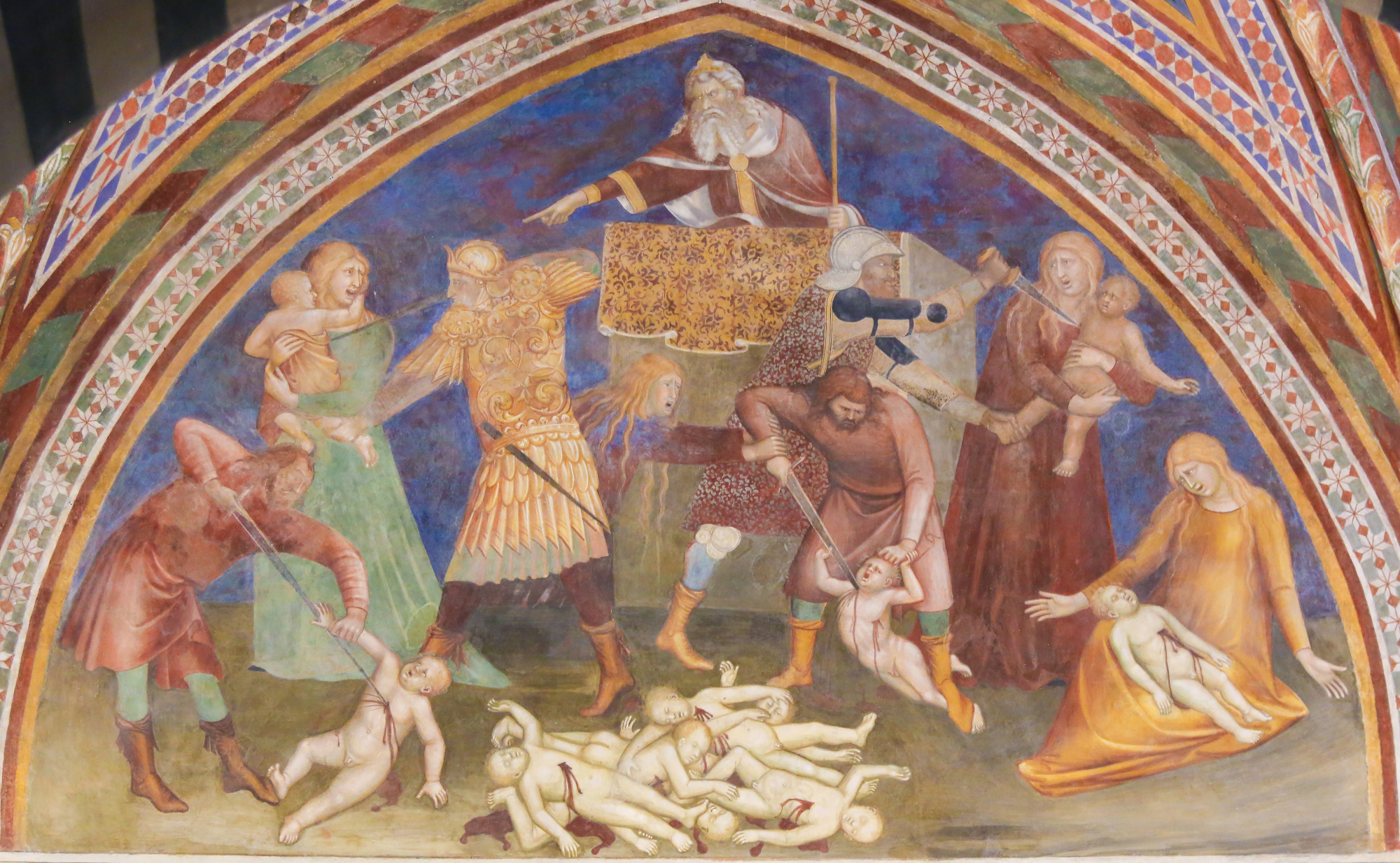
LOOK: Massacre of the Innocents by Lippo Memmi (attrib.)

Memmi, Lippo_Massacre of the Innocents
Attributed to Lippo Memmi (Italian, ca. 1291–1356), Massacre of the Innocents, ca. 1335–45. Fresco, Collegiate Church of San Gimignano, Italy.

In the Collegiate Church of San Gimignano, this scene is part of a narrative cycle on Christ’s infancy in six upper bays, comprising also the Annunciation, the Nativity and Adoration of the Shepherds, the Adoration of the Magi, the Presentation in the Temple, and the Flight to Egypt.

LISTEN: “And Herod Rages On” | Words by Kate Bluett, 2020 | Music by Elise Massa, 2020 | Performed by Elise Massa

The streets ran red in Bethlehem;
our little boys were gone
when soldiers came on Herod’s whim,
but Herod rages on.
No newborn king his light should dim;
he’d be the only dawn,
sent men to tear them limb from limb—
and Herod rages on.

Two thousand years, all filled with births
and stained as red as dawn
by blood that soaks the thirsty earth,
still Herod rages on.
And what is all this bloodshed worth,
our sons and daughters gone,
but barren fields and empty hearths,
while Herod rages on?

Dear infant Christ in Joseph’s arms,
escaped before the dawn,
O come and heal how we’ve been harmed,
for Herod rages on.
The sirens shriek, deep fear alarms;
when will you make them gone?
Or must we wait ’til hate’s disarmed?
For Herod rages on.

The stones that wept in Abel’s gore
cry out with every dawn
’til swords are laid down evermore,
while Herod rages on.
Someday he’ll fall to rise no more;
someday he will be gone.
Our hearts ’til then are bleeding sore,
and Herod rages on.

This song by Kate Bluett and Elise Massa views Herod as representative of any political leader whose policymaking or direct command threatens the lives of innocent children today. Lord, have mercy.


This post is part of a daily Christmas series that goes through January 6. View all the posts here, and the accompanying Spotify playlist here.

The Reproaches: A divine lament for Good Friday

O my people, what have I done to you?
In what have I wearied you? Answer me!

—Micah 6:3

The Reproaches (Latin: Improperia), also known by the first phrase of their refrain, “Popule meus” (O My People), are a series of antiphons and responses used in Good Friday liturgies across all three branches of Christianity. The text contrasts Old Testament stories of God’s goodness with humanity’s enactment of evil against God’s Son. Whereas God graciously delivered his people from death time and again throughout history, they delivered his Son to death—death on a cross. Thus God reproaches us, his beloved ones, for our fatal rejection of Christ, his greatest gift, lamenting that we have spurned his love.

The lyrics are reproduced below (the side-by-side formatting with English translation on the right is best viewed on a computer screen), followed by four musical settings, chosen from among dozens. In the present Roman Rite, the roman-style text is sung by a cantor and the italicized text by a choir, and the lines of the Trisagion (“Thrice Holy”), the ancient hymn that follows the first improperium, are sung by two halves of a choir in alternation—the first singing in Greek, the second in Latin. Composers working outside that context, however, may assign the sections differently.

(Related post: “Blood and Tears”)

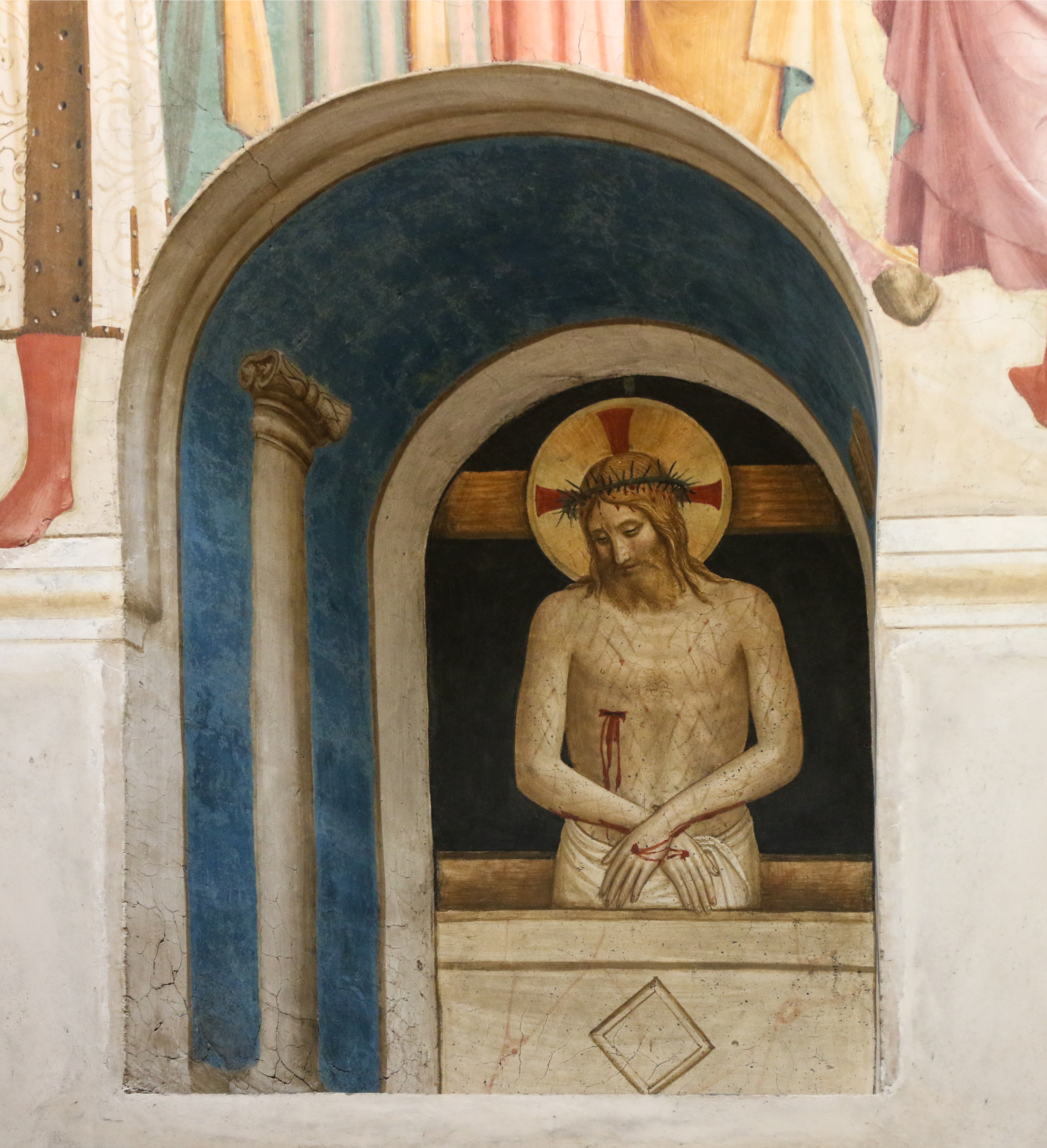
Fra Angelico_Man of Sorrows
Fra Angelico (Italian, ca. 1395–1455), Man of Sorrows, ca. 1440. Fresco, Cell 39, Convent of San Marco, Florence. Photo: Fr. Lawrence Lew, OP.

Popule meus, quid feci tibi?
Aut in quo contristavi te?
Responde mihi.

Quia eduxi te de terra Aegypti:
parasti Crucem Salvatori tuo.

   Hagios o Theos.
      Sanctus Deus.
   Hagios Ischyros.
      Sanctus fortis.
   Hagios Athanatos, eleison himas.
      Sanctus immortalis, miserere nobis.

Quia eduxi te per desertum quadraginta annis:
et manna cibavi te, et introduxi te in terram satis bonam:
parasti Crucem Salvatori tuo.
Hagios . . .

Quid ultra debui facere tibi, et non feci?
Ego quidem plantavi te vineam meam speciosissimam:
et tu facta es mihi nimis amara:
aceto namque sitim meam potasti:
et lancea perforasti latus Salvatori tuo.
Hagios . . .

Ego propter te flagellavi Aegyptum cum primogenitis suis:
et tu me flagellatum tradidisti.
Popule meus . . .

Ego te eduxi de Aegypto, demerso Pharone in mare Rubrum:
et tu me tradidisti principibus sacerdotum.
Popule meus . . .

Ego ante te aperui mare:
et tu aperuisti lancea latus meum.
Popule meus . . .

Ego ante te praeivi in columna nubis:
et tu me duxisti ad praetorium Pilati.
Popule meus . . .

Ego te pavi manna in desertum:
et tu me cedisti alapis et flagellis.
Popule meus . . .

Ego te potavi aqua salutis de petra:
et tu me potasti felle et aceto.
Popule meus . . .

Ego propter te Chananeorum reges percussi:
et tu percussisti arundine caput meum.
Popule meus . . .

Ego dedi tibi sceptrum regale:
et tu dedisti capiti meo spineam coronam.
Popule meus . . .

Ego te exaltavi magna virtute:
et tu me suspendisti in patibulo crucis.
Popule meus . . .
O my people, what have I done to thee?
Or how have I offended thee?
Answer me.

Because I led thee out of the land of Egypt:
thou hast prepared a cross for thy Savior.

O holy God!
O holy God!
O holy strong One!
O holy strong One!
O holy and immortal, have mercy upon us.

Because I led thee through the desert for forty years:
and fed thee with manna, and brought thee into a land exceeding good:
thou hast prepared a cross for thy Savior.
O holy God! . . .

What more ought I to have done for thee, that I have not done?
I planted thee, indeed, my most beautiful vineyard:
and thou hast become exceeding bitter to me:
for in my thirst thou gavest me vinegar to drink:
and with a spear thou hast pierced the side of thy Savior.
O holy God! . . .

For thy sake I scourged the firstborn of Egypt:
Thou hast given me up to be scourged.
O my people . . .

I led thee out of Egypt, having drowned Pharaoh in the Red Sea:
and thou hast delivered me to the chief priests.
O my people . . .

I opened the sea before thee:
and thou hast opened my side with a spear.
O my people . . .

I went before thee in a pillar of cloud:
and thou hast led me to the judgment hall of Pilate.
O my people . . .

I fed thee with manna in the desert:
and thou hast assaulted me with blows and scourges.
O my people . . .

I gave thee the water of salvation from the rock:
and thou hast given me gall and vinegar to drink.
O my people . . .

For thy sake I struck the kings of the Canaanites:
and thou hast struck my head with a reed.
O my people . . .

I gave thee a royal scepter:
and thou hast given a crown of thorns for my head.
O my people . . .

I exalted thee with great strength:
and thou hast hanged me on the gibbet of the cross.
O my people . . .

1. “Popule meus” by Tomás Luis de Victoria (1585)

First up, a traditional setting of the Latin by the Spanish Renaissance composer Tomás Luis de Victoria (ca. 1548–1611) [previously], performed by Ensemble Invocatio under the direction of Daniel Knaggs in 2022 at Seminary Church in Warsaw, Poland. The soloist is Łukasz Dziuba. This four-part motet is the most widely performed setting of the Reproaches.

2. “The Reproaches” by John Sanders (1984)

This setting in English by the British composer John Sanders (1933–2003) has become standard repertoire for many English cathedral and church choirs. Sanders first wrote it in 1984 for a Good Friday service at Gloucester Cathedral, where he served as organist, but it wasn’t published until 1993. It’s performed here by the Ely Cathedral Choir, conducted by Sarah MacDonald, from 2018. Whereas Victoria scored his setting for four voices (SATB), Sanders scored his for eight (SSAATTBB), creating more complex harmonies, including dissonance.

3. “Popule meus” by Filipe Faria and Sérgio Peixoto (2015)

In 1999 Portuguese composers Filipe Faria (b. 1976) and Sérgio Peixoto (b. 1974) founded Sete Lágrimas ECMC (Early and Contemporary Music Consort) to create dialogues between medieval, Renaissance, and early Baroque music on the one hand and contemporary music on the other. Their “Popule meus,” which includes just the opening refrain, is from their Missa Mínima, a minimalistic setting for two voices and recorder of the five parts of the Catholic Mass, along with other important liturgical texts. They began composing it in 1999, put it on the back burner for a while, and returned to it later, completing it in 2015. In this 2016 recording, the singers are Faria and Peixoto. The melodic embellishment on the syllable -sta in contristavi (literally “saddened” but more often translated in this song as “offended” or “distressed”) creates a tense quivering effect, a climax before the languid return to the title phrase and a petering off with “Responde mihi.”

4. “The Reproaches” by Paul Zach (2021)

American singer-songwriter Paul Zach wrote this condensed version of the Reproaches with frequent collaborator Kate Bluett [previously], which puts the words in the voice of the people, who assume and repent of their responsibility for Jesus’s death—for no matter our temporal or geographical proximity to the event, it was our sin that led him to and held him on the cross. Transferring the speaker from God to the Christian for the whole duration helps make the song more suitable for congregational singing, as it can then function as a corporate confession.

You delivered us from Pharaoh;
We delivered you to death.
You gave manna in the desert;
We gave a crown of thorns for your head.

You brought us out of slavery
Into the promised land;
We brought you up to Calvary
And pierced your feet and hands.

Holy God, Holy Mighty One,
Holy Immortal One,
Have mercy, mercy,
Have mercy on us.

You opened up the Red Sea;
We opened up your side.
“Come down, come down,” we mocked you;
“My God, my God,” you cried.

Holy God, Holy Mighty One,
Holy Immortal One,
Have mercy, mercy,
Have mercy on us.

Zach told me he’s not fully satisfied with the song and is working on a rewrite that he may release in 2024. Nonetheless, I really like what he and Bluett have created here! And I appreciate how it brings the Reproaches into an indie-folk idiom, making that long-standing sung portion of the global church’s Good Friday liturgy accessible to those who find it difficult to connect with choral music or chant.

Addendum, 3/21/23: Rev. Bill Combs from Greensboro, Georgia, has just reminded me of a contemporary adaptation of the text of the Reproaches by Janet Morley, a liturgist from the UK. It’s from her wonderful collection All Desires Known, a resource for public worship and private devotion, and can be read here. Combs’s church, Episcopal Church of the Redeemer, chants this text as part of their annual Good Friday service using Tone II.1.

Christmas, Day 6: Black-Haired Boy

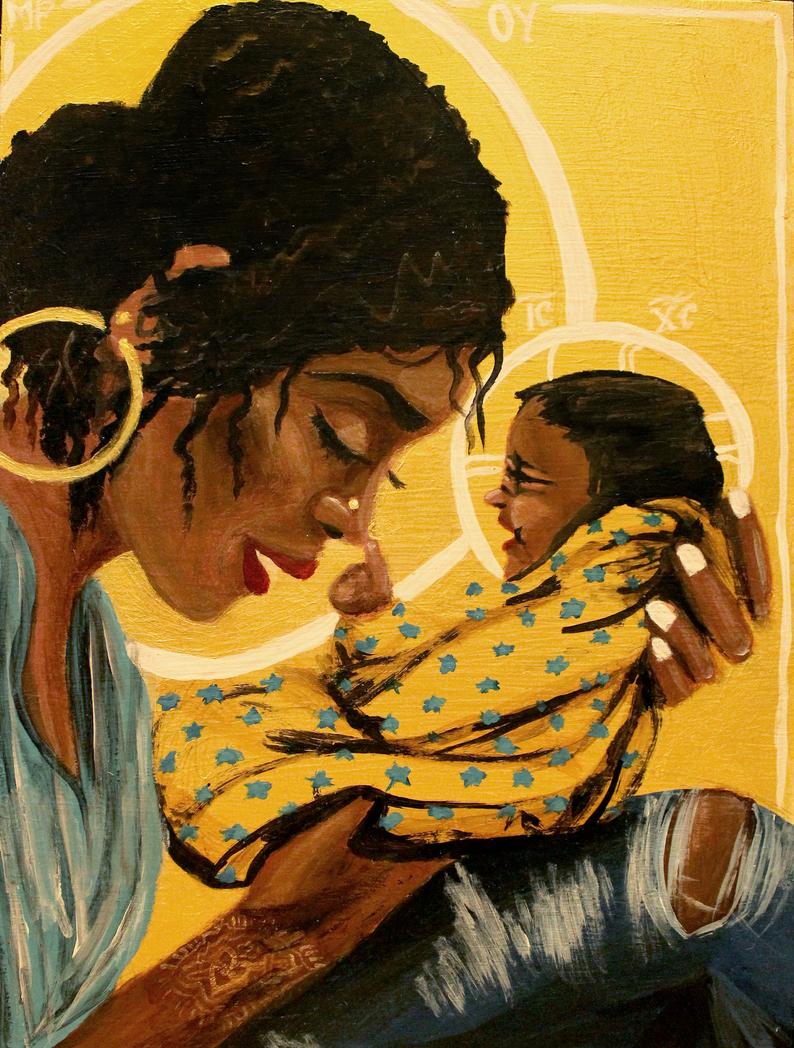
LOOK: Madonna and Child by Gracie Morbitzer

Morbitzer, Gracie_Madonna and Child
Gracie Morbitzer (American, 1997–), Madonna and Child, 2018. Acrylic on repurposed wood, 14 × 12 in. Private collection.

Gracie Morbitzer is a Catholic artist from Columbus, Ohio, who paints biblical and extrabiblical saints as modern, everyday people in a range of skin tones, forgoing the hieratic style of traditional icons in favor of a more relatable, this-worldly look that enables the individuals’ distinctive personalities to shine through. She uses discarded or thrifted pieces of wood as her substrate, welcoming cracks and imperfections as only further reiterating how the extraordinary shines through the ordinary.

In her Madonna and Child, Mary props up her newborn on her knees, basking in her new role as mother. She wears frayed jeans, a loose blouse, gold hoop earrings, and a nose stud. On her wrist is a henna tattoo of her Immaculate Heart—a burning, bloodied heart pierced with a sword and banded with roses, representing the intensity and purity of her love and the suffering that Simeon prophesies.

Jesus, wrapped in a starry blanket and donning a cruciform halo, playfully touches Mom’s nose, crinkling his face as he giggles with delight.

The yellow acrylic background recalls the gold leafing of icons, used to suggest the transfiguring light of God. Morbitzer also uses the traditional Greek abbreviations for the Mother of God (MP OY) and Jesus Christ (IC XC).

This image can be purchased as a 5 × 7-inch print at The Modern Saints Etsy shop.

LISTEN: “Mary’s Lullaby (Black Haired Boy)” | Words by Kate Bluett | Music by Paul Zach | Sung by Liz Vice on Advent Songs by The Porter’s Gate (2021)

Oh, black-haired boy, your eyes are dark
as midnight lit by shining stars
and bright as love that filled my heart
when first I looked at you.
Your skin is brown as pilgrim roads,
laid straight through fragrant olive woods,
as brown as mine, and I’m in awe
each time I look at you.

You made the ox and lamb, my love,
and shaped the wings of turtledoves.
You wrote the hidden secrets of
the world I’ll show to you.
Within my body you took form
and wailed aloud when you were born—
the moment that my heart was torn
with love I’ll show to you.

You wove these wonders through the earth;
you made them all and gave them worth,
and now you join them in your birth,
and I’ll give them to you.
I’ll show you skies filled up with stars
and teach you words for light and dark,
for all the wondrous things there are:
I’ll give them all to you.

I’ll hold you closely as I can
and watch you grow into a man.
As long as I can hold your hand,
I’ll walk the world with you.
And you’ll lead me to God’s own heart,
where all these wonders have their start.
But here within the stable dark,
I’ll be the world for you.

Since the Middle Ages, Christians have written lullabies in the voice of Mary, imagining her rocking her infant son to sleep, sharing with him her most tender feelings and wishes. This contemporary one by frequent songwriting collaborators Kate Bluett and Paul Zach—so poignantly sung by Liz Vice—is among my favorites.

In the first stanza Mary dotes poetically on Jesus’s features—his eyes dark and bright as star-studded midnight skies, his skin brown as the footpaths to Zion. In the remaining stanzas she marvels at how the Creator of the universe lies as a babe in her arms, and how she will get to experience its many wonders with him at her side, discover its secrets together. Jesus made the world in which she lives and moves and has her being, but now, while he is small, vulnerable, and dependent, she’ll be a whole world to him, as mothers are to their children.

Psalm 91: Fifteen musical versions

Psalm 91 (Psalm 90 in the Vulgate) is a psalm of protection, commonly invoked in times of hardship or before embarking on a journey. It conveys the sheltering presence of God, using the metaphor, tender and intimate, of a mother bird who cares for her fledglings, shading them under her wings and lifting them up out of danger. This image recurs throughout the Psalter and the Bible at large (see Pss. 17:8; 36:7; 57:1; 63:7; Exod. 19:4; Deut. 32:11).

Pelton, Agnes_The Primal Wing
Agnes Pelton (American, 1881–1961), The Primal Wing, 1933. Oil on canvas, 25 × 24 in. San Diego Museum of Art, California. Source: Agnes Pelton: Desert Transcendentalist, p. 113.

Let me quote the psalm in full, using the King James Version, whose poetic quality cannot be beat:

1 He that dwelleth in the secret place of the most High shall abide under the shadow of the Almighty.

2 I will say of the Lord, He is my refuge and my fortress: my God; in him will I trust.

3 Surely he shall deliver thee from the snare of the fowler, and from the noisome pestilence.

4 He shall cover thee with his feathers, and under his wings shalt thou trust: his truth shall be thy shield and buckler.

5 Thou shalt not be afraid for the terror by night; nor for the arrow that flieth by day;

6 Nor for the pestilence that walketh in darkness; nor for the destruction that wasteth at noonday.

7 A thousand shall fall at thy side, and ten thousand at thy right hand; but it shall not come nigh thee.

8 Only with thine eyes shalt thou behold and see the reward of the wicked.

9 Because thou hast made the Lord, which is my refuge, even the most High, thy habitation;

10 There shall no evil befall thee, neither shall any plague come nigh thy dwelling.

11 For he shall give his angels charge over thee, to keep thee in all thy ways.

12 They shall bear thee up in their hands, lest thou dash thy foot against a stone.

13 Thou shalt tread upon the lion and adder: the young lion and the dragon shalt thou trample under feet.

14 Because he hath set his love upon me, therefore will I deliver him: I will set him on high, because he hath known my name.

15 He shall call upon me, and I will answer him: I will be with him in trouble; I will deliver him, and honour him.

16 With long life will I satisfy him, and shew him my salvation.

The righteous will be protected, sings the psalmist, from sickness and attack, whether by arrow or by wild animal. Because of the psalm’s specific mention of plagues, or “deadly disease,” it became especially popular during the COVID-19 pandemic.

Now, we know from experience that some of these statements cannot be taken at face value. Physical harm does befall those who love God. Believers were among the “ten thousand” (and more) felled by the most recent raging pestilence. It’s wrong to conclude that this was a result of their lack of faith.

Biblical scholar J. Alec Motyer clarifies that “the promise [in Psalm 91] is not security from but security in.” That God looks after us is an absolute principle, but the Bible makes clear that no one is immune from suffering. Still, we can trust in God’s grace and strength and ultimate deliverance, and entreat him for specific protections. Bodily salvation won’t come in full until the new heavens and the new earth are ushered in, but we are kept spiritually in the shelter of our loving God.

That doesn’t mean Psalm 91 is a lie; it is poetry, and poetic language is often not meant to be literal. The assurances are still worth praying. God does often intervene on our behalf.

The ancient Jewish community at Qumran near the Dead Sea, through whom the oldest manuscript fragments of the Hebrew Bible come to us, referred to Psalm 91 as a “psalm against demons,” and it is thought to have been used by that community in exorcisms. Jewish midrash interprets many of the listed threats as veiled language for demons, and there is Christian precedent for that interpretation as well. In Luke 10:17, Jesus’s followers marvel that “Lord, in your name even the demons submit to us!,” to which Jesus affirms that yes, “I have given you authority to tread on snakes and scorpions and over all the power of the enemy, and nothing will hurt you”—language very similar to that in Psalm 91.

In the Late Antique era, both Jews and Christians wore the words of Psalm 91 on amulets, to attain or simply feel God’s guarding power. In the church it is traditionally sung or recited during Compline services and on the first Sunday of Lent (in Matthew 4:6 the devil manipulatively quotes verse 11 in his temptation of Christ in the desert).

This psalm has also influenced popular culture, as from it comes the concept of guardian angels (vv. 11–12).

Below I have selected fifteen musical settings or adaptations of Psalm 91 from diverse sources, including homophonic and polyphonic choral works, songs in indie folk and soul styles, a Puerto Rican hymn, a Nepali bhajan, and more.

For each I have embedded either a YouTube video or Bandcamp track, and if a Spotify link exists, I’ve included it at the end of the description. If you cannot see these music players in your email client or RSS feed reader, open the post in your browser.

This is a curation, not a collation, meaning that I’ve intentionally picked these songs from among hundreds of options, for both excellence and variety. I tried to limit the list to ten and just couldn’t, but I thought twenty would be too overwhelming, so I compromised by choosing fifteen with five honorable mentions. I’ve added almost all twenty to a YouTube playlist (the Sister Sinjin song isn’t available on that platform), if you prefer to listen that way.

1. Gregorian chant performed by Harpa Dei: Born in Germany and raised in Ecuador, siblings Nikolai, Lucía, Marie-Elisée, and Mirjana Gerstner form the sacred vocal quartet Harpa Dei. Here they sing Psalm 91 in Latin in the medieval plainchant tradition. Subtitles are provided in Spanish and English.

For a plainchant in English, albeit of verses 4–5 only, see here.

2. “Psalm 91” by Victory Boyd: This is probably my favorite of all the selections. Victory Boyd is one of seven musical siblings, and before she started her solo career, she was a member of the vocal-harmony sibling act Infinity Song. Her voice is gorgeous, as is this simple musical setting she wrote, conveying both the vulnerability and confidence present in the psalm.

3. “Psalm 91” by Poor Bishop Hooper: Every Wednesday since January 1, 2020, married couple Jesse and Leah Roberts, who record music under the alias Poor Bishop Hooper, have been releasing a new psalm-based song for free download as part of their EveryPsalm project. Handling them consecutively, they have just eight left to go! They made a live video for “Psalm 91,” which shows them playing their own piano four hands accompaniment. [Spotify]

4. “Qui habitat in adjutorio altissimi” (He who dwells in the shelter of the Most High) by Josquin des Prez, adapted by Laurel MacDonald: Josquin des Prez (pronounced “joss-can day pray”) was a highly influential Franco-Flemish composer of the High Renaissance. In 1542 he wrote a setting of Psalm 91[90]:1–8 in Latin for twenty-four voices (SATB ×6)—that is, six distinct soprano parts, six distinct alto parts, etc.

Inspired by this choral motet, in 2007 composer and video artist Laurel MacDonald worked with longtime associate John Oswald to create qui, a sound installation of twenty-nine voices singing an adaptation of des Prez’s “Qui habitat” in twenty-nine languages over twenty-nine speakers, for the Royal Ontario Museum in Toronto. MacDonald revisited the project in 2010, creating the short video “XXIX” (below) with twenty-one of the original qui singers, each singing in the language of his or her personal heritage. They weave a complex tapestry with interlocking threads of Krio, Spanish, Korean, Hungarian, Hindi, Greek, Finnish, English, French, Italian, Latin, Zulu, Xhosa, Sesotho, Georgian, Russian, English, Tamil, Hebrew, Swahili, Japanese, and Arabic—a multilingual declaration of God’s protective power.

To hear Josquin des Prez’s motet as originally conceived, click here.

5. “Your Wings” by Lauren Daigle: Lauren Daigle is one of the most popular CCM (contemporary Christian music) artists of the past decade. Two-time-Grammy-winning and with two platinum records, she is often compared to Adele in terms of her vocal style—soulful, rich, in a husky register. In April 2020 she released on YouTube a stripped-down, “social distancing” version of her Psalm 91–based song (written with Jason Ingram and Paul Mabury) from Look Up Child, with just her and a piano. You can get a sense of her strong stage presence from the video; here she hits the melody with both her voice and her body—bouncy on the verses, smooth on the refrain! [Spotify (studio version)]

6. “Whomsoever Dwells” by Sinéad O’Connor: “Whomsoever Dwells,” written with Ron Tomlinson, is one of nine Hebrew Bible–based songs that appears on Sinéad O’Connor’s stellar 2007 double album, Theology. (Thanks to Art & Theology reader Koen Desmecht for introducing me to this!) The acoustic performance below—from November 8, 2006, at The Sugar Club in Dublin—was released on disc one, subtitled “The Dublin Sessions,” and features guitars, fiddle, harp, and low whistle; the same song, arranged for a pop-rock band and recorded in a London studio, is on disc two. (I much prefer the acoustic version.)

Theology is an attempt to create a place of peace in a time of war and to provoke thought,” O’Connor said. It is very “personal” and “emotional.”

7. “El que habita al abrigo de Dios” (Those Who Dwell in the Shelter of God) by Luz Ester Ríos de Cuna and Rafael Cuna: This 1943 hymn from Puerto Rico is a versification of Psalm 91 in Spanish by Luz Ester Ríos de Cuna, with music by her husband, Rafael Cuna (1907–1995). I learned of it from the bilingual hymnal Santo Santo Santo: Cantos para el pueblo de Dios (Holy, Holy, Holy: Songs for the People of God). Here it’s performed by musicians from Iglesia Central del Movimiento Misionero Mundial en el Perú (Central Church of the World Missionary Movement in Peru) in Lima. Their names are not given.

8. “Denn er hat seinen Engeln befohlen” (For he shall give his angels charge), MWV B 53 by Felix Mendelssohn: Early Romantic composer Felix Mendelssohn, a Reformed Christian with Jewish ancestry, wrote this setting of Psalm 91:11–12 in German in 1844 for Berlin Cathedral, where he was serving as Generalmusikdirektor (royal composer of church music). It is for an unaccompanied eight-part choir, but he later reused it with orchestral accompaniment as movement 7 of his oratorio Elijah.

9. “No Harm Befall You (Psalm 91)” by Sister Sinjin: Released on the 2022 compilation album Joy to the World (Psalms 90–​106) from Cardiphonia Music, “No Harm Befall You” was written by Elizabeth Duffy and is sung by her and Kaitlyn Ferry, who make up the Indianapolis folk duo Sister Sinjin. Their harmonies are a hallmark of their music.

10. “Psalm 91” by Sharyn: Sharyn (pronounced “sha-REEN”) is a Ugandan-born, London-based gospel/R&B singer-songwriter “whose mission is to spread the gospel through adventurous, original, and engaging music,” she says. She wrote “Psalm 91” during the height of the coronavirus, as that scripture passage is one she would read again and again as a source of comfort amid the uncertainty. “This song is an affirmation and a reminder of who God is, what He can do, will do and has done,” she says. “Never forget that God is faithful and his promises are the greatest form of protection we can ever have. His promises are your armor and shield.” The recording features Calibleubird on backing vocals. [Spotify]

11. “Shelter Me” by Buddy Miller: In a 2010 episode of PBS’s Soundstage, country-rock artist Buddy Miller performed a set with other Americana greats Emmylou Harris, Shawn Colvin, and Patty Griffin, including this original song (written with Julie Miller) from his 2004 album Universal United House of Prayer. “Shelter Me” is about not being scared in the face of disaster or war, for God is our hiding place. The song could apply to Psalm 57 just as well, which addresses the same themes as Psalm 91 and even uses the same language of sheltering under the wings of the Almighty. [Spotify (studio version)]

12. “Underneath the Shadow” by Tom Wuest: This is one of twelve quiet, sparsely instrumented songs that Tom Wuest recorded with his wife, Karen, which were written as their two young sons fell asleep. They all “draw their lyrics from the psalms and from our family’s joy in and meditation upon the good creation of God,” he says. Fitting indeed for meditation, “Underneath the Shadow” comprises just three simple lines: “Underneath the shadow of Your wings / We dwell underneath the shadow of Your wings / Hidden close to Thee, we find rest.” [Spotify]

13. “Mero Saransthaan (My Shelter)” by Suraj Khadka: A Nepali adaptation of Psalm 91, this bhajan (devotional song) from 2021 features traditional instruments from the Indian subcontinent: sarangi (vertical fiddle), bansuri (bamboo flute), and dholak, madal, and tabla (drums). Thanks to Dr. Paul Neeley at Global Christian Worship for alerting me to this one.

14. “Lang en gelukkig (Psalm 91)” (Long and Happy) by Psalmen voor Nu: Founded in 2002, Psalmen voor Nu (Psalms for Now) was a project in the Netherlands to set all 149 psalms (they combined Psalms 42 and 43) in Dutch to music, a task they completed in 2014 with the release of their eleventh album. Seeking “to introduce as many people as possible to the beauty and power of the psalms,” the team comprised some twenty theologians, poets, and composers, plus a band. They wanted the texts to be understandable and the melodies modern and singable. This particular song from the project was written by Liesbeth Goedbloed (words) and Roeland Smith (music) and released in 2013. It has a smoky nightclub vibe. I’ve copied the lyrics below. [Spotify]

[1] Als je bij de Allerhoogste woont, mag je in zijn schaduw slapen.
Als je zegt: ‘De Hoogste is mijn huis. mijn God, ik kan op u vertrouwen’,
dan mag je in zijn schaduw slapen.

[2] Het is God die jou bevrijdt van de dood, de zwarte dood.
Hij dekt je met zijn vleugels toe. Ga maar slapen. Je bent moe.
Zijn trouw zal jou beschermen. Dan kun je slapen, dan kun je slapen.
God waakt over jou. Dan kun je slapen.

[3] Voor de angst die elke avond komt, hoef je niet meer bang te wezen,
ook al spookt de zwarte dood weer rond, al sloopt een ziekte alle mensen,
jij hoeft niet meer bang te wezen.

[4] Ook al komt de dood dichtbij, vallen duizend mensen om,
toch zul jij altijd veilig zijn wat de rest ook overkomt
en slechte mensen krijgen, durf je te kijken, durf je te kijken?
hun verdiende loon. Durf je te kijken?

[5] Jij zei ooit: ‘Mijn God, u bent mijn huis. Geen ziekte komt de drempel over.’
Die ellende gaat je deur voorbij, sinds je dicht bij God ging wonen.
Geen ziekte komt je drempel over.

[6] Zijn engelen staan klaar. Ze dragen je op handen.
God stuurt ze met je mee.
Je stoot je nergens aan. De leeuw, de draak, de adder
jij loopt over ze heen.

[7] Want je houdt van mij, zegt God, en die liefde maakt je vrij.
Ik dek je met mijn vleugels toe, omdat jij weet wie ik ben.
Je kent mijn naam en roept me. Ik kom je redden, ik kom je redden.
En ik antwoord jou: ik kom je redden.

[8] In de zwartste nacht blijft ik bij jou. Ik red je en ik geef je leven.
Deze keer is alle eer voor jou. Ik zeg: Ik ben voor jou een zegen!
Voor jou een lang gelukkig leven!

[Outro] Lang en gelukkig, lang zul je leven, lang zul je leven,
lang en gelukkig, lang zul je le ven! [source]

15. “In Him I Will Trust” by Sherri Youngward: Covering Psalm 91:1–5, this is one of sixteen psalm-passage settings by Bay Area singer-songwriter Sherri Youngward. For more, see her two Scripture Songs albums.

HONORABLE MENTIONS: “Your Wings” by Kate Bluett and Keiko Ying; “Scapulis suis” by Giovanni Pierluigi da Palestrina; “Psalm 91” by John Michael Talbot; “Under Your Wings” by Freddie Fardon (feat. Darla Baltazar); “Psalm 91” by Jonathan Ogden

If you appreciated this post and would like to see more like it in the future, please consider donating to my work. If you do, leave a note telling me which psalm you’d like me to do next!