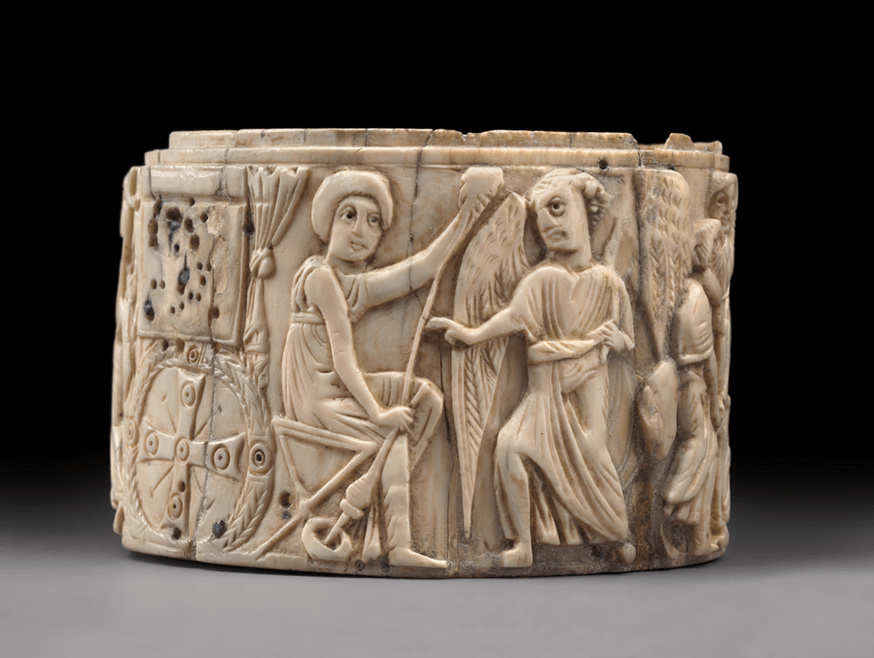
Pyxis with the Annunciation, Byzantine Empire (Minden?), 5th or 6th century. Ivory, height 7.9 cm, diameter 11.8 cm. Museum für Byzantinische Kunst, Bode-Museum, Staatliche Museen zu Berlin. [object record]
According to the Protoevangelium of James, an apocryphal infancy gospel from the second century, the Virgin Mary was raised in the Jerusalem temple from age three and was tasked with weaving the purple and scarlet thread of the veil that shrouded the holy of holies, the temple’s innermost sanctuary. One day while taking a break from this sacred labor to collect water from a well, the angel Gabriel approached her with a greeting: “Hail, favored one. The Lord is with you.” She looked around and saw no one, so she returned to her work indoors.
As she was engaged in her spinning, Gabriel reappeared and delivered the message he had been sent with: that Mary was chosen to bear the Son of God.
This account of the Annunciation gained special traction in the East, where the Virgin Annunciate is almost always shown with a spindle of scarlet thread in her hand, or less frequently, standing at a well—unlike in Western depictions, where she is typically shown holding a book.
The Byzantine art object pictured above is an ivory-carved pyxis (pl. pyxides), a cylindrical container used to store small items, such as jewelry or cosmetics. The Annunciation is one of three scenes represented, the other two being the Journey to Bethlehem and the Nativity (including Salome with her withered hand; see Prot. 19–20). The square to Mary’s left is where the lock case was originally mounted.
In the early fifth century, the prominent Byzantine theologian Proclus of Constantinople (ca. 390–446) developed Mary’s weaving into an extended theological metaphor of the Incarnation. He preached on Mary’s womb as a “workshop” containing the “awesome loom of the divine economy” on which the flesh of God was woven together, providing the bodiless divinity with form and texture. [1] “In the workshop of Mary’s womb, the vertical warp thread of divinity was bound to a weft of virgin flesh,” writes Fr. Maximos Constas (b. 1961), paraphrasing Proclus. [2]
Jesus’s flesh is a kind of clothing—the same we wear—made during Mary’s nine months of pregnancy:
The one who redeemed us was not a mere man. May this never be! But neither was he God denuded of humanity, for he had a body. And if he had not clothed himself with me, he could not have saved me, but in the womb of a virgin the one who pronounced the sentence against Adam clothed himself with me, who stood condemned, and there in her womb was transacted that awesome exchange, for taking my flesh, he gave me his spirit. [3]
Notes:
Nicholas Constas, “The Purple Thread and the Veil of Flesh: Symbols of Weaving in the Sermons of Proclus,” chap. 6 of Proclus of Constantinople and the Cult of the Virgin in Late Antiquity (Leiden and Boston: Brill, 2003), 317. The quotations are from Proclus’s Homily 1.I.21–25.
Constas, 357.
Proclus of Constantinople, Homily 1.VIII.122–27, qtd. Constas, 354.
I’m spinning the scarlet and purple—woman’s work But God is spinning the gold, I see Weaving a tiny thread like me Into the grand design to be The saving of the world
Chosen as the roving fiber—clean and combed Then dropped and spun and quickly wound Upon the spindle tightly bound To serve the One I’m wound around: The Savior of the world
Refrain: Son of the Most High, let it be, let it be Son of God, let it be, let it be to me
In the hands of the Master, I marvel at his ways He brings me into his weaving room My heart is stretched upon the loom The God-man knitted within my womb The Savior of the world [Refrain]
Bridge: First to hear, first to hear and believe First to love, first to love and receive The Son of God
Will they believe me? I wonder, who can say? But I will always answer yes Though a sword may pierce my breast The Father of my son knows best The Savior of the world [Refrain]
In “The Virgin, Spinning,” singer-songwriter Katy Wehr takes the weaving metaphor in a different direction than Proclus. Voiced by Mary, the song reflects on how God is weaving a grand tapestry of salvation, in which Mary is a thread.
O set me as a seal upon thy heart O set me as a seal upon thine arm For love is strong, strong as death, my love And jealousy is cruel as the grave
Its flashes are the living flame of a blazing fire That cannot be drowned out in a flood All earthly gold in exchange for love Would be utterly contemptible and scorned
Come, my love Let me hear your voice My companions and I wait in the garden Make haste, my love, and shine out like the rising sun Like a stag appearing on the mountain
After the crucifixion of Jesus, a small group of his female followers purchased spices and prepared them to bring to the tomb to anoint his body on Sunday morning. (Sabbath restrictions prevented them from doing work on Saturday.) This was an act of love and reverence that served the practical function of counteracting the smell of decomposition.
The singer-songwriter Katy Wehr [previously] imagines the women consoling each other by singing excerpts from the Song of Songs as they crushed the myrrh, mixed it with oil, and bottled it up for transport—maybe also as they headed over to the gravesite. Wehr has set to music four of the verses from the book’s final chapter, a setting she says she hopes conveys a tone that is both mournful and hopeful.
The Song of Songs, or Song of Solomon, is an ancient collection of Hebrew love poems that Christians have long read as allegorical of the love between Christ and his bride, the church.
Wehr’s selections comment on the nature of love: it is permanent, strong, passionate, inextinguishable, and priceless. The female speaker in the poem seeks to stamp herself on her lover’s heart like a seal, claiming him as hers. She professes love’s power, which is as severe and enduring as death. In the context of this passage, the word “jealousy” appears to be used in the positive sense to mean zeal or passion—a resolute devotion.
She goes on to describe love as fiery and intense.
It seems her lover has gone out for the day, or gone on a trip, and she calls him back home. She can’t wait to hear his voice again. She waits outside for him in the garden, wishing for him to come bounding back into her arms.
“Make haste, my love, and shine out like the rising sun.” One can imagine the myrrh-bearing women of the Gospels hoping beyond hope that their beloved Jesus would arise, would speak their names once more, would prove that love is indeed stronger than death.
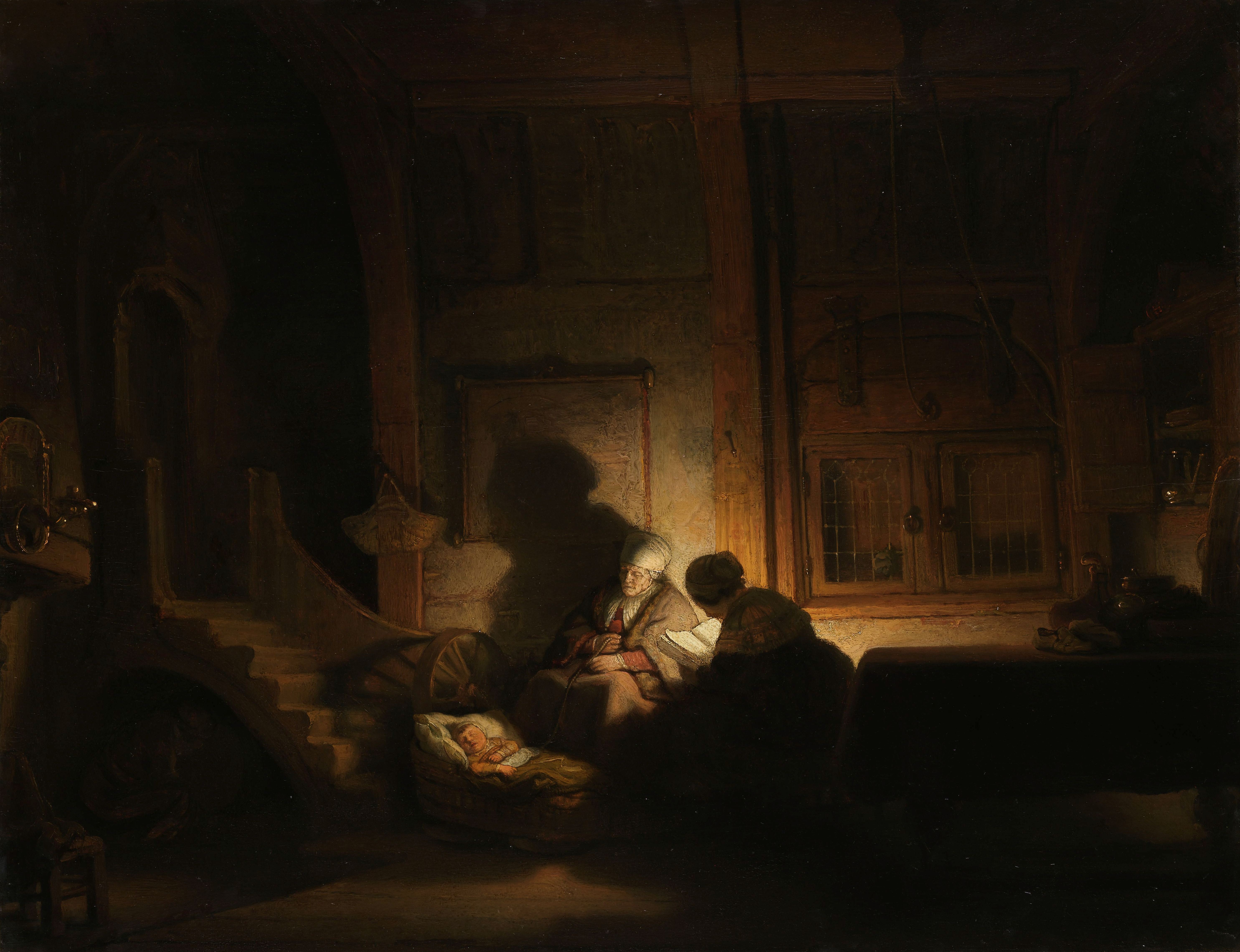
Workshop of Rembrandt van Rijn, Holy Family at Night, ca. 1642–48. Oil on panel, 66.5 × 78 cm. Rijksmuseum, Amsterdam.
During the Dutch Golden Age, the master artist Rembrandt van Rijn (1606–1669) ran a flourishing workshop in Amsterdam, overseeing the production of students’ paintings that continued the deep chiaroscuro and distinctive application of paint seen in his own work.
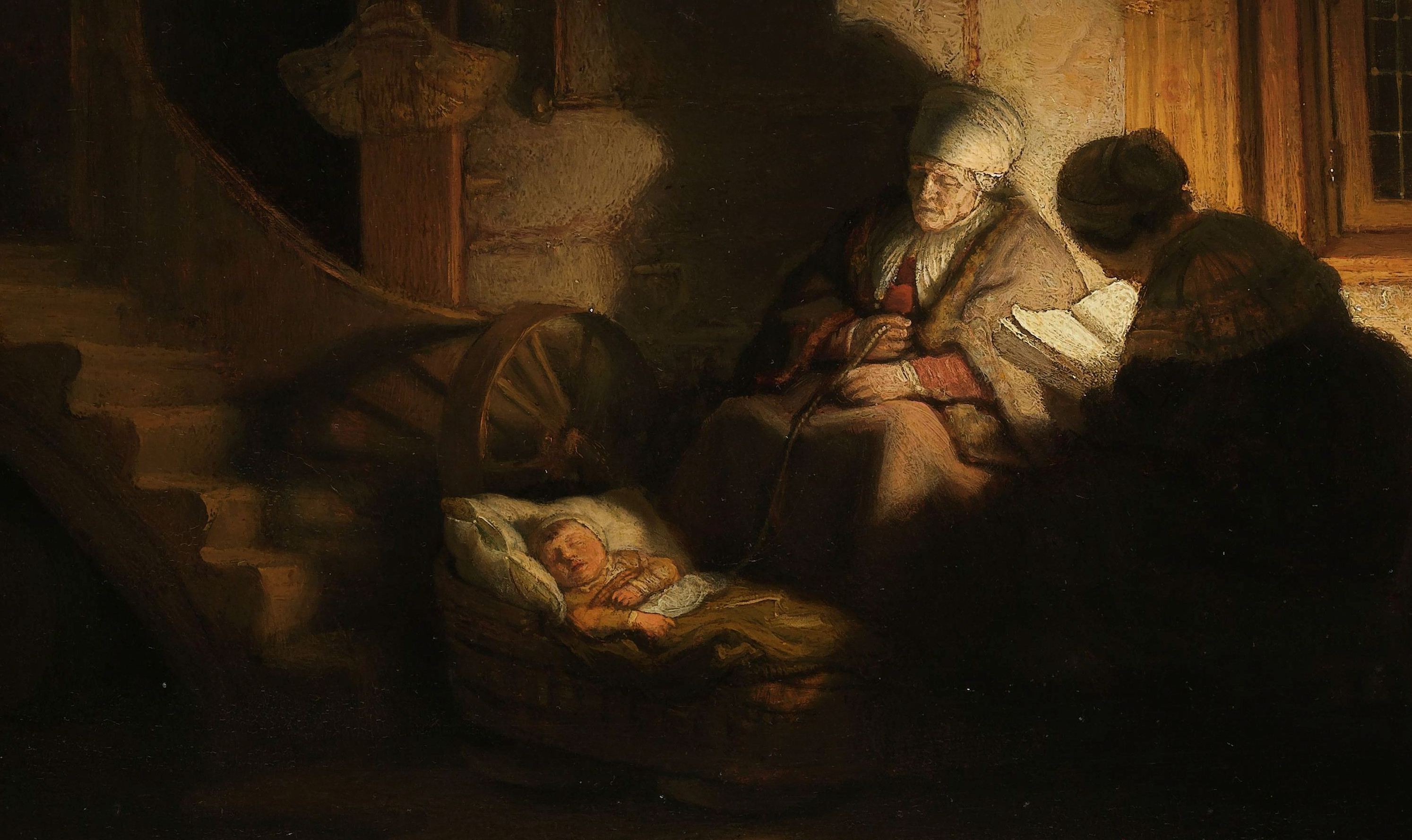
This painting from his workshop shows the Holy Family in a sparsely lit domestic interior at night. The Christ child lies asleep in a wicker cradle at the foot of a half staircase, his grandma Anne likewise nodding off as she rocks him gently with the cradle rope. Relieved by the quiet, Jesus’s mom, Mary, catches up on some reading, and Joseph taps liquid from a barrel on the left under the stairs (he’s very difficult to make out through the shadows).
This lived-in room is full of everyday objects from seventeenth-century Holland. Over the hearth on the left a copper candlestick holder is affixed to the wall. Behind Anne is a map, and beside her a spinning wheel, and a wicker basket hangs from the nail of a curved wooden beam. On the table to the right are a pair of old shoes, a flask attached to a leather belt, and a mortar and pestle, and a Jan Steen jug and other kitchenware are stored in the cupboard above. The shutters are drawn closed over the window. How utterly ordinary!
Although scholarly opinion since 1900 has identified the figures as biblical ones (the title is not the artist’s, as artists did not title their paintings at the time), for much of the painting’s history viewers interpreted it as simply a genre scene—that is, a scene showing regular people going about their daily lives. It lacks the “distinction, nobility, and loftiness” owed to biblical subject matter, it was believed, especially the Holy Family. There are no angels, no haloes. The only hint of sacredness is the pouring of light from a mysterious unknown source.
But the ordinariness of the scene depicted is precisely what makes it so glorious. Jesus was born into a working-class family. For most of his life he labored as a carpenter, adopting Joseph’s trade. He wasn’t surrounded by lavish things. His upbringing looked much like that of all the other Jewish boys in Nazareth. That he was God incarnate would be revealed in time, to those who had eyes to see. But in the meantime, he cooed and pooed and cried and slept and fed and spit up like any other baby! And his mom was exhausted like any other mom, forced to sneak in some time for herself (including private devotional time, as she’s probably reading her Bible here) wherever she could, between childcare, chores, and other obligations.
That God chose to come to us as an ordinary human being born to an ordinary family (albeit conceived in an extraordinary way!) surprised everyone. The song that follows extends the surprise of the Incarnation into God’s other interventions in our lives, on a more personal scale. Just as he defied expectations in his first coming, so he often continues to surprise us in the ways he comes to us now—that is, not according to our own prescriptions, but down his “own secret stair,” when and where we’re least expecting it.
LISTEN: “That Holy Thing” | Words by George MacDonald, 1877 | Music by Katy Wehr, on In Others’ Words, 2008
They all were looking for a king, To slay their foes, and lift them high: Thou cam’st a little baby thing That made a woman cry.
O Son of Man, to right my lot Naught but thy presence can avail; Yet on the road thy wheels are not, Nor on the sea thy sail.
My how or when thou wilt not heed, But come down thine own secret stair, That thou mayst answer all my need, Yea, every bygone prayer.
This song is a setting of a poem written by George MacDonald (1824–1905) in December 1877 and sent by letter to a handful of friends.* When it was first published in 1893 in the two-volume Poetical Works of George MacDonald, it was with this revised final stanza:
My fancied ways why shouldst thou heed? Thou com’st down thine own secret stair; Com’st down to answer all my need, Yea, every bygone prayer!
The poem appears in the highly influential Oxford Book of English Verse (1900), compiled and edited by Arthur Quiller-Couch, but in its original form.
“That holy thing” is a translation of the Greek word hagios, which appears in Gabriel’s speech to Mary in Luke 1:35: “that holy thing which shall be born of thee shall be called the Son of God.” Educator Missy Andrews unpacks the poem:
In “That Holy Thing,” MacDonald meditates on man’s expectations and God’s will. In the first line of the poem, the poet remembers the first-century Jews who suffered under Roman occupation, waiting for the Messiah who would restore the throne of David to Israel. He acknowledges their plight and their expectation, contrasting it with what they in fact received. The baby Christ represented both a gracious answer to their need, and an immediate disappointment. He satisfied the deepest intentions of their prayer and Yahweh’s ancient prophecies, but frustrated their earthy expectations for geographic kingdoms and vindication. Not only that, but the baby King “made a woman cry.” This references not only the immediate suffering and travail of the Christ Child’s mother, Mary, but ultimately the suffering that would rend her heart when He himself was lifted high upon the cross in answer to their desperate prayer for triumph over their foes.
The poet notes that his own travails and petitions, his own desperate need of God’s intervening help, is denied in its immediacy as well. For, although the Son of Man’s own presence alone can help to “right the lot” of the poet, his coming is not visible by road or sea. In this way, MacDonald acknowledges that his own expectations, like those of his spiritual forebears, eclipse his ability to see the Lord’s coming in his own circumstances. He acknowledges the differences between God’s ways and man’s, in faith acknowledging that the Lord answers man in his own ways and times, keeping secret His approach, but stealthily accomplishing man’s every need, answering his every prayer through the mystery of incarnation. This incarnate Child, the Son of Man, replete with humanity and no stranger to suffering, suggests a remedy for all who wait and suffer.
Andrews is a founding director of CenterForLit, whose goal is “to bring readers face to face with the world’s best books so they can know themselves more fully as God’s creatures.” The center has a special emphasis on equipping parents to teach the classics to their kids.
The commentary above is excerpted, with Andrews’s permission, from the first post of twenty-five published in Advent 2015 for the CenterForLit’s “Literary Advent” blog series (which is excellent!). Andrews provides interpretations of poems by John Donne, Madeleine L’Engle, Gerard Manley Hopkins, T. S. Eliot, W. H. Auden, and more, combining literary analysis and theological reflection. You can enjoy Andrews’s series in print form with the book Wild Bells: A Literary Advent.
Kathryn Wehr, PhD, is a singer-songwriter whose most recent album, which leans folk rock in style, is And All the Marys: Women Encountering Christ in the Gospels (2018).
Besides being a musical artist, Wehr is also a scholar whose interests include theology and the arts, spiritual formation, and church history. Her specialization is the religious drama of Dorothy L. Sayers, and as such, she is the editor of the forthcoming book The Man Born to be King, Wade Annotated Edition(IVP Academic, 2023). In addition, she is the managing editor of Logos: A Journal of Catholic Thought and Culture at the Center for Catholic Studies at the University of St. Thomas in Saint Paul, Minnesota.
* Thank you to the Special Collections & University Archives at Taylor University, through whose British Author Collections I discovered this earlier composition date for the poem, as well as an authoritative version of stanza 3 from MacDonald’s own hand. They provided me with a scan of one of MacDonald’s handwritten copies of “That Holy Thing” (Ref. ID 482), which contains the headnote “Written for my friends—Christmas, 1877.”


 Art & Theology