
Advent Prelude: Not Knowing

Watch therefore: for ye know not what hour your Lord doth come.

—Matthew 24:42 (KJV)

LOOK: Quote-Unquote, Hyphen, and The Point of Intersection by Kay Sage

There’s a wistful quality to the paintings of the midcentury American surrealist artist Kay Sage [previously], which often feature tenuous, draped structures and a distant light in the vast dark. The first work of hers I saw in person was Quote-Unquote, which shows a ragged, exposed architectonic form—is it fallen into disrepair, or incomplete?—whose vertical wood beams pierce the dreary gray sky.
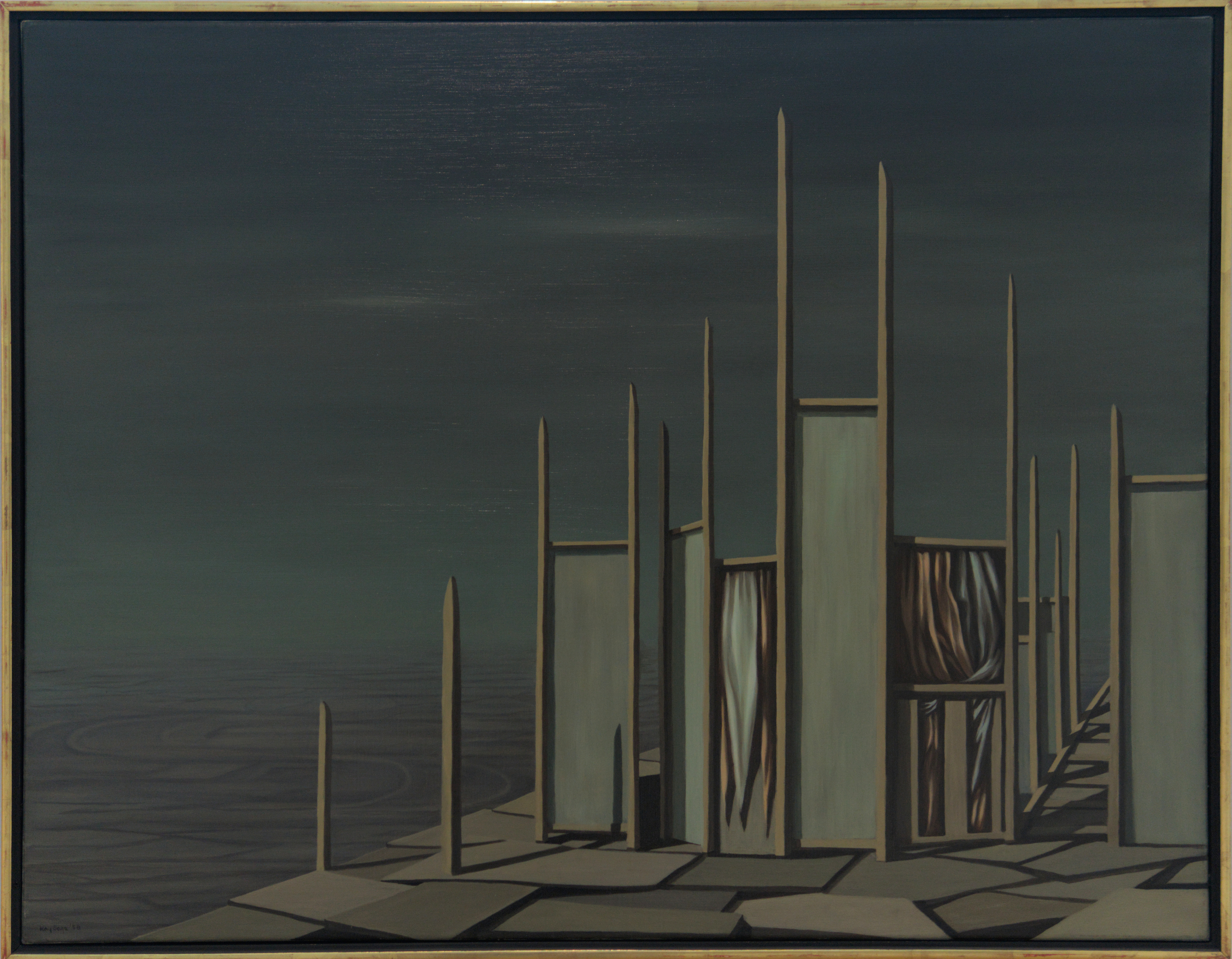
Sage, Kay_Quote-Unquote
Kay Sage (American, 1898–1963), Quote-Unquote, 1958. Oil on canvas, 28 × 39 in. (71.1 × 99.1 cm). Wadsworth Atheneum, Hartford, Connecticut, 1963.198. Photo: Victoria Emily Jones. © Estate of Kay Sage / Artists Rights Society (ARS), New York.

The museum label at the Wadsworth Atheneum reads in part: “Sage’s later paintings featured vertical architectural structures, such as walls and scaffolding, set in otherwise deserted landscapes. These inanimate forms were often draped with plain fabric, as if to suggest a human presence or absence.” The title Quote-Unquote provides little interpretive help. What is being quoted here? Is irony intended?

Painted the same decade, Sage’s Hyphen shows a towering structure of open doors and windows.
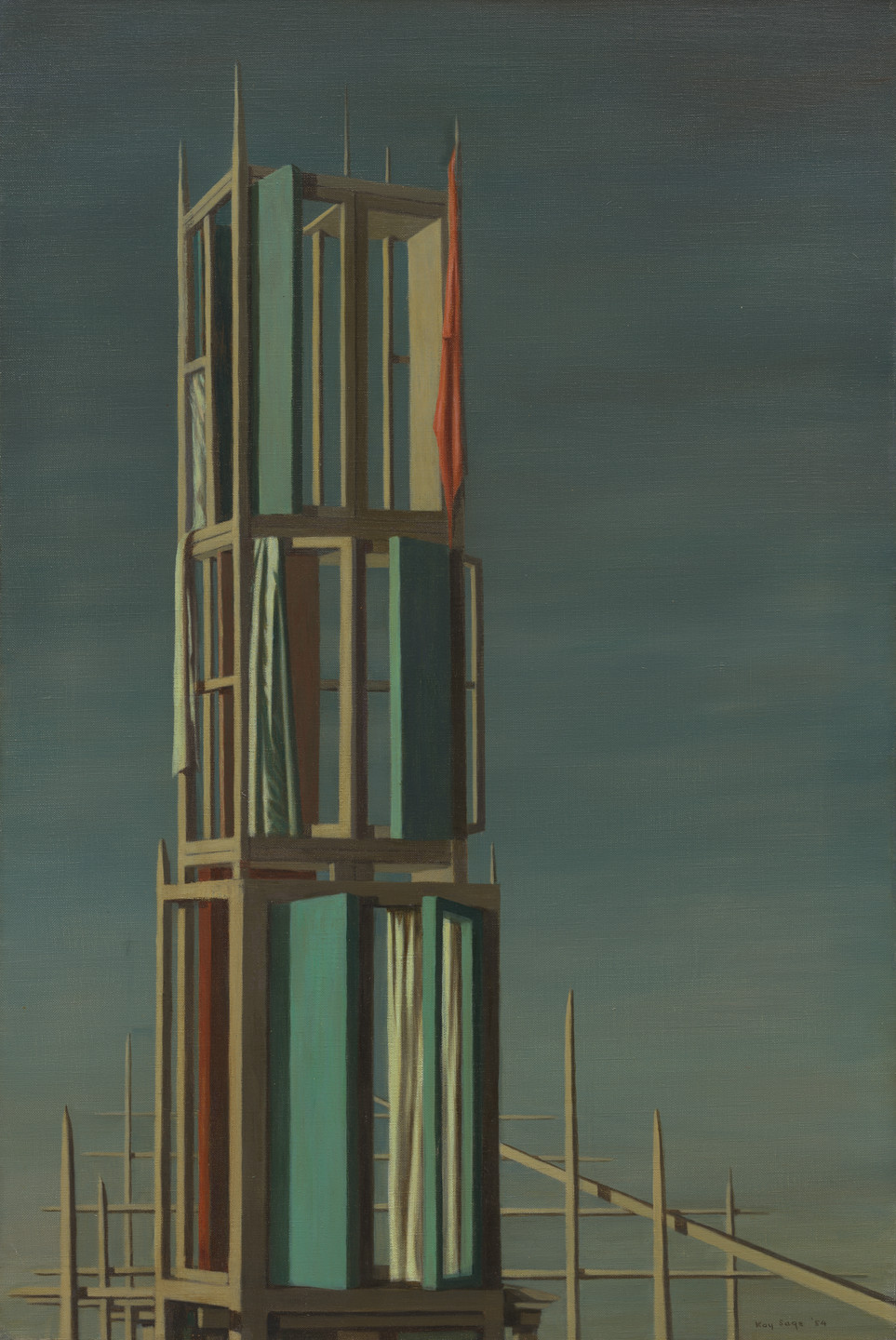
Sage, Kay_Hyphen
Kay Sage (American, 1898–1963), Hyphen, 1954. Oil on canvas, 30 × 20 in. (76.2 × 50.8 cm). Museum of Modern Art, New York. © Estate of Kay Sage / Artists Rights Society (ARS), New York.

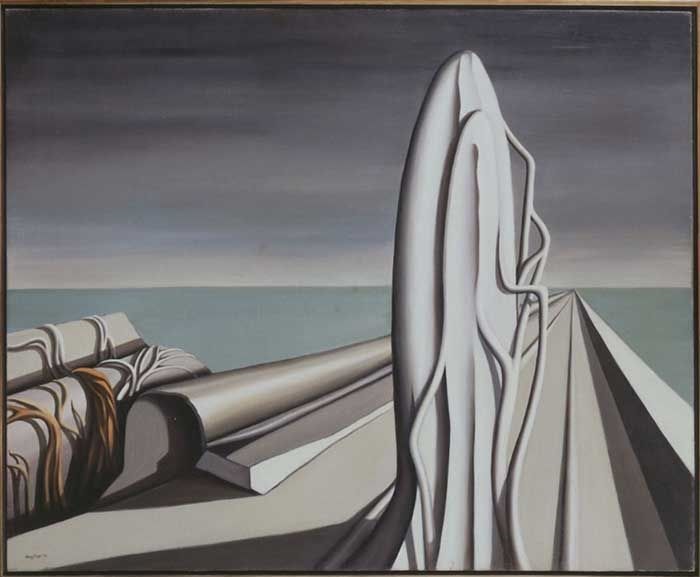
And The Point of Intersection shows a series of wooden boards and frames standing, slightly diagonal to the viewer, on a ground that recedes into infinity. In the bottom left corner a rumpled sheet or garment lies on a squat platform.

Sage, Kay_The Point of Intersection
Kay Sage (American, 1898–1963), The Point of Intersection, 1951–52. Oil on canvas, 39 × 32 in. (99.1 × 81.3 cm). Collection of Selma Ertegun, New York. © Estate of Kay Sage / Artists Rights Society (ARS), New York. Source: Kay Sage: Catalogue Raisonné, p. 269

Is the “intersection” of the title between time and eternity, or . . . ?

LISTEN: “Not Knowing When the Dawn Will Come” | Words by Emily Dickinson, ca. 1884 | Music by Jan Van Outryve, 2018 | Performed by Naomi Beeldens (voice) and Jeroen Malaise (piano) on Elysium, Emily Dickinson Project, 2018

Not knowing when the Dawn will come,
I open every Door,
Or has it Feathers, like a Bird,
Or Billows, like a Shore –

This is one of twelve musical settings of Dickinson poems for piano and voice by the Belgian composer Jan Van Outryve. It’s sung by soprano Naomi Beeldens, with Jeroen Malaise on keys.

I’ve always read “Not knowing” as an Advent poem, as promoting a posture of readiness for the coming of Christ—he who is, as we call out in the O Antiphons of late Advent, our Oriens, Rising Sun, Dayspring. Will he come softly, rustling, avian-like, or will he come crashing onto earth’s shore like a wave?

Expecting Dawn’s imminent arrival, the speaker of the poem opens every door, welcoming its light.

(Related posts: https://artandtheology.org/2022/12/14/advent-day-18-will-there-really-be-a-morning/; https://artandtheology.org/2022/12/15/advent-day-19-healing-wings/)

From Augustine (Confessions) to Teresa of Ávila (The Interior Castle), the picture-making nuns of St. Walburga’s Abbey in Eichstätt to C. S. Lewis (Mere Christianity), the human heart has long been compared to a house. To open the windows or doors of the heart to Christ is to invite him to come in and dwell there and to transform the place.

Advent commemorates three comings of Christ: his coming in “history, mystery, and majesty,” as one priest put it. That is, Christ’s coming (1) as a babe in Bethlehem, (2) in the Spirit, to convert, illuminate, equip, and console, and in the bread and wine of the Eucharist, and (3) at the end of time.

Have you opened every door to him? Do you eagerly expect him to arrive—this Christmas (are you telling, singing, enacting the story of his nativity?); into your struggles and brokenness, to companion you and to heal and strengthen; and again on earth, to unite it with heaven and establish, fully and finally, his universal reign?

This is the first post in a daily Advent and Christmastide series that will extend to January 6. I hope you follow along!
Advent roundup: “All Creation Waits,” Rev Simpkins on “the last things,” and more

Before I launch into the Advent content, I want to alert newcomers to, and remind old-timers of, my Thanksgiving Playlist on Spotify (introduced here), which is revised and expanded since last year. You can get an overview at this blog post. From Destiny’s Child to Yo-Yo Ma, Meister Eckhart to Mister Rogers, there’s a little something for everyone, I hope. And exemplifying the global nature of Christianity, there are songs in Hebrew, Luganda, Zulu, Swahili, Yoruba, Spanish, French, Hawaiian, Arabic, Korean, and Tamil.

+++

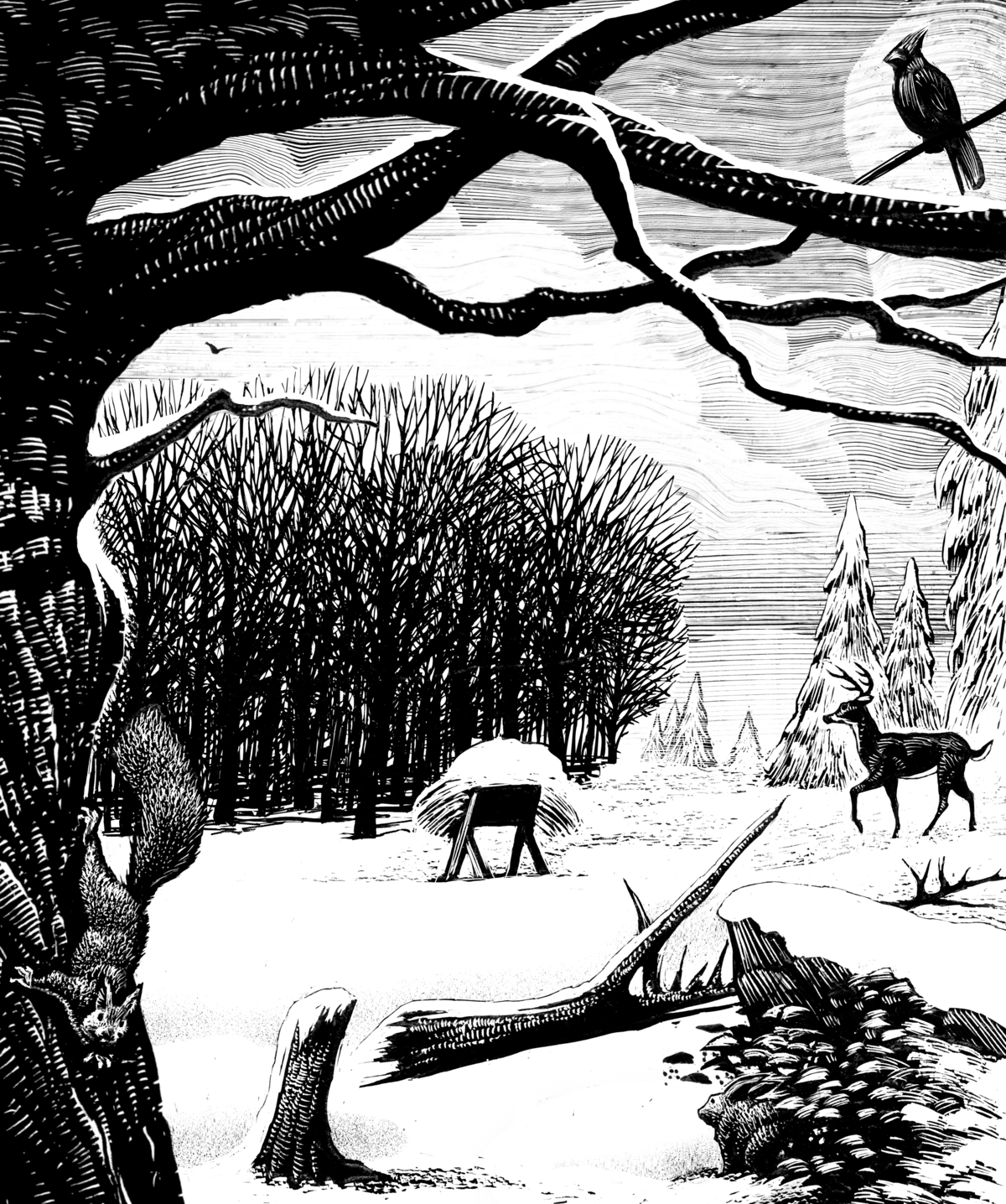
ESSAY: “All Creation Waits” by Gayle Boss: In the northern hemisphere, Advent is accompanied by a deepening of the dark and cold. In her bestselling and wholly unique Advent devotional, All Creation Waits, Gayle Boss provides twenty-five reflections that detail how wildlife—turtles, loons, black bears, and so on—adapts to these changing conditions. Animals know that the darkness is a door to a new beginning, and we would do well to embrace this wisdom. In the book, each day’s reading is paired with a woodcut illustration by David G. Klein.

The year of the book’s 2016 release, On Being published the introduction on its blog, where Boss answers, “Why animals for Advent?” and describes some of the inspiration behind and framing of the book. This year Paraclete Press released a hardcover gift edition with a new introduction and afterword.

Woodcut by David G. Klein
Woodcut by David G. Klein, 2016. In All Creation Waits, Gayle Boss tells a story of how one year, a week into Advent, she found a manger in the woods, which local children had filled with hay for the animals, then shelled corn.

+++

SONG: “O Come, O Come, Emmanuel”: There are hundreds of arrangements and recordings of this most beloved Advent hymn. Last year I featured two that I particularly like, and I think I’ll start a trend on the blog by doing the same at the beginning of each Advent—sharing two new renditions of the song.

>> Anna Hawkins. Anna Hawkins is a singer-songwriter of Irish heritage living in New Zealand. In her version of “O Come, O Come, Emmanuel” from her album Divine (2015), she sings the first verse in Hebrew, honoring the lyrics’ rootedness in the Hebrew scriptures. The music video was shot in Israel (cinematography by Michael Hilsden from Aspiring Productions). [HT: Global Christian Worship]

חזור חזור עמנואל
ופדה אסירי ישראל
שבגולה נאנחים
עד כי תבוא בן- האלוהים
,שמחו! שמחו! עמנואל
יבוא לכם בני ישראל

Chazor, chazor Immanu-El
Ufde asirei Israel
Shebagola ne’enachim
Ad ki tavo Ben Elohim
Simchu, Simchu, Immanu-El
Yavo lachem bnei-Israel

[English translation:]
O come, O come, Emmanuel
And ransom captive Israel
That mourns in lonely exile here
Until the Son of God appear
Rejoice! Rejoice! Emmanuel
Shall come to thee, O Israel

>> CeCe Winans, arr. Alvin Love III. CeCe Winans is a gospel legend. On Something’s Happening! A Christmas Album (2018), she collaborated with her son, Alvin Love III, who wrote the lush orchestral arrangements and produced the record. “O Come, O Come, Emmanuel” opens with a celesta, which sounds like a music box or twinkling stars and has long been associated with the supernatural. The accompaniment is played by the Zagreb Philharmonic Orchestra, conducted by Tim Akers.

+++

VISUAL MEDITATION: “I Corinthians 7:29-31: God Only Knows” by Lynn Miller: Rev. Dr. Lynn Miller is an author, ecclesiastical artist, workshop leader, and Presbyterian minister who holds a BFA in graphic design, an MA in art history, an MFA in creative writing, an MDiv, and a DMin. From 2014 to 2021 she ran the blog Art&Faith Matters, curating a diversity of images based on the liturgical calendar. In this post she guides us in looking at the surrealist painting At the Appointed Time by Kay Sage, which features a mysterious, draped figure or object and lines receding toward the horizon. “What do you see in the painting? What do you think about what you see? What do you wonder about this painting?” She posits a number of possible interpretations.

Sage, Kay_At the Appointed Time
Kay Sage (American, 1898–1963), At the Appointed Time, 1942. Oil on canvas, 81.3 × 99.1 cm. Newark Museum of Art, Newark, New Jersey.

+++

PODCAST SERIES: “Whispered Light: Advent Reflections on Death, Judgement, Heaven and Hell” by Matt Simpkins: In this four-episode podcast series from December 2020, Rev. Matt Simpkins, an Anglican priest and musician from Essex, explores the four themes traditionally contemplated by Christians during Advent—death, judgment, heaven, and hell—through four old American folk songs. He performs the songs, giving their history and using them as a launchpad for spiritual and theological reflection, which also integrates discussion of the Psalms. He addresses misconceptions about these “last things,” tracing the thread of hope and redemption that runs through them all. Just twenty to thirty minutes each, the episodes are available on your favorite podcast app and on YouTube (links below).

Simpkins records music under the name Rev Simpkins & The Phantom Notes. Check him out on Spotify or wherever you listen to music.