Two major exhibitions of African art are currently running in Manhattan and Baltimore, containing many Christian objects, some of them never before seen in the US. I attended both, and they’re excellent. I want to write a full-on review for each, but because I don’t know that I’ll have time to do so before they close, I wanted to at least make you aware of them in this abbreviated form in the hopes that you’ll have a chance to go see them. I will share more photos soon.
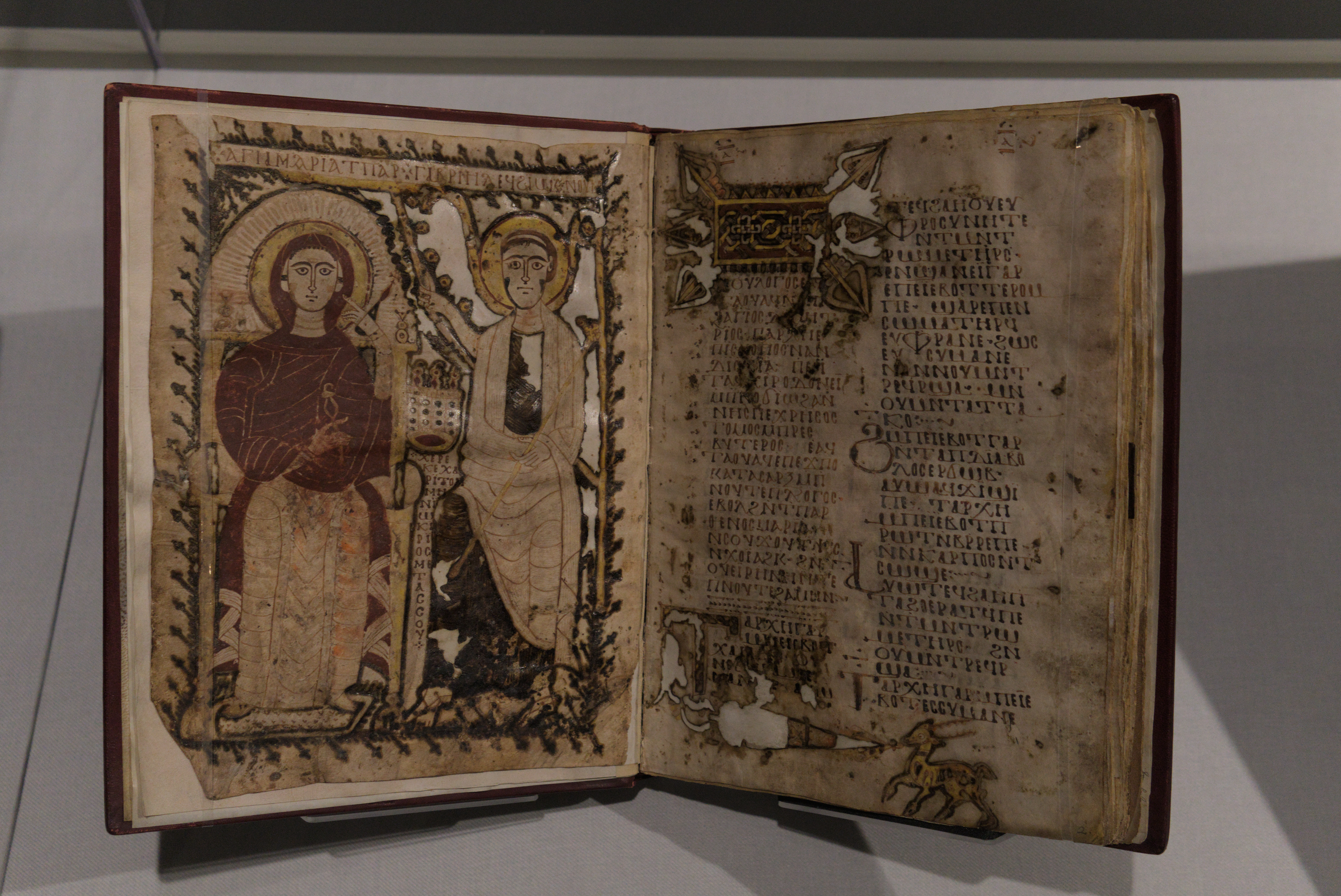
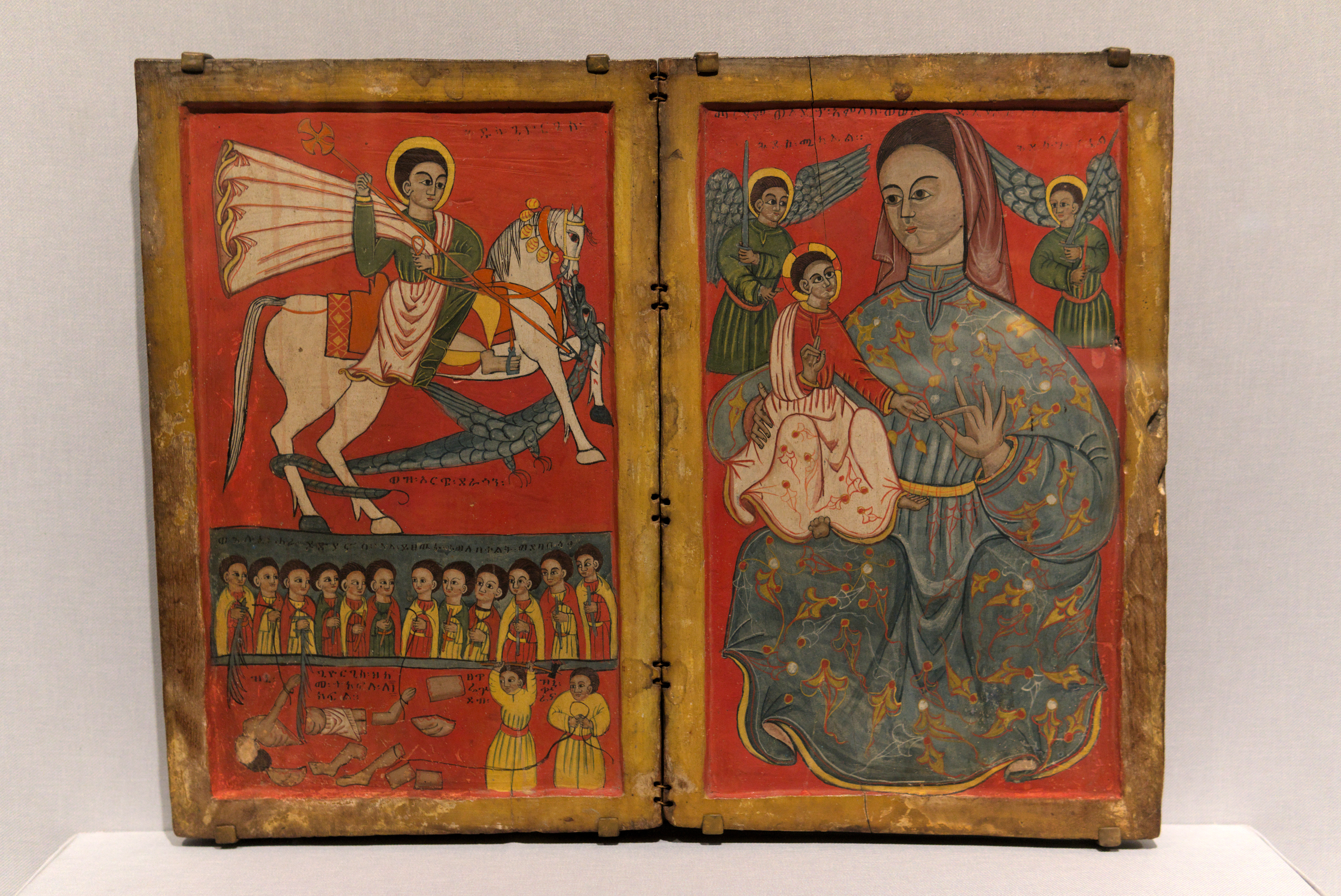
>> Africa & Byzantium, Metropolitan Museum of Art, New York City, November 19, 2023–March 3, 2024: Curated by Dr. Andrea Myers Achi. “Art history has long emphasized the glories of the Byzantine Empire (circa 330–1453), but less known are the profound artistic contributions of North Africa, Egypt, Nubia, Ethiopia, and other powerful African kingdoms whose pivotal interactions with Byzantium had a lasting impact on the Mediterranean world. Bringing together a range of masterworks—from mosaic, sculpture, pottery, and metalwork to luxury objects, paintings, and religious manuscripts—this exhibition recounts Africa’s central role in international networks of trade and cultural exchange. With artworks rarely or never before seen in public, Africa & Byzantium sheds new light on the staggering artistic achievements of medieval Africa. This long-overdue exhibition highlights how the continent contributed to the development of the premodern world and offers a more complete history of the vibrant multiethnic societies of north and east Africa that shaped the artistic, economic, and cultural life of Byzantium and beyond.”
The Annunciation, from a miscellany, Egypt, Fayyum Oasis, 913–14. Ink on parchment, 10 9/16 × 13 13/16 in. (26.8 × 35.1 cm). Collection of the Morgan Library and Museum, New York. Photo: Victoria Emily Jones.Diptych with Saint George and the Virgin and Child, Ethiopia, late 15th–early 16th century. Paint on wood, 20 1/2 × 26 5/16 × 1 3/16 in. (52 × 66.8 × 3 cm). Collection of the National Museum of African Art, Smithsonian Institution, Washington, DC. Photo: Victoria Emily Jones.
Exhibition tour:
Smarthistory video of one of the extraordinary early icons on display, borrowed from St. Catherine’s Monastery in Mount Sinai, Egypt:
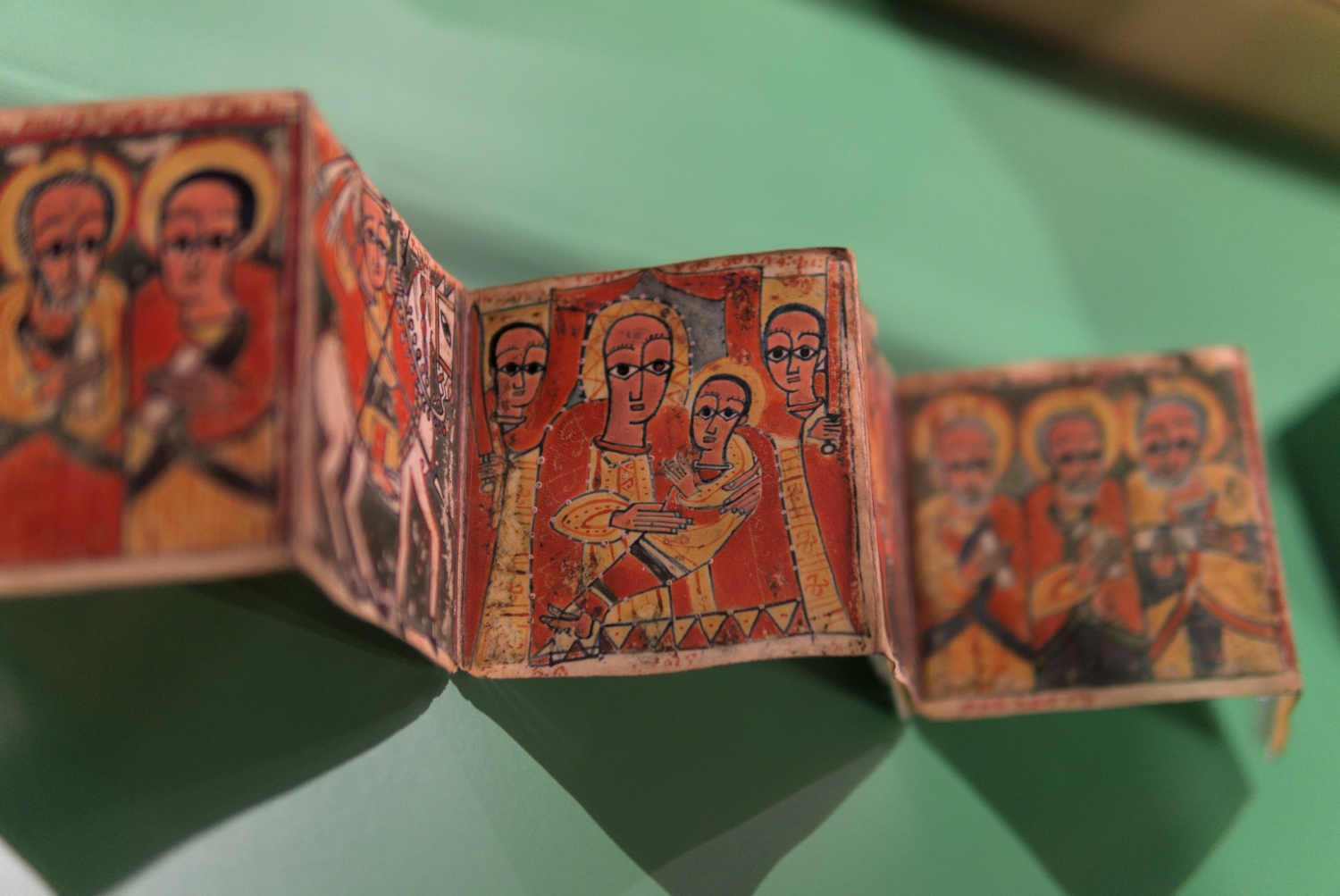
>> Ethiopia at the Crossroads, Walters Art Museum, Baltimore, December 3, 2023–March 3, 2024: Curated by Dr. Christine Sciacca. “Ethiopia at the Crossroads is the first major art exhibition in America to examine an array of Ethiopian cultural and artistic traditions from their origins to the present day and to chart the ways in which engaging with surrounding cultures manifested in Ethiopian artistic practices. Featuring more than 220 objects drawn from the Walters’ world-renowned collection of Ethiopian art and augmented with loans from American, European, and Ethiopian lenders, the exhibition spans 1,750 years of Ethiopia’s proud artistic, cultural, and religious history.
“Seated in the Horn of Africa between Europe and the Middle East, Ethiopia is an intersection of diverse climates, religions, and cultures. Home to over 80 different ethnicities and religious groups, a large portion of the historic artistic production in Ethiopia supported one of the three Abrahamic faiths (Judaism, Christianity, and Islam), all of which have early roots in Ethiopia. As one of the oldest Christian kingdoms, Ethiopian artists produced icons, wall paintings, crosses of various scales, and illuminated manuscripts to support this religious tradition and its liturgy. . . .”
The exhibition will travel to the Peabody Essex Museum in Salem, Massachusetts, April 13–July 7, 2024, and to the Toledo Museum of Art in Ohio August 17–November 10, 2024.
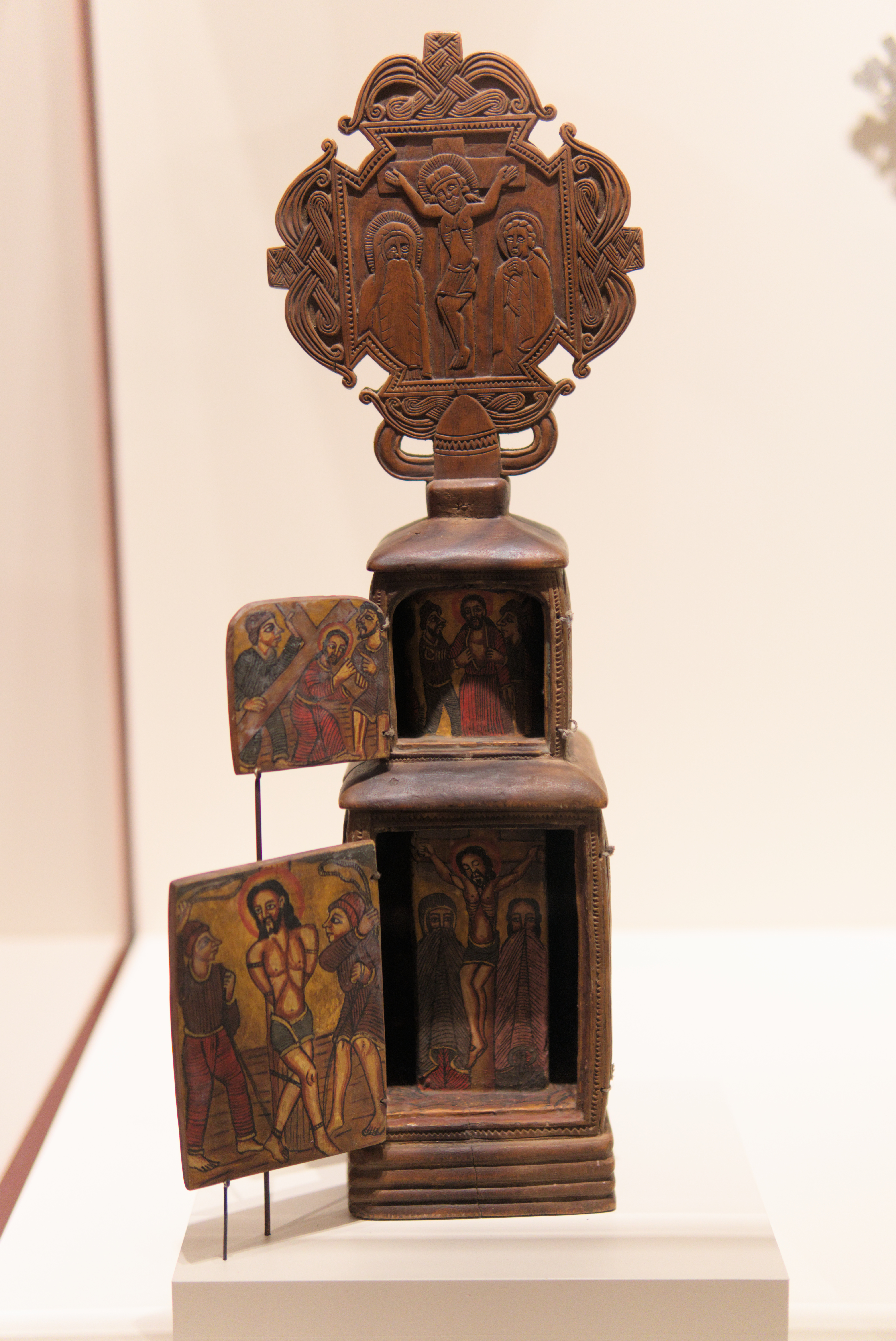
Detail of a sensul (chained manuscript), Ethiopia, 15th–early 16th century. Parchment, ink, paint, and leather. Collection of the Peabody Essex Museum, Salem, Massachusetts. Photo: Victoria Emily Jones.Mänbärä Tabot Icon with Eight Panels and Painted Scenes, Ethiopia, ca. 1850. Carved wood and glue tempera. Private collection, United States. Photo: Victoria Emily Jones.
Also, as Lent starts on February 14, don’t forget about my Lent playlist! Since its original publication in 2021, I’ve added songs to the bottom.
+++
BLOG POST: “The True Purpose of Theology” by W. David O. Taylor: Professor Taylor shares seven things about theology that he opens his first theology class lecture with each term at Fuller. So important. I hope I reflect these on my blog.
>> Sung by Kristyn Getty and Dana Masters: Keith and Kristyn Getty, a powerhouse couple in the Christian music industry, have chosen “O Love That Wilt Not Let Me Go” as their Family Hymn of the Month for February, providing some background on the writer, a free sheet music download of their arrangement, and a video performance from 2021 with guest vocalist Dana Masters. The Gettys’ large platform among evangelicals is sure to get this lesser-known hymn into many homes!
>> Sung by Westminster Chorus: Here Westminster Chorus (from Westminster, California) performs David Phelps’s a cappella arrangement of the hymn in Petrikirche in Dortmund, Germany. I previously shared a video of Phelps singing this version with three of his fellow Gaither Vocal Band members, which is itself moving, but with a thirty-four-person choir, the effect is tremendous.
+++
VIDEO: The Greeter’s Guild Goes to Times Square: Ryan Pemberton, director of community cultivation for Image journal, introduced me to “the moustachioed motivator of the high street,” Troy Hawke, in the January 18 installment of ImageUpdate. His videos are so delightful! Pemberton writes,
Call me quaint, but at the start of a presidential election year, what I’m most looking for in books, film, and certainly in public life is kindness. Under the circumstances, I can’t stop recommending Troy Hawke to friends. A character created by British comedian Milo McCabe, Hawke is a 1930s throwback, eloquent in speech and dapper in dress. His go-to wardrobe includes a smoking jacket worn over loose-fitting linen pants and Oxford dress shoes. As founder (and only member) of the Greeters Guild, he offers hyper-specific and articulate compliments to strangers—guests entering a Waitrose, commuters at a public transit hub, or those stopping at an EV charging station. After being invited to “try that in New York,” Hawke has been spotted offering compliments to passersby in Central Park. His intentional and attentive praise is a refreshing contrast to so much vitriol pouring its way through my screens and speakers. These public encounters call to mind Kierkegaard’s Works of Love, in which he notes that the work of love is to see and name the love already present in others, and, in so doing, to catalyze that love’s growth into its fullest expression (all while refusing to take credit—it was there the whole time). In this way, Hawke is both prophetic and timely. Fred Rogers, in an interview offered toward the end of his life (captured in the 2018 documentary Won’t You Be My Neighbor), shared that the most pressing work facing our species in this millennium is “making goodness attractive.” To that end: Thank you, Mr. Hawke; I can’t look away.
Brian Kershisnik (American, 1962–), Wounded Saint, 2002. Oil on panel, 40 × 30 in.
Blow the trumpet in Zion; sound the alarm on my holy mountain! Let all the inhabitants of the land tremble, for the day of the LORD is coming, it is near . . .
Yet even now, says the LORD, return to me with all your heart, with fasting, with weeping, and with mourning; rend your hearts and not your clothing. Return to the LORD, your God, for he is gracious and merciful, slow to anger, and abounding in steadfast love, and relents from punishing.
—Joel 2:1, 12–13
Let me hear joy and gladness; let the bones that you have crushed rejoice.
—Psalm 51:8
The sacrifice acceptable to God is a broken spirit; a broken and contrite heart, O God, you will not despise.
—Psalm 51:17
+++
SONG: “Come, Ye Sinners, Poor and Needy” | Words by Joseph Hart, 1759, with anonymous refrain, ca. 1811 | Music: American folk melody (RESTORATION), published in William Walker’s Southern Harmony, 1835 | Performed by Keith and Kristyn Getty, on The Greengrass Session: Six Hymns from the Old World and the New, 2014
Come, ye sinners, poor and needy,
Weak and wounded, sick and sore;
Jesus ready stands to save you,
Full of pity, love, and pow’r.
I will arise and go to Jesus, He will embrace me in His arms; In the arms of my dear Savior, Oh, there are ten thousand charms.
Come, ye thirsty, come, and welcome,
God’s free bounty glorify;
True belief and true repentance,
Every grace that brings you nigh.
Come, ye weary, heavy-laden,
Lost and ruined by the fall;
If you tarry till you’re better,
You will never come at all.
Let not conscience make you linger,
Nor of fitness fondly dream;
All the fitness He requireth
Is to feel your need of Him.
The singing-songwriting duo Keith and Kristyn Getty [previously], who are married, are from Northern Ireland and split their time between there and Nashville, Tennessee, in the United States. In 2014 they recorded a medley of the (American) shape-note hymn “Come, Ye Sinners” with a traditional Irish reel tune known as MUSICAL PRIEST, blending the musics of their two homes. The song starts out at a slow, weary pace with spare violin accompaniment and then picks up with a brisk guitar and other strings, including a free-ranging fiddle. The dirge gives way to celebration—this is the movement of Lent.
“Come, Ye Sinners” appears in hymnals with slight variations in verses, sometimes with an additional two, but the text above is one of the most commonly used. The anonymous refrain (“I will arise . . .”), which makes an oblique reference to the parable of the prodigal son, was added to Hart’s text sometime in the nineteenth century; it is a “floating lyric” found in Southern hymnals as early as 1811.
Though I most associate the hymn with the tune RESTORATION (sometimes called ARISE), it has been set to several tunes over the years, both traditional and contemporary. These include BEACH SPRING, GREENVILLE (which uses a different refrain), and ones by Todd Agnew and Matthew S. Smith, to name a few.
+++
In his painting Wounded Saint, Brian Kershisnik [previously] shows us a young woman with downcast eyes and a bleeding gash in her right arm. This wound, a metaphor for the pain she carries inside, could be self-inflicted or inflicted by others or both, but either way, her child gently leads her forward toward healing, as two angels support her from behind. “Poor and needy, weak and wounded, sick and sore,” the woman returns to her God, whose light emanates faintly from her head. In his arms, as the hymn says, “there are ten thousand charms”—ten thousand graces, ten thousand traits that fascinate, allure, delight . . . and make whole.
+++
I’ve just published a piece on the Christians in the Visual Arts (CIVA) blog to mark Ash Wednesday tomorrow. It’s a short reflection on the interactive installation hash2ash by the Warsaw-based art collective panGenerator, which uses digital technology to turn selfies into a pile of ash. “Dust you are, and to dust you shall return,” as the liturgy goes. Visit https://civa.org/civablog/remember-you-are-dust/ to read more.
This post belongs to the weekly series Artful Devotion. If you can’t view the music player in your email or RSS reader, try opening the post in your browser.
To view all the Revised Common Lectionary scripture readings for Ash Wednesday, cycle A, click here.
SONG: “O Children, Come”by Keith and Kristyn Getty: The Gettys are an Irish married couple who are major contributors to the modern Christian hymn-writing movement. I really enjoyed singing this song of theirs at church last week (CCLI 7036340); it was my first time hearing it. The acoustic performance below is from the Gettys’ 2015 Christmas concert. They’ve also recorded it with Ladysmith Black Mambazo.
+++
PHOTO ESSAY: “Alternative Nativity”: Kezia M’Clelland works with children affected by conflict in the Middle East and raises public awareness through her blog, Kezia Here and There. In 2015 she compiled news photos that document the refugee crisis and set them to excerpts from St. Matthew’s account of Christ’s birth and the prologue to St. John’s Gospel—a very powerful pairing that gives impetus to our Advent cry, “Come, Lord Jesus!” This is not a generic mashup; each photo was carefully selected to amplify a corresponding scripture text.
“About that time Caesar Augustus ordered a census to be taken throughout the Empire. This was the first census when Quirinius was governor of Syria. Everyone had to travel to his own ancestral hometown to be accounted for.” (Photo via Reuters. Displaced Yazidis escape across the Syrian border by foot, fleeing violence from the Islamic State militants who have taken over their home town of Sinjar.)
“So Joseph went to Bethlehem. He took with him Mary, his fiancée, who was obviously pregnant by this time.” (Photo via Al Jazeera. A refugee father with his pregnant wife and daughter asks for permission to enter into Hungary near Roszke as the border fence with Serbia is closed by Hungarian police.)
For each subsequent Advent, M’Clelland has released something in a similar vein: the video “Hope Is on the Way” in 2016, and this year, “Light in the Darkness,” with verses of scripture, mainly from the Old Testament prophets, emblazoned across photos from today’s Middle East. “This year again these Advent pictures and words will speak of a hope that is now and not yet,” she writes. “I am grateful that Advent gives us the freedom to weep and to hope, to rejoice and to grieve, to wait for and to recognise the Christ who is already here among us.”
Marrying the Christmas story with contemporary photojournalism can teach us to “pray with the Bible in one hand and a newspaper in the other,” as the popular adage goes. As we see the world’s brokenness, it should intensify our fervor for Christ’s shalom and impel us to action.
+++
UPCOMING MUSIC & ART EVENT: “Messiaen and the Incarnation,”December 20, 8 p.m., St. Mary’s Addington, London: Next Wednesday evening, Dr. Edward Forman will be performing three movements each from the French avant-garde composer Olivier Messiaen’s organ suite La Nativité du Seigneur (The Nativity of the Lord) and piano suite Vingt regards sur l’Enfant-Jésus (Twenty Contemplations on the Infant Jesus). Messiaen was a committed Christian who sought to express theological truths in a fresh, modern idiom. Like much of his output, these two works reject the Western conventions of forward motion, development, and diatonic harmonic resolution, so they can be difficult for first-time hearers. But this complexity, this sense of the unexpected, is appropriate for the mystical content they seek to convey.
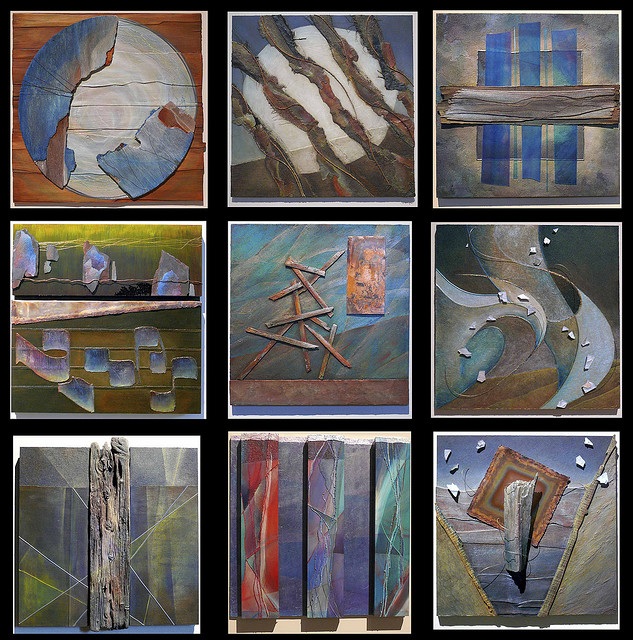
Inspired by the unique palette of sounds, textures, and rhythms of Nativité, British artist Sophie Hacker translated these into visual form. After deeply studying the music, in 2007 she created nine mixed-media panels in response—one for each movement—using slats of wood, nails, lead, wire, tree bark, and other found objects; you can see some of her process in the video below. These premiered at Winchester Cathedral in 2008. Then again in 2015 Hacker participated in another Messiaen-inspired artistic collaboration, under the direction of pianist Cordelia Williams, with poets Michael Symmons Roberts and Rowan Williams. This project is called “Between Heaven and the Clouds: Messiaen 2015.”
Sophie Hacker (British), La Nativité du Seigneur (The Nativity of the Lord), 2007. Mixed media on nine canvases, 60 × 60 cm each. Photo: Mike J. Davis.
To guide us through the listening experience, St. Mary’s will be projecting Hacker’s artworks onto a screen during the playing, and interspersing it with poetic reflections on the theological themes—from the Bible, Messiaen, Roland Riem (Icons of the Incarnation), and other sources. “We think it is equally pointless to try to explain Messiaen’s music in words as to attempt a sensible account of what it means for God to become human,” writes Forman in the booklet that will be provided to attendees. “We hope that the visual effects, words and music will enhance each other in ways that are inspiring and provoking.”
Messiaen’s compositions are definitely more challenging than the standard Christmas music fare, so I am grateful that St. Mary’s has the boldness, vision, and talent to offer them to the public, and in the meaningful context (which you likely won’t get in the concert hall) of meditation on the mystery of the Incarnation.
+++
ARTIST PROFILE: Zaki Baboun: Zaki Baboun is a Palestinian Christian artist living in Beit Jala, a suburb of Bethlehem. He paints religious scenes in oils on olive wood, which you can browse and purchase here—either the originals or reproductions on Christmas cards.
The first video below contains a short, two-minute interview with Zaki and shows him painting TheJourney of the Magi; the second shows him painting The Good Shepherd.
+++
ALBUM: The Unusual Tale of Mary and Joseph’s Baby by Waterdeep: I saw the world premiere of this nativity musical last summer in New York (read my review here), and it really helped shepherd my imagination into a deeper understanding of Mary and Joseph’s social and emotional realities. Now the album is out! The songs express the many ups and downs the Holy Couple likely underwent in their faith journeys to bring the Messiah into the world, with the theme of deliverance standing in highest relief. (Mary’s opening song, “I Want to Be Delivered,” is what spurs, much to her shock, the Annunciation, and the finale, “Walk Through the Sea on Dry Land,” draws everyone into a joyful reminiscence of God’s mighty hand in ages past, manifest in the present through the birth of the Christ child.) Comedy is provided through invented characters like Joseph’s friend Benjamin, the innkeeper and his wife, and a shepherd named Naphtali.
The most poignant scene, for me—and hence probably my favorite song—is the “Magnificat.” The biblical account doesn’t tell us much about Mary’s state of mind at this point, so the writers imagine her coming to Elizabeth filled with fear, and Elizabeth building her up, preaching truth to her (and sharing her own story of shame), helping her move from doubt to confidence. Elizabeth’s song is what emboldens Mary to sing. Their “Magnificat” is later reprised by the full cast immediately following Christ’s birth, concluding part 1.
The new album is not an original cast recording; instead the songs were recorded by their writer, Don Chaffer, and his wife, Lori, and released under the Waterdeep moniker. Stream on Spotify; sample and purchase at Amazon or iTunes.




 Art & Theology