
LOOK: The Life of Christ by Keith Haring
Keith Haring [previously] was a popular artist and activist on the New York scene during the 1980s. Inspired by graffiti art, he started his career by filling empty poster spaces with chalk drawings in the city’s subway stations. He wanted to make art accessible to everyone and believed that it “should be something that liberates the soul, provokes the imagination, and encourages people to go further.”
His style is characterized by bold black outlines, vibrant colors, a sense of rhythm, and simple iconic figures like the Barking Dog and Radiant Baby, which recur again and again in his oeuvre.
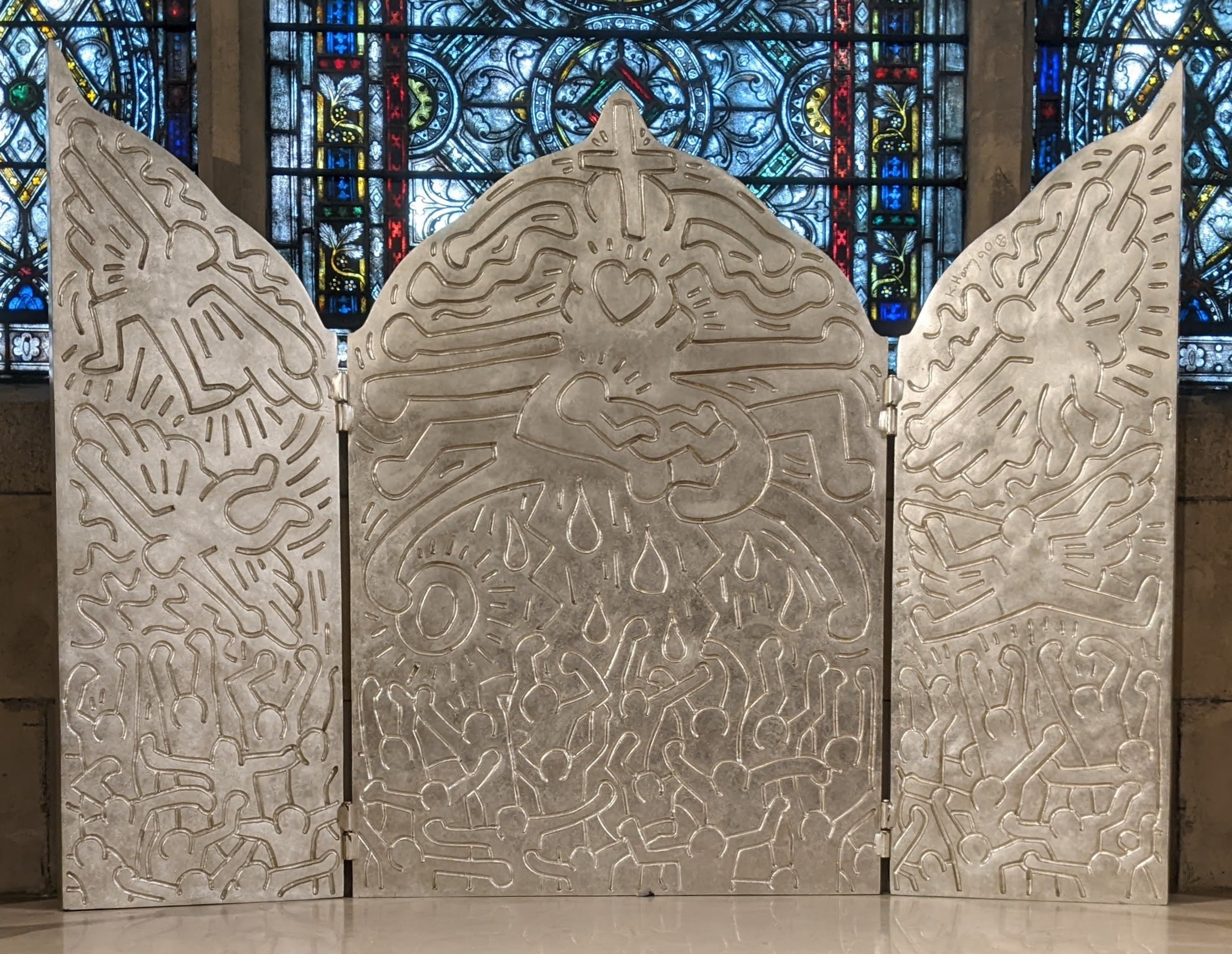
Sadly, Haring’s career was cut short by AIDS, which he died of on February 16, 1990, at age thirty-one. The last work he completed, just weeks before his death, was a Life of Christ altarpiece, a work that conveys eternal love and loss, divine suffering and hope. Without any preliminary sketches, he cut the design into clay using a loop knife. It was posthumously cast in bronze and covered in a white gold patina, an edition of nine.
The first edition is housed in the Cathedral of St. John the Divine in New York, the world’s fourth-largest church by area, where Haring’s memorial service was held.


(Related posts: “Michael Wright on Keith Haring’s ‘Jesus freak’ connection”; Felix Gonzalez-Torres, “Untitled [Portrait of Ross in L.A.]”)
Pulsating, cosmic, and somehow both mournful and joyous, the altarpiece is a triptych, meaning it has three panels. The central panel shows, at the top, a cross, below which is a multiarmed figure holding a baby. The top figure I interpret as God the Father, his arms all-embracing. Below him, at torso level, I discern a second figure (though the head is not clearly defined), who must be Mary, a shining heart over her face. Nestled in her arms is, irrefutably, her infant son Jesus.
Another possible reading is that this is the Trinity—Father, Spirit, and Son—united in an act of self-giving.
The surplus of arms (I count thirteen, plus the baby’s two) reminds me of the Thousand-Armed Avalokiteśvara in Buddhism; a bodhisattva associated with limitless compassion, his arms represent his extending aid, his reaching out to touch, heal, and uplift. One of the arms here stretches down to bestow a halo on humankind, which in Christianity symbolizes the grace/light of God.
Below this primary grouping is a crowd of people who appear to me to be dancing and celebrating, lifting their arms to receive the blessings that flow forth from the holy child. (Or are they clamoring, turning away, resisting? Without facial features and fingers, it’s hard to tell!) Drops of Jesus’s blood fall over all, bringing redemption.
On the two side panels, angels careen down from the heavens, surfing, leaping, tumbling, one screeching to a halt.
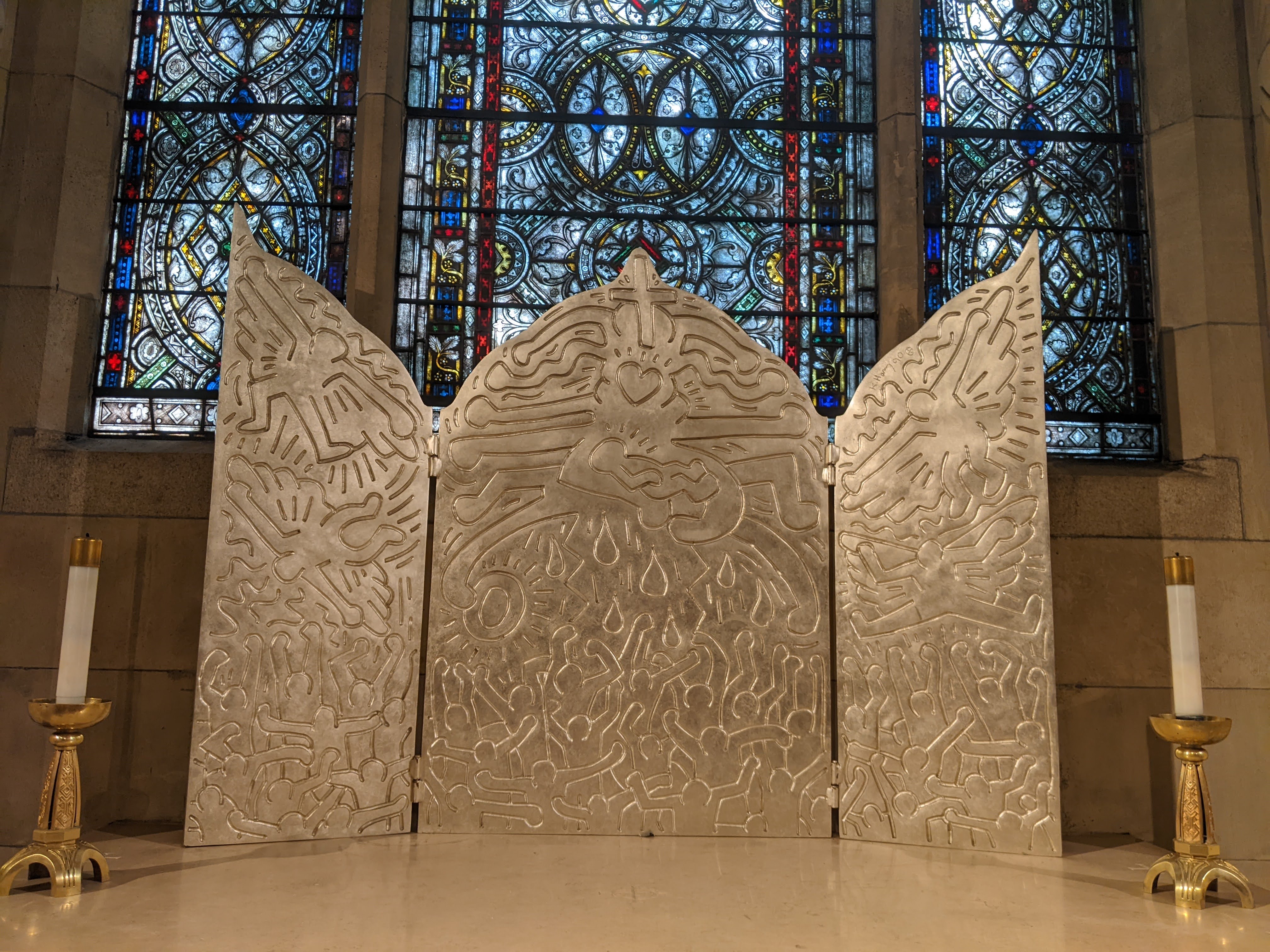
Haring’s Life of Christ combines, as have many artworks before it, Jesus’s birth and death, collapsing his time on earth, his ministry of salvation, into a single image of incarnation and atonement. Mary holds him as a newborn, but she also holds him as a lifeless adult after his crucifixion—a traditional representation known as the Pietà. Many artists have given Mary a sad twinge in her eye at the nativity, suggesting a premonition of loss.
Haring’s figures are faceless, so we can’t look there for emotional clues, but Mary’s body language suggests both a desire to keep and protect her son, and a willingness to give him up for the greater good.
I wonder whether, when Haring incised the sacred blood drops, he was not only thinking of the “power in the blood” that Christians sing about in reference to Jesus’s redemptive sacrifice—and all the weight that bodily fluid as Christian symbol carries—but also lamenting the HIV infecting his own bloodstream, ravaging his body and stigmatizing him, and that had already killed many of his friends and his partner.
Haring’s friend Sam Havadtoy, who was present at the altar’s creation, reports that when Haring finished the piece, he stepped back and, gazing at it, said, “Man, this is really heavy.”
I think the prominence of blood must have been at least partly influenced by the destructiveness of the AIDS epidemic and the artist’s meditation on his mortality, perhaps even hope for transcendence through death. And if so, then the Radiant Baby, who, the artist’s title would lead us to assume, is Jesus, could also double as the soul of an AIDS victim being taken back up to God.
While I hesitate to ascribe prayers or intentions to others that they have not clearly voiced, I can’t help but think that this last artwork of Haring’s, executed in the final throes of his illness, its subject returning him to the Christianity of his youth, to a story that once captivated him, was in one sense a plea for (physical and spiritual?) cleansing, for deliverance.
LISTEN: “We Sing Glory” by Fred Hammond, on Fred Hammond Christmas . . . : Just Remember (2001)
Little baby boy, sent as God among us
For your plan to free all humanity
We sing glory to your name
Sing glory to your nameTiny fragile heart
Pumped your blood to save us
For you’ve come to be a sin offering
Singing glory to the Lamb
Sing glory to the LambSinging glory to the one
Who saved the whole world
Born to die but you live again
And take all our sins awayLittle hands and feet
Made for nail and hammer
For the pain and grief you suffered for me
I sing glory to the Lamb
Oh, glory to the LambTiny arms and legs
Broad, strong, and sturdy
You carry the key to our victory
We sing glory to your name
We sing glory to your nameWe sing glory to the Child
Who will save the whole world
Born to die and then live again
To take all our sins awayGlory, glory to the one
Who was born to save the whole world
You died but you’ll rise again
So Jesus, we praise your nameHark the herald angels sing
Glory to the newborn King
Peace on earth and mercy mild
God and sinner reconciled
Thank you, JesusHark the herald angels sing
Glory to the newborn King
Peace on earth and mercy mild
God has come to save us
Yes, he hasGloria in excelsis Deo
God has come to save us


 Art & Theology