The following exhortation is by Kenneth Tanner, pastor of Holy Redeemer church in Rochester Hills, Michigan, and the author of Vulnerable God: Reviving the Wonder of God-with-Us in Our Humanity, forthcoming from Brazos Press. He originally posted it on Facebook on March 26, 2018, and I reprint it here with his permission.
[In 2004] a film premiered during Lent. The film was about this week we are entering, the week that changes the world.
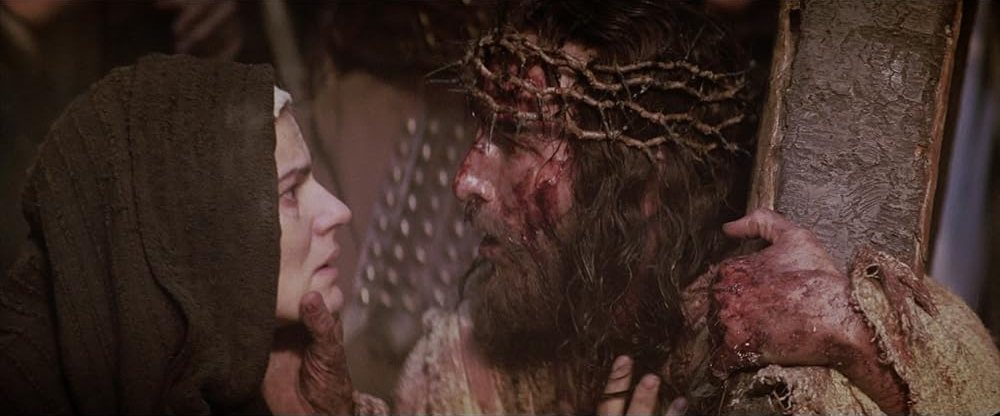
There’s a scene in the film of Jesus falling flat on his face into a dusty road; surrounded by crowds, a crown of thorns on his head, the heavy timber he is carrying comes down hard on his back.
He falls at the intersection of an alleyway where we see his mother Mary huddled in anguish as she waits in horror to glimpse Jesus passing.
When Jesus hits the ground just yards from her, Mary flashes back to a moment when as a child Jesus stumbled and hurt himself. In the memory, Jesus runs to her in pain and she takes him into her arms of comfort.
Startled back from her vision, back to the reality of her son laying prostrate in the dust, Mary springs to life and rushes to the aid of her son. When Jesus sees her, he shoulders his cross, and as he slowly rises back to his feet, he looks at Mary and says, “Behold, mother, I make all things new.”
Film still from The Passion of the Christ (2004), dir. Mel Gibson
Once a year Christians let this story be the priority in their lives. We take children out of music lessons and sporting events. We don’t plan social engagements. We pause. We take a deep breath. We put ordinary busyness on hold. We take a long weekend of sabbaths.
We pray. We sing. We lament. We remember. We find silence and dwell in it. We worship.
We ENTER the story together by the Spirit in gathered liturgies that re-enact the gift of the Last Supper, the command to love as God has loved us, the anxious questions and perspiration of Gethsemane.
We come together again to take a hard look at the cross, at our own violence toward God, at the Love that forgives even as we betray and deny and flee, as we smite and whip and nail and mock.
In the quiet of Holy Saturday we ponder a world without God, where death reigns without the resurrection.
Then we gather once more with great joy to remember that death is not the end of anyone or the end of the world, that the resurrection is the end of all things.
I want to encourage you to disconnect from the grind and walk the way of the cross this week, to stay with Jesus and the women and John in the darkness that has to come before the new dawn.
You will never quite understand our community, ancient practices, or the deeper meanings of this week until you let it take over your life once a year. And with every passing year, as you keep this sacred week sacred, free from other obligations and pursuits, you will see and experience and encounter Jesus Christ anew.
So I invite you to surrender and enter contemplation of the mighty acts whereby God has reconciled the world to himself in Jesus Christ, the things only Jesus can do, for we cannot do them ourselves, where we find genuine rest from our labors in the acts of Love that make the world new.
To assist your contemplations, I’ll be sharing a song and an artwork here on each day of Holy Week, as is my custom. (You can view the archived posts in this annual series, from 2024, 2023, 2022, 2021, and 2020.) Some of the songs can be found on Art & Theology’s Holy Week Playlist:
Every warrior’s boot used in battle and every garment rolled in blood will be destined for burning, will be fuel for the fire. For to us a child is born, to us a son is given, and the government will be on his shoulders. And he will be called Wonderful Counselor, Mighty God, Everlasting Father, Prince of Peace.
—Isaiah 9:5–6 NIV
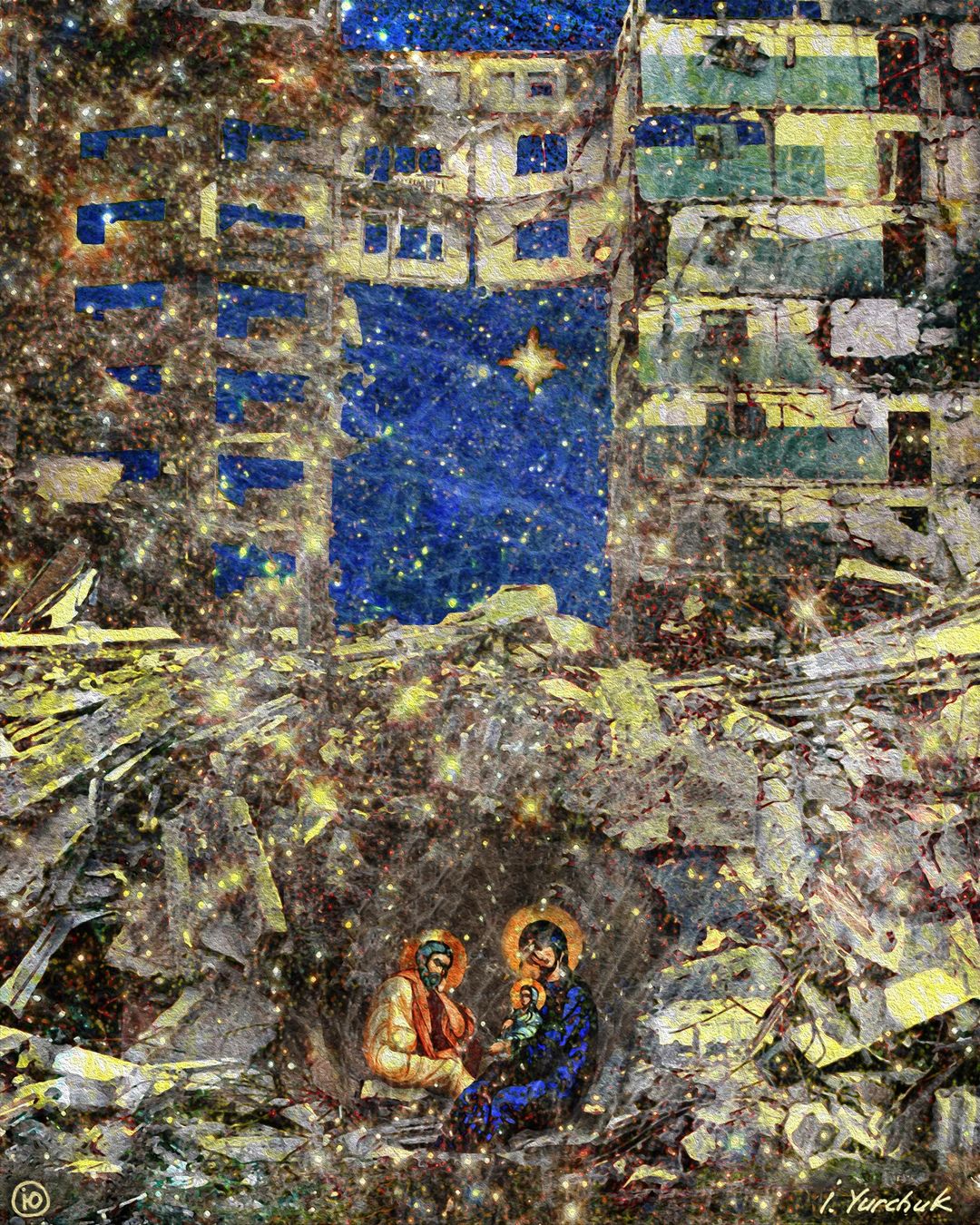
LOOK: Nativity by Irenaeus Yurchuk
Irenaeus Yurchuk (Іриней Юрчук), Nativity, 2022. Mixed media on canvas. Used with permission.
Irenaeus Yurchuk was born in Ukraine during World War II and raised in central New York, where he still resides. He worked professionally as an urban planner until 2010, when he turned to art full-time.
“Over the years my work has evolved to combine multiple-image photography with drawing and painting, using a variety of digital editing and physical montage techniques,” Yurchuk says. “This includes adjusting inkjet images by applying acrylics, watercolors, pastels, markers, colored pencils together with selected collage materials to achieve a desired effect.”
Yurchuk’s Nativity is a response to Russia’s 2022 military invasion of Ukraine. This is no facile depiction of that historic birth, no cozy winter idyll. It is a war-zone Nativity. It shows the Holy Family, rendered in iconic style, sheltering at night in the rubble of a bombed-out apartment complex. Surrounded by fallen steel beams, concrete, and broken glass, Mother Mary holds the newborn Jesus while a downcast Joseph sits beside them with head in hands. Though their circumstances are dire, through the building’s shell shines one particularly bright star, signifying hope in the horror.
One of the biblical names for Jesus is Emmanuel, Hebrew for “God with us.” By showing the Christ child being born amid the ruins of a contemporary Ukrainian city, Yurchuk reinforces the ongoing relevance of the Incarnation, meditating on God’s descent into our world of woe to dwell with and to deliver. Jesus is “God with us” in our suffering. When everything around us is crumbling, God is there too, hurting alongside and calling all oppressors to account.
Do you recall the famous Christmas text from Isaiah, further immortalized by Handel, that begins “Unto us a child is born . . .”? Well, it is immediately preceded by a prophecy of war’s final demise, of soldiers’ uniforms and accoutrements and all their bloody violence being consigned to one great big burning trash heap. In the new world government established by Christ, the Prince of Peace, tyrants will be overthrown (Luke 1:51–52), and the nations will study war no more (Isa. 2:4).
May this artwork and the song below prompt you to intercede for those suffering under war today, in Ukraine and elsewhere.
LISTEN: “Drive Out the Darkness” by Paul Zach, Isaac Wardell, Dan Marotta, and John Swinton, on Lament Songs by the Porter’s Gate (2020)
Refrain: Come, O come Be our light Drive out the darkness Come, Jesus, come
Every year under the thorn Every wrong that we have known Every valley will be raised Ancient ruins will be remade [Refrain]
Every weapon made for war Every gun and every sword Will be melted in the flame To be used for gardening [Refrain]
In the emptiness of grief Through the night of suffering In the loss and in the tears God of comfort, O be near [Refrain]
Coda: Come, and end all the violence Come, do not be silent Come, we cling to your promise Come, you’ll break all injustice Come, Jesus, come
For my review of the Lament Songs album by the Porter’s Gate, see here.
In addition to these words that the Porter’s Gate has given us to pray, I commend to you this prayer by Rev. Kenneth Tanner, which he posted October 13 in response to recent atrocities in Israel and Gaza (I’ve been returning to it a lot over the past month):
This post is part of a daily Advent series from December 2 to 24, 2023 (with Christmas to follow through January 6, 2024). View all the posts here, and the accompanying Spotify playlist here.
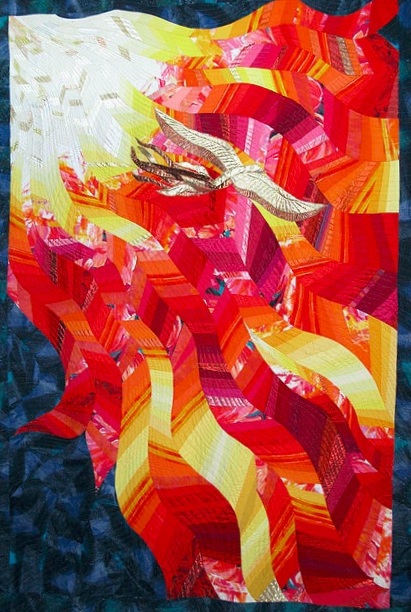
Linda S. Schmidt, Pentecost, 1991. Quilt, 111 × 80 in.
“I came to cast fire on the earth, and would that it were already kindled” (Luke 12:49).
In the churches in which many of us were raised, we were taught to live in fear of this fire of God.
We are not going to repeat that lie. The ancient Christians show us a better way of perceiving this divine fire as we encounter it in the Scriptures and in our experiences.
I want the children listening to me today to know and trust they can welcome and embrace the fire of God, that there is no reason to live in terror about the fire that has come from God, is coming even now, and will come at the end of time.
We welcome the fire of God because we know the character of the God who meets us in the flesh of Jesus Christ.
This God comes among us not to destroy humanity but to burn everything out of us that is not of love, that does not have its origin in the divine life.
Like all healing, deliverance, and reconciliation, there is pain involved in being set free and made well. It is not easy. It is not a cake walk.
But here is the good news: we are free from anxiety and fear as we embrace the cleansing fire of God. “With its fire, love makes better whatever it touches” (Ambrose).
We became cold in our self-imposed exile from God, and like any object, the further it gets away from the fiery source of its life, the colder it becomes.
Remember that God makes his ministers flames of fire, that we shine like the sun in the kingdom of heaven.
Remember that Cleopas, later in Luke, describes that their “hearts burned within them” as Jesus taught them from the Scriptures.
Remember at Pentecost that flames of fire come to rest on the heads of the gathered men and women.
As John promised, Christ baptizes us with fire and the Spirit.
For Cyril of Jerusalem, these words of Jesus about casting fire upon the earth find their fulfillment at Pentecost.
Remember that the flames of the fiery furnace do not consume the Hebrew children, but the angel—Christ himself—stands with them in scorching flames and they emerge from the fire unharmed.
Remember that the burning bush is aflame, is entirely engulfed, but never consumed by the fire of God.
So it is with us: the fire of the love that is the Spirit of God—Ambrose describes this fire of love as having wings—flies through us, consuming whatever is not of Love and trying whatever is good in us in order to purify the good and make it ready for the kingdom.
And we can trust this fire because it comes from the human who is God, who has journeyed through death and hell to bring us back alive with him.
We walk confidently into the fire that is God, knowing that his fire will keep us unto everlasting life.
Kenneth Tanner is the pastor of Church of the Holy Redeemer in Rochester Hills, Michigan, and a contributing writer for Mockingbird, Sojourners, Clarion Journal, and more. He frequently posts theological reflections and sermon excerpts on Facebook, such as the one above [source], which he preached August 18, 2019, the tenth Sunday after Pentecost. I’ve reposted it here with his permission. The liturgical quilt is by fiber artist Linda S. Schmidt.

 Art & Theology