
Easter, Day 4: “I come to my garden”

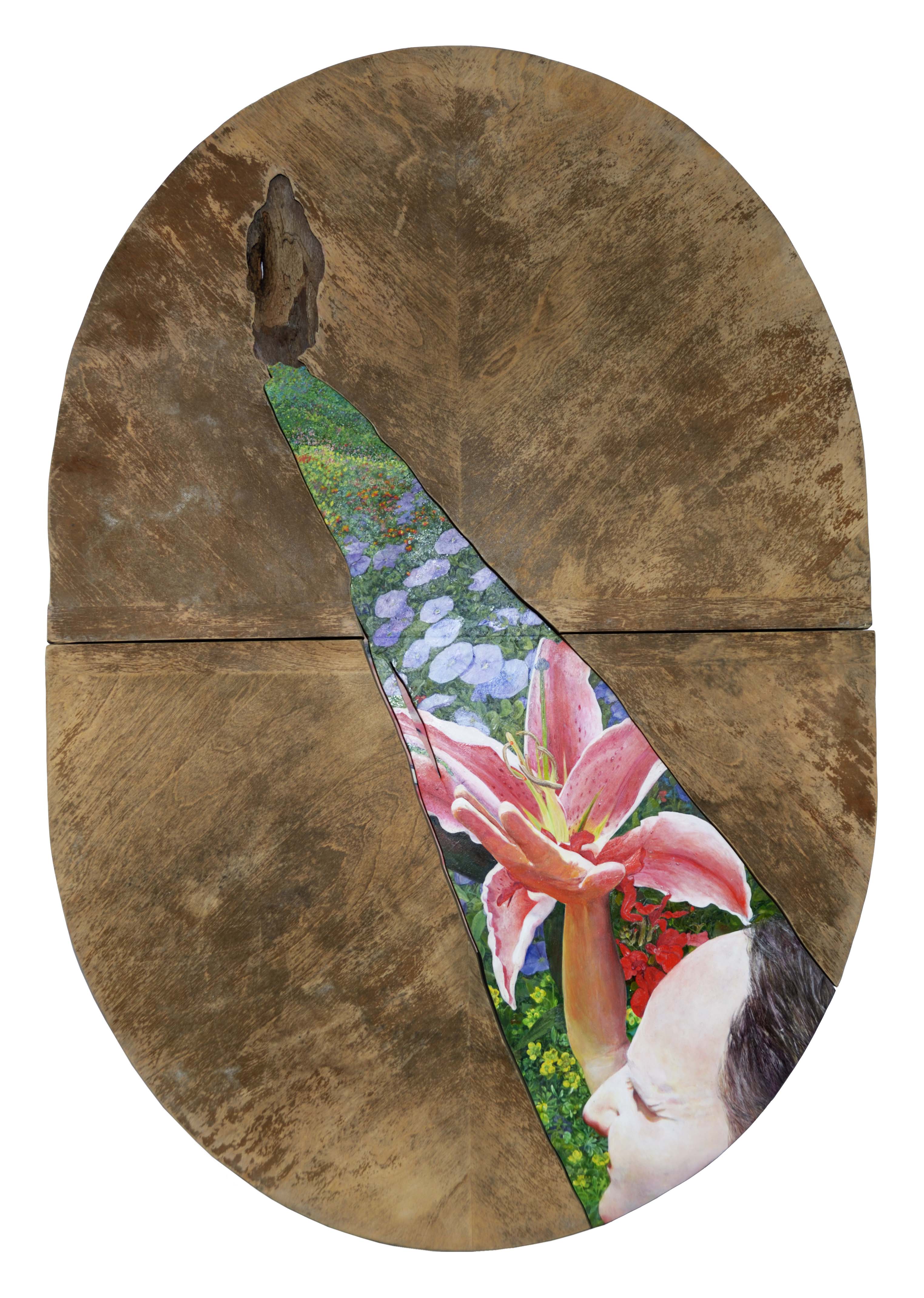
LOOK: (She thought he was) The Gardener by Helen Sherriff
Sheriff, Helen_The Gardener
Helen Sherriff (Australian, 1951–), (She thought he was) The Gardener, 2013. Acrylic and oil on found medium-density fiberboard tabletop with parquetry veneer and bark insert, 15 × 10.7 cm.

This painting by Helen Sherriff, which won the Needham Religious Art Prize in 2013, shows Christ appearing to the forlorn Mary Magdalene after his resurrection. Sheriff cut the figure of Christ out of the MDF substrate and “inserted a piece of thick tree bark which had a scar in an appropriate place suggesting a wound,” she writes at ArtWay.eu.

The colorful flowering cast forth from his form is such a unique way to visually interpret the significance of this moment of encounter. “Normally there would be a shadow stretching forward,” Sherriff says, “but this darkness is light.”

Sherriff also notes how the shape of the Stargazer lily is echoed by Mary’s hand held up to shield her face from the brightness.

LISTEN: “J’entre dans mon jardin” (I Come to My Garden) by the Choeur des Moines de l’abbaye de Keur Moussa au Sénégal, on L’heure vient (2007)

This instrumental piece, an air for kora (traditional calabash harp-lute) and recorder, is part of the Liturgy of the Resurrection at Keur Moussa Abbey in Senegal. Its title is taken from Song of Songs 5:1:

I come to my garden, my sister, my bride;
    I gather my myrrh with my spice;
    I eat my honeycomb with my honey;
    I drink my wine with my milk.

Eat, friends, drink,
    and be drunk with love.

The liner notes for this track on the CD sleeve, which are all in French, say, “Christ, in the Christian tradition, is the Bridegroom. He comes, resurrected on Easter morning, to meet Mary Magdalene, seated at the entrance to the tomb. The kora and the flute convey the joy of this Easter reunion with freshness and brightness.”

On Saturday I shared an example of another Christian musician who has linked the Song of Songs to the Easter story.

To learn more about the music making of the Keur Moussa community of brothers, read the 2022 New Yorker profile “The Monks Who Took the Kora to Church” by Julian Lucas, or the blog feature I published in 2017. I also shared their musical setting of the “Vidi aquam” in Wolof last Easter, along with a wood-carved candlestand by Thomas Mpira of Malawi.
Easter, Day 5: Vidi aquam

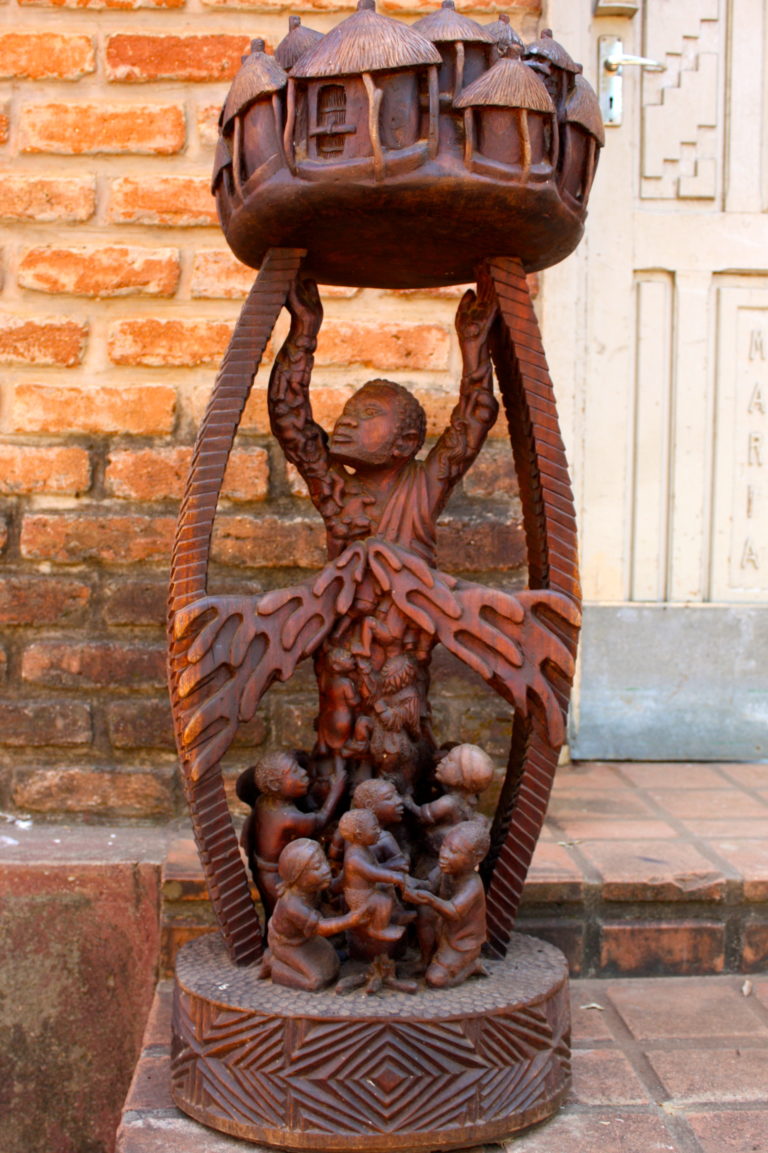
LOOK: Paschal Candlestand by Thomas Mpira

Mpira, Thomas_Paschal Candlestand
Thomas Mpira, Paschal Candlestand, 1990. Tangatanga wood, height 104 cm. Mua Parish Church, Mua, Malawi.

This large Paschal candlestand was made by Thomas Mpira, a master carver at the Kungoni Centre of Culture and Art in Mua, Malawi. Founded in 1976 by Father Claude Boucher Chisale, this center employed over 120 carvers at its height and is remarkable for how it synthesizes Christian faith and African culture. It is still active, with many locally produced artworks put on display at the center’s Chamare Museum. Others, like this one, are used in the liturgies at the Mua parish church in the diocese of Dedza, whose services are in Chichewa.

Traditionally, the Paschal candle is lit during the Easter Vigil on the night of Holy Saturday, representing the light of Christ’s resurrection expelling the darkness. It is raised and leads a procession, with the lighting blessing referencing

Christ, that Morning Star,
who came back from the dead,
and shed his peaceful light on all humanity,
[God’s] Son, who lives and reigns for ever and ever.

The candle is then placed on the stand and remains lit at all worship services throughout the Easter season, and during baptisms and funerals at any time of the year.

The central figure of Mpira’s carving is the risen Christ, his body constituted of people who’ve been incorporated by his death and resurrection into the “celestial village” he holds aloft, the kingdom of God. From his Sacred Heart gushes a river of life that waters a Chewa village, where a newborn is being passed over a fire to welcome him into the community. (Some Chewa Christians have adapted this ritual such that the child is passed over a lit candle at baptism.) Powerful and regenerating, Christ’s Spirit pours out over the villagers and their daily lives.

The arched forms that support the top of the stand are stylized rainbows, symbolic of God’s promise.

LISTEN: “Vidi aquam” (Wolof: “Gis Na Deh”) by the Monks of Keur Moussa Abbey, from Keur Moussa: Sacred Chant and African Rhythms from Senegal (1997)

English translation:

I saw water flowing out of the temple, from its right side, alleluia:
And all to whom this water came were saved,
And they exclaim, “Alleluia, alleluia!”

Glory to the Father and to the Son and to the Holy Spirit:
As it was in the beginning, now and forever.

I saw water flowing out of the temple, from its right side, alleluia:
And all to whom this water came were saved,
And they exclaim, “Alleluia, alleluia!”

“Vidi aquam” (“I saw the water”) is a joyful Easter chant for the asperges ritual at the beginning of Mass, in which the altar, the clergy, and the congregation are sprinkled with holy water. The Latin word “asperges” is taken from Psalm 51:3, “Asperges me hyssopo” (Thou shalt sprinkle me with hyssop), which is intoned during the rite for most of the year—except during Eastertide, when this text is replaced with one based on Ezekiel 47, in which the prophet sees a sanctifying flood issuing forth from the temple in Jerusalem:

Then he brought me back to the entrance of the temple; there water was flowing from below the entryway of the temple toward the east. . . . Wherever the river goes, every living creature that swarms will live . . . (vv. 1, 9)

(Related posts: “‘River’ by Eugene McDaniels”; “Music making at Keur Moussa Abbey, Senegal”)

This sensory ritual celebrates the cleansing power of Christ, from whose speared side, on the cross, gushed water and blood, a fount of life.

The monks of Keur Moussa Abbey in Senegal use a Wolof translation of the Vidi aquam, which they’ve set to music inspired by a diola melody from Casamance, southern Senegal. In this recording, they sing accompanied by two tom-toms.

Music making at Keur Moussa Abbey, Senegal

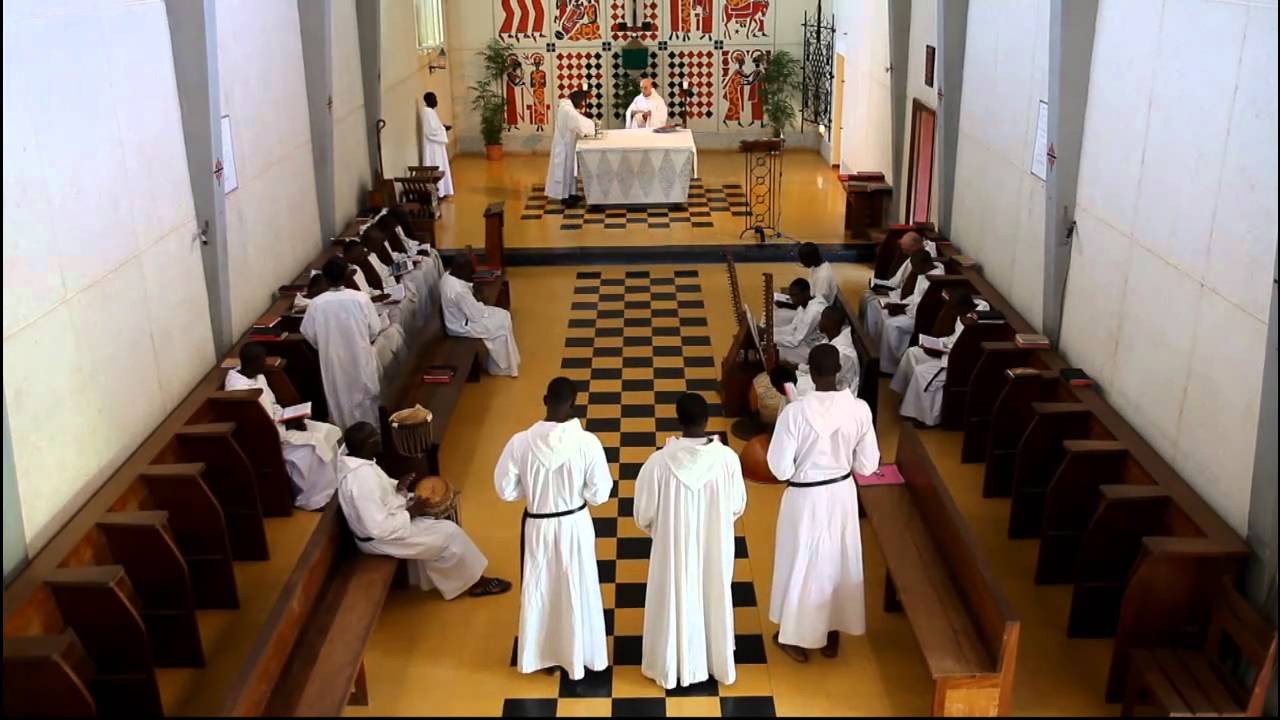
Mass at Keur Moussa Abbey in Senegal

Lately I’ve been enjoying the music of the monks at Keur Moussa Abbey, a brotherhood of French expatriates and Senegalese who wed Western liturgical chant with the rhythms and instrumental textures of West Africa. One of their income streams is musical recording sales—in North America, for example, Sounds True distributes Keur Moussa: Sacred Chant and African Rhythms from Senegal. It’s an excellent, seventeen-track CD that comprises songs of praise, exhortation, confession, and supplication in French and Wolof. Below you will find two of those tracks, embedded with the kind permission of Sounds True.

The first is “Suma Hol Nam” (“I Was Glad”), an adaptation of Psalm 122 in Wolof, accompanied by tom-tom. “Let peace reign in your tents, joy within your walls!” it exclaims. The refrain is “How glad I was when they said to me, ‘Let us go to the house of the Lord.’”


The second is “Yesu Dekalikuna” (“Jesus Is Risen”), a brisk instrumental kora interlude that evokes the holy women hastening from the tomb on Easter morning.


From the liner notes:

In 1963, nine monks from the French monastery of Saint-Pierre of Solesmes—a centuries-old stronghold of the ancient Gregorian plainchant tradition—journeyed to the remote Wolof village of Keur Moussa in Senegal to found the Benedictine Abbey of the Immaculate Heart of Mary [Abbaye du Cœur Immaculé de Marie]. Keur Moussa Abbey, as it is known to the villagers, means “House of Moses.” It is above all a place of prayer, where praise of God is celebrated through hard work, contemplative silence, and joyful music. From the first day of their arrival, these expatriate monks sought to invite the traditions, music, and people of their host village into the monastery grounds.

Today, Keur Moussa Abbey houses 35 brothers, 24 of whom are Senegalese. [According to OSB International, the current number of brothers is 44.] The abbey also sponsors an elementary school and dispensary, run by sisters and laypeople. The monks themselves live from the work of their hands, tending fruit trees, making cheese, and hand-crafting their renowned koras.

The kora, employed for both solos and accompaniment, is an African lute-harp of Mandingo origin. Enchanted by its lyrical voice, the first monks of Keur Moussa Abbey learned from the griots (nomadic Mandingo kora players and storytellers) to play the instrument, and eventually adapted it for use in their liturgical services. Through careful changes in the kora’s construction, they have made it easier to tune—a process that once frustrated even the most experienced of players—without altering its extraordinarily beautiful timbre. . . .

Through the continual exploration of their convergent musical worlds, the monks of Keur Moussa have created an entirely new liturgical choral tradition . . . weav[ing] the rhythms and instrumental textures of the African continent with the sacred words and compositional structures of traditional Western plainchant (sung in French and Wolof, the language of the region). Here, as in the daily masses at the abbey, the choral works are occasionally preceded or followed by instrumental performances on kora, tabala (a large Mauritanian camel-skin drum), balafon (a Malinke instrument similar to the xylophone), tom-tom, and flute.

The notes include English translations of all the songs, plus background information on each one.   Continue reading “Music making at Keur Moussa Abbey, Senegal”