Advent, Day 17: Come, My Beloved

What is that coming up from the wilderness like columns of smoke, perfumed with myrrh and frankincense, with all the fragrant powders of a merchant?

—Song of Solomon 3:6 (KJV)

Arise, shine; for thy light is come, and the glory of the LORD is risen upon thee.

—Isaiah 60:1 (KJV)

Awake, awake; put on thy strength, O Zion; put on thy beautiful garments, O Jerusalem, the holy city. . . . Shake thyself from the dust; arise, and sit down, O Jerusalem: loose thyself from the bands of thy neck, O captive daughter of Zion. For thus saith the LORD, Ye have sold yourselves for nought; and ye shall be redeemed without money.

—Isaiah 52:1–3 (KJV)

LOOK: Eve by Kiki Smith
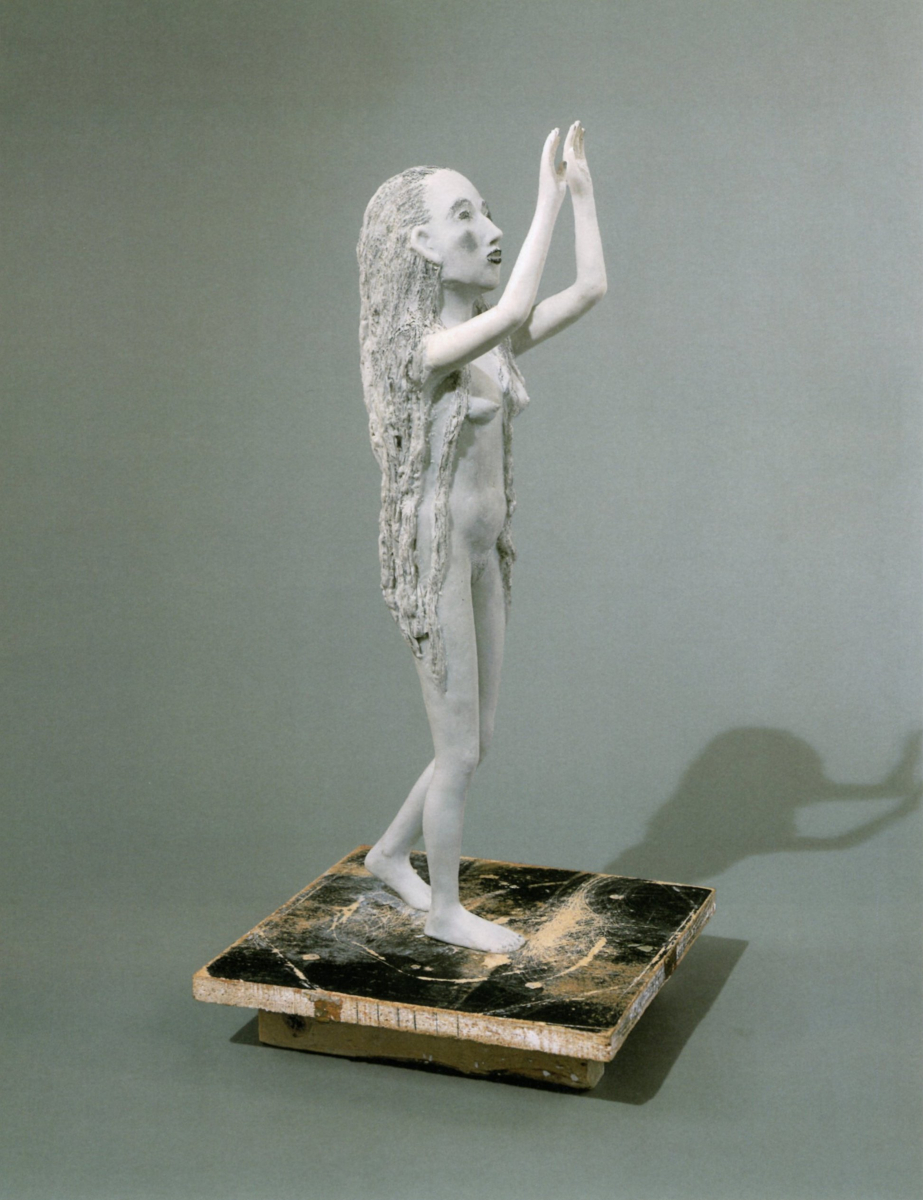
Smith, Kiki_Eve
Kiki Smith (American, 1954–), Eve, 2001. Manzini (resin and marble dust) and graphite, 20 3/8 × 5 × 6 3/4 in. (51.8 × 12.7 × 17.1 cm). Source: Kiki Smith: A Gathering, 1980–2005, p. 247

Eve, the mother of all living, a representative of humanity. The crown of God’s creation, and yet she distrusted God’s word, transgressed his command, breaking what was intended to be an eternal communion. In this small sculpture, she looks up, raising her hands in front of her face—in a gesture of prayer or praise? Shielding her eyes from brightness? Could it be she sees redemption on the horizon?

LISTEN: “Lecha Dodi” (Come, My Beloved), traditional Jewish hymn | Words by Shlomo ha-Levi Alkabetz, based on verses from the Hebrew Bible, 16th century | Music by Maayan Tzafrir, 2021 | Sung by Maayan Tzafrir, 2021

(Turn on CC on the video to read the Hebrew lyrics alongside the English.)

ENGLISH TRANSLATION (supplied by 12 Tribes Music):

Rouse yourselves! Rouse yourselves! [Isa. 51:17]
Your light is coming; rise up and shine. [Isa. 60:1]
Awake! Awake! Utter a song.
The glory of God is revealed upon you.

Who is this that cometh up out of the wilderness,
Perfumed with myrrh and frankincense,
With all the fragrant powders of a merchant? [Song of Sol. 3:6]

Shake off the ashes! Rise up from the dust!
Put on your garments of splendor, my people. [Isa. 52:1]
Through the son of Yishai [Jesse] of Bethlehem,
Redemption draws near to my soul.

Awake! Awake! Utter a song,
Let me see thy countenance.
Awake! Awake! Utter a song,
Let me hear thy voice.

When I was a student at UNC–Chapel Hill, I was curious to learn more about the Jewish roots of my Christian faith. I reached out to the Jewish campus organization Hillel, and they invited me to attend their Shabbat dinner, hosted every Friday at sundown at a large house on Cameron Ave.

Most markedly, I remember, before eating, the communal singing of the piyyut (Jewish liturgical poem) “Lecha Dodi” as everyone turned to face the door. I had no idea what the words meant—they were in Hebrew—or what the orientation of bodies was communicating. The song was part of the group’s regular liturgy, familiar to the Jewish students who were gathered, so no introduction or explanation was given, no lyric sheet that I recall. Afterward I asked the rabbi what just happened. “We welcomed in the Shabbat bride,” she said. “The Shekinah.” (The Shekinah is a dwelling or settling of the divine presence. The word is a feminine noun in Hebrew.)

I was puzzled by this statement. It sounded so mystical, challenging my very literalistic sensibilities at the time. The words of the song, by the rabbi and Kabbalist Shlomo ha-Levi Alkabetz (1500–1576), are mostly a composite of scripture texts from the Song of Songs, Isaiah, and elsewhere. Rabbi Shlomo personifies Shabbat (the Sabbath) as a bride, and Israel as her mate. The song anticipates the everlasting Shabbat, ultimate redemption, as the people of Israel ask God to bring about messianic deliverance.

(Related posts: https://artandtheology.org/2024/12/10/advent-day-10-bridegroom-of-the-soul/; https://artandtheology.org/2019/11/26/salvation-is-him-artful-devotion/)

I was taken back to this experience from almost twenty years ago when recently, I came across a version of the “Lecha Dodi” distributed by 12 Tribes Music [previously]. There are hundreds of different tunes for Rabbi Shlomo’s text, from medieval Moorish to northern European folk; but 12 Tribes features a newer setting by the Israeli musician Maayan Tzafrir.

The YouTube video description provides some biographical background:

Maayan Tzafrir is a singer and musician who weaves Balkan and Middle Eastern musical traditions with her Jewish roots. In her music she combines ancient piyutim (chants) with folk melodies. Maayan’s original compositions are inspired by Greek, Bulgarian, Georgian, and Turkish traditions. Maayan is the founder and vocal leader of the Yearot Ensemble, a singer in the Greek band Tavernikos, founder of The Hebrew Balkan Choir, and conductor of various workshops, meetings, and tours focusing on Balkan traditional singing with a Hebrew and feminine spirit.

The lyrics provided for Tzafrir’s version differ slightly from the traditional lyrics. It appears that she uses verses 5 and 4, with complementary material in between.

As a Christian, I can’t help but hear these words in light of Jesus. Several of the Hebrew scripture texts for Jewish Shabbat overlap with the Hebrew scripture texts for the Christian season of Advent, which is itself a dedicated time of looking forward to the arrival of the Messiah, beseeching his coming to dwell.

The phrase “son of Jesse” is a reference to the royal Davidic line from which the Messiah will come—and, in Christian belief, did come, in Jesus of Nazareth, son of Mary, who has since ascended into heaven but has promised to return to bring about the fullness of God’s kingdom.

Awake! Sing! Redemption draweth nigh!
Advent, Day 17: O!

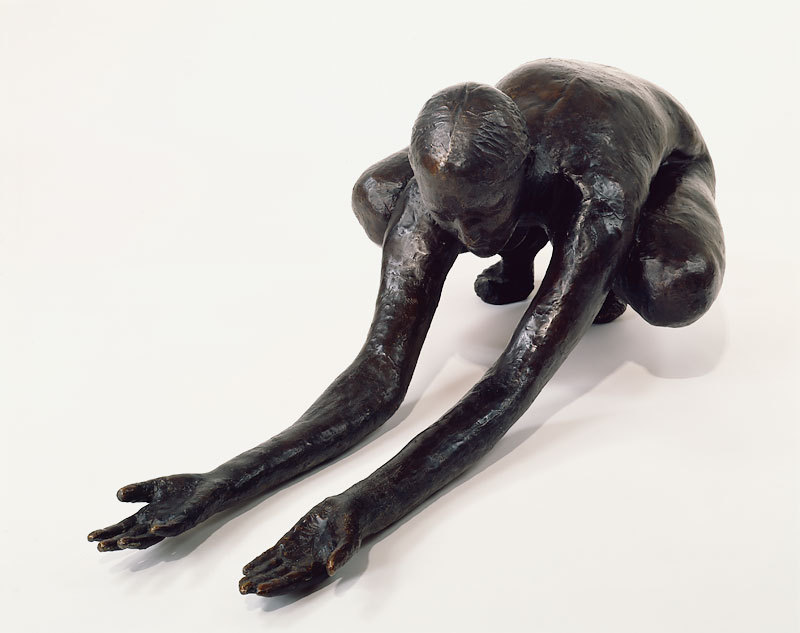
LOOK: Untitled by Kiki Smith

Smith, Kiki_Untitled bronze
Kiki Smith (American, 1954–), Untitled, 1992. Bronze with patina, 19 1/2 × 51 × 25 in. (49.5 × 129.5 × 63.5 cm). Edition of 2 + 1 AP. © Kiki Smith, courtesy The Pace Gallery.

LISTEN: “Advent ‘O’ Carol” by Joanna Forbes L’Estrange, 2018 | Performed by London Voices, dir. Ben Parry, on Winter Light, 2024

Refrain:
O, O, O, O, O, O, O
O, O, O, O, O, O, O

We long for your coming, O Wisdom;
we long for your coming, O Lord.
Come and teach us the way of understanding;
you are the living Word. [Refrain]

We long for you, O Lord and Ruler;
we long for your coming, O Lord.
Come and stretch out your arms and redeem us;
you are the living Word. [Refrain]

We long for you, O Root of Jesse;
we long for your coming, O Lord.
Come to deliver us and do not tarry;
you are the living Word. [Refrain]

We long for you, O Key of David;
we long for your coming, O Lord.
Come and bring forth the captive from his prison,
who sits in the shadow of death. [Refrain]

Dawn of the East,
we long for your coming, O Lord.
Come and lighten those who sit in darkness
and in the shadow of death. [Refrain]

We long for you, O King of the Gentiles;
we long for your coming, O Lord.
Come and deliver man, whom you formed
out of the dust of the earth. [Refrain]

O Emmanuel!
When will you come?
Come to save us, O Lord our God. [Refrain]

Tomorrow I will come.

Revealing different titles of the Messiah based on Isaiah’s prophecies, the seven so-called O Antiphons have been sung, one each from December 17 to 23, since at least as far back as the eighth century. For Christians outside the Roman Catholic Church, these antiphons are probably most familiar as the basis of the Advent hymn “O Come, O Come, Emmanuel.”

The British composer Joanna Forbes L’Estrange has lightly adapted them and set them to music for unaccompanied SATB choir. She offers the following note:

“Advent ‘O’ Carol” is inspired by the text and chants of the seven “O” Antiphons which traditionally would have been sung in the days immediately preceding Christmas (known as the Greater Ferias). The “O” refrain, which opens the piece and reoccurs between each of the seven verses, is based on the opening melodic chant of the Medieval antiphons, its 7/8 time signature reinforcing the piece’s connection to the number seven.

Ignoring the “O,” the first letter of each verse forms an acrostic which, when reversed, spells ERO CRAS, Latin for “I shall be (with you) tomorrow.” I have reworded this as “Tomorrow I will come” for the final resolution of the piece.

  1. Sapientia (Wisdom)
  2. Adonai (Lord and Ruler)
  3. Radix Jesse (Root of Jesse)
  4. Clavis David (Key of David)
  5. Oriens (Dawn of the East)
  6. Rex Gentium (King of the Gentiles)
  7. Emmanuel

“Leavetaking” by Anne Porter

Starry, Starry Night by Kiki Smith
Kiki Smith (American, 1954–), Starry, Starry Night, 2013

“Leavetaking” by Anne Porter

Nearing the start of that mysterious last season
Which brings us to the close of the other four,
I’m somewhat afraid and don’t know how to prepare
So I will praise you.

I will praise you for the glaze on buttercups
And for the pearly scent of wild fresh water
And the great crossbow shapes of swans flying over
With that strong silken threshing sound of wings
Which you gave them when you made them without voices.

And I will praise you for crickets.
On starry autumn nights
When the earth is cooling
Their rusty diminutive music
Repeated over and over
Is the very marrow of peace.

And I praise you for crows calling from treetops
The speech of my first village,
And for the sparrow’s flash of song
Flinging me in an instant
The joy of a child who woke
Each morning to the freedom
Of her mother’s unclouded love
And lived in it like a country.

And I praise you that from vacant lots
From only broken glass and candy wrappers
You raise up the blue chicory flowers.

I thank you for that secret praise
Which burns in every creature,
And I ask you to bring us to life
Out of every sort of death

And teach us mercy.

This poem appears in Living Things: Collected Poems (Hanover, NH: Zoland Books/Steerforth Press, 2006) and is used here by permission of the publisher.

+++

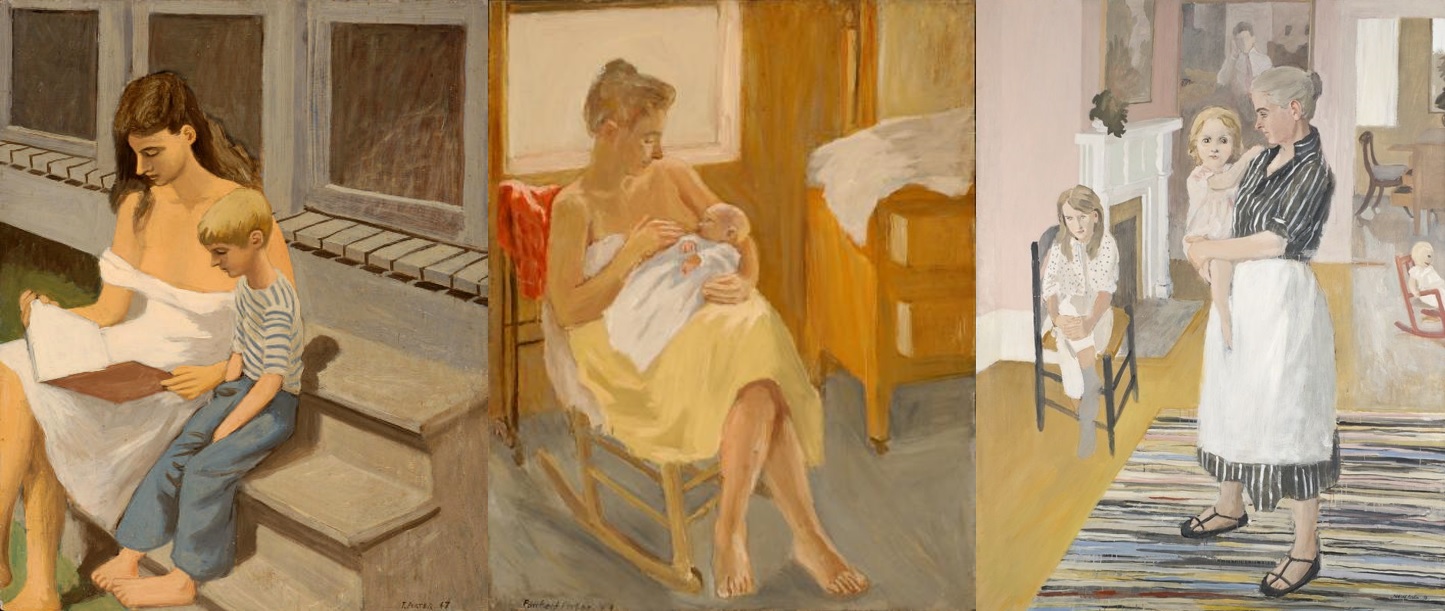
Anne Porter (1911–2011) is one of the last century’s foremost poets of thanks and praise. She wrote all her life, occasionally sharing poems with friends and family, but she focused mainly on raising five kids with her husband, Fairfield Porter, who was a painter.

Motherhood paintings by Fairfield Porter
Fairfield Porter (American, 1907–1975): Anne Reading to Laurence, 1947, oil on Masonite, 30 × 24 in., Parrish Art Museum, Southampton, New York; Katie and Anne, 1949, oil on board, 30 × 24 in., Parrish Art Museum, Southampton, New York; Anne, Lizzie and Katie, 1958, oil on canvas, 78 × 60 in., Sheldon Museum of Art, Lincoln, Nebraska.

She wrote “Leavetaking” upon entering old age, and after her husband had died. As her body grew weaker and more burdensome and death drew nearer, she still found much to praise God for—for the regal shape of swans’ wings overhead, for the “rusty diminutive music” of crickets on starry nights, for the vast love between mother and child, for the hope of resurrection preached in abandoned lots where flowers rise out of debris.

Some years later, Porter’s friend David Shapiro, a literary critic and fellow poet, asked if for his birthday, she could compile some of her poems for him. She gathered up what she could find in the house, and without her foreknowledge, he submitted it to a publisher. The resulting collection, An Altogether Different Language (1994), was published when she was eighty-three and was named a finalist for the National Book Award.

In the foreword to that first book of hers, Shapiro wrote,

If we have problems, because so much of the language of belief has grown connotatively encrusted, then we wait for the poets who believe enough and can freshen this dialect.

Anne Porter is one of the rare poets who believes enough, who lives in days and holidays, and who has stunningly found a language to transmit her Franciscan joy in created things.

Also from the foreword:

  • “Her faith has enlarged her, not the reverse, and her poetry has the grandeur of seeing things ‘as if for the first time.’”
  • “Her greatest emotional perspective is that of praise.”
  • She is “an American religious poet of stature who reminds us that the idea of the holy is still possible for us.”
  • “For Anne Porter, the holy is found in a commitment to Christ the Mediator and his triumph in suffering for a suffering world. However, she gives a constant, almost pantheistic pressure to the theme that the Kingdom of God is within and without, so that her radiant if concise imagism is all in the service of God.”

Whereas many modern and contemporary poets write about the hiddenness of God, the deus absconditus, Porter wrote unabashedly about the myriad ways in which God reveals himself in the world. Her second and last book, Living Things: Collected Poems (2006), brings together thirty-nine new poems with those published in the previous volume.

In 2010, theologian and biblical scholar Ellen F. Davis wrote a beautiful article for the Christian Century titled “Our proper place: The poetry of care and loss,” in which she discusses Porter’s poetry alongside that of Mary Oliver. Like Oliver, she says, Porter is a “direct descendant of the psalmists”; she “clarif[ies] what is at stake in the Psalter: nothing less than the possibility of praising God truly.”