Roundup: “Poetry for All” podcast, startling Crashaw poem, despair and grace, and more

SPOTIFY PLAYLIST: October 2025 (Art & Theology)

+++

PODCAST: Poetry for All, hosted by Joanne Diaz and Abram Van Engen: Poetry for All “is for those who already love poetry and for those who know very little about it. In this podcast, we read a poem, discuss it, see what makes it tick, learn how it works, grow from it, and then read it one more time.” I’ve consistently enjoyed this podcast since its launch in 2020, having learned about it through cohost Abram Van Engen [previously], an academic who often writes and speaks about poetry for general Christian audiences. Here are some of my favorite episodes of the ninety-seven that have been released to date:

  • Three haiku by Kobayashi Issa, translated from the Japanese by Robert Hass: The first: “The snow is melting / and the village is flooded / with children.” Learn the characteristics of what Joanne Diaz calls “the perfect poetic form.”
  • “spring song” by Lucille Clifton: One of my favorite poems by one of my favorite poets. “This joyful poem caps a sequence of sixteen poems called ‘some jesus,’ which walks through biblical characters (beginning with Adam and Eve) and ends on four poems for Holy Week and Easter. [Clifton] wrote other poems on the Bible as well, including ‘john’ and ‘my dream about the second coming,’ which reimagine a way into biblical characters to make their stories fresh.”
  • “Elegy for My Mother’s Mind” by Laura Van Prooyen: This episode is unique in that it has the poet herself on to read and discuss the poem, which in this case navigates the complexities of memory, loss, and familial relationships.
  • “View but This Tulip” by Hester Pulter: Ashamedly, I had never heard of this seventeenth-century female poet before listening to this episode, so I’m grateful to guest Wendy Wall, cocreator of the award-winning Pulter Project website, for introducing me to her! “In this episode we discuss [Pulter’s] work with emblems, her scientific chemistry experiment with flowers, and her wonderment (both worried and confident, doubtful and awestruck) about the resurrection of the body and its reunification with the soul after death.”
  • “From Blossoms” by Li-Young Lee: A much-anthologized poem ostensibly about eating summer peaches, but more deeply, it’s about joy. “One of the things that draws me to this poem,” says Van Engen, “is that joy is actually very hard to write about . . . without it sounding naive or sentimental or withdrawn or unaware.”
  • “Primary Care” by Rafael Campo: Dr. Rafael Campo is both a poet and a practicing physician. Here he uses blank verse to explore the experience of illness and suffering.

+++

POEMS:

>> “For V. the Bag Lady, Great in the Kingdom of Heaven,” “Damascus Road,” “The Sower,” and “Crosses” by Paul J. Pastor: The Rabbit Room received permission to reproduce four poems from Paul J. Pastor’s [previously] new poetry collection, The Locust Years, which “explores a world of mystery and sorrow, desolation and love. Rooted in the Pacific Northwest, these poems offer readers an invitation to walk along a path pebbled with profound joy and deep loss.” I’ll be sharing another on the blog next week, courtesy of Wiseblood Books.

>> “Undone” by Michael Stalcup: The rise of blogging in the aughts and its descendant, Substacking, in the last few years has meant that poets and other writers can share their work directly with their reading publics and give them insight into their creative process if they wish. On his Substack, the Thai American poet Michael Stalcup [previously] recently shared one of his new poems that’s based on the story of the woman caught in adultery in John 8:1–11. He explains how the poem’s form, a blend of the Petrarchan sonnet and the chiasmus, contributes to its meaning.
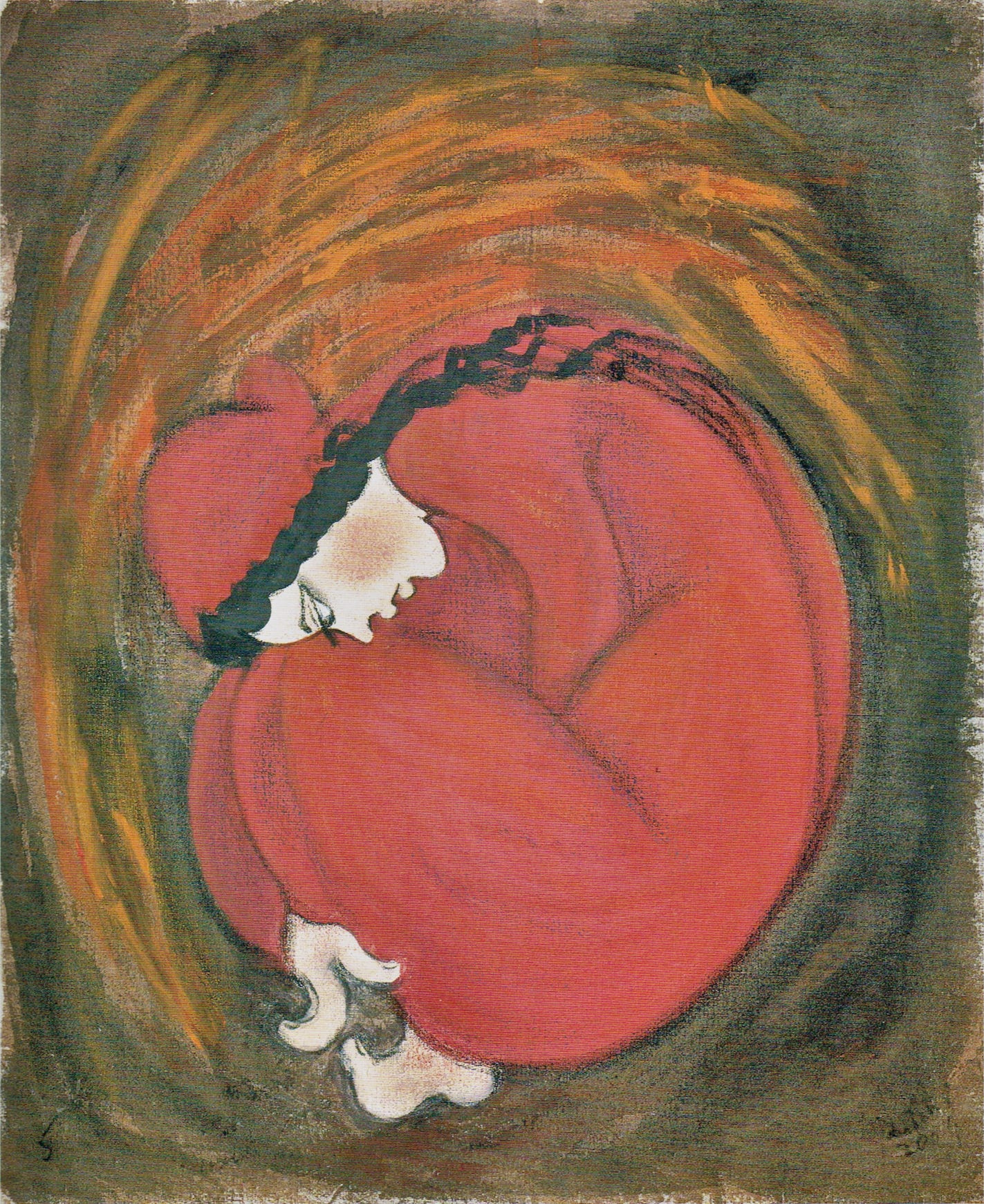
Jayasuriya, Nalini_Go, Sin No More
Nalini Jayasuriya (Sri Lankan, 1927–2014), Go, Sin No More, 2004. Mixed media on cloth, 23 × 19 in. Published in The Christian Story: Five Asian Artists Today, ed. Patricia C. Pongracz, Volker Küster, and John W. Cook (Museum of Biblical Art, 2007), p. 119.

+++

POEM COMMENTARY: “The Crèche and the Brothel: The Poetic Turn in Crashaw’s Infamous Epigram” by Kimberly Johnson, Voltage Poetry: The seventeenth-century Anglican-turned-Catholic poet Richard Crashaw [previously] was a master of the epigram, and this is one of my favorites of his:

Blessed be the paps which Thou hast sucked.
    —Luke 11:27

Suppose he had been Tabled at thy Teats,
Thy hunger feels not what he eats:
He’ll have his Teat ere long (a bloody one).
The Mother then must suck the Son.

Scholar Kimberly Johnson [previously] unpacks these four lines about the body of Christ, who as an infant drank milk from his mother’s breast, and whose sacrificial death opened up his own breast whence flows the blood that nourishes us all. Johnson teases out the overlap of physical and spiritual in the poem, highlighting the maternal sharing of one’s own substance that links both couplets. At the eucharistic table, we are bidden to come and eat; or, in the stark metaphorical language of Crashaw, come and suck Christ’s bloody teat.

I plan to write an essay sometime about Christ as a nursing mother, as I’ve seen the image pop up in medieval writings and some visual art, including from Kongo and Ethiopia. In the meantime, here’s an illumination of the sixth vision in part 2 of Hildegard of Bingen’s Scivias (Know the Ways), painted under the supervision of Hildy herself. It shows the crucified Christ feeding Ecclesia (his bride, the church) with blood from his breast.
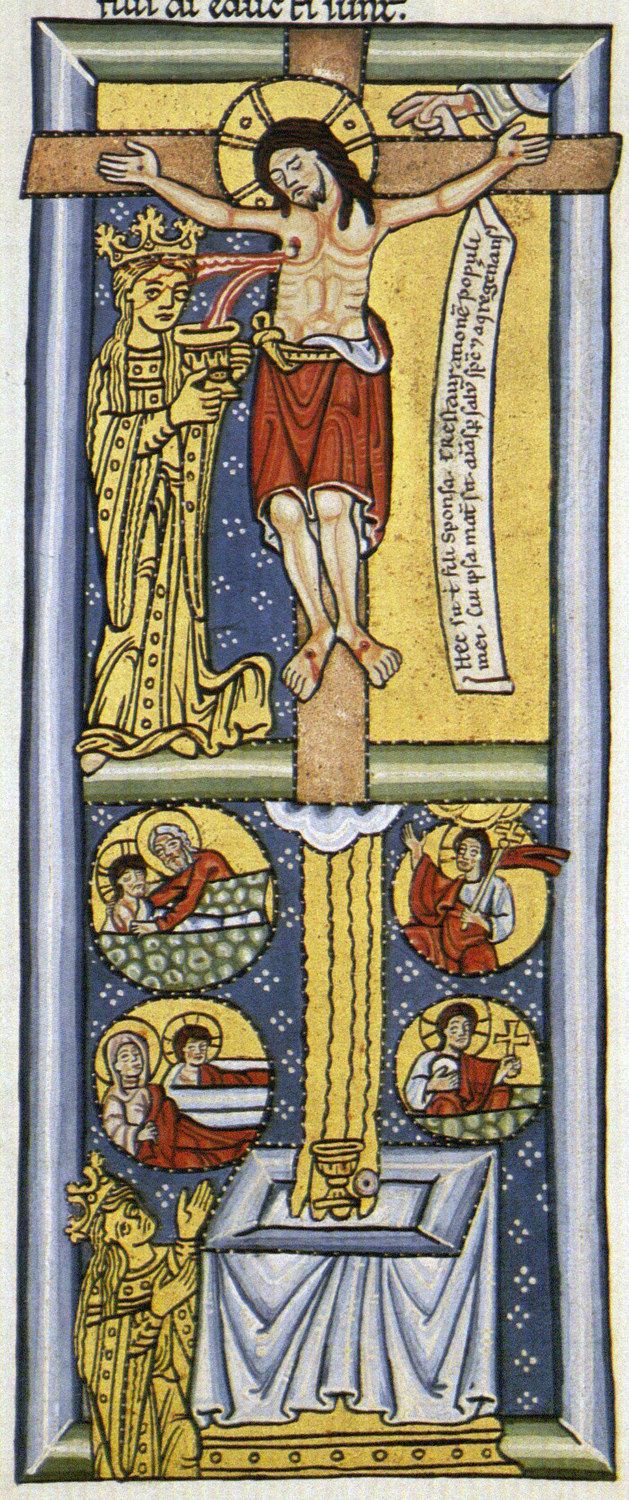
Hildegard of Bingen_Crucifixion
“The Crucifixion and the Eucharist,” from Scivias (Know the Ways) II.6, Rupertsberg Abbey, Germany, before 1179. Rupertsberg Codex, fol. 86r, Hildegard Abbey, Eibingen, Germany. The original manuscript from Hildegard’s lifetime was lost in 1945, but a faithful copy was made in 1927–33, which is the source of the color reproductions now available.

+++

ESSAY: “Only One Heart: The Poetry of Franz Wright as Emblem of God’s Grace” by Bonnie Rubrecht, Curator: “Are You / just a word? // Are we beheld, or am I all alone?” These three lines typify the poetry of Franz Wright (1953–2015), the Pulitzer Prize–winning author of Walking to Martha’s Vineyard, God’s Silence, and other collections. “Wright’s work is often described as confessional, colored by irony and humor. His irreverence, juxtaposed with honesty and humility, make his poetic voice unique in addressing God. Writers and poets often traffic in spiritual themes, but few modern poets echo the prophetic Old Testament tradition of crying out, approaching God with the concision and raw emotion that Wright does. He excels in voicing the concerns and ruminations of the human experience of suffering, while simultaneously shifting towards his own embodiment of grace.”
Pentecost roundup: Invocations; Holy Spirit as “lodes-mon”; organ improv; tongues of fire in a flower patch

SONGS:

Here are three sung invocations of the Holy Spirit, seeking his power, liberation, comfort, light, and renewal.

>> “Holy Spirit, Come with Power”: This hymn was written by Anne Neufeld Rupp in 1970, who set it to a Sacred Harp tune from 1844 attributed to B. F. White. It’s performed here by the Bel Canto Singers from Hesston College in Kansas, featuring Gretchen Priest-May on fiddle and Tim May on acoustic guitar.

I was introduced to this hymn through the Voices Together Mennonite hymnal, where it appears in both English and Spanish as no. 57.

>> “Mweya Mutsvene” (Holy Spirit, Take Your Place) by Joshua Mtima and The Unveiled: The Unveiled is a collective of Christian musicians from Harare, Zimbabwe, founded by Joshua Mtima in 2020. Here they sing one of their songs in Shona. An English translation is provided onscreen. [HT: Global Christian Worship]

>> “Ven Espíritu Divino (Secuencia de Pentecostés)” (Come, Spirit Divine) by Pablo Coloma, performed by Chiara Bellucci: The Spanish lyrics of this contemporary Christian song from the Latin American Catholic tradition are in the YouTube video description. They ask the Holy Spirit, “sweet guest of our souls,” to come bringing healing, regeneration, growth, joy, and charisms.

+++

SUBSTACK POST: “Veni Creator Spiritus: A Lush Middle English Hymn” by Grace Hamman, Medievalish: Dr. Grace Hamman shares Friar William Herebert’s (ca. 1270–ca. 1333) Middle English translation of the classic Latin Pentecost hymn attributed to Rabanus Maurus (ca. 780–856), “Veni Creator Spiritus” [previously]. Herebert uses words like vor-speker (for-speaker; i.e., intercessor), lodes-mon (lodesman; i.e., journeyman or navigator), and shuppere (shaper) as titles for the Holy Spirit.

+++

ORGAN WORK: “Improvisation on Veni Creator Spiritus” by Alfred V. Fedak: “Your congregation will hear the rushing of the Holy Spirit in this improvisatory prelude (taken from Fedak’s and Carl P. Daw’s oratorio The Glories of God’s Grace),” writes Selah Publishing. “Fedak effectively uses sweeping whole-tone scale passages and arpeggios to indicate the Spirit’s presence, while the pedal plays phrases of the hymn tune,” a medieval plainchant. The publisher has posted the following performance of the piece (audio only), by the composer himself, along with a selection of Pentecost art from the thirteenth to eighteenth centuries. [HT: Global Christian Worship]

There are many other works on organ (fantasias, partitas, fugues) based on the “Veni Creator Spiritus” tune; view a select list on Wikipedia.

+++

POEM: “Book of Hours” by Kimberly Johnson: “A pentecost of bloom: all the furred tongues / awag in the iris patch, windrush through the fireflower.” So opens the poem “Book of Hours” by Kimberly Johnson [previously], from her collection Uncommon Prayer (Persea, 2014). A book of hours is a genre of medieval prayer-book used by laypeople, which arranges prayers, scripture, and other devotional texts for reading at prescribed times of the day. Johnson’s “Book of Hours” draws on the fields of codicology (the study of manuscripts as physical objects) and botany to consider how God’s Spirit moves through and enlivens the material world, be it the irises, fire lilies, alyssum, and paperwhite narcissus in her garden, or the ink and natural pigments on calfskin—green verdigris, red cochineal, yellow curcumin—in the rare manuscripts library where she examines a book of hours whose embellished Latin text she can’t quite make out but whose beauty enraptures her nonetheless. These are but two untranslatable experiences of sensual, embodied communion with God that Johnson narrates in the collection, the paint flakes on her lips and the pollen on her wrist a chrism and a prayer.

ESSAY: “On ‘Laudes Creaturarum’ (‘All Creatures of Our God and King’): A Polyphony” by Kimberly Johnson

Blogger’s note: I’m fascinated by the history of hymns—all the creative hands they pass through (lyricists, translators, composers, harmonizers, arrangers, hymnal editors, church musicians, worship pastors, recording artists, etc.) to become what we use in our churches today. In this essay, poet, translator, and literary critic Kimberly Johnson traces in fragments the history of “All Creatures of Our God and King” [previously], interweaving that history with snippets of the authors’ biographies, musical analysis, personal confession, and observations from the time she spent in and around the hymn’s origin place of Assisi in the Umbria region of Italy.

Copyright credit: The essay “On ‘Laudes Creaturarum’ (‘All Creatures of Our God and King’): A Polyphony” by Kimberly Johnson is from Stars Shall Bend Their Voices: Poets’ Favorite Hymns and Spiritual Songs, edited by Jeffrey L. Johnson (Asheville, NC: Orison Books, 2018). It is reproduced here by permission of the publisher. I’ve added the photos for visual reference.

Laudes Creaturarum

Altissimu onnipotente bon signore
      tue so le laude la gloria e l’ onore e onne benedictione.
Ad te solo altissimo se konfano
      e nullu homo ene dignu te mentovare.
Laudatu si mi signore cum tucte le tue creature
      spetialmente messor lu frate sole
      lu quale iorno et allumini per loi.
E ellu è bellu e radiante cum grande splendore
      de te altissimu porta significatione.
Laudatu si mi signore per sora luna e le stelle
      in celu l’ ai formate et pretiose e belle.
Laudatu si mi signore per frate vento
      e per aere e nubilo e sereno et onne tempu
      per lu quale a le tue creature dai sustentamentu.
Laudatu si mi signore per sor aqua
      la quale è multo utile e humele e pretiosa e casta.
Laudatu si mi signore per per frate focu
      per lu quale n’ allumeni la nocte
      e ellu è bello e iucundo e robusto e forte.
Laudatu si mi signore per sora nostra matre terra
      la quale ne sustenta e governa
      e produce diversi fructi e coloriti fiore e erba.
Laudatu si mi signore per quilli ke perdonano per lo tue amore
      e sostengono infirmitate e tribulation
      beati quelli ke ‘l sosterranno in pace
      ke da te altissimu sirano incoronati.
Laudatu si mi signore per sora nostra morte corporale
      da la quale nullu homo vivente po skappare
      guai a quilli ke morranno in peccata mortale.
      Beati quelli ke troverà ne le tue sanctissime voluntati
      ke la morte secunda no ’l poterà far male.
Laudate e benedicete lu mi signore e rengratiate
      e servite a lui cum grande humilitate. Amen.

Francis of Assisi, c. 1225

Praises of the Creatures

Highest, omnipotent, good our Lord,
      yours are the praises, the glory, the honor, and all blessing.
To you alone, Most High, they are owed,
      and no mortal is worthy to mention you.
Be praised, my Lord, through all your creatures,
      especially through my Lord Brother Sun,
      who brings the day, and you shed light through him.
And he is beautiful and radiant in his grand splendor!
      Of you, Most High, he bears the likeness.
Be praised, my Lord, through Sister Moon and the stars;
      in heaven you formed them, bright and precious and beautiful.
Be praised, my Lord, through Brother Wind
      and through the air, cloudy and serene, and through all weathers
      by which you give your creatures sustenance.
Be praised, my Lord, through Sister Water,
      who is so useful and humble and precious and chaste.
Be praised, my Lord, through Brother Fire,
      through whom you illuminate the night;
      and he is lovely and playful and robust and strong.
Be praised, my Lord, through our Sister Mother Earth,
      who sustains and governs us
      and who brings forth varied fruits with vibrant flowers and herbs.
Be praised, my Lord, through those who give pardon for love of you,
      and bear infirmity and tribulation;
      blessed are those who persevere in peace,
      for they will be, by you Most High, endowed a crown.
Be praised, my Lord, through our sister, Death-of-the-Flesh,
      from whom no living mortal can escape.
      Woe to those who die in mortal sin!
      Blessed whom death finds abiding in your most sacred will,
      for the second death shall do them no harm.
Praise and bless my Lord, and render thanks to Him,
      and serve Him with great humility. Amen.

Translated from the Italian by Kimberly Johnson, 2018

All Creatures of Our God and King

All creatures of our God and King,
lift up your voice and with us sing:
Alleluia, alleluia!
O burning sun with golden beam,
and shining moon with silver gleam,
O praise Him, O praise Him,
Alleluia, alleluia, alleluia!

O rushing wind so wild and strong,
white clouds that sail in heaven along:
Alleluia, alleluia!
New rising dawn in praise rejoice;
you lights of evening find a voice,
O praise Him, O praise Him,
Alleluia, alleluia, alleluia!

Cool flowing water, pure and clear,
make music for your Lord to hear:
Alleluia, alleluia!
Fierce fire, so masterful and bright,
providing us with warmth and light,
O praise Him, O praise Him,
Alleluia, alleluia, alleluia!

Earth ever fertile, day by day,
bring forth your blessings on our way:
Alleluia, alleluia!
All flowers and fruits that in you grow,
let them his glory also show,
O praise Him, O praise Him,
Alleluia, alleluia, alleluia!

All you who are of tender heart,
forgiving others, take your part:
Alleluia, alleluia!
All you who pain and sorrow bear,
praise God and on him cast your care,
O praise Him, O praise Him,
Alleluia, alleluia, alleluia!

And thou most kind and gentle death,
waiting to hush our latest breath:
Alleluia, alleluia!
Thou leadest home the child of God,
and Christ our Lord the way hath trod.
O praise Him, O praise Him,
Alleluia, alleluia, alleluia!

Let all things their Creator bless,
and worship Him in humbleness:
Alleluia, alleluia!
Praise, praise the Father, praise the Son,
and praise the Spirit, Three in One!
O praise Him, O praise Him,
Alleluia, alleluia, alleluia!

Translated from the Italian by William Henry Draper, 1919

Basilica of St. Francis of Assisi
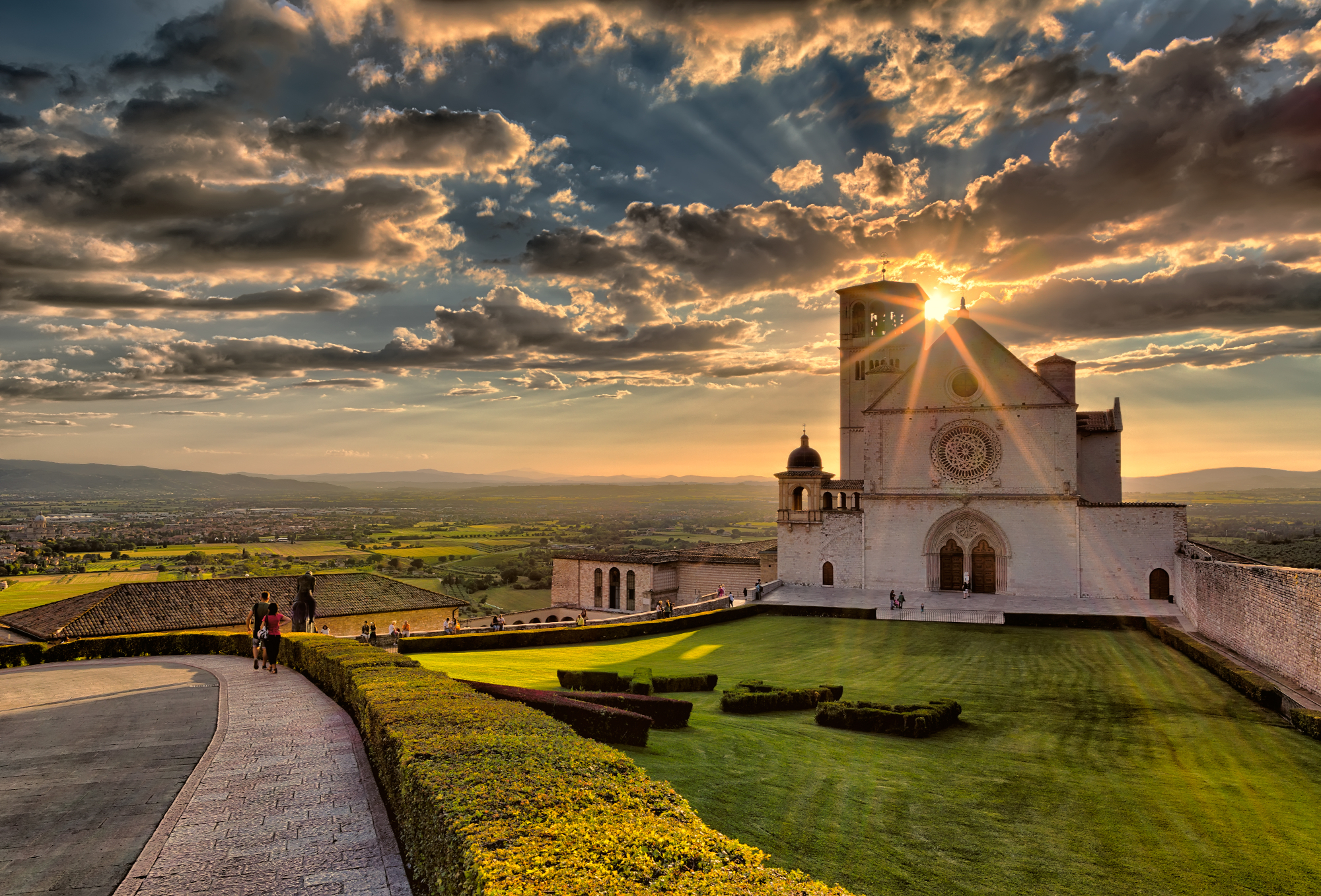
Basilica of St. Francis of Assisi, Assisi, Italy. Photo: Giorgio Art.

In Assisi, the sky vaults clouded and serene against the foothills.

*

Pietro, known as Francesco, devoted brother of his order, put quill to thirteenth-century parchment and began to praise. His inspiration was Psalm 148, whose Hebrew exhortations spur the sun and moon, the stars and highest heavens, tempests and mountains and wingèd birds to sing their Lord’s splendid name. Barchu and Hallelu.

*

In the trees that ring the great cathedral at Assisi, birds trill an antiphon in the innumerable dialects of their collected species.

*

“Laudatu si mi signore per sora nostra morte corporale,” Francis wrote in his backwater dialect, “da la quale nullu homo vivente po skappare.” Be praised, my Lord, through our sister, Death-of-the-Flesh, from whom no living mortal can escape.

*

William Henry Draper lost his first wife in childbirth. He lost his second wife in her youth. He lost three sons in World War I and a daughter in her childhood.

*

In Francesco’s hymn, the psalm’s call to worship forges familial bonds, each voice enfolded into the household: My Lord Brother Sun. Sister Moon and Sister Water, Brother Fire and Brother Wind.

*

Twice widowed, four times unfathered, William Henry Draper served as rector of the parish church in Leeds, where, in 1919, he translated a centuries-old poem by an Umbrian monk for a Whitsunday children’s concert.

*

On Whitsunday, the Assisi cathedral is afire with cloven tongues, pilgrims murmuring a babel of prayer.

*

Thou rushing wind that art so strong

*

At the wind of the day I walked the fortress wall on Assisi’s hilltop as the houselights came on below. “A mighty fortress is our God,” another word-dazzled monk would write three centuries after Francesco threw open the enclosures of monastic care to the lazar-house, the beggars, the birds.

*

At a piazza dinner in the hilltop town of Perugia, against which the young soldier Pietro called Francesco marched impenitent and won a year in prison for his pains, I overhear a tourist family at the next table. In New Jersey cadence, the mother suggests a next day’s trip to the basilica in Assisi. She sells it: “It’s where St. Francis is from.” Her son whines, “Who’s St. Francis?” The mother pauses. The pavement birds are belled into the evening sky. “He’s this really famous Franciscan monk.”

*

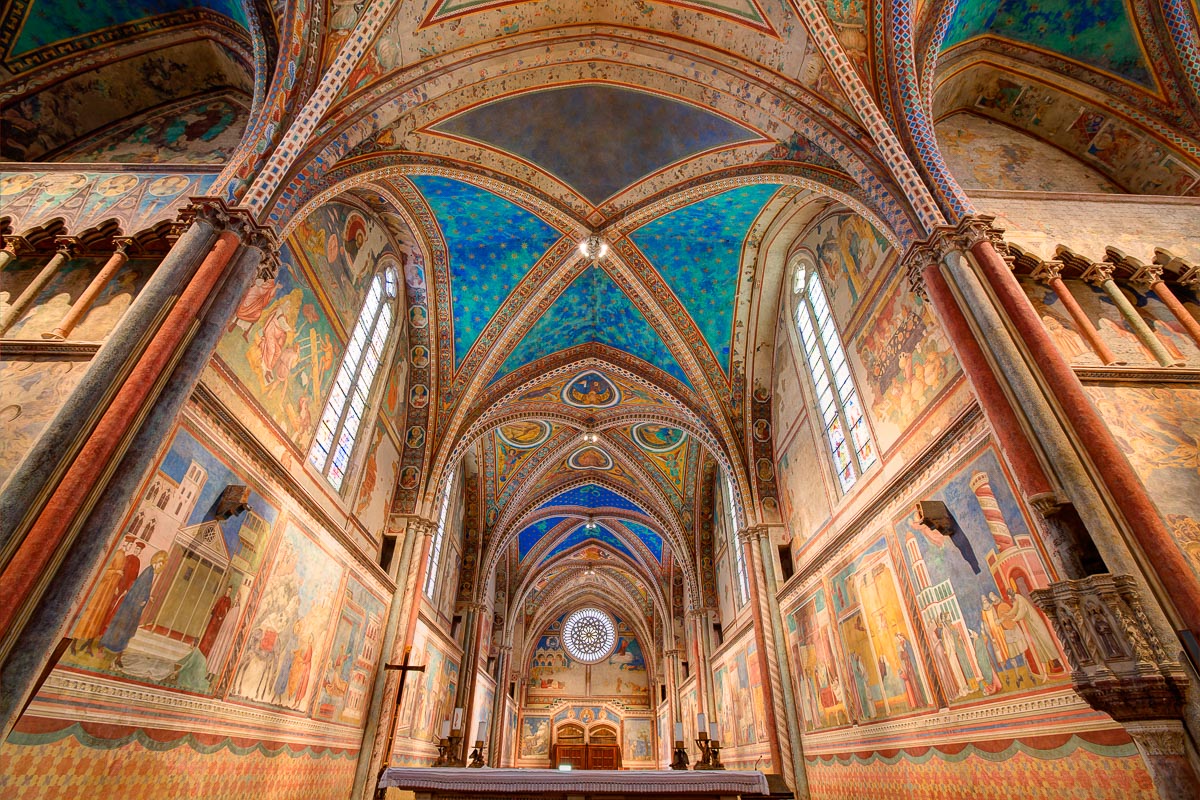
In the basilica, the nave vaults with sky, a gloaming blue clouded with verdant green. Gold stars fan out like finches. Like gilt notes on an ethereal staff.

Basilica of St. Francis of Assisi
Basilica of St. Francis of Assisi, Assisi, Italy. Photo: Gustavo Kralj / Gaudium Press Images.

*

Ralph Vaughan Williams, son of a vicar, took up an old German tune, “Lasst uns Erfreuen” (“Let Us Rejoice”), harmonizing his Anglican to that melody’s spare Jesuit. And how hear we every man in our own tongue, wherein we were born?

*

It’s not the repeated alleluia. It’s not the catalogue of earthy beauty. It’s not the open-throated Ptolemaic chime. What undoes me is the single minor chord.

*

Undone. Unfathered. Lazar-house. Lost. Tempest. Prison. Babel. Evening. “Sora nostra morte corporale.”

*

The minor chord: unheard in the tune’s Teutonic plainchants, unheard before Vaughan Williams’s harmonies. It falls at the end of the penultimate line of each verse—in some versions of Draper’s English text, the minored syllable is Him, and in some it is Jah; either way, God takes the fall.

*

Vaughan Williams’s minor chord is the musical cognate of Francesco’s steadfast praise in and through the death of the flesh: a gut punch that refuses to be redeemed by the next line’s joy.

*

Confiteor: The next line’s return to D major requires a resolve that, many days, I don’t have.

*

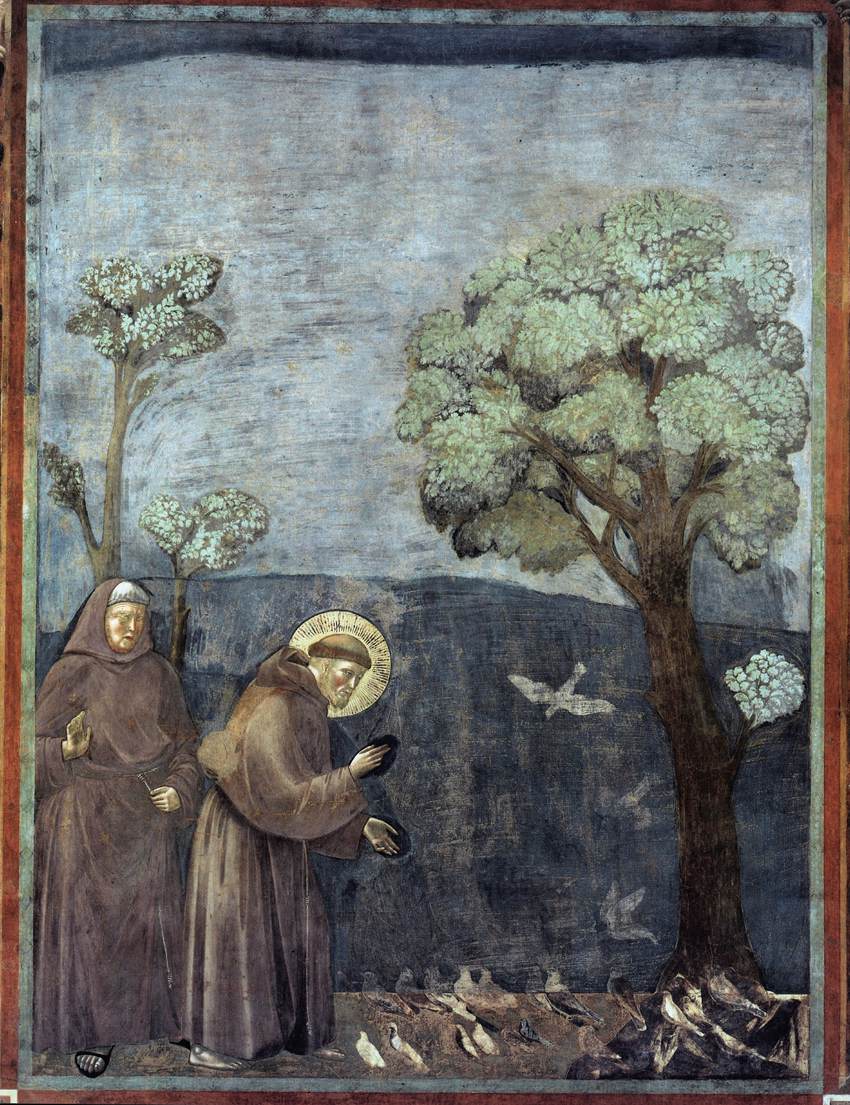
In the Upper Church in Assisi, the fresco cycle attributed (probably wrongly) to Giotto includes San Francesco d’Assisi predica agli uccelli. There are doves, of course, in the saint’s congregation. There is a woodcock, I think. A robin. They will not fly until his sermon is finished. Until he follows the downpour with worms.

St. Francis Preaching to the Birds
“Sermon to the Birds,” from the Legends of Saint Francis cycle, attributed to Giotto, 1297–1300. Fresco, 270 × 200 cm. Upper Church, Basilica of St. Francis of Assisi, Assisi, Italy.

*

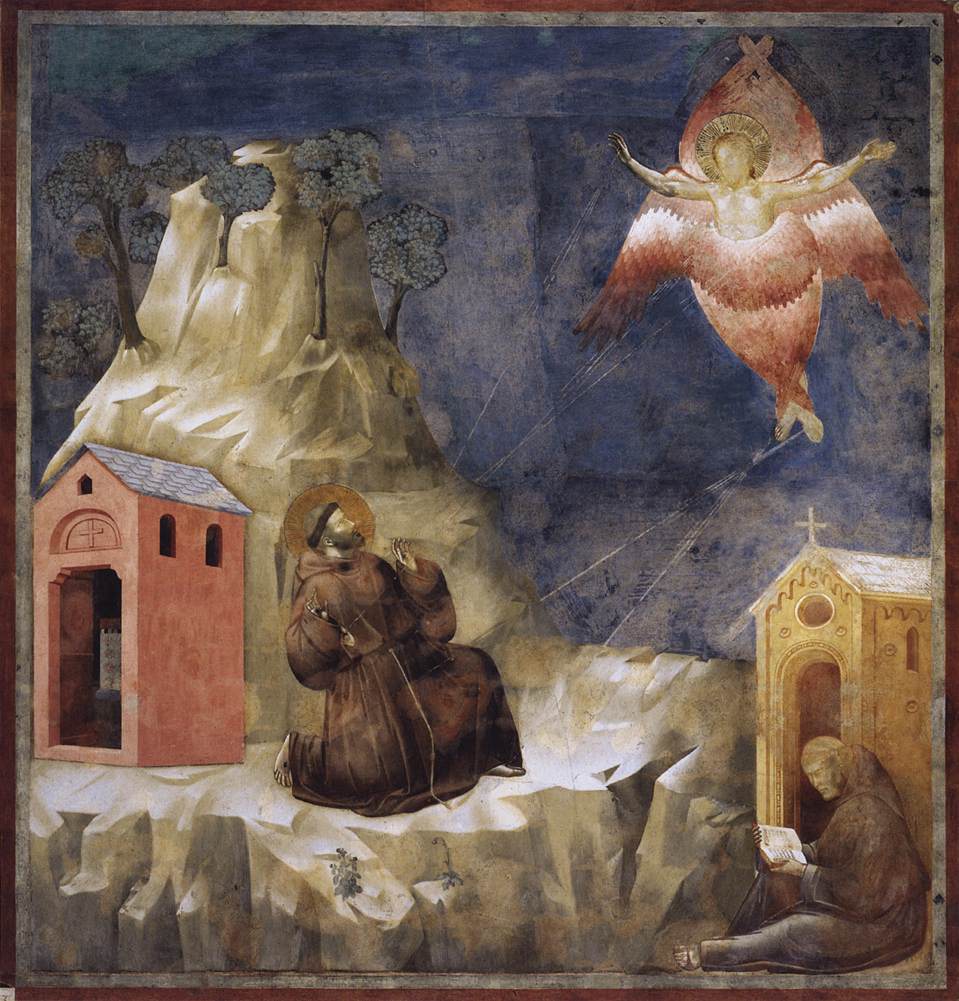
Nearby, another fresco shows Francis struck with stigmata; each wound an asterisk, a caveat. A flurry of wings above his head.

Stigmatization of St. Francis
“The Stigmatization of St. Francis,” from the Legends of Saint Francis cycle, attributed to Giotto, 1297–1300. Fresco, 270 × 230 cm. Upper Church, Basilica of St. Francis of Assisi, Assisi, Italy.

*

You lights of evening

*

At the altar in Assisi, my vespers are belled into the vault, where they flock and cloud.

*

Outside, rain. The birds tangle among the leaves, sustain their refractory antiphon. All with one accord in one place.

*

“perdonano per lo tue amore / infirmitate e tribulatione”

*

Pardon and love, weakness and wrack. Blame and whine, and worms and no escape. O praise Him.

*

A creaturely hymn for us creatures: Pietro called Francesco, faux Giotto, bereft William, Ralph, the variant birds, and myself. Each of us cloven by major and minor, each our own Pentecost.