A Blessing for Those Who Hate and Hurt

Pena Defillo, Fernando_The Offering
Fernando Peña Defilló (Dominican, 1928–2016), La ofrenda (The Offering), 1993. Oil and acrylic on canvas, 126 × 166 cm. Private collection. Source: Latin American Art in the Twentieth Century, ed. Edward J. Sullivan (Phaidon, 1996), p. 110.

May those whose hell it is
To hate and hurt
Be turned into lovers
Bringing flowers.

—Shantideva, eighth century

These lines are from chapter 10, stanza 9, of the Bodhicharyavatara (Way of the Bodhisattva), a Mahayana Buddhist text by the eighth-century Indian monk Shantideva. I first encountered this religious classic, originally written in Sanskrit, while working at Shambhala Publications. The excerpt above was adapted by author David Richo from a translation by the Padmakara Translation Group. Here’s 10.9 in full, as translated by PTG:

May the hail of lava, fiery stones, and weapons
Henceforth become a rain of blossom.
May those whose hell it is to fight and wound
Be turned to lovers offering their flowers. [source]

Other translations include those by Stephen Batchelor—

May the rains of lava, blazing stones, and weapons
From now on become a rain of flowers,
And may all battling with weapons
From now on be a playful exchange of flowers. [source]

—and Fedor Stracke:

May the rain of leafs, embers, and weapons
Become forthwith a rain of flowers.
May those cutting each other with knives
Forthwith throw flowers for fun. [source]

I am so struck by this short benediction that prays our hate be transformed into love, our hardness into softness, our cold, sterile weaponry into delicately petaled, fragrant blooms. Shantideva recognized that when we lash out in physical or verbal violence, we create a hell that’s all our own. We may intend to inflict suffering on another, but in doing so, we often wound ourselves—psychologically, spiritually. When we dehumanize others, we become less human.

Instead of hurling rocks, punches, bullets, or insults, what if we were to completely confound our enemies by offering them words or tokens of love? Love is the way of the bodhisattva, the “enlightened being.” It’s the way of Jesus—he who said, “Love your enemies; do good to those who hate you; bless those who curse you; pray for those who mistreat you” (Luke 6:27–28).

Loving people doesn’t mean we can’t be angry at them—but we cannot allow our anger to fester into bitterness and ill will or to explode in harmful outbursts. It should be a productive anger.

How might we use an ethic of love to direct our anger or somebody else’s toward a good end, to defuse a contentious situation? Not taking the easy way out by simply ignoring or retreating from a problem, but confronting our opponent in peaceful, creative, and potentially transformative ways?

I’m reminded of the historic Pulitzer Prize–nominated photograph Flower Power, taken by Washington Star photojournalist Bernie Boston on October 21, 1967, when he was covering an antiwar march on the Pentagon. As the 503rd Military Police Battalion formed a semicircle around demonstrators to prevent them from climbing the Pentagon steps, Boston captured eighteen-year-old George Edgerly Harris III, aka Hibiscus, placing a carnation into the barrel of an M14 rifle held by one of the soldiers. What a powerful image!
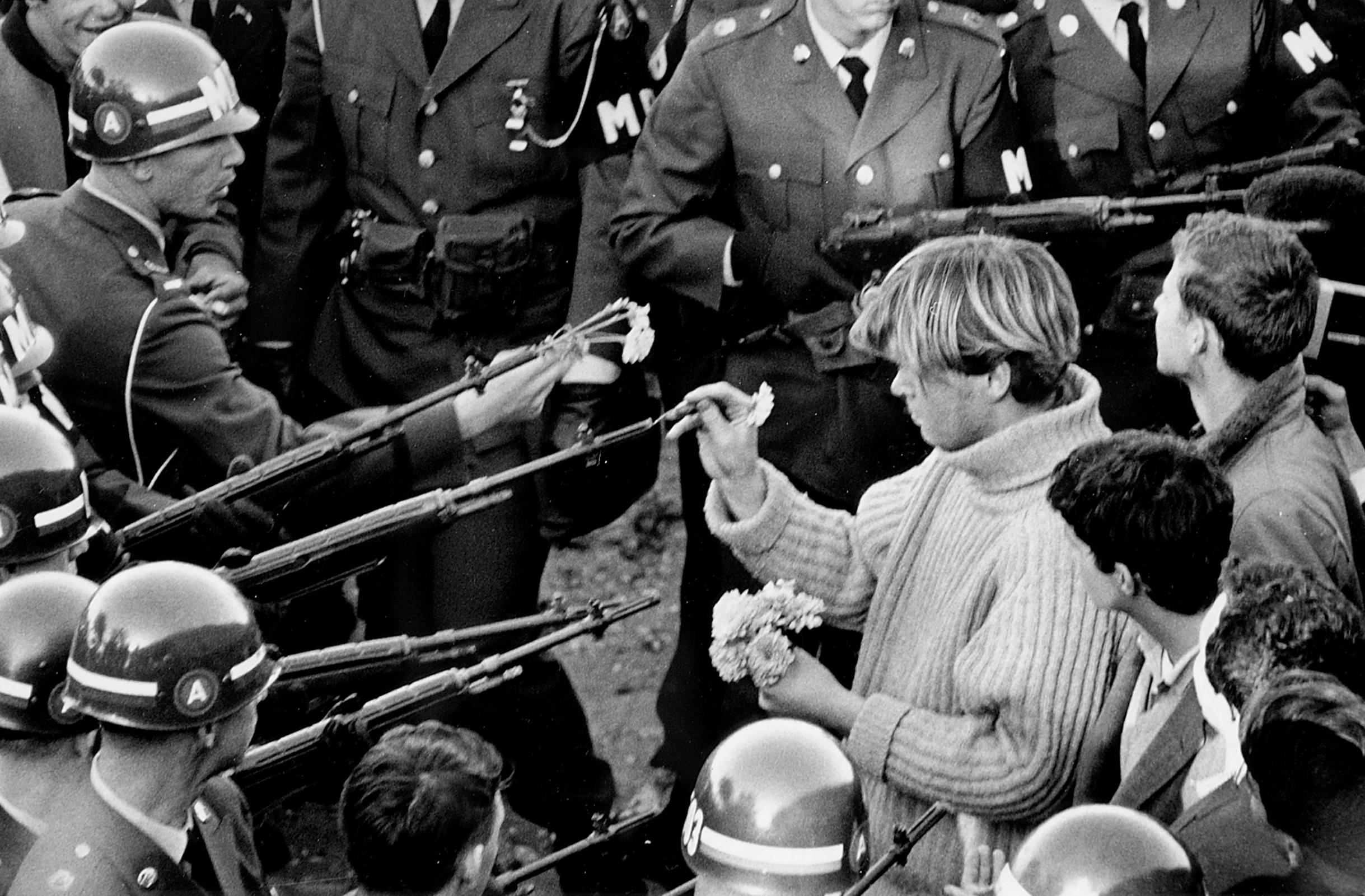
Flower Power
Bernie Boston (American, 1933–2008), Flower Power, Arlington, Virginia, 1967

Two years earlier in his essay “How to Make a March/Spectacle,” Allen Ginsberg was the first to expound on the potency of flowers as a spectacle to simultaneously disarm opponents and influence thought. He said “masses of flowers” should be handed out on the front lines of protests to police, the press, and onlookers as a symbol of nonviolent advocacy. He also suggested candy bars and toys.

Artist Scott Erickson seems to have drawn on Boston’s Flower Power photograph in his visual interpretation of Isaiah 2:4, Swords into Plowshares, which shows a sprig of foliage growing out of the barrel of a pistol, oriented upward like a vase. Its deadly power mocked and reversed, the gun releases a benign projectile that attracts and nourishes rather than strikes fear.
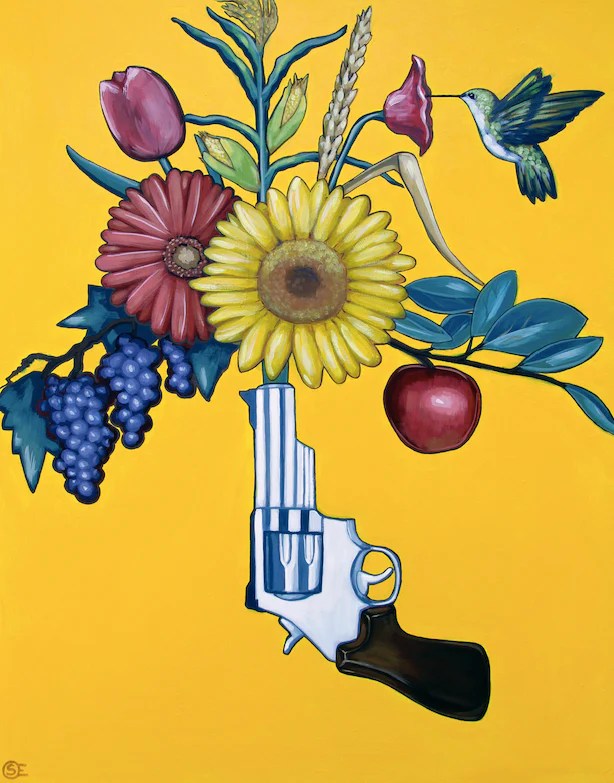
Erickson, Scott_Swords into Plowshares
Scott Erickson (American, 1977–), Swords into Plowshares, 2016 [purchase a reproduction]

The evocative Bible verse on which this painting is based prophesies a day when all the nations “shall beat their swords into plowshares, and their spears into pruning hooks”—a poetic way of describing the cessation of violence, as tools of destruction are transformed into gardening tools.

Christian activist Shane Claiborne has been instrumental in helping me see the immense beauty of Isaiah’s visions of the eschaton—he has worked with RAWtools to decommission firearms and literally forge them into shovels, spades, and other life-giving implements!—along with the holy foolishness of the gospel and all that implies. Before becoming a leader of the new monasticism movement, Claiborne went to circus school, and he has often put that training to use on the streets of Philadelphia where he lives. In his first book, The Irresistible Revolution: Living as an Ordinary Radical (2006), he writes,

Whenever there is a fight on our block, my first instinct is to run inside and grab our torches and begin juggling them, to upstage the drama of violent conflicts in our neighborhood. Perhaps the kids will lose interest in the noise of a good fight and move toward the other end of the block to watch the circus. I truly believe we can overwhelm the darkness of this world by shining something brighter and more beautiful. (285)

He has also written about Jesus’s “triumphal” entry into Jerusalem as a theatrical parody of power: he rode in on a dinky donkey instead of a warhorse, showing a much different alternative to the military might of empires. (“Imagine the president riding a unicycle in the Fourth of July parade”! Jesus for President, p. 122) And then on the cross, Jesus made a spectacle of human violence. In exchange for taunts and blows, he gave forgiveness, a metaphorical bouquet.

Banksy_Rage, Flower Thrower
Banksy, Rage, Flower Thrower, 2005. Mural, Beit Sahour, Palestinian Territories. Photo: Eddie Gerald / Alamy Stock Photo.

The UK-based street artist Banksy draws on the association of flowers with love and peace and their playful ability to disrupt violence in his mural Rage, Flower Thrower, which debuted on the West Bank wall in Israel-Palestine. Nathan Mladin, a researcher for Theos think tank, wrote about this artwork for the Visual Commentary on Scripture’s Logics of Reversals exhibition:  

With a balaclava drawn over his face, the young protester is shown leaning back, as though braced to hurl a Molotov cocktail. But instead of a weapon, he wields a flower bouquet, the only coloured element in this otherwise monochrome work. We expect an act of aggression—all other elements of the mural suggest imminent violence—but instead we are offered a call to peace. . . . Theologically construed, the mural hints at the eschatological terminus of violence.

The absurd juxtaposition of flowers and violence is employed too by Lithuanian artist Severija Inčirauskaitė-Kriaunevičienė, who embroiders floral patterns onto antique soldiers’ helmets sourced from various countries, and Natalie Baxter of Lexington, Kentucky, whose Warm Gun series comprises over one hundred quilted stuffed guns, “droopy caricatures of assault weapons,” she says, “bringing ‘macho’ objects into a traditionally feminine sphere and questioning their potency.”
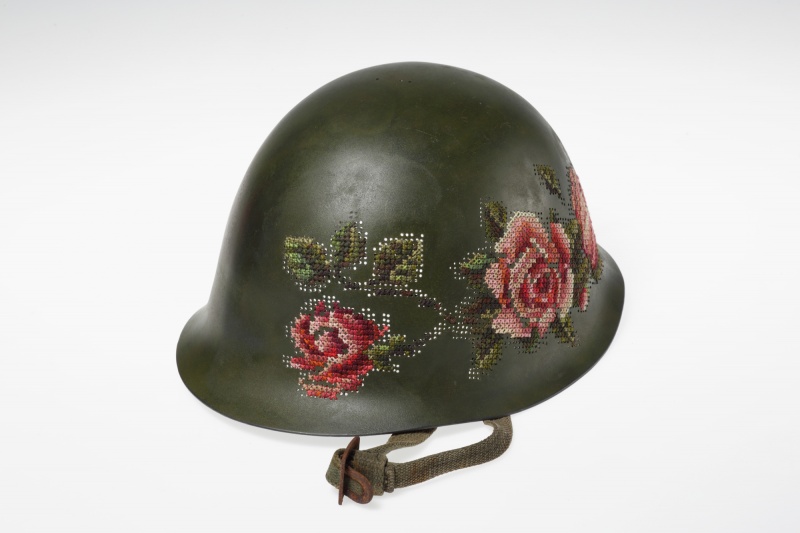

Incirauskaite-Kriauneviciene, Severija_Kill(ed) for Peace
Severija Inčirauskaitė-Kriaunevičienė (Lituanian, 1977–), from the series Kill(ed) for Peace, 2016. Antique soldier’s helmet, cotton, cross-stitch embroidery, drilling, and industrial needle punching, 30 × 22 × 21 cm. Private collection, Latvia.

Baxter, Natalie_Rose to the Occasion (Warm Gun)
Natalie Baxter (American, 1985–), Rose to the Occasion, from the Warm Gun series, 2016. Fabric and polyfill, 15 × 42 × 3 in.

Another artistic example of overcoming brutality with gentleness can be found in the climactic battle sequence from Disney’s animated classic Sleeping Beauty (1959). As Prince Phillip escapes from Maleficent’s dungeon with the aid of the three good fairies, Maleficent’s goons shoot arrows at him—but Flora transforms them by magic into flowers, which fall innocuously about his booted feet. (The animation is by Dan McManus.)
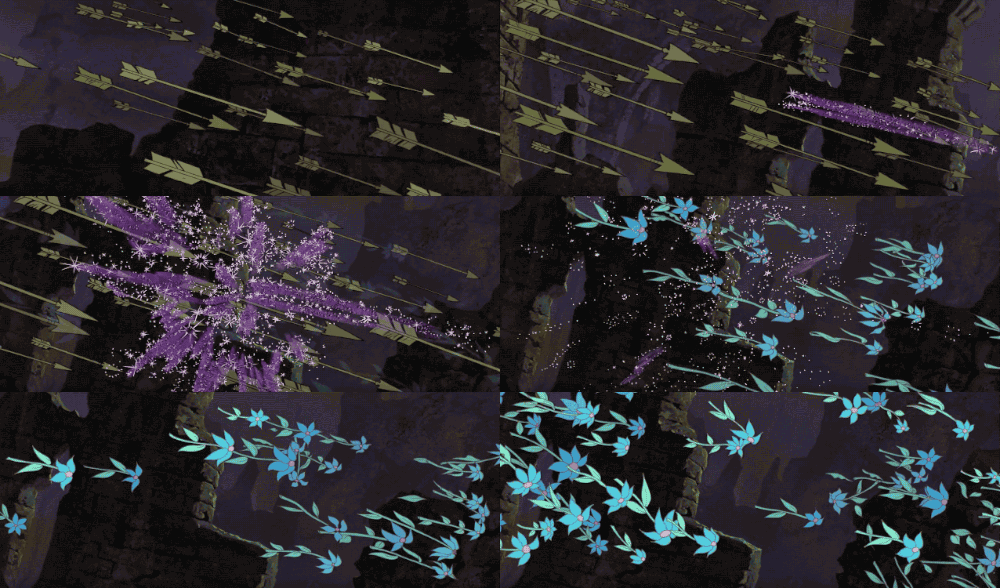
Sleeping Beauty arrows

Flora’s other enchantments include turning launched boulders into soap bubbles and a curtain of boiling water, tipped from a cauldron over a doorway, into a rainbow. Each of these deflective maneuvers involves the transformation of something threatening into something whimsical. While they do not ultimately deter the villain from her murderous rampage, and alas, Phillip conquers evil with a sword (albeit the Sword of Truth—there’s metaphor at play here), Flora’s few creative interventions at the outset of the battle assert an attractive counterethic that we would do well to embrace.

I need the dreams of Isaiah and the prayers of Shantideva, I need the ridiculous street theater of Hibiscus and Shane Claiborne and the activist blacksmithing of RAWtools, I need Banksy’s murals in zones of conflict and other subversive art, I need fairy tales from writers and animation studios, to help me relinquish my hate and imagine wholesome new ways of engaging my enemies. Most of all, I need Christ’s vibrant, upending gospel embedded more deeply in my heart, and the Holy Spirit—renewer, transformer—to melt the disdain and loathing I feel for certain figures in the current US political landscape and reshape it into loving regard.

While I do not have an urge to enact physical violence on anyone, I often seethe and think unkindly thoughts toward those I deem morally odious. Sometimes I pray they get what’s coming to them. But then I am convicted by that un-Christlike posture. I crave the eyes and mind of Christ, who sees everyone as redeemable and worthy of love, bearers of the divine image, and who moves toward them with open arms instead of clenched fists.

“May those whose hell it is to hate and hurt be turned into lovers bringing flowers.”

I pray this, sincerely, for others (I have a few particular names in mind), and also for myself.

Amen.
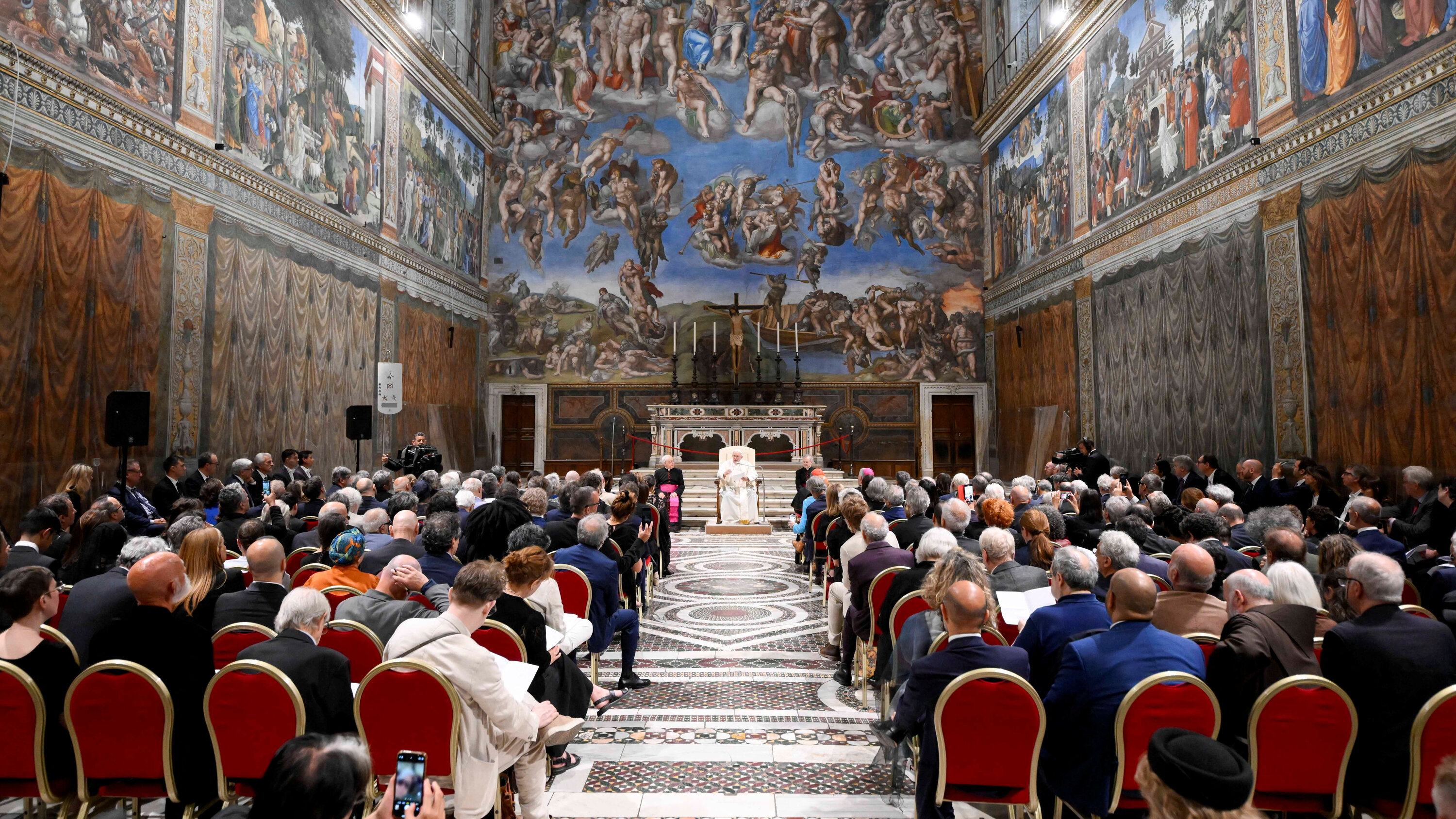
Roundup: Artists convene at Vatican, “crucified with Christ” artworks, and more

SPEECH: “Address of His Holiness Pope Francis to Artists for the 50th Anniversary of the Inauguration of the Vatican Museums’ Collection of Modern Art”: On June 23, at the invitation of Pope Francis, some two hundred select visual artists, filmmakers, composers, poets, and other creatives gathered at the Sistine Chapel to commemorate the fiftieth anniversary of the Vatican Museums’ Collection of Modern and Contemporary Art, inaugurated in 1973 by Pope John Paul VI. “One of the things that draws art closer to faith is the fact that both tend to be troubling,” Pope Francis said last Friday. “Neither art nor faith can leave things simply as they are: they change, transform, move and convert them.” He applauded how “artists take seriously the richness of human existence, of our lives and the life of the world, including its contradictions and its tragic aspects. . . . Artists remind us that the dimension in which we move, even unconsciously, is always that of the Spirit. Your art . . . propel[s] us forward.” For reporting on this event by the New York Times, see here.

Pope Francis meeting artists
Pope Francis addresses a group of artists, June 23, 2023. Photo: Vatican Media, via Reuters.

This papal address came less than a month after the pope addressed another gathering of artists at the Vatican for the conference The Global Aesthetics of the Catholic Imagination, sponsored by La Civiltà Cattolica with Georgetown University (read that address here).

+++

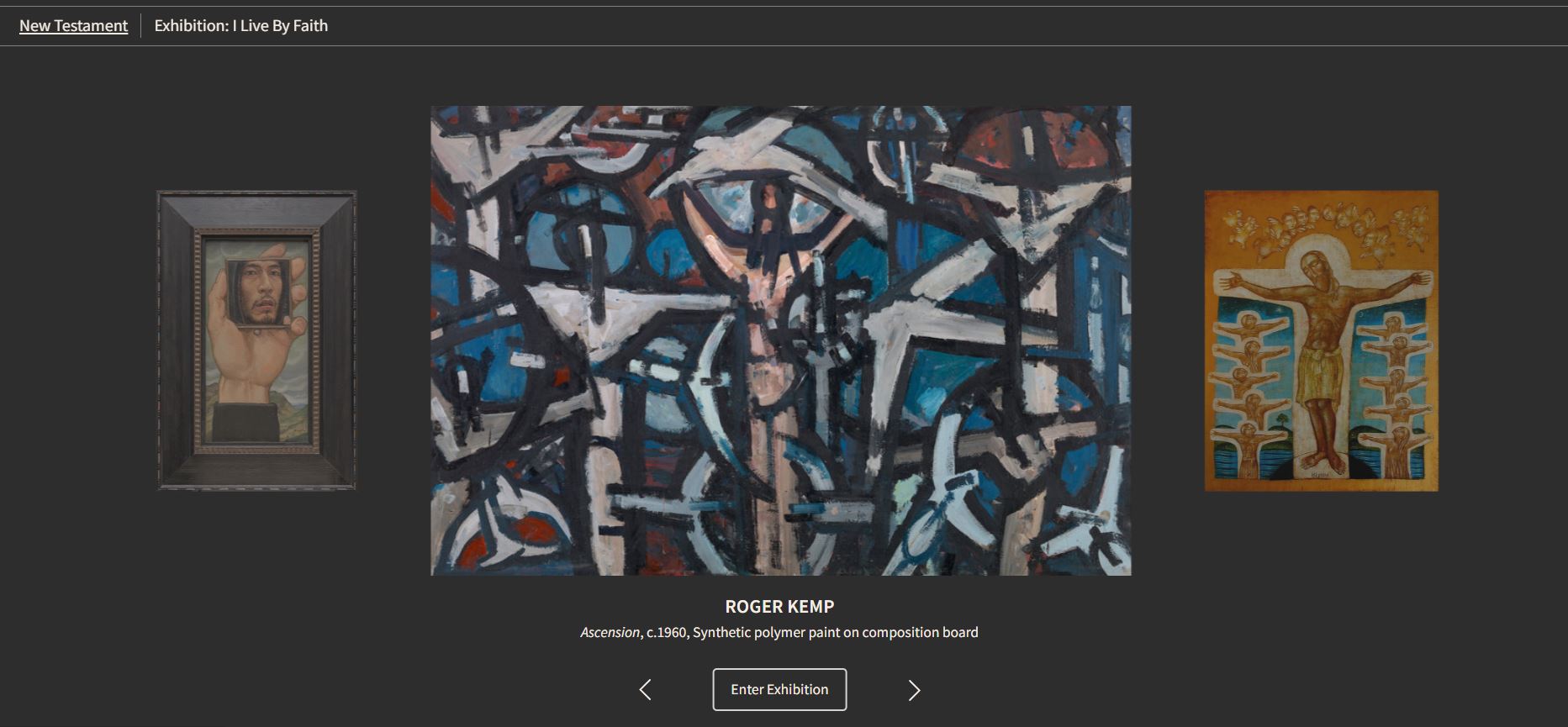
VISUAL COMMENTARY ON SCRIPTURE: “I Live by Faith (Galatians 2:15–21)” by Victoria Emily Jones: My latest set of commentaries for the VCS went live this month! It centers on one of Paul’s famous sayings: “I have been crucified with Christ, and it is no longer I who live, but it is Christ who lives in me.” I was bummed that one of the three commentaries I originally wrote had to be scrapped because the image permission was ultimately denied; I thus had to reconfigure and replace, and I ended up with two artworks in the three-piece exhibition that aren’t as diverse from each other as I had hoped. But still, each artwork brings a unique and compelling lens through which to examine this passage. (Note: If you’re viewing the exhibition on your phone, after you “Enter Exhibition,” you’ll need to expand the “Exhibition Menu” to access the “Show Commentary” button.)

Crucified with Christ (VCS)

The VCS was covered by The Art Newspaper in a recent article by Anna Somers Cocks. “Theology is making a comeback as an important tool for interpreting art,” reads the URL.

+++

VIDEO: “Abraham: An Interfaith Discussion at the Bode-Museum, Berlin”: Besides publishing written commentaries on works of art in dialogue with Bible passages, the Visual Commentary on Scripture also produces videos. This one brings together an Anglican Christian priest (who directs the VCS), a Jewish rabbi, and a Muslim theologian around a fifth-century ivory pyxis depicting Abraham, a figure held in common by all three faith traditions.

+++

POEM: “Gate A-4” by Naomi Shihab Nye: I’ve always loved this heartwarming poem about an unexpected moment of communion shared with strangers at an airport, made possible through kindness and the letting down of one’s guard. Listen to commentary by Joanne Diaz and Abram Van Engen on the Poetry for All podcast, episode 19; they answer the question “Why is this a poem?” Here’s a video of Nye reading it herself:

+++

NEW ALBUMS:

>> April 21: Worship for Workers by the Porter’s Gate: “In 2022 a group of songwriters, pastors, and professionals gathered in Nashville, Tennessee to write a series of worship songs for workers. Over three days they discussed the spiritual, emotional, and material struggles facing workers around the world today. Soon enough, they began to compose a series of songs specifically designed to help Christians carry their daily work before the Lord.” Here’s one of the thirteen songs on the album, “You Hold It All”:

The Worship for Workers album is part of a larger project, sponsored by the Brehm Center and a number of other institutions, to provide music, prayers, art, liturgies, and training to the church around the topic of work. It grew out of the book Work and Worship: Reconnecting Our Labor and Liturgy by Matthew Kaemingk and Cory Willson.

>> May 5: Glory Hour by Victory: Victory Boyd [previously] is a Grammy-winning soul and gospel artist who got her start singing with her siblings in the group Infinity Song but whose career really kicked into high gear when she worked as a songwriter for Kanye West’s Jesus Is King (2019). Glory Hour is her second full-length album as a solo artist; its title refers to the time of the morning when the sun rises. Most of the tracks are original songs or spoken word, but there are also three classic hymns/gospel songs: “His Eye Is on the Sparrow,” “Great Is Thy Faithfulness,” and “I Know It Was the Blood.” Here’s the music video for “Just like in Heaven,” based on the Lord’s Prayer:

>> May 19: Seven Psalms by Paul Simon: Paul Simon released this original seven-movement composition about doubt and belief as a single thirty-three-minute track, as it is meant to be listened to in one sitting. I’m a Simon fan; one of my early blog posts is a review of his and Garfunkel’s debut album, Wednesday Morning, 3 A.M. But if I’m honest, I was underwhelmed by this much-anticipated release. I’m in the minority there, so I think I’ll need to give it another listen. What do you think of it? Here’s the trailer:

>> June 2: Byrd: Mass for Five Voices by the Gesualdo Six: One of my favorite vocal ensembles has just come out with an album of songs by William Byrd—his setting of the Mass along with a handful of motets. A Catholic composer in Protestant England in the late Renaissance, Byrd wove together musical “notes as a garland to adorn certain holy and delightful phrases of the Christian rite,” as he wrote in the preface to his second book of Gradualia (1607). Here’s the Gesualdo Six’s performance of his “Afflicti pro peccatis nostris,” a Latin prayer, a desperate plea for sanctification, that translates to “Afflicted by our sins, each day with tears we look forward to our end: the sorrow in our hearts rises to thee, O Lord, that you may deliver us from those evils that originate within us”:

Give Good Gifts (Artful Devotion)

Mary Antoinette Lorania Pike and Sarah Adeline Pike
Joseph H. Davis (American, 1811–1865), Mary Antoinette Lorania Pike and Sarah Adeline Pike, 1835. Watercolor, pencil, and ink on paper, 8 1/2 × 11 in. American Folk Art Museum, New York. Photo: John Bigelow Taylor.

Let love be without hypocrisy. Detest evil; cling to what is good. Love one another deeply as brothers and sisters. Outdo one another in showing honor. Do not lack diligence in zeal; be fervent in the Spirit; serve the Lord. Rejoice in hope; be patient in affliction; be persistent in prayer. Share with the saints in their needs; pursue hospitality.

Bless those who persecute you; bless and do not curse. Rejoice with those who rejoice; weep with those who weep. Live in harmony with one another. Do not be proud; instead, associate with the humble. Do not be wise in your own estimation. Do not repay anyone evil for evil. Give careful thought to do what is honorable in everyone’s eyes. If possible, as far as it depends on you, live at peace with everyone.

—Romans 12:9–18 CEB

+++

SONG: “Give Good Gifts One to Another” by Sister Martha Jane Anderson, 1893 | Performed by The Rose Ensemble, on And Glory Shone Around: Early American Carols, Country Dances, Southern Harmony Hymns, and Shaker Spiritual Songs (2014)

Give good gifts one to another,
Peace, joy, and comfort gladly bestow;
Harbor no ill ’gainst sister or brother,
Smooth life’s journey as you onward go.

Broad as the sunshine, free as the showers,
So shed an influence, blessing to prove;
Give for the noblest of efforts your pow’rs;
Blest and be blest, is the law of love.

+++

Born in Limington, Maine, to a farming family, Joseph H. Davis was an itinerant artist who created small, inexpensive portraits of New England citizens from 1832 to 1837. He wandered from town to town through the border region between Maine and New Hampshire with his watercolors, paper, pencils, and brushes, initially seeking clients among his church connections. (He was a member of the Freewill Baptist Church.) His reputation spread by word of mouth, and over a five-year period he executed at least 150 watercolor portraits, most often posing together in profile a husband and wife or, as in the above painting, siblings, either in parlor settings or outdoors. The family pets are sometimes included too. Along the bottom borders he recorded the sitters’ names and ages.

After Davis’s daughter was born, he gave up painting and became involved in land speculation, manufacturing, and inventing.

Mary Antoinette Lorania Pike and Sarah Adeline Pike was part of the exhibition A Piece of Yourself: Gift Giving in Self-Taught Art, which ran from July 22, 2019, to January 10, 2020, at the American Folk Art Museum in New York City. Other pieces included quilts, handmade valentines and toys, Shaker gift drawings, a tin top hat (a tenth anniversary present), and a delicate, lacelike papercut made in 1830 by an inmate at Walnut Street Prison in Pennsylvania for a prison guard’s daughter.


This post belongs to the weekly series Artful Devotion. If you can’t view the music player in your email or RSS reader, try opening the post in your browser.

To view all the Revised Common Lectionary scripture readings for Proper 17, cycle A, click here.

Roundup: Lent devotionals, Joseph Shabalala, dancing with dust, kids’ songs and doodles

Lent begins next week, and as usual, I’ll be sharing visual art, music, poetry, and other media throughout the season that I hope will be a quiet support to your spiritual walk. If you are giving up social media for Lent but want to be kept aware of new Art & Theology posts, sign up to receive the posts by email by clicking the “Subscribe” button—on the right sidebar if you’re on a desktop, or at the bottom of this post if you’re on your phone. (Note that the sidebar/footer is not visible from the homepage; you have to click through into a post to see it.)

+++

Lent devotionals 2020

NEW LENT DEVOTIONALS: I’ve become aware of two new poetry devotionals for Lent published this year.

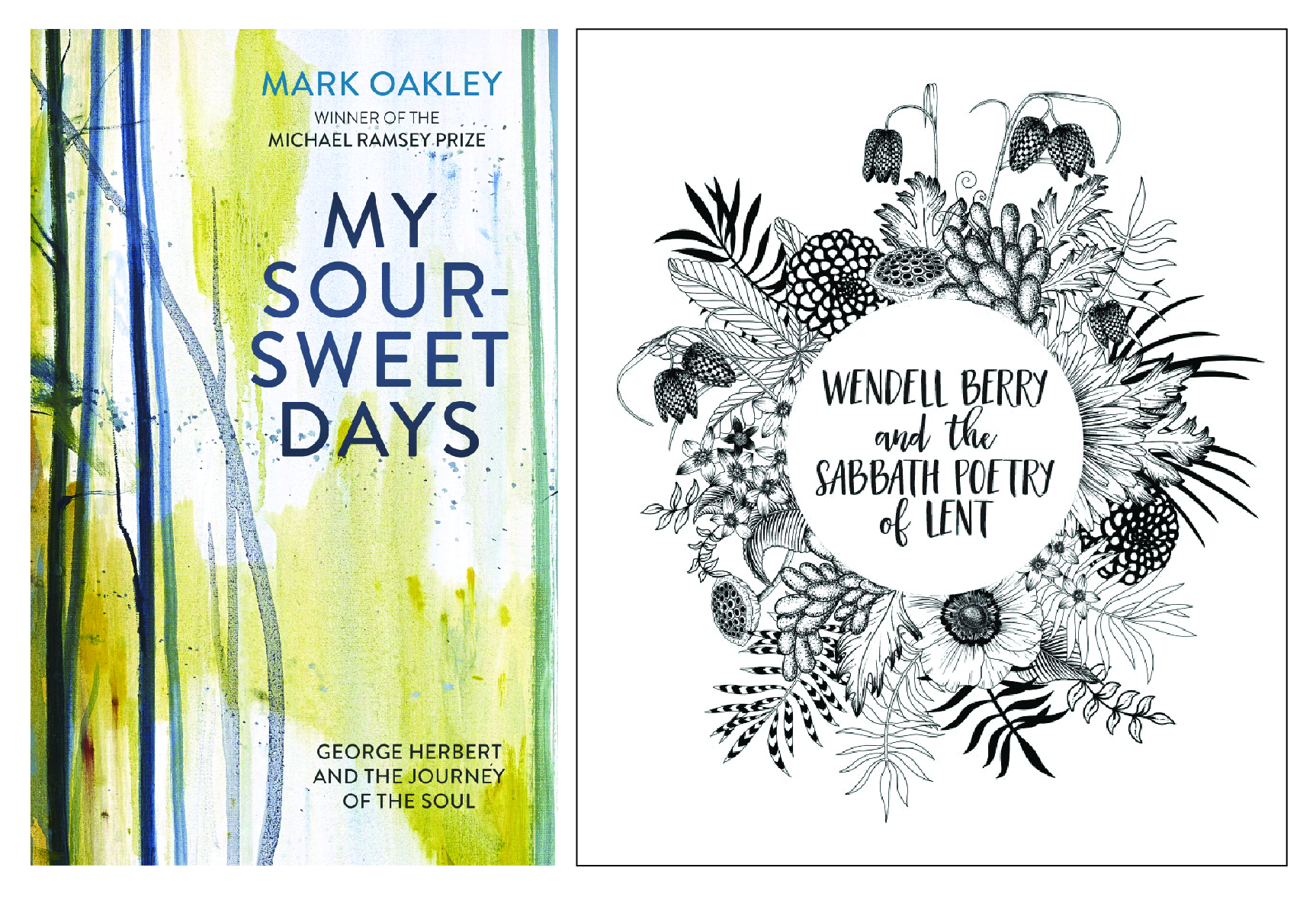
My Sour-Sweet Days: George Herbert and the Journey of the Soul by Mark Oakley: “George Herbert is one of the great 17th century poet-priests. His poems embrace every shade of the spiritual life, from love and closeness, to anger and despair, to reconciliation and hope. And his work is always rich with audacious playfulness: he seems to take God on, knowing God will win, as if he’s having an argument with a faithful friend he knows is not going to leave. In much of theology and spirituality, God is a critical spectator to human lives, but for Herbert, his sense of relationship with God is primarily of a friendship that can never be broken. These are some of the themes Mark Oakley explores in this book. He offers a poem for every day in Lent, with a two-page commentary on each of the forty included.”

Wendell Berry and the Sabbath Poetry of Lent by SALT Project: “In this Lenten devotional, biblical texts and simple, accessible practices walk hand-in-hand with Wendell Berry’s poetic vision of sabbath and the natural world. All you’ll need is your favorite Bible and Wendell Berry’s This Day: Collected and New Sabbath Poems. Week by week, we’ll walk through the woods together toward Easter morning, keeping sabbath as we go—with Wendell Berry as our guide.” Sold as a professionally designed, downloadable PDF with printing and folding instructions.

I really enjoyed SALT Project’s Lent devotional from last year, built around the poetry of Mary Oliver, so I bought this new one and gave it a breeze-through so I could recommend it here prior to Lent; I look forward to spending more time with it throughout the season. Devotions are provided for Ash Wednesday; the first, second, third, fourth, and fifth Sundays of Lent; Palm Sunday, Maundy Thursday, Good Friday, and Easter Sunday. Each one includes an instruction to read a Bible passage and a Wendell Berry poem, a short meditation that draws the two together, an additional reading of two more related Berry poems, a candle lighting and one-sentence prayer (on the themes of silence, trust, delight, care, insight, resurrection, joy, love, sorrow), a few recommended practices for the week, and personal questions to ponder and discuss with a friend, if desired.

I especially appreciate the “Practices” section, which includes ideas like: make a list of your favorite little delights (“the sunlight’s slant in the late afternoon, your dog’s ears, the steam rising from your coffee—no delight is too slight!”) and read it aloud with family or friends over a meal; take a neighborhood walk and count how many shades of green you see; ignore a household chore for an entire day each week.

+++

DANCE VIDEO: “Seas of Crimson”: In this music video for one of the pieces on Bethel Music’s album Without Words: Synesthesia, Jessica Lind of the Oregon Ballet Theatre dances with dust that by the composition’s end turns to vibrant color. A metaphor for the Lenten journey, perhaps? [HT: A Sacramental Life]

+++

OBITUARY: Joseph Shabalala, Ladysmith Black Mambazo Founder, Dies at 78: From the New York Times obituary by Jon Pareles:

Joseph Shabalala, the gentle-voiced South African songwriter whose choir, Ladysmith Black Mambazo, brought Zulu music to listeners worldwide, died on [February 11] in a hospital in Pretoria. He was 78. . . . Mr. Shabalala began leading choral groups at the end of the 1950s. By the early ’70s his Ladysmith Black Mambazo — in Zulu, “the black ax of Ladysmith,” a town in KwaZulu-Natal Province — had become one of South Africa’s most popular groups, singing about love, Zulu folklore, rural childhood memories, moral admonitions and Christian faith. Ladysmith Black Mambazo’s collaborations with Paul Simon on his 1986 album “Graceland,” on the tracks “Homeless” and “Diamonds on the Soles of Her Shoes,” introduced South African choral music to an international pop audience.

Joseph Shabalala

Shabalala was an ordained minister in the Pentecostal Church of God of Prophecy, having become a Christian in 1976. He said he hopes his music shows people “how to be good to God, how to praise God, how to respect, how to forgive each other . . .”

Below is a video of Shabalala with Ladysmith Black Mambazo singing one of his songs, “King of Kings,” live in Montreux, Switzerland, in 2000. Written during apartheid, it is a prayer for peace in South Africa and the rest of the world. It was first released on the 1987 album Shaka Zulu. [Listen on Spotify]

+++

KIDS’ SONGS: I’m not a mom, but I often enjoy listening to “children’s music,” as there’s so much of quality out there these days. Here are two songs released this year in that too-restrictively-titled genre (because hey, there’s much for grown-ups to love here too!), along with animated music videos.

“Glad You’re Here” by Justin Roberts: This new single by “the Judy Blume of kiddie rock” (New York Times) is for a new or soon-to-be-born baby. So fun, warm, and adorable! (Note: The video was produced by the same company that brought you the Wendell Berry devotional mentioned above.)

“Dinosaurs in Love” by Fenn Rosenthal, feat. Tom Rosenthal: This sad-sweet song about two dinosaurs eating cucumbers and having parties and then, well, you’ll have to listen . . . was written by three-year-old Fenn Rosenthal from London (with some help on the tune from her dad, Tom). At the end of January Tom Rosenthal, who is himself a singer-songwriter, posted a recording of Fenn singing this one-minute creation of hers on Twitter, and it went viral. Now the song is streaming on Spotify and is up on iTunes, Amazon, and other e-tailer websites, with all proceeds benefitting wildlife charities. It was also picked up by directorial team Hannah Jacobs, Katy Wang, and Anna Ginsburg, who created a music video using 2D frame-by-frame animation. [HT: Colossal]

+++

DRAWING CONTEST: “Doodle for Google,” for K–12 artists: Google Doodles are those special drawings, sometimes animated, that embellish Google’s logo on the website’s homepage from time to time. For the twelfth consecutive year, that highly visible space is up for grabs to one young artist in the US through the tech company’s “Doodle for Google” competition, open to ages K–12. This year the theme is “How do you show kindness?” In addition to having their work featured on Google’s landing page for an entire day, the winner will receive a $30,000 college scholarship, and the winner’s school will be awarded a $50,000 technology package. The deadline for submissions is March 13, 2020, at 11 p.m. ET. [HT: Hyperallergic]