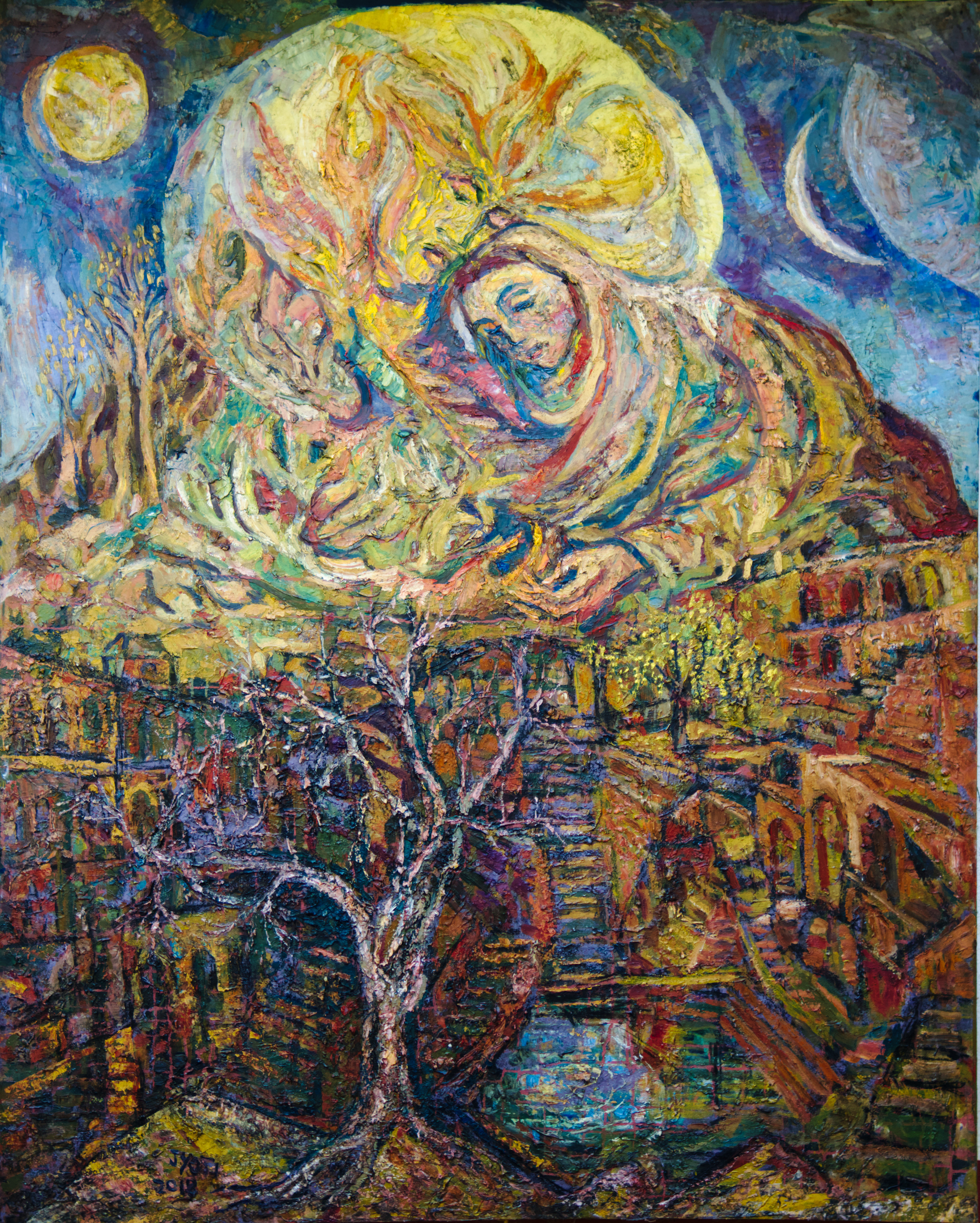
Jyoti Sahi (Indian, 1944–), Beulah, 2018. Oil and acrylic on canvas, 5 × 4 ft. Photo: Victoria Emily Jones.
In Isaiah 62:2–5, God talks to Zion about her future. He says that on the day of the Lord,
The nations shall see your vindication and all the kings your glory, and you shall be called by a new name that the mouth of the LORD will give. You shall be a beautiful crown in the hand of the LORD and a royal diadem in the hand of your God. You shall no more be termed Forsaken, and your land shall no more be termed Desolate, but you shall be called My Delight Is in Her and your land Married, for the Lord delights in you, and your land shall be married. For as a young man marries a young woman, so shall your builder marry you, and as the bridegroom rejoices over the bride, so shall your God rejoice over you.
The painting Beulah by the Indian Christian artist Jyoti Sahi (pictured below) takes its title from the Hebrew word for “married” that’s used in Isaiah 62:4. He told me the image pictures the coming together of heaven and earth, the sun marrying the land, which can also be read as Christ uniting with his bride. Christ comes as dawn, his head like flame, like the great I AM revealed to Moses in the burning bush. His glory, the yellow halo around his head, encompasses the female figure. He leans in, tenderly resting his head on hers, and their hands touch.
Beulah shows the reunion not only of humanity and the Divine at the end of time, but also of the land and the Divine. As the Isaiah passage states, the earth, too, will be redeemed and made to flourish once again.
The two figures here form a sacred mountain. A river of life flows down between them, watering the new city, which is a wilderness no longer. This is Isaiah’s vision wrapped up into John the Revelator’s.
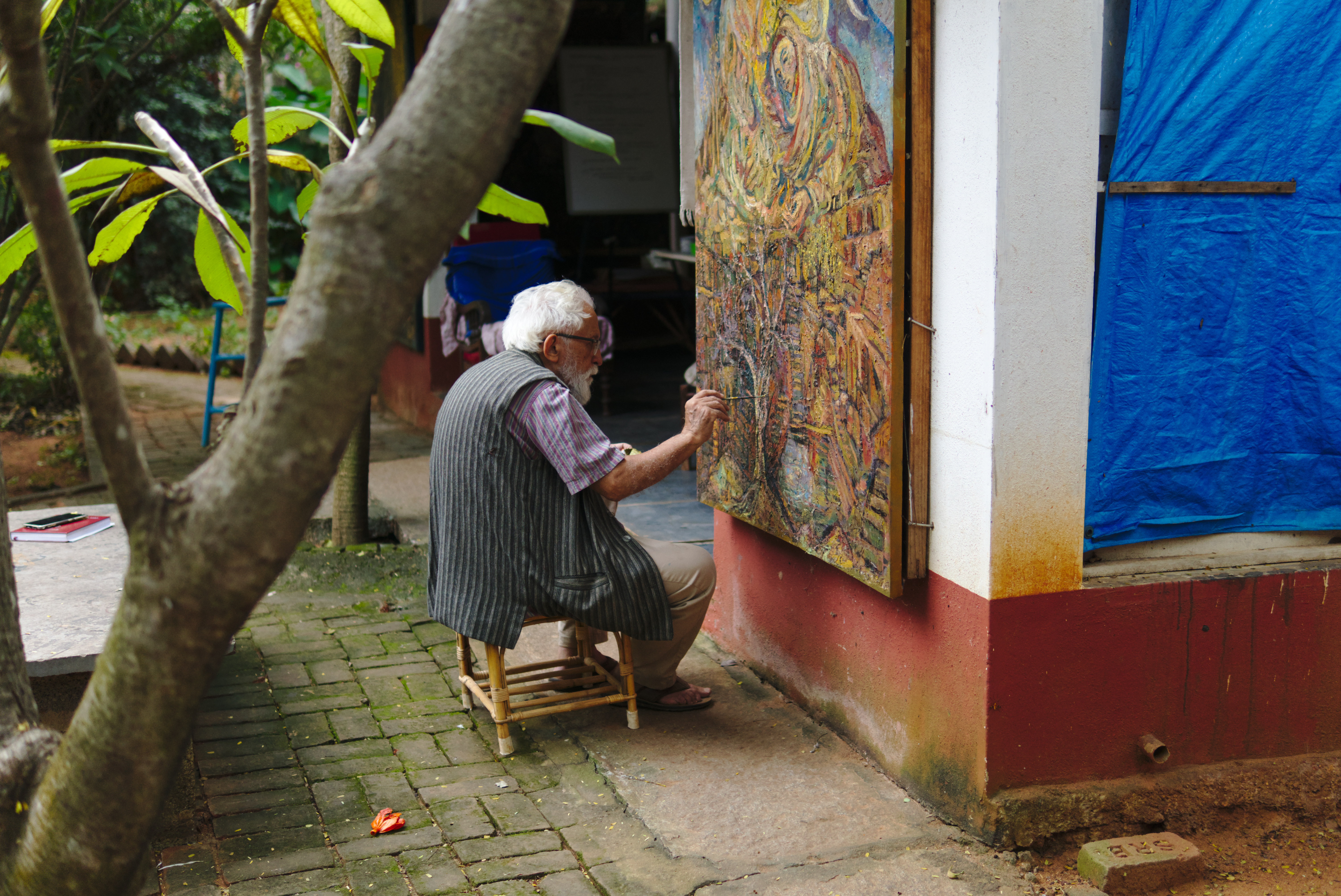
Jyoti Sahi touches up a detail of his painting Beulah. Photo: Victoria Emily Jones.
LISTEN: “The Reign of Mercy” by Kate Bluett and Paul Zach, 2021 | Performed by Paul Zach and Lauren Plank Goans on Advent Songs by the Porter’s Gate, 2021
Oh may our world at last be just And hilltops echo with your peace A harvest come from barren dust The reign of mercy never cease He comes as rain upon the grass High heaven’s sun to earth descends Not as the seasons that will pass But with a light that never ends
Oh come to him and find your rest Who saw the poor and came as one Who hears the cries of the oppressed And rules till all oppression’s done Someday he’ll come to reign as king And we will see his justice done Our souls will magnify and sing The Christ whose kingdom now is come
And all the mighty and the strong Will bow before him on that day The silenced fill the world with song The poor and lowly he will raise And all our bitterness and tears Our violence and our endless wars Will end at last when he draws near Come soon, come soon, oh Christ our Lord
Digital concept for outdoor fountain by Chad Knight, 2017 [purchase]
FIRST VOICE.

I thirst, but earth cannot allay
The fever coursing through my veins.
The healing stream is far away—
It flows through Salem’s lovely plains.

The murmurs of its crystal flow
Break ever o’er this world of strife;
My heart is weary, let me go,
To bathe it in the stream of life;

For many worn and weary hearts
Have bathed in this pure healing stream,
And felt their griefs and cares depart,
E’en like some sad forgotten dream.

SECOND VOICE.

“The Word is nigh thee, even in thy heart.”

Say not, within thy weary heart,
Who shall ascend above,
To bring unto thy fever’d lips
The fount of joy and love.

Nor do thou seek to vainly delve
Where death’s pale angels tread,
To hear the murmur of its flow
Around the silent dead.

Within, in thee’s one living fount,
Fed from the springs above;
There quench thy thirst till thou shalt bathe
In God’s own sea of love.
This poem was originally published in Sketches of Southern Life (1872) (revised and expanded from an earlier version in Forest Leaves [1845]) and is in the public domain.
Tired and disheartened, the speaker in the first half of “I Thirst” by Frances Ellen Watkins Harper longs to be with God in the New Jerusalem (Salem for short). She thirsts for another world, away from the brokenness and suffering endured on earth. She can faintly hear the rush of living waters somewhere above and beyond her, and she wants desperately to plunge in. Essentially, she wishes to die, to enter the eternal presence of the Lord, where true life is.
But then a wise voice gently reprimands her escapist attitude, reminding her that God is with her in the Spirit right now, pouring his life into her, even residing within her. She has intimate access to the Divine. While full beatitude still lies on the horizon, in the meantime, we can quench our thirst for that “something more” by communing with God interiorly, through prayer and the word, and in corporate worship with our fellow pilgrims on the way. We receive a foretaste of the heavenly feast at the Lord’s Table, and throughout the week God nourishes us again and again so that, overflowing with the Holy Spirit, we may nourish others, pointing them to the Source.
This second half of the poem is based on Romans 10:6–8: “The righteousness which is of faith speaketh on this wise: ‘Say not in thine heart, “Who shall ascend into heaven?” (That is, to bring Christ down from above.) Or, “Who shall descend into the deep?” (That is, to bring up Christ again from the dead.)’ But what saith it? ‘The word is nigh thee, even in thy mouth, and in thy heart: that is, the word of faith . . .’” (KJV). There’s an echo of Jesus’s words to his disciples that “neither shall they say, ‘Lo here!’ or, ‘lo there!’ for, behold, the kingdom of God is within you” (Luke 17:21). There’s also an implicit connection to John 4:13–14 and 7:38, which says that springs of living water—that is, Spirit-powered life—flow forth from the hearts of believers unto eternity.
Frances Ellen Watkins Harper (1825–1911) was a best-selling poet, fiction writer, essayist, traveling lecturer, and prominent political activist who advocated for abolitionism, temperance, and women’s suffrage. Born to free African American parents in Baltimore, Maryland (a slave state), she was orphaned at age three and subsequently raised by her maternal uncle, William Watkins, an AME minister and educator. In her twenties she moved to Philadelphia, and a letter she wrote to a friend in April 1858 describes how, against orders, she refused to give up her seat on a city trolley to a white person. At the forefront of nineteenth-century Black political thought and action, Harper founded, supported, and held high office in several national progressive organizations, including the National Association of Colored Women. She was also at the forefront of the early African American literary tradition, publishing ten volumes of poetry during her lifetime, which sold in the tens of thousands—in addition to her short stories and novels.
“Therefore I tell you, do not be anxious about your life, what you shall eat or what you shall drink, nor about your body, what you shall put on. Is not life more than food, and the body more than clothing? Look at the birds of the air: they neither sow nor reap nor gather into barns, and yet your heavenly Father feeds them. Are you not of more value than they? And which of you by being anxious can add one cubit to his span of life? And why are you anxious about clothing? Consider the lilies of the field, how they grow; they neither toil nor spin; yet I tell you, even Solomon in all his glory was not arrayed like one of these. But if God so clothes the grass of the field, which today is alive and tomorrow is thrown into the oven, will he not much more clothe you, O men of little faith? Therefore do not be anxious, saying, ‘What shall we eat?’ or ‘What shall we drink?’ or ‘What shall we wear?’ For the Gentiles seek all these things; and your heavenly Father knows that you need them all. But seek first his kingdom and his righteousness, and all these things shall be yours as well.”
—Matthew 6:25–33
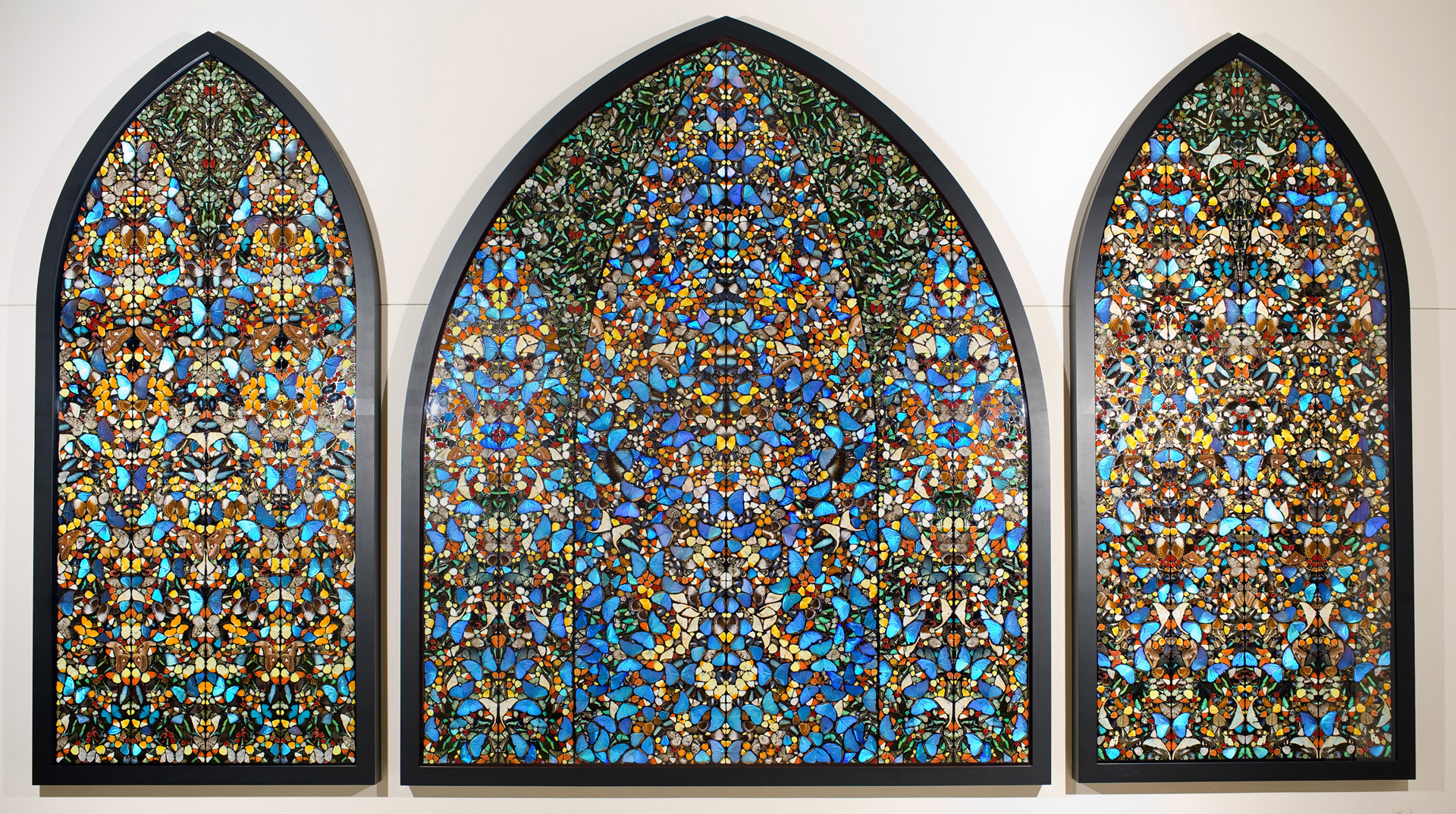
LOOK: The Kingdom of the Father by Damien Hirst
Damien Hirst (British, 1965–), The Kingdom of the Father, 2007. Butterflies and household gloss on three canvas panels, 115 7/8 × 190 in. (294.3 × 482.6 cm). Photo: Randy Boverman.Detail. Photo: Yvette Wohn.
Seek ye first the kingdom And watch God add to your life Seek ye first the kingdom of God And his righteousness, it shall be yours
No need to worry ’bout the lack in your life The God I know, he will supply Submit your request, make it known Give it to God, leave it alone But you must have faith and believe what he said In his word, trust his word
When you pray, seek his face, trust his word—trust and obey If it’s in his word, you can count on it, trust his word—trust and obey When you seek him, believe—trust and obey Trust him, then seek him, and you’ll find him—trust and obey
Seek ye first the kingdom of God And his righteousness, it shall be yours
I was searching for a good rendition of “Seek Ye First” by Karen Lafferty, a pioneer of the Jesus Movement of the 1970s—but instead I came across this awesome gospel song inspired by the same scripture passage! It was written by Emorja Roberson—pianist, conductor, workshop coordinator, composer, arranger, and classical and gospel vocalist. He graduated with a master’s of sacred music in vocal performance from the University of Notre Dame in 2017 and is currently a student in the school’s doctor of musical arts in choral conducting program, with a focus on the African American repertoire. He is the director of the Voices of Faith Gospel Choir.
In this season, we pause and examine the things that stand in the way of our relationship with God. Notre Dame’s Voices of Faith Gospel Choir reminds us that we must seek God first – before fame, riches, pleasure, or certainty. In order to anchor our lives in God and to direct our efforts towards the coming of the kingdom, we must trust in God’s providence. What might be taking priority in our lives over our relationship with God? How can we re-center this day, this week, and this Lenten season, by seeking God first?
American artist Cody F. Miller’s body of work deals with themes of journeying, grace, self-offering, and hope amidst suffering. Many of his mixed-media pieces are keyed to specific biblical texts or to lines of spiritual verse, offering imaginative interpretations. In the work pictured here, he shows the boy Jesus engaged in a ring dance with his cousin John and another playmate, while Mary and Elizabeth peek at them over a clothesline in adoring delight.
Describing his technique, Miller says, “I work with cut paper and paint because I enjoy the interplay of the known and unknown. For the known, I work out many variations of a sketch until the design I’m looking for is finally realized. The unknown comes from my files full of patterns and objects waiting to find a new home. I am repeatedly fascinated when I find that some odd cut-out works better than my original intention.”
I commend to you the set of Christmas cards he offers through his website, which includes three different designs: the Adoration of the Shepherds, the Journey of the Magi, and the Holy Family Asleep.
LISTEN: “A Child Will Lead Us All” by Drew Miller, 2017; on Consolation, 2019
The following video performance is by the Orchardists, with the song’s writer, Drew Miller, on guitar and lead vocals, Janie Townsend on background vocals, Lincoln Mick on mandolin, Kevin Gift Jr. on bass, and Camille Faulkner on violin. The recording on Spotify, released two years later, is from Miller’s solo album Consolation.
The kingdom’s coming as a seed Smaller than the eye can see From wanting eyes to set us free Kingdom come
The kingdom’s coming as the rain To wash away our castles vain And cleanse the burdened heart from stain Kingdom come
The kingdom’s coming as a word The wisest man has never heard And foolish lips will speak the cure Kingdom come
The kingdom’s coming as a song Mournful dirge and anthem strong To cheer the ones who sing it wrong Kingdom come
A child will lead us all home
The kingdom comes from far away The kingdom has no place to stay To you who open up the door Kingdom come
The kingdom’s coming to the poor Sons and daughters of the Lord And all that’s lost will be restored Kingdom come
The kingdom’s coming as a feast The finest wine for all the least We’ll taste the broken bread of peace Kingdom come
The kingdom’s coming slow and true Till every inch has been made new And it will ask your life of you Kingdom come
A child will lead us all home
A brilliant piece of songwriting, “A Child Will Lead Us All” is full of poetic verve and biblical allusiveness, bringing several of Jesus’s parables into conversation with ancient Jewish prophecy and John’s Apocalypse. Christ’s kingdom is coming as seed, rain, a word, a song, a feast, from far away and to the poor. The refrain “A child will lead us all home” is derived from Isaiah 11:6, which describes the messianic kingdom, where heaven and earth join again as one. We are led into that reality by the One who came to us first as an infant, small and vulnerable.
A voice cries: “In the wilderness prepare the way of the LORD; make straight in the desert a highway for our God. Every valley shall be lifted up, and every mountain and hill be made low; the uneven ground shall become level, and the rough places a plain. And the glory of the LORD shall be revealed, and all flesh shall see it together, for the mouth of the LORD has spoken.”
—Isaiah 40:3–5
LOOK: Caiphas Nxumalo (South African, 1940–2002), John the Baptist, 1970. Linocut. Source: Christliche Kunst in Afrika, p. 278.
Caiphas Nxumalo was a printmaker and wood sculptor who studied at the Rorke’s Drift Art School from around 1968 to 1971 (sources vary on the precise years). He was associated with the African-initiated amaNazaretha Church in South Africa.
In this linoleum cut Nxumalo shows John the Baptist, the forerunner of Jesus, preaching repentance (bottom; Matt. 3:1–3), baptizing (Matt. 3:5–6), and eating wild honey (Matt. 3:4). The eye of God, which sees secret sins, burns bright and glorious. I’m not sure whether the people at the bottom are running away from John’s message of wrath or “turning around” from their wickedness to follow the true way. In Matthew’s account there are people from both categories of response.
The triangular frame rising from the base line was a common compositional device Nxumalo used to tell multiple components of a story, and in this context it’s especially appropriate, as it seems to me to allude to the valleys being lifted and the mountains being brought down low—a leveling of the landscape so that God’s glory can be plainly seen from any vantage point. (On another level, this Isaianic prophecy probably also refers to the proud being overthrown and the humble being exalted, as Mary sings about in her Magnificat.)
Advent is about the coming consummation of the kingdom of God in the day of the Lord. In Advent: The Once and Future Coming of Jesus Christ, Fleming Rutledge, who calls on the church to restore Advent’s focus on apocalyptic theology, describes John the Baptist as the central figure of Advent. She half-jokes that behind one of those cute little Advent calendar windows should be a coarse, fiery John shouting, “You brood of vipers!” (Matt. 3:7). “Irreducibly strange, gaunt and unruly, lonely and refractory, utterly out of sync with his age or our age or any age,” John the Baptist “arrives announcing the opening event of the end-time” (277, 13). As prophesied by Malachi at the end of the Old Testament and confirmed by Jesus in Matthew 11, “John the Baptist is the new Elijah, standing at the edge of the universe, at the dawn of a new world, the turn of the ages. That is his location as the sentinel, the premier personage of this incomparable Advent season—the season of the coming of the once and future Messiah” (277).
Like John, the church, Rutledge says, is also located on the frontier of the new age, between Jesus’s first and second advents, and we, too, are called to herald the Messiah, announcing, “Repent! For the kingdom of God is at hand.”
In those days John the Baptist came preaching in the wilderness of Judea, “Repent, for the kingdom of heaven is at hand.” For this is he who was spoken of by the prophet Isaiah when he said,
“The voice of one crying in the wilderness: ‘Prepare the way of the Lord; make his paths straight.’”
Now John wore a garment of camel’s hair and a leather belt around his waist, and his food was locusts and wild honey. Then Jerusalem and all Judea and all the region about the Jordan were going out to him, and they were baptized by him in the river Jordan, confessing their sins.
But when he saw many of the Pharisees and Sadducees coming to his baptism, he said to them, “You brood of vipers! Who warned you to flee from the wrath to come? Bear fruit in keeping with repentance. And do not presume to say to yourselves, ‘We have Abraham as our father,’ for I tell you, God is able from these stones to raise up children for Abraham. Even now the axe is laid to the root of the trees. Every tree therefore that does not bear good fruit is cut down and thrown into the fire.
“I baptize you with water for repentance, but he who is coming after me is mightier than I, whose sandals I am not worthy to carry. He will baptize you with the Holy Spirit and fire. His winnowing fork is in his hand, and he will clear his threshing floor and gather his wheat into the barn, but the chaff he will burn with unquenchable fire.”
—Matthew 3:1–12
LISTEN: “His Kingdom Now Is Come (Behold! Behold!)” by Paul Zach, Isaac Wardell, Leslie Jordan, Lorenzo Baylor, and Brian Nhira, on Justice Songs by the Porter’s Gate (2020) | CCLI #7158500
Justice Songs opens with a rousing call-and-response song, “His Kingdom Now Is Come (Behold! Behold!),” that combines material from the mystical prologue of John’s Gospel with an Isaianic prophecy commonly read during Advent [Isaiah 40:3–5]. . . . Verse 4, syncopated with hand claps, lists divine epithets like “God of justice” (Isa. 30:18). “Father of the fatherless” (Ps. 68:5), “Prince of Peace” (Isa. 9:6). “He’s troubling the water, and we’re marching through”—an oblique reference to the African American spiritual “Wade in the Water,” about the liberation of the Israelites through the miraculously parted Red Sea, the paradigmatic “day of the Lord.”
The refrain, “Behold!,” is a word used hundreds of times throughout scripture, and it means “to fix the eyes upon; to see with attention; to observe with care.” Jesus says in Luke 7:21, “Behold, the kingdom of God is in the midst of you.” May we behold with humility and excitement the age to come and respond with fruits of repentance.
Here’s a socially distanced performance of “His Kingdom Now Is Come” by the musicians of Whitworth Campus Worship for the Center for Congregational Song’s Election Day 2020 broadcast.
(Update, 12/9/20: Watch the Porter’s Gate perform this song in the studio on this Instagram video.)





 Art & Theology